Fighting Style
Fighting styles have been reworked to be fun.
When you gain the Fighting Style class feature, or the Fighting Initiate feat, you can choose one of the following:
Dual Wielder. While you are dual wielding, you gain the following benefits:
- Your main-hand weapon can lack the light feature.
- When a creature misses you with a melee attack, you can use your reaction to make an off-hand weapon attack against the creature.
Duelist. While you are wielding a single melee weapon that lacks the heavy property, you gain the following benefits:
- Increase the size of a damage die dealt by your weapon by one, to a maximum of a d12.
- When a creature misses you with a melee weapon attack, you can use your reaction to attempt to shove, grapple or disarm the attacking creature.
Great Weapon Master. While wielding a weapon with the heavy property, you gain the following benefits:
- Creatures provoke an opportunity attack from you when they move 5 feet or more while within your melee weapon's reach.
- On your turn, when you score a critical hit with a melee weapon or reduce a creature to 0 hit points with one, you can make one melee weapon attack as a bonus action.
Protector. While you are wielding a shield, you gain the following benefits:
- You gain an additional +1 to your shield's AC bonus.
- When a creature you can see attacks a target other than you that is within 5 feet of you, you can use your reaction to add your shield's AC bonus to the target's AC until the start of your next turn, or until you and your target are separated by more than 5 feet.
Sharpshooter. While you are wielding a ranged weapon, you gain the following benefits:
- Your ranged weapon attacks ignore half and three-quarters cover.
- When a creature you can see targets you with a ranged weapon or spell attack, you can use your reaction to make a ranged weapon attack against the attacking creature.
Tavern Brawler. A natural combatant, you gain the following benefits:
- Your unarmed strikes deal bludgeoning damage equal to 1d6 + your Strength modifier on a hit. When you make an unarmed strike against a creature you have grappled, the d6 becomes a d8.
- When a creature that is within 5 feet of you is the target of a melee attack by a creature other than you, you can use your reaction to make an unarmed strike or an improvised weapon attack against the targeted creature.
Some Stuff I Stole
Duelist: u/KibblesTasty
Duelist: u/Quad49nine
Complementary Rules
Dual Wielding
When you make a main-hand melee attack with a weapon that has the light property as part of an action on your turn, you can use a bonus action to make an off-hand attack with a different light, melee weapon. You don’t add your ability modifier to the damage of the off-hand attack, unless that modifier is negative.
If either weapon has the thrown property, you can throw the weapon, instead of making a melee Attack with it.
Bloodied
When a creature is reduced to below half of it's maximum hit points, it is bloodied.
Bloodied creatures have disadvantage on all skill checks.
The bloodied condition is removed when the creature is restored to above half of their maximum hit points.
Feats
Dual Wielder, Great Weapon Master, Sharpshooter, Tavern Brawler, Polearm Master, Defensive Duelist, Grappler, Shield Master and Crossbow Expert.
Advanced Fighting Styles
6th-level Fighter feature, which replaces the Ability Score Increase feature at that level
You become the master of your chosen Fighting Style. If you know more than one Fighting Style, you can choose one to master:
Dual Wielder. While you are Dual Wielding, you gain the following benefits:
- Your off-hand weapon can lack the light property.
- You can add your ability modifier to the damage of your off-hand weapon attacks.
Duelist. While you are wielding a one-handed or versatile melee weapon, and no other weapon, you gain the following benefits:
- When you successfully shove, grapple or disarm a creature, you can deal 1d8 damage to the target, using your weapon's damage type.
- When you hit a creature with a melee attack on your turn, you can use your bonus action to impose disadvantage on the creature's next attack roll.
Great Weapon Master. While wielding a weapon with the heavy property, you gain the following benefits:
- Your weapon attacks score a critical hit on a roll of 19 or 20.
- On your turn, when you bloody a creature, by reducing them to below 1/2 their hit point maximum with a melee weapon attack, you can make one melee weapon attack as a bonus action.
Art Credit
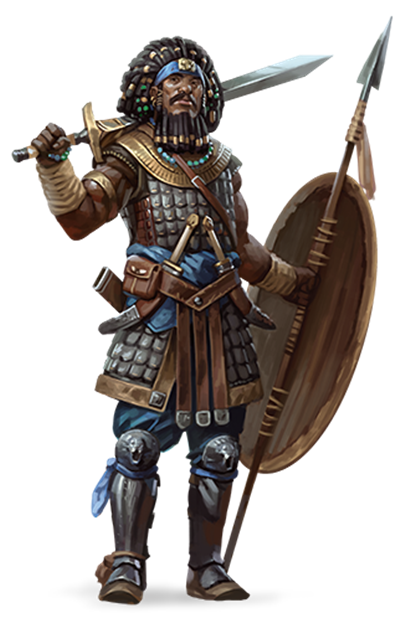
All images are from the 5e Player's Handbook and are property of Wizards of the Coast.
Protector. While you are wielding a shield, you gain the following benefits:
- You can add your shield's AC bonus to your Dexterity saving throws.
- After making a melee weapon attack as part of an action on your turn, you can use a bonus action to try to shove a creature within 5 feet of you with your shield.
Sharpshooter. While you are wielding a ranged weapon, you gain the following benefits:
- Attacking at long range doesn't impose disadvantage on your ranged weapon attack rolls.
- When you hit a creature with a ranged weapon attack on your turn, you can use your bonus action to gain advantage on your next ranged weapon attack against the target until the start of your next turn.
Tavern Brawler. A supernatural combatant, you gain the following benefits:
- Your unarmed strikes count as magical for the purpose of overcoming resistance and immunity to nonmagical attacks and damage.
- When you hit a creature with an unarmed strike or an improvised weapon on your turn, you can use a bonus action to attempt to grapple the target.