
Table of Content
Document Version 0.5 (WIP)
-
Section 1: The Martial Classes
-
Section 3: Maneuvers
-
Section 4: Rules Changes & Updates
-
Section 5: The Feats Compendium
- See the Feat Compendium:
- 1st-Level Feats
- 4th Level+ Feats
Designer notes
The Tome of Battle, The Book of Nine Swords (ToB) was my favorite players supplement for 3.5E. With the introduction of strikes, boosts, counters and stances the martial classes suddenly felt way more heroic and exciting to play. After a long D&D hiatus, I came back to 5E. I was surprised and quite disappointed to learn that WotC didn't introduce similar mechanics to the core martial classes in 5E. After playing several campaigns, our playgroup shared an opinion disappointment with regards to martial classes; they were lacking exciting combat options, especially mid to high level. This inspired me to try and redesign the martial classes with a similar philosophy to the original 3.5 ToB. Soon after I started the project in October 2022, the first One D&D playtest was released. Over the months as more One D&D playtests released, I decided to take certain elements and incorporate them in this redesign.
Note that the Monk is also part of the Warrior group, but its redesign still a work in progress.
Feat Redesign
These classes and rules are deisgned to be used together with the The Feat Compendium. This contains a redesign of the traditional Feat system, which includes modal feats with so-called subfeatures you can choose from. For example, the new Fighting Styles refer to these subfeatures.
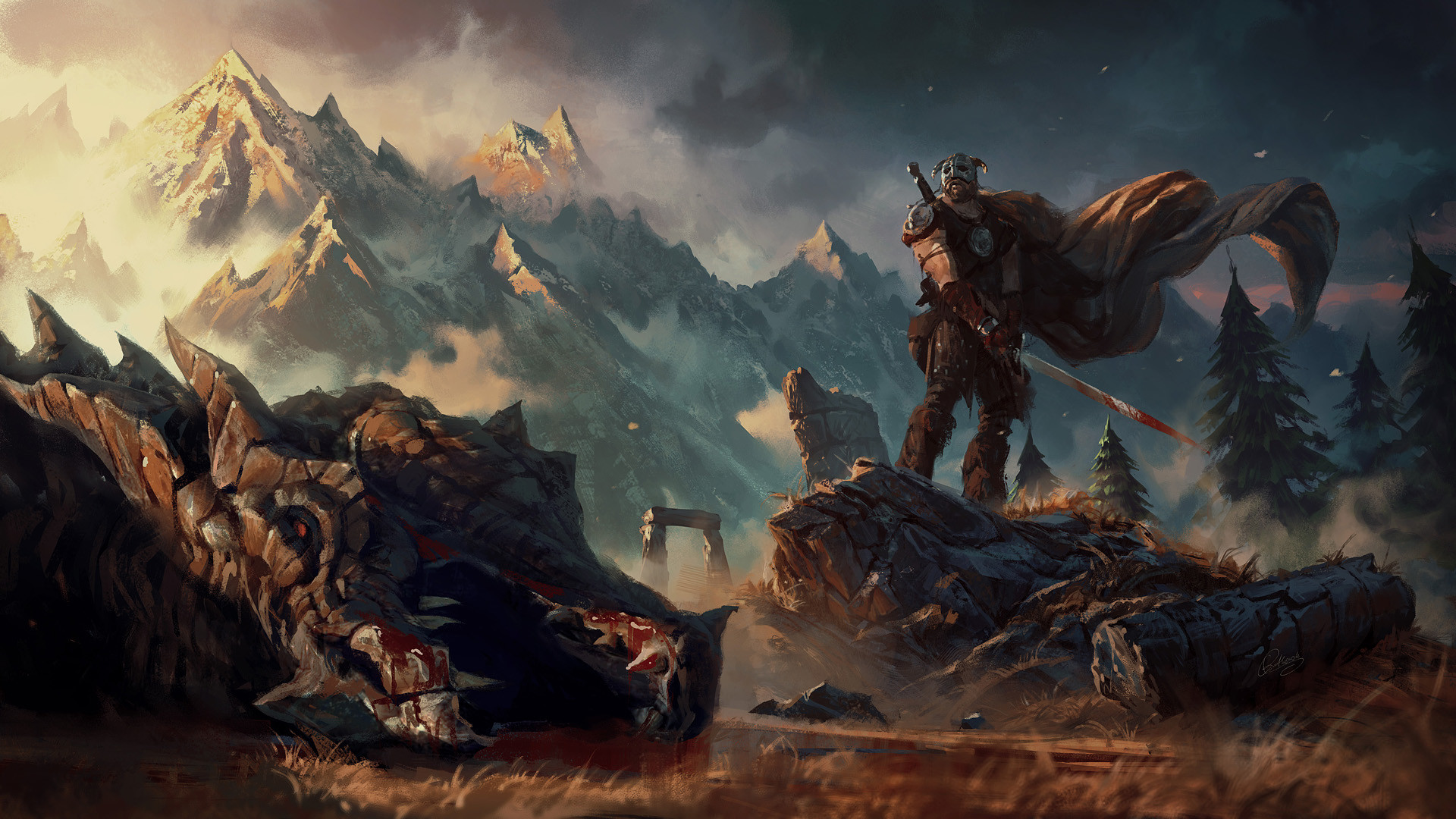


The Barbarian
As a Barbarian, you gain the following class features.
Core Barbarian Traits
Primary Ability: Strength
Hit Dice: D12 per Fighter level
Saving Throw Proficiencies: Strength, Constitution
Skills Proficiencies: Choose two skills from Animal Handling, Athletics, Intimidation, Nature, Perception, and Survival
Weapons Proficiencies: Simple weapons and Martial Weapons
Armor Training: Light Armor, Medium Armor, and Shields
Starting Weapons: Choose A or B: (A) Greataxe, 4 Handaxes, Explorer’s Pack and 15 GP, or (B) 75 GP
Level 1: Rage
In battle, you fight with primal ferocity. On your turn, you can enter a Rage as a Bonus Action. While raging, you gain the following benefits if you aren't wearing Heavy Armor:
- You have advantage on Strength checks and saving throws.
- You have resistance to Bludgeoning, Piercing, and Slashing damage.
- When you deal damage with a weapon or unarmed strike using Strength, you gain a bonus to the damage equal to your Rage Damage.
- You can't cast spells, or concentrate while Raging.
Your Rage lasts for up to 10 minutes. It ends early if you are knocked unconscious. You can also end your Rage on your turn as a Bonus action.
You start with two uses of Rage, which increases as you gain levels in Barbarian. You regain all expended uses when you finish a Long Rest.
Level 1: Tribal Tradition
Your tribes ancient traditions have thought you how to use channel your strength in unconventional ways. Choose one of the following to gain:
-
Barbaric Stature. You may use your Strength modifier in place of your Charisma modifier when making Intimidation skills checks.
-
Shamanic Visions. You may use your Strength modifier in place of the default modifier when making Animal Handling and Nature skills checks.
-
Hunter-Gatherer. You may use your Strength modifier in place of your Wisdom modifier when making Perception and Survival skills checks.
Level 1: Unarmoured Defence
While you are not wearing any armor, you gain a natural armor bonus to your AC equal to your Constitution modifier. You can use a Shield and still gain this benefit.

The Barbarian
| Level | Proficiency Bonus |
Features | Rages | Rage Damage |
Maneuvers Known |
Martial Die |
|---|---|---|---|---|---|---|
| 1st | +2 | Rage, Tribal Tradition, Unarmored Defense | 2 | +2 | — | — |
| 2nd | +2 | Brutal Superiority, Reckless Attack | 2 | +2 | 2 | 1d4 |
| 3rd | +2 | Primal Path | 3 | +2 | 2 | 1d4 |
| 4th | +2 | Feat | 3 | +2 | 3 | 1d4 |
| 5th | +3 | Extra Attack, Fast Movement | 3 | +3 | 3 | 1d6 |
| 6th | +3 | Primal Path Feature | 4 | +3 | 4 | 1d6 |
| 7th | +3 | Primal Instinct | 4 | +3 | 4 | 1d6 |
| 8th | +3 | Feat | 4 | +3 | 5 | 1d6 |
| 9th | +4 | Savage Critical | 4 | +4 | 5 | 1d8 |
| 10th | +4 | Primal Path Feature | 4 | +4 | 5 | 1d8 |
| 11th | +4 | Brute Force | 4 | +4 | 5 | 1d8 |
| 12th | +4 | Feat | 4 | +4 | 6 | 1d8 |
| 13th | +5 | Undying Rage | 5 | +5 | 6 | 1d10 |
| 14th | +5 | Primal Path Feature | 5 | +5 | 6 | 1d10 |
| 15th | +5 | Seething Fury | 5 | +5 | 6 | 1d10 |
| 16th | +5 | Feat | 5 | +5 | 7 | 1d10 |
| 17th | +6 | Utmost Might | 6 | +6 | 7 | 1d12 |
| 18th | +6 | Primal Path Feature | 6 | +6 | 7 | 1d12 |
| 19th | +6 | Feat | 6 | +6 | 8 | 1d12 |
| 20th | +6 | Primal Champion | 6 | +6 | 8 | 1d12 |
Level 2: Brutal Superiority
You learn certain special combat abilities referred to as maneuvers, which in turn are fueled by your Stamina.
Maneuvers: Maneuvers are powerful combat abilities that expend Stamina to enhance an attack or provide another type of powerful benefit. As you gain this class feature, you learn two maneuvers from the Brutal type. As you gain additional class levels, your learn additional maneuvers as shown in the Barbarian table. To execute an attack maneuver you must be proficient with any weapon used in conjunction with it. You can only use one maneuver per turn. When you gain a level in this class, you can replace one maneuver you know with a different one.
Stamina: The amount of Stamina you have available is based on to the proficiency bonus gained from levels in classes that grant Stamina plus your Constitution modifier. You can expend Stamina to fuel maneuvers and other features. Each time you take a Short or Long Rest, you regain all your expended Stamina.
Saving Throws: Some of your maneuvers require your target to make a saving throw to resist the maneuver’s effects. The saving throw DC is calculated as follows:
Maneuver save DC = 8 + your proficiency bonus + your Strength modifier.
Level 2: Reckless Attack
You can throw aside all concern for defense to attack with ferocity. When you make your first attack on your turn, you can decide to attack recklessly. Doing so gives you Advantage on attack rolls using Strength until the start of your next turn, but attack rolls against you have Advantage during that same time.
Level 7: Primal Path
You choose a path that shapes the nature of your rage. Your choice grants you features at 3rd level and again at 6th, 10th, 14th and 18th levels.
Level 4: Feat
You gain a Feat of your choice for which you qualify. You gain this feature again at Barbarian levels 8, 12, and 16.
Level 5: Extra Attack
At 5th level, you can attack twice, instead of once, whenever you take the Attack action.
Level 5: Fast Movement
Your Speed increases by 10 feet while you aren't wearing Heavy armor.
Level 7: Primal Instinct
Your instincts have become so honed that you can sense danger, providing you with the following benefits:
- You have Advantage on Initiative rolls and Dexterity saving throws, unless you have the Incapacitated condition.
- When you see a creature that has a CR of three or more than your character level, you can instinctively sense that the creature is dangerous.
Level 9: Savage Critical
When you score a critical hit with an attack using Strength, the target takes extra damage equal to your Barbarian level.
Level 11: Brute Force
When you have Advantage on a Strength skill check, Saving Throw, or an attack roll using Strength, you can reroll one of the dice once.
Level 13: Undying Rage
Your Rage can keep you fighting despite grievous wounds. If you would drop to 0 Hit Points while your Rage is active and don’t die outright, you can make a DC 10 Constitution saving throw. If you succeed, your Hit Points drop to 1 instead.
Each time you use this feature after the first, the DC increases by 5. When you finish a Short Rest or Long Rest, the DC resets to 10.
Level 15: Seething Fury
When you roll Initiative you regain one use of Rage, and you may choose to immediately enter Rage.
Level 17: Utmost Might
If your total for a Strength or Constitution check or saving throw is less than your Strength score, you can use that score in place of the total.
In addition, your jump distance and carrying weight are doubled.
Level 20: Primal Champion
You embody primal power. Your Strength and Constitution scores increase by 4, and their maximum is now 26.

Path of the Beast
Barbarians who walk the Path of the Beast draw their rage from a bestial presence coursing through their blood, causing physical transformations when they draw on its power. The source of this power might be a primal spirit, the touch of lycanthropy, or descent from a shapeshifter.
Beast Within
Starting at 3rd level, when you enter your Rage, you undergo a bestial transformation that lasts for as long as your Rage. You manifest one of the following features (your choice):
-
Bite: You gain a bite attack, which is a natural weapon. Your bite attack deals 1d10 Piercing damage. Once on each of your turns when you hit a creature no more than one size category larger than you with your bite, you can attempt to Grapple the creature as a Bonus Action.
-
Claws: Your hands transform in razor-sharp claws, which you can use as natural weapons if the hand is empty. Your claws deal 1d8 Slashing damage. Your claws count as Light melee Slashing weapons, and if both hands are free it is considered as two-weapon fighting.
-
Hide: You add half your Rage Bonus to the natural armor bonus granted by your Barbarian Unarmoured Defense, rounded down.
At 6th level you can manifest two features when entering Rage, and at 10th level you manifest all three.
Bestial Senses
Also at 3rd level, your natural senses are enhanced. You have Advantage on Perception and Survival check made to track creatures. In addition, you can track creatures while traveling at a fast pace.
Predatory Movement
At 6th level, your movements becomes akin to those of natural predators, granting you the following benefits:
- You may make Stealth checks as Strength checks, and can move stealthily while traveling at a normal pace.
- You gain a Climb Speed is equal to your Speed. You can freely climb difficult surfaces, including upside down on ceilings.
Pack Hunter
At 10th level, you have Advantage on attack rolls against a creature if at least one of your allies is within 5 feet of that creature. An ally must be conscious to provide this benefit.
In addition, you and each ally within 10 feet of you has Advantage on Stealth checks made to move silently.
Evolved Form
Starting at 14th level, your transformation evolves. When you enter Rage, you also manifest one of the following features:
-
Feeding Frenzy: When u hit using your Bite attack, you regain Hit Points equal to your Constitution modifier, with a minimum of 1.
-
Rake and Tear: Once per turn, when your two Claw attacks hit a target in succession, you may make an extra claw attack against that target using your Bonus Action.
-
Thick Fur: While raging, you have resistance to Cold, Fire, and Lightning damage.
Apex Predator
At 18th level, your transformation becomes complete. From now on when you Rage, you manifest all three features from Evolved Form, instead of having to choose one.
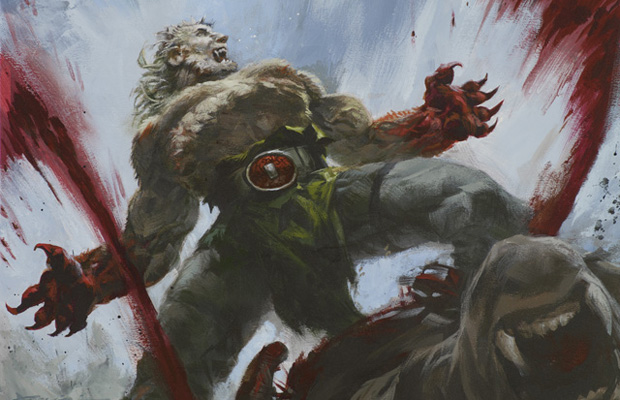
Path of the Berserker
For some barbarians, rage is a means to an end – that end being violence. The Path of the Berserker is a path of untrammeled fury, slick with blood. As you enter the berserker's rage, you thrill in the chaos of battle, heedless of your own health or well-being.
Berserking
Starting at 3rd level, when you enter a Rage, you fly into a reckless frenzy.
While you are Raging, youa always gain the benefits of Reckless Attack on each of your turns, and you do not add your Dexterity modifier to your Armor Class if it is positive.
When you enter a Rage, and again as a Bonus Action on your turn, you can move up to your Speed toward a hostile creature you can see or hear.
In addition, when a creature within 5 feet of you hits you with an attack, that creature provokes an Opportunity Attack from you.
Mindless Rage
At 6th level, while Raging, you gain resistance to Psychic damage and can’t be Charmed or Frightened. If you are Charmed or Frightened when you enter your Rage, those conditions end.
Bloodlust
At 10th level, your fury becomes fueled by your own wounds. As long as you are Bloodied (at or below half your hit point maximum) while Raging, you apply your Rage damage bonus to your attacks damage twice.
Gratuitous Violence
At 14th level, you can rip your foe apart in a display of gruesome violence, instilling fear in those around you. Immediately after you score a critical hit or reduce an enemy to 0 Hit Points with an attack, you may have all enemies within 30 feet of you that can see you make a Wisdom saving throw. Each creature that fails its saving throw becomes Frightened of you for 1 minute. A Frightened creature can repeat this saving throw at the end of each of its turns, ending the effect on itself on a success. The DC is equal to 8 + your Proficiency Bonus + your Strength modifier.
You can use this feature a number of times equal to your Rage bonus, and you regain all expended uses when you finish a Long Rest.
Flawless Savagery
Starting at 18th level, making an Opportunity attack no longer requires your Reaction.
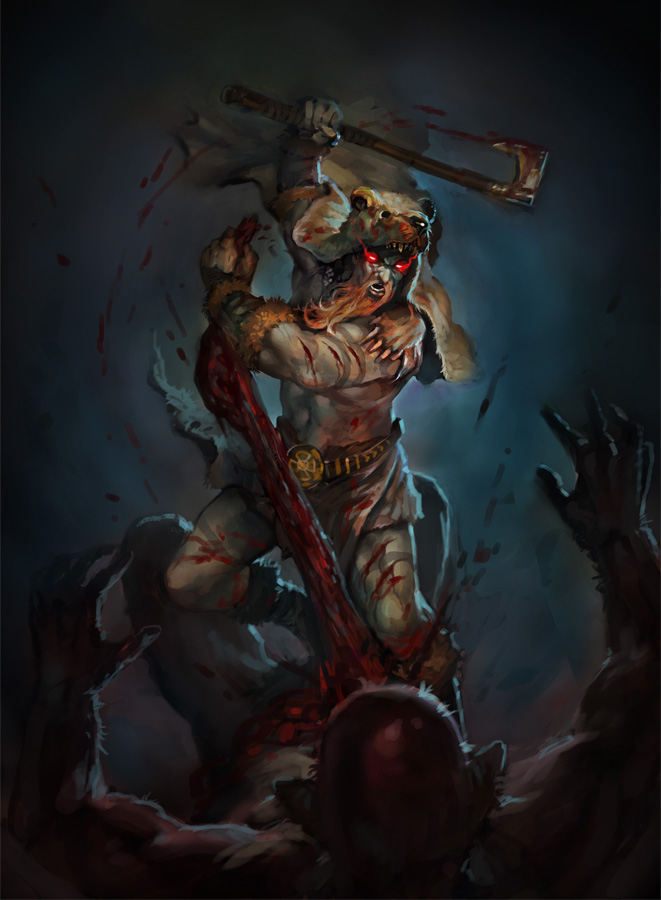
Path of the Titan
Even among the Barbarian tribes, Titans are known for their hulking stature and the monstrous weapons they wield with seeming ease, symbolizing their dominance on the battlefield. With unparalleled might, the Titan cleaves through armies with howling swings, leaving behind a trail of terror and devastation wherever he treads.
Level 3: Granite Grip
Your immense strength allows you to wield monstrous weapons with surprising easy. You gain the following:
-
You can use normal sized weapons with the two-handed property in one hand. It counts as both held in one hand and two hands for class features and Feats.
-
While carrying an oversized two-handed melee weapon, your Speed is reduce by 10 feet, and you suffer a -6 penalty on Attack rolls instead of having Disadvantage. This penalty is reduced by an amount equal to your Strength modifier (to a minimum of 0).
-
You count as one size category larger for the purpose of carrying capacity, and for Grappling, Pushing and Dragging creatures or objects.
Level 6: Pillar of Steel
You learn how to use your colossal weapon to its full potential. While wielding a two-handed melee weapon, it is treated as having the Reach property.
In addition, while you wield an oversized weapon it provides you half cover.
Level 10: Overwhelming Offense
Your attack land with tremendous force, knocking your foes aback. When you hit a creature with a Heavy melee weapon that is no more than one size category larger than you, you may push it up to 10 feet away from you. You can then Move up to half your Speed straight toward the target without provoking Opportunity Attacks.
Level 14: Severing Steel
You maim through your foes, severing them to pieces with tremendous force. After you deal damage to a creature with a Heavy or Oversized melee weapon, if it has fewer remaining hit points than your Strength score, it takes extra damage of the same type equal to your Strength score. You may carry over any excess damage from that attack onto an adjacent creature of your choosing. This can activate Severing Steel again to repeat the effect.
Level 18: Titanic Stature
If you are smaller than Large, you permanently become Large. Your Strength and maximum Strength score are increase by 2.
Oversized Weapons
The official rules (278 DMG) treat oversized weapons as one full size category larger. As a weapon increases in size, the weapons damage dice are added again for every step above Medium.

Path of Wild Magic
Many places in the multiverse are unbound and run rampant with chaotic magic; the elemental planes, limbo, and many other such realms of innate magic power radiate with such forces that it can spill over. Barbarians draw strength from their raw chaotic rage, this however makes susceptible to these wild influences, with some barbarians being transformed by the magic. These magic-suffused barbarians walk the Path of Wild Magic.
Magic Awareness
At 3rd level, you can open your awareness to the presence of magic. As a Magic action, you gain the benefits of Detect Magic. You can use this feature a number of times equal to your Rage bonus, and you regain all expended uses when you finish a Long Rest.
In addition, you are treated as being under the effect of Detect Magic while Raging.
Wild Surge
When you Rage, you roll a d12 on the Wild Magic table on the following page to determine the magic effect you produce. You do not need to provide any components or maintain concentration for any of these effects, even if the mentioned spell normally would require it. Any persisting effects end immediately when your Rage ends.
If the Wild Magic effect requires a saving throw, the effect is determined as follows
-
Spell save DC = 8 + your proficiency bonus + your Strength modifier.
-
Spell attack modifier = Your proficiency bonus + your Strength modifier.
Nexus of Chaos
At 6th level, your connection with wild magic strengthens, making it both more powerful and volatile. From now on, when you roll on the Wild Magic Table use a d20 instead of a d12 to determine the effect.
Controlled Chaos
At level 10, you gain limited control over the magic within you. Whenever you roll on the Wild Magic table, you can roll the die twice and choose which of the two effects to unleash. If you roll the same number on both dice, you can ignore the number and choose any effect on the table.
Bolster Magic
At 14th level, you may use your Bonus Action to touch a creature to instill one of the following effects:
-
For 1 minute, when that creature casts a spell, it is treated as if one higher level spell slot was used to cast it.
-
Until the start of your next turn, if that creature would make a saving throw to resist a spell or magical effect, it makes the saving throw with Disadvantage.
This feature shares its number of uses with your Magical Awareness feature.
Maelstrom Wielder
At level 18, by exerting yourself you can gain control over the magic within you. At any time after you rolled on the Wild Magic table, you can expand one of your uses of Rage to reroll any number of the dice and roll an additional one. You may choose up to two outcomes to manifest. If you roll the same number more than once, you can ignore any two dice and choose any effect on the table.

The Wild Surge Table
| d20 | Description | Effect |
|---|---|---|
| 1 | Violent winds gather around you. | This Wild Surge acts as a Dust Devil spell centred on you. You are excluded from its negative effects, except for the obscurement caused by gathered debris as you move. |
| 2 | A strange steam releases from your skin. | A Fog Cloud spell immediately manifests centered on you. As a Magic Action, you spend one Stamina to cast Fog Cloud centered on you, replacing other clouds caused by you. |
| 3 | You become shrouded in unnatural silence. | Sound is suppressed within 10 feet of you, similar to the Silence spell. |
| 4 | An alien landscape forms around you. | You ignore difficult terrain, and the area within 10 feet of you is treated as difficult terrain. |
| 5 | Dark fleshy tendrils lash out violently. | On your turn, you can replace one of your attacks with the Thorn Whip spell, except it deals Necrotic damage instead of Piercing. You have resistance to Necrotic damage. |
| 6 | Your limbs grow long and nimble. | The reach of your melee attacks increases by 5 feet, your speed increases by 10 feet, and you can move through a hostile creature’s space as though its difficult terrain. |
| 7 | You suddenly enlarge. | Your size grows by one category. Your Strength and Maximum Strength are increased by 2. |
| 8 | Opaque hexagons float manifest you. | You and allies within 10 feet gain a +1 to AC. During the Rage, you can cast the Shield spell by spending one Stamina. |
| 9 | Your weapons ignite in flame. | Your Rage damage bonus is doubled and added as Fire damage. You shed bright light within 20 feet and dim light for an additional 20 feet. You have resistance to Fire damage. |
| 10 | As you breath out, you exhale arcane energy. | You gain benefit from the Dragon's Breath spell¹, except you can replace one of your attacks by exhaling energy. The damage type is chosen at random.² |
| 11 | A layer of crystalline rime sheets your skin. | You gain benefit from the Armor of Agathys spell.¹ You have resistance to Cold damage. |
| 12 | Lightning courses through your weapon. | Your Strikes maneuvers deal an extra 1d20 damage instead of your Rage bonus. All damage dealt by Strikes becomes Lightning damage. You have resistance to Lightning damage. |
| 13 | Spheres of scintillating energy appear, orbiting around you. | You gain 2d4 spheres.² On your turn you can forgo one of your attacks to fire a sphere, which acts as a Chromatic Orb spell. When you take damage, roll a d6. On a 1, all remaining spheres explode dealing 1d8 damage per sphere to each other creature with 10 feet of you, or half as much on a successful Dexterity saving throw. |
| 14 | Your weapon hums with vibrant power. | Until your Rage ends, your weapon’s damage becomes Force damage, and it gains the Thrown property (range 20/60). When thrown, it immediately returns to your hand. |
| 15 | Arcane duplicates appear around you. | You gain the benefits of the Mirror Image spell. As a Bonus action, you can make a melee attack through one of your duplicates, after which it is immediately destroyed. |
| 16 | Time around you suddenly slows down. | At the end of the turn on which you gained this Wild Surge, a Slow spell manifests centered on you, except it affects all other creatures within 30 feet of you. |
| 17 | You are shrouded in vitalizing energy. | You recover 1 Hit Dice. As a Bonus Action, you may use a Hit Dice to restore 1d12 + your Strength modifier worth of Hit Points to yourself or an ally within 5 feet. |
| 18 | Mesmerizing patterns cover your body. | When a creature with 10 feet of you wants to attack you, it must first succeed a Wisdom saving throw or become Charmed by you. Each creature can only be effected once per Rage. |
| 19 | You absorb magic around you. | You have Advantage on saving throws against spells and magical effects. When you roll a 19 or 20 on a save this way, the spell takes no effect at all, and you regain a Stamina. |
| 20 | You start to flicker as space warps around you. | As a Bonus Action, you can either teleport up to 30 feet to an unoccupied space you can see, or you spend a Stamina to cast Vortex Warp. |
¹: The spell is cast as though a spell slot equal to your Rage bonus was used to cast it.
²: The damage type is chosen at random (d6) from among [1] Poison, [2] Fire, [3] Cold, [4] Lightning, [5] Acid or [6] Thunder.


The Fighter
As a Fighter, you gain the following class features.
Core Fighter Traits
Primary Ability: Strength or Dexterity
Hit Dice: D10 per Fighter level
Saving Throw Proficiencies: Strength, Constitution
Skills Proficiencies: Choose 2: Acrobatics, Animal Handling, Athletics, History, Insight, Intimidation, Persuasion, Perception, or Survival
Weapons Proficiencies: Simple weapons and Martial Weapons
Armor Training: Light Armor, Medium Armor, Heavy Armor, and Shields
Starting Weapons: Chose A, B or C: (A) Chain Mail, Greatsword, Flail, 8 Javelins, Dungeoneer’s Pack, and 4 GP; (B) Studded Leather Armor, Scimitar, Shortsword, Longbow, 20 Arrows, Quiver, Dungeonneer's Pack, and 11 GP; or (C) 155 GP
Level 1: Fighting Style
You specialize in a certain fighting style. Choose one of the below options. When you gain a level in Fighter, you can replace your Fighting Style with a different one.
Armored Fighter
- You gain a subfeature from the Light & Medium Armor Mastery feat, or the Heavy Armor Mastery feat.
Dual Weapon Fighter
- You gain a named subfeature of your choice from the Dual Wield Mastery Feat.
Duelist
- You gain a named subfeature of your choice from the One-Handed Weapon Mastery Feat.
- When learning new maneuvers you can choose Cunning maneuvers.
Great Weapon Fighter
- You gain a named subfeature of your choice from the Great Weapon Mastery Feat.
Ranged Weapon Fighter
- You gain a named subfeature of your choice from the Ranged Weapon Mastery Feat.
- When you wield a longbow, it gains the Finesse property.
- When learning new maneuvers you can choose Marksmanship maneuvers.
Shield Fighter
- You gain a named subfeature of your choice from the Shield Mastery Feat.
Student of War
- You gain the Vigilant subfeature from the Combat Acumen Feat.
- You gain proficiency in one skill of your choice from the skills available to Fighters.
- At 2nd level, you learn an additional Command maneuver. When learning new maneuvers you can choose Command maneuvers.
Unarmed Fighting
- You gain a named subfeature of your choice from the Brawler Feat.
- Your Unarmed Strikes are considered melee weapons and count as Maul attacks for qualifying for maneuvers. If you do not have both hands free, they count as a Mace instead.
Versatile Combatant
- You gain the Guarded Stance subfeature from the Great Weapon Mastery Feat.
- You may equip or stow a Shield with the same free interaction you use to equip or stow a weapon.
The Fighter
| Level | Proficiency Bonus |
Features | Second Wind |
Maneuvers Known |
Stamina | Martial Die |
|---|---|---|---|---|---|---|
| 1st | +2 | Fighting Style, Second Wind | 2 | — | — | — |
| 2nd | +2 | Indomitable I, Martial Superiority | 2 | 3 | 2 | 1d4 |
| 3rd | +2 | Martial Archtype | 2 | 4 | 2 | 1d4 |
| 4th | +2 | Feat | 3 | 4 | 3 | 1d4 |
| 5th | +3 | Adrenaline Rush, Extra Attack | 3 | 4 | 3 | 1d6 |
| 6th | +3 | Martial Archetype feature | 3 | 5 | 3 | 1d6 |
| 7th | +3 | Weapon Mastery (Tier I) | 3 | 5 | 4 | 1d6 |
| 8th | +3 | Feat | 3 | 5 | 4 | 1d6 |
| 9th | +4 | Indomitable II | 3 | 6 | 4 | 1d8 |
| 10th | +4 | Martial Archetype feature | 4 | 6 | 5 | 1d8 |
| 11th | +4 | Second Extra Attack | 4 | 7 | 5 | 1d8 |
| 12th | +4 | Feat | 4 | 7 | 5 | 1d8 |
| 13th | +5 | Weapon Mastery (Tier II) | 4 | 8 | 6 | 1d10 |
| 14th | +5 | Martial Archetype feature | 4 | 8 | 6 | 1d10 |
| 15th | +5 | Indomitable III, Improved Adrenaline Rush | 4 | 8 | 6 | 1d10 |
| 16th | +5 | Feat | 4 | 9 | 7 | 1d10 |
| 17th | +6 | Unyielding | 4 | 9 | 7 | 1d12 |
| 18th | +6 | Martial Archetype feature | 4 | 9 | 7 | 1d12 |
| 19th | +6 | Feat | 4 | 10 | 8 | 1d12 |
| 20th | +6 | Third Extra Attack | 4 | 10 | 8 | 1d12 |
Level 1: Second Wind
You learn to draw on deep reserves of stamina and willpower to drive yourself on where lesser combatants might fall. As a Bonus Action on your turn, you regain Hit Points equal to 1d10 + your Fighter level. If you have spent Stamina, you also regain one Stamina.
You can use this feature twice, and you regain all expended uses when you finish a Long Rest. When you reach certain Fighter level you gain more uses of this feature, as shown in the Fighter table.
Level 2: Indomitable
If you fail a saving throw, you may roll your Martial Die and add the number rolled to the saving throw, potentially turning it into a success. If the saving throw still fails, your use of this ability isn't expended. Once you use this feature, you can’t use it again until you finish a Long Rest.
At level 9 and again at level 13, you gain an additional use per Long Rest.
Level 2: Martial Superiority
You learn certain special combat abilities referred to as maneuvers, which in turn are fueled by your Stamina.
Maneuvers: Maneuvers are powerful combat abilities that expend Stamina to initiate an extraordanry martial feat. You learn three maneuvers with the Brutal or Martial types. With additional class levels, your learn more maneuvers, as shown in the Fighter table. To execute an attack maneuver you must be proficient with any weapon used in conjunction with it.
You can only use one maneuver per turn. When you gain a level in Fighter, you can replace one maneuver you know with a different one.
Stamina: Your Fighter level determines the number of Stamina you have, as shown in the Stamina column of the Fighter Features table. You add your Constitution modifier to that number. You can expend Stamina to fuel maneuvers and certain class features. You regain all expended Stamina when you finish a Short or Long Rest.
Saving Throws: Some of your maneuvers require your target to make a saving throw to resist the maneuver’s effects. The saving throw DC is calculated as follows:
Maneuver save DC = 8 + your proficiency bonus + your attack Ability modifier.
Level 3: Martial Archetype
You choose an archetype that you strive to emulate in your combat styles and techniques. Your choice grants you features at 3rd level and again at 6th, 10th, 14th and 19th level.
Level 4: Feat
When you reach 4th level, and again at 8th, 12th, 16th and 19th level, you gain a Feat of your choice.
Level 5: Adrenaline Rush
In a rush of adrenaline you can push yourself beyond your normal limits. On your turn, you can take one additional Action, except for the Magic Action. In addition, you may initiate a second maneuver during that Action.
Once you use this feature, you must finish a Long Rest before you can use it again. Starting at 15th level you can use it twice before a Long rest but only once per turn.
Level 5: Extra Attack
Beginning at 5th level, you can attack twice, instead of once, whenever you take the Attack action.
The number of attacks increases to three when you reach 11th level in this class and to four when you reach 20th level in this class.
Level 7: Weapon Mastery
Choose one weapon with which you have proficiency. You gain Mastery with that weapon.
Once on each of your turns, when you initiate a Strike or Counter that has a weapon requirement fulfilled by your Mastery weapon, you can do so without expending Stamina, provided the maneuver is no higher than Tier 1.
At 13th level, this feature also applies to Tier 2 Strikes and Counters.
Level 17: Unyielding
When you are in great peril, you can draw on a deep well of resilience within yourself. While you are Bloodied, you have Advantage on saving throws.
In addition, when you use your Indomitable feature, you succeed automatically on the saving throw instead.
The Battle Master
Battle Masters are not simply set out to achieve victory, for them it must be accomplished through technical supremacy. These disciplined warriors treat combat as an academic field, that ought to be carefully studied. In their martial aspiration, they reflect upon their battles, diligently analyzing ever move made. Most warriors do not absorbs the lessons of history, theory, and artistry to such degree, but those who do become exceptional fighters of great skill and with sharp minds.
Level 3: Superior Technique
When you roll one or more Martial Dice for a Strike or Counter that has a weapon requirement, you can roll one additional dice and forgo any one dice you rolled.
In addition, the save DC of your Strike maneuvers increases by 1.
Level 6: Honed Discipline
Your disciplined approach towards weapon mastery does not only hone your techniques, but also your body and mind. You gain additional Stamina equal to your Intelligence or Wisdom modifier (your choice, minimum of 1).
In addition, you gain proficiency in Wisdom saving throws. If you already have this proficiency, you instead gain proficiency in Intelligence or Charisma saving throws.
Level 10: Flawless Execution
Endless repetition allow you to execute your maneuvers perfectly. Your declared strikes are made with Advantage and you may declare up to two different strikes as part of your attack Action.
Level 14: Battle Recollection
Even during the heat of battle, your disciplined mind allows you to control your breathing and remain calm. During combat, the first time you expend Stamina on each of your turns on a maneuver requiring a weapon, you regain one Stamina.
Level 18: Technical Supremacy
You have reached the pinnacle of technical mastery, allowing you to seamlessly weave together your strikes. From now on, you can initiate a different Strike maneuver with each attack you make on your turn.

The Champion
The archetypal Champion focuses on the development of their raw physical talent and hone it to deadly perfection. Those who model themselves on this archetype combine exceptional athleticism with rigorous training to push their physical capabilities into the realm of legends.
Level 3: Exceptional Physique
Your innate physical potential starts to manifest. You gain a bonus equal to your lowest ability modifier among Strength, Dexterity and Constitution to all Strength, Dexterity and Constitution based skill checks and saving throws.
Level 3: Martial Acuity
Your strikes land with deadly acuity. Your attack rolls with weapons and Unarmed Strikes can now score a Critical Hit on a 19 or 20.
Level 6: Unleashed Potential
Through a combination of sheer talent and rigorous training your physical prowess attains new heights. You may increase your lowest score among Strength, Dexterity or Constitution by 1.
Attacks you make can use your lowest two modifiers from among Strength, Dexterity and Constitution in place of your Strength or Dexterity modifier for the attack and damage rolls. The same holds true for determining your Grapple and Shove DC.
Level 10: Paragon Warrior
You unlocked most of your physical potential. You gain a Feat of your choice that has a Strength, Dexterity or Constitution prerequisite that you meet.
Level 14: Outmatch
Your body is honed to perfection providing your with exceptional precision. Your attack rolls with weapons and Unarmed Strikes can now score a Critical Hit on a 18-20.
In addition, immediately after you score a Critical Hit, you may move up to half your Speed without provoking Opportunity attacks.
Level 18: Outlast
As you survived through endless battles you have acquired legendary resilience. You gain the following benefits:
- At the start of each of your turns, if you are Bloodied but conscious, you may regain Hit Points equal to your Strength, Dexterity and Constitution modifiers combined.
- You have Advantage on Death Saving throws. Also, when you roll a 18 or 19 on your Death Saving throw, treat it as a 20 instead.
- You are immune to the Exhausted condition.

The Commander
As a Commander, you are the strategist of the battlefield. With sharp intellect and commanding presence, you guide allies with decisive orders and precise tactics. Your voice rallies comrades, turning the tide of battle with each calculated move. In the chaos of combat, your leadership can mean the difference between defeat and victory, whether holding the line or leading a devastating assault.
Level 3: Tactical Awareness
Your tactical insight enables effective responses to threats, providing you with the following benefits:
Command Radius = Your Command Radius equals 10 feet + 5 × your Intelligence modifier (minimum of 10 feet).
Coordination. When initiative is rolled, you can redistribuite the initiative scores of willing allies within your Command Radius. Each ally must consent to the new initiative position.
Leadership. You gain the Student of War Fighting Style. If you already have that Fighting Style, you may choose another one to gain.
Regimented. When initiative is rolled, you can issue immediate commands to your allies. Choose a number of willing allies up to your proficiency bonus within your Command Radius. Each chosen ally can move up to half their speed, ending this movement within your Command Radius. This movement occurs before the first turn of combat and does not provoke opportunity attacks.
Level 6: Battlefield Control
Your leadership sharpens your responsiveness on the battlefield.
Command Reflex. You can take one additional Reaction on each round of combat. You can use this extra Reaction only to initiate a Command maneuver.
Span of Control. The range of your Command maneuvers is doubled.
Level 10: Unified Response
Your command presence allows your allies to react as a unit. While an ally is within your Command Radius, it can use the unused Reaction of another willing ally within the radius to take a Reaction. No creature can take more than two Reactions per round as a result of this feature.
Level 14: Incite to Glory
When you use Second Wind, you can choose to have the feature also affect a willing allied creature within your Command Radius, provided that ally isn’t incapacitated.
Level 18: Tactical Supremacy
Your mastery of strategy shapes the battlefield itself, your allies moving in perfect harmony with your will. At the end of each allied creatures turn, you regain your Reaction if it was used for Command maneuver.

The Mage Knight
The Mage Knight combine arcane teachings with martial prowess to enhance their combat capabilities. Their spells both complement and extend their combat skills, providing additional protection to shore up their armor and also allowing them to engage many foes at once with explosive magic.
Level 3: Spellcasting
You augment your martial prowess with the ability to cast spells. As you gain this feature, and as you progress your Fighter levels, you learn Wizard spells according Mage Knight Spellcasting table, starting with two cantrips and one 1st level spell. The spells you learn are committing to memory instead of keeping them in a spellbook.
Cantrips. You know two cantrips of your choice from the Wizard spell list. Whenever you gain a Fighter level, you can replace one of these cantrips with another of your choice from the Wizard spell list. When you reach Fighter level 10, you learn an other Wizard cantrip of your choice.
Spell Slots. The Eldritch Knight Spellcasting table shows how many spell slots you have to cast your level l+ spells. You regain all expended slots when you finish a Long Rest.
Changing Your Prepared Spells. Whenever you gain a Fighter level, you can replace one spell on your list with another Wizard spell for which you have spell slots.
Spellcasting Ability. Intelligence is your spellcasting ability for your Wizard spells.
Spellcasting Focus. You can use an Arcane Focus as a Spellcasting Focus for your Wizard spells.
Level 3: Might and Magic
You gain proficiency in Arcana, as you learn an esoteric ritual that creates a magical bond between yourself and up to one weapon. You perform the ritual over the course of 1 hour, which can be done during a Short Rest. The weapon must be within your reach throughout the ritual, at the conclusion of which you touch the weapon and forge the bond. The bond fails if another Fighter is bonded to the weapon or if the weapon is a magic item to which someone else is attuned.
Once you have bonded a weapon to yourself, you gain the following benefits while using that weapon:
- You can use your bonded weapon as a spellcasting focus.
- You can perform the somatic components of spells even while wielding your bonded weapon and/or a shield.
- When you cast an instantaneous spell that deals damage, you can add your Strength modifier to one damage roll of that spell.
- Being within 5 feet of an enemy doesn’t impose Disadvantage on your Attack Rolls with spells.
- As long as you can see your bonded weapon, you can call it to you as a Bonus Action, causing it to rapidly fly to your hand avoiding any obstacles, landing in perfectly.
Mage Knight Spellcasting
| Fighter Level | Cantrips Known | Spells Known | 1st Level | 2nd Level | 3rd Level | 4th Level |
|---|---|---|---|---|---|---|
| 3rd | 2 | 3 | 2 | — | — | — |
| 4th | 2 | 4 | 3 | — | — | — |
| 5th | 2 | 4 | 3 | — | — | — |
| 6th | 2 | 4 | 3 | — | — | — |
| 7th | 2 | 5 | 4 | 2 | — | — |
| 8th | 2 | 6 | 4 | 2 | — | — |
| 9th | 2 | 6 | 4 | 2 | — | — |
| 10th | 3 | 7 | 4 | 3 | — | — |
| 11th | 3 | 8 | 4 | 3 | — | — |
| 12th | 3 | 8 | 4 | 3 | — | — |
| 13th | 3 | 9 | 4 | 3 | 2 | — |
| 14th | 3 | 10 | 4 | 3 | 2 | — |
| 15th | 3 | 10 | 4 | 3 | 2 | — |
| 16th | 3 | 11 | 4 | 3 | 2 | — |
| 17th | 3 | 11 | 4 | 3 | 3 | — |
| 18th | 3 | 11 | 4 | 3 | 3 | — |
| 19th | 3 | 12 | 4 | 3 | 3 | 1 |
| 20th | 3 | 13 | 4 | 3 | 3 | 1 |

Level 6: Battle Arcana
You seamlessly weave magic into your martial assaults, gaining the following benefits:
Spell Cadence. When you take the Attack action on your turn, you can replace one of the attacks with the casting of a cantrip that has a casting time of an Action. If you cast the cantrip in this way after making a weapon attack as part of the same action, you have Advantage on the first spell attack roll you make as part of that cast.
Battle Caster. If you take the Magic Action on your turn to cast a spell, you can use your Bonus Action to make one weapon using your bonded weapon.
Level 10: Spellstrike
You learn how release spells with your strikes. When you hit a creature with your bonded weapon, you can expend your Bonus Action and one Stamina to cast a Mage Knight spell. The spell must be instantaneous, have a casting time of an Action, and target one creature or affect an area. When you cast a spell this way, the following effects apply:
- The spell is cast as though two higher level spells slot were used to cast it.
- If the spell requires a single attack roll, it uses the same roll as your initial weapon attack.
- If the spell forces a saving throw on the struck creature, that creature has Disadvantage on the saving throw.
- If the spell you deliver through your weapon creates an effects based on a position, the effects instead use the struck creatures position. For direction it uses a straight line between you and the struck creature.
- You may exclude yourself from the spell's area of effect.
Level 14: Improved Battle Arcana
Your Battle Arcana extends beyond cantrips. When you take the Attack action on your turn, you can replace one of the attacks with the casting of a spell that has a casting time of an Action, provided the spell’s duration is instantaneous.
In addition, when you use Adrenaline Rush, the additional action it grants can also be used to take the Magic action.
Level 18: Arcane Surge
When you use Improved Battle Arcana to cast a spell of 2nd level or higher, you may combine two spells slots of lower levels to cast that spell. The combined spell slots must be equal or higher than the level of the spell cast this way.
In addition, when you use Adrenaline Rush, you immediately recover three levels worth of expended spell slots, divided as you choose.

List of Maneuvers
This section presents a list of combat maneuvers.
Maneuver Types. Each maneuver belongs to one of three types. Strikes are special attacks, usually made as part of the Attack action. Counters are reactions triggered in response to another creature’s Action. Stratagems provide temporary tactical effects or buffs. You can initiate only one maneuver of each type on your turn.
Tiers. Maneuvers are divided into four tiers by power and required level: Tier 1 can be learned at level 2+, Tier 2 at level 5+, Tier 3 at level 10+ and Tier 4 at level 15+.
Initiating a Maneuver. To initiate a maneuver you must be proficient with any weapon used as part of it and meet all listed requirements. Unless a maneuver states otherwise, it must be declared before the attack roll is made. Maneuvers that are declared on a hit are announced after the attack roll succeeds but before damage is rolled.
Saving Throws. If a maneuver calls for a saving throw, the saving throw DC is determined by its group. Brutal maneuvers use Strength. Martial and Marksmanship maneuvers use the same ability modifier used for the triggering attack. Cunning maneuvers use Dexterity.
Exert. Some maneuvers have an Exert option. When you Exert a maneuver, you spend additional Stamina to enhance its effects, as detailed in the maneuver’s Exert entry.
Martial Die. Some maneuvers add damage using your Martial Die, the size of which is determined by your class features. Damage from Martial Dice is not doubled on a critical hit.



Ambush
Maneuver Type: Cunning 1 (Stratagem)
Requires: Dexterity 15+, Proficiency in Stealth.
When you roll initiative, you can expend one Stamina to roll initiative twice and take the higher result, provided you are not incapacitated or surprised.
The first attack you make against a creature that has not yet taken a turn in this combat is made with Advantage.
Bait and Switch
Maneuver Type: Cunning 2 (Counter)
When an allied creature within 5 feet of you is targeted by an attack, you can use your Reaction and expand one Stamina to swap places with that creature, provided they are willing. The attack then targets you instead, and the attack roll is made with Disadvantage.
Crushing Anvil
Maneuver Type: Brutal 3 (Strike)
Requires: A Bludgeoning Martial Melee weapon.
When you make an attack as part of the Attack Action, you can declare this maneuver. On a hit, you expand one Stamina to deal additional damage equal to your Martial Die. The target must also succeed on a Constitution saving throw or become Stunned until the start of its next turn and Dazed until the end of its next turn.
Bolstering Cry
Maneuver Type: Command 2 (Warcry)
As a Bonus Action, you call out to bolster an ally’s resolve. Choose a friendly creature that can hear you. That creature gains temporary Hit Points equal two Martial Die and Advantage on Constitution and Death saving throws. These effects last for 1 minute.
Exert [X]: For each additional Stamina you spend, you can affect one additional ally who can see or hear you.
Cleave
Maneuver Type: Brutal 1 (Strike)
Requires: A Slashing weapon held in two hands.
When you make an attack as part of the Attack action, you can expand one Stamina to declare it a Cleave attack. Choose a second creature within your reach and within 5 feet of the original target. Make the attack roll against the original target as normal. You may then make an attack roll with the same weapon against the second creature, even if the first attack misses. The first hit you make this way deals additional damage equal to your Martial Die.
Exert [X]: For each additional Stamina spent, you may target one additional creature within your reach.
Coordinated Strike
Maneuver Type: Command 2 (Warcry)
As a Bonus Action, you may spend one Stamina to direct a coordinated assault. Choose one ally within 30 feet of you.
The chosen ally can immediately use its Reaction to move up to half its Speed toward a hostile creature it can see. If at the end of this movement the hostile creature is within the ally’s attack range, the ally can make one weapon or unarmed attack against it.
If the ally hits with this attack, it deals additional damage equal to your Martial Die.
Disarming Attack
Maneuver Type: Cunning 1 (Strike)
Requires: Any melee weapon with the Finesse property.
When you make an attack as part of the Attack Action, you can declare it a Disarming Attack. On a hit, you expend one Stamina to deal additional damage equal to your Martial Die and attempt to disarm the target. The target must succeed on a Strength saving throw or drop one item of your choice that it is holding at its feet.
Exert [1]: On a successful Disarm, you may spend a Stamina you send the disarmed item up to 10 feet in a direction of your choice.
Earthshatter
Maneuver Type: Brutal 2 (Strike)
Requires: Strength 15+, Greataxe or Maul.
As an Action, you can expend one Stamina to perform Earthshattering blow. Each creature of your choice within 10 feet of a point you can reach must make a Dexterity saving throw. On a failed save, a creature takes Bludgeoning damage equal to your proficiency bonus × your Martial Die + your Strength modifier and gain the Prone condition. On a successful save, a creature takes half damage and remains standing.
Exert [1]: Spend one additional Stamina to increase the radius by 5 feet, and if the ground in that area is earth or stone, it becomes Difficult Terrain.
Exposing Strike
Maneuver Type: Cunning 2 (Strike)
Requires: Finesse or Versatile Weapon, Intelligence 13+
When you hit with a melee weapon on your turn while you have Advantage on the attack roll, or when you score a Critical Hit with such a weapon, you can initiate this maneuver.
You can expend one Stamina to expose the creatures defenses, giving your allies an opening. The creature provokes an Attack of Opportunity from each ally that is flanking the creature.
Defy Pain
Maneuver Type: Brutal 1 (Counter)
When you take damage, you can use your Reaction and expend one Stamina to push through the pain. You may immediately spend one Hit Die to regain Hit Points equal to the Martial Die + your Constitution modifier.
If you are Bloodied when you use Defy Pain, roll you Martial Dice twice and use the higher result.
Execute
Maneuver Type: Brutal 2 (Strike)
Requires: Any Heavy melee weapon.
When you take the Attack Action, you can declare one of your attacks against a Prone, Incapacitated, or Restrained creature an Executing strike. On a hit, you expend one Stamina to cause the attack to be an automatic Critical Hit, and you add your Martial Die to the damage of the attack.
Fall Back!
Maneuver Type: Command 1 (Warcry)
You can use your Reaction to call for a tactical retreat. Choose a friendly creature you can see or hear.
Until the start of your next turn, that creature can use its Bonus Action to Disengage. When it does, it Speed increases by 10.
Exert [X]: For each additional Stamina you spend, you can affect one additional ally who can see or hear you.
Fan of Blades
Maneuver Type: Cunning 2 (Strike)
Requires: Dagger or Handaxe
As an Action, you can make a ranged thrown weapon attack against any number of creatures within a 15-feet cone in front of you. On a hit, each creature takes extra damage equal to your Martial Die.
Exert [1]: The cone is increased to 20 feet and you add an additional Martial Die to each damage roll.

Feint Attack
Maneuver Type: Cunning 1, Martial 1 (Stratagem)
Requires: One-handed melee weapon, Proficiency in Deception.
As a Bonus Action, you can feint with an attack, choosing one creature you can see within your melee weapon's range as the target. The creature must make a Wisdom saving throw. On a failed save, you have Advantage on all melee attack rolls against that creature this turn.
Final Blade
Maneuver Type: Martial 4 (Strike)
Requires: Any non-Light martial Slashing weapon.
When you score your first hit against a creature on your turn, you can expend all of your Stamina to perform a Final Blade. For each Stamina spent, roll your Martial Die twice and add the total to the attack’s damage roll. Your turn immediately ends.
Flesh Ripper
Maneuver Type: Brutal 4 (Strike)
Requires: Wielding two Slashing weapons.
As part of the Attack action, you can expend one Stamina to perform Flesh Ripper. Each time you attack with your main-hand weapon during this Attack action, you may also make a melee attack with the weapon in your off-hand.
Each time your main-hand and off-hand attacks hit in succession, the target takes extra Slashing damage equal to your Martial Die.
All other attacks follow the normal Two-Weapon Fighting rules.
Exert [1]: Roll two Martial Dice instead of one for each successful succession hit.
Gleaming Strike
Maneuver Type: Cunning 2, Martial 2 (Strike)
Requires: Any Light melee weapon.
As a Bonus Action, you can expend one Stamina and make a weapon attack. You can draw the weapon as part of this attack. If you do, and it is the first attack you make since the start of combat, the attack is made with Advantage and you may add your Martial Die to the damage of the attack.
Heavy Blow
Maneuver Type: Brutal 1 (Strike)
Requires: A Bludgeoning weapon, Strength 15+
When you attack with a melee weapon attack as part of the Attack Action, you can declare it a Heavy Blow. On a hit, you can expand one Stamina to have the attack deal extra damage equal ot you Martial Die and the target must make a Strength saving throw. If the target fails the saving throw, it is pushed up to 10 feet away and gains the Prone condition. On a successful save, the target is pushed 5 feet and remains standing instead.
Hold the Line!
Maneuver Type: Command 3 (Warcry)
As a Bonus Action, you expend one Stamina to establish a defensive formation. Choose up to two allies within 30 feet of you who can see or hear you.
Until the start of your next turn:
- The chosen creatures gain a +2 bonus to AC while within 5 feet of at least one other chosen ally.
- A hostile creature that enters a space within 5 feet of one of the chosen ally for the first time on a turn provokes an Opportunity Attack from that ally.
- If an ally hits a creature with Opportunity Attacks this way before the start of your next turn, that creature’s Speed becomes 0 for the rest of the turn.
Exert [X]: For each additional Stamina you spend, you can affect one additional ally who can see or hear you.
Hooking Strike
Maneuver Type: Martial 1 (Strike)
Requires: A Dagger, Shortsword, Sickle, War Pick, Whip
When you hit a creature with a melee weapon attack as part of the Attack Action, you can declare the attack a Hooking Strike. On a hit, you expend one Stamina to attempt to Grapple the target using your weapon. Roll your Martial Die and subtract the result from the target’s saving throw to resist the Grapple.
While you are using the weapon to Grapple in this way, you cannot make attacks with that weapon.
Impale
Maneuver Type: Brutal 3 (Strike)
Requires: A Lance, Pike or Spear, Strength 15+
When you make an melee weapon attack as part of the Attack Action, you can declare the attack an Impale. On a hit, you expend one Stamina. If the target creature is no more than one size larger than you, it must succeed on a Dexterity saving throw or become Grappled by you as your weapon pierces and pins it.
While a creature is impaled, you can forgo one attack as part of your Attack Action to Shove it up to 5 feet, provided it is no more than one size larger than you. When you do so, you may move along with the creature, the shove deals damage as if the attack automatically hit with the impaling weapon, and the creature has Disadvantage on its attack rolls until the start of your next turn.
While a creature is impaled, you can’t make normal attacks with the impaling weapon. You can freely end the impalement on your turn, and it ends immediately if you move more than 5 feet away from the impaled creature.
Exert [1]: Instead you can move the impaled creature up to 10 feet and you deal an extra Martial Die damage.
Interpose Shield
Maneuver Type: Martial 3 (Counter)
Requires: Shield.
You can use this maneuver in reaction to a ranged attack or an area effect (cone, line, or sphere) that allows a Dexterity saving throw to take half damage.
When you or creatures within a 30-foot cone behind you (relative to the origin of the attack or effect) would take damage, you can throw up your shield as a barrier. For the effect or attack:
All affected creatures, including you, are treated as having three-quarters cover (+5 bonus to AC and Dexterity saving throws).
You take no damage if you succeed on the saving throw.
Savage Leap
Maneuver Type: Brutal 3 (Stratagem)
Requires: Proficiency in Athlethics.
After moving at least 10 feet straight, as a Bonus Action, you can spend one Stamina to leap between 10 and 30 feet. You can move unhindered through the space of any creature up to your size as you leap over. Any movement made as part of leap does not provoke attacks of opportunity.
When you land next to a creature and leaped at least 10 feet straight towards it, the creature must make a Strength saving throw or gain the Prone conditions.
Lunging Strikes
Maneuver Type: Cunning 1 (Stratagem)
Requires: Any Slashing or Piercing melee weapon.
As a Bonus Action, you can expend one Stamina to temporarily increase your reach with each weapon you wield by 5 feet. This effect lasts until the end of your next turn.
Maneuvering Attack
Maneuver Type: Cunning 1, Martial 1 (Strike)
Requires: Any non-Heavy melee weapon.
When you hit with a melee weapon attack as part of the Attack Action, you can declare it a Maneuvering Attack. On a hit, you expend one Stamina to force the target to make a Dexterity saving throw. On a failed save, you and the target swap positions. This maneuver only affects creatures up to one size larger than you, and the swap occurs only if there is sufficient space for the target to move into.
Exert [1]: Deal extra damage equal to your Martial Die, and you Push the target 5 feet in a chosen direction after the swap.
Menacing Attack
Maneuver Type: Cunning 2 or Brutal 2 (Strike)
Requires: Proficiency in Intimidate, a martial melee weapon.
When you hit a creature with a martial melee weapon while you have Advantage on the attack roll, or when you score a Critical Hit with such a weapon, you can expand one Stamina to initiate this maneuver. The target must make a Wisdom saving throw. On a failed save, it is Frightened of you. At the end of each of its turns, the creature can repeat the saving throw, ending the effect on a success.
Parry
Maneuver Type: Martial 1 (Counter)
Requires: Any martial melee weapon.
When you are hit by an attack, you can use your Reaction to add your Martial Die as a bonus to AC, potentially causing the attack to miss. The bonus lasts until the end of the current turn.
Exert [1]: Roll a second Martial Die and add it to your AC for this reaction. You may choose do so after the first roll.
Piercing Bolt
Maneuver Type: Brutal 2, Marksmanship 2 (Strike)
Requires: Longbow, Javelin or Spear.
As an Action, you can expend one Stamina to make a Piercing Bolt. Each creature in a straight line up to the weapon’s normal range must succeed on a Dexterity saving throw or take proficiency bonus × your Martial Die + your Strength modifier. Any damage modifiers that normally apply to a ranged attack with this weapon also apply to this maneuver. On a successful save, creatures take half damage.
Exert [1]: The range of this maneuver is increased to the weapon’s long range, and add two Martial Dice to damage for creatures within normal range.
Pinning Shot
Maneuver Type: Marksmanship 2 (Strike)
Requires: A ranged or thrown piercing weapon.
When you make an ranged attack as part of the Attack Action, you can declare the attack a Pinning Shot. On a hit, you expend one Stamina to force the target to make a Strength saving throw. On a failed save, the target’s speed becomes 0 until the end of its next turn. On a successful save, its speed is reduced by 10 feet until the end of its next turn. Creatures that are flying, swimming, or immune to being knocked prone are unaffected.
Creatures that are flying, swimming, or immune to being knocked prone are unaffected.
Exert [1]: Deal extra damage equal to your Martial Die and the target has Disadvantage on the saving throw.
Precision Attack
Maneuver Type: Cunning, Marksmanship 1 (Strike)
Requires: Dexterity 13+
When you miss with an attack roll that used your Dexterity Modifier, you can expend one Martial Die, roll that die, and add it to the attack roll, potentially causing the attack to hit.
Exert [1]: Until the end of turn, you attacks are made with Advantage.
Press the Advance
Maneuver Type: Command 1 (Warcry)
At the start of an ally’s turn, if you can see or hear that ally with 30 feet of you, you can use your Reaction and expend one Stamina to urge them forward. Until the start of that ally’s next turn, the next melee attack roll it makes is made with Advantage. If that attack hits, it deals additional damage equal to your Martial Die, and the ally can push the target up to 10 feet directly away from itself, provided the target is no more than one size larger than the ally.
Exert [X]: For each additional Stamina you spend, you can affect one additional ally who can see or hear you.
Puncture
Maneuver Type: Cunning 3, Martial 3 (Strike)
Requires: Any Martial Piercing weapon.
When you make an melee attack as part of the Attack Action, you can expand one Stamina to declare one of your attacks a Puncture. For this attack, the target’s AC is considered equal to its Dexterity score. Roll your Martial Die and add the result to your attack roll. On a hit, for each point the attack roll exceeds the target’s AC, the attack deals 1 additional damage.
Exert [1]: You make the attack with Advantage and score a Critical Hit on a 19 or 20.
Rallying Cry
Maneuver Type: Command 1 (Warcry)
On an allied creature’s turn, you can use your Reaction to incite that companion. Until the end of its turn, it may use the Dash action as a Bonus Action. The ally must be able to see or hear you.
Ram Through
Maneuver Type: Brutal 1 (Strike)
Requires: Strength 15+.
When you move at least 10 feet in a straight line immediately before attacking a creature with a melee attack as part of the Attack Action, you attempt to trample through the target. On a hit, you can expend one Stamina. If it is no more than one size larger than you, the target must succeed on a Strength saving throw or gain the Prone condition.
If the target falls Prone and you have enough remaining movement to move through its space in a straight line, you can do so unhindered. When you move through the creature’s space in this way, it takes additional damage equal to your Martial Die.
Exert [1]: If the creature becomes Prone, you regain all movement you spent this turn.
Rain of Arrows
Maneuver Type: Marksmanship 3 (Strike)
Requires: Shortbow or Longbow
As an Action, you can expend one Stamina to unleash a Rain of Arrows. Choose a 20-foot-radius circle within the weapon’s normal range. Make a ranged weapon attack against each creature within the area. Apply any normal modifiers for ranged attacks with this weapon.
Exert [1]: Increase the radius by 10 feet and you can exclude allies.
Roar of the Challenger
Maneuver Type: Brutal 3 (Warcry)
Requires: Constitution 15+
As a Bonus Action, you expend one Stamina and issue a resounding challenge to your foes. Choose a number of creatures within 10 feet of you that can see or hear you, up to your proficiency bonus. Each chosen creature must succeed on a Wisdom saving throw or become challenged by you for 1 minute. While challenged, a creature has Disadvantage on attack rolls against creatures other than you. A creature may repeat the saving throw at the end of each of its turns, ending the effect on a success.
Exert [1]: The radius increases to 30 feet.
Riposte
Maneuver Type: Martial 2 (Counter)
Requires: Greatsword, Longsword, Rapier or Shortsword.
When a creature makes a melee attack against you, you can use your Reaction to perform a Riposte. Make a weapon attack against the creature adding your Martial Die to the roll. If your attack roll exceeds the incoming attack roll, the incoming attack misses, and you deal damage using your attack roll as normal. If your attack roll is lower than the incoming attack, you take half damage, having partially deflected the blow.
Larcerate
Maneuver Type: Martial 3 (Strike)
Requires: Any Slashing or Piercing weapon.
When you make an attack as part of the Attack Action, you can declare one of your attacks a Larcerate. On a hit, you expend one Stamina to deal additional damage equal to your Martial Die and force the target to make a Constitution saving throw. On a failed save, the target suffers a bleeding wound.
At the end of each of its turns, it loses Hit Points equal to one roll of your Martial Die. If the creature moved more than half its Speed during that turn, roll twice as many Martial Dice instead.
The bleeding lasts for 1 minute. It ends early if the creature receives magical healing or if a creature uses its Action to succeed on a DC 10 Wisdom (Medicine) check to staunch the wound.
A creature without blood is immune to this maneuver, and a creature can be affected by only one Rupture at a time.
Exert [1]: When the creature loses Hit Points from this maneuver, roll two Martial Dice instead of one.
Savage Hurl
Maneuver Type: Brutal 3 (Strike)
Requires: Any melee weapon, Strength 17+.
When you make an attack as part of the Attack Action, you can declare it a Savage Hurl. If the attack hits, you may expend one Stamina to brutally throw either your weapon or a creature you are grappling that is at least one size smaller than you.
If you hurl a weapon, the attack becomes a ranged weapon attack. For this attack, the weapon is treated as having the Thrown property, with a normal range equal to 10 × your Strength modifier. On a hit, add your Martial Die to the damage roll. If the weapon is Heavy, the range is halved, and the target must succeed on a Strength saving throw or be pushed 5 feet away from you and gain the Prone condition. The weapon lands at the target’s feet.
If you instead hurl a creature, choose a target point or creature within 5 × your Strength modifier. The hurled creature is treated as a Heavy thrown weapon for this attack, and takes bludgeoning damage equal to twice your Martial Die plus your Strength modifier. If the hurled creature strikes another creature, that creature takes the same damage, and if it is no more than one size larger than you, it must succeed on a Strength saving throw or be knocked prone. The hurled creature then falls Prone in the nearest unoccupied space adjacent to the point of impact.
Sundering Blow
Maneuver Type: Brutal 2 (Strike)
Requires: Flail, Mace, Maul or Warhammer.
When you make a melee attack as part of the Attack Action, you can declare one of your attacks a Sundering Blow. On a hit, you may expend one Stamina to add your Martial Die to the damage roll and have the target’s AC be reduced by 1. Reductions to physical armor last until the armor is repaired, while reductions to natural armor are restored when the creature is restored to its maximum hit points.
Exert [1]: Increase the AC reduction by 1 and deal extra damage equal to your Martial Die.
Supressing Barrage
Maneuver Type: Marksmanship 4 (Strategem)
Requires: A ranged weapon or thrown dagger.
As a Bonus Action, you expend two Stamina and forgo your Reaction to designate one creature you can see within your weapon’s range as your barrage target.
Until the start of your next turn while it remains in weapon range, the first time the target takes an Action, takes a Bonus Action, uses a Reaction, or moves 5 feet or more, you can immediately make one ranged weapon attack against it (no Reaction required).
An attack made as part of this maneuver deals damage equal to your Martial Die instead of the weapon’s normal damage. Each time you hit the target this way, its Speed is reduced by 5 feet until the start of your next turn, and the next attack roll it makes before the start of your next turn is made with Disadvantage.
Tendon Slash
Maneuver Type: Cunning 1, Martial 1 (Strike)
Requires: Any Slashing weapon.
When you make a melee attack as part of the Attack Action, you can declare it a Tendon Slash. On a hit, you can expand one Stamina to have the attack deal extra damage equal to you Martial Die and the target must make a Dexterity saving throw. If the target fails the saving throw, it gains the Slowed condition until the end of its next turn. On a successful save, the targets Speed is reduced by 10 until the end of its next turn instead.
Only creatures that rely on limbs for movement can be affected by this maneuver.
Taunting Strike
Maneuver Type: Martial 2 (Strike)
Requires: Any Martial melee weapon, Proficiency in Persuasion.
When you make a melee attack as part of the Attack Action, you can declare it a Taunting Strike. On a hit, you can expend one Stamina to deal extra damage equal to your Martial Die and attempt to goad the target. The target must succeed on a Wisdom saving throw or be goaded by you until the end of your next turn. While goaded, the creature has Disadvantage on attack rolls against creatures other than you and can’t willingly move to a space farther away from you.
Exert [1]: On a hit, deal extra damage equal to your Martial Die and the target has Disadvantage on the saving throw.
Thicket of Blades
Maneuver Type: Martial 2 (Strike)
Requires: Shortsword or Rapier
When you make a melee attack as part of the Attack Action, you can declare this maneuver. On a hit, you can expand one Stamina to have the attack deal extra damage equal to you Martial Die, and until the start of your next turn the target cannot take the Disengage action.
In addition, until the start of your next turn, creatures provoke Opportunity Attacks from you when they move 5 feet or more while within your reach.
Thunderous Bellow
Maneuver Type: Brutal 3 (Warcry)
Requires: Constitution 15+
As an Action, you can expend one Stamina to unleash a thunderous roar empowered by raw physical force. Each creature within 10 feet of you must make a Constitution saving throw.
On a failed save, a creature takes Thunder damage equal to a number of Martial Dice equal to your Constitution modifier and gains the Deafened condition until restored to full Hit Points. On a successful save, a creature takes half as much damage and isn’t Deafened.
This roar is audible up to 300 feet away and automatically reveals your location to any creature that can hear.
Exert [1]: Increase the radius by 5 feet, and one creature within 5 feet of you take double damage.
Twisting Fang
Maneuver Type: Cunning 4 (Strike)
Requires: Piercing Finesse Weapon
When you hit a creature in melee while you have Advantage on the attack roll, or when you score a Critical Hit, you can initiate this maneuver.
The attack deals additional damage equal to three rolls of your Martial Die, and the target must make a Constitution saving throw.
On a failed save, the cruel twisting of your blade causes agonizing pain. Until the start of your next turn, the creature has: Disadvantage on attack rolls, Disadvantage on saving throws, and becomes Dazed.
On a successful save, the creature takes additional damage equal to one roll of your Martial Die.
Venom Thrust
Maneuver Type: Cunning 2 (Strike)
Requires: Dagger or Short Sword
When you hit with a melee weapon on your turn while you have Advantage on the attack roll, or when you score a Critical Hit with such a weapon, you can initiate this maneuver.
If your weapon is coated with a poison that forces the target to make a saving throw as part of the hit, roll your Martial Die and subtract the result from the target’s saving throw against that poison.
War Master's Charge
Maneuver Type: Command 4 (Warcry)
As an Action, you expend two Stamina to inspire an overwhelming charge. As part of this Action, you make one attack against a creature you can see, designating it as the target.
Choose up to three allies within 30 feet of you that can see or hear you. Each chosen ally can immediately use its Reaction to move up to its Speed toward the target creature. This movement must end closer to the charge target.
If the target creature is within a chosen ally’s normal attack range at the end of this movement, that ally can make one attack against it as part of the same Reaction. An attack made as part of this maneuver deals additional damage equal to your Martial Die + you Intelligence modifier (minimum 0).
Warning Call
Maneuver Type: Command 2 (Warcry)
When an ally within 30 feet you can see or who can hear you is attacked or must make a Dexterity saving throw, you can spend one Stamina and use your Reaction to alert them of danger. Until the start of their next turn, attacks against that ally are made with Disadvantage, and the ally has Advantage on Dexterity saving throws.
Exert [X]: For each additional Stamina you spend, you can affect one additional ally who can see or hear you.
Wing Clip
Maneuver Type: Martial 2 (Strike)
Requires: Any ranged or Throwing weapon.
As part of the Attack Action, you can declare one of your ranged or thrown attacks a Wing Clip. On a hit, the attack deals extra damage equal to your Martial Die and the target must succeed on a Dexterity saving throw. On a failed save, its Flying and Climbing speeds are reduced to 0 until the end of its next turn. A flying creature that fails this save descends at a rate of up to 60 feet per round until it lands or regains a flying speed. On a successful save, the target’s Flying and Climbing speeds are halved until the end of its next turn.
Only creatures that rely on appendages such as wings or arms to climb or fly can be affected.
Exert [1]: The next ranged or thrown attack as part of the same attack action is also considered a Wing Clip.
Whirlwind Onslaught
Maneuver Type: Martial 4 (Strike)
Requires: Melee Slashing or Bludgeoning weapon, used while two-weapon fighting or held with two hands.
When you take the Attack Action, you can forgo all remaining movement and expend two Stamina to unleash a devastating whirlwind of blows. Until the end of your turn, you may make a full Attack Action against each creature of your choice within your reach, resolving each Attack Action separately.
After the attacks, each creature hit during this maneuver is pushed up to 10 feet directly away from you if it is no more than one size larger than you. This forced movement does not provoke opportunity attacks.
Doming Phalanx
Maneuver Type: Martial 1 (Stratagem)
Requires: A Shield.
As a Bonus Action while wielding a shield, you brace into a defensive formation. Until the start of your next turn, you and allied creatures within 5 feet of you gain a +2 bonus to AC while they remain within 5 feet of you and you are not Incapacitated.
Exert [1]: The bonus to AC is doubled.
Field Triage
Maneuver Type: Martial 1 (Stratagem)
Requires: Proficiency in Medicine, Wisdom 13+
As an Action, you can expend one Stamina to administer urgent battlefield aid to a creature within 5 feet of you that has 0 Hit Points and is not dead.
Make three DC 10 Medicine checks. For each successful check, the creature immediately marks one successful Death Saving Throw. If this maneuver causes the creature to reach three successful Death Saving Throws, it regains Hit Points equal to your Martial Die and loses the Unconscious condition.
Exert [1]: Each Medicine check is made with Advantage.
Garrote
Maneuver Type: Cunning 3 (Strike)
Requires: Free hand and a steel wire
When you hit a creature with an Unarmed Strike or a one-handed weapon while you had Advantage on the attack roll, or when you score a Critical Hit with such an attack, you can initiate this maneuver. The attack deals additional damage equal to your Martial Die and you automatically Grapple the target. Until your Grapple on it ends, the following additional effects apply to the creature:
- It cannot speak or provide verbal components for spells.
- It has Disadvantage on Constitution saving throws.
- At the start of each of its turns, it takes damage equal to your Martial Die.
If the creature fails this saving throw a number of times equal to its Constitution modifier on its turn before succeeding (minimum 1), it falls Unconscious until the end of its next turn.
Iron Interdiction
Maneuver Type: Martial 3 (Counter)
Requires: A Shield or a Heavy Reach weapon
When a creature within your reach hits a target other than you with an attack, or when a creature within your reach attempts to move, you can use your Reaction and expend one Stamina to become an immovable bulwark. Make a melee weapon attack against the triggering creature. On a hit, the attack deals additional damage equal to your Martial Die, and the creature’s Speed becomes 0 until the end of the current turn.
If the trigger was the creature attacking an ally, and your attack hits, the creature has Disadvantage on any remaining attacks it makes this turn.
Tactical Mind
Maneuver Type: Martial 1 (Stratagem)
You have a mind for tactics on and off the battlefield. When you fail an History, Insight, Intimidation, or Persuasion ability check, you can expend one Stamina to push yourself toward success. You roll your Martial Die and add the number rolled to the ability check, potentially turning it into a success. If the check still fails, you regain the Stamina you spent.
Work-in-Progress
Crimson Dance
Once on each of your turns, when you make a melee attack with a slashing weapon, you can move up to 10 feet immediately before the attack, provided you end this movement in a space you haven’t occupied this turn. If the attack hits, it deals an extra 1d6 damage.
When you hit a creature with this attack, its Speed is reduced by 10 feet until the start of your next turn.
Glancing Blows
Maneuver Type: Martial 1 (Stratagem)
Requires: Shield.
Castle Formation / Barricade
Maneuver Type: Martial 2 (Stratagem)
Requires: Shield.
While using a Shield, you and allies adjacent to you not using this Maneuver gain a +1 bonus to Armor Class.
Quick Draw
Maneuver Type: Marksmanship 2 (Counter)
Requires: Any ranged or thrown weapon.
When a creature enters the normal range of a ranged or thrown weapon you wield, you can use your Reaction to make a ranged weapon attack with that weapon.
Rocichet
Maneuver Type: Marksmanship 2 (Counter)
Requires: Any ranged or thrown weapon.
Piercing Departure
Maneuver Type: Martial 4 (Strike)
Requires: Lance or Pike, Strength 17+.
When you move at least 10 feet in a straight line immediately before making a melee attack with a Lance or Pike as part of the Attack Action, you can declare the attack a Piercing Torrent. For every 10 feet you moved straight toward the target, the attack deals an additional 1 Martial Die of damage.
On a hit, the target is knocked back 10 feet in a straight line away from you, and any creature in the path must succeed on a Strength saving throw or be knocked prone.
Mountain Hammer
Maneuver Type: Brutal 2 (Strike)
Requires: Strength 15+, Maul.
As an Action, you can expend one Stamina to perform cataclysmic blow. Each creature of your choice within 10 feet of a point you can reach must make a Dexterity saving throw. On a failed save, a creature takes Bludgeoning damage equal to your proficiency bonus × your Martial Die + your Strength modifier and gain the Prone condition. On a successful save, a creature takes half damage and remains standing.
Difficult terrain + movement reduced to 0.
Titan’s Surge
Maneuver Type: Brutal 4 (Stratagem)
Requires: Strength 17+
As a Bonus Action, you can expend 2 Stamina to flood your body with overwhelming strength. Until the end of your next turn:
- You count as one size larger for the purposes of grappling, shoving, carrying, pushing, dragging, and lifting.
- The maximum weight you can push, drag, or lift is multiplied by 100 × your Strength score.
- You have Advantage on Strength checks and Strength saving throws.
- When you hit a creature with a melee weapon attack using Strength, you can immediately attempt to Shove that creature as part of the same attack.
If you successfully shove a creature during this maneuver, you can move it up to 10 feet instead of 5 feet.
Exert [1]: The duration extends until the end of your next turn, and you count as two sizes larger (instead of one) for determining what creatures you can grapple or shove.
Rooting Mountain
At the end of your turn, you gain temporary hit points equal to your proficiency bonus if you moved 10 feet or less during that turn. These temporary hit points last until the start of your next turn.
In addition, you can’t be pushed, dragged, or knocked prone by creatures that are Large or smaller.
Resolute Form
If you make an attack roll against a creature and miss, you have Advantage on your next attack roll against that creature before the end of your next turn.
Crushing Tombstone
Once per turn, when you deal Bludgeoning damage to a creature with a melee attack, that creature has Disadvantage on the next attack roll it makes before the start of your next turn.
You have Advantage on attack rolls that deal Bludgeoning damage against creatures that are in difficult terrain.
House Rules & Additions
This chapter contains changes to base combat rules. In line with most other rule changes presented in this document, the aim of these changes is to make combat more tactical, exciting, intuitive and balanced. Choices will have more weight to them and revolve more around pro's and con's.
Critical Hits
When a player scores a critical hit with an unarmed or weapon attack, that player adds the maximum value of the base damage die as extra damage. All other damage dice are rolled twice and added together.
For example, if you would score a critical hit as a level 1 Rogue using sneak attack (1d6) with a Rapier (1d8), you would double the sneak attack dice (2d6) and add 8 extra damage (maximum of a d8) to the normal base weapon damage roll.
Fear the Dark
Darkvision is an unnatural sense and is not inherent to playable races.
Darkvision cannot be gained through backgrounds or racial traits. It may only be granted by spells, magic items, feats, class features or supernatural effects that explicitly state they grant Darkvision, and such effects are temporary unless otherwise noted.
Difficult Terrain
If a space is Difficult Terrain, every foot of movement in that space costs 1 extra foot. For example, moving 5 feet through Difficult Terrain costs 10 feet of movement. Difficult Terrain isn’t cumulative; either a space is Difficult Terrain or it isn’t. A space is Difficult Terrain for a creature if the space contains any of the following:
- Creature that isn’t Tiny
- Furniture that is Small or larger
- Heavy snow or ice
- Heavy undergrowth
- Liquid that’s between shin- and waist-deep (any deeper and you need to Swim)
- Narrow opening that is sized for a creature one Size smaller
- Pit or another gap of 2–5 feet
- Rubble
- Slope of 20 degrees or more
- The DM may determine that other things count as Difficult Terrain based on the examples here.
Equipment Handling
An adventurers equipment can be carried in different ways. Some equipment is likely stored away for practical transport. Yet, a warriors favored weapon is more likely holstered or sheathed, to be available at the ready. There is limited space however, to equip items in such a manner. This section describes how this is handled and why it matters what weapons you have sheathed:
-
Equipment Slots. You have three slots for holding armaments. These can be used for sheathing, stowing or holstering weapons and/or a Shield. Non-Heavy weapons and a Shield take up one slot, while Heavy weapons take up two. Exchanging a sheathed armaments with an unsheathed one you have packed away in your adventuring gear costs 1 Action.
-
Drawing & Stowing Weapons. Drawing a sheathed weapon or stowing a held weapon, can be done once on your turn freely. You must do so at the start or end of your turn. If you want to do it at any other moment, it instead requires your Bonus action. For each hand you have free, or use to hold a weapon, you can draw or stow a weapon that lacks the Heavy property, respectively. This means, for example, you can draw or stow two one-handed weapons simultaneously. Drawing or stowing a weapon with the Heavy property requires two hands instead.
-
Donning or Doffing a Shield. It takes an Action to Don or Doff a sheathed Shield. You only benefit from a Shields AC if you have take the full time to don it. You can't drop a donned shield.
-
Throwing Weapons. If a weapon has the Thrown property, you can throw the weapon to make a ranged attack, and you can draw a weapon with the Thrown property as part of the attack.
-
Picking Up Items. A creature can pick up and equip an item from the ground at its feet by using its Bonus Action. When a creature picks up an item from the ground while it is within reach of a hostile creature, it provokes an opportunity attack from the hostile creature.
Flanking
When a creature and at least one ally are within 5 feet of the same enemy on opposite sides, that enemy is considered flanked. Each of the creatures flanking get +1 on attack rolls for each ally surrounding the creature.
To determine whether two allied creatures are considered on opposite sides and thus flanking a hostile creature, trace a line between the one of the allied creatures and the center of the hostile creature that is being surrounded. If the line passes directly through the square of the ally, or the ally is in a square next to the crossed square, than the creature is being Flanked.
Healing Potions
You may use your Bonus Action to use a healing potion normally, or you may spend a Full Action to gain maximize healing effect from the potion instead.
Multiclassing & Martial Maneuvers
When a player decided to multiclass, the following rules apply for maneuvers and Stamina:
-
Maneuvers Known. The number of maneuvers known from different classes are added together.
-
Martial Dice. The amount of Stamina you have available is based on your proficiency bonus gained from classes belonging to the Warrior group. For example, if you have 5 levels in Fighter and 4 levels in Barbarian, your Warrior level is considered 9. At level 9, your proficiency bonus is +4 and thus you will have 4 Stamina. On the other hand, if you would have 5 levels in Wizard and 4 levels in Fighter, your Warrior level would be 4. At level 4 you have a proficiency bonus of +2, and thus your would only have 2 Stamina.
Resting
Heroic though they might be, Adventurers can’t spend every hour of the day in the thick of Exploration, Social Interaction, and Combat. They need rest — time to sleep and eat, tend their wounds, refresh their minds and spirits for Spellcasting, and brace themselves for further adventure.
Adventurers can take Short Rests in the midst of an Adventuring day and a Long Rest to end the day.
Long Rest
A Long Rest is a period of extended downtime at least 8 hours long during which a creature sleeps for at least 6 hours and performs no more than 2 hours of light activity, such as reading, talking, eating, or standing watch.
Benefits of a Long Rest:
- Recovery. You regain all Hit Points. When you rest in a comfort, such as an inn, ship, or tiny hut, you also recover all Hit Dice and 2 levels of Exhaustion. If you find a place to take a Long Rest in the wilderness, however, you only recover half of your Hit Dice (rounded down) and 1 level of Exhaustion.
- HP Max Restored. If your Hit Point Maximum was reduced, it returns to normal.
- Ability Scores Restored. If any of your Ability Scores were reduced, they return to normal.
A creature can’t benefit from more than one Long Rest in a 24-hour period, and a creature must have at least 1 Hit Point at the start of the rest to gain its benefits.
Short Rest
A Short Rest is a period of Downtime, at least 15 minutes, during which a character does nothing more strenuous than eating, drinking, reading, and tending to wounds.
Interrupting the Rest
If a Long Rest is interrupted by combat or by 1 hour of walking, casting Spells, or similar activity, the rest confers no benefit and must be restarted; however, if the rest was at least 1 hour long before the interruption, the creature gains the benefits of a Short Rest.

A character can spend one or more Hit Dice at the end of a Short Rest, up to the character’s maximum number of Hit Dice, which is equal to the character’s level.
For each Hit Die spent in this way, the player rolls the die and adds the character’s Constitution modifier to it. The character regains Hit Points equal to the total. The player can decide to spend an additional Hit Die after each roll.
A character can benefit from a limited number of Short Rests in between Long Rests. This is limited to a number of times equal to one plus half your proficiency bonus.
Two-Weapon Fighting
Two-Weapon fighting means your are wielding two weapons simultaneously, by holding each weapon in a different hand.
Once on your turn, when you take the Attack action and attack with a Light weapon in one hand (referred to as your main-hand), you can also attack with a Light weapon you are wielding in your other hand (referred to as your off-hand) as part of the same Attack action. You don’t add your attack modifier to the damage of your off-hand weapon unless that modifier is negative. If either weapon has the Thrown property, you can throw the weapon, instead of making a melee attack with it. Each turn, you main-hand is defined as the weapon u use to make the first attack with. The other is automatically considered your off-hand (for that turn).
Unarmed Strike
An Unarmed Strike is a Melee Attack that involves you using your body to damage, grapple, or shove a target within 5 feet of you, and thus does not necessarily require your to have free hands. Whenever you use your Unarmed Strike, choose one of the following options for its effect:
-
Damage. You make an attack roll against the target. Your bonus to hit equals your Strength modifier + your Proficiency Bonus. On a hit, the target takes Bludgeoning damage equal to 1 + your Strength modifier.
-
Grapple. The target must succeed on a Strength or Dexterity saving throw (it chooses which), or it has the Grappled condition. The DC for the saving throw and any escape attempts equals 8 + your Strength modifier + your Proficiency Bonus. This grapple is possible only if the target is no more than one size larger than you and if you have a hand free to grab it.
-
Shove. The target must succeed on a Strength or Dexterity saving throw (it chooses which), or you either push the target 5 feet away or cause it to have the Prone condition. The DC for the saving throw equals 8 + your Strength modifier + your Proficiency Bonus. This shove is possible only if the target is no more than one size larger than you
List of Conditions
Conditions are temporary states that can affect a creature's ability to act or interact with the environment. These conditions can be inflicted by spells, abilities, traps, or environmental hazards, and can often also be cured by certain spells or abilities. This section contains a list of different conditions.
At Death's Door
When a player falls to 0 hit points, that player is at Death's Door, also referred to as Dying, and experiences the following effects:
-
Dying. You have 0 Hit Points and the Unconscious condition. Death's Door ends if you regain any Hit Points.
-
Death Saving Throws. At the start of each of your turns, you must make a Death Saving Throw; roll a d20. If the roll is 10 or higher, you succeed. Otherwise, you fail. The Keep track of both until you collect three of a kind, the effects of which are described below. Successes and failures don’t need to be consecutive. When this condition ends on you, reset the number of success and failures to zero.
-
Hidden Rolls. Unlike normal saving throws, death saving throws are made hidden from the other players.
-
Critical Failure. If you roll a 1 on your Death save, you gain two failures instead of one.
-
Critical Successes. If you roll a 20 on your Death save, you immediately regain 1 hit point and lose the Unconscious condition.
-
Three Failures. On your third failure, you die.
-
Three Successes. On your third successful Death save, you regain 1 Hit Point, but you are still Unconscious and start a Short Rest. You remain Unconscious until you regain more Hit Points or until another creature uses an action to administer first aid to you, which requires a successful DC 10 Wisdom (Medicine) check.
-
Damage. If you take any damage while at Death's Door, you suffer one death saving throw failure instead. If you suffer a critical hit, you instead suffer two death saving throw failures.
-
Exhausting Trauma. When At Death's Door ends on you, you are exhausted from the grievous wounds you suffered. If you failed one or more a Death Saving Throws, you gain 1 level of Exhaustion.
Dazed
While Dazed, you can Move or take one action on your turn, not both. You also can’t take a Bonus Action or a Reaction.
Exhaustion
Exhaustion is a cumulative condition. Each time you receive it you gain 1 level of exhaustion. While you are subjected to the Exhausted Condition, you suffer the following effects:
- Levels of Exhaustion. This condition is cumulative. Each time you receive it, you gain 1 level of exhaustion. You die if your exhaustion level exceeds 10.
- Affected d20 Rolls When you make a d20 Test, you subtract your exhaustion level from the d20 roll.
- Save DCs are reduced. Subtract your exhaustion level from the Spell save DC of any Spell you cast.
- Ending Exhaustion: Finishing a Long Rest removes 1 of your levels of exhaustion. When your exhaustion level reaches 0, you are no longer Exhausted.
Grappled
While you are Grappled, you experience the following effects:
- Speed 0. Your Speed is 0 and can’t change.
- Attacks Affected. You have Disadvantage on attack rolls against any target other than the grappler.
- Movable. The grappler can drag or carry you, but the grappler must spend 1 extra foot of movement for every foot you move, unless you are two or more Sizes smaller than the grappler.
- Escape. While Grappled, you can make a Dexterity or Strength saving throw against the grapple’s escape DC at the end of each of your turns, ending the Condition on yourself on a success. You may also spent your Action to make an escape attempt. The Condition also ends if the grappler is Incapacitated or if the distance between you and the grappler exceeds the grapple’s range.
Invisible
While Invisible, you experience the following effects:
- Concealed. You aren’t affected by any effect that requires its target to be seen.
- Surprise. If you are Invisible when you roll initiative, you have Advantage on the roll.
- Attacks Affected. Attack rolls against you have Disadvantage, and your attack rolls have Advantage. If a creature can somehow see you, as with magic or Blindsight, you don’t gain this benefit against that creature.
Incapacitated
While Incapacitated, you experience the following effects:
- Inactive. You can’t take any Action, Bonus Action, or Reaction.
- No Concentration. Your Concentration is broken.
- Speechless. You can’t speak.
- Surprised. If you are Incapacitated when you roll Initiative, you have Disadvantage on the roll.
Prone
Your movement is hindered, you experience the following effects:
- Limited Movement. You must spend 1 extra foot of movement for every foot you move using your Speed.
- Attacks Affected. Attack Rolls against you have Advantage.
- Sluggish. You have Disadvantage on Dexterity saving throws.
- Standing Up. You can spend an amount of movement equal to half your speed to end the Prone condition on yourself. You can’t stand if your speed is 0.
Restrained
- A restrained creature’s speed becomes 0, and it can’t benefit from any bonus to its speed.
- Attack rolls against the creature have Advantage, and the creature’s attack rolls have Disadvantage.
- The creature has Disadvantage on Dexterity saving throws.
Slowed
Your movement is hindered, you experience the following effects:
- Attacks Affected. Attack Rolls against you have Advantage.
- Impaired Movement. You must spend 1 extra foot of movement for every foot you move using your Speed.
- Sluggish. You have Disadvantage on Dexterity saving throws.
Unconscious
While Unconscious, you experience the following effects:
- Inert. You have the Incapacitated and Prone conditions, and you drop whatever you are holding. When this condition ends, you remain Prone.
- Unmoving. Your Speed is 0 and can’t change, and you automatically fail Strength and Dexterity saving throws.
- Helpless Attack rolls against you have Advantage, and any attack roll that hits you is a critical hit if the attacker is within 5 feet of you.
- Unaware. You are unaware of your surroundings.
Weakened
- You have Disadvantage on a Strength and Dexterity based skill checks or saving throws, and attack rolls using Strength or Dexterity.
Bloodied
A creature is Wounded while below 50% of of its maximum Hit Points, and retains the condition until it recover Hit Points above 50% of it maximum. This condition does nothing by itself, but some abilities are affected by this condition.