Stormlight L5R example
This is meant to show an overall idea of how an L5R inspired Stormlight RPG could form its ground principles. It is not meant to be playable and does not include a full combat system. The idea here is more to show how such a game could work on an overall level.
Making of a character
A character consists of 2 main attributes: approaches and skills. Apart from these, they know a set of techniques, and can have multiple advantages or detriments.
Approaches
An approach describes a character's way of doing something, rather than what they are doing. In this example, there are two approaches. Each approach can be used in any situation, whether combat or social intrigue.
Overwhelming
A character that focuses on the overwhelming approach demands attention and for things to follow their tune. They are often leaders, either by right or by force of personality.
In combat, an overwhelming approach can be beating the enemy down with pure strength or fast, relentless attacks.
In social situations, an overwhelming approach can be demanding or imposing. An overwhelming person is less likely to notice smaller details in the situation, in favor of controlling the overall flow.
Dalinar and Lirin are examples of characters who excel at the overwhelming approach.
Subtlety
A character that focuses on the subtlety approach will to at a task with cunning and craftiness. Advisors or diplomats are often subtlety focused.
It is a careful and studying approach.
In combat, an subtlety focused character can either be ambushing unaware enemies, or fighting using feints and trickery.
In social situations, subtlety is used both for lying or for stating things gently or without causing offense.
Shallan, Wit, Navani and Ialai could all be considered subtlety focused characters.
Dedication
Not fleshed out (yet), but something like Navani's dedication to fabrial science and Adolin's dedication to sword training.
Skills
Martial: Sword
Represents a character's skill with the sword
Martial: Spear
Represents a character's skill with the spear
Martial: Unarmed
Represents a character's skill in unarmed combat
Craftsmanship
Represents a character's skill at building things
Medical aid
Represents a character's skill at attending to wounds.
Religion
Represents a character's knowledge of religious affairs
Playing the game
Dice
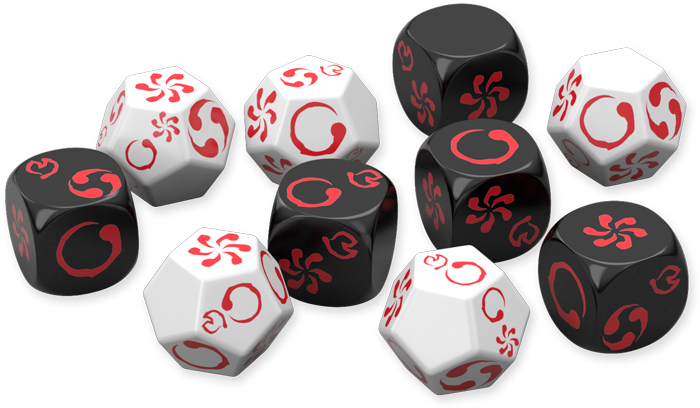
The system uses 2 kinds of dice, one representing approach and one representing skill.
The approach dice is 6 sided (in the below table, written as "ring die" because that is the L5R name).
The skill die is a 12 sided die.
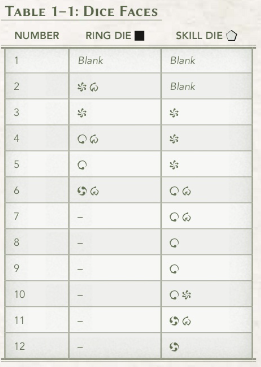
Each of the sides on a die can contain one or more symbols and shown in the table. Custom dice would be made to avoid having to look up the result (see image above).
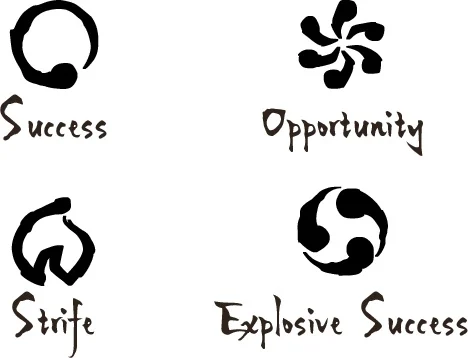
Success
Contributes a single success towards a check.
Opportunity
Creates an additional opportunity whether you succeed or fail a check.
Some opportunities are always available for a particular approach, while others can be granted by techniques. In L5R, there are plenty of both narrative and mechanical things to spend opportunity rolled during a check on. These are often tied to the player's approach.
Example uses can be determining a better way to succeed (some approach and skill combination might make it easier to succeed), reassuring other characters to lower their strife, hinder enemies from targeting other people than you, recall an important, unrelated fact, notice something interesting present or missing from the environment and many other things.
Strife
Does not impact success, but represents your character being pressured or stressed during their conflict. When strife becomes overwhelming, the character acts out in an inappropriate or detrimental way. This can include leaving the scene, performing an angry outburt or another violent show of emotion. It can also take the form of a status condition, such as becoming unfocused.
Explosive success
Contributes a single success and you can roll (and keep) an additional of that die type. You can choose not to keep the additional die.
Turns
No matter whether it is a social or physical conflict, participants take turns performing their contribution. Turn order is rolled (initiative) during combat, but determined by the narrative in social conflict. All participants must have a turn before a participant can take a second though.
Action Checks
Each action a player takes can trigger an action check, if the GM considers it likely to fail, or thinks the outcome can vary greatly
SL5RE uses a Roll and Keep system. When the player rolls, they roll a number of dice depending on their approach and skill, and keep a number of dice equal to their approach. In a full game, advantages and detriments to a character can allow them to affect the outcome. In the example below, is included such an advantage, but no examples will otherwise be listed in this document.
Successes above the required are considered "bonus successes" and can contribute to increased effect.
Example Play
Dalinar (played by Marie) wants to convince a highprince to join his cause, while Sadeas tries to keep him from it. Marie decides that Dalinar will demand the highprince's obedience because of his relationship to the king. The GM determines that this is an Overwhelming Diplomacy check, and that the highprince is somewhat resistant to it, setting the difficulty to 2.
Marie looks at her character sheet. Dalinar has an Overwhelming level of 3 and a Diplomacy skill of 1. She picks up and rolls 3 approach dice and 1 skill die. The approach die gives a 1, 2 and 5. The skill die gives a 3.
This leaves her with 1 opportunity, 2 strife and 1 success. She chooses to use her Royal Title advantage, which allows her to re-roll 2 dice when using an Overwhelming Diplomacy skill. She chooses to reroll the blank ring die and the skill die. She rolls 4 and 1.
Marie now has to pick 3 dice to keep. She chooses the 3 overwhelming dice, resulting in her getting 2 strife (which she tracks on her sheet) , 2 successes and an opportunity. She succeeds the check and uses the Overwhelming opportunity to startle the some of highprince Sedeas's ardents, making him appear weaker. With a success, the GM notes that the highprince is now more likely to join the cause. Play continues until Dalinar or Sadeas has gathered enough points to convince the highprince of their cause.
Example techniques
Each technique has a type, which determined which kind of characters have access to them. I don't have a good way to show these, so I will just write the type in brackets in front of them. [O] means an opportunity needs to be spent to activate that part of the ability.
[Sword] Iron Stance
1st level
When making an Overwhelming Martial: Sword attack, you gain the following opportunities:
[O]: Knock the enemy prone
[OO]: Damage an enemy's shardplate for each bonus success.
[Religion] Burn a prayer
1st level
You know how to write a simple prayer to the almighty. Once per day, You can burn such a prayer for another character to perform a Dedication Religion check (difficulty 2). On a success, the target may choose 2 dice results from your result and save them on their character sheet. Until the end of the day, the character in question can substitute a die result from their own roll with one of those, depleting that saved die.
Spending XP
During the game, XP is earned, In L5R this is per playtime, and not for defeating enemies.
Classes
Classes in show your character's focus area by giving you access to different abilities. Each class has 5 different levels. You can upgrade any technique and approach, as well as anything granted access to by your current and former level in your class.
When you spend XP on something inside your class, that XP contributes towards you gaining a level and reaching greater heights of your power. XP spent outside of the class gives
An example table below show how a Windrunner's 1st and 2nd level could look.
Level 1
| type | Advancement |
|---|---|
| Skill | Martial: Spear |
| Skill | Martial : Sword |
| Approach | Dedication |
| Techniques | Spear |
Level 2
| type | Advancement |
|---|---|
| Skill | Diplomacy |
| Techniques | Social (rank 1) |
Titles
Titles represent something a character has achieved or become. They list a group of techniques or skills and can give access to something the character would not normally have access to (e.g. social techniques). A title allows for a certain amount of XP to be spent on those things and only progress when spending XP on something inside the title (no half-increase like in the class).
A non-radiant character could use different titles as advancement opportunities, as they represent new opportunities in the character's life. Below is an example of a title that allows a character to practice spear techniques, something that is not available as a baseline.
Bridge 4 Bridgeman
| type | Advancement |
|---|---|
| Skill | Martial: Spear |
| Approach | Dedication |
| Skill | Craftsmanship |
| Techniques | Spear (level 1) |
Reward: Parshendi Carapace Armor: You learn to craft armor from the carapace of parshendi warriors. If wearing such an armor, any parshendi who can reach you for an attack must re-roll 1 success if they attack a character not using this ability.