
The Vampire


Vampire Cohorts
Per your request, the inquisition has investigated the Braskov incident. The report follows.
Within Braskov's walls lie four families of old blood, all of whom openly pledge allegiance to the kingdom. However, we have reason to believe that three of the four families are led not by their living Patricians, but by forces unseen. The Graf clan, in particular, has had several of their most prominent members die by suspicious circumstance. In truth, we believe they are not dead at all. Not fully, in any case.
We thank the court mage for his tip- once re-opened, we found that multiple cold cases of missing persons and murder occurred shortly after each of the Graf clan disappearances. Strange as it may sound, we believe the civilian deaths to have been sacrifices- and the Graf elders to be the recipients of related, grisly rituals. Our texts state that such ceremonies often occur in this way; by having a member of their own clan vanish, the Grafs can claim victim even while they perpetuate the crime.
We look forward to unsealing the Graf clan catacombs... though the creatures within may be less pleased.
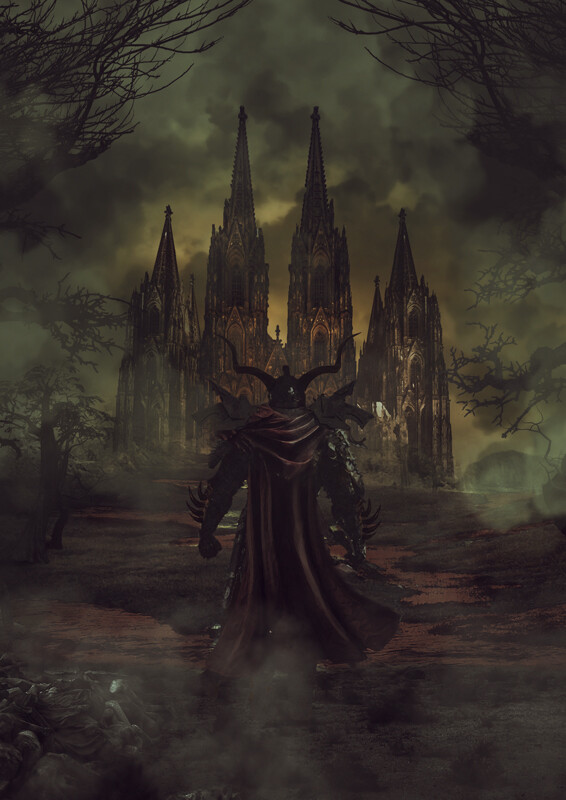
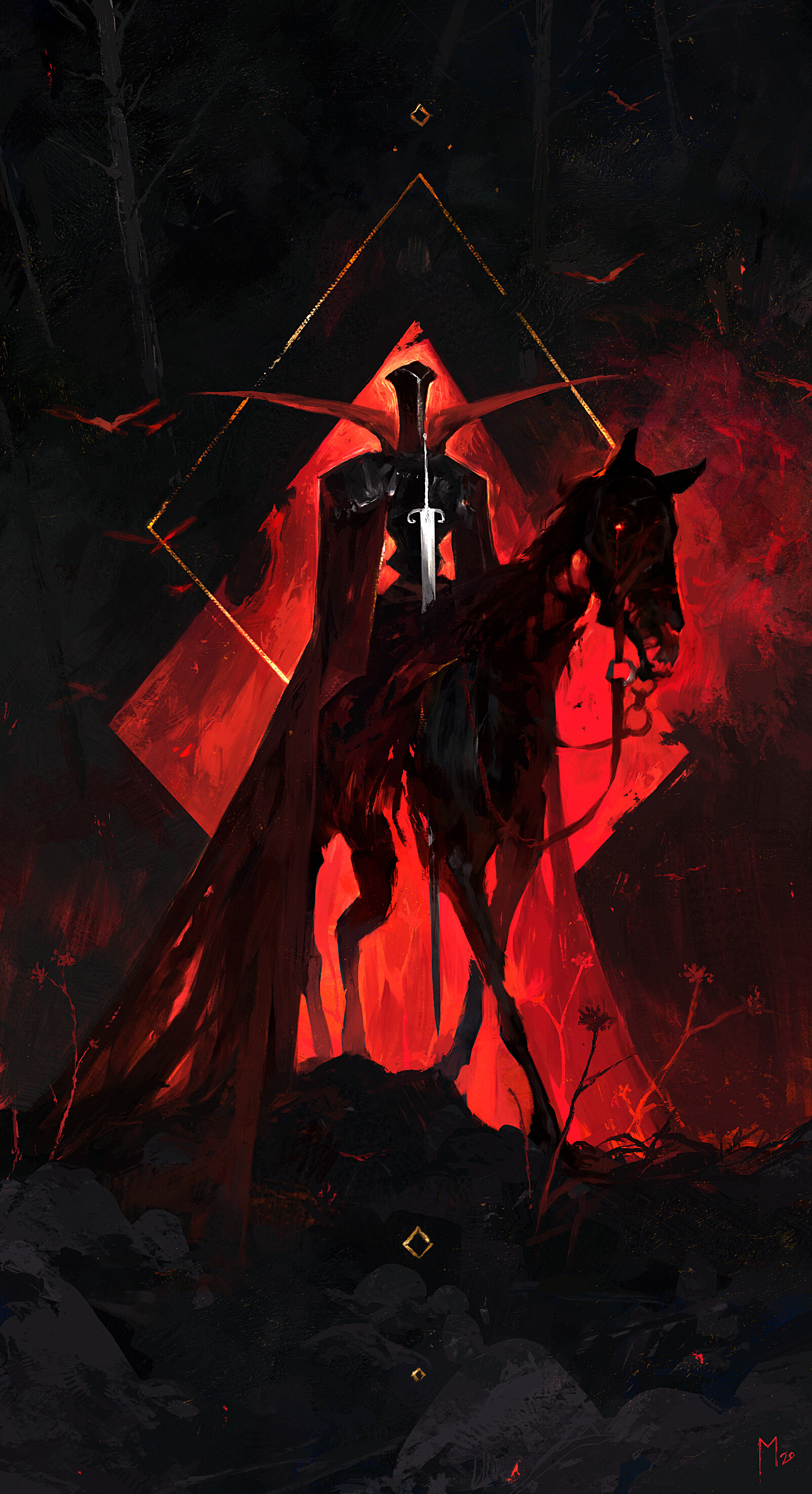
art by Spiros Karkav
cover art by Valentina Remenar
What is a Cohort?
A creature cohort is a monster straight from the pages of Dungeons and Dragons Fifth Edition that has been redesigned for use as its own race and associated class. A cohort race and class (like the Vampire race and Viscount class) are typically meant to be taken together. The Viscount, though, is designed for use with any race or lineage.
A cohort can be used for multiple purposes: as a sidekick (friendly NPC), a recurring villain/rival, or as a player character. You create a cohort much like making a character, following the same rules in the Player's Handbook.
However, cohorts are designed to be built differently depending on how they are used. If a cohort is being used as an NPC sidekick, then the cohort does not get a background at 1st level, nor do they choose a subclass as they advance in their class. Cohorts as sidekicks instead rely on the base class alone for their abilities- which leads to a more streamlined, simpler experience (at a power level a little lower than that of a full-fledged player character).
(Note that, at the time of this writing, there are multiple existing cohorts that are not yet designed around 'subclasses for characters only'. For cohorts prior to the original Angel release (July 2021) it is recommended to use those cohorts as written. Updated versions of those cohorts are planned for future releases.)
Vampire Racial Features
Of all the creatures that prefer the night, few are as openly feared as vampires. Having strength and reflexes beyond that of most mortals, while being functionally immortal themselves, vampires possess unquestionable power. However, their undead nature causes their emotions to become increasingly dim over time. In the end, vampires tend to be both envied and deeply envious.
Ability Score Increase. One ability score of your choice increases by 2, and one other ability score of your choice increases by 1.
Age. Vampires are made more often than they are born, and are typically mortal creatures converted (or 'sired') by other vampires. Once transformed, vampires age immeasurably slowly. While there are "old" vampires, these creatures are said to live for millenia. There are no written records of a vampire having died of old age.
Alignment. Having to feed off of other humanoids to survive, it is difficult for a full-blooded vampire to maintain a truly selfless outlook. Those that attempt to walk the straight and narrow often struggle with their unholy thirst, and may restrict themselves to feeding only from willing servants.

Most vampires are self-centered if not downright arrogant, and so these creatures lean heavily towards evil. That said, vampires in many settings tend to operate in long family lines, organized into well established hierarchies. Lawful evil is the most common alignment for true vampires.
Half-Vampires run the gamut from good to evil- though they tend to prefer spending time with mortals rather than with other partially (or fully) undead creatures.
Size. Full-blooded vampires are Medium. A vampire converted from another lineage retains whatever size their original form was. Virtually all sired vampires are Small or Medium-sized.
Speed. Your base movement speed is 30 feet.
Darkvision. You can see in dim light within 60 feet of you as if it were bright light, and in darkness as if it were dim light. You can't discern color in darkness, only shades of gray.
Not Quite Mortal. You count as a humanoid as well as an undead for the purposes of spells and effects. You can be healed like a humanoid, but also turned as an undead.
Superior Reflexes. You add your proficiency bonus to Initiative rolls.
Graven Form. You have resistance to necrotic damage.
Languages. You naturally speak Common.
Subraces. Two major subraces of vampire are found within the worlds of D&D: half-vampire, and true vampire. Choose one of these subraces.
Half-Vampire
Vampires are normally incapable of breeding. That said, half-breeds of their kind do exist, and the rumors around them are many. Some believe they are the spawn of vampires who have recently consumed a great deal of blood, with the other parent being mortal. Half-vampires are generally not as feared as their parents, and they also do not have the deep bloodlust of their kind. Thus, they are free to explore the world on their own terms.
Keen Sight. You are proficient in your choice of one of the following skills: Insight, Investigation, or Perception.
Death's Defense. You can add a +1 bonus to any saving throw you make that doesn't include your proficiency bonus.
True Vampire
Full-blooded vampires are, in some ways, walking contradictions. They have impressive power, and yet they lack the perspective to truly appreciate it. Feeling dulled emotions compared to mortals, and being keenly aware of this fact, many vampires turn to lust or other obsessions to fill the void left by undeath. Even good-aligned vampires tend to fixate on a specific person or place, choosing to live vicariously through others rather than suffer the endless jealousy of their kindred.
Breathless. You do not require air.
Vampire Fangs. You have a bite attack that deals 1d6 piercing damage. You add your Strength or Dexterity modifier (your choice) to attack and damage rolls with your bite. Your bite counts as a natural weapon.
.
art by Andrej Z.T.
Once per long rest, when you hit a creature with your bite attack that is willing, grappled by you, incapacitated or restrained, you may deal extra necrotic damage equal to your character level, and regain hit points equal to half of that amount (rounded up).
Bloodlust. You must drink blood to sustain yourself. Whenever you consume at least a half-pint of blood from a humanoid, you gain a 5-foot bonus to your base walking speed for 1d4+1 days. Whenever you complete a long rest, if you do not have this bonus, you gain one level of exhaustion. This exhaustion can only be removed by drinking at least a half-pint of blood from a humanoid, which also restores your bonus to base speed.
If you damage a creature with your bite attack that is willing, grappled by you, incapacitated or restrained, you may drink blood from that creature as part of the same action. Blood consumed in this way is considered a half-pint for the purposes of this feature.
Sunlight Hypersensitivity. You take 5 radiant damage when you start your turn in sunlight. While in sunlight, you have disadvantage on attack rolls and ability checks.

New Class: The Viscount
Class Features
As a viscount, you gain the following class features.
Hit Points
- Hit Dice: 1d10 per viscount level
- Hit Points at 1st Level: 10 + your Constitution modifier
- Hit Points at Higher Levels: 1d10 (or 6) plus your Constitution modifier per viscount level after 1st.
Proficiencies
- Armor: All armor, shields
- Weapons: Simple weapons, martial weapons
- Tools: None
- Saving Throws: Constitution, Charisma
- Skills: choose two from Acrobatics, Arcana, Athletics, Deception, Insight, Intimidation, Perception, Persuasion, and Stealth
Equipment
You start with the following equipment, in addition to any equipment granted by your background:
- (a) chain mail or (b) leather armor
- (a) a martial weapon and a shield or (b) two martial weapons
- (a) five javelins or (b) any simple melee weapon
- (a) a diplomat's pack or (b) a scholar's pack
Charm
You learn to influence others with only so much as a gaze in their direction. As an action during your turn, you target one humanoid that you can see within 30 feet. If the target can see you, they must succeed on a Wisdom saving throw with a DC equal to 8 + your proficiency bonus + your Charisma modifier (minimum of one). On a failed save, the target is charmed by you.
A charmed target treats you as a trusted friend to be heeded and protected. Although the target is not under your control, it does take your requests or actions in the most favorable way it can, and it is a willing target for your Vampiric Bite feature (see below).
Each time you or your companions do anything harmful to the target, it can repeat the saving throw, ending the effect on itself on a success. Otherwise, the effect lasts for 1 hour or until you are killed, or you take a bonus action to end the effect. Once the effect ends, the target knows they were charmed by you.
You may use this ability once per point of proficiency bonus, and recover any expended uses upon completion of a long rest.
The Viscount
| Level | Proficiency Bonus | Features |
|---|---|---|
| 1st | +2 | Charm, Vampiric Weapons |
| 2nd | +2 | Profane Strength, Vampiric Bite |
| 3rd | +2 | Dark Art, Night's Protégé |
| 4th | +2 | Ability Score Improvement |
| 5th | +3 | Extra Attack |
| 6th | +3 | Improved Natural Weapons, Shapechanger |
| 7th | +3 | Dark Art feature |
| 8th | +3 | Ability Score Improvement |
| 9th | +4 | Regeneration |
| 10th | +4 | Dark Art feature |
| 11th | +4 | Unholy Might |
| 12th | +4 | Ability Score Improvement |
| 13th | +5 | Fell Shroud |
| 14th | +5 | Misty Escape |
| 15th | +5 | Hierarchy of Blood |
| 16th | +5 | Ability Score Improvement |
| 17th | +6 | Supreme Might |
| 18th | +6 | Dark Art feature |
| 19th | +6 | Ability Score Improvement |
| 20th | +6 | Blot Out the Sun |
.
Vampiric Weapons
Vampires-- and the dark supplicants that have inherited their powers-- are well endowed to defend themselves even when seemingly unarmed.
You may roll a d6 in place of the normal damage of your unarmed strike. In addition, you can use Dexterity instead of Strength for the attack and damage rolls of your unarmed strikes. When you hit a creature with an unarmed strike, you can instead choose to automatically grapple that creature if they are Large-sized or smaller.
You also gain a bite attack, which uses the same attack and damage roll as your unarmed strike, but deals piercing damage instead.
Your natural weapons become more powerful as you do. At 6th level, your unarmed strike deals 1d8 damage. At 11th level, your unarmed strike deals 1d10 damage. At 17th level, your unarmed strike deals 2d6 damage.
Profane Strength
At 2nd level, you gain proficiency in Athletics. If you are already proficient in Athletics, you may instead choose another skill from the viscount class proficiencies list. Your proficiency bonus is doubled for any Athletics ability check that you make.


art by Dominik Mayer
copyright Wizards of the Coast
Vampiric Bite
Starting at 2nd level, you can drain the life essence from your foes with a vicious bite. When you hit a creature with your bite attack that is willing, grappled by you, incapacitated or restrained, you may deal a bonus 2d8 necrotic damage to the target. You regain hit points equal to half of the necrotic damage dealt by this feature, rounded up.
This ability's damage increases by 1d8 when you reach 5th level (3d8), 11th level (4d8), and 17th level (5d8).
You may use this ability once per point of proficiency bonus, and recover any expended use upon completion of a long rest.
.
Dark Art
If your cohort is being created as a player character (or if it is meant to have an equivalent power level) then at 3rd level, you choose your subclass-- your dark art. Dark art options are detailed at the end of this class description.
Night's Protégé
Many have walked beneath the sunless sky, but your kind have learned to draw power from the darkness itself. At 3rd level, you gain one eldritch invocation of your choice as though you were a warlock of your viscount level. When an invocation gained in this way requires you to consume a warlock spell slot, you can instead use that feature without consuming a spell slot once per long rest. The spell slot you "consume" is treated as the minimum spell level required to use the ability. You use Charisma as your spellcasting ability for spells cast in this way.

Whenever you complete a long rest, you may choose one of the invocations you know and replace it with another invocation that you could learn at that level.
You learn additional invocations as you gain levels in the viscount class. At 9th level, you learn a second invocation of your choice. At 15th level, you learn a third invocation.
Ability Score Improvement
When you reach 4th level, and again at 8th, 12th, 16th, and 19th level, you can increase one ability score of your choice by 2, or you can increase two ability scores of your choice by 1. As normal, you can't increase an ability score above 20 using this feature.
Extra Attack
At 5th level, you may attack twice, rather than once, when using the Attack action.
Improved Natural Weapons
Starting at 6th level, your natural weapon attacks count as magical for the purpose of overcoming resistance and immunity to nonmagical attacks and damage.
Shapechanger
At 6th level, you learn to take on other forms using the dark powers natural to your kind. If you aren't in sunlight or running water, you can use an action to polymorph into a Tiny bat or a Medium cloud of mist, or back into your true form.
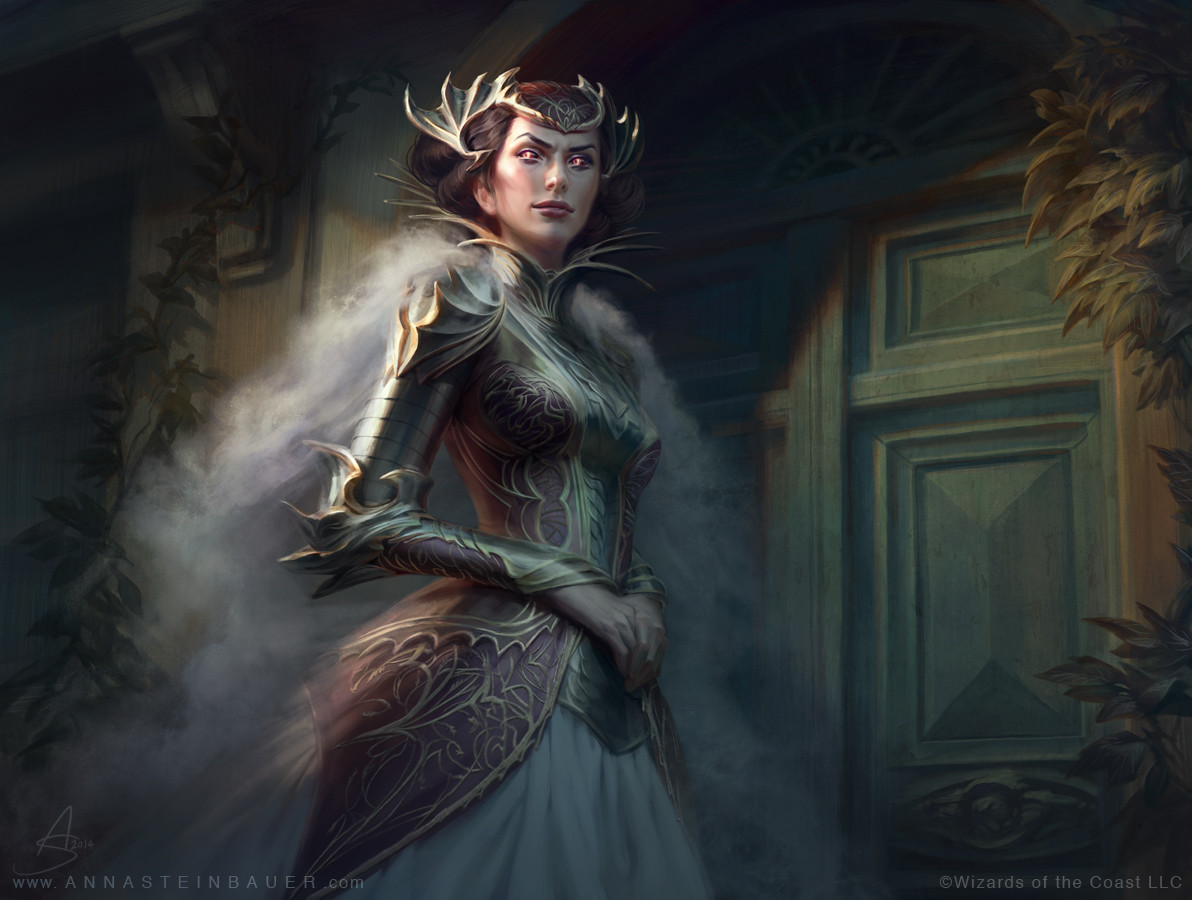
art by Anna Steinbauer
copyright Wizards of the Coast
While in bat form, you cannot speak, your walking speed is 5 feet, and you have a flying speed of 30 feet. Your statistics, other than your size and speed, are unchanged. Anything that you are wearing transforms with you, but nothing carried by you does. You revert to your true form if you die.
While in mist form, your only method of movement is a flying speed of 10 feet. You can enter and occupy the space of another creature. You have resistance to nonmagical damage, as well as advantage on Strength, Dexterity, and Constitution saving throws. You can pass through small holes, narrow openings, and even mere cracks, though you treat liquids as though they were solid surfaces. You can't fall and remain hovering in the air even when stunned or otherwise incapacitated.
While in mist form, you can't talk or manipulate objects, and any objects you were carrying or holding can't be dropped, used, or otherwise interacted with. You can't attack or cast spells.
This ability lasts for one hour, or until you use a bonus action to revert back to your normal form. You may use this ability twice, and recover any expended use upon completion of a long rest.
Regeneration
Starting at 9th level, you regain 1d6 hit points at the end of each hour, provided that you have at least 1 hit point.
Unholy Might
At 11th level, whenever you hit a creature with a melee weapon or unarmed strike (including your bite attack), the creature takes an extra 1d8 necrotic damage.
Fell Shroud
The darkness that grants you your powers now hangs thick in the air. At 13th level, you emanate an unnerving aura out to 60 feet. If any of this aura's area overlaps with an area of light created by a spell of 2nd level or lower, the spell that created the light is suppressed. The spell remains suppressed so long as there is any overlap with your aura. You may suppress or resume this aura as a bonus action.
In addition, while this aura is active, any necrotic damage you deal ignores damage resistance, but not immunity.
Misty Escape
Starting at 14th level, when you are reduced to 0 hit points but not killed outright, you can drop to 1 hit point instead. You then turn into your mist form (per the shapechanger ability). When you turn into mist form in this way, you are immune to nonmagical damage for the duration, and the duration of your mist form is reduced to 1 minute. You can also revert to your normal form without an action, but only during your turn.
Once you use this feature, you may not do so again until you complete a long rest.

Hierarchy of Blood
At 15th level, when you use your vampiric bite feature against a creature charmed or grappled by you, you now gain a number of hit points equal to the total necrotic damage dealt by the attack.
Supreme Might
At 17th level, you gain a bonus to damage rolls with weapon attacks as well as with your unarmed strike and bite attacks. The bonus equals your Charisma modifier (minimum of 1).
Blot Out the Sun
There comes a point where the student becomes the master. For most of your ascension, you drew power from the night. Now, when you see it fit, the darkness answers to you. At 20th level, as an action during your turn, you expand the aura from your fell shroud ability out to a half-mile radius. Bats, rats, and other vermin within this area become unusually agitated and may be aggressive against creatures not including you and your companions.
While this ability is active, all areas of light created by spells of 3rd level or lower (including the daylight spell) are suppressed within this radius. The area within your aura is dimly lit throughout, and is not considered to be hit by sunlight. If the sun is out, all within the radius see what appears to be a total eclipse.
When you activate this feature, you may choose up to three creatures within 60 feet of you that you can see. You and the chosen creatures each deal an extra 1d6 necrotic damage on a hit during this duration. You also regain 1d6 hit points at the end of each of your turns, instead of each hour, while this ability is in effect.
The bonus damage and rapid regeneration last one minute. The remaining effects last one hour, after which time your fell shroud aura returns to its original radius and level of potency. You may end this ability early as a bonus action.
You may use this ability once, and recover any expended use upon completion of a long rest.
Dark Arts
At 3rd level, some viscounts descend further into the profane traditions carried on by their families. Once a dark art is chosen, a viscount gains additional features unique to that art. You choose one of the dark arts available: the Blood Sire, the Crimson Knight, or the Long-Shadow.
.
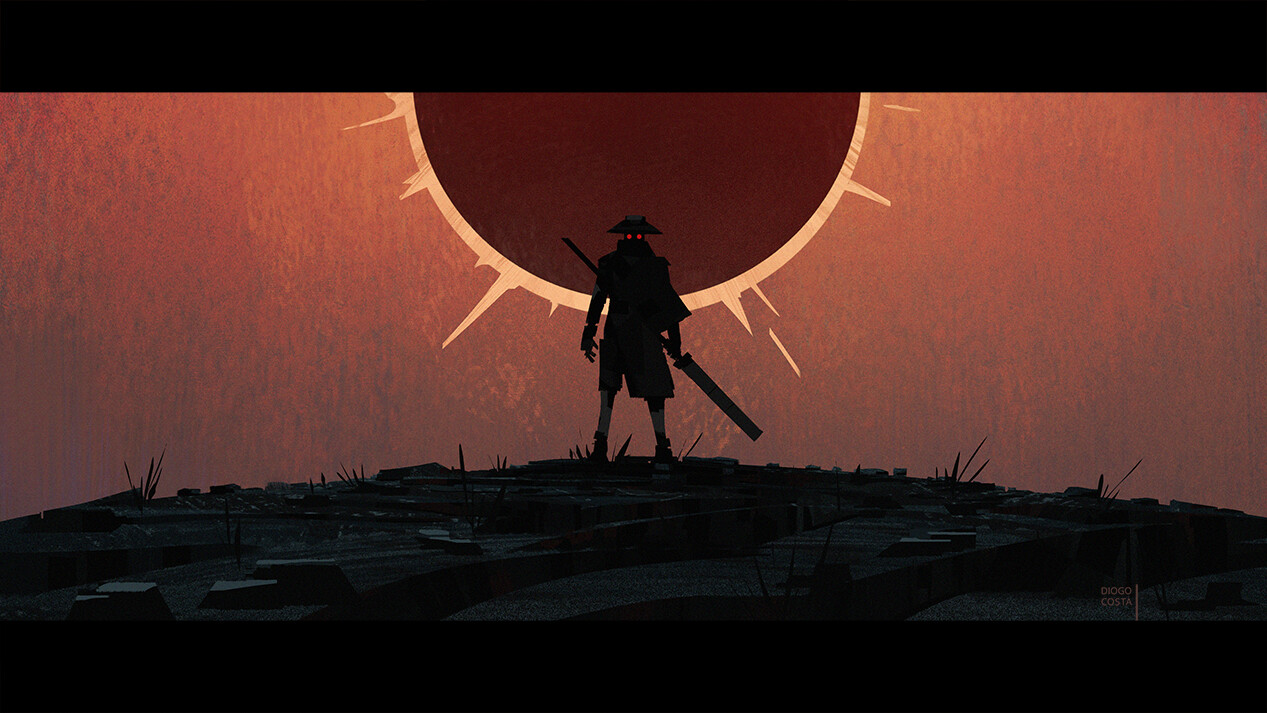
art by Diogo Costa

Blood Sire
Vampires-- and those nobles that carry similar powers-- both tend to lean on long-standing traditions. One such tradition is the family legacy; each new generation carries the prestige of those who came before them. Blood sires are those gifted to direct the legacy of the family (whether literal or metaphorical) through control of thralls. Blood sires may be the hierarchal figures that lead entire organizations. In society's outskirts, they may instead be hermits that shepherd the wilds as they see fit.
Children of the Night
At 3rd level, as an action during your turn, you magically summon 1 swarm of rats or 1 swarm of bats. While outdoors, you can call two wolves instead. The called creatures arrive in 1d4 rounds, acting as your allies and obeying your spoken commands.
You can summon greater allies as you gain viscount levels. At 7th level, you summon 2 bat swarms, 2 rat swarms or 2 dire wolves when using this ability.
At 15th level, you summon 4 bat or rat swarms, 4 dire wolves, or 1 vampire spawn. Starting at 15th level, any creatures you summon with this ability have advantage on Dexterity saving throws.
Creatures summoned with this ability stay for 1 hour, until you die, or until you dismiss them as a bonus action. You may use this ability twice, and recover any expended use upon completion of a long rest.
Vampire Whelp
At 3rd level, you summon a young vampire who serves you without question. It's friendly to you and your companions, and it obeys your commands. See its game statistics in the Vampire Whelp stat block, which uses your profiency bonus (PB) in several places. You determine the creature's appearance and whether or not it is outwardly undead-looking (it may simply appear pale-skinned). The appearance has no effect on its game statistics.
In combat, the vampire whelp shares your initiative count, but it takes its turn immediately after yours. It can move and use its reaction on its own, but the only action it takes on its turn is the Dodge action, unless you take a bonus action on your turn to command it to take another action. That action can be one in its stat block or some other action. If you are incapacitated, the whelp can take any action of its choice, not just Dodge.
If the whelp has died within the last hour, you can channel a small amount of life energy into it as an action to revive it, taking 1d4 damage in the process, provided you are within 5 feet of it. The whelp returns to (un)life after 1 minute with all its hit points restored.
At the end of a long rest, you can summon a new vampire whelp by spending one minute performing the required ritual. If you already have a whelp from this feature, the first one immediately perishes. The whelp also perishes if you die.
Protector of the Pack
You learn to channel ritualistic magic to protect yourself and your allies. Starting at 7th level, you may cast the magic circle spell without consuming a spell slot and without material or costly components.
You may use this ability once, and recover any expended use upon completion of a long rest.
Spawn of Darkness
At 10th level, creatures that you summon with your children of the night ability gain temporary hit points equal to your viscount class level when they are summoned, and add your Charisma modifier to their attack and damage rolls.
In addition, whenever you complete a long rest, your whelp gains temporary hit points equal to your viscount class level.
Dread Alpha
At 18th level, you have advantage on an attack roll if an ally is within 5 feet of the target and the ally isn't incapacitated.
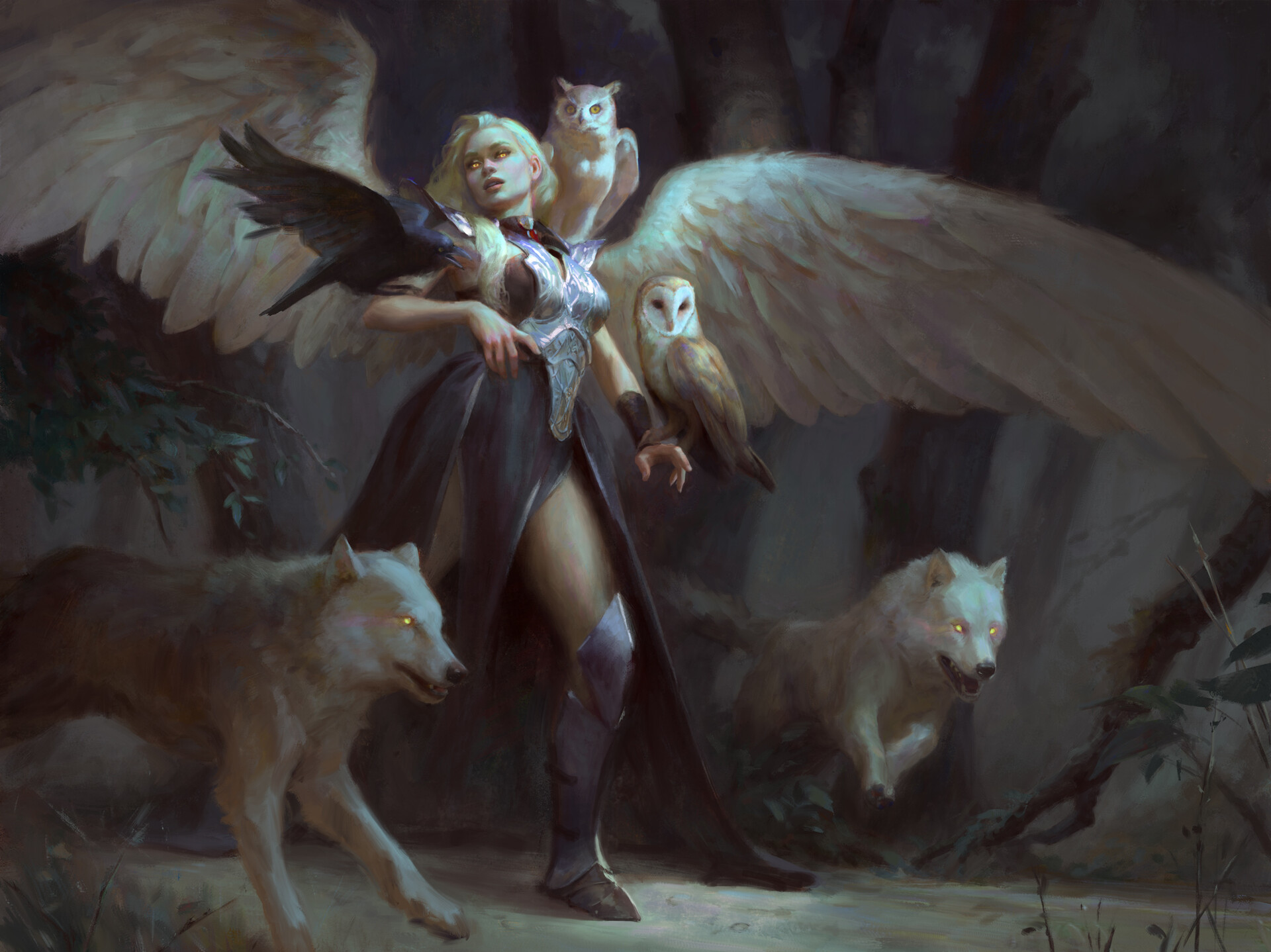
art by Marta Nael


Vampire Whelp
Small undead
- Armor Class 15 (natural armor)
- Hit Points 5 + five times your viscount level
- Speed 35 ft
STR DEX CON INT WIS CHA 10 (+0) 14 (+2) 14 (+2) 8 (-1) 12 (+1) 6 (-2)
- Saving Throws Dex +2 plus PB, Con +2 plus PB
- Skills Acrobatics +2 plus PB, Stealth +2 plus PB x2
- Damage Immunities None
- Condition Immunities charmed
- Senses Darkvision 60 ft., passive Perception 11
- Languages Speaks Common; understands the languages you speak
- Challenge --
- Proficiency Bonus (PB) equals your bonus
Slippery. The vampire whelp has advantage on acrobatics checks to resist being grappled or to escape from a grapple.
Actions
Claw. Melee Weapon Attack: (your Charisma modifier plus your proficiency bonus) to hit, reach 5 ft., one target you can see. Hit: 1d6 + PB slashing damage
Whelp Bite (2/day). The whelp makes an attack roll as if using its claw attack. If it hits, it instead drains its target with a deep bite, dealing 2d6 necrotic damage and recovering hit points equal to the damage dealt.
Bat Form (1/day). The whelp turns into a Tiny bat. In this form it has no attacks and has a 5 ft speed and 30 foot flying speed. Its other statistics are unchanged in this form. This ability lasts one hour or until the whelp chooses to return to normal.
Reaction
Defend the Pack. The whelp imposes disadvantage on the attack roll of one creature it can see that is within 5 feet of it, provided the attack roll is against its summoner or another summoned creature.
.
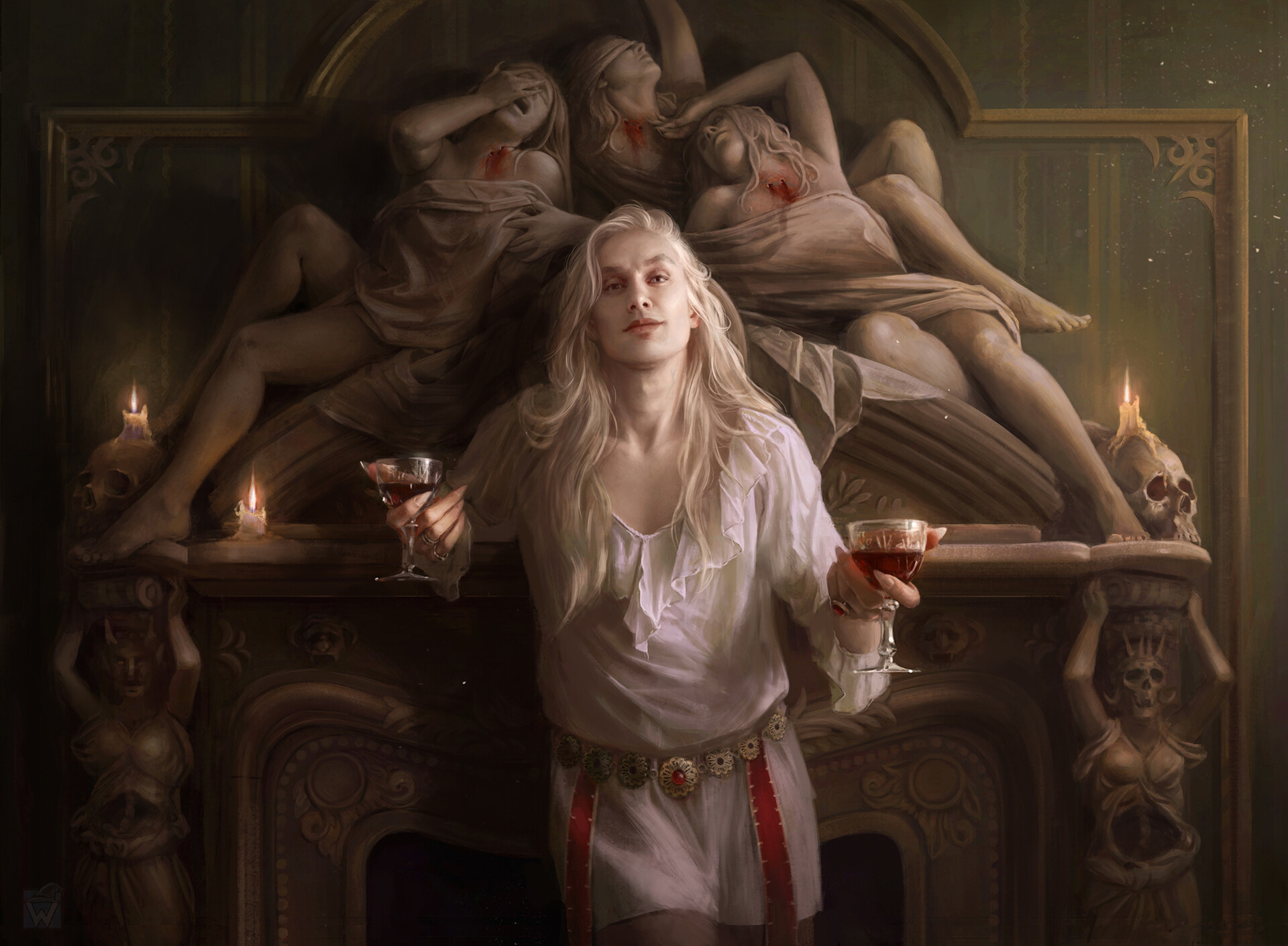
art by Raymond Minnaar

art by Dominik Mayer
Crimson Knight
The fields of war are littered with so-called knights; warriors who claim both adequate training and considerable pedigree. Some of these men and women even state they were born to serve a higher power. Crimson knights, on the other hand, serve only when they choose to. Their presence may be tied to anarchy or law, but in either case the rules of combat seem to warp slightly in their wake. Foes of crimson knights find their alliances strained and their wounds more grevious; no one can say why. That fact alone makes the crimson tide ever more terrifying to face.
Bound in Blood
You and your weapon have a special bond, such that you can draw your unholy power through it. At 3rd level, you may choose your unarmed strike, or a simple or martial melee weapon that is in your possession. You gain a +1 bonus to attack rolls with your chosen weapon.
In addition, you may siphon an enemy's life essence through your chosen weapon, rather than resorting to a bite. Whenever you hit a creature with your chosen weapon, you may activate your vampiric bite ability (even if the creature does not satisfy the normal conditions of that ability, such as being grappled by you, et cetera).
You can only bond to one weapon at a time using this ability. At the end of a short or long rest, you may choose to bond to your unarmed strike or a different weapon. Doing so causes the bond on any previously chosen weapon to end immediately.
Edict
At 3rd level, you learn to briefly overpower your foes with your supernatural aura. You may cast the command spell without using a spell slot. When casting the spell in this way, you may do so as a bonus action. Charisma is your spellcasting ability for this feature.
If a target's saving throw is successful or the effect ends for it, the target is immune to this ability for 24 hours.
You may use this ability once per point of proficiency bonus, and recover any expended use upon completion of a long rest.
Rupture
Starting at 7th level, wounds inflicted on those around you seem to become more severe just by virtue of your being there. Whenever a creature within 30 feet of you that you can see becomes damaged by an attack, you can use this ability as a reaction. The damaged creature immediately takes 1d8 necrotic damage. This damage ignores damage resistance but not immunity.
This ability's damage increases by 1d8 when you reach 12th level (2d8), and 18th level (3d8).
Well of Souls
At 10th level, you learn to siphon small motes of blood and energy from your enemies, even from a short distance away. At the beginning of each of your turns, each hostile creature within 10 feet of you takes necrotic damage equal to your Charisma modifier. If a creature damaged in this way dies before the beginning of your next turn, you gain a number of temporary hit points equal to your Charisma modifier.
You may suppress or resume this ability as a a bonus action.
Unassailable
At 18th level, any critical hit against you becomes a normal hit.


art by Livia Prima
copyright Wizards of the Coast
Long-Shadow
The darkness provides; those who embrace its call have an arsenal of weapons (both physical and psychological) at their disposal. Long-shadows are fell operatives who specialize in stealth, subterfuge, and indirect means to solve their problems. They can be as charming or deadly as the situation demands, turning from one disposition to the other like two sides of the same jagged coin.
Natural Climber
At 3rd level, you gain a climb speed of 30 feet.
Spellcasting
When you reach 3rd level, you gain the ability to cast spells.
Cantrips. You learn three cantrips: chill touch and two other cantrips of your choice from the wizard spell list. You learn another wizard cantrip of your choice at 10th level.
.
Spell Slots. The Long-Shadow Spellcasting table shows how many spell slots you have to cast your spells of 1st level and higher. To cast one of these spells, you must expend a slot of the spell's level or higher. You regain all expended spell slots when you finish a long rest.
For example, if you know the 1st-level spell color spray and have a 1st-level and a 2nd-level spell slot available, you can cast color spray using either slot.
Spells Known of 1st-Level and Higher. You know three 1st level spells of your choice, two of which you must choose from the enchantment and necromancy spells on the wizard spell list.
The Spells Known column of the Long-Shadow Spellcasting table shows when you learn more wizard spells of 1st level or higher. Each of these spells must be an enchantment or necromancy spell of your choice, and must be of a level for which you have spell slots. For instance, when you reach 7th level in this class, you can learn one new spell of 1st or 2nd level.
The spells you learn at 8th, 14th, and 20th level can come from any school of magic.
Whenever you gain a level in this class, you can replace one of the wizard spells you know with another spell of your choice from the wizard spell list. The new spell must be of a level for which you have spell slots, and it must be an enchantment or necromancy spell, unless you’re replacing the spell you gained at 8th, 14th, or 20th level.

Long-Shadow Spellcasting
| Viscount Level | Cantrips Known | Spells Known | Spell Slots 1st |
2nd | 3rd | 4th |
|---|---|---|---|---|---|---|
| 3rd | 3 | 3 | 2 | — | — | — |
| 4th | 3 | 4 | 3 | — | — | — |
| 5th | 3 | 4 | 3 | — | — | — |
| 6th | 3 | 4 | 3 | — | — | — |
| 7th | 3 | 5 | 4 | 2 | — | — |
| 8th | 3 | 6 | 4 | 2 | — | — |
| 9th | 3 | 6 | 4 | 2 | — | — |
| 10th | 4 | 7 | 4 | 3 | — | — |
| 11th | 4 | 8 | 4 | 3 | — | — |
| 12th | 4 | 8 | 4 | 3 | — | — |
| 13th | 4 | 9 | 4 | 3 | 2 | — |
| 14th | 4 | 10 | 4 | 3 | 2 | — |
| 15th | 4 | 10 | 4 | 3 | 2 | — |
| 16th | 4 | 11 | 4 | 3 | 3 | — |
| 17th | 4 | 11 | 4 | 3 | 3 | — |
| 18th | 4 | 11 | 4 | 3 | 3 | — |
| 19th | 4 | 12 | 4 | 3 | 3 | 1 |
| 20th | 4 | 13 | 4 | 3 | 3 | 1 |
Spellcasting Ability. Charisma is your spellcasting ability for your wizard spells. While you may learn your magical arts through grim tomes and some manner of study, it is raw willpower and, perhaps, a cursed bloodline that actually fuels your casting proper. You use your Charisma whenever a spell refers to your spellcasting ability. In addition, you use your Charisma modifier when setting the saving throw DC for a wizard spell you cast and when making an attack roll with one.
Spell Save DC
Spell attack modifier
Compelling Glare
At 7th level, you can use your charm ability as a bonus action.
In addition, you have advantage on attack rolls against creatures with the charmed condition.
.
art by Martina Fačková
Dominion
Starting at 10th level, you may befuddle a creature affected by your charm ability. As a bonus action during your turn (or, if they failed their save, as part of the bonus action used to charm the creature), you may force the charmed creature into a state of temporary insanity. The creature is treated as though affected by the confusion spell for one minute. At the end of that minute, the charm effect ends.
Legendary Agility
At 18th level, you can move so swiftly that others find you nearly impossible to pin down. At the end of another creature's turn, you can use your reaction to move up to your movement speed without provoking opportunity attacks. You may then make a free grapple attempt against an adjacent enemy.
You may use this ability once per point of proficiency bonus, and recover any expended use upon completion of a long rest.
Vampire Cohorts - Miscellany
Challenge Rating for Vampires
The following challenge ratings are based on the Monster Statistics by Challenge Rating table on page 274 of the Dungeon Master's Guide. Note that the below numbers were calculated without accounting for equipped magic items.
As a point of reference: The average level 20 player character may have a CR around 12-14 depending on the character's build and magic items, and can become higher still when using an optimized build and powerful items.
| Cohort Level | Recommended CR |
|---|---|
| 1 | 1/4 |
| 2 | 1/2 |
| 3 | 1/2 |
| 4 | 1 |
| 5 | 2 |
| 6 | 2 |
| 7 | 3 |
| 8 | 3 |
| 9 | 4 |
| 10 | 4 |
| 11 | 5 |
| 12 | 6 |
| 13 | 6 |
| 14 | 7 |
| 15 | 7 |
| 16 | 8 |
| 17 | 8 |
| 18 | 9 |
| 19 | 10 |
| 20 | 11 |
Roleplaying as a Vampire
As creatures detached from mortality, vampires can take a certain fascination from observing mortals and the way they operate. However, a vampire may want some manner of cover story when moving openly in society. Some occupations, such as arcane researchers, alchemists, or medicinal healers may have reason to extract blood on their travels without drawing suspicion. Any vampire (whether half or full-blooded) would benefit from the resources that an adventuring organization can provide... assuming that creatures like themselves are either welcome or adequately concealed.
For good-aligned (or even neutral) vampires, walking the path of eternal redemption may be a reason all its own to go adventuring. Righting the wrongs of the world may, in its own way, give a vampire the rush they seek out of unlife. To kill two birds with one stone is no crime.
Living on the Edge
Full-blooded vampires tend to live on society's fringes; they need humanoid blood to sustain themselves, but they cannot operate in open daylight or they risk being utterly destroyed. The cities of the realms are not an uncommon haunt for vampire-kind, given the sheer number of late night establishments available. In addition, where there is a thriving underworld (criminal or otherwise) a vampire can adapt with few questions being asked of them.
That said, a vampire could live in the countryside just as well. A charismatic cult leader might find plenty of willing subjects to feed from. Even those vampires who refuse to victimize others may find an occasional student... willing to draw their blood in exchange for otherwise long-lost knowledge. Stranger alliances have occurred.
Purity of Blood
Half-vampires find themselves in an odd social space... on the one hand, they lack the need to drink blood, and do not suffer in open sunlight. On the other hand, half-vampires tend to be of suspiciously fair skin, and may have other out-of-place features that might call them out as not fully mortal. As such, half-vampires do tend to distance themselves from their more monstrous kindred, but cannot count on being fully accepted in mortal society either. Half-vampires are fully free, in theory, but there are societies that would give them a hard time (or worse) simply for existing.
Half-vampires do still have many of the strengths of their full-blooded kin, though. Vampires of any strain tend to have fewer issues when they offer their services for less palatable lines of work. Both varieties of vampire can take up the mantle of the bounty hunter readily enough. Who, after all, could hunt down criminals better than a natural predator in mortal skin? Any line of work that is either dangerous, or well out of the way of casual observers could readily suit a vampire.
As a side note: for those interested, there are several official 5th edition campaigns that take place in vampire-friendly settings. Curse of Strahd, Out of the Abyss, and Rime of the Frostmaiden come to mind, but a few other campaigns (such as Descent into Avernus?) could be tweaked for a nocturnal party.

Credits
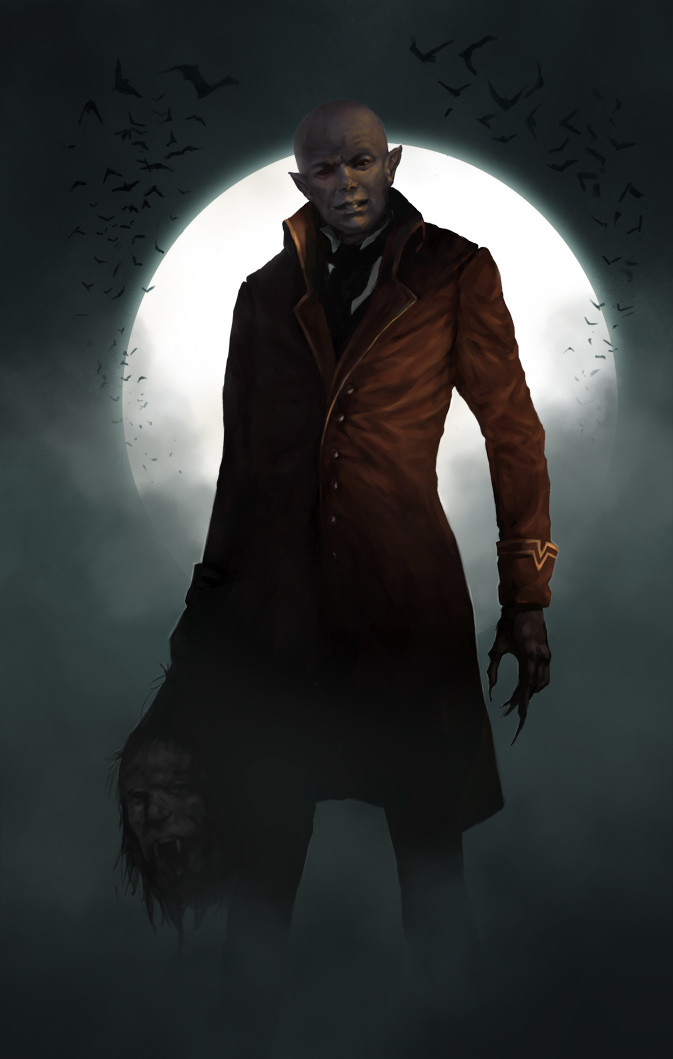
Cover Art by Valentina Remenar (https://www.artstation.com/tincek-marincek) Page 2 Art by Spiros Karkav (https://www.artstation.com/spirosk) Page 3 Art by Andrej Z.T. (https://www.artstation.com/andrejzt) Pages 5, 10 Art by Dominik Mayer (https://www.artstation.com/dtmayer) Page 6 Art by Anna Steinbauer (https://www.artstation.com/depingo) Page 7 Art by Diogo Costa (https://www.artstation.com/diogocosta) Page 8 Art by Marta Nael (https://www.artstation.com/martanael) Page 9 Art by Raymond Minnaar (https://www.artstation.com/raymondminnaar) Page 11 Art by Livia Prima (https://www.artstation.com/dopaprime) Page 12 Art by Martina Fačková (https://www.artstation.com/martinafackova) Page 14 Art by Andres Martinez (https://www.artstation.com/andresmgi) Back Cover Art by Samuel Eriksson (https://www.artstation.com/sampaints) Watercolor stains by Jared Ondricek (https://watercolors.giantsoup.com/xgte/xgtebottom-left/index.html)

May Your
Sidekick
Never Thirst
Creature Cohorts were created by me, Mister_Thr33, and were inspired by Tasha's Cauldron of Everything as well as the 3rd Edition supplement Savage Species
'Creature Cohorts' is unofficial Fan Content permitted under the Fan Content Policy. Not approved/endorsed by Wizards. Portions of the materials used are property of Wizards of the Coast. ©Wizards of the Coast LLC.
Special thanks to the r/unearthedarcana and r/dndhomebrew subreddits for their input and inspiration
No glasses of wine were harmed in the making of this document
Thank you all for your support!