
Arcane Tradition
Mesmer
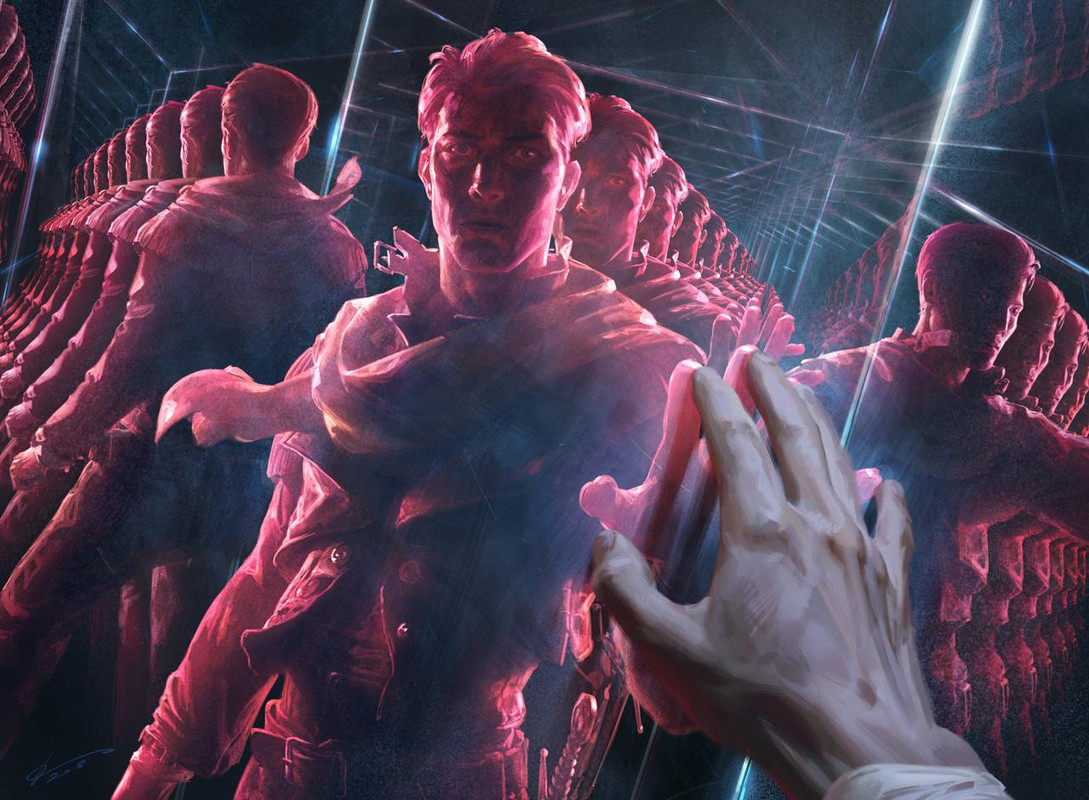
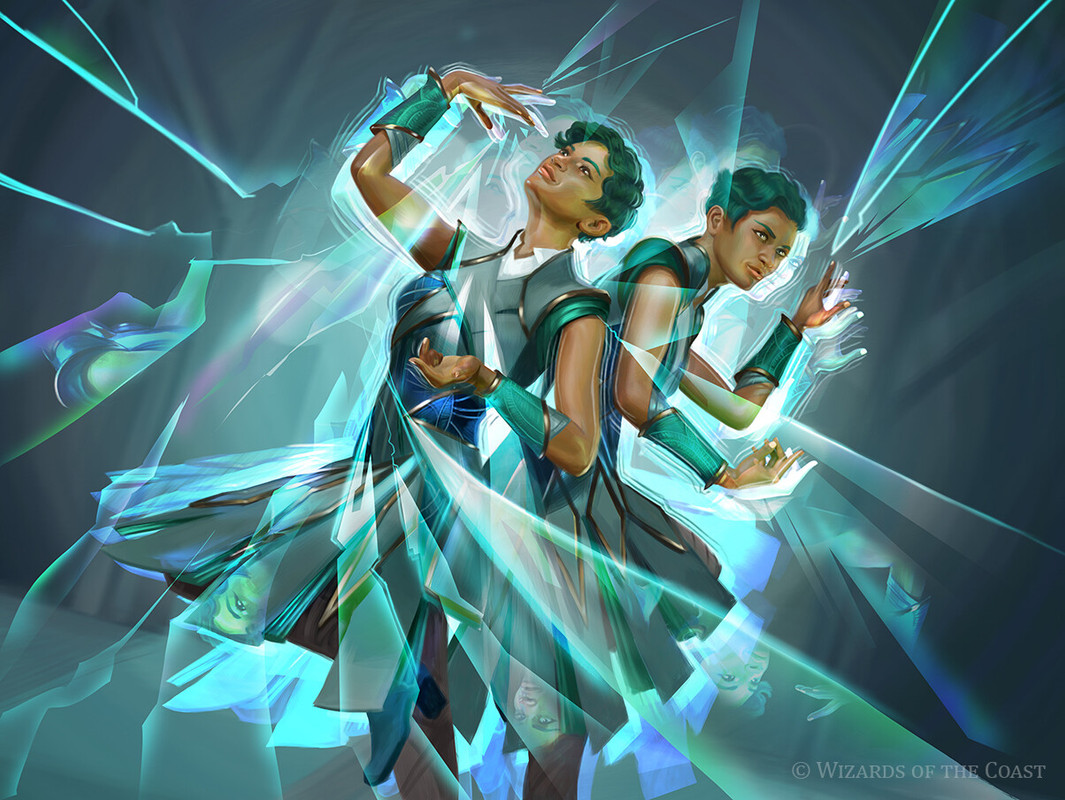
A mesmer is a wizard who delves entirely into the study of the mind and that of reality itself. Masters of deception and misdirection, a mesmer conjures illusory duplicates of themselves that twist the senses and muddle the mind. When a mesmer shatters the grand deception of these illusions, the broken shards of belief tear at the sanity of any who witness it.
Wizards of this Arcane Tradition risk losing their personal identity entirely, but many great mesmers claim that is an outcome to be desired, representing a step towards true enlightenment and great power.
Mesmer Features
| Wizard Level | Feature |
|---|---|
| 2nd | Illusory Clones, Multiself-Awareness |
| 6th | Shatter Illusions |
| 10th | Duplicitious Duplication |
| 14th | Myriad Selves |
Illusory Clones
When you choose this Arcane Tradition at 2nd level, your magic can conjure confounding images of yourself. As an action by expending a spell slot of 1st level or higher, or when you cast an enchantment or illusion spell using a spell slot, you may create an illusory clone of yourself in an unoccupied space you can see within 30 feet of either you or a target of that spell.
This clone is an incorporeal image of yourself along with anything you are wearing or holding. It is purely visual and isn't accompanied by sound, smell, or other sensory effects. Your clone remains in place, but otherwise mimics your movements.
As a bonus action you can command one of your clones to move up to 30 feet to a space you can see, but it must remain within 120 feet of you. As your clone changes location, its movements appear natural, walking or running to its destination. If its position or motion would cause it to collide with terrain or objects, it phases through them instead.
You may have no more than 3 clones at a time. You can freely dismiss any of your clones at any time. A clone fades away on its own after one minute.
When you create a clone you may choose to concentrate on maintaining it (as if concentrating on a spell), for up to one hour, and if you do it doesn’t fade away until you end your concentration.
Your clones are precise visual duplicates of yourself, but they are not always perfectly convincing. A creature will automatically recognize a clone as an illusion if it witness it being created, or observes it doing something obviously illusory. Possible giveaways can include a clone running in place when you move, appearing to speak without making a sound, performing somatic movements without casting a spell, or phasing through solid objects.
Physical interaction with a clone reveals it to be an illusion, because things can pass through it. A creature that uses its action to examine a clone can determine that it is an illusion with a successful Intelligence (Investigation) check against your spell save DC. If a creature discerns the illusion for what it is, the clone becomes faint to that creature.
Your clones mimic your visual appearance, meaning they are invisible when you are.
Creatures may lose track of which clones are false under sufficiently confounding circumstances, such as heavy obscuration, invisibility, or after being knocked unconscious.
Multiself-Awareness
Also at 2nd level your sense of self is shared between you and your clones. As an action, you can choose one of your clones to see through its eyes and hear what it hears until the start of your next turn. During this time, you deaf and blind with regard to your own senses. While perceiving through your Clone's senses, you can also speak through it in your own voice.
When you cast a spell with a range of either Touch or Self, you may choose a clone to deliver the spell as if it had cast the spell. Your clone must use its reaction to deliver the spell when you cast it. If the spell requires an attack roll, you use your attack modifier for the roll.
When you reach 10th level in this class, you can choose any number of your clones, gaining access to the senses of each of them at once, and can retain your own senses as well.
Additionally, you can now also cast a spell with any range through your clones, but if it has a range besides Touch or Self, it is halved.
Shatter Illusions
When something once thought true is revealed to be an illusion, reality breaks and reforms in a moment of power. Beginning at 6th level, as an action, you may disrupt reality, dispelling all your clones simultaneously. Each one fractures into glimmering shards, suspended for an instant throughout a 10-foot-radius sphere centered on that clone’s last location. Creatures you choose within these areas must make an Intelligence saving throw against your spell save DC, as the shards splinter and fade. Each time you Shatter Illusions, choose one of the following effects:
-
Shatter Sanity: Witnessing clones shatter in this way tears sanity to shreds. A creature takes 2d8 psychic damage on a failed save, or half as much damage on a successful one. Creatures may be dealt multiple instances of this damage by the same saving throw if they are within overlapping areas of multiple clones you shattered. This effect’s damage per clone increases by 1d8 at certain Wizard levels: 10th level (3d8), and 14th level (4d8).
-
Shatter Will: You cause those affected to lose confidence in their abilities. Creatures that fail the saving throw have disadvantage on ability checks until the end of your next turn. You may also choose to Shatter Illusions using this effect as a reaction, when a creature within the shatter area of one of your clones misses an attack. If you shatter this way and the attacking creature fails its saving throw, that creature also has disadvantage on attacks and saving throws until the end of your next turn.
-
Shatter Reality: You make it difficult for affected creatures to differentiate reality from illusion. Creatures that fail the saving throw instantly forget any evidence they have observed that prove any illusions created by a spell you had cast are not real. Additionally, the next time an affected creature would target you with an attack or with a harmful ability or magical effect, it must make an Intelligence (Investigation) check against your spell save DC. On a failure, it believes you to be a an illusion, and will target a different creature. If you have any clones conjured, it must target one of them instead.
-
Shatter Self: You erase yourself from the visual spectrum. Creatures that fail the saving throw can’t see you or your clones until the end of your next turn, as if you were invisible.
Duplicitious Duplication
By 10th level, the distinction between your true self and your clones becomes nearly imperceptible. As a bonus action, you can choose one of your clones in an unoccupied space and teleport, magically swapping places with it at a cost of 15 feet of your movement, regardless of the distance between the two of you. There is no detectable sign of this when it occurs, and creatures that believed you to be real now believe the clone in your place to be real.
You can use this ability a number of times equal to your Intelligence modifier (minimum of once), regaining all uses after a long rest.
Myriad Selves
Beginning at 14th level, the line between reality and illusion becomes blurred around your body. You gain the following benefits:
- The limit of clones you can have at one time increases to 4.
- When you Shatter Illusions, you count as an additional clone and you may use Shatter Illusions when you have no clones.
- Whenever you use Duplicitious Duplication you may create a new clone in an unoccupied space you can see within 30 feet of either your new or previous position.
- You may use Duplicitious Duplication as a reaction to taking damage. When you do, the clone you swap with is destroyed (not shattered), and you gain resistance to all damage from the triggering attack. Once you use this feature as a reaction, you must finish a long rest before you can use it in this way again.
Mesmer quirks
The following are some optional quirks for a player of this Arcane Tradition to choose from.
| d6 | Quirk |
|---|---|
| 1 | You appear slight blurry from time to time. |
| 2 | Each of your clones has its own personality. Whichever personality is in control of your physical self may change. |
| 3 | You often forget where you left things. |
| 4 | You are extremely vain, and love looking at your clones. |
| 5 | You summon a clone simply to have someone to talk to. |
| 6 | On occasion, parts of your body may appear incorrect until you notice it, like your hair appearing as the wrong color. |
Change Log
v0.1
- Initial draft
Credits & References:
Mesmer Arcane Tradition adapted by KFblade from dmforeva's concept. Inspired by the Guild Wars 2 Mesmer profession, owned by ArenaNet.
Art
- Double Major, by Suzanne Helmigh, © Wizards of the Coast LLC
- Mirror March, by Johannes Voss, © Wizards of the Coast LLC
Background Image Stains
- /u/flamableconcrete, https://watercolors.giantsoup.com/
Fan Content Policy
This work is unofficial Fan Content permitted under the Fan Content Policy. Not approved/endorsed by Wizards. Portions of the materials used are property of Wizards of the Coast. ©Wizards of the Coast LLC.