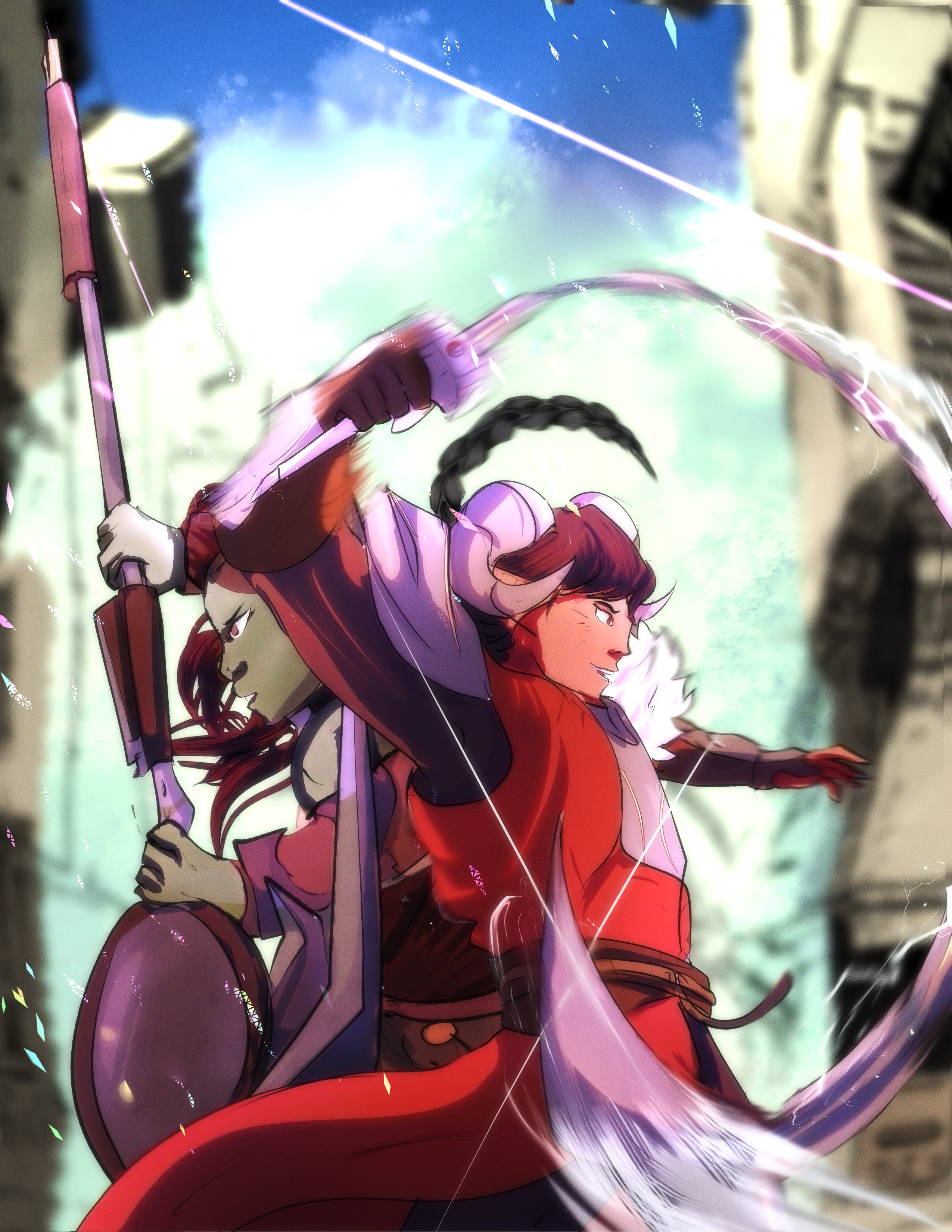
Hybrid Weaponary
The Hybrid Weapons are a unique weapon originally invented by the dwarves but they kept secret about it because of its destructive power and a lot of accidents while wielding them. While some with two melee weapons can be somewhat safe, many dwarven blacksmiths and artificers often let their ambition get the best of them. Putting in a firearm in a weapon, making them deadly to the user; The Gunblade. Even the construction turned out to be so difficult that only the great masters of their blacksmiths were able to produce the more advanced chambers.
Over the course of the years a few black market spies raided a weapon hall filled with those Hybrid Weapons, they stole them, sold ´em and the rest of the world took interest in these weapons. After a few weeks the first prototypes were used in battle, with fatal results, but over some months later, they were refined, the building plans and the materials and were able to produce the same lethal weapon as the dwarfs. Anyhow, the Gunblade in particular was so deadly it is partially forbidden in some towns. Also if anyone who lacked the skill and talent to wield this monster fell victim to his own Gunblade. The most deaths of the wielders were by shooting themselves and be slain in battle. Therefore only a handful of these weapons and users are out there.
But perhaps, you adventurer are an exception….
Mechanics
Mechanically, Hybrid Weapons are of two components. Any two melee weapons or a melee weapon and any ranged weapon. Anyone using a trick weapon, by using half their movement speed to transform the weapon to its second form and use their die as normal. This is because trick weapons are complicated machinery that can slow you down.
Trick Weapons composing of only two melee weapons are the simiplier of the two. Gunblades composing of a fire arm component are potientally stronger.
Example Trick Weapon
Example: A trick weapon with a longsword component, will use their 1d6 damage die, and have its verstile properity. If you were switch to its, say, whip form, it would use its 1d4 damage die, and gain its reach and Finesse properities.
Any skills, spells, or features that need a type of weapon, your gunblade can still fulfill that condition if one of its parts uses that same weapon, however, that effect will end once you switch to its other form.
Ruling on Fighting Styles
Example: You have a gunblade that is a greatsword melee component, you can still use Great Weapon Fighting Sytle, but switch to a pepperbox form. You lose the ability to use Great Weapon Fighting Style while in this form.
Using Weapon Mastery
What really brings this system to shine is the Weapon Mastery System. Without it, the trick weapon system is limited and stripped down to simply extra attacking and damage numbers, with properties alone not cutting up.
With weapon mastery, the individual weapons in both parts of the trick weapon have their seperate masteries. For example: A rapier form of a trick weapon has its Vex Mastery. Its second form, the whip, will have its Slow Mastery. But they cannot have the other's Mastery.
Below, however, is not only the mastery system, but it expanded with more weapon types and masteries. Some may not appear in the table, but can be swapped in.
You can use a weapon's mastery if you are proficient in said weapon. You may swap a weapon's mastery to another if that mastery meets the requirments if you spend downtime practicing with the weapon.
Acquiring a Hybrid Weapon
To obtain a Hybrid Weapon, when starting out in a game, the character can take any two weapons they start with and have them combined into one.
In any levels above 1, a player can start out with an additional weapon they are proficient with, and combine that with any other weapons they started with before the adventure begins.
In the middle of the adventure, any character with downtime can craft a hybrid weapon with the ones they have access to. Artificers, those who can use and are proficient with Tinkers tools and Smith tools are also able to craft one.
Any blacksmith in any town or city can also craft and upgrade a hybrid weapon. Combination services usually takes the medium price of the two weapons. If a player wants their current weapons combined, it is half of the lowest cost weapon.
Simple Weapons
| Weapon | Damage | Properties | Weapon Art | Weight | Cost |
|---|---|---|---|---|---|
| Club | 1d4 Bludgeoning | light | Slow | 2 lb. | 1sp |
| Dagger | 1d4 Piercing | Finesse, Light, Thrown (range 20/60) | Nick | 1 lb. | 1 gp |
| Greatclub | 1d8 bludgeoning | Two-handed | Sunder | 10 lb | 2 sp |
| Handaxe | 1d6 Slashing | Light, Thrown (Range 20/60) | Vex | 2 lb. | 5 gp |
| Javelin | 1d6 Piercing | Thrown (Range 30/120) | Slow | 2 lb. | 5 SP |
| Light Hammer | 1d4 Bludgeoning | Light, Thrown (Range 20/60) | Sunder | 2 lb. | 2 GP |
| Mace | 1d6 Bludgeoning | - | Sunder | 4 lb. | 5 GP |
| Quarter Staff | 1d6 Bludgeoning | Versatile (1d8) | Flex | 4 lb. | 2 SP |
| Sickle | 1d4 Slashing | Light | Nick | 2 lb. | 1 GP |
| Spear | 1d6 Piercing | Thrown (Range 20/60), Versatile (1d8) | Flex | 3 lb. | 1 GP |
Simple Ranged Weapons
| Weapon | Damage | Properties | Weapon Art | Weight | Cost |
|---|---|---|---|---|---|
| Light Crossbow | 1d8 Piercing | Ammunition (Range 80/320), Loading, Two-Handed | Sunder | 5 lb. | 25 GP |
| Dart | 1d4 Piercing | Finesse, Thrown (Range 20/60) | Vex | 1/4 lb. | 5 CP |
| Shortbow | 1d6 Piercing | Ammunition (Range 80/320), Two-Handed | Vex | 2 lb. | 25 GP |
| Sling | 1d4 Bludgeoning | Ammunition (Range 30/120) | Slow | — | 1 SP |
Martial Melee Weapons
| Weapon | Damage | Properties | Weapon Art | Weight | Cost |
|---|---|---|---|---|---|
| Battleaxe | 1d8 Slashing | Versatile (1d10) | Topple | 4 lb. | 10 GP |
| Estoc | 1d6 Piercing | Finesse, versatile (1d8) | Breaker | 4 lb. | 25 GP |
| Flail | 1d8 Bludgeoning | — | Sap | 2 lb. | 10 GP |
| Glaive | 1d10 Slashing | Heavy, Reach, Two-Handed | Graze | 6 lb. | 20 GP |
| Greataxe | 1d12 Slashing | Heavy, Two-Handed | Cleave | 7 lb. | 30 GP |
| Greatsword | 2d6 Slashing | Heavy, Two-Handed | Sunder | 6 lb. | 50 GP |
| Halberd | 1d10 Slashing | Heavy, Reach, Two-Handed | Cleave | 6 lb. | 20 GP |
| Lance | 1d10 Piercing | Heavy, Reach, Two-Handed (unless mounted) | Topple | 6 lb. | 10 GP |
| Longsword | 1d8 Slashing | Versatile (1d10) | Flex | 3 lb. | 15 GP |
| Katana | 2d4 Slashing | Finesse, Two-handed | Precise | 3 lb. | 30 gp |
| Maul | 2d6 Bludgeoning | Heavy, Two-Handed | Topple | 10 lb. | 10 GP |
| Morningstar | 1d8 Piercing | — | Sap | 4 lb. | 15 GP |
| Pike | 1d10 Piercing | Heavy, Reach, Two-Handed | Push | 18 lb. | 5 GP |
| Rapier | 1d8 Piercing | Finesse | Vex | 2 lb. | 25 GP |
| Scimitar | 1d6 Slashing | Finesse, Light | Nick | 3 lb. | 25 GP |
| Shortsword | 1d6 Piercing | Finesse, Light | Vex | 2 lb. | 10 GP |
| Trident | 1d8 Piercing | Thrown (Range 20/60), Versatile (1d10) | Topple | 4 lb. | 5 GP |
| War Pick | 1d8 Piercing | Versatile (1d10) | Flex | 2 lb. | 5 GP |
| Warhammer | 1d8 Bludgeoning | Versatile (1d10) | Flex | 2 lb. | 15 GP |
| Whip | 1d4 Slashing | Finesse, Reach | Slow | 3 lb. | 2 GP |
| War scythe | 1d8 Piercing/Slashing | heavy, reach, two-handed | Gleave | 8 lb. | 25 gp |
Martial Range Weapons
| Weapon | Damage | Properties | Weapon Art | Weight | Cost |
|---|---|---|---|---|---|
| Blowgun | 1 Piercing | Ammunition (Range 25/100), Loading | Vex | 1 lb. | 10 GP |
| Crossbow, Hand | 1d6 Piercing | Ammunition (Range 30/120), Light, Loading | Vex | 3 lb. | 75 GP |
| Crossbow, Heavy | 1d10 Piercing | Ammunition (Range 100/400), Heavy, Loading, Two-Handed | Push | 18 lb. | 50 GP |
| Longbow | 1d8 Piercing | Ammunition (Range 150/600), Fineesse, TwoHanded | Slow | 2 lb. | 50 GP |
| Great Bow | 2d6 Piercing | Ammunition (Range 300/600ft), Heavy, Two-handed | Topple | 10 lb. | 100 GP |
| Musket | 1d12 Piercing | Ammunition (Range 40/120), Loading 1, TwoHanded | Blow Back | 10 lb. | 500 GP |
| Pistol | 1d10 Piercing | Ammunition (Range 30/90), Loading 4, Light | Vex | 3 lb. | 250 GP |
Cleave
Prerequisite: Melee Weapon, Heavy Property
If you hit a creature with a melee attack using this weapon, you can make an attack roll with the weapon against a second creature within 5 ft of the first that is also within your reach where your first attack's roll hits their AC, you can damage them as well.
Flex
Prerequisite: Versatile Property
When you hit with a melee attack using this weapon, you deal its Versatile damage even if you’re wielding it with one hand.
Graze
Prerequisite: Melee Weapon, Heavy Property
If your attack roll with this weapon misses a creature, you can deal damage to that creature equal to the ability modifier you used to make the attack roll. This damage is the same type dealt by the weapon.
Nick
Prerequisite: Light Property
When you make the extra attack of the light property, you can make it as part of the attack action, instead of the bonus action. You can still make this extra attack only once per turn.
Push
Prerequisite: Heavy, Two-Handed, or Versatile Property
If you hit a creature with this weapon, you can push the creature up to 10 feet away from you if it is no more than one size larger than you.
Breaker
Prerequiste: Heavy, versatile
If you strike an opponent who is wearing non magical armor or natural armor they take a -2 penalty to their AC until the start of your next turn.
Sunder
Prerequisite: Heavy, Two-Handed
Your powerful blows with sunder weapons can devastate opponents. You roll one extra die of damage for the if the attack roll exceeds the target's AC by 10 or more.
Sap
Prerequisite: No Other Properties
If you hit a creature with this weapon, that creature loses additional modifiers to its attack roll once.
Slow
If you hit a creature with this weapon and deal damage to the creature, you can reduce its Speed by 10 feet until the start of your next turn. If you hit the creature more than once with this property, the Speed reduction doesn’t exceed 10 feet.
Topple
Prerequisite: Heavy, Reach, or Versatile Property
If you hit a creature with this weapon, you can force the creature to make a Constitution saving throw with a DC equal to 8 + your Proficiency Bonus + the ability modifier you used to make the attack roll. On a failed save, the creature has the Prone condition
Vex
Prerequisite: Ammunition, Finesse, or Light Property
If you hit a creature with this weapon and deal damage to the creature, you have Advantage on your next attack roll against that creature before the end of your next turn.
Finisher
Prerequiste: Finesse or light
When you hit a creature that is prone or cannot move with weapon, you deal extra damage equal to the weapon's damage die. (Example: If the weapon deals 2d8 damage, the extra damage would be 1d8.)
Precise
Requirement: Finesse
If the attack roll of this weapon is a 19, it is considered a critical hit. (Any features that increase the critical range will allow this weapon's critical range to increase by 1.)
Blow Back
Requirement: Firearm
When you hit a creature with a weapon with this mastery, you can attempt to launch your enemy backwards, and/or blow yourself back 10ft.
Explosive
Requirement: Firearm
Upon a hit, everything within 5 ft of the target also takes the damage if the attack roll also beats their AC.
Crush
Requirement: Heavy or inflict Bludgeoning damage
Once per turn on one creature, when you hit a creature with this weapon, their AC is reduced by half your Proficiency bonus (round down, minmum of 1) until the start of your next turn.
Drag
Requirement: Reach
When you hit a creature with this weapon, you can drag it 5 feet towards you; as part of this drag, you can move 5 feet away from the creature at the same time
Return
Requirement: Thrown Property
You have ways to make your thrown weapons return to you. When you make a ranged attack with this weapon and the attack misses, it immediately returns to your hand.
Weapon Upgrading & More Masteries
You may use more masteries on each of your weapons by taking it to a blacksmith to "refine" it when you have a +1 type of upgrade to it.
- +1: You may use 2 Masteries
- +2 : You may use 3 Masteries
- +3: You may use 4 Masteries
Hybrid weapons, however, each weapon is a seperate weapon. Meaning, the +x upgrade is seperate to that one side of the weapon.
Maneuvers for All
This is a optional rule that takes the Maneuvers of the Fighter's Battle Master subclass, and allows martial classes to use them without the need to multiclass or aquire a feat.
The following chart provides progression for when and how many superority dice and Maneuvers the martial classes learn from the battle master maneuver list
What is considered "Martial Level"
Any class that starts out with giving profiency in martial weapons or focuses on melee combat. For example: the following Classes Fighter, Barbarian, Blood Hunter, Monk, Paladin, Ranger & Rogue Use this line of thinking for any other homebrewed classes added.
Applying Maneuvers or Mastery to Attacks
You can only apply either a weapon mastery OR a Maneuver, not both, to an attack.
Difference between Weapon Mastery & Maneuvers
Masteries are basic function of the weapon, its also a fallback free effect you can apply. Maneuvers are learned techniques that you learn.
Multiclassing
Using any two classes that are martial are combined. For example: For a level 7 character with 2 levels in fighter, and 5 levels in barbarian, they are a martial level 7.
But if they are a level 8 character with 2 levels in fighter, 5 levels in barbarian, and 1 in wizard, you are still a martial level 7.
DC
Any maneuver that calls for a DC, use the following:
Maneuver Save DC
Manuevers For All
| Level | Maneuvers Known | Number of Superiority Die | Superiority Die Number |
|---|---|---|---|
| 1st | 1 | 2 | d6 |
| 2nd | 1 | 2 | d6 |
| 3rd | 2 | 2 | d6 |
| 4th | 2 | 2 | d6 |
| 5th | 3 | 3 | d6 |
| 6th | 3 | 3 | d8 |
| 7th | 4 | 3 | d8 |
| 8th | 4 | 3 | d8 |
| 9th | 5 | 4 | d8 |
| 10th | 5 | 4 | d8 |
| 11th | 6 | 4 | d10 |
| 12th | 6 | 4 | d10 |
| 13th | 7 | 5 | d10 |
| 14th | 7 | 5 | d10 |
| 15th | 8 | 5 | d10 |
| 16th | 8 | 5 | d12 |
| 17th | 9 | 6 | d12 |
| 18th | 9 | 6 | d12 |
| 19th | 10 | 6 | d12 |
| 20th | 10 | 6 | d12 |
Ambush
When you make a Dexterity (Stealth) check or an initiative roll, you can expend one superiority die and add the die to the roll, provided you aren't incapacitated.
Bait and Switch
When you're within 5 feet of a creature on your turn, you can expend one superiority die and switch places with that creature, provided you spend at least 5 feet of movement and the creature is willing and isn't incapacitated. This movement doesn't provoke opportunity attacks.
Roll the superiority die. Until the start of your next turn, you or the other creature (your choice) gains a bonus to AC equal to the number rolled.
Brace
When a creature you can see moves into the reach you have with the melee weapon you're wielding, you can use your reaction to expend one superiority die and make one attack against the creature, using that weapon. If the attack hits, add the superiority die to the weapon's damage roll.
Commander's Strike
When you take the Attack action on your turn, you can forgo one of your attacks and use a bonus action to direct one of your companions to strike. When you do so, choose a friendly creature who can see or hear you and expend one superiority die. That creature can immediately use its reaction to make one weapon attack, adding the superiority die to the attack's damage roll.
Commanding Presence
When you make a Charisma (Intimidation), a Charisma (Performance), or a Charisma (Persuasion) check, you can expend one superiority die and add the superiority die to the ability check.
Disarming Attack
When you hit a creature with a weapon attack, you can expend one superiority die to attempt to disarm the target, forcing it to drop one item of your choice that it's holding. You add the superiority die to the attack's damage roll, and the target must make a Strength saving throw. On a failed save, it drops the object you choose. The object lands at its feet.
Distracting Strike
When you hit a creature with a weapon attack, you can expend one superiority die to distract the creature, giving your allies an opening. You add the superiority die to the attack's damage roll. The next attack roll against the target by an attacker other than you has advantage if the attack is made before the start of your next turn.
Evasive Footwork
When you move, you can expend one superiority die, rolling the die and adding the number rolled to your AC until you stop moving.
Feinting Attack
You can expend one superiority die and use a bonus action on your turn to feint, choosing one creature within 5 feet of you as your target. You have advantage on your next attack roll against that creature this turn. If that attack hits, add the superiority die to the attack's damage roll.
Goading Attack
When you hit a creature with a weapon attack, you can expend one superiority die to attempt to goad the target into attacking you. You add the superiority die to the attack's damage roll, and the target must make a Wisdom saving throw. On a failed save, the target has disadvantage on all attack rolls against targets other than you until the end of your next turn.
Grappling Strike
Immediately after you hit a creature with a melee attack on your turn, you can expend one superiority die and then try to grapple the target as a bonus action (see the Player's Handbook for rules on grappling). Add the superiority die to your Strength (Athletics) check.
Lunging Attack
When you make a melee weapon attack on your turn, you can expend one superiority die to increase your reach for that attack by 5 feet. If you hit, you add the superiority die to the attack's damage roll.
Maneuvering Attack
When you hit a creature with a weapon attack, you can expend one superiority die to maneuver one of your comrades into a more advantageous position. You add the superiority die to the attack's damage roll, and you choose a friendly creature who can see or hear you. That creature can use its reaction to move up to half its speed without provoking opportunity attacks from the target of your attack.
Menacing Attack
When you hit a creature with a weapon attack, you can expend one superiority die to attempt to frighten the target. You add the superiority die to the attack's damage roll, and the target must make a Wisdom saving throw. On a failed save, it is frightened of you until the end of your next turn.
Parry
When another creature damages you with a melee attack, you can use your reaction and expend one superiority die to reduce the damage by the number you roll on your superiority die + your Dexterity modifier.
Precision Attack
When you make a weapon attack roll against a creature, you can expend one superiority die to add it to the roll. You can use this maneuver before or after making the attack roll, but before any effects of the attack are applied.
Pushing Attack
When you hit a creature with a weapon attack, you can expend one superiority die to attempt to drive the target back. You add the superiority die to the attack's damage roll, and if the target is Large or smaller, it must make a Strength saving throw. On a failed save, you push the target up to 15 feet away from you.
Quick Toss
As a bonus action, you can expend one superiority die and make a ranged attack with a weapon that has the thrown property. You can draw the weapon as part of making this attack. If you hit, add the superiority die to the weapon's damage roll.
Rally
On your turn, you can use a bonus action and expend one superiority die to bolster the resolve of one of your companions. When you do so, choose a friendly creature who can see or hear you. That creature gains temporary hit points equal to the superiority die roll + your Charisma modifier.
Riposte
When a creature misses you with a melee attack, you can use your reaction and expend one superiority die to make a melee weapon attack against the creature. If you hit, you add the superiority die to the attack's damage roll.
Sweeping Attack
When you hit a creature with a melee weapon attack, you can expend one superiority die to attempt to damage another creature with the same attack. Choose another creature within 5 feet of the original target and within your reach. If the original attack roll would hit the second creature, it takes damage equal to the number you roll on your superiority die. The damage is of the same type dealt by the original attack.
Tactical Assessment
When you make an Intelligence (Investigation), an Intelligence (History), or a Wisdom (Insight) check, you can expend one superiority die and add the superiority die to the ability check.
Trip Attack
When you hit a creature with a weapon attack, you can expend one superiority die to attempt to knock the target down. You add the superiority die to the attack's damage roll, and if the target is Large or smaller, it must make a Strength saving throw. On a failed save, you knock the target prone.
Art of the Transform & More Feats
All Hybrid Weapons have the ability to transform into their other form.
Transform. Once per turn, you may gave up half your movement to transform your weapon into its other form. This can be done in between your attack actions if you have something that grants another attack, such as extra attack, but still costing half your movement. After transforming, you may use one more attack with that weapon you transformed into with the new statistics, if able.
Hybrid Mastery
Requirement: Trick Weapon or Gunblade, 8th level
You have started to master the power of switching to and fo your hybrid weapon, sometimes, swapping or using part of your weapons other form without fully transforming. You may use the Weapon Mastery of one form of your weapon on the another.
Desperate Swap
Requirement: Trick Weapon or Gunblade, 8th level
You have learned how to get that extra juice of your weapon to start transforming even after using half your movement already. You may do this once per turn to transform your weapon once more, and gain +10 to the damage roll of the resulting damage.
However, doing it this way will open you up to attacks. Enemies will have a chance to perform a attack of opporunity on you if you are in their melee range.
Point-Blank Parry Shot
Prerequisite: level 8, Gunblade or Firearm with Firearm Profiency
If a medium sized creature's attack misses you while you have a firearm/Gunblade in your hand, you can use your reaction to expend a piece of ammunition to fire point-blank.
Make the attack with Disadvantage. If the attack hits, it counts as a critical from the firearm.
Burst Parry
Prerequisite: Gunblade, level 8
You gain the ability to explosively block enemy strikes. When creature hits you with a melee attack, you can use your reaction to spent your ammunition and add +3 to your AC for that attack, potentially causing the attack to miss you.
Gun Flame
Prerequisite: Level: 12, Gunblade, with a Firearm Component with a reload score of 2 or higher
When you use your Transform as part of the Transform attack, you can expend two Ammunitions at once to cause a conal explosion behind the target creature. Each creature in a 15 foot cone behind the target creature, including the target creature, must make a Dexterity saving throw against (DC equal to 8 + your proficiency bonus + your Dexterity modifier). A creature takes additional 1d10 fire damage to your normal weapon damage on a failed save, or half as much damage on a successful one.
Blade Mastery
You master the versatile weapon family of swords: estocs, greatswords, katanas, longswords, rapiers, scimitars and shortswords. You gain the following benefits when wielding any of them:
- On your turn, you can use your reaction to assume a parrying stance, provided you have the weapon in hand. Doing so grants you a +2 bonus to your AC for one attack.
- Creatures provoke opportunity attacks from you when they begin their movement while within your reach, not just when they leave it.
- When you make an opportunity attack with the weapon, you have advantage on the attack roll
Critical Finisher
You learned how to finish off targets with lethal precision with weapons of the Finisher Mastery.
- When you roll the extra damage of the Finisher Mastery and roll the maximum number, you can roll it again and add the result to the damage. You can keep going if the next die roll hits the max number.
- Once per turn, if you do have advantage on the target, you can forgo the advantage. If that attack hits, it triggers the Finisher Mastery extra damage die.
- You cannot have the option to make this attack non-lethal.
Dual Weilder
You master fighting with two weapons, gaining the following benefits:
- You gain a +1 bonus to AC while you are wielding a separate melee weapon in each hand.
- You can use two-weapon fighting even when the one- handed melee weapons you are wielding aren't light.
- You can draw or stow two one-handed weapons when you would normally be able to draw or stow only one, even if those weapons aren't light.
- As long as you are dual weilding two weapons, your off-hand weapons has the Nick Mastery in addition to any masteries they have.
The Hybrid Armory of Zeal
Listed below are example hybrid weapons. This system is more meant to be modular so players can come up with their own combinations of weapons. But here are a few to use and maybe get started with. Here is a Template to follow if you were to make a hybrid weapon of your own.
Stoneway Hammer
A weapon that as a sheath that is a massive stone maul. Pulling out and ejecting has the longsword within.
Transform. By using half your movement speed, you can transform your weapon into its other form. This can be done in between your attack actions if you have something that grants another attack, such as extra attack, but still costing your bonus action. After transforming, you may use a special attack, but roll damage dependent on the property of the weapon you transformed into. If a weapon has more than one property, you may pick the highest die to use.
Form 1: Longsword
Melee Weapon, Martial, Common
Damage: 1d8 Slashing
Property: Versatile (1d10)
Mastery: Flex
Weight 15 lbs.
Form 2: Maul
Melee Weapon, Martial
Damage: 2d6 Bludgeoning
Property: Heavy, Two-handed
Mastery: Topple
Weight 15 lbs.
Butcher Cleaver
A cleaver that can fold itself into a lighter scimitar like weapon. Or it can extend itself and become a glaive. This simple weapon often catches enemies off-guard with its deceptive range
Transform. By using half your movement speed, you can transform your weapon into its other form. This can be done in between your attack actions if you have something that grants another attack, such as extra attack, but still costing your bonus action. After transforming, you may use a special attack, but roll damage dependent on the property of the weapon you transformed into. If a weapon has more than one property, you may pick the highest die to use.
Form 1: Scimitar
Melee Weapon, Martial, Common
Damage: 1d6 Slashing
Property: Finesse, Light
Mastery: Nick
Weight 6 lbs.
Form 2: Glaive
Melee Weapon, Martial
Damage: 1d10 Slashing
Property: Heavy, Two-handed, Reach
Mastery: Graze
Weight: 9 lbs.
Ranger Ax
A ax commonly used by hunter rangers. This ax can extend for extra reach or shorten.
Transform. By using half your movement speed, you can transform your weapon into its other form. This can be done in between your attack actions if you have something that grants another attack, such as extra attack, but still costing your bonus action. After transforming, you may use a special attack, but roll damage dependent on the property of the weapon you transformed into. If a weapon has more than one property, you may pick the highest die to use.
Form 1: Battle Ax
Melee Weapon, Martial, Common
Damage: 1d8 Slashing
Property: Versatile (1d10)
Mastery: Topple
Weight 6 lbs.
Form 2: Great Axe
Melee Weapon, Martial
Damage: 1d12 Slashing
Property: Heavy, Two-handed
Mastery: Cleave
Weight: 9 lbs.
Blade Whip
A simple looking blade that can seperate segments of itself to turn into a bladed whip. Catching many offguard.
Transform. By using half your movement speed, you can transform your weapon into its other form. This can be done in between your attack actions if you have something that grants another attack, such as extra attack, but still costing your bonus action. After transforming, you may use a special attack, but roll damage dependent on the property of the weapon you transformed into. If a weapon has more than one property, you may pick the highest die to use.
Form 1: Rapier
Melee Weapon, Martial, Uncommon
Damage: 1d8 Piercing
Property: Finesse
Mastery: Vex
Weight 6 lbs.
Form 2: Whip
Melee Weapon, Martial
Damage: 1d4 Slashing
Property: Finesse, Reach
Mastery: Slow
Weight: 6 lbs.
Valkyrie Great Spear
This trick weapon is a unique one among Gloria's Valkyries. A spear and shield that can combine into a greatsword.
Transform. By using half your movement speed, you can transform your weapon into its other form. This can be done in between your attack actions if you have something that grants another attack, such as extra attack, but still costing your bonus action. After transforming, you may use a special attack, but roll damage dependent on the property of the weapon you transformed into. If a weapon has more than one property, you may pick the highest die to use.
Form 1: Spear and Shield
Simple Melee, Rare
Damage: 1d6 Slashing
Property: Versatile (1d8), Thrown (range20/60)
Mastery: Flex
Weight 6 lbs.
Transformed State: While in this form you have a Shield: +2 AC
Form 2: Greatsword
Melee Weapon, Martial
Damage: 2d6 Slashing
Property: Heavy, Two-handed
Mastery: Sunder
Weight: 6 lbs.
Dual-bladed Scimitar
A two sided bladed "polearm" that was made by the elves but enhanced by artificers to split into two longswords or scimitars.
Transform. By using half your movement speed, you can transform your weapon into its other form. This can be done in between your attack actions if you have something that grants another attack, such as extra attack, but still costing your bonus action. After transforming, you may use a special attack, but roll damage dependent on the property of the weapon you transformed into. If a weapon has more than one property, you may pick the highest die to use.
Form 1: Two Longswords
Melee Weapon, Martial, rare
Damage: 1d8 Slashing
Property: Versatile (1d10)
Mastery: Flex
Transform State: While in this state, you are considered dual wielding.
Weight 6 lbs.
Form 2: Double-Bladed Scimitar
Melee Weapon, Martial
Damage: 2d4 Slashing
Property: Special, Two-handed
Mastery: Nick
Special and Transform Bonus Property: If you attack with a double-bladed scimitar as part of the Attack action on your turn, you can use a bonus action immediately after to make a melee attack with it. This attack deals 1d4 slashing damage on a hit, instead of 2d4.
Weight: 9 lbs.
Knuckle-Stopper
A pair of what look like punching gauntlets. But within its metallic shine was a shatter type gun that fires off shards in a cone. Popular with ruffians in the streets and often the planter of seeds of hubris within them.
Transform. By using half your movement speed, you can transform your weapon into its other form. This can be done in between your attack actions if you have something that grants another attack, such as extra attack, but still costing your bonus action. After transforming, you may use a special attack, but roll damage dependent on the property of the weapon you transformed into. If a weapon has more than one property, you may pick the highest die to use.
Form 1: Brass Knuckles
Melee Weapon, Simple, Uncommon
Damage: 1d4 Bludgeoning
Property: Light
Mastery: Graze
Weight 2 lbs.
Form 2: Pistol
Firearm
Damage: 1d10 Piercing
Property: Ammunition (Range 30/90), Loading 4, Light
Mastery: Explosion
Weight: 5 lbs
Toothpick
A very simple looking dagger that can flip around and turn itself into a pistol. A favorite among rogues of the street, with its quick transformation for its quick, light-weight, and effective prowless
Transform. By using half your movement speed, you can transform your weapon into its other form. This can be done in between your attack actions if you have something that grants another attack, such as extra attack, but still costing your bonus action. After transforming, you may use a special attack, but roll damage dependent on the property of the weapon you transformed into. If a weapon has more than one property, you may pick the highest die to use.
Form 1: Dagger
Melee Weapon, Simple, Common
Damage: 1d4 Piercing
Property: Finesse, light, thrown (range 20/60)
Mastery: Parry
Weight 1 lbs.
Form 2: Pistol
Firearm
Damage: 1d10 Piercing
Property: Ammunition (Range 30/90), Reload (4), Light
Mastery: Vex
Weight: 3 lbs
Steel Queen
One of the first common types of gunblades made, made to be a gunblade wielders first weapon to practice with, but it is still one of the most versatile basic weapons.
Transform. By using half your movement speed, you can transform your weapon into its other form. This can be done in between your attack actions if you have something that grants another attack, such as extra attack, but still costing your bonus action. After transforming, you may use a special attack, but roll damage dependent on the property of the weapon you transformed into. If a weapon has more than one property, you may pick the highest die to use.
Form 1: Longsword
Melee Weapon, Martial, Common
Damage: 1d8 Piercing
Property: Versatile (1d10)
Mastery: Flex
Weight 3 lbs.
Form 2: Musket
Firearm
Damage: 1d12 Piercing
Property: Ammunition (Range 30/90), Loading 1, Two-handed
Mastery: Blowback
Weight: 3 lbs
Warriors' Mare
A Greataxe hidden within are explosive rounds. highly favored by Barbarians, making them a bigger threat.
Transform. By using half your movement speed, you can transform your weapon into its other form. This can be done in between your attack actions if you have something that grants another attack, such as extra attack, but still costing your bonus action. After transforming, you may use a special attack, but roll damage dependent on the property of the weapon you transformed into. If a weapon has more than one property, you may pick the highest die to use.
Form 1: Greataxe
Melee Weapon, Martial, Common
Damage: 1d12 Slashing
Property: Heavy, two-handed
Mastery: Cleave
Weight 7 lbs.
Form 2: Musket
Firearm
Damage: 2d8 fire
Property: Ammunition (Range 40/120), Loading 1, TwoHanded
Mastery: Explosive
Weight: 10 lbs
The Prototypes
Magic weapons are from a time long gone. With Hybrid weapons being so new, there are very few magic items of these type of weapons. The oldest of these types are the "Prototype Hybrids." The very first ever made that have been scattered across the winds.
Aulem Draconis
Legendary, Requires Attunement
A glaive used by the legendary Drachenlancer Drake "Raiden" Itsuki. This polearm used has mechanisms to turn itself into a greatbow. And unique among all Hybrid Weapons, a third form: a scythe form. By turning the transformation midway, the bow component can be able to "jam" and turn the weapon into a scythe.
Effect. You deal an additional +2 to attack and damage rolls with this weapon. If you manage to land a critical hit on a dragon, you can deal extra 2d6 damage.
Transform. By using half your movement speed, you can transform your weapon into its other form. This can be done in between your attack actions if you have something that grants another attack, such as extra attack, but still costing your bonus action. After transforming, you may use a special attack, but roll damage dependent on the property of the weapon you transformed into. If a weapon has more than one property, you may pick the highest die to use.
Form 1: Glaive
Melee Weapon, Martial
Damage: 1d10 Slashing
Property: Heavy, Reach, Two-handed
Mastery: Graze
Weight 6 lbs.
Form 2: Greatbow
Range Weapon, Martial
Damage: 1d10 Piercing
Property: Ammunition (range 200/800), Heavy, Special, Two-handed.
Mastery: Topple
Transform Effect: Among transforming, when performing your transform damage, you can backflip up to 15ft to a location you can reach without provoking opporunity attacks.
Weight: 10 lbs.
Form 3: War Sycthe
Range Weapon, Martial
Damage: 2d4 Slashing
Property: Heavy, Reach, Two-handed.
Mastery: Gleave
Weight: 7 lbs.
Transform Effect: Pull. By using half your movement speed, (including when you transform into this form, instead of using the damage die,) you can make a target within your reach make a DC 12 Strength Saving Throw and move them away from you or to you 5ft. You may move along side the target with this movement should you choose to. You do not provoke opporunity attacks with this movement
'Asada Alfajr
Legendary Weapon, Greatsword, Gunblade, (Requires Attunement)
A greatsword that has many mechanicisms in it. Transforming into a explosive firearm version. This sword was used by the Mirembe Elfair. A Paladin of sunlight in Coehiem.
Effect. You gain a +2 bonus to attack and damage rolls made with this weapon, which you can choose to deal radiant damage instead of its normal damage types. When you hit an undead with it, that target takes an extra 1d8 radiant damage.
Dim Light. This blade can shed light in a 15ft radius and dim light for an additional 15ft.
Transform. By using half your movement speed, you can transform your weapon into its other form. This can be done in between your attack actions if you have something that grants another attack, such as extra attack, but still costing your bonus action. After transforming, you may use a special attack, but roll damage dependent on the property of the weapon you transformed into. If a weapon has more than one property, you may pick the highest die to use.
Form 1: Greatsword
Melee Weapon, Martial
Damage: 2d6 Slashing
Property: Heavy, Two-handed
Mastery: Sunder
Weight 12 lbs.
Form 2: Musket
Ranged Firearm
Damage: 1d12 piercing
Property: Reload (1), Misfire(1), Ammunition, Explosive
Mastery: Explosive