

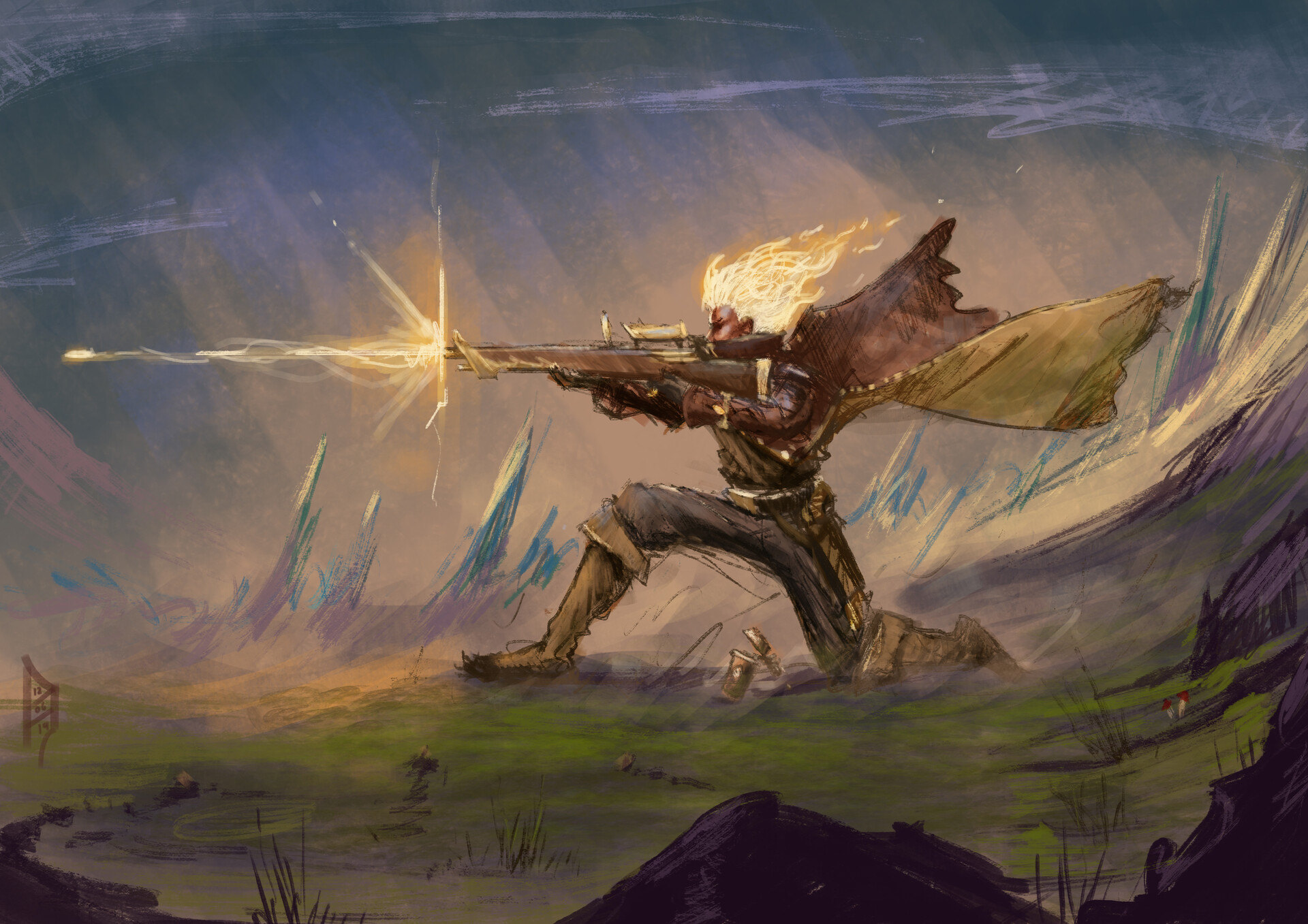
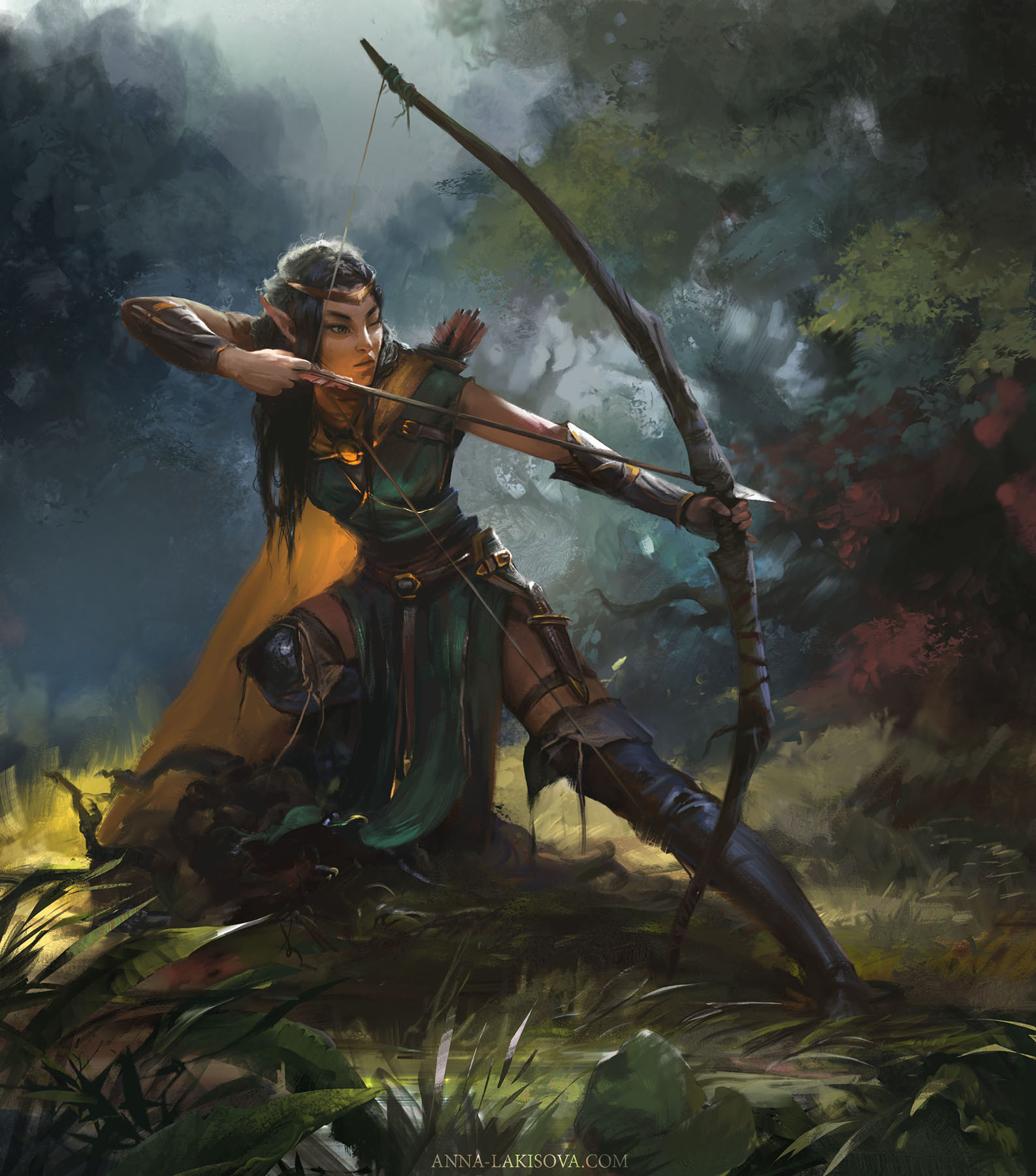
An elven man knocks an arrow in his bow and takes aim at the orc keeping lookout from a crudely-constructed watch tower. He concentrates all of his focus on the shot, and when he releases the arrow, it swiftly and silently enters the orc's neck, killing him instantly. The elf smirks, knowing the rest of his party can now infiltrate the stronghold with ease.
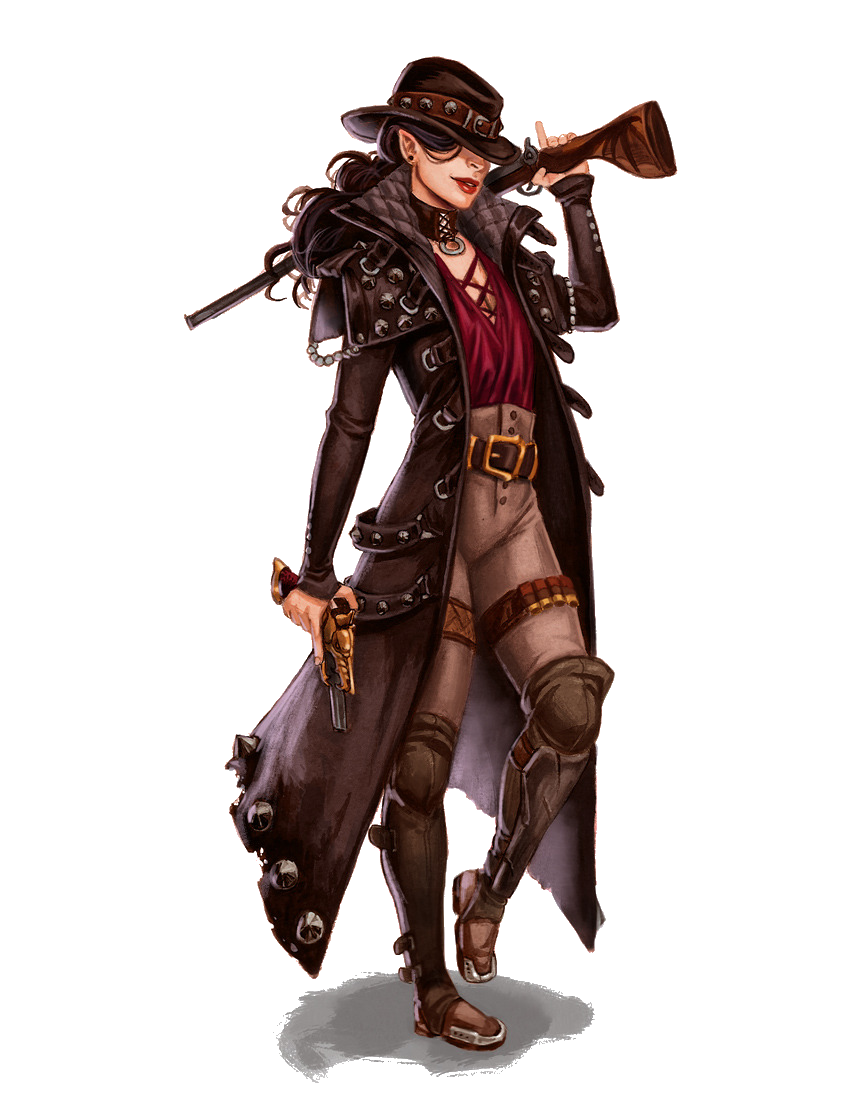
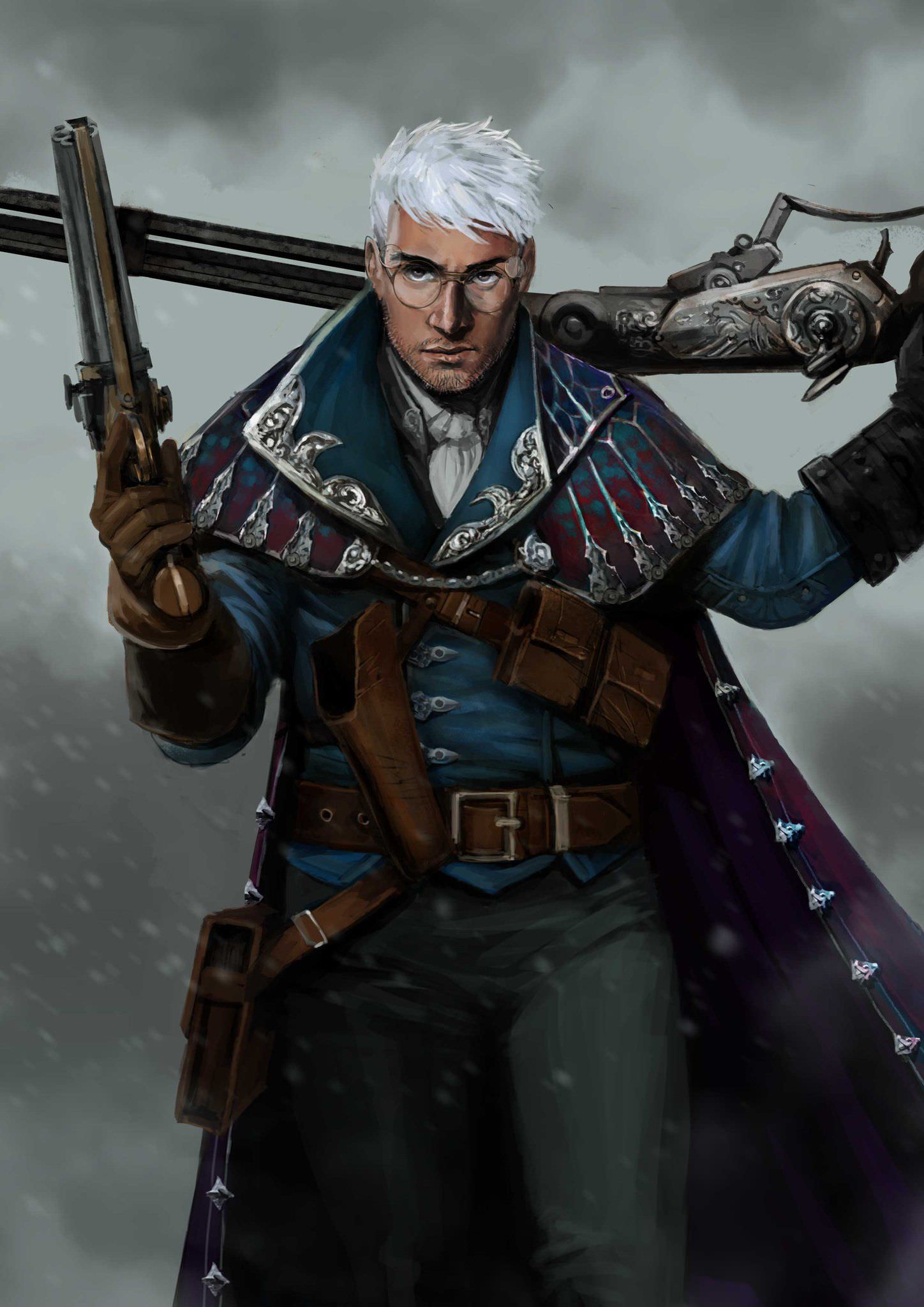
A pistol in each hand, a human walks through the streets of a desert town. She casts her gaze from building to building, knowing her mark must be here somewhere. When a tiefling loudly exits a nearby tavern, she knows the time has come. With deadly accuracy, she raises a pistol and fires; and a few hours later, her pursestrings are fifty gold coins heavier.
Swift and deadly, a halfling swings their sword at the leg of the dire wolf attacking them. When the beast whirls around for a bite, a bolt from a hand crossbow, expertly aimed, enters its eye, causing it to wheel back in pain. Two more slices and another bolt to the jaw, and the halfling stands triumphant over their prey.
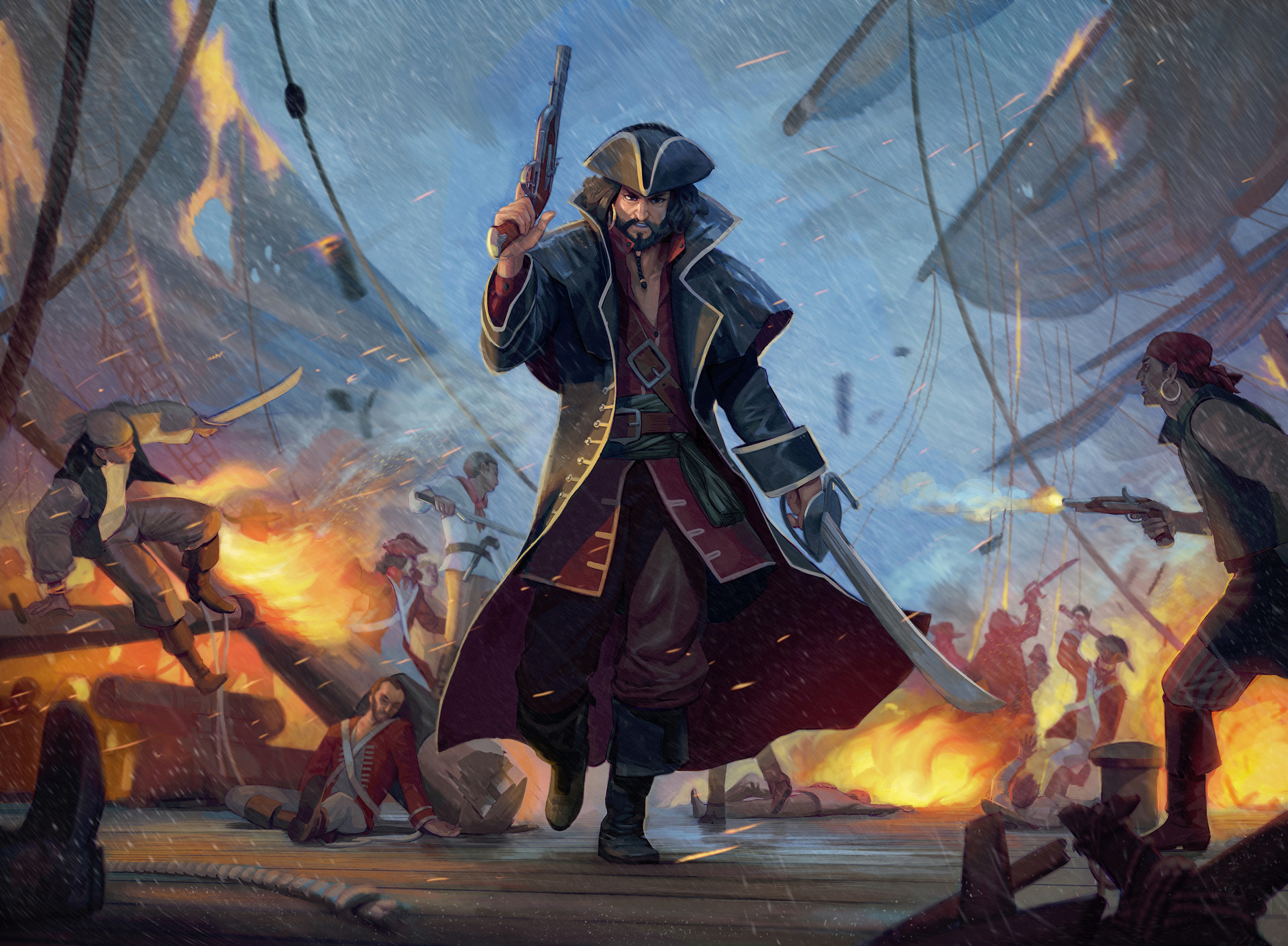
Desperados are those who ply their wit and determination into ranged combat. Be it bow, crossbow, or gun, desperados can take down any target from afar. From frontiersmen and privateers to snipers and assassins, anyone who specializes in ranged weapons could be called a desperado.
Rugged Adventurers
Most, if not all, desperados are adventurers at heart. There is little need for marksmen and crack shots outside of the trade of explorers and mercenaries, after all, so most with the skills of a desperado find themselves taking on bounties and other dangerous work. They also tend to move around a lot, since having such a violent trade will eventually put a target on your back if you linger too long in one location.
Desperados have a reputation for being rugged, rigorous folk. They are viewed as focused, determined, and patient; a desperado will get the job done where most couldn't. They aren't concerned with being flashy, all that matters is results. What is the point in giant gouts of flame or crackling arcs of lightning if a swift shot ends a life just as well?
Lethal and Versatile
Other areas in which desperados are known to excel are their sheer lethality and ability to improvise. It can be said that every desperado's motto is "it only takes one shot", and that is certainly true for most of them. They are also incredibly quick on their feet and able to adapt to any situation. A good desperado has a variety of tricks up their sleeve, and the right amount of skill to be able to pull off these tricks. Both of these traits combined make desperados quite deceptively dangerous.
Optional Rule: Multiclassing
If your group uses the optional rule on multiclassing in the Player's Handbook, here's what you need to know if you choose desperado as one of your classes.
Ability Score Minimum. As a multiclass character, you must have at least a Dexterity score of 13 to take a level in this class, or to take a level in another class if you are already a desperado.
Proficiencies Gained. If desperado isn't your initial class, here are the proficiencies you gain when you take your first level as a desperado: light armor, simple weapons, and martial weapons.
Optional Rule: Firearm Proficiency
Though firearms are generally uncommon in many settings and nonexistant in others, it is possible that your desperado may be familiar enough with these weapons to wield them. With permission from your DM, your desperado may be proficient in firearms, and potentially, tinker's tools.
Desperados are heavily based on the theme of cowboys and pirates, both groups of people that famously wielded guns. However, not all settings and not all tables allow for firearms, and this class is designed with that in mind; every feature works with any ranged weapon, including crossbows and bows. Guns aren't a necessity to play this class.
That said, if your DM permits you to use firearms, this document comes with rules for firearms, which are detailed at the end of the class description. Enjoy!



Class Features
As a desperado, you gain the following class features.
Hit Points
- Hit Dice: 1d8 per desperado level
- Hit Points at 1st Level: 8 + your Constitution modifier
- Hit Points at Higher Levels: 1d8 (or 5) + your Constitution modifier per desperado level after 1st
Proficiencies
- Armor: Light armor
- Weapons: Simple weapons, martial weapons
- Tools: None
- Saving Throws: Dexterity, Strength
- Skills: Choose two from Acrobatics, Stealth, Perception, Survival, Insight, Intimidation, or Sleight of Hand
Equipment
You start with the following equipment, in addition to the equipment granted by your background:
- (a) a longbow and 20 arrows or (b) a heavy crossbow and 20 bolts or (c) a hand crossbow and 20 bolts
- (a) a shortsword or (b) any simple melee weapon
- An explorer's pack and leather armor
Ranged Specialty
Desperados are experts at fighting from afar. You gain a +1 bonus to attack and damage rolls with ranged weapons, unless it is a magic weapon that already has a bonus to those rolls or you already have a similar bonus (such as from the Archery fighting style). This bonus increases to +2 at 9th level and +3 at 17th level. Additionally, you can ignore the loading property of ranged weapons that you are proficient in.
Mark Target
You can focus all your efforts on taking down one foe. At the start of your turn, you can expend a use of this feature to mark a creature you can see within range of one weapon you are holding for 1 minute or until you use this feature again.
While a creature is marked by you, you have advantage on Perception checks to locate them, and whenever you hit them with a weapon attack, you may add half your proficiency bonus (rounded up) to the damage roll.
When you make a ranged weapon attack against a marked creature, you can choose to end the mark early to take aim on the target, gaining advantage on the attack. This attack still benefits from Mark Target's damage bonus if it hits.
You can use this feature a number of times equal to your proficiency bonus, and you regain all expended uses when you finish a short or long rest.
Focus
At 2nd-level, your concentration becomes one of your most useful tools. You have a pool of points, called focus points.
The first time you make a ranged weapon attack on each of your turns during combat, you gain 1 focus point whether it hits or misses. You can have a maximum of 5 focus points at a time, and cannot gain any over this limit. You lose all unexpended focus points when you finish a short or long rest.
The Desperado
| Level | Proficiency Bonus | Features | Deeds Known |
|---|---|---|---|
| 1st | +2 | Ranged Specialty (+1), Mark Target | — |
| 2nd | +2 | Focus, Deeds | 2 |
| 3rd | +2 | Desperado Trail | 2 |
| 4th | +2 | Ability Score Improvement | 2 |
| 5th | +3 | Extra Attack | 3 |
| 6th | +3 | At The Ready, Crack Shot |
3 |
| 7th | +3 | Trail feature | 3 |
| 8th | +3 | Ability Score Improvement | 3 |
| 9th | +4 | Ranged Specialty (+2) | 4 |
| 10th | +4 | Clear Head | 4 |
| 11th | +4 | Trail feature | 4 |
| 12th | +4 | Ability Score Improvement | 4 |
| 13th | +5 | Impromptu | 5 |
| 14th | +5 | Crack Shot Improvement | 5 |
| 15th | +5 | Trail feature | 5 |
| 16th | +5 | Ability Score Improvement | 5 |
| 17th | +6 | Ranged Specialty (+3) | 6 |
| 18th | +6 | Can't Miss | 6 |
| 19th | +6 | Ability Score Improvement | 6 |
| 20th | +6 | Dead Set | 6 |
You can spend a minute concentrating (as if you were concentrating on a spell) to gain 1 focus point. Once you gain a focus point in this manner, you can't do it again for 1 hour or until you roll initiative. When you roll initiative, your number of focus points is set to 1.
Reliance
You are reliant on something to produce your intense level of focus. Choose one of the following options.
- Discipline. Your reliance ability is Wisdom.
- Moxie. Your reliance ability is Charisma.
- Wit. Your reliance ability is Intelligence.
When a desperado feature refers to your reliance ability, you use the corresponding ability from this feature (such as Charisma, if you chose Moxie).
Deeds
Also at 2nd level, you learn how to perform various deeds. You learn two deeds of your choice from the options listed at the end of the class description. When you gain certain desperado levels, you gain additional deeds of your choice, as shown in the Deeds Known column of the Desperado table.
When you gain a level in this class, you can choose one of the deeds you know and replace it with another deed that you could learn at that level. A level prerequisite in a deed refers to your desperado level, not your character level.
Deeds require focus points to use, described by your Focus feature. Some deeds modify your ranged weapon attacks or allow you to make more; if you spend focus points on such a deed, that attack does not grant you a focus point like normal.
Some deeds require your target to make a saving throw to resist the deed's effects. The saving throw DC is calculated as follows:
Deed Save DC = 8 + your proficiency bonus + your reliance ability modifier
Desperado Trail
At 3rd level, you choose your trail, which determines how you apply your desperado skills. Choose from the Deadeye, the Duelist, the Engineer, the Falconer, the Malefactor, the Mountebank, the Pioneer, the Renegade, the Tactician, or the Vanguard, each detailed at the end of the class description. Your choice grants you features at 3rd level and again at 7th, 11th, and 15th level.
Ability Score Improvement
When you reach 4th level, and again at 8th, 12th, 16th, and 19th level, you can increase one ability score of your choice by 2, or you can increase two ability scores of your choice by 1. As normal, you can't increase an ability score above 20 using this feature.
Extra Attack
At 5th level, you can attack twice, instead of once, whenever you take the Attack action on your turn.
At The Ready
At 6th level, you are always prepared for a fight to break out. You can add your reliance ability modifier to initiative rolls.
Crack Shot
Also at 6th level, you know how to hit your enemy's weak points. When you make a ranged weapon attack, you score a critical hit on a roll of 19 or 20.
When you reach 14th level, your ranged weapon attacks score a critical hit on a roll of 18-20.
Clear Head
At 10th level, your mind is sharper than ever. You now gain a focus point the second time you make a ranged weapon attack on your turn during combat, and the amount of focus points you gain by spending a minute concentrating is now 2.
Impromptu
At 13th level, you can change your tactics at a moment's notice. When you finish a long rest, you can replace one deed you know with another deed that you could learn at that level.
Can't Miss
At 18th level, your aim becomes the stuff of legends. If you miss with an attack roll using a ranged weapon, you can reroll it. You can use this feature once per round.
Dead Set
At 20th level, nothing in the world can stop you. You have unlimited uses of your Mark target feature, and you gain 1 focus point at the start of each of your turns in combat, which is in addition to any you might gain by making attacks.


Deeds
The following deeds are available to all desperados.
Blast Shot
When you make a ranged weapon attack, you can spend 1 focus point make it particularly destructive. If the attack hits an object or structure, the damage is doubled. Alternatively, if it hits a lock, the attack roll can be used in place of a thieves' tools check to unlock it.
Combat Roll
As a reaction to being hit by an Attack or failing a Dexterity saving throw, you can spend any number of available focus points. Your AC or saving throw result against the attack or effect increases by 1 for each focus point spent, potentially causing it to miss.
Detection Field
As a bonus action, you can spend 1 focus point to direct your finely-tuned senses to the area around you. For the next minute, or until you lose concentration (as if you were concentrating on a spell), you benefit from a detection field that extends in a 30-foot radius around you. You have advantage on any Perception, Investigation, Survival, or Insight check that you make, as long as what you are sensing is within the field's area.
The advantage granted by this ability increases your passive scores for the affected skills by 5 as normal.
Fan the Hammer
When you take the Attack action, you can spend any number of available focus points. You can then make an additional number of ranged weapon attacks equal to the number of focus points spent, as well as the number of attacks you can normally make with the Attack action. Any attacks you make as part of this action do not add your Dexterity modifier to the damage roll.
Marksman's Knack
When you make an ability check, you can spend any number of available focus points to roll a die and add it to the result. The die you roll depends on the number of focus points spent; a d4 for 1 focus point, a d6 for 2 focus points, a d8 for 3 focus points, a d10 for 4 focus points, and a d12 for 5 focus points.
Overwatch
When a creature within range of a ranged weapon you are wielding makes an attack against a creature other than you, you can spend 1 focus point as a reaction to make an attack against that creature using that weapon.
Propulsive Shot
When you make a ranged weapon attack, you can spend any number of available focus points to launch the target backwards. If the attack hits, the target must make a Strength saving throw; on a failure, they are pushed 10 feet for each focus point spent away from you in a straight line, or half that distance on a success.
Rapid Fire
Immediately after you take the Attack action, you can spend 1 focus point to make an attack with one ranged weapon you are holding as a bonus action.
Retort
When a creature within range of a ranged weapon you are wielding makes an attack against you, you can spend 1 focus point as a reaction to make an attack against that creature using that weapon.
Showdown
As a bonus action, you can spend any 1 focus point to challenge a creature within 60 feet of you that can see or hear you to a duel. The target must make a Charisma saving throw. On a failed save (or if they accept the challenge), you and the target have disadvantage on attack rolls against other creatures for 1 minute, until one of you reach 0 hit points, or until one of you uses an action to surrender.
Sniper's Stance
As a bonus action, you can spend 1 focus points to hone your senses to be able to shoot far away targets. For the next minute, you treat the short and long ranges of all ranged weapon attacks as double their normal distance.
Trip Up
When you make a ranged weapon attack against a creature, you can spend 1 focus point to attempt to trip them. If the attack hits, the target must make a Strength saving throw; on a failure, they are knocked prone.

Vital Shot
When you make a ranged weapon attack against a creature, you can spend any number of available focus points to aim for a weak point. If the attack hits, you roll an additional weapon damage die for each focus point spent.
Winging Shot
When you make a ranged weapon attack against a creature, you can spend any number of available focus points to attempt to cripple them. If the attack hits, choose one of the target's movement speeds; that movement speed is reduced by 15 feet for each focus point spent until the end of your next turn.
Withdraw
As a bonus action, you can spend 1 focus point to move up to half your speed. This movement does not provoke opportunity attacks.
Alerting Shot
Prerequisite: 5th level
When an allied creature within range of a ranged weapon you are wielding makes a saving throw, you can spend any number of available focus points to warn them of the threat. Your ally gains a bonus to the saving throw equal to the number of focus points spent.
Deflecting Shot
Prerequisite: 5th level
When a creature within range of a ranged weapon you are wielding is hit by an attack, you can spend any number of available focus points to deflect the attack. Your ally's AC against the attack increases by 1 for each focus point spent, potentially causing it to miss.
Distracting Shot
Prerequisite: 5th level
When a creature within range of a ranged weapon you are wielding makes a saving throw, you can spend any number of available focus points to distract them. The creature takes a penalty to the saving throw equal to the number of focus points spent.
Focus Fire
Prerequisite: 5th level
When you make a ranged weapon attack, you can spend any number of available focus points to direct an ally that can see or hear you to attack the same creature. Whether your attack hits or misses, the chosen ally gains a bonus to the next attack roll they make against your target before the start of your next turn equal to the number of focus points spent.
Harrowing Shot
Prerequisite: 5th level
When you make a ranged attack roll, you can spend 2 focus points to attempt to frighten the target. Whether the attack hits or misses, the target must make a Wisdom saving throw or be frightened of you until the end of your next turn.
Hemorrhage
Prerequisite: 5th level
When you make a ranged weapon attack against a creature, you can spend 3 focus points to attempt to wound the target. If the attack hits, the target takes damage at the start of its next turn equal to half the damage the attack dealt.
Kickback
Prerequisite: 5th level
When you make a ranged attack, you can spend any number of available focus points to let the shot propel you backwards. Whether the attack hits or misses, you are moved backwards in a straight line; up to 10 feet horizontally for each focus point spent, or up to 5 feet vertically for each focus point spent.
Quick on the Trigger
Prerequisite: 5th level
When you roll initiative and aren't surprised, you can choose to spend 1 focus point to take your turn first instead of making an initiative roll.
Stagger Shot
Prerequisite: 5th level
When you make a ranged weapon attack against a creature, you can spend 3 focus points to attempt to daze the target. If the attack hits, the target must make a Constitution saving throw; on a failure, they are stunned until the end of your next turn.
Bombardment
Prerequisite: 9th level
As an action while wielding a ranged weapon, you can spend 3 focus points to bombard an area with projectiles. Choose a point within range of a ranged weapon you're holding; every creature within 10 feet of that point must make a Dexterity saving throw, taking the weapon's damage on a failure.

Counter Shot
Prerequisite: 9th level
When a creature within range of a ranged weapon you are wielding casts a spell, you can spend any number of available focus points to counter it. Make a ranged weapon attack against the target; on a hit, instead of dealing the weapon's damage, the spell they are casting automatically fails if its level is equal to or less than the number of focus points spent.
Keep Your Cool
Prerequisite: 9th level
At the start of your turn, you can spend 1 focus point (no action required) to end one effect on yourself that is causing you to be charmed or frightened.
Penetrative Shot
Prerequisite: 9th level
When you make a ranged weapon attack, you can spend 3 focus points to have it penetrate your targets. Instead of making an attack roll, you force every creature in a line to make a Dexterity saving throw, taking the weapon's damage on a failure. The line is 5 feet wide and is a number of feet long equal to the weapon's normal range, extending out from your space.
Ricochet
Prerequisite: 9th level
When you miss with a ranged weapon attack, you can spend 2 focus points to reroll the attack against a different target within 60 feet of the original target.
Because this deed is retroactive, you still gain a focus point from making the attack as normal. However, you do not gain a focus point from rerolling the attack.
Scatter Blast
Prerequisite: 9th level
As an action while wielding a ranged weapon, you can spend 3 focus points to spray projectiles in front of you. Every creature in 30-foot cone in front of you must make a Dexterity saving throw, taking the weapon's damage on a failure. If the weapon you are wielding has the Scatter property, every creature in the area takes damage from that property whether they succeed or fail.
Stand Your Ground
Prerequisite: 9th level
When you are subjected to an effect that allows you to make a Strength, Dexterity, or Constitution saving throw to take only half damage, you can spend 1 focus to instead take no damage if you succeed on the saving throw, and only half damage if you fail.
Cheat Death
Prerequisite: 13th level
When you are reduced to 0 hit points, you can spend 2 focus points (no action required) to have 1 hit point instead.
Lightning Reflexes
Prerequisite: 13th level
Once per round, if you've already taken your reaction, you can spend 1 focus point to take an additional reaction.

Deadeye
Other desperados may focus on other skills and fill other roles, but a deadeye chooses to perfect the art of ranged combat. All they need is a good rifle, crossbow, or bow to complete their mission; no need to diversify their skill set when good enough aim will get the job done just as well.
Deadeye Features
| Desperado Level |
Feature |
|---|---|
| 3rd | Eagle Eye, Deadeye's Deeds |
| 7th | Vantage Point |
| 11th | Upper Hand |
| 15th | Deadly Intent |
Eagle Eye
When you choose this trail at 3rd level, your vision becomes incredibly sharp. You gain proficiency in the Perception skill if you don't have it already. Your proficiency bonus is doubled for any ability check you make that uses this proficiency.
Additionally, you can see up to 1 mile away with no difficulty, able to discern even fine details as though looking at something no more than 100 feet away from you.
Deadeye's Deeds
Also at 3rd level, you gain two additional deeds, which don't count against your number of deeds known and can't be replaced. The deeds are as follows.
One Shot, One Kill. As an action, you can spend 3 focus points to concentrate on a single shot. Make a ranged weapon attack; if it hits, it becomes a critical hit. You can only use this deed if you haven't made any attacks this turn, and once you use this deed, you can't make any attacks until end of the current turn.
Suppressive Fire. As an action, you can spend 2 focus points to lay down suppressive fire. Choose a point within range of one ranged weapon you're holding; all hostile creatures within 15 feet of that point suffer a penalty to all attack rolls and saving throws equal to your reliance ability modifier until the start of your next turn.
Vantage Point
At 7th level, you know how to maintain an advantageous position. When you have disadvantage on an attack roll or saving throw, you can choose to roll without the disadvantage.
Once you use this feature, you can't use it again until you finish a short or long rest. You do not expend the use of this feature if you fail the attack or saving throw, only if you succeed.
Upper Hand
At 11th level, you are a master of utilizing your advantages to the fullest. If you have advantage on a ranged weapon attack, you roll 3 d20's, instead of 2, and take the highest result.
Deadly Intent
At 15th level, you have an incredible amount of focus. Your maximum amount of focus points increases to 6.


Duelist
One crossbow, bow, or rifle is not enough for some. Duelists do what many think is far too impractical and attempt to use two weapons in a fight. While many prefer to wield two hand crossbows or pistols, a few replace one of those with a sword or something similar for even greater versatility.
Duelist Features
| Desperado Level |
Feature |
|---|---|
| 3rd | Akimbo, Duelist's Deeds |
| 7th | One On One |
| 11th | Deadly Dance |
| 15th | Incessant Assault |
Akimbo
When you choose this trail at 3rd level, your fighting style incorporates the use of two separate weapons. You gain the following benefits.
- You can treat light ranged weapons with which you are proficient as light melee weapons for the purposes of two-weapon fighting. They do not count as melee weapons in any other way, however.
- Being within 5 feet of a hostile creature doesn’t impose disadvantage on your ranged weapon attacks against that creature.
- You can draw or stow two one-handed weapons when you would normally be able to draw or stow only one.
- If you are engaging in two-weapon fighting using a melee weapon and a ranged weapon, the melee weapon you are wielding is treated as a ranged weapon for the purposes of features from this class, including deeds.
Duelist's Deeds
Also at 3rd level, you gain two additional deeds, which don't count against your number of deeds known and can't be replaced. The deeds are as follows.
Tandem Strike. If you are engaging in two-weapon fighting, when you make an attack with one of the weapons you are wielding, you can spend 2 focus points to strike with both weapons, provided the target is within range of both weapons. If the attack hits, you roll the damage dice of both weapons when dealing damage to the target. You can only use this deed once per turn.
Ten Paces. At the start of your turn, you can spend 1 focus point (no action required). Until the end of the turn, whenever you make a weapon attack, you can move up to 10 feet before making the attack.
One On One
At 7th level, you have further perfected your dueling technique. While you are engaging in two-weapon fighting, you gain the following benefits.
- When you hit a creature with a weapon attack, that creature can't make opportunity attacks against you for the rest of the turn.
- You can add your ability modifier to the damage of the bonus attack.
Deadly Dance
At 11th level, you can attack all nearby foes. While engaging in two-weapon fighting, you can use your action to make a weapon attack against each creature of your choice within 5 feet of you, with a separate attack roll for each target. These attacks can be made using either weapon you are wielding.
Incessant Assault
At 15th level, you never stop shooting or slashing at your enemies. You can make three attacks, instead of two, when you take the Attack action on your turn.
Engineer
Tinkering with their weapons and ammunition, engineers bring a little more to the battlefield than a rifle and their wits. While many use scientific means to enhance their weapons, some dabble in magic to achieve these ends. However a given Engineer accomplishes it, their creations are sure to wreak havoc wherever they do battle.
Engineer Features
| Desperado Level |
Feature |
|---|---|
| 3rd | Weapon Tinkering, Engineer's Deeds |
| 7th | Elemental Ammunition |
| 11th | Charged Shot |
| 15th | Upgraded Ammunition |
Weapon Tinkering
When you choose this trail at 3rd level, you learn how to tinker with weapons and other devices. You gain proficiency with tinker's tools, thieves' tools, and another kind of artisan's tools of your choice.
Additionally, choose one of the proficiencies you gained from this feature. Your proficiency bonus is doubled for any ability check you make that uses the chosen tool.
Engineer's Deeds
Also at 3rd level, you gain two additional deeds, which don't count against your number of deeds known and can't be replaced. The deeds are as follows.
Explosive Shot. When you make a ranged weapon attack, any number of available focus points to fire an explosive shot. Whether the attack hits or misses, the target of the attack and every creature within 10 feet of the target must make a Dexterity saving throw. Roll 1d10 per focus point spent; a creature takes fire damage equal to the result on a failure, or half as much on a success. If the attack hits, the target of the attack has disadvantage on this saving throw.
Smoke Screen. When you make a ranged weapon attack, you can spend 1 focus point to instead create a smoke screen. Choose a point within range of your weapon; smoke fills a 20-foot-radius sphere centered on that point, causing the area to be heavily obscured. The smoke lingers for 1 minute or until wind of moderate or greater speed (at least 10 miles per hour) disperses it.
Elemental Ammunition
At 7th level, when you make a ranged weapon attack, you can choose to load a piece of elemental ammunition. Choose from the options below.
- Corrosive Round. If the attack hits, the target of the attack takes 1d6 acid damage, and its AC is reduced by an amount equal to half your proficiency bonus (rounded down) until the start of your next turn.
- Electric Round. If the attack hits, the target of the attack takes 1d6 lightning damage, and it cannot take reactions until start of your next turn.
- Freezing Round. If the attack hits, the target of the attack takes 1d6 cold damage, and its speed is halved until the start of your next turn.
- Incendiary Round. If the attack hits, the target of the attack takes 1d6 fire damage, and it takes an additional 1d6 fire damage at the start of its next turn.
- Thundering Round. If the attack hits, the target of the attack takes 1d6 thunder damage, and all other creatures within 5 feet of the target also take 1d6 thunder damage.
- Venomous Round. If the attack hits, the target of the attack takes 1d6 poison damage, and is poisoned until the start of your next turn.
You can use this feature a number of times equal to your reliance ability modifier (minimum of once), and you regain all expended uses when you finish a short or long rest.
Charged Weaponry
At 11th level, your weapons become permanently charged, allowing them to overcome certain defenses. Your ranged weapon attacks count as magical for the purpose of overcoming resistance and immunity to nonmagical attacks and damage.
Additionally, damage you deal with ranged weapon attacks ignores resistance, treats immunity as resistance, and can't be reduced, such as by features like a rogue's Uncanny Dodge or an ancestral guardian's Spirit Shield.
Upgraded Ammunition
At 15th level, you improve the power and efficacy of your elemental ammunition. All damage dealt by your Elemental Ammunition feature increases to 1d8, and any effect caused by your Elemental Ammunition feature that lasts until the start of your next turn now lasts until the end of your next turn.
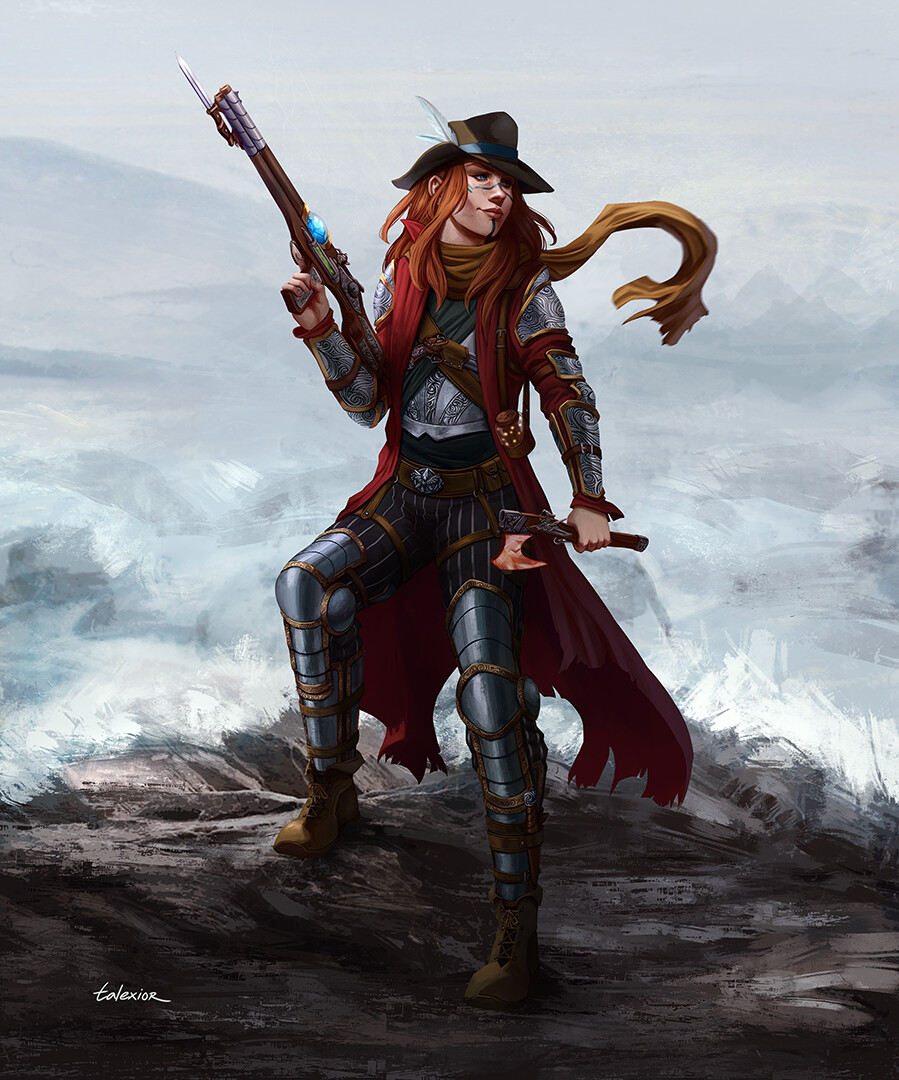

Falconer
Birds aren't an uncommon companion to sharpshooters, so the existence of falconers is hardly a surprise. What is a shock is how efficient these pairs are. Some may dismiss the threat of a simple bird, but when working alongside a clever desperado, the two can wreak incredible havoc.
Falconer Features
| Desperado Level |
Feature |
|---|---|
| 3rd | Bird of Prey, Falconer's Deeds |
| 7th | Fighting Duo |
| 11th | Aerial Maneuver |
| 15th | Falcon's Focus |
Bird of Prey
When you choose this trail at 3rd level, you bond with a bird of prey. It's friendly to you and your companions, and it obeys your commands. See its game statistics in the Bird of Prey stat block, which uses your proficiency bonus (PB) and reliance ability modifier in several places.
In combat, the bird shares your initiative count, but it takes its turn immediately after yours. It can move and use its reaction on its own, but the only action it takes on its turn is the Dodge action, unless you take a bonus action on your turn to command it to take another action. That action can be one in its stat block or some other action. If you are incapacitated, the bird can take any action of its choice, not just Dodge.
If it dies or disappears, you can bond with a new bird over the course of a short rest. If you already have a bird from this feature, your bond with it is immediately broken.
Falconer's Deeds
Also at 3rd level, you gain two additional deeds, which don't count against your number of deeds known and can't be replaced. The deeds are as follows.
Master's Shot. When you use a bonus action to command your bird of prey to attack a creature, you can spend 2 focus points to make an attack with a ranged weapon you're holding against the same creature.
Eye in the Sky. As an action, you can spend a 1 focus point to tell your bird of prey to locate something or someone, after which it flies high into the sky. After 1 minute, it returns to you, and tells you the current location of the thing or person you named (and its direction, if it's moving) if it is within 1 mile of you. While the bird is unaffected by effects that ward against divination, it will be unable to locate the thing or person if it is invisible, disguised, or hidden.
Fighting Duo
At 7th level, you and your bird have had plenty of experience fighting together. Your bird of prey benefits from your Mark Target feature as if it were you.
Additionally, your bird of prey gains a bonus to its attack and damage rolls equal to the bonus granted by your Ranged Specialty feature.
Aerial Maneuver
At 11th level, your bird can help you take wing----if only briefly. Your bird gains the following action.
Aerial Maneuver (3/day). If the bird of prey is within 40 feet of its master, it flies to their master's space. It then grabs their master and flies up to 40 feet away before dropping its master in an unoccupied space within 5 feet of it. After taking this action, the bird's speed is reduced to 0 until the start of its next turn.
Falcon's Focus
At 15th level, you and your bird of prey are perfectly in sync. Your falcon's attacks grant you focus points as if they were ranged attacks made during your turn. They still count against the number of focus points you can gain each turn.
Bird of Prey
Tiny beast
- Armor Class 12 + PB (natural armor)
- Hit Points your reliance ability modifier + 5 times your desperado level (the bird has a number of Hit Dice [d8s] equal to your desperado level)
- Speed 10ft., fly 40ft.
STR DEX CON INT WIS CHA 6 (-1) 16 (+3) 12 (+1) 4 (-3) 12 (+1) 6 (-2)
- Saving Throws Dex +3 plus PB
- Skills Perception +1 plus (PB×2), Stealth +3 plus PB
- Senses darkvision 120 ft., passive Perception 11 plus (PB×2)
- Languages understands the languages you speak
- Proficiency Bonus (PB) equals your bonus
Flyby. The bird doesn't provoke opportunity attacks when it flies out of an enemy's reach.
Actions
Talons. Melee Weapon Attack: your reliance ability modifier + PB to hit, reach 5 ft., one target you can see. Hit: 1d8 + PB slashing damage.
Reactions
Harry. The bird imposes disadvantage on the attack roll of one creature it can see that is within 10 feet of it, provided the attack roll is against a creature other than the bird.


Malefactor
Either through deliberate bargains or terrible luck, there are a few desperados that are afflicted with terrible curses, but in exchange are able to wield the dark power within them as a weapon against their foes. They can be just as dangerous to themselves as to their foes, but many view the supernatural efficiency their curse grants them as well worth the risk.
Malefactor Features
| Desperado Level |
Feature |
|---|---|
| 3rd | Accursed, Malefactor's Deeds |
| 7th | Cursed Gaze |
| 11th | Deathdealer |
| 15th | Vengeful Shot |
Accursed
When you choose this trail at 3rd level, you become afflicted with a curse that grants you dark powers----at a cost. Choose one ability score; you permanently have disadvantage on all ability checks and saving throws made using that score.
Additionally, you learn two cantrips of your choice from the warlock spell list. Your reliance ability is your spellcasting ability for these spells. When you gain a level in this class, you can replace one of your chosen cantrips with another cantrip from the warlock spell list.
Malefactor's Deeds
Also at 3rd level, you gain two additional deeds, which don't count against your number of deeds known and can't be replaced. The deeds are as follows.
Shot of Doom. When you make a ranged weapon attack, you can spend 2 focus points to curse your target. If the attack hits, the target is doomed until the end of your next turn. When a doomed creature makes an attack roll or saving throw, you can end this effect on them (no action required) and roll a d4, subtracting the result from their roll.
Eldritch Eye. As a bonus action, you can spend any number of focus points to magically peer through things that would normally block your sight. Until the start of your next turn, you can see through solid objects and any obscuration (such as fog or magical darkness) out to a range of 5 feet, plus 5 feet for each focus point spent.
Cursed Gaze
At 7th level, your dark powers allow you to make truly impossible shots. When you make a ranged attack roll, you can choose to invoke your curse by expending a hit die, rolling it, and reducing your maximum and current hit points by the number rolled.
When you do so, you gain a bonus to your attack roll equal to your reliance ability modifier, and the attack ignores all forms of cover (including full cover) and obscuration (including heavily obscured). You do not have to be aware of the target's exact position to make this attack.
Once you use this feature, you can't use it again until you finish a short or long rest, or until you roll initiative. Any hit point reduction from this feature ends when you finish a short or long rest.
Deathdealer
At 11th level, you deal in the souls of the dead. When you hit a creature marked by your Mark Target feature with a ranged weapon attack, you can end it early on them to claim part of their soul. You regain hit points equal to the damage dealt by the attack, and their hit point maximum is reduced by the same amount. This reduction lasts until they finish a short or long rest.
Vengeful Shot
At 15th level, the pain others inflict on your only fuels your desire to kill them. When a creature deals damage to you, you can use your reaction to store that pain. The first time you hit that creature with a ranged weapon attack, you release the pain, dealing additional necrotic, force, or psychic damage (your choice) equal to the damage taken that triggered the reaction.
Once you use this feature, you can't do so again until you finish a short or long rest.
Mountebank
More than just an expert sharpshooter, a mountebank is a charming trickster. They know how to convince and deceive people, a skillset they utilize both on and off the field of battle. Mountebanks fool their opponents with elaborate schemes and help get their allies out of trouble----or into it!
Mountebank Features
| Desperado Level |
Feature |
|---|---|
| 3rd | Sharp Tongue, Mountebank's Deeds |
| 7th | Make a Mockery |
| 11th | Suave |
| 15th | False Pretenses |
Sharp Tongue
When you choose this trail at 3rd level, you have learned to be both convincing and deceiving. You gain proficiency in the Persuasion and Deception skills.
Additionally, choose one of the proficiencies you gained from this feature. Your proficiency bonus is doubled for any ability check you make that uses the chosen skill.
Mountebank's Deeds
Also at 3rd level, you gain two additional deeds, which don't count against your number of deeds known and can't be replaced. The deeds are as follows.
Pistol Twirl. When you make a ranged attack roll, you can spend any number of available focus points to disguise the attack's target. The target of the attack must make a Perception or Insight check (their choice) against your deed save DC. On a failure, their AC against the attack is reduced by half the number of focus points spent (rounded up), and they cannot take a reaction that would be triggered by the attack, such as casting the Shield spell.
Sweet-Talk. As an action, you can spend 1 focus point to force a creature within 15 feet of you that can hear and understand you to make a Charisma saving throw. If you or your allies are fighting the target, they have advantage on the saving throw. On a failed save, they are charmed by you for 10 minutes or until you or your allies do something harmful to it. While charmed by you, the creature is inclined to trust you, but doesn't regard you as a friend or an ally.
Make a Mockery
At 7th level, you mock your foes to make them slip up. When a creature within 60 feet of you that can see or hear you makes an attack roll, ability check, or saving throw, you can force them to make a Charisma saving throw against your deed save DC. If they fail the saving throw, they automatically fail the triggering roll.
Once you use this feature, you can't use it again until you finish a short or long rest.
Suave
At 11th level, you are just as capable in social situations as you are in combat. Once per minute when you make a Charisma ability check, you may gain 1 focus point. This usually occurs when you make a witty or convincing statement, but is ultimately at your DM's discretion.
False Pretenses
At 15th level, you are an exceedingly skilled liar. You gain the following benefits.
- Magic that determines whether you are lying always indicates you are being truthful, and you cannot be compelled to tell the truth via magical means.
- Your mind cannot be read by any means, unless you allow it to be.
- At the start of your turn, if a creature is marked by your Mark Target feature, you can move your mark to a different creature without expending a use of that feature.

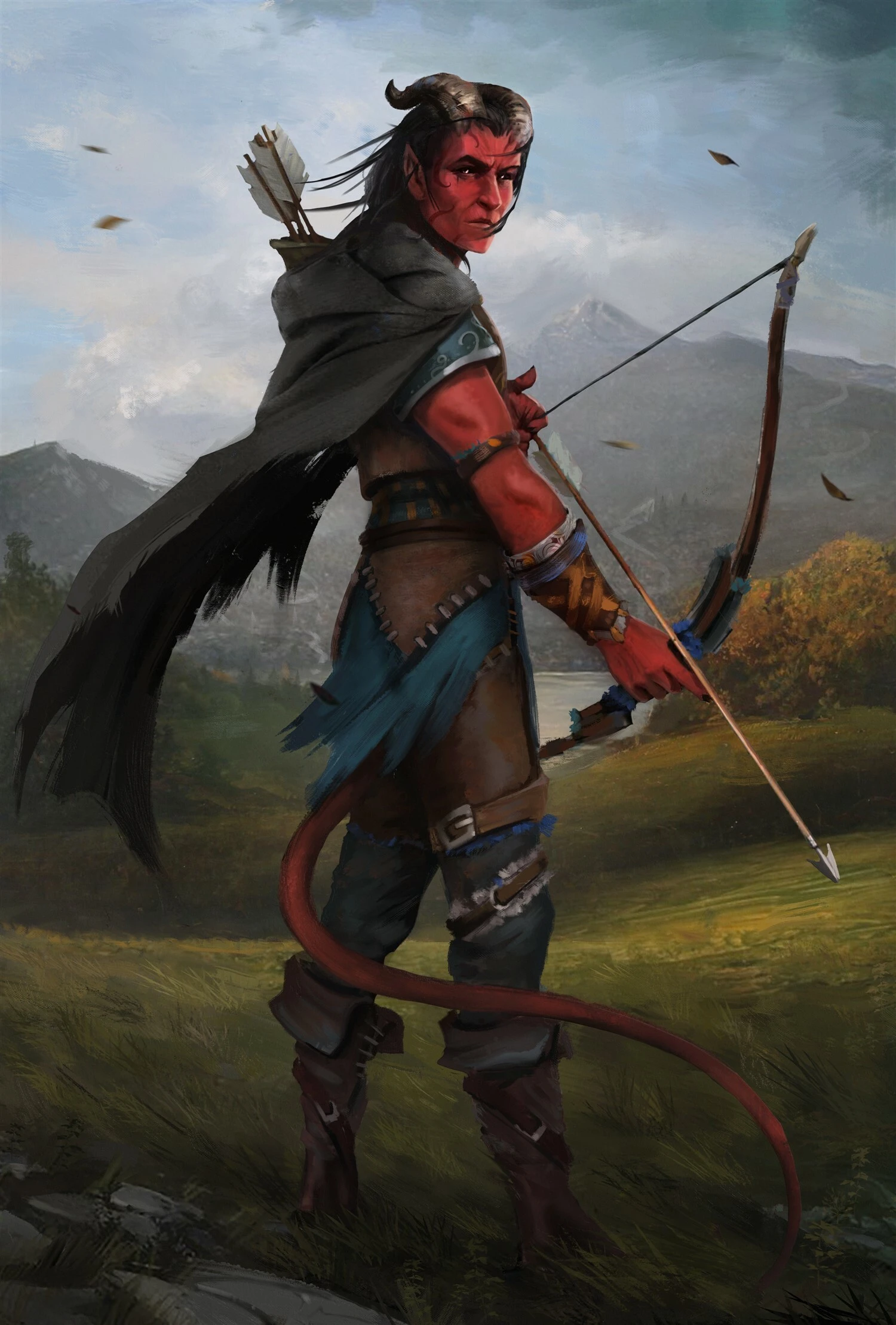
Pioneer
Explorers and scouts, pioneers take to the frontier and choose to explore everything beyond the civilized society they know. They protect the townspeople who do not dare venture past the safety of civilization, keeping the dangers of the outside world at bay. Pioneers are adventurers in every sense of the word.
Pioneer Features
| Desperado Level |
Feature |
|---|---|
| 3rd | Lay of the Land, Pioneer's Deeds |
| 7th | Well-Travelled |
| 11th | Reposition |
| 15th | Fog of War |
Lay of the Land
When you choose this trail at 3rd level, you have learned the necessary skills to explore beyond the bounds of civilization. You gain proficiency in two of the following skills of your choice: Survival, Animal Handling, and Nature.
Additionally, choose one of the proficiencies you gained from this feature. Your proficiency bonus is doubled for any ability check you make that uses the chosen skill.
Pioneer's Deeds
Also at 3rd level, you gain two additional deeds, which don't count against your number of deeds known and can't be replaced. The deeds are as follows.
Exposing Shot. When you make a ranged weapon attack, you can spend 1 focus point to expose your target's position. Whether the attack hits or misses, the target can't benefit from being hidden, and any cover it is benefiting from, except full cover, is reduced by one stage (three-fourths becomes half cover, and half becomes no cover). Both of these effects last until the end of your next turn.
Scout's Sprint. You can spend 1 focus point to take the Dash action as a bonus action on your turn.
Well-Travelled
At 7th level, your walking speed increases by 10 feet, and you gain a climbing speed or a swimming speed (your choice) equal to your walking speed.
Additionally, when you take the Dash action, you ignore non-magical difficult terrain and can move through other creature's spaces, but you cannot end your movement in the space of another creature.
Reposition
At 11th level, you are a master of positioning in combat. Once per round at the start of any creature's turn, you can move up to half your movement speed or direct an allied creature within 30 feet of you to move up to half their movement speed (no action required). In order to take this movement, the creature must be able to see or hear you.
Fog of War
At 15th level, you know how to obscure and obfuscate yourself or your allies through clever strategy. When you make an attack on your turn, you can choose a number of creatures equal to your reliance ability modifier (minimum of 1), including possibly yourself. Each of those creatures can choose to gain the benefits of being lightly obscured or having half cover until the end of their next turn.
You can use this feature once, and regain the ability to do so when you finish a short or long rest or when you roll initiative.
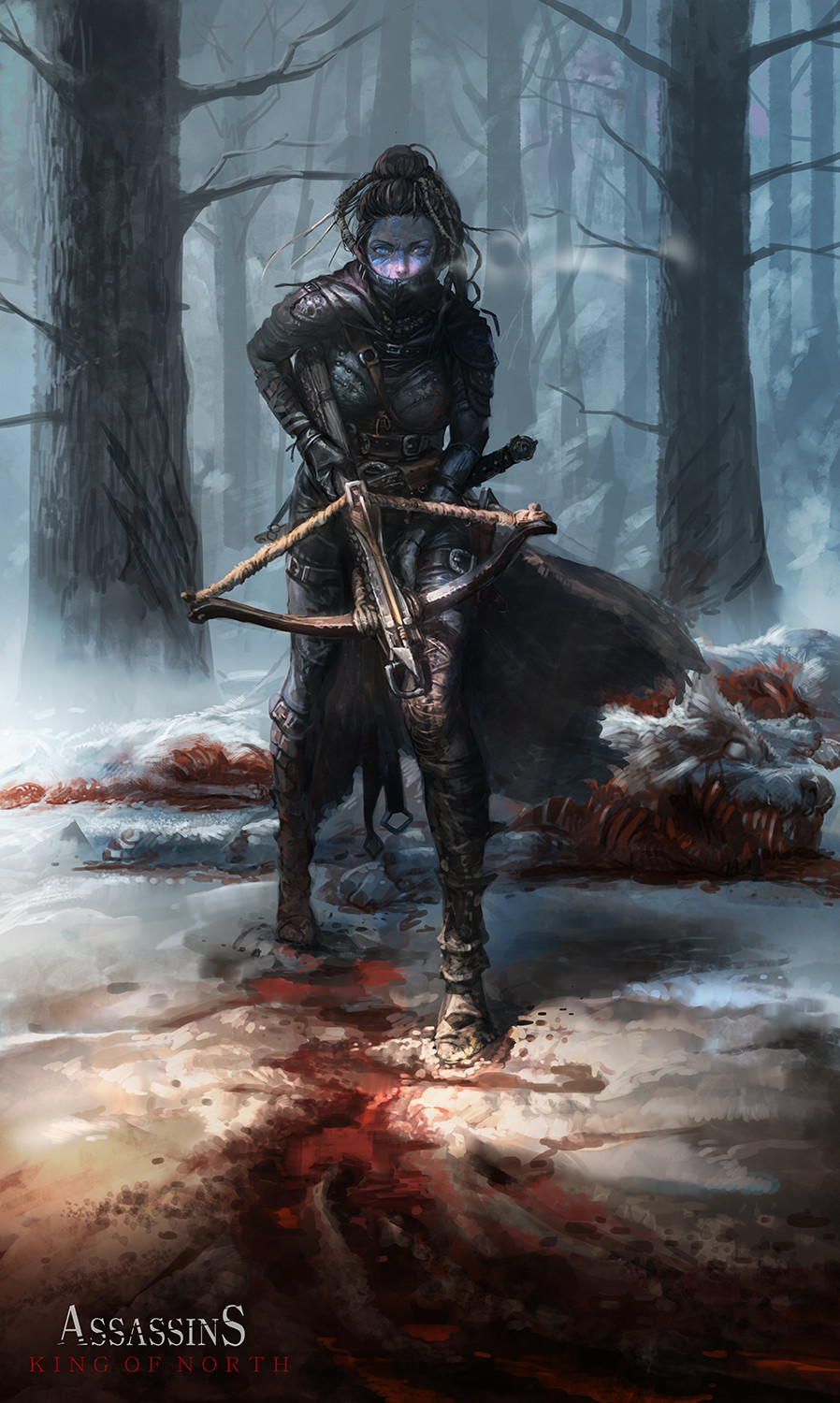
Renegade
Taking the stealthy approach, a renegade strikes when their foes least expect it. Be they highwaymen and cutpurses or private detectives and spies, they employ both a desperado's focus and subterfuge. You'll be taken out by a renegade before you're even aware that they're there.
Renegade Features
| Desperado Level |
Feature |
|---|---|
| 3rd | Sly Talents, Renegade's Deeds |
| 7th | Out of Sight |
| 11th | Blindside |
| 15th | Now You Don't |
Sly Talents
When you choose this trail at 3rd level, you become an expert at the unsavory skills of the underworld. You become proficient in Stealth and your choice of Decepetion or Sleight of Hand.
Additionally, choose one of the proficiencies you gained from this feature. Your proficiency bonus is doubled for any ability check you make that uses the chosen skill.
Renegade's Deeds
Also at 3rd level, you gain two additional deeds, which don't count against your number of deeds known and can't be replaced. The deeds are as follows.
Concealed Shot. When you make a ranged weapon attack against a target from which you are hidden, you can spend 1 focus point to turn it into a concealed shot. Whether the attack hits or misses, your position isn't revealed to the target, only to other creatures.
Infiltrate. You can spend 1 focus point to take the Hide action as a bonus action on your turn.
Out of Sight
At 7th level, your enemies can never see your attacks coming. Once per round when you make an attack, you can choose to move 5 feet and Hide immediately before doing so.
You can do this a number of times equal to your reliance ability modifier (minimum of once), and you regain all expended uses when you finish a short or long rest.
Blindside
At 11th level, when your foes don't know you're there, you can aim for their weak spots without effort. When you are hidden from a creature and you make a ranged weapon attack against them, you can forgo the advantage on the attack roll. When you do so, you can add your desperado level to the damage dealt on a hit.
Now You Don't
At 15th level, even when your enemies can see you, you can find a way to surprise them. You can use your Out of Sight feature to Hide even if there is nothing that would allow you to Hide, such as cover or a heavily obscured area. This feature doesn't allow you to Hide from creatures that can't be hidden from, such as a rogue with the Blindsense feature.
Tactician
Being an excellent shot is not what makes a desperado sought after; it's knowing when to shoot. Tacticians know this, and take it to the extreme. They keep a careful eye on their foes, planning each and every shot with careful consideration----and plenty of contingencies, for good measure. A tactician's strategic prowess extends to their allies, making them even more dangerous when part of a tight-knit crew.
Tactician Features
| Desperado Level |
Feature |
|---|---|
| 3rd | Strategic Mind, Tactician's Deeds |
| 7th | Coordination |
| 11th | Deny the Advantage |
| 15th | Priority Target |
Strategic Mind
When you choose this trail at 3rd level, you are a master of tactics. You gain proficiency in the History skill, and have advantage on any History checks made to recall knowledge of strategy or tactics.
You can use the Help action as a bonus action, and when you use the Help action to aid an ally in attacking a creature, the target of that attack can be within range of one ranged weapon you're wielding, rather than 5 feet of you. The target must be able to see or hear you for you to gain this benefit.
Tactician's Deeds
Also at 3rd level, you gain two additional deeds, which don't count against your number of deeds known and can't be replaced. The deeds are as follows.
Assisting Shot. When you take the Help action to aid an ally in attacking a creature, you can spend 2 focus points to prepare a shot. When your ally attacks the creature, you can use your reaction to make a ranged weapon attack against the same creature. You make this attack before your ally makes their attack.
Survey the Field. As a bonus action, you can spend any number of focus points and choose a number of creatures that you can see within 60 feet of you equal to the number of focus points spent. You learn each creature's AC, current hit points, and hit point maximum. Alternatively, you can use this deed after observing each creature for a minute to learn one of each creature's traits (such as a bond, ideal, or flaw).
Coordination
At 7th level, you and your allies know how to work in near-perfect tandem. Allied creatures that can see you can add their reliance ability modifier to their initiative rolls. You can only grant this benefit while you are conscious.
Additionally, whenever you roll initiative, one willing creature of your choice (including potentially yourself) can forgo rolling initiative. Instead, they may take their turn immediately before or after an ally of their choosing that has also rolled initiative. If another creature would also take their turn immediately before or after theirs, such as an artificer's Steel Defender, then they must cannot take their turn then.
Deny the Advantage
At 11th level, you know how to stop your enemies from having the upper hand. When a creature within range of one ranged weapon you're wielding makes an attack roll, saving throw, or ability check with advantage, you can use your reaction to make a ranged weapon attack against that creature.
If the attack hits, instead of dealing damage you negate the advantage; the target then must make the triggering roll normally. If the attack misses, the target makes the roll with advantage as normal.
You have a number of uses of this feature equal to your reliance ability modifier, and you regain all expended uses when you finish a short or long rest.
Priority Target
At 15th level, your allies follow your lead----when you focus on one foe, so do they. Whenever an ally hits a creature marked by your Mark Target feature with an attack (not just a weapon attack), they can add your Mark Target damage bonus to the damage roll.
Vanguard
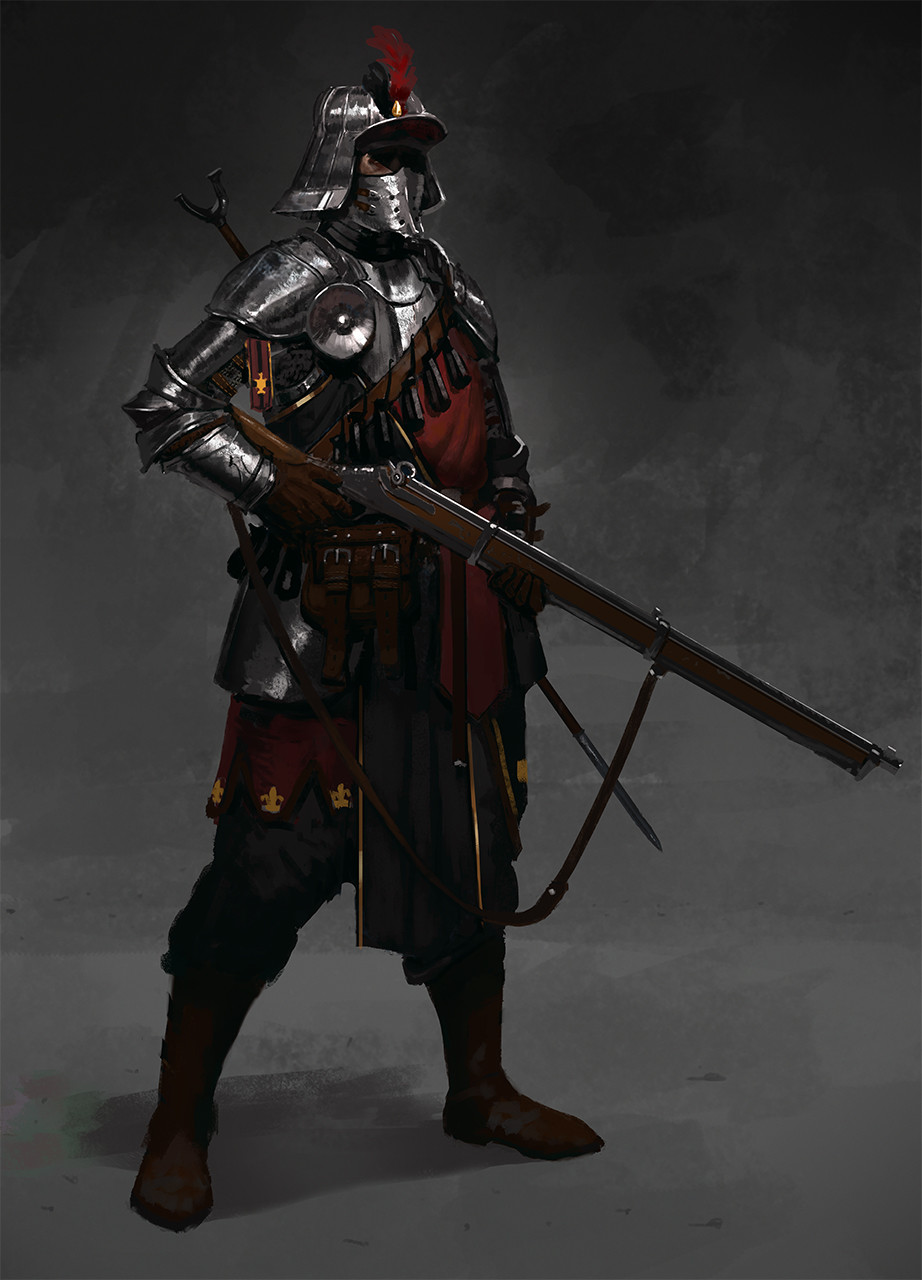
Most desperados are ranged combatants, and even the few that wade into the thick of combat are evasive and mobile. Vanguards have a very different strategy: don some armor and become an obstacle on the battlefield, taking hits for their compatriots and getting in the way of their enemies.
Vanguard Features
| Desperado Level |
Feature |
|---|---|
| 3rd | Tough As Nails, Vanguard's Deeds |
| 7th | Point-Blank |
| 11th | Feet on the Ground |
| 15th | Juggernaut |
Tough As Nails
When you choose this trail at 3rd level, you can take a hit in the heat of combat better than any other desperado. You gain the following benefits.
- You gain proficiency in the Athletics skill if you don't have it already. Your proficiency bonus is doubled for any ability check you make that uses this proficiency.
- You become proficient in medium armor and shields.
- Being within 5 feet of a hostile creature doesn’t impose disadvantage on your ranged weapon attacks against that creature. You must be wielding a two-handed ranged weapon or a shield to gain this benefit.
- You can choose to replace your current reliance ability with Strength. This cannot be changed later.
Vanguard's Deeds
Also at 3rd level, you gain two additional deeds, which don't count against your number of deeds known and can't be replaced. The deeds are as follows.
Brace for Impact. When you are targeted by an attack, you can spend any number of focus points as a reaction to brace. You gain 1d12 temporary hit points per focus point spent; these temporary hit points are gained before the attack hits or misses, and they persist until the start of your next turn.
Rough and Tumble. Immediately after making a ranged weapon attack, you can spend 2 focus points take the Shove or Grapple action (no action required), even if you do not have a free hand. You can only use this deed once per turn.
Point-Blank
At 7th level, you start engaging in truly merciless tactics. Once per round when you hit a prone or grappled creature within 5 feet of you with a ranged weapon attack, you can roll an additional weapon damage die.
Feet on the Ground
At 11th level, you become exceptionally hard to move. You have advantage on saving throws and ability checks against effects that would force you to move, knock you prone, or make you Restrained or Grappled.
Additionally, if you do not move on your turn, you gain temporary hit points equal to your reliance ability modifier (minimum of 1) at the end of your turn.
Juggernaut
At 15th level, you can persist even when heavily wounded. As a bonus action, you can roll a number of d10's equal to your reliance ability modifier; you regain hit points equal to the total rolled. You can only take this bonus action if you are at or below half your maximum hit points.
Once you do this, you can't do so again until you finish a short or long rest or until you roll initiative.
Pistols
| Name | Damage | Range | Reload | Misfire | Properties | Cost |
|---|---|---|---|---|---|---|
| Coachgun | 1d8 piercing | 30/90 | 1 | 2 | Scatter, Dueling | 150gp |
| Derringer | 1d6 piercing | 40/120 | 1 | 0 | Light | 50gp |
| Dragoon | 1d10 piercing | 80/240 | 2 | 3 | Dueling | 200gp |
| Pepperbox | 1d6 piercing | 50/150 | 4 | 1 | Light | 100gp |
| Flintlock | 1d8 piercing | 60/180 | 1 | 1 | Light, Dueling | 100gp |
| Lupara | 2d4 piercing | 50/150 | 1 | 2 | Dueling | 150gp |
| Revolver | 1d8 piercing | 60/180 | 6 | 2 | Salvo, Dueling | 200gp |
Rifles
| Name | Damage | Range | Reload | Misfire | Properties | Cost |
|---|---|---|---|---|---|---|
| Blunderbuss | 1d12 piercing | 50/150 | 1 | 2 | Scatter, Two-handed | 300gp |
| Capegun | 2d6 piercing | 100/240 | 2 | 1 | Two-handed | 300gp |
| Falcon | 2d8 piercing | 150/450 | 1 | 2 | Sniper (15ft), Two-handed | 350gp |
| Musket | 1d10 piercing | 100/300 | 1 | 0 | Two-handed | 200gp |
| Rampart | 2d10 piercing | 200/600 | 1 | 3 | Sniper (20ft), Two-handed, Heavy | 400gp |
| Vierling | 1d10 piercing | 80/240 | 4 | 2 | Two-handed | 250gp |
| Volcan | 1d12 piercing | 100/300 | 6 | 2 | Salvo, Two-handed | 350gp |
Optional: Firearms
These optional rules introduce firearms into your game.
Firearm Properties
Four properties are unique to firearms: Dueling, Salvo, Scatter, and Scatter. Their effects are described below.
Dueling
Weapons with this property are well suited for close combat. Being within 5 feet of a hostile creature doesn't impose disadvantage on your attacks with this weapon if that creature is the target of your attack.
Salvo
Weapons with this property can fire rapidly. When you take the Attack action on your turn and only make attacks with this weapon, you can make an additional attack with it as part of the same action. This attack doesn't add your ability modifier to the damage roll.
Scatter
Weapons with this property fire in a wide spread. When you make an attack with this weapon, every object or creature within 5 feet of the target (other than you) is subjected to its scatter. If the original attack roll would hit a creature or object within 5 feet of the target, it takes damage equal to your Dexterity modifier (minimum of 1).
Sniper
Weapons with this property are intended for long ranges only. Next to this property is a range in parentheses; attacks made with this weapon have disadvantage against targets within that range.
Rules for Firearms
Below are some rules for using firearms.
Misfire
Every firearm has a Misfire score, which represents how likely the weapon is to fire incorrectly. When you make an attack with a firearm, a roll on the d20 equal to or less than its Misfire score causes it to jam. A jammed weapon needs to be cleaned, which takes an action, or a bonus action if you have proficiency with tinker's tools.
Reload
Every firearm has a Reload score, which represents how much ammunition it can hold at a single time. You can make a number of attacks with a fully reloaded firearm equal to its Reload score before needed to reload it.
Reloading a firearm takes a bonus action or can be done in place of an attack. If you have a feature that allows you to ignore the Loading property, you can instead reload a firearm as a free object interaction during your move or action.
You must have a free hand to reload a firearm, unless it has the Light or Two-handed property.
Noise
Firearms are loud. When a firearm is fired, the shot is audible out to a number of feet equal to twice its normal range, or three times its normal range if it has the Scatter property. For example, a musket being fired can be heard from 200 feet away, and a coachgun can be heard from 90 feet away.
Starting Proficiency
If you would like to give starting firearm proficiency to your players, then use or take inspiration form the following list.
- Artificers, desperados, and fighters are proficient in all firearms.
- Bards and rogues are proficient in all pistols.
- Rangers are proficient in all rifles.
There are other ways to attain proficiency in firearms, such as by taking the Gunner feat or spending downtime training. However, how proficiency in firearms can be attained is ultimately at the DM's discretion.
Ammunition
Firearms require ammunition. The below table lists the types of ammunition, which firearms they are used by, and the amount of it you can buy with 1gp, also known as a "batch".
A character can attempt to craft a batch of ammunition on their own, rather than purchasing it. To do so, they must spend 10 minutes and make a DC 15 tinker's tools check. On a success, they craft the batch at half the cost in materials. On a failure, they waste half the batch's cost in materials.
| Name | Used By... | Amount per 1gp |
|---|---|---|
| Buckshot | Blunderbuss, Coachgun, Lupara | 15 |
| Heavy Rounds | Falcon, Rampart | 10 |
| Light Rounds |
Derringer, Pepperbox, Vierling | 20 |
| Lead Bullets | Capegun, Dragoon, Revolver, Volcan | 15 |
| Steel Balls | Flintlock, Musket | 20 |
Modifying Firearms
Firearms can have modification applied to them, which alter the firearm's properties. A firearm can have a maximum of 2 modifications applied to it at a single time. The available modifications are listed in the below table.
A character can attempt to apply a modification on their own, rather than paying the listed price to have a gunsmith apply it. To do so, they must spend an hour and make a tinker's tools check with a DC of 15 + twice the Misfire score of the weapon they are attempting to modify. On a success, they apply the modification at half the cost in materials. On a failure, they waste half the modification's cost in materials and the firearm is damaged. Repairing a firearm damaged in this manner takes 10 minutes, or 1 minute by casting the Mending spell on it.
Modifications
| Name | Requirements | Effect | Cost |
|---|---|---|---|
| Arcane Ignition | A non-magical firearm | Attacks with this weapon count as magical. | 50gp |
| Ergonomic Grip | A pistol that lacks the Dueling property | This weapon gains the Dueling property. | 50gp |
| Flared Muzzle | A firearm with the Scatter property | Scatter damage increases to half of the attack damage. | 100gp |
| Increased Capacity | A rifle | This weapon's Reload score either becomes 4, or increases by 2. | 150gp |
| Iron Sights | A firearm that lacks the Sniper and Scatter properties | Normal and long ranges both increase by 30 feet. | 50gp |
| Lightweight Frame | A pistol that lacks the Light property or a rifle with the Heavy property | This weapon either gains the Light property or loses the Heavy property. | 100gp |
| Noise Suppressor | A firearm that lacks the Scatter property | Attacks made with this firearm are now audible to a distance equal to half its normal range. | 100gp |
| Reinforced Chamber | A firearm with a Misfire score of 1 or higher | This weapon's Misfire score is reduced by 1. | 100gp |
| Semi-automatic Spring | A firearm that lacks the Salvo property and with a Reload score of 2 or higher | This weapon gains the Salvo property. | 100gp |
| Unstable Mechanism | A firearm | This weapon's damage die increases one size (d6 to d8, d8 to d10, d10 to d12, d12 to 2d6) and its Misfire score increases by 1. | 150gp |
The Desperado
Created by: u/KaiTries5
Artist Credits:
Cover - Hazardous Docks, by Igor Artyomenko
Page 1 - Old West Wallpaper, by Samantha Thompson
Page 1 - Elf Gunslinger, by Xandra
Page 3 - Mae the Gunslinger, by kyliemanogue
Page 4 - Metra, by Daniel Denova
Page 5 - Elven Archer, by Anna Lakisova
Page 6 - Apprentice Sharpshooter, by Steve Prescott
Page 7 - Assassin of the Silver Flame, by Tikos
Page 8 - The Dock's Attack, by Felipe Prest
Page 9 - Isen, by Tiago Alexandre
Page 10 - Falconer Adept, by Billy Christian
Page 11 - Tiefling Gunslinger, by Peter Lin
Page 12 - Valrysn Xiltazza, by Liana Draws
Page 13 - Araxis, by Iromonik
Page 14 - Assassin, by Kim Junghun
Page 15 - Tiefling Archer, by SpiritHide
Page 16 - Rifleman, by Evhen Petlia
Back - Percival de Rolo, by unknown
Other Credits:
Page Stains by Jared Ondricek
Desperado Icon by Game-icons.net