
Dynamic Combat Movement D&D5e
This small document brings new Rules that expand the simple Melee Combat in the tabletop, making it an advance and slip from tactical positions, Flanking enemies, at the rhythm of war.
Forced Movement
All the Movement that happens due to an Advance or Slip counts as Forced Movement, so it doesn't provoke Opportunity Attacks, nor uses part of your own Movement.
Advance
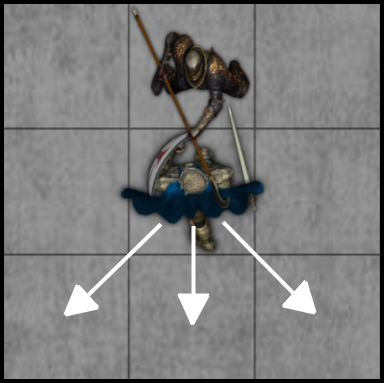
When you Hit a Creature with a Melee Attack, you can Move your Target 5ft to any of the spaces in its immediate rear, and you must Move 5ft to another space while keeping the Target within your Melee Reach at the end of the Advace.
You cannot Advance if your Target is 2 or more Sizes larger than you, or if you cannot Move at least 5ft.
-
If your Target dies or falls Unconscious as part of your Melee Attack, you can still make one last Advance to it.
-
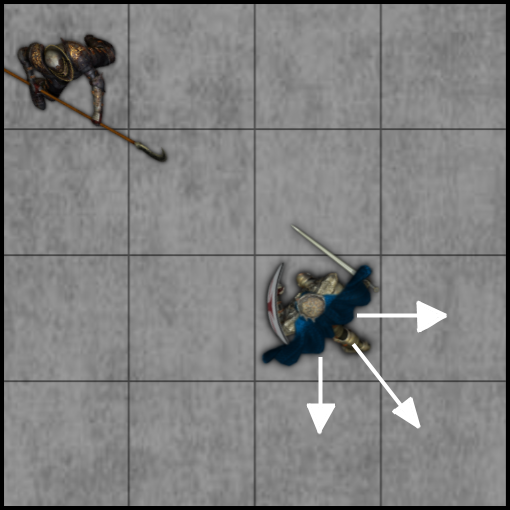
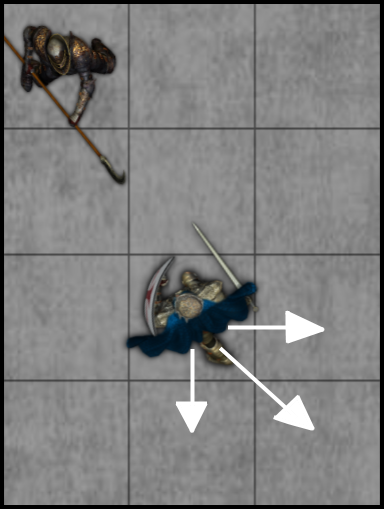
Partially diagonal Attacks made with a Reach greater than 5ft can result in strange angles where how to define rear spaces is ambiguous. Treat all diagonal Advances the same, as seen in the images to the right.
Dodge with Advance
If you take the Dodge Action and a Melee Attack Hits you, if the Attacker makes an Advance you can choose to which space you are Moved to in your immediate rear.
Halt the Advance
There are situations where you can Halt the Advance, by making a Strength or Dexterity Saving Throw (your choice) against a DC 10 or half the Damage taken (whichever is higher, up to DC 30 max) to negate it on a success.
To Halt the Advance you must meet one of the following:
- Steadying yourself by replacing one Weapon Attack or as a Bonus Action until the start of your next Turn.
- Using your Reaction.
- Being 1 or more Sizes larger than your Attacker.
- Wielding a Shield.
- Be Moved to a hazard (such as an acid bath or fire wall).
- *Be Moved to a fall (such as a hole or precipice).
- *Be Moved to an obstacle (such as a wall, a Creature or Difficult Terrain).
- *Being unable to Move in an Advance against you.
You cannot try to Halt the Advance if your Attacker is 2 or more Sizes larger than you.
*Advance to Prone
If a Creature makes an Advance against you and Moves you to an obstacle (such as a wall, a Creature or Difficult Terrain), or Moves you to a fall (such as a hole or precipice), or you cannot Move in an Advance against you, failing to Halt the Advance also makes you fall Prone.
Straight Advance
Diagonal Advance
Partially Diagonal Advance
Slip
When a Creature Misses you with a Melee Attack, you can Move 5ft to any adjacent space (other than the one that was or will be occupied by your Attacker), and your Attacker must Move 5ft towards the space you previously occupied.
If the Attacker cannot Move the 5ft towards the space you previously occupied, you can still Move and complete a Slip.
You cannot Slip if there are obstacles in the space you Move to (such as a wall, a Creature, or Difficult Terrain), or if you cannot Move.
Optional Rules
Obligatory Advances and Slips
The Advance and Slip must always be used when Attacking or being Attacked, they cannot be skipped nor ignored. If you cannot Move to end an Advance against you or to complete a Slip when an Attack Misses you, you must make a Halt the Advance Saving Throw or fall Prone on a failure.
Ranged Attacks
If a Creature makes a Ranged Attack and Misses you, you can make a Slip to Move 5ft to another adjacent space (your Ranged Attacker is not Forced Moved from this Slip).
Familiars
When you Cast a Spell through a Familiar, your Familiar can Advance as if it was of your same Size.
Flanking
Since Flanking is optional, its not included in the basic rules of D&D5e. A wise choice, as in its current state, Flanking is free Advantage without any tactics or sacrifices (which is different from its implementation in D&D3.5).
However, in DCM, specially with the Obligatory Advances and Slips Optional Rule, this corrects the strange checkerboard formations that often occur when using Flanking in D&D5e, so it creates fun tactical choices, where you and the enemy are constantly maneuvering in and out of Flanking positions, both purposely and unintentionally.
It is recommended to use Flanking, found in the Dungeon Master's Guide page 251, with DCM.
Variant: Halt the Advance
Change the DC of Halt the Advance to 8 + PB or CR of the Creature (up to DC 30 max).
Slip
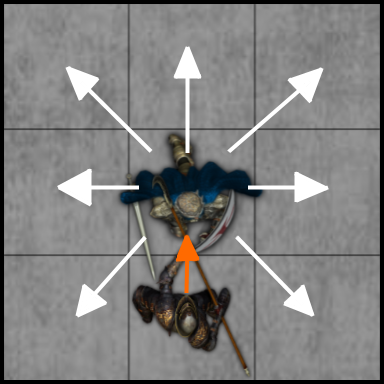
Diagonal Slip
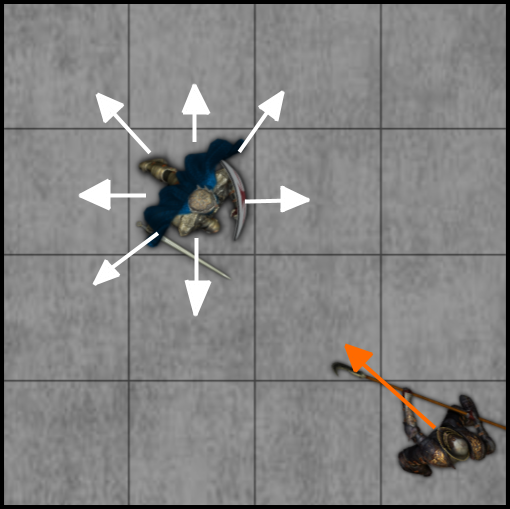
Partially Diagonal Slip
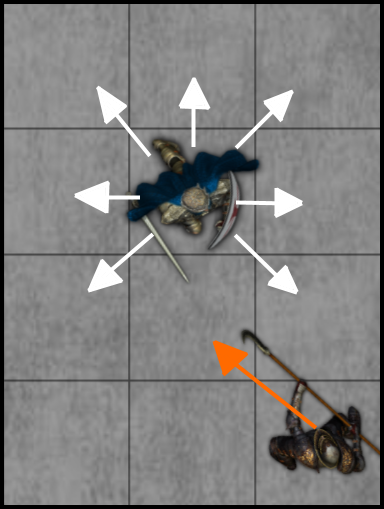
Advance Tactics
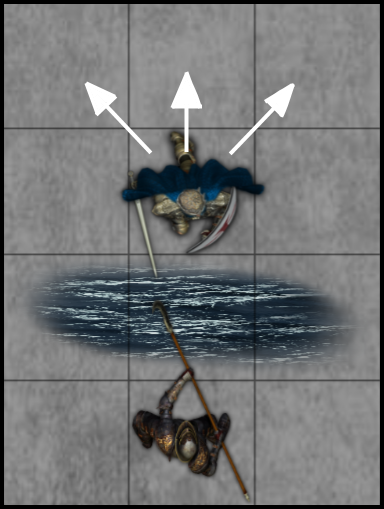
- Maneuvering with Reach. Using a Weapon with the Reach Property while Attacking within 5ft, you can Advance to Move your Target 5ft away from you, and then complete your Movement by stepping to an adjacent space that is now 10ft away from your Target. As shown in the image at the right.
- Maneuvering without Reach. If you do not have a Weapon with the Reach Property and an Attack Misses at 10ft, you can Slip towards them. Allowing you to get within striking distant if you lack the Reach Property.
- Slip to Disengage. Since you can always complete the Movement of a Slip, even if the Target cannot Move, you can use this to get mini/free Disengage Action from a Creature by using obstacles that block the Attackers Movement, such another Creature, a low wall, or perhaps a chasm. As shown in the image at the right.
Shove Attacks
Normally, Shove Attacks are rarely used outside of very specific character builds because it is generally more efficient to just Hit for Damage. DCM offers a small buff to Shove Attacks. Since a Shove Attack is a Melee Special Attack, it is eligible for the Effects of Advance and can be combined to push an opponent 10ft with a single Shove, or push the Creature 5ft and knock them Prone.
Touch Spells
DCM affects Melee Attacks in general, so Spell Attacks are also affected, which could be useful for Spellcasters.
Fighter & Monk
Both Fighters and Monks have one thing in common, their number of Attacks available.
Each Attack can be used to Advace, this gives them more control over the battlefield, advancing with each Attack, improving their position.
Or maybe to keep enemies away from their more fragile companions, or to slowly pushed them off a cliff.
You can also consider to Advance or Slip with Attacks that have added Effects. Nothing stops you from using them with Attacks that have Spells, Maneuvers or Ki Techniques.
Spells and Forced Movement
Remember that Advance and Slip in DCM are Forced Movement, both for the Target and yourself. This means that certain Spells may or may not allow someone being forced into an Area-of-Effect to take Damage. Some Spells may also create Difficult Terrain, meaning that the Target of an Advance needs a way to ignore Difficult Terrain or Halt the Advance to avoid falling Prone.
Maneuvering with Reach
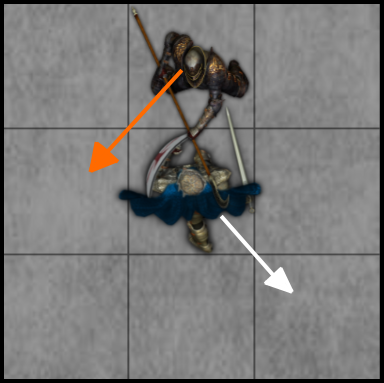
Slip to Disengage
Myself:
Discord: @Larry2233
Reddit: /u/Little-Mist-Walker
Credits:
OG Homebrew: Dynamic Combat Movement v1.01 Original Creator: BakaEngel/Raven Tear Productions
Artwork:
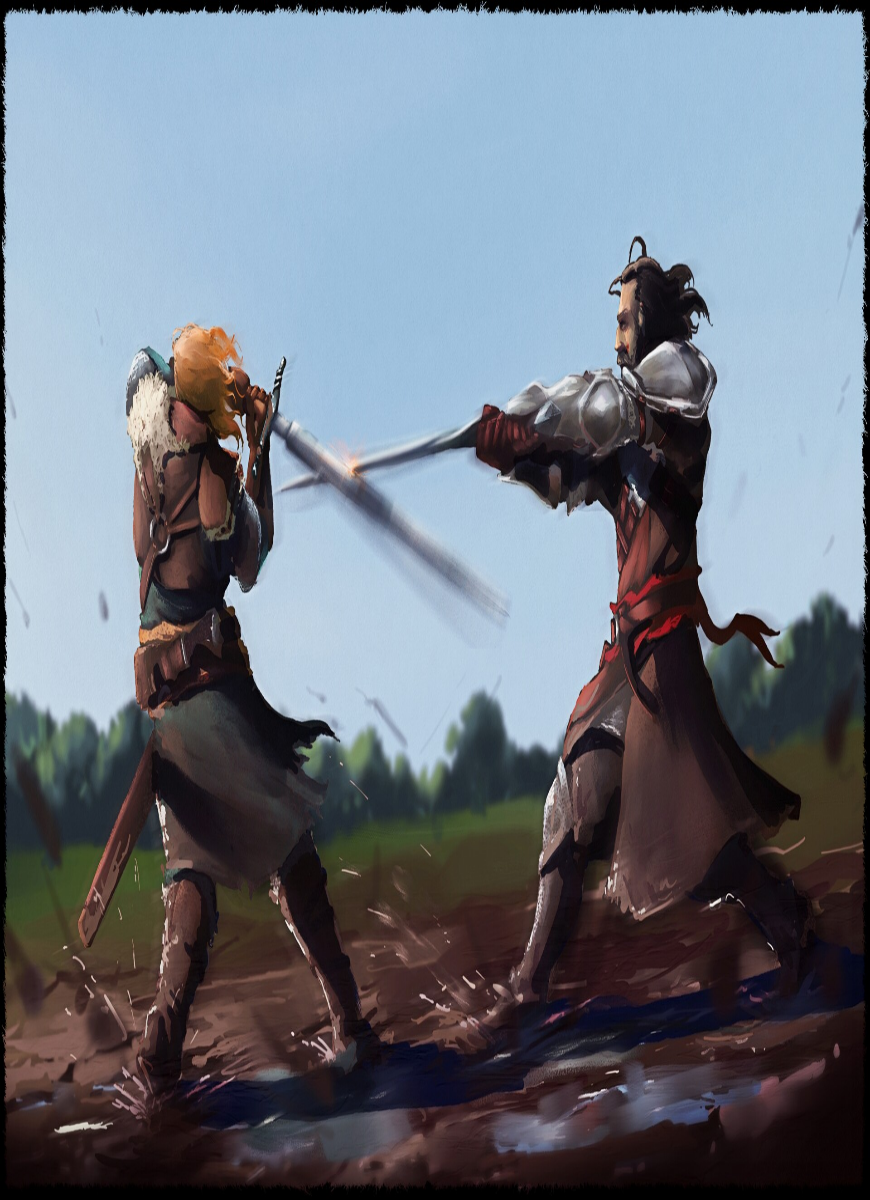
Front Page: "Sword fight" by Declan McDermott.