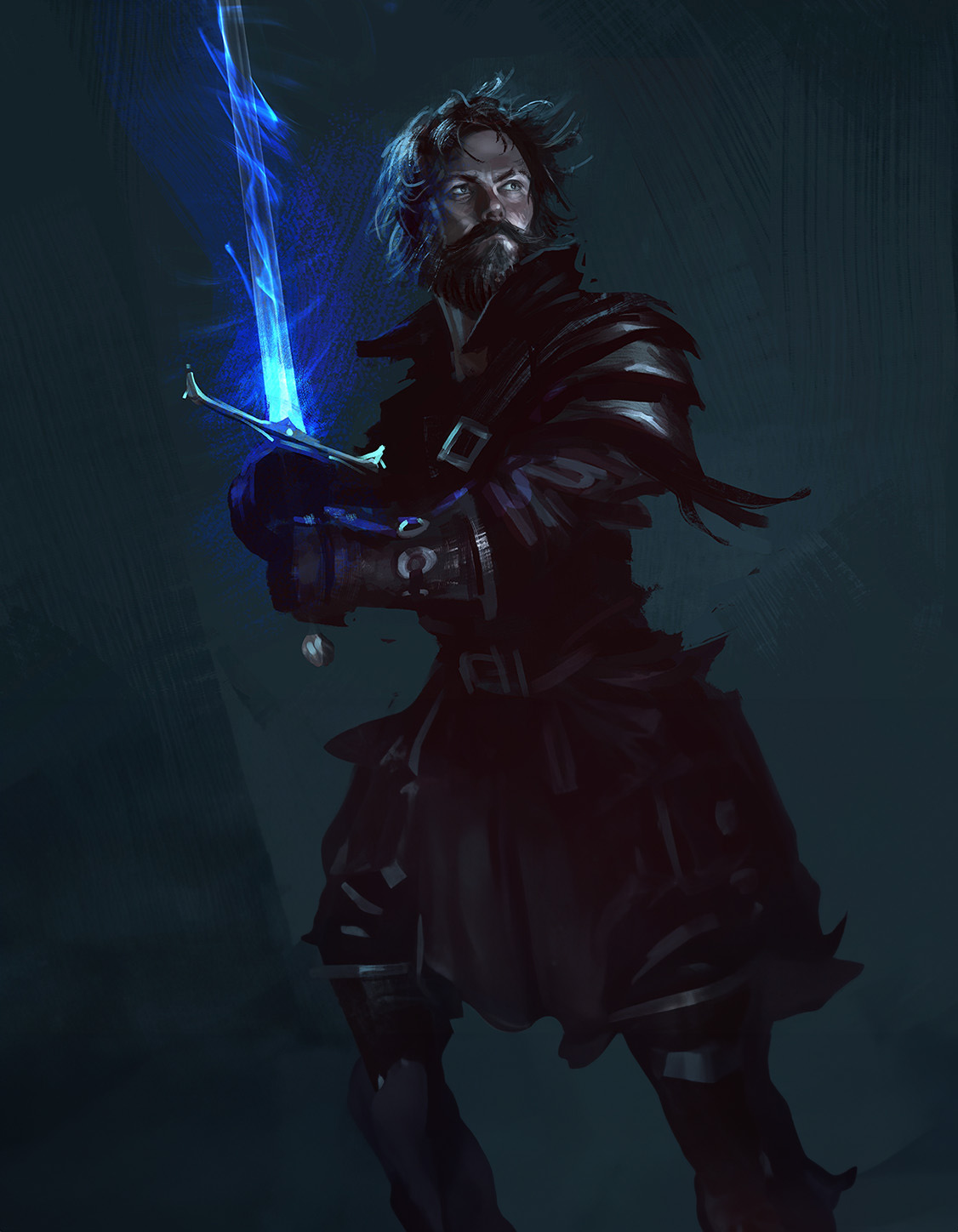
Vanguard
A vanguard spends their life gleaning techniques from warriors and casters alike, endeavoring to use the disparate disciplines to enhance one other in unconventional ways. Blending martial attacks with arcane spells, vanguards are unpredictable front line combatants whose abilities marry both traditions to devastating effect.
First on the Field
Vanguards use arcane magic to enhance their abilities as in-your-face combatants, performing unusual feats with their bonded weapons and swordplay-enhancing spells. They thrive when dynamically navigating a battlefield, teleporting between combatants to land strikes on marked foes to release devastating magical energies. While vanguards are competent casters, their unique strength is their ability to channel magical energies from melee attacks and spells that fuel their suite of bonus actions. While they lack the extra melee attacks of other martial classes, no one else can mix cantrip usage and swordplay like they do.
Innovative Swordplay
A vanguard is a kind of aggressive battlefield artist, and their two muses are the blade and the weave. They respect the technical mastery of their fighting brethren, but ultimately finds their approach a bit mundane. Why trip an opponent when one can have their weapon emit a thunderous boom that does the same? Rather than reach for a bow, a vanguard would sooner throw their blade and magically recall it to their hand. That these methods are unanticipated by their foes, all the better.
Key to this creative fighting style is a symbiotic relationship between sword and spell that the vanguard has learned to cultivate. When they cast a spell, they traces its energies and channel it to enhance their weapons, and as they performs weapon actions that come from martial training, the combat fervor it produces is redirected to strengthen their cantrips.
Class Features
As a vanguard, you gain the following class features:
Hit Points
- Hit Dice: 1d8 per class_name level
- Hit Points at 1st Level: 8 + your Constitution modifier
- Hit Points at Higher Levels: 1d8 (or 5) + your Constitution modifier per vanguard level after 1st
Proficiencies
- Armor: Light and medium armor, shields
- Weapons: All simple and martial weapons
- Saving Throws: Constitution and Intelligence
- Skills: Choose two from Athletics, Acrobatics, Investigation, Arcana, Insight, Perception, Intimidation
A vanguard's aggressive nature allows them to use their Strength bonus to determine the results of an Intimidation check, even though Intimidation is normally associated with Charisma.
Vanguard
| Level | Proficiency Bonus | Eldritch Points | Features | Cantrips Known | Spells Known | 1st | 2nd | 3rd |
|---|---|---|---|---|---|---|---|---|
| 1st | +2 | 1 | Eldritch Inspiration, Weapon Bond, Spellcasting | 3 | 2 | 2 | — | — |
| 2nd | +2 | 2 | Fighting Style, Symbiotic Channeling (Melee) | 3 | 2 | 2 | — | — |
| 3rd | +2 | 3 | Arcane Armor, Elemental Blade | 3 | 3 | 3 | — | — |
| 4rd | +2 | 4 | Ability Score Improvement, Symbiotic Channeling (Spells) | 4 | 4 | 3 | — | — |
| 5th | +3 | 5 | Improved Weapon Bond, Blade Dash | 4 | 5 | 4 | 2 | — |
| 6th | +3 | 6 | Martial Magic, Close Cantrips | 4 | 5 | 4 | 2 | — |
| 7th | +3 | 7 | Elemental Smite | 5 | 6 | 4 | 3 | — |
| 8th | +3 | 8 | Superior Weapon Bond, Ability Score Improvement | 5 | 7 | 4 | 3 | — |
| 9th | +4 | 9 | ─ | 5 | 8 | 4 | 3 | 2 |
| 10th | +4 | 10 | Symbiotic Throw | 6 | 8 | 4 | 3 | 2 |
| 11th | +4 | 11 | Elemental Aura | 6 | 9 | 4 | 3 | 3 |
| 12th | +4 | 12 | Ability Score Improvement | 6 | 10 | 4 | 3 | 3 |
Spellcasting
You've studied the workings of magic and how to cast spells, channeling the magic through your bonded weapons.
Cantrips
Vanguards rely heavily on their cantrips and have made it an area of focus. At 1st level, you know three cantrips of your choice from the Vanguard spell list. At higher levels, you learn additional vanguard cantrips of your choice, as shown in the Cantrips Known column of the Vanguard table.
Spell Slots
The Vanguard Spellcasting table shows how many spell slots you have to cast your vanguard spells of 1st level and higher. To cast one of these spells, you must expend a slot of the spell's level or higher. You regain all expended spell slots when you finish a long rest.
For example, if you know the 1st-level spell Shield and have a 1st-level and a 2nd-level spell slot available, you can cast Shield using either slot.
When multiclassing, add half your levels (rounded up) in the vanguard class to the appropriate levels from other classes to determine your available spell slots.
Spells Known of 1st Level and Higher
You know two 1st-level vanguard spells of your choice.
The Spells Known column of the Vanguard Spellcasting table shows when you learn more vanguard spells of 1st level or higher. Each of these spells must be of a level for which you have spell slots. For instance, when you reach 7th level in this class, you can learn one new spell of 1st or 2nd level.
Whenever you gain a level in this class, you can replace one of the vanguard spells you know with another spell of your choice from the vanguard spell list. The new spell must be of a level for which you have spell slots.
Spellcasting Ability
Intelligence is your spellcasting ability for your vanguard spells. You use your Intelligence whenever a vanguard spell refers to your spellcasting ability. In addition, you use your Intelligence modifier when setting the saving throw DC for an vanguard spell you cast and when making an attack roll with one.
Spell Save DC
Spell attack modifier
Spellcasting Focus
A vanguard uses their bonded weapons as spellcasting foci.
Features
Eldritch Inspiration
You have a reservoir of magic energy that you can use to produce a number of magical effects, represented by eldritch points.
You have 1 eldritch point, and you gain more as you reach higher levels, as shown in the Eldritch Points column of the Vanguard table. You can never have more eldritch points than shown on the table for your level. You regain all spent eldritch points when you finish a long rest.
Weapon Bond
At 1st level, you learn how to create a magical bond between yourself and your weapons. A weapon must be equipped during the process, at the conclusion of which you touch the weapon and forge a bond that lasts indefinitely. You can forge this bond once per long rest. You can have up to two bonded weapons.
Once you have bonded a weapon to yourself, you can't be disarmed of that weapon. After throwing the weapon as part of your attack, it immediately teleports back into your hand.
After casting a spell and while holding your bonded weapon, you can spend 1 eldritch point to activate Eldritch Combat, allowing you to make one additional melee attack on your turn.
Fighting Style
At level 2, you adopt a particular style of fighting as your specialty. Choose one of the following options. You can't take a Fighting Style option more than once, even if you later get to choose again.
- Defense: While you are wearing armor, you gain a +1 bonus to AC.
- Dueling: When you are wielding a melee weapon in one hand and no other weapons, you gain a +2 bonus to damage rolls with that weapon.
- Great Weapon Fighting: When you roll a 1 or 2 on a damage die for an attack you make with a melee weapon that you are wielding with two hands, you can reroll the die and must use the new roll, even if the new roll is a 1 or a 2. The weapon must have the two-handed or versatile property for you to gain this benefit.
- Two-Weapon Fighting: When you engage in two-weapon fighting, you can add your ability modifier to the damage of the second attack.
Symbiotic Channeling (Melee)
At 2nd level, you learn to how to channel magical energies from weapon actions. Using a Weapon Action provides magical benefits, and casting a leveled spell enhances your physical attacks.
After using a weapon action (such as Cleave) on a bonded weapon, you temporarily gain the following:
- Martial Flow State: Add the greater of your Strength or Dexterity modifiers to cantrip damage rolls.
- Ethereal Pirouette: A bonus action that teleports the player 15 feet. Enemies within 5 feet of the teleporting player must succeed on a Dexterity saving throw or be considered surprised against your actions until the end your next turn. Surprised enemies have a -2 penalty to their attack rolls and vanguards have a +2 advantage on attack rolls against them.
Martial Flow State remains active and Ethereal Pirouette is usable for a number of turns equal 2 + your vanguard level divided by 2.
- Note: Weapon actions are a mechanic specific to Baldur's Gate 3 that have limited usage. Normal weapon attacks cannot trigger Symbiotic Channeling. Note that weapon actions refresh after a short rest.
Arcane Armor
At 3rd level, you may use Intelligence, in place of Dexterity, when calculating your Armor Class in light and medium armor.
Symbiotic Channeling (Spells)
At 4th level, you learn to how to channel magical energies from spellcasting. After casting a leveled spell or using an action that consumes a spell slot, you temporarily gain the following:
- Synergetic Strikes, which adds your Intelligence modifier to weapon damage rolls.
- Eldritch Mark - A bonus action that enhances your damage potential. On use, it marks a target with your personal sigil. The next time the target is hit with a melee attack from your bonded weapon or a spell you cast from a range of 5 feet or less, a burst erupts out in a 10-foot radius, dealing 1d6 force damage to all enemies in the area. The mark then transfers to another random target, making them vulnerable to your next attack. The mark's damage increases every time it transfers to a new target in this order: 1d6, 1d8, 1d10, 1d12. If there is no other valid target within range, the effect expires and the player is able to mark another target. Once activated, Eldritch Mark cannot be used again until another leveled spell has been cast.
Note: Eldritch Mark may sometimes get blocked by obstacles when attempting to travel to its next target. In these cases, and when there are no more creatures for your mark to target, you will gain a temporary ability to reapply Eldritch Mark to a target of your choice.
Synergetic Strikes remains active and Eldritch Mark is usable for a number of turns equal 2 + your vanguard level divided by 2.
Improved Weapon Bond
At level 5, your bonded weapons gain the Thrown property, regardless of their type.
Blade Dash
At 5th level, you may throw your Bonded Weapon at a creature or location and teleport there instantly. You gain the effects of the Blur spell for 2 turns. If you use a normal Throw attack and successfully hit a creature, you may choose to teleport to it after confirmation of the hit. Using this ability costs 1 eldritch point.
Martial Magic
Beginning at 6th level, you can make a standard attack and cast a cantrip when taking your action. This ability does not stack with any sources of Extra Attack, with the exception of Eldritch Combat.
Close Cantrips
At level 6, you can enhance your cantrips when they are cast within 5 feet of your target: you ignore disadvantage for close range attacks, add your spellcasting modifier to damage rolls, and enemy saves against your cantrips are made at Disadvantage. This does not apply to cantrips that use weapons attacks.
Superior Weapon Bond
At level 8, strikes with your bonded weapon apply Eldritch Strike: the affected creature has disadvantage on the next saving throw it makes against a spell you cast before the end of your next turn.
Symbiotic Throw
At level 10, you have become adept at manipulating your bonded weapons. When any form of Symbiotic Channeling is active, you may make a throw attack with a bonded weapon as a bonus action and take advantage of Blade Dash, if desired. Hitting an enemy tagged by Eldritch Mark will trigger the mark's normal effects. In addition, you may use Blade Dash to teleport to the next enemy your mark has settled upon.
Class Subclasses
At 3rd level, you choose the type of specialist you are. Your choice grants you features at 3rd level and again at 7th level.
Elementalist
Elementalists seek to empower their weapons and abilities with acid, cold, fire lightning and thunder. They are flashy and deadly combatants.
Features
Elemental Blade
At level 3, you can, as a bonus action, empower your bonded weapon with magical energy (choosing between Acid. Cold, Fire, Lightning and Thunder). Your weapon attack deals an additional 1d4 damage. This effect lasts for 1 hour and costs 1 eldritch point to activate.
At level 6, Elemental Blade now adds 1d6 damage to your weapon. This improves to 1d8 at level 9 and 1d10 at level 12.
Elemental Smite
At level 7, you can perform an Elemental Smite on a hit by sacrificing a spell slot. Your target must roll to save against a debilitating effect based on the type of smite performed:
- Booming Smite: Target takes 2d6 thunder damage. If they fail a STR save, they are pushed back 10 feet and knocked prone. (Level 1 spell slot)
- Erupting Smite: Target takes 3d6 fire damage. If they fail a DEX save, they are blinded. (Level 2 spell slot)
- Shocking Smite: Target takes 4d6 lightning damage. If they fail a CON save, they are stunned. (Level 3 spell slot)
Elemental Aura
At level 11, you can spend 3 eldritch points to generate a damaging aura in a 15 foot radius around yourself for 10 turns. Each turn, targets entering or remaining within your aura must contend with one of the following effects:
- Acidic Aura: 3d6 acid damage or half damage on a successful Intelligence save. Creatures that fail their save gain the Acid status (-2 to armor) for a turn.
- Cold Aura: 2d8 cold damage or half damage on a successful Intelligence save. Creatures that fail their save gain the Chlled status (vulnerable to cold, resistant to fire) for a turn.
- Fiery Aura: 3d8 fire damage or half damage on a successful Intelligence save. Creatures that fail their save gain the Burning status (1d4 fire damage) for a turn.
- Lightning Aura: 3d6 lightning damage or half damage on a successful Intelligence save. Creatures that fail their save gain the Shocked status (cannot take reactions and has Disadvantage on Ability Checks and Dexterity saves) for a turn.
- Thunderous Aura: 2d8 thunder damage or half damage on a successful Intelligence save. Creatures that fail their save gain the Wet status (vulnerable to cold and lightning damage, resistant to fire damage, immune to burning) for a turn.
Vanguard Spells
Cantrips (0 Level)
- Acid Splash
- Blade Ward
- Booming Blade
- Bone Chill
- Create Bonfire
- Dancing Lights
- Frostbite
- Green-Flame Blade
- Gust
- True Strike
- Toll the Dead
- Light
- Lightning Lure
- Mage Hand
- Mind Sliver
- Minor Illusion
- Mold Earth
- Poison Spray
- Prestidigitation
- Produce Flame
- Sapping Sting
- Shape Water
- Shocking Grasp
- Sword Burst
- Thunderclap
1st Level
- Absorb Elements
- Armor of Agathys
- Burning Hands
- Cause Fear
- Caustic Brew
- Colour Spray
- Earth Tremor
- Wrathful Smite
- Expeditious Retreat
- False Life
- Feather Fall
- Grease
- Enhance Leap
- Longstrider
- Mage Armour
- Protection from Evil and Good
- Ray of Sickness
- Searing Smite
- Thunderous Smite
- Thunderwave
- Witch Bolt
- Zephyr Strike
2nd Level
- Aganazzar's Scorcher
- Blindness
- Blur
- Darkness
- Darkvision
- Dragon's Breath
- Enhance Ability
- Enlarge/Reduce
- Gust of Wind
- Invisibility
- Kinetic Jaunt
- Knock
- Magic Weapon
- Maximilian's Earthen Grasp
- Misty Step
- Ray of Enfeeblement
- Rime's Blinding Ice
- Scorching Ray
- Shadow Blade
- Shatter
- Snowball Storm
- Vortex Warp
- Web
- Wither and Bloom
3rd Level
- Ashardalon's Stride
- Blink
- Counterspell
- Erupting Earth
- Fear
- Grant Flight
- Gaseous Form
- Minute Meteors
- Protection from Energy
- Slow
- Speak with Dead
- Stinking Cloud
- Thunder Step
- Vampiric Touch
- Water Walk