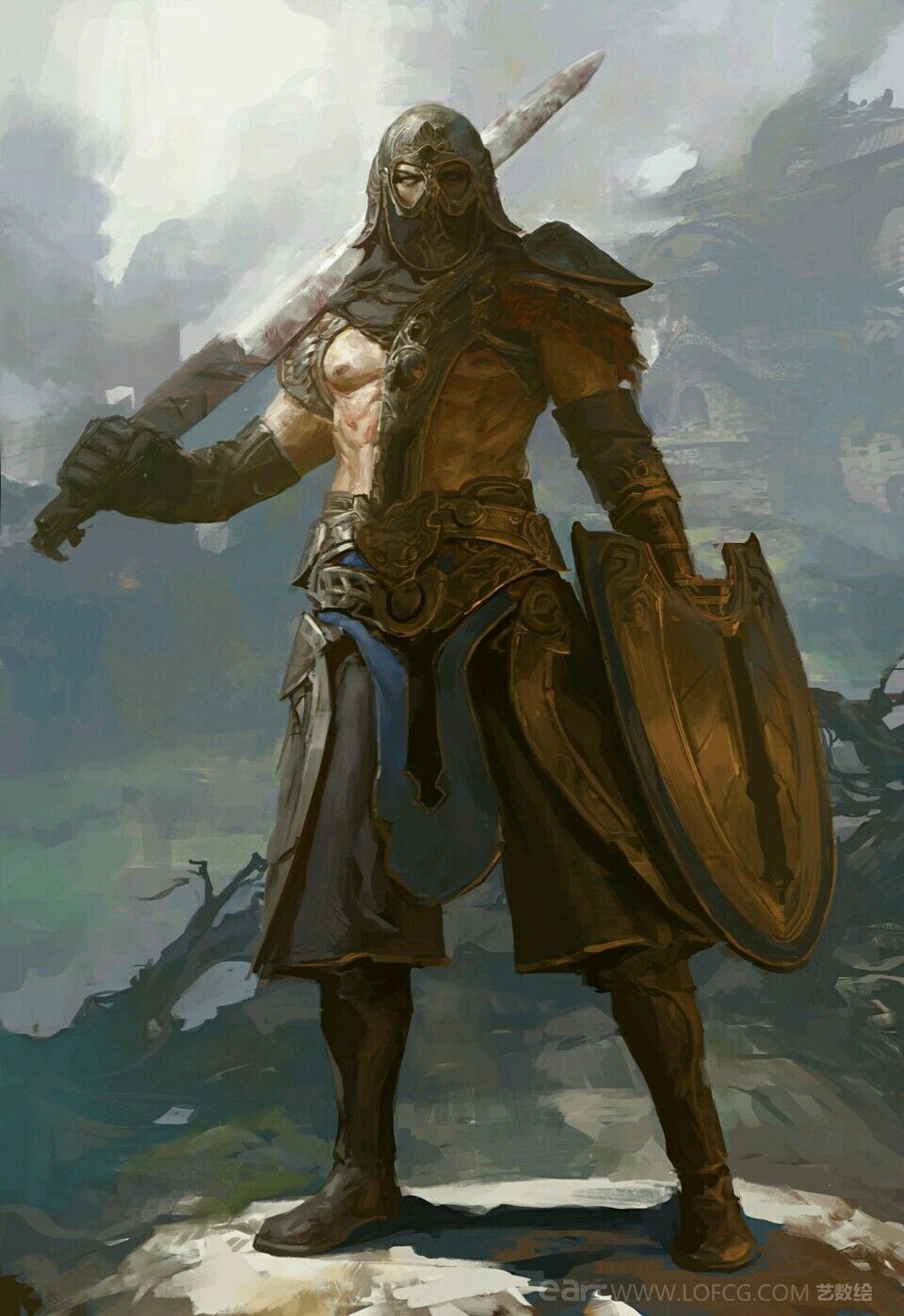

Design Notes
The Fighter class can tend to be boring or uninspired in base 5e and even with additions from OneDND. The original design appeared to rely on ASIs more frequently than other classes, suggesting the Fighter would be made interesting by the player through the selection of feats to round out their character. If true, this makes for bland character progression in my opinion, and build-tunneled feat choices based on "best-at-level" feats for a Fighter build. In addition, martials tend to only have the option to attack each turn, which does not make for an interesting decision space during combat. The following class redesign was made in an attempt to enhance the gameplay feel of playing a Fighter.
Overall, leveling should be exciting, every time. There should not be dead levels if possible where the player is not excited to reach it because no features are gained. While this iteration of the Fighter has many levels that are just improvements of previous features, the design was overall tailored to make leveling up more interesting. This update attempts to add features without getting out of hand like some previous editions. Note, the original Fighter is not the only class that suffers from boring level gains, but I feel they suffer the most.
Battlefield Role is the first major change. Fighters are characterized as having a good health pool (1d10 HP die) and being able to use all weapons and armors. The Role selection modifies this to allow additional customization of a player's Fighter. The Bulwark role offers 1d12 HP die, such that the Barbarian is no longer the only high HP class. Alternatively, the Myrmidon is built for speed and using Dex as a main stat. Players could previously make a Dexterity-based Fighter, but the Battlefield Role adds more flavor to the decision rather than "I use a rapier as my weapon, and I'm a worse Rogue." For a balanced approach that focuses on hard hitting attacks, the Warrior is a good option. Later, players will graduate to an Advanced Role to allow further customization. This feature has been described as "DnD Fire Emblem," which I'm okay with.
The Second Wind and playtest 7 features overall for Fighter are interesting, so they were mainly kept but moved to different levels to balance feature gains. In general, the Fighter has slightly more features to once again add options for how to play the class. Fighting Styles have changed slightly and the Fighter gets additional styles as they level.
Combat Master is a new feature that pulls in a change often requested by the community. Combat Master is a renamed inclusion of the Battle Master martial archetype into the main class. Fighters now gain maneuvers every level, and more at the adventuring tier levels. Like spellcasters, the Fighter now has many options to play with on their turn, with maneuver uses still fueling their choice economy. The original Fighter had a pool of superiority dice representing how often maneuvers could be performed between rests, but the wording was updated in this version to match Bardic Inspiration. No change mechanically, it's still just a pool of "times you can use this," but it is now consistent with Bard. The maneuvers themselves are mostly the same with a few new ones, but now each Fighter should have increased opportunity to make interesting plays on their turn.
While there are many places this class needs to be playtested for balance, the number of maneuvers gained is a big one. I don't see the maneuvers as being very different than spells, so having many of them is not far fetched in terms of difficulty to play the class. By the time the Fighter has reached max level, however, he or she will have learned all base maneuvers available. Players and DMs are encouraged to create new ones to add to the fun.
ASIs have now been removed at the intermediate levels where other classes would not otherwise get them. They were removed because, as previously stated, it felt like picking feats was the main point of the Fighter class's build diversity, and with the enhancements made in this version of the class, that is no longer necessary (or balanced). Instead, at levels 6 and 14, the Fighter gains the Rogue and Bard's Expertise feature, so that players have one more option other than Rogue and Bard as the party "skill monkeys."
Chain is a new feature which boosts the Fighter's damage output while doing flashy turns with multiple maneuvers. It enhances as the player gains levels to ensure the player isn't gaining 1-4 damage per attack at high levels, which is lame in base 5e.
Advanced Role is the third major jump in the Fighter's kit diversity, in addition to the major role bonus gained from their Battlefield Role. The player now chooses a second role, and depending on their starting role, they become one of the nine possible Advanced Roles. These are relatively straight-forward enhancements for build diversity.
The rest of the class (except level 20) is mainly just rebalancing of existing features that improve over time, and swapping the level at which the player gains features to balance feature gain.
Master of Armaments is an answer to the disappointing OneDND weapon masteries. Weapon masteries add a passive addition to weapons that is only gained if the character has mastered the weapon, which certain classes get drip-fed masteries in the new rules, and the Fighter slightly more so. For example, "Cleave" can only be used if a player has mastered the weapon. A large weapon like a greatsword is likely going to cleave... always. A character using a greatsword doesn't need to master the weapon to swing it wildly enough to hit multiple enemies. For this reason, weapon masteries have been reworked outside of the class (intending to be used by other classes as well). I think a perfect redesign for weapons would give them each three special ways to attack, to make them unique and useful to keep around.
The Master of Armaments feature lets the Fighter, who could be considered the weapon master class in the DnD class fantasy, use the whole set of weapon properties on any weapon. For example, a Fighter who specializes in daggers can make a cleave attack with a dagger. This is easily flavored during the game, but something that is immediately obvious that a normal dagger user like a Wizard may not have the knowledge how to properly employ.
Dominance is a new level 20 feature, because a third extra attack is extremely boring. Third extra attack is at level 19 instead, and Dominance allows for a powerful capstone related to the player's Advanced Role.
| Level | Proficiency Bonus | Superiority Die | Maneuvers | Features |
|---|---|---|---|---|
| 1st | +2 | - | - | Battlefield Role, Fighting Style, Second Wind |
| 2nd | +2 | 1d6 | 3 (+3) | Combat Master, Action Surge |
| 3rd | +2 | 1d6 | 4 (+1) | Martial Archetype, Tactical Mind |
| 4th | +2 | 1d6 | 5 (+1) | Feats, Chain |
| 5th | +3 | 1d8 | 8 (+3) | Extra Attack, Second Wind, Fighting Style |
| 6th | +3 | 1d8 | 9 (+1) | Tactical Shift, Expertise |
| 7th | +3 | 1d8 | 10 (+1) | Martial Archetype, Chain |
| 8th | +3 | 1d8 | 11 (+1) | Feats, Quick Swap |
| 9th | +4 | 1d8 | 12 (+1) | Second Wind, Indomitable |
| 10th | +4 | 1d8 | 13 (+1) | Martial Archetype, Advanced Role, Master of Armaments |
| 11th | +4 | 1d10 | 16 (+3) | Fighting Style, Extra Attack |
| 12th | +4 | 1d10 | 17 (+1) | Feats, Chain |
| 13th | +5 | 1d10 | 18 (+1) | Second Wind, Indomitable, Studied Attacks |
| 14th | +5 | 1d10 | 19 (+1) | Action Surge, Expertise |
| 15th | +5 | 1d10 | 20 (+1) | Martial Archetype, Fighting Style |
| 16th | +5 | 1d10 | 21 (+1) | Feats, Chain |
| 17th | +6 | 1d12 | 24 (+3) | Second Wind, Indomitable |
| 18th | +6 | 1d12 | 25 (+1) | Martial Archetype, Fighting Style |
| 19th | +6 | 1d12 | 26 (+1) | Feats, Extra Attack |
| 20th | +6 | 1d12 | 27 (+1) | Dominance |
Creating a Fighter
When defining your Fighter character, decide the "holy trinity-esque" role you wish to fulfill. Do you want to tank as many blows as a Barbarian or Paladin? Do you want rapidly jump from foe to foe, cutting down everything in your path? Do you want to dual wield greataxes and run shirtless at your foes blades held high?
How do you want to manipulate your foes during fights? Do you want to knock them prone so your allies gain advantage in melee?
Quick build
You can make a Fighter quickly by following these suggestions. First, take the Warrior Role and make Strength your highest ability score, followed by Constitution. Second, choose the Folk Hero background. Third, select Athletics and Acrobatics for your skill profiencies. Fourth, choose the Immense Weapon Fighting and Dual Wielding Fighting Styles.
Class Features
As a Ranger, you gain the following class features.
Hit Points (New)
- Hit Dice: See Battlefield Role
- HP at Level 1: See Battlefield Role
- HP at Level 2+: See Battlefield Role
Proficiencies (New)
- Armor: Shields, See Battlefield Role
- Weapons: All weapons
- Tools: Choose any one
- Saving Throws: See Battlefield Role
- Skills: Choose two skills from Acrobatics, Animal Handling, Athletics, History, Insight, Intimidation, Perception, and Survival
Equipment (New)
You start with the following equipment or 150 GP, in addition to the equipment granted by your background:
- (a) any ranged gear (a light crossbow + 20 bolts, two handaxes, any bow with 20 arrows, etc.)
- (a) any weapon and a shield, or any two weapons
- (a) armor - see Battlefield Role
- (a) a dungeoneer's pack or (b) an explorer's pack
| Category | Myrmidon | Warrior | Bulwark |
|---|---|---|---|
| Role Modifier | Dexterity | Strength | Constitution |
| Saving Throw | Str & Dex | Str & (Dex or Con) | Str & Con |
| Minor Role Bonus (Level 1) | +1 Crit Range | +1 to hit | +1 AC |
| Major Role Bonus (Level 10) | +Bonus Actions | Second Wind Allies | +1 All Saves +Allies |
| HP Features | |||
| Hit Dice | 1d8 | 1d10 | 1d12 |
| HP at Level 1 | 8 + Dex Mod | 10 + Str Mod | 12 + Con Mod |
| HP at Level 2+ | 1d8 + Dex Mod | 1d10 + Str Mod | 1d12 + Con Mod |
| Armor Features | |||
| Starting Armor | Leather | Scale Mail | Chain Mail |
| Armor Proficiencies | Light, Medium | All | Medium, Heavy |
1st Level: Battlefield Role (New)
When you start your adventure as the Fighter class, you choose a role around which you will define your purpose on the battlefield. Choose from Myrmidon, Warrior, or Bulwark. This role should align with your physical characteristics (defined by your stat choices). The features of this class will differ based on the chosen role and your Battlefield Role will not change during your journey (though you will gain an Advanced Role later).
Role Modifier. When you are prompted to add your Fighter class modifier to any roll, you add your Role modifier. This includes roles for weapons. For example, if you are a Myrmidon wielding a greatsword, you would add your Dexterity to the attack role and damage role, instead of Strength.
Role Bonuses. Picking a role grants a minor role bonus at level 1 specific to that Role's playstyle, and a major role bonus at level 10. The table above summarizes the Role choices.
Hit Dice and Points. Your hit dice, hit points at level 1, and hit points at higher levels are defined by your Battlefield Role. The table summarizes the HP features.
Starting Armor. Your Role determines your starting armor. Unlike armor, however, as a Fighter, you can make use of most weapons at your disposal, and therefore are not limited to certain weapons based on your role.
1st Level: Second Wind (One D&D+)
You have a limited well of physical and mental stamina that you can draw on. As a Bonus Action, you can use it to regain Hit Points equal to your Fighter hit die value + your Fighter level (a hit die is not consumed when you use Second Wind).
You can use this feature a number of times equal to your proficiency bonus. You regain one expended use when you finish a Short Rest, and you regain all expended uses when you finish a Long Rest.
1st Level: Fighting Style (5e)
You adopt a particular style of fighting as your specialty, gaining new styles as you grow more experienced. Choose one of the following options. You can't take a Fighting Style option more than once, even if you later get to choose again. Any Role can take any Fighting Styles. You gain an additional Fighting Style at level 5, 11, 15, and 18.
The following Fighting Styles are available to you:
Armored Fighting - While you are wearing armor, you gain a +1 bonus to AC.
Blind Fighting - You have blindsight with a range of 10'.
Chain Fighting - You begin each turn with one level of chain (your first attack deals 1d4 extra damage, etc.).
Dual Wielding - When you wield a weapon in both hands, you can add your ability modifier to the damage of the second attack, and gain +1 AC if you take the Dodge action.
Dueling - When you attack a hostile creature and only you are in its melee range, and only it is in yours, you gain a +2 bonus to attack and damage rolls.
Finesse Fighting - When you are wielding a melee weapon with the finesse property in one hand and no other weapons, you gain a +2 bonus to attack and damage rolls with that weapon.
Great Weapon Fighting - When you roll 1 or 2 melee damage with a two-handed or versatile weapon, you can reroll the die and must use the new roll.
Guardian Fighting - When a creature you can see attacks a target other than you that is within 5 feet of you, you can use your reaction to impose disadvantage on the attack roll. You must be wielding a shield or a melee weapon.
Immense Weapon Fighting - (Prerequisite: strength > 16) You can wield a two-handed weapon in one hand (including the two-handed damage of a versatile weapon).
Long Range Shooting - You gain a +1 bonus to attack rolls you make with ranged weapons. The range of ranged weapons is doubled for you.
Lucky Fighting - When you roll a 1 on an attack roll, you may reroll the die and must use the new roll.
Mobile Fighting - You gain 10' of speed, and you gain a swimming and climbing speed equal to your normal speed.
Short Range Shooting - You gain a +1 bonus to attack rolls you make with ranged weapons. Your ranged attacks are not made at disadvantage while within 5' of a hostile target.
Thrown Weapon Fighting - You treat any weapon as if it has the thrown property (20/60'), and when you hit by throwing a weapon, you gain a +2 bonus to the damage roll.
Unarmed Fighting - Your unarmed strikes can deal bludgeoning damage equal to 1d6 + your Strength modifier on a hit. If you aren't wielding any weapons or a shield when you make the attack roll, the d6 becomes a d8. At the start of each of your turns, you can deal 1d4 bludgeoning damage to one creature grappled by you or grappling you.
2nd Level: Combat Master (Battlemaster+)
You've learned to employ special combat maneuvers against your foes to gain the upper hand on the battlefield.
Maneuvers. You know how to employ 3 maneuvers by level 2. As you gain new levels as a Fighter, you learn more maneuvers, as shown in the Maneuvers column of the Fighter table. Each time you learn new maneuvers, you can also replace one maneuver you know with a different one. Many maneuvers enhance an attack in some way. You can use only one maneuver per attack, and you can use a number of maneuvers equal to your Role modifier plus your proficiency bonus per short rest.
Superiority Die. Many (most) maneuvers have you add a superiority die to a damage roll or other ability check. Your superiority die is a d6, and increases to a d8 at level 5, a d10 at level 11, and a d12 at level 17.
Role DC. Some of your maneuvers require your target to make a saving throw to resist the maneuver's effects. The saving throw is referred to as your Role DC and the DC is calculated as follows:
Role DC = 8 + your PB + your Role modifier
Level 2: Action Surge (One D&D+)
You can push yourself beyond your normal limits for a moment. On your turn, you can take one additional action, except the Magic action.
Once you use this feature, you must finish a Short Rest or Long Rest before you can use it again. Starting at level 14, you can use it twice before a rest but only once on a turn.
Level 3: Tactical Mind (One D&D)
You have a mind for tactics and getting the upper hand on and off the battlefield. When you fail an ability check, you can expend a use of your Second Wind to push yourself toward success. Rather than regaining Hit Points, you roll 1d10 and add the number rolled to the ability check, potentially turning it into a success. If the check still fails, this use of Second Wind is not expended.
Level 3: Martial Archetype (New)
You gain a Martial Archetype (Fighter subclass) of your choice from the list below. Subclasses are detailed after this class’s description.
A subclass is a specialization that grants you special features at certain Fighter levels. For the rest of your career, you gain each of your subclass’s features that are of your Fighter level and lower. You gain these additional abilities at levels 7, 10, 15, and 18.
| Arcane Archer, Revised | Gunslinger, Revised |
| Banneret, Revised | Mage Knight, New |
| Battle Master, Revised | Monster Hunter, Revised |
| Brute, Revised | Psi Knight, Revised |
| Cavalier, Revised | Rune Knight, Revised |
| Champion, Revised | Samurai, Revised |
| Dragoon, New | Scout, Revised |
| Dervish, New | Sniper, Revised |
| Echo Knight, Revised | Northumbrian Lord, New |
| Eldritch Knight, New | Others not listed |
Level 4: Feats (5e Standardized)
At character level 4, 8, 12, 16, and 19, you gain the Ability Score Improvement feat and a feat of your choice for which you qualify (excluding the ASI feat).
Level 4: Chain (New)
When you perform an attack or a maneuver that targets a creature in succession, add 1d4 to the damage roll, whether the maneuver deals damage or not. The damage is of type appropriate for the action. This damage increase by one die for each chained attack in a given turn (e.g. the fourth hit in a chain deals an additional 3d4 damage).
This damage increase to 1d6 at level 7, 1d8 at level 12, and 1d10 at level 16.
Level 5: Extra Attack (5e Modified)
You can attack twice, instead of once, whenever you take the Attack action on your turn. At level 11, you can attack three times, and at level 19, you can attack 4 times.
Level 6: Tactical Shift (One D&D)
Whenever you activate your Second Wind with a Bonus Action, you can move up to half your Speed without provoking Opportunity Attacks.
Level 6: Expertise (New)
Choose two of your skill proficiencies in which to gain expertise.
At 14th level, you can choose another two skill proficiencies in which to gain expertise.
Level 8: Quick Swap (New)
You may draw and/or stow weapons and items after making an attack or using a maneuver, as long as they are not in an extra-dimensional space like a bag of holding that requires an action to pull items from.
Level 9: Indomitable (5e)
If you fail a saving throw, you can reroll it with a bonus equal to your Fighter level. If you do so, you must use the new roll, and you can’t use this feature again until you finish a Long Rest. You can use this feature twice between Long Rests starting at level 13 and three times between Long Rests starting at level 17.
Level 10: Major Role Bonus (New)
You gain additional abilities to help control the battlefield based on your Battlefield Role. You gain the following benefit, depending on your role:
- Myrmidon: You can take the Dash, Disengage, or Hide action as a bonus action.
- Warrior: When you use your Second Wind, all allies within 10 feet of you also heal the same amount.
- Bulwark: You and all allies within 10 feet of you gain a +1 bonus to all saving throws (including death saves). You must be conscious to grant this bonus.
Level 10: Advanced Role (New)
You've gained an additional role, based on your current role. Select an Advanced Role from the options below. When you do, you gain the Minor Role Bonus of the added role (but not the Major Role Bonus). If you take the same role, you gain the bonus a second time. Your Role modifier does not change no matter which Advanced Role you choose. For example, if your starter Role is Myrmidon, your Role modifier is Dexterity. If you then take the Bulwark as your second role, you advance to the Blitzer Advanced Role, and your Role modifier remains Dexterity, not Dexterity and/or Constitution.
| Starting Role | Added Role | Advanced Role | ||
|---|---|---|---|---|
| Myrmidon | + | Myrmidon | = | Blademaster |
| Myrmidon | + | Warrior | = | Predator |
| Myrmidon | + | Bulwark | = | Blitzer |
| Warrior | + | Myrmidon | = | Greatblade |
| Warrior | + | Warrior | = | Warlord |
| Warrior | + | Bulwark | = | Centurion |
| Bulwark | + | Myrmidon | = | Vanguard |
| Bulwark | + | Warrior | = | Dreadknought |
| Bulwark | + | Bulwark | = | Fortress |
Advanced Role Bonuses (New)
You gain the following bonus based on your Advanced Role.
Blademaster. You add 2d8 to the damage roll when you crit, and gain +5' of speed until your next long rest each time you kill a foe with a critical hit and that foes CR is half your level or higher, and not unconscious or paralyzed when slain.
Predator. You can first use a maneuver without expending a use of Combat Master when you take the attack action while hidden. You don't lose the "hidden" status (and benefits granted by it) until after your attack.
Blitzer. When you hit a hostile creature with an attack or damaging maneuver, you gain temp HP equal to 1/4 your AC, or if wielding a shield, equal to 1/2 your AC instead.
Greatblade. You triple your superiority die damage when using any ability that adds damage using the superiority die.
Warlord. You regain a use of Combat Master when you use your Second Wind.
Centurion. You can apply two weapon abilities to attacks you make.
Vanguard. You gain an additional reaction, which you can only use to automatically deal 1d12 weapon damage when a hostile creature misses you.
Dreadknought. You can use your reaction to split half the damage received by an ally within 5' of you to you, reducing their damage.
Fortress. Every round (at the start of your turn in combat), you regain 1d12 hit points if you have no more than half of your hit points left. You automatically stabilize if unconscious, but do not heal while unconscious.
Level 10: Master of Armaments (One D&D+++)
You are a master of weapons. All weapons have all weapon abilities for you, deciding which one to apply when you make an attack roll as normal (per the new Weapon Property rules).
Level 13: Studied Attacks (One D&D)
You masterfully study your opponents and learn from each attack you make. If you make an attack roll against a creature and miss, you have Advantage on your next attack roll against that creature before the end of your next turn.
Level 20: Dominance (New)
You dominate the battlefield, and under your guidance, so do your allies. When you activate your Dominance feature, in addition to the affects described below specific to each Advanced Role, you and your allies within 20 feet gain 10 temporary hit points and +1 to hit until those temporary hit points gained via Dominance are lost.
Blademaster. You can instantly kill a foe you hit with a melee attack with less than 100 hit points, once per long rest.
Predator. You can turn invisible until the start of your next turn when you successfully hit an opponent with an attack or maneuver.
Blitzer. Your movement speed is doubled, your movement does not provoke attacks of opportunity, and foes you hit with a melee attack or maneuver are blinded until the start of your next turn, or until they hit you.
Greatblade. On your turn, when you score a critical hit with a melee weapon or reduce a creature to 0 hit points with one, you gain an action which allows you to take the attack action only (4 additional attacks).
Warlord. You and allies within 10 feet of you gain 1d10 hit points whenever you hit an enemy with an attack or maneuver.
Centurion. You can instantly kill a creature you hit with a melee attack with less than 40 hit points, by consuming a use of Combat Master.
Vanguard. When you hit a creature with an attack roll or maneuver, you can compel it to make a Charisma saving throw against your Role DC. On a failed save, the creature is compelled to do battle with you for 1 minute. It has disadvantage on attack rolls against creatures other than you, and must make a Wisdom saving throw each time it attempts to move away from you. If it succeeds on this saving throw, it is instead frightened and its speed is reduced to 0 until the end of its next turn.
Dreadknought. When you fail a saving throw, you can instead choose to succeed, by consuming a use of Combat Master.
Fortress. You gain resistance to all damage for 1 minute at a time, usable up to 5 times between long rests.
Manuevers
The following maneuvers are available to learn when you gain a new maneuver from this class or a feat.
-
Ambush - When you make a Stealth check or an initiative roll, you can add your superiority die to the roll, provided you aren't incapacitated.
-
Bait and Switch - When you're within 5 feet of a creature on your turn, you can switch places with that creature if they are willing and you use 5 feet of movement. This movement doesn't provoke opportunity attacks. Until the start of your next turn, you or the other creature (your choice) gains a bonus to AC equal to your superiority die.
-
Brace - When a creature you can see moves into your wielded melee weapon's reach, you can use your reaction to make one attack against the creature, using that weapon. If the attack hits, add your superiority die to the weapon's damage roll.
-
Commander's Strike - When you take the Attack action on your turn, you can forgo one of your attacks and use a bonus action to direct one of your companions to strike. When you do so, choose a friendly creature who can see or hear you. That creature can immediately use its reaction to make one weapon attack, adding your superiority die to the attack's damage roll.
-
Commanding Presence - When you make an Intimidation, Performance, or Persuasion check, you can add your superiority die to the ability check.
-
Disarming Attack - When you hit a creature with a weapon attack, you can attempt to disarm the target, forcing it to drop one item of your choice that it's holding. You add your superiority die to the attack's damage roll, and the target must make a Strength saving throw. On a failed save, it drops the object you choose. The object lands where appropriate per the DM.
-
Distracting Strike - When you hit a creature with a weapon attack, you can distract the creature, giving your allies an opening. You add your superiority die to the attack's damage roll. The next attack roll against the target by an attacker other than you has advantage if the attack is made before the start of your next turn.
-
Evasive Footwork - When you move, you can add your superiority die to your AC until the end of your turn.
-
Feinting Attack - You can use a bonus action on your turn to feint, choosing one creature within 5 feet of you as your target. You have advantage on your next attack roll against that creature this turn. If that attack hits, add your superiority die to the attack's damage roll.
-
Goading Attack - When you hit a creature with a weapon attack, you can attempt to goad the target into attacking you. You add your superiority die to the attack's damage roll, and the target must make a Wisdom saving throw. On a failed save, the target has disadvantage on all attack rolls against targets other than you until the end of your next turn.
-
Grappling Strike - Immediately after you hit a creature with a melee attack on your turn, you can try to grapple the target as a bonus action (see the Player's Handbook for rules on grappling). Add your superiority die to your Athletics check.
-
Lunging Attack - When you take the attack action with a melee weapon, you can increase your reach for each attack by 5 feet. If you hit, you add your superiority die to the attack's damage roll.
-
Maneuvering Attack - When you hit a creature with a weapon attack, you can maneuver one of your comrades into a more advantageous position. You add your superiority die to the attack's damage roll, and you choose a friendly creature who can see or hear you. That creature can use its reaction to move up to half its speed without provoking opportunity attacks from the target of your attack.
-
Menacing Attack - When you hit a creature with a weapon attack, you can attempt to frighten the target. You add your superiority die to the attack's damage roll, and the target must make a Wisdom saving throw. On a failed save, it is frightened of you until the end of your next turn.
-
Parry - When another creature damages you with a melee attack, you can use your reaction to reduce the damage by the your superiority die + your Role modifier.
-
Precision Attack - When you make a weapon attack roll against a creature, you can add your superiority die to the roll. You can use this maneuver before or after making the attack roll, but before any effects of the attack are applied.
-
Pushing Attack - When you hit a creature, you can attempt to drive the target back. You add your superiority die to the attack's damage roll, and if the target is Large or smaller, it must make a Strength saving throw. On a failed save, you push the target up to 15 feet away from you.
-
Quick Toss - As a bonus action, you can make a ranged attack with a weapon that has the thrown property. You can draw the weapon as part of making this attack. If you hit, add your superiority die to the weapon's damage roll.
-
Rally - On your turn, you can use a bonus action to bolster the resolve of one of your companions. When you do so, choose a friendly creature who can see or hear you. That creature gains temporary hit points equal to your superiority die roll + your Role modifier.
-
Riposte - When a creature misses you with a melee attack, you can use your reaction to make a melee weapon attack against the creature. If you hit, you add your superiority die to the attack's damage roll.
-
Spinning Attack - When you hit a creature with a cleave weapon, you can attempt to extend the cleave arc to a full circle. An additional attack roll is made for each creature in your range. If the additional attack roll hits, the other creatures takes cleave damage + your superiority die. The damage is of the same type dealt by the original attack.
-
Tactical Assessment - When you make an Investigation, History, or Insight check, you can add your superiority die to the ability check.
-
Trip Attack - When you hit a creature with a weapon attack, you can attempt to knock the target down. You add your superiority die to the attack's damage roll, and if the target is Large or smaller, it must make a Strength saving throw. On a failed save, you knock the target prone.
-
[NEW] Jump - When you perform a Jump (long or high), you can add your superiority die to the jump before any modifiers (such as from magic items that extend jump distance).
-
[NEW] Mount - You may attempt to climb onto a bigger creature using a bonus action instead of an action. If you attempt to do so, you add your superiority die to the grapple check, and can use Athletics or Acrobatics.
-
[NEW] Climb - When you attempt to climb an object such as a wall, you can add your superiority die to the number of feet of height to which you can climb. Note, normal climbing rules apply.
-
[NEW] Reversal - When you're within 5 feet of a creature on your turn, you can maneuver to an unoccupied space on the opposite side of that creature using 5 feet of movement. This movement doesn't provoke opportunity attacks, and you can do so regardless of other creatures or objects otherwise blocking the movement to that space above, below, or to the sides. If you use this maneuver on a hostile creature, you can make an attack on the creature adding your superiority die to the damage roll.
-
[NEW] Medic - You can use a bonus action to make a medicine check on an ally, adding your superiority die to the roll. If you roll a 10 or higher, the ally regains hit points equal to the superiority die roll. On a natural 20 roll, they regain twice as many instead.
-
[NEW] Anti-magic Attack - You can attempt to interrupt a creature in the process of casting a spell by using a reaction to attack the creature, adding your superiority die to the attack roll (but dealing no damage unless you have chain). On hit, if the creature is casting a spell of 2nd level or lower, its spell fails and has no effect. If it is casting a spell of 3rd level or higher, the target must make a Constitution save against your Role DC. On failure, the creature’s spell fails and has no effect.
Rule Changes
Flanking Variant
Flanking remains a variant rule that DMs may add to their game as desired. Advantage can be too powerful and easy to gain, so instead, the following Flanking variant may be used.
Flanking. You gain a +2 to hit if an ally is opposite of your foe from you and within range. Your target must be able to sense your ally as a threat, and your ally must not be incapacitated. For each additional ally within 5' (as long as at least two are on opposite sides), each ally gains an additional +1 to hit.
Discussion. Most adventuring parties are 4-5 characters with at least one or two magic users or ranged characters. This means that the most benefit most parties will get from this is +2-3 to hit, and that requires a focused effort of all melee characters to surround a single foe, which is also less likely. The average is likely closer to +2 to hit given a single ally supporting by flanking, which is similar to a common homebrew for flanking.
Foes can make use of this rule as well, making creatures with pack tactics far more dangerous in large numbers. On the other hand, it will make the ordeal of parties attacking a large creature more thematic and reliable overall.
Finally, unlike sneak attack, this rule requires allies, not just enemies of the target creature. A minor difference but impactful in some scenarios.
Weapon Abilities (Weapon Masteries Variant)
The following weapon abilities can be used by any character when they make an attack with an appropriate weapon, per the table on the next page. They must call out which property they will use before they determine if the attack hits.
CLEAVE. (Prerequisite: Melee Weapon, Heavy Property) - If you hit a creature with a melee attack using this weapon, you can make an attack roll with the weapon against a second creature within 5 feet of the first that is also within your reach. On a hit, the second creature takes the weapon’s damage, but don’t add your ability modifier to that damage, unless that modifier is negative. You can make this extra attack only once per turn.
GRAZE. (Prerequisite: Melee Weapon, Heavy Property) - If your attack roll with this weapon misses a creature, you can deal damage to that creature equal to the ability modifier you used to make the attack roll. This damage is the same type dealt by the weapon, and the damage can’t be increased in any way, other than increasing the ability modifier.
NICK. (Prerequisite: Light Property) - When you make the extra attack of the Light property, you can make it as part of the Attack action, instead of as a Bonus Action. You can still make this extra attack only once per turn.
PUSH. (Prerequisite: Heavy, Two-Handed, or Versatile Property) - If you hit a creature with this weapon, you can push the creature up to 10 feet straight away from yourself if it is Large or smaller.
SAP. (Prerequisite: No Other Properties) - If you hit a creature with this weapon, that creature has Disadvantage on its next attack roll before the start of your next turn.
SLOW. (Prerequisite: None) - If you hit a creature with this weapon and deal damage to the creature, you can reduce its Speed by 10 feet until the start of your next turn. If you hit the creature more than once with this property, the Speed reduction doesn’t exceed 10 feet.
TOPPLE. (Prerequisite: Heavy, Reach, or Versatile Property) - If you hit a creature with this weapon, you can force the creature to make a Constitution saving throw with a DC equal to 8 + your Proficiency Bonus + the ability modifier you used t make the attack roll. On a failed save, the creature has the Prone condition.
VEX. (Prerequisite: Ammunition, Finesse, or Light Property) - If you hit a creature with this weapon and deal damage to the creature, you have Advantage on your next attack roll against that creature before the end of your next turn.
Weapons with Abilities
| Weapon | Type | Cleave | Graze | Nick | Push | Sap | Slow | Topple | Vex |
|---|---|---|---|---|---|---|---|---|---|
| Club | Simple Melee | - | - | Yes | - | - | - | - | Yes |
| Dagger | Simple Melee | - | - | Yes | - | Yes | - | - | Yes |
| Greatclub | Simple Melee | - | - | - | Yes | - | Yes | Yes | - |
| Handaxe | Simple Melee | - | - | Yes | - | Yes | - | - | Yes |
| Javelin | Simple Melee | - | - | - | - | Yes | - | - | - |
| Light Hammer | Simple Melee | - | - | Yes | - | Yes | - | - | Yes |
| Mace | Simple Melee | - | - | - | - | - | Yes | Yes | - |
| Quarterstaff | Simple Melee | - | - | - | Yes | - | Yes | Yes | - |
| Sickle | Simple Melee | - | - | Yes | - | - | - | - | Yes |
| Spear | Simple Melee | - | - | - | Yes | Yes | Yes | Yes | - |
| ---------------------- | ---------------- | -------- | -------- | -------- | -------- | -------- | -------- | -------- | -------- |
| Light Crossbow | Simple Ranged | - | - | - | Yes | - | - | - | - |
| Dart | Simple Ranged | - | - | - | - | Yes | - | - | - |
| Shortbow | Simple Ranged | - | - | - | Yes | - | - | - | - |
| Sling | Simple Ranged | - | - | - | - | Yes | Yes | Yes | - |
| ---------------------- | ---------------- | -------- | -------- | -------- | -------- | -------- | -------- | -------- | -------- |
| Battleaxe | Martial Melee | - | - | - | Yes | - | Yes | Yes | - |
| Flail | Martial Melee | - | - | - | - | - | Yes | Yes | - |
| Glaive | Martial Melee | Yes | Yes | - | Yes | - | Yes | Yes | - |
| Greataxe | Martial Melee | Yes | Yes | - | Yes | - | Yes | Yes | - |
| Greatsword | Martial Melee | Yes | Yes | - | Yes | - | Yes | Yes | - |
| Halberd | Martial Melee | Yes | Yes | - | Yes | - | Yes | Yes | - |
| Lance | Martial Melee | - | - | - | - | - | Yes | Yes | - |
| Longsword | Martial Melee | - | - | - | Yes | - | - | - | - |
| Maul | Martial Melee | Yes | Yes | - | Yes | - | Yes | Yes | - |
| Morningstar | Martial Melee | - | - | - | - | - | Yes | Yes | - |
| Pike | Martial Melee | Yes | Yes | - | Yes | - | Yes | Yes | - |
| Rapier | Martial Melee | - | - | - | - | Yes | - | - | - |
| Scimitar | Martial Melee | - | - | Yes | - | - | - | - | - |
| Shortsword | Martial Melee | - | - | Yes | - | - | - | - | - |
| Trident | Martial Melee | - | - | - | Yes | - | - | - | - |
| Warpick | Martial Melee | - | - | - | - | - | - | - | - |
| Warhammer | Martial Melee | - | - | - | Yes | - | Yes | Yes | - |
| Whip | Martial Melee | - | - | - | - | - | Yes | Yes | - |
| ---------------------- | ---------------- | -------- | -------- | -------- | -------- | -------- | -------- | -------- | -------- |
| Blowgun | Martial Ranged | - | - | - | - | Yes | - | - | - |
| Hand Crossbow | Martial Ranged | - | - | Yes | - | - | - | - | - |
| Heavy Crossbow | Martial Ranged | - | - | - | Yes | - | Yes | Yes | - |
| Longbow | Martial Ranged | - | - | - | Yes | - | Yes | Yes | - |
| Net | Martial Ranged | - | - | - | - | Yes | - | - | - |
Arcane Archer [XGTE - Revised]
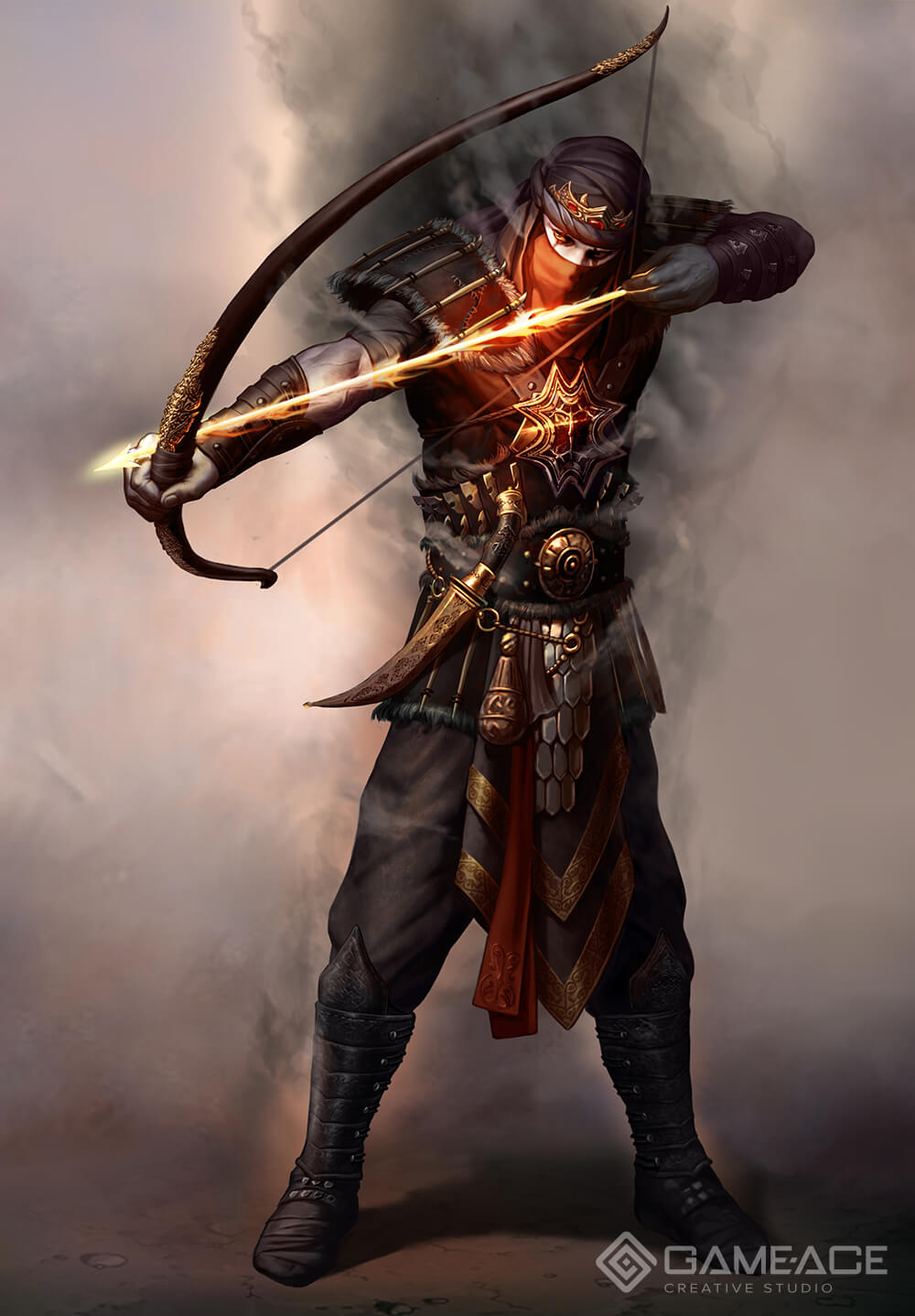
Mod Notes
A common complaint about Arcane Archer is only having two charges, so the main change is using Combat Master charges. The Arcane Shots were slightly tweaked and new shots were added.
The Elemental Arrows and Elemental Arrows+ features were added to give more choices to the Fighter on each attack (a common theme with the rework).
Finally, the level 18 evolution of the arcane shots that just added damage was removed because it was boring for a subclass "capstone," and the main class gains damage as it levels. Instead, Magical Quiver was added to give the subclass something for those players that are afraid to use single-use arrows (even though level 18 is quite late).
Level 3: Elemental Arrows
When you make an attack using a bow, instead of using a real arrow, you can conjure a magical arrow made of arcane energy from an unlimited font of magic that you've accessed. Each arrow deals the same damage as your bow damage, but takes on an element of your choice when fired out of the level 3 options in the element table below.
Level 3: Arcane Shot
You learn to unleash special magical effects when firing. When you gain this feature, you learn three Arcane Shot options of your choice (see "Arcane Shot Options" below).
Once per turn when you fire an arrow from a bow as part of the Attack action, you can apply one of your Arcane Shot options to that arrow. You decide to use the option when the arrow hits, unless the option doesn’t involve an attack roll. You consume a use of your Combat Master feature to use an Arcane Shot.
You gain an additional Arcane Shot option of your choice when you reach certain levels in this class: 7th, 10th, 15th, and 18th level.
Level 7: Curving Shot
You learn how to direct an errant arrow toward a new target. When you make an attack roll with a magic arrow and miss, you can use a bonus action to reroll the attack roll against a different target within 60 feet of the original target.
Level 10: Ever-Ready Shot
Starting at 15th level, your magical archery is available whenever battle starts. If you roll initiative and have no uses of Combat Master remaining, you regain one use of it (though you can use it on maneuvers instead of arcane shots if desired). You may also apply an arcane shot without consuming a use of Combat Master when you land a critical hit.
Level 15: Elemental Arrows+
When you make an elemental arrow attack, you now fire two magical arrows and can pick two different damage types.
In addition, your elemental options have expanded to the remaining damage types, and gain a special effect based on the element used. The options and their options effects are shown in the element table below.
Level 18: Magical Quiver
Your magic extends to your quiver. You can use a charge of Combat Master to pull any arrow from your quiver that you have used before. You can add your Superiority Die to the attack and damage roll for that arrow.
| Element | Level Gained | Optional Effect (Level 15+) |
|---|---|---|
| Acid | 3 | 1d4 acid splash damage to creatures within 5' of target |
| Cold | 3 | Target loses 10' of speed until end of your next turn |
| Fire | 3 | Target ignites and takes 1d4 fire damage until put out |
| Lightning | 3 | Arc travels 15' up to twice to 2 creatures, dealing 1d4 damage |
| Poison | 3 | Target gains the poisoned condition |
| Thunder | 3 | Target is deafened until end of your next turn |
| Force | 15 | Target is pushed back up to 10' |
| Necrotic | 15 | You gain health equal to half the damage dealt |
| Psychic | 15 | Target has disadvantage on Wis, Int, or Cha saves until end of your next turn |
| Radiant | 15 | You and allies gain advantage attacking target until end of your next turn |
Arcane Shot Options
The Arcane Shot feature lets you choose options for it at certain levels. The options are presented here in alphabetical order. They are all magical effects, and each one of the base options are associated with one of the schools of magic. If an option requires a saving throw, your Arcane Shot save DC equals 8 + your PB + your Int mod. Your superiority die is added to the damage roll.
Base Arcane Shots
Banishing Arrow. You use abjuration magic to try to temporarily banish your target to a harmless location in the Feywild. The creature takes damage from the arrow then must succeed on a Charisma saving throw or be banished. While banished in this way, its speed is 0, and it is incapacitated. At the end of its next turn, the target reappears in the space it vacated or in the nearest unoccupied space if that space is occupied.
Beguiling Arrow. Your enchantment magic beguiles a target hit by this arrow. The creature takes an additional 2d6 psychic damage from the arrow then must succeed on a Wisdom saving throw or be Charmed by an ally you choose within 30'. The charm wears off at the start of your next turn or upon your ally attacking the charmed target, dealing damage to it, or forcing it to make a saving throw.
Bursting Arrow. You imbue your arrow with force energy drawn from the school of evocation. The arrow detonates after your attack. Immediately after the arrow hits the creature, the target and all other creatures within 10 feet of it take 2d6 elemental damage each.
Enfeebling Arrow. You weave necromantic magic into your arrow. The creature takes an extra 2d6 necrotic damage and must succeed on a Constitution saving throw, or the damage dealt by its weapon attacks are halved until the start of your next turn.
Grasping Arrow. You use conjuration magic to conjure grasping, poisonous brambles on a target hit by this arrow. The creature hit by the arrow takes an extra 2d6 poison damage, its speed is reduced by 10 feet, and it takes 2d6 slashing damage the first time on each turn it moves 1 foot or more without teleporting. The target or any creature that can reach it can use its action to remove the brambles with a successful Strength (Athletics) check against your Arcane Shot save DC. Otherwise, the brambles last for 1 minute or until you use this option again.
Piercing Arrow. You use transmutation magic to give your arrow an ethereal quality. When you use this option, you don’t make an attack roll for the attack. Instead, the arrow fires forward in a line, which is 1 foot wide and 30 feet long, before disappearing. The arrow passes harmlessly through objects, ignoring cover. Each creature in that line must make a Dexterity saving throw. On a failed save, a creature takes damage as if it were hit by the arrow, plus an extra 1d6 piercing damage. On a successful save, a target takes half as much damage.
Shadow Arrow. You weave illusion magic into your arrow, causing it to occlude your foe’s vision with shadows. The creature hit by the arrow takes an extra 2d6 psychic damage, and it must succeed on a Wisdom saving throw or be unable to see anything farther than 5 feet away until the start of your next turn.
Seeking Arrow. Using divination magic, you grant your arrow the ability to seek out your target, allowing the arrow to curve and twist its path in search of its prey. When you use this option, you don’t make an attack roll for the attack. Instead, choose one creature you have seen in the past minute. The arrow flies toward that creature, moving around corners if necessary and ignoring three-quarters cover and half cover. If the target is within the weapon’s range and there is a path large enough for the arrow to travel to the target, the target must make a Dexterity saving throw. On a failed save, it takes damage as if it were hit by the arrow, plus an extra 1d6 elemental damage, and you learn the target’s current location. On a successful save, the target takes half as much damage, and you don’t learn its location.
Special Arcane Shots
[NEW] Magic Missile Arrows. You conjure three glowing arrows from the ether. The arrows strike a single target of your choice, dealing 1d4 elemental damage per hit simultaneously. For the purposes of concentration checks, this damage is additive (make one save against the three arrows total damage). An extra arrow is added at each subclass level (7, 10, 15, & 18).
[NEW] Radiant Flarrow. You conjure an array of magical light which shines bright light within 100 feet of its point of impact and dim light for another 100 feet. Undead within the bright light radius take damage equal to your superiority die as radiant damage, and targets within the inner range must make a Constitution save or be blinded until the start of your next turn. The light lasts for 1 hour or until you choose for it to end.
[NEW] Gravity Hole Arrow. You imbue dunmantic forces into an arrow. The arrow detonates into a small gravitational well. All creatures within 20' of the well must succeed on a Strength saving throw or be pulled towards an empty location adjacent to the hole and become Restrained. The well dissipates at the start of your next turn.
[NEW] Delayed Detonator Arrow. You conjure an arrow that sticks to a target on impact. When you fire the arrow, you choose a number of charges of Combat Master to consume. The arrow explodes dealing three times the superiority die damage to the target at the start of the turn equal to the number of dice you chose. A target may make an Intelligence saving throw to transfer the charge to any location (including another creature) within 5' of it, at the end of its turns.
[NEW] Safety Arrow. You imbue abjuration magic into an arrow that you target an ally with. On hit, the ally takes no damage but gains resistance to the damage type of the arrow used, until the start of your next turn (this can provide two resistances at level 15 with the Elemental Arrows+ feature).
[NEW] Warding Arrow. You imbue abjuration magic into an arrow that you target an ally with. On hit, the ally takes no damage but gains AC equal to half your proficiency bonus rounded up until the start of your next turn.
[NEW] Necromantic Bolt. You take the life force of another willing creature to deal necrotic damage equal to half of the health taken. A target whose health was reduced by this ability must be within 5' of you, and gains 1 level of exhaustion if the health taken is greater than a quarter of its health.
Banneret [SCAG - Revised]
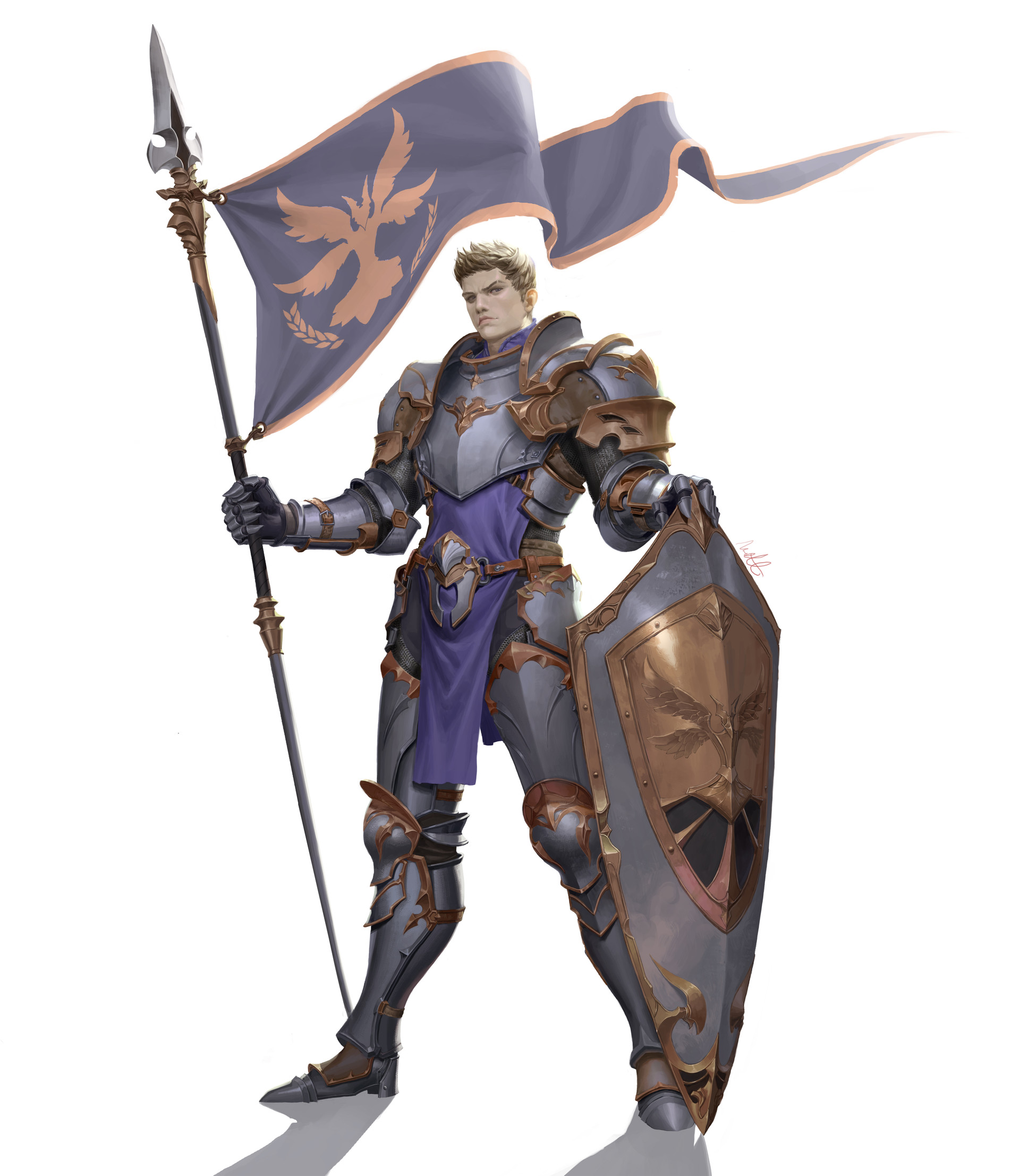
Battle Master [PHB, Revised]

Mod Notes
Battlemaster was integrated into the core class, so I kept the subclass but updated it to make it sort of synergize with the base class in a way that fulfilled the original battlemaster's subclass fantasy.
Know your enemy was too hard to apply during a given game, so it now happens more reliably, and you explicitly get to keep the information.
Combat superiority is an enhancement to maneuvers, and the battlefield/advanced roles added to the main class get a bonus when playing a battlemaster to really round out the idea of this new Fighter variant.
Finally, relentless was slightly improved and always ready was added to round out any final corners the Battlemaster Fighter may still need to cover.
Level 3: Know Your Enemy
Whether a prodigy or seasoned war veteran, your combat knowledge aids you against any foe.
Immediately upon seeing a foe, the DM tells you if the creature is equal, superior, or inferior to you with regard to one of the following characteristics of your choice. Each time you hit a creature with an attack or maneuver, you learn another characteristic. For that unique creature type, you always know these characteristics (recommend writing them down as you learn them to help your DM!).
If the creature's true form is under disguise (such as a dragon transformed to be a human), you learn the statistics of the disguise form, not the true form (unless you have true sight). You learn the creatures species (such as Ambush Drake, Human, etc.).
- Strength score
- Dexterity score
- Constitution score
- Armor Class
- Current hit points
- Total class levels, if any
- Fighter class levels, if any
Level 7: Combat Superiority
Your arsenal of combat tricks is ever expanding, and you've studied and overcome each flaw behind your maneuvers so that your success is nigh guaranteed. You learn 5 maneuvers.
When you use a maneuver, you can immediately perform an additional maneuver without spending a superiority die (but you still roll a superiority die if the maneuver has a roll associated with it).
Finally, your Role DC is increased by 1.
Level 10: Role Expert
Your allies may find you aiding a fight in any role, attacking swiftly, dealing heavy blows, or providing protection when needed most.
When you choose your Advanced Role at level 10, you also gain the Major Role Bonus of the Advanced Role. If you chose the same Role twice, you can choose to gain the Major Role Bonus of a Battlefield Role that you didn't choose as your second Battlefield Role.
In addition, you also gain the Minor Role Bonus of one Battlefield Role of your choice, and may regain a Minor Role Bonus that you already have.
Example 1. If you take the Myrmidon Battlefield Role then at level 10 you take the Warrior Battlefield Role (to assume the Predator Advanced Role), your character will have the Minor Role Bonus of the Myrmidon and Warrior, and the Major Role Bonus of the Myrmidon. You then also gain the Major Role Bonus of the Warrior, and may choose to gain again the Minor Role Bonus of the Myrmidon or the Warrior, or take the Minor Role Bonus of the Bulwark.
Example 2. If you choose the Blademaster Advanced Role by taking Myrmidon at level 3 and level 10, you gain +2 Crit Range and +Bonus Actions from your Battlefield Role and Advanced Role, and may then choose to further increase your crit range, gain +1 to hit, or +1 to AC as your Minor Role Bonus. You then may take the Second Wind Allies or +1 All Saves +Allies Major Role Bonus, since gaining +Bonus Actions (the Major Role Bonus of the Myrmidon) a second time does not otherwise provide any benefit.
Level 15: Relentless
When you roll initiative and have no superiority dice remaining, you regain 1 superiority die.
If you are reduced to zero hit points, you can use a charge of Combat Master to immediately gain health equal to your superiority die roll.
Level 18: Always Ready
You gain two reactions which, in addition to your existing reaction, can be used to perform any of the following as appropriate, once per single enemy turn:
- Perform an attack of opportunity.
- Perform a held action.
- Stand from prone.
- Reattempt a saving throw.
- Attempt to free yourself from a grapple.
- Perform a maneuver.
- Make a skill check (such as a Perception check)
- Call out to your allies
- Move 5' without provoking an AoO
Brute [UA, Revised]
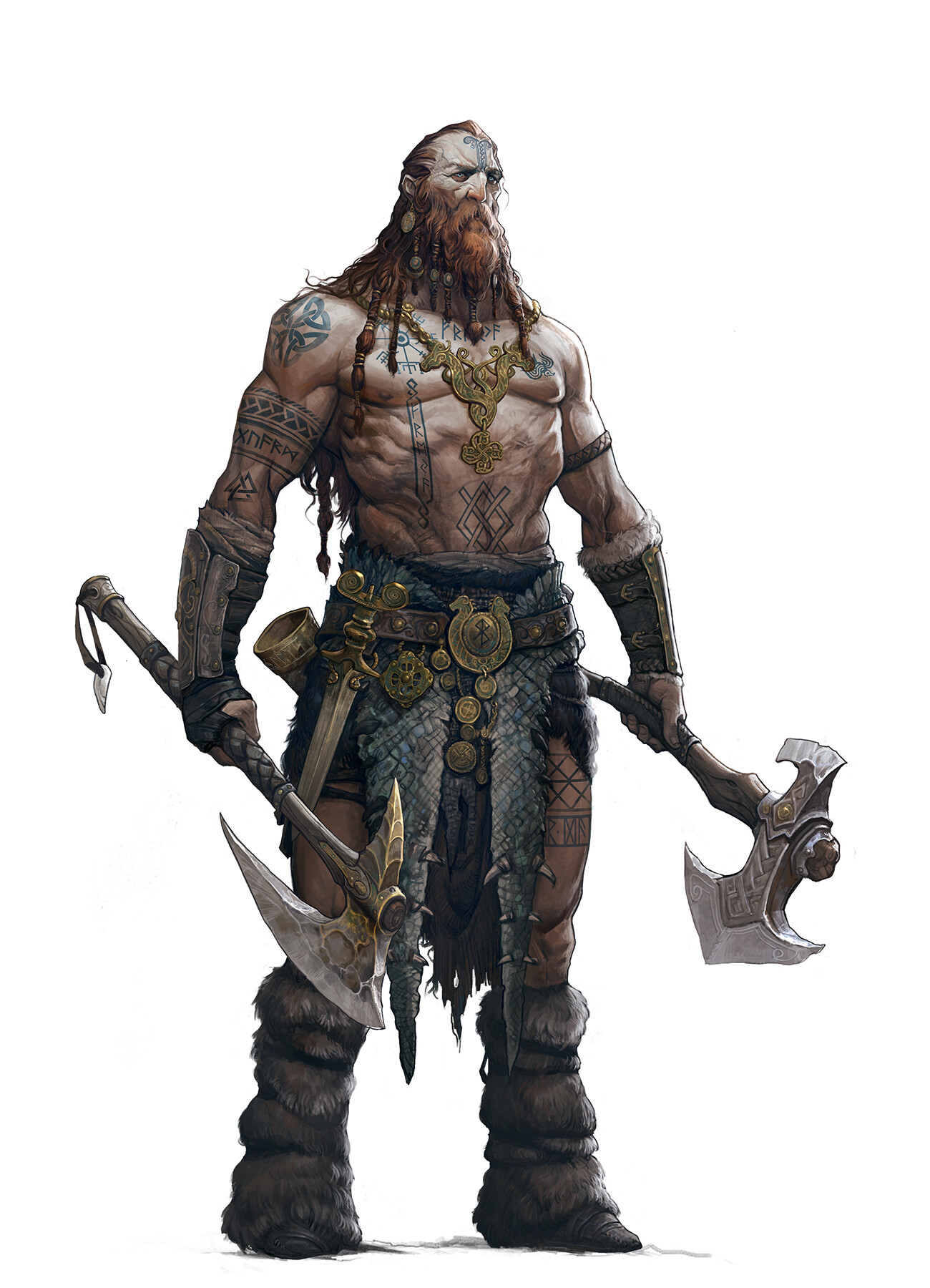
Mod Notes
I have no opinions on the base Brute other than it was pretty boring, like the others. I don't really have any subclass fantasies to apply to the subclass other than making them big, scary, and a Fighter-variant to taking the Barbarian class.
Brute Force was improved to match subclass level gains which effectively give you more damage earlier.
Brutish durability was added to help you stay up in fights since you don't have the resistances that Barbarians have (yet).
Violent Strikes give a nice power increase at level 10 and make them a scary opponent to face.
Enrage is a way to focus the main class Action Surge ability into a subclass-flavored damage boost, with a minor push your luck mechanic.
Finally, Terror just makes you big, which is fun and brute-epitomizing.
Level 3: Frightful Presence
You gain proficiency in Intimidation checks, or expertise if you already have proficiency. You may choose to use your Role modifier instead of your Charisma modifier when calculating the check total.
Level 3: Brute Force
You are able to strike with your weapons with especially brutal force. Whenever you hit with a weapon and deal damage (excluding with an arrow or dart), the weapon’s damage increases by an amount based on your level in this class, as shown on the Brute Bonus Damage table.
Brute Bonus Damage
| Fighter Level | Damage Increase |
|---|---|
| 3rd | 1d4 |
| 7th | 1d6 |
| 10th | 1d8 |
| 15th | 1d10 |
| 18th | 1d12 |
Level 7: Brutish Durability
Your toughness allows you to shrug off assaults that would devastate others.
You gain the Tough feat or the Resilient feat. If you already have either, you can may take the same feat a second time.
Whenever you make a saving throw, roll 1d6 and add the die to your saving throw total. If applying this bonus to a death saving throw increases the total to 20 or higher, you gain the benefits of rolling a 20 on the d20.
Level 10: Violent Strikes
You treat a roll of 1 or 2 on a damage die as a 3 instead. When you roll a 1, 2, or 3, you can reroll the die but must take the rerolled value (where a 1 rerolled to a 1 would still be treated as a 3).
If you roll maximum damage on at least half of the damage dice rolled, the target must make a Constitution saving throw against your Role DC or gain a grievous wound. The wounded takes slashing damage equal to your Brute Bonus Damage die at the start of their turn until healed.
Finally, if you have the Great Weapon Fighting feat, you can replace it with a different fighting style, or gain the Great Weapon Master feat.
Level 15: Enrage
When you use your Action Surge ability, you can enter a frenzy. If you choose to Enrage, you must use your Action surge to take the attack action. Your attacks are at a -5 penalty to hit, but deal an additional 3d6 damage per hit.
Each time you hit while Enraged, you gain 5' of movement speed until the end of your turn and gain health equal to your Role modifier. If you hit with all of your additional attacks, you can immediately perform another Action Surge. If you do, you can Enrage again. You gain 1 level of exhaustion at the end of your turn if you use enrage again in this way.
You have 2 uses of Action Surge between levels 15 and 20. If you gain additional uses of Action Surge through in-game means, you can perform Action Surge multiple times using your Enrage feature, but the number of levels of exhaustion you gain at the end of your turn increases by 1 for each additional Action Surge you use each turn in this way.
Level 18: Terror
An otherworldly force embraces your being, reforming you into the true brute that you are.
You gain 12-18" of height (your choice) and you grow dimensionally to match the change in height. You also gain 2 to your Role attribute (STR|DEX|CON), which may increase beyond 20.
In addition, you may may gain the following effects for 10 minutes once per short rest, and may end the affects prematurely if desired:
Enlarge. Your size doubles in all dimensions, and your weight is multiplied by 8. Your size is increased by one category. If there isn't enough room to double in size, you attain the maximum possible size in the space available, though you may break through walls and ceilings if weak enough. You have advantage on Strength checks and Strength saving throws, and your weapons also grow to match your size. While these weapons are enlarged, your attacks with them deal 1d6 extra damage.
Cavalier [XGTE, Revised]

Mod Notes
The subclass is interesting and decent overall, but I thought some features could have minor improvements. The level 7 feature especially needed a complete overhaul to make level 7 the subclass fantasy fulfillment point. War Mount gives some variation on how the player can use their mount in a simple way.
The Born to the Saddle feature was slightly improved for just a bit more mechanical flavor and overall strength. Mounted Combatant was given as a free feat because every cavalier must take it to function, so it might as well be a part of the subclass.
Unwavering Mark was nerfed and buffed by removing the per-day requirement, while also reducing the overall damage since it can be used more often. It also no longer offers advantage, but many creatures will already have advantage imposed against them due to Mounted Combatant.
Finally, I required the character to be mounted or near the mount in general to get the features. I know that makes it difficult in some campaigns but I think it should be required for a mount-based subclass. I tried to balance this to having a weaker form of the ability while not mounted.
For an extensive review of the rules, see rpgbot's excellent guide on mounted combat: https://rpgbot.net/dnd5/characters/mounted_combat/
Level 3 - Born to the Saddle
You've mastered life on a saddle. You have advantage on saving throws made to avoid falling off your mount and if you do fall off, and descend no more than 10 feet, you can land on your feet if you’re not incapacitated. You can choose to make a Strength or Constitution saving throw instead of a Dexterity saving throw to avoid falling off your mount.
Mounting or dismounting a creature costs you no movement, rather than half your speed, but it still costs 5' of movement to swap to a different mount.
You have advantage on Animal Handling checks made to calm or convince a creature to allow you to use it as a steed, saddle or not, and the creature may be intelligent.
Level 3 - Mounted Combatant
You gain the Mounted Combatant feat.
Level 3 - Unwavering Mark
You can menace your foes, foiling their attacks and punishing them for harming others. While mounted, when you hit a creature with a melee weapon attack, you can mark the creature until the end of your next turn. This effect ends early if you are incapacitated or die.
While it is within 5 feet of you, a creature marked by you has disadvantage on any attack roll that doesn't target you or your mount.
Finally, if a creature marked by you deals damage to anyone other than you or your mount, you can make a special melee weapon attack against the marked creature as a bonus action on your next turn. If the attack hits, the attack's weapon deals extra damage to the target equal to your proficiency bonus, or twice that damage if mounted.
Level 7 - War Mount
Your mount has learned from your leadership, gaining a feature based on your Battlefield Role.
- Myrmidon. Your mount can take two actions per turn, from Dash, Dodge, or Disengage.
- Warrior. When you take the attack action, your mount can make one attack of appropriate means and damage type (bite, hooves, claws, tail, etc.). The damage is equal to 2dX where X is your superiority die size.
- Bulwark. While mounted, the saving throw portion of your Mounted Combatant feat is extended to all saving throws for your mount, and you gain the dexterity throw portion of the feature.
Level 10 - Hold the Line
You've become a master of locking down your enemies. While mounted or within 5 feet of your mount, creatures provoke an opportunity attack from you when they move 5 feet or more while within your reach.
If you hit a creature with an opportunity attack while mounted, the target's speed is reduced to 0 until the end of the current turn. If you are not mounted, the target's speed is halved instead for the same duration.
Level 15 - Ferocious Charger
With your trusty steed, you can run down your foes. If you move at least 10 feet in a straight line while mounted right before you attack and hit a creature, that target must succeed on a Strength saving throw (DC 8 + your PB + your Role modifier) or be knocked prone. If you charge a foe in the same way while not mounted, the DC is instead 8 + your Role modifier only.
You can use this feature only once on each of your turns.
Level 18 - Vigilant Defender
You've learned to respond to danger with extraordinary vigilance. In combat, you get a special reaction that you can take once on every creature's turn, except your turn. You can use this special reaction to make an opportunity attack or perform a dash. You can't use it on the same turn that you take your normal reaction.
Champion [PHB, Revised]
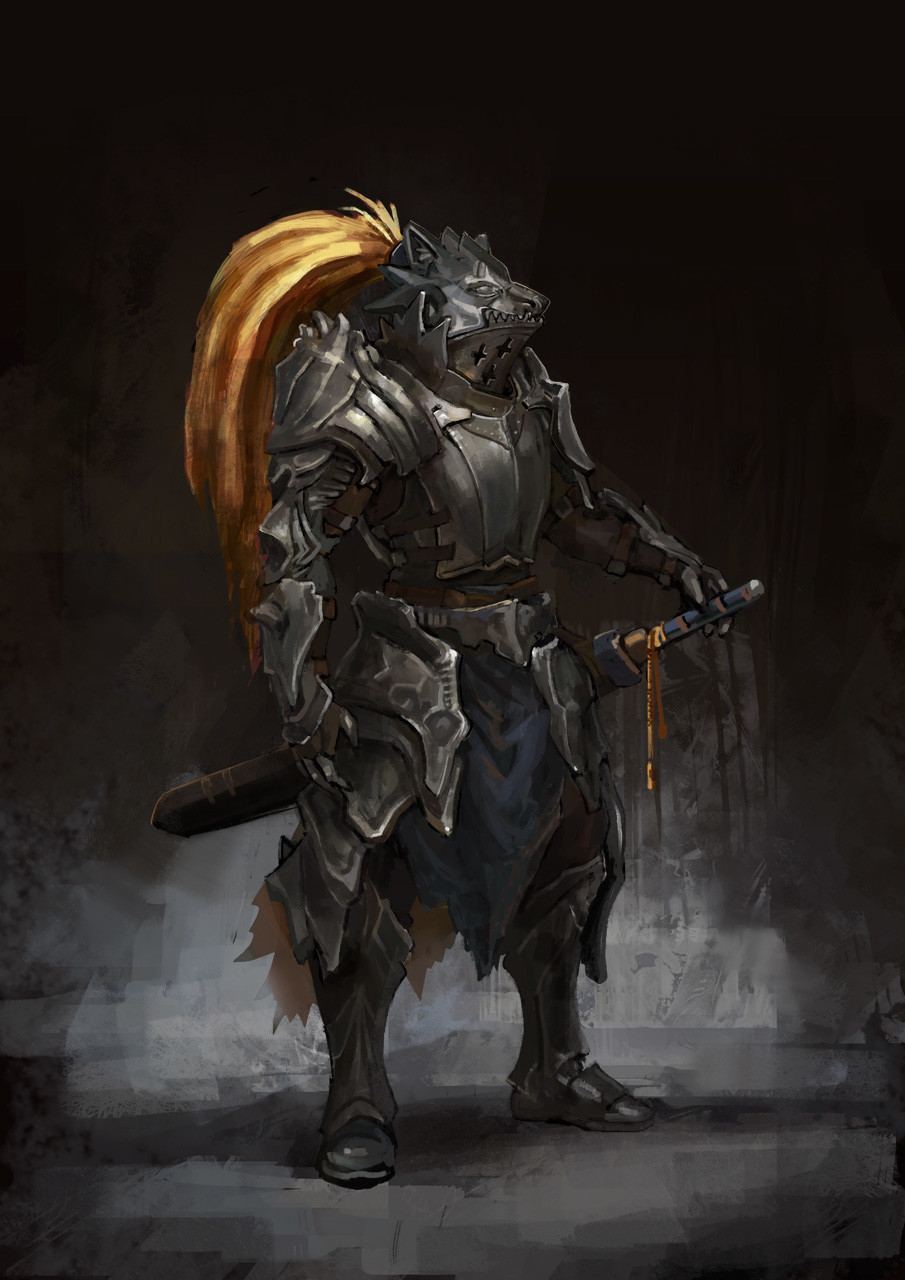
Mod Notes
People tend to take the Champion subclass because there isn't much to it, or to build a crit fishing build. Given the ability to take the myrmidon for enhanced crits, I felt players could take the level 3 improved critical of this subclass plus myrmidon for crit fishing, which allowed me to pull out the enhanced crit at level 15 for a different passive bonus. The base class now has enhanced player choice, so the subclass still doesn't necessarily need a lot of features or choices to make it interesting.
The main focus was to make the champion excellent at its skills more often, enhancing Remarkable Athlete at level 15 and building the character's core at level 10 (and future levels) with Champion Ability. Remarkable Athlete only works on Athletics, Acrobatics, Sleight of Hand, and Stealth, then eventually Strength, Dexterity, and Constitution saving throws.
Level 3 - Improved Critical
Your prowess with weapons has honed your ability to deal heavy blows for massive damage. Your critical hit range is increased by 1.
Level 3 - Muscle Memory
Your muscle memory becomes more concrete with each battle, allowing you to perform with extreme competence. When you roll to attack and miss or fail a saving throw, you can choose to hit or succeed instead. You can use this feature a number of times equal to your proficiency bonus per short rest.
Level 7 - Remarkable Athlete
You can add half your proficiency bonus (rounded up) to any Strength, Dexterity, or Constitution ability check you make that doesn't already use your proficiency bonus.
In addition, when you make a jump, the distance you can cover increases by a number of feet equal to your Strength modifier.
Level 10 - Champion Ability
You can choose an additional Fighting Style and gain the ASI feat. During future Fighter class levels where you gain the ASI Feat (levels 12, 16, and 19), you gain 3 ASIs instead of 2.
Level 15 - Perfect Athlete
Your athletic capabilities have reached near supernatural levels. You've become proficient in all Strength, Dexterity, and Constitution ability checks and saving throws, or expertise if you are already proficient.
Level 18 - Survivor
You attain the pinnacle of resilience in battle. At the start of each of your turns, you regain hit points equal to 5 + your Role modifier if you have no more than half of your hit points left. You don't gain this benefit if you have 0 hit points.
Dragoon [NEW]
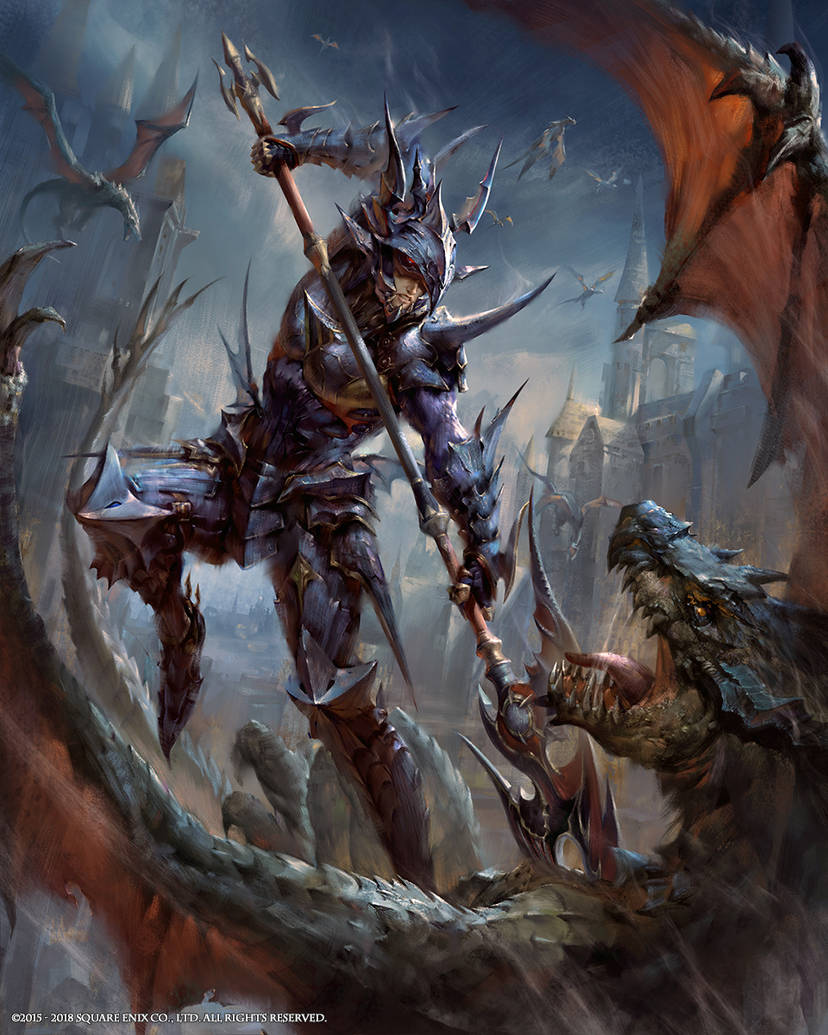
Mod Notes
The Dragoon was designed to reflect the popular class in games like Final Fantasy. The subclass is defined around being able to jump high, and harm things below.
Level 3: Launch
You have honed a magic resident in those few who can survive performing the arts of a Dragoon. You can now perform a Launch, which allows you to leap great distances in in short periods of time.
Launch Height/Distance. When you Launch, you make a long or high jump with distance up to 30'. The Launch distance increases an additional 10' at each subclass level (7, 10, 15, & 18), and the entire Launch distance can be modified via magic such as the Jump spell, magic items, etc.
You consume movement equal to your maximum movement speed to Launch (i.e. you must launch while standing without having voluntarily moved on your turn). You reach the apex of your jump during your turn. If you are in the air on your next turn and do not have a hover/fly/etc. ability, you drop up to 500'.
Launch Uses. You can perform a Launch a number of times equal to your Role modifier per long rest.
Launch Safety. Like standard Jump rules, no fall damage is taken if you return to the same elevation or higher as a result of the Launch.
Level 7: Dragoon Descent
You bring terror from above, piercing down from the heavens to wreak havoc on your foes below.
After falling from great height and upon reaching your target, you can make an attack roll with your weapon. Examples of a fall that could begin a Drop Attack include the desecent after performing a Launch or regular jump, the descent after jumping off a cliff onto a creature below, or the descent after being thrown by a trebuchet.
Drop Attack Hit Penalty. The attack roll is at a -1 penalty to hit for every 10' of descent, up to 200'.
Drop Attack Advantage. If an enemy of the target is within that enemy's range and isn't incapacitated, or if you descended 30' or more, you have advantage on the attack roll.
Drop Attack Range. For every 10' of height dropped, you may choose to drop to any location within 5' of your initial point of descent (or Launch).
Drop Attack Crit. Your critical hit range is increased by 1 for every 30' of drop, and you regain a charge of Launch and Dragoon Descent when you crit.
Drop Attack Uses. You can perform a Drop Attack a number of times equal to your proficiency bonus, and regain uses on a Long Rest.
Drop Attack Results. Calculate damage as follows:
-
Damaging hit (attack roll ≥ target's AC) - You deal damage equal to your weapon attack's normal damage plus extra damage of the same type equal to 1d6 for every 10' of descent. This damage increases to 1d8 at Fighter level 10, 1d10 at level 15, and 1d12 at level 18.
-
Non-damaging hit (8 < attack roll ≤ target's AC) - You land in the selected location on your feet but the target deflects the damage.
-
On miss (attack roll ≤ 8) - You land in the selected location, releasing the energy intended for your target into the ground instead, creating a shockwave of energy. Any creature within 5' must succeed on a Strength saving throw with DC equal to 8 + 1 for every 10' dropped, or be pushed backwards 5' and knocked prone.
Level 10: Sky Sentinel
You gain spectral wings that allow you to hover (but not fly). While hovering, you can move up to your movement speed horizontally or downwards but not up. Your descent can be controlled by gravity or by using your wings.
In addition, your melee reach is increased by 5'.
Level 15: Explosive Landing
You can infuse your weapon with the explosive might of your archetypes origin. Each dawn, you can choose a dragon by color (your DM may offer more options). You can perform an Explosive Landing once per long rest, or twice at level 18.
When you land after using your Dragoon Descent feature, regardless of your attack roll, you can create an explosion of magical, elemental energy at the point of impact, up to 10 feet in radius. Any creature (excluding yourself) that is caught in the blast must succeed on a saving throw with type matching the chosen dragon, and with DC equal to your Role DC, or take damage as shown in the table. The target takes half damage on success.
| Color | Damage | Save |
|---|---|---|
| Red/Brass/Gold | 16d6 Fire | Dex |
| Blue/Bronze | 10d10 Lightning | Dex |
| Green | 12d6 Poison | Con |
| Black/Copper | 11d8 Acid | Dex |
| White/Silver | 10d8 Cold | Con |
Level 18: King of Dragons
You gain the Find Steed spell which you can cast once per day, and only to call upon the spirit of a Dragon (any type (Young, Ambush, Wyvern, Drake, etc.) or color). In general, you gain control, but if you attempt to summon too great a being (such as an ancient black dragon), the DM may prevent you from controlling it.
Dervish [NEW]

Mod Notes
This subclass is all about swinging your weapons as much as possible to become a storm of blades. This class doesn't really function correctly without the dual wielder feat and two-weapon fighting, and while it is likely that anyone taking this subclass will choose those features, it was built into the subclass to be safe.
Elemental strikes is just a flavor item to enhance the storm imagery. Whirlwind is a typical subclass fantasy for a dual-wield build, allowing characters to deal enhanced damage a few times per short rest. Whirlwind causes more attacks, which means more chances to miss, but also more chances to crit. Overall, it may result in less damage because of this, but it lets the character be flashy for a potential for more damage. Assuming a Role modifier of +4 at level 7 and +5 at levels 11 and 19, this features results in an average damage increase of 23%, 35%, and 43% at each respective "extra attack" level (assuming all attacks hit and there are no resistances, immunities, or critical hits).
Climber is flavor given the dual-pick method of climbing sharing similarities to dual-wielding weapons. Flash Dance Strike can be paired with or without whirlwind and allows the dervish to blitz about the battlefield, or dance around a single target. One Against Many exists to embody deflecting attacks with your blades easily, and free hand riposte makes you dangerous to attack as you can dish out more damage.
Level 3 - Dual Wielder
You gain the Two-Weapon Fighting Fighting Style and the dual wielder feat. If you already have the dual wielder feat, you gain a feat of your choice.
Dual Wielder Feat
You master fighting with two weapons, gaining the following benefits:
- You gain a +1 bonus to AC while you are wielding a melee weapon in each hand.
- You can use two-weapon fighting even when the one handed melee weapons you are wielding aren't light.
- You can draw or stow two one-handed weapons when you would normally be able to draw or stow only one.
Level 3 - Elemental Strike
The power of your strikes bends the weave itself, bestowing the energies of the universe into your attacks. When you use a feature of this subclass, you can add elemental energy to your weapon or tool. This elemental energy deals damage of that type equal to your Role modifier.
You can use this feature a number of times per short rest equal to your proficiency bonus, and it applies to every attack of the attack action. You can change the element imbued to your weapon with each attack, and the imbuement only lasts for the duration of the swing. The available elements include poison, fire, cold, and lightning.
These elements create real effects for the purposes of the impact of using this ability on the world (such as invoking fire on a weapon to melt ice, etc.).
Level 7 - Whirlwind
The spirit of wind can guide your blades. While wielding two weapons, as a bonus action, you can become a frenzy of steel dealing a burst of attacks on your target. When you do, during your next attack action this turn, you attack with both weapons for each attack. The attacks use each weapon's modifiers as normal.
For example, when you first gain this feature at level 7, you have the extra attack feature, so you can normally make two attacks per turn plus one attack as a bonus action using two-weapon fighting. Using your whirlwind feature, you make 4 attack rolls instead of 3, 2 with each weapon.
You can use this feature a number of times equal to your proficiency bonus per short rest.
Finally, each time you make an attack of opportunity, you can make an attack with both of your weapons.
Level 7 - Climber
While wielding two weapons or two climbing implements, you gain a climbing speed equal to your speed, and you have advantage on skill checks related to remaining attached to something you are climbing with two weapons, including climbing picks or similar objects.
Level 10 - Flash Dance Strike
While wielding two weapons, each time you attack, you can move 5' before the attack, which doesn't consume your normal movement speed. If you are attacking a creature and remaining within their attack range with this movement, you can use this movement to move diagonally to spaces in front of, left of, behind, and right of, your target.
If you attack a creature from 4 different sides using this feature, the fourth and all additional attacks after (if any) are made at advantage.
Level 15 - One Against Many
While wielding two weapons, you gain +1 AC for each hostile creature greater than 1 this is within 10 feet of you, up to a maximum of your Role modifier. For example, if there are 4 creatures around you and targeting you, you gain +3 AC.
Level 18 - Free Hand Riposte
When a hostile creature misses a melee attack against you, you can make a single weapon attack with your main hand or off hand weapon. This does not consume your reaction.
Echo Knight [EGTW, Revised]

Mod Notes
Only a few changes were made to the subclass to enhance some holes in its abilities. Unleash Incarnation can be used based on your Role mod instead of Con. Echo Avatar has a little more usability and can be used to attack/etc. Shadow Martyr explodes on death dealing damage and blinding. Reclaim Potential allows you to take your dead Echo's place and you can use it more often. Finally, Legion of One lets you cycle your echos rather than just destroying them both when casting a new one.
Manifest Echo
At 3rd level, you can use a bonus action to magically manifest an echo of yourself in an unoccupied space you can see within 15 feet of you. This echo is a magical, translucent, gray image of you that lasts until it is destroyed, until you dismiss it as a bonus action, until you manifest another echo, or until you're incapacitated. It is considered an object for the purposes of targeting.
Your echo has AC 14 + your proficiency bonus, 1 hit point, and immunity to all conditions. If it has to make a saving throw, it uses your saving throw bonus for the roll. It is the same size as you, and it occupies its space. On your turn, you can mentally command the echo to move up to 30 feet in any direction (no action required). If your echo is ever more than 30 feet from you at the end of your turn, it is destroyed.
- As a bonus action, you can teleport, magically swapping places with your echo at a cost of 15 feet of your movement, regardless of the distance between the two of you. You can use this to escape from a grapple, but the cost is subtracted from your speed after escaping.
- When you take the Attack action on your turn, any attack you make with that action can originate from your space or the echo's space. You make this choice for each attack.
- When a creature that you can see within 5 feet of your echo moves at least 5 feet away from it, you can use your reaction to make an opportunity attack against that creature as if you were in the echo's space.
Unleash Incarnation
At 3rd level, you can heighten your echo's fury. Whenever you take the Attack action, you can make one additional melee attack from the echo's position.
You can use this feature a number of times equal to your Role modifier (a minimum of once). You regain all expended uses when you finish a short rest.
Echo Avatar
Starting at 7th level, you can temporarily transfer your consciousness to your echo. As an action, you can see through your echo's eyes and hear through its ears. During this time, you are deafened and blinded. You can sustain this effect for up to 10 minutes, and you can end it at any time (requires no action). While your echo is being used in this way, it can be up to 1,000 feet away from you without being destroyed, and can hover up to a foot off of any surface.
While using your Echo in this way, it has all of your abilities, but still has its own health/resistances/etc.
Shadow Martyr
Starting at 10th level, you can make your echo throw itself in front of an attack directed at another creature that you can see. Before the attack roll number is announced, you can use your reaction and a charge of Combat Master to teleport the echo to an unoccupied space within 5 feet of the targeted creature. The attack roll that triggered the reaction is instead made against your echo and its AC.
If your Echo is destroyed when martyring itself, you explodes in a flash of light. The attacking creature must succeed on a Constitution saving throw against your Role DC or take 3dX force damage and be blinded for 1 minute, where X is your superiority die size.
Reclaim Potential
By 15th level, you've learned to absorb the fleeting magic of your echo. When an echo of yours is destroyed by taking damage, you can gain a number of temporary hit points equal to 2d6 + your Constitution modifier. When this occurs, you can use your reaction to magically teleport to the location that your Echo was destroyed (as long as you are not piloting it using your Echo Avatar feature). If you used your reaction to use your Shadow Martyr ability and your Echo was destroyed as a result, you can activate Reclaim Potential as a part of the same reaction.
You can use this feature a number of times equal to your Role modifier (a minimum of once). You regain all expended uses when you finish a long rest.
Legion of One
At 18th level, you can use a bonus action to create two echos with your Manifest Echo feature, and these echoes can co-exist. If you create a third echo, you choose which of the two echos to destroy.
In addition, when you roll initiative and have no uses of your Unleash Incarnation feature left, you regain one use of that feature.
Eldritch Knight [NEW]
Mod Notes
The original Eldritch Knight as really just a Mage Knight, so this class is just a new class with the same name but an actual mind-breaking, eldritch feel.
Invoker's Soul simply lets the subclass feel Warlock-like, but with fewer invocations than warlocks, and none that require warlock prerequisites.
Terror's Mask is essentially a weaker version of Mask of Many Faces, but at least lets you completely change how you are perceived. Eldritch Haunt is the main function of the class, allowing you to attack the psyche of a single target. You become a mind destroyer for that target, embodying fear. Haunted Plague is "free," balanced via the limited uses of Eldritch Haunt, which is required to use this ability unless the DM gives another way to cause a haunt.
Eldritch Submit gives a combat boost and enhances the theme of the class, and Death is an enhanced, thematic Power Word Kill. Finally, the level 20 bonus is just for fun.
Level 3, 7, 10, 15, 18 - Invoker's Soul
You've dipped your soul into the darkness of the void. Something beyond reaches towards you from beyond, its tendrils caressing your form and supplying you with the power to invoke certain eldritch abilities.
Each time you reach an Eldritch Knight subclass level, you can learn an Eldritch Invocation of your choice. You must meet the prerequisites as usual. You may also swap one Invocation.
Level 3 - Terror's Mask
You gain a haunting aura. You can spend 1 minute to change your physical appearance, though you gain unnatural features during your transformation, such as illithid-like face tentacles, blood red eyes, sharpened teeth, skeletal facial structure, and more. Your equipment and physical size do not change, and this effect is not considered an illusion.
Your Persuasion and Intimidation checks are made at advantage when your appearance is otherwise used to unsettle your target.
Level 7 - Eldritch Haunt
As a bonus action, you can impinge your aura onto a creature you can see within 30' of you, haunting them. While haunted, that creature is frightened of you, takes 1d6 psychic damage when they make an attack while you are within 30' of them, and your attacks against them deal psychic damage instead of weapon damage.
In addition, when you hit a haunted creature with an attack, you may ignite the fear in its heart. It must succeed on a Wisdom Saving Throw against your Role DC or be forced to use its reaction to move up to its speed away from you along the safest available route. If no safe route is available, it must succeed on another Wisdom Saving Throw or move away even unsafely.
You can apply Eldritch Haunt a number of times equal to your proficiency bonus per short rest.
Level 10 - Haunted Plague
As an action, you can cause your haunt to infect the minds of those around your haunted foe. If you do, any creature of your choice within 20' of the haunted creature also becomes haunted.
In addition, the spectral terror you unleash upon your foes can be made real. As a separate action, you expand the terror within their minds, detonating the haunt to destroy their minds. Haunted creatures take 6d12 psychic damage and the haunt is removed.
Neither of these actions consume a use of Eldritch Haunt.
Level 15 - Eldritch Submit
The spirit of a great eldritch being clings to your soul, forming a bond with you which grants you new powers. The spirit appears as a large floating dark entity always behind you, always watching.
You can command the spirit to protect or to attack with a thought. When commanded to protect, you gain +2 AC, and cannot be surprised. The spirit has hit points equal to your maximum, and any damage dealt to you is split in half, dealing half to you and half to your spirit.
When the spirit is commanded to attack, it bolsters all attacks you make by swinging its terrible claws with every swing of your blade. When your spirit attacks with you, you have advantage on attacks against foes haunted by you, and your spirit's claws deal 2d12 additional damage per hit, of either type.
If your spirit is reduced to 0 hit points, it dissipates, returning to the plane from whence it came. Each dusk, the spirit returns, often accompanied by news of nightmares of those around you.
Level 18 - Death
You walk the fringe between reality and the supernatural, glimpsing into the astral plane and garnering the favor of horrors within. Once per day, you can invoke Death on a single creature you touch. That creature must make a Constitution saving throw with DC equal to 20, or take 150 force damage. If this reduces the targets hit points to zero, they instantly die and their soul and body are torn apart and locked away within the clutches of a powerful entity of another plane.
Level 20 - Reaper's Arsenal
You can cast Eldritch Blast while wielding a scythe.
Gunslinger [CR, Revised]

Mod Notes
Not a lot of change, just moved some things around and added some features, to shore up the class fantasy and make it happen a bit earlier.
Level 3 - Firearm Proficiency
You gain proficiency with firearms, allowing you to add your proficiency bonus to attacks made with firearms.
Level 3 - Gunsmith
You gain proficiency with Tinker’s Tools. You may use them to craft ammunition at half the cost, repair damaged firearms, or even draft and create new ones (DM’s discretion). Some extremely experimental and intricate firearms are only available through crafting.
Level 3 - Adept Marksman
You learn to perform powerful Trick Shots to disable or damage your opponents using your firearms.
- Trick Shots. You learn two trick shots of your choice. Many maneuvers enhance an attack in some way. Each use of a trick shot must be declared before the attack roll is made. You can use only one trick shot per attack. You learn an additional trick shot of your choice at 7th, 10th, 15th, and 18th level. Each time you learn a new trick shot, you can also replace one trick shot you know with a different one.
- Grit. You gain a number of grit points equal to your Intelligence or Wisdom modifier (minimum of 1). You regain 1 expended grit point each time you roll a 20 on the d20 roll for an attack with a firearm, or deal a killing blow with a firearm to a creature of significant threat (DM’s discretion). You regain all expended grit points after a short or long rest.
- Saving Throws. Some of your trick shots require your targets to make a saving throw to resist the trick shot’s effects. The saving throw DC is calculated as follows:
Trick shot save DC = 8 + your PB + your Role mod
Level 7 - Quickdraw
You add your proficiency bonus to your initiative. You can also stow a firearm, then draw another firearm as a single object interaction on your turn.
Level 7 - Lightning Reload
You can reload any firearm as a bonus action.
Level 10 - Rapid Repair
You learn how to quickly attempt to fix a jammed gun. You can spend a grit point to attempt to repair a misfired (but not broken) firearm as a bonus action.
Level 10 - Breathe
You can use a bonus action to steady your breathing to gain advantage on your next shot. If your attack hits while made at advantage using this feature, you regain your bonus action, which you can use for any normal bonus action, including using this feature again.
Level 15 - Specialty Gunner
You gain a feature based on your Battlefield Archetype:
- Myrmidon. You can attempt to repair a misfire using a bonus action.
- Warrior. Your attacks do not miss on a misfire, but the weapon still requires a repair as normal.
- Bulwark. You can prevent misfires by choosing to make your attack at disadvantage.
Level 18 - Vicious Intent
Your critical hit range is increased by 1 for firearm attacks, and you regain a grit point when you roll a critical hit on a d20 attack roll.
Level 18 - Hemorrhaging Critical
Whenever you score a critical hit on an attack with a firearm, the target additionally suffers half of the damage from the attack at the end of its next turn.
Firearms
| Name | Cost | Ammo | Damage | Weight | Range | Properties |
|---|---|---|---|---|---|---|
| Palm Pistol | 50g | 2g (20) | 1d8 piercing | 1 lb. | (40/160) | Light, reload 1, misfire 1 |
| Pistol | 150g | 4g (20) | 1d10 piercing | 3 lb. | (60/240) | Reload 4, misfire 1 |
| Musket | 300g | 5g (20) | 1d12 piercing | 10 lb. | (120/480) | Two-handed, reload 1, misfire 2 |
| Pepperbox | 250g | 4g (20) | 1d10 piercing | 5 lb. | (80/320) | Reload 6, misfire 2 |
| Blunderbuss | 300g | 5g (5) | 2d8 piercing | 10 lb. | (15/60) | Reload 1, misfire 2 |
| Bad News | Crafted | 10g (5) | 2d12 piercing | 25 lb. | (200/800) | Two-handed, reload 1, misfire 3 |
| Hand Mortar | Crafted | 10g (1) | 2d8 fire | 10 lb. | (30/60) | Reload 1, misfire 3, explosive |
Firearm Properties
Firearms are a new and volatile technology, and as such bring their own unique set of Weapon Properties. Some properties are followed by a number, signifying an element of that property. Firearms are ranged weapons.
Reload. The weapon can be fired a number of times equal to its Reload score before you must spend 1 attack or 1 action to reload. You must have one free hand to reload a firearm.
Misfire. Whenever you make an attack roll with a firearm, and the dice roll is equal to or lower than the weapon’s Misfire score, the weapon misfires. The attack misses, and the weapon cannot be used again until you spend an action to try and repair it. To repair your firearm, you must make a successful Tinker’s Tools check (DC equal to 8 + misfire score). If your check fails, the weapon is broken and must be mended out of combat at a quarter of the cost of the firearm. Creatures who use a firearm without being proficient increase the weapon’s misfire score by 1.
Explosive. Upon a hit, everything within 5 ft of the target must make a Dexterity saving throw (DC equal to 8 + your proficiency bonus + your Role mod) or suffer 1d8 fire damage. If the weapon misses, the ammunition fails to detonate, or bounces away harmlessly before doing so.
Ammunition
All firearms require ammunition to make an attack, and due to their rare nature, ammunition may be near impossible to find or purchase. However, if materials are gathered, you can craft ammunition yourself using your Tinker’s Tools at half the cost. Each firearm uses its own unique ammunition and is generally sold or crafted in batches listed next to the price.
Trick Shots
Bullying Shot
You can use the powerful blast and thundering sound of your firearm to shake the resolve of a creature. You can expend one grit point while making a Charisma (Intimidation) check to gain advantage on the roll.
Dazing Shot
When you make a firearm attack against a creature, you can expend one grit point to attempt to dizzy your opponent. On a hit, the creature suffers normal damage and must make a Constitution saving throw or suffer disadvantage on attacks until the end of their next turn.
Deadeye Shot
When you make a firearm attack against a creature, you can expend one grit point to gain advantage on the attack roll.
Disarming Shot
When you make a firearm attack against a creature, you can expend one grit point to attempt to shoot an object from their hands. On a hit, the creature suffers normal damage and must succeed on a Strength saving throw or drop 1 held object of your choice and have that object be pushed 10 feet away from you.
Forceful Shot
When you make a firearm attack against a creature, you can expend one grit point to attempt to trip them up and force them back. On a hit, the creature suffers normal damage and must succeed on a Strength saving throw or be pushed 15 feet away from you.
Piercing Shot
When you make a firearm attack against a creature, you can expend one grit point to attempt to fire through multiple opponents. The initial attack gains a +1 to the firearm’s misfire score. On a hit, the creature suffers normal damage and you make an attack roll with disadvantage against every creature in a line directly behind the target within your first range increment. Only the initial attack can misfire.
Violent Shot
When you make a firearm attack against a creature, you can expend one or more grit points to enhance the volatility of the attack. For each grit point expended, the attack gains a +2 to the firearm’s misfire score. If the attack hits, you can roll one additional weapon damage die per grit point spent when determining the damage.
Winging Shot
When you make a firearm attack against a creature, you can expend one grit point to attempt to topple a moving target. On a hit, the creature suffers normal damage and must make a Strength saving throw or be knocked prone.
Mage Knight [PHB, Revised]

Mod Notes
Renamed from Eldritch Knight to Mage Knight, since the class was leaning into magic rather than something eldritch.
Removed spell school limitation, which was pointless. Players who want to flavor it that way can. Beyond that, the class was just modified to give a nice bond between being a weapon-based warrior and a mage, attempting to give the player options with respect to weaving attacks and spells in and outside of combat.
Eldritch Knight Spellcasting
| Fighter Level | Cantrips Known | Spells Known | 1st | 2nd | 3rd | 4th |
|---|---|---|---|---|---|---|
| 3rd | 2 | 3 | 3 | - | - | - |
| 4th | 2 | 4 | 3 | - | - | - |
| 5th | 3 | 4 | 4 | 2 | - | - |
| 6th | 3 | 4 | 4 | 2 | - | - |
| 7th | 3 | 5 | 4 | 3 | - | - |
| 8th | 3 | 6 | 4 | 3 | - | - |
| 9th | 3 | 6 | 4 | 3 | 2 | - |
| 10th | 3 | 7 | 4 | 3 | 2 | - |
| 11th | 4 | 8 | 4 | 3 | 3 | - |
| 12th | 4 | 8 | 4 | 3 | 3 | - |
| 13th | 4 | 9 | 4 | 3 | 3 | 1 |
| 14th | 4 | 10 | 4 | 3 | 3 | 1 |
| 15th | 4 | 10 | 4 | 3 | 3 | 2 |
| 16th | 4 | 11 | 4 | 3 | 3 | 2 |
| 17th | 5 | 11 | 4 | 3 | 3 | 3 |
| 18th | 5 | 11 | 4 | 3 | 3 | 3 |
| 19th | 5 | 12 | 4 | 3 | 3 | 3 |
| 20th | 5 | 13 | 4 | 3 | 3 | 3 |
Level 3 - Spellcasting
Your martial prowess is augmented with magic, gaining more cantrips, spell slots, and spells as you gain Fighter levels.
Cantrips. You learn cantrips per the table.
Spell Slots. You have spell slots per the Eldritch Knight Spellcasting table, regaining spell slots on long rest.
Spells Known. You know a number of spells as shown in the Eldritch Knight Spellcasting table.
Spellcasting Ability. Intelligence is your spellcasting ability, which you use when a spell requires it for spellcasting or saves.
Spell save DC = 8 + your PB + your Int mod
Spell attack modifier = your PB + your Int mod
Level 3 - Spellblade Bond
You learn a ritual that creates a magical bond between yourself and one weapon. You perform the ritual over the course of 10 minutes, which can be done at any time, including during a short or long rest. The weapon must be within your reach throughout the ritual, at the conclusion of which you touch the weapon and forge the bond.
Once you have bonded a weapon to yourself, you can't be disarmed of that weapon unless you are incapacitated. If it is on the same plane of existence, you can summon that weapon as a bonus action on your turn, causing it to teleport instantly to your hand.
You can have up to two bonded weapons and summon them both with a single bonus action. If you attempt to bond with a third weapon, you must break the bond with one of the other two.
Level 3 - Forged Mind
While your spellblade is on your person, your intelligence is increased by 2 (can be >20).
Your spellblade counts as a spellcasting focus.
Level 7 - War Magic
You can cast a cantrip as part of each attack roll you make. At level 15, you can cast a level 1 spell instead of a cantrip.
In addition, when you use your action surge, you can use the Magic action to cast up to a level 2 spell.
Level 10 - True Strike
Your spellcrafting enhances your weapon and spell strikes.
When you successfully hit a foe with a weapon attack, your next leveled spell attack before the end of your next turn can either be made at advantage or can surpass the target's resistance to a certain damage type. You choose the effect when you hit with the weapon attack.
When you successfully hit a foe with a spell attack, your next weapon attack before the end of your next turn is made at advantage, or at up to double its normal range, decided before you make the attack roll.
Finally, if your target fails a saving throw against a spell you cast, they have disadvantage on attack rolls until the start of your next turn.
Level 15 - Weave Walker
When you cast a spell, you can magically teleport to a location you can see within a number of feet equal to the level of the spell cast * 5. You can perform the teleportation before or after the spell is cast.
Level 18 - Specialized
You've become specialized in a particular spell of your choice. Pick one up to 3rd level spell. You can cast it a number of times equal to your Intelligence modifier between each Short Rest without using a spell slot.
Monster Hunter [NEW]

Mod Notes
This was another UA class with copy/paste features, so I just rebuilt it from scratch. Overall this is just a simple class to make you an expert of tracking creatures and turning their bodies into weapons, armors, and otherwise magical items, and transforming into them yourself.
Level 3 - Beast Knowledge
You have what some would consider a supernatural understanding of monsters and beasts. The first time you succeed on a check to hunt a creature (typically Survival), you recall a property of your choice of the creature you're hunting from the following list:
| AC | Damage Vulnerabilities |
| HP | Damage Resistances |
| Damage Immunities | Condition Immunities |
| A special feature | Appearance |
When you see the creature, you immediately recall the name of the type of creature, and one more item on the list. This feature cannot be used on things created by humanoids such as robots or laboratory experiments.
Finally, as a result of your tracking success, you gain the following benefits while hunting the creature, including during battle with it:
- Your speed increased by 5
- Your jump ability is doubled
- You take 10 feet less of fall damage
- You and allies gain a +1 to initiative rolls against this creature
Level 3 - Unnatural Endurance
You've learned to hunt efficiently, allowing you to find and catch small prey far quicker than others (except for maybe a seasoned Ranger). In addition, while hunting a creature including while journeying through the wilderness to reach its expected location, you and your allies cannot gain exhaustion from lack of sleep or from constant pressing, invigorated by the spirit of the hunt.
Level 3 - Cut and Craft
You've learned to incorporate the bodies of slain beasts into your arsenal. You can spend an appropriate amount of time based on the size of the creature, and the parts you wish to harvest, harvesting parts from a dead creature. Your knowledge of creatures ensures your success so no skill check is required, but time still is. The DM decides the amount of time it would take to salvage the parts.
You can sell the components or use them to mystically craft weapons and armor. You can perform a 30 minute ritual to magically form armor or weapons out of the components, applying appropriate magical features to the gear when you do. For example, the scale armor of a young red dragon may act as Scale Armor +1 with fire resistance. The pelt of a feral blink dog could be fashioned into a cloak which allows you to teleport 10' as a bonus action. Work with your DM to determine appropriate possibilities.
Level 7 - Creature Totem
You have learned to perform a ritual which allows you to gain even more insight into the entities that you hunt. You can perform a 10 minute ritual using the corpse of a creature that is not completely destroyed, and which was killed in the last 30 minutes, to transform the creature into a small totem. This cannot be used on humanoid creatures.
You can perform this ritual as many times as you want, but may only carry a number of totems equal to your proficiency bonus. You must choose and banish a totem during a ritual to create a new one for there to be success.
While gripping a totem in your hand, you can use an action to take the form of the creature, gaining all of its properties, but keeping your mind otherwise in tact. This transformation lasts up to 1 hour or until you choose to end the transformation early using an action. If you are reduced to 0 hit points, you revert to your original form, taking any excess damage remaining, and the totem is destroyed. If you revert early to prevent the destruction of the totem, that totem cannot be used again until the next dawn.
Level 10 - Monster Foresight
When you would be hit by an attack from a non-humanoid that would reduce you to zero hit points, you can use your reaction to avoid the damage completely. You can use this feature a number of times equal to your Role modifier per long rest.
Level 15 - Hunting Party
You've learned to extend your abilities to your allies. While an ally is within 10 feet of you, you can use your reaction to apply the benefit of Monster Foresight on them instead of yourself.
In addition, you can perform the totem ritual on an ally, causing the same affects to take them as they would you.
Level 18 - Totem Master
You are no longer limited to totems equal to your proficiency bonus, and can instead create as many as you desire.
Psi Knight [TCoE, Revised]
Mod Notes
There were three variants of psionic subclasses across Tasha's and UA. I mostly just picked the stuff I liked best out of the 3, and added what I felt the subclass needed to drive home the rule of cool of being a psionic knight.
Level 3 - Psionic Power
You harbor a wellspring of psionic energy within yourself. This energy is represented by your Psionic Energy dice, which are each a d6. You have a number of these dice equal to twice your proficiency bonus, and they fuel various psionic powers you have, which are detailed below.
Some of your powers expend the Psionic Energy die they use, as specified in a power's description, and you can't use a power if it requires you to use a die when your dice are all expended. You regain all your expended Psionic Energy dice when you finish a long rest, and 1d4 when you finish a short rest.
When you reach certain levels in this class, the size of your Psionic Energy dice increases: at 7th level (d8), 10th level (d10), and 15th level (d12).
The powers below use your Psionic Energy dice.
Psionic Field. When you or another creature you can see within 30 feet of you takes damage, you can use your reaction to roll any number of Psionic Energy dice and reduce the damage taken by the number rolled plus your Intelligence modifier (minimum reduction of 1), as you create a momentary shield of telekinetic force.
Psionic Strike. You can attack from afar with the force of your psionic abilities. When you make an attack roll with a weapon, you can increase the range by you character level. If you do, you may also roll a Psionic Energy die and add the value rolled to the damage dealt.
Psionic Teleport. You can expend Psionic Energy dice to teleport a number of feet equal twice the value rolled on all dice, minimum 5'. You do not need to see your destination.
Level 3 - Telekinesis
You can move an object or a creature with your mind. As an action, you target one object or creature that you can see with 30' of you, that is of size Large or smaller. You can move it up to 30 feet in any direction.
This feature has a number of charges equal to your proficiency bonus plus your Intelligence modifier, of which you regain 2 on short rest and all on long rest. Using telekinesis requires a number of charges based on the size of the object or creature, equal to 0 for tiny, 1 for small, 2 for medium, or 3 for large.
Attempting to move a held object or creature can be resisted by the creature. The creature makes a Strength saving throw against a DC equal to 8 + your PB + your Intelligence modifier to attempt to hold onto its item or prevent itself from moving. If you attempt to dislodge an object, you must make a Intelligence check against an appropriate DC chosen by your DM (such as a DC 10 to dislodge a small boulder). If a creature succeeds in resisting your mental control, they make future checks at advantage to resist the affects.
Level 7 - Enhanced Telekinesis
Your Telekinesis reaches greater speeds, offering new ways to control the field around.
Missile Capture. You can use a reaction to focus your psionic will into the air around you, reducing the damage of incoming arrows by the size of your Psionic Die + your Intelligence modifier + your Fighter level, until the start of your next turn. The total is cumulative, potentially reducing damage from multiple sources.
Hover. You gain the ability to telekinetically hover at all times, up to 1 foot off the ground. You can move as normal, using your mind to glide instead of walking. You can hover over any solid or liquid surface using this ability, and you can descend at a slow rate when falling and conscious.
Level 10 - Guarded Mind
The psionic energy flowing through you has bolstered your mind, which you can expand outward to protect nearby allies. You and any creatures you choose within 10' have resistance to psychic damage. In addition, if you start your turn charmed or frightened, you can expend a Psionic Energy die and end every effect on yourself subjecting you to those conditions.
Level 10 - Bulwark of Force
You can shield yourself and others with telekinetic force. As a bonus action, you can choose creatures, which can include you, that you can see within 30 feet of you, up to a number of creatures equal to your Intelligence modifier (minimum of one creature). Each of the chosen creatures is protected by half cover for 1 minute or until you're incapacitated.
You can use this feature a number of times equal to your Intelligence modifier, regaining 2 uses per short rest and all on long rest.
Level 15 - Psionic Hold
You can exert control over a creature's body to hold them in place. As an action, you take hold of a creature you can see within 30', that is Large or smaller. The creature must succeed on a Wisdom saving throw against a DC equal to 8 + your PB + your Intelligence modifier or be held in place as long as you maintain concentration. If the creature is 1 or more sizes smaller than you, you can function as normal and concentrate on the ability like you would concentrate on a spell. Otherwise, you must focus all of your will into holding the creature still. You cannot move or take any actions, bonus actions, or reactions while concentrating in that way.
You can use this feature a number of times equal to your Intelligence modifier, regaining 1 use on short rest and all on long rest.
Level 18 - Telekinetic Master
Your telepathic control has reached incredible heights. You can use your Psionic Hold on Huge creatures and the body parts of Gargantuan creatures, and your incapacitated concentration is required only on Huge and Gargantuan creatures.
In addition, each turn per target, whenever you affect a creature when a psionic ability, such as through Telekinesis or Psionic Hold, you can deal 3d12 psychic damage in addition to the affect.
Rune Knight [TCOE, Revised]

Mod Notes
WotC's Rune Knight is about preparing each long rest for how a Rune Knight will operate the next day, but my preference is in having choice and adaptability. Most features are short rest features now, and there are more active abilities to use during combat based on what you've selected.
As usual, the major change to the subclass is adding more options. This subclass would require a lot of playtesting to balance properly since it's basically a new spellcaster, so many tweaks are expected from this baseline. The complexity overall has increased, but certain limitations like slowly introducing more the runes of each Race as well as players gaining runes slowly over time should ensure the player isn't overwhelmed while playing. The subclass features themselves were reduced in complexity since most of the subclass complexity comes from the Runic Ritual feature.
As a final note, there is a lot crammed into this subclass, but the various runes have very similar theming, like a fire rune giving fire resistance and an ice rune giving ice resistance, so it's not as absurd as it looks!
Level 3: Ancient Arts
You gain proficiency with smith’s tools and Perception, and you learn to speak, read, and write Giant.
Level 3: Runic Ritual
You can use magic runes to enhance yourself and your gear. You can apply a number of runes based on their size as you gain levels in this class, as shown in the Rune Table.
As a part of a short or long rest, you can spend 1 hour performing a runic ritual where you cleanse any active runes and reapply runes to your gear or yourself using your smith's tools through an intricate carving process. You can apply a rune to any object, including magical items, including any item in the following list: your weapon, your armor (clothing or shield included), or your flesh. The runes provide no benefits to creatures other than yourself unless otherwise stated by an ability of this subclass. Runes are only destroyed if the object on which they are inscribed is destroyed.
You have access to all runes, but cannot apply the same rune (size and race) to the same location twice. Runes are described on the next pages.
Rune Table
| Fighter Level |
Lesser | Greater | Giant | Rune Points |
Races |
|---|---|---|---|---|---|
| 3 | 1 (+1) | - | - | 6 (+6) | 1 |
| 4 | 1 | - | - | 6 | 1 |
| 5 | 1 | 1 (+1) | - | 14 (+8) | 1 |
| 6 | 2 (+1) | 1 | - | 14 | 2 |
| 7 | 2 | 1 | - | 17 (+3) | 2 |
| 8 | 2 | 2 (+1) | - | 17 | 2 |
| 9 | 3 (+1) | 2 | - | 27 (+10) | 3 |
| 10 | 3 | 2 | 1 (+1) | 27 | 3 |
| 11 | 3 | 2 | 1 | 32 (+5) | 3 |
| 12 | 4 (+1) | 2 | 1 | 32 | 4 |
| 13 | 4 | 3 (+1) | 1 | 38 (+6) | 4 |
| 14 | 4 | 3 | 2 (+1) | 38 | 4 |
| 15 | 5 (+1) | 3 | 2 | 44 (+6) | 5 |
| 16 | 5 | 3 | 2 | 44 | 5 |
| 17 | 5 | 4 (+1) | 2 | 57 (+13) | 5 |
| 18 | 6 (+1) | 4 | 3 (+1) | 57 | 6 |
| 19 | 7 (+1) | 4 | 3 | 64 (+7) | 6 |
| 20 | 8 (+1) | 4 | 3 | 64 | 6 |
Level 3: Runic Giant
You have learned how to imbue yourself with the might of giants. As a bonus action, you magically gain the following benefits, which last for 1 minute:
- You become Large, along with anything you are wearing, as long as there room to do so.
- You have advantage on Strength checks and Strength saving throws.
- Each of your attacks deal appropriate oversized weapon damage for their new size (DMG pg 278).
You can use this feature a number of times equal to your proficiency bonus, and you regain all expended uses of it when you finish a long rest.
Level 10: Runic Blessing
Your close allies gain strength from your ancient powers.
During your Runic Ritual, you can carve a rune into one of your allies gear or flesh to give them that rune's power. If you do, any ally currently under empowered by one of your runes loses their rune.
Level 15: Enhanced Runic Blessing
You can bless two allies at a time using your Runic Blessing feature.
Level 18: Runic Juggernaut
You learn how to amplify your rune-powered transformation. When you use Runic Giant, your size can increase to Huge.
Ordning
In some DnD lore, giants of different races fall into a hierarchy, in the following order from lowest to highest: Hill, Stone, Frost, Fire, Cloud, and Storm. Despite this, no races of this subclass are superior or inferior to others. In general, runes are not better or worse based on the race of giant, which acts as the source of the underlying runic magic, but the runes are presented here in Ordning order.
Runic Magic
While a rune is carved into a gear piece, it provides a passive bonus based on the size of the rune (Lesser, Greater, or Giant) and the location of the rune (Weapon, Body, or Armor). In addition, each rune has an active ability based on the same parameters. These features are described on the following pages after the descriptions.
Your runic magic may have a cost associated with it. You have a number of Rune Points per the Rune Table, gaining more as you gain levels (equivalent to half-caster spell points from the DMG). You regain 8 points each short rest, and all points each long rest. The number of points required to unleash your runic magic is defined by each rune below.
If a rune requires a saving throw, your Rune Magic is equivalent to your Role DC.
Finally, if a Lesser, Greater, and Giant Rune are carved on the same piece of equipment, they provide a passive set bonus based on the giant race.
Runecasting
If a rune of this subclass provides runecasting, you can cast the spells identified by the tier of runecasting gained. You can upcast the spells like normal, and the cost to cast spells is the same as the spell points rule in the DMG.
Appearance
While the rune itself is a defined design, a rune carved can magically appear how you choose, such as changing color, giving off faint light, repeating across the carved surface, etc.
Major Rune Descriptions
Each major rune represents the force of strength governed by one of the six great giant races. You can choose to gain access to one of the following runes as you learn new runes at certain levels of your character class, per the Rune Table:
| Haug - Hill Rune | Ilo - Fire Rune |
| Stein - Stone Rune | Skye - Cloud Rune |
| Ise - Frost Rune | Uvar - Storm Rune |
Forgotten Lesser Runes
The set of giant runes was once great and widely used, but many have been lost to war, famine, and disuse. As the tribes that used the runes died out, so did their magic, and the methods to inscribe them.
The following runes have fallen to this fate, and only their lesser forms remain, allowing weaker passive bonuses when inscribed. You always have access to these runes when choosing which rune to carve (in addition to the major runes chosen as you gain Fighter levels).
| Blod - Blood Rune | Stig - Light Rune |
| Dod - Death Rune | Liv - Life Rune |
| Wyrm - Dragon Rune | Fjell - Mountain Rune |
| Uven - Enemy Rune | Hellig - Sacred Rune |
| Venn - Friend Rune | Skold - Shield Rune |
| Ferd - Journey Rune | Krig - War Rune |
| Kong - King Rune | Vind - Wind Rune |
Forgotten Lesser Runes
The following runes provides an active or passive bonus as stated, no matter where they are inscribed.
Blod - Blood Rune (1 Rune Point)
As a bonus action, you can carve your weapon against your flesh to take 1d8 weapon damage to gain +1 to attack and damage rolls for 1 minute.
Dod - Death Rune (1 Rune Point)
Once per day while at 0 hit points, you can choose to immediately restore to 1 HP, and can invoke this rune if a death saving throw would have killed you.
Wyrm - Dragon Rune
Dragons are more likely to treat you as friend.
Uven - Enemy Rune
Hostile creatures are more likely to attack you than your allies, but will not pass through dangerous terrains or attacks of opportunity to reach you to attack.
Venn - Friend Rune
You have advantage on all skill checks using your Charisma modifier.
Ferd - Journey Rune
Your movement is unaffected by difficult terrain.
Kong - King Rune
You are respected as giant royalty, to giants and non-giants familiar with giant culture.
Stig - Light Rune
You can cause the rune to emit bright light up to 20'.
Liv - Life Rune (1 Rune Point)
As a bonus action, you can touch any creature to heal it 1d8 hit points.
Fjell - Mountain Rune
While you are in mountains, you gain the following benefits:
- Difficult terrain doesn’t slow your travel.
- You can’t become lost except by magical means.
- Even when you are engaged in another activity while traveling (such as foraging, navigating, or tracking), you remain alert to- danger.
- While tracking other creatures, you also learn their exact number, their sizes, and how long ago they passed through the area.
Hellig - Sacred Rune (1 Rune Point)
As an action, you consecrate a 5' radius area. While consecrated, creatures of types you choose from celestials, elementals, fey, fiends, and undead can’t enter the area, nor can such creatures charm, frighten, or possess creatures within it. Any creature charmed, frightened, or possessed by such a creature is no longer charmed, frightened, or possessed upon entering the area.
Skold - Shield Rune (1 Rune Point)
As a reaction, you gain 3 AC until the start of your next turn.
Krig - War Rune
While surrounded by 3 or more targets, you have advantage on attack rolls.
Vind - Wind Rune
You gain the gust cantrip and cast the Gust of Wind spell once per long rest.

Hill Rune
| Type | Type | Location | RP Cost | Ability |
|---|---|---|---|---|
| Lesser | Passive | Armor | 0 | You gain resistance to either Poison or Acid. |
| Lesser | Active | Armor | X | As a bonus action, you create a poison cloud with radius 5 times the number of RP used. |
| Greater | Passive | Armor | 0 | Critical hits on you become normal hits. |
| Greater | Active | Armor | 3 | As a reaction, you can add your proficiency bonus to all of your saving throws until your next turn. |
| Giant | Passive | Armor | 0 | Targets that hit you are knocked back up to 15' (your choice). |
| Giant | Active | Armor | X | As a reaction, gain AC equal to the RP consumed until the start of your next turn. |
| Set | Bonus | Armor | 0 | The first time you are hit by Poison or Acid damage each day, you can choose to become immune to that damage type for 10 minutes. |
| Lesser | Passive | Body | 0 | You gain advantage on saving throws caused by poison affects, as well as advantage on Animal Handling and Survival skill checks. |
| Lesser | Active | Body | 1 | As a bonus action, you gain temporary HP equal to your Role modifier. |
| Greater | Passive | Body | 0 | Your max hit points are increased equal to your Character Level. |
| Greater | Active | Body | 3 | As an action, you can enable a 15' aura that forces hostile creatures to make a Wisdom save against your Role DC or be frightened of you for 12 seconds. |
| Giant | Passive | Body | 0 | You become immune to disease. |
| Giant | Active | Body | 7 | As an action, you can heal yourself 5d8 hit points. |
| Set | Bonus | Body | 0 | You can enable/disable a loss of 4 Intelligence to gain 4 Strength (can go >20). |
| Lesser | Passive | Weapon | 0 | Your weapon gains a +1 to attack and damage rolls, and deals an additional +1d4 Acid Damage. |
| Lesser | Active | Weapon | 1 | When you hit with an attack action, you can attempt to apply the Weakened condition on your target. |
| Greater | Passive | Weapon | 0 | Your weapon gains a +1 to attack and damage rolls, and deals an additional +1d8 Acid Damage. |
| Greater | Active | Weapon | 2 | As an action, you can summon a Dire Wolf, which follows your commands no matter what. |
| Giant | Passive | Weapon | 0 | Your weapon gains a +1 to attack and damage rolls, and deals an additional +1d12 Acid Damage. |
| Giant | Active | Weapon | 8 | As an action, you can summon and hurl a rock 30/60', dealing 6d10 Bludgeoning damage on hit. |
| Set | Bonus | Weapon | 0 | You heal 1/4 of all damage you deal (round up twice). |
Additional Rules
- Weakened. This condition causes your attacks to deal half damage.
- Poison Cloud. You create a cloud of poisonous smoke that lasts for one minute. A creature that ends its turn within the cloud must succeed on a Constitution saving throw or take 1d10 poison damage. A moderate wind (at least 10 miles per hour) disperses the cloud after 4 rounds. A strong wind (at least 20 miles per hour) disperses the cloud after 1 round.
Stone Rune
| Type | Type | Location | RP Cost | Ability |
|---|---|---|---|---|
| Lesser | Passive | Armor | 0 | You're resistant to Piercing or Slashing damage. |
| Lesser | Active | Armor | X | As a reaction, spend 2X Rune Points to gain resistance to a Level X spell cast on you. |
| Greater | Passive | Armor | 0 | Your armor does not impose disadvantage on Stealth checks or have a Strength requirement. |
| Greater | Active | Armor | 3 | As a reaction, when a creature would attack you, roll a d20 and then choose whether the attack uses the attacker's roll or yours. |
| Giant | Passive | Armor | 0 | You can burrow half your speed through nonmagical, unworked earth and stone without disturbing the material it moves through. |
| Giant | Active | Armor | 8 | As a reaction, prevent an allied creature within 30' from being involuntarily moved. |
| Set | Bonus | Armor | 0 | The first time you are hit by Slashing or Piercing damage each day, you can choose to become immune to that damage type for 10 minutes. |
| Lesser | Passive | Body | 0 | You gain advantage on saving throws caused by petrify affects, as well as advantage on Stealth and Insight skill checks. |
| Lesser | Active | Body | 1 | As an action, you can silence a creature for 1 turn. The creature cannot and does not produce any sound. They become immune to thunder damage and deafened. |
| Greater | Passive | Body | 0 | You gain darkvision to 120'. |
| Greater | Active | Body | 3 | As an action, you can become invisible for 10 minutes while not moving. |
| Giant | Passive | Body | 0 | You become immune to curses. |
| Giant | Active | Body | 5 | As an action or reaction, you can petrify yourself for up to 1 minute. |
| Set | Bonus | Body | 0 | You can enable/disable stone skin, giving you a base AC of 20. |
| Lesser | Passive | Weapon | 0 | Your weapon gains a +1 to attack and damage rolls, and deals an additional +1d4 Bludgeoning Damage. |
| Lesser | Active | Weapon | 2 | As an action, you can force a creature to succeed on a Wisdom save or be charmed for 1 minute. |
| Greater | Passive | Weapon | 0 | Your weapon gains a +1 to attack and damage rolls, and deals an additional +1d8 Bludgeoning Damage. |
| Greater | Active | Weapon | 4 | When you hit with an attack, you can attempt to petrify the target creature. |
| Giant | Passive | Weapon | 0 | Your weapon gains a +1 to attack and damage rolls, and deals an additional +1d12 Bludgeoning Damage. |
| Giant | Active | Weapon | 8 | As an action, you can summon an Earth Elemental. |
| Set | Bonus | Weapon | 0 | If you hit, you can automatically kill a creature with 20 hit points or less. |
Additional Rules
Petrify. The creature must succeed on a DC 14 Constitution save or begin to turn to stone and become restrained. The target must repeat the save at the end of its next turn. On success, the effect ends. On failure, the target is petrified for 1 minute or until otherwise freed by the usual means.
Frost Rune
| Type | Type | Location | RP Cost | Ability |
|---|---|---|---|---|
| Lesser | Passive | Armor | 0 | You gain resistance to cold and Cold damage. |
| Lesser | Active | Armor | X | As a bonus action, you create icy terrain on any surface within a 2X' radius. |
| Greater | Passive | Armor | 0 | You have advantage on grapple checks. |
| Greater | Active | Armor | X | As an action, you gain X (max 3) to all Strength and Constitution saves for 1 minute. |
| Giant | Passive | Armor | 0 | On Medium armor, you heal half damage from Cold after taking the damage, otherwise, gain 2 AC. |
| Giant | Active | Armor | 12 | As a reaction, you can choose to succeed on a saving throw. |
| Set | Bonus | Armor | 0 | The first time you are hit by Cold damage each day, you can choose to become immune to that damage type for 10 minutes. |
| Lesser | Passive | Body | 0 | You gain advantage on saving throws caused by charm affects, as well as advantage on Athletics and Intimidation skill checks. |
| Lesser | Active | Body | X | You gain Runecasting 1: you can cast spells with Rune Points (DMG Spell Points variant). |
| Greater | Passive | Body | 0 | You are immune to involuntary movement from non-magical effects, excluding gravity. |
| Greater | Active | Body | X | You gain Runecasting 2. |
| Giant | Passive | Body | 0 | You emit a 5' radius aura, dealing 1d4 Cold damage and chilling enemies that enter or start their turn in your aura, and fail a Constitution save. |
| Giant | Active | Body | X | You gain Runecasting 3. |
| Set | Bonus | Body | 0 | You gain 2 Strength and Constitution (can go >20). |
| Lesser | Passive | Weapon | 0 | Your weapon gains a +1 to attack and damage rolls, and deals an additional +1d4 Cold Damage. |
| Lesser | Active | Weapon | 2 | When you hit with an attack, you can force your target to succeed on a Wisdom save or be Frightened of you for 1 minute. |
| Greater | Passive | Weapon | 0 | Your weapon gains a +1 to attack and damage rolls, and deals an additional +1d8 Cold Damage. |
| Greater | Active | Weapon | X | As an action, you summon a Tomb of Ice. |
| Giant | Passive | Weapon | 0 | Your weapon gains a +1 to attack and damage rolls, and deals an additional +1d12 Cold Damage. |
| Giant | Active | Weapon | 5 | As a bonus action, your attacks ignore your target's Cold resistance this turn. |
| Set | Bonus | Weapon | 0 | When you hit with an attack, your target must succeed on a DC 18 Constitution save or become chilled, or frozen if already chilled. |
Additional Rules
- Chilled. Your speed is halved and you have disadvantage on Strength/Dexterity checks and saving throws.
- Frozen. You are frozen, as if you have the petrified condition.
- Icy Terrain. Creatures attempting to move must succeed on a DC 10 Acrobatics check or fall prone, once per turn. The icy surface is considered difficult terrain.
- Tomb of Ice. You summon a tomb of ice around your target: the target must succeed on a DC 16 Strength save or take (X/3)d6 cold damage, become chilled, and be encased in ice for 1 minute. While encased, the target cannot breath and takes 2d6 cold damage at the start of each of its turns. The target can repeat the saving throw at the end of each of its turns, banishing the tomb on success. The target cannot be affected by anything outside of the tomb and is considered petrified while within the tomb.
Runecasting 1 Spells
- Level 0 - Frostbite
- Level 0 - Ray of Frost
- Level 1 - Armor of Agathys
- Level 1 - Ice Knife
- Level 1 - Frost Fingers
Runecasting 2 Spells
- Level 3 - Caelem's Aegis of Force
- Level 4 - Ice Storm
Runecasting 3 Spells
- Level 5 - Cone of Cold
- Level 6 - Wall of Ice
Fire Rune
| Type | Type | Location | RP Cost | Ability |
|---|---|---|---|---|
| Lesser | Passive | Armor | 0 | You gain resistance to heat and Fire damage. |
| Lesser | Active | Armor | X | As a bonus action, you create lava terrain in a line 2X' long and 5' wide. |
| Greater | Passive | Armor | 0 | Your are proficient in every artisan tool, and gain expertise if already proficient. |
| Greater | Active | Armor | X | As an action, you gain X (max 3) to all Strength and Dexterity saves for 1 minute. |
| Giant | Passive | Armor | 0 | If applied to Heavy armor, you heal half damage from Fire after taking the damage; otherwise, you gain 2 AC. |
| Giant | Active | Armor | 12 | As a reaction, you can force a creature to fail a saving throw (excluding legendary resistance). |
| Set | Bonus | Armor | 0 | The first time you are hit by Fire damage each day, you can choose to become immune to that damage type for 10 minutes. |
| Lesser | Passive | Body | 0 | You gain advantage on saving throws caused by frightened affects, as well as advantage on Acrobatics and Perception skill checks. |
| Lesser | Active | Body | X | You gain Runecasting 1: you can cast spells with Rune Points (DMG Spell Points variant). |
| Greater | Passive | Body | 0 | The effects of exhaustion are reduced by 1 level for you always (min 0). |
| Greater | Active | Body | X | You gain Runecasting 2. |
| Giant | Passive | Body | 0 | You emit a 5' radius aura, dealing 1d6 Fire damage and igniting enemies that enter or start their turn in your aura, and fail a Constitution save. |
| Giant | Active | Body | X | You gain Runecasting 3. |
| Set | Bonus | Body | 0 | You gain 2 Strength and Dexterity (can go >20). |
| Lesser | Passive | Weapon | 0 | Your weapon gains a +1 to attack and damage rolls, and deals an additional +1d4 Fire Damage. |
| Lesser | Active | Weapon | 2 | When you hit with an attack, you can force your target to succeed on a DC10 Constitution save or gain 1 level of exhaustion. |
| Greater | Passive | Weapon | 0 | Your weapon gains a +1 to attack and damage rolls, and deals an additional +1d8 Fire Damage. |
| Greater | Active | Weapon | X | When you hit with attack, you can summon Fire Shackles. |
| Giant | Passive | Weapon | 0 | Your weapon gains a +1 to attack and damage rolls, and deals an additional +1d12 Fire Damage. |
| Giant | Active | Weapon | 5 | As a bonus action, your attacks ignore your target's Fire resistance this turn. |
| Set | Bonus | Weapon | 0 | When you hit with an attack, your target must succeed on a DC 18 Constitution save or become ignired, or immolated if already ignited. |
Additional Rules
- Ignite. Until a creature takes an action to douse the fire, the target takes 5 (1d10) fire damage at the start of each of its turns.
- Immolate. The creature takes 3d10 fire damage instead, and turns to ash if reduced to 0 hit points.
- Lava Terrain. The lava is 2" deep and magical, not burning objects on contact. Any creature that steps into the lava takes 3d10 fire damage for every 5' moved through the lava. If the lava deals 21 or more damage, the creature ignites.
- Fire Shackles. You summon fiery shackles. The target takes an extra (X/3)d6 fire damage, and it must succeed on a DC16 Strength saving throw or be restrained for 1 minute. While restrained by the shackles, the target takes 2d6 fire damage at the start of each of its turns. The target can repeat the saving throw at the end of each of its turns, banishing the shackles on a success.
Runecasting 1 Spells
- Level 0 - Create Bonfire
- Level 0 - Fire Bolt
- Level 1 - Burning Hands
- Level 2 - Flaming Sphere
- Level 2 - Scorching Ray
- Level 2 - Heat Metal
Runecasting 2 Spells
- Level 3 - Caelem's Aegis of Force
- Level 3 - Fireball
- Level 4 - Wall of Fire
Runecasting 3 Spells
- Level 5 - Immolation
- Level 6 - Fire Storm
- Level 9 - Meteor Swarm
Cloud Rune
| Type | Type | Location | RP Cost | Ability |
|---|---|---|---|---|
| Lesser | Passive | Armor | 0 | You gain resistance to Force or Psychic damage. |
| Lesser | Active | Armor | 1 | As a bonus action, you double your jump height for 1 minute. |
| Greater | Passive | Armor | 0 | You can jump in midair, changing the direction of your momentum and with height equal to half your jump height. |
| Greater | Active | Armor | 3 | When another creature you can see within 60 feet of you is hit by an attack roll, you can use your reaction to force the attacker to reroll the d20 and use the new roll. |
| Giant | Passive | Armor | 0 | You are immune to fall damage. |
| Giant | Active | Armor | 6 | As an action, you gain a flying speed of 50' for 1 minute. |
| Set | Bonus | Armor | 0 | The first time you are hit by Force or Psychic damage each day, you can choose to become immune to that damage type for 10 minutes. |
| Lesser | Passive | Body | 0 | You gain advantage on saving throws caused by restrained affects, as well as advantage on Sleight of Hand and Arcana skill checks. |
| Lesser | Active | Body | X | You gain Runecasting 1: you can cast spells with Rune Points (DMG Spell Points variant). |
| Greater | Passive | Body | 0 | You can levitate up to 1' off of any solid or liquid surface. |
| Greater | Active | Body | X | You gain Runecasting 2. |
| Giant | Passive | Body | 0 | You gain Cloud Step: your movement does not provoke attacks of opportunity. |
| Giant | Active | Body | X | You gain Runecasting 3. |
| Set | Bonus | Body | 0 | You gain 2 Intelligence and Charisma (can go >20). |
| Lesser | Passive | Weapon | 0 | Your weapon gains a +1 to attack and damage rolls, and your weapon deals force damage. |
| Lesser | Active | Weapon | 3 | When you attack, you can roll an additional d20. You choose which of the d20s is used. |
| Greater | Passive | Weapon | 0 | Your weapon gains a +1 to attack and damage rolls, and you can transform it into any weapon type during an attack. |
| Greater | Active | Weapon | X | When you attack, you can reduce your attack roll by X to gain 2X Rune Points on hit. |
| Giant | Passive | Weapon | 0 | Your weapon gains a +1 to attack and damage rolls, and floats beside you under your telepathic control. |
| Giant | Active | Weapon | 6 | When you hit with an attack, you can force your target to succeed on a Charisma save or become banished per the Banishment spell. |
| Set | Bonus | Weapon | 0 | The reach of your melee attacks is increased by 20'. |
Additional Rules
Runecasting 1 Spells
- Level 0 - Light
- Level 1 - Detect Magic
- Level 1 - Fog Cloud
- Level 1 - Magic Missile
- Level 1 - Feather Fall
- Level 2 - Levitate
- Level 2 - Misty Step
Runecasting 2 Spells
- Level 3 - Caelem's Aegis of Force
- Level 3 - Fireball
- Level 3 - Fly
- Level 3 - Gaseous Form
- Level 4 - Wall of Fire
Runecasting 3 Spells
- Level 5 - Telekinesis
- Level 5 - Control Winds
- Level 6 - Disintegrate
- Level 8 - Dark Star
- Level 8 - Control Weather
Storm Rune
| Type | Type | Location | RP Cost | Ability |
|---|---|---|---|---|
| Lesser | Passive | Armor | 0 | You gain resistance to Lightning or Thunder damage. |
| Lesser | Active | Armor | 1 | As a bonus action, you double your speed for 1 minute. |
| Greater | Passive | Armor | 0 | You gain the Alert feat. |
| Greater | Active | Armor | 4 | As a bonus action, you can swap positions with an ally. |
| Giant | Passive | Armor | 0 | A creature that hits you with a melee attack takes 1d12 Lightning damage. |
| Giant | Active | Armor | 6 | As a bonus action, you can disengage to perform a Lightning Dash. |
| Set | Bonus | Armor | 0 | Immune to Lightning/Thunder 10 min, auto trigger, 1/day |
| Lesser | Passive | Body | 0 | You gain advantage on saving throws caused by incapacitated affects, as well as advantage on History and Persuasion skill checks. |
| Lesser | Active | Body | X | You gain Runecasting 1: you can cast spells with Rune Points (DMG Spell Points variant). |
| Greater | Passive | Body | 0 | You gain +10 Speed. |
| Greater | Active | Body | X | You gain Runecasting 2. |
| Giant | Passive | Body | 0 | You emit a 5' radius aura, dealing 1d6 Lightning damage and stunning enemies that enter or start their turn in your aura and fail a Constitution save. |
| Giant | Active | Body | X | You gain Runecasting 3. |
| Set | Bonus | Body | 0 | You gain 2 Strength and Wisdom (can go >20). |
| Lesser | Passive | Weapon | 0 | Your weapon gains a +1 to attack and damage rolls, and deals an additional +1d4 Lightning Damage. |
| Lesser | Active | Weapon | 2 | As a reaction, you can cause any attacking creature within 30' to attack at advantage or disadvantage. |
| Greater | Passive | Weapon | 0 | Your weapon gains a +1 to attack and damage rolls, and deals an additional +1d8 Lightning Damage. |
| Greater | Active | Weapon | 3 | When you hit with an attack, you can force your target to succeed on a Wisdom save or become commanded per the Command spell. |
| Giant | Passive | Weapon | 0 | Your weapon gains a +1 to attack and damage rolls, and deals an additional +1d12 Lightning Damage. |
| Giant | Active | Weapon | 4 | When you hit with an attack, you can force your target to succeed on a Constitution save or become stunned until the end of your next turn. |
| Set | Bonus | Weapon | 0 | You automatically score a critical hit against full health targets. |
Additional Rules
- Lightning Dash. You become a ball of lightning when you move. When moving as a ball of lightning, you can pass through another creature's space to deal lightning damage to them equal to your proficiency bonus + your Role modifier. You may only deal this damage to a creature once per round, but can do this damage to as many creatures that you pass through during a Lightning Dash. You may pass through an ally’s space without damaging them, but you may not end your movement in an occupied space. You return to your corporeal form when you choose to or at the end of your turn, whichever is sooner.
Runecasting 1 Spells
- Level 0 - Booming Blade
- Level 0 - Shocking Grasp
- Level 0 - Thaumaturgy
- Level 1 - Command
- Level 1 - Thunderous Smite
- Level 2 - Shocking Smite
Runecasting 2 Spells
- Level 3 - Caelem's Aegis of Force
- Level 3 - Water Breathing
- Level 3 - Call Lightning
- Level 3 - Lightning Bolt
- Level 4 - Storm Sphere
Runecasting 3 Spells
- Level 5 - Dominate Person
- Level 6 - Chain Lightning
- Level 8 - Control Weather
Samurai [XGtE, Revised]

Mod Notes
The XGTE Samurai is a strong subclass, however, I prefer more choice, and more interesting, exciting (but not fully anime) Samurai design. This subclass variant leans into popular samurai design, and allows for players to branch to Samurai, Ronin, or Shinobi. Samurai gain monk-like ki abilities and form connections with nature spirits. They also have a signature technique which differentiates them from their cousins within the subclass, as well as other fighters.
Level 3: Path to Honor
Choose your path to honor, either Samurai, Ronin, or Shinobi. Your choice determines the subclass abilities gained.
You gain proficiency (or expertise if you already have proficiency) in one of the selected skills:
- Samurai: Persuasion, History, Insight, or Religion
- Ronin: Perception, Deception, Intimidation, or Survival
- Shinobi: Acrobatics, Stealth, Investigation, Perception
Level 3: Ki Forms
You gain 3 Ki points that allow you to tap into the mystical energy within you, empowering your abilities or allowing you to access new ones. You gain 2 Ki points at each subclass level (10, 15, & 18). You gain the following features:
- Form of the Rabbit: (1 Ki) Take the Dash or Disengage action as a bonus action on your turn.
- Form of the Tiger: (1 Ki) You gain an additional reaction until the start of your next turn.
- Form of the Viper: (1 Ki) You can use a reaction to strike an arrow targeting you or would pass within your weapon's reach. The arrow AC is the attack roll made by the attacker. On hit, the arrow is destroyed.
- Form of the Dragon: (1 Ki) You breath fire, ice, or lightning in a 15' cone or 30' line. Each creature within must make a Dexterity saving throw against your Role DC. A creature takes 3dX damage on a failed save, and half as much on success, where X is your superiority die size
- Form of the Eagle:: (1 Ki) You gain a Fly speed equal to your walking speed until the end of your turn.
Level 7: Warrior Technique
Your Path to Honor determines your warrior technique:
- Samurai - Iaijutsu: (1 CM Charge + Action) You place your weapon into a passive stance and perform a Dodge action, ending your turn. Until the start of your next turn, when missed by an enemy attack, you may counterattack that creature without using your reaction. You add the superiority die to each attack and damage roll.
- Ronin - Intimidator: (1 CM charge) Your chain damage die increases by 1 (1d6>1d8) and if you kill a foe with a chain attack, hostile creatures who saw the death must make a Wisdom saving throw against your Intimidation check (plus superiority die) or be frightened for 1 minute.
- Shinobi - Spirit Kunai: (1 CM Charge + Attack) While hidden from your target, you can throw a kunai conjured of pure spirit energy. The Kunai has the same statistics as a dagger, but has a range of 60'/120' and deals 3dX force damage, where X is your superiority die size.
Level 10: Spirit Guide
You learn the Find Familiar and Commune spells which you may cast once per long rest without material components. Using Find Familiar, you garner the favor of a spirit of the lands, forming a link to a spirit guide of your choosing from the following list: Wolf, Dog, Rabbit, Cat, Phoenix, Fox, Unicorn, Fish, Pseudodragon, Great Butterfly, Turtle, Merrow, Bull, Spider, Tanuki, Hawk, Bat, Crow, Lion, Bear, Monkey, Kodama, or Tiger. The creature takes the form of a colorful sprite standing or floating at your side, preferably with elemental flair to its appearance.
In addition, your Path to Honor determines the benefit you gain by absorbing your spirit familiar into you while within 5' of it:
- Samurai - Spirit Weapon: (1 Ki + Action) You ignite your weapon with an element of your choice for 1 minute, dealing an additional 3dX damage of that type when you hit with that weapon, where X is your superiority die size.
- Ronin - Ki Burst: (1 Ki + Action) You gain the effects of the Haste spell.
- Shinobi - Shadow Justu: (1 Ki + Action) You turn invisible for 10 minutes, or until you hit a creature.
Level 15: Rapid Strike
You learn to trade accuracy for swift strikes. If you take the Attack action on your turn and have advantage on an attack roll against against one of the targets, you can forgo the advantage for that roll to make an additional weapon attack against that target, as part of the same action. The additional attack does half damage. This feature can be applied to all attacks that could be made at advantage.
Level 18: Strength Before Death
If you are reduced to 0 hit points, you can use your reaction to immediately take another turn. While you have 0 hit points during that extra turn, taking damage causes death saving throw failures as normal, and three death saving throw failures can still kill you. When the extra turn ends, you fall unconscious if you still have 0 hit points.
Once you use this feature, you can’t use it again until you finish a long rest.
Scout [UA, Revised]

Mod Notes
The UA Scout was clearly just pulling features from other classes/subclasses almost if not exactly word-for-word, so I simply tried to make the class more scout flavored. Some features I included are drawn from other classes and feats, but I tried to add more flavor if I did so.
Every part of the class is focused on being a good party scout. The Hidden Vanguard gives many passive bonuses similar to the Ranger's Natural Explorer, with more bonuses since it only affects the Scout themselves. Survival Superiority further increases the ability of the Scout to perform scout-like functions better.
Scout's Dodge and Skirmisher are combat abilities related to a scout's quickness and agility.
Chameleon is an improved form of the Ranger's Hide in Plain Sight ability, focusing on allowing the Scout to hide quickly and effectively. A slight trade off is that it is considered a magical effect, meaning it's easier to find over raw camouflage, and the character has to hold their breath.
Ambusher is similar to the UA Rogue Scout's level 15 ability, but more straight forward with a Skulker kicker to support the whole team.
Finally, nimbus is just a good way to get around by level 18 and be the most effective scout possible.
Level 3 - Scout's Dodge
While scouting, when an attacker that you can see hits you with an attack, you can use your reaction to halve the attack's damage against you. You can also expend a superiority die to reduce the damage further (after halving it) by the amount rolled on the die.
Level 7 - Survival Superiority
When you make an Athletics, Nature, Perception, Stealth, or Survival skill check, you can expend one superiority die to bolster the check. Add the number rolled to your check. You apply this bonus after making the check but before learning if it was successful.
Level 7 - Skirmisher
You are difficult to pin down during a fight. You can move up to half your speed as a reaction when an enemy ends its turn within 5 feet of you. This movement doesn’t provoke opportunity attacks.
Level 10 - Chameleon
While scouting alone, you can use a bonus action to hold your breath and stand completely still to become invisible. You gain the affects of the invisibility spell as long as you do so. Creatures cannot perceive you unless they come into contact with you, have true sight, or any other feature or magic that reveals invisible creatures.
In addition, your Hidden Vanguard trait now applies to man-made terrain as well, such as dungeons and towns.
Level 15 - Ambusher
You excel at leading ambushes. If any of your foes are surprised, you and all allies gain +5 to initiative rolls, and ranged attacks while hidden do not reveal you or your allies' locations.
Level 18 - Nimbus
As a bonus action, you can summon a silent nimbus cloud from another plane to carry you, giving you a flying speed of 60'. It dissipates when you leap off of it. You can use your Chameleon ability by holding your breath while on your nimbus to make you and your nimbus invisible.
Sniper [UA, Revised]
Mod Notes
Sharpshooter felt like a quickly-thrown-together-then-abandoned subclass, having the less interesting parts of the sharpshooter feat, and the level 15 ability of the samurai. Nobody uses the Search action and people taking this subclass wouldn't either. Snap Shot adds an additional attack, which is plainly boring and not really the point of the idea that is a "Sharpshooter."
I've changed the name (though "Sniper" is relatively generic itself) and have tried to give abilities that make the subclass shine in that role.
Level 3: Enhanced Accuracy
You gain proficiency in Perception checks, or expertise if you already have proficiency.
In addition, the precision of your aim becomes unmatched. Your attacks ignore 1/2 and 3/4 cover, and your attacks are not made at disadvantage when attacking at long range or attacking prone targets.
Level 3: Wild Shot
You empower your shot with as much force as you can, sacrificing aim for greater penetration.
Before you make an attack with a ranged weapon, you can choose to take a -X penalty to the attack roll to deal and additional 2X on hit. For example, if you take a -3 penalty to the attack roll, the attack deals +6 additional damage.
Level 7: Enhanced Precision
When you make an attack roll against a target that you hit on your previous turn that you can see, your attacks are made with advantage.
Additionally, if you make an attack roll against a target that you hit on a previous turn that you can see, and your previous turns' attack was at advantage, your attacks this turn are made with super advantage (roll 3d20). If you have disadvantage on the attack, the super advantage is canceled and you instead attack with advantage.
Level 10: Archery Maneuvers
The following maneuvers are added to the list of maneuvers you can gain when you gain a level in the Fighter class. In addition, you immediately gain two maneuvers from this list.
- Covering Fire - When an allied creature is targeted by an attack of opportunity, you can use your reaction to make an attack against the attacker, adding your superiority die to the damage roll on hit. The target must succeed on a concentration check or the attack against your ally fails.
- Countershot - You can use a reaction to shoot a missile within your weapon's reach. The arrow AC is the attack roll made by the attacker. On hit, the arrow is destroyed.
- Jump Shot - You make an acrobatic leap to fire on a foe that is otherwise behind full cover. When you do, you can add your superiority die to the height/distance you jump, and the first damage roll, should your jump place you high/far enough to see and attack a target.
- Evading Shot - As a part of an attack action you make, you can leap away from a creature in melee range with you, adding your superiority die to the damage roll. The leap does not provoke an attack of opportunity and the shot is not made at disadvantage if you would otherwise be at disadvantage due to close-ranged shooting.
- Extended Range - When you make an attack, you can double the range of your weapon (short and long), and add your superiority die to the damage roll. If you hit a target that you can't see, or a target that can't see you, your superiority die is not expended.
- Archer's Prowess - When you would be hit by an incoming missile, you can use your reaction to add your superiority die to your AC until the next creature's turn.
- Grapple Shot - As a bonus action, you can use a grapple hook, whip, or similar item to move to the grapple point, or swing to a realistic position in range.
Level 15: Combat Flow
You control the flow of the battlefield, as if time slows while you fight. When you use a maneuver, second wind, or action surge, the next attack you make is an auto-hit. You still roll to see if the attack is a critical hit. This only applies to the first attack, if multiple attacks are made by you at higher levels.
In addition, if you take the dodge, dash, or disengage action or bonus action, you can make a single attack as a part of that action or bonus action.
Level 18: Divine Shot
You calm your mind and close your eyes, seeing your target before you as if in a an open void without obstacle or distractions.
You can use a bonus action and forgo one attack of your attack action to guarantee all attacks hit against a target in your range that is not otherwise behind a structure that your arrow could not fit through. For example, if a target is behind a house and you are both outside, that target is valid. If a target is trapped within a solid metal cage with no openings, that creature cannot be targeted. If you and a target are within a dungeon maze passing beyond numerous walls and twists and turns, that target is valid. If a target is crouched behind a door, and the door has a window slit wide enough for your arrow to pass through, that target is valid.
Attack rolls are still made to determine if the attack would be a critical hit. This feature cannot be used with Wild Shot.
Northumbrian Lord [NEW]
Mod Notes
N/A.
Level 3: Undying Protector
You have taken an oath to protect the people of your home, a nation, or some other people in need, and cannot die until you have ensured their unending safety. Some may mistake you for a paladin but unlike a paladin, your strength does not come from your oath, your oath exists because you are strong.
You have advantage on death saving throws and your body ages at 1/10th the normal speed.
Level 3: Guardian's Blade
You choose and name a weapon of your choice, mounting a large gemstone into the pommel. You have a +1 bonus to hit with this weapon, and it is considered magical for the purpose of enemy resistances. This bonus increases to +2 at level 9 and +3 at level 13.
Level 7: Role Support
Your skills in combat evolve based on your role:
- Myrmidon: You can add your Intelligence to your Role DCs and skill checks that add your role modifier.
- Warrior: Allies within 10' of an enemy killed by you using your sword gain hit points equal to your charisma modifier.
- Bulwark: When you are within 5' of an ally and you both wield shields, attacks made against you and adjacent allies are at a -1 penalty to hit. While you have a shield equipped, you cannot be forcibly moved.
Level 10: A Leader's Destiny
You can add your Role modifier to charisma checks made to inspire allies before battle. If you are inspiring allies into battle using a strategy of your creation, you have advantage.
If you are successful (typically rolled against an NPC or PC's insight at DM discretion), all inspired allies gain temporary hit points equal to your character level plus your Role modifier. Until the battle is over, they are immune to the effects of fear. Being knocked unconscious or dying does not end the immunity to the effects of fear.
Level 15: Kingsman
You gain proficiency in Persuasion checks, or expertise if you already have proficiency. That said, people, especially kings, are usually too stubborn to listen to you.
When fighting on the side of battle defending a king, lord, or other nobility, or even just the common man and his village, you gain resistance too all damage while below half of your max hit points. You can use an action to extend this resistance to all allies within 10' of you until the start of your next turn.
Level 18: Valhalla Awaits
You must be attacked while at three failed death saves to be killed in combat, and critical hits do not cause two death saves against you. Melee attacks are not automatic critical hits against you while unconscious.
If an ally is targeted for an attack or falls below half of their max hit points, you immediately gain hit points equal to half your maximum and may take the Dash action as a reaction to run up to your speed towards your ally. This movement does not provoke attacks of opportunity. You may use this feature once per long rest.
New Spells
Shocking Smite
2nd-level evocation
- Casting Time: 1 Bonus Action
- Range: Self
- Components: V
- Duration: Concentration, up to 1 minute
- Classes: Paladin
The next time you hit a creature with a weapon attack before this spell ends, the weapon surges with shocking fury as you strike. The attack deals an extra 2d6 lightning damage to the target, and the target must success on a Constitution saving throw or become stunned until the start of your next turn.
Caelem's Aegis of Force
3rd-level abjuration
- Casting Time: 1 Action or 1 Reaction
- Range: Self
- Components: V S
- Duration: Concentration, permanent while channeling
- Classes: Bard, Sorcerer, Wizard
You thrust your arms out, channeling raw abjuration magic into the space around you. The magic forms into an inch-thick, 10', transparent, spherical shield with color of blueish arcane hue. If the sphere cuts through a creature’s space when it appears, the creature is pushed to one side of the wall (your choice which side).
Nothing can physically pass through the sphere. It is immune to all damage and can’t be dispelled by dispel magic, including from a disintegrate spell. The sphere also extends into the Ethereal Plane, blocking ethereal travel through the wall.
The spell requires your full concentration; if you lose concentration, the shield fails. When the shield is attacked, you must make a concentration check. You can choose to channel energy into the shield to increase the likelihood of the shield holding. When you do, you are considered paralyzed (but can still speak). If the shield is attacked while you are channeling, the Concentration check is made against a DC 5 or 1/4 damage, whichever is greater.
Finally, other spellcasters that know the spell (and have it prepared if necessary) can assist the channeling. When the sphere is attacked, every channeler must make a concentration check. If at least one maintains concentration, the shield remains. Any who fail lose concentration and are stunned for 1 round, but may resume channeling next round.