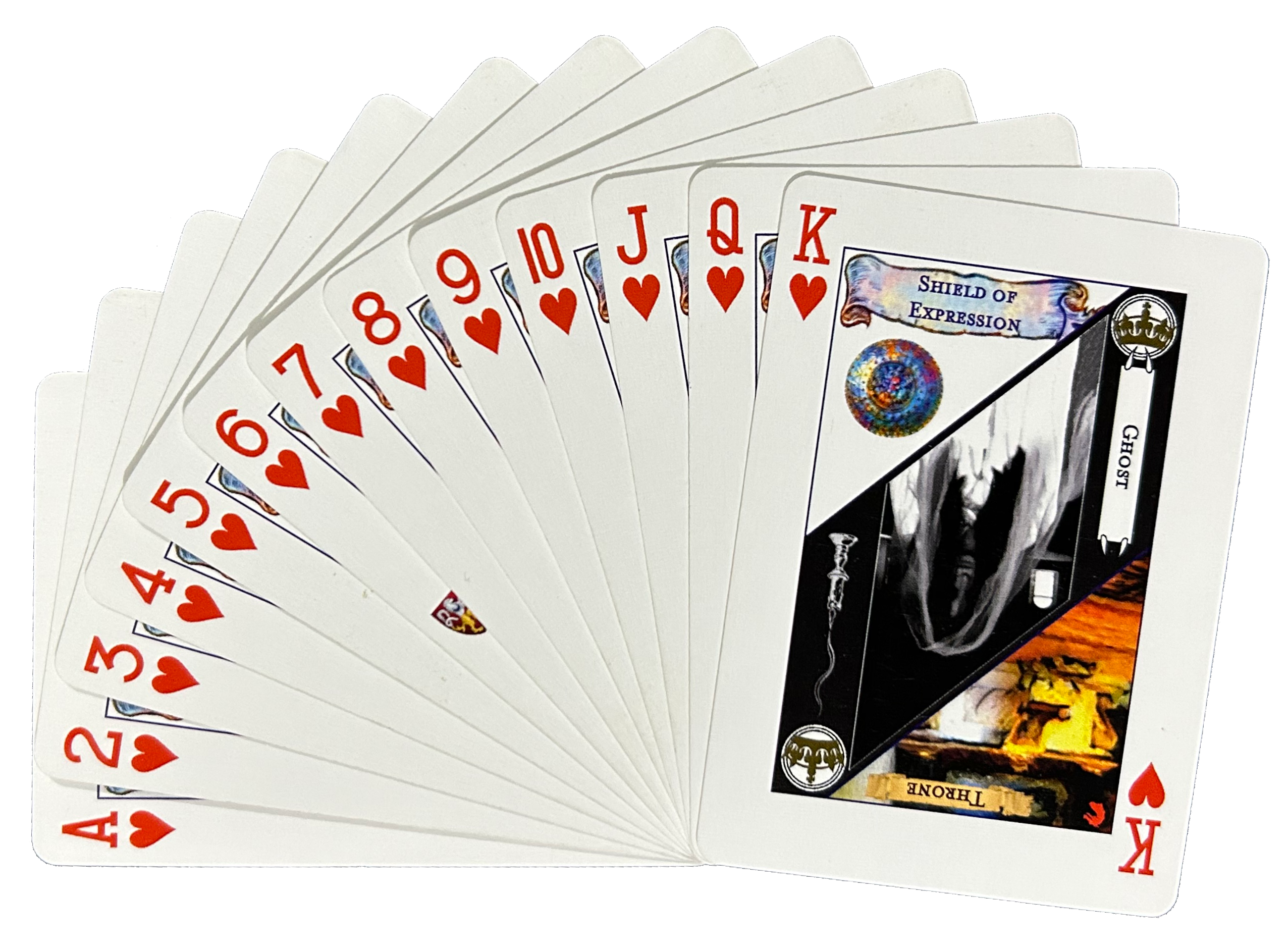
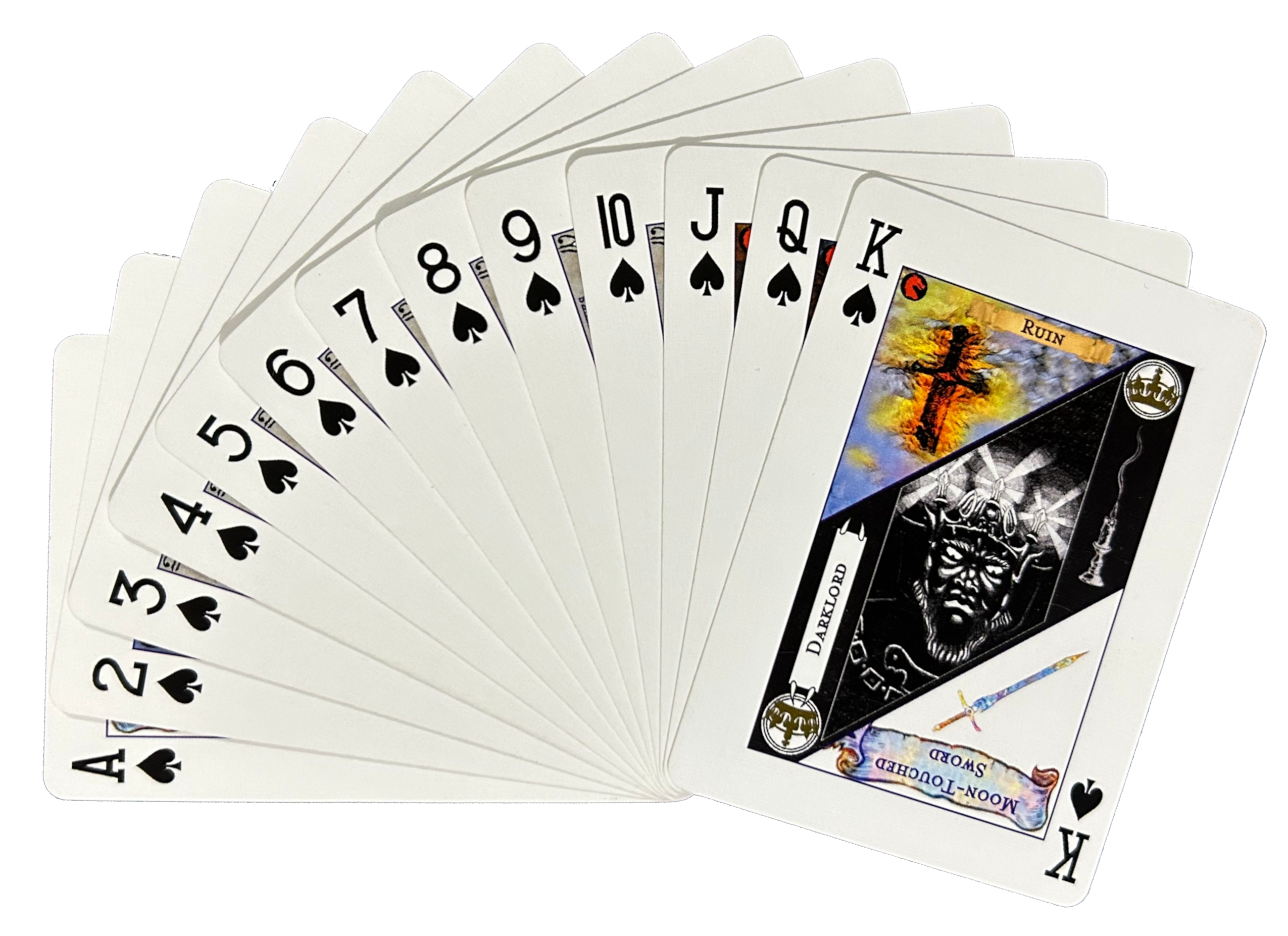
What is this?
Dragon+ Magazine was unfortunately very short-lived, and on-line only. When it was discontinued, the vast majority of content was taken down and is no longer accessible. This publication attempts to centralize the monsters that were published in that magazine. Edits have been made to some of the various stat blocks to fix typos and to attempt to bring the stat blocks up to 5e's current format. Enjoy.
v1.0

Chapter 1: The Negative Plane
The Negative Plane
Also known as the Plane of Death, the Negative Plane is the source of necrotic energy that destroys the living and animates the undead. Any living thing that enters the plane is instantly torn apart and consumed. Only living beings with the most powerful magic can survive for a short time within its colorless desolation. But the Negative Plane isn’t devoid of inhabitants—liches, nightwalkers, death knights, and swaths of undead reside in the swirling decay of its bleak landscape, ready to destroy any who intrude on their deathless vigil.
Surviving the Negative Plane
If a party must enter the Negative Plane to rescue a person or steal an object, they must be protected from its annihilating energies. This can be accomplished by a powerful magic item of your invention (such as a ring, potion, or amulet), or by a wish spell.
A fun situation to create is to have the party be on a timer. This ticking clock counts down the time before their protection fails and they are exposed to the Negative Plane’s necrotic energy.
Another option is to limit the bubble of their protection. Have the magic ring only offer a 15-foot diameter sphere of protection that the whole party must cluster inside of. As the bearer of the protection moves, the party must move with them. Anyone moving out of that sphere takes 36 (8d8) necrotic damage per turn until they are back inside the bubble.
Monastery of Shadows
High up on a deserted altiplano lies a monastery dedicated to the study of the Negative Plane of existence. Residing in the monastery are a group of monks, all of whom have willingly entered into undeath so that they may eternally carry out their duty. Sigils of magical power—which were once used in ancient times to access the Negative Plane and bring forth a nightwalker to torment the world—have been etched into the mountain plateau. Knowledge of the monastery has slipped into myth and legend, with only a few sages and scholars still aware of the scattered tales of its nefarious past.
The question is, who are the monks that dwell in the monastery now? Are they noble guardians of a horrifying secret that must not see the light of day? Or are they evildoers waiting to wield the monastery’s terrible power once again?
History of the Monastery
Eons ago, Urd, a lich monarch of the Negative Plane, left his crumbling tower and wormed his way onto the Material Plane. His plan was to bring forth a terrible entity known as a nightwalker and wreak havoc on the living. The lich had in his possession an ancient chart of planar motions, which foretold of a cosmic cycle that would bring the Negative Plane, the Shadowfell, and the Material Plane into alignment. From this chart, he knew the time and place where a bridge could be created, and a nightwalker could be summoned.
With the help of his undead minions, the lich built a monastery on a desolate altiplano within the Material Plane. There, he interred his library of arcane knowledge, known as the Litany of Urd, etching powerful sigils of necrotic magic into the surrounding earth and rock. This turned the area itself into a potent magical nexus that called to the nightwalker. The monastery became an omphalos, designed to observe celestial patterns and provide the exact time when the bridge from the Negative Plane could be made manifest.
The lich lord was successful. The planes aligned and a nightwalker crossed the shadow bridge, lured by the energy of the living, to be unleashed on the material world. For an age, there was darkness and misery as the nightwalker brought pestilence, famine, and death to the region, but the forces of goodness gathered and struck back, banishing the nightwalker and hunting down the lich lord.
The Monastery Today
Centuries have passed, and the nightwalker’s reign of terror has slipped into myth. The monastery still stands, as it always has, on a remote mountain plateau observing the ceaseless movement of the stars. It is now cared for by an order of undead monks who call it the Monastery of Shadows. It serves as a stellar observatory and as a school for those interested in the necromantic arts. Within its walls, the monks decode and study the lich lord’s ancient library—star charts that show the paths of the planes and manuscripts dedicated to dimensional travel and undeath. When possible, the monks use the monastery’s power to transport themselves to the Negative Plane to try and find the lich’s lair. They believe if they can unearth further knowledge and clues about the monastery’s function, they might discover even greater secrets.
The Litany of Urd
Around the Monastery of Shadows, cryptic symbols are etched into the stone. Some of these symbols have been decoded by the monks, while others remain tantalizingly unintelligible. Using the texts they have deciphered, the monks have revealed the secrets of moving through shadows and summoning the nightwalker Malthraxis, who previously wrought chaos on the Material Plane. But there are many more secrets yet to be revealed. Perhaps the secret to controlling Malthraxis awaits discovery, or the symbols will predict the focus of Malthraxis’ destruction once it arrives on the Material Plane. The Litany of Urd can contain anything a DM wishes it to, and it’s a perfect way to kick off another adventure entirely or deepen the mystery of the Monastery of Shadows for many adventures to come.
This chapter was included in Dragon+ 37.
Two Possible Scenarios
In this adventure you can choose two possibilities:
- The monks are an evil cabal awaiting the moment the stars to align once again to use the monastery’s power for evil.
- The monks are good, protecting the monastery from those who would use its power to summon the nightwalker once again.
Scenario 1: Choosing Evil
In this scenario, the monks are all in the service of evil and are waiting with deathless patience for the moment when the veil between the planes grows thin once again. When the time is right, they use the power of the monastery to punch a hole through to the Negative Plane and summon a nightwalker. But the monks need a sacrifice, a soul potent and vital enough to draw the nightwalker’s attention. This could be an NPC from a nearby city, town, or village; a sacred creature such as a unicorn, couatl, or ki-rin; an object with a soul trapped in it; or it could be one of the PCs.
Defeating the Evil. If the party is on the weaker side, and the nightwalker is summoned, then it should feel like a catastrophe and everyone should run for the hills. DMs can avoid a TPK (total party kill) by having the nightwalker soar down the starlit mountainside to the valley below to wreak necrotic havoc on a nearby city, giving the adventurers some time to figure out how to stop it. To avoid a disaster, the party must work fast to banish the monster.
Here are a few suggestions of how the nightwalker might be defeated without direct combat:
- Recover the sacrifice or object who was sent into the Negative Plane to summon the nightwalker. This requires that a PC or the party be protected from the annihilating energies of the Negative Plane before they go there (see “Surviving the Negative Plane” below).
- Lure the nightwalker back into the Negative Plane with some creature or object that has a powerful lifeforce.
- Create a MacGuffin (like a helm, necklace, or portal) that, if destroyed, banishes the nightwalker and severs the bridge to the Negative Plane. This MacGuffin is guarded by monsters and evil monks that the party has a chance of defeating.
Scenario 2: Choosing Good
In this scenario, the lich lord (see History of the Monastery above) has taken centuries to reform, and is now a tattered, shambling version of his former self, bent on revenge and desperate to get back to his tower on the Negative Plane. Depending on the level of your party, you can have them face a full powered lich, or you can use the archmage stat block and give it undead immunities and resistances. You can also use the necromancer stat block below to make it an undead creature for a very low-powered lich. Zashtii (if you choose to use her) and some of the other monks in the monastery are among the original fighters who helped stop the lich and the nightwalker centuries ago. Not willing to entrust their task of protecting the monastery to anyone else, they took a vow of undeath that eternally bound them to the monastery and their duty.
When the adventure begins, the stellar alignment is drawing near. The lich lord and his shadow horde are closing in, ready to reclaim the monastery from the monks and either unleash the nightwalker once again to devour the living world or use the planar bridge to return to the lich’s tower so he can fully reform. Knowing what they are about to face, Zashtii is eager to accept help from any friendly PCs willing to aid her in their stand against the lich lord. Just for fun, here are a few other ideas for who the enemy could be:
- A mummy lord with a horde of undead minions who wishes to turn the monastery into a mausoleum and rule over the living.
- Deranged former shadow monks wish to reclaim the Monastery of Shadows and summon the nightwalker to be worshipped as a god.
- A host of shadow demons led by a demonic necromancer wish to cause mayhem and destruction.
- A vampire warrior, a former member of the monastery who commands vampire spawn, believes that Zashtii should be ousted, and the nightwalker unleashed.
Ramping it Up
If you want to make this a higher-level challenge for your players (if they are tough enough to take on a nightwalker), then you can remove the magical MacGuffins that the adventurers can find and use to avoid dealing with the Negative Plane and the nightwalker. Without these aids, the adventurers must have their own magical means to figure out how to banish (or go toe-to-toe with) the nightwalker before it destroys hundreds of villagers in its necrotic rampage. You can always throw a lich into the mix if your adventurers are itching for a real challenge.
For a milder ramp up, doubling monster hit points, adding tougher minions, and giving an NPC a cool magic item (like a +3 sword or an Ioun stone) are among a host of other tricks you can use to increase the punch of your monsters and give your players a challenge.
The Order of Shadows
The monks that watch over the Monastery of Shadows have undergone a ritual of undeath to become its eternal guardians. Each monk wields a unique weapon, a blade forged exclusively for them, which is imbued with necrotic energy and attached by a length of chain to a censer. The blade represents their new soul, which replaces the one sacrificed to the order. Both the blade and the censer serve as ritual objects in their religious ceremonies, but they are also effective and deadly weapons. The blade can inflict painful, festering wounds and the censer not only affects the mind with its intoxicating smoke, but can also lash out and crush bone.
Items
There are many secrets within the Monastery of Shadows that the monks use to their advantage. Yet during their tireless pacing throughout the structure, it is their blade and censer that never leave their side.
Smoke Censer
The smoke from the censer that a monk uses is a special blend of olfactory allure and mind-altering substances. Being undead, neither are of any consequence or concern to the monks. But any living creature that inhales the censer’s fumes has the possibility of being transported to a psychological dimension beyond normal understanding. Inhaling this smoke causes a variety of reactions—from confusion and terror to elation and euphoria. Some monks are known to interpret the reactions as cryptic messages from the Negative Plane.
Shadow Blade
A monk’s shadow blade is a ritual object sacred to them. These blades are forged within the monastery using special ore mined on the plateau. Each blade is given a name and is chanted over while undergoing the annealing process that seals the monk’s soul within it. Further incantations from the Litany of Urd imbue the blade with necromantic power that is activated when its name is spoken aloud. A cut from a shadow blade is no normal thing. Even though the wound knits, the chilling ache of it can linger on for months or years.
The Litany of Urd and Malthraxis
The monks are aware of the nightwalker, Malthraxis, and its connection to the Monastery of Shadows. Whether the monks revere or revile Malthraxis, they understand it is essentially a cosmic force to be respected and have found ways to protect themselves and their monastery should Malthraxis desire their destruction.
By inscribing certain fragments of the Litany of Urd on their blades, they have created a potential way to banish Malthraxis. If enough of the monks gather together and use their blades to chant the Litany of Urd, they can send Malthraxis back through the portal. But this practice has never been tested and the monks hope that day never comes.
Using the Monks in Your Game
Although they are written here as an order of monks dedicated to a specific monastery and leader, a DM can use these shadowy, undead zealots in any way they wish. The monks might be led by a powerful necromancer, a mummy lord, or an elder god that speaks through an onyx sphere in a mountain temple. Here are a few ideas for how these monks can show up in your game:
Return of the Master
The monks have cowed a town into submission, and no one dare speak out against their edicts. Many of the townsfolk and even the mayor’s own daughter has either been kidnapped or brainwashed and rumor has it that they are being prepared for some mass ritual of undeath to replenish their ranks.
As the adventurers get involved, there is an interesting turn of events. On meeting their foes, the monks rejoice. Apparently, they believe one of the adventurers is their reincarnated master who they have waited centuries for. They begin preparations at their monastery for an even bigger festival to prepare the PC to undergo the Ritual of Becoming—a process where the character’s life force is bound into the body of a nightwalker—the greatest of honors among the shadow monks.
Expedition Into Night
A powerful creature of undeath has captured a celestial being—such as a unicorn, couatl, or ki-rin—and has taken them into the Negative Plane of existence to undergo a foul ritual that drains their life force and leaves them a corrupt and twisted monstrosity. The characters are approached by a holy cleric who pleads with them to help return the creature to their order and back to the Celestial Realm from where they originated.
If they accept the quest, the holy cleric leads them to a death domain cleric, who then leads them to the Monastery of Shadows and its deathless host of monks—experts of the Negative Plane. Although they are undead, the monks are not evil and are able to act as guides within the ghastly domain. The monks can provide information that can lead to a portal to the Negative Plane, and they might also provide a special potion that when consumed can withstand the life draining effects of the Negative Plane for 24 hours. One of them might also be persuaded to act as a guide. The monks know this undead creature and they are aware of the foul ritual that is about to take place.
Shadow Monk
Medium Undead, Typically Neutral
- Armor Class 14
- Hit Points 91 (14d8 + 28)
- Speed 40 ft.
STR DEX CON INT WIS CHA 16 (+3) 18 (+4) 14 (+2) 13 (+1) 12 (+1) 14 (+2)
- Saving Throws Dex +8, Int +5
- Skills Perception +9, Stealth +12
- Damage Vulnerabilities radiant
- Damage Resistances bludgeoning, piercing, and slashing from nonmagical attacks
- Damage Immunities necrotic, poison
- Condition Immunities exhaustion, frightened, grappled, paralyzed, petrified, poisoned, prone, restrained
- Senses darkvision 60 ft., passive Perception 19
- Languages understands the languages it knew in life but can’t speak
Sunlight Weakness. While in sunlight, the monk has disadvantage on attack rolls, ability checks, and saving throws.
Shadow Stealth. While in dim light or darkness, the monk can take the Hide action as a bonus action.
Ritual Smoke. Any creature within 10 feet of the shadow monk must succeed on a DC 15 Constitution saving throw to avoid inhaling the smoke. On a failed save, they are poisoned for 1d4 turns and see bewildering visions unless the condition can be removed. Creatures immune to the poisoned condition are immune to this mind-altering effect.
Actions
Multiattack. The monk makes two Shadow Blade attacks and one Censer attack.
Shadow Blade. Melee Weapon Attack: +8 to hit, reach 5 ft., one target. Hit: 7 (1d6 + 4) piercing damage plus 14 (4d6) necrotic damage. Unless the target is immune to necrotic damage, the target’s Strength score is reduced by 1d4 each time it is hit by this attack. The target dies if its Strength is reduced to 0. The reduction lasts until the target finishes a short or long rest. If a non-evil humanoid dies from this attack, a shadow rises from the corpse 1d4 hours later.
Censer. Melee Weapon Attack: +8 to hit, reach 10 ft., one target. Hit: 14 (3d6 + 4) bludgeoning damage.
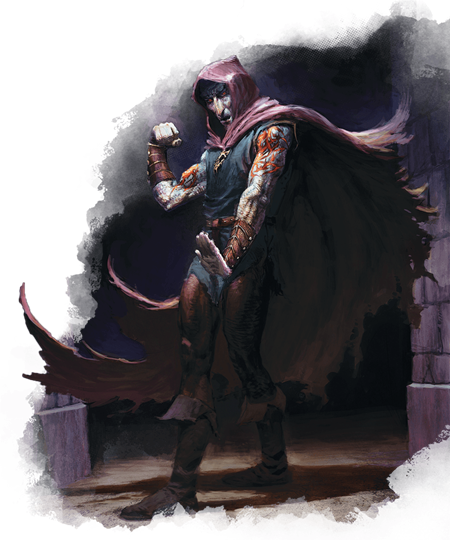
Zashtii, Devout Monk
Zashtii is a devout monk who became obsessed with harnessing the eldritch energies of the Negative Plane of existence. To give herself an eternity to grow in power, she underwent a ritual of undeath that turned her into a creature of shadow and smoke. The ritual bound her into a pair of magic bracers which allow her to solidify and control her form. But the bracers are vampiric and demand a steady feast of blood to keep Zashtii’s form coherent and tangible and, depending on how long it is since she last fed, Zashtii can be more smoke than solid. When encountering Zashtii, some part of her always appears as if she is materializing within the smoke or being dematerialized by it – a terrifying reminder of her curse.
By entering undeath, Zashtii can now walk unharmed within the deathless wasteland of the Negative Plane. With no life force or living flesh to be pulled apart by its necrotic energies, she can wander its endless ruins and uncover its ancient secrets. As head of the Monastery of Shadows, she has plans to bring back long forgotten magic and arcane lore from the Negative Plane so that others who seek ultimate power can join her order and learn its mysteries.
Zashtii’s Gear
Over the centuries, Zashtii has discovered a few items of necromantic power in and around the Monastery of Shadows and on the Negative Plane of existence.
Shadow Bracers
Zashtii has a pair of metal bracers that end in steel clawed gloves. The bracers are etched with necromantic sigils that allow her to form a pair of smoky talons from her being. These talons can reach out and inflict necrotic wounds that sap the strength out of the living, which she then uses to hold her form together.
Cylinders of Urd
At the ends of her two long braids are a pair of metal cylinders that are inscribed with symbols of power—a fragment of a long lost manuscript called the Litany of Urd. Once attuned to these cylinders, the wearer can “shadow jump”, disappearing in one shadowy place and appearing instantly in another.
Using Zashtii In Your Game
Zashtii can function as a villain or as an unlikely ally for an adventuring party. She can also provide access to the Negative Plane of existence and any kind of necromantic lore that the party might need. Here are some ideas on how to use Zashtii in your game to get your creativity flowing:
The Royal Blood
A prince or princess has become involved in an order known as the Monastery of Shadows. The adventurers are hired by the ruling monarch to find them and bring them back to their family. The monarch is offering a great reward.
Zashtii could be using the influence of the younger royal, who is a willing convert to the order, to grow her ranks and overthrow the kingdom from within. Or she could simply be preparing the royal for sacrifice to summon a nightwalker and unleash mayhem on the realm. Blood from this royal lineage has mythic power.
A Walk in the Dark
The adventurers must venture into the Negative Plane of existence to get something for their benefactor. It could be an artifact or the body of someone important. Despite a lot of research, the benefactor only has vague clues about a monastery hidden in the mountains that is rumored to house an order of undead monks. They are to go there and see if they can enlist their aid in getting to the Negative Plane.
Zashtii has an item that can protect a party from the effects of the Negative Plane, but she will bargain with them for its use. There might also be something on the Negative Plane that she desires. Perhaps an item of power locked inside a vault that only a person with a soul can enter.
Zashtii
Medium Undead, Lawful Neutral
- Armor Class 16 (natural armor)
- Hit Points 112 (15d8 + 45)
- Speed 30 ft.
STR DEX CON INT WIS CHA 17 (+3) 18 (+4) 17 (+3) 18 (+4) 16 (+3) 18 (+4)
- Saving Throws Dex +9, Wis +8, Cha +9
- Skills Perception +8, Stealth +9
- Damage Resistances necrotic; bludgeoning, piercing, and slashing from nonmagical attacks
- Senses darkvision 120 ft., passive Perception 18
- Languages Common
Legendary Resistance (3/Day). If Zashtii fails a saving throw, she can choose to succeed instead.
Spider Climb. Zashtii can climb difficult surfaces, including upside down on ceilings, without needing to make an ability check.
Shadow Jump. As a bonus action, Zashtii can teleport up to 30 feet to an unoccupied space she can see. Both the space she teleports from and the space she teleports to must be in dim light or darkness. Zashtii can use this ability between the weapon attacks of another action she takes.
Actions
Steel Claw. Melee Weapon Attack: +9 to hit, reach 5 ft., one creature. Hit: 13 (2d8 + 4) slashing damage 7 (2d6) necrotic damage. Instead of dealing damage, Zashtii can grapple the target (escape DC 18).
Bite. Melee Weapon Attack: +8 to hit, reach 5 ft., one willing creature, or a creature that is grappled by Zashtii, incapacitated, or restrained. Hit: 7 (1d6 + 4) piercing damage plus 10 (3d6) necrotic damage. The target’s hit point maximum is reduced by an amount equal to the necrotic damage taken, and Zashtii regains hit points equal to that amount. The reduction lasts until the target finishes a long rest. The target dies if this effect reduces its hit point maximum to 0.
Smoke Talons. Melee Weapon Attack: +9 to hit, reach 15 ft., one creature. Hit: 14 (3d6 + 4) necrotic damage, and the target’s Strength score is reduced by 1d4. The target dies if this reduces its Strength to 0. Otherwise, the reduction lasts until the target finishes a long rest.
Charm. Zashtii targets one humanoid she can see within 30 feet of her. If the target can see Zashtii, the target must succeed on a DC 17 Wisdom saving throw against this magic or be charmed by Zashtii. The charmed target regards Zashtii as a trusted friend to be heeded and protected. Although the target isn’t under Zashtii’s control, it takes Zashtii’s requests or actions in the most favorable way it can, and it is a willing target for Zashtii’s bite attack.
Each time Zashtii or her companions do anything harmful to the target, it can repeat the saving throw, ending the effect on itself on a success. Otherwise, the effect lasts 24 hours or until Zashtii is destroyed, is on a different plane of existence than the target, or takes a bonus action to end the effect.
Reactions
Deflect Missile. In response to being hit by a ranged weapon attack, Zashtii deflects the missile. The damage she takes from the attack is reduced by 1d10 + 14. If the damage is reduced to 0, Zashtii catches the missile if it’s small enough to hold in one hand and she has a hand free. If she doesn’t have a hand free, the smoke entity which surrounds her catches the missile for her.
Legendary Actions
Zashtii can take 3 legendary actions, choosing from the options below. Only one legendary action option can be used at a time and only at the end of another creature’s turn. Zashtii regains spent legendary actions at the start of her turn.
- Quick Step. Zashtii moves up to her speed without provoking opportunity attacks.
- Attack. Zashtii makes one attack with her steel claw.
- Attack (Costs 2 Actions). Zashtii makes one bite attack or one attack with her smoke talons.
Malthraxis
Malthraxis is a nightwalker that is ancient beyond reckoning. It wanders within the dark wasteland of the Negative Plane of existence waiting for the moment when it can return to the Material Plane and feast on the raw nectar of the living. Malthraxis is covered with arcane sigils carved into its body by some long forgotten archmagus. The sigils not only give Malthraxis power, but they also contain long lost secrets of necromancy—no doubt put there to be guarded by the nightwalker.
Soul Tendrils
Unlike other nightwalkers, Malthraxis has tendrils of thick smoke that endlessly cascade from its body. These are comprised of the souls it has devoured over the eons and they
wail or laugh maniacally as they dissipate and dissolve into the air. Malthraxis can lash out with this smoke to entangle its prey and drag them into its annihilating aura.
The Litany of Urd
The hide of Malthraxis is etched with arcane symbols and glyphs known as the Litany of Urd. Translating these glyphs reveals necromantic secrets that are of great value to scholars, necromancers, and those who covet powerful magic. Comprehending the Litany of Urd requires intense study, a grasp of many languages, and a vast intellect, but it could reveal mysteries such as: the key to lichdom, how to kill a demigod, how to become a demigod, and other arcane secrets. It could also include ways to summon or banish a creature such as Malthraxis and other powerful undead.
Malthraxis
Huge Undead, Chaotic Evil
- Armor Class 14
- Hit Points 297 (22d12 + 154)
- Speed 40 ft., fly 40 ft.
STR DEX CON INT WIS CHA 22 (+6) 19 (+4) 24 (+7) 6 (-2) 9 (-1) 8 (-1)
- Saving Throws Con +13
- Damage Resistances acid, cold, fire, lightning, thunder; bludgeoning, piercing, and slashing from nonmagical attacks
- Damage Immunities necrotic, poison
- Condition Immunities exhaustion, frightened, grappled, paralyzed, petrified, poisoned, prone, restrained
- Senses darkvision 120 ft., passive Perception 9
- Languages –
Annihilating Aura. Any creature that starts its turn within 30 feet of Malthraxis must succeed on a DC 21 Constitution saving throw or take 14 (4d6) necrotic damage and grant Malthraxis advantage on attack rolls against it until the start of Malthraxis’ next turn. Undead are immune to this aura.
Life Eater. A creature reduced to 0 hit points from damage dealt by Malthraxis dies and can’t be revived by any means short of a wish spell.
Actions
Multiattack. Malthraxis uses Enervating Focus twice, or it uses Enervating Focus and Soul Tendrils, if available, or it uses Enervating Focus and Finger of Doom, if available.
Enervating Focus. Melee Weapon Attack: +12 to hit, reach 15 ft., one target. Hit: 28 (5d8 + 6) necrotic damage. The target must succeed on a DC 21 Constitution saving throw or its hit point maximum is reduced by an amount equal to the necrotic damage taken. This reduction lasts until the target finishes a long rest.
Finger of Doom (Recharge 6). Malthraxis points at one creature it can see within 300 feet of it. The target must succeed on a DC 21 Wisdom saving throw or take 26 (4d12) necrotic damage and become frightened until the end of Malthraxis’s next turn. While frightened in this way, the creature is also paralyzed. If a target’s saving throw is successful, the target is immune to Malthraxis’s Finger of Doom for the next 24 hours.
Soul Tendrils. Melee Weapon Attack: +12 to hit, reach 60 ft., one target. Hit: 17 (2d10 + 6) slashing damage. If the target is a Medium or smaller creature, it is grappled (escape DC 23), pulled into an unoccupied space within 5 feet of Malthraxis, and must succeed on a DC 23 Intelligence saving throw or be stunned until this grapple ends. Malthraxis can’t use its soul tendrils on another target until this grapple ends.
Using Malthraxis In Your Game
Malthraxis is either an apocalyptic threat for lower-level parties or a dangerous foe for high-level parties.
Decoding the Sigils
For a high-level adventure, the party is approached by wealthy patron who claims to have found a scroll that tells the story of a nightwalker named Malthraxis. The scroll was written by an ancient archmage who claims to have etched a lifetime of their secrets into Malthraxis’ hide for safe keeping as few would dare to try and take down a nightwalker. The scholar believes that it’s possible that some of these etchings could be the secret to controlling Malthraxis, while the writings might also contain a missing chapter from the legendary Book of Vile Darkness known as the Litany of Urd—whether the patron reveals this to the party is up to the DM. The patron desires access to the sigils (however the party might arrange that) and is willing to pay handsomely for it. The patron could be a necromancer, archmage, or a historian who represents a famous and well-funded museum or library. How the party finds Malthraxis is up to the DM. They could go to the Monastery of Shadows and have the monks transport the party onto the Negative Plane. The patron’s scroll may even contain a rough map of where Malthraxis’ lair is situated on the Negative Plane.
Time Bomb
If you have a low-level party, then the threat of having Malthraxis summoned to the Material Plane is a major problem requiring all hands on deck. Having a town be the target of Malthraxis is a great challenge to throw at your players and will test their creative thinking. Do they alert the townsfolk and risk panic? Do they keep the danger a secret and hope they can stop the nightwalker’s arrival? Do they try to defeat Malthraxis in a Seven Samurai-style standoff? Or do they try to find some arcane solution to banish the horror? Perhaps an order of doom cultists gets a whiff of this threat and emerges from the woodwork to cause mayhem?
Having a very overpowered enemy begs for a noncombat solution, and this can be an opportunity to let the cleric, wizard, or warlock shine as they work in libraries and temple sanctums to uncover clues. What they discover may either prevent the coming of Malthraxis or banish the nightwalker once it arrives. They also might work with a ranger to rig an arcane trap that imprisons it like an ordinary beast but has the extra added magic of the wizard to make sure it doesn’t escape.
With a “ticking time bomb” plot—the explosion being the arrival of Malthraxis—it’s fun to place hurdles in front of the characters to get the pot boiling. Perhaps the magic item they need to retrieve is hundreds of miles away or maybe the wizard they need to talk to is long since dead and her tomb is unknown. Adding problems that must be solved while the clock ticks down and the lives of innocents hang in the balance makes for gripping roleplaying.
Higher Levels
With higher-level characters, an encounter with Malthraxis presents some interesting choices. Giving the players an opportunity to take a major risk as they seek to be heroes is always a fun option to have on the table. Be sure to offer a lower-risk path but if a party wants to push all the chips in and gamble, give them a way to do it. In the case of dealing with a threat like Malthraxis, they could be presented with a way to travel to the Negative Plane and hunt the nightwalker there—keeping innocents on the Material Plane from ever having to face such a monster.
Making powerful characters care deeply about lesspowerful NPCs also builds vulnerabilities into a party, which can be used to create drama and tension. There’s no better mechanism than to put an innocent gnome village; an orphanage; or a kindly, halfling baker in the path of a nightwalker to stir the emotions of your party of superheroes and draw them away from their original plan and into deeper and more dangerous waters.
Lower Levels
For a lower-level party, defeating Malthraxis is a daunting if not impossible task. One potential option may be the cooperation or coercion of the Order of Shadows, and the applied use of their shadow blades. Another might be the investigation of symbols that seem to relate to Malthraxis carved throughout the monastery (see The Litany of Urd section of this document). With some deciphering, these symbols could contain the answer to banishing or controlling the nightwalker.

Necromancer
Necromancers are specialist wizards who study the interaction of life, death, and undeath. Some like to dig up corpses to create undead slaves. A few use their powers for good, hunting the undead and risking their lives to save others.
The necromancer that appeared in Dragon+ 37 was slightly different than the necromancer in Volo's Guide to Monsters. The Dragon+ version had Shadow Blade and Censer actions. The stat block below is the rebalanced necromancer stat block from Monsters of the Multiverse with those same variant actions.
Necromancer
Medium Humanoid (any race), Typically Neutral
- Armor Class 12 (15 with mage armor)
- Hit Points 110 (20d8 + 20)
- Speed 30 ft.
STR DEX CON INT WIS CHA 9 (-1) 14 (+2) 12 (+1) 17 (+3) 12 (+1) 11 (+0)
- Saving Throws Int +7, Wis +5
- Skills Arcana +7, History +7
- Damage Resistances necrotic
- Senses passive Perception 11
- Languages any four languages
Actions
Multiattack. The monk makes two Shadow Blade attacks and one Censer attack.
Shadow Blade. Melee Weapon Attack: +7 to hit, reach 5 ft., one target. Hit: 5 (2d4) necrotic damage.
Censer. Melee Weapon Attack: +8 to hit, reach 10 ft., one target. Hit: 14 (3d6 + 4) bludgeoning damage.
Spellcasting. The necromancer casts one of the following spells, using Intelligence as the spellcasting ability (spell save DC 15):
- At will: dancing lights, mage hand, prestidigitation
- 2/day: bestow curse, dimension door, mage armor, , web
- 1/day: circle of death
Bonus Actions
Summon Undead (1/Day). The necromancer magically summons five skeletons or zombies. The summoned creatures appear in unoccupied spaces within 60 feet of the necromancer, whom they obey. They take their turns immediately after the necromancer. Each lasts for 1 hour, until it or the necromancer dies, or until the necromancer dismisses it as a bonus action.
Reactions
Grim Harvest (1/Turn). When the necromancer kills a creature with necrotic damage, the necromancer regains 9 (2d8) hit points.

Chapter 2: The Fathomless
The Fathomless
The Fathomless are a guild of bounty hunters trained to survive in even the most challenging subterranean environments. When criminals flee to places where the law of the surface realm cannot go, the Fathomless take up the chase.
Members of the Fathomless are always on the lookout for candidates to join their guild, and they actively recruit adventurers who they think would be a good fit. The members of the guild share no specific ethos or morals. In the end, it’s money that talks, and many ask few questions about the jobs they’re assigned. Adventurers who have proven their ability to face the worst threats in cramped passageways a mile underground might attract the attention of a member of the Fathomless guild—followed by an invitation to join.
In Faerûn, the Fathomless actively work throughout the Underdark and in the dungeons of Undermountain, and the guild holds maps to many of the labyrinthine catacombs beneath major cities such as Baldur’s Gate, Neverwinter, and Waterdeep. As guides, compatriots, or information brokers, members of the guild might be a resource for characters preparing to undertake a major dungeon delve. Alternatively, the Fathomless might be antagonists to a party—racing through the Underdark to get to the same prize the characters are seeking.
This chapter appeared in Dragon+ #36.
Hieronymus Black, Bounty Hunter
Hieronymus Black is a dwarf bounty hunter who operates almost exclusively underground as a member of the Fathomless—a guild of expert subterranean hunters known for tracking down those who think they can disappear into the dark places of the world. In the manner of an old gunslinger of the Wild West, Hieronymus is a dwarf of few words who easily sees through fast-talking scalawags and weaselly cutthroats. He has a strong dedication to a job well done, and won’t compromise his integrity for anything—not even gold.
Hieronymus rides through the catacombs and grand caverns of the Underdark on his faithful mount, Maybelle—a deep rothé adapted to the pitch darkness of subterranean life. Maybelle is trained for hunting fugitives, and she works like an extension of Hieronymus to chase down quarry and bring the wanted back to the Fathomless—dead or alive.
Hieronymus has friends and connections throughout the subterranean world, especially among the drow. Far from the influence of Lolth’s infamous sects of zealots, countless peaceful drow enclaves and villages can be found throughout the Underdark, and Hieronymus has little patience with those who view his friends as potential enemies—or who traffic in old prejudices.
Hieronymus’s Gear
Hieronymus makes use of all kinds of special gear when stalking and taking down his quarry.
Kleaver
This custom-built oversized knife unleashes deadly slashing damage, backed up with a pulse of magical destruction.
Ol’ Bessie
This magic crossbow gives Hieronymus a forceful edge in combat as it knocks foes off their feet.
Spiderfang Blades
Hieronymus carries a number of these balanced throwing knives, whose poison paralyzes targets to take them out of the fight.
Headband of the Bat
While wearing this headband, Hieronymus has blindsight out to a range of 120 feet and a +3 bonus to Wisdom (Perception) checks. He loses both these features if he becomes deafened.
Pauldron of the Spider
Forged by a drow armorsmith, this shoulder plate was given to Hieronymus as payment for taking down an assassin of Lolth targeting the leader of a drow village. While wearing the pauldron, Hieronymus has a climbing speed equal to his walking speed, and he can move up, down, and across vertical surfaces and upside down along ceilings while leaving his hands free.
Maybelle
Maybelle is Hieronymus’s deep rothé companion, and the one creature he truly counts on. Keeping Hieronymus safe is a full-time job for her, and she has saved the dwarf’s life more than once. Like most deep rothés, Maybelle is stubborn and grumpy as a rule, but those who get to know her understand that there’s a heart of gold underneath that shaggy coat.
Using Hieronymus In Your Game
In an adventure or a full campaign involving the Underdark, Hieronymus Black might end up crossing paths with the characters in any number of ways.
Requesting Aid
The characters are on a mission to slay a dangerous subterranean monster. Any search for special equipment or resources leads them to the Fathomless, and to Hieronymus. The dwarf might become a source of information and lore, a broker for needed magic and equipment, or a guide prepared to lead and fight alongside the characters in their quest.
Chance Meeting
While journeying through the Underdark, the characters need to choose between a long, safer route and a potentially dangerous shortcut, but time is of the essence in their journey. From out of the shadows, Hieronymus Black appears and offers to guide them along the dangerous route—for a fee.
Deep Rothe (Maybelle)
Medium Beast, Unaligned
- Armor Class 10
- Hit Points 13 (2d8 + 4)
- Speed 30 ft.
STR DEX CON INT WIS CHA 18 (+4) 10 (+0) 14 (+2) 2 (-4) 10 (+0) 4 (-3)
- Senses darkvision 60 ft., passive Perception 10
- Languages rothés communicate with each other using their dancing lights innate spell
Charge. If Maybelle moves at least 20 feet straight toward a target and then hits it with a gore attack on the same turn, the target takes an extra 7 (2d6) piercing damage.
Innate Spellcasting. Maybelle’s innate spellcasting ability is Wisdom. She can innately cast the following spell, requiring no components:
At will: dancing lights
Actions
Gore. Melee Weapon Attack: +6 to hit, reach 5 ft., one target. Hit: 7 (1d6 + 4) piercing damage.
Hieronymus Black
Medium Humanoid (Dwarf), Neutral
- Armor Class 16 (half plate)
- Hit Points 93 (11d8 + 44)
- Speed 25 ft., climb 25 ft.
STR DEX CON INT WIS CHA 16 (+3) 12 (+1) 18 (+4) 12 (+1) 16 (+3) 16 (+3)
- Saving Throws Str +6, Dex +4, Wis +6
- Skills Insight +6, Perception +9, Stealth +7, Survival +6
- Damage Resistances poison
- Senses darkvision 60 ft., blindsight 120 ft., passive Perception 19
- Languages Common, Dwarvish, Undercommon
Dwarven Resilience. Hieronymus has advantage on saving throws against being poisoned.
Second Wind (Recharges after a Short or Long Rest). As a bonus action, Hieronymus can regain 20 hit points.
Actions
Multiattack. Hieronymus can attack three times with Kleaver or throw two spiderfang blades.
Kleaver. Melee Weapon Attack: +6 to hit, reach 5 ft., one target. Hit: 6 (1d6 + 3) slashing damage plus 4 (1d8) force damage.
Spiderfang Blades. Ranged Weapon Attack: +6 to hit, range 20/60 ft., one target. Hit: 5 (1d4 + 3) piercing damage, and the target must succeed on a DC 15 Constitution saving throw or be poisoned for 1 minute. While poisoned in this way, the target is paralyzed. The target can repeat the saving throw at the end of each of its turns, ending the effect on itself on a success.
Spiderthread Net. Ranged Weapon Attack: +4 to hit, range 20/40 ft., one Large or smaller creature. Hit: The target is restrained. A creature can use its action to make a DC 17 Strength check to free itself or another creature in the net, ending the effect on a success. Dealing 20 slashing damage to the net (AC 15) frees the target without harming it and destroys the net.
Ol’ Bessie (Heavy Crossbow). Ranged Weapon Attack: +4 to hit, range 100/400 ft., one target. Hit: 6 (1d10 + 1) piercing damage plus 6 (1d12) force damage. If the target is a creature, it must succeed on a DC 13 Strength saving throw or be knocked prone.

Grabitha Grindleclaw, Green Hag
The green hag Grabitha Grindleclaw lurks in the middle of a dank and dangerous swamp with her toad familiar, Wart. She’s a collector of rare mushrooms, monster parts, extraplanar flowers, and magical spices, which she stores in the drawers of a wooden medicine chest she carries on her back. With the right ingredients, Grabitha can brew any potion imaginable in the magic cauldron she rides. If an adventurer brings her something special such as a roper’s tongue or a moth’s breath flower, Grabitha might take a liking to them and brew something to order. But be forewarned! Grabitha keeps a close eye on her business partners, and characters who aren’t careful might find themselves turned into the ingredients for one of her more fiendish concoctions.
Grabitha’s Gear
In the course of the countless bargains she’s made with mortals in her lifetime, Grabitha has come to possess an assortment of magic items and strange curios.
The Galloping Cauldron
The galloping cauldron is a magic iron pot, forged by a night hag coven from the iron bones of a fallen titan. Grabitha won the cauldron in a fiendish game of rattleskulls—and narrowly escaped a grisly death at the hands of the night hags, who still seethe over the loss to this day. She uses the galloping cauldron to brew her elixirs and potions, with its magic infusing her brews with increased potency. The galloping cauldron also acts as her main mode of transportation, and she rarely leaves her perch on its lip. When she needs to move fast, Grabitha hops inside the pot, shakes the ropes, and clicks her tongue. The cauldron then takes off like a shot, its squat legs galloping tirelessly day and night.
Only Grabitha knows the Sylvan command words to activate the cauldron, which has the following features:
- It has Armor Class 16 and 150 hit points.
- It has a speed of 30 feet.
- It is immune to poison and psychic damage.
- It understands Abyssal and Sylvan but can’t speak.
Chattertooth the Shrunken Head
This magical shrunken head is named Chattertooth, and it normally lives up to its name with its constant bantering. Grabitha limits Chattertooth to blinking and making muffled sounds by binding the head’s mouth with gauze wrappings. Despite this, the hag often talks to Chattertooth, and responds as if she can understand what the shrunken head is saying.
Grabitha’s Lamprey Ladle
Grabitha’s lamprey ladle operates as both a serving ladle and a deadly weapon. In response to its user’s mental commands, the ladle manifests a ring of fangs along its spoon-shaped head that can clamp on to hapless victims. The handle of the ladle is a magical gullet of sorts, which greedily sucks the blood from the body of its victim and gives life force back to its wielder.
Medicine Chest
The drawers and cubbyholes of Grabitha’s magical medicine chest are filled with all kinds of strange ingredients, and just about every spell component a wizard could imagine. And if Grabitha doesn’t have it, she knows just where to get it.
Wart
Wart has been Grabitha’s toad familiar for as long as she can remember. Wart uses the frog stat block, and understands Common and Sylvan but cannot speak. (Grabitha can understand Wart’s croaks and chirps fairly well nonetheless). The toad helps Grabitha fetch items from her medicine chest, as his sticky feet are perfect for grasping slippery bottles, popping open cork stoppers, and rifling through cluttered drawers.
Using Grabitha In Your Game
Grabitha can be used as the centerpiece of a fun encounter for a lower-level party of adventurers. As a green hag, she’s powerful enough to command respect but not so powerful that she sees the characters as insignificant. And for higher-level adventurers, Grabitha can be an NPC resource that they must seek out for her formidable brewing skills.
Like most hags, Grabitha is an exceptional source of information. She knows where many monsters have their lairs, and where many rare and unique magical reagents and alchemical ingredients can be found. You can play Grabitha as a kindly grandmother, or as a straight-up hag who wants nothing more than to inspire tears and mayhem. Even as a foil to the characters, though, Grabitha doesn’t need to be evil, so feel free to make her fit your campaign’s story however you’d like.
Shopping List
Grabitha loves to take advantage of most adventurers’ desire for interesting challenges—or their need to make some coin to fund their next expedition. She’s always in search of the best ingredients for her brews, and is quite willing to tell a group of fresh-faced adventurers where and how to get them. Once they bring her the items from her shopping list, Grabitha is willing to pay them for their help with a few lesser potions or one powerful potion that can aid the characters on their future quests.
Use the Grabitha’s Shopping List table on the next page to select the ingredients she needs the characters to find, or as inspiration for ingredients of your own.
A Party’s Best Friend (For a Price)
If the characters have a need for a magic potion or strange alchemical substance to unlock a secret, provoke a vision, or solve a problem, you can have rumors send them to the dark swamps to look for Grabitha. There, the characters must bargain with the hag for the things they seek.
You can set up that Grabitha is the only one who knows how to make the particular potion, elixir, poultice, or philter that cures a specific disease, opens a magic door, or removes a curse. Grabitha is always up for an alchemical challenge, so all the characters need to do is tell her what they require. She can then figure out what ingredients she needs to craft a brew that packs a real punch—and what favors she’ll ask for in return.
Grabitha’s Potion Mastery
Grabitha’s signature ability allows her to make any potion in the Dungeon Master’s Guide. However, with the help of her galloping cauldron, she is also able to make unique potions, limited only by your imagination. All you need to determine is how difficult it is to obtain the ingredients Grabitha tasks the characters with collecting for her— and the more powerful the brew, the more dangerous getting those ingredients should be!
Grabitha’s Shopping List
| d12 | Ingredient |
|---|---|
| 1 | A vial of basilisk blood |
| 2 | A tuft of troll hair |
| 3 | Shed snakeskin from a medusa’s hair |
| 4 | A feather from a cockatrice |
| 5 | Donkey cap mushrooms from the Feywild |
| 6 | A toenail from a lich |
| 7 | Scales from a merrow king |
| 8 | A feather from a pegasus |
| 9 | Wine from the court of the Pixie Queen |
| 10 | A finger from a wight |
| 11 | A chunk of purple amethyst from the Underdark |
| 12 | A captive will-o’-wisp |
Grabitha Grindleclaw (Green Hag)
Medium Fey, Neutral
- Armor Class 17 (natural armor)
- Hit Points 82 (11d8 + 33)
- Speed 30 ft.
STR DEX CON INT WIS CHA 18 (+4) 12 (+1) 16 (+3) 17 (+3) 14 (+2) 14 (+2)
- Skills Arcana +5, Deception +4, Perception +4, Stealth +3
- Senses darkvision 60 ft., passive Perception 14
- Languages Common, Draconic, Sylvan
Amphibious. Grabitha can breathe air and water.
Mimicry. Grabitha can mimic animal sounds and humanoid voices. A creature that hears the sounds can tell they are imitations with a successful DC 14 Wisdom (Insight) check.
Actions
Claws. Melee Weapon Attack: +6 to hit, reach 5 ft., one target. Hit: 13 (2d8 + 4) slashing damage.
Grabitha’s Lamprey Ladle. Melee Weapon Attack: +6 to hit, reach 5 ft., one target. Hit: 9 (2d4 + 4) piercing damage, and the ladle attaches to the target. While the ladle is attached, at the start of each of Grabitha’s turns,
the target loses 5 (2d4) hit points due to blood loss. If the target loses hit points this way, Grabitha gains 5 hit points (up to her hit point maximum). Removing the ladle requires a successful DC 15 Strength saving throw made as an action. If Grabitha commands the ladle to detach (no action required), it instantly returns to her hand.
Illusory Appearance. Grabitha covers herself and anything she is wearing or carrying with a magical illusion that makes her look like another creature of her general size and humanoid shape. The illusion ends if Grabitha takes a bonus action to end it or if she dies. The changes wrought by this effect fail to hold up to physical inspection. For example, Grabitha could appear to have smooth skin, but someone touching her would feel her rough flesh. Otherwise, a creature must take an action to visually inspect the illusion and succeed on a DC 20 Intelligence (Investigation) check to discern that Grabitha is disguised.
Invisible Passage. Grabitha magically turns invisible until she attacks or casts a spell, or until her concentration ends (as if concentrating on a spell). While invisible, she leaves no physical evidence of her passage, and can be tracked only by magic. Any equipment she wears or carries is invisible along with her.
Potion Mastery. Once per day, if she is in possession of the right ingredients, Grabitha can create any potion in the Dungeon Masters Guide.
Spellcasting. Grabitha casts one of the following spells, requiring no material components and using Charisma as the spell casting ability (spell save DC 12):
At will: dancing lights, minor illusion, vicious mockery

Yahira Silverblade, Monster Hunter
Yahira Silverblade is a monster hunter for hire. This well equipped elf travels from city to town to village, following stories and rumors of monstrous trouble so that she might ply her trade and earn another sackful of loot.
Yahira is not much for words. But when she does open her mouth, she’s a straight talker who’s all about business. A student of her craft, she has extensive knowledge regarding aberrations, monstrosities, and the undead, with a special focus on fighting fiends of all kinds. But she is always on the lookout to learn more, and if someone wants to get her attention, the best way is to talk about fighting monsters—especially a monster she hasn’t previously heard about.
Magic Items
Over long years of hunting monsters, Yahira has picked up a few unique magical tools of the trade.
Fiend-Forged Pauldrons
The shoulder plates of Yahira’s scale mail were forged in the Abyss and the Nine Hells, and instantly translate any speech in Abyssal and Infernal by whispering it to her in Elvish.
Plane Shift Ring
Yahira wears a magic ring that allows her to cast the plane shift spell to chase down monsters across the multiverse. Once the ring is used in this way, it cannot be used again until the next dawn.
Lioness brooch
The magic of this brooch, which is carved as the head of a lioness, allows Yahira to cast the true seeing spell. Once the brooch is used in this way, it cannot be used again until the next dawn.
Radiant Daggers
The matching pair of radiant daggers Yahira wields were given to her by a holy order of clerics, as payment for hunting down a fiend that plagued their abbey.
Fuerza
Yahira’s magic greatsword is named Fuerza—an ancient heirloom that is now her only reminder of her family.
Yahira Silverblade
Medium Humanoid (Elf), Neutral
- Armor Class 16 (scale mail)
- Hit Points 52 (8d8 + 16)
- Speed 30 ft.
STR DEX CON INT WIS CHA 16 (+3) 15 (+2) 14 (+2) 15 (+2) 14 (+2) 17 (+3)
- Saving Throws Dex +4, Con +4
- Skills Athletics +5, Nature +4, Perception +6, Survival +4
- Senses darkvision 60 ft., passive Perception 12
- Languages Common, Elvish
Fey Ancestry. Yahira has advantage on saving throws against being charmed, and magic can’t put her to sleep.
Actions
Multiattack. Yahira makes two melee or ranged attacks.
Fuerza (Greatsword). Melee Weapon Attack: +5 to hit, reach 5 ft., one target. Hit: 10 (2d6 + 3) slashing damage plus 7 (2d6) force damage.
Radiant Dagger. Ranged or Melee Weapon Attack: +5 to hit, reach 5 ft. or range 20/60 ft., one target. Hit: 5 (1d4 + 3) piercing damage, plus 7 (2d6) radiant damage.
Reactions
Parry. Yahira adds 3 to her AC against one melee attack that would hit her. To do so, she must see the attacker and be wielding a melee weapon.
Using Yahira in Your Game
Yahira can be used in a number of ways in your campaign, most easily as a helper or a competitor to the characters.
Helper
In the role of a helper, Yahira might be a specialist NPC brought into the party to help defeat a particularly tough monster—or she could be a stranger who comes to the aid of the characters when all seems lost. She might be an acquaintance or friend of one of the party members, who
owes that character a favor. She can also be a resource for information to a group of adventurers about to embark into the Abyss, the Nine Hells, or some other deadly realm, sharing the secrets she has learned about fighting fiends, undead, and more. Yahira could also accompany the party as a guide to dangerous extraplanar sites, cheerfully telling horrific stories about monsters to put the characters (and the players) on edge before a big battle.
Competitor
As a competitor, Yahira could be hired to seize a bounty that the characters are also after. Her employer might be the wealthy rival of the party’s patron, in a scenario where both employers are vying for the rare treasure or magic item the monster possesses. For a humorous start to the interaction, you can have Yahira better outfitted all around than the characters, so that if they have an ornery donkey and a cart, she has a noble Clydesdale and a wagon. If the characters’ gear is showing wear and their patron has gifted them with only common magic items to help in their quest, have Yahira show off her gleaming scale mail and a healthy supply of alchemist’s fire, potions, scrolls, and more. The monster hunter might lord it over the characters at first, but then become an ally and a resource when she and the characters establish a common cause.

Chapter 3: Magic the Gathering
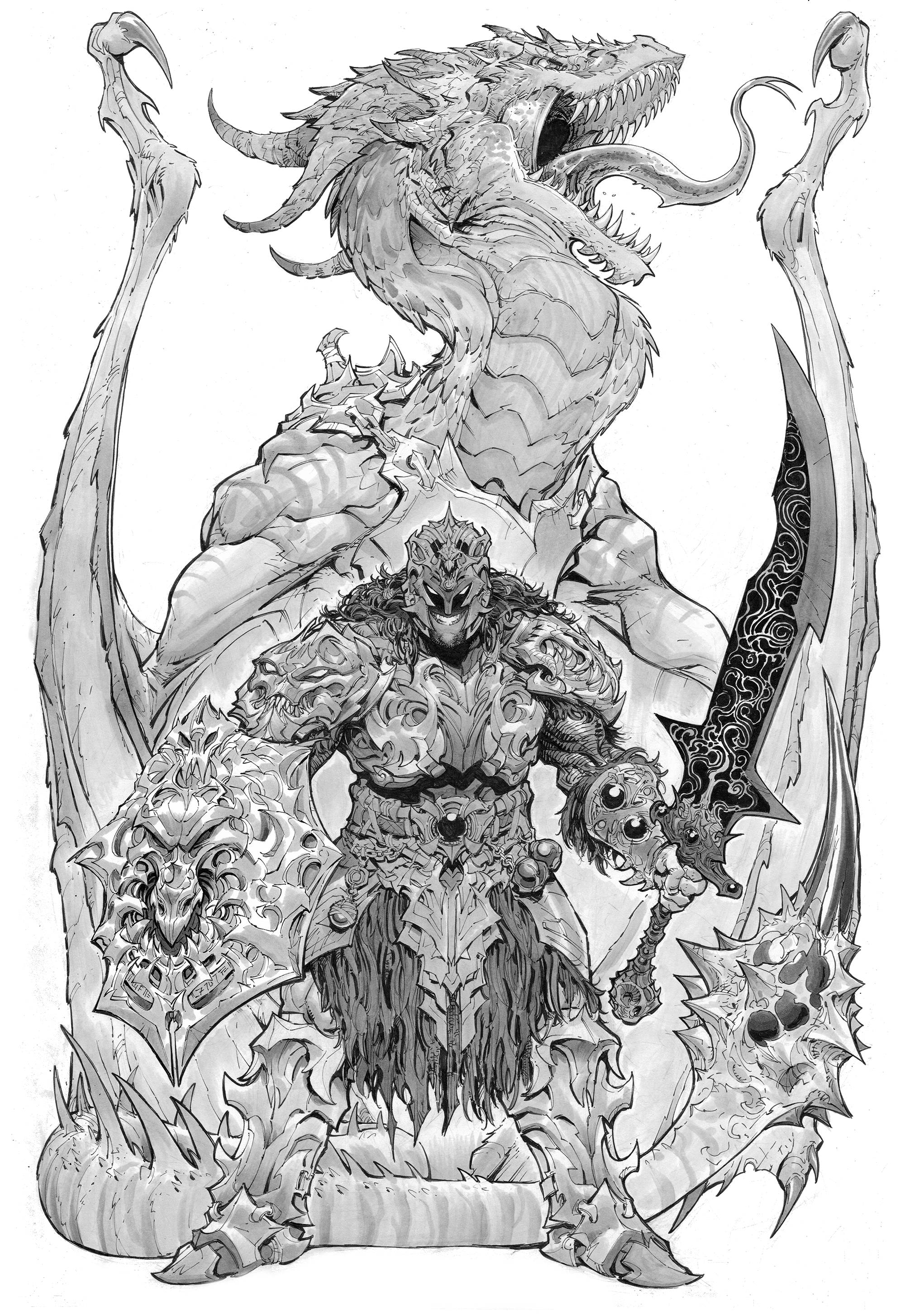
Dakkon, Shadow Slayer
Dakkon was once a gifted blacksmith who some say had sold his soul for his uncanny ability to shape steel. Many in his village would hear him working at night as he chanted unknown litanies to the fire and steel. They say the litanies were taught to him by the fire, turning his forge into a portal so that he could bring forth a being of shadow—a master—to teach him the art of steel. Many nights a plume of red-hot embers crackled into the darkness as his hammer rang to the incessant gasping of the bellows. Some who spied on him as he worked swore that they saw a shadow appear from within the forge and slide up the glowing steel, entering the veins that bulged on his powerful arm.
As his clientele grew, Dakkon became less and less aware of those who peered into his smithy. They were gawkers and mere strewers of tales about town, chickens who clucked and kicked the dirt with nothing better to do. He was more focused on the voice in his head. A voice that sounded like a silver wind and the swelling sigh of the incoming tide. It told him how hot the forge should be, what metals to mix together, and where to strike the steel. The voice spoke in words and images; it showed him beautiful shapes and revealed complex secrets of the steel. Then the voice mentioned Shadow Slayer. It gave Dakkon a glimpse of a sword beyond the skill of any mortal master, a sword that longed to be alive. As the painter might dream that their work could walk off the canvas, so this voice spoke to Dakkon of Shadow Slayer, infusing his mind with inspiration and desire to make a sword of legend.
As Dakkon labored harder and harder, increasing his prowess so that he could one day attempt Shadow Slayer, the voice began to shift its way of speaking. It was now as if Shadow Slayer itself was speaking to him, giving him instructions on how it wished itself to be made. As Dakkon followed the voice, the more his skill progressed and the more secrets it divulged. He learned how to fold and forge spectral symbols into the steel to suffuse his work with magic. Under the guidance of the voice, he fashioned armor—a shield, a helm, and pauldrons—all of which would imbue his body with the unearthly power needed to wield Shadow Slayer.
With the armor complete, he followed instructions to prepare the forge to birth his final masterpiece. By this time, he was no more than a mortal shell, his body wasted away by neglect. Without any conscious understanding, guided by Shadow Slayer, he inscribed demonic sigils into the interior of the forge and over his body. When he did, he could feel arcane forces flood into his limbs, instilling them with enough energy to continue. On some level, he knew the energy from the sigils also bound him to the forge and would destroy what remained of his body, but the drive to complete Shadow Slayer was too great. He had come too far to turn back. To withstand the final process, he donned the armor and drew on its magic, and began to heat the steel. With each blow of his hammer, Dakkon could feel a part of his soul being consumed by Shadow Slayer. He could feel its hunger; the blade was starving for life and Dakkon suddenly became aware of the pulsing energy of the village and its inhabitants as he pulled Shadow Slayer from the fire. He left the forge, Shadow Slayer still glowing, and went into the village to quench its hunger.
Dakkon and Shadow Slayer
Dakkon and Shadow Slayer are entangled in a cursed dance. Shadow Slayer needs Dakkon so it can access the Material Plane and reap a harvest of souls. Dakkon needs his armor to sustain his life so that he may wield the power of Shadow Slayer. Very little of the original Dakkon remains, but what does clings to sanity with an iron grip. Although it fills his body with power enough to wield Shadow Slayer, his armor is essentially a prison, for should he remove it, Dakkon would skeletonize and turn to dust in a matter of seconds.
When Shadow Slayer needs souls, it becomes the dominant persona until its otherworldly hunger is slaked. In these moments, Dakkon must hunt. Where once a lowly commoner would satisfy Shadow Slayer’s thirst, now only the most powerful souls will suffice, forcing Dakkon to track down ever more dangerous prey. Once it is satiated with souls, Shadow Slayer’s influence lessens and Dakkon has more control over himself. Although, as time has gone on, one could say that differentiating between the two is becoming harder and harder.
Dakkon appeared in Dragon+ #38.
Dakkon’s Items
Dakkon has forged his own arsenal of powerful magic items.
Wyvern Shield
Dakkon’s Wyvern Shield works like a figurine of wondrous power that contains Razharak, an elder wyvern. Whoever attunes to the shield becomes the new master of Razarak. Razharak can materialize for up to 24 hours or until she is reduced to 0 hit points. Once it has been used, the shield can’t be used again until 2 days have passed. As a magic item, it is a shield +3.
Ur-Armor
The secrets of creating the Ur-Armor were given to Dakkon by the evil entity that inhabits Shadow Slayer. Donning and attuning to the armor provides the wearer the power and protection to wield Shadow Slayer, otherwise any attempt to attune would instantly result in Shadow Slayer consuming their soul. Once the armor is donned, it takes over as the source of life force for its wearer. If the armor is removed, the wearer’s drained body cannot support itself and turns to dust. Only three wish spells cast in unison can reverse this effect of the Ur-Armor.
The Ur-Armor as a whole is a suit of plate mail +3 and each individual piece also provides the following properties:
- Helm. Wearing the helm grants darkvision 120 ft. and covers the wearer’s eyes in a shroud of darkness that cannot be dispelled by magic. It also allows the wearer to speak and understand Infernal.
- Pauldrons. Wearing the pauldrons allow the wearer to speak Draconic and grants the wearer immunity from fire. The faces on the pauldrons animate from time to time to grimace and snarl.
- Breastplate. The armor allows the wearer to regenerate 20 hit points at the beginning of the wearer’s turn as long as they have 1 hit point.
- Belt. The belt contains an onyx eye, a magic gemstone, which is set into the buckle. This onyx eye grants the wearer the boon of immortality (see Epic Boons in the Dungeon Master’s Guide).
- Vambraces. The left vambrace of the Ur-Armor has two onyx eyes that imbue damage dealt by the wearer with Abyssal energy, dealing double damage to Celestial creatures.
- Greaves. The greaves grant the wearer resistance to non-magical damage.
Shadow Slayer
Shadow Slayer is an evil entity that has brought itself into being using Dakkon’s skills as a blacksmith, and now inhabits the sword known as Shadow Slayer. It is an ancient intellect that understands a type of magic powered by the consumption of souls. If Shadow Slayer isn’t fed a steady diet of souls (100 hit points per week), it begins to cause a conflict that can result in Shadow Slayer consuming the soul of its wielder.
Every morning Shadow Slayer’s persona attempts to supplant the wielder’s. The wielder must make a DC 20 Charisma save or be taken over by Shadow Slayer’s will for 12 hours or until Shadow Slayer’s 100 hit point soul requirement is fulfilled.
Anyone wielding Shadow Slayer gains +3 to attack and damage rolls. It has the following additional properties:
- Psychic Intensity. While holding Shadow Slayer, you can’t be charmed or frightened.
- Consume Soul. When Shadow Slayer reduces a creature to 0 hit points, it consumes its soul (if it has one). That creature can only be restored to life by a wish spell.
- Soul Sense. While holding Shadow Slayer, the wielder can sense the direction of the nearest soul within 300 yards and feels a growing hunger the closer they get to it.
- Necrotic Bolt. Shadow Slayer can discharge a bolt of necrotic energy which does 16 (3d8 + 3) necrotic damage.
Epic Level Items
Caveat emptor!
Dakkon is meant to be a quest giver or a terrible threat monster to lower level characters and his items remain with him. Only epic level characters should even dream of trying to get some of Dakkon’s items—and DMs should consider each item carefully within the context of their campaign. A way of avoiding an overpowered character is to have Dakkon’s items be annihilated or become depowered when they are separated from their master.
Epic level items should be handled with care. Allowing a character access to the full suit of Ur-Armor can tilt the power level in a campaign; DMs are advised to tread carefully and make sure all suitable countermeasures are considered when giving over a single one of these items.
Now enjoy some epic items!
Dakkon, Shadow Slayer
Medium Humanoid (Human), Chaotic Evil
- Armor Class 21 (Ur-Armor)
- Hit Points 256 (27d8 + 135)
- Speed 30 ft.
STR DEX CON INT WIS CHA 23 (+6) 21 (+5) 20 (+5) 17 (+3) 22 (+6) 21 (+5)
- Saving Throws Str +13, Dex +12, Con +12
- Skills Athletics +13, Intimidation +12, Perception +13
- Damage Resistances necrotic; bludgeoning, piercing, and slashing from nonmagical attacks
- Damage Immunities poison, fire
- Condition Immunities charmed, exhaustion, frightened, paralyzed, poisoned
- Senses darkvision 120 ft., passive Perception 23
- Languages Abyssal, Common, Draconic, Infernal
Legendary Resistance (3/Day). If Dakkon fails a saving throw, he can choose to succeed instead.
Planeswalker. Dakkon can use an action to cast the plane shift spell (no spell slot or components required), targeting himself only, and travel to the chosen plane, or from that plane back to the Material Plane. Once he uses this boon, he can’t use it again until he finishes a short rest.
Rampage. When Dakkon reduces a creature to 0 hit points with a melee attack on his turn, Dakkon can take a bonus action to move up to half his speed and make a shield bash attack.
Regeneration. Dakkon regains 20 hit points at the start of his turn if he has at least 1 hit point.
Actions
Multiattack. Dakkon makes three attacks with Shadow Slayer.
Shadow Slayer. Melee Weapon Attack: +16 to hit, reach 5 ft., one target. Hit: 19 (3d6 + 9) slashing damage, or 22 (3d8 + 9) slashing damage if used with two hands to make a melee attack, plus 16 (3d8 + 3) necrotic damage.
Wyvern Shield. Melee Weapon Attack: +13 to hit, reach 5 ft., one target. Hit: 15 (2d8 + 6) bludgeoning damage.
Necrotic Bolt. Ranged Weapon Attack: +15 to hit, reach 60 ft., one target. Hit: 16 (3d8 + 3) necrotic damage.
Legendary Actions
Dakkon can take 3 legendary actions, choosing from the options below. Only one legendary action option can be used at a time and only at the end of another creature’s turn. Dakkon regains spent legendary actions at the start of his turn.
- Charge. Dakkon moves up to his speed.
- Backhand. Dakkon makes a Wyvern Shield attack. If the attack hits, the target must succeed on a DC 21 Strength saving throw or be pushed up to 10 feet away and knocked prone.
- Feast of Souls (Costs 2 Actions). Dakkon makes a Shadow Slayer attack against each creature within 10 feet of him.

Razharak, Dakkon’s Wyvern
Under the arcane instruction of Shadow Slayer, Dakkon forged the soul of a wyvern into a shield. The wyvern, Razharak, can be summoned from the shield by speaking her name aloud.
Razharak, Elder Wyvern
Large Dragon, Unaligned
- Armor Class 16 (natural armor)
- Hit Points 178 (17d10 + 85)
- Speed 20 ft., fly 80 ft.
STR DEX CON INT WIS CHA 19 (+4) 10 (+0) 20 (+5) 5 (-3) 12 (+1) 6 (-2)
- Skills Perception +4
- Senses darkvision 60 ft., passive Perception 14
- Languages –
Actions
Multiattack. Razharak makes two attacks: one with her bite and one with her stinger or tail. While flying, she can use her claws in place of one other attack.
Bite. Melee Weapon Attack: +8 to hit, reach 10 ft., one creature. Hit: 11 (2d6 + 4) piercing damage.
Claws. Melee Weapon Attack: +8 to hit, reach 5 ft., one target. Hit: 13 (2d8 + 4) slashing damage.
Stinger. Melee Weapon Attack: +8 to hit, reach 10 ft., one creature. Hit: 14 (3d6 + 4) piercing damage. The target must make a DC 15 Constitution saving throw, taking 24 (7d6) poison damage on a failed save, or half as much damage on a successful one.
Tail. Melee Weapon Attack: +8 to hit, reach 10 ft., one creature. Hit: 18 (4d6 + 4) bludgeoning damage. If the target is a creature, it must succeed on a DC 19 Strength saving throw or be pushed up to 20 feet away and knocked prone.
Using Dakkon In Your Game
There’s one main question to answer in order to unlock the mystery of Dakkon: Is he in accord with Shadow Slayer, is he locked in conflict with it, or is he the master of it? Here are some related questions to ponder:
- Is Dakkon just a death dealer, bent solely on harvesting souls for Shadow Slayer, or is there still humanity left that is looking for a way out of this curse?
- Has Dakkon become a mouthpiece for Shadow Slayer, his body and mind now a puppet for its ancient intellect or does he now enjoy his existence, wielding the power of Shadow Slayer to achieve his own goals?
- What does Shadow Slayer want other than more souls?
- Is there an endgame that Dakkon and Shadow Slayer are seeking together or are their ends separate and in conflict with one another?
Here’s one story possibility:
Curse of Shadow Slayer
In this scenario, Dakkon, in a moment of lucidity, wishes for the end to his cursed existence. He has caused so much bloodshed and pain that he longs only for the end. But Shadow Slayer is no fool and is slowly taking over the tiring Dakkon, grinding him down and crushing his will. He’s desperate; there may only be one last chance before he is subsumed entirely under the might of Shadow Slayer. He reaches out to the party, believing that they are the ones who can free him from his prison of torment. Dakkon knows of the “kill switch” for Shadow Slayer, but it’s a quest that is not to be taken lightly.
From here, you can make the quest to release Dakkon as hard or as easy as you’d like. It could be that the solution to ending Shadow Slayer’s hold on Dakkon is on another plane, which opens up the whole multiverse to your adventure. If the journey takes the characters into Celestial and Abyssal realms, Dakkon might be willing to pry out two of the onyx eyes from his armor. As they bounce from plane to plane, Dakkon becomes a hub for the adventurers to return to after they have completed their missions. You can have fun switching personas for Dakkon—one time he is himself but the next time the adventurers might encounter Shadow Slayer. This makes for a dangerous game, especially if your adventurers are not epic level. One slip and they could be found out, making their souls an easy banquet for Shadow Slayer.
At the end of the quest, the adventurers have a choice—allow Dakkon to end Shadow Slayer’s curse and be freed from his torment or try to steal Shadow Slayer and the Ur-Armor. Be sure to have a moment where Shadow Slayer appeals to one of the characters—it chooses the one most tempted by its power—and tries to make a deal with them. If Dakkon breaks the curse, Shadow Slayer shatters—its essence banished to the Abyss—and Dakkon turns to dust.
Sivitri Scarzam
Sivitri Scarzam was born with the blood of ancient sea dragons flowing through her veins. As a young girl, the ocean called to her, and many times her parents pulled her from its waters after she swam too far into its blue-green depths. As she grew, her sorcerous abilities began to surface with uncontrollable power—the tide would swell and tower before her in the form of a giant serpent, then crash at her feet. Often when this would happen, her eyes would roll back and she would begin speaking an unknown tongue.
People began to fear her, whispering that she was marked by evil. Sivitri did not understand the power that was emerging within her, and was terrified by what she might become. At night her dreams were filled with wild visions of a dark, underwater realm ruled by a scaled serpent that sat coiled in the dark, its cold eyes silently speaking to her, filling her mind with arcane symbols and magical secrets.
Her only refuge was the sea, and each time she entered its soothing depths the world faded into its deep blue void. In the embrace of the ocean Sivitri could know peace away from the chattering crowds and the confusion that clouded her mind. But she was always limited by how long she could hold her breath, her burning lungs forcing her back to the surface and its noise.
She began to stay under longer and longer until one night she entered the sea with no intention of returning to the surface. She surrendered to death. But instead of dying, Sivitri walked through a blinding veil into another realm. She passed into the Dragon Stronghold—an undersea dimension where the Scarzam dragons had created their lair—to find a great sea serpent waiting to reinstate her into the lineage of the ancient sea dragons. Her draconic blood had opened a portal to her birthright and a power beyond death— the ability to walk between worlds.
Sivitri stayed in the dragon’s realm to learn magic that filled her blood with energy as she uncovered a history far older than the memory of humanity could fathom. Knowledge of that history instilled her with a purpose. When she emerged from the ocean years later, she was born anew. Her mortal self was long gone and her reign of immortal power had begun.
Items
As a planeswalker, Sivitri has traveled all over the multiverse. And as a master of magic, she’s amassed a small trove of magic items (feel free to choose several from the Dungeon Master’s Guide). In addition, here are two iconic items that Sivitri has fashioned herself:
Scarzam Armor
Sivitri created the Scarzam armor, forging it in the cold fire located at the center of the Dragon’s Stronghold has the following properties:
- The Scarzam armor magically bonds to the wearer’s skin upon attuning, covering it with a flexible but strong chiton, adding +3 to Strength up to a maximum of 21. While wearing this armor, you also gain a +3 bonus to your AC.
- The armor grants the wearer the Amphibious trait, allowing them to breathe air and water.
- The wearer gains a swimming speed of 40 ft.
Scarzam Saddle and Bridle
This saddle and bridle were created by Sivitri especially for riding the Scarzam dragon and its magic effects only work on that particular kind of dragon. The saddle is made from shark skin and adheres to the dragon’s hide like a barnacle. The bridle is fashioned from silver and is inscribed with magic sigils. The bridle and saddle have the following properties:
- While in the saddle, the rider and the dragon can communicate telepathically. While conscious, the rider can’t fall off the dragon, even if inverted or swimming underwater. They can be knocked off by an opposing force (such as being buffeted by an air elemental’s whirlwind attack).
- While in the saddle, the rider can speak and understand Draconic.
Using Sivitri In Your Game
Sivitri Scarzam is a powerful sorcerer and there are many ways she can interact with the characters in your game. She could be looking for an ancient magic item that she needs to attain the next level of power. She could need the assistance of adventurers to lure a foe into her clutches or to acquire an object for her. She could also be the mousetrap that is guarding a very delicious piece of magic cheese that the adventurers are set on stealing from within her tower (or underwater sanctum). Here are a few ideas:
Foil the Plan
While on a search for a powerful magic item, the trail leads the adventurers to Sivitri’s island. They must sneak onto her island and attempt to break into her tower and steal the magic item before she uses it to create a tsunami and wipe out a city. Sivitri has a host of giant crabs, merrow, sharks, and other ocean critters guarding her lair. Those monsters stand in the way, but if the characters are too loud or clumsy in their assault, the ruckus might bring the wrath of Sivitri herself down on their heads.
Heal the Dragon
In this scenario, Sivitri’s dragon is dying and she doesn’t know how to cure it. When the characters hear of this via a rumor, one of them may remember a dream, a vision, or a story from a venerable grandmother about how to cure the dragon. It may be that they need to get a special blend of herbs that can only be found in certain areas of the world, or they need to procure a special magic item and sacrifice something dear to them to get the antidote that heals the dragon.
Dragonnapped
In this adventure, the Scarzam dragon has been taken to the Abyss by a balor and its demonic host. Sivitri needs some high-level adventurers to help her get it back before the demons roast it over an Abyssal fire.
Sivitri appeared in Dragon+ #39.
Sivitri Scarzam
Medium Humanoid (Human), Neutral
- Armor Class 20 (natural armor)
- Hit Points 171 (18d8 + 90)
- Speed 30 ft., Swim 60 ft.
STR DEX CON INT WIS CHA 19 (+4) 22 (+6) 21 (+5) 25 (+7) 20 (+5) 24 (+7)
- Saving Throws Dex +13, Int +14, Cha +14
- Skills Arcana +14, History +14, Insight +12, Persuasion +14
- Damage Resistances poison; lightning; bludgeoning, piercing, and slashing from nonmagical attacks
- Damage Immunities cold
- Condition Immunities charmed, frightened
- Senses truesight 60 ft., passive Perception 15
- Languages Aquan, Common, Draconic
Amphibious. Sivitri can breathe air and water.
Legendary Resistance (3/Day). If Sivitri fails a saving throw, she can choose to succeed instead.
Benthic Mind. Sivitri is immune to magic that would ascertain her thoughts, truthfulness, alignment, or creature type.
Planeswalker. Sivitri can use an action to cast the plane shift spell (no spell slot or components required), targeting herself only, and travel to the chosen plane, or from that plane back to the Material Plane. Once she uses this boon, she can’t use it again until she finishes a short rest.
Actions
Multiattack. Sivitri makes four attacks, three attacks with her chilling hair, deathly claw, and poison quill in any combination, and one spell attack.
Chilling Hair. Melee Weapon Attack: +19 to hit, reach 10 ft., one target. Hit: 10 (3d6) cold damage.
Deathly Claw. Melee Weapon Attack: +19 to hit, reach 5 ft., one target. Hit: 7 (2d6) slashing damage and 10 (3d6) necrotic damage. If hit points are lost this way, Sivitri gains 10 hp.
Poison Quill. Melee or Ranged Weapon Attack: +6 to hit, reach 5 ft. or range 30/120 ft., one target. Hit: 11 (2d6 + 4) piercing damage and 10 (3d6) poison damage.
Spellcasting. Sivitri casts one of the following spells, using Charisma as the spellcasting ability (spell save DC 17, +14 to hit with spell attacks):
- At will: control water, frostbite
- 3/day each: lightning bolt, wall of water
- 2/day each: cone of cold, eyebite
- 1/day each: chain lightning, power word stun
Legendary Actions
Sivitri can take 3 legendary actions, choosing from the options below. Only one legendary action option can be used at a time and only at the end of another creature’s turn. Sivitri regains spent legendary actions at the start of her turn.
- Swift Move. Sivitri moves up to her speed.
- Attack. Sivitri makes one attack with her chilling hair, deathly claw, or poison quill.
- Freezing Gaze (Costs 2 Actions). Sivitri can look at one creature. That creature must make a DC 26 Constitution saving throw, taking 44 (8d10) cold damage and be paralyzed for 1 minute on a failed save, or half as much damage and not paralyzed on a successful one.

Scarzam Dragon
The Scarzam dragons were once powerful and feared, and all save one have been wiped out. This dragon is now the last of its kind and is bonded to Sivitri by blood. Some claim that Sivitri was the creator of these unique dragons, while others say that long ago the Scarzam dragons foresaw their demise and mingled their blood with humanity, in the hopes that one day the bloodline would bring forth a human who could be a champion of their lineage.
Scarzam Dragon
Huge Dragon, Neutral
- Armor Class 18 (natural armor)
- Hit Points 138 (12d12 + 60)
- Speed 20 ft., swim 60 ft.
STR DEX CON INT WIS CHA 24 (+7) 19 (+4) 20 (+5) 16 (+3) 18 (+4) 17 (+3)
- Saving Throws Str +12, Con +10
- Skills Perception +9, Stealth +9
- Damage Immunities Cold
- Damage Resistances bludgeoning, piercing, and slashing from nonmagical attacks
- Senses darkvision 120 ft., passive Perception 14
- Languages Draconic
Legendary Resistance (3/Day). If the dragon fails a saving throw, it can choose to succeed instead.
Actions
Multiattack. The dragon makes one Bite attack and one Tail attack. It can choose to replace its Tail attack with its Constrict attack.
Bite. Melee Weapon Attack: +12 to hit, reach 15 ft., one target. Hit: 20 (2d12 + 7) piercing damage.
Tail. Melee Weapon Attack: +12 to hit, reach 20 ft., one target. Hit: 20 (2d12 + 7) bludgeoning damage. If the target is a creature, it must succeed on a DC 20 Strength saving throw or be pushed up to 30 feet away from the dragon and knocked prone.
Constrict. Melee Weapon Attack: +12 to hit, reach 20 ft., one creature. Hit: 18 (2d10 + 7) bludgeoning damage and 16 (3d10) lightning damage and the target is grappled (escape DC 20). Until this grapple ends, the target is restrained, and the dragon can’t constrict another target.
Electric Breath (Recharge 5–6). The dragon exhales a 60-foot cone of crackling energy. Each creature in that area must make a DC 19 Dexterity saving throw, taking 55 (10d10) lightning damage on a failed save, or half as much damage on a successful one.
Legendary Actions
The dragon can take 3 legendary actions, choosing from the options below. Only one legendary action option can be used at a time and only at the end of another creature’s turn. The dragon regains spent legendary actions at the start of its turn.
- Move. The dragon moves up to its speed.
- Tail. The dragon makes one Tail attack.
- Bite (Costs 2 Actions). The dragon makes one Bite attack.

Snapdax, Apex of the Hunt
On the treacherous world of Ikoria, gargantuan beasts fight each other for survival in a land where humans sit at the bottom of the food chain. Ikoria’s wildlife, it turns out, is evolutionarily aggressive. If a creature doesn’t already have the advantage in an encounter it might grow a new body part to gain the upper hand—sometimes quite literally!
Adventurers should also be wary of further changes. A creature might have transformed once already but Ikoria is home to countless others with the same ability and there’s nothing to stop further mutations making Snapdax even more deadly than it already is!
Snapdax appeared in Dragon+ #31.
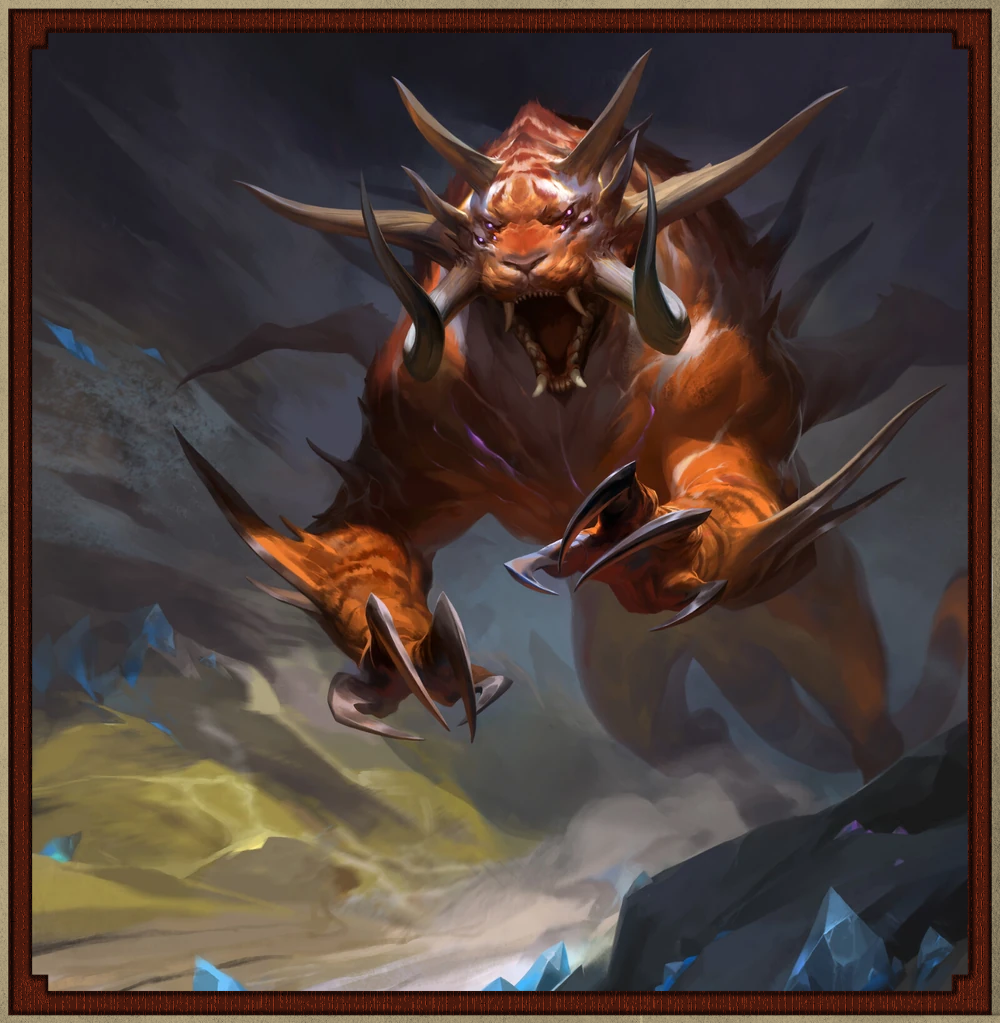
Snapdax
Gargantuan Monstrosity, Unaligned
- Armor Class 18 (natural armor)
- Hit Points 186 (12d20 + 60)
- Speed 60 ft.
STR DEX CON INT WIS CHA 22 (+6) 25 (+7) 20 (+5) 8 (-1) 14 (+2) 16 (+3)
- Saving Throws Dex +13, Con +11, Wis +8
- Skills Perception +14, Stealth +19
- Senses darkvision 120 ft., passive Perception 24
- Languages -
Blood Frenzy. Snapdax has advantage on melee attack rolls against any creature that doesn’t have all its hit points.
Keen Sight and Smell. Snapdax has advantage on Wisdom (Perception) checks that rely on sight or smell.
Legendary Resistance (1/Day). If Snapdax fails a saving throw, it can choose to succeed instead.
Pounce. If Snapdax moves at least 20 feet straight toward a creature and then hits it with a claw attack on the same turn, that target must succeed on a DC 20 Strength saving throw or be knocked prone. If the target is prone, Snapdax can make one claw attack against it as a bonus action.
Actions
Multiattack. Snapdax makes three claw attacks, or it makes one claw attack and uses Mutation Helix.
Claw. Melee Weapon Attack: +13 to hit, reach 10 ft., one target. Hit: 17 (3d6 + 7) slashing damage.
Mutation Helix. Snapdax releases a coiling bolt of necrotic energy at one creature it can see within 30 feet of it. The target must make a DC 19 Constitution saving throw, taking 18 (4d8) necrotic damage on a failed save or half as much damage on a successful one. Snapdax then gains temporary hit points equal to the amount of damage the target takes.
Reactions
Reactive Mutation. When Snapdax fails a saving throw or takes 30 or more damage in a single turn, it can use Mutation Helix and gain resistance to a damage type of its choice until the next time it uses Mutation Helix.
Legendary Actions
Snapdax can take 3 legendary actions, choosing from the options below. Only one legendary action option can be used at a time and only at the end of another creature’s turn. Snapdax regains spent legendary actions at the start of its turn.
- Claw Attack. Snapdax makes a claw attack.
- Daunting Roar. Snapdax can let out an especially menacing roar. Each creature of its choice within 60 feet of it that can hear it must succeed on a DC 17 Wisdom saving throw or become frightened of Snapdax until the end of the creature’s next turn.
- Nightmare Prowl. Snapdax moves up to half its speed. This movement doesn’t provoke opportunity attacks

Sol’kanar the Swamp King
Sol’kanar was once a nature spirit who dwelled within the island of Corondor. There, in the island’s core, he mingled with the other forces of nature—sometimes in conflict, sometimes in harmony—but always with the overall health and well-being of Corondor in mind. Each force shaped the land’s geology and filled it with a diversity of life.
But as ill-fortune would have it, a great multiversal war came to Corondor, crushing the island in its grip of madness and throwing everything out of balance. The forces of nature fled deeper into Corondor, but a demon planeswalker singled out Sol’kanar and tore him from the land to use as a living weapon. The benevolent nature spirit was unable to resist the planeswalker’s demonic magic, which warped Sol’kanar’s mind and twisted him into an instrument of destruction.
In his new demonic form, Sol’kanar saw things through different eyes. His mind was no longer constrained, death and rage were his to wield like an unquenchable fire, and he found himself embracing war and relishing slaughter—the once benevolent force of nature was now fuel for a demonic pyre. But, as with most wars, this conflict eventually moved to another front, leaving only death and ruin in its wake. With nothing more to gain from Corondor’s domination, the demon planeswalker left to pursue her wrath and madness elsewhere and Sol’kanar’s broken form was discarded and left to rot in the corpse-laden swamps of his home world.
Sol’kanar’s spirit did not die, but was taken deep into the soul of Corondor, where the remaining forces of nature formed a confluence of Corondor’s energies. There, in the vault of the world, they discussed whether or not to revive Sol’kanar, as his soul would be forever demon-tainted and potentially dangerous. But Corondor had been horribly defiled and the forces of nature had been helpless to stop it. Nature needed a champion. Sol’kanar, it was decided, was to be brought back to life.
The mountain spirits offered up a sacred stone known as the Heart of the Mountain, and both the river spirits and those of the great swamp poured their elemental power into it. It was there, deep within Corondor that Sol’kanar was reborn, emerging from the bogs with a burning desire to defend Corondor and destroy any who would dare defile it.
Corondor
Corondor is a large island on the plane of Dominaria in the Golthonor Sea. A tremendous mountain chain called The Spine runs down its center, roughly dividing it into Stonehaven to the west, Casindral to the south, and Golthonor to the east, with The Northern Ice Wastes lying above them. It was ground zero of the Planeswalker War where tremendous powers were unleashed.
Sol’kanar’s Items
Sol’kanar has the following items:
Heart of the Mountain
The Heart of the Mountain is a living diamond taken from deep within The Spine mountain range that keeps Sol’kanar alive and stops him becoming a demonic force of destruction. Were it to be removed from his chest, Sol’kanar would turn into a thick, bubbling mass of demonic ichor or become a rampaging servant of the Abyss.
The gem itself is unique and contains the powers of three elemental forces—earth, water, and the decaying power of death. Should someone come into possession of the gemstone, they are able to bring a creature back from the dead as if they had cast the true resurrection spell. This can only be used once. If this power is used, the Heart of the Mountain embeds itself in the new body of the revived creature. The revived creature now has one use of true resurrection. If the Heart of the Mountain is somehow removed from its host, the creature turns to dust.
Corondor Crystals
There are numerous crystals embedded in Sol’kanar’s body and he may give them as gifts to those who are friends of Corondor. Each crystal acts as a charm (see Supernatural Gifts in the Dungeon Master’s Guide).
Jawbone of Yawgmoth
Sol’kanar’s club is the gore-encrusted jawbone he tore from an avatar of Yawgmoth in a battle to reclaim Corondor. The bone is seething with demonic life, and growls and gibbers, gnashing its fangs and glaring with its soulless eyes. Other than being a foul, Abyssal artifact, it has the following properties:
- It can warn Sol’kanar of approaching danger. It can sense any living creature, size Medium or larger, up to 120 ft. away. If it senses a living creature, it chatters aggressively until Sol’kanar commands it to be quiet (which it does reluctantly).
- On Sol’kanar’s command, the jawbone’s eyes all focus on one target and issue forth a blast of necrotic energy that deals 36 (8d8) necrotic damage.
Sol'Kanar appeared in Dragon+ #39.
Sol’kanar the Swamp King
Large Fiend (Demon), Lawful Neutral
- Armor Class 23
- Hit Points 270 (20d10 + 160)
- Speed 40 ft.
STR DEX CON INT WIS CHA 26 (+8) 15 (+2) 27 (+8) 16 (+3) 17 (+3) 14 (+2)
- Saving Throws Str +15, Con +15, Wis +10
- Skills Intimidation +16, Nature +17, Perception +10
- Damage Resistances cold, fire; bludgeoning, piercing, and slashing from nonmagical attacks
- Damage Immunities lightning, necrotic, poison
- Condition Immunities charmed, deafened, exhaustion, frightened, poisoned, stunned
- Senses darkvision 120 ft. passive Perception 13
- Languages Common, Abyssal, telepathy 120 ft.
Legendary Resistance (3/Day). If Sol’kanar fails a saving throw, he can choose to succeed instead.
Lightning Absorption. Whenever Sol’kanar is subjected to lightning damage, he takes no damage and regains a number of hit points equal to the lightning damage dealt.
Actions
Multiattack. Sol’kanar makes three attacks: two with his Jawbone of Yawgmoth, and one with his mouthing tentacles or necrotic bolt.
Jawbone of Yawgmoth. Melee Weapon Attack: +15 to hit, reach 20 ft., one target. Hit: 21 (3d8 + 8) bludgeoning damage and 13 (3d8) necrotic damage.
Necrotic Bolt. Sol’kanar emits a blast of necrotic energy from his Jawbone of Yawgmoth in a 60-foot line that is 5 ft. wide. Each creature in that line must make a DC 21 Dexterity saving throw, taking 36 (8d8) necrotic damage on a failed save, or half as much damage on a successful one.
Mouthing Tentacles. Melee Weapon Attack: +15 to hit, reach 25 ft., one target. Hit: 14 (3d6 + 4) piercing damage, and the target is grappled (escape DC 21) if it is a Huge or smaller creature. Until this grapple ends, the target is restrained, and Sol’kanar can’t use the same tentacle on another target. Sol’kanar has three tentacles.
Bonus Actions
Blood Drain. Sol’kanar can force one creature grappled by a tentacle to make a DC 21 Constitution saving throw. On a failed save, the target takes 22 (4d10) necrotic damage, and Sol’kanar regains that many hit points.
Legendary Actions
Sol’kanar can take 3 legendary actions, choosing from the options below. Only one legendary action option can be used at a time and only at the end of another creature’s turn. Sol’kanar regains spent legendary actions at the start of his turn.
- Swift Move. Sol’kanar moves up to his speed.
- Attack. Sol’kanar makes a Jawbone of Yawgmoth attack.
- Festering Swarm (Costs 2 Actions). Each creature within 20 feet of Sol’kanar takes 10 (3d6) piercing damage, and 27 (6d8) necrotic damage from the swarm of blood-sucking flies that live in his hide.

Using Sol’kanar In Your Game
Sol’kanar is bound to his island kingdom of Corondor, which can be used in any fashion in your game. It could be a place where the characters are shipwrecked, or it could be a place where an item is hidden.
If you’d like to use the rich history from the Magic: The Gathering storyline, Corondor is a place still recovering after the devastation of a terrible war, so all manner of latent magic, mysterious weapons, cool artifacts, and wrecked war machines could be buried there.
Sol’kanar is a fierce defender of his land, so any untoward activity on Corondor is sure to pique his ire, and few survive his wrath. However, there could be things that Sol’kanar
needs to bring stability and peace back to his land. Although he is a demon, Sol’kanar’s chaotic nature is kept in check by the Heart of the Mountain, which allows him to hold on to some of his original essence—a spirit of nature who cares for his kingdom.
Healing Corondor
The land of Corondor could have been violently wounded in the great battles where weapons of immense arcane power were used. These wounds might only be able to be healed by magic from elsewhere. Sol’kanar is unable to leave his island’s shores—the characters are his only hope of bringing a close to a turbulent past.

Chapter 4: Planescape
Grillig
Grilligs are small, scaled beasts with long arms and hunched legs. Their movement resembles that of gorillas, as they use their arms to propel themselves along. Grilligs are vicious pests and can be lethal if they encounter an expedition unprepared for them.
Legend has it that grilligs were born from two-dimensional angles. But whatever their origin, they are strangely resistant to arrows, spears, swords, and other edged weapons. They can be found in almost any rugged, angular terrain. Chasms, caves, and mountainous areas have been known to run thick with them.
Pack Tactics. Grilligs have a pack mentality, and their society revolves around finding something larger and meaner than themselves, killing it, and then moving onto a larger, meaner creature. They prefer to weaken a target with ambushes or crude traps (pushing boulders off ledges, causing avalanches, stampeding other creatures over the victim, and so on). They then attack in groups, raising themselves on their forelimbs to lash out with their foot talons, and shredding targets with lightning speed.
If all except one member of a grillig pack is killed, the remaining grillig either flees combat or joins another group of grilligs. If cornered before it can flee, a lone grillig hisses and gnashes its teeth, but it does not defend itself from attackers.
Unknown Natures. It is not known how grilligs breed—more of them simply seem to appear whenever their numbers become too thin. The bariaur root out these pests whenever they find them, but no matter how many they kill, more appear in the later seasons. If actively hunted, the grilligs lie low for a while, then emerge when the hunters relax their guard. Members of bariaur tribes on the Outlands always carry bludgeoning weapons against the threat of a grillig attack.
A grillig’s teeth and talons can be used in the creation of magic armor as well as magic arrowheads and spearheads. It is said that secret rituals can give certain weapons the “speed of a grillig,” allowing the wielder of the weapon to make a frenzy of multiple attacks.
Grillig
Medium Monstrosity, Typically Neutral Evil
- Armor Class 13
- Hit Points 19 (3d8 + 6)
- Speed 30 ft., climb 30 ft.
STR DEX CON INT WIS CHA 14 (+2) 16 (+3) 14 (+2) 4 (-3) 13 (+1) 7 (-2)
- Skills Acrobatics +5, Perception +3
- Damage Immunities piercing, slashing
- Senses passive Perception 13
- Languages -
Actions
Multiattack. The grillig makes four talons attacks.
Talons. Melee Weapon Attack: +4 to hit, reach 5 ft., one target. Hit: 4 (1d4 + 2) slashing damage.
Monsters in this chapter appeared in Dragon+ #16 and were featured in the video game Planescape: Torment.

Gronk
Huge, squat beasts with powerful legs and a thundering croak, the gronk are also known as “hopping rocks” or “stone frogs.” The ill-tempered beasts pose a threat to the nomadic bariaur tribes that roam the Outlands, and those tribes occasionally mount hunting parties solely to thin the gronk’s numbers. According to the bariaur nomads, gronk have existed on the Outlands for as far back as five bariaur generations. Their numbers have not increased substantially during that time, mostly due to bariaur thinning gronk herds with their rites of passage. A number of planewalkers have sighted the gronk on several Prime worlds as well.
Violent and Antisocial. When a creature comes within its line of sight, a gronk emits a thundering croak and hops toward the target to smash it to death with its spiked headplate. All gronk are nearly deaf, and bright visual displays irritate them. Tales tell of wizards who cast dancing lights into gronk herds to drive them into a frenzy. This results in the gronk turning on themselves until nearly every member of the herd is dead.
The gronk are so ill tempered that they can’t even tolerate their own species. Despite their herd mentality, the strength of the herd depends on the gronk’s emotional cycle, and members of a new herd can survive for a week at most before becoming irritated with one another. Soon after, their natural hatred gives way to furious bouts of head smashing. The herd then dissolves and reforms into new herds several months later.
Unusual Biology. Ironically, the gronk’s hatred of each other propagates their species. A gronk’s reproductive organs are located near its brain, in the spiked carapace over its forehead. The ridged spikes that cover the gronk’s headplate are actually buds that exchange reproductive material when two gronk smash their heads into each other, then subsequently fall off. If a fallen bud touches dirt, sand, earth, or rock, it submerges a few inches beneath the ground, only to burrow forth a few months later as a tiny gronk.
The gronk have never been seen to eat; it is a mystery how they sustain themselves. A gronk’s lifespan ranges from three to five years. As a gronk ages, its headplate cracks and flakes off until the creature suffers brain failure and dies.
Valuable Parts. Gronk headplates are often sought after for use in creating shields and armor plating, including for siege towers and shield walls. One bariaur myth talks of gronk headplates being placed upon an enchanted battering ram that could act as a horn of blasting upon any structure, but which needed a huge number of people to carry it.
The gronk also have bladder-like glands along their necks and upper backs that can be removed with care after a gronk is slain. When treated with the right resins and filled with acid, the gland sacs can be used as grenades, and are known to be extremely effective against fiends.
Gronk
Large Monstrosity, Unaligned
- Armor Class 14 (natural armor)
- Hit Points 37 (5d10 + 10)
- Speed 30 ft.
STR DEX CON INT WIS CHA 17 (+3) 14 (+2) 15 (+2) 1 (-5) 13 (+1) 5 (-3)
- Skills Athletics +5, Perception +3
- Damage Immunities bludgeoning from nonmagical attacks
- Senses passive Perception 13
- Languages -
Hopping Charge. If an enemy is within 45 feet of the gronk, the gronk can increase its speed to 45 feet and use its movement to hop toward that enemy, moving normally through other creatures’ spaces or difficult terrain. If it finishes this movement next to the original enemy and makes a spiked headplate attack against it, the gronk has advantage on the attack roll.
Hard of Hearing. A gronk has disadvantage on Wisdom (Perception) checks that involve hearing, but has advantage on saving throws that require it to hear another creature.
Actions
Spiked Headplate. Melee Weapon Attack: +5 to hit, reach 5 ft., one target. Hit: 10 (2d6 + 3) piercing damage. If the target is a creature, it must succeed on a DC 13 Strength saving throw or be knocked prone.

Sohmien
A sohmien resembles a huge horse with a leathery, ashen hide and dead white eyes. Its shoulder blades extend beyond its head and neck, and bone spikes (extensions of its spinal column) sprout from each shoulder.
Sohmiens leave a trail of mist in their wake, resembling that which shrouds the Hinterlands. The touch of their hooves kills vegetation and can taint the lands they stampede across for years. No one has ever successfully used a sohmien as a mount.
Sohmien do not eat, sleep, or mate, and their rides are governed by some cycle that eludes scholars. Herds of them emerge from the Hinterlands randomly before returning, and many suspect that they appear only in response to a creature craving vengeance.
Born of Nightmare. According to legend, the last of the nightmare lords was lured to the Gloom Meet by his subjects, then attacked by fiends who had tired of bartering for permission to use his nightmares. The nightmare lord was driven into the Hinterlands, his body riddled by cold iron spears and arrows. It is believed that where his blood struck the earth, sohmien sprang forth.
Sohmien hate nightmares and attack them over all other targets. It is said that the ride of the sohmien will not end until they kill every nightmare in existence.
Sadistic Combatants. Sohmien prefer to start combat at range with their shoulder spines, each of which makes a horrible whistling noise when fired and shrieks when it tastes blood. In close-up combat, a sohmien gores and bites its foes in non-vital areas, allowing a creature to experience as much pain as possible before its eventual death.
A Thirst for Vengeance. According to myth, sohmien are creatures of vengeance. They can be summoned by any vengeful mage or priest of sufficient power through a long-lost ritual called the sohmien pact. When summoned, sohmien must be ordered to ride, destroying all in the path leading to the creature that has wronged the summoner.
The ride ends only when all the sohmien are slain or when they have reduced the offending creature to near death. At that point, the sohmien wait, pawing the ground in the hope that their victim will seek its own revenge by sending them stampeding back to the first summoner. What happens when the sohmien return is unknown, but chronicles talk of the original summoner vanishing, its voice joining the frightful wails that follow the sohmien as they ride from the Hinterlands.
Sohmien
Gargantuan Monstrosity, Unaligned
- Armor Class 11
- Hit Points 32 (5d8 + 10)
- Speed 40 ft.
STR DEX CON INT WIS CHA 17 (+3) 12 (+1) 15 (+2) 2 (-4) 12 (+1) 4 (-3)
- Skills Perception +3
- Senses passive Perception 13
- Languages -
Fear Stampede. When six or more sohmien enter combat together in an environment of dim light or darkness, each creature that can see the stampede must succeed on a DC 11 Wisdom saving throw or be frightened for 1 minute. A creature that is riding a mount has advantage on this saving throw.
Actions
Multiattack. The sohmien makes one gore attack and one bite attack. If either attack hits, it can also make a hooves attack. Alternatively, the sohmien can make three spines attacks.
Gore. Melee Weapon Attack: +5 to hit, reach 5 ft., one target. Hit: 8 (1d10 + 3) piercing damage.
Bite. Melee Weapon Attack: +5 to hit, reach 5 ft., one target. Hit: 6 (1d6 + 3) piercing damage.
Hooves. Melee Weapon Attack: +5 to hit, reach 5 ft., one target. Hit: 6 (1d6 + 3) bludgeoning damage.
Spines. Ranged Weapon Attack: +3 to hit, range 30/120 ft., one target. Hit: 5 (1d8 + 1) piercing damage. This attack is treated as magical.

Trelon
Trelons originated on one of the Prime worlds and were brought to the Outlands by a sorcerer living on the ninth ring. This sorcerer used them as weapons, transporting them into the Academy of Weavers near Curst, where the trelons murdered the entire school of illusionists in their sleep.
Trelons have been described as a “mixture of orange and shadow.” They have two long arms that end in curved spikes, two mandibles near the mouth for feeding, and two spindly legs. According to legend, trelons were created to exterminate mages on some long-dead Prime world. True or not, the trelons seem to hate mages and magic in general.
Deadly Swarms. A trelon swarm is terrible to behold. When they appear, they mob any nearby creature, tearing through their victims like scythes. Trelons attack with their two arm spikes, bisecting a target like a pair of cutting shears. They do not stop until they have killed every non-trelon in sight, but when the fight is done, the mandibles around their mouths scoop up the remains of their victims.
Trelons do not like natural light, and torches or strong lanterns can prevent them from attacking. However, magical light drives them into a frenzy, and they attack any opponent using it without hesitation.
Unseen and All Seeing. A trelon never appears at a distance of greater than 30 feet from other creatures. Targets might thus never know that they are in the middle of a swarm of trelons until the creatures suddenly begin to materialize. How this ability works remains a mystery, but trelons are known to appear primarily in shadowy conditions where there is no natural light. It is likewise not known where they retreat to once they have finished their attacks.
Some believe that the trelons track creatures by their shadows, their emotions, or the sounds they make. But it is also known that trelons have the ability to track a victim through the use of spells or magic items designed to conceal the user. They are drawn to those protected by invisibility, a cloak of displacement, and similar magic, and can sense targets no matter how well they are hidden. Magical cloaking seems to drive trelons into a rage, and they often attack invisible or cloaked targets before other foes.
Mysterious Ways. Trelons speak a unique language that consists of soft clicks and chittering noises, which rise to a near-deafening screeching when they strike. Their insect-like nature makes several sages suspect that they may have a hive mentality, but like much that is known about trelons, this is only speculation.
Trelons are valued for their talons, which are long enough to be used as sword blades and make fearsome mage-slaying weapons when properly enchanted. Likewise, trelon blood is said to be usable in the crafting of unique arrows of slaying meant to kill mages. But incidents have been recorded in which attempts to use trelon blood in magical rituals have instead summoned a swarm of trelons to the scene.
Trelon
Large Monstrosity, Typically Neutral Evil
- Armor Class 13 (natural armor, shield)
- Hit Points 51 (6d10 + 18)
- Speed 30 ft.
STR DEX CON INT WIS CHA 15 (+2) 13 (+1) 16 (+3) 7 (-2) 16 (+3) 7 (-2)
- Skills Perception +7
- Condition Immunities charmed, paralyzed
- Senses truesight 120 ft., passive Perception 17
- Languages Trelon
Always Hidden. To any creature more than 30 feet away from the trelon, the trelon is invisible and makes no sound. This invisibility cannot be overcome by any mundane or magical means. Magic Resistance. The trelon has advantage on saving throws against spells and other magical effects.
Actions
Multiattack. The trelon makes two claw attacks. If both attacks hit the same target, that target takes an extra 7 (2d6) slashing damage.
Claw. Melee Weapon Attack: +4 to hit, reach 10 ft., one target. Hit: 6 (1d8 + 2) slashing damage.

Chapter 5: Lower Planes
Belaphoss, Devourer of Hope
Belaphoss the Mad is an ancient and powerful balor with ambitions to godhood. Called the Left Hand of Demogorgon, the Devourer of Hope, and the Warlord of the Gibbering Hordes, he has long waged war across the Abyss. As a lieutenant of Demogorgon, Belaphoss commands significant demon armies and demands loyalty from all his servants. As crafty as he is powerful, he often masquerades as a devil or a benign spirit to lure mortals into pacts designed to fulfill his own plans—after which he betrays his unwitting followers at his own whim. Belaphoss often gathers such servants through dreams and nightmares, using them to set his centuries-old plans into motion. Belaphoss styles himself more civilized and cunning than other balors. He has served Demogorgon for eons, leading the hordes of the Prince of Demons into battle against the armies of Graz’zt and Orcus. However, this service has all been part of a calculated plan to one day turn against Demogorgon—and become lord of the Gaping Maw in his stead. The demon Belaphoss is a multihorned balor who wields a deadly weapon: a greataxe wreathed in flame that has a flaming whip attached to the base of its haft.
Belaphoss’s Lair
Belaphoss’s lair is in the Gaping Maw—the abyssal layer that is home to Demogorgon. As a lieutenant of Demogorgon, Belaphoss controls countless minions of the Prince of Demons.
His lair is a realm of chaos and duplicity, where he encourages those beneath him to rise among the ranks in whatever way possible, short of challenging his dominion. Those that do challenge the balor find their advancement halted—normally in a prolonged and torturous manner.
Madness of Belaphoss
If a creature goes mad in Belaphoss’s lair or within line of sight of the demon, roll on the Madness of Belaphoss table to determine the nature of the madness, which is a character flaw that lasts until cured. See the Dungeon Master’s Guide for more on madness.
Madness of Belaphoss
| d100 | Flaw (lasts until cured) |
|---|---|
| 01-20 | “I care not for others; my mad goals are all that matters.” |
| 21-40 | “This world would look better with a bit more chaos mixed in, and I’m the perfect person to introduce it.” |
| 41-60 | “If anyone even looks at me wrong, I’ll cut them down!” |
| 61-80 | “I’m terrified of sleep. Sleep is when I die. Sleep is when I do terrible things. Sleep is when the nightmares come . . .” |
| 81-100 | “I have an undeniable urge to study all things demonic. Lore, rumors, magic—I need it all.” |

Belaphoss
Huge Fiend (Demon), Chaotic Evil
- Armor Class 19 (natural armor)
- Hit Points 262 (21d12 + 126)
- Speed 40 ft., fly 80 ft.
STR DEX CON INT WIS CHA 26 (+8) 15 (+2) 22 (+6) 20 (+5) 16 (+3) 22 (+6)
- Saving Throws Str +14, Con +12, Wis +9, Cha +12
- Damage Resistances cold, lightning; bludgeoning, piercing, and slashing from nonmagical weapons
- Damage Immunities fire, poison
- Condition Immunities charmed, frightened, poisoned
- Senses truesight 120 ft., passive Perception 13
- Languages Abyssal, telepathy 120 ft.
Death Throes. When Belaphoss dies, he explodes, and each creature within 30 feet of him must make a DC 20 Dexterity saving throw, taking 70 (20d6) fire damage on a failed save, or half as much damage on a successful one. The explosion ignites flammable objects in that area that aren’t being worn or carried, and it destroys Belaphoss’s weapon.
Fire Aura. At the start of each of Belaphoss’s turns, each creature within 5 feet of him takes 10 (3d6) fire damage, and flammable objects in the aura that aren’t being worn or carried ignite. A creature that touches Belaphoss or hits him with a melee attack while within 5 feet of him takes 10 (3d6) fire damage.
Magic Resistance. Belaphoss has advantage on saving throws against spells and other magical effects.
Magic Weapons. Belaphoss’s weapon attacks are magical.
Actions
Multiattack. Belaphoss makes two attacks: one with his greataxe and one with his whip.
Greataxe. Melee Weapon Attack: +14 to hit, reach 10 ft., one target. Hit: 24 (3d10 + 8) slashing damage plus 13 (3d8) fire damage. If Belaphoss scores a critical hit, he rolls damage dice three times, instead of twice.
Whip. Melee Weapon Attack: +14 to hit, reach 30 ft., one target. Hit: 15 (2d6 + 8) slashing damage plus 10 (3d6) fire damage, and the target must succeed on a DC 20 Strength saving throw or be pulled up to 25 feet toward Belaphoss.
Abyssal Storm (Recharge 5–6). Belaphoss surrounds himself with explosive fire that fills a 30-foot sphere centered on him and spreads around corners. Each creature in the fire must make a Dexterity saving throw, taking 28 (8d6) fire damage and 28 (8d6) bludgeoning damage on a failed save, or half as much damage on a successful one. Belaphoss is immune to this damage. Objects in the area are subject to it, and the fire ignites flammable objects in the area that aren’t being worn or carried.
Teleport. Belaphoss magically teleports, along with any equipment he is wearing or carrying, up to 120 feet to an unoccupied space he can see.
Winged Barrage. Belaphoss beats his wings. Each creature in a 20-foot cube originating from him must make a DC 20 Dexterity saving throw. On a failure, a target takes 29 (6d6 + 8) bludgeoning damage and is pushed 20 feet away from Belaphoss. On a success, the target takes half the bludgeoning damage and isn’t pushed. Belaphoss can then fly up to half his flying speed.
Belaphoss appeared in Dragon+ #4 and is mentioned in the Sword Coast Adventurer’s Guide as a patron, but without stats.

Subknock (Imp)
Among the many former masters of the imp known as Subknock was the bone devil that would later invade Kwalish’s lost laboratory, installing itself as the Grand Master of the Monastery of the Distressed Body. Long before those events, however, a quasit fought the shiftless Subknock for the right to serve the bone devil, becoming its new assistant and sharing in its triumphs. (Full details on the Grand Master can be found in Lost Laboratory of Kwalish.)
Thwarted Ambition. Subknock can assume beast form at will, but in its natural state, it resembles a diminutive red-skinned humanoid with small horns and leathery wings. It bears a set of special necrotic claws stolen from its rival, the quasit Whazzit. The quasit in turn stole and now bears Subknock’s barbed stinger tail.
Like its quasit rival, Subknock is a rather accomplished inventor, especially when it comes to devices of warfare and torture. To further its ambitions, it might offer to serve as a familiar to a new master. Even if it does, however, Subknock is principally interested in gaining control of Daoine Gloine, the site of Kwalish’s newer lost laboratory, or in establishing another suitable laboratory for its own dark experiments.
Subknock is also motivated to seek vengeance against its quasit rival. The two are rumored to keep in contact with each other, with both sending emissaries and assassins against one another via the planar gates located in the Monastery of the Distressed Body and in Daoine Gloine.
Familiar. Subknock might serve another creature as a familiar, forming a telepathic bond with its willing master. While the two are bonded, the master can sense what Subknock senses as long as they are within 1 mile of each other. While Subknock is within 10 feet of its master, the master gains proficiency with two sets of artisan’s tools of the master’s choice: alchemist’s supplies, carpenter’s tools, glassblower’s tools, mason’s tools, smith’s tools, or tinker’s tools, determined when first bonded. At any time and for any reason, Subknock can end its service as a familiar, ending the telepathic bond.
Subknock is likely to serve only spellcasters of 7th level or higher and of evil alignment, or who can grant the imp access to materials and resources to further its own experiments.
Subknock
Tiny Fiend (Devil), Lawful Evil
- Armor Class 13
- Hit Points 21 (6d4 + 6)
- Speed 20 ft., fly 40 ft.
STR DEX CON INT WIS CHA 6 (-2) 17 (+3) 13 (+1) 11 (+0) 12 (+1) 14 (+2)
- Skills Deception +4, Insight +3, Persuasion +4, Stealth +5
- Damage Resistances cold; bludgeoning, piercing, and slashing from nonmagical attacks not made with silvered weapons
- Damage Immunities fire, poison
- Condition Immunities poisoned
- Senses darkvision 120 ft., passive Perception 11
- Languages Common, Infernal
Devil’s Sight. Magical darkness doesn’t impede Subknock’s darkvision.
Magic Resistance. Subknock has advantage on saving throws against spells and other magical effects.
Actions
Change Shape. Subknock can polymorph into a beast form that resembles a stuffed toy rat (speed 20 ft.), a papercraft raven (20 ft., fly 60 ft.), or a clockwork spider (20 ft., climb 20 ft.), or back into its true form. Its statistics are the same in each form, except for the speed changes noted. Any equipment it is wearing or carrying isn’t transformed. It reverts to its true form if it dies.
Claws of Wounding (Bite in Rat or Spider Form). Melee Weapon Attack: +5 to hit, reach 5 ft., one target. Hit: 5 (1d4 + 3) piercing damage. Once per turn, when Subknock hits a creature using this attack, it can wound the target. At the start of each of the wounded creature’s turns, it takes 1 necrotic damage for each time it’s been wounded, and it can then make a DC 13 Constitution saving throw, ending this wounded effect on itself on a success. Alternatively, the wounded creature, or a creature within 5 feet of it, can use an action to make a DC 15 Wisdom (Medicine) check, ending this wounded effect on the wounded creature on a success.
Invisibility. Subknock magically turns invisible until it attacks or until its concentration ends (as if concentrating on a spell). Any equipment Subknock wears or carries is invisible with it.
Subknock appeared in Dragon+ #24.

Whazzit (Quasit)
Quasits infest the Lower Planes. Physically weak, they keep to the shadows to plot mischief and wickedness. More powerful demons use quasits as spies and messengers when they aren’t devouring them or pulling them apart to pass the time.
In ages past, a bone devil gained the services of a particularly ambitious quasit named Whazzit, which was looking to escape the typical fate of its kind. With Whazzit’s help, the bone devil conquered the lost laboratory of Kwalish and converted it into a monastery dedicated to its own dark cult, becoming the monastery’s Grand Master. But the devil eventually met its demise investigating Kwalish’s grand experiments, and its infernal life force was drawn into powerful extraplanar machinery. (Full details on the Grand Master can be found in Lost Laboratory of Kwalish.)
Whazzit survived—and quickly saw opportunity. The quasit managed to construct an elaborate war machine based on Kwalish’s designs, using the bone devil’s exoskeleton as its framework. The tiny fiend then kept up an elaborate ruse for years, piloting this exoskeleton as it pretended to be the Grand Master.
Infernal Plotting. Whazzit can assume a number of beast forms, but in its true form, it looks like a two- foot-tall green humanoid with horns. The quasit has grafted tiny shards of the bone devil’s exoskeleton onto its own body for added protection, and has incorporated a stinger into its tail stolen from a rival—the imp known as Subknock. The imp in turn stole Whazzit’s original set of necrotic claws, a theft that still fills the quasit with rage.
Whazzit
Tiny Fiend (Demon), Chaotic Evil
- Armor Class 15 (6d4)
- Hit Points 52 (8d8 + 16)
- Speed 40 ft.
STR DEX CON INT WIS CHA 5 (-3) 17 (+3) 10 (+0) 12 (+1) 10 (+0) 10 (+0)
- Skills Stealth +5
- Damage Resistances cold, fire, lightning; bludgeoning, piercing, and slashing from nonmagical attacks
- Damage Immunities poison
- Condition Immunities poisoned
- Senses darkvision 120 ft., passive Perception 10
- Languages Abyssal, Common
Magic Resistance. Whazzit has advantage on saving throws against spells and other magical effects.
Actions
Change Shape. Whazzit can use its action to polymorph into a beast form that resembles an oversized wasp (speed 10 ft., fly 40 ft.), a scorpion (40 ft., climb 40 ft.), or a skeletal toad (40 ft., swim 40 ft.), or back into its true form. Its statistics are the same in each form, except for the speed changes noted. Any equipment it is wearing or carrying isn’t transformed. It reverts to its true form if it dies.
Sting (Bite in Toad Form). Melee Weapon Attack: +5 to hit, reach 5 ft., one target. Hit: 5 (1d4 + 3) piercing damage plus 5 (2d4) poison damage, and the target must succeed on a DC 13 Constitution saving throw or become poisoned for 1 minute. The target can repeat the saving throw at the end of each of its turns, ending the effect on itself on a success.
Scare (1/Day). One creature of Whazzit’s choice within 20 feet of it must succeed on a DC 10 Wisdom saving throw or be frightened for 1 minute. The target can repeat the saving throw at the end of each of its turns, with disadvantage if Whazzit is within line of sight, ending the effect on itself on a success.
Invisibility. Whazzit magically turns invisible until it attacks or uses Scare, or until its concentration ends (as if concentrating on a spell). Any equipment Whazzit wears or carries is invisible with it.
Whazzit appeared in Dragon+ #24.

Chapter 6: Novels
Farideh appeared in Dragon+ #30, with the release of Fire in the Blood. Zaknafein appeared in Dragon+ 32 with the release of Relentless.
Farideh
Medium Humanoid (Tiefling), Neutral Good
- Armor Class 12 (15 with mage armor)
- Hit Points 82 (12d8 + 24)
- Speed 30 ft.
STR DEX CON INT WIS CHA 10 (+0) 14 (+2) 14 (+2) 14 (+2) 13 (+1) 18 (+4)
- Saving Throws Wis +5, Cha +8
- Skills Arcana +6, Athletics +4, Deception +8, History +6, Insight +5, Persuasion +8
- Damage Resistances fire
- Senses darkvision 120 ft., passive Perception 11
- Languages Common, Draconic, Infernal
Dark One’s Blessing. When Farideh reduces a hostile creature to 0 hit points, she gains 16 temporary hit points.
Dark One’s Own Luck (Recharges after a Short or Long Rest). Farideh can call upon her patron, the cambion Lorcan, to alter her fate in her favor. When she makes an ability check or saving throw, she can use this feature to add a d10 to her roll.
Fiendish Resilience. Farideh can choose a damage type when she finishes a long or short rest. She gains
resistance to that damage type until she chooses a different one with this feature. Damage from magical weapons or silver weapons ignores this resistance.
Pact of the Tome. Lorcan grants Farideh a grimoire called a Book of Shadows. While she carries this book, she can cast fire bolt, light, and shocking grasp.
Actions
Shortsword. Melee Weapon Attack. +5 to hit, reach 5 ft., one target. Hit: 5 (1d6 + 2) piercing damage.
Firebolt (Pact of the Tome). Ranged Spell Attack: +7 to hit, range 120 ft., one target. Hit: 14 (2d10 + 4) fire damage.
Shocking Grasp (Pact of the Tome). Melee Spell Attack: +7 to hit, reach 5 ft., one target. Hit: 12 (2d8 + 4) lightning damage. Farideh has advantage on the attack roll if the target is wearing armor made of metal. On a hit, the target can't take reactions until the start of its next turn.
Spellcasting. Farideh casts one of the following spells, using Charisma as the spellcasting ability (spell save DC 15):
- At will: light (Pact of the Tome), thaumaturgy
- 1/day each: circle of death, darkness, hellish rebuke
- 3/day: mage armor

Sun Pellet
Wondrous item, very rare
This small ceramic ball is specially coated with enchanted oil. As an action, you can crack a sun pellet or throw it up to 100 feet, whereupon it releases a brilliant magical light. This light is equivalent to a sunburst spell (save DC 15) but has a radius of 20 feet.
Zaknafein Do’Urden
Medium Humanoid (Elf), Lawful Neutral
- Armor Class Armor Class 21 (+3 studded leather)
- Hit Points 142 (19d8 + 57)
- Speed 30 ft., climb 30 ft.
STR DEX CON INT WIS CHA 20 (+5) 22 (+6) 14 (+3) 19 (+4) 12 (+1) 14 (+2)
- Saving Throws Str +10, Con +8
- Skills Athletics +15, Intimidation +12, Perception +6, Survival +6
- Senses darkvision 120 ft., passive Perception 16
- Languages Common, Elvish, Undercommon
Fey Ancestry. Zaknafein has advantage on saving throws against being charmed, and magic can’t put him to sleep.
Legendary Resistance (1/Day). If Zaknafein fails a saving throw, he can choose to succeed instead.
Poison Resilience. Zaknafein has advantage on saving throws against poison.
Special Equipment. Zaknafein wears +3 studded leather and wields two +3 longswords, a +1 whip, and six +1 daggers. He carries five sun pellets.
Standing Leap. Zaknafein’s long jump is up to 20 feet and his high jump is up to 10 feet, with or without a running start.
Actions
Multiattack. Zaknafein makes three attacks with his +3 longsword or two attacks with his +1 daggers.
+3 Longsword. Melee Weapon Attack: +13 to hit, reach 5 ft., one target. Hit: 12 (1d8 + 8) slashing damage.
+1 Whip. Melee Weapon Attack: +12 to hit, reach 10 ft., one target. Hit: 9 (1d4 + 7) slashing damage.
+1 Dagger. Melee or Ranged Weapon Attack: +12 to hit, reach 5 ft. or range 20/60 ft., one target. Hit: 9 (1d4 + 7) piercing damage.
Spellcasting. Zaknafein’s casts one of the following spells, requiring no material components and using Charisma as the spellcasting ability (spell save DC 15):
- At will: dancing lights
- 1/day each: darkness, faerie fire, levitate (self only)
Bonus Action
Second Wind (Recharges after a Short Rest). Zaknafein regains 16 (1d10 + 11) hit points.
Reactions
Parry. Zaknafein adds 4 to his AC against one melee attack that would hit him. To do so, he must see the attacker and be wielding a melee weapon.
Uncanny Dodge. Zaknafein halves the damage that he takes from an attack that hits him. He must be able to see the attacker.
Legendary Actions
Zaknafein can take 3 legendary actions, choosing from the options below. Only one legendary action option can be used at a time and only at the end of another creature’s turn. Zaknafein regains spent legendary actions at the start of his turn.
- Quick Step. Zaknafein moves up to his speed without provoking opportunity attacks.
- Lunging Attack (Costs 2 Actions). Zaknafein makes one +3 longsword attack that has a reach of 10 feet.

Chapter 7: Monster Miscellany
Dragon Rat
Dragon rats are vicious little dragons resembling the rodents that are their namesake. They have patches of colored scales covering their bodies like armor, leathery dragon wings, and sharp fangs that crackle with destructive energy. A dragon rat is a much more terrible nuisance than its mundane kin, as its destructive potential is augmented by its inherited dragon breath. That nuisance quickly becomes a nightmare when dragon rats gather in great numbers, swarming up from beneath the ground or down from the sky to devour and destroy. An unchecked plague of dragon rats can poison water supplies, devour whole fields of crops, and spark devastating and widespread fires.
Draconic Origin. Whether the first dragon rats were the result of mad arcane experiments, a divine plague sent by draconic deities, or a strange twist of nature remains a mystery. Virtually all that is known is that they carry a virulent plague that can infect true dragons, and that this plague is the source of all new dragon rats. If a dragon egg contracts this plague (most commonly by being chewed on by a dragon rat), it undergoes a terrible transformation. When the egg hatches, it releases not a dragon wyrmling, but a swarm of dragon rats.
Vexing Infestations. Dragons despise dragon rats, not only because they destroy dragon eggs to procreate, but because they infest older dragons as parasites, similar to how fleas infest many lesser creatures. Dragons in areas prone to infestation often task groups of kobold servants to meticulously groom their scales and scour their lairs. Only by searching for and eliminating any trace of dragon rats can a dragon stem the tide of plague that might be carried to its incubating eggs.
Draconic Heritage
| Dragon | Damage Type | Breath Weapon |
|---|---|---|
| Black | Acid | 5 by 30 ft. line (Dex. save) |
| Blue | Lightning | 5 by 30 ft. line (Dex. save) |
| Brass | Fire | 5 by 30 ft. line (Dex. save) |
| Bronze | Lightning | 5 by 30 ft. line (Dex. save) |
| Copper | Acid | 5 by 30 ft. line (Dex. save) |
| Gold | Fire | 15 ft. cone (Dex. save) |
| Green | Poison | 15 ft. cone (Con. save) |
| Red | Fire | 15 ft. cone (Dex. save) |
| Silver | Cold | 15 ft. cone (Con. save) |
| White | Cold | 15 ft. cone (Con. save) |
Dragon Rat
Tiny Dragon, Unaligned
- Armor Class 12 (natural armor)
- Hit Points 3 (1d4 + 1)
- Speed 30 ft., fly 30 ft.
STR DEX CON INT WIS CHA 4 (-3) 12 (+1) 12 (+1) 3 (-4) 13 (+1) 6 (-2)
- Damage Immunities varies by heritage
- Senses blindsight 10 ft., darkvision 60 ft., passive Perception 11
- Languages -
Draconic Heritage. The dragon rat arises from a draconic source. Choose one type of dragon from the Draconic Heritage table. The dragon rat’s breath weapon, bite damage, and damage immunity are determined by the dragon type, as shown in the table.
Keen Smell. The swarm has advantage on Wisdom (Perception) checks that rely on smell.
Actions
Bite. Melee Weapon Attack: +3 to hit, reach 5 ft., one target. Hit: 1 piercing damage, plus 1 damage of the type determined by the dragon rat’s Draconic Heritage trait.
Breath Weapon (Recharge 6). The dragon rat breathes destructive energy as determined by its Draconic > Heritage trait. Each creature in the area of the breath weapon must make a DC 11 saving throw, the type of which is determined by the dragon rat’s Draconic Heritage. On a failed save, the creature takes 2 (1d4) damage of the noted type. On a success, the creature takes half as much damage.
Dragon rats appeared in Dragon+ #30.
Swarm of Dragon Rats
Medium swarm of Tiny Dragons, Unaligned
- Armor Class 12 (natural armorArmor)
- Hit Points 22 (4d8 + 4)
- Speed 30 ft., fly 30 ft.
STR DEX CON INT WIS CHA 14 (+2) 12 (+1) 12 (+1) 3 (-4) 13 (+1) 6 (-2)
- Damage Immunities varies by heritage
- Damage Resistances bludgeoning, piercing, slashing
- Condition Immunities charmed, frightened, grappled, paralyzed, petrified, prone, restrained, stunned
- Senses blindsight 10 ft., darkvision 60 ft., passive Perception 11
- Languages -
Draconic Heritage. The dragon rat arises from a draconic source. Choose one type of dragon from the Draconic Heritage table. The dragon rat’s breath weapon, bite damage, and damage immunity are determined by the dragon type, as shown in the table.
Keen Smell. The swarm has advantage on Wisdom (Perception) checks that rely on smell.
Swarm. The swarm can occupy another creature’s space and vice versa, and the swarm can move through any opening large enough for a Tiny rat. The swarm can’t regain hit points or gain temporary hit points.
Actions
Bites. Melee Weapon Attack: +4 to hit, reach 0 ft., one target in the swarm’s space. Hit: 5 (2d4) piercing damage, or 2 (1d4) piercing damage if the swarm has half of its hit points or fewer, plus 7 (2d6) damage of the type determined by the swarm’s Draconic Heritage trait.
Breath Weapon (Recharge 5–6). The swarm breathes destructive energy as determined by its Draconic Heritage trait. Each creature in the area of the breath weapon must make a DC 11 saving throw, the type of which is determined by its Draconic Heritage. On a failed save, the creature takes 15 (6d4) damage of the noted type, or 7 (3d4) damage if the swarm has half of its hit points or fewer. On a success, the creature takes half as much damage.

Havoc Orb
The havoc orb is an insane embodiment of law from a distant plane, which leads a retinue of destructive fey creatures in an effort to eliminate all chaos from the multiverse—starting with all other living creatures. It resents even the chaos of its fey retinue, but it willingly suffers them until all other chaos is eliminated. At that point, it plans to destroy its minions last of all.
Drawn to Chaos. All havoc orbs are created on some distant lawful plane through an unknown process. Their essence is the very fabric of chaos from Limbo, which is taken and carefully urged into a metastable order. But this metastability causes a havoc orb to go mad when confronted with a disordered reality that it must compute, calculate, and model internally. Some believe that havoc orbs begin existence as lawful neutral creatures on their home plane, whose perfect order is easy for them to understand. But as soon as it experiences any other reality, a havoc orb’s madness twists it to evil.
A havoc orb is attracted to areas of high natural chaos, such as forests, even as it attracts chaos to itself—causing many fey to be enamored of it. The creature perceives an inherent order in water, and so it avoids lakes and seas. Still, a havoc orb can easily adapt to living underwater, and in rare cases, these creatures can be found beneath the sea with a horde of aquatic fey behind them.
Phasing Form. A havoc orb is a creature of chitinous joints and spindles set around a massive, glaring eye. Its long claws change phase as they come into contact with other creatures or matter. The effect is hard to see, with the orb’s appendages seeming to ripple and vanish into whatever it is touching. This phasing form also provides an orb with powerful defenses, letting it throw itself into combat with impunity. It harries creatures at range with multiple eldritch blast attacks, but its more fearsome assault comes from its phasing claws. When those claws hit, the havoc orb’s structure momentarily melds with its target, weakening it in body and spirit.
Fey Minions. A havoc orb often travels in the company of fey creatures. Evil fey bent on destruction are easily attracted to the orb’s service, including redcaps, quicklings, and hags. But even neutral fey such as satyrs, boggles, and darklings are often swayed by the destructive potential a havoc orb unleashes, and they too can be found in the creature’s service. No society of havoc orbs exists, for each is mad in its own unique way. An orb maintains its retinue of fey followers, and that circle functions like any other group of fey. It pays no real attention to its retinue, however, other than to shepherd its fey along and lead them into combat.
A havoc orb has no interest in treasure, but its fey followers are quick to scoop up coins, jewels, and magic left behind in the aftermath of the destruction commanded by their master.

Havoc Orb
Large Aberration, Typically Lawful Evil
- Armor Class 20 (natural armor)
- Hit Points 152 (16d10 + 64)
- Speed 20 ft.
STR DEX CON INT WIS CHA 15 (+2) 17 (+3) 18 (+4) 25 (+7) 14 (+2) 22 (+6)
- Saving Throws Con +9, Int +12, Wis +7, Cha +11
- Skills Arcana +12, Nature +12, Perception +12, Persuasion +11
- Damage Resistances acid, cold, fire, lightning, necrotic, poison, radiant, thunder; bludgeoning, piercing, and slashing from nonmagical attacks
- Senses blindsight 60 ft., darkvision 60 ft., passive Perception 22
- Languages Common, Sylvan
Blasphemous Geometry. The havoc orb’s form takes on the appearance of obscene angles and planes when looked at for too long, making it difficult for other creatures to focus on it. Its AC includes its Intelligence modifier.
Fey Charm. A supernatural attraction draws fey creatures to the havoc orb. At the DM’s determination, such creatures treat the orb as a friendly acquaintance, as if under the effect of a charm person spell. A creature not naturally inclined to follow the orb can resist this effect with a DC 20 Charisma saving throw. With a successful save, a creature becomes immune to that havoc orb’s Fey Charm.
Geometric Vision. The havoc orb’s extradimensional nature allows it to see around corners and behind objects, causing its attacks to ignore half cover and three-quarters cover.
Magic Resistance. The havoc orb has advantage on saving throws against spells and other magical effects.
Overreaching Enemy. If an enemy misses the havoc orb with an opportunity attack provoked by the orb’s movement, the enemy must succeed on a DC 16 saving throw or be knocked prone.
Wild Magic Aura. The havoc orb is a natural conduit for wild magic. Any creature casting a spell of 1st level or higher within 100 feet of the orb must roll a d20. On a roll of 1, roll again on the Wild Magic Surge table (see the “Sorcerer” section in the Player’s Handbook) to create a magical effect. The magical effect created
cannot be affected or augmented by any ability the casting creature has. An effect that normally requires concentration does not require concentration, and lasts for its full duration. A havoc orb’s spells are not affected by this feature.
Actions
Multiattack. The havoc orb makes two phasing claws attacks.
Eldritch Blast. Ranged Spell Attack. +12 to hit, range 120 ft., one creature. Hit: 20 (4d10) force damage.
Phasing Claws. Melee Weapon Attack: +8 to hit, reach 10 ft., one target. Hit: 12 (2d8 + 3) slashing damage, and the target must succeed on a DC 17 Constitution saving throw or gain one level of exhaustion.
Spellcasting. The havoc orb casts one of the following spells, requiring no material components and using Intelligence as the spellcasting ability (spell save DC 20): , +12 to hit with spell attacks). It can innately cast the following spells, requiring no material components:
- At will: suggestion
- 3/day each: dispel magic, phantasmal killer
- 1/day each: blur
Reactions
Deflecting Defense. If the havoc orb has an enemy within 5 feet of it, it can nullify a weapon attack made against it by another creature by deflecting the attack toward that nearby enemy. The attack is made against the target enemy, and gains a +5 bonus to the attack roll. An enemy’s attack cannot be deflected back against itself.
Magical Mettle (Recharge 6). If the havoc orb is the subject of a spell attack, it can ignore the effect of that attack.
Legendary Actions
The havoc orb can take 3 legendary actions, choosing from the options below. Only one legendary action option can be used at a time and only at the end of another creature’s turn. The orb regains legendary actions at the start of its turn.
- Detect. The havoc orb makes a Wisdom (Perception) check.
- Phasing Claws. The havoc orb makes one phasing claws attack.
- Eldritch Blast (Costs 2 Actions). The havoc orb uses its eldritch blast.
Havoc orbs appeared in Dragon+ #18.
Minion
Small Humanoid, Typically Chaotic Neutral
- Armor Class 12
- Hit Points 11 (2d6 + 4)
- Speed 30 ft.
STR DEX CON INT WIS CHA 7 (-2) 14 (+2) 15 (+2) 4 (-3) 3 (-4) 15 (+2)
- Saving Throws Con +4, Cha +4
- Skills Stealth +4
- Senses passive Perception 6
- Languages Minion, understands Common but doesn’t speak it
Pack Tactics. The minion has advantage on an attack roll against a creature if at least one of the minion’s allies is within 5 feet of the creature and the ally isn’t incapacitated.
Strategy Degeneration. Whenever a minion misses on a melee attack roll by 5 or more, it automatically hits a random ally within 5 feet of it. If that ally is also a minion, that minion’s next attack targets the minion that hit it.
Convulsive Laughter. A minion that can see another creature fail by 5 or more on an attack roll, Strength
check, Dexterity check, Strength saving throw, or Dexterity saving throw must make a DC 12 Wisdom saving throw. On a failed save, the minion is overcome by hysterical laughter, suffering the effect of its own Tickle attack.
Contagious Laughter. Any creature that starts its turn able to see or hear five or more minions under the effect of Convulsive Laughter must succeed on a DC 12 Wisdom saving throw or be subject to the effect of a minion’s Tickle attack.
Tasty Temptation. A minion has disadvantage on any ability check or saving throw that involves being tempted by food.
Actions
Slap. Melee Weapon Attack: +4 to hit, reach 5 ft., one target. Hit: 4 (1d4 + 2) bludgeoning damage.
Tickle. Melee Weapon Attack: +4 to hit, reach 5 ft., one target. Hit: The target must succeed on a DC 12 Wisdom saving throw or be overcome by hysterical laughter for 1 minute, becoming incapacitated and unable to stand up for the duration. The target can make a new saving throw at the end of each of its turns and each time it takes damage, ending the effect on itself with a success.
Fart (Recharge 5–6). The minion fires noxious fumes in a 15-foot cone. Each creature in that area must succeed on a DC 12 Constitution saving throw or be poisoned until the end of their next turn.
Minion
A minion is a small, yellow-skinned humanoid that has either one or two eyes. They are often found in packs ranging from dozens to hundreds of minions, though groups as small as three sometimes undertake select missions. They speak their own language, seemingly composed of words and phrases borrowed from many tongues. While minions are chaotic neutral by nature (with a strong emphasis on chaotic), their strongest desire is to provide service to the greatest evil leader in any given area.
Minions appeared in Dragon+ #21.

Shaggy the Groovy God
Shaggy is an entity of unfathomable power of which little is known, though every inhabited plane has legends in which Shaggy appears. Some versions devour all in their path and bring ruin, while other factor prominently in creation myths. In several, Shaggy is a comic, even bumbling character that goes on to significantly influence the world. Common threads exist across tellings, most notably the presence of its beloved and loyal familiar, Scooby-Doo, an extraordinarily intelligent canine, capable of speech, resembling a Great Dane. Shaggy and its familiar are sometimes thought to be extensions of the same being, though they act as distinct entities.
Omniplanar. Shaggy exists across many planes simultaneously, with any given manifestation on any given plane utilizing but a fraction of the being’s overall power. Even a small percentage of Shaggy’s power, if demonstrated, can have immense ramifications; entire universes exist due to an act of pure will be a single manifestation.
Bottomless Hunger. Shaggy is generally concerned with little beyond the ample sustenance required to maintain its immense power. Above all else, Shaggy and Scooby-Doo desire “Scooby Snacks.” They will go to nearly any lengths to obtain and consume them.
Reluctant Combatant. Shaggy tends to be an easygoing or even friendly presence, with a distaste for fighting. But while merciful and likely to feign terror and flee, Shaggy will retaliate should its familiar, Scooby-Doo, be threatened, and the wise will avoid this at all costs. Should battle occur, vanquishing Shaggy would likely require extraordinary effort from a team of powerful entities. Still, the resulting cataclysm would leave the plane a scorched, uninhabitable wasteland, and the victory would be a hollow one, since any single Shaggy is but a trivial piece of the whole. Engaging Shaggy in combat is a fool's errand, and truly defeating it is virtually impossible. A battle with Shaggy will result in devastating consequences, both for the other combatants and the entire plane in which the battle occurs, and the odds of living to tell about it are slim to none.

Shaggy
Medium Humanoid (Groovy God), Unaligned
- Armor Class 22 (natural armor)
- Hit Points 620 (25d20 + 420)
- Speed 30 ft. (60 ft. if frightened)
STR DEX CON INT WIS CHA 30 (+10) 11 (+0) 30 (+10) 11 (+0) 11 (+0) 30 (+10)
- Damage Immunities fire, poison, bludgeoning, piercing, slashing
- Condition Immunities charmed, paralyzed, poisoned
- Condition Vulnerabilities frightened
- Senses truesight 60 ft., tremorsense 15 ft., passive Perception 10
- Languages understands all spoken on its plane -
Legendary Resistance (3/Day). If Shaggy fails a saving throw, it can choose to succeed instead.
Magic Resistance. The Shaggy has advantage on saving throws against spells and other magical effects.
Actions
Multiattack. The Shaggy can make three melee attacks: one with its bite, two with its fists. It can use its Devour instead of its bite.
Bite. Melee Weapon Attack: +19 to hit, reach 10 ft., one target. Hit: 36 (4d12 + 10) piercing damage. If the target is a creature, it is grappled (escape DC 20). Until this grapple ends, the target is restrained. and the Shaggy can’t bite another target.
Fist. Melee Weapon Attack: +19 to hit, reach 5 ft., one target. Hit: 28 (4d8 + 10) bludgeoning damage.
Devour. The Shaggy makes one Bite attack against a Large or smaller creature it is grappling. If the attack hits, the target takes the Bite’s damage, the target is swallowed. and the grapple ends. While swallowed, the
creature is blinded and restrained, it has total cover against attacks and other effects outside of the Shaggy, and it takes 56 (16d6) necrotic damage at the start of each of the Shaggy's turns. If the Shaggy takes 60 damage or more on a single turn from a creature inside it, the Shaggy must succeed on a DC 20 Constitution saving throw at the end of that turn or regurgitate all swallowed creatures, which fall prone in a space within 10 feet of the Shaggy. If the Shaggy dies, a swallowed creature is no longer restrained by it and can escape from the corpse by using 30 feet of movement, exiting prone.
Hey Scoob (1% power). The Shaggy calls for a nightmarish Shadow Mastiff Alpha to emerge from the shadows. The physical form is that of a Great Dane, the dog is loyal only to the Shaggy and is immune to being charmed. Anyone within 30 feet of Shaggy has disadvantage to save against the shadow mastiff’s terrifying howl.
Zoinks!! (12.375% power). Each creature of the Shaggy’s choice within 60 feet of it and aware of it must succeed on a DC 17 Charisma saving throw. A creature that fails is considered charmed and is then teleported to a place within the multiverse that has not yet been touched by the Shaggy’s presence. When the creature appears, they are left with no memory of the Shaggy’s awesome power, but are haunted by an inescapable need to tell the story of a man named Shaggy and his group of crime-solving friends. If a creature’s saving throw is successful, the creature is immune to the Shaggy’s Zoinks!! for the next 24 hours.
Legendary Actions
The Shaggy can take 3 legendary actions, choosing from the options below. Only one legendary action option can be used at a time and only at the end of another creature’s turn. The Shaggy regains spent legendary actions at the start of its turn.
- Attack. The Shaggy makes one fist attack.
- Move. The Shaggy moves up to half its speed.
- I’m Hungry (costs two actions). The Shaggy makes one bite attack or uses its Devour.
Shaggy appeared in Dragon+ #25.
Terror of Undermountain
A grotesque creature of Halaster Blackcloak’s own creation, this legendary monstrosity was abandoned shortly after being unleashed within Undermountain. Now long forgotten and left to wander the great dungeon, it is driven only by its instinct to destroy.
Infectious Hunter. The Terror of Undermountain has cultivated a diseased bite from years of consuming carcasses and offal. Whenever it comes across a potent threat, it satisfies itself with biting that creature once, then falling back and waiting for it to die.
The lights grow dim, the walls shake and what starts as a low rumble swells into an all-encompassing wail like the endless screams of some infernal abattoir. Crafted to the ear that hears them, the words call into being the unthinkable--our greatest fears made flesh and blood.
Born from a regretted communion of the Mad Mage and a dreaded hellbeast whose name none dare pronounce, Halaster's greatest mistake stalks her father's halls, proudly wearing the scars endured from centuries of banishment and the magical deformities she wrought upon herself to survive.
Torturing and killing those who dare venture beyond Undermountain's measured paths, she seeks to gain her father's approval--one which he bitterly witheld--by becoming worthy of the name, The Terror of Undermountain!
Terror of Undermountain
Large Monstrosity, Chaotic Evil
- Armor Class 16 (natural armor)
- Hit Points 194 (9d10 + 45)
- Speed 30 ft.
STR DEX CON INT WIS CHA 21 (+5) 11 (+0) 20 (+5) 4 (-3) 12 (+1) 10 (+0)
- Saving Throws Str +8, Con +8
- Damage Resistances cold, fire
- Damage Immunities poison
- Condition Immunities charmed, frightened, poisoned
- Senses darkvision 120 ft., passive Perception 11
- Languages understands Common but can’t speak
Magic Resistance. The Terror of Undermountain has advantage on saving throws against spells and other magical effects.
Stench. Any creature that starts its turn within 10 feet of the Terror of Undermountain must succeed on a DC 16 Constitution saving throw or be poisoned until the start of its next turn. On a successful saving throw, the creature is immune to the Terror of Undermountain’s stench for 24 hours.
Actions
Multiattack. The Terror of Undermountain makes three attacks: two with its claws and one with its bite.
Bite. Melee Weapon Attack: +8 to hit, reach 5 ft., one target. Hit: 16 (2d10 + 5) piercing damage. If the target is a creature, it must succeed on a DC 16 Constitution saving throw or become diseased. While diseased, the target can’t regain hit points. After every 24 hours that elapse, the target must repeat the saving throw, reducing its hit point maximum by 7 (2d6) on a failure. This reduction to the target’s hit point maximum lasts until the disease is cured. The disease is cured on a success. The target dies if the disease reduces its hit point maximum to 0.
Claws. Melee Weapon Attack: +8 to hit, reach 5 ft., one target. Hit: 12 (2d6 + 5) slashing damage.
Terror of Undermountain appeared in Dragon+ #27 and was the result of a creative contest sponsored by D&D and Photoshop.

Vlaakith the Lich Queen
To slay in her name is our greatest service. To die in her name is our last act of reverence.
-Meldavh, githyanki knight
Vlaakith, The Revered Queen, sits at the center of everything concerning the githyanki. She is their ruler in every sphere of activity and, as such, demands and receives utter obedience.
During the war with the illithids, Vlaakith urged Gith to seek out allies from among the planes and in particular advised her to seek counsel with Tiamat. Gith agreed to venture into the Nine Hells to forge an alliance with the Queen of Dragons. She didn't return. Instead, the great red dragon Ephelomon brought news to the gith: Tiamat had pledged many of her red dragon servants to the gith cause. They would refrain from attacking gith and would provide support against the illithids and protection for the gith's outposts on the Material Plane. In return, a few select young dragons would serve alongside the gith for a time, for purposes known only to Tiamat. Ephelomon also proclaimed that Vlaakith was to rule in Gith's place until she returned.
After the gith overthrew the mind flayers and Zerthimon's followers began to emerge as a threat to Gith's preeminence, Vlaakith played a critical role in ensuring that the githyanki under her rule were protected from an immediate, direct assault by their kin. Using her mastery of arcane magic, she helped the githyanki establish a permanent stronghold on the Astral Plane. From there, she began making plans to strike back at both the hated mind flayers and the traitorous githzerai.
Vlaakith's Delimna
Long gone are the days when the gith race was fully embroiled in conflict. When the githyanki settled Tu'narath and took up residence in the Astral Plane, they no longer had to fight constantly for survival, and in that respect the lives of all githyanki became easier.
The mission laid out by Vlaakith in her grand proclamation remains of utmost importance. Her rule remains absolute, in part because she suffers no competition or divergent viewpoints. And her regime is in no danger, yet to an outsider in Tu'narath it might seem as though the place is in decline.
Indeed, in a way the githyanki are victims of their own success. After centuries of staging lucrative raids throughout the multiverse, the folk ofTu'narath have become spoiled and decadent. Vlaakith can still summon her people to action, and when she does so they obey her willingly. But when they aren't otherwise occupied, many of the citizens of the city spend their time in self-indulgent activities.
For all her seeming invincibility, Vlaakith finds herself in an awkward situation that--in her paranoid mind has no easy resolution. If she keeps her people busy more often by ordering an increase in raids, she risks her best warriors and marauders becoming experienced and powerful enough to challenge her rule. Also, if she sends out too many raiding parties at one time, the security of Tu'narath might be compromised. So she addresses the problem by not dealing
with it directly, but by trying to encourage her indolent followers to find purpose in meaningful activities that don't involve plundering and killing. She isn't always successful in that effort.
Vlaakith appeared in Dragon+ #19. She is also discussed at length in Mordenkainen's Tomb of Foes. The stat block on the following page was heavily rearranged by the author to fit more into the current 5e format.
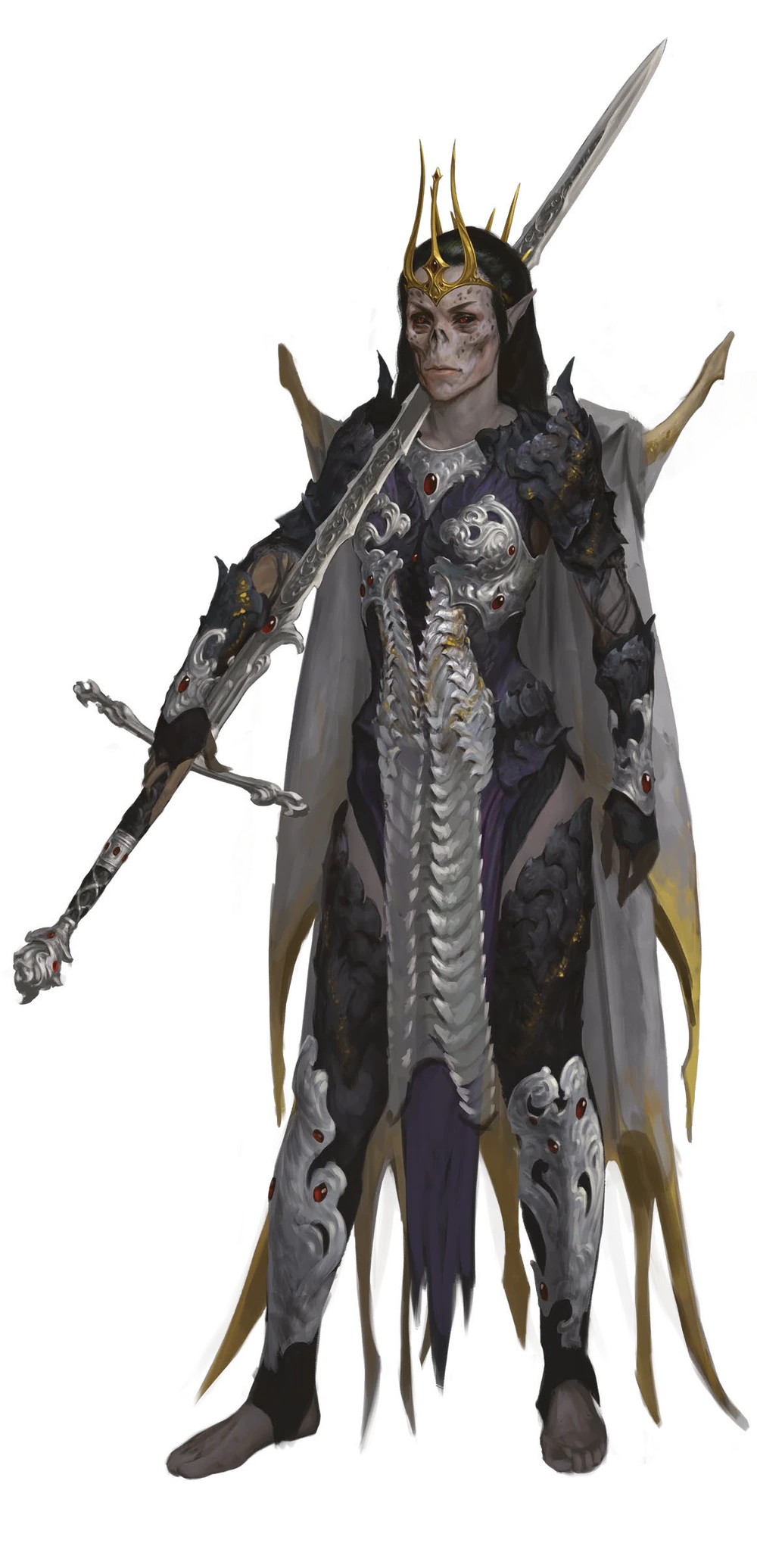
Vlaakith the Lich-Queen
Medium Undead, Chaotic Evil
- Armor Class 18 (natural armor)
- Hit Points 180 (24d8 + 72)
- Speed 30 ft.
STR DEX CON INT WIS CHA 16 (+3) 22 (+6) 16 (+3) 30 (+10) 16 (+3) 25 (+7)
- Saving Throws Dex +13, Int +17, Wis +10
- Skills Arcana +17, History +17, Insight +10, Perception +10, Stealth +13
- Damage Resistances cold, lightning, necrotic
- Damage Immunities poison; bludgeoning, piercing, and slashing from nonmagical attacks
- Condition Immunities charmed, exhaustion, frightened, paralyzed, poisoned
- Senses truesight 120 ft., passive Perception 20
- Languages Abyssal, Celestial, Common, Draconic, Gith
Fear Aura. Any creature hostile to Vlaakith that starts its turn within 20 feet of her must make a DC 22 Wisdom saving throw, unless she is incapacitated. On a successful save, the creature is immune to Vlaakith’s Fear Aura for the next 24 hours; otherwise, the creature is frightened until the start of its next turn.
Legendary Resistance (3/Day). If Vlaakith fails a saving throw, she can choose to succeed instead.
Rejuvenation. If Vlaakith is destroyed, she gains a new body in 1d10 days, regaining all her hit points and becoming active again. Her new body appears within 5 feet of her phylactery.
Turn Resistance. Vlaakith has advantage on saving throws against any effect that turns undead.
Actions
Multiattack. Vlaakith makes two silver greatsword attacks.
Silver Greatsword. Melee Weapon Attack: +13 to hit, reach 5 ft., one target. Hit: 13 (2d6 + 6) slashing damage plus 10 (3d6) psychic damage. This is a magic weapon attack. On a critical hit against a target in an astral body (as with the astral projection spell), Vlaakith can cut the silvery cord that tethers the target to its material body, instead of dealing damage.
Paralyzing Touch. Melee Spell Attack: +17 to hit, reach 5 ft., one creature. Hit: 10 (3d6) cold damage. The target must succeed on a DC 18 Constitution saving throw or be paralyzed for 1 minute. The target can repeat the saving throw at the end of each of its turns, ending the effect on itself on a success.
Ray of Frost. Ranged Spell Attack. +17 to hit, range 60 ft., one creature. Hit: 16 (4d8) cold damage, and the target's speed is reduced by 10 feet until the start of Vlaakith's next turn.
Spellcasting (Psionics). Vlaakith casts one of the following spells, requiring no spell components, using Intelligence as the spellcasting ability (spell save DC 25):
- At will: mage hand (the hand is invisible)
- 3/day each: jump, nondetection (self only), tongues
- 1/day each: plane shift, telekinesis
Spellcasting. Vlaakith casts one of the following spells, using Intelligence as the spellcasting ability (spell save DC 25):
- At will: acid splash, minor illusion, prestidigitation
- 4/day: detect magic, magic missile, unseen servant
- 3/day: detect thoughts, enhance ability, invisibility, mirror image, web
- 3/day: animate dead, dispel magic, haste, lightning bolt, magic circle
- 3/day: blight
- 3/day: hold monster, scrying, wall of force
- 2/day: disintegrate, eyebite, globe of invulnerability
- 2/day: finger of death
- 1/day: dominate monster, power word stun
- 1/day: power word kill, wish
Bonus Actions
Dancing Silver Greatsword. Vlaakith tosses her silver greatsword into the air, where it makes two attacks against a creature of her choice that she can see within 30 feet of her. Each round on her turn, she can use a bonus action to have the sword make two attacks on a creature she can see within 30 feet of her, or to call the sword back to her hands.
Misty Step (3/day). Vlaakith teleports up to 30 feet to an unoccupied space that she can see.
Reactions
Counterspell (3/day). Vlaakith interrupts a creature she can see that is casting a spell with verbal, somatic, or material components. If the spell is 4th level or lower, it fails and has no effect. If the spell is 5th level or higher, Vlaakith makes an Intelligence check (DC 10 + the spell's level). On a success, the spell fails and has no effect.
Shield (4/day). Until the start of her next turn, Vlaakith has a +5 bonus to AC, including against the triggering attack, and she takes no damage from magic missile.
Legendary Actions
Vlaakith can take 3 legendary actions, choosing from the options below. Only one legendary action option can be used at a time and only at the end of another creature’s turn. Vlaakith regains spent legendary actions at the start of her turn.
- Silver Greatsword. Vlaakith makes a silver greatsword attack, whether the weapon is in hand or dancing.
- Paralyzing Touch (Costs 2 Actions). Vlaakith uses her Paralyzing Touch.
- Frightening Gaze (Costs 2 Actions). Vlaakith fixes her gaze on one creature she can see within 10 feet of her. The target must succeed on a DC 22 Wisdom saving throw against this magic or become frightened for 1 minute. The frightened target can repeat the saving throw at the end of each of its turns, ending the effect on itself on a success. If a target’s saving throw is successful or the effect ends for it, the target is immune to Vlaakith’s gaze for the next 24 hours.
The Deck of Decks
This section features the 3rd-party product, the Deck of Decks, which is an actual deck of
54 cards (standard poker-sized cards, each with 3 images) that serves a total of five purposes:
- First and foremost, it is a standard 54-card deck of PLAYING CARDS that can be used
for any non-D&D card game requiring up to 54 cards. - It is a deck of 5e compatible TAROKKA (TAROT) CARDS that can be used in an TTRPG
game. This is the center image on all 54 cards. - It is a DECK OF MANY THINGS. This includes 22 cards (the two jokers are shared with
the deck of illusions) that can be pulled out into their own deck for game play. Full deck vs.
standard deck and cards with enmity are also identified. These are cards noted with a red
dragon in the top left corner. - It is a DECK OF ILLUSIONS. This includes 34 cards (including the two jokers that are
shared with the deck of many things) that can be pulled into their own deck for game play.
These are cards noted with an eye image in the top left corner. - It is a DECK OF COMMONS. This includes 52 cards consisting of a variety of common
magic items that can be used for a variety of purposes including random loot generation.
These are cards with a large bluish banner in the bottom right corner.