Table Of Contents
-
• Overview
-
• 3. Getting Started
-
○ 3.2 Setting Boundaries
-
○ 4.0 Building Your Enemies
-
• 5.0 Bosses & Mechanics
-
• 6. Legendary Actions
-
○ 7.0 Combat
-
○ 8.0 Rolls and Modifiers
-
• 9.0 Specialty Items
-
○ 10.0 Lore Savvy:
-
○ 11.0.Effective DM Tips:
- ○ 11.0.1 There's no "I" in Roleplay:
- ○ 11.0.2 TALK TO EACH OTHER
- ○ 11.0.3 Resolving Conflict:
- ○ 11.0.4 Working with your players:
- ○ 11.0.5 Getting your session checked:
- ○ 11.0.6 Gardening with Wallflowers:
- ○ 11.0.7 Spotlighting & Mary Sues:
- ○ 11.0.8 Metagaming:
- ○ 11.0.9 Don't treat your players bad idk:
-
○ 12.0 Storycrafter's Guide
Copyright Information & General Notice:
This book or parts thereof may not be reproduced in any form, stored in any retrieval system, or transmitted in any form by any means -- electronic, mechanical, photocopy, recording, or otherwise -- without prior written permission of the publisher, except as provided by the United States of America copyright law. For permission requests, write to the publisher with the following heading: "Attention: Permissions Coordinator" at the following points of contact --
- Business Email: GalaxyWritersBiz@rocketmail.com
- Post: Galaxy Writing Publishers, P.O Box 7894, West Bank RD, Harbor Heights KT 68201
- Phone: 719-266-2837
System Patch List
- Core System (1.0) [Released 09/07/2018]
- Shattering the Chains (2.0) [Released 10/21/2018]
- Dark Moon (2.5) [Released 01/09/2019]
- Shields and Shadows (2.8) [Released 03/14/2019]
- Strength Together (3.0) [Released 05/01/2019]
- A New Sun (4.0) [Released 09/21/2019]
- New Horizons (5.0) [Released 11/24/2019]
- Final Encounters (6.0) [Released 07/09/2020]
- Edge of Refulgence (6.5) [Released 09/26/2020]
- A Moment's Reprieve (6.8) [Released 02/28/2021]
- Expanding Sights (7.0) [Released 12/21/2021]
- In the Balance (7.5) [07/13/2023]
- White Stone, Black Feathers (8.0) [04/04/2024]
- Infinite Horizons (8.1) [06/22/2025]
- Bygone Serenity (9.0) [12/07/2025]
Overview~
So. You want to start actually writing up epic events and interesting storylines. Best of luck to you, friend. Depending on how much you've changed the COMET base system, this guide may be of some scant use to you!
However, we wanted to clarify some things to the DMs of the world so that they can run the system easier.
"Okay but why was this not just put in the base guide instead so everybody could look at it, and not just DMs?"
To be perfectly honest, it was so that newer RPers who may be involved with an FC using this system don't get too overloaded. If a situation ever comes up that someone might need explaining, this PDF is here to help. With that said, there are only THREE Public versions of our system -- The Player's Handbook, The Bestiary, and the DM's Guide.
A Warning Before You Start:
Before you decide you want to become a DM, know that you are, essentially, your comrade's referee, chaperone, and parent once you take the mantle up, and I wish I was joking when I wrote this. Regardless of whether you are running a Free Company or not, this will happen. Embrace and accept it, and you're already at LEAST a third of the way done with your life of agony.
Writing things for other people (and yourself) is a tedious, tiresome...other word that starts with "T", task. It is time-consuming and takes a significant amount of effort to put out a good "product" at the end. If you do it WELL, people will be speaking about your adventures to others for ages to come. Do it poorly, and you'll likely end up making some people upset, or far, far worse...bored.
Why You Should DM:
-
You get to tell a story in a collaborative manner with other roleplay-loving people
-
You get to create fun and interesting puzzles, situations, and character development opportunities for other people
-
You get to worldbuild and expand on existing lore
-
You want to give people an experience that they can remember fondly
Why You Should NOT DM:
-
You want an audience for your personal character story
-
You want to kill, maim, control, or nearly kill other people’s characters, or otherwise put them in uncomfortable situations or events
-
You feel an obligation, responsibility, or are otherwise just fulfilling a request
-
You want to control the narrative and aren't willing to bend or deviate even a LITTLE from what you've planned
There are two types of RP events in this system – LEVEQUESTS and CAMPAIGNS.
A Levequest is a one-off adventure. Sometimes one Levequest completed will unlock a second one, but these are typically considered smaller events.
An overall story made up of one or more Levequests is called a "Campaign" With COMET's system, we typically do 3 or 4 per "Campaign" to make sure the story doesn't drag out too terribly long, but what you do is entirely up to you!
Getting Started:
Have A Plan:
- What do you want to happen for this RP Event?
- What is the goal?
- What circumstances bring your fellow RPers into participating?
- Where does this Event take place?
- What do the RPers gain by participating?
- Are there enemies they must face? If so, what are they?
- What challenges will your fellow RPers face during this Event?
- Are there lasting consequences for this event? How might things that are said, the mentalities of enemies or challenges, or things that happen affect those who've participated?
- What kind of characters might be attending this event? How might they react if they're stimulated in some way?
You need to tackle all of these elements going in, and plan them accordingly. A "good" DM is always flexible, but every DM should always have at least a floor plan for what they want to happen during their Event. Some of these things might not apply, and that's okay! Just keep them in consideration when you're planning your Event.
Time Keeps On Ticking...
Sessions should not run more than 2-3 hours at a time. If the story you want to tell lasts longer than that, please consider splitting your story into multiple sessions. This allows for more people to join at a later date and helps avoid burnout on both your end and that of your players.
SETTING BOUNDARIES
Being a DM is a stressful duty to take on, and many players, even those who are DMs themselves, can forget this. Implementing boundaries is important, not just for your players, but for yourself as a DM.
ASK YOURSELF:
- What am I willing to tolerate?
- What things am I trying to avoid?
- What are some of my pet peeves?
- Are there certain ways I'd prefer to do things to make them easier for me?
- What actions will I take if I encounter any of these things?
It is critical to communicate your boundaries with your players so that everybody knows what to make note of while they're roleplaying. Respecting the limitations and expectations of your group is one of the best ways to ensure that everybody enjoys themselves and is comfortable.
One of the easiest ways to communicate what boundaries you would like as a DM is through the use of Table Rules.
Table Rules:
The player’s guide contains all the rules you need to play. However, you may prefer implementing personal rules for how your sessions are handled. Be prepared to provide your players with a copy or run-down of your table rules before the start of the Leve, for example:
-
“I’d like that we keep the voice chat channel quiet unless you have a rules question or have an important thing to let people know.”
-
“I will be rolling some of my rolls in secret and whispering the results to you.”
-
“I’m considering everything you say to be in-character unless you specify otherwise, beforehand.”
Constructing your table rules in a way that is direct and polite can severely limit the amount of stress and annoyance you can accumulate as a DM.
Joyful Song Says:
Take BREAKS. Nobody says you can't. Even Yoshida himself says to take breaks from Final Fantasy XIV, so roleplaying should be no different! Make some time for yourself, touch some grass, hug your pets, watch some TV, and cook yourself a meal. If you keep pushing yourself to a breaking point, you'll end up resenting not only yourself, but your players and even RPing as a whole. Please, please, please take breaks. You'll regret it if you don't. Take it from someone who's been doing this 10 years.
Building Your Enemies:
Amber Lemonade Hamster
Some enemies might have variants to them. A Jellyfish might have a slightly different appearance to a Sea Stinger, but they are both of the Aurellia type.
- A good rule of thumb is if they share the same model, they're probably a variant.
- Enemy Tier: How strong are they? This can vary from type to type, so don't be afraid to guess.
- Base HP: How many Hit Points the monster has without taking into account their END rating. Different types of monsters and enemies will have different base HP ratings due to a number of factors, like their race or background--especially if they're special kinds of foes.
- Element: Their element. Take into consideration that ASTRAL Aether is more passive whereas UMBRAL is more active.
- Weakness: If an enemy has a weakness, put it here.
- Class: (If applicable). Spoken enemies (humanoids) will usually have at least one or two classes--three if the enemy is particularly adept or powerful.
Does this enemy have additional stat tiers? Maybe their STRENGTH is only T1 but their MP is T7? Keep these things in mind when you design opponents for your players.
IMPORTANT NOTE: If you give your enemies (even bosses) additional stat tiers that aren't just the same Tier as your enemy's Tier (as listed above) these ADDITIONAL STAT TIERS will (as the name suggests) ADD ON to what is there by default!
- Immunities: Is this monster immune to anything?
- Passive: Any special effects?
- Status Effects: (Can it inflict other status effects?)
- Any other additional information, like language comprehension, or other stuff, can get added down here.
Abilities:
Attack Name: -- Type of Ability: (Physical, Magical) Describe it! What does it do?
Dual Cobra Wristlock: Melee Weapon Attack: Summons two (2) medium-sized snakes to grab onto people's hands, inflicting Poison and Bind.
Don't forget to be as descriptive on attacks as possible. (Within reason.) Players need as much information as they can to understand the whole situation!
Enemies will typically work in the same fashion as players. If a player gets +100 to a roll because their STR is T4, the same will be said of any regular enemy with T4 STR. The same is said of all of their stats. Please make note, this is for REGULAR ENEMIES, and does not apply to BOSSES. Due to the unique way in which bosses are fought, their stats and rolls are slightly different at their base, to account for the multiple players who may wish to fight them.
[Designer's Note: I would beef up these stats a considerable amount for my own RP groups, personally, but I tend to get upwards of 10 people in events. Like everything else in the COMET system, adjust accordingly!]
Alternatively, you can use the Bestiary to help make things easier on you.
Quick Joy Tip:
Most players will deal around 5-10 damage per round of combat, depending on the job they play and the roll of the dice. (So about 25-50 damage in a standard 5-round combat encounter.) Account for this when building your encounters against players attending your party.
Enemy Health Chart:
Enemy END to HP conversion chart
| END Rating | Additional HP Added |
|---|---|
| 0 | 0 HP |
| 1 | 15 HP |
| 2 | 30 HP |
| 3 | 45 HP |
| 4 | 60 HP |
| 5 | 75 HP |
Note: Normal enemies will NEVER exceed +75 HP from their END bonuses. For bosses, there is a special calculation to better adjust fights for the number of players fighting them.
So let's see an example here using the good old Aldgoat.
Aldgoat
Elder Longhorn, Loaghthan, Billygoat, Billy, Nanny, Nannygoat
- Enemy Tier: T0-T4
- Hit Points 30 + END
- Element: Umbral Earth / Umbral Ice (Loagthan)
- Weakness: N/A
END STR MP Hit Class INT CHA T0-T4 T0-T4 T0 +200 T1 T1
- Condition Immunities: N/A
- Status Effects: Stun, Paralyze
Actions
Headbutt: [Physical] -- Deals damage, inflicts stun. [5 turn CD]
Stampede: [Physical] --Takes two (2) turns to charge and requires a group of antelope-type enemies (more than 5). Inflicts paralyzes to party for three (3) turns. [3 turn CD]
As you can see, an Aldgoat has a base HP of 30 HP. If an Aldgoat enemy had an END rating of 0, it would have only 30HP.
However, an Aldgoat with T4 END would have 30HP + the 60HP from its END which would equal a total of 90HP.
These bonuses DO NOT stack.
Hit classes:
A creature's "Hit Class" tells you how much you need to roll to hit an enemy. More agile creatures, beings with thick armor, or just very tanky foes who can take a lot of hits, will have higher Hit Classes than enemies who are larger, or enemies who are slow, or weak.
A good comparison is to look at a Rodent enemy, who is very small and agile but very fragile, to a Megalocrab who is very tanky due to its natural shell, but is also slow and large.
Enemy Clusters:
Sometimes you will want clusters (or groups) of enemies for your players to fight. However, you only have so many markers in-game to tell your players what is where! Therefore, you can make the fights easier on everybody by putting your enemies into "clusters".
All you have to do to turn a group of enemies into a "cluster" is to take the HP of the enemy, and multiply it by however many enemies are in that "cluster".
For Example:
You use the "A" marker to represent 1 cluster of 5 Banshee-type enemies.
5 * 8 = 40HP
So every 8 HP, 1 Banshee-type enemy is destroyed out of the cluster. When it reaches 0/40, all enemies in the cluster are destroyed.
Enemy Hordes:
A horde is a lot like a cluster, with the difference being that a horde is a massive group of enemies that share a Health Pool, Hit Class, and Turn Order. A good example would be a large army of undead, or a fleet of airships.
There are a number of ways to approach hordes, but a good rule of thumb is to consider the action economy of the fight you intend to have this horde participate in.
[Designer's Note: Because of the way fights are designed in the COMET system, it's recommended that hordes be used sparingly, as they can lose their effect after too many uses. Save them for big, epic encounters!]
Bosses and how they work:
A Boss enemy should have the following ...
A different set of HP than normal enemies (these might include "parts", "adds", or "armor" that might first need to be destroyed. If this doesn't apply, that's okay!)
Is at LEAST T5 or higher.
At LEAST 200 HP base.
No penalty to their AoEs or Status Effects
T6 or above in at least TWO stats.
At least T5 or above in General.
Access to LEGENDARY ACTIONS and LEGENDARY ACTION POINTS
Attacks at LEAST twice in a single turn.
LEGENDARY ACTIONS and LEGENDARY ACTION POINTS will be further elaborated upon in an upcoming section.
A Quick Note:
Because bosses typically face larger parties of players, they have been given several immunities and status resistances by default, to make running them easier. While you can edit these at your own will please keep in mind that this is risking your encounter being subjected to constant status effect lockdown (depending on the jobs of the players you're facing) which may make running it less fun for you as a DM.
Tier 6, 7, 8 & 9 Enemies are granted the following RESISTANCES:
Silence, Paralyze, Addle, Confusion, Bind, Blind last ONE ROUND instead of THREE. You may only be effected by Daze ONCE per combat.
These bosses are IMMUNE to: Fear, Sleep, Break, Frenzy
ADDITIONALLY, if an entity is aligned with a specific element, attacks dealing said element will convert directly into HP. (IE: hitting Ifrit with fire ain't gonna do shit but make him healthy and also mad. I'm aware that's not how that works in-game.)
Boss Power Tiers:
Tier 6:
Not quite on a godlike scale, but definitely nothing to scoff at.
Stats and foes of this tier gain +300 to their rolls and +3 to damage.
Tier 7:
Fighting these will definitely take a team of 8 players.
Stats and foes of this tier gain +450 to their rolls and +4 to damage.
Tier 8:
A Campaign Master would have to be pretty secure in their party (or just want to mess with them) to even consider unleashing something like this on their party.
Stats and foes of this tier gain +600 to all their rolls and +4 to damage.
Tier 9:
Pretty impossible to kill with the standard 8 man party. You're incredibly unlikely to run into any of these enemies willy-nilly.
Stats and foes of this tier gain +700 to all their rolls and +5 to damage.
Tier 10:
The absolute height of power. If you're encountering a Tier 10, you may want to just back away. There are higher tiers than 10, but it is next to impossible to run into these types of beings (or stronger) without drawing the attention of a certain...light-based Warrior and his meddlesome friends.
Stats and foes of this tier gain +800 to all their rolls and +5 to damage. They are also IMMUNE to all status effects, EXCEPT the following -- Bleed, Poison, & Elemental Debuffs.
Calculating Boss HP:
Calculating the HP of Boss enemies is a little different than normal monsters, because usually, you have far more people fighting them than you do a cluster of normal enemies. While all enemies have a base HP of at LEAST 20, sometimes this will need to be adjusted to however many players are fighting against the enemy.
RECOMMENDATION: For every player against the boss ADD +30 HP to the Boss' HP pool.
If a player must leave in the middle of a session, allow them to attack (regardless of whether or not its their turn.) This attack will deal +30 damage, and hits automatically. The player is immediately ejected from the battle.
How do I know what enemy is in which tier?
The following chart gives a pretty good idea of which enemies can be classified in which level of strength.
[Designer's Note: Don't be shy about adding additional HP or adjusting aspects of the tier system if you have a lot of people showing up to an event. (Or taking it away if there's fewer people than expected.) The numbers used on here are typically balanced for fights where there are 4-8 players involved in, so take them with a grain of salt and adjust where you need to. Because the damage cap in the COMET system is 15 per round maximum, giving the boss extra HP to account for that damage is what most DM's for COMET use.]
Moreover, this chart is there to give a guide as to what most common levels of strength can potentially be expected of creatures of certain origins. (AKA, I went and made boss sheets for every single significant enemy I could think of from the MSQ and then averaged out their power levels.) For example, OMEGA classifies as an "Otherworldly" entity, due to its point of origin, but is most certainly one of the more powerful beings from out of Etheryis that we have encountered. (Thus far, as written in Endwalker 2024.) There are also enemies who may fall into multiple categories -- such as Midgardsormr who is both "Otherworldly" and a Dragon..
If your Allagan Creation Boss is slightly more powerful than T8 for mathmatical reasons, it shouldn't be a point of too much worry in short.
That being said...I don't personally recommend throwing around enemies that are incredibly high tier all the time, otherwise they lose their effect and potency to put some minor nervousness and excitement into your players. It's important to have a balance between your super difficult encounters and your sort-of-easy encounters, otherwise you'll end up with a condition I call "Combat Numbness" where players can get so used to fighting incredibly powerful opponents that you have to keep one-upping yourself over and over again. (And that can lead to you burning out over time.)
✬ Please note that in this chart "player Seekers" refers to players overall. (As "Seeker" refers to an employed member of COMET.)
✹ A "Master" refers to someone who has mastery over their particular art of war or magic.
✫ An "Auspice" is noting the Four Lords, and not specifically ALL auspice. Most of them are very weak.
✤ "Blue Collar Workers" is reference to Miners and other people who perform more physical aspects of labor. They would be, traditionally, better suited to encountering trouble than your average merchant or festival-goer, for example.
❈ We are aware not every Imperial is at the same level of strength. (Zenos, for example, would certainly not be T6.)
[CAUTION: FFXIV MAIN STORY QUEST SPOILERS from A REALM REBORN → ENDWALKER BELOW! YOU HAVE BEEN WARNED!]
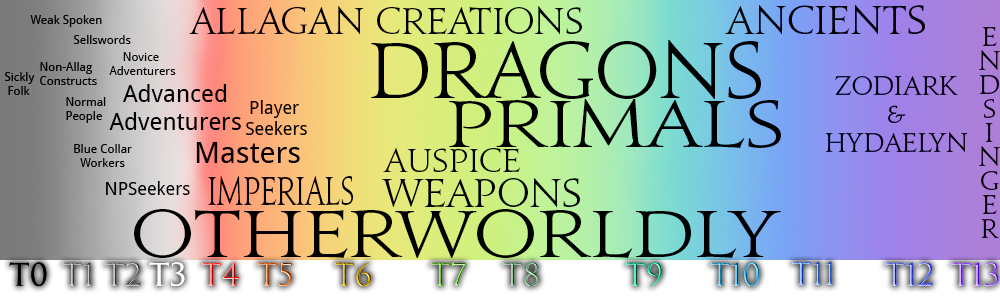
[Designer's Note: This does NOT mean that your enemy HAS to be a certain level of strength in order to be a certain tier. This chart is a GUIDELINE, not a law. For example, while logically there is no reason for a creation of an ancient to be a higher tier level than the ancient themselves, the Pandemonium questlines and the final boss of the Endwalker MSQ are a fantastic example of things that should be a lower tier (and therefore less difficult to deal with) are absolutely DEFINITELY not.]
(This message was brought to you by Joyful Song's on-content Phoinix PTSD.)
Legendary Actions & Legendary Action Points:
Every Boss in this bestiary has abilities that are different than the normal enemies encountered. Where standard foes can only attack during their own turn, Bosses can use Legendary Actions to do things DIRECTLY after a player's turn.
Legendary Actions take Legendary Action Points in order to perform--each boss has a set number of total Legendary Action Points they can use, and each Legendary Action costs a certain amount of Legendary Action Points.
After the end of each turn order (when the first person who attacked can attack again,) a Boss will gain +1 Legendary Action Point if they have used one. Bosses cannot exceed their total Legendary Action Point pool unless otherwise specified.
For example:
Cloud, Bartz, and Leon are fighting a King Slime.
Turn Order: Cloud, Bartz, Leon, King Slime.
King Slime has 4 Legendary Action Points.
Cloud attacks.
Bartz attacks.
It is now Leon's turn.
King Slime uses "Mega Slime" -- A Legendary Action that costs it 2 Legendary Action Points. (4-2=2)
Cloud, Bartz, and Leon take damage.
Leon attacks.
King Slime attacks.
The turn order has returned to Cloud. King Slime gains back +1 Legendary Action Points. (2+1=3)
The Purpose of Legendary Actions:
Legendary Actions provide Bosses with the ability to better manage what is called "Action Economy"--essentially, whoever has the most turns is most likely to prevail. By allowing Bosses to have more actions at random times, players don't know what to expect out of enemies with Boss status, therefore making the encounters more exciting and dangerous.
Combat:
Starting Combat
Each combat begins with an initiative roll. Write these outcomes down, with the numbers if possible. If you have other enemies show up partway through the fight or if players don’t remember the order, you have a handy reference.
Actions In Combat:
Players get to take one action on their turn, and have the option to take one immediate action outside of their turn if the situation and their abilities call for it. Ensure you enforce the one action rule. The action can be an ability, a stance activation, a movement, or a stat roll (like charisma!). Talking is generally a free action, but warn your players that if they want to say more than a sentence or two, it may necessitate taking their turn.
Remember, players have the following options in combat:
"What Can I Do On My Turn?"
| Option | Description |
|---|---|
| Attack | Try and hit an enemy with an ability or an attack. |
| Defend | (T1 DEF/EVA Only) Take a turn and defend yourself against incoming damage, giving yourself +50 to DEF/EVA until your next turn. |
| Heal | Try and recover the HP of yourself or your allies. |
| Move | Move around the battlefield up to a distance = to 2 IRL seconds. |
| Scan | INV roll for information. Max 3 times per use per enemy. |
| Flee | Run from the fight. Enemies may strike at you if you decide to run! |
Every player also has...
- 1 Standard Action (StA)
- 1 Swift Action (SwA)
- 1 Reaction (RA)
- 1 Passive Action (PA)
- 1 Movement Action (MA)
Make a note of these as you're balancing your combat encounters to make sure you're not being caught off-guard!
Limit Breaks:
Limit breaks are granted to any player who naturally rolls a 950 or above. Players are allowed to save Limit Breaks during the same session and share them, and use up to three at once. To use them together, each player who owns the limit break must provide verbal or written consent.
The CHEAT SHEET is your FRIEND!
From tracking your player's HP and HC, to being able to calculate damage for you, the Cheat Sheet has just about everything you need in order to DM in one handy little segment. We recommend exploring the Cheat Sheet thoroughly in order to get familiar with what is where. While not EVERYTHING is on the sheet, it does cover a vast amount of the system overall.
Rolls and Modifiers:
As a general rule, use this handy chart to determine how difficult a roll will be to make.
Roll Chart
| Roll Threshold | Difficulty |
|---|---|
| 001-100 | Very Easy |
| 101-200 | Easy |
| 201-300 | Average |
| 301-400 | Tough |
| 401-500 | Difficult |
| 501-600 | Challenging |
| 601-700 | Formidable |
| 701-800 | Heroic |
| 801-900 | Nigh Impossible |
| 901+ | Godlike |
The DM's Best Friend:
If you would like to nudge your players in a direction, consider giving them a Favorable or Unfavorable Circumstance. This is a +100 or -100 to a roll that they only get granted from the DM that might help or hinder them along the way. Maybe they gave a good description of the roll they’re about to make. Maybe they’re dangling from a cliff fifty feet above the ocean. Feel free to modify this as necessary, but if you get into bigger numbers, be prepared to answer why you’re using this. You don’t want to make your players think you’re favoring anyone.
Rolls as a Defense:
Not all rolls are determined by the player. There are a good spread of abilities, and they can be used for many situations. Consider having players roll Dexterity for a reflexive leap back, or Endurance to withstand a toxic poison cloud. Reward players for having different stat spreads.
Roll Failure:
Not every missed roll spells the end of times. Sometimes a character just doesn’t succeed. Instead of telling them “It didn’t work,” consider making it an opportunity for development. The Difficulty to kick down the door may have been 400, and your player rolled a 350. Instead of bouncing off the door until someone else rolls better, maybe one of the hinges cracks, or they slip and hit the handle and it breaks off. Maybe the character pulls a muscle in their ankle. Always consider one of these outcomes even if it’s not the most favorable. The characters might pick up and pocket that door handle for later, only to find someone willing to give them information for that nice piece of iron they can melt down.
Conclusion and Rewards
When the players finish their session, they get to update their sheets. First they get Commendations, which are used to purchase specialty items and other perks. All players get two per session, and you have the option to award one person an additional commendation. Consider all facets of the game before you award this. Do you want to award it to someone who ended up in a humorous situation? Do you want to give it to the player with the best killshot description? Do you want to give it to the person who was the best team player? Ultimately it’s your choice, but it’s also your responsibility to make that choice fair.
Your players will mentally reflect on your session once it’s over. Did they have fun? Did they develop their character any? Was it beneficial for them to come along? Try to give your players as many reasons as you can to come back and play in another session you run, or to encourage them to join someone else’s session later!
What is a "Specialty Item?"
Specialty Items are granted to players for achieving unique circumstances in an FC RP event or levequest, or can be particularly rare drops in either situation. Unlike items made by CREATION, they have no finite usage, and do not have to be recharged. Many of these items protect against status effects and have other unique abilities. Think of these as Legendary Drops. They could be found by a lucky roll, or at the end of a campaign!
"When should I give out these items?"
That's honestly up to you as a DM! I (Joy) usually give them out at the ends of campaigns– although COMET (the Free Company that designed this system) typically puts all of these items into a vault that is opened only in emergency situations. Essentially, these items are whatever kind of thing you might want to give out to advance plots, give advantages (or disadvantages) to players, or make things interesting! These items are completely free range, so it's up to you as a DM to decide how you want to use them, and what you want them to do! Just make sure you don't break your own game!
Specialty Items are granted to players via the DM.If they feel like the levequest isn’t worthy of a Specialty Item being earned, they can abstain from allowing it to “drop” so to speak.
An Example of a Specialty Item:
Joyful Song's Sharlayan Tome-- Litoreincola Papilionemorphus:
[[A Made-Up Item ]]
"Joy's prized Sharlayan Tome. A gift to her from her very dearest and oldest of friends. Hums with a magical power you don't yet understand."
[[DM NOTE: Unlocks the Arithmatician Class]]
Example #2 of a Specialty Item:
Shard of the Mhachi Shadow Orb:
[[ From the COMET "The Dark Soul" Campaign -- Completed 8/12/2018 ]]
During the War of the Magi, Nym, Mhach, and Amdapor were fierce and bitter opponents--when the Sixth Calamity befell the world however, the three sides were forced to work together...or suffer in death. A small collection of Mhachi mages, led by High Priestess Tallia and her followers, sacrificed their mortal forms, occupying an ancient Mhachi relic, which kept them from vanishing into the lifestream...and there, they waited for their chance to strike back against Amdapor once and for all. Thousands of years passed, and it was COMET who accidentally freed Tallia and her allies...for when the orb was touched by Agine, it exploded--sending shards of the crystal orb...and the souls of the Mhachi Mages...flying everywhere...including the living bodies of the Seekers themselves.
[[DM NOTE: This object allows the user to temporarily place the shard within their own body, and for the next five (5) turns, gain +200 to MP. However, if this person rolls below 100 on ANY roll while the shard is in place...they will become possessed.]]
Achievement Unlocked: Lore Savvy
Like many people, you don't quite have the time to be absolutely and utterly absorbed in every aspect of the game. You've got a life outside of it, just like everybody else, after all! With that said, there are plenty of resources to get a good grasp on things in the game that aren't quite pronounced without doing a little digging.
Yes, there are tools like the Lorebooks, which are large, hardcover books filled with all sorts of details (some that aren't available in the game,)--however these cost a good chunk of cash, and getting physical copies is NOT an easy task. That being said, the internet is AMAZING at consolidating information, and COMET is proud to present our library collection.
"Alright but why should I care about the Lore?"
Well, like all universes, the world of Final Fantasy XIV has "rules" that everything adheres to--things that make sense in the context of the world the game takes place in. Normally, most people are of the mindset that, as long as what other RPers are doing makes sense in the context of the game, it's not a big deal. Others feel that people should follow the lore of the game to a T, and others still will tell you people should be able to do whatever they want.
While I personally fall into that first segment, I'm not here to tell you what to do. I've seen plenty of people get ripped to shreds over silly lore holes--and some blatantly wrong information being spouted off, too.
The Lore Library is just here to use--think of it as a useful tool to 'check your work' so to speak if you're one of those people who cares about being lore-accurate. Regardless if you are or not, these links might be helpful to you in building your own events, and who knows, you might learn something new!
The Heavensward Lorebook (2016)
A full PDF of the 2016 Lorebook for Heavensward. Originally released as part of FanFest 2016.
Lorefinder
Looking for a specific piece of lore in-game to back up your findings or theories? Just use this nifty link here.
Racial Naming Conventions
Having some trouble naming NPCs or characters to be more believable? Look no further!
MIRKE's Menagerie
MIRKE, well-known resident lore guru, has both a Tumblr page and a series of RPC wiki forum posts detailing everything from racial lore, to Geomancy, to everything in-between.
A List of Etherysian Minerals:
Look at all these rocks, metals, minerals, and crystals!
A List of Etherysian Botanicals:
A comprehensive guide to all things plant!
A List of Etherysian Fauna:
(Isn't up yet! ...sorry. >.<)
LEARN HOW TO SPEAK DRAGON
You too can learn the elaborate and honestly...pretty complicated language of the ancient dragons! Who needs the Echo anyway?
Before the Calamity
Here are a series of maps and other information bits chronicling what things were like before and after the Calamity. Useful for those of you who came to Eorzea or lived in Eorzea before Bahamut went and blew everything up.
Effective GM Tips
There's no "I" in "Roleplay"
This is not a competitive sport. Player agency is very important to the player-- this is a character they play for hundreds of hours at a time, and they have (very graciously) accepted to allow Things to Happen They May Not Expect. This puts you in a precarious position, as many people are looking to develop their characters through group roleplay. Try to create situations that help players while giving them an appropriate challenge or new angle to consider, rather than fight-or-flight ‘Is my DM going to kill me’ situations.
Talk To Each Other!
Communication is important! If your player approaches you with an idea, be open to it! On the other hand, if your player indicates they’re uncomfortable with a situation, always be ready with a backup plan. This does not extend to letting a player get their way-- there are some times that rules are rules. However, if there is a disagreement that can be resolved without much fuss, try to resolve it to the player’s benefit as often as possible.
Resolving Conflict:
Conflict is going to occur. There will be a rules question or inconsistency. We are human and we all make mistakes. In these situations, we refer to the communication tip-- if something can be resolved with little impact to the story, it’s often the best choice to resolve it to the player’s benefit. “Yeah, okay, you make the jump across the river and scrape your ankle” is a much easier solution than stopping the game to determine which of the six bonuses your player is getting apply to the situation.
If something comes up that is not easily resolvable but does not result in character death, it is advised to tell your players “Hey, I’d like to resolve this situation X way right now, and then when the session is over, (person) and I will determine how severe the consequences are.” This ensures gameplay continues at a smooth pace and does not derail the session.
If a conflict arises that would result in character death and there is no easy way to resolve the situation, you may have to pause and resolve it. This should be the only time lengthy pauses occur, but they should not be common. At this point it may be a good idea to get a secondary, unbiased opinion.
Addendum: Working With Your Players
When the players cannot come to a decision between themselves, you will have to arbitrate or impose a solution. There is also a chance players will be upset with each other for even OOC reasons and may harass or snap at each other. It is up to you in this case to step in and attempt to help resolve these conflicts. Make it clear as nicely as you can that you can’t let anyone’s argument ruin the game for the other players and that you won’t tolerate real-world hard feelings affect how characters in your session react to each other. If a player gets angry about a rule that is placed against them, be firm but kind in telling them that you try your best to be fair and that you would prefer to handle the frustrations outside of the game. Ultimately, remind the players (and yourself!) that you’re here to have fun.
Getting Your Session Checked:
Before you run your game, I recommend letting another DM who isn't attending the event see your plans and notes. It’s always good to have a second pair of eyes on your creations, just to make sure you don’t miss any details. It also means someone can help you balance encounters and difficulties. This extends to items you wish to drop.
It's always good to have the perspective of other people, since a lot of the times something that seems fine to you after weeks of working on it may have a flaw you didn't originally see. The more experienced you get seeing what can work, the easier it becomes over time to identify what might not. Like everything else in life, DMing in the COMET system is matter of practice -- and even the practiced can make a mistake!
Control Narrative, NOT Players:
Do your best not to speak for players or their characters, or puppet them too much. Players enjoy having agency over their characters and their decisions, so taking those away from them may not be enjoyably if it's done too often.
NOTE: This is not to tell you NOT to do these things. Sometimes, these can be used in clever ways to give your players a feeling of helplessness, or to move the plot along... but I would generally avoid using them, or doing so VERY sparingly.
Some examples of controling player agency:
- "Bob shouts angrily at the enemy for attacking his friends!" This takes the opportunity for Bob's player to respond to the enemy...you've done it for them.
- "Steve leaps off the cliff, following his friends!" This takes away agency from Steve, who might've wanted to do something before descending.
- "Phil is furious that the Moogle called him a baby!" This puts feelings or thoughts on a character that they might not have, thus making the player feel as though their character is being rewritten. I recommend only using this one if you are 10000000% confident in your understanding of someone's character.
- "Frank succeeds in this Investigation roll and does XYZ to do it!" Again, use this one SPARINGLY. A better way to handle this is to ask the player how they accomplish a task. It'll give you time to focus on the next part of your event, allow that player to shine, and give more weight to the moment of triumph. This ALSO applies to FAILURES (though this can vary.)
Your two most powerful phrases:
YES AND helps with players keeping their autonomy (IE, doing the thing they were doing) without derailing the direction you're trying to take the story in.
For example...
- Someone gets a really good roll on a very different approach to a problem you've put in front of the players. "Yes, you succeed in XYZ AND..." This approach allows the player to feel like they contributed to the narrative and progression of the plot, without something getting too out of hand.
NO, BUT... allows for you to possibly steer players away from things that may put things wildly off kilter, without being rude about it, or your players feeling like they're being railroaded through a story. My (Joy's) advice is to come up with a middle ground where a player can still cause a little bit of chaos, without everything immediately going up in flames.
For example...
- Someone is trying to blow open a door to a fortress crawling with enemies. "No, you cannot blow open the door, BUT..." This allows you to give players a hint about how to progress in a less chaotic way. That player then feels they contributed by getting this information!
The NARRATIVE is yours.
The RESULTS are not.
Always have a goal for your leves...but know that it may not be the result that you end up with. You cannot predict where players will go, what will spark up their interest, or what the dice might end up rolling. A DM must always be flexible when coming up against the unexpected and be prepared to compromise. Don't spend so much energy trying to figure out how to make players follow the story you wrote to a T – instead, try and use the flow of the player's choices, taking them into account when you plan out your next steps. Fighting against the tide of your player's ideas and contributions to the story will only lead to friction between yourself and your group, and cause you to burn yourself out all the faster.
Rewarding the small things:
Some players will go above and beyond when it comes to action descriptions. Use your best judgment, but try to reward players for giving good descriptions of their actions. Maybe something was almost dead, and a player rolls well and describes their sword swing in a particularly inspiring way, and maybe that last point or two of health can be ignored for Coolness Points. That being said, don’t overly reward this. Encourage your players to become invested in their actions, without creating a disagreement.
They Who Hesitate Are Lost:
Keep combat flowing smoothly. Know the statblocks of the enemies you’ve created or be able to reference them quickly. Your encounters can be handled without much fuss over rule referencing and you can keep all your players actively focused and in the action this way.
Again, the Cheat Sheet will be your best friend in this situation – get familiar with it and use it to your advantage! It can calculate damage not just to your players, but you can use the charts to calculate your own as well!
SERIOUSLY, LOOK AT THE TOOLBOX:
I'm not even remotely joking, the toolbox in the DM section is packed with insanely useful stuff. Please look at it. You can just click on the giant text above this section and it'll take you right there.
Gardening with Wallflowers:
Some players are naturally shy, or may have a hard time opening up to others, but still want to participate. It may be frustrating at first to deal with them, but much like a garden, dealing with a wallflower is all about investing time and patience into a person. Try giving that person a little bit of the spotlight at a time, and see how they react. Gradually give them a little bit more at a time, so as to not overwhelm them, and you'll see them come out of their shell!
Spotlighting and Mary-Sues:
Without naming names, everyone is familiar with That Player. The one who builds their character in such a way that they can overcome “almost” any obstacle, insists they’re the best at everything they try, or generally butts in and keeps other people from participating because they would like to be the Center of Attention. Sometimes, this problem resolves itself, because the players police themselves, but other times, newer or shyer players won’t speak up, won’t have fun, and then won’t come back. It’s important to recognize when this happens.
- You may have to be the Bad Guy for a moment. Be courteous, but also just quickly tell that player, “No, you just said you were doing X, so you can’t also be doing Y. I’ll come back to you in a minute, please be patient.”
Granted, the COMET system has been designed to combat against Mary Sues (mainly with the way specialties are designed), but spotlighting is an issue pertaining to individuals, and is a little harder to deal with en masse.
The best way to combat wallflowers and spotlighters both is to split your player involvement up in your head. If you are running a session for six players (excluding yourself), each player should in theory have about ten minutes of that hour all to themselves-- not consecutively, of course, but for ten minutes of that hour, they should more or less have the spotlight.
If one of your players has been quiet for a while, it may be good to prompt them for a response- “Hey Ivy, you know this area well. What do you think?” may go a long way. Giving players a chance to show everybody more about their character will let them be more open about themselves too!
Metagaming:
It’s going to happen. Your players are going to, at some point, have information known to them that their characters don’t know. As players, they know what’s at the end of the Ridorana Lighthouse. In character, they might not. So how do you handle this? Always be ready to gently remind your players that their characters aren’t as omnipotent as they may be. When possible, encourage them to employ in-game logic to solve their problems, or have a lore-supported reason for why their characters make decisions.
To this end, try not to let players know what they have to roll to succeed, or give them too much information. Without an element of risk vs reward, it’s often less immersive for the players and less fun.
Designer Recommends...
Put your foot down gently, but firmly if someone isn't respecting your boundaries or that of other players. If that player continues to be an issue, it may be time to speak to your roleplay group about what actions to take next.
Don't treat your players bad idk...
- Lambast your players in front of each other -- speak to players about issues in private!
- Punish your players in-character for issues happening out of character
- Cross your player's boundaries unless you specifically ask them to BEFOREHAND.
- Compromise on your boundaries too often for the sake of making your players happy, or without explanation.
Joy's Final Notes:
- If a player isn't giving you the same energy that you're putting out, it's okay to be a little frustrated at them, but don't take that frustration out on them. (Or anybody else.)
- Sometimes it's okay to cut your losses and tell someone it's not working out.
- Communication is CRITICAL for running a roleplay group, and if you leave things unsaid (politely), people will never be able to learn from their mistakes. If people don't know what's wrong, how can they learn?
Puzzles, Traps, Weather, Fall Damage, Minigames & Riddles:
Outside of combat and conversation, there is an aspect of adventuring that is oftentimes overlooked in terms of FFXIV roleplay – exploration and discovery. In a world filled with enigmatic secrets and lost knowledge, you're bound to come across a fortified bandit camp, territories controlled by warlords, and of course...spooky ruins. To that end, a hint of mystery is needed to keep players entertained, on their toes, and only slightly blown up.
These aspects will test your player's attention to detail, or problem-solving skills, using creative solutions in order to deal with an obstacle.
Joy Note:
I won't always adhere to this chart, as players can come up with creative solutions. I recommend bracing yourself for someone trying to circumvent the chart below with an alternative solution (IE: Magic or Magitech.) (And of course, always be aware of Kingsglaive. If they get an opportunity to teleport they will do it.)
Traps: the CLICK moment
When it comes to traps specifically, you don't need something particularly detailed or intricate for it to work out. But springing random damage on your players can be frustrating as well! Thus, I employ the "CLICK" moment in order to heighten the stakes, allow players to react, and give them a moment of real legitimate fear.
- When a player triggers any manner of trap, the DM describes how it was triggered, and by whom. This is the CLICK moment.
- After the CLICK is established, give two (2) players the opportunity (including the person/people about to be hit by the trap) to see if they can escape the incident unscathed. There are a few ways to do this, but I use a rock, paper, scizzors method for a couple of traps:
Traps:
| Trap | Roll | Damage | Good Reaction | Bad Reaction | Status Effect |
|---|---|---|---|---|---|
| Darts/Arrows | DEX | Piercing | Duck | Jump/Brace | Puncture Wound (Bleed) |
| Pit | DEX / STR | Falling | Jump | Duck/Brace | Twisted Ankle (-1 Speed) |
| Snare | STR | Slashing | Jump | Duck/Brace | Bind |
| Spikes | DEX | Piercing | Jump | Duck/Brace | Puncture Wound (Bleed) |
| Saws/Blades | DEX | Slashing | Jump/Duck | Brace | Slashed Wound (Bleed) |
| Falling Debris | STR | Falling | Brace | Duck/Jump | Confused |
| Swinging Ram | DEX | Blunt | Duck | Jump/Brace | Winded |
| Poison | END | Magic | Duck/Jump | Brace | Poison |
| Fire (or other "Magic-type" trap) | DEX | Magic | Duck/Jump | Brace | Elemental Weakness (or Curse will work.) |
The CLICK (continued)
I allow players a singular reaction out of three – DUCK, JUMP, or BRACE. This gives them the opportunity to try and wiggle their way out of particular trap when it has already been triggered.
If a trap has already been spotted (usually by way of an Investigation roll–) the solutions are much more varied. This is exclusively for when traps have already been set off.
You can alter these traps as you'd like, such as swapping off the status effects for raw damage (or combining both concepts.) There's plenty of kinds of traps, though I recommend sticking to this chart to make it consistent and easy on folks.
KEEP IN MIND: Players will usually have a way of getting around a single instance of consequences. If you want them to really feel like they're in danger? Give them MANY.
Using Weather Conditions:
Climate and weather are an important detail when setting up a scene, contrary to popular belief. I (Joy) fall into the camp that theme and location go hand in hand, and really help with the vibes. In certain types of weather, or in specific instances where an area may have been tampered with, it might be more difficult to find clues, enemies, or items. I'm even giving you "because I'm the DM and I said this is a thing" excuses.
Investigation & Weather
| Conditions | "Excuse" | Roll to Pass |
|---|---|---|
| Falling Snow | The snow is causing limited visiblity | Whatever roll normally passes + 100 |
| Light Fog | A fog is obscuring normal visual distance | Whatever roll normally passes + 100 |
| Light Rain | A drizzle is causing limited visiblity while reducing/increasing noise. | Whatever roll normally passes + 100. (Please note stealth checks may be at advantage/disadvantage due to puddles.) |
| Blizzard | Heavy snow is causing highly limited visibility. | Whatever roll normally passes + 200 |
| Heavy Fog | A heavy fog is creating incredibly limited visual distance. | Whatever roll normally passes + 200 (Please note that stealth checks may be advantage/disadvantage.) |
| Rainstorm | High amounts of rain and thunder are reducing visibility, while reducing noise. | Whatever roll normally passes + 100. (Please note stealth checks may be at advantage/disadvantage due to puddles. Timing things with thunder may also grant advantage on things.) |
| Heatwaves | Intense heat is sapping your endurance. | Whatever roll normally passes + 200. |
| Aetherical Density | This area is thick with a dense aether... | Whatever roll normally passes + 100. (Please note that things like Aether Eye or any manner of Magic could potentially backfire...or get hella juiced, it all ultimately depends on what you wanna do.) |
Investigation & Weather (cont.)
| Conditions | "Excuse" | Roll to Pass |
|---|---|---|
| Astral/Umbral Intensity | The land is highly Astrally(stasis)/Umbrally(activity) intense. | Whatever roll normally passes -/+100 |
| Extreme Weather (Dustorms, Tornadoes, ect.) | The weather has picked up significantly, making traversal and visuals difficult to ascertain... | Whatever roll normally passes +300 |
| Aetherical / Astral / Umbral Interference | Incredibly high levels of Aether have influenced the surrounding area... | Whatever roll normally passes +300 |
Storycrafters's Guide:
Show vs Tell:
Showing an action, person, or event allows players to make their own determinations on things.
Telling meanwhile clarifies everything from the perspective of the DM, and is the most effective way of conveying information directly with no ambiguity.
Showing and telling are both critical parts of storytelling. Consider which works best for you and the story you're trying to convey. Relying too much on just one of these tools can result in players getting confused or bored.
When to SHOW something --
- Personality Traits of a character (via quirks, responses, actions, mannerisms, habits, or routines
- Emotions (Body language, point of view character thoughts, action, dialogue, and emotion-driven decision making )
- Foreshadowing (hinting at a future events. This should be descriptive and memorable, so you can do a callback later)
- Evoking Mood (indicate shifts in the vibe by changing the weather, lighting, and changing your word choices to fit what you're trying to convey.)
- Highlighting Importance (to show that something is more important, describe it in more detail)
- Settings (describe your location and help set the scene -- we talked about this earlier!)
- Creating Shared Experiences (If you want your players to feel like part of the scene, describe the sensory details of what's going on around them.)
- Dialogue Exchanges (show emotions through words choice, steering the conversation or avoiding conversation topics, body language, and vocal tones)
When to TELL something --
- Periods of High Drama (when emotions have escalated significantly, showing too much can result in melodrama.)
- Revisiting a static setting (locations that were described earlier, but haven't changed)
- Transition scenes (want to get your players from point A to point B without eating a bunch of time? Tell, don't show!)
- Time, Location, or Point of View leaps (this can help players skip the "boring stuff" and transition easier into a new scene)
- Details that don't further the story (complicated processes, equipment function, infastructure, and other things that might slow you down if you explain too much )
- High Action Scenes (If there's a lot of action going on, describing things in too much detail may make things feel less impactful)
- When it's part of a character's personality (some characters are matter of fact, or lack much emotional attachment.)
- Minimizing Importance (telling can act as a statement, a way for players to understand what might be more important in a situation)
An Eye For Detail
Details are important! Consider the following descriptions:
Too Smoll Didn't Pay Attention:
“You are walking across the Central Shroud. It is raining hard.”
VERSES...
THICC JUICY DESCRIPTOR:
“Bentbranch’s thick canopy of trees above seems to be doing little to shield you from the heavy rain pelting your shoulders. The low hiss of water droplets hitting the ground is accompanied every few moments by a distant roll of thunder. Your hair is plastered to your face and you are soaked to the bone, but your Miqo’te guide catches a whiff of death and decay past the downpour-- the Deepcroft is not far now.”
A good rule of thumb is to try to hit at least two of the five major senses in your descriptions. Your goal is to create a comforting, warm environment for your players to roleplay in, and as the person in charge of the setting, you can encourage good responses with good setups. As stated above in "Show vs Tell" emphasizing or leaving out details can highlight their importance and connect themes.
Joy Recommends...
- Use your five senses. (Touch, Taste, Smell, Sound, and Sight).
- How might your players be feeling going into the situation you're describing?
- Why are the players going through or to this area?
- What might they experience on the way to their destination?
- Set the mood with weather or foreshadowing omens. (Be subtle or else your players may figure out what you're planning before you can make a move!)
SYNONYMS ARE YOUR FRIEND!!!
Seriously do not be afraid to look up words with a Thesaurus. Trust me, if you type or say a word enough times, it WILL feel like gibberish to your brain, and it will start to lose meaning. I am actively encouraging you to learn and use new words.
Location, Location, Location...
In a similar vein, combats in interesting locales can make for more fun encounters! Try having your combats include terrain difficulties, elevation difference, or even natural disasters! Fighting a dragon on land is great, fighting a dragon on a rickety bridge over a pit of lava is terrifying.
Remember, if you can't find an exacting location for what you have in mind, you can always try and find something that's close to the spirit of what you're trying to accomplish. After all, roleplaying is all theatre of the mind!
Creating a Sense of Satisfaction:
Promises to Keep:
Before anything even happens in an event series, there may be certain expectations from your players. Unfortunately, these may have been unintentionally set up by you -- describing your campaign as a "classic dungeon crawl" or "gothic horror" might have implications on what players are looking for in your events. Everything from the description of the campaign to the atmosphere is a promise to your players -- "This is what you can expect in this experience."
Delivering the Payoff:
The purpose of a story is to introduce a promise to a player, and the purpose of the climax is to deliver that promise. Players will always draw their own conclusions about what that promise is, but it's important that you make good on at least some manner of promise by the time your event has ended. For example, if the event hinted at a powerful artifact, the party should be encountering it in some way or another.
Subverting Expectations:
Plot twists can be a powerful (and delightful) tool to use, but like all tools, they can be overdone or used improperly. Having the innocent NPC be the villain or having the MacGuffin fall into the wrong hands at the very last second can be fun and dramatic the first time...but leaning on too many twists can make everybody queazy.
There are some genres where twists are even anticipated, such as a murder mystery, and the key is to slowly sprinkle in those twists so they don't overwhelm or bore the players. If they can uncover the mystery themselves, players will feel more satisfied rather than simply being told the answers.
Trust is a Bridge:
But you can't begin subverting expecations without first making players comfortable -- building trust is the key way to ensure that there is a baseline to deviate away from in the first place. Consistently delivering on promises made helps build that trust, and will cushion the pressure on all ends if -- even if the journey doesn't go as anticipated -- the destination and the payoff were worth it.
In The Balance:
Keeping players (and yourself) entertained is a delicate balance to maintain. While you do want to keep players on their toes, yanking them in too many directions emotionally may result in players becoming overwhelmed or bored. You always want your players ending the campaign feeling as though their actions and efforts were meaningful and made an impact. Were the narrative threads tied up successfully, or if there are any left to dangle, could you use them in future efforts? As long as you understand what promises you're setting and delivering to your players, your events should always be a success!
The Power of Well-Placed Scenes:
Timing is key in comedy, but it's also important when you're building a story to impact your players. I recommend making some kind of timeline, or putting things in order when you're building your campaign so that you can get a better idea of when things will be impacting your players at which times.
It's important to keep a balance between LOUD MOMENTS and QUIET MOMENTS.
Quiet Moments:
Soft, subtle periods of time where players can learn things. This can be about themselves, the world about them, or even other players and characters. Quiet moments allow players to collect themselves, build deeper connections to what you've created, and have a breather. They can even be entire adventures, where your players can have a slice-of-life moment, like collecting butterflies in a field or fishing in the middle of a tranquil forest, or enjoying a quiet night drinking around the campfire with their friends.
Quiet moments are very important. When you have only loud moments, they tend to get lost in all the "narrative noise", and they lose their power and weight after a while. Make sure you take the time to have adventures with quiet moments in them, if not making an adventure all about a quiet moment! They're very relaxing and a lot of fun to enjoy.
Loud Moments:
Loud moments are periods of action, excitement, and high drama. These are typically stressful both to run and to play in, both in and out of character, but the rewards can be incredibly solid. You can use these moments to forge interesting character growth and narratives between your NPCs and your players, and even between players and other players if you manage to structure it properly.
Loud moments break up the mundane and move the plot forward. Without loud moments, everything would stagnate and eventually decay...probably resulting in no roleplay at all. It's important to make sure you space out your loud moments, or they'll bleed in together and make everything feel far more stressful than they are...or worse, you can make players numb to the experience in general, which is no fun for anybody.
Never Shove a Moment In:
You should never have a constant deluge of Loud moments where your players are thrust into chaos, or an overabundance of Quiet moments, as stated before. When it comes to making loud or quiet moments in your campaigns (or just generally, really--) I can't stress how important timing is. I (Joy) recommend slowly building up to LOUD moments, and winding down for QUIET moments. Otherwise, the change is so jarring that it rattles players and causes them to be less interested in what you're trying to tell them.
Use the Quiet moments to better highlight your Loud moments, and vice-versa, particularly if the two have something in common to make your players remember the one that came before -- it can really add to the weight of the story you're trying to tell.
Space out your loud and quiet moments, not just with one another, but with mid-tier adventures, problems, and stakes. Just like life, not everything is do or die, and not everything is lofi beats to relax and slay monsters to. Finding that happy medium takes time and practice, and will take a while to understand where you and your players are comfortable with.
Writing Compelling Characters:
This can be used for either writing your player characters OR characters in your campaigns. It's just genuinely solid advice across the board.
Perfectly Imperfect:
Minor Flaws, such as...
- Sarcasm
- Being a know it all
- Self-Depreciating
- A fear of something minor (spiders, the dentist)
Major Flaws, like...
- People-pleasing
- Prejudice
- Selfishness
- Paranoia
- Denial of a major truth
Tragic Flaws, for example...
- A need for praise consumes their entire self-identity
- Grudges become all-encompassing
- Pride or ambition drives everything, erasing all morality
"But How Do I Give Them Flaws?"
- What Makes The Character Afraid?
- What Makes The Character Angry?
- What Traits Do They Have That Don't Always Work Out In Their Favor?
Typically, these three things, when considered from your character's perspectives, can help with motivation or even sympathy, as well as flaws. Try thinking about these questions from their point of view -- their responses may come to you quite easily!
Characters with absolutely nothing wrong with them don't make for particularly compelling interactions, but it's important to ensure that the flaw doesn't entirely make up the character (unless you're going for utterly unlikable, then carry on.) The balance between a character's flaws and the rest of the character's personality is tricky to nail -- make the flaw too consuming and it becomes a flat caricature...make it too subtle, and it becomes lost in the rest of the character and doesn't come through at all, making it feel like a slapped on addition.
It's important that when you add a trait to a character, you find something else to counter-balance it. Otherwise, the character becomes a stereotype, and therefore not very interesting overall.
An Example: Why Nidhogg is a (somewhat) compelling villain:
A prime specimen of being accused of only one trait, Nidhogg is most famous for his (allegedly) eternal fury and outrage at the Ishgardian people. But we as the audience later learn that this pure, raw anger is fueled by a deep love for his sister, Ratatoskr, who championed the good in mortal kind and paid the ultimate price with her death at the betraying hands of man.
To hate everything else so vehemently, Nidhogg was given a backstory in which he had a great deal of love and care for the beings in his life. The point of great and powerful love turning into an all-encompassing hatred is one that balances itself, as you can understand clearly how one lead to the other, and vice-versa.
Let Them Have Conflict:
If you want to make your characters compelling, you need to give them conflict. A story without a conflict is merely an uninteresting anecdote. Ask yourself the following questions:
- Is the conflict with themselves?
- With others?
- With an idea?
- Where did this conflict come from?
- Why does it conflict with them?
- How does the character feel about the conflict?
- How could this conflict potentially be overcome, and how would the character react if they knew the answer to their issue?
If you use your character's flaws to bully someone, for any reason... Don't? Seriously, that's not a cool thing to do. Don't.
The OGAS Method:
- Occupation -- What does this person do for a living?
- Goals -- What is it that they want?
- Attitude -- What is their response when dealing with a situation?
- Stake -- What is their investment in the things above? What are they willing to do to accomplish them? What do they gain? What do they lose? Do they care? Why or why not?
The Joy Method:
Give your character at least 3~4 of the following...
- A Weakness - What are their flaws?
- A Goal - What is their purpose?
- A Want - What do they want?
- A Love - What do they care about?
- A Need - What is it that they need? (This is different than a want, a child might want candy but need a dentist appointment.)
- A Ghost - What haunts the character? Where do they draw their strengths and weaknesses from?
- A Character - What are their Strengths? Their values? Their beliefs?
- A Characterization - How do they dress? How do they look? How do they act in positive, neutral, and negative situations?
- An Arc - If your character is incomplete (and they should be, nobody ever is,) then they need a way to try and become complete.
- A Change - Who is your character by the end of their story? (If there is one.)
- An Illumination - Nobody goes out telling everybody all of their secret inner workings and thoughts and feelings (character) from the get-go, and neither should your character. Don't play your character so close to your chest, but ALSO don't word-vomit your character's backstory to anybody who asks. Even bubbly/outgoing characters who might, will have things they keep to themselves. Everybody does. You don't light a room with a floodlight unless you want to blind people, and you don't use a flashlight because you'll stub your toe on furniture because your ass can't see.
The Power of the Backstory:
The backstory is the backbone of your character, whether it's a villain or an NPC...but it shouldn't be their entire personality. Consider it as more of the bones, rather than the muscle, of whatever character you're trying to design.
- Trauma: Trauma isn't always tragic...but it is something that shapes your character's world view. A Trauma allows for other characters and DMs to push a character's buttons or further their growth.
- Unresolved Problems: An unsolved mystery or a wound never healed are good unresolved problems, and can further drive a character's story and growth. This typically ties in with other elements on this list, and acts as something of a ticking time bomb.
- Unknown Enemy: Antagonists hiding just on the edges of a character's vision can add a significant amount of stress and suspense.
- Old Ally: Callbacks to former allies can add a touch of familiarity, or an agonizing twist if their personalities or loyalyies have changed. (For example, trusted officers using their leader's absence to stage a coup.)
- Mid-Term / Long-Term Goals: Giving the character a purpose and a trajectory can help flesh out other aspects. Whether for redemption or revenge, goals are critical to a character's creation.
- A Secret: Not entirely needed, but a secret (whether good or ill) can connect to any of these other aspects, and can really put a pressure point on a pivotal moment in a character's development.
Using these methods on most NPCs should allow you to flesh them out. Some beings are simple enough that you can skip this method entirely, but for major antagonists and allies, I highly recommend using this at least a little. It can potentially save you from the dreaded "Why is any of this happening?" question.
How to Break Shit Without Breaking Your Friends:
Writing everything being fine is easy. Writing when everything is NOT...isn't. Take these tips for when you wanna hurt people emotionally rather than physically.
KEEP IN MIND: You should use these SPARINGLY. If you milk this too much, too often, it might come off a touch overdramatic, and lose all of its flavor.
Break a character to reveal a truth:
Pressure strips away a person's mask. When a person is broken, it allows someone to see their real values, fears, and desires in a different way than when someone is comfortable.
Target what they love most:
The most efficient way to break a character is to target something they value. A relationship. A belief. A dream. Making people physically injured is easy. Breaking their sense of identity is not. (We'll get to this more later.)
Remove their Illusions:
Breaking a character can also mean breaking something they believed was true. This can force a character to either cling to what they thought was real desperately, or painfully adapt to their new reality.
Make them fail at what they do best:
You can strip away the one thing a character relies on, forcing them to deal with a part of their identity they may not have considered, or to adapt to a new way of thinking about said thing.
There are no best options:
A good way to break a group is to present them with two options that both kind of suck. An impossible decision can really highlight the way a character thinks. It can really sting when picking the "better" option feels like you're still losing.
They are complicit:
Whether through inaction (doing nothing, ignoring a problem,) or indirect action (accidentally convincing someone to do something, unwittingly disrupting the local order, ect.) a character can drastically shift a narrative without even realizing it...before it's much too late. That mage you talked into continuing with his studies? Yeah he's a lich now, have fun, this is technically your fault.
Isolate at the worst moment:
Nothing says "you're about to make a bad decision" like being at your low point without any support to talk you out of doing that terrible thing that immediately pops into your head. Go ahead and drunk dial your ex. What's the worst that could happen?
Build it small:
Sure, big pain all at once is nice and dramatic...but nothing makes you suck air through your teeth and go "ooooh" quite like little pains stretched out over time building into that breaking point. Of course people saw it coming, but it wasn't a big deal...until it was.
The Aftermath Aftermatters:
Of course it's important to show the breaking point...but what happens afterwards? Let people grieve. Let people spiral. Let them adapt. Let them harden. Allow the pain point to shape characters, rather than just moving right along to more dramatics. If someone dies...don't describe the death. Describe what remains – their belongings left as haunting reminders. Their pet waiting anxiously by the door.
The absence of something that should be there hurts much more than the moment that thing disappears.
Break them with PURPOSE:
Never break a character for the sake of shock factor, that nonsense is played out. Every fracture should force meaningful change, deepen a theme, or show a different point of view.
Single. Lines. Are. Powerful.
Sometimes a single line, a single thought, is more powerful than a whole paragraph or description of poetic mourning. "You were never supposed to leave" stings a lot more than recounting every moment you spent with a person.
Frame the Pain:
A picture can only be admired so much if it's in an ugly frame. Build up to the point of pain slowly. Give little, good moments built around what you want to hurt.
Music and Story:
Written by Adaji on 02/21/2024
"Battle on the Big Bridge".
"Maybe I'm a Lion".
"To The Edge".
Throughout the history of Final Fantasy as a franchise, music is perhaps one of, if not the, most iconic art associated with it. It evokes emotion, it sets moods, it creates within the mind's eye a visualization of a scene that often cannot be expressed merely through text and tone. To this end, that is why it is important to know the appropriate timing for a certain song and the importance of remaining true to the theme of your scene. Otherwise, you're going to blow your load early using songs that contrast too strongly against the setting you're conducting, and you'll leave your adventurers perhaps confused or unattached from the mood you hope to establish. The point of this isn't necessarily to tell you when and how to do something, but rather to assist you in crafting a setpiece that will be sure to be memorable, rather than confusing.
The Imitation of Reality
Mimesis, which means "to imitate", is a term that dates back to antiquity and refers to the concept that art is itself an imitation and reflection of the reality that surrounds the artist. Aristotle's Poetics spoke on the nature of mimesis and concluded that humans by nature are mimetic beings, imitating and reflecting nature and seeking the perfection past the entropy. But what does this have to do with what I'm rambling about? Music in itself is mimetic, it seeks to reflect the "reality" that we perceive and express it in a more perfected form. Thus, when crafting a scene and seeking to evoke a certain mood, remember Mimesis, does the music you select evoke within you that sensation that you want for the scene to evoke? Consider whether detached from the text that the music you select can still evoke that sensation you want to instill within your players, rather than simply relying on what seems reliable, popular, or simply "epic" for the sake of it.
Timing, Tone, Transformation
Now that we've introduced the basic concept of mimesis, we must discuss timing and "transformation." Consider the very game we play, do we start off a boss fight going straight into lyrics? Perhaps for some fights, but in general the Ursatz of a fight is split into phases. You must first establish a lead-up to the climax of your conflict rather than rushing straight into it, irregardless how excited you may be to reveal your ideas. After all, you may know where it all leads, but your players don't! You need to tease them along, slowly raise the temper and mood of them through build-up before pulling back the curtain to reveal what you have in store. To this end, I know people quite enjoy using lyrical themes in their boss fights. Who doesn't? It's cool, it's climactic, it reflects the game we're in, but! Do as Soken does. Establish that mood first, build it up, remember mimesis, and plan your timing for it. Remember this and you'll be able to establish in your players the same excited emotions you feel when you come up with your ideas.
Conclusion:
Now that I've talked your ear off, I'd like to take a moment to close this out with one last encouragement. While we all love Final Fantasy's long and storied history of music, I encourage you to reach out of the box and try out different soundtracks rather than the reliable OST. And remember, just because we're in a high fantasy setting doesn't mean you necessarily have to just use fantastical orchestral music or tavern faire. Go crazy! Soken does, and you can too. Just remember mimesis, and maybe don't put on Rihanna.