Contents
Our Sources........................................................2 Norse Settings and Historical Elements......2 Between History and Myth..............................3 Creatures Pronouns..........................................3
Artificer - Mastersmith..........................................4
Barbarian -- Path of Ginnungagap......................6
Bard -- College of Fate...........................................7
Cleric -- Seidr Domain...........................................9
Druid -- Circle of Fury...........................................12
Circle of Fury and Lycanthropy......................13
Fighter -- Tireless Watcher..................................14
Additional Fighting Styles..............................15
Monk -- Way of Struggle......................................16
Paladin -- Oath of Honor......................................18
Ranger -- Treestrider.............................................20
Rogue -- Deceiver...................................................23
Sorcerer -- Helsoul.................................................25
Warlock -- The Twilight Harbinger.....................28
Wizard -- Runeseer................................................31
A Wizard With no Spellbook..........................32
College of Fate Cheat Sheet...............................34

Heroes of the Sagas
Norse mythology is more ingrained in pop culture than most of us realize. It’s the birthplace of forge-bound dwarves, elves of light and dark, giants, trolls, and dragons with an insatiable appetite for treasure. Modern-day fantasy is largely a reinterpretation of this pantheon of mythical creatures, runic magic, heroes bound by fate, tricksters, knowledge-seekers and legendary items. You could just decide to play a game set in Midgardr (the realm of men) using your run-of-the-mill fantasy tropes (including D&D official content, as it mostly derives from modern reimaginations of Norse mythology) and it would more or less work.
With our character options, we tried to not just borrow from the original mythology, but to build on its foundations, using its ideas and stories to create some new, exciting archetypes. We wanted to let you live your own norse legend, to make you feel its unique world living and breathing around you and alongside you.
This supplement gives you thirteen subclasses (one for each class) that will help you create memorable stories set in Midgardr and the nine realms of Yggdrasil, as well as suggestions and ideas to tweak modern-day fantasy into something that can really give you a viking experience.
Before each subclass, you will find a brief introduction. We liked the idea of providing a small insight into our creative process and the concepts behind the archetypes.
Our sources
There is something to be said about the accuracy that a Norse-inspired supplement can have, and that has a lot to do with the sources available to us to study their culture. Old Norse people did not have paper, so their myths and legends were passed on orally and through depictions on runestones. That is, until more frequent contacts with England and the rest of Europe brought them both paper and the Christian faith.
The Prose Edda – comprising the majority of Norse myths – is the main source to study Norse folklore, but many scholars today deem it unreliable. It was written by Snorri Sturluson, an Icelandic historian, poet and politician. He was a Christian, so his beliefs and way of life have doubtlessly spilled into his retelling of the original myths. The Christian perspective is evident in some passages of the Edda, and may have affected its integrity in deeper ways than we realize. The world being born anew after Ragnarok is probably fruit of this contamination. There is also plenty of studies claiming that Valhalla, Helheimr and Nidavellir were simply different destinations for the afterlife, and no "life judgement" of sort was involved. If true, that would discredit the myth of an honorable death in battle being required to access the halls of the gods, one of the most
distinctive Norse concepts in popular culture. In short, the reinterpretation of these myths started much, much earlier than fantasy literature began, and subsequent influences are probably impossible to tell apart from actual Norse culture.
Norse mythology has never been a stranger to cultural contaminations anyway: many believe that the war between the Aesir and Vanir gods was a mythological representation of the clash and subsequent merging of Norse people and other cultures from northern Europe.
With such contrasting sources, and without one that can be considered as "official", we took bits and pieces from more than one of them, trying to balance historical accuracy with a compelling narrative.
Norse settings and historical elements
The Heroes of the Sagas subclasses are perfect for any kind of setting in which ancient Norse gods and magic make an appearance, yet they can also work in the classic D&D settings, with – as always – a little reflavoring. You could, for example, use already existing planes of existence in place of the Nine Realms, or use them on top of the others.
Having said that, there are a few elements that we thought were worth mentioning here, if you want to give your games a more distinct "ancient Norse" feel. Among these are a few technological peculiarities that were typical of ancient Norse culture.
As we said earlier, paper did not spread among the Norse until they started having more frequent contacts with European peoples, with the spread of Christian faith. Instead, they carved their runes onto stones, pieces of wood or iron. If you want to have this specific historical element in your games, you could replace magic items such as scrolls or spellbooks with rune-inscribed stones, jewelry or other items (you will find our wizard does just that).
Similarly, the ancient Norse did not have access to all of the weapons that the D&D 5e Player's Handbook provides. If you want to give your game a historically coherent feel, it is probably best to reflavor exotic weapons to fit the era. For example, vikings did not use rapiers, but if you wanted to, characters could still have access to a somewhat longer and lighter longsword, used for piercing. Speaking of loaded weapons, there could be instances where a Norse warrior wields a crossbow stolen from their European enemies, but that would somehow imply contacts with Europe. It would instead be pretty common for a norse character to wield a bow, as they always made great use of them for ranged combat (longbows, however, were technically an English army prerogative). Of course, these are all guidelines. In your setting, crossbows and rapiers could easily be bizarre dwarven artifacts.
Between history and myth
As you might have guessed by now, to build a compelling Norse setting you need to find your own sweet spot between historical accuracy and a timeless, mythical world. Mythology is a living and breathing fantasy setting of its own. Finding inspirations is easy enough, and the Nine Realms would be a rather interesting twist on classic D&D. There’s also much to be said about actual history, though, that is often overlooked. It can be an unending source of inspiration for your setting, and it’s not limited to the snowy wastes of Scandinavia.
Historical vikings were Middle Age raiders, colonizers and wayfarers. No seas were fearsome enough to stop them: as you might have heard, they were probably the first to land in North America. Wherever they went, they did so with a fierce combative spirit. As different groups spread throughout the world, they conquered (being a fundamental presence in the history of England), pillaged, found new homes and sometimes even put themselves in service of others (you might want to look up the Varangian Guard, for some interesting Bizantine Viking action). Weaving some magic in these already fascinating scenarios could really make for fresh and exciting campaigns. The Nine Realms and our real planet could exist at the same time.
Imagine your Norse character finding themselves at odds with Bizantine politics, or meeting North American tribes, or sieging European castles, all while wielding the magic from their homeland – and their enemies could be wielding their own magic too. Let alone, Ragnarok may be actually coming, in some form or another.
Creatures Pronouns
Official books refer to creatures with "it" in features descriptions, but we chose to use "they" for creatures and "it" for objects, since the majority of creatures we refer to are humanoids anyway.
Artificer
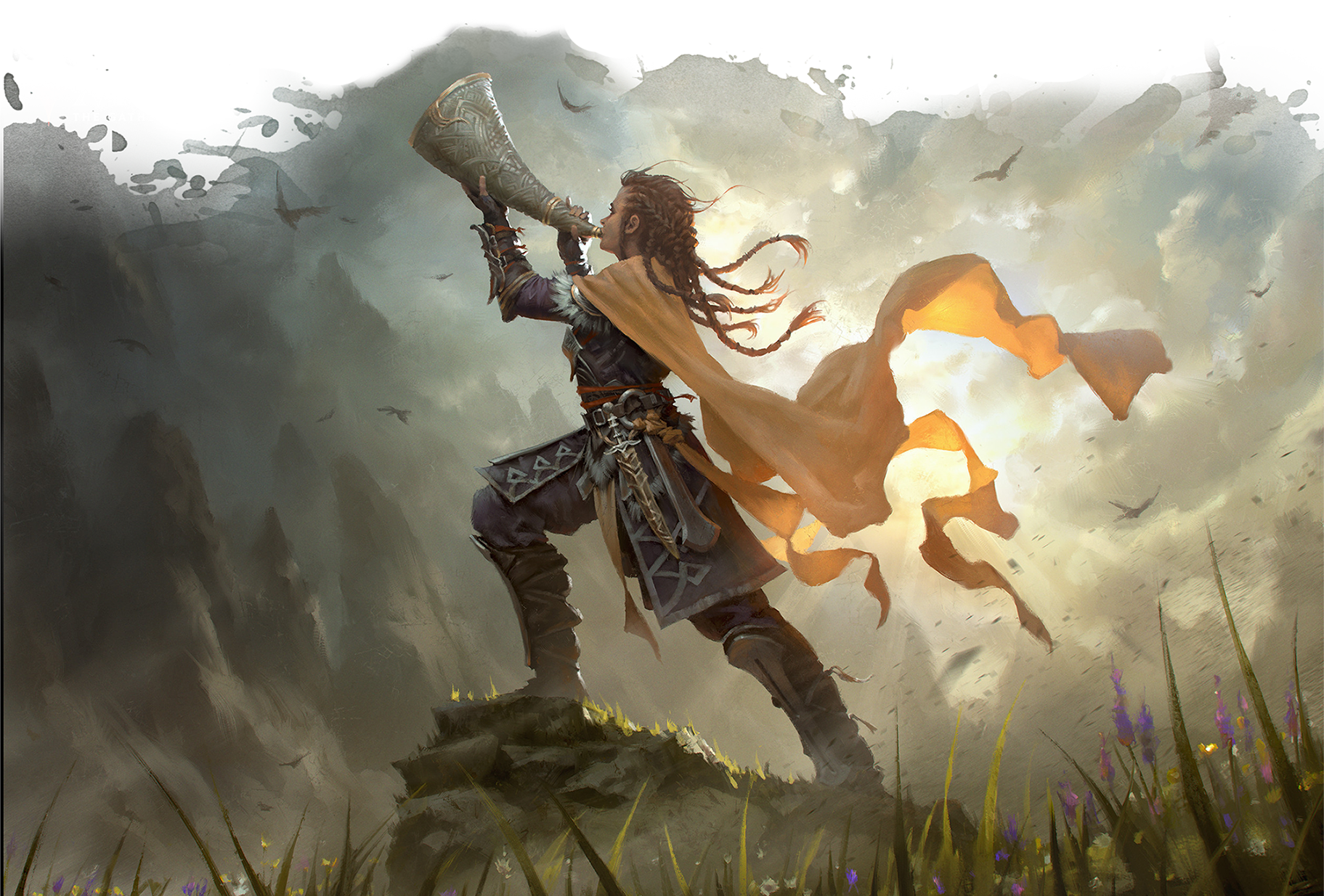
The Artificer could seem out of place in a Norse setting. There are, however, some pretty outstanding figures in norse mythology that call back to its identity: the legendary dwarves, master craftsmen of the artifacts wielded by the gods.
The Mastersmith follows that very path, beginning the outstanding project of a masterpiece weapon to rival those of the dwarven smiths. The weapon gains unique properties depending on its damage type, and even magical powers based on mythical weaponry. It is a combat-oriented Artificer, branching out on its original support role, and can change its weapon into another at any time, diversifying its playstyle.
We expanded on some already existing Artificer features, which are very reminiscent of Norse mythology, like throwing and recalling one’s weapon, to better develop the concept.
Artificer Specialist
Mastersmith
Inspired by the legendary artifacts of the dwarfs, Mastersmiths devote their craft to the creation of a mythical weapon, a work of art so masterful that will forever live in the tales of the skalds. In their endless search for the finest materials and techniques, Mastersmiths wield their own weapon in battle with precision and grace. Each new struggle plants the seeds of a future stroke of genius, be it a sharper blade, a sturdier frame or a more penetrating spearhead. A Mastersmith's creation is a mirror of themselves: as they refine it and empower it with divine magic, it grows to perfectly suit their battle style and personality, their rigidity or fluidity of being. It will one day be a weapon to rival those of the great Aesir; perhaps, its story will be told alongside theirs.
Tool Proficiency
3rd-level Mastersmith feature
You gain proficiency with smith's tools. If you already have this tool proficiency, you gain proficiency with one other type of artisan's tools of your choice.
Mastersmith Spells
3rd-level Mastersmith feature
You always have certain spells prepared after you reach particular levels in this class, as shown in the Mastersmith Spells table. These spells count as artificer spells for you, but they don't count against the number of artificer spells you prepare.
Mastersmith Spells
| Artificer Level | Spells |
|---|---|
| 3rd | searing smite, thunderous smite |
| 5th | branding smite, spiritual weapon |
| 9th | blinding smite, crusader's mantle |
| 13th | staggering smite, guardian of faith |
| 17th | banishing smite, holy weaponXGtE |
Masterpiece Weapon
3rd-level Mastersmith feature
Your smithing prowess has led you to pursue the creation of exquisite magical weaponry. At the end of a long rest, if you have smith's tools with you, you can create a Masterpiece Weapon, which can be any simple or martial melee weapon. If you already have a weapon from this feature, the first one immediately disappears. This weapon is magical, and it grants a +1 bonus to attack and damage rolls made with it while you're wielding it. This bonus increases to +2 when you reach 9th level in the Artificer class and to +3 when you reach 15th level in the Artificer class.
Moreover, it has the following properties while you're wielding it:
- You are proficient with this weapon, regardless of its weapon type. When you attack with this weapon, you can use your Intelligence modifier, instead of Strength or Dexterity modifier, for the attack and damage rolls.
- You can't be disarmed while you are wielding this weapon.
- You can use this weapon as a spellcasting focus for your artificer spells.
- If it doesn't have it already, this weapon gains the thrown property (range 20/60), and it returns to your hands immediately after it is used to make a ranged attack. At 15th level, the range of the thrown property becomes (range 30/120).
- If at any time you are not carrying this weapon and it is within 90 feet of you, you can use a bonus action to recall it. If there is any clear and unobstructed path that it can take, it returns to your hands immediately. If a creature is holding this weapon when you recall it, the creature must make a Strength saving throw against your spell save DC to keep it from flying away from their hands. On a failed save, the weapon escapes their grasp. Starting when you reach 15th level in the Artificer class, you can use this feature to recall your weapon no matter where it is, as long as it is on your same plane of existence.
Extra Attack
5th-level Mastersmith feature
You can attack twice, rather than once, whenever you take the Attack action on your turn.
Improved Masterpiece
9th-level Mastersmith feature
Your smithing mastery rivals that of the mythical dwarven artisans, who gifted the Gods their legendary artifacts. Your Masterpiece Weapon cannot be destroyed, except when you create another one.
Additionally, your Masterpiece Weapon gains one of the following features while you are wielding it, based on the type of damage it deals.
Slashing Damage: Attacks you make with this weapon are swift and wide, giving you the chance of hitting multiple enemies at once. The first time on your turn that an attack you make with this weapon hits, you can choose another creature within 5 feet of the original target and within your reach. If the original attack roll would hit the second creature, make a damage roll against that target as well.
Bludgeoning Damage: Enemies hit by this weapon are pummeled and battered, unable to keep their focus. The first time on your turn that an attack you make with this weapon hits a creature, the target must make a Constitution saving throw against your spell save DC. On a failed save, they have disadvantage on the first attack they make until the end of their next turn. Additionally, if the damage dealt by this attack causes the target to make a Constitution saving throw to keep concentrating on a spell, they make the saving throw with disadvantage.
Piercing Damage: Your masterpiece cuts the wind and smashes the bone, inflicting grievous wounds from afar. This weapon has a normal range of 60 feet and no long range. Additionally, attacks made with this weapon score a critical hit on a roll of 19 or 20. When you reach 15th level in this class, this weapon has a normal range of 120 feet and no long range.
Legendary Masterpiece
15th-level Mastersmith feature
Your weapon becomes legendary, manifesting aspects of the mythical artifacts of the sagas. While you're wielding your Masterpiece Weapon, you gain one of the following features, depending on the type of damage of your Masterpiece Weapon:
Aspect of Gramr (Slashing): You can cast the steel wind strike spell once without expending a spell slot and using your Masterpiece Weapon in place of the spell's material components. When you cast the spell this way, you use your Masterpiece Weapon to make a cleaving attack against all the targets of the spell. Follow the spell's description, with the following exception:
- The attacks you make are melee weapon attacks made with this weapon, instead of melee spell attacks.
Aspect of Mjollnir (Bludgeoning): You can cast the destructive wave spell once without expending a spell slot. Follow the spell's description, with the following exceptions:
- You strike the ground with your Masterpiece Weapon when you cast the spell.
- The spell deals 5d6 thunder damage and 5d6 lightning damage, instead of the damage types listed in the spell's description.
Aspect of Gungnir (Piercing): You can cast the conjure volley spell once without expending a spell slot and using your Masterpiece Weapon in place of the spell's material components. After you cast the spell, your Masterpiece Weapon flies back into your hands.
You can't use this feature again until you complete a long rest, unless you expend a spell slot of 5th level or higher.

Barbarian
The Barbarian is the quintessential viking. The official class is heavily inspired by the Norse myth of the berserker – a raging warrior who feels no pain – and most of its subclasses cover many other popular viking tropes. Creating your own viking Barbarian is easy enough with already released content, so we decided to go in a slightly different direction, starting with a gameplay idea: an anti-magic barbarian.
In Norse mythology, before the death of Ymir and the birth of the realms from its corpse, there was but an endless void, Ginnungagap. This primordial abyss still tries to devour creation and restore that all-encompassing nothingness. In some interpretations of Norse sagas, the Giants are agents of Ginnungagap, thus enemies of the gods and their creation.
You can see why the Ginnungagap was the obvious narrative tie-in for our barbarian, and a perfect driving force behind its powers.
Primal Path
Path of Ginnungagap
Willing or unwilling, barbarians who follow the path of Ginnungagap are agents of the primordial nothingness that birthed the universe. With every action they strip something out of creation, pushing it ever so slightly to return to the void. They wield emptiness as a weapon, consuming magic and feeding on its energy, sapping the life force out of their foes and feasting on it. Theirs is a path that brings destruction without renewal.
Null Warrior
3rd-level Path of Ginnungagap feature
The nothingness of Ginnungagap shields you from harm, consuming magical and physical threats alike. While you are raging, you have advantage on saving throws made to resist spells and magical effects.
Additionally, while you are raging, if a creature targets you with an attack and scores a critical hit, you can use your reaction to turn that hit into a normal hit. Any effects triggered by a critical hit are canceled. You can only take this reaction once per rage.
Magic Syphoning
6th-level Path of Ginnungagap feature
You have learned to briefly harness the Void, allowing you to snuff magic before it is unleashed while bolstering your battle rage. While you are raging, when a creature you can see within 60 feet of you begins casting a spell, you can take a reaction and attempt to interrupt the casting of that spell. Make a Constitution check. The DC equals 10 + the spell's level. On a success, the spell fails and has no effect,

and the next time you hit a creature with a weapon attack, that attack deals extra damage equal to double the spell's level.
Once you successfully interrupt the casting of a spell, you can't use this feature again until you take a bonus action to enter a rage.
Spell Eater
10th-level Path of Ginnungagap feature
The Void within you can now consume ongoing magic and use it to fuel itself and your own resilience. As an action, you can target one creature, object or magical effect within 30 feet of you. Any spell of 3rd level or lower on the target ends. For each spell of 4th level or higher on the target, make a Constitution check. The DC equals 10 + the spell's leveI. On a successful check, the spell ends. You regain a number of hit points equal to your barbarian level + the sum of the levels of the spells you ended, and you gain the same amount of temporary hit points.
You can use this feature a number of times equal to your Constitution modifier. You regain expended uses when you finish a long rest.
Herald of Ginnungagap
14th-level Path of Ginnungagap feature
While you are raging, when you hit a creature with a weapon attack, you can empower the attack to rend space and time from your target. The target creature must make a Constitution saving throw. On a failed save, the target is under the same effects of the slow spell for 1 minute. On a success, the target can't take reactions until the end of their next turn. The target can make a Constitution saving throw at the end of each of their turns, ending the effect of this feature on themselves on a success.
The DC of saving throws forced by this feature equals 8 + your proficiency bonus + your Constitution modifier.
You can use this feature a number of times equal to your proficiency bonus. You regain expended uses when you finish a long rest.
Bard
Classic D&D Bards already take a lot from Norse myth: they are artisans of stories and songs, singers of legends and mythical undertakings, much like the skalds of that time. We decided to take this concept a step beyond, merging it with the Norse obsession for fate.
A Bard from the College of Fate sings the party's deeds in advance – knowing its stories will become reality – and incites its companions to write their own legend. Prophecy mechanics are never easy to implement in RPGs, and we wanted the archetype to have a distinct feel of predicting the future beforehand and then watching it come to pass, as opposed to retroactively realizing a non-existent prediction, so we came up with this original mechanic.
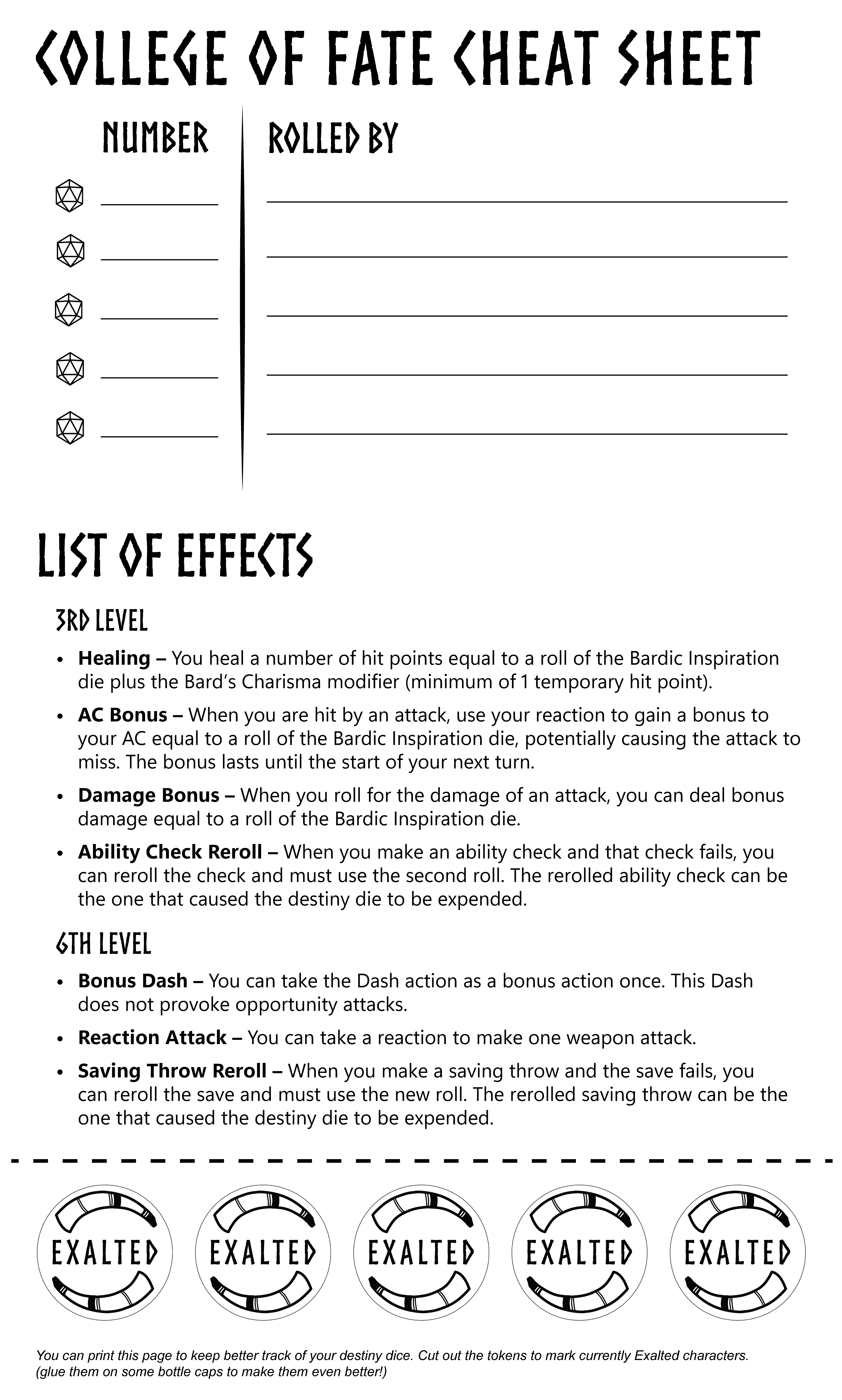
Some dice are rolled at the end of each rest, as the Bard tells stories of what will happen. The numbers are recorded, symbolizing various prophecies; when they come up in a roll, the character realizes they are in the middle of the story told by the Bard, and gains some unique effects. The main challenge was to not make the Bard into a mere enabler of the mechanic without any active part in it.
It ultimately came out as a bit convoluted, and we realize that it will require a bit of bookkeeping from the players (you will find a helpful tool for that at the end of this supplement), but we hope you will appreciate the novelty of it. The subclass probably gives its best in a full-fledged campaign: its functioning needs to be warmed up to, but it can pay off very well in both mechanical and narrative terms.
Bardic College
College of Fate
To inspire greatness, a bard sings of fearless heroes and fabled deeds of the past or of an imaginary world. Those who belong to the College of Fate don't dwell on history or imagination: they sing of the future. They compose what still has to happen through the uncompromising power of their art and will, peering into the unknown and warping reality to resemble their fiction. Their signature is etched on the patterns of the Norns, and their companions know they will achieve godly undertakings, becoming more and more exalted as their already written story manifests in reality.
Song of Exalted Destiny
3rd-level College of Fate feature
When you rest and get ready to face the challenges of the day, you get inspiration for your art, knowing full well that what you play and sing will eventually come to pass, and what mighty glory it will bring upon your witnesses. When you finish a short or long rest, roll 3d20 and record the numbers rolled (reroll any doubles until all the numbers are different). These are your destiny dice. When any other creature of your choice makes an ability check, an attack roll or a saving throw, if the number rolled on the die is the same of one of your destiny dice, the matching destiny die is expended, and the creature that rolled it becomes exalted for 1 minute or until they become unconscious or are incapacitated.
When an exalted creature uses your Bardic Inspiration die on an ability check, an attack roll or a saving throw, they can roll the Bardic Inspiration dice twice and pick the best result.
At any point while a creature is exalted, they can gain one of the following benefits of their choice:
- They heal a number of hit points equal to a roll of your Bardic Inspiration die plus your Charisma modifier (minimum of 1 temporary hit point).
- When they are hit by an attack, they can use their reaction to gain a bonus to their AC equal to a roll of your Bardic Inspiration die, potentially causing the attack to miss. This bonus lasts until the start of their next turn.
- When they roll for the damage of an attack, that attack deals bonus damage equal to a roll of your Bardic Inspiration die.
- When they make an ability check and that check fails, they can reroll the check and must use the second roll. The rerolled ability check can be the one that caused the destiny die to be expended.
Once an exalted creature has gained a benefit of this feature, they can't do so again until they become exalted again.
When you finish a short or long rest, any unused destiny die is lost.
When you reach 6th level in this class, you roll 5d20 when you finish a short or long rest instead of 3.

Song of Certain Doom
3rd-level College of Fate feature
Your stories tell of the deeds of your allies as well as the doom of your foes. As a bonus action, you can expend a use of your Bardic Inspiration and choose a creature within 60 feet of you that you can see, to which you recite their imminent failure. The next time that creature is hit by an attack or fails an attack roll, ability check or saving throw, they realise the truth in your words and become frightened of you. This effect lasts for 1 minute, or until the creature scores a critical hit. At the end of each of their turns, the creature can make a Wisdom saving throw against your spell save DC, ending the effect on a success.
Grandiose Destiny
6th-level College of Fate feature
The divinatory and fate-shaping capacities of your art are even more astounding, granting new benefits to your allies and extending those benefits to yourself. When an exalted creature chooses a benefit from your Song of Exalted Destiny feature, the following options are added to the list:
- They can take the Dash action as a bonus action once. This Dash does not provoke opportunity attacks.
- They can take a reaction to make one weapon attack.
- When they make a saving throw and the save fails, they can reroll the save and must use the new roll. The rerolled saving throw can be the one that caused the destiny die to be expended.
Additionally, each time a destiny die is expended, you can gain one benefit from the list of your Song of Exalted Destiny feature or from the list of this feature, as long as you do that while the creature who expended the destiny die is exalted.
Fate of the Exalted
14th-level College of Fate feature
As the tales you weave become truth and the heroes you sing of carve their legend, you go beyond the limits of your form, channeling your will and mastery to briefly force the hand of the Norns themselves. When you or a creature you can see makes an ability check, an attack roll or a saving throw, you can cause the attack to hit, or the check or save to succeed. You can use this feature after you see the roll, and after the DM says whether the roll succeeds or fails.
Once you use this feature, you can't use it again until you finish a long rest.
Cleric
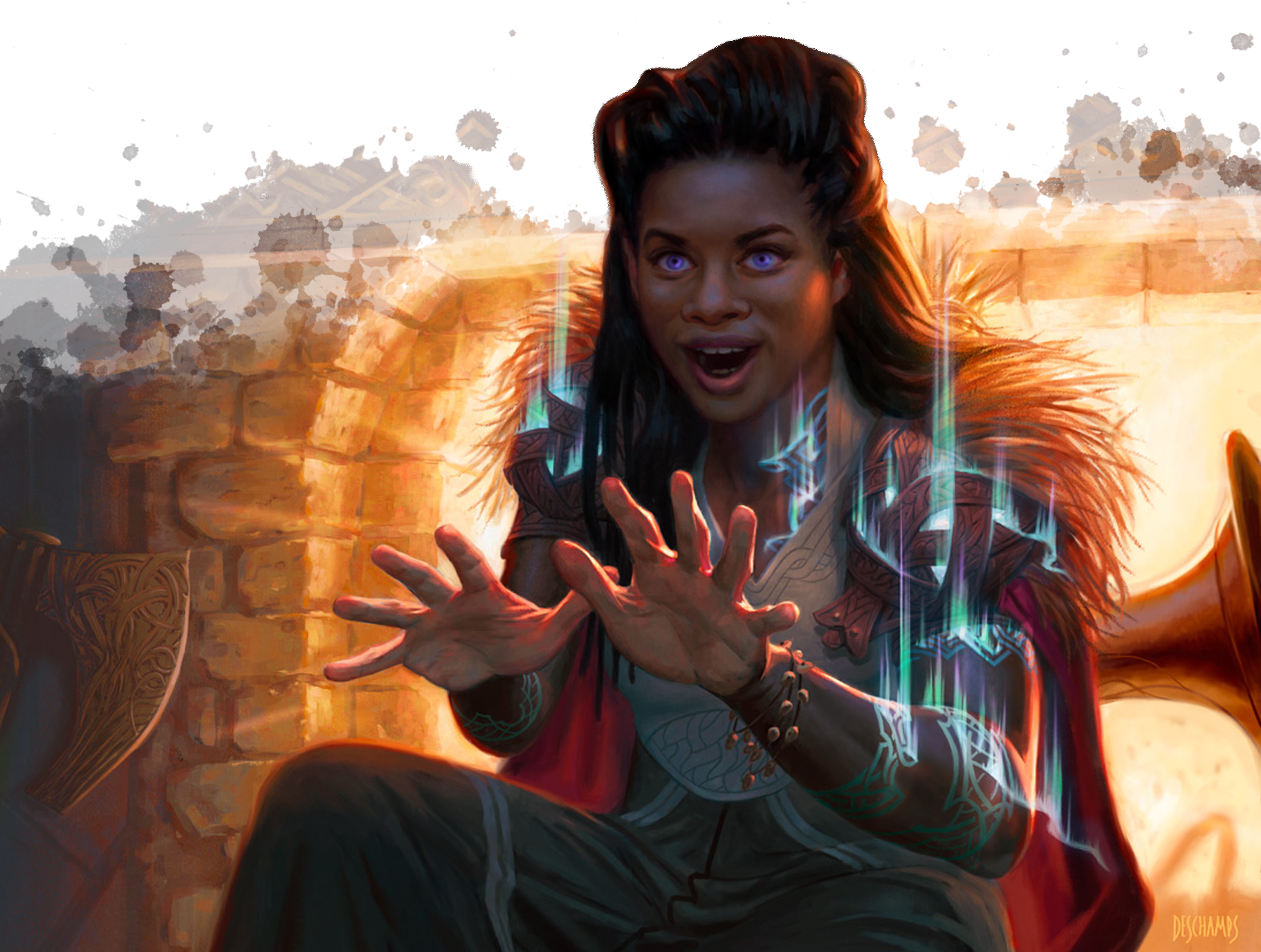
The official Cleric class has many domains, most of which are general enough to be easily tied to your deity of choice, and some of which even mention Norse gods. Instead of trying to link specific divine powers to our viking Cleric, we worked on their very approach to religion.
Seidr is the old norse magic, teached to Odinn by Freyja herself. Through its intoxicating rites, shamans could access the spirit world and receive visions, or manipulate the strands of fate to bind blessings and curses to others. It is a visceral and physical type of magic, closely related to the Vanir gods and, in some interpretations, to the Norns themselves: there is plenty of options for which god your cleric will be devoted to, and from whom they will receive the secrets to master the old rites.
We wanted the Seidr domain to feel like receiving foresight and blessings from another realm, thus the idea of tying boons and curses to visions randomly gained each day through a religious rite. These visions can also serve as a narrative tool to the DM, who can freely exchange our prompts for something more story relevant.
Incorporating a collective ritual was also a main focus for us. We wanted a subclass that could really give flavour to an adventuring party, with daily rituals that every character would have reason to attend, eventually growing into a group tradition and making the Cleric feel like an indispensable and wise figure.
Divine Domain
Seidr Domain
Clerics of the Seidr domain are practitioners of the shamanistic Seidr rites, passed down from the Vanir themselves. They peer beyond the veil of reality and journey through the cryptic and deceitful world of the spirits, where they are blessed with visions and ancient magic. With confident hands and stalwart minds, they manipulate the energies of the spiritual realms, crafting boons or curses to manifest in the physical world. Having been granted foresight and the tools to face the future, they confront the world with pride and expertise, guiding their allies to glory and their foes to certain demise.
Domain Spells
1st-level Seidr Domain feature
You gain domain spells at the cleric levels listed in the Seidr Domain Spells table. See the Divine Domain class feature in the Player's Handbook for how domain spells work.
Seidr Domain Spells
| Cleric Level | Spells |
|---|---|
| 1st | bane, bless |
| 3rd | augury, suggestion |
| 5th | bestow curse, remove curse |
| 7th | charm monster, death ward |
| 9th | dream, greater restoration |
What Lies Ahead
1st-level Seidr Domain feature
Being an adept of the Seidr, you are able to divine what it is and what is yet to come, through the performance of many different rituals. When you cast a Divination spell, you can cast it as a ritual even if it doesn't have the ritual tag.
Additionally, you are able to enter an altered state of mind that allows you to peer into the unknown. When you finish a short rest, you can cast one Divination spell of 6th level or lower of your choice from any spell list, as long as you are at a high enough level to have spell slots for it, and provided that you didn't do anything but meditate during that rest. You don't need to provide material components for the spell, and you don't consume spell slots when casting a spell this way.
Once you have cast a spell this way, you can't do so again until you finish a long rest.
Rites of Seidr
1st-level Seidr Domain feature
Through the rites of Seidr, you cross into the realm of spirits, which bestow upon you certain powers, according to their unfathomable machinations. When you finish a long rest, after you have prepared your spells, you can perform a ritual that takes 10 minutes to complete. Choose up to 5 other willing creatures to share the ritual with. When you complete the ritual, roll on the Rites of Seidr Boons table to determine the boon you gain.
If a boon has limited uses, when a creature that benefits from it finishes a long rest and still has available uses, those uses are lost. Otherwise, a boon lasts until the creature benefitting from it finishes a long rest.
When you reach 8th level in this class, each time you complete the ritual you gain two boons from the Rites of Seidr Boons table. You can't gain the same boon more than once from the same ritual.
Channel Divinity: Fated Confrontation
2nd-level Seidr Domain feature
When fighting ensues, you can gain a glimpse of the immediate future, giving your net of allies an edge in preparing themselves for the upcoming conflict. When you roll initiative, you present your holy symbol and use your Channel Divinity. All creatures that took part in the ritual performed via your Rites of Seidr feature have advantage on the Dexterity check made to determine initiative.
Curseweaver
6th-level Seidr Domain feature
You are at home in the world of spirits, and know how to weave ruin to the threads of your enemies. When you use your Rites of Seidr feature, also roll on the Curseweaver Curses table to determine the curse you gain.
Each curse can only be used once. If you finish a long rest and still have a curse available, that curse is lost.
Potent Spellcasting
8th-level Seidr Domain feature
You add your Wisdom modifier to the damage you deal with any cleric cantrip.
Persistent Visions
17th-level Seidr Domain feature
Your connection to the Vanir gods is so strong that the echoes of your rituals carry on with you, bestowing upon you new boons and curses when they are most needed. When you roll initiative, if you have less than two available boons from your Rites of Seidr feature, you immediately roll on the Rites of Seidr Boons table until you have two boons.
Additionally, if you roll initiative and you don't have an available curse, you immediately roll on the Curseweaver Curses table and gain one.
You only gain the benefits of this feature if you performed your Rites of Seidr ritual at the end of your last long rest.
Rites of Seidr Boons
| d10 | Boons |
|---|---|
| 1 | You feel an obstinate will to succeed. When you or a creature that you shared the ritual with rolls a 1 on an ability check, attack roll or saving throw, they can choose to reroll that check, and must keep the new roll, even if it's a 1. Each creature can only do so once, after which this boon is expended. |
| 2 | You feel a tireless advance, pushed by the winds of fate. When you or a creature of your choice that you shared the ritual with that you can see moves, you can use your reaction to increase their speed by 10 feet until the end of their turn. |
| 3 | You see a lethal blow being struck, only to be blocked by an intervention of divine might. When you or a creature that you shared the ritual with would be hit by an attack, you can use your reaction to give them +5 to their AC until the start of their next turn. You can only take this reaction once, after which the boon is expended. |
| 4 | You see bloodied fingers hanging on the thread of the Norns. When a creature of your choice that you shared the ritual with that you can see is forced to make a Death saving throw, you can use your reaction to have them regain 1 hit point instead. Once you have taken this reaction, the boon is expended. |
| 5 | You feel the precision of the blow struck by a seasoned veteran. When you or a creature that you shared the ritual with rolls the damage of an attack, they can reroll any of the dice and must use the new roll. Each creature can only do so once, after which this boon is expended. |
| 6 | You see Sæhrímnir, the mythical beast that each night is slaughtered to feed the gods and Einherjar, yet each day is born anew. When you roll dice to determine the number of hit points a spell restores, you can reroll any number of that roll, and must keep the new result. You can use this boon a number of times equal to your proficiency bonus, after which the boon is expended. |
| 7 | You receive the gift of mastery, that which can only be achieved with a lifetime of practice. When you or a creature that you shared the ritual with makes an ability check, they can choose to add their proficiency bonus to the roll. If they already have proficiency, they double their proficiency bonus for that roll. Each creature can only do so once, after which this boon is expended. |
| 8 | You see the waves crashing against the fjords; you feel the might of the raging storm. Each time you or a creature that you shared the ritual with scores a critical hit, they deal an additional 1d6 thunder damage, and the target of the attack must make a Strength saving throw. On a failed save, the creature that was hit by the attack is pushed 10 feet away and is knocked prone. |
| 9 | You feel the endless life force of Yggdrasil bless you. Choose yourself or a creature that you shared the ritual with. Their Constitution score increases by 2, to a maximum of 22. |
| 10 | You see a great champion writing their own legend. Choose yourself or a creature that you shared the ritual with. That creature gains a Charm of Blessing. This charm allows the bearer to cast the bless spell as an action, without material components. A creature can only target themselves when casting the bless spell with this charm. Once used, the charm vanishes and the boon is expended. |
Curseweaver Curses
| d6 | Curse |
|---|---|
| 1 | You see the frailty of an old warrior on the brink of defeat. As an action, you can choose a creature that you can see within 60 feet of you. Attacks made by the target creature deal the minimum possible amount of damage. At the end of each of their turns, the affected creature can make a Charisma saving throw against your spell save DC. On a successful save, the curse ends. |
| 2 | You see a leader made object or ridicule, a charlatan unmasked. As an action, you can choose a creature that you can see within 90 feet of you. That creature has disadvantage on all Charisma (Deception), Charisma (Intimidation) and Charisma (Persuasion) checks they make. Additionally, allies of the cursed creature within 20 feet of them have disadvantage on ability checks and attack rolls. At the end of their turn, the affected creature can make a Charisma saving throw against your spell save DC, ending the effect on themselves on a success. |
| 3 | You see a shameful deed, a terrible endeavor that brings death upon innocent lives. As an action, you can choose a creature that you can see within 60 feet of you. That creature is assailed by visions of undead people coming for retribution for something that they did. The target creature has disadvantage on ability checks and attack rolls they make while under the effect of this curse. At the end of each of their turns, the affected creature can make a Charisma saving throw against your spell save DC. On a failed save, they take 1d6 psychic damage as the visions continue. On a successful save, the curse ends. |
| 4 | You see the humiliation of transmutation, of utter power upon the body's form. As an action, you can choose a creature that you can see within 30 feet of you. That creature must make a Charisma saving throw against your spell save DC. On a successful save, the creature is poisoned until the end of their next turn. On a failed save, the creature is transformed into a toad, a rat, a weasel, or any other beast of challenge rating 0. The target's game statistics are replaced by the statistics of the chosen beast. They retain their alignment, personality, and mental ability scores. The target assumes the hit points of their new form. When they revert to their normal form, the creature returns to the number of hit points they had before they transformed. If they revert as a result of dropping to 0 hit points, any excess damage carries over to their normal form. As long as the excess damage doesn't reduce the creature's normal form to 0 hit points, they aren't knocked unconscious. The creature is limited in the actions they can perform by the nature of their new form, and they can't speak, cast spells, or take any other action that requires hands or speech. The target's gear melds into the new form. The creature can't activate, use, wield, or otherwise benefit from any of their equipment. At the end of each of their turns, the affected creature can make a Charisma saving throw against your spell save DC, ending the effect on themselves on a success. Shapechangers are immune to this curse. |
| 5 | You see an impossible mountain of gold, a dragon hoard that started with one simple ring. As an action, you can choose a creature that you can see within 90 feet of you. That creature must make a Charisma saving throw against your spell save DC. On a failed save, they must spend their next turn doing nothing except attempting to pile any metallic or magic item in the closest unoccupied space to them. Once a creature has become affected by this curse, you can use an action to force the same creature to make the saving throw again, as long as you keep concentration on it (as if concentrating on a spell). On a successful save, the target has disadvantage on attack rolls and ability checks until the end of their next turn, and the curse ends. |
| 6 | You see the immobility of indolence, the sheer lack of will. As an action, you can choose a creature that you can see within 60 feet of you. That creature's speed decreased by 10 feet, and they take a -2 penalty to their AC. At the end of each of their turns, the affected creature can make a Charisma saving throw against your spell save DC, ending the effect on themselves on a success. |

Druid
Druids did not exist during the Viking age, having instead been an important figure within Celtic society many centuries earlier. Lacking a direct parallel in Norse society, we looked elsewhere, digging through Norse mythology and folklore.
We thought about a Druid subclass based on the "cursed warriors" of legends, which were the ones to actually give rise to the myth of the berserker. They were allegedly shapeshifting warriors, wearing bear, wolf or boar pelts on their head and fighting in a psychedelic-fueled frenzy.
The first version was a Druid-Barbarian hybrid, which was extremely vicious and fun. Being in its special form, however, prevented you from casting, and there were many situations in which the best play still was to revert to Druid form and cast high level spells. In short, Druid is a full caster, no matter how you try to spin it.
The final version of the Circle of Fury draws from those early ideas and incorporates it within a more classical Druid framework. It is a controlled lycanthrope who, even though it likes to be in the middle of the action and get its hands dirty, works with the base class ability to cast spells, turning the Druid into a more primal and savage spellcaster.
Druidic Circle
Circle of Fury
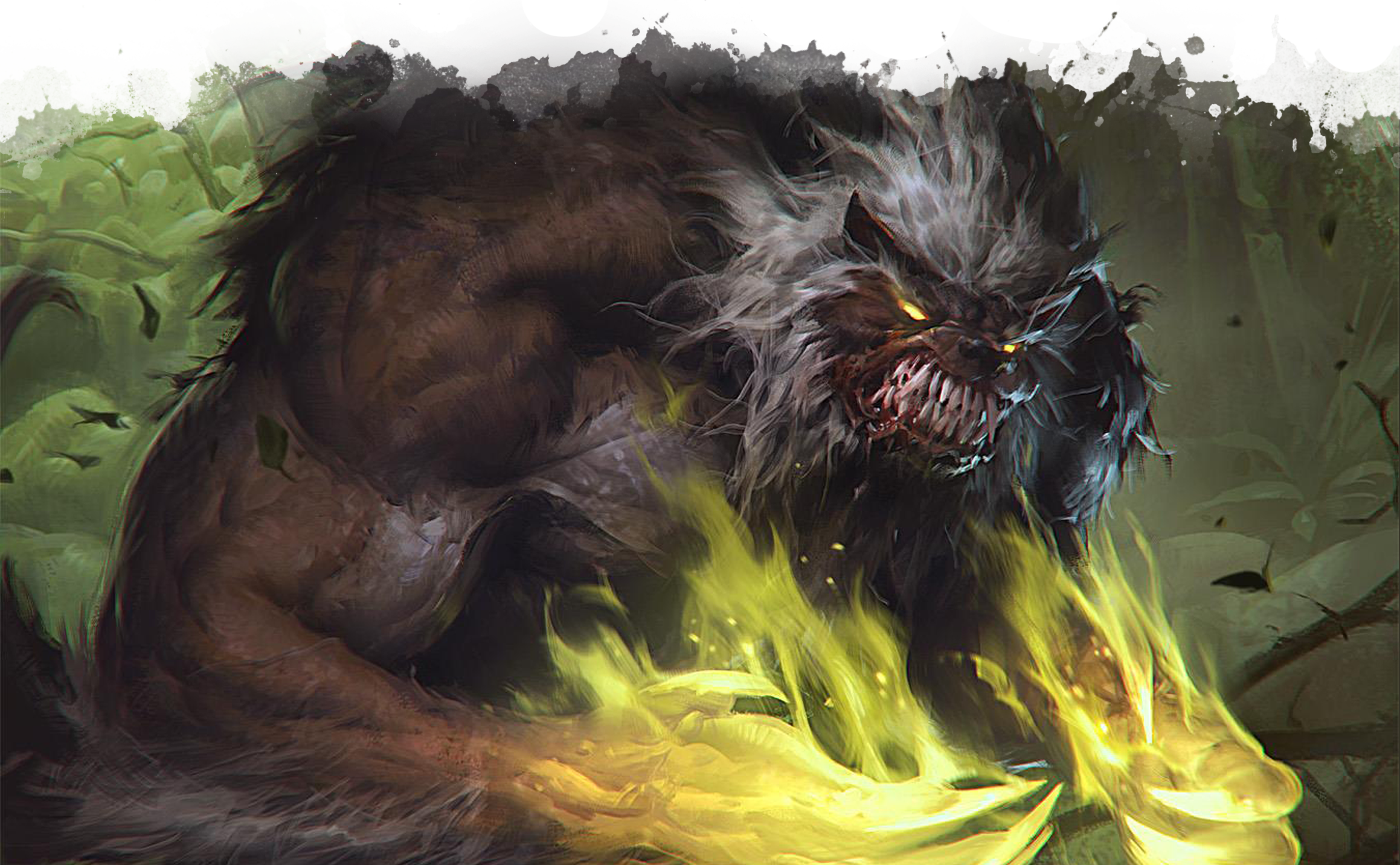
Druids of the Circle of Fury have unleashed their most feral instincts, and their connection to the natural realm is an unusual and frightening one. Violent and unyielding, their bestial forms awaken their inner predator without sacrificing their humanlike shape. They embody both the primal strength of the wild and the cruelty of man, fearlessly dominating the battlefield, stalking and felling their foes as prey. They feed on their own savagery to empower their magic, relentlessly chasing blood to quench their thirst. They are the cursed berserkers of legend.
Feral Form
2nd-level Circle of Fury feature
Amidst the secrets of the land, you unearthed your inner predator and understood how to channel its fury in battle. As a bonus action, you can expend a use of your Wild Shape feature to turn into a humanoid-beast hybrid, rather than assuming a beast form.
While in your feral form, you retain your game statistics, but you assume a form resembling that of a lycanthrope, and anything you are wearing or carrying isn't transformed with you. The transformation lasts for 10 minutes. It ends early if you dismiss it (no action required), are incapacitated, die, or use this feature again.

You can't transform if you are wearing medium or heavy armor.
Whenever you assume your feral form, choose one of the following werebeast forms to draw your strength from.
Berserkr. You assume the form of a bear-humanoid hybrid. While in this form, you gain the following benefits:
- You can use your Wisdom modifier instead of your Strength modifier whenever you make a Strength check, an attack roll based on Strength, or a Strength saving throw.
- Whenever a spell or feature rolls dice to determine the amount of hit points you regain, you add your proficiency bonus to the number rolled.
- When you cast a druid spell of 1st level or higher, you gain temporary hit points equal to 3 x the spell's level.
Ulfhednar. You assume the form of a wolf-humanoid hybrid. While in this form, you gain the following benefits:
- You can use your Wisdom modifier instead of your Dexterity modifier whenever you make a Dexterity check, an attack roll based on Dexterity, or a Dexterity saving throw.
- Your speed increases by 10 feet.
- When a creature takes damage from an attack you made, a spell you cast or a feature you used, the next attack roll made against that creature before the start of your next turn has advantage. If more than a creature took damage from the same source, choose one to be affected by this feature.
Jofurr. You assume the form of a boar-humanoid hybrid. While in this form, you gain the following benefits:
- You can use your Wisdom modifier instead of your Constitution modifier whenever you make a Constitution check, an attack roll based on Constitution, or a Constitution saving throw.
- When a creature takes damage from a spell you cast for the first time on your turn, you can attempt to shove them. They must succeed on a Strength saving throw against your spell save DC or be knocked prone.
- When you go unconscious as a result of having 0 hit points while in Jofurr form, even if you lose your Feral Form, you have advantage on Death saving throws you make until you become stable or go back to consciousness.
Eldritch Wail
6th-level Circle of Fury feature
You are dread incarnate, and your war cries are enough to break the bravest of souls. While you are in your feral form, when you cast a spell of 1st level or higher, you can use your reaction to let out a horrifying howl. Creatures of your choice within 30 feet of you must make a Wisdom saving throw against your spell save DC. On a failed save, they take 3d6 psychic damage and their movement speed is reduced to 0 until the end of their next turn. On a successful save, they only take half damage and their speed isn't reduced.
You can use this feature a number of times equal to your proficiency bonus. You regain expended uses when you finish a long rest.
Predatory Leap
10th-level Circle of Fury feature
The world is your hunting ground. As an action while you are in your feral form, you can jump to an unoccupied space within 30 feet of you, provided there is a clear and unobstructed path to it. Each creature within 10 feet of you when you land must make a Constitution saving throw against your spell save DC. On a failed save, they take 3d8 thunder damage and are knocked prone. On a successful save, they only take half damage and aren't knocked prone. You then gain 5 temporary hit points for each creature that was forced to make this save.
You can use this feature a number of times equal to your proficiency bonus. You regain expended uses when you finish a long rest.
Circle of Fury and lycanthropy
The Circle of Fury initially had a feature preventing it from being cursed with lycantrophy, as we thought that having both "forms" would be awkward from a narrative standpoint. We eventually decided to remove the feature, leaving the choice to player and DM. Maybe you want to have both forms, with true lycanthropy being the more feral one, or maybe you want the Circle of Fury form to be your "curse" and to effectively be immune to other kinds of lycanthropy, or something else entirely. It's up to you!
Apex Predator
14th-level Circle of Fury feature
You are the might of nature made manifest. While in your feral form, you gain one of the following bonuses, based on the shape you assume:
Berserkr. You gain resistance to bludgeoning, piercing and slashing damage.
Ulfhednar. When you force a creature to make a saving throw, that creature makes the save with disadvantage if you have two or more allies that are within 5 feet of that creature.
Jofurr. If you would drop to 0 hit points as a result of taking damage, you can drop to 1 hit point instead. Once you have used this feature, you can't use it again until you finish a short or long rest.
Fighter
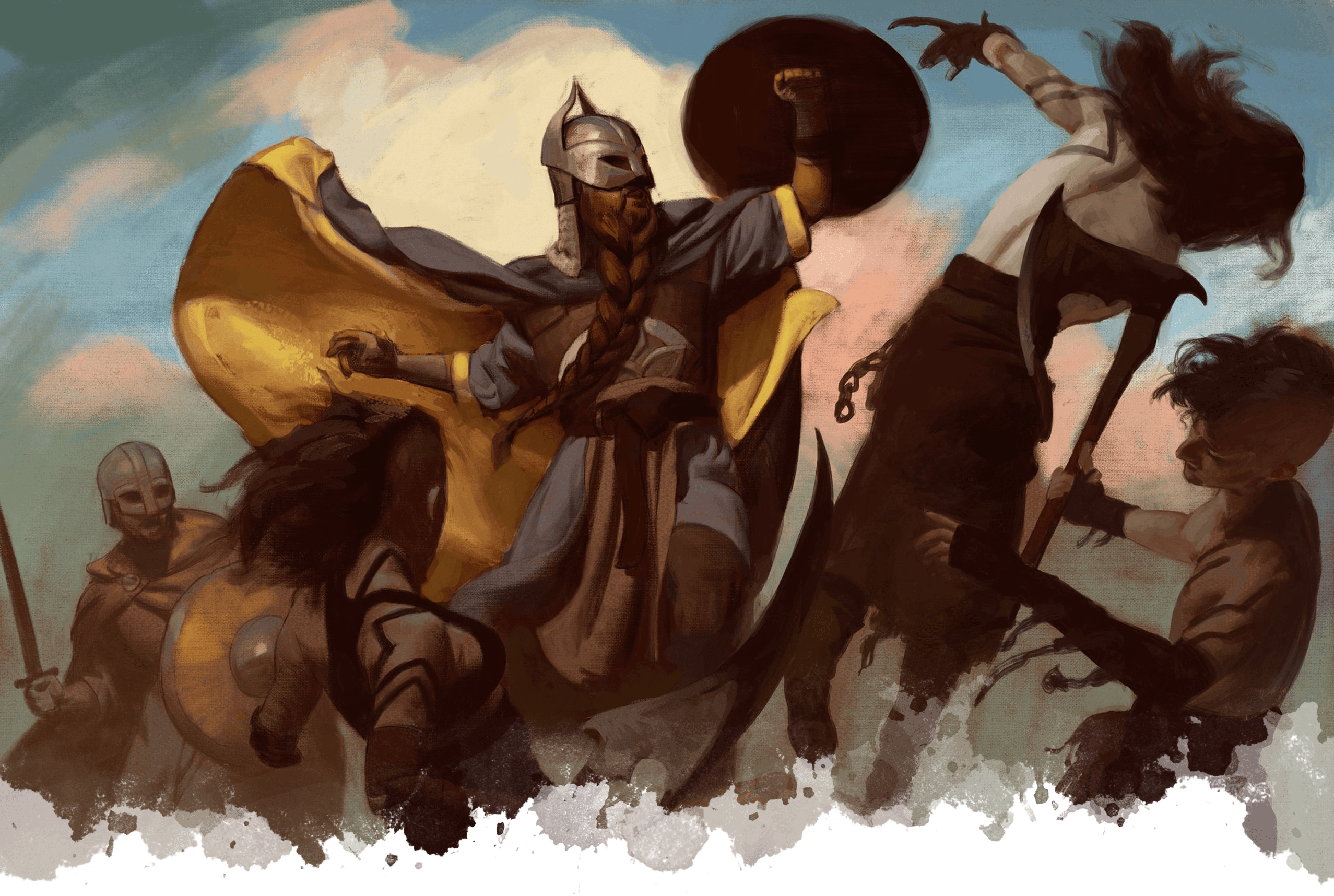
Given that there is no shortage of options for bloodlusted warriors in the official content, we sticked to the Fighter’s identity and made it into a more tactical kind of skirmisher, also drawing from popular figures like shield maidens.
We envisioned an honorable warrior, striving to follow the path of Heimdallr, the Watchman of the Gods and guardian of Asgardr. What starts out as an inspiration could eventually become a real source of power, as the class takes on some supernatural notes. Maybe Heimdallr himself will at some point bestow his powers on the character, to reward their deeds and discipline.
This Fighter's main role is to guard and protect the party, both in and outside of combat. Its core feature works with defensive fighting styles, turning them into more active and engaging abilities. You will want to always stand by your companions' side to truly get the most out of this subclass.
Martial Archetype
Tireless Watcher
Fighters of the Tireless Watcher archetype have trained their bodies and steeled their minds for the single purpose of protecting their allies. These stalwart warriors and leaders ceaselessly stand watch: no threat escapes their gaze, and they thwart every menace headed their way, no matter how great. The veterans among these fighters might attract the favor of deities such as Heimdallr, the Watchman of the Gods, bestowing upon them divine insight and heightened vigilance. They are consecrated as the ultimate guardians.
Training of Himinbjörg
3rd-level Tireless Watcher feature
You gain proficiency in the Insight or Perception skill (your choice). Additionally, you gain an extra fighting style of your choice between Interception and Protection.
Might of the Ram
3rd-level Tireless Watcher feature
Your training makes you an excellent warden, flawlessly combining defense and offense. When you take a reaction to use the Interception or Protection fighting styles, after their effect has resolved, you can use one of the following additional effects:
- Until the end of the attacking creature's next turn, each time they make an attack against a creature within 5 feet of you other than you, they have disadvantage on the attack roll.
- The attacking creature must succeed on a Strength saving throw. On a fail, you can either knock them prone or shove them 10 feet. You can only use this effect if the attacking creature is within 5 feet of you.
- Until the start of their next turn, the attacking creature has their movement speed halved and they can't take reactions. You can only use this effect if the attacking creature is within 5 feet of you.
When you reach 7th level in this class, each time you use this feature against a creature that is within 5 feet of you, you can have that creature take 1d8 + your Strength or Dexterity modifier (your choice) bludgeoning damage.
The DC for saving throws forced by this feature is calculated as follows:
Might of the Ram Save DC
Defender of Midgardr
7th-level Tireless Watcher feature
You put yourself in harm's way with unflinching confidence, for you know the tactical value of protecting your allies. When a creature within 5 feet of you that you can see is subjected to an effect or spell that forces them to make a Dexterity saving throw, you can use your reaction and choose one of the options below:
- If the effect or spell has a target, you become the target of that effect or spell and make the save with disadvantage.
- If the effect or spell does not have a target, the creature you are protecting automatically succeeds on the save. If the effect or spell would cause the creature to take only half damage in case of a success on the save, they take no damage instead. You become subjected to the same effect or spell, even if you weren't before taking this reaction, and make the save with disadvantage.
Investiture of the White God
10th-level Tireless Watcher feature
You are blessed with the divine vigilance of Heimdallr: your senses are as sharp as a blade, and sleep isn't something that can stop your watch. You gain proficiency in the Insight and Perception skills if you don't already have it, and your proficiency bonus is doubled for any ability check you make that uses either of those skills.
Additionally, you cannot be surprised and you only need 4 hours of sleep to complete a long rest.
Additional Fighting Styles
This subclass makes great use of the Interception fighting style, found on Tasha's Cauldron of Everything. Though it was designed to implement both Protection and Interception for a more diverse gameplay, it works just as well only using Protection, if you prefer not to use content from that book in your campaign.
Ultimate Guardian
10th-level Tireless Watcher Feature
You are an ever-present apparition on the battlefield, fully embodying the role of Heimdallr, Watchman of the Gods. When a creature within 30 feet of you that you can see is targeted by an attack or is subjected to an effect or spell that forces them to make a Dexterity saving throw, you can use your reaction to instantly teleport in an unoccupied space within 5 feet of that creature. If the creature was targeted by an attack, as a part of the same reaction, you use the Interception or Protection fighting style. Otherwise, as a part of the same reaction, you use your Defender of Midgardr feature. If there is no space
that you could teleport to, you cannot take this reaction.
You can only use this feature if the attack or effect originates from a hostile creature.
You can use this feature a number of times equal to your proficiency bonus. You regain expended uses when you complete a long rest.
When you reach the 18th level in this class, the range of the teleport increases to 60 feet.
Gjallarhorn's Call
15th-level Tireless Watcher feature
You can channel the thundering bellow of Gjallarhorn, calling your allies to arms as Heimdallr will when Ragnarok comes. As a bonus action, you release a mighty war cry. Up to ten creatures of your choice that can hear you cannot be frightened and have advantage on Strength and Wisdom saving throws. Each creature affected by this feature also gains a number of temporary hit points equal to your Fighter level plus your Wisdom modifier, and the first time on each of their turns they hit with an attack, that attack deals 1d8 bonus damage. This effect ends on a creature after one minute or if that creature falls unconscious.
Once you take this bonus action you can't do so again until you finish a long rest.
Monk
Even though we always picture axe-wielding vikings, hand-to-hand combat was actually part of ancient Norse martial culture. We researched glima, a nordic martial art that serves as both a sport discipline and a fighting technique, and we found it to be the perfect fit for a viking monk.
Glima is all about trying to overpower the opponent with grabs and throws, often using their own strength against them. This concept gave us the perfect opportunity to go for a grappling and shoving focused monk, a playstyle that is a fan-favorite for many martial players, even though it is fairly hard to implement in a practical way. This subclass tries to bring to the table the right tools to let you go toe to toe with any enemy, strengthening your grappling and shoving options. You will be able to cling to your opponents and throw them around without ever letting up.
The monk class was born from the shaolin monk concept, but it has already strayed pretty far from that original idea. Our Norse monk follows the guidelines of more modern monk concepts, which center their identity on a spiritual and balanced approach to combat, without necessarily tying themselves to eastern martial arts tradition. "Ki" could be reflavoured as any other type of energy or inner focus. For the name, we referred to the broader meaning of "glima", which is "struggle", in a both physical and spiritual sense.
Monastic Tradition
Way of Struggle
The Way of Struggle is the study of glima, an ancient Norse discipline focused on bare-handed physical contact and technical throws. Practitioners of the Way of Struggle draw from their inner strength to fuel their moves and to keep fighting above and beyond the limits of the uninitiated. Their physical endurance and mental resistance are unmatched, allowing them to fight for every inch, never letting go of a grapple and always knowing the right moment to overpower their enemies. Masters in the Way of Struggle can even dominate foes several sizes larger: in their eyes all opponents are the same, and all can be overcome.
Fundamentals of the Struggle
3rd-level Way of Struggle feature
You're proficient in the basics of glima, which grant you the following benefits:
Nimble fighting: When making a contested check to initiate a grapple, prevent a grappled creature from escaping, shove a creature, or to attempt to escape a grapple, you can choose to make a Dexterity (Athletics) check instead of a Strength (Athletics) check.
Rapid grip: When you hit a creature with an attack, you can spend 1 ki point to immediately make a grapple check on the target of the attack, as a part of the same attack.
Locked grip: While you are grappling a creature, that creature has disadvantage on all ability checks made to to escape your grapple. If a creature you are grappling would be moved away from your reach, you can expend 1 ki point to prevent any movement that would cause the grappled creature to be outside your reach.
Devastating throw: When you successfully shove a creature, it takes bludgeoning damage equal to your martial arts dice + your Strength or Dexterity bonus (your choice).
Veteran of the Struggle
6th-level Way of Struggle feature
You have become an expert in the art of glima. You gain the following benefits:
Mighty technique: You can shove creatures up to two sizes larger than you. Additionally, you can attempt a brief grapple against a creature that is two sizes larger than you: you need to have two free hands to attempt this grapple, and you and your target make contested checks as normal. If you win, the target creature is grappled. On its turn, the grappled creature can use an action to break free of the grapple. When grappling a creature two sizes bigger than you, your speed is 0 and you can't benefit from any bonus to your speed.
Mighty throw: When you successfully shove a creature, you can spend up to 5 ki points. If you choose to push the creature, it is pushed 5 additional feet for each ki point you spent this way. When you shove a creature this way, if they would be pushed into an occupied space, or a space where they cannot end their turn, they are knocked prone. If they are pushed into a space occupied by a creature up to one size larger than them, that creature is also knocked prone.
Endless Struggle
11th-level Way of Struggle feature
You can go beyond normal physical limits and keep fighting, even after suffering deadly injuries. While you are grappling a creature and you drop to 0 hit points, you can use your reaction to take your physical struggle above and beyond. Until the grapple ends, having 0 hit points doesn’t knock you unconscious. You don't make death saving throws, but you can still suffer Instant Death.
If you regain 1 or more hit points, the effects of this feature immediately end. When the grapple ends, if you still have 0 hit points, you fall unconscious.
Once you have used this reaction, you can't use it again until you finish a long rest.
Master Wrestler
17th-level Way of Struggle feature
You can use a bonus action to spend 3 ki points and enter a state of heightened focus. For one minute, you gain the following benefits:
- You have advantage on all checks made to initiate or maintain a grapple.
- You have advantage on all checks made to shove a creature.
- You can't be shoved, and you are immune to the grappled condition.
- When a creature escapes your grapple, you can immediately use your reaction to attempt to grapple that creature.
- You don't suffer penalties to your movement speed while you are grappling a creature that is no more than a size larger than you. When grappling a creature two sizes bigger than you, your speed is halved instead of being 0.
Once you have used this feature, you can't use it again until you finish a short or long rest.
Paladin
Paladins are warriors who fully embody their ideals with their actions, never straying from their path. Týr is the perfect example of this archetype in Norse mythology, as a force of justice who doesn't falter even when sacrificing his own body. Honor, for a viking, should be upheld in all kinds of fights, even verbal ones. The Oath of Honor pushes the player to be the figurehead of the party when it comes to negotiations and social affairs, other than their leader in combat.
The feature Mark of the War God is a kind of reenactment of the myth of Tyr and Fenrir, where Tyr willingly gave up his own hand to distract the beast and let his companion imprison it. The Paladin chooses an enemy to pin down and never lets up on them, seizing useful opportunities for the party to attack. It is a different take on the aura that Paladins often gain at 7th level.
This is a Paladin who never backs down, always aspiring to Valhalla, and eventually becoming worthy of fighting alongside the Valkyries.
Sacred Oath
Oath of Honor
Paladins of the Oath of Honor have sworn to be martial forces of integrity, respect and rectitude, embodying the values of divinities such as Týr, god of war and justice. Putting their lives on the lines first and foremost, they tip the scales of battle, facing threats head on and never wavering. Under the Oath of Honor, paladins challenge their enemies with exemplar valor and unyielding belief, keeping them cornered and neutralized even at the expense of their own body. They fight knowing that their deeds are witnessed by the mightiest warriors of Valhalla: the Valkyries.
Tenets of Honor
The Oath of Honor demands its paladins to be examples of integrity in both their lives and their fighting.
Helm the Roundtable. Verbal fights are as honorable as physical ones. Respect the right to parley and make sure everyone has their say.
Keep your Word. The honorable never compromise on their vows. Keep your hand in the wolf's jaws, even when you know you are going to lose it.
Live in Abnegation. Offer your body to pursue virtue. Face threats head on, so that others won't have to. This way, one day you will fight among the Einherjar.
Oath spells
3rd-level Oath of Honor feature
You gain oath spells at the paladin levels listed in the Oath of Honor Spells table. See the Sacred Oath class feature for how oath spells work.
Oath of Honor Spells
| Paladin Level | Spells |
|---|---|
| 3rd | compelled duel, heroism |
| 5th | calm emotions, zone of truth |
| 9th | beacon of hope, magic circle |
| 13th | banishment, death ward |
| 17th | circle of power, dispel evil and good |
Channel Divinity
3rd-level Oath of Honor feature
You gain the following two Channel Divinity options. See the Sacred Oath class feature for how Channel Divinity works.
Detain the Offender. If you would become blinded, deafened, frightened, paralyzed, poisoned, restrained or stunned as a result of an effect or spell that a creature that you can see cast on you, you can take a reaction and use your Channel Divinity. That creature is restrained as long as you are affected by that condition.
Unflinching Prowess. As a bonus action, you can use your Channel Divinity to heighten your combat skills when you are fighting against the odds. For 1 minute, when you make an attack against a creature, if you have more than one hostile creature within 5 feet of you, you have advantage on the attack roll. You only need to have one creature within 5 feet of you to gain this benefit if that creature is at least two sizes larger than you.
Mark of the War God
7th-level Oath of Honor feature
You fight your enemies head on, never backing down and enduring their worst, so that your allies can strike at the openings you create. When you hit a creature with your Divine Smite, you can mark that creature with the Tiwaz rune for 1 minute. As long as the creature is marked, if they willingly move, you can move the same amount of feet, up to your movement speed.
Additionally, if the marked creature hits you with an attack, you can use your reaction to choose a friendly creature who can see or hear you. That creature can immediately use its reaction to make one weapon attack against the marked creature. This effect ends early if you willingly move away from the marked creature, if the creature becomes unconscious or if you use this feature on another creature.
You can use this feature a number of times equal to your proficiency bonus. You regain expended uses when you finish a long rest.
In the Jaws of the Wolf
15th-level Oath of Honor feature
When the wolf finally bites you, he finds a thicker skin than expected. You have resistance against damage you take from creatures marked by your Mark of the War God feature.
Ride of the Valkyries
20th-level Oath of Honor feature
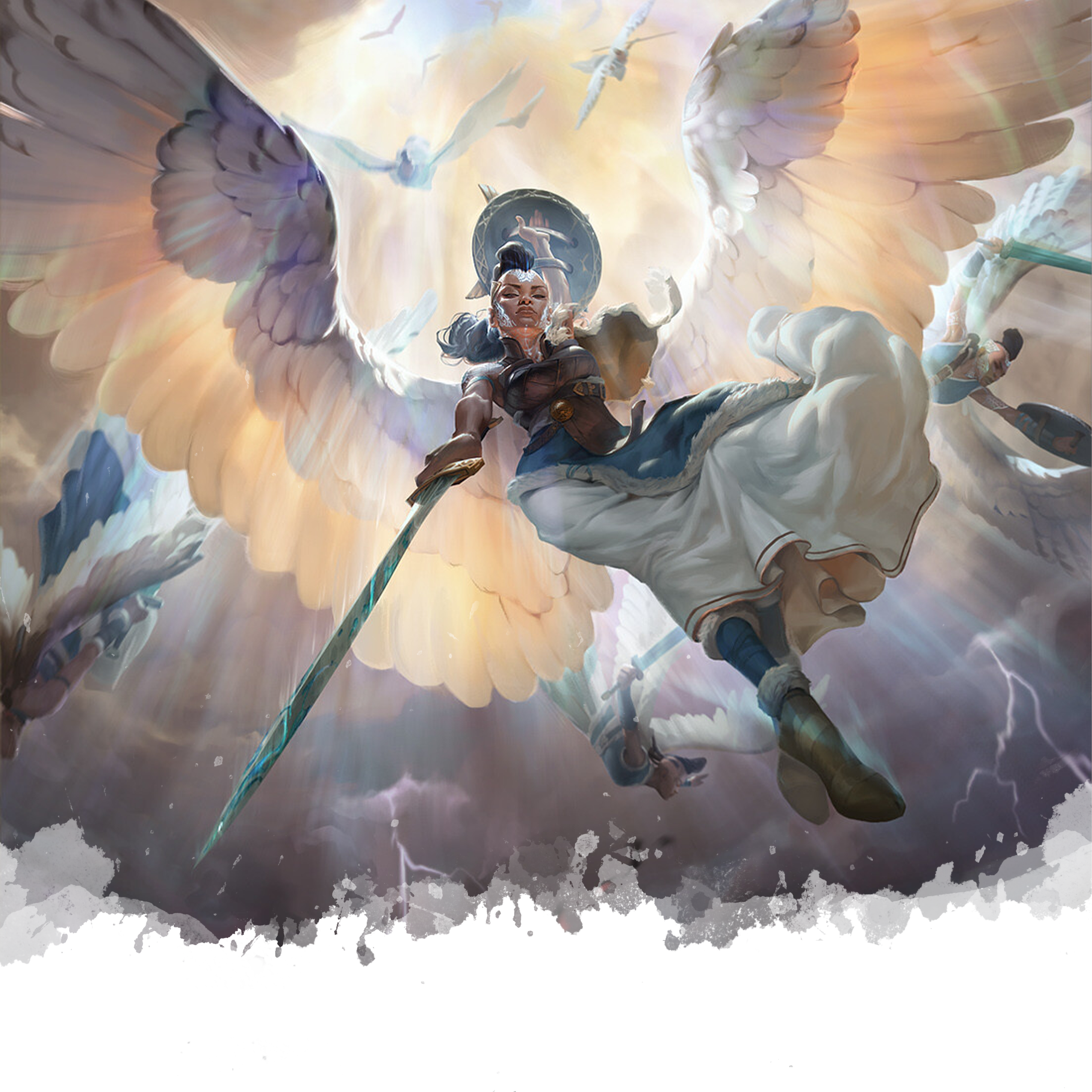
Valkyries have long witnessed your deeds, and they now deem you worthy of fighting alongside them. As a bonus action, you can call upon a cavalcade of winged spirits to surround you, gaining the following benefits for 1 minute:
- You gain a flying speed equal to your movement speed, as the spiritual valkyries carry you on the battlefield.
- You are immune to the charmed condition. If a creature attempts to charm or frighten you, you can use your reaction and cause them to make a Charisma saving throw against your spell save DC. On a failed save, they are restrained until the start of their next turn.
- When you take the Attack action on your turn, you can use a bonus action to make a weapon attack, guided by the fury of the spiritual valkyries.
Once you use this bonus action, you can't use it again until you finish a long rest, unless you expend a 5th-level spell slot to use it again.
Ranger
A Ranger is a traveler and a trailblazer. We thought that the aspect of Norse mythology better representing this identity would be the World Tree Yggdrasil, which connects the realms through its branches and offers infinite paths to journey through.
The Treestrider can teleport attacks, items, allies and spells through summoned branches of Yggdrasil. Even the legendary squirrel Ratakoskr gives a helping hand, carrying messages and items across the realms for the party. At high levels, the Treestrider is able to fully channel the powers and wisdom of Yggdrasil, having access to a single daily cast of either the Teleport, Divination or Legend Lore spells.
Having tested the archetype in combat, we found that these features have a profound impact on both the fight and the playstyle of the class. The Ranger stops being a jack-of-all-trades and assumes the mantle of a commander or supporting presence, playing with the battlefield and enriching combat opportunities for the whole party. Keep in mind: this subclass might not be the best suited for you if you don't like the role.
Ranger Conclave
Treestrider
Treestriders have ventured beyond the boundaries of their world by communing with Yggdrasil, the World Tree. Within its roots and branches, these rangers find countless doors to cross over to other realms and obtain a newfound awareness, provided they are capable enough to brave the twisting paths. These mystical travelers can be warriors, manipulating the battlefield to their advantage by summoning projections of the World Tree; knowledge-seekers, walking the paths of Yggdrasil to uncover its wisdom; or even caretakers, tending to their companions through their all-reaching magic. Their home is everywhere, and their own roots keep growing deeper.
Yggdrasil Magic
3rd-level Treestrider feature
You learn an additional spell when you reach certain levels in this class, as shown in the Yggdrasil Spells table. Each spell counts as a ranger spell for you, but it doesn't count against the number of ranger spells you know.
Yggdrasil Spells
| Ranger Level | Spells |
|---|---|
| 3rd | comprehend languages, message |
| 5th | misty step |
| 9th | clairvoyance |
| 13th | banishment |
| 17th | scrying |
Branches of the Ash
3rd-level Treestrider feature
Your connection with the World Tree allows you to invoke its extensions to take advantage of their ubiquity. As an action, you can conjure a number of Branches of Yggdrasil equal to your Wisdom modifier (minimum of 1) within 60 feet of you. A Branch of Yggdrasil has the following properties:
- It occupies a 5-foot-radius, 10-foot-high cylinder.
- It is considered a magical effect for all rules purposes.
- Objects and creatures can move through it and can occupy the same space it occupies as though it wasn’t there.
- It can be targeted by attacks and spells and can be subjected to any damaging effect or spell. It has an AC of 10 + your proficiency bonus, and taking any amount of damage causes it to disappear. It is immune to psychic damage.
- If, at any time, it's more than 120 feet away from you, the Branch of Yggdrasil disappears.
For 1 minute after you expend a use of this feature, you can conjure one Branch of Yggdrasil in a space within 60 feet of you without expending a use of this feature. You can do this once per turn, as part of any other action. After this minute, all Branches of Yggdrasil disappear. You can make any or all Branches disappear at any time (no action required).
You can't conjure a Branch of Yggdrasil behind total cover.
When you expend a use of this feature, any Branch of Yggdrasil previously conjured disappears.
You can use this feature a number of times equal to your proficiency bonus. You regain expended uses when you finish a long rest.

Branching Connections
3rd-level Treestrider feature
The Branches of Yggdrasil that you conjure connect the spaces they touch, allowing you and your allies to move items across the battlefield and deliver attacks from one branch to the other. Any creature of your choice (including you) can interact with your Branches of Yggdrasil in the following ways:
- If there is a Branch of Yggdrasil within 5 feet of you, you can use it to teleport a melee attack to another Branch of Yggdrasil and target a creature within 5 feet of that Branch. You see your target as if you were occupying the space of the delivering Branch. Once you make an attack in this way, one Branch within 5 feet of you disappears.
- You can use Branches of Yggdrasil to teleport a projectile or thrown weapon. When you make a ranged weapon attack, you can choose a Branch of Yggdrasil to receive the attack, and another Branch of Yggdrasil to deliver the attack. The effective distance of the attack equals the distance that separates you and the receiving Branch of Yggdrasil, plus the distance that separates the delivering Branch of Yggdrasil and your target. You have to be able to see your target to make an attack this way, but you check for cover considering the new direction of the projectile or weapon. Once you make an attack this way, the Branch of Yggdrasil that received the projectile or weapon disappears. When you reach 11th level in this class, you can use this benefit to teleport a ranged spell attack as well.
- If there is a Branch of Yggdrasil within 5 feet of you, you can take a bonus action and use it to teleport an item that can be held in one hand. The item disappears and immediately reappears in the space occupied by another Branch of Yggdrasil of your choice, falling on the ground. A creature within 5 feet of the delivering Branch that sees the item apparating can take a reaction to snatch the item, provided they have a free hand to do so. If more that one creature take this reaction, they make a contested Dexterity check, and the winner manages to grab the item.
Channelling Connections
7th-level Treestrider feature
Your bond with the World Tree deepens: you can now physically travel through its extensions, and use them to channel magic. Any creature of your choice (including you) can interact with your Branches of Yggdrasil in the following additional ways:
-
If there is a Branch of Yggdrasil within 5 feet of you, you can take a bonus action to instantly teleport to an unoccupied space within 5 feet of another Branch of Yggdrasil. After you teleport, the Branch from which you teleported disappears.
-
When you cast a spell with a range of touch, you can choose a Branch of Yggdrasil as the target of the spell. If you do, another Branch can deliver the spell to a new target within 5 feet of the Branch. When you cast a spell this way, the Branch that you chose as the target of the spell disappears.
Manifestation of Ratatoskr
7th-level Treestrider feature
You can call upon the legendary messenger of Yggdrasil to aid you. As an action, you can summon a magical squirrel, which you can command to perform one of the following actions:
- The squirrel can send a short message of twenty-five words or less to a creature with which you are familiar. You tell the message to the squirrel, which disappears and instantly reappears before the recipient, speaking in your voice. The creature recognizes you as the sender if they know you, and can answer in a like manner immediately. The squirrel makes it so creatures with Intelligence scores of at least 1 can understand the meaning of your message. The squirrel can send the message across any distance and even to other planes of existence.
- The squirrel can deliver an object to a creature with which you are familiar. The object must fit in a 5-foot-cube. You give the object to the squirrel, which instantly teleports to the recipient. The squirrel can wait for up to 1 minute for someone to take the object. If no one does, the squirrel teleports back to you bringing the object along with it.
- The squirrel can bring you a simple object. The object can be a shield, a weapon from the Weapons table, an item from the Adventuring Gear table, or any one non-magical item that costs no more than 50 gp. When you make your request, the squirrel magically disappears, reappearing 24 hours later with the object you requested.
You can use this feature a number of times equal to your proficiency bonus. You regain expended uses when you finish a long rest.
Undying Connections
11th-level Treestrider feature
The extension you conjure are difficult to sever and grant you even more possibilities, as your grip on the World Tree strengthens. Any creature of your choice (including you) can interact with your Branches of Yggdrasil in the following additional way:
- When you cast a spell, you can choose a Branch of Yggdrasil within 5 feet of you that you can see and another Branch within 60 feet of you that you can see. The spell is cast as if you were occupying the same space of the chosen Branch that is within 60 feet of you. Once you cast a spell this way, the chosen Branch of Yggdrasil that is within 5 feet of you disappears.
Additionally, when a Branch of Yggdrasil would disappear as a result of taking damage, make a Constitution saving throw. On a successful save, the Branch of Yggdrasill doesn't disappear. The DC of the save equals 10 or half the damage inflicted to the Branch of Yggdrasil, whichever is higher.
The Wells of Mímir, Urdr and Hvergelmir
15th-level Treestrider feature
Yggdrasil is held by three strong roots, each of which reaches one distinct well in three different Realms. You are able to use your connection to the World Tree to briefly tap into the powers of those wells. When you use this feature, choose one of the following options:
- As you reach into the immense wisdom of the Well of Mímir, you can cast the legend lore spell once without expending a spell slot. You don’t need material components to cast the spell.
- As you reach into the Well of Ur∂r, from which the Norns tend to the World Tree, you can cast the divination spell once without expending a spell slot. You don’t need material components to cast the spell. The spell puts you in contact with one of the Norns.
- As you reach into the Well of Hvergelmir and follow its world-spanning rivers, you can cast the teleport spell once without expending a spell slot. You don’t need material components to cast the spell.
Once you have used this feature, you can't use it again until you finish a long rest.
Rogue
The Rogue is the most mischievous class in D&D and, lucky for us, there's a very much alike figure in the Norse myths: Loki was an obvious choice, as his deceptive and cunning demeanor play very well into the Rogue's identity and style.
The Deceiver is a wild card and a true con artist. It immediately knows how to hide his identity and how to trick others into his schemes. Its combat style also is twisted and deceitful, turning allies into enemies and pulling off sneak attacks even when directly facing its opponents. Though its shapeshifting is only an illusion at first, it becomes a tangible power later on.
We hope the subclass makes you feel as charming and elusive as the trickster god. With a Deceiver in your party, every social interaction could turn into a quite thrilling matter.
Roguish Archetype
Deceiver
Rogues of the Deceiver archetype can channel a fragment of the mischievous power of Loki, the god of guile and deceit. These rogues are both elusive fighters and charismatic liars; they hold the power to alter their own image and very nature, much like the ambiguous shapeshifter god. A Deceiver possesses the power to fool their foes into believing their misdirections, dissolving their reality into a finely crafted web of lies of which they are the epitome and sole controller, shapeless and intangible, one for whom the concept of "truth" does not apply.
Bonus Proficiencies
3rd-level Deceiver feature
You gain proficiency in the Deception skill. If you are already proficient in it, you gain proficiency in a skill of your choice.
Deceitful Fighting
3rd-level Deceiver feature
You are unreadable in battle, throwing off your opponents with your every step and taking advantage of their confusion. As a bonus action, you can make a Charisma (Deception) check against a creature you can see that isn't incapacitated, contested by the target's Wisdom (Insight) check. If you win the contest, you can use your Sneak Attack against that target even if you don't have advantage on the roll, but not if you have disadvantage on it. This effect lasts for 1 minute or until you successfully use this feature against a different target.
Shifting Visage
3rd-level Deceiver feature
You are able to mimic the shapeshifting powers of the trickster god. You can take an action to cast the disguise self spell. The DC for checks made to discern this disguise equals 8 + your Proficiency Bonus + your Charisma modifier.
You can use this feature a number of times equal to your proficiency bonus. You regain all expended uses when you finish a long rest.
When you reach 9th level in this class, you can cast the alter self spell with a use of this feature.
Smoke and Mirrors
9th-level Deceiver feature
You magically twist the perceptions of your foes, presenting yourself as a victim of injustice and turning them on their own allies. When a creature hits you with an attack, you can use your reaction and target one or more creatures within 60 feet of you that can see and hear you, up to a number equal to your Charisma modifier (minimum of one target). The targeted creatures must make a Wisdom saving throw. A creature that failed the save becomes friendly toward you and hostile toward the attacker, if they weren't already. The effect lasts one minute, and it ends early on a creature if you attack them, or if the creature that attacked you dies.
Once a creature succeeds on the save, they can't be affected by this feature for 24 hours. A creature that can't be charmed is immune to this effect.
You can use this feature a number of times equal to your proficiency bonus. You regain expended uses when you finish a long rest.
The DC for saving throws forced by this feature equals 8 + your Proficiency Bonus + your Charisma modifier.
Two-Faced
13th-level Deceiver feature
You have learned to move unseen, leaving behind you a residual image which acts as a decoy for your enemies. As an action, you become invisible at the same time that an illusory double of you appears where you are standing. Anything you are wearing or carrying is invisible as long as it's on your person. The illusion matches the appearance you have when you use this feature. You can use your bonus action to move your illusory double up to 30 feet and make it gesture, speak, and behave in whatever way you choose.
The illusion has your AC, and if a creature hits it with an attack, it vanishes. It is otherwise immune to damage. Creatures that can see the illusion can take an action and make an Intelligence (Investigation) check contested by your Charisma (Deception) check. If they win, they see the illusion for what it is.
When the illusion vanishes as the result of an attack that hit it, you can use your Smoke and Mirrors feature as if you were hit. If you do, creatures affected by it pay no mind to the illusion's disappearance, believing you took the attack.
The invisibility and the illusion last for 10 minutes. The invisibility ends early if you attack, cast a spell, use the Smoke and Mirrors feature, or if you dismiss it (no action required).
Once you have used this feature, you can't use it again until you finish a short or long rest.
Multifarious
17th-level Deceiver feature
Your shapeshifting capacities have reached a level that can only be challenged by the gods themselves.
You are considered a shapechanger for all rules purposes, and when you use your Shifting Visage feature to cast the alter self spell, the duration of the spell is changed to be a number of hours equal to your proficiency bonus.
Additionally, you can take an action to cast the polymorph spell without needing material components, with the following changes:
- You can only choose yourself as a target of the spell.
- The spell can affect you even if you are a shapechanger.
- The challenge rating of the beast you choose to transform into must be 1 or less.
- While transformed, you keep your mental ability scores.
- While transformed, you can use your Smoke and Mirrors and Two-Faced features.
Sorcerer
Raw, powerful magic permeates Norse mythology, offering many different opportunities for a Sorcerer archetype. We explored different ideas for its magical origins, such as the elemental forces of fire and ice, or even the more primal energy of creation.
At last, we chose its source of magic to be Helheimr, the realm of the dead. A Helsoul is eerily reminding of a Draugr or a ghost, as the magical energy of Helheimr changes its very nature. It is representative of the many depictions of undeath found in the Norse myths.
The subclass has its core in necrotic damage and curses. Having access to an alternative type of transmutation metamagic, it is able to turn elemental damage into necrotic, which is needed to trigger Putrefy or to gain useful damage rerolls from its Eye of the Draugr curse. With Putrefy, we tried to steer away from save-or-suck mechanics, implementing a minor effect even when the opponent rolls a successful saving throw.
The Helsoul also gains access to a rather important out-of-combat ability, being able to cast Speak with Dead even when there is no body to be found, given that it met the target at least once. This could be a major narrative tool, for both player and DM.
Sorcerous Origin
Helsoul
Helsoul sorcerers are bound to the magic of the hopeless, barren lands of Helheimr, the realm of the dead. Your bloodline might be cursed by forbidden rites performed by your lost ancestors, or you might be mysteriously connected to the forces of the lands of the passed, where the souls of those who died without honor live their torments. Whatever the reason, you have developed a deep affinity to necromancy and to the spirits of the deceased, and your very nature has twisted into something more sinister, not alive nor dead. Others might shun you and curse you, keep away from you or treat you with deference. To all of them, you stand as a grim reminder of something to come.
Hel Spells
1st-level Helsoul feature
Starting at 1st level, you learn additional spells when you reach certain levels in this class, as shown on the Hel Spells table. Each of these spells counts as a sorcerer spell for you, but it doesn't count against the number of sorcerer spells you know. Whenever you gain a sorcerer level, you can replace one spell you gained from this feature with another spell of the same level. The new spell must be a necromancy or enchantment spell from the sorcerer, warlock, or wizard spell list.
Trigger Warning
Some descriptions featured in this archetype present slight body horror imagery.
Hel Spells
| Sorcerer Level | Spells |
|---|---|
| 1st | hex, inflict wounds |
| 3rd | gentle repose, ray of enfeeblement |
| 5th | speak with dead, summon undeadTCoE |
| 7th | blight, shadow of moilXGtE |
| 9th | danse macabreXGtE, negative energy floodXGtE |
Eye of the Draugr
1st-level Helsoul feature
You can curse your enemies with the evil eye, a dreadful hex that can put the living on a path towards certain death. As a bonus action, you can choose a creature within 60 feet of you that you can see and curse them for 1 minute. The curse ends early if the target dies, you die, or you use this feature on another creature. Until the curse ends, you gain the following benefits:
- When you deal necrotic damage to the cursed creature, that creature can't regain hit points until the end of their next turn.
- When you deal necrotic damage to the cursed creature, you can reroll any damage dice of 1 and 2. You must use the second rolls.
- If the cursed target dies, you regain hit points equal to your sorcerer level + your Charisma modifier (minimum of 1 hit point).
You can use this feature a number of times equal to your proficiency bonus and you regain all expended uses when you finish a long rest.
Undead Nature
1st-level Helsoul feature
The ghastly magic of the land of the dead courses through your form, moulding you into something a little less than alive, as well as a little less likely to die. You don't need to eat, drink or breathe, you suffer none of the frailty of old age, and you can't be aged magically. You can still die of old age.
Additionally, you have advantage on death saving throws. If you would become stable as a result of succeeding on three death saving throws, you regain 1 hit point.
Commune With Hel
6th-level Helsoul feature
Your direct link to Helheimr allows you to call upon the souls of the deceased to gain information. When you cast the speak with dead spell, you can target any creature that you have met at least once and you know has died. You follow the description of the spell, with the following exception:
- You briefly summon the spirit of the deceased and receive your answers from it, effectively making it so you don't need the body of your target for the spell to work.
Putrefy
6th-level Helsoul feature
When you deal necrotic damage to a creature, you can use your reaction and have the necrotic energy cling to their body to putrefy parts of it. Choose one of the following effects:
- The hands of your target rot and lose their grip. If the target creature is holding a weapon or object, they must make a Constitution saving throw against your spell save DC. On a failed save, they drop whatever they are holding. Whether they save or fail, they have disadvantage on attack rolls they make for 1 minute. At the end of each of their turns, they can make a Constitution saving throw against your spell save DC, ending the effect on themselves on a success.
- The legs of your target yield and crumble. The target creature must make a Constitution saving throw against your spell save DC. On a failed save, they are knocked prone. Whether they save or fail, their movement speed is reduced by 10 feet for 1 minute. At the end of each of their turns, they can make a Constitution saving throw against your spell save DC, ending the effect on themselves on a success.
- The eyes of your target grow dull and weary. The target creature must make a Constitution saving throw against your spell save DC. On a failed save, they are blinded for 1 minute. On a success, they have disadvantage on Wisdom (Perception) checks for 1 minute. At the end of each of their turns, they can make a Constitution saving throw against your spell save DC, ending the effect on themselves on a success.
- Your target weakens, as necrotic energy seeps through their muscles and very bones. The target creature must make a Constitution saving throw against your spell save DC. On a failed save, their armor class is reduced by 2 for 1 minute. Whether they save or fail, they have disadvantage on Strength (Athletics) checks for 1 minute. At the end of each of their turns, they can make a Constitution saving throw against your spell save DC, ending all effects on themselves on a success.
You can use this feature a number of times equal to your proficiency bonus. You regain expended uses when you finish a long rest.

Necrotic Transmutation
6th-level Helsoul feature
When you deal acid, cold, fire, lightning, poison or thunder damage to a creature, you can spend 2 sorcery points to change that damage type to necrotic instead.
When you use this feature on a spell, you can't use any Metamagic option on the same casting of the spell, with the exception of Metamagic options that can be used even if you have already used a different Metamagic option during the casting of the spell.
Deathguise
14th-level Helsoul feature
You completely manifest your undead nature, becoming an apparition of death, a dreadful spirit which only presence is enough to drive a mortal insane. As a bonus action, you can twist your body into an undead form for 10 minutes. While transformed this way, you gain the following benefits:
- You gain a number of temporary hit points equal to your sorcerer level + your Charisma modifier.
- You can use the life essence of the living to fuel your magic. When a creature affected by your Eye of the Draugr feature drops to 0 hit points, or when a creature fails a saving throw forced by your Putrefy feature, you regain 1 sorcery point.
- Your body becomes unnaturally strong and resistant. You have advantage on Strength and Constitution saving throws, and you gain resistance to necrotic and poison damage.
- Your nature becomes akin to that of an undead monster. You cannot be charmed, frightened or poisoned, and you are immune to exhaustion.
Additionally, when you use this bonus action, up to five creatures of your choice within 60 feet of you that can see you must make a Wisdom saving throw. On a failed save, they are frightened of you for the duration of your transformation. A creature cursed by your Eye of the Draugr feature automatically fails this saving throw. At the end of their turn, a frightened creature can repeat the saving throw, ending the effect on themselves on a success.
Once you use this feature, you can't use it again until you finish a long rest, unless you spend 5 sorcery points to use it again.
Tide of the Dead
18th-level Helsoul feature
You can summon a fraction of Náströnd, the sea of corpses, urging the deceased to fight one last time in your servitude. As an action, you can target an area 90 feet across. Skeletons, zombies and other undead rise up from the ground, recalled from Helheimr, swarming the targeted area. Choose one of the following effects when you use this feature:
Interposing Dead: The corpses shield you and your allies, protecting you from attacks from afar. When creatures of your choice within the area are hit by any attack, you can roll a d20. On a 12 or higher, the attack misses, hitting a corpse instead of the target creature.
Clinging Dead: The corpses grasp and hang onto your enemies, hindering their movements and actions. The area becomes difficult terrain for all creatures of your choice, and those creatures have disadvantage on attack rolls, ability checks and saving throws based on Strength and Dexterity. Additionally, creatures of your choice within the area that are concentrating on a spell must make a Constitution saving throw at the beginning of each of their turns to maintain concentration on that spell.
Overwhelming Dead: The corpses flock to your enemies and submerge them under a wave of rotting flesh. Up to five creatures of your choice in the area must make a Strength saving throw against your spell save DC. On a failed save, they fall under the weight of the corpses and become blinded, prone and restrained for as long as this effect is active. A submerged creature is considered being behind full cover. A submerged creature can repeat the saving throw at the end of their turn, ending the effect on themselves on a success.
Clawing Dead: The corpses reach out and attack your enemies with nailless claws and rotting teeth. Creatures of your choice that are within the area when you choose this effect take 4d6 necrotic damage.
At the beginning of each of your turns, you can change the active effect of this feature. Only one effect can be active at a time.
This feature's effects last for 1 minute, after which the sea of undead crumbles to ash, returning to the land of the dead.
Once you use this feature, you cannot use it again until you complete a long rest, unless you spend 7 sorcery points to use it again.
Warlock
The Warlock is a class that is often portrayed as an agent – be it reluctant or compliant – of terrible and villainous entities. Norse mythology is packed with these kind of destructive forces, so we felt that we would be doing a disservice by only dedicating this archetype to one of the many mortal enemies of the gods: should it be Fenrir or Jormungandr, Nidhoggr or Surtr? And the list does not even end there.
We have always been fascinated with multi-choice classes, so we seized the occasion to include all of these monstrous being in a single archetype. Choosing a wolf patron makes you into a relentless predator, especially effective against restraining abilities; the wyrm gives you wings, the ability to move underwater and to imbue your spells with poison; the giant is a martial class, granting you some of the tools available to the Hexblade, but focusing more on offense. The common theme is to feel like an unstoppable force, just as these patrons are.
Each patron aids a different type of playstyle, be it melee, ranged, or a mix of the two. The wolf has some minor synergies with the Pact of the Chain, while the giant was created with the Pact of the Blade in mind, but could also work with a more creative flame blade build. We hope this subclass opens the way to some pretty fun characters, both mechanically and narratively.
Otherwordly Patron
The Twilight Harbinger
You have struck a pact with an entity that will one day bring about Ragnarok, the twilight of the Gods. Your patron is a foil to the Aesir, a destroyer that hungers for the end of creation. You are walking down the same path, whether you have accepted your fate or decide to struggle against it. Among the end bringers are Linnorms, serpentine dragons such as Niddhogr, who gnaws on the roots of Yggdrasil, and the world serpent, Jormungandr, as well as countless other wyrm progeny; the canine monsters, counting the hell-hound Garmr, the twin wolves Skoll and Hati, and the great wolf Fenrir, who will ultimately devour the world; and the fire giants of Muspelheimr, led by the fearsome Surtr, who will struck down Asgardr and engulf the nine realms in flame. You choose your patron's nature or determine it randomly, using the Twilight Harbinger Kind table.
Twilight Harbinger Kind
| d6 | Kind |
|---|---|
| 1-2 | Wyrm |
| 3-4 | Wolf |
| 5-6 | Giant |
Expanded Spell List
1st-level Twilight Harbinger feature
The Twilight Harbinger lets you choose from an expanded list of spells when you learn a warlock spell. The Twilight Harbinger Spells table shows the spells that are added to the warlock spell list for you, along with the spells associated in the table with your patron's kind: wyrm, wolf, or giant.
Unrelenting Spite
1st-level Twilight Harbinger feature
You will swiftly pursue your enemies until their fateful demise. You can add your proficiency bonus to initiative rolls.
Portents of Doom
1st-level Twilight Harbinger feature
You gain a fragment of the supernatural capabilities of your patron, granting you enhanced senses or fighting prowess. You gain one of the following features, depending on the nature of your patron:
Blood of the Dragon (Wyrm): You gain a shred of the venomous nature of a wyrm's blood. You have advantage on saving throws against poison, and you have resistance against poison damage.
Additionally, you can imbue your spells with the noxious power of wyrms. When you deal damage with a spell of first level or higher, you can force the creature that took the damage to make a Constitution saving throw against your spell DC or be poisoned until the start of your next turn.
You can use this feature a number of times equal to your proficiency bonus, and you regain all expended uses when you finish a long rest.
Scent of Blood (Wolf): You gain a fraction of the hunting senses of your patron, attaining the sharp smell for blood of the wolf. If there are creatures within 90 feet of you or your familiar that are missing any of their hit points, you know who they are. Once on each of your turns, you can focus your senses on any number of those creatures, and know which of the selected creatures has the lowest current hit points.
Additionally, you have advantage on saving throws made against effects or spells that would reduce your speed or cause you to be paralyzed or restrained, and you can spend half of your movement to automatically escape a grapple.
If you later gain the Pact of the Chain feature, when you cast the find familiar spell, you can choose your familiar to be a wolf.
Prowess of the Giant (Giant): You gain a modicum of the devastating might of the warring giants of Muspelheimr. You gain proficiency with shields, scimitars, and longswords.
Twilight Harbinger Spells
| Spell Level | Twilight Harbinger Spells | Wyrm Spells | Wolf Spells | Giant Spells |
|---|---|---|---|---|
| 1st | bane | ray of sickness | inflict wounds | burning hands |
| 2nd | phantasmal force | Melf's acid arrow | Maximilian's earthen graspXGtE (appears as chains) | flame blade |
| 3rd | bestow curse | tidal waveXGtE | vampiric touch | elemental weapon (fire only) |
| 4th | phantasmal killer | vitriolic sphereXGtE | Mordenkainen's faithful hound | fire shield |
| 5th | destructive wave (necrotic damage only) | cloudkill | Bigby's hand (appears as a wolf's claw) | immolationXGtE |
Additionally, as long as you're not wearing armor, your AC equals 13 + your Dexterity modifier, as a wreathe of flames surrounds you.
If you later gain the Pact of the Blade feature, when you conjure a pact weapon that is a scimitar, shortsword, longsword or greatsword, it becomes embroiled with magical fire. When you attack with that weapon, you can use your Charisma modifier, instead of Strength or Dexterity, for the attack and damage rolls. This effect also extends to the attacks you make with the blade summoned by the flame blade spell.
Boons of Annihilation
6th-level Twilight Harbinger feature
Your patron grants you powerful boons, enhancing your capabilities of seeking out, chasing and destroying your enemies. You gain one of the following features, depending on the nature of your patron:
Flight of the Dragon (Wyrm): Your patron bestows upon you the power to move through air and water as effortlessly as a serpent of legends. As a bonus action, you gain a flying speed and a swimming speed of 30 feet for 10 minutes. During this time, you are capable of breathing underwater and you don't provoke opportunity attacks.
You can use this feature a number of times equal to your proficiency bonus, and you regain all expended uses when you finish a long rest.
Bloodied Chase (Wolf): Your patron enhances your predatory senses, giving you the power to faultlessly hunt down your enemies, tuning into their smell and chasing them to their demise. You can use a bonus action to target a creature within 90 feet of you that is missing any of their hit points. For 1 minute, the creature is cursed. While that creature is cursed this way, you always know their location if they are within 90 feet of you, they can't become hidden from you, if they're invisible they gain no benefit from that condition against you, you have advantage on attack rolls you make against them, and the first time you hit them with an attack on each of your turns, you regain hit points equal to your Charisma modifier.
The curse ends early if the creature is healed to their full hit points or if they die.
Once you take this bonus action, you can't take it again until you finish a short or long rest.
Smite of Muspelheimr (Giant): Your strikes are empowered with the searing heat of Muspelheimr's fire. When you take the Attack action, the first time on each of your turns that you hit a creature with a weapon attack or melee spell attack you make, that attack deals an extra 1d6 fire damage. This damage increases to 2d6 at 11th level and 3d6 at 17th level.
Break Free
10th-level Twilight Harbinger feature
You scoff at those who would wish to hold you, to bind you, to banish you: you're coming for them, and they cannot stop you. Your movement is unaffected by difficult terrain, and being underwater imposes no penalties on your movement and attacks.
Additionally, you only need 10 ft of movement to get up from prone and to mount or dismount a creature.
Bring the End
14th-level Endbringer feature
As you are finally entrusted with your patron’s most terrible weapons of destruction, each battlefield you partake in resembles Ragnarok. You gain one of the following features, depending on the nature of your patron.
Venom of the Linnorm (Wyrm): You release the venom of the linnorms upon your enemies, eating away their flesh and dragging them closer to death with each step they take. You can use your action to breathe poison into a 60-foot-cone originating from you. Creatures in the area must make a Constitution saving throw against your spell save DC. On a failed save, they take 10d6 poison damage and are poisoned. On a successful save, they take half as much damage and aren't poisoned. While a creature is poisoned by this feature, they take 1d6 poison damage for each 5 feet that they move.
A creature that is poisoned by this feature can make a Constitution saving throw at the end of each of their turns, ending the effect on themselves on a success.
After you use this feature, you can't use it again until you finish a long rest.
Maw of the Wolf (Wolf): You call upon an apparition of your patron to devour your enemies. As a bonus action, you can summon a spectral wolf maw by your side. When you use this feature and as a bonus action on each of your turns, you can make a melee spell attack on a target within 60 feet of you. The wolf maw rushes towards its target, feasting on them. On a hit, the target takes 4d10 necrotic damage and is grappled and restrained by the maw until the start of your next turn. A grappled creature can use their action to make a Strength (Athletics) or Dexterity (Acrobatics) check against your spell save DC. On a success, they free themselves from the grapple.
A creature killed by damage from this feature is swallowed by the maws and disappears, along with anything they was wearing or carrying, with the exception of magical items. The creature can be restored to life only by means of a true resurrection or a wish spell.
The spectral wolf maw doesn't occupy its space and can move any number of feet when you command it to attack. It lasts for 1 minute or until you make it disappear (no action required).
After you use this feature, you can't use it again until you finish a long rest.
The Flaming Sword of Muspelheimr (Giant): You are capable of calling upon the magic of the fire giants to summon a scorching blade, reminiscent of those wielded by the denizens of Muspelheimr. As a bonus action, you can choose one of the following options:
- You summon the Flaming Sword of Muspelheimr, which is similar in shape to a longsword, but of unnaturally big size. You can use your action to make a melee spell attack with the sword, which deals 5d6 + your Charisma modifier fire damage on a hit.
- If you're wielding a weapon that can be affected by your Prowess of the Giant feature, you empower that weapon, wreathing it in the destructive fire of Muspelheimr.
Regardless of the option you choose, the weapon has a reach of 15 feet, and it sheds bright light in a radius of 15 feet and dim light in a radius of an additional 15 feet. When you hit with a melee weapon attack made with this weapon, you can cause the target to be set ablaze with the flames of Muspelheimr until the start of your next turn. While aflame this way, the target loses all resistances.
Additionally, when you hit a creature with an attack made with this weapon, creatures of your choice within 10 feet of the target creature must make a Dexterity saving throw. On a failed save, they take damage from your Smite of Muspelheimr feature and they lose damage resistances until the start of your next turn. They only take half damage on a successful save.
The summoned or empowered weapon lasts for 1 minute. After you use this feature, you can't use it again until you finish a long rest.

Wizard
Wizards in D&D are the scholars of magic. They approach the art methodically, exploring its meaning and inquiring its secrets. Odinn himself shares this analytical and unyielding outlook. In this same search for power and knowledge, he once hung himself from a branch of Yggdrasil. On the brink of death, he had an epiphany: he saw and understood the runes, and he finally obtained mastery of magic, which then he passed down to mankind.
We wanted our Norse wizard to walk down Odinn's path, mirroring his exploits and relentless chase for understanding. We rendered this mechanically by creating a fully choice-oriented progression. As the character learns and assimilates spells, it also delves into the hidden meaning of the runes, understanding more and more, and shaping its growth around these hand-picked powers.
This subclass is intended to be played over and over while never being exactly the same, as the player chooses and mixes different runes to create a personalized playstyle for their wizard. We do realize that there might be unintended consequences and undesirable combinations, but we thought the concept and effects to be fun enough to go through with the idea. We leave you the sacred duty and pleasure to work with your DM to work out the details, if you will need to.
Wizard School
Runeseer
Runeseers embark on a journey of understanding, as Odinn once did. They inquire the nature of magic and reality, meditating on their highest form of expression: the futhark runes. Within their sounds and shapes, different answers and revelations await each different mind and set of questions. Shining the light of intellect and intuition on the unknown and unfamiliar, Runeseers carve their own path of magic and develop their own concept of reality. At each step, they find a new intuition; at each crossroad, a new epiphany. At the end of the road, never truly in sight, they can discern the distant promise of omniscience.
Scholar of the Runes
2nd-level Runeseer feature
You study the hidden power of the runes to gain knowledge and power. You learn two runes of your choice from among the runes described below, and each time you gain a level in this class, you can replace one rune you know with a different one from the list of runes available to you. When you reach certain levels in this class, you learn additional runes.
The following runes are available to you when you learn a rune. Learning a rune unlocks its power and grants you the corresponding feature. You can learn each rune once,
unless the rune specifies differently. If a rune has a level requirement, you must be at least that level in this class to learn the rune. If a rune requires a saving throw, you use your spell save DC.
Fehu. This rune reveals prosperity and success. When you use a spell slot to cast a spell of 1st level or higher, you have advantage on the next attack roll or ability check you make until the end of your next turn.
Thurisaz. This rune warns of looming enemies and danger. You can add your proficiency bonus to initiative rolls you make.
Ansuz. This rune lauds the infinite wisdom of the Allfather. When you learn this rune, you add to your spellbook one wizard spell of a level for which you have spell slots. You can learn this rune up to a number of times equal to your Intelligence modifier, choosing a different spell each time. If you replace this rune, the associated spell disappears from your spellbook.
Raido. This rune announces an eventful journey. On your first turn after having rolled initiative, or when you take the Dash action, your movement speed is increased by 10 feet until the end of your turn.
Kenaz. This rune points to the enlightening power of the torch. You gain darkvision up to a distance of 60 feet. If you already have darkvision from other sources, its maximum distance is increased by 60 feet. As a bonus action, you can see through magical darkness to a distance of 60 feet for one minute. For the duration, you are under the effect of a Detect Magic spell. At 6th level, you are also under the effect of a See Invisibility spell. You can't take this bonus action again until you finish a short or long rest.
Eiwaz. This rune connects the living and the dead through the World Tree, giving you glimpses of forgotten knowledge you couldn’t otherwise possess. You have advantage on all Intelligence (Arcana), Intelligence (History), Intelligence (Nature) and Intelligence (Religion) checks you make.
Peorth. This rune revels in the pleasure of recreation. When you use your Arcane Recovery feature, add 1 to the combined spell slot levels you can recover. You can learn this rune more than once.

Hanging from the Tree
6th-level Runeseer feature
You learn two runes. Additionally, the following runes are added to the list of runes available to you when you learn a rune.
Hagalaz (6th level or higher). This rune threatens with the impending violence of hail. When you cast a spell that deals damage in an area of effect, you can use your reaction and cause residual magic to condense into battering hail. Until the start of your next turn, the area affected by the spell becomes difficult terrain. You can't take this reaction again until you finish a short or long rest.
Naudiz (6th level or higher). This rune reminds of the need for support when facing hardships. When you and a creature you can see must both make a saving throw at the same time, you can expend a spell slot of 3rd level or higher and give both you and that creature advantage on the saving throw. Once you use this effect, you can't do so again until you finish a short or long rest.
Gebo (6th level or higher). This rune tells of generosity, sacrifice and the gifts that come from them. As an action, you can touch a willing creature that is missing any spell slots, and consume one of your spell slots. That creature regains a spell slot of a level equal to or less than the one that you consumed. Once you have used this feature, you can't use it again until you finish a long rest.
Isaz (6th level or higher). This rune embodies the peaceful stillness of ice. As a bonus action, while you are concentrating on a spell, you can choose to go into an heightened state of isolation. While you are in this state, you have advantage on Constitution saving throws you make to mantain concentration. The state ends when you are no longer concentrating on a spell, or if you willingly move. Once you use this feature, you can't do so again until you finish a short or long rest.
Jeran (6th level or higher). This rune celebrates a bountiful harvest. When preparing your list of Wizard spells, you can prepare 1 additional spell. You can learn this rune more than once.
Ehwaz (6th level or higher). This rune commends the horse for its tireless service. You can cast the find steed spell once without expending a spell slot. When you reach 14th level in this class, you can cast the find greater steed spell once without expending a spell slot. When you cast either the find steed spell or the find greater steed spell with this feature, follow the spell's descritpion with the following exception: While mounted on your steed, you can make any spell you cast that targets only you also target your steed, as long as the spell is of 5th level or lower. Once you have cast a spell with this rune, you can’t do so again until you finish a long rest.
Dagaz (6th level or higher). This rune proclaims the arrival of the day. As an action, you touch a magic item that can hold charges and restore some of its charges. Follow the description of the item to see how many charges it regains. Once you have used this feature, you can't use it again until you finish a long rest.
A wizard with no spellbook
Norse people originally did not have paper, so they carved runes and drawings on what we call runestones. Books only started to appear after their contacts with Christians. If that's coherent with your setting, you could just have a wizard with a normal spellbook if you wanted to. We also think that playing a wizard very distant from the class trope – using no spellbook – is an interesting opportunity, whether using this subclass or any other. If you and the DM agree, you can have a set of 24 runes to act as your spellbook.
Your rune set. Instead of writing spells on the book, you would spend time pondering the runes and grasping their hidden magical powers. Mechanically, you still apply the rules of a normal spellbook, and can simply work with your DM to tweak its narrative aspect. For example, to copy a spell from a scroll (which could not be a scroll at all) you could spend the time and materials to attune with the scroll and transfer its magical powers onto your rune set. You could also link some spells to some of your runes, so that in case you lose a specific rune your access to those spells would be precluded, or use a simpler approach and say that the rune set only works as a spellbook if it has all of its 24 runes. The possibilities are endless!
Pierced by the Spear
10th-level Runeseer feature
You learn two runes. Additionally, the following runes are added to the list of runes available to you when you learn a rune.
Wunjo (10th level or higher). This rune exalts joy and its salvific capabilities. When a creature you can see within 90 feet of you casts a spell or uses an ability that makes a creature regain hit points, you can use your reaction to extend that healing. Choose a creature within 90 feet of you that you can see and that is not being targeted by a healing effect or spell. That creature regains the same amount of hit points as the creature first being targeted by the healing effect or spell. Once you use this feature, you can't do so again until you finish a short or long rest.
Algiz (10th level or higher). This rune evokes the majestic fortitude of the elk. When you should take damage, you can use your reaction and only take half of the total damage. Once you use this effect, you can't do so again until you finish a long rest.
Tiwaz (10th level or higher). This rune prompts to follow a righteous path, under the watchful gaze of Tyr. When a creature that can see you and from which you don't benefit from any cover forces you to make a saving throw, you can choose to gain advantage on that saving throw. Once you use this effect, you can't do so again until you finish a short or long rest.
Berkanan (10th level or higher). This rune blesses the generating capabilities of birch. Any creature that you summon or create with a conjuration spell has 15 temporary hit points.
Mannaz (10th level or higher). This rune glorifies the endless potential of the self. When you cast a spell of 5th level or lower with a range of self, you can choose a willing creature that you can see within 60 feet of you to be the origin point of the spell and gain its benefits. Once you have used this effect, you can’t use it again until you finish a long rest.
Laguz (10th level or higher). This rune manifests the transforming faculties of water. You can use an action and expend a 3rd level spell slot to target a number of willing creatures within 90 feet of you that you can see up to your Intelligence modifier. The position of a targeted creatures is swapped with that of another targeted creature in any way you choose. Once you have used this effect, you can’t do so again until you finish a short or long rest.
Sowilo (10th level or higher). This rune reveres the divine brightness of the sun. When you cast a spell that deals fire or radiant damage, you can force creatures affected by the spell to make a Constitution saving throw. On a failed save, they have disadvantage on Wisdom (Perception) checks and attack rolls for 1 minute. At the end of each of their turns, an affected creature can repeat the save, ending the effect on themselves on a success. If a spell you cast already forces the creatures affected by it to make a saving throw, and a failed save would blind them, the targeted creatures have disadvantage on that saving throw.
Once you use this effect, you can't do so again until you finish a long rest.
Gazing into the Waters Below
14th-level Runeseer feature
You learn one of the following runes.
You can only replace a rune from this feature with another rune from this feature. You cannot replace any other rune with one from this feature.
Uruz (14th level or higher). This rune beckons a mighty, untamed force. When you cast a spell that deals damage, you can reroll a number of the damage dice equal to the level of the spell slot you used to cast the spell. You must use the new rolls.
Othala (14th level or higher). This rune honors the binding duty of heritage. While you are concentrating on a spell, you can use an action to touch a willing creature with an Intelligence score of 10 or more. That creature now keeps concentration on that spell for you, and uses all rules for concentrating on a spell in your place, making it so you can concentrate on a different spell. If that creature is ever more than 90 feet from you, the concentration on the spell is dropped. Once you take this action, you can’t take it again until you finish a long rest.
Ingwaz (14th level or higher). This rune praises the might of the legendary Ingwaz, progenitor of kings. As an action, you can gain the following benefits:
- You summon a spectral apparitions of Ingwaz’s sword, for which you use the description of the Mordenkainen’s sword spell.
- You become clad in a magical, translucent armor. As long as you aren’t wearing any armor, your Armor Class equals 14 + your Intelligence modifier.
- You are invested by Ingwaz's might. You gain 30 temporary hit points.
This effect lasts for 1 minute. It ends early if you lose concentration, as if you were concentrating on a spell.
Once you take this action, you can’t take it again until you finish a long rest.