Table of Contents
Chapter One: Setting
- Settlements
- The Avatar
- Spirits
Chapter Two: Homebrew Rules
- Chi Point System
- Techniques (Spells)
- Technique Level (Upcasting)
- Special Sub Bending
- Skill Checks
- Bending
Chapter Three: Races
- Human
- Standard Human
- Elemental Bender
- Bending Lineages
Chapter Four: Classes
- Class List
- Bending Specialist
- Fighter
- Monk
- Rogue
- Scholar
Chapter Five: Equipments & Wealth
- Items & Wealth
- Expenses
- Armour
- Simple Weapons
- Martial Weapons
Chapter Six: Feats
Chapter Seven: Bending
- Waterbending List
- Earthbending List
- Firebending List
- Airbending List
- Waterbending Techniques
- Earthbending Techniques
- Firebending Techniques
- Airbending Techniques
- Bloodbending List
- Healing Specialist List
- Lavabending List
- Lightning Bending List
- Metal Bending List
- Bloodbending Techniques
- Healing Specialist Techniques
- Lavabending Techniques
- Lightning Bending Techniques
- Metal Bending Techniques

CHAPTER ONE: SETTING
The world of Avatar has always been one of my favourites; the bending, the worldbuilding, and the story itself were amazing. Today, I've decided to convert that world into D&D 5E. The power system in Avatar is known as bending or controlling an element to your will; it's something that you're born with and must train to master. Each bending discipline—water, earth, fire, and air—has its own unique movements and fighting styles. Waterbending originated from humans studying the moon and how it controlled the tides, while earthbending was inspired by the beasts known as badgermoles. Firebending was taught by the dragons, and airbending was passed down by the flying bison.
Settlements
There are four main settlements in the Avatar world: the Water Tribe residing in the North and South Poles; the Earth Kingdom spanning a vast continent; the Fire Nation on a series of volcanic islands; and the Air Nomads living in temples high in the mountains.
The Avatar
However, there's a person born to bring peace to all these nations in times of trouble. The Avatar is able to master all four bending disciplines and is reincarnated into a new body each time they pass away. The Avatar acts as a bridge between the Material and Spirit Worlds , ensuring balance and harmony in the world. With the ability to communicate with past Avatars and access the wisdom of their predecessors, the current Avatar is guided in their quest to maintain peace and order. Through their journey, they must conquer powerful enemies, and ultimately bring all four nations together to prevent chaos and destruction. The Avatar's duty is not just a responsibility but a destiny that shapes the fate of the entire world.
Spirits
Humans were given the ability to bend by the lion turtles, who granted them the power to manipulate the elements of fire, water, earth, and air. This gift allowed humans to survive in a world filled with dangerous spirits and powerful creatures. Creatures are able to travel through the Material and Spirit Worlds through meditation. Air Nomads are exceptionally good at this, using their spiritual connection to navigate between realms effortlessly. Travelling through the Spirit World does come with its own risks, like malevolent spirits like Koh the Face Stealer or being corrupted and ending up in the Fog of Lost Souls forever.

Warning
This homebrew hasn't been fully playtested, but I've attempted to balance it as well as I can and have taken feedback from people I've asked.
If you find any issues, feel free to fix them. This is my first actual homebrew and weeks of work have been put into this project, but of course there will be a couple mistakes. I encourage you to customise and tweak this material to better suit your gaming experience.
It's difficult to add new classes to 5E as they're either too weak or very broken. In this case, I have included the Bending Specialist Class. If you feel the need to nerf or buff it, you can do so.
Thank you for taking the time to try out this content, and I hope you have a great time using it in your games.
CHAPTER TWO: HOMEBREW RULES
Chi Point System
Instead of spell slots you use chi points, similar to the option spell point system from original 5e, the chi point cost is equal to the level of the technique (spell).
Techniques (Spells)
Techniques replace spells, each bending style has a technique list from Cantrip level to 5th-Level.
Technique Level (Upcasting)
If the technique has At Higher Level, you are able to use it at higher levels by increase the number of chi points spent to be equal to the new level, for example, if you use the 1st-Level Cure Wounds technique, which costs 1 chi point, at 3rd-Level it would instead cost 3 chi points to use.
Special Sub Bending
Special Sub Bending styles like Metal Bending and Blood Bending which are not included in their base bending style are locked behind feats due to their difficulty to learn or invent.
Skill Checks
Arcana is replaced with Bending, it’s used to detail your knowledge on bending styles and arts. Religion also groups Spirit World Knowledge. The new Crafting skill is an intelligence skill used to make new contraptions. Religion can be an Intelligence skill or a Wisdom skill.
Bending
To access bending you have to have the Variant Human: Elemental Bender race however without the Bending Specialist Class you can only access Cantrip level Bending Techniques. Once you have the Bending Specialist Class you begin to access the full list of techniques as you level up.
-
Bending Save DC. Your Bending Save DC will be used for techniques like the Fireball Technique, it’s the number opponents have to beat with their Saving throws in order to lessen the effects of your attack. It’s equal to 8 + your Bending modifier + your Proficiency bonus.
-
Bending Attack Bonus. If a technique calls for a melee or ranged attack roll against an opponent's Armour Class you roll a 1d20 and add your bending attack bonus to it. It’s equal to your Bending modifier + your Proficiency bonus.
-
Bender v Bender. Let’s say you’re a firebender and your opponent is about to attack you with a fire attack which requires you to make a Dexterity Saving throw to take half damage. At the DM’s discretion you can instead make a Bending Check to take half damage. Or if a firebender attacks you with a fire attack which requires them to make an attack roll, instead of them going against your AC you make a Bending Attack Roll against theirs and if you get higher than them then they fail the attack.
-
Feats. Some Feats have been changed to either better fit the Avatar world, buff Non-Benders etc, seek the Feats section to see all available feats.

CHARACTER CREATION

CHAPTER THREE: RACES
Human
Human Features
Perhaps it is because of their shorter lives that humans strive to achieve as much as they can in the years they are given. Or maybe they feel they have something to prove to themselves and the spirits of the world, and that's why most of them build their mighty settlements on the foundation of conquest and trade.
Whatever drives them, humans are the innovators, the achievers, and the pioneers of the world.
- Age. Humans reach adulthood in their late teens and live less than a century.
- Size. Humans vary widely in height and build, from barely 5 feet to well over 6 feet tall. Regardless of your position in that range, your size is Medium.
- Speed. Your base walking speed is 30 feet.
- Languages. You can speak, read, and write Common.
Standard Human
- Ability Score Increase. Choose two of your ability scores to increase by 2.
- Specialty. You may choose one of the following specialties:
- Hunter’s Specialty. Whenever you make a Wisdom (Perception) or a Wisdom (Survival) check, you can roll a d4 and add the number rolled to the total ability check.
- Wilderness Specialty. Whenever you make a Wisdom (Animal Handling) or a Intelligence (Nature) check, you can roll a d4 and add the number rolled to the total ability check.
- Artisan's Specialty. Whenever you make an Intelligence (Crafting) or an Ability Check involving Artisan's Tools, you can roll a d4 and add the number rolled to the total ability check.
- Performer’s Specialty. Whenever you make a Charisma (Performance) or an Ability Check involving an Instrument, you can roll a d4 and add the number rolled to the total ability check.
- Charmer’s Specialty. Whenever you make a Charisma (Persuasion) or a Charisma (Deception) check, you can roll a d4 and add the number rolled to the total ability check.
- Thieves Specialty. Whenever you make an Dexterity (Sleight of Hand) or an Ability Check involving Thieves Tools, you can roll a d4 and add the number rolled to the total ability check.
- Sentinel's Specialty. Whenever you make a Strength (Athletics) or a Wisdom (Insight) check, you can roll a d4 and add the number rolled to the total ability check.
Variant Human - Elemental Bender:
The four elemental bending arts are based on the four classical elements, water, earth, fire, and air, each being manipulated through certain martial art styles that are reminiscent of the qualities of the element itself. Bending is traditionally performed through the motions of one's hands and feet.
- Elemental Bending. You have the ability to use bending moves based on your elemental subrace. The Bending Move Table shows how many chi points you have. The table also shows what the level of those bending moves are. To use one of your bending moves of 1st level or higher, you must expend a number of chi points equal to the level. You regain all expended chi points when you finish a long rest. (Without the Bending Specialist Class you can only perform bending moves of Cantrip level.
- Subrace. There are four subraces of elemental benders, one for each of the primal elements: earth, fire, air, and water. Choose one of these subraces.
Bending Lineages
Waterbender
"Water is the element of change. The people of the Water Tribes are capable of adapting to many things. They have a sense of community and love that holds them together through anything."
- Ability Score Increase. Your Wisdom score increases by 2, and one other ability score increases by 1.
- Water Bending. You gain access to the Water Bender technique list. Your bending ability is Wisdom. The components for these techniques become Somatic and Material: an appropriate amount of water. You learn one cantrip level waterbending technique.
- Moon's Blessing. Your waterbending increases in certain climates, in rainy weather you gain a +1 bonus to your bending attack rolls, damage rolls and DCs as well as always having your material components. In the heavy rain weather the bonus becomes a +2. And in the monthly event of a full moon you gain a +3 to attack rolls, damage rolls and DCs and advantage on attack rolls. In dry weather your bending has a -1 subtracted to your bending attack rolls, damage rolls and DCs, in extreme sun weather it becomes a -2.
Airbender
"Air is the element of freedom. The Air Nomads detached themselves from worldly concerns and found peace and freedom. Also, they apparently had pretty good senses of humour."
- Ability Score Increase. Your Wisdom score increases by 2 and one other ability score increases by 1.
- Air Bending. You gain access to the Air Bender move list. Your bending ability is Wisdom. The components for these techniques become Somatic and Material: an appropriate amount of air. You learn one cantrip level airbending technique.
- Parry. As a reaction to being hit by an attack, you can add your Proficiency modifier to your AC, potentially causing the attack to miss. You can use this ability a number of times equal to your Wisdom modifier before needing a short or long rest.
- Lightfooted. Starting at 3rd level, you may take the Dash or Disengage action as a bonus action.
Earthbender
"Earth is the element of substance. The people of the Earth Kingdom are diverse and strong. They are persistent and enduring."
- Ability Score Increase. Your Strength or Wisdom scores increase by 2, and one other ability score increases by 1.
- Earth Bending. You gain access to the Earth Bender move list. Your bending ability is Strength or Wisdom. The components for these techniques become Somatic and Material: an appropriate amount of earth. You learn one cantrip level earthbending technique.
- Hands of Stone. As a bonus action, you can encase your hands in stone, using them to make unarmed strikes. If you hit with them, you deal bludgeoning damage equal to 1d6 + your Strength modifier.
- Solid Footing. Starting at 2nd level, when walking on earth, (rocks, solid/normal ground, etc.) terrain cannot be difficult for you. You can use your bonus action to allow any ally within 15 feet to also have this benefit while walking through the difficult terrain.
Firebender
"Fire is the element of power. The people of the Fire Nation have desire and will and the energy and drive to achieve what they want."
- Ability Score Increase. Your Constitution score increases by 2, and one other ability score increases by 1.
- Fire Bending. You gain access to the Fire Bender move list. Your bending ability is Constitution. The components for these techniques become Somatic and Material: your breath. You learn one cantrip level firebending technique.
- Sun Blessing's. Your firebending increases in certain climates, in sunny weather at noon you gain a +1 bonus to your bending attack rolls, damage rolls and DCs. In the extreme sun weather you the bonus becomes a +2. In the rare event of a large comet you gain a +4 to attack rolls, damage rolls and DCs and advantage on attack rolls. During a large comet, once per turn, you can reroll the damage of your fire techniques. In humid weather your firebending has a -1 subtracted to your bending attack rolls, damage rolls and DCs and in rainy weather this becomes a -2.
CHAPTER FOUR: CLASSES

Classes
Choice
Choosing your character’s class is one of the most important decisions you will make when creating your character for a new campaign. Choosing the right class for yourself and your character will dictate the effectiveness of your character’s career.
What is a Class?
Your character’s class determines their skills and abilities, ultimately dictating how they are played. Skills are determined by particular Class Features, while abilities are measured by Ability Scores.
Class List
| Class Name | Hit Die | Saving Throws | Proficiencies |
|---|---|---|---|
| Bending Specialist | 1d8 | Varies | Varies |
| Fighter | 1d10 | Strength & Constitution | All Armour, Shields, Simple Weapons, Martial Weapons |
| Monk | 1d10 | Strength & Dexterity | Simple Weapons, Shortswords |
| Rogue | 1d8 | Dexterity & Intelligence | Light Armour, Simple Weapons, Longswords, Rapiers, Shortswords |
| Scholar | 1d6 | Wisdom & Intelligence | Light Armour, Simple Weapons, Shortswords |
Bending Specialist
The Bending Specialist
| Level | Proficiency Bonus | Features | Techniques Known | Chi Points | Capability |
|---|---|---|---|---|---|
| 1st | +2 | Bending Type, Bending Style, Untapped Potential | 2 | 3 | 1st Level |
| 2nd | +2 | Chi Replenish | 3 | 4 | 1st Level |
| 3rd | +2 | Bending Form Feature | 4 | 5 | 1st Level |
| 4th | +2 | Ability Score Increase | 5 | 6 | 2nd Level |
| 5th | +3 | Improved Bending Style, Extra Attack (x2) | 6 | 7 | 2nd Level |
| 6th | +3 | Improved Technique | 7 | 8 | 2nd Level |
| 7th | +3 | Bending Form Feature | 8 | 9 | 3rd Level |
| 8th | +3 | Ability Score Increase | 9 | 10 | 3rd Level |
| 9th | +4 | Chi Guidance | 10 | 12 | 3rd Level |
| 10th | +4 | Improved Technique | 12 | 14 | 3rd Level |
| 11th | +4 | Bending Form Feature, Extra Attack (x3) | 13 | 16 | 4th Level |
| 12th | +4 | Ability Score Increase | 14 | 18 | 4th Level |
| 13th | +5 | ─ | 15 | 20 | 4th Level |
| 14th | +5 | Improved Technique | 16 | 22 | 4th Level |
| 15th | +5 | Bending Form Feature | 17 | 24 | 4th Level |
| 16th | +5 | Ability Score Increase | 18 | 26 | 5th Level |
| 17th | +6 | Bending Mastery | 20 | 27 | 5th Level |
| 18th | +6 | Bending Form Feature | 22 | 28 | 5th Level |
| 19th | +6 | Ability Score Increase | 24 | 29 | 5th Level |
| 20th | +6 | Bending Peak, Extra Attack (x4) | 25 | 30 | 5th Level |
Class Features
As a bending specialist, you gain the following class features.
Hit Points
- Hit Dice: 1d8 per bending specialist level
- Hit Points at 1st Level: 8 + your Constitution modifier
- Hit Points at Higher Levels: 1d8 (or 5) + your Constitution modifier per bending specialist level after 1st.
Proficiencies
Armour:
- Airbender. None
- Earthbender. Light armour, medium armour
- Firebender. Light armour, medium armour
- Waterbender. Light armour
Weapons:
- Airbender. Blowgun, dagger, gliderstaff, javelin, quarterstaff, sai, sling
- Earthbender. Simple weapons, maul, warhammer
- Firebender. Simple weapons, falchion, katana, shuriken, shortsword, sickle, scimitar
- Waterbender. Simple weapons, net, sai, shuriken
Tools:
- Airbender. One type of artisan's tools or one musical instrument
- Earthbender. Mason’s tools, smith’s tools, mason’s tools
- Firebender. Smith’s tools
- Waterbender. Navigator’s tools, vehicles (water)
Saving Throws:
- Airbender. Dexterity, Intelligence
- Earthbender. Strength, Wisdom
- Firebender. Constitution, Strength
- Waterbender. Wisdom, Intelligence
Skills:
- Airbender. Bending and choose two from Acrobatics, Animal Handling, Athletics, Insight, Perception, Religion, Performance, and Stealth
- Earthbender. Bending and choose two from Athletics, History, Nature, Perception, and Survival
- Firebender. Bending and choose two from Acrobatics, Athletics, Insight, Intimidation, Perception, and Stealth
- Waterbender. Bending and choose two from Acrobatics, Athletics, Insight, Medicine, Nature, and Survival
Equipment
You start with the following equipment, in addition to the equipment granted by your background:
- Airbenders start with their gliderstaff as well as a quarterstaff, you have a choice between four daggers or a sling with 20 ball bearings. Finally you can choose either one artisan's tool or one musical instrument and a pack of your choice.
- Earthbenders start with studded leather armour, a choice between two handaxes or a club as well as a warhammer or a greatclub. You can choose an artisan's tool and you can choose either an explorer's pack or a dungeoneer's pack.
- Firebenders start with padded armour and a choice between two daggers or two shortswords as well as a falchion or katana. You also have an explorer's pack.
- Waterbenders start with a thick coat as well as four javelins or four daggers. You have a net and a water tribe spear. You have navigator’s tools and an explorer's pack.
Alternatively, you may start with 2d4 x 5 starting gold
You must choose whatever bending type your race gives you. Your bending type gives you a feature at 1st, 3rd, 7th, 11th, 15th and 18th level. Airbending, Earthbending, Firebending or Waterbending. You also gain access to your Bending Style’s Techniques, these take Chi Points to use, you regain all expended chi points when you complete a long rest. At 1st level, you adopt a particular style of bending to progress in. Choose one of the following options: Unlike basic benders you have the potential to go beyond first level bending moves, you unlock your full bending list. You learn an extra cantrip from your bending list. Once you reach 2nd level, your ability to control your chi increases. On your turn, you can use a bonus action to replenish 1d4+1 chi points.
Once you’ve used this ability you are unable to use it again until you complete a short or long rest before you can use it again.Elemental Bending
Bending Style
Untapped Potential
Chi Replenish

Ability Score Improvement
When you reach 4th level, and again at 8th, 12th, 16th, and 19th level, you can increase one ability score of your choice by 2, or you can increase two ability scores of your choice by 1. As normal, you can't increase an ability score above 20 using this feature.
Improved Bending Style
At 5th level, you improve upon your chosen Bending Style, performing feats few benders can match. You gain an improvement to the Bending Style you gained from the 1st level in this class:
- Offensive Bending. Your bending attacks deal a +2 bonus to their damage rolls. Under the same conditions, if you’re fighting against an enemy and there's no other creatures within 5ft of you and that enemy, you gain advantage in all melee bending attacks against that enemy. If you end your turn without attacking you end this stance.
- Evasive Bending. As long as you are wearing light or no armour you gain a +1 bonus to your AC as well as Strength and Dexterity saving throws. Additionally as a reaction to an attack missing you, you can attempt a damage-dealing cantrip on the attacker. This stance ends after you move more than 5ft.
- Precise Bending. When you can concentrate, your bending attacks have a bonus of +2 to their attack rolls. As a reaction to missing a bending attack roll you can reroll it and use either roll. Once you've used this feature an amount of times equal to your Proficiency bonus you can’t use it again until you complete a long rest. If you are hit you must make a Concentration check or end the stance.
Extra Attack
Beginning at 5th level, you can attack twice, instead of once, whenever you take the Attack action on your turn.
The number of attacks increases to three when you reach 11th level in this class and to four when you reach 20th level in this class.
Improved Technique
At 6th level, you gain the ability to twist your techniques to suit your needs. You gain two of the following Improved Technique options of your choice. You gain another one at 10th and 16th level. You can use only one Improved Technique option on a move when you bend it, unless otherwise noted.
- Careful Technique. When you use a technique that forces other creatures to make a saving throw, you can protect some of those creatures from the technique's full force. To do so, you spend 1 chi point and choose a number of those creatures up to your Bending modifier (minimum of one creature). A chosen creature automatically succeeds on its saving throw against the technique.
- Distant Technique. When you use a technique that has a range of 5 feet or greater, you can spend 1 chi point to double the range of the technique.
- Empowered Technique. When you roll damage for a technique, you can spend 1 chi point to reroll a number of the damage dice up to your Bending modifier (minimum of one). You must use the new rolls. You can use Empowered Technique even if you have already used a different Improved Technique option during the bending of the move.
- Extended Technique. When you use a technique that has a duration of 1 minute or longer, you can spend 1 chi point to double its duration, to a maximum duration of 24 hours.
- Heightened Technique. When you bend a technique that forces a creature to make a saving throw to resist its effects, you can spend 3 chi points to give one target of the move disadvantage on its first saving throw made against the technique.
- Quickened Technique. When you use a technique that has a bending time of 1 action, you can spend 2 chi points to change the casting time to 1 bonus action for this move.
- Seeking Technique. If you make an attack roll for a technique and miss, you can spend 2 chi points to reroll the d20, and you must use the new roll. You can use Seeking Technique even if you have already used a different Improved Technique option during the bending of the move.
- Psychic Bending. When you bend a technique, you can spend 2 chi points to bend it without any somatic, if the technique lasts for more than one round, expend a chi point on your turns to maintain the Psychic Bending.
Chi Guidance
When you reach 9th level, you can tap into your inner pools of chi to try and create success from failure. When you make an ability check that fails, you can spend 1 chi point to reroll the d20, and you must use the new roll, potentially turning the failure into a success.
Bending Mastery
At 17th level, you have achieved such mastery over certain bending moves that you can decrease the amount of chi you need to use them to a 0 allowing you to use them at will. Choose a 1st-level bending move and a 2nd-level bending move that you have learned. You can use that move at its lowest level without expending any chi points. If you want to use either bending move at a higher level, you must expend a chi point as normal. By spending 4 hours in training, you can exchange one or both of the moves you chose for different bending moves of the same levels.
Bending Peak
At 20th level, your bending has reached its highest point, its peak. Your bending modifier, Strength if you’re an Earthbender, Constitution if you’re a Firebender, Wisdom or Dexterity if you’re an Airbender, and Wisdom if you’re a Waterbender, increase by 4. Your maximum for that score is now 24.
Bending Lineage
Airbender
Air Benders, also known as Air Nomads, have the ability to bend the air to their will through intricate movements. They prefer peaceful or evasive measures over aggressive ones. They seek enlightenment and detachment from the earth, and to live peacefully with one another.
Unarmored Defense
Beginning at 1st level, while you are wearing no armour and not wielding a shield, your AC equals 10 + your Dexterity modifier + your Wisdom modifier.
Agile Attacker
Due to your monk-like lifestyle, you’ve learned to attack with your dexterity instead of your strength. You can use your Dexterity modifier instead of your Strength modifier for weapons that your Bending Specialist class gives you proficiency on and your unarmed strikes.
Nomadic Path
At 3rd level, your position at the temple has taught you of air and weather patterns. Your travel time is not slowed down by storms and when there are no storms you travel by the currents, and your travel time is halved.
Aerial Senses
Starting at the 7th level, you can use your reaction to sense and evade when you are targeted by a ranged weapon attack, granting the attack disadvantage. If the attack lands, you can expend 1 chi point to make a Dexterity saving throw contested by the attack roll. If you win the contest, you take half as much damage from the attack. You may make this reaction while surprised, but you may not make this reaction if the attack is a critical hit.
At 11th level, you may use this feature against any melee or ranged attack made within 15 feet of you that is not a critical hit.
At 18th level, when you make a Dexterity Saving throw using this feature, you take no damage on a success, and half as much damage on a failure, and you may use this feature on a critical hit.
Evasion
At 11th level, your instinctive agility lets you dodge out of the way of certain area effects, such as a firebender's lightning attack or an earthbender's quakes. When you are subjected to an effect that allows you to make a Dexterity saving throw to take only half damage, you instead take no damage if you succeed on the saving throw, and only half damage if you fail.
Understanding
Starting at 11th level, you gain a greater understanding of the world, as well as the invisible strings that tie everything together. You gain proficiency in Nature and Religion. If you are already proficient in one or both of these skills, your proficiency bonus is doubled for any ability check you make that uses the chosen proficiency.
Air Movement
Starting at 15th level, you’ve mastered the art of using the air to aid your movement in tight situations. You can rise up from being prone without losing movement. You also gain advantage on avoiding and breaking out of being grappled or restrained.
Air Bending Master
At 18th level, you become immune to the frightened and charmed conditions, as well as gaining resistance to thunder damage. When you cast an air bending technique, you may double its cost to double its range or damage, gain advantage on its attack roll, or grant the target disadvantage on its saving throws.

Earthbender
Earthbenders have the innate ability to manipulate rocks and stone to their will. They often wait for just the right opportunity to attack, thus turning the tables in their advantage.
Climbing
At 1st level, you have a 30 ft. climbing speed while you’re not wearing heavy armour.
Emergency Armour
Beginning at 1st level, when you are hit by a ranged attack, melee attack, or bending attack that you are aware of, you can attempt to block the attack without using an action or reaction by rolling your Emergency Armor die, which is a d4, it increases to a d6 at 5th level, d8 at 10th level, d10 at 15th level and finally a d12 at 20th level. Whatever you roll increases your AC by that much against that one attack.
You can use this ability a total number of times equal to your Wisdom modifier, then you must complete a long rest before using this feature again.
Earthen Arts
At 3rd level, as a bonus action on your turn, you can expend and roll a 1d4 to enter a hardened defensive stance. Until the start of your next turn or until you're incapacitated, you reduce all damage by an amount equal to the dies result. At 12th level this becomes a d6. You can use this ability an amount of times equal to your proficiency bonus, and regain all uses on a completed long rest.
Stuck in the Mud
Also at 3rd level, when you make a melee attack, you can swing your attack to knock your target downwards into the ground. This only works when standing on earth. The target must make a Strength saving throw. A failure leads to them becoming restrained with their legs, or whatever appendage that can be restrained stuck in the rock. They can take an action on next turns to try to succeed on a Strength saving throw to break out of the rock. You can use this ability an amount of times equal to your Proficiency bonus and regain all charges after a completed long rest.
Seismic Sense I
Starting at 7th level, you have attuned your senses to feel vibrations in the earth caused by others. You gain 30 feet of tremorsense as long as you are touching the ground and the ground is made of earth or your subelement. You can pinpoint anything that is touching the ground within that range.
Seismic Sense II
Starting at 11th level, your tremorsense increases to 60 feet. You can also now tell if someone is lying or not by feeling their heartbeat. You make Insight checks with advantage when detecting if someone is lying. Also, when an enemy attempts to make a melee attack towards you, you can use your reaction and consume 2 chi points to attempt to trap the attacker in earth before they hit you. The attacker makes Dex Save against your save DC. If they succeed they attack as normal. If they fail, they are encased in rock from their shoulders down and are considered restrained. They can take an action in subsequent turns to make Strength Saving throws against your Save DC to break out of the rock.
Earthly Detection
Additionally at 11th level, you have studied long and hard on detecting others. You gain proficiency in Perception and Investigation. If you were already proficient with one or both of these skills, you now have double proficiency.
Rock Strengthening
Starting at 15th level, you can consume 1 chi point, gather several rocks together and then compress them to make a single, incredibly dense rock as a bonus action. When you use this rock in an attack or an ability, the damage dice is treated as one category higher (1d6 changes to 1d8 etc, to a max of a d12). In addition, you can treat any 1 or 2 on a damage roll as a 3.
Seismic Sense III
Starting at 15th level, your tremorsense now increases to 90 feet and enables you to detect vibrations in the ground to perceive objects, creatures, and other aspects of their environment, essentially acting as sonar, but through earth and your subelement. You can now see in complete darkness within 90 feet of you as if it were dim light without an action or reaction. You tap your foot and can feel the vibrations bouncing off of objects in the room. If something is floating or not touching earth, you can’t see it.
Shockwave
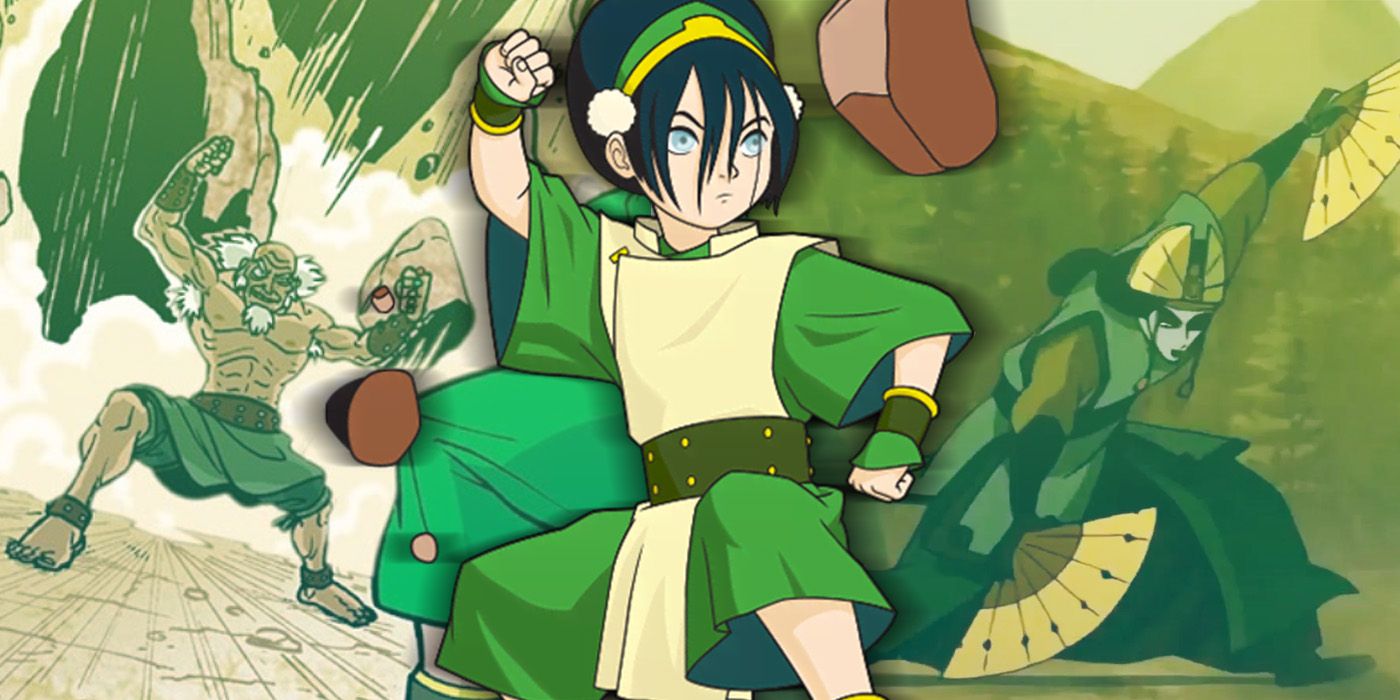
Starting at 18th level, you can use your action and 6 chi points to slam your fist into the ground, creating a massive shockwave. The shockwave has a radius of 60 feet centred on you. Whatever is within the radius becomes difficult terrain. Every creature in the radius must make a Dexterity saving throw. Failure causes the creature to take 8d8 force damage and forces them to make a Constitution saving throw. Failing the Constitution saving throw results in being knocked prone and horribly winded, and success resulting in being knocked prone and badly winded. Succeeding the Dexterity saving throw results in taking half damage, and not being knocked prone. You can expend extra chi points to allow certain creatures to be unaffected by the shockwave, 1 chi point per creature. After you’ve used this ability you are unable to use it again until your next long rest.
Prone and Badly Winded. It costs all of your target’s movement to get up and the target must succeed a Constitution Saving throw against your Save DC or not be able to use any reactions until the end of their next turn.
Prone and Horribly Winded. It costs all of your target’s movement to get up and the target must succeed a Constitution Saving throw against your Save DC or not be able to use any actions or reactions until the end of their next turn. A success results in them being able to use their actions, but not their reactions.
Firebender
Fire Benders have the innate ability to generate and manipulate fire at will. Most Fire Benders have rather extreme or passionate personalities, much like how a flame can never be lukewarm. Though some are aggressive and domineering, many are known to be quite peaceful.
Heated Attack
At 1st level, whenever you hit with a melee weapon attack, you can take a reaction to deal an extra 1d4 points of fire damage to your target. This damage will increase as you level up, 1d6 at 6th level, 1d8 at 13th level and 1d10 at 17th level.
Hot Foot
Starting at 3rd level, your rigorous training as a Firebender enables you to move more quickly. Your speed increases by 10 feet while you are not wielding a shield or wearing heavy armor. This bonus increases by 5 feet at 6th and 10th level.
At 9th level, you gain the ability to jump twice your normal distance, using a jet of flame to assist your leap.
Intense Release
Starting at 7th level, if you are restrained in any way, you can cause your body to reach extremely high temperatures to break the bonds as an action. Metal bonds, like handcuffs, may take several minutes or maybe hours to break, up to the DM. This ability can also be used so that if anyone makes physical contact with you, they will take 1d8 fire damage. You gain resistance to cold damage. This buff lasts for 1 hour, or you can cancel it without taking an action. It can instead be used to create an explosion around you as an action. It has a 15 foot radius centred on you, dealing 4d8 damage to all creatures and objects within the radius besides you. You must complete a long rest before using this feature again.
Heated Passion
Starting at 11th level, you gain Heated Passion. Heated Passion is a feature that allows you to tap into what drives your Fire Bending to increase the amount of damage you deal when dealing fire damage. You have 2 uses of this feature, which resets every dawn. When you use Heated Passion, you increase the damage dice that you use by one size (d4 to d6, d6 to d8, d8 to d10, d10 to d12, and d12 to 1d12 + Constitution Modifier.). You must decide before you roll for damage if you want to use Heated Passion or not. For example, if you used Heated Passion when you used fire bolt, which deals 2d10 fire damage, you would instead deal 2d12 fire damage.
Fiery Spirit
Starting at 11th level, great intensity, increasing your skills notably. You gain proficiency in Athletics and Intimidation. If you already have proficiency in one or both of these abilities, you gain double proficiency.
Intense Training
At 15th level, when you deal fire damage to a creature, you ignore fire resistance. You have learned to raise your internal temperature high enough that you can burn away any foreign disease or poison. You are now immune to disease and poison.
Dragon Dance
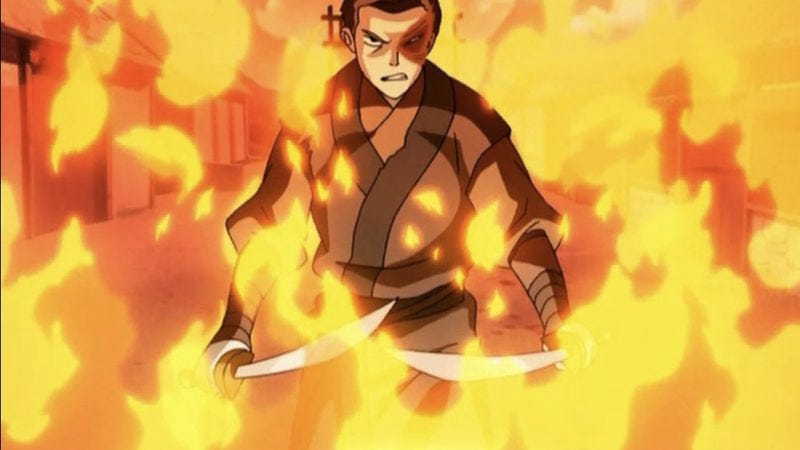
At 18th level you've learned an art perfected by Sun Warrior’s themselves. As an action you can expend 6 chi points to create a rush of flames in the form of a dragon, you can choose to perform one of the following:
- Whirlwind. The dragon whips around you in a tornado of extreme heat, it circles a 15 foot radius, any water around you almost dissipates, and gives the effect of extreme sun. Any creature near the tornado of flames takes 3d8 fire damage at the start of their turn. Your bending attacks deal an extra damage die while the dragon surrounds you.
- Rush. The dragon rushes in a straight line, it’s 10 ft wide at 30 ft long, anyone in that range must make a Dexterity Saving throw against your Bending Save DC or take 5d10 fire damage on a fail and half as much on a successful one.
- Combust. The dragon combusts in a 20 foot radius, everyone in that radius must make a Dexterity Saving throw or take 10d8 fire damage and half as much on a successful one, the dragon dissipates after.
You can choose an amount of creatures to be unaffected by expending one extra chi point per creature. On your next turn the dragon dissipates into colourful flames and you can’t use it until the end of your next long rest, however you can expend 2 extra chi points to extend the effects for another turn.
Waterbender
Waterbenders have the natural ability to manipulate water to their will. Their techniques often use their opponent’s force against them, which leads to a more defensive fighting style. Although they may not always have their element around them like the other three elements, they make up for it with very clever techniques to gather the water they need to defend themselves.
Fluid Defence
Beginning at 1st level, while you are wearing no armour and not wielding a shield, your AC equals 10 + your Dexterity modifier + your Wisdom modifier.
Advanced Healing (Optional)
Starting at 3rd level, your healing bending moves are more effective. Whenever you use a bending move that restores hit points to a creature, the creature regains additional hit points equal to the moves level.
Advanced Battling (Optional)
Starting at 3rd level, your damaging water techniques are more effective. Whenever you bend technique of 1st level or higher to damage a creature, the creature also takes additional cold damage equal to the move’s level.
Air Hydration
At 7th level, as a bonus action, you can consume 1 chi point to gather water from the air, or from sweat or moisture on other objects. This is enough water to fill a water skin. You can spend extra chi points to gather more water in the same bonus action, one filled water skin for each chi point. If the area is incredibly dry or incredibly moist, it is up to the DM to determine how much water is gathered per chi point.
Watery Limbs
Starting at 11th level, you can wrap water around your arms as a bonus action and expending 1 chi point, giving your melee attacks more range and power. Your range for melee attacks and melee waterbending techniques increases by 10 feet and the damage dealt by the attack or technique deals an additional 1d6 points of damage. This increases at level 14 (1d8), level 17 (2d6) and level 20 (2d8). This buff lasts for 1 minute.
Medical Eye
Also at 11th level, you have learned to study people to tell if they’re feeling sick and need care, or just hoping to get some attention. You gain proficiency in Medicine and Insight. If you already have proficiency in one or both of these skills, you gain double proficiency.
Drain
Starting at 15th level, you have honed your waterbending enough for you to withdraw the water that exists inside of plants. You rip the water out of the plant as a bonus action, allowing you to use it with your normal water abilities and killing the plant (Unless the plant is a creature, in which case it takes 2d8 necrotic damage that cannot be healed back except over a long rest). Most plants will grant enough water to fill two water-skins, but it’s up to the DM to determine how much water you get if the plant is in a very dry or very moist environment.
Octopus Form
Starting at 18th level, you have learned the defensive Octopus Form. By consuming your action and 5 chi points, you create a ring of water around you with many tendrils. This acts as a concentration spell. The circle has a radius of 15 feet centred on you. You cannot move this circle once you have created it, and if you step out of it, the form falls apart. Your AC increases by 5, and all ranged attacks have disadvantage against you. When an opponent walks through the ring of water, they must make a Dexterity Saving Throw against your Bending Save DC. Success results in them getting through, while failure results in a tentacle grabbing them and throwing them a maximum of 15 feet in any direction you choose. At the end of every enemy’s turn that is in the circle, you can choose to force them to make a Dexterity Saving Throw against your Bending Save DC with advantage or be tossed out. You can use your action to make an attack on everyone within the ring. Any number of creatures within the ring of your choice must make a Dexterity Saving Throw or take 2d8 cold damage and 2d8 bludgeoning damage. You can also make an attack against any creature within 15 feet of the ring, dealing 2d8 bludgeoning damage and 2d8 cold damage on a hit.
Fighter
The Fighter
| Level | Proficiency Bonus | Features |
|---|---|---|
| 1st | +2 | Fighting Style, Second Wind |
| 2nd | +2 | Action Surge (x1) |
| 3rd | +2 | Martial Archetype |
| 4th | +2 | Ability Score Improvement, Martial Versatility (Optional) |
| 5th | +3 | Extra Attack (x1) |
| 6th | +3 | Ability Score Improvement, Martial Versatility (Optional) |
| 7th | +3 | Martial Archetype feature |
| 8th | +3 | Ability Score Improvement, Martial Versatility (Optional) |
| 9th | +4 | Indomitable (x1) |
| 10th | +4 | Martial Archetype feature |
| 11th | +4 | Extra Attack (x2) |
| 12th | +4 | Ability Score Improvement, Martial Versatility (Optional) |
| 13th | +5 | Indomitable (x2) |
| 14th | +5 | Ability Score Improvement, Martial Versatility (Optional) |
| 15th | +5 | Martial Archetype feature |
| 16th | +5 | Ability Score Improvement, Martial Versatility (Optional) |
| 17th | +6 | Indomitable (x3) |
| 18th | +6 | Martial Archetype feature |
| 19th | +6 | Ability Score Improvement, Martial Versatility (Optional) |
| 20th | +6 | Extra Attack (x3) |

Class Features
As a fighter, you gain the following class features.
Hit Points
- Hit Dice: 1d10 per fighter level
- Hit Points at 1st Level: 10 + your Constitution modifier
- Hit Points at Higher Levels: 1d10 (or 6) + your Constitution modifier per fighter level after 1st
Proficiencies
- Armour: All armour, shields
- Weapons: Simple weapons, martial weapons
- Tools: None
- Saving Throws: Strength, Constitution
- Skills: Choose two skills from Acrobatics, Animal Handling, Athletics, History, Insight, Intimidation, Perception, and Survival
Equipment
- (a) chain mail or (b) leather, longbow, and 20 arrows
- (a) a martial weapon and a shield or (b) two martial weapons
- (a) a light crossbow and 20 bolts or (b) two - handaxes
- (a) a dungeoneer's pack or (b) an explorer's pack
Fighting Style
You adopt a particular style of fighting as your specialty. Choose one of the following options. You can't take a Fighting Style option more than once, even if you later get to choose again.
- Archery. You gain a +2 bonus to attack rolls you make with ranged weapons. Blind Fighting. You have blindsight with a range of 10 feet. Within that range, you can effectively see anything that isn't behind total cover, even if you're blinded or in darkness. Moreover, you can see an invisible creature within that range, unless the creature successfully hides from you.
- Defence. While you are wearing armour, you gain a +1 bonus to AC.
- Duelling. When you are wielding a melee weapon in one hand and no other weapons, you gain a +2 bonus to damage rolls with that weapon.
- Great Weapon Fighting. When you roll a 1 or 2 on a damage die for an attack you make with a melee weapon that you are wielding with two hands, you can reroll the die and must use the new roll, even if the new roll is a 1 or a 2. The weapon must have the two-handed or versatile property for you to gain this benefit.
- Interception. When a creature you can see hits a target, other than you, within 5 feet of you with an attack, you can use your reaction to reduce the damage the target takes by 1d10 + your proficiency bonus (to a minimum of 0 damage). You must be wielding a shield or a simple or martial weapon to use this reaction.
- Protection. When a creature you can see attacks a target other than you that is within 5 feet of you, you can use your reaction to impose disadvantage on the attack roll. You must be wielding a shield.
- Superior Technique. You learn one manoeuvre of your choice from among those available to the Battle Master archetype. If a manoeuvre you use requires your target to make a saving throw to resist the manoeuvre's effects, the saving throw DC equals 8 + your proficiency bonus + your Strength or Dexterity modifier (your choice.)
You gain one superiority die, which is a d6 (this die is added to any superiority dice you have from another source). This die is used to fuel your manoeuvres. A superiority die is expended when you use it. You regain your expended superiority dice when you finish a short or long rest. - Thrown Weapon Fighting. You can draw a weapon that has the thrown property as part of the attack you make with the weapon. In addition, when you hit with a ranged attack using a thrown weapon, you gain a +2 bonus to the damage roll.
- Two-Weapon Fighting. When you engage in two-weapon fighting, you can add your ability modifier to the damage of the second attack.
- Unarmed Fighting. Your unarmed strikes can deal bludgeoning damage equal to 1d6 + your Strength modifier on a hit. If you aren't wielding any weapons or a shield when you make the attack roll, the d6 becomes a d8. At the start of each of your turns, you can deal 1d4 bludgeoning damage to one creature grappled by you.
- Close Quarters Shooter. When making a ranged attack while you are within 5 feet of a hostile creature, you do not have disadvantage on the attack roll. Your ranged attacks ignore half cover and three-quarters cover against targets within 30 feet of you. You have a +1 bonus to attack rolls on ranged attacks.
- Mariner. As long as you are not wearing heavy armour or using a shield, you have a swimming speed and a climbing speed equal to your normal speed, and you gain a +1 bonus to armour class.
- Tunnel Fighter. As a bonus action, you can enter a defensive stance that lasts until the start of your next turn. While in your defensive stance, you can make opportunity attacks without using your reaction, and you can use your reaction to make a melee attack against a creature that moves more than 5 feet while within your reach.
Second Wind
You have a limited well of stamina that you can draw on to protect yourself from harm. On your turn, you can use a bonus action to regain hit points equal to 1d10 + your fighter level. Once you use this feature, you must finish a short or long rest before you can use it again.
Action Surge
Starting at 2nd level, you can push yourself beyond your normal limits for a moment. On your turn, you can take one additional action. Once you use this feature, you must finish a short or long rest before you can use it again. Starting at 17th level, you can use it twice before a rest, but only once on the same turn.
Martial Archetype
At 3rd level, you choose an archetype that you strive to emulate in your combat styles and techniques. The archetype you choose grants you features at 3rd level and again at 7th, 10th, 15th, and 18th level. Banneret, Brute, Battle Master, Cavalier, Champion.
Ability Score Improvement
When you reach 4th level, and again at 6th, 8th, 12th, 14th, 16th, and 19th level, you can increase one ability score of your choice by 2, or you can increase two ability scores of your choice by 1. As normal, you can't increase an ability score above 20 using this feature.
Martial Versatility (Optional)
Whenever you reach a level in this class that grants the Ability Score Improvement feature, you can do one of the following, as you shift the focus of your martial practice: Replace a fighting style you know with another fighting style available to fighters. If you know any manoeuvres from the Battle Master archetype, you can replace one manoeuvre you know with a different manoeuvre.
Extra Attack
Beginning at 5th level, you can attack twice, instead of once, whenever you take the Attack action on your turn. The number of attacks increases to three when you reach 11th level in this class and to four when you reach 20th level in this class.
Indomitable
Beginning at 9th level, you can reroll a saving throw that you fail. If you do so, you must use the new roll, and you can't use this feature again until you finish a long rest. You can use this feature twice between long or short rests starting at 13th level and three times between long or short rests starting at 17th level.
Fighter Archetypes
Banneret
A banneret is a knight who inspires greatness in others by committing brave deeds in battle. The mere presence of one in a hamlet is enough to cause some pirates and bandits to seek easier prey. A lone banneret is a skilled warrior, but a banneret leading a band of allies can transform even the most poorly equipped militia into a ferocious war band. A banneret prefers to lead through deeds, not words. As a banneret spearheads an attack, their actions can awaken reserves of courage and conviction in allies that they never suspected they had.
Bulwark
Beginning at 15th level, you can extend the benefit of your Indomitable feature to an ally. When you decide to use Indomitable to reroll an Intelligence, a Wisdom, or a Charisma saving throw and you aren't incapacitated, you can choose one ally within 60 feet of you that also failed its saving throw against the same effect. If that creature can see or hear you, it can reroll its saving throw and must use the new roll.

Battle Master
Those who emulate the archetypal Battle Master employ martial techniques passed down through generations. To a Battle Master, combat is an academic field, sometimes including subjects beyond battle such as weaponsmithing and calligraphy. Not every fighter absorbs the lessons of history, theory, and artistry that are reflected in the Battle Master archetype, but those who do are well-rounded fighters of great skill and knowledge.
Combat Superiority
When you choose this archetype at 3rd level, you learn manoeuvres that are fueled by special dice called superiority dice.
- Manoeuvres. You learn three manoeuvres of your choice. Many manoeuvres enhance an attack in some way. You can use only one manoeuvre per attack. You learn two additional manoeuvres of your choice at 7th, 10th, and 15th level. Each time you learn new manoeuvres, you can also replace one manoeuvre you know with a different one.
- Superiority Dice. You have four superiority dice, which are d8s. A superiority die is expended when you use it. You regain all of your expended superiority dice when you finish a short or long rest. You gain another superiority die at 7th level and one more at 15th level.
- Saving Throws. Some of your manoeuvres require your target to make a saving throw to resist the manoeuvre's effects. The saving throw DC is calculated as follows: Manoeuvre save DC = 8 + your proficiency bonus + your Strength or Dexterity modifier (your choice)
Student of War
At 3rd level, you gain proficiency with one type of artisan's tools of your choice.
Know Your Enemy
Starting at 7th level, if you spend at least 1 minute observing or interacting with another creature outside combat, you can learn certain information about its capabilities compared to your own. The DM tells you if the creature is your equal, superior, or inferior in regard to two of the following characteristics of your choice:
- Strength score
- Dexterity score
- Armour Class
- Current hit points
- Total class levels, if any
- Fighter class levels, if any
Improved Combat Superiority
At 10th level, your superiority dice turn into d10s. At 18th level, they turn into d12s.
Relentless
Starting at 15th level, when you roll initiative and have no superiority dice remaining, you regain 1 superiority die.
Brute
Brutes are simple warriors who rely on mighty attacks and their own durability to overcome their enemies. Some brutes combine this physical might with tactical cunning. Others just hit things until those things stop hitting back.
Brute Force
Starting at 3rd level, you’re able to strike with your weapons with especially brutal force. Whenever you hit with a weapon that you’re proficient with and deal damage, the weapon’s damage increases by an amount based on your level in this class, as shown on the Brute Bonus Damage table.
Brute Damage Bonus
| Fighter Level | Damage Increase |
|---|---|
| 3rd | 1d4 |
| 10th | 1d6 |
| 16th | 1d8 |
| 20th | 1d10 |
Unarmoured Defense
At 3rd level, while you are not wearing any armour, your armour class equals 10 + your Dexterity modifier + your Constitution modifier. You can use a shield and still gain this benefit.
Brutish Durability
Beginning at 7th level, your toughness allows you to shrug off assaults that would devastate others.
Whenever you make a saving throw, roll 1d6 and add the die to your saving throw total. If applying this bonus to a death saving throw increases the total to 20 or higher, you gain the benefits of rolling a 20 on the d20.
Additional Fighting Style
At 10th level, you can choose a second option from the Fighting Style class feature.
Devastating Critical
Starting at 15th level, when you score a critical hit with a weapon attack, you gain a bonus to that weapon’s damage roll equal to your level in this class.
Survivor
At 18th level, you attain the pinnacle of resilience in battle. At the start of each of your turns in combat, you regain hit points equal to 5 + your Constitution modifier (minimum of 1 hit point). You don’t gain this benefit if you have 0 hit points or if you have more than half of your hit points left.
Cavalier
The archetypal cavalier excels at mounted combat. Usually born among the nobility and raised at court, a cavalier is equally at home leading a cavalry charge or exchanging repartee at a state dinner. Cavaliers also learn how to guard those in their charge from harm, often serving as the protectors of their superiors and of the weak. Compelled to right wrongs or earn prestige, many of these fighters leave their lives of comfort to embark on glorious adventure.
Bonus Proficiency
When you choose this archetype at 3rd level, you gain proficiency in one of the following skills of your choice: Animal Handling, History, Insight, Performance, or Persuasion. Alternatively, you learn one language of your choice.
Born to the Saddle
Starting at 3rd level, your mastery as a rider becomes apparent. You have advantage on saving throws made to avoid falling off your mount. If you fall off your mount and descend no more than 10 feet, you can land on your feet if you’re not incapacitated.
dismounting a creature costs you only 5 feet of movement, rather than half your speed.
Unwavering Mark
Starting at 3rd level, you can menace your foes, foiling their attacks and punishing them for harming others. When you hit a creature with a melee weapon attack, you can mark the creature until the end of your next turn. This effect ends early if you are incapacitated or you die, or if someone else marks the creature. While it is within 5 feet of you, a creature marked by you has disadvantage on any attack roll that doesn't target you.
In addition, if a creature marked by you deals damage to anyone other than you, you can make a special melee weapon attack against the marked creature as a bonus action on your next turn. You have advantage on the attack roll, and if it hits, the attack's weapon deals extra damage to the target equal to half your fighter level.
Regardless of the number of creatures you mark, you can make this special attack a number of times equal to your Strength modifier (a minimum of once), and you regain all expended uses of it when you finish a long rest.
Warding Manoeuvre
At 7th level, you learn to fend off strikes directed at you, your mount, or other creatures nearby. If you or a creature you can see within 5 feet of you is hit by an attack, you can roll 1d8 as a reaction if you're wielding a melee weapon or a shield. Roll the die, and add the number rolled to the target's AC against that attack. If the attack still hits, the target has resistance against the attack's damage.
You can use this feature a number of times equal to your Constitution modifier (a minimum of once), and you regain all expended uses of it when you finish a long rest.
Hold the Line
At 10th level, you become a master of locking down your enemies. Creatures provoke an opportunity attack from you when they move 5 feet or more while within your reach, and if you hit a creature with an opportunity attack, the target's speed is reduced to 0 until the end of the current turn.
Ferocious Charger
Starting at 15th level, you can run down your foes, whether you're mounted or not. If you move at least 10 feet in a straight line right before attacking a creature and you hit it with the attack, that target must succeed on a Strength saving throw (DC 8 + your proficiency bonus + your Strength modifier) or be knocked prone. You can use this feature only once on each of your turns.
Vigilant Defender
Starting at 18th level, you respond to danger with extraordinary vigilance. In combat, you get a special reaction that you can take once on every creature's turn, except your turn. You can use this special reaction only to make an opportunity attack, and you can't use it on the same turn that you take your normal reaction.
Champion
Those who follow the combative ways of the champion focus on the development of raw physical power honed to deadly perfection. Those who model themselves on this archetype are committed to their combat arts, becoming unparalleled masters of their fighting style, sharpening their proficiency beyond any other martial master.
Combat Expert
Your intense training has shown you how to pierce the stoutest defences and exploit the slightest of missteps. When you choose this archetype at 3rd level, your weapon attacks score a critical hit on a roll of 19 or 20.
Physical Superiority
Starting at 3rd level, you choose either the Strength, Constitution, or Dexterity ability score. This feature gives you bonuses depending on your choice. At 10th and 18th level, you can select one of the other ones that you have not selected.
- Strength. You gain proficiency in the Athletics skill and if you were already proficient, you instead gain Expertise. You count as one size larger when determining your carrying capacity, the weight you can push, drag, or lift, and when grappling or shoving. Additionally, when you make a running long jump, the distance you can cover increases by a number equal to your Strength Modifier.
- Constitution. Your hit point maximum increases by a number equal to your fighter level when you gain this feature, and continues to increase by an additional 1 every time you gain a level in this class. The amount of time you can hold your breath is doubled, and you have resistance to fall damage. Additionally, you can use your Second Wind feature one additional time per short or long rest.
- Dexterity. You gain proficiency in the Acrobatics skill and if you were already proficient, you instead gain Expertise. Your movement speed increases by 5 feet. This bonus applies also to any native climbing, swimming, or flying speed you may have. Additionally, whenever you roll Initiative you may treat a roll of 9 or lower on the die as a 10.
Signature Fighting Style
At 7th level, you improve upon your chosen Fighting Style, performing martial feats few warriors can match. You gain an improvement to the Fighting Style you gained from the 1st level in this class:
- Improved Archery. You gain a +3 to attack rolls you make with ranged weapons, and ignore half and three- quarters cover. Improved Blind Fighting. You have blindsight with a range of 30 feet. Within that range, you can effectively see anything that isn’t behind total cover, even if blinded or in darkness. Moreover, you can see an invisible creature within range, unless the creature successfully hides. Additionally, you can take the Search Action as a bonus action.
- Improved Defence. While wearing armour, you gain +1 to AC and all Saving Throws. Additionally, as a reaction to an attack missing you, you can attempt to grapple or shove the attacker.
- Improved Duelling. When you are wielding a melee weapon in one hand and no other weapons, you gain a +2 bonus to damage rolls with that weapon. Under the same conditions, if you're fighting against an enemy and there's no other creature within 5ft of you and that enemy, you gain advantage in all melee attacks against that enemy.
- Improved Superior Technique. You learn three manoeuvres of your choice from among those available to the Battle Master archetype. If a manoeuvre you use requires your target to make a saving throw to resist the manoeuvre's effects, the saving throw DC equals 8 + your proficiency bonus + your Strength or Dexterity modifier (your choice.)
You gain three superiority dice, which is a d8 (this die is added to any superiority dice you have from another source). This die is used to fuel your manoeuvres. A superiority die is expended when you use it. You regain your expended superiority dice when you finish a short or long rest.
- Improved Interception. When a creature you can see hits a target, including you, within 5 feet of you with an attack, you can use your reaction to reduce the damage the target takes by 2d10 + your level (to a minimum of 0 damage). You must be wielding a simple or martial weapon to use this reaction. When you intercept an attack, you have advantage on your next attack roll against the attacking creature.
- Improved Unarmed Fighting. Your unarmed strikes increase to 1d8 + your Strength modifier on a hit. If you aren’t wielding any weapons or a shield when you make the attack roll, the d8 becomes a d10. Your grappling damage also becomes a 1d6.
- Improved Thrown Weapon Fighting. You can draw a weapon that has the thrown property as part of the attack you make with the weapon. In addition, when you hit with a ranged attack using a thrown weapon, you gain a +2 bonus to the damage roll. Whenever you roll a critical hit using a thrown weapon, you roll an additional damage dice. Also, you do not have disadvantage when using a thrown weapon against a target within 5ft.
- Improved Close Quarters Shooter. While you're wielding a ranged weapon, you gain a +2 bonus to attack rolls and a 1d4 bonus to the damage roll and you do not have disadvantage on ranged attacks while a creature is within 5 feet of you. Your ranged attacks also ignore half cover and three-quarters cover against targets within 45 feet of you.
- Improved Great Weapon Fighting. When you roll damage for an attack you make with a melee weapon that you are wielding with two hands, you can reroll the dice and must use the higher of the two rolls. The weapon must have the two handed or versatile property for you to gain this benefit. Additionally, when you roll the maximum damage on the weapon dice, you can push the target back 10ft.
- Improved Protection. While you're wielding a shield and an enemy attacks a creature within 5ft of you, including yourself, you can use your reaction to reroll all attack rolls against that creature until the start of their next turn.
- Improved Two-Weapon Fighting. When you engage in two-weapon fighting, you can add your ability modifier to the damage of the second attack. when you make an opportunity attack, you can attack with both of your weapons. Moreover, you can make your attack with an off-hand weapon as a part of the attack action instead of a bonus action. You can still only attack with an off-hand weapon once per turn.
- Improved Versatile Fighting. When wielding a weapon with the versatile property with one hand, you gain a +1 bonus to attack and damage rolls. While wielding a weapon with the versatile property with two hands, you gain a +1 bonus to your AC, and opportunity attacks against you are made with disadvantage.
- Improved Mariner. As long as you are not wearing heavy armour or using a shield, you have a swimming speed and a climbing speed equal to double your normal speed, and you gain a +1 bonus to armour class and saving throws.
- Improved Tunnel Fighter. As a bonus action, you can enter a defensive stance that lasts until the start of your next turn. While in your defensive stance, you can make opportunity attacks without using your reaction, and you can choose to make a melee attack against a creature that moves more than 5 feet while within your reach or enters your reach without expending a reaction.
Combat Master
Starting at 10th level your weapon attacks score a critical hit on a roll of 18-20.
Perfected Fighting Styles
At 15th level, you have gone through extensive training in not only one, but two fighting styles, becoming a true master of combat. Choose another fighting style from your class. In addition, that fighting style gains the benefits of the appropriate style in the Signature Fighting Style feature.
Monk
The Monk
| Level | Proficiency Bonus | Features | Martial Arts | Chi Points | Unarmoured Movement |
|---|---|---|---|---|---|
| 1st | +2 | Unarmored Defense, Martial Arts | 1d6 | — | — |
| 2nd | +2 | Chi, Unarmored Movement | 1d6 | 2 | 10 ft. |
| 3rd | +2 | Monastic Tradition, Deflect Missiles | 1d6 | 3 | 10 ft. |
| 4th | +2 | Ability Score Improvement, Slow Fall, Quickened Healing | 1d6 | 4 | 10 ft. |
| 5th | +3 | Extra Attack, Stunning Strike, Focused Aim | 1d8 | 5 | 10 ft. |
| 6th | +3 | Monastic Tradition feature | 1d8 | 6 | 15 ft. |
| 7th | +3 | Evasion, Stillness of Mind | 1d8 | 7 | 15 ft. |
| 8th | +3 | Ability Score Improvement | 1d8 | 8 | 15 ft. |
| 9th | +4 | Unarmored Movement improvement | 1d8 | 9 | 15 ft. |
| 10th | +4 | Purity of Body | 1d8 | 10 | 20 ft. |
| 11th | +4 | Monastic Tradition feature | 1d10 | 11 | 20 ft. |
| 12th | +4 | Ability Score Improvement | 1d10 | 12 | 20 ft. |
| 13th | +5 | ─ | 1d10 | 13 | 20 ft. |
| 14th | +5 | Diamond Soul, Ability Score Improvement | 1d10 | 14 | 25 ft. |
| 15th | +5 | Timeless Body | 1d10 | 15 | 25 ft. |
| 16th | +5 | Ability Score Improvement | 1d10 | 16 | 25 ft. |
| 17th | +6 | Monastic Tradition feature | 1d12 | 17 | 25 ft. |
| 18th | +6 | Perfect Self, Empty Body | 1d12 | 18 | 30 ft. |
| 19th | +6 | Ability Score Improvement | 1d12 | 19 | 30 ft. |
| 20th | +6 | Perfect Soul | 2d6 | 20 | 30 ft. |
Class Features
As a monk, you gain the following class features.
Hit Points
- Hit Dice: 1d10 per monk level
- Hit Points at 1st Level: 10 + your Constitution modifier
- Hit Points at Higher Levels: 1d10 (or 6) + your Constitution modifier per monk level after 1st
Proficiencies
- Armour: None
- Weapons: Simple weapons, shortswords
- Tools: Choose one type of artisan's tools or one musical instrument
- Saving Throws: Strength, Dexterity
- Skills: Choose two from Acrobatics, Athletics, History, Insight, Religion, and Stealth
Equipment
You start with the following equipment, in addition to the equipment granted by your background:
- (a) a shortsword or (b) any simple weapon
- (a) a dungeoneer's pack or (b) an explorer's pack
- 10 darts
Unarmored Defense
Beginning at 1st level, while you are wearing no armour and not wielding a shield, your AC equals 10 + your Dexterity modifier + your Wisdom modifier.
Martial Arts
At 1st level, your practice of martial arts gives you mastery of combat styles that use unarmed strikes and monk weapons, which are shortswords and any simple melee weapons that don't have the two-handed or heavy property.
You gain the following benefits while you are unarmed or wielding only monk weapons and you aren't wearing armour or wielding a shield:
- You can use Dexterity instead of Strength for the attack and damage rolls of your unarmed strikes and monk weapons.
- You can roll a d6 in place of the normal damage of your unarmed strike or monk weapon. This die changes as you gain monk levels, as shown in the Martial Arts column of the Monk table.
- When you use the Attack action with an unarmed strike or a monk weapon on your turn, you can make one unarmed strike as a bonus action. For example, if you take the Attack action and attack with a quarterstaff, you can also make an unarmed strike as a bonus action, assuming you haven't already taken a bonus action this turn.
Certain monasteries use specialised forms of the monk weapons. For example, you might use a club that is two lengths of wood connected by a short chain (called a nunchaku) or a sickle with a shorter, straighter blade (called a kama). Whatever name you use for a monk weapon, you can use the game statistics provided for the weapon on the Weapons page.
Starting at 2nd level, your training allows you to harness the mystic energy of chi. Your access to this energy is represented by a number of Chi points. Your monk level determines the number of points you have, as shown in the Chi Points column of the Monk table.
You can spend these points to fuel various chi features. You start knowing three such features: Flurry of Blows, Patient Defense, and Step of the Wind. You learn more chi features as you gain levels in this class.
When you spend a chi point, it is unavailable until you finish a short or long rest, at the end of which you draw all of your expended chi back into yourself. You must spend at least 30 minutes of the rest meditating to regain your chi points.
Some of your chi features require your target to make a saving throw to resist the feature's effects. The saving throw DC is calculated as follows:
Chi save DC = 8 + your proficiency bonus + your Wisdom modifier Starting at 2nd level, your speed increases by 10 feet while you are not wearing armour or wielding a shield. This bonus increases when you reach certain monk levels, as shown in the Monk table. At 9th level, you gain the ability to move along vertical surfaces, you gain a climbing speed equal to your walking speed. When you reach 3rd level, you commit yourself to a monastic tradition. Your tradition grants you features at 3rd level and again at 6th, 11th, and 17th level. Drunken Master, Kensei, Chi Blocking, Open Hand, Outcast Starting at 3rd level, you can use your reaction to deflect or catch the missile when you are hit by a ranged weapon attack. When you do so, the damage you take from the attack is reduced by 1d10 + your Dexterity modifier + your monk level. If you reduce the damage to 0, you can catch the missile if it is small enough for you to hold in one hand and you have at least one hand free. If you catch a missile in this way, you can spend 1 chi point to make a ranged attack with a range of 20/60 using the weapon or piece of ammunition you just caught, as part of the same reaction. You make this attack with proficiency, regardless of your weapon proficiencies, and the missile counts as a monk weapon for the attack. When you reach 4th level, and again at 8th, 12th, 14th, 16th, and 19th level, you can increase one ability score of your choice by 2, or you can increase two ability scores of your choice by 1. As normal, you can't increase an ability score above 20 using this feature.Chi
Unarmored Movement
Monastic Tradition
Deflect Missiles
Ability Score Improvement
Slow Fall
Beginning at 4th level, you can use your reaction when you fall to reduce any falling damage you take by an amount equal to five times your monk level.
Quickened Healing
Also at 4th level, as an action, you can spend 2 chi points and roll a Martial Arts die. You regain a number of hit points equal to the number rolled plus your proficiency bonus.
Extra Attack
Beginning at 5th level, you can attack twice, instead of once, whenever you take the Attack action on your turn.
Stunning Strike
Starting at 5th level, once per turn, you can interfere with the flow of chi in an opponent's body. When you hit another creature with a melee weapon attack, you can spend 1 chi point to attempt a stunning strike. The target must succeed on a Constitution saving throw or be stunned until the end of your next turn.
Focused Aim
Also at 5th level, when you miss with an attack roll, you can spend 1 to 3 chi points to increase your attack roll by 2 for each of these chi points you spend, potentially turning the miss into a hit.
Evasion
At 7th level, your instinctive agility lets you dodge out of the way of certain area effects, such as a firebender's lightning attack or a waterbender’s wave attack. When you are subjected to an effect that allows you to make a Dexterity saving throw to take only half damage, you instead take no damage if you succeed on the saving throw, and only half damage if you fail.
Stillness of Mind
Starting at 7th level, you can use your action to end one effect on yourself that is causing you to be charmed or frightened.
Purity of Body
At 10th level, your mastery of the chi flowing through you makes you immune to disease and poison.
Diamond Soul
Beginning at 14th level, your mastery of chi grants you proficiency in all saving throws. Additionally, whenever you make a saving throw and fail, you can spend 1 chi point to reroll it and take the second result.
Timeless Body
At 15th level, your chi sustains you so that you suffer none of the frailty of old age. You can still die of old age, however. In addition, you no longer need food or water.
Empty Body
Beginning at 18th level, you can use your action to spend 4 chi points to become nigh-invisible for 1 minute. During that time, you also have resistance to all damage but force damage.
Perfect Self
At 18th level, when you roll for initiative and have no chi points remaining, you regain 4 chi points.
Perfect Soul
At 20th level, you embody the power of the wilds. Your Dexterity and Wisdom scores increase by 4. Your maximum for those scores is now 24.
Monastic Tradition
Chi Blocking
Monks that follow the Way of Chi Blocking, known collectively as chi blockers, are able to inhibit the flow of energy within a person's body. By precisely targeting pressure points, a chi blocker can completely immobilise their opponents, rendering them useless in a fight.
Disable Bending
Starting when you choose this tradition at 3rd level, you can temporarily disable an opponent's ability to use bending moves. When you hit a humanoid with an unarmed strike, you can spend 1 chi point to attempt a disabling strike. The target must succeed on a Constitution saving throw or be unable to use their bending for 1 minute. At the end of each of its turns, the target can make a Constitution saving throw. On a success, the effect ends and it can bend again.
Nimble Hands
Also at 3rd level, you can interact with an additional object or feature of the environment for free during your turn.
Improved Stunning Strike
At 6th level, your stunning strikes become more powerful. When a target fails a Constitution saving throw against your stunning strike, they become paralyzed instead of stunned. Additionally, paralyzed creatures have disadvantage on Wisdom saving throws against your disabling strikes.
Empowered Chi
At 11th level, your knowledge of pressure points and energy flow has bolstered your own chi. Each time you spend 1 or more chi points on your turn, you may roll 1d8 and add it to the first saving throw you make before the start of your next turn.
Stunning Frenzy
At 17th level, you become an anti-chi hurricane. When you paralyse a humanoid with a stunning strike on your turn, you can immediately move up to half your speed and make an unarmed strike against a different humanoid as part of the same action. On a hit, the target must succeed on a Constitution saving throw or be stunned until the start of your next turn.
Drunken Master
The Way of the Drunken Master teaches its students to move with the jerky, unpredictable movements of a drunkard. A drunken master sways, tottering on unsteady feet, to present what seems like an incompetent combatant who proves frustrating to engage. The drunken master’s erratic stumbles conceal a carefully executed dance of blocks, parries, advances, attacks, and retreats. A drunken master often enjoys playing the fool to bring gladness to the despondent or to demonstrate humility to the arrogant, but when battle is joined, the drunken master can be a maddening, masterful foe.
Bonus Proficiencies
When you choose this tradition at 3rd level, you gain proficiency in the Performance skill if you don't already have it. Your martial arts technique mixes combat training with the precision of a dancer and the antics of a jester. You also gain proficiency with brewer's supplies if you don't already have it.
Drunken Technique
At 3rd level, you learn how to twist and turn quickly as part of your Flurry of Blows. Whenever you use Flurry of Blows, you gain the benefit of the Disengage action, and your walking speed increases by 10 feet until the end of the current turn.
Tipsy Sway
Starting at 6th level, you can move in sudden, swaying ways. You gain the following benefits.
- Leap to Your Feet. When you're prone, you can stand up by spending 5 feet of movement, rather than half your speed.
- Redirect Attack. When a creature misses you with a melee attack roll, you can spend 1 chi point as a reaction to cause that attack to hit one creature of your choice, other than the attacker, that you can see within 5 feet of you.
Drunkard's Luck
Starting at 11th level, you always seem to get a lucky bounce at the right moment. When you make an ability check, an attack roll, or a saving throw and have disadvantage, you can spend 2 chi points to cancel the disadvantage for that roll.
Intoxicated Frenzy
At 17th level, you gain the ability to make an overwhelming number of attacks against a group of enemies. When you use your Flurry of Blows, you can make up to three additional attacks with it (up to a total of five Flurry of Blows attacks), provided that each Flurry of Blows attack targets a different creature this turn.
Kensei
Monks of the Way of the Kensei train relentlessly with their weapons, to the point that the weapon becomes like an extension of the body. Founded on a mastery of sword fighting, the tradition has expanded to include many different weapons. A kensei sees a weapon much in the same way a calligrapher or a painter regards a pen or brush. Whatever the weapon, the kensei views it as a tool used to express the beauty and precision of the martial arts. That such mastery makes a kensei a peerless warrior is but a side effect of intense devotion, practice, and study.
Path of the Kensei
When you choose this tradition at 3rd level, your special martial arts training leads you to master the use of certain weapons. This path also includes instruction in the deft strokes of calligraphy or painting. You gain the following benefits:
- Kensei Weapons. Choose two types of weapons to be your kensei weapons: one melee weapon and one ranged weapon. Each of these weapons can be any simple or martial weapon that lacks the heavy and special properties. The longbow is also a valid choice. You gain proficiency with these weapons if you don't already have them. Weapons of the chosen types are monk weapons for you. Many of this tradition's features work only with your kensei weapons. When you reach 6th, 11th, and 17th level in this class, you can choose another type of weapon – either melee or ranged – to be a kensei weapon for you, following the criteria above.
- Agile Parry. If you make an unarmed strike as part of the Attack action on your turn and are holding a kensei weapon, you can use it to defend yourself if it is a melee weapon. You gain a +2 bonus to AC until the start of your next turn, while the weapon is in your hand and you aren’t incapacitated.
- Kensei's Shot. You can use a bonus action on your turn to make your ranged attacks with a kensei weapon more deadly. When you do so, any target you hit with a ranged attack using a kensei weapon takes an extra 1d4 damage of the weapon’s type. You retain this benefit until the end of the current turn. Way of the Brush. You gain proficiency with your choice of calligrapher's supplies or painter's supplies.
Deft Strike
At 6th level, when you hit a target with a kensei weapon, you can spend 1 chi point to cause the weapon to deal extra damage to the target equal to your Martial Arts die. You can use this feature only once on each of your turns.
Sharpen the Blade
At 11th level, you gain the ability to augment your weapons further with your chi. As a bonus action, you can expend up to 3 chi points to grant one kensei weapon you touch a bonus to attack and damage rolls when you attack with it. The bonus equals the number of chi points you spent. This bonus lasts for 1 minute or until you use this feature again.
Unerring Accuracy
At 17th level, your mastery of weapons grants you extraordinary accuracy. If you miss with an attack roll using a monk weapon on your turn, you can reroll it. You can use this feature only once on each of your turns.
Outcast
An Outcast is a monk that has lost their Way. Trained in the basics of the style, they have abandoned the rigorous discipline and philosophy of their tradition, and are usually now enrolled only in the school of hard knocks. Having been trained in the fundamentals of the art of chi, these monks choose as often as not to apply that art to tavern brawls. Much to the horror of many more formal monks, their rough and tumble lifestyle tends to be a solid source of further training.
Pragmatism
At 3rd level, you embrace a more pragmatic view, gaining the following benefits:
- You have proficiency in improvised weapons. Improvised melee weapons count as Monk weapons for you.
- You gain proficiency in light armour and medium armour, and gain the benefits of Martial Arts and Unarmored Movement while wearing it.
- You can use your Strength modifier in place of your Wisdom modifier for calculating your chi save DC.
- You gain the following additional Pragmatic Techniques you can spend chi on.
- When you hit a target that is prone, restrained, or incapacitated, you can expend a chi point to deal additional damage equal to two rolls of your Martial Arts die.
- Unexpected Technique (1 Chi). When you make a grapple check, you can expend a chi point to add your Martial Arts die to the roll. You can do this after the contested roll, and it can potentially turn a failure into a success. On success, the target takes damage equal to the amount rolled on the added die.
Soak it Up
At 6th level, your extensive training in the art of getting hit with bar stools and broken bottles grants you increased endurance. When you roll initiative you gain temporary hit points equal to your Constitution modifier + your proficiency bonus. These temporary hit points are refreshed any time you take the Dodge action.
Where it Hurts
At 11th level, when you make an unarmed strike against a creature who is missing hit points you can expend a chi point to reroll the damage roll if you hit.
Lean Into It
At 17th level, you have thrown your fair share of walloping hits, and know how to make them reliably. You can forgo adding your proficiency bonus to an attack roll with an unarmed strike or melee monk weapon. When you do so, you can add twice your proficiency bonus to the damage roll.

Rogue
The Rogue
| Level | Proficiency Bonus | Features | Sneak Attack |
|---|---|---|---|
| 1st | +2 | Expertise, Sneak Attack, Thieves’ Cant | 1d6 |
| 2nd | +2 | Cunning Action | 1d6 |
| 3rd | +2 | Roguish Archetype, Steady Aim | 2d6 |
| 4th | +2 | Ability Score Increase | 2d6 |
| 5th | +3 | Uncanny Dodge | 3d6 |
| 6th | +3 | Expertise | 3d6 |
| 7th | +3 | Evasion | 4d6 |
| 8th | +3 | Ability Score Increase | 4d6 |
| 9th | +4 | Roguish Archetype feature | 5d6 |
| 10th | +4 | Ability Score Increase | 5d6 |
| 11th | +4 | Reliable Talent | 6d6 |
| 12th | +4 | Ability Score Increase | 6d6 |
| 13th | +5 | Roguish Archetype feature | 7d6 |
| 14th | +5 | Blindsense | 7d6 |
| 15th | +5 | Slippery Mind | 8d6 |
| 16th | +5 | Ability Score Improvement | 8d6 |
| 17th | +6 | Roguish Archetype feature | 9d6 |
| 18th | +6 | Elusive | 9d6 |
| 19th | +6 | Ability Score Improvement | 10d6 |
| 20th | +6 | Stroke of Luck | 10d6 |

Class Features
As a rogue, you gain the following class features.
Hit Points
- Hit Dice: 1d8 per rogue level
- Hit Points at 1st Level: 8 + your Constitution modifier
- Hit Points at Higher Levels: 1d8 (or 5) + your Constitution modifier per rogue level after 1st
Proficiencies
- Armour: Light armour
- Weapons: Simple weapons, hand crossbows, longswords, rapiers, shortswords
- Tools: Thieves' tools
- Saving Throws: Dexterity, Intelligence
- Skills: Choose four from Acrobatics, Athletics, Deception, Insight, Intimidation, Investigation, Perception, Performance, Persuasion, Sleight of Hand, and Stealth
Equipment
You start with the following equipment, in addition to the equipment granted by your background:
- (a) a rapier or (b) a shortsword
- shortbow and quiver of 20 arrows or (b) a shortsword
- (a) a burglar's pack, (b) dungeoneer's pack, or (c) an explorer's pack
- Leather armour, two daggers, and thieves' tools
Expertise
At 1st level, choose two of your skill proficiencies, or one of your skill proficiencies and your proficiency with thieves' tools. Your proficiency bonus is doubled for any ability check you make that uses either of the chosen proficiencies.
At 6th level, you can choose two more of your proficiencies (in skills or with thieves' tools) to gain this benefit.
Sneak Attack
Beginning at 1st level, you know how to strike subtly and exploit a foe's distraction. Once per turn, you can deal an extra 1d6 damage to one creature you hit with an attack if you have advantage on the attack roll. The attack must use a finesse or a ranged weapon.
You don't need advantage on the attack roll if another enemy of the target is within 5 feet of it, that enemy isn't incapacitated, and you don't have disadvantage on the attack roll. The amount of the extra damage increases as you gain levels in this class, as shown in the Sneak Attack column of the Rogue table.
Thieves' Cant
During your rogue training you learned thieves' cant, a secret mix of dialect, jargon, and code that allows you to hide messages in seemingly normal conversation. Only another creature that knows thieves' cant understands such messages. It takes four times longer to convey such a message than it does to speak the same idea plainly.
In addition, you understand a set of secret signs and symbols used to convey short, simple messages, such as whether an area is dangerous or the territory of a thieves' guild, whether loot is nearby, or whether the people in an area are easy marks or will provide a safe house for thieves on the run.
Cunning Action
Starting at 2nd level, your quick thinking and agility allow you to move and act quickly. You can take a bonus action on each of your turns in combat. This action can be used only to take the Dash, Disengage, or Hide action.
Roguish Archetype
At 3rd level, you choose an archetype that you emulate in the exercise of your rogue abilities. Your archetype choice grants you features at 3rd level and then again at 9th, 13th, and 17th level. Seeker, Thief, Assassin, Inquisitive, Fencer, Mastermind, Scout, Swashbuckler, Ringmaster, Wildcard, Bruiser
Steady Aim (Optional)
At 3rd level, as a bonus action, you give yourself advantage on your next attack roll on the current turn. You can use this bonus action only if you haven't moved during this turn, and after you use the bonus action, your speed is 0 until the end of the current turn.
Ability Score Improvement
When you reach 4th level, and again at 8th, 10th, 12th, 16th, and 19th level, you can increase one ability score of your choice by 2, or you can increase two ability scores of your choice by 1. As normal, you can't increase an ability score above 20 using this feature.
Uncanny Dodge
Starting at 5th level, when an attacker that you can see hits you with an attack, you can use your reaction to halve the attack's damage against you.
Evasion
Beginning at 7th level, you can nimbly dodge out of the way of certain area effects, such as a firebenders's fire attacks or a waterbender’s ice storm. When you are subjected to an effect that allows you to make a Dexterity saving throw to take only half damage, you instead take no damage if you succeed on the saving throw, and only half damage if you fail.
Reliable Talent
By 11th level, you have refined your chosen skills until they approach perfection. Whenever you make an ability check that lets you add your proficiency bonus, you can treat a d20 roll of 9 or lower as a 10.
Blindsense
Starting at 14th level, if you are able to hear, you are aware of the location of any hidden or invisible creature within 10 feet of you.
Slippery Mind
By 15th level, you have acquired greater mental strength. You gain proficiency in Wisdom saving throws.
Elusive
Beginning at 18th level, you are so evasive that attackers rarely gain the upper hand against you. No attack roll has advantage against you while you aren't incapacitated.
Stroke of Luck
At 20th level, you have an uncanny knack for succeeding when you need to. If your attack misses a target within range, you can turn the miss into a hit. Alternatively, if you fail an ability check, you can treat the d20 roll as a 20. Once you use this feature, you can't use it again until you finish a short or long rest.
Roguish Archetype
Assassin
You focus your training on the grim art of death. Those who adhere to this archetype are diverse: hired killers, spies and bounty hunters. Stealth, poison, and disguise help you eliminate your foes with deadly efficiency.
Bonus Proficiencies
When you choose this archetype at 3rd level, you gain proficiency with the disguise kit and the poisoner's kit.
Assassinate
Starting at 3rd level, you are at your deadliest when you get the drop on your enemies. You have advantage on attack rolls against any creature that hasn't taken a turn in the combat yet. In addition, any hit you score against a creature that is surprised is a critical hit.
Infiltration Expertise
Starting at 9th level, you can unfailingly create false identities for yourself. You must spend seven days and 25 gp to establish the history, profession, and affiliations for an identity. You can't establish an identity that belongs to someone else. For example, you might acquire appropriate clothing, letters of introduction, and official- looking certification to establish yourself as a member of a trading house from a remote city so you can insinuate yourself into the company of other wealthy merchants. Thereafter, if you adopt the new identity as a disguise, other creatures believe you to be that person until given an obvious reason not to.
Impostor
At 13th level, you gain the ability to unerringly mimic another person's speech, writing, and behaviour. You must spend at least three hours studying these three components of the person's behaviour, listening to speech, examining handwriting, and observing mannerisms. Your ruse is indiscernible to the casual observer. If a wary creature suspects something is amiss, you have advantage on any Charisma (Deception) check you make to avoid detection.
Death Strike
Starting at 17th level, you become a master of instant death. When you attack and hit a creature that is surprised, it must make a Constitution saving throw (DC 8 + your Dexterity modifier + your proficiency bonus). On a failed save, double the damage of your attack against the creature.
Bruiser
Although their kin may deftly attack from the shadows, a Bruiser’s style relies more on their brute strength in an upfront confrontation. A good rogue can pick a pocket without ever being noticed, but a Bruiser would rather just take it through force.
Bonus Proficiencies
When you choose this subclass at 3rd level you gain proficiency in medium armour and martial weapons.
Bruiser
Also at 3rd level, you learn how to apply more force behind your subtle strikes. You may still apply Sneak Attack damage when using a weapon that is not finesse or ranged by taking disadvantage on the attack roll, provided that the attack would have granted Sneak Attack damage without the disadvantage.
Also, you have advantage on an attack roll against a creature if you dealt Sneak Attack damage to it with a weapon attack using Strength since the start of your last turn, and when you hit with a weapon that is not finesse or ranged using Strength, your Sneak Attack dice for the damage are d8s instead of d6s.
Bully
At 9th level, you can use the bonus action granted by your Cunning Action to make a single shove or grapple attack.
Brute Force
Starting at 13th level, you can use your muscular strength to give yourself finer control over your body. When you make a Dexterity check or saving throw, you may add a bonus equal to twice your Strength modifier to the result. You can choose to use this feature after you roll the die, but before the outcome is determined. Once you use this feature, you must finish a short or long rest before you can use it again.
Improved Bruiser
Finally, at 17th level, you can now apply Sneak Attack damage while using any weapon. All other requirements of Sneak Attack are still in effect.

Inquisitive
As an archetypal Inquisitive, you excel at rooting out secrets and unravelling mysteries. You rely on your sharp eye for detail, but also on your finely honed ability to read the words and deeds of other creatures to determine their true intent. You excel at defeating creatures that hide among and prey upon ordinary folk, and your mastery of lore and your sharp eye make you well equipped to expose and end hidden evils.
Ear for Deceit
When you choose this archetype at 3rd level, you develop a keen ear for picking out lies. Whenever you make a Wisdom (Insight) check to determine whether a creature is lying, treat a roll of 7 or lower on the d20 as an 8.
Eye for Detail
Starting at 3rd level, you can use a bonus action to make a Wisdom (Perception) check to spot a hidden creature or object or to make an Intelligence (Investigation) check to uncover or decipher clues.
Insightful Fighting
At 3rd level, you gain the ability to decipher an opponent's tactics and develop a counter to them. As a bonus action, you make a Wisdom (Insight) check against a creature you can see that isn't incapacitated, contested by the target's Charisma (Deception) check. If you succeed, you can use your Sneak Attack against that target even if you don't have advantage on the attack roll, but not if you have disadvantage on it.
This benefit lasts for 1 minute or until you successfully use this feature against a different target.
Steady Eye
At 9th level, you gain advantage on any Wisdom (Perception) or Intelligence (Investigation) check if you move no more than half your speed on the same turn.
Unerring Eye
At 13th level, your senses are almost impossible to foil. As an action, you sense the presence of illusions, shapechangers not in their original form, and other tricks designed to deceive the senses within 30 feet of you, provided you aren't blinded or deafened. You sense that an effect is attempting to trick you, but you gain no insight into what is hidden or into its true nature.
You can use this feature a number of times equal to your Wisdom modifier (minimum of once), and you regain all expended uses of it when you finish a long rest.
Eye for Weakness
At 17th level, you learn to exploit a creature's weaknesses by carefully studying its tactics and movement. While your Insightful Fighting feature applies to a creature, your Sneak Attack damage against that creature increases by 3d6.

Mastermind
Your focus is on people and on the influence and secrets they have. Many spies, courtiers, and schemers follow this archetype, leading lives of intrigue. Words are your weapons as often as knives or poison, and secrets and favours are some of your favourite treasures.
Master of Intrigue
When you choose this archetype at 3rd level, you gain proficiency with the disguise kit, the forgery kit, and one gaming set of your choice. You also learn two languages of your choice.
Additionally, you can unerringly mimic the speech patterns and accent of a creature that you hear speak for at least 1 minute, enabling you to pass yourself off as a native speaker of a particular land, provided that you know the language.
Master of Tactics
Starting at 3rd level, you can use the Help action as a bonus action. Additionally, when you use the Help action to aid an ally in attacking a creature, the target of that attack can be within 30 feet of you, rather than 5 feet of you, if the target can see or hear you.
Insightful Manipulator
Starting at 9th level, if you spend at least 1 minute observing or interacting with another creature outside combat, you can learn certain information about its capabilities compared to your own. The DM tells you if the creature is your equal, superior, or inferior in regard to two of the following characteristics of your choice:
- Intelligence score
- Wisdom score
- Charisma score
At the DM's option, you might also realise you know a piece of the creature's history or one of its personality traits, if it has any.
Beginning at 13th level, you can sometimes cause another creature to suffer an attack meant for you. When you are targeted by an attack while a creature within 5 feet of you is granting you cover against that attack, you can use your reaction to have the attack target that creature instead of you. Starting at 17th level, your thoughts can't be read by telepathy or other means, unless you allow it. You can present false thoughts by making a Charisma (Deception) check contested by the mind reader's Wisdom (Insight) check.
Additionally, no matter what you say, tricks that would determine if you are telling the truth indicates you are being truthful if you so choose, and you can't be compelled to tell the truth.Misdirection
Soul of Deceit

Scout
You are skilled in stealth and surviving far from the streets of a city, allowing you to scout ahead of your companions during expeditions. Rogues who embrace this archetype are at home in the wilderness and among barbarians and rangers, and many Scouts serve as the eyes and ears of war bands. Ambusher, spy, bounty hunter – these are just a few of the roles that Scouts assume as they range the world.
Skirmisher
Starting at 3rd level, you are difficult to pin down during a fight. You can move up to half your speed as a reaction when an enemy ends its turn within 5 feet of you. This movement doesn’t provoke opportunity attacks.
Survivalist
When you choose this archetype at 3rd level, you gain proficiency in the Nature and Survival skills if you don't already have it. Your proficiency bonus is doubled for any ability check you make that uses either of those proficiencies.
Superior Mobility
At 9th level, your walking speed increases by 10 feet. If you have a climbing or swimming speed, this increase applies to that speed as well.
Ambush Master
Starting at 13th level, you excel at leading ambushes and acting first in a fight. You have advantage on initiative rolls. In addition, the first creature you hit during the first round of a combat becomes easier for you and others to strike; attack rolls against that target have advantage until the start of your next turn.
Sudden Strike
Starting at 17th level, you can strike with deadly speed. If you take the Attack action on your turn, you can make one additional attack as a bonus action. This attack can benefit from your Sneak Attack even if you have already used it this turn, but you can't use your Sneak Attack against the same target more than once in a turn.
Swashbuckler
You focus your training on the art of the blade, relying on speed, elegance, and charm in equal parts. While some warriors are brutes clad in heavy armour, your method of fighting looks almost like a performance. Duelists and pirates typically belong to this archetype. A Swashbuckler excels in single combat, and can fight with two weapons while safely darting away from an opponent.
Fancy Footwork
When you choose this archetype at 3rd level, you learn how to land a strike and then slip away without reprisal. During your turn, if you make a melee attack against a creature, that creature can't make opportunity attacks against you for the rest of your turn.
Rakish Audacity
Starting at 3rd level, your confidence propels you into battle. You can give yourself a bonus to your initiative rolls equal to your Charisma modifier.
You also gain an additional way to use your Sneak Attack; you don't need advantage on the attack roll to use your Sneak Attack against a creature if you are within 5 feet of it, no other creatures are within 5 feet of you, and you don't have disadvantage on the attack roll. All the other rules for Sneak Attack still apply to you.
Panache
At 9th level, your charm becomes extraordinarily beguiling. As an action, you can make a Charisma (Persuasion) check contested by a creature's Wisdom (Insight) check. The creature must be able to hear you, and the two of you must share a language.
If you succeed on the check and the creature is hostile to you, it has disadvantage on attack rolls against targets other than you and can't make opportunity attacks against targets other than you. This effect lasts for 1 minute, until one of your companions attacks the target or affects it with a trick, or until you and the target are more than 60 feet apart.
If you succeed on the check and the creature isn't hostile to you, it is charmed by you for 1 minute. While charmed, it regards you as a friendly acquaintance. This effect ends immediately if you or your companions do anything harmful to it.
Elegant Manoeuvre
Starting at 13th level, you can use a bonus action on your turn to gain advantage on the next Dexterity (Acrobatics) or Strength (Athletics) check you make during the same turn.
Master Duelist
Beginning at 17th level, your mastery of the blade lets you turn failure into success in combat. If you miss with an attack roll, you can roll it again with advantage. Once you do so, you can't use this feature again until you finish a short or long rest.

Thief
You hone your skills in the larcenous arts. Burglars, bandits, cutpurses, and other criminals typically follow this archetype, but so do rogues who prefer to think of themselves as professional treasure seekers, explorers, delvers, and investigators. In addition to improving your agility and stealth, you learn skills useful for delving into ancient ruins, reading unfamiliar languages, and using items you normally couldn't employ.
Fast Hands
Starting at 3rd level, you can use the bonus action granted by your Cunning Action to make a Dexterity (Sleight of Hand) check, use your thieves' tools to disarm a trap or open a lock, or take the Use an Object action.
Second-Story Work
When you choose this archetype at 3rd level, you gain the ability to climb faster than normal; climbing no longer costs you extra movement.
In addition, when you make a running jump, the distance you cover increases by a number of feet equal to your Dexterity modifier.
Supreme Sneak
Starting at 9th level, you have advantage on a Dexterity (Stealth) check if you move no more than half your speed on the same turn.
Work Device
By 13th level, you have learned enough about the workings of devices that you can improvise the use of items even when they are not intended for you. You ignore all class, race, and level requirements on the special items.
Thief's Reflexes
When you reach 17th level, you have become adept at laying ambushes and quickly escaping danger. You can take two turns during the first round of any combat. You take your first turn at your normal initiative and your second turn at your initiative minus 10. You can't use this feature when you are surprised.
Scholar
The Scholar
| Level | Proficiency Bonus | Features | Academic Superiority | Superiotity Dice | Discoveries Known |
|---|---|---|---|---|---|
| 1st | +2 | Academic Superiority, Critical Analysis (1d4) | 1d4 | 4 | — |
| 2nd | +2 | Discovery, Sage Advice (one use) | 1d4 | 4 | 2 |
| 3rd | +2 | Expertise, Pursuit | 1d4 | 5 | 2 |
| 4th | +2 | Ability Score Increase | 1d4 | 5 | 2 |
| 5th | +3 | Critical Analysis (1d6) | 1d6 | 6 | 3 |
| 6th | +3 | Pursuit feature | 1d6 | 6 | 3 |
| 7th | +3 | Unwavering Mind | 1d6 | 7 | 4 |
| 8th | +3 | Expertise, Ability Score Increase | 1d6 | 7 | 4 |
| 9th | +4 | Critical Analysis (1d8) | 1d8 | 8 | 5 |
| 10th | +4 | ─ | 1d8 | 8 | 5 |
| 11th | +4 | Pursuit feature | 1d8 | 8 | 5 |
| 12th | +4 | Ability Score Increase | 1d8 | 8 | 6 |
| 13th | +5 | Sage Advice (two uses) | 1d8 | 9 | 6 |
| 14th | +5 | Calculated Defence | 1d8 | 9 | 6 |
| 15th | +5 | Critical Analysis (1d10) | 1d12 | 9 | 7 |
| 16th | +5 | Ability Score Increase | 1d10 | 8 | 7 |
| 17th | +6 | Pursuit feature | 1d10 | 10 | 7 |
| 18th | +6 | Lightning Execution | 1d10 | 10 | 8 |
| 19th | +6 | Ability Score Increase | 1d10 | 10 | 8 |
| 20th | +6 | Genius Unbound | 1d10 | 10 | 8 |

Class Features
As a scholar, you gain the following class features
Hit Points
- Hit Dice: 1d6 per scholar level
- Hit Points at 1st Level: 6 + your Constitution modifier
- Hit Points at Higher Levels: 1d6 (or 4) + your Constitution modifier per scholar level after 1st
Proficiencies
- Armour: Light armour
- Weapons: simple weapons, hand crossbows, shortswords
- Saving Throws: Wisdom, Intelligence
- Skills: Choose three from Arcana, Deception, History, Insight, Intimidation, Investigation, Medicine, Nature, Persuasion, Religion, and Survival
Equipment
You start with the following equipment, in addition to the equipment granted by your background:
- (a) any simple weapon or (b) a light crossbow and 20 bolts
- (a) scholar's pack or (b) explorer's pack
- any simple weapon
- any two tools of your choice
Academic Superiority
Beginning at 1st level, you know how to apply your studies in practical ways known as manoeuvres. Your manoeuvres are fueled by special dice called superiority dice. Manoeuvres. You know 2 manoeuvres of your choice, which are detailed under “Manoeuvres” below. You may only use a particular manoeuvre once per turn. Many of your manoeuvres enhance an attack in some way, you can use only one manoeuvre per attack. You learn two additional manoeuvres of your choice at 3rd, 6th, 11th, and 17th level. Each time you learn new manoeuvres, you can also replace one manoeuvre you know with a different one.
- Superiority Dice. You have a number of superiority dice as shown in the Superiority Dice column of the Scholar class table which are d6s. This die changes as you gain Scholar levels, as shown in the Academic Superiority column of the Scholar table. A superiority die is expended when you use it. You regain all of your expended superiority dice when you finish a short or long rest.
- Saving Throws. Some of your manoeuvres require your target to make a saving throw to resist the manoeuvre’s effects. The saving throw DC is calculated as follows: Manoeuvre save DC = 8 + your proficiency bonus + your Intelligence modifier
Manoeuvres
The manoeuvres are presented in alphabetical order.
- Administer Aid. As an action, you can expend a superiority die to tend to a creature you can touch. The creature regains a number of hit points equal to the number rolled + your Intelligence modifier.
- Assess the Situation. You can expend one superiority die to make a Wisdom (Perception) or Intelligence (Investigation) check as a bonus action, adding the superiority die to the check.
- Deliberate Movement. You can expend one superiority die to use the Disengage action as a bonus action and ignore the effects of non spiritual difficult terrain until the end of your turn.
- Distracting Strike. When you hit a creature with a weapon attack, you can expend one superiority die to distract the creature, and give your allies an opening. You add the superiority die to the attack’s damage roll. The next attack roll against the target by an attack other than you has advantage if the attack is made before the start of your next turn.
- Evasive Footwork. When you move, you can expend one superiority die, rolling the die and adding the number rolled to your AC until you stop moving.
- Exploit Weakness. When you hit a creature with a weapon attack, you can expend a superiority die and deal additional damage equal to the number rolled. This damage cannot be reduced in any way.
- Measured Action. As a reaction when you make a roll for a contested skill check, you can expend a superiority die to add to the roll. You can use this manoeuvre before or after making the contested skill check roll, but before any effects of the contested skill check are determined.
- One Step Ahead. As a reaction when you roll initiative, you can expend a superiority die and add the number rolled to your initiative.
- Reasoned Defence. As a reaction when you are forced to make a saving throw against an effect you can see, you can expend a superiority die and add the number rolled to your saving throw. You can use this manoeuvre before or after making the saving throw roll, but before any effects of the saving throw are determined.
Critical Analysis
At 1st level, you are able to analyse a target, develop a plan on how to best overcome any potential obstacle, and execute that plan with ruthless efficiency. As a bonus action on your turn, you can analyse a target you can see within 60 feet of you. For the next minute, or until you analyse another target, attack rolls and damage rolls made with a finesse or ranged weapon may use your Intelligence modifier instead of Strength or Dexterity.
Additionally, once per turn when you use a manoeuvre targeting your analysed target, you can roll an additional d4 and add the number rolled to the total. The die increases to a d6 at 5th level, a d8 at 10th level, and a d10 at 15th level.
Discovery
As you adventure, your studies have helped you discover new practices you can apply to your skills.
At 2nd level, you master two discoveries of your choice. Your discovery options are detailed at the end of the class description. When you gain certain scholar levels, you gain additional discoveries of your choice, as shown in the Discoveries column of the Scholar table.
Additionally, when you gain a level in this class, you can choose one of the discoveries you know and replace it with another discovery that you could learn at that level.
Sage Advice
When you reach 2nd level, you can spend 1 minute advising and spreading your knowledge and experience to those around you. When you do so, choose a skill or tool you are proficient with and a number of friendly creatures up to your Intelligence modifier within 30 feet of you who can hear you and who can understand you. Once within the next hour, the next time each creature would make an ability check with the chosen skill or tool, they may add their proficiency modifier to the roll, or double their proficiency if they are already proficient.
A creature may only benefit from this feature once, if a creature is targeted by this feature again before using it, they can choose to retain the first benefit or replace it with the new skill or tool instead.
Once you’ve used this feature, it cannot be used again until you complete a short or long rest. Starting at 13th level, you can use it twice before a rest.
Expertise
At 3rd level, choose two of your skill proficiencies, or one of your skill proficiencies and one of your tool proficiencies, or two of your tool proficiencies. Your proficiency bonus is doubled for any ability check you make that uses either of the chosen proficiencies.
At 8th level, you can choose another two proficiencies (in skills or tools) to gain this benefit.
Pursuit
At 3rd level, you dedicate your studies towards a pursuit of your choice: physician, politician, or tactician, detailed at the end of the class description. The pursuit you choose grants you features at 3rd level, and again at 6th, 11th, and 17th level.
Ability Score Improvement
When you reach 4th level, and again at 8th, 12th, 16th, and 19th level, you can increase one ability score of your choice by 2, or you can increase two Ability Scores of your choice by 1. As normal, you can’t increase an ability score above 20 using this feature.
Unwavering Mind
Starting at 7th level, you gain proficiency in Wisdom saving throws.
Calculated Defences
Beginning at 14th level, whenever you make a saving throw from an effect you can see, you gain a bonus to the saving throw equal to your Intelligence modifier.
Lightning Execution
At 18th level, your mind works at incredible speeds, seconds turn into minutes allowing you ample time to react to any situation. You may take one additional reaction each round. You may only use one reaction per trigger.
Genius Unbound
When you reach 20th level, your genius has no equal. Your Intelligence score increases by 4. Your maximum for that score is now 24. Additionally, you may use any manoeuvre you know without expending a superiority die, rolling a d6 instead.
Pursuits
Your pursuit is a representation of which fields you have studied or how you practically apply your knowledge.
Physician
The Physician pursuit reflects your studies into the medical, anatomical, and biological sciences. Those who follow this pursuit use their knowledge to men their allies on the field and deal crippling blows with surgical accuracy.
Bonus Proficiencies
Beginning at 3rd level when you select this pursuit, you gain proficiency in the Medicine and Nature skills, and with alchemist’s supplies.
Medical Practitioner
At 3rd level, you gain access to new manoeuvres which reflect the progress of your studies into the medical arts. Whenever you learn a new manoeuvre, you can choose from any of the following as well. The manoeuvres are listed in alphabetical order.
- Dazing Strike. When you hit a creature with a melee weapon attack, you can expend a superiority die to temporarily daze the creature. Add the number rolled to the damage of the weapon attack and the creature must succeed a Constitution saving throw or be stunned until the end of their next turn.
- Dull the Pain. You can use an action and expend one superiority die to dull the feeling of a creature. When you do so, a creature you can touch gains temporary hit points equal to the superiority die roll + your Intelligence modifier. These temporary hit points last 1 minute.
- Hamstring. When you hit a creature with a weapon attack, you can expend one superiority die to cripple the creature. You add the superiority die to the attack's damage roll and the creature's speed is reduced by 10 feet until the end of their next turn.
- Lacerate. When you hit a creature with a melee weapon attack, you can expend a superiority die to cause a lacerating wound. Add the number rolled to the damage of the weapon attack and the creature must succeed a Constitution saving throw or take 1d4 necrotic damage at the end of each of its turns for 1 minute or until it or another creature uses its action to stop the bleeding.
- Neuroblock. When you hit a creature with a melee weapon attack, you can expend a superiority die to halt its ability to heal. Add the number rolled to the damage of the weapon attack and the creature cannot regain hit points until the end of your next turn.
- Rapid Response. While moving, you can expend a superiority die and add 5 times the number rolled to your movement speed.
- Reassure. As an action, you can call out to a creature within 60 feet that can hear or see you that has been charmed or frightened. When you do, expend a superiority die and the creature can immediately make another saving throw with advantage to end the effect.
- Remove Toxins. As an action, you can expend a superiority die to purge the toxins from a creature you can touch. The target regains hit points equal to the number rolled and the target is cured of one disease or one poison affecting it.
- Smelling Salts. As a bonus action, you can expend a superiority die to heal a creature you can touch a number of hit points equal to the number rolled.
Field Surgeon
At 6th level, whenever you expend superiority dice to restore hit points or grant temporary hit points to a creature, you can expend up to two dice instead of just one, adding both to the roll. Both dice are expended as normal. When you do, if the target regaining hit points is the target of your Critical Analysis feature, you also roll your Critical Analysis dice twice, adding both to the roll.
Resuscitate
Beginning at 11th level, your medical studies have revealed to you how to cheat death itself. As an action, you can tend to a creature you can touch that has died since the end of your last turn to bring it back to life with 1 hit point remaining. A creature can only regain hit points this way once before that creature finishes a short or long rest.
Additionally, as a bonus action, you can stabilise a creature you can touch that has 0 hit points.
Panacea
When you reach 17th level, you develop the formula to concoct a cure-all miracle solution: a panacea. Over the course of 10 minutes, you can expend rare medicinal herbs and oils worth 100 gp to create your panacea in a simple vial. The panacea retains its potency for 24 hours. As an action, a creature can drink the elixir or administer it to another creature. The drinker has their exhaustion level reduced by one or has one of the following debilitating effects end:
- One effect that petrified or cursed the target.
- One effect afflicting the creature.
- Any reduction to one of the target's ability scores.
- One effect reducing the target's hit point maximum.
Once you create a panacea, you can't create another until you finish a short or long rest.
Politician
Scholars who choose to follow the Politician pursuit are those who study social & political sciences. They use their knowledge of the people to manipulate the masses into doing their bidding or allow them and their allies to carry out their business without being impeded.
Silver Tongue
Beginning at 3rd level you add half your proficiency bonus to any Charisma skill check you are not already proficient in.
Learned Diplomat
At 3rd level, you gain access to new manoeuvres which reflect the progress of your studies into the political world. Whenever you learn a new manoeuvre, you can choose from any of the following as well. The manoeuvres are listed in alphabetical order.
- Call to Arms. If you are surprised at the beginning of combat and aren't incapacitated, you can expend one superiority die to act normally. On your first turn as a bonus action you can make a call to arms. When you do so, creatures you choose within 30 feet who can see or hear you who haven't gone yet may act normally on their first turn.
- Overwhelming Presence. As an action, you can make a Charisma (Persuasion) or Charisma (Intimidation) skill check and expend one superiority die to attempt to charm or frighten a humanoid creature who can see or hear you within 60 feet. Add the superiority die to the roll. The target makes a contested Wisdom (Insight) check. If your check succeeds, the target is charmed by you if you used Persuasion, or frightened of you if you used Intimidation, until the end of your next turn.
- Charge. As a bonus action on your turn, you can expend one superiority die to spurn your allies to move. Until the start of your next turn, creatures you choose within 30 feet who can see or hear you, have their speed increased by 10 feet and ignore difficult terrain.
- Goading Attack. When you hit a creature with a weapon attack, you can expend one superiority die to attempt to goad the target into attacking you. You add the superiority die to the attacks damage roll, and the target must make a Wisdom saving throw. On a failed save, the target has disadvantage on all attack rolls against targets other than you until the end of your next turn.
- Inspiring Defence. As a reaction when an ally you can see within 30 feet who can see or hear you, makes a saving throw, you can expend a superiority die. Add the number rolled to the target's saving throw. You can use this manoeuvre before or after making the saving throw, but before any effects of the saving throw are determined.
- Rally. On your turn, you can use a bonus action and expend one superiority die to bolster the resolve of one of your companions. When you do so, choose a friendly creature who can see or hear you. That creature gains temporary hit points equal to your superiority die + your Intelligence modifier.
- Targeted Feint. You can expend one superiority die and use a bonus action on your turn to feint, choosing one creature within 30 feet of you as your target. You have advantage on your next attack roll against that creature. If that attack hits, add the superiority die to the attack's damage roll.
- Tyrannical Strike. When you hit a creature with a weapon attack, you can expend one superiority die and issue a one-word command to a creature who can see or hear you. You add the superiority die to the attacks damage roll, and the target must succeed on a Wisdom saving throw. On a failed save, the target must follow the command on its next turn.
The target automatically succeeds if it is Undead, can't be charmed, it doesn’t understand your language, or if your command is directly harmful to it.
Force of Personality
At 6th level, as an action, you suggest a course of activity (limited to a sentence or two) to influence a creature you can see within range that can hear and understand you. Creatures that can’t be charmed are immune to this effect. The suggestion must be worded in such a manner as to make the course of action sound reasonable. Asking the creature to stab itself, throw itself onto a spear, immolate itself, or do some other obviously harmful act ends the effect.
The target must make a Wisdom saving throw. On a failed save, it pursues the course of action you described to the best of its ability. The suggested course of action can continue for up to 24 hours. If the suggested activity can be completed in a shorter time, the effect ends when the subject finishes what it was asked to do.
You can also specify conditions that will trigger a special activity during the duration. For example, you might suggest that a knight give her warhorse to the first beggar she meets. If the condition isn’t met before the effect ends, the activity isn’t performed.
If you or any of your companions damage the target, the effect ends. You may only use this feature once before finishing a short or long rest.
Beguiling Presence
Beginning at 11th level, humanoids within 30 feet are particularly susceptible to your presence. Humanoids within range have disadvantage on saving throws against any charm or fear effects from you. Creatures who can’t be charmed are immune to this effect.
Call to Victory
Starting at 17th level, you can call out to your allies, beckoning them to victory. As an action, you can expend any number of superiority die, giving each to a creature of your choice within 60 feet who can see or hear you. Once, within the next minute, a creature may roll their die and add the number rolled to one ability check, attack roll, or saving throw it makes. The creature can wait until after it rolls the d20, but before any effects are determined. Once the superiority die is rolled, it is lost. A creature can have only one superiority die at a time.
Tactician
To a tactician, the ways of war is just another subject to be studied. They train themselves and their allies in combat manoeuvres to deftly eliminate their foes through clever positioning, and fierce, timely attacks.
Bonus Proficiencies
Beginning at 3rd level when you select this pursuit, you gain proficiency in martial weapons, medium armour, and shields.
Tactic Mastery
At 3rd level, you gain access to new manoeuvres which reflect your mastery in the field of combat. Whenever you learn a new manoeuvre, you can choose from any of the following as well. The manoeuvres are listed in alphabetical order. Additionally, You learn one additional manoeuvre of your choice.
- Commander's Strike. When you take the Attack action on your turn, you can forgo one of your attacks and use a bonus action to direct one of your companions to strike. When you do so, choose a friendly creature within 60 feet who can see or hear you and expend one superiority die. That creature can immediately use its reaction to make one weapon attack, adding your superiority die to the attack’s damage roll.
- Disarming Attack. When you hit a creature with a weapon attack, you can expend one superiority die to attempt to disarm the target, forcing it to drop one item of your choice that it's holding. You add the superiority die to the attack's damage roll, and the target must make a Strength saving throw. On a failed save, it drops the object you choose. The object lands at its feet.
- Lunging Attack. When you make a melee weapon attack on your turn, you can expend one superiority die to increase your reach for that attack by 5 feet. If you hit, you add the superiority die to the attack's damage roll.
- Manoeuvring Attack. When you hit a creature with a weapon attack, you can expend one superiority die to manoeuvre one of your comrades into a more advantageous position. You add the superiority die to the attack's damage roll, and you choose a friendly creature who can see or hear you. That creature can use its reaction to move up to half its speed without provoking opportunity attacks from the target of your attack.
- Pushing Attack. When you hit a creature with a weapon attack, you can expend one superiority die to attempt to drive the target back. You add the superiority die to the attack's damage roll, and if the target is Large or smaller, it must make a Strength saving throw. On a failed save, you push the target up to 15 feet away from you.
- Riposte. When a creature misses you with a melee attack, you can use your reaction and expend one superiority die to make a melee weapon attack against the creature. If you hit, you add the superiority die to the attack's damage roll.
- Scholar's Parry. When a creature damages you with a weapon attack, you can use your reaction and expend one superiority die to reduce the damage by your superiority die + your Intelligence modifier.
- Sweeping Attack. When you hit a creature with a melee weapon attack, you can expend one superiority die to attempt to damage another creature with the same attack. Choose another creature within 5 feet of the original target and within your reach. If the original attack roll would hit the second creature, it takes damage equal to the number you rolled on your superiority die. The damage is of the same type dealt by the original attack.
- Targeted Attack. When you make a weapon attack roll, you can expend one superiority die to add it to the roll. You can use this manoeuvre before or after making the attack roll, but before any effects of the attack are applied.
- Trip Attack. When you hit a creature with a weapon attack, you can expend one superiority die to attempt to knock the target down. You add the superiority die to the attack's damage roll, and if the target is Large or smaller, it must make a Strength saving throw. On a failed save, you knock the target prone.
Combat Survey
At 6th level, you can survey the field, allowing you a moment to formulate a plan. When you are in combat, you can use your action to survey the field and recover one expended superiority die. You can use this feature once before finishing a short or long rest.
Multi-Target Analysis
At 11th level, when you use your Critical Analysis feature, you can analyse two targets within range at once and can have two analysed targets at any one time.
All-Out Attack
At 17th level, you can use your action to initiate an all-out attack. Choose a number of allies up to your Intelligence modifier within 60 feet who can see or hear you. The chosen allies may then immediately use their reaction to make one weapon attack against a target of your choice. You may choose the target for each attack separately. Once you use this feature, you cannot use it again until you finish a short or long rest.
Discoveries
The discoveries are presented in alphabetical order. If a discovery has prerequisites, you must meet them to learn it. If a discovery requires a level, you must be that level in this class to learn the discovery. You can learn the discovery at the same time you meet its prerequisites.
Adaptive
Prerequisite: 7th level
When the target of your critical analysis feature is reduced to 0 hit points, you can use your reaction to change the target of your analysis to another creature within range.
Backstab
Prerequisite: 15th level, Politician Pursuit
When you hit a creature that is charmed or frightened of you, the attack is a critical hit. You can’t use this feature again on the same creature until you finish a short or long rest.
Charming Feint
Prerequisite: 12th level, Politician Pursuit
Add your Charisma modifier to melee attack rolls you make against humanoids within 5 feet.
Clever Applications
You become proficient in Improvised Weapons. Additionally, when you make an attack with an improvised weapon, it deals 1d6 damage instead.
Cold Logic
Prerequisite: Politician Pursuit
You may use your Intelligence modifier instead of your Charisma modifier when you make an Intimidation skill check.
Contingency Plan
Prerequisite: 9th level, Tactician Pursuit
When the target of your critical analysis feature attacks you and scores a critical hit, you can expend a superiority die to treat the attack as a normal hit instead. Once you use this feature, you can’t do so again until you finish a long rest.
Developed Resistance
Prerequisite: 9th level You gain resistance to poison damage and advantage on saving throws against poison.
Discerning Eyes
Prerequisite: 5th level You have advantage on saving throws against illusions and on Intelligence checks to discern them from reality.
Dominating Presence
Prerequisite: 15th level, Politician Pursuit
As an action, you can call out to a humanoid who can understand you that is charmed by you or frightened of you to direct their next action. The target must succeed a Wisdom saving throw (DC 8 + your proficiency bonus + your Intelligence modifier) or until the end of your next turn, the creature takes only the actions you choose, and doesn't do anything that you don't allow it to do. During this time you can also cause the creature to use a reaction, but this requires you to use your own reaction as well. Once you use this feature, you can’t do so again until you finish a long rest.
Dungeoneer
You have advantage on Perception (Wisdom) checks and Investigation (Intelligence) checks to locate any secret doors or traps.
Explorer
When you make a Survival skill check, you may use your Intelligence modifier instead of your Wisdom modifier.
Extra Attack
Prerequisite: 5th level, Tactician Pursuit
You can attack twice, instead of once, whenever you take the Attack action on your turn.
Fighting Style
Prerequisite: Tactician Pursuit
You adopt a particular style of fighting as your specialty. Choose one of the options available to the Fighter class. You can’t take a Fighting Style option more than once, even if you later get to choose again.
Hardened Mind
Prerequisite: 15th level
You gain resistance to Psychic damage.
Lifelong Learning
Gain proficiency in two skills or two tools, or one skill and one tool. You can select this discovery multiple times, each time choosing two new skills or tools.
Lingering Advice
Prerequisite: 7th level
When you use your sage advice feature, the targeted creatures retain the benefit from your instruction for the full duration.
Master's Advice
Prerequisite: 15th level
When you use your sage advice feature, the first time each targeted creature makes the chosen skill check, they gain an additional +10 bonus to the roll.
Medical Genius
Prerequisite: Physician Pursuit
When you make a Medicine skill check, you may use your Intelligence modifier instead of your Wisdom modifier.
Mortician
Prerequisite: Physician Pursuit
You can use your critical analysis feature to examine a body that has died within the last 7 days. At the DM’s discretion, you are able to accurately determine the cause of death. This may require additional checks, such as determining a type of poison, or bite marks of a creature.
Perfect Maneuver
Prerequisite: 15th level
When you roll a superiority die, you can choose to take the maximum result. If you were to roll multiple dice, it only applies to one. You can’t do so again until you finish a short or long rest.
Physical Conditioning
Your hit point maximum increases by 1 for every level you have in the scholar class, and increases by 1 again whenever you gain a level in this class.
Quick Analysis
Prerequisite: 7th level
When you roll initiative and aren't surprised, you can use your reaction to use your critical analysis feature.
Reliable Sources
Prerequisite: 12th level
When you make an Arcana, History, Nature, or Religion skill check and may add your proficiency bonus to the check, treat any roll of 9 or lower as if you had rolled a 10.
Reliable Words
**Prerequisite: **12th Level, Politician Pursuit
When you make a Deception, Insight, Intimidation, or Persuasion skill check and may add your proficiency bonus to the check, treat any roll 9 or lower as if you had rolled a 10.
Resolute
Prerequisite: 9th level
You have advantage on saving throws to resist charm and fear effects.
Reasoned Vigilance
You may add your Intelligence modifier to your Initiative roll.
Ruthless Execution
Prerequisite: 9th level
When you would expend one or more superiority dice, you can expend one additional die, add the number rolled to the total.
Sound Reasoning
Prerequisite: Politician Pursuit
You may use your Intelligence modifier instead of your Charisma modifier when you make a Persuasion skill check.
Surgical Precision
Prerequisite: 5th Level, Physician Pursuit
When you hit a creature with a weapon attack, it takes additional damage equal to your Intelligence modifier.
Tactical Retreat
Prerequisite: Tactician Pursuit
When you take the dash action, opportunity attacks made against you are made at disadvantage.
Targeted Analysis
Attack rolls made against the target of your critical analysis feature cannot suffer from disadvantage.
Tend the Wounded
Prerequisite: 5th level, Physician Pursuit
If you or any friendly creatures you can touch regain hit points by spending Hit Dice at the end of the Short Rest, each of those creatures regain additional hit points equal to your superiority die.
Theoretical Advice
Prerequisite: 12th level
When you use your sage advice feature, you may choose a skill you are not proficient in. When you do, targeted creatures add half their proficiency bonus (rounded down) instead.
Tyrant’s Ferocity
Prerequisite Politician Pursuit
You have advantage on any attack against a creature that is charmed by you or frightened of you.
Unarmored Defense
While wearing no armour and not wielding a shield, your AC equals 10 + your Dexterity modifier + your Intelligence modifier.
Universal Language
You can communicate simple ideas with any creature with an Intelligence of 6 or more through basic expressions and gestures.
CHAPTER FIVE: EQUIPMENT & WEALTH

Equipment & Wealth
Items and Wealth
Marketplaces exist in almost every settlement, carrying with them a wide variety of goods and sundries for the travelling adventurer. You will find fishmongers, farmers, clothes boutiques, weaponsmiths, and shipwrights in just about every major area. Merchants and traders are vital for every adventurer that intends to travel the nations.
Wealth
In larger settlements you’ll find bustling marketplaces filled with weapons, armour, gear and rare items, you buy these with gold, silver and copper pieces. The exchange rate for these is the following:
| Gold | Silver | Copper | |
|---|---|---|---|
| Gold | 1 | 10 | 100 |
| Silver | 0.1 | 1 | 10 |
| Copper | 0.01 | 0.1 | 1 |
Expenses
Lifestyle expenses provide you with a simple way to account for the cost of living in a fantasy world. They cover your accommodations, food and drink, and all your other necessities. Furthermore, expenses cover the cost of maintaining your equipment so you can be ready when adventure next calls.
At the start of each week or month (your choice), choose a lifestyle from the Expenses table and pay the price to sustain that lifestyle. The prices listed are per day, so if you wish to calculate the cost of your chosen lifestyle over a thirty-day period, multiply the listed price by 30. Your lifestyle might change from one period to the next, based on the funds you have at your disposal, or you might maintain the same lifestyle throughout your character’s career.
Your lifestyle choice can have consequences. Maintaining a wealthy lifestyle might help you make contacts with the rich and powerful, though you run the risk of attracting thieves. Likewise, living frugally might help you avoid criminals, but you are unlikely to make powerful connections.
Armour
Armour
| Armour | Armour Class (AC) | Strength | Stealth | Weight | Cost |
|---|---|---|---|---|---|
| Light Armour | |||||
| Padded | 11 + Dex modifier | ─ | Disadvantage | 8 lb. | 5 gp |
| Leather | 11 + Dex modifier | ─ | ─ | 10 lb. | 10 gp |
| Studded Leather | 12 + Dex modifier | ─ | — | 13 lb. | 45 gp |
| Medium Armour | |||||
| Hide | 12 + Dex modifier (max 2) | ─ | — | 12 lb. | 10 gp |
| Chain Shirt | 13 + Dex modifier (max 2) | ─ | — | 25 lb. | 50 gp |
| Scale Mail | 14 + Dex modifier (max 2) | ─ | Disadvantage | 45 lb. | 50 gp |
| Spiked Armour | 14 + Dex modifier (max 2) | ─ | Disadvantage | 45 lb. | 75 gp |
| Breast Plate | 14 + Dex modifier (max 2) | ─ | — | 20 lb. | 400 gp |
| Half Plate | 15 + Dex modifier (max 2) | ─ | Disadvantage | 40 lb. | 750 gp |
| Heavy Armour | |||||
| Ring Mail | 14 | ─ | Disadvantage | 40 lb. | 30 gp |
| Chain Mail | 16 | Str 13 | Disadvantage | 55 lb. | 75 gp |
| Splint | 17 | Str 15 | Disadvantage | 60 lb. | 200 gp |
| Plate | 18 | Str 15 | Disadvantage | 65 lb. | 1,500 gp |
| Shields | |||||
| Buckler | +1 | — | — | 2 lb. | 15 gp |
| Shield | +2 | — | — | 6 lb. | 10 gp |
| Tower Shield | +3 | Str 13 | Disadvantage | 20 lb. | 50 gp |
Armour & Shields
New Armour:
- Buckler. A small shield used for parrying by warriors focusing on technique instead of power. You can still hold a two handed weapon or two weapons when using this shield.
- Tower Shield. Gigantic shield used by the strongest warrior out there. When using this shield your speed is reduced by 5ft and it can't be used by small or smaller creatures. When standing on a soft surface, you can use your action to plant the shield in the ground, creating a wall that gives full cover to small creatures, ¾ cover to medium creatures and ½ cover to large creatures.
Simple Weapons
Simple Weapons
| Weapon | Cost | Damage | Weight | Properties |
|---|---|---|---|---|
| Simple Melee Weapon | ||||
| Club | 1 sp | 1d4 bludgeoning | 1 lb. | Light |
| Cestus | 1 gp | 1d4 bludgeoning | ½ lb. | Light, B,P* |
| Dagger | 2 gp | 1d4 piercing | 1 lb. | Finesse, Finisher, Light, Prone Fighting*, Thrown (20/60), P/S* |
| Gliderstaff | ??? | 1d6 bludgeoning | 3 lb. | Defensive (+1 AC), Special, Versatile (2d4) |
| Greatclub | 5 sp | 2d4 bludgeoning | 10 lb. | Heavy, Status*, Two-handed |
| Handaxe | 5 gp | 1d6 slashing | 2 lb. | Light, Thrown (20/60) |
| Javelin | 2 sp | 1d6 piercing | 2 lb. | Thrown (30/120) |
| Light Hammer | 5 sp | 1d4 bludgeoning | 2 lb. | Light, Status*, Thrown (20/60) |
| Mace | 5 gp | 1d6 bludgeoning | 4 lb. | Versatile (1d8) |
| Quarterstaff | 2 sp | 1d6 bludgeoning | 4 lb. | Defensive (+1 AC)*, Versatile (2d4) |
| Sickle | 1 gp | 1d4 slashing | 2 lb. | Light, Status* |
| Short Spear | 1 gp | 1d6 piercing | 3 lb. | Finisher*, Versatile (1d8) |
| Spear | 1 gp | 1d8 piercing | 4 lb. | Reach, Thrown (20/60), Two-handed |
| Simple Ranged Weapon | ||||
| Dart | 5 cp | 1d4 piercing | ¼ lb. | Finesse, Thrown (20/60) |
| Shortbow | 25 gp | 1d6 piercing | 2 lb. | Ammunition (80/120) |
| Sling | 1 sp | 1d4 bludgeoning | ¼ lb. | Ammunition (30/120) |
Martial Weapons
Martial Weapons
| Weapon | Cost | Damage | Weight | Properties |
|---|---|---|---|---|
| Martial Melee Weapon | ||||
| Battleaxe | 10 gp | 1d8 slashing | 4 lb. | Status*, Sweeping*, Versatile (1d10) |
| Falchion | 30 gp | 1d8 slashing | 8 lb. | Heavy, Versatile (2d4), Special* |
| Flail | 10 gp | 1d8 bludgeoning | 2 lb. | B/P*, Ensnaring*, Wind Up* |
| Glaive | 20 gp | 1d10 slashing | 6 lb. | Heavy, Reach, Sweeping*, Two-handed |
| Greataxe | 30 gp | 1d12 slashing | 9 lb. | Heavy, Status*, Sweeping*, Two-handed |
| Greatsword | 50 gp | 2d6 slashing | 7 lb. | Finisher*, Heavy, Two-handed |
| Halberd | 20 gp | 1d10 slashing | 7 lb. | S/P*, Heavy, Reach, Status*, Two-handed |
| Katana | 25 gp | 2d4 slashing | 3 lb. | P/S*, Finisher*, Finesse, Status*, Versatile (1d10) |
| Longsword | 15 gp | 1d8 slashing | 3 lb. | S/P*, Finisher*, Status*, Versatile (1d10) |
| Maul | 10 gp | 2d6 bludgeoning | 12 lb. | Heavy, Status*, Two-handed |
| Rapier | 25 gp | 1d8 piercing | 2 lb. | Finesse, Parry*, Status* |
| Sai | 2 gp | 1d6 piercing | 1 lb. | B/P*, Special*, Light |
| Scimitar | 20 gp | 1d6 slashing | 3 lb. | S/P*, Light, Finesse, Status* |
| Shortsword | 10 gp | 1d6 slashing | 2 lb. | S/P*, Light, Finesse, Finisher* |
| Shuriken | 1 sp | 1d4 piercing | ¼ lb. | Finesse, Thrown (20/60) |
| War Fan | 10 sp | 1d6 bludgeoning | 2 lb. | Finesse, Thrown (20/60), Return* |
| Whip | 2 gp | 1d4 slashing | 3 lb. | Ensnaring*, Finesse, Reach |
| Martial Ranged Weapon | ||||
| Blowgun | 10 gp | 1 piercing | 1 lb. | Ammunition (25/100), Loading, Special |
| Boomerang | 10 sp | 1d6 bludgeoning | 3 lb. | Finesse, Range 30/120, Return*, Thrown |
| Longbow | 50 gp | 2d4 piercing | 2 lb. | Ammunition (150/600), Heavy, Two-handed |
| Net | 1 gp | — | 3 lb. | Special, Thrown (5/15) |
Weapons
Properties:
- X/Y. For example, B/P this means the weapon can do both Bludgeoning and Piercing damage depending on the way you use it or S/P which allows the weapon to use Slashing or Piercing damage.
- Return. When thrown it comes back on to you at the start of your next turn unless it is blocked by something.
- Status. The weapon is particularly potent in maximising its unique damage type. When an attack roll with a Status weapon exceeds the AC of the target by 5 or more, it will inflict an additional Status effect based upon the type of damage dealt. A critical hit guarantees a Status effect as well.
- Slashing weapons can inflict gaping wounds and profuse bleeding. Inflicting this status will cause the target to take an additional amount of necrotic damage, equal to your proficiency bonus. Objects, Constructs, and Elementals are immune to this damage.
- Bludgeoning weapons can hit with a singularly bone-shaking blow, stunning the target. Inflicting this status causes the target's next attack roll to be made with disadvantage.
- Piercing weapons can punch holes in defences or otherwise leave a target more vulnerable. Inflicting piercing status allows the next attack roll against the target to be made at advantage.
- Sweeping. The weapon makes attacks in broad, sweeping motions. You must declare a Sweeping attack. If damage from a Sweeping attack reduces a creature to 0 hit points, you may deal the weapon dice in damage to another creature adjacent to you. If there are multiple walls, friendly characters size Medium or larger, or other such obstructions adjacent to you, a Sweeping attack is made at disadvantage.
- Prone Fighting. The weapon is able to be used just as effectively while laying on the ground or while standing. When you are prone and attack with this weapon, you do not take disadvantage.
- Ensnaring. The weapon features chains, rope, or other parts that can entangle a combatant. When you hit with a weapon attack, you may use your bonus action to attempt to grapple, disarm, or knock the target prone. This attempt uses your weapon attack modifier at disadvantage, instead of the Strength (Athletics) skill.
- Parry. The weapon has some catching or deflecting feature, allowing it to be used to parry incoming attacks. When you use the Parry combat action, you may reroll the weapon die once. You must take the new value, even if it is lower.
- Finisher. The weapon is particularly adept at making the most of the advantageous situation, when an enemy is at your mercy. When the weapon is used to attack a prone creature, roll an additional damage die on a hit.
- Wind Up. The weapon can be used with extra time to prepare a more effective attack than normal. On your turn you can use an attack action to begin a Wind-up for a weapon attack, such as spinning a flail to gain momentum. If the next attack you make with this weapon hits, you can double the Strength and proficiency bonus when applying them to damage. If no attack is made by the end of your turn, the weapon is no longer wound up. You can also spend an attack action to keep the weapon wound up until your next turn. A weapon that is wound up can be used to make an attack of opportunity, when an enemy enters its range.
Special Weapons:
- Blowgun: Ammunition for this weapon is made up of small, fine needles that are especially potent when paired with a poison coating. When applying poison to Blowgun needles as Ammunition for this weapon, the dose of poison can cover 10 units of Ammunition instead of the usual 3.
- Gliderstaff: An altered quarterstaff majorly wielded by the Air Nomads, if you have air bending you have a flight speed of 30 ft while wielding it properly. While flying this way you are unable to use any bending moves which use somatic components with your hands.
- Sai: You can choose for the sai to do either bludgeoning or piercing damage. When you perform the dodge action you gain a +1 bonus to your armour class per sai you’re wielding to a maximum of 2.
- Boomerang: A boomerang in a curved hand held weapon. When thrown it comes back on to you at the start of your next turn unless it is blocked by something.
- Falchion: A large, curved, heavy-point sword. When wielded in two hands, it is considered a finesse weapon.
- War Fan: A weaponised fan usually used in the Earth Kingdom. When thrown it comes back on to you at the start of your next turn unless it is blocked by something.
New Weapons:
- Boomerang: A boomerang in a curved hand held weapon. When thrown it comes back on to you at the start of your next turn unless it is blocked by something.
- Falchion: A large, curved, heavy-point sword. When wielded in two hands, it is considered a finesse weapon.
- Gliderstaff: An altered quarterstaff majorly wielded by the Air Nomads, if you have air bending you have a flight speed of 30 ft while wielding it properly. While flying this way you are unable to use any bending moves which use somatic components with your hands or legs.
- Katana: A strong, single-edged sword. It’s intended for two handed use, but it’s light enough to be wielded one-handed.
- Sai: You can choose for the sai to do either bludgeoning or piercing damage. When you perform the dodge action you gain a +1 bonus to your armour class per sai you’re wielding to a maximum of 2.
- Shuriken: Shuriken are small star-shaped throwing blades that are easily concealable.
- War Fan: A weaponised fan usually used in the Earth Kingdom. When thrown it comes back on to you at the start of your next turn unless it is blocked by something.
CHAPTER SIX: FEATS

Accelerated Learning
Prerequisites: Bending Specialist Class
You learn 1 additional cantrip and 1st level technique from your bending technique list.
Acrobat
Prerequisite: Proficiency with the Acrobatics skill
You become more nimble, gaining the following benefits:
- Increase your Dexterity score by 1, to a maximum of 20.
- You add double your proficiency bonus to checks you make with the Acrobatics skill.
- As a bonus action, you can make a DC 15 Dexterity (Acrobatics) check. If you succeed, difficult terrain doesn’t cost you extra movement until the end of the current turn.
Actor
Skilled at mimicry and dramatics, you gain the following benefits:
- Increase your Charisma score by 1, to a maximum of 20.
- You have an advantage on Charisma (Deception) and Charisma (Performance) checks when trying to pass yourself off as a different person.
- You can mimic the speech of another person or the sounds made by other creatures. You must have heard the person speaking, or heard the creature make the sound, for at least 1 minute. A successful Wisdom (Insight) check contested by your Charisma (Deception) check allows a listener to determine that the effect is faked.
Adaptive Fighter
As a bonus action at the start of your turn you can adopt one of the following stances or end one. You can only benefit from one stance at a time.
- Aggressive. You gain a +5 bonus to the damage of your melee attacks, but other creatures have advantage on attacks against you.
- Defensive. Your attack rolls are made at disadvantage, but other creatures have disadvantage on attacks against you.
- Precise. Your attack rolls have advantage, but you do not add your ability modifier to the damage of your attacks.
Air Bending Mastery
Prerequisites: DM Permission, Bending Specialist: Airbender, Wisdom of 18 or higher.
You master the art of air bending, you gain the following abilities:
- Increase your Wisdom score by 1, to a maximum of 20.
- You can add a +2 bonus to your Air Bending attack rolls, damage rolls and DC.
Alert
Always on the lookout for danger, you gain the following benefits:
- You can't be surprised while you are conscious.
- You gain a +5 bonus to initiative.
- Other creatures don't gain advantage on attack rolls against you as a result of being unseen by you.
Animal Handler
Prerequisite: Proficiency with the Animal Handling skill
You master the techniques needed to train and handle animals. You gain the following benefits:
- Increase your Wisdom score by 1, to a maximum of 20.
- You add double your proficiency bonus to checks you make with the Animal Handling skill.
- You can use a bonus action on your turn to command one friendly beast within 60 feet of you that can hear you and that isn’t currently following the command of someone else. You decide now what action the beast will take and where it will move during its next turn, or you issue a general command that lasts for 1 minute, such as to guard a particular area.
Astute
Your mind is lightning quick, enabling you to rapidly analyse and learn from your mistakes. You gain the following benefits:
- Increase your Intelligence score by 1, to a maximum of 20.
- You can use Intelligence, instead of Dexterity, when calculating initiative.
- When you miss with an attack roll or fail an ability check or saving throw, you can use your reaction to analyse the failure. The next time you try to perform the same task or resist the same effect before you finish a short or long rest, you have advantage on the roll. Once you use your reaction in this way, you can't do so again until you finish a short or long rest.
Athlete
You have undergone extensive physical training to gain the following benefits:
- Increase your Strength or Dexterity score by 1, to a maximum of 20.
- When you are prone, standing up uses only 5 feet of your movement.
- Climbing doesn't cost you extra movement.
- You can make a running long jump or a running high jump after moving only 5 feet on foot, rather than 10 feet.
Battlewise
Prerequisite: Requires a Wisdom score of 14 or higher Your experience on the battlefield has hardened you and gifted you with tactical instinct. You gain the following benefits:
- Increase your Constitution or Wisdom score by 1, to a maximum of 20.
- You gain a bonus to initiative equal to your Wisdom modifier.
- You can use the Help action as a bonus action.
- You gain a +5 bonus to saving rolls made against being Frightened.
Bender Slayer
You have practised techniques in melee combat against benders, gaining the following benefits:
- When a bender within 5 feet of you uses a technique, you can use your reaction to make a melee weapon attack against that creature.
- When you damage a creature that is concentrating on a technique, that creature has disadvantage on the saving throw it makes to maintain its concentration.
- You have advantage on saving throws against techniques used by creatures within 5 feet of you.
Blade Mastery
Prerequisite: Proficiency with your chosen blade
You master the shortsword, longsword, scimitar, rapier, or greatsword. You gain the following benefits when using any of them:
- You gain a +1 bonus to attack rolls you make with the weapon.
- On your turn, you can use your reaction to assume a parrying stance, provided you have the weapon in hand. Doing so grants a +1 bonus to your AC until the start of your next turn or until you're not holding the weapon.
- When you make an opportunity attack with the weapon, you have advantage on the attack roll.
Blood Bending
Prerequisites: DM Permission, Bending Specialist: Water Bender, Wisdom of 16 or higher
On the night of a full moon, you gain the ability to bend blood, a style that mimics puppetry, stripping it’s victims of their bodies, you gain the following benefits:
- Increase your Wisdom score by 1, to a maximum of 20.
- You can now use Blood Bending Techniques.
Blood Bending Mastery
Prerequisites: DM Permission, Bending Specialist: Waterbender, Wisdom of 18 or higher, Blood Bending Feat
You master the art of blood bending, you gain the following abilities:
- Increase your Wisdom score by 1, to a maximum of 20.
- You have access to the further Blood Bending techniques.
- You can add a +2 bonus to your Blood Bending attack rolls, damage rolls and DC.
- You no longer need the full moon to access your Blood Bending abilities.
Brawny
Prerequisite: Proficiency with the Athletics skill
You become stronger, gaining the following benefits:
- Increase your Strength score by 1, to a maximum of 20.
- You add double your proficiency bonus to checks you make with the Athletics skill.
- You count as if you were one size larger for the purpose of determining your carrying capacity.
Charger
When you use your action to Dash, you can use a bonus action to make one melee weapon attack or to shove a creature. If you move at least 10 feet in a straight line immediately before taking this bonus action, you either gain a +5 bonus to the attack’s damage roll (if you chose to make a melee attack and hit) or push the target up to 10 feet away from you (if you chose to shove and you succeed).
Crusher
You are practised in the art of crushing your enemies, granting you the following benefits:
- Increase your Strength or Constitution by 1, to a maximum of 20.
- Once per turn, when you hit a creature with an attack that deals bludgeoning damage, you can move it 5 feet to an unoccupied space, provided the target is no more than one size larger than you.
- When you score a critical hit that deals bludgeoning damage to a creature, attack rolls against that creature are made with advantage until the start of your next turn.
Defensive Duelist
Prerequisite: Dexterity 14 or higher
When you are wielding a finesse weapon with which you are proficient and another creature hits you with a melee attack, you can use your reaction to add your proficiency bonus to your AC for that attack, potentially causing the attack to miss you.
Diplomat
Prerequisite: Proficiency with the Persuasion skill
You master the arts of diplomacy, gaining the following benefits:
- Increase your Charisma score by 1, to a maximum of 20.
- You add double your proficiency bonus to checks you make with the Persuasion skill.
- If you spend 1 minute talking to someone who can understand what you say, you can make a Charisma (Persuasion) check contested by the creature’s Wisdom (Insight) check. If you or your companions are fighting the creature, your check automatically fails. If your check succeeds, the target is charmed by you as long as it remains within 60 feet of you and for 1 minute thereafter.
Dual Wielder
You master fighting with two weapons, gaining the following benefits:
- You gain a +1 bonus to AC while you are wielding a separate melee weapon in each hand.
- You can use two-weapon fighting even when the one-handed melee weapons you are wielding aren't light.
- You can draw or stow two one-handed weapons when you would normally be able to draw or stow only one.
Dungeon Delver
Alert to the hidden traps and secret doors found in many dungeons, you gain the following benefits:
- You have advantage on Wisdom (Perception) and Intelligence (Investigation) checks made to detect the presence of secret doors.
- You have advantage on saving throws made to avoid or resist traps.
- You have resistance to the damage dealt by traps.
- Travelling at a fast pace doesn't impose the normal -5 penalty on your passive Wisdom (Perception) score.
Durable
Hardy and resilient, you gain the following benefits:
- Increase your Constitution score by 1, to a maximum of 20.
- When you roll a Hit Die to regain hit points, the minimum number of hit points you regain from the roll equals twice your Constitution modifier (minimum of 2).
Earth Bending Mastery
Prerequisites: DM Permission, Bending Specialist: Earthbender, Strength of 18 or higher.
You master the art of earth bending, you gain the following abilities:
- Increase your Strength score by 1, to a maximum of 20.
- You can add a +2 bonus to your Earth Bending attack rolls, damage rolls and DC.
Empathetic
Prerequisite: Proficiency with the Insight skill
You possess keen insight into how other people think and feel. You gain the following benefits:
- Increase your Wisdom score by 1, to a maximum of 20.
- You add double your proficiency bonus to checks you make with the Insight skill.
- You can use your action to try to get uncanny insight about one humanoid you can see within 30 feet of you. Make a Wisdom (Insight) check contested by the target’s Charisma (Deception) check. If your check succeeds, you have advantage on attack rolls and ability checks against the target until the end of your next turn.
Expanded Mind
Prerequisite: Bending Specialist Class
Increase your number of bending moves known by half of your proficiency bonus.
Fell Handed
Prerequisite: Proficiency with the chosen weapon
You master the handaxe, battleaxe, greataxe, warhammer or maul. You gain the following benefits when using any of them:
- You gain a +1 bonus to attack rolls you make with the weapon.
- Whenever you have advantage on a melee attack roll you make with the weapon and hit, you can also knock the target prone if the lower of the two d20 rolls would also hit the target.
- Whenever you have disadvantage on a melee attack roll you make with the weapon, the target takes bludgeoning damage equal to your Strength modifier (minimum of 0) if the attack misses but the higher of the two d20 rolls would have hit.
- If you use the Help action to aid an ally's melee attack while you're wielding the weapon, you knock the target's shield aside momentarily. In addition to the ally gaining advantage on the attack roll, the ally gains a +2 bonus to the roll if the target is using a shield.
Fighting Initiate
Prerequisite: Proficiency with a martial weapon
- Increase your Strength or Dexterity scores by 1, to a maximum of 20.
- Your martial training has helped you develop a particular style of fighting. As a result, you learn one Fighting Style option of your choice from the fighter class. If you already have a style, the one you choose must be different.
- Whenever you reach a level that grants the Ability Score Improvement feature, you can replace this feat's fighting style with another one from the fighter class that you don't have.
Fire Bending Mastery
Prerequisites: DM Permission, Bending Specialist: Firebender, Constitution of 18 or higher.
You master the art of fire bending, you gain the following abilities:
- Increase your Constitution score by 1, to a maximum of 20.
- You can add a +2 bonus to your Fire Bending attack rolls, damage rolls and DC.
Flail Mastery
Prerequisite: Proficiency with the Flail
The flail is a tricky weapon to use, but you have spent countless hours mastering it. You gain the following benefits:
- You gain a +1 bonus to attack rolls you make with a flail.
- As a bonus action on your turn, you can prepare yourself to extend your flail to sweep over targets’ shields. Until the end of this turn, your attack rolls with a flail gain a +2 bonus against any target using a shield.
- When you hit with an opportunity attack using a flail, the target must succeed on a Strength saving throw (DC 8 + your proficiency bonus + your Strength modifier) or be knocked prone.
Flight
Prerequisite: DM Permission, Bending Specialist: Airbender, Wisdom of 18 or higher
You let go of your earthly attachments and become one with the winds, you gain the following abilities:
- Increase your Wisdom score by 1, to a maximum of 20.
- You can use the Flight spell on yourself, only with the Material Component of an appropriate amount of air, it’s always active.
Focused Bender
Prerequisite: Bending Specialist Class
You have learned techniques to enhance your attacks with certain kinds of techniques, gaining the following benefits:
- When you use a technique that requires you to make an attack roll, the range of the technique is doubled.
- Your technique that can be used at a range ignores half cover and 3/4 cover.
Grappler
Prerequisite: Strength 14 or Dexterity 14
You have developed the skills necessary to become a master of close-quarters grappling. You gain the following benefits:
- You gain proficiency in Acrobatics or Athletics if you don’t already have it.
- You can make grapple checks with expertise in either Acrobatics (Dexterity) or Athletics (Strength).
- Creatures grappled by you are under the effects of the Restrained condition, rather than the Grappled condition.
Great Weapon Master
Prerequisite: Proficiency with a heavy weapon, Strength 14
You've learned to put the weight of a weapon to your advantage, letting its momentum empower your strikes. You gain the following benefits:
- On your turn, when you score a critical hit with a melee weapon or reduce a creature to 0 hit points with one, you can make one melee weapon attack as a bonus action.
- Before you make a melee attack with a heavy weapon that you are proficient with, you can choose to take a -5 penalty to the attack roll. If the attack hits, you add +10 to the attack's damage.
Fortune Teller
You delve into the world of reading fate and the cosmos
- Increase your Intelligence, Wisdom, or Charisma score by 1, to a maximum of 20.
- Choose one of the following: Persuasion, Insight and Deception. You gain proficiency in the chosen one. If you already have proficiency, you gain expertise.
- You can accurately tell the time of year and what fates might be in store for yourself and others by looking at the stars. At the DM’s discretion, you can read a person's energy to give them insight on what may happen to them in the near future.
Healing Training
Prerequisites: Bending Specialist: Water Bender, Wisdom of 14 or higher
You take your ability to heal to new heights, you gain the following benefits:
- Increase your Wisdom score by 1, to a maximum of 20.
- You can now use Healing Specialist Techniques.
Heavily Armoured
Prerequisite: Proficiency with medium armour
You have trained to master the use of heavy armour, gaining the following benefits:
- Increase your Strength score by 1, to a maximum of 20.
- You gain proficiency with heavy armour.
Heavy Armour Master
Prerequisite: Proficiency with heavy armour
You can use your armour to deflect strikes that would kill others. You gain the following benefits:
- Increase your Strength score by 1, to a maximum of 20.
- While you are wearing heavy armour, bludgeoning, piercing, and slashing damage that you take from non magical attacks is reduced by 4.
Historian
Prerequisite: Proficiency with the History skill
Your study of history rewards you with the following benefits:
- Increase your Intelligence score by 1, to a maximum of 20.
- You add double your proficiency bonus to checks you make with the History skill.
- When you take the Help action to aid another creature’s ability check, you can make a DC 15 Intelligence (History) check. On a success, that creature’s check gains a bonus equal to your proficiency bonus, as you share pertinent advice and historical examples. To receive this bonus, the creature must be able to understand what you’re saying.
Human Determination
Prerequisite: Human
You are filled with a determination that can draw the unreachable within your reach. You gain the following benefits:
- Increase one ability score of your choice by 1, to a maximum of 20.
- When you make an attack roll, an ability check, or a saving throw, you can do so with advantage. Once you use this ability, you can’t use it again until you finish a short or long rest.
Inspiring Leader
Prerequisite: Charisma 14 or higher
You can spend 5 minutes inspiring your companions, shoring up their resolve to fight. When you do so, choose up to six friendly creatures (which can include yourself) within 30 feet of you who can see or hear you and who can understand you. Each creature can gain temporary hit points equal to your level + your Charisma modifier. A creature can't gain temporary hit points from this feat again until it has finished a short or long rest.
Investigator
Prerequisite: Proficiency with the Investigation skill
You have an eye for detail and can pick out the smallest clues. You gain the following benefits:
- Increase your Intelligence score by 1, to a maximum of 20.
- You add double your proficiency bonus to checks you make with the Investigation skill.
- You can take the Search action as a bonus action.
Keen Mind
You have a mind that can track time, direction, and detail with uncanny precision. You gain the following benefits.
- Increase your Intelligence or Wisdom scores by 1, to a maximum of 20.
- You always know which way is north.
- You always know the number of hours left before the next sunrise or sunset.
- You can accurately recall anything you have seen or heard within the past month.
Kyoshi Warrior Training
You study the ways of the Kyoshi Warriors, granting you the following benefits:
- Increase your Strength, Dexterity or Wisdom scores by 1, to a maximum of 20.
- You can add your proficiency bonus to attacks you make with War Fans.
- When you are attacked with a weapon or bending technique and you are wielding two War Fans, as a reaction you can lessen the damage you take by 1d8 + your Proficiency bonus or cause the attack to suffer disadvantage on the attack roll against you. You can use this ability twice and regain the ability to do so after you complete a long rest.
Lava Bending
Prerequisites: DM Permission, Bending Specialist: Earth Bender, Strength of 16 or higher
You unlock the rare Earthbending substyle, Lavabending, you gain the following benefits:
- Increase your Strength score by 1, to a maximum of 20.
- You can now use Lava Bending Techniques.
Lava Bending Mastery
Prerequisites: DM Permission, Bending Specialist: Earthbender, Strength of 18 or higher, Lava Bending Feat
You master the art of lava bending, you gain the following abilities:
- Increase your Strength score by 1, to a maximum of 20.
- You have access to the further Lava Bending abilities.
- You can add a +2 bonus to your Lava Bending attack rolls, damage rolls and DC.
Light Armour Master
Prerequisite: Proficiency with light armour
You are agile and hard to pin down in your light armour and gain the following benefits:
- Increase your Dexterity or Intelligence score by 1, to a maximum of 20.
- If you do not start your turn within the reach of a hostile creature, opportunity attacks from moving are made against you with Disadvantage.
- You can take the Dodge Action even when your speed is 0.
Lightly Armoured
You have trained to master the use of light armour, gaining the following benefits.
- Increase your Strength or Dexterity score by 1, to a maximum of 20.
- You gain proficiency with light armour.
Lightning Generation
Prerequisite: Bending Specialist: Firebender, Constitution of 16 or higher
You learn the dangerous practice of lightning generation. You gain the following benefits:
- Increase your Constitution score by 1, to a maximum of 20.
- You can now use Lightning Bending Techniques.
Lightning Generation Mastery
Prerequisites: DM Permission, Bending Specialist: Firebender, Constitution of 18 or higher
You master the art of lightning bending, you gain the following abilities:
- Increase your Constitution score by 1, to a maximum of 20.
- You have access to the further Lightning Bending techniques.
- Bending attack rolls, damage rolls and DC.
Lightning Redirection
Prerequisite: Lightning Generation feat, Constitution of 18 or higher
You learn the most dangerous practice of Lightning Bending, you gain the following benefits:
- Increase your Constitution score by 1, to a maximum of 20.
- You learn the Lightning Redirection Technique
Linguist
Prerequisite: Intelligence 13
You have studied languages and codes, gaining the following benefits:
- Increase your Intelligence score by 1, to a maximum of 20.
- You learn three dialects of your choice.
- You can ably create written ciphers or a spoken code. Others can't decipher a code you create unless you teach them, they succeed on an Intelligence check (DC equal to your Intelligence score + your proficiency bonus), or they use magic to decipher it.
Martial Adept
You have martial training that allows you to perform special combat manoeuvres. You gain the following benefits:
- You learn two manoeuvres of your choice from among those available to the Battle Master archetype in the fighter class. If a manoeuvre you use requires your target to make a saving throw to resist the manoeuvre's effects, the saving throw DC equals 8 + your proficiency bonus + your Strength or Dexterity modifier (your choice).
- You gain one superiority die, which is a d6 (this die is added to any superiority dice you have from another source). This die is used to fuel your manoeuvres. A superiority die is expended when you use it. You regain your expended superiority dice when you finish a short or long rest.
Master of Disguise
Prerequisite: Proficiency with a disguise kit
You have honed your ability to shape your personality and to read the personalities of others. You gain the following benefits:
- Increase your Charisma score by 1, to a maximum of 20.
- You add double your proficiency bonus to checks you make with a disguise kit.
- If you spend 1 hour observing a creature, you can then spend 8 hours crafting a disguise you can quickly don to mimic that creature. Making the disguise requires a disguise kit. You must make checks as normal to disguise yourself, but you can assume the disguise as an action.
Medic
Prerequisite: Proficiency with the Medicine skill
You master the physician's arts, gaining the following benefits:
- Increase your Wisdom score by 1, to a maximum of 20.
- You add double your proficiency bonus to checks you make with the Medicine skill.
- During a short rest or breather, you can clean and bind the wounds of up to six willing beasts and humanoids. Make a DC 15 Wisdom (Medicine) check for each creature. On a success, if a creature spends a Hit Die during this rest, that creature can forgo the roll and instead regain the maximum number of hit points the die can restore. A creature can do so only once per rest, regardless of how many Hit Dice it spends.
Medium Armour Master
Prerequisite: Proficiency with medium armour
You have practised moving in medium armour to gain the following benefits:
- Wearing medium armour doesn't impose disadvantage on your Dexterity (Stealth) checks.
- Wearing medium armour doesn’t impose disadvantage on your Dexterity (Stealth) checks.
- When you wear medium armour, you can add 3, rather than 2, to your AC if you have a Dexterity of 16 or higher.
Menacing
Prerequisite: Proficiency with the Intimidation skill
You become fearsome to others, gaining the following benefits:
- Increase your Charisma score by 1, to a maximum of 20.
- You add double your proficiency bonus to checks you make with the Intimidation skill.
- When you take the Attack action on your turn, you can replace one attack with an attempt to demoralise one humanoid you can see within 30 feet of you that can see and hear you. Make a Charisma (Intimidation) check contested by the target's Wisdom (Insight) check. If your check succeeds, the target is frightened until the end of your next turn. If your check fails, the target can't be frightened by you in this way for 1 hour.
Metal Bending
Prerequisites: DM Permission, Bending Specialist: Earthbender, Strength of 16 or higher
You learn a never seen before substyle in earthbending, with your DM’s permission you can invent metal bending, you gain the following benefits:
- Increase your Strength score by 1, to a maximum of 20.
- You can now use Metal Bending Techniques.
Metal Bending Mastery
Prerequisites: DM Permission, Bending Specialist: Earthbender, Strength of 18 or higher
You master the art of metal bending, you gain the following abilities:
- Increase your Strength score by 1, to a maximum of 20.
- You have access to the further Metal Bending techniques.
- You can add a +2 bonus to your Metal Bending attack rolls, damage rolls and DC.
Mobile
You are exceptionally speedy and agile. You gain the following benefits:
- Your speed increases by 10 feet.
- When you use the Dash action, difficult terrain doesn't cost you extra movement on that turn.
- When you make a melee attack against a creature, you don't provoke opportunity attacks from that creature for the rest of the turn, whether you hit or not.
Moderately Armoured
Prerequisite: Proficiency with light armour
You have trained to master the use of medium armour and shields, gaining the following benefits:
- Increase your Strength or Dexterity score by 1, to a maximum of 20.
- You gain proficiency with medium armour and shields.
Mounted Combatant
You are a dangerous foe to face while mounted. While you are mounted and aren't incapacitated, you gain the following benefits:
- You have advantage on melee attack rolls against any unmounted creature that is smaller than your mount.
- You can force an attack targeted at your mount to target you instead.
- When you make a melee weapon attack against a creature, you and your mount don't provoke opportunity attacks from that creature for the rest of the turn.
- If your mount is subjected to an effect that allows it to make a Dexterity saving throw to take only half damage, it instead takes no damage if it succeeds on the saving throw, and only half damage if it fails.
National Teachings
Prerequisite: Fire Nation Lineage
The teachings of the Fire Nation have captivated you, you gain the following benefits:
- Increase your Wisdom score by 1, to a maximum of 20.
- You know about the way of life, political system and surface level traditions of the Fire Nation. The Fire Nation are proud and mighty. If you miss with an attack roll or fail an ability check or a saving throw, you can gain a bonus to the roll equal to the number of allies you can see within 30 feet of you (maximum bonus of +5). Once you use this trait, you can't use it again until you finish a long rest.
Nomadic Teachings
Prerequisite: Air Nomad Lineage
The teachings of the Air Nomads have enlightened you, you gain the following benefits:
- Increase your Wisdom score by 1, to a maximum of 20.
- You know the lifestyle of airbenders. Their diets, traditions and social system. You know the locations of the Airbending Temples and the significance of each respective temple.
- While you are meditating, you can spirit walk into the spirit realm with other creatures that meditate with you. You can choose a location you know or go to a random location in the spirit world. The bodies of those who spirit walk remain unconscious as long as they spirit walk.
Observant
Prerequisite: Intelligence 13 or Wisdom 13
Quick to notice details of your environment, you gain the following benefits:
- Increase your Intelligence or Wisdom by 1, to a maximum of 20.
- If you can see a creature's mouth while it is speaking a language you understand, you can interpret what it's saying by reading its lips.
- You have a +5 bonus to your passive Wisdom (Perception) and passive Intelligence (Investigation) scores.
Perceptive
Prerequisite: Proficiency with the Perception skill
You hone your senses until they become razor sharp. You gain the following benefits:
- Increase your Wisdom score by 1, to a maximum of 20.
- You add double your proficiency bonus to checks you make with the Perception skill.
- Being in a lightly obscured area doesn't impose disadvantage on your Wisdom (Perception) checks if you can both see and hear.
Performer
Prerequisite: Proficiency with the Performance skill.
You master performance so that you can command any stage. You gain the following benefits:
- Increase your Charisma score by 1, to a maximum of 20.
- You add double your proficiency bonus to checks you make with the Performance skill.
- While performing, you can try to distract one humanoid you can see who can see and hear you. Make a Charisma (Performance) check contested by the humanoid's Wisdom (Insight) check. If your check succeeds, you grab the humanoid's attention enough that it makes Wisdom (Perception) and Intelligence (Investigation) checks with disadvantage until you stop performing.
Piercer
You have achieved a penetrating precision in combat, granting you the following benefits:
- Increase your Strength or Dexterity by 1, to a maximum of 20.
- Once per turn, when you hit a creature with an attack that deals piercing damage, you can re-roll one of the attack’s damage dice, and you must use the new roll.
- When you score a critical hit that deals piercing damage to a creature, you can roll one additional damage die when determining the extra piercing damage the target takes.
Poisoner
You can prepare and deliver deadly poisons, gaining the following benefits:
- When you make a damage roll, you ignore resistance to poison damage.
- You can coat a weapon in poison as a bonus action, instead of an action.
- You gain proficiency with the poisoner's kit if you don't already have it. With one hour of work using a poisoner's kit and expending 50 gp worth of materials, you can create a number of doses of potent poison equal to your proficiency bonus. Once applied to a weapon or piece of ammunition, the poison retains its potency for 1 minute or until you hit with the weapon or ammunition. When a creature takes damage from the coated weapon or ammunition, that creature must succeed on a DC 14 Constitution saving throw or take 2d8 poison damage and become poisoned until the end of your next turn.
Polearm Master
Prerequisite: Proficiency with the reach weapon.
You can keep your enemies at bay with reach weapons. You gain the following benefits:
- When you take the Attack action and attack with only a glaive, halberd, quarterstaff, or spear, you can use a bonus action to make a melee attack with the opposite end of the weapon; this attack uses the same ability modifier as the primary attack. The weapon's damage die for this attack is a d4, and the attack deals bludgeoning damage.
- While you are wielding a glaive, halberd, pike, quarterstaff, or spear, other creatures provoke an opportunity attack from you when they enter your reach.
Quick Fingered
Prerequisite: Proficiency with the Sleight of Hand skill.
Your nimble fingers and agility let you perform sleight of hand. You gain the following benefits:
- Increase your Dexterity score by 1, to a maximum of 20.
- You add double your proficiency bonus to checks you make with the Sleight of Hand skill.
- As a bonus action, you can make a Dexterity (Sleight of Hand) check to plant something on someone else, conceal an object on a creature, lift a purse, or take something from a pocket at advantage against a creature who is not paying attention to you.
Resilient
Choose one ability score. You gain the following benefits:
- Increase the chosen ability score by 1, to a maximum of 20.
- You gain proficiency in saving throws using the chosen ability.
Savage Attacker
Once per turn when you roll damage for a melee weapon attack, you can reroll the weapon's damage dice and use either total.
Sentinel
You have mastered techniques to take advantage of every drop in any enemy's guard, gaining the following benefits:
- When you hit a creature with an opportunity attack, the creature's speed becomes 0 for the rest of the turn.
- Creatures provoke opportunity attacks from you even if they take the Disengage action before leaving your reach.
- When a creature within 5 feet of you makes an attack against a target other than you (and that target doesn't have this feat), you can use your reaction to make a melee weapon attack against the attacking creature.
Sharpshooter
Prerequisite: Strength 14 or Dexterity 14
You have mastered ranged weapons and can make shots that others find impossible. You gain the following benefits:
- Attacking at long range doesn't impose disadvantage on your ranged weapon attack rolls.
- Your ranged weapon attacks ignore half cover and three-quarters cover.
- Before you make an attack with a ranged weapon that you are proficient with, you can choose to take a -5 penalty to the attack roll. If the attack hits, you add +10 to the attack's damage.
Shield Master
You use shields not just for protection but also for offence. You gain the following benefits while you are wielding a shield:
- If you take the Attack action on your turn, you can use a bonus action to try to shove a creature within 5 feet of you with your shield.
- If you aren't incapacitated, you can add your shield's AC bonus to any Dexterity saving throw you make against a bending technique or other harmful effect that targets only you.
- If you are subjected to an effect that allows you to make a Dexterity saving throw to take only half damage, you can use your reaction to take no damage if you succeed on the saving throw, interposing your shield between yourself and the source of the effect.
Shield Training
You’ve trained in the effective use of shields. You gain the following benefits:
- Increase your Strength, Dexterity, or Constitution score by 1, to a maximum of 20.
- You gain proficiency with shields.
- In combat, you can don or doff a shield as the free object interaction on your turn.
Silver-Tongued
Prerequisite: Proficiency with the Deception skill
You develop your conversational skill to better deceive others. You gain the following benefits.
- Increase your Charisma score by 1, to a maximum of 20.
- You add double your proficiency bonus to checks you make with the Deception skill.
- When you take the Attack action on your turn, you can replace one attack with an attempt to deceive one humanoid you can see within 30 feet of you that can see and hear you. Make a Charisma (Deception) check contested by the target's Wisdom (Insight) check. If your check succeeds, your movement doesn't provoke opportunity attacks from the target and your attack rolls against it have advantage; both benefits last until the end of your next turn or until you use this ability on a different target. If your check fails, the target can't be deceived by you in this way for 1 hour.
Skilled
- Increase one ability score by 1, to a maximum of 20.
- You gain proficiency in any combination of three skills or tools of your choice.
Skirmisher
Prerequisite: Dexterity 14
You've learned how to harass your opponents from afar in combat, leaving them off balance when you close in to strike. You gain the following benefits:
- When you take the attack action and are not within a hostile creature's reach, you can use a bonus action to draw and make a ranged weapon attack with a weapon that has the thrown property.
- When you attack a creature with a ranged attack, you have advantage on your next melee weapon attack against that creature until the end of your next turn.
- When you take the Disengage action your speed increases by 15 ft. for the rest of your turn.
Skulker
Prerequisite: Dexterity 14 or higher
You are expert at slinking through shadows. You gain the following benefits:
- You have advantage on any checks to hide when you are at least heavily obscured, and can attempt to hide if you are only lightly obscured.
- When you are hidden from a creature and miss it with a ranged weapon attack, making the attack doesn't reveal your position.
- Dim light doesn't impose disadvantage on your Wisdom (Perception) checks relying on sight.
Slasher
You've learned where to cut to have the greatest results, granting you the following benefits:
- Increase your Strength or Dexterity by 1, to a maximum of 20.
- Once per turn when you hit a creature with an attack that deals slashing damage, you can reduce the speed of the target by 10 feet until the start of your next turn.
- When you score a critical hit that deals slashing damage to a creature, you grievously wound it. Until the start of your next turn, the target has disadvantage on all attack rolls.
Sovereign Teachings
Prerequisite: Earth Kingdom Lineage
The resilience of Earth Kingdom citizens has shocked you, you gain the following benefits:
- Increase your Wisdom score by 1, to a maximum of 20.
- You know about the way of life, political system and surface level traditions of the Earth Kingdom.
- Once per long rest, whenever you are about to be knocked prone you can make a Constitution Check of DC 15 to resist being knocked prone.
- Once per short rest, you can decrease the damage of any attack or technique by 1d10 + your Constitution Modifier.
Spear Dancer
You've put a lot of time into mastering the spear and turned a fairly simple weapon style into a beautiful dance of death. As a result, you are more accurate and deadly, and able to hit foes farther away than normal. You gain the following benefits when using a spear:
- You gain a +1 bonus to attack rolls with the weapon.
- The damage for the spear changes from a d6 to a d8 for single-handed attacks, and from a d8 to a d10 for two-handed attacks. (This benefit has no effect if another feature has already improved this weapon's damage die).
- As a bonus action, you may attempt one of the following advanced manoeuvres while wielding a spear:
- You shift your grip and can increase the range of the spear by 5 ft until the start of your next turn.
- You thrust repeatedly against any target in melee range, causing 1d6 piercing damage, but also leaving yourself wide-open to attacks: all attacks have advantage against you until your next turn starts.
- You dance the spear around your opponent, tripping their stance and making them focus on your attacks first and foremost. While they remain within range and before your next turn starts, the next attack against them gains advantage.
- You spin your spear in a weaving flurry about your body, gaining +1 to your AC until your next turn starts. You cannot take any reactions without ending the defensive swings.
Spear Mastery
Prerequisite: Proficiency with the Spear.
Though the spear is a simple weapon to learn, it rewards you for the time you have taken to master it. You gain the following benefits:
- You gain a +2 bonus to attack rolls you make with a spear.
- When you use a spear, its damage die changes from a d6 to a d8, and from a d8 to a d10 when wielded with two hands. (This benefit has no effect if another feature has already improved the weapon’s die.)
- You can set your spear to receive a charge. As a bonus action, choose a creature you can see that is at least 20 feet away from you. If that creature moves within your spear’s reach on its next turn, you can make a melee attack against it with your spear as a reaction. If the attack hits, the target takes an extra 1d8 piercing damage, or an extra 1d10 piercing damage if you wield the spear with two hands. You can’t use this ability if the creature used the Disengage action before moving.
- As a bonus action on your turn, you can increase your reach with a spear by 5 feet for the rest of your turn.
Spiritual Projection
Prerequisite: DM Permission, Bending Specialist: Airbender, Wisdom of 16 or higher
You learn to project your spirit into places around the globe, you giant the following benefits:
- Increase your Wisdom score by 1, to a maximum of 20.
- When you meditate, you can choose to project your spirit to a location you have been or know for certain (i.e where Ba Sing Sae is located). When you want to project yourself, make a Wisdom Check with a DC determined by the GM according to the distance you want to project yourself to.
- You can speak with and hear other creatures however you can not interact with any physical object. Your body is ethereal at the location you project yourself and has the same statistics as you, with the exception of it having 1 HP. You can move up to 1000 ft away from the initial point you project yourself.
- You can project your spirit once per day.
Spirit World Enthusiast
The beauty of the spirit world has pushed you to learn more about it, granting you the following benefits:
- Increase your Intelligence or Wisdom score by 1, to a maximum of 20.
- You know how the spirit world operates and its relationship relative to the material world and you know the names or given names of powerful evil and good spirits.
- You know of important locations in the spirit world and the material world alongside their significant meaning behind them such as: The Spirit Portals, Realm of Koh, The Fog of Lost Souls, Forgetful Valley, Spirit Oasis.
Stealthy
Prerequisite: Proficiency with the Stealth skill
You know how best to hide. You gain the following benefits:
- Increase your Dexterity score by 1, to a maximum of 20.
- You add double your proficiency bonus to checks you make with the Stealth skill.
- If you are hidden, you can move up to 10 feet in the open without revealing yourself if you end the move in a position where you're not clearly visible.
Tandem Tactician
Your presence in a scrap tends to elevate your comrades. You gain the following benefits:
- You can use the Help action as a bonus action.
- When you use the Help action to aid an ally in attacking a creature, increase the range of the Help action by 10 feet. Additionally, you can help two allies targeting the same creature within range when you use the Help action this way.
Tavern Brawler
Accustomed to rough-and-tumble fighting using whatever weapons happen to be at hand, you gain the following benefits:
- Increase your Strength or Constitution by 1, to a maximum of 20.
- You are proficient with improvised weapons.
- Your unarmed strike uses a d6 for damage.
- When you hit a creature with an unarmed strike or an improvised weapon on your turn, you can use a bonus action to attempt to grapple the target.
Tough
Prerequisite: Constitution 13
Your hit point maximum increases by an amount equal to twice your level when you gain this feat. Whenever you gain a level thereafter, your hit point maximum increases by an additional 2 hit points.
Tribal Teachings
Prerequisite: Water Tribe Lineage
The culture of the Water Tribes have humbled you, you gain the following benefits:
- Increase your Wisdom score by 1, to a maximum of 20.
- You know about the way of life, political system and surface level traditions of one of the Water Tribes of your choice. You can always catch fish when you go fishing.
- You can use the Help action as a bonus action. When you use the Help action to aid an ally in attacking a creature, increase the range of the Help action by 10 feet. Additionally, you can help two allies targeting the same creature within range as an action.
Water Bending Mastery
Prerequisites: DM Permission, Bending Specialist: Waterbender, Wisdom of 18 or higher.
You master the art of air bending, you gain the following abilities:
- Increase your Wisdom score by 1, to a maximum of 20.
- You can add a +2 bonus to your Water Bending attack rolls, damage rolls and DC.
Weapon Master
You have practised extensively with a variety of weapons, gaining the following benefits:
- Increase your Strength or Dexterity score by 1, to a maximum of 20.
- You gain proficiency with four weapons of your choice. Each one must be a simple or a martial weapon
Weapon Specialist
Prerequisite: Requires a 16 or above on your primary combat ability score.
You have spent countless hours of focused training and study with a selected weapon. As you become one with this chosen weapon, you reach levels of deadly accuracy that few others could begin to fathom.
- You gain a +1 bonus to your primary combat ability score, to a maximum of 20.
- Choose one weapon to specialise in, if you are not already proficient with this weapon, you now gain proficiency with it.
- Your command over this weapon grants you a +1 bonus to the weapon's critical range (i.e. you score a Critical Hit on a 19 or 20).
- At higher levels you can choose this feat option again, to gain an additional +1 bonus to your chosen weapon's critical range, for a maximum bonus of +2 (i.e. you score a Critical Hit on a 18, 19 or 20). Conversely, you can also pick this feat option again at higher levels, to gain proficiency and a +1 bonus to critical range with a different weapon.
Well-Rested
Your practised napping leaves you invigorated when you are awake. You gain the following benefits:
- Increase your Strength or Dexterity score by 1, to a maximum of 20.
- Whenever you spend one or more hit dice during a short rest, you can regain an extra 1d6 hit points.
- At the end of a long rest, you gain inspiration.
CHAPTER SEVEN: FEATS
Bending Table
The Bending Specialist
| Level | Techniques Known | Chi Points | Capability |
|---|---|---|---|
| 1st | 2 | 3 | 1st Level |
| 2nd | 3 | 4 | 1st Level |
| 3rd | 4 | 5 | 1st Level |
| 4th | 5 | 6 | 2nd Level |
| 5th | 6 | 7 | 2nd Level |
| 6th | 7 | 8 | 2nd Level |
| 7th | 8 | 9 | 3rd Level |
| 8th | 9 | 10 | 3rd Level |
| 9th | 10 | 12 | 3rd Level |
| 10th | 12 | 14 | 3rd Level |
| 11th | 13 | 16 | 4th Level |
| 12th | 14 | 18 | 4th Level |
| 13th | 15 | 20 | 4th Level |
| 14th | 16 | 22 | 4th Level |
| 15th | 17 | 24 | 4th Level |
| 16th | 18 | 26 | 5th Level |
| 17th | 20 | 27 | 5th Level |
| 18th | 22 | 28 | 5th Level |
| 19th | 24 | 29 | 5th Level |
| 20th | 25 | 30 | 5th Level |
Waterbending
Cantrips (0 Level)
- Frostbite
- Ray of Frost
- Shape Water
- Water Splash
- Water Whip
1st Level
- Arms of Water
- Cure Wounds
- Ensnaring Ice
- Entangle
- Frost Fingers
- Ice Claw
- Ice Knife
- Mist Cloud
- Slippery Ice
- Water Orb
2nd Level
- Binding Ice
- Deathly Frost
- Icy Grasp
- Snowball Swarm
3rd Level
- Sleet Storm
- Tidal Wave
- Water Pilar
- Water Walk
- Wall of Water
4th Level
- Control Water
- Freedom of Movement
- Grasping Tentacle
- Ice Storm
- Water Shield
- Watery Sphere
- Watery Tentacle
5th Level
- Cone of Cold
- Water Whirl
Earthbending
Cantrips (0 Level)
- Earth Hand
- Footsink
- Foot Sweep
- Mould Earth
1st Level
- Catapult
- Dust Cloud
- Earthen Missile
- Earth Jump
- Earth Tremor
- Entangle
- Shield
2nd Level
- Dust Devil
- Earthbind
- Earthen Grasp
- Rockskin
- Shield of Stone
- Spike Growth
3rd Level
- Erupting Earth
- Meld into Stone
- Pass Without Trace
- Stone Column
- Stone Spheres
- Wave of Earth
4th Level
- Earthen Vine
- Land of Spikes
- Stone Shape
- Stone Skin
5th Level
- Bend Volley
- Maelstrom
- Transmute Rock
- Wall of Stone
- Earth's Wrath
Firebending
Cantrips (0 Level)
- Control Flames
- Create Bonfire
- Firebolt
- Produce Flame
- Sacred Flame
1st Level
- Burning Hands
- Expenditious Retreat
- Flaming Missile
- Flaming Orb
- Flaming Rebuke
- Fire Knife
- Fire Whip
- Rocket Jump
- Searing Smite
2nd Level
- Dragon's Breath
- Flame Blade
- Pyrotechnics
- Scorching Flame
- Scorching Ray
3rd Level
- Fire Flight
- Flame Stride
- Flaming Meteors
- Flaming Weapons
- Ignite Projectile
4th Level
- Fire Shield
- Wall of Fire
5th Level
- Cone of Heat
- Flame Strike
Airbending
Cantrips (0 Level)
- Air Thrust
- Gust
- Thunderclap
- Wind Hand
1st Level
- Air Jump
- Catapult
- Feather Fall
- Fog Cloud
- Orb of Air
- Thunderwave
- Wind Dodge
- Zephyr Strike
2nd Level
- Air Bubble
- Dust Devil
- Forceful Breath
- Gust of Wind
- Warding Wind
3rd Level
- Air Scooter
- Gale Slice
- Haste
- Pass Without Trace
- Wind Wall
4th Level
- Freedom of Movement
- Shockwave
5th Level
- Control Winds
- Move Mass
- Explosion of Air
- Wind Whirl
Waterbending
Waterbending Cantrips
Frostbite
- Bending Time: 1 action
- Range: 60 feet
- Components: S, M
- Material: An appropriate amount of water.
- Duration: Instantaneous
You cause numbing frost to form on one creature that you can see within range. The target must make a Constitution saving throw. On a failed save, the target takes 1d6 cold damage, and it has disadvantage on the next weapon attack roll it makes before the end of its next turn.
At Higher Levels. The move's damage increases by 1d6 when you reach 5th level (2d6), 11th level (3d6), and 17th level (4d6).
Ray of Frost
- Bending Time: 1 action
- Range: 60 feet
- Components: S, M
- Material: An appropriate amount of water.
- Duration: Instantaneous
A frigid beam of frost streaks toward a creature within range. Make a ranged bending attack against the target. On a hit, it takes 1d8 cold damage, and its speed is reduced by 10 feet until the start of your next turn.
At Higher Levels. The move’s damage increases by 1d8 when you reach 5th level (2d8), 11th level (3d8), and 17th level (4d8).
Shape Water
- Bending Time: 1 action
- Range: 30 feet
- Components: S, M
- Material: An appropriate amount of water.
- Duration: Instantaneous or 1 hour
You choose an area of water that you can see within range and that fits within a 5-foot cube. Y- ou manipulate it in one of the following ways:
- You instantaneously move or otherwise change the flow of the water as you direct, up to 5 feet in any direction. This movement doesn’t have enough force to cause damage.
- You cause the water to form into simple shapes and animate at your direction. This change lasts for 1 hour.
- You freeze the water, provided that there are no creatures in it. The water unfreezes in 1 hour.
If you use this move multiple times, you can have no more than two of its non-instantaneous effects active at a time, and you can dismiss such an effect as an action.
Water Splash
- Bending Time: 1 action
- Range: 60 feet
- Components: S, M
- Material: An appropriate amount of water.
- Duration: Instantaneous
You hurl a bubble of water. Choose one creature you can see within range, or choose two creatures you can see within range that are within 5 feet of each other. A target must succeed on a Dexterity saving throw or take 1d6 cold damage.
At Higher Levels. This move’s damage increases by 1d6 when you reach 5th level (2d6), 11th level (3d6), and 17th level (4d6).
Water Whip
- Bending Time: 1 action
- Range: 30 feet
- Components: S, M
- Material: An appropriate amount of water.
- Duration: Instantaneous
You create a long, vine-like whip of water that lashes out at your command toward a creature in range. Make a melee bending attack against the target. If the attack hits, the creature takes 1d6 piercing damage, and if the creature is Large or smaller, you pull the creature up to 10 feet closer to you.
At Higher Levels. This move’s damage increases by 1d6 when you reach 5th level (2d6), 11th level (3d6), and 17th level (4d6).
1st Level Waterbending
Arms of Water
- Bending Time: 1 action
- Range: Self (10-foot radius)
- Components: S, M
- Material: An appropriate amount of water.
- Duration: Instantaneous
You bend the water to act as an extension of your limbs. Tendrils of water erupt from you and batter all creatures within 10 feet of you. Each creature in that area must make a Strength saving throw. On a failed save, a target takes 2d6 bludgeoning damage and can’t take reactions until its next turn. On a successful save, the creature takes half damage, but suffers no other effect.
At Higher Levels. When you use this move using a bending cost of 2nd level or higher, the damage increases by 1d6 for each chi point spent above 1st.
Cure Wounds
- Bending Time: 1 action
- Range: Touch
- Components: S, M
- Material: An appropriate amount of water.
- Duration: Instantaneous
A creature you touch regains a number of hit points equal to 1d8 + your bending ability modifier.
At Higher Levels. When you use this move using a bending cost of 2nd level or higher, the healing increases by 1d8 for each chi point spent above 1st.
Ensnaring Ice
- Bending Time: 1 action
- Range: 30 feet
- Components: S, M
- Material: An appropriate amount of water.
- Duration: Concentration, up to 1 minute
A writhing mass of ice appears below a target, and the target must succeed on a Strength saving throw or be restrained by the ice until the move ends. A Large or larger creature has advantage on this saving throw. If the target succeeds on the save, the ice has no effect.
While restrained by this move, the target takes 1d4 cold damage at the start of each of its turns. A creature restrained by the ice or one that can touch the creature can use its action to make a Strength check against your bending save DC. On a success, the target is freed.
At Higher Levels. When you use this move using a bending cost of 2nd level or higher, the damage increases by 1d4 for each chi point spent above 1st.
Entangle
- Bending Time: 1 action
- Range: 30 feet
- Components: S, M
- Material: An appropriate amount of water.
- Duration: Concentration, up to 1 minute
Freezing ice sprouts from the ground in a 20-foot square starting from a point within range. For the duration, this ice turns the ground in the area into difficult terrain.
A creature in the area when you use the bending move must succeed on a Strength saving throw or be restrained by the ice until the move ends. A creature restrained by the ice can use its action to make a Strength check against your bending save DC. On a success, it frees itself.
Frost Fingers
- Bending Time: 1 action
- Range: Self (15-foot-cone)
- Components: S, M
- Material: An appropriate amount of water.
- Duration: Instantaneous
Freezing cold blasts from your fingertips in a 15-foot cone. Each creature in that area must make a Constitution saving throw, taking 2d8 cold damage on a failed save, or half as much damage on a successful one. The cold freezes non spiritual liquids in the area that aren't being worn or carried.
At Higher Levels. When you use this move using a bending cost of 2nd level or higher, the damage increases by 1d8 for each chi point spent above 1st.
Ice Claw
- Bending Time: 1 action
- Range: 60 feet
- Components: S, M
- Material: An appropriate amount of water.
- Duration: Instantaneous
You cover your fingers with sharp ice. When you use this technique, your next unarmed strike deals an additional 2d6 slashing or piercing damage. You can use the claws to climb, gaining advantage on Athletics Checks related to climbing. You can also choose to launch these as projectiles, you make a ranged bending attack against a target, on a hit you deal 2d6 piercing damage and the technique ends.
At Higher Levels. When you use this move using a bending cost of 2nd level or higher, the damage increases by 1d6 for each chi point spent above 1st.
Ice Knife
- Bending Time: 1 action
- Range: 60 feet
- Components: S, M
- Material: An appropriate amount of water.
- Duration: Instantaneous
You create a shard of ice and fling it at one creature within range. Make a ranged bending attack against the target. On a hit, the target takes 1d10 piercing damage. Hit or miss, the shard then explodes. The target and each creature within 5 feet of the point where the ice exploded must succeed on a Dexterity saving throw or take 2d6 cold damage.
At Higher Levels. When you use this move using a bending cost of 2nd level or higher, the cold damage increases by 1d6 for each chi point spent above 1st.
Mist Cloud
- Bending Time: 1 action
- Range: 15 feet
- Components: S, M
- Material: An appropriate amount of water.
- Duration: Concentration, up to 1 hour
You create a 20-foot-radius sphere of mist centred on a point within range. The sphere spreads around corners, and its area is heavily obscured. It lasts for the duration or until a wind of moderate or greater speed (at least 10 miles per hour) disperses it.
At Higher Levels. When you use this bending move using a bending cost of 2nd level or higher, the radius of the fog increases by 20 feet for each chi point spent above 1st.
Slippery Ice
- Bending Time: 1 action
- Range: 30 feet
- Components: S, M
- Material: An appropriate amount of water.
- Duration: 1 minute
Ice covers the ground in a 10-foot square centred on a point within range and turns it into difficult terrain for the duration.
When the grease appears, each creature standing in its area must succeed on a Dexterity saving throw or fall prone. A creature that enters the area or ends its turn there must also succeed on a Dexterity saving throw or fall prone.
Water Orb
- Bending Time: 1 action
- Range: 90 feet
- Components: S, M
- Material: An appropriate amount of water.
- Duration: Instantaneous
You hurl a 4-inch-diameter sphere of water or ice at a creature that you can see within range. You then make a ranged bending attack against the target. If the attack hits, the creature takes 3d8 cold damage.
At Higher Levels. When you use this move using a bending cost of 2nd level or higher, the damage increases by 1d8 for each chi point spent above 1st.
2nd Level Waterbending
Binding Ice
- Bending Time: 1 action
- Range: Self (30-foot-cone)
- Components: S, M
- Material: An appropriate amount of water.
- Duration: Instantaneous
A burst of cold ice emanates from you in a 30-foot cone. Each creature in that area must make a Constitution saving throw. On a failed save, a creature takes 3d8 cold damage and is hindered by ice formations for 1 minute, or until it or another creature within reach of it uses an action to break away the ice.
A creature hindered by ice has its speed reduced to 0. On a successful save, a creature takes half as much damage and isn’t hindered by ice.
At Higher Levels. When you use this move using a bending cost of 3rd level or higher, the cold damage increases by 1d8 for each chi point spent above 2nd.
Deathly Frost
- Bending Time: 1 action
- Range: Self (15-foot cone)
- Components: S, M
- Material: An appropriate amount of water.
- Duration: Instantaneous
A burst of icy cold energy emanates from you in a 30-foot cone. Each creature in that area must make a Constitution saving throw. On a failed save, a creature takes 3d8 cold damage and is covered in ice for 1 minute or until a creature uses its action to break the ice off itself or another creature.
A creature covered in ice has its speed reduced to 0. On a successful save, a creature takes half as much damage with no additional effects.
At Higher Levels. When you use this move using a bending cost of 3rd level or higher, the cold damage increases by 1d8 for each chi point spent above 2nd.
Icy Grasp
- Bending Time: 1 action
- Range: 30 feet
- Components: S, M
- Material: An appropriate amount of water.
- Duration: Concentration, up to 1 minute
You choose a 5-foot-square unoccupied space on the ground that you can see within range. A Medium hand made from compacted ice rises there and reaches for one creature you can see within 5 feet of it. The target must make a Strength saving throw. On a failed save, the target takes 2d6 bludgeoning damage and is restrained for the techniqe’s duration. As an action, you can cause the hand to crush the restrained target, who must make a Strength saving throw. It takes 2d6 bludgeoning damage on a failed save, or half as much damage on a successful one.
To break out, the restrained target can use its action to make a Strength check against your bending save DC. On a success, the target escapes and is no longer restrained by the hand.
As an action, you can cause the hand to reach for a different creature or to move to a different unoccupied space within range. The hand releases a restrained target if you do either.
Snowball Swarm
- Bending Time: 1 action
- Range: 90 feet
- Components: S, M
- Material: An appropriate amount of water.
- Duration: Instantaneous
A flurry of snowballs erupts from a point you choose within range. Each creature in a 5-foot-radius sphere centred on that point must make a Dexterity saving throw. A creature takes 3d6 cold damage on a failed save, or half as much damage on a successful one.
At Higher Levels. When you use this move using a bending cost of 3rd level or higher, the cold damage increases by 1d6 for each chi point spent above 2nd.
3rd Level Waterbending
Sleet Storm
- Bending Time: 1 action
- Range: 120 feet
- Components: S, M
- Material: An appropriate amount of water.
- Duration: Concentration, up to 1 minute
Until the technique ends, freezing rain and sleet fall in a 20-foot-tall cylinder with a 40-foot radius centred on a point you choose within range. The area is heavily obscured, and exposed flames in the area are doused. The ground in the area is covered with slick ice, making it difficult terrain. When a creature enters the technique’s area for the first time on a turn or starts its turn there, it must make a Dexterity saving throw. On a failed save, it falls prone.
If a creature starts its turn in the technique's area and is concentrating on a technique, the creature must make a successful Constitution saving throw against your bending save DC or lose concentration.
Tidal Wave
- Bending Time: 1 action
- Range: 120 feet
- Components: S, M
- Material: An appropriate amount of water.
- Duration: Concentration, up to 1 minute
You bend up a wave of water that crashes down on an area within range. The area can be up to 30 feet long, up to 10 feet wide, and up to 10 feet tall. Each creature in that area must make a Dexterity saving throw. On a failure, a creature takes 4d8 bludgeoning damage and is knocked prone. On a success, a creature takes half as much damage and isn’t knocked prone. The water then spreads out across the ground in all directions, extinguishing unprotected flames in its area and within 30 feet of it.
Water Pillar
- Bending Time: 1 action
- Range: 30 feet (Pillar Height = 20 feet Pillar Width = 10 feet)
- Components: S, M
- Material: An appropriate amount of water.
- Duration: Concentration, up to 10 minutes
Create a pillar of water at a location within range. Creatures affected by the pillar are pushed up 20ft in the air on top of a 10 ft square pillar of water. The creature can make a Strength or Dexterity Saving Throw to resist/evade being pushed up the pillar. The creature can use its action to make an Athletics or Acrobatics check against your bending save DC, escaping itself on a success.
Each time the water pillar is attacked, you must make a Concentration Check with a DC equal to half the damage taken. If you choose to turn the pillar into ice you can end concentration. The ice pillar has 15 AC and 50HP.
Water Walk
- Bending Time: 1 action
- Range: 30 feet
- Components: S, M
- Material: An appropriate amount of water.
- Duration: 1 hour
This technique grants the ability to move across water, mud or snow – as if it were harmless solid ground. An amount of willing creatures, equal to your proficiency bonus, you can see within range gain this ability for the duration.
If you target a creature submerged in a liquid, the technique carries the target to the surface of the liquid at a rate of 60 feet per round.
Wall of Water
- Bending Time: 1 action
- Range: 60 feet
- Components: S, M
- Material: An appropriate amount of water.
- Duration: Concentration, up to 10 minutes
You bend up a wall of water on the ground at a point you can see within range. You can make the wall up to 30 feet long, 10 feet high, and 1 foot thick, or you can make a ringed wall up to 20 feet in diameter, 20 feet high, and 1 foot thick. The wall vanishes when the technique ends. The wall’s space is difficult terrain.
Any ranged weapon attack that enters the wall’s space has disadvantage on the attack roll, and fire damage is halved if the fire effect passes through the wall to reach its target. Techniques that deal cold damage that pass through the wall cause the area of the wall they pass through to freeze solid (at least a 5-foot square section is frozen). Each 5-foot-square frozen section has AC 5 and 15 hit points. Reducing a frozen section to 0 hit points destroys it. When a section is destroyed, the wall’s water doesn’t fill it.
4th Level Waterbending
Control Water
- Bending Time: 1 action
- Range: 300 feet
- Components: S, M
- Material: An appropriate amount of water.
- Duration: Concentration, up to 10 minutes
Until the technique ends, you control any freestanding water inside an area you choose that is a cube up to 100 feet on a side. You can choose from any of the following effects when you use this bending move. As an action on your turn, you can repeat the same effect or choose a different one.
- Flood. You cause the water level of all standing water in the area to rise by as much as 20 feet. If the area includes a shore, the flooding water spills over onto dry land. If you choose an area in a large body of water, you instead create a 20-foot tall wave that travels from one side of the area to the other and then crashes down. Huge or smaller vehicles in the wave’s path are carried with it to the other side. Huge or smaller vehicles struck by the wave have a 25 percent chance of capsizing. The water level remains elevated until the technique ends or you choose a different effect. If this effect produces a wave, the wave repeats on the start of your next turn while the flood effect lasts.
- Part Water. You cause water in the area to move apart and create a trench. The trench extends across the technique’s area, and the separated water forms a wall to either side. The trench remains until the technique ends or you choose a different effect. The water then slowly fills in the trench over the course of the next round until the normal water level is restored.
- Redirect Flow. You cause flowing water in the area to move in a direction you choose, even if the water has to flow over obstacles, up walls, or in other unlikely directions. The water in the area moves as you direct it, but once it moves beyond the technique’s area, it resumes its flow based on the terrain conditions. The water continues to move in the direction you chose until the technique ends or you choose a different effect.
- Whirlpool. This effect requires a body of water at least 50 feet square and 25 feet deep. You cause a whirlpool to form in the centre of the area. The whirlpool forms a vortex that is 5 feet wide at the base, up to 50 feet wide at the top, and 25 feet tall. Any creature or object in the water and within 25 feet of the vortex is pulled 10 feet toward it. A creature can swim away from the vortex by making a Strength (Athletics) check against your bending save DC. When a creature enters the vortex for the first time on a turn or starts its turn there, it must make a Strength saving throw. On a failed save, the creature takes 2d8 bludgeoning damage and is caught in the vortex until the technique ends. On a successful save, the creature takes half damage, and isn’t caught in the vortex. A creature caught in the vortex can use its action to try to swim away from the vortex as described above, but has disadvantage on the Strength (Athletics) check to do so. The first time each turn that an object enters the vortex, the object takes 2d8 bludgeoning damage, this damage occurs each round it remains in the vortex.
Freedom of Movement
- Bending Time: 1 action
- Range: Self
- Components: S, M
- Material: An appropriate amount of water.
- Duration: 1 hour
For the duration, while in water, your movement is unaffected by difficult terrain, and bending techniques and other spiritual effects can neither reduce the target’s speed nor cause the target to be paralyzed or restrained.
The target can also spend 5 feet of movement to automatically escape from any non spiritual restraints in water, such as manacles or a creature that has it grappled. Finally, being underwater imposes no penalties on the target’s movement or attacks.
Grasping Tentacle
- Bending Time: 1 bonus action
- Range: 30 feet
- Components: S, M
- Material: An appropriate amount of water.
- Duration: Concentration, up to 1 minute
You bend a watery tentacle that sprouts from the ground in an unoccupied space of your choice that you can see within range. When you use this bending move, you can direct the tentacle to lash out at a creature within 30 feet of it that you can see. That creature must succeed on a Dexterity saving throw or be pulled 20 feet directly toward the tentacle.
Until the technique ends, you can direct the tentacle to lash out at the same creature or another one as a bonus action on each of your turns.
Ice Storm
- Bending Time: 1 action
- Range: 300 feet
- Components: S, M
- Material: An appropriate amount of water.
- Duration: Instantaneous
A hail of rock-hard ice pounds to the ground in a 20-foot-radius, 40-foot-high cylinder centred on a point within range. Each creature in the cylinder must make a Dexterity saving throw. A creature takes 2d8 bludgeoning damage and 4d6 cold damage on a failed save, or half as much damage on a successful one.
Hailstones turn the storm’s area of effect into difficult terrain until the end of your next turn.
At Higher Levels. When you use this move using a bending cost of 5th level or higher, the bludgeoning damage increases by 1d8 for each chi point spent above 4th.
Water Shield
- Bending Time: 1 action
- Range: Self
- Components: S, M
- Material: An appropriate amount of water.
- Duration: 10 minutes
A ring of water wreaths your body for the duration. You can end the technique early by using an action to dismiss it.
The water provides you with a cold shield which grants you resistance to fire damage.
In addition, whenever a creature within 5 feet of you hits you with a melee attack, the shield erupts at them. The attacker takes 2d8 cold damage.
Watery Sphere
- Bending Time: 1 action
- Range: 90 feet
- Components: S, M
- Material: An appropriate amount of water.
- Duration: Concentration, up to 1 minute
You bend up a sphere of water with a 5-foot radius on a point you can see within range. The sphere can hover in the air, but no more than 10 feet off the ground. The sphere remains for the technique’s duration.
Any creature in the sphere’s space must make a Strength saving throw. On a successful save, a creature is ejected from that space to the nearest unoccupied space outside it. A Huge or larger creature succeeds on the saving throw automatically. On a failed save, a creature is restrained by the sphere and is engulfed by the water. At the end of each of its turns, a restrained target can repeat the saving throw.
The sphere can restrain a maximum of four Medium or smaller creatures or one Large creature. If the sphere restrains a creature in excess of these numbers, a random creature that was already restrained by the sphere falls out of it and lands prone in a space within 5 feet of it.
As an action, you can move the sphere up to 30 feet in a straight line. If it moves over a pit, cliff, or other drop, it safely descends until it is hovering 10 feet over ground. Any creature restrained by the sphere moves with it. You can ram the sphere into creatures, forcing them to make the saving throw, but no more than once per turn.
When the technique ends, the sphere falls to the ground and extinguishes all normal flames within 30 feet of it. Any creature restrained by the sphere is knocked prone in the space where it falls.
Watery Tentacle
- Bending Time: 1 action
- Range: 90 feet
- Components: S, M
- Material: An appropriate amount of water.
- Duration: Concentration, up to 1 minute
Watery tentacles fill a 20-foot square on ground that you can see within range. For the duration, these tentacles turn the ground in the area into difficult terrain.
When a creature enters the affected area for the first time on a turn or starts its turn there, the creature must succeed on a Dexterity saving throw or take 3d6 bludgeoning damage and be restrained by the tentacles until the technique ends. A creature that starts its turn in the area and is already restrained by the tentacles takes 3d6 bludgeoning damage.
A creature restrained by the tentacles can use its action to make a Strength or Dexterity check (its choice) against your bending save DC. On a success, it frees itself.
5th Level Waterbending
Cone of Cold
- Bending Time: 1 action
- Range: Self (60-foot
- Components: S, M
- Material: An appropriate amount of water.
- Duration: Instantaneous
A blast of cold air erupts from your hands. Each creature in a 60-foot cone must make a Constitution saving throw. A creature takes 8d8 cold damage on a failed save, or half as much damage on a successful one. A creature killed by this technique becomes a frozen statue until it thaws.
Water Whirl
- Bending Time: 1 action
- Range: 120 feet
- Components: S, M
- Material: An appropriate amount of water.
- Duration: Concentration, up to 1 minute
A mass of 5-foot-deep water appears and swirls in a 30-foot radius centred on a point you can see within range. The point must be on ground or in a body of water. Until the technique ends, that area is difficult terrain, and any creature that starts its turn there must succeed on a Strength saving throw or take 6d6 bludgeoning damage and be pulled 10 feet toward the centre.
Earthbending
Earthbending Cantrips
Earth Hand
- Bending Time: 1 action
- Range: 30 feet
- Components: S, M
- Material: An appropriate amount of earth
- Duration: 1 minute
A hand of earth appears at a point you choose within range. The hand lasts for the duration or until you dismiss it as an action. The hand crumbles if it is ever more than 30 feet away from you or if you use this technique again.
You can use your action to control the hand. You can use the hand to manipulate an object, open an unlocked door or container, stow or retrieve an item from an open container, or pour the contents out of a vial. You can move the hand up to 30 feet each time you use it.
Footsink
- Bending Time: 1 action
- Range: 30 feet
- Components: S, M
- Material: An appropriate amount of earth.
- Duration: Instantaneous
Choose a 5-foot square of earth with a creature standing on it. That creature must make a Strength or Dexterity saving throw or become grappled. The creature can use its action to make an Athletics or Acrobatics check against your bending save DC, freeing itself on a success.
Footsweep
- Bending Time: 1 action
- Range: 30 feet
- Components: S, M
- Material: An appropriate amount of earth.
- Duration: Instantaneous
You quickly shift the ground beneath a creature's feet, knocking them off balance. Choose one Medium or smaller sized creature standing on earthen ground that you can see within range. The target must make a Dexterity saving throw or be knocked prone. The target makes this save at disadvantage if it cannot see you.
Mould Earth
- Bending Time: 1 action
- Range: 30 feet
- Components: S, M
- Material: An appropriate amount of earth.
- Duration: Instantaneous or 1 hour
You choose a portion of dirt or stone that you can see within range and that fits within a 5-foot cube. You manipulate it in one of the following ways:
- If you target an area of loose earth, you can instantaneously excavate it, move it along the ground, and deposit it up to 5 feet away. This movement doesn’t have enough force to cause damage. If the dirt or stone you target is on the ground, you cause it to become difficult terrain.
- Alternatively, you can cause the ground to become normal terrain if it is already difficult terrain. This change lasts for 1 hour.
If you use this bending technique multiple times, you can have no more than two of its non-instantaneous effects active at a time, and you can dismiss such an effect as an action.
You launch a ball of earth or minerals weighing 1 to 5 pounds. The ball flies in a straight line up to 90 feet in a direction you choose before falling to the ground, stopping early if it impacts against a solid surface. If the ball would strike a creature, that creature must make a Dexterity saving throw. On a failed save, the object strikes the target and stops moving. When the object strikes something, the object and what it strikes each take 3d8 bludgeoning damage. At Higher Levels. When you bend this technique using a chi point cost of 2nd level or higher, the maximum weight of objects that you can target with this technique increases by 5 pounds, and the damage increases by 1d8, for chi point above 1st. You create a 20-foot-radius sphere of dust centred on a point within range. The sphere spreads around corners, and its area is heavily obscured. It lasts for the duration or until a wind of moderate or greater speed (at least 10 miles per hour) disperses it. At Higher Levels. When you use this move using a bending cost of 2nd level or higher, the radius of the fog increases by 20 feet for each chi point spent above 1st.1st Level Earthbending
Catapult
Dust Cloud
Earthen Missile
- Bending Time: 1 action
- Range: 120 feet
- Components: S, M
- Material: An appropriate amount of earth.
- Duration: Instantaneous
You create three darts of stone. Each dart hits a creature of your choice that you can see within range. A dart deals 1d4 + 1 bludgeoning damage to its target. The darts all strike simultaneously and you can direct them to hit one creature or several.
At Higher Levels. When you use this technique using a bending cost of 2nd level or higher, you create one more dart for each chi point spent above 1st.
Earth Jump
- Bending Time: 1 action
- Range: Self
- Components: S, M
- Material: An appropriate amount of earth.
- Duration: Instantaneous
You use the earth to rocket you into the sky, you can launch up to 20 feet into the sky.
At Higher Levels. The distance this technique allows you to soar increases by 10 feet when you reach 5th level (30 feet), 11th level (40 feet), and 17th level (50 feet).
Earth Tremor
- Bending Time: 1 action
- Range: Self (10-foot-radius)
- Components: S, M
- Material: An appropriate amount of earth.
- Duration: Instantaneous
You cause a tremor in the ground in a 10-foot radius. Each creature other than you in that area must make a Dexterity saving throw. On a failed save, a creature takes 1d6 bludgeoning damage and is knocked prone. If the ground in that area is loose earth or stone, it becomes difficult terrain until cleared.
At Higher Levels. When you use this technique using a bending cost of 2nd level or higher, the damage increases by 1d6 for each chi point spent above 1st.
Entangle
- Bending Time: 1 action
- Range: 90 feet
- Components: S, M
- Material: An appropriate amount of earth.
- Duration: Concentration, up to 1 minute
Grasping vines made from earth sprout from the ground in a 20-foot square starting from a point within range. For the duration, these earthen vines turn the ground in the area into difficult terrain.
A creature in the area when you use this bending move must succeed on a Strength saving throw or be restrained by the entangling earth until the technique ends. A creature restrained by the ground can use its action to make a Strength check against your bending save DC. On a success, it frees itself. When the technique ends, the earth sinks back into the ground.
Shield
- Bending Time: 1 reaction, which you take when you are hit by an attack or a missile technique.
- Range: Self
- Material: An appropriate amount of earth.
- Components: V, S
- Duration: 1 round
A barrier of earth appears and protects you. Until the start of your next turn, you have a +5 bonus to AC, including against the triggering attack, and you take no damage from missile bending techniques.
2nd Level Earthbending
Dust Devil
- Bending Time: 1 action
- Range: 60 feet
- Components: S, M
- Material: An appropriate amount of earth.
- Duration: Concentration, up to 1 minute
Choose an unoccupied 5-foot cube of air that you can see within range. A dust devil appears in the cube and lasts for the technique’s duration.
Any creature that ends its turn within 5 feet of the dust devil must make a Strength saving throw. On a failed save, the creature takes 1d8 bludgeoning damage and is pushed 10 feet away. On a successful save, the creature takes half as much damage and isn’t pushed.
As a bonus action, you can move the dust devil up to 30 feet in any direction. If the dust devil moves over sand, dust, loose dirt, or small gravel, it sucks up the material and forms a 10-foot-radius cloud of debris around itself that lasts until the start of your next turn. The cloud heavily obscures its area.
At Higher Levels. When you use this move using a bending cost of 3rd level or higher, the damage increases by 1d8 for each chi point spent above 2nd.
Earthbind
- Bending Time: 1 action
- Range: 300 feet
- Components: S, M
- Material: An appropriate amount of earth.
- Duration: Concentration, up to 1 minute
Choose one creature you can see within range in contact with the ground. The ground wraps around the creature. The target must succeed on a Strength saving throw or its flying speed (if any) is reduced to 0 feet for the technique’s duration.
Earthen Grasp
- Bending Time: 1 action
- Range: 30 feet
- Components: S, M
- Material: An appropriate amount of earth.
- Duration: Concentration, up to 1 minute
You choose a 5-foot-square unoccupied space on the ground that you can see within range. A Medium hand made from compacted soil rises there and reaches for one creature you can see within 5 feet of it. The target must make a Strength saving throw. On a failed save, the target takes 2d6 bludgeoning damage and is restrained for the technique’s duration.
As an action, you can cause the hand to crush the restrained target, who must make a Strength saving throw. It takes 2d6 bludgeoning damage on a failed save, or half as much damage on a successful one.
Rockskin
- Bending Time: 1 action
- Range: Self
- Components: S, M
- Material: An appropriate amount of earth.
- Duration: Concentration, up to 1 hour
You touch a willing creature. Until the technique ends, the target’s skin has a rough, bark-like appearance, and the target’s AC can’t be less than 16, regardless of what kind of armour it is wearing.
Shield of Stone
- Bending Time: 1 reaction
- Range: 5 feet
- Components: S, M
- Material: An appropriate amount of earth)
- Duration: 1 hour
When targeted by a ranged attack or forced to make a Dexterity saving throw against a technique, you may use your reaction to create a stone or earthen wall from the ground between you and the attacker. The wall is up to 5 feet high and wide, and is 1 foot thick. It grants you 3/4 cover against the incoming attack, potentially causing it to miss.
The wall has an AC of 15 and has a number of hit points equal to 5 times your bending modifier. The wall crumbles back into earth and gravel after 1 hour.
At Higher Levels. When you use this move using a bending cost of 3rd level or higher, you can create 1 additional wall adjacent to another wall for each chi point spent above 2nd.
Spike Growth
- Bending Time: 1 action
- Range: 150 feet
- Components: S, M
- Material: An appropriate amount of earth.
- Duration: Concentration, up to 10 minutes
The ground in a 20-foot radius centred on a point within range twists and sprouts hard spikes and thorns. The area becomes difficult terrain for the duration. When a creature moves into or within the area, it takes 2d4 piercing damage for every 5 feet it travels.
The transformation of the ground is camouflaged to look natural. Any creature that can’t see the area at the time the bending technique is used must make a Wisdom (Perception) check against your bending save DC to recognize the terrain as hazardous before entering it.
3rd Level Earthbending
Erupting Earth
- Bending Time: 1 action
- Range: 120 feet
- Components: S, M
- Material: An appropriate amount of earth.
- Duration: Instantaneous
Choose a point you can see on the ground within range. A fountain of churned earth and stone erupts in a 20-foot cube centred on that point. Each creature in that area must make a Dexterity saving throw. A creature takes 3d12 bludgeoning damage on a failed save, or half as much damage on a successful one. Additionally, the ground in that area becomes difficult terrain until cleared away. Each 5-foot-square portion of the area requires at least 1 minute to clear by hand.
At Higher Levels. When you use this move using a bending cost of 4th level or higher, the damage increases by 1d12 for each chi point spent above 3rd.
Meld Into Stone
- Bending Time: 1 action
- Range: Touch
- Components: S, M
- Material: An appropriate amount of earth.
- Duration: 8 hours
You step into a stone object or surface large enough to fully contain your body, melding yourself and all the equipment you carry with the stone for the duration. Using your movement, you step into the stone at a point you can touch. Nothing of your presence remains visible or otherwise detectable by non spiritual senses.
While merged with the stone, you can’t see what occurs outside it, and any Wisdom (Perception) checks you make to hear sounds outside it are made with disadvantage. You remain aware of the passage of time and can use bending techniques on yourself while merged in the stone. You can use your movement to leave the stone where you entered it, which ends the technique. You otherwise can’t move.
Minor physical damage to the stone doesn’t harm you, but its partial destruction or a change in its shape (to the extent that you no longer fit within it) expels you and deals 6d6 bludgeoning damage to you. The stone’s complete destruction (or transmutation into a different substance) expels you and deals 50 bludgeoning damage to you. If expelled, you fall prone in an unoccupied space closest to where you first entered.
Pass Without Trace
- Bending Time: 1 action
- Range: 30 feet
- Components: S, M
- Material: An appropriate amount of earth.
- Duration: Concentration, up to 1 hour
You bend the earth around you to better accommodate your allies for stealth for every creature within 30 ft of you.
For the duration, each creature you choose within 30 feet of you (including you) has a +10 bonus to Dexterity (Stealth) checks and can’t be tracked. A creature that receives this bonus leaves behind no tracks or other traces of its passage.
Stone Column
- Bending Time: 1 action
- Range: 30 feet
- Components: S, M
- Material: An appropriate amount of earth.
- Duration: Instantaneous
You create a stone column 5 feet wide and 10 feet long at a point you can see within range, erupting from an earthen surface in any direction. A creature in the column's path must make a Dexterity saving throw, moving 5 feet in any direction of their choice on a success, including onto the pillar. On a failure, the creature is knocked prone and pushed by the pillar. If the pillar pushes the creature into a solid object, the creature takes 1d6 bludgeoning damage for every 10 feet the pillar moves and is restrained. The creature can use its action to make an Athletics or Acrobatics check against your bending save DC, freeing itself on a success.
At Higher Levels. When you use this move using a bending cost of 4th level or higher, you may increase the column's length by 10 feet for each chi point spent above 3rd.
Stone Spheres
- Bending Time: 1 action
- Range: Self
- Components: S, M
- Material: An appropriate amount of earth.
- Duration: Concentration, up to 10 minutes
You create six tiny spheres of earth in your space. They float in the air and orbit you for the technique’s duration. When you use the bending technique — and as a bonus action on each of your turns thereafter — you can expend one or two of the meteors, sending them streaking toward a point or points you choose within 120 feet of you. Once a meteor reaches its destination or impacts against a solid surface, the meteor explodes. Each creature within 5 feet of the point where the meteor explodes must make a Dexterity saving throw. A creature takes 2d6 bludgeoning damage on a failed save, or half as much damage on a successful one.
At Higher Levels. When you use this move using a bending cost of 4th level or higher, the number of meteors increases by 2 for each chi point spent above 3rd.
Wave of Earth
- Bending Time: 1 action
- Range: 120 feet
- Components: S, M
- Material: An appropriate amount of earth.
- Duration: Instantaneous
You bend up a wave of earth that crashes down on an area within range. The area can be up to 30 feet long, up to 10 feet wide, and up to 10 feet tall. Each creature in that area must make a Dexterity saving throw. On a failure, a creature takes 4d8 bludgeoning damage and is knocked prone. On a success, a creature takes half as much damage and isn’t knocked prone.
4th Level Earthbending
Earthen Vine
- Bending Time: 1 bonus action
- Range: 30 feet
- Components: S, M
- Material: An appropriate amount of earth.
- Duration: Concentration, up to 1 minute
You bend a vine of earth that sprouts from the ground in an unoccupied space of your choice that you can see within range. When you use this bending technique, you can direct the vine to lash out at a creature within 30 feet of it that you can see. That creature must succeed on a Dexterity saving throw or be pulled 20 feet directly toward the vine.
Until the technique ends, you can direct the vine to lash out at the same creature or another one as a bonus action on each of your turns.
Land Of Spikes
- Bending Time: 1 action
- Range: 30 feet (20-foot-radius)
- Components: S, M
- Material: An appropriate amount of earth.
- Duration: Instantaneous
Transform the earth in an area into spikes of pyramids. When you use this technique, you create spikes on a patch of terrain you can see within 30 feet. Creature’s affected must make a Dexterity Saving Throw. On a fail, the creatures take 5d8 piercing damage and the terrain is transformed into difficult terrain. On a success the damage is halved.
At Higher Levels. When you use this technique using a bending cost of 5th level or higher, the damage increases by 1d8 for each chi point spent above 4th.
Stone Shape
- Bending Time: 1 action
- Range: Touch
- Components: S, M
- Material: An appropriate amount of earth.
- Duration: Instantaneous
You touch a stone object of Medium size or smaller or a section of stone no more than 5 feet in any dimension and form it into any shape that suits your purpose. So, for example, you could shape a large rock into a weapon, idol, or coffer, or make a small passage through a wall, as long as the wall is less than 5 feet thick. You could also shape a stone door or its frame to seal the door shut. The object you create can have up to two hinges and a latch, but finer mechanical detail isn’t possible.
Stoneskin
- Bending Time: 1 bonus action
- Range: Self
- Components: S, M
- Material: An appropriate amount of earth.
- Duration: Concentration, up to 1 minute
This technique turns the flesh of a willing creature you touch as hard as stone. Until the technique ends, the target has resistance to non spiritual bludgeoning, piercing, and slashing damage.
5th Level Earthbending
Bend Volley
- Bending Time: 1 action
- Range: 150 feet
- Components: S, M
- Material: An appropriate amount of earth.
- Duration: Instantaneous
You fire a piece of ammunition from a ranged weapon or throw a weapon into the air and choose a point within range. Hundreds of duplicates of the ammunition or weapon fall in a volley from above and then disappear. Each creature in a 40-foot-radius, 20-foot-high cylinder centred on that point must make a Dexterity saving throw. A creature takes 8d8 damage on a failed save, or half as much damage on a successful one. The damage type is the same as that of the ammunition or weapon.
Earthen Swirl
- Bending Time: 1 action
- Range: 120 feet
- Components: S, M
- Material: An appropriate amount of earth.
- Duration: Concentration, up to 1 minute
A mass of 5-foot-deep earth appears and swirls in a 30-foot radius centred on a point you can see within range. The point must be on ground or in a body of earth. Until the technique ends, that area is difficult terrain, and any creature that starts its turn there must succeed on a Strength saving throw or take 6d6 bludgeoning damage and be pulled 10 feet toward the centre.
Transmute Rock
- Bending Time: 1 action
- Range: 120 feet
- Components: S, M
- Material: An appropriate amount of earth.
- Duration: Instantaneous
You choose an area of stone or mud that you can see that fits within a 40-foot cube and that is within range, and choose one of the following effects.
Transmute Rock to Mud.
- Non-spiritual rock of any sort in the area becomes an equal volume of thick and flowing mud that remains for the technique’s duration. If you use the bending technique on an area of ground, it becomes muddy enough that creatures can sink into it. Each foot that a creature moves through the mud costs 4 feet of movement, and any creature on the ground when you use the technique must make a Strength saving throw. A creature must also make this save the first time it enters the area on a turn or ends its turn there. On a failed save, a creature sinks into the mud and is restrained, though it can use an action to end the restrained condition on itself by pulling itself free of the mud. If you use the technique on a ceiling, the mud falls. Any creature under the mud when it falls must make a Dexterity saving throw. A creature takes 4d8 bludgeoning damage on a failed save, or half as much damage on a successful one.
Transmute Mud to Rock.
- Non-spiritual mud or quicksand in the area no more than 10 feet deep transforms into soft stone for the technique’s duration. Any creature in the mud when it transforms must make a Dexterity saving throw. On a failed save, a creature becomes restrained by the rock. The restrained creature can use an action to try to break free by succeeding on a Strength check (DC 20) or by dealing 25 damage to the rock around it. On a successful save, a creature is shunted safely to the surface to an unoccupied space.
Wall of Stone
- Bending Time: 1 action
- Range: 120 feet
- Components: S, M
- Material: An appropriate amount of earth.
- Duration: Concentration, up to 10 minutes
A wall of solid stone springs into existence at a point you choose within range. The wall is 6 inches thick and is composed of ten 10-foot-by-10-foot panels. Each panel must be contiguous with at least one other panel. Alternatively, you can create 10-foot-by-20-foot panels that are only 3 inches thick.
If the wall cuts through a creature’s space when it appears, the creature is pushed to one side of the wall (your choice). If a creature would be surrounded on all sides by the wall (or the wall and another solid surface), that creature can make a Dexterity saving throw. On a success, it can use its reaction to move up to its speed so that it is no longer enclosed by the wall.
The wall can have any shape you desire, though it can’t occupy the same space as a creature or object. The wall doesn’t need to be vertical or resting on any firm foundation. It must, however, merge with and be solidly supported by existing stone. Thus you can use this technique to bridge a chasm or create a ramp.
If you create a span greater than 20 feet in length, you must halve the size of each panel to create supports. You can crudely shape the wall to create crenelations, battlements, and so on. The wall is an object made of stone that can be damaged and thus breached. Each panel has AC 15 and 30 hit points per inch of thickness. Reducing a panel to 0 hit points destroys it and might cause connected panels to collapse at the DM’s discretion.
If you maintain your concentration on this technique for its whole duration, the wall becomes permanent and can’t be dispelled. Otherwise, the wall disappears when the technique ends.
Wrath of the Earth
- Bending Time: 1 action
- Range: 120 feet
- Components: S, M
- Material: An appropriate amount of earth.
- Duration: Concentration, up to 1 minute
You release your earthbending in a feat of strength. Choose a point you can see within range. You cause earth, rocks, and minerals in a 60-foot cube centred on that point to be under your control until the technique ends.
As a bonus action on your turn, you can cause a rock in the cube to launch at up to 5 creatures you can see in the cube. Make a ranged bending attack against the target. On a hit, the target takes 3d8 bludgeoning damage, and they must succeed on a Strength saving throw or fall prone.
Firebending
Firebending Cantrips
Control Flame
- Bending Time: 1 action
- Range: 60 feet
- Components: S, M
- Material: Your breath
- Duration: Instantaneous or 1 hour
You choose a flame that you can see within range and that fits within a 5-foot cube. You affect it in one of the following ways:
- You instantaneously expand the flame 5 feet in one direction, provided that wood or other fuel is present in the new location. You instantaneously extinguish the flames within the cube.
- You double or halve the area of bright light and dim light cast by the flame, change its colour, or both. The change lasts for 1 hour. You cause simple shapes—such as the vague form of a creature, an inanimate object, or a location—to appear within the flames and animate as you like. The shapes last for 1 hour.
- If you use this technique multiple times, you can have up to three of its non-instantaneous effects active at a time, and you can dismiss such an effect as an action.
Create Bonfire
- Bending Time: 1 action
- Range: 60 feet
- Components: S, M
- Material: Your breath
- Duration: Concentration, up to 1 minute
You create a bonfire on the ground that you can see within range. Until the technique ends, the bonfire fills a 5-foot cube. Any creature in the bonfire’s space when you use the technique must succeed on a Dexterity saving throw or take 1d8 fire damage. A creature must also make the saving throw when it enters the bonfire’s space for the first time on a turn or ends its turn there.
At Higher Levels. The technique’s damage increases by 1d8 when you reach 5th level (2d8), 11th level (3d8), and 17th level (4d8).
Firebolt
- Bending Time: 1 action
- Range: 120 feet
- Components: S, M
- Material: Your breath
- Duration: Instantaneous
You hurl a mote of fire at a creature or object within range. Make a ranged bending attack against the target. On a hit, the target takes 1d10 fire damage. A flammable object hit by this technique ignites if it isn’t being worn or carried.
At Higher Levels. This technique’s damage increases by 1d10 when you reach 5th level (2d10), 11th level (3d10), and 17th level (4d10).
Produce Flame
- Bending Time: 1 action
- Range: Self
- Components: S, M
- Material: Your breath
- Duration: 10 minutes
A flickering flame appears in your hand. The flame remains there for the duration and harms neither you nor your equipment. The flame sheds bright light in a 10-foot radius and dim light for an additional 10 feet. The technique ends if you dismiss it as an action or if you bend it again.
You can also attack with the flame, although doing so ends the technique. When you use this technique, or as an action on a later turn, you can hurl the flame at a creature within 30 feet of you. Make a ranged bending attack. On a hit, the target takes 1d8 fire damage.
At Higher Levels. This technique’s damage increases by 1d8 when you reach 5th level (2d8), 11th level (3d8), and 17th level (4d8).
Sacred Flame
- Bending Time: 1 action
- Range: 60 feet
- Components: S, M
- Material: Your breath
- Duration: Instantaneous
Radiant flames descend on a creature that you can see within range. The target must succeed on a Dexterity saving throw or take 1d8 fire damage. The target gains no benefit from cover for this saving throw.
At Higher Levels. The technique’s damage increases by 1d8 when you reach 5th level (2d8), 11th level (3d8), and 17th level (4d8).
1st Level Firebending
Burning Hands
- Bending Time: 1 action
- Range: Self (15-foot-cone)
- Components: S, M
- Material: Your breath
- Duration: Instantaneous
As you hold your hands with thumbs touching and fingers spread, a thin sheet of flames shoots forth from your outstretched fingertips. Each creature in a 15-foot cone must make a Dexterity saving throw. A creature takes 3d6 fire damage on a failed save, or half as much damage on a successful one.
The fire ignites any flammable objects in the area that aren’t being worn or carried.
At Higher Levels. When you use this technique using a bending cost of 2nd level or higher, the damage increases by 1d6 for each chi point spent above 1st.
Expeditious Retreat
- Bending Time: 1 bonus action
- Range: Self
- Components: S, M
- Material: Your breath
- Duration: Concentration, up to 10 minutes
This technique allows you to move at an incredible pace. When you use this technique you release a jet of flames behind you as you move, as a bonus action on each of your turns until the technique ends, you can take the Dash action.
Flaming Missile
- Bending Time: 1 action
- Range: 120 feet
- Components: S, M
- Material: Your breath
- Duration: Instantaneous
You create three hot darts of fiery force. Each dart hits a creature of your choice that you can see within range. A dart deals 1d4 + 1 fire damage to its target. The darts all strike simultaneously and you can direct them to hit one creature or several.
At Higher Levels. When you use this technique using a bending cost of 2nd level or higher, you create one more dart for each chi point spent above 1st.
Flaming Orb
- Bending Time: 1 action
- Range: 90 feet
- Components: S, M
- Material: Your breath
- Duration: Instantaneous
You hurl a 4-inch-diameter sphere of fire at a creature that you can see within range. You then make a ranged bending attack against the target. If the attack hits, the creature takes 3d8 fire damage.
At Higher Levels. When you use this move using a bending cost of 2nd level or higher, the damage increases by 1d8 for each chi point spent above 1st.
Flaming Rebuke
- Bending Time: 1 reaction, which you take when you are damaged by a creature within 60 feet of you that you can see
- Range: 60 feet
- Components: S, M
- Material: Your breath
- Duration: Instantaneous
You point your finger, and the creature that damaged you is momentarily surrounded by hellish flames. The creature must make a Dexterity saving throw. It takes 2d10 fire damage on a failed save, or half as much damage on a successful one.
At Higher Levels. When you use this technique using a bending cost of 2nd level or higher, the damage increases by 1d10 for each chi point spent above 1st.
Fire Knife
- Bending Time: 1 action
- Range: 60 feet
- Components: S, M
- Material: Your breath
- Duration: Instantaneous
You create a knife of fire and fling it at one creature within range. Make a ranged bending attack against the target. On a hit, the target takes 1d10 fire damage. Hit or miss, the shard then explodes. The target and each creature within 5 feet of the point where the fire exploded must succeed on a Dexterity saving throw or take 2d6 fire damage.
At Higher Levels. When you use this move using a bending cost of 2nd level or higher, the fire damage from the explosion increases by 1d6 for each chi point spent above 1st.
Fire Whip
- Bending Time: 1 action
- Range: 30 feet
- Components: S, M
- Material: Your breath
- Duration: Instantaneous
You create a long, vine-like whip of flames that lashes out at your command toward a creature in range. Make a melee bending attack against the target. If the attack hits, the creature takes 2d6 fire damage.
At Higher Levels. When you use this move using a bending cost of 2nd level or higher, the damage increases by 1d6 and the range increases by 5 feet for each chi point spent above 1st.
Rocket Jump
- Bending Time: 1 action
- Range: Self
- Components: S, M
- Material: Your breath
- Duration: Instantaneous
You use your flames to rocket you into the sky, you can launch up to 20 feet into the sky.
At Higher Levels. The distance this technique allows you to soar increases by 10 feet when you reach 5th level (30 feet), 11th level (40 feet), and 17th level (50 feet).
Searing Smite
- Bending Time: 1 bonus action
- Range: Self
- Components: S, M
- Material: Your breath
- Duration: Concentration, up to 1 minutes
The next time you hit a creature with a melee weapon attack during the technique’s duration, your weapon flares with white-hot intensity, and the attack deals an extra 1d6 fire damage to the target and causes the target to ignite in flames.
At the start of each of its turns until the technique ends, the target must make a Constitution saving throw. On a failed save, it takes 1d6 fire damage. On a successful save, the technique ends. If the target or a creature within 5 feet of it uses an action to put out the flames, or if some other effect douses the flames (such as the target being submerged in water), the technique ends.
At Higher Levels. When you use this technique using a bending cost of 2nd level or higher, the damage increases by 1d6 for each chi point spent above 1st.
2nd Level Firebending
Dragon’s Breath
- Bending Time: 1 bonus action
- Range: Self
- Components: S, M
- Material: Your breath
- Duration: Concentration, up to 1 minute
You imbue yourself with the power to spew fire from your mouth, provided you have one. Until the technique ends, you can use an action to exhale flames in a 15-foot cone. Each creature in that area must make a Dexterity saving throw, taking 3d6 fire damage on a failed save, or half as much damage on a successful one.
At Higher Levels. When you use this technique using a bending cost of 3rd level or higher, the damage increases by 1d6 for each chi point spent above 2nd.
Flame Blade
- Bending Time: 1 bonus action
- Range: Self
- Components: S, M
- Material: Your breath
- Duration: Concentration, up to 10 minute
You evoke a fiery blade in your free hand. The blade is similar in size and shape to a scimitar, and it lasts for the duration. If you let go of the blade, it disappears, but you can evoke the blade again as a bonus action.
You can use your action to make a melee bending attack with the fiery blade. On a hit, the target takes 3d6 fire damage. The flaming blade sheds bright light in a 10-foot radius and dim light for an additional 10 feet.
At Higher Levels. When you use this technique using a bending cost of 4th level or higher, the damage increases by 1d6 for every 2 chi points spent above 2nd.
Pyrotechnics
- Bending Time: 1 action
- **Range: **60 feet
- Components: S, M
- **Material: **Your breath
- Duration: Instantaneous
Choose an area of flame that you can see and that can fit within a 5-foot cube within range. You can extinguish the fire in that area, and you create either fireworks or smoke.
- Fireworks. The target explodes with a dazzling display of colours. Each creature within 10 feet of the target must succeed on a Constitution saving throw or become blinded until the end of your next turn.
- Smoke. Thick black smoke spreads out from the target in a 20-foot radius, moving around corners. The area of the smoke is heavily obscured. The smoke persists for 1 minute or until a strong wind disperses it.
Scorching Flame
- Bending Time: 1 action
- Range: 30 feet
- Components: S, M
- Material: Your breath
- Duration: Instantaneous
A line of roaring flame 30 feet long and 5 feet wide emanates from you in a direction you choose. Each creature in the line must make a Dexterity saving throw. A creature takes 3d8 fire damage on a failed save, or half as much damage on a successful one.
At Higher Levels. When you use this technique using a bending cost of 3rd level or higher, the damage increases by 1d8 for each chi point spent above 2nd.
Scorching Ray
- Bending Time: 1 action
- Range: 120 feet
- Components: S, M
- Material: Your breath
- Duration: Instantaneous
You create three rays of fire and hurl them at targets within range. You can hurl them at one target or several. Make a ranged bending attack for each ray. On a hit, the target takes 2d6 fire damage.
At Higher Levels. When you use this technique using a bending cost of 3rd level or higher, you create one additional ray for each chi point spent above 2nd.
3rd Level Firebending
Flaming Meteors
- Bending Time: 1 action
- Range: Self
- Components: S, M
- Material: Your breath
- Duration: Concentration, up to 10 minutes
You create six tiny meteors made completely of flames in your space. They float in the air and orbit you for the technique’s duration. When you use the technique— and as a bonus action on each of your turns thereafter — you can expend one or two of the meteors, sending them streaking toward a point or points you choose within 120 feet of you.
Once a meteor reaches its destination or impacts against a solid surface, the meteor explodes. Each creature within 5 feet of the point where the meteor explodes must make a Dexterity saving throw. A creature takes 2d6 fire damage on a failed save, or half as much damage on a successful one.
At Higher Levels. When you use this technique using a bending cost of 4th level or higher, the number of meteors increases by 2 for each chi point spent above 3rd.
Flaming Stride
- Bending Time: 1 bonus action
- Range: Self
- Components: S, M
- Material: Your breath
- Duration: Concentration, up to 1 minute
The billowing flames cover your feet, granting you explosive speed. For the duration, your speed increases by 20 feet and moving doesn’t provoke opportunity attacks. When you move within 5 feet of a creature or object that isn’t being worn or carried, it takes 1d6 fire damage from your trail of heat. A creature or object can take this damage only once during a turn.
At Higher Levels. When you use this technique using a bending cost of 4th level or higher, increase your speed by 5 feet for each chi point spent above 3rd. Additionally, the technique deals an additional 1d6 fire damage for each chi point spent above 3rd.
Flaming Weapon
- Bending Time: 1 action
- Range: Self
- Components: S, M
- Material: Your breath
- Duration: Concentration, up to 1 hour
A non-spiritual weapon you are wielding bypasses non-spiritual resistance. For the duration, the weapon has a +1 bonus to attack rolls and deals an extra 1d6 fire of the chosen type when it hits.
At Higher Levels. When you bend this technique using a chi point cost of 5th, the bonus to attack rolls increases to +2 and the extra damage increases to 2d6.
Fireball
- Bending Time: 1 action
- Range: 150 feet
- Components: S, M
- Material: Your breath
- Duration: Instantaneous
A bright streak flashes from your pointing finger to a point you choose within range then blossoms with a low roar into an explosion of flame. Each creature in a 20-foot radius must make a Dexterity saving throw. A target takes 5d6 fire damage on a failed save, or half as much damage on a successful one. The fire spreads around corners. It ignites flammable objects in the area that aren’t being worn or carried.
At Higher Levels. When you use this technique using a bending cost of 4th level or higher, the damage increases by 1d6 for each chi point spent above 3rd.
Ignite Projectile
- Bending Time: 1 action
- Range: Touch
- Components: S, M
- Material: Your breath
- Duration: Instantaneous
You ignite a piece of ammunition you are touching. When a target is hit by a ranged weapon attack using a piece of ammunition you ignited, the target takes an extra 1d6 fire damage.
At Higher Levels. When you use this technique using a bending cost of 4th level or higher, the damage increases by 1d6 for each chi point spent above 3rd.
4th Level Firebending
Fire Shield
- Bending Time: 1 action
- Range: Self
- Components: S, M
- Material: Your breath
- Duration: 10 minutes
Thin and wispy flames wreathe your body for the duration, shedding bright light in a 10-foot radius and dim light for an additional 10 feet. You can end the technique early by using an action to dismiss it.
The flames provide you with a scorching shield which grants you resistance to cold damage.
In addition, whenever a creature within 5 feet of you hits you with a melee attack, the shield erupts with flame. The attacker takes 2d8 fire damage from it.
Wall of Fire
- Bending Time: 1 action
- Range: 120 feet
- Components: S, M
- Material: Your breath
- Duration: Concentration, up to 1 minute
You create a wall of fire on a solid surface within range. You can make the wall up to 60 feet long, 20 feet high, and 1 foot thick, or a ringed wall up to 20 feet in diameter, 20 feet high, and 1 foot thick. The wall is opaque and lasts for the duration.
When the wall appears, each creature within its area must make a Dexterity saving throw. On a failed save, a creature takes 5d8 fire damage, or half as much damage on a successful save.
One side of the wall, selected by you when you use this technique, deals 5d8 fire damage to each creature that ends its turn within 10 feet of that side or inside the wall. A creature takes the same damage when it enters the wall for the first time on a turn or ends its turn there. The other side of the wall deals no damage.
At Higher Levels. When you use this technique using a bending cost of 5th level or higher, the damage increases by 1d8 for each chi point spent above 4th.
5th Level Firebending
Cone of Heat
- Bending Time: 1 action
- Range: Self
- Components: S, M
- Material: Your breath
- Duration: Concentration, up to 10 minutes
A blast of boiling hot air erupts from your hands. Each creature in a 60-foot cone must make a Constitution saving throw. A creature takes 8d8 fire damage on a failed save, or half as much damage on a successful one.
Flame Strike
- Bending Time: 1 action
- Range: Self
- Components: S, M
- Material: Your breath
- Duration: Instantaneous
A vertical column of divine fire roars down from you in a location you specify. Each creature in a 10-foot radius, 40-foot-high cylinder centred on a point within range must make a Dexterity saving throw. A creature takes 10d6 fire damage on a failed save, or half as much damage on a successful one.
Airbending
Airbending Cantrips
Air Thrust
- Bending Time: 1 action
- Range: 30 feet
- Components: S, M
- Material: An appropriate amount of air
- Duration: Instantaneous
One Medium or smaller creature of your choice you can see within range must succeed on a Strength saving throw or be pushed up to 5 feet in any direction. This distance is halved going upwards, and doubled pushing an airborne target downwards. Pushing a target down while it is standing on a solid surface knocks it prone instead.
At Higher Levels. This technique’s distance increases by an additional 5 feet when you reach 5th level (10 feet), 11th level (15 feet), and 17th level (20 feet).
Gust
- Bending Time: 1 action
- Range: 30 feet
- Components: S, M
- Material: An appropriate amount of air
- Duration: Instantaneous
You seize the air and compel it to create one of the following effects at a point you can see within range:
- One Medium or smaller creature that you choose must succeed on a Strength saving throw or be pushed up to 5 feet away from you.
- You create a small blast of air capable of moving one object that is neither held nor carried and that weighs no more than 5 pounds.
- The object is pushed up to 10 feet away from you. It isn’t pushed with enough force to cause damage.
- You create a harmless sensory effect using air, such as causing leaves to rustle, wind to slam shutters shut, or your clothing to ripple in a breeze.
Thunderclap
- Bending Time: 1 action
- Range: 30 feet
- Components: S, M
- Material: An appropriate amount of air
- Duration: Instantaneous
You create a burst of thunderous wind, which can be heard 100 feet away. Each creature other than you within 5 feet of you must make a Constitution saving throw. On a failed save, the creature takes 1d6 thunder damage.
At Higher Levels. The technique’s damage increases by 1d6 when you reach 5th level (2d6), 11th level (3d6), and 17th level (4d6).
Wind Hand
- Bending Time: 1 action
- Range: 30 feet
- Components: S, M
- Material: An appropriate amount of air
- Duration: 1 minute
A gust appears at a point you choose within range. The gust lasts for the duration or until you dismiss it as an action. The gust disappears if it is ever more than 30 feet away from you or if you use this technique again.
- You can use your action to control the gust.
- You can use the gust to manipulate an object, open an unlocked door or container, stow or retrieve an item from an open container, or pour the contents out of a vial.
- You can move the gust up to 30 feet each time you use it.
The gust can’t attack, or carry more than 10 pounds.
1st Level Airbending
Air Jump
- Bending Time: 1 action
- Range: Self
- Components: S, M
- Material: An appropriate amount of air.
- Duration: Instantaneous
You use the air to rocket you into the sky, you can launch up to 20 feet into the sky.
At Higher Levels. The distance this technique allows you to soar increases by 10 feet when you reach 5th level (30 feet), 11th level (40 feet), and 17th level (50 feet).
Catapult
- Bending Time: 1 action
- Range: 60 feet
- Components: S, M
- Material: An appropriate amount of air
- Duration: Instantaneous
Choose one object weighing 1 to 5 pounds within range that isn’t being worn or carried. The object flies in a straight line up to 90 feet in a direction you choose before falling to the ground, stopping early if it impacts against a solid surface. If the object would strike a creature, that creature must make a Dexterity saving throw. On a failed save, the object strikes the target and stops moving. When the object strikes something, the object and what it strikes each take 3d8 bludgeoning damage.
At Higher Levels. When you bend this technique using a chi point cost of 2nd level or higher, the maximum weight of objects that you can target with this technique increases by 5 pounds, and the damage increases by 1d8, for chi point above 1st.
Feather Fall
- Bending Time: 1 reaction, which you take when you or a creature within 60 feet of you falls
- Range: 60 feet
- Components: S, M
- Material: An appropriate amount of air
- Duration: 1 minute
Choose up to five falling creatures within range. A falling creature’s rate of descent slows to 60 feet per round until the technique ends. If the creature lands before the technique ends, it takes no falling damage and can land on its feet, and the technique ends for that creature.
Fog Cloud
- Bending Time: 1 action
- Range: 120 feet
- Components: S, M
- Material: An appropriate amount of air
- Duration: Concentration, up to 1 minute
You create a 20-foot-radius sphere of fog centred on a point within range. The sphere spreads around corners, and its area is heavily obscured. It lasts for the duration or until a wind of moderate or greater speed (at least 10 miles per hour) disperses it.
At Higher Levels. When you use this technique using a bending cost of 4th level or higher, the radius of the fog increases by 20 feet for each chi point spent above 3rd.
Orb of Air
- Bending Time: 1 action
- Range: 90 feet
- Components: S, M
- Material: An appropriate amount of air
- Duration: Instantaneous
You hurl a 4-inch-diameter sphere of air at a creature that you can see within range. You then make a ranged bending attack against the target. If the attack hits, the creature takes 3d8 thunder damage.
At Higher Levels. When you use this move using a bending cost of 2nd level or higher, the damage increases by 1d8 for each chi point spent above 1st.
Thunder Wave
- Bending Time: 1 action
- Range: Self (15-foot cube)
- Components: S, M
- Material: An appropriate amount of air.
- Duration: Instantaneous
A wave of thunderous force sweeps out from you. Each creature in a 15-foot cube originating from you must make a Constitution saving throw. On a failed save, a creature takes 2d8 thunder damage and is pushed 10 feet away from you. On a successful save, the creature takes half as much damage and isn’t pushed.
In addition, unsecured objects that are completely within the area of effect are automatically pushed 10 feet away from you by the technique’s effect, and the technique emits a thunderous boom audible out to 300 feet.
At Higher Levels. When you use this technique using a bending cost of 2nd level or higher, the damage increases by 1d8 for each chi point spent above 1st.
Wind Dodge
- Bending Time: 1 reaction, which you take when you are hit by an attack or targeted by the missile technique
- Range: Self
- Components: S, M
- Material: An appropriate amount of air.
- Duration: 1 round
An invisible barrier of air appears and protects you. Until the start of your next turn, you have a +5 bonus to AC, including against the triggering attack, and you take no damage from the missile technique.
Zephyr Strike
- Bending Time: 1 bonus action
- Range: Self
- Components: S, M
- Material: An appropriate amount of air.
- Duration: Concentration, up to 1 minute
You move like the wind. For the duration, your movement doesn’t provoke opportunity attacks.
Once before the technique ends, you can give yourself advantage on one weapon attack roll on your turn. That attack deals an extra 1d8 thunder damage on a hit. Whether you hit or miss, your walking speed increases by 30 feet until the end of that turn.
2nd Level Airbending
Air Bubble
- Bending Time: 1 action
- Range: 60 feet
- Components: S, M
- Material: An appropriate amount of air.
- Duration: 24 hours
You create a globe of air around the head of a willing creature you can see within range. The globe is filled with fresh air that lasts until the technique ends. If the creature has more than one head, the globe of air appears around only one of its heads (which is all the creature needs to avoid suffocation, assuming that all its heads share the same respiratory system).
At Higher Levels. When you use this technique using a bending cost of 3rd level or higher, you can create two additional globes of fresh air for each chi point spent above 2nd.
Dust Devil
- Bending Time: 1 bonus action
- Range: Self
- Components: S, M
- Material: An appropriate amount of air.
- Duration: Concentration, up to 1 minute
Choose an unoccupied 5-foot cube of air that you can see within range. A force that resembles a dust devil appears in the cube and lasts for the technique’s duration.
Any creature that ends its turn within 5 feet of the dust devil must make a Strength saving throw. On a failed save, the creature takes 1d8 bludgeoning damage and is pushed 10 feet away. On a successful save, the creature takes half as much damage and isn’t pushed.
As a bonus action, you can move the dust devil up to 30 feet in any direction. If the dust devil moves over sand, dust, loose dirt, or small gravel, it sucks up the material and forms a 10-foot-radius cloud of debris around itself that lasts until the start of your next turn. The cloud heavily obscures its area.
At Higher Levels. When you use this technique using a bending cost of 3rd level or higher, the damage increases by 1d8 for each chi point spent above 2nd.
Forceful Breath
- Bending Time: 1 bonus action
- Range: Self
- Components: S, M
- Material: An appropriate amount of air
- Duration: Concentration, up to 1 minute
You imbue yourself with the power to spew wind from your mouth, provided you have one. Until the technique ends, you can use an action to exhale wind in a 15-foot cone. Each creature in that area must make a Dexterity saving throw, taking 2d6 thunder damage on a failed save, or half as much damage on a successful one.
At Higher Levels. When you use this technique using a bending cost of 3rd level or higher, the damage increases by 1d6 for each chi point spent above 2nd.
Gust of Wind
- Bending Time: 1 action
- Range: Self (60-foot-line)
- Components: S, M
- Material: An appropriate amount of air.
- Duration: Concentration, up to 1 minute
A line of strong wind 60 feet long and 10 feet wide blasts from you in a direction you choose for the technique’s duration. Each creature that starts its turn in the line must succeed on a Strength saving throw or be pushed 15 feet away from you in a direction following the line. Any creature in the line must spend 2 feet of movement for every 1 foot it moves when moving closer to you.
The gust disperses gas or vapour, and it extinguishes candles, torches, and similar unprotected flames in the area. It causes protected flames, such as those of lanterns, to dance wildly and has a 50 percent chance to extinguish them.
As a bonus action on each of your turns before the technique ends, you can change the direction in which the line blasts from you.
Warding Wind
- Bending Time: 1 action
- Range: Self
- Components: S, M
- Material: An appropriate amount of air.
- Duration: Concentration, up to 10 minutes
A strong wind (20 miles per hour) blows around you in a 10-foot radius and moves with you, remaining centred on you. The wind lasts for the technique’s duration. The wind has the following effects:
- It deafens you and other creatures in its area.
- It extinguishes unprotected flames in its area that are torch-sized or smaller.
- The area is difficult terrain for creatures other than you.
- The attack rolls of ranged weapon attacks have disadvantage if they pass in or out of the wind.
- It hedges out vapour, gas, and fog that can be dispersed by strong wind.
3rd Level Airbending
Air Scooter
- Bending Time: 1 action
- Range: Self
- Components: S, M
- Material: An appropriate amount of air.
- Duration: Concentration, up to 10 minutes
You create a Small bubble of air capable of carrying you at high speed. The scooter has a speed of 60 feet, can climb vertical surfaces, and can jump 60 feet. You can mount or dismount it using 5 feet of your movement. The scooter vanishes if it is more than 10 feet away from you.
At Higher Levels. When you bend this technique using a chi point cost of 4th level, the size of the bubble increases to Medium and can carry up to 4 Medium sized creatures. When you use this technique using a chi point cost of 5th level, the size of the bubble increases to Large and can carry up to 10 Medium sized creatures.
Gale Slice
- Bending Time: 1 action
- Range: 30 feet
- Components: S, M
- Material: An appropriate amount of air.
- Duration: Concentration, up to 1 minute
Bend forth a thin, cutting edge of wind that can pierce even the toughest of materials. When you use this technique, you send out a crescent of air in the direction you choose. The crescent impacts and stops on the first target in its path. When you use this technique, make a Bending Attack Roll. On a hit, the target takes 4d8 slashing damage. On a miss, the target takes no damage. This technique deals double damage to objects and structures.
At Higher Levels. When you use this move using a bending cost of 4th level or higher, the damage increases by 1d8 for each chi point spent above 3rd.
Haste
- Bending Time: 1 action
- Range: Self
- Components: S, M
- Material: An appropriate amount of air.
- Duration: Concentration, up to 1 minute
You surround yourself with the wind. Until the technique ends, your speed is doubled, and you gain a +2 bonus to AC, you have advantage on Dexterity saving throws, and you gain an additional action on each of its turns. That action can be used only to take the Dash, Disengage actions.
When the technique ends, the target can’t move or take actions until after its next turn, as a wave of lethargy sweeps over it.
Pass Without Trace
- Bending Time: 1 action
- Range: 30 feet
- Components: S, M
- Material: An appropriate amount of earth.
- Duration: Concentration, up to 1 hour
You bend the air around you to better accommodate your allies for stealth for every creature within 30 ft of you.
For the duration, each creature you choose within 30 feet of you (including you) has a +10 bonus to Dexterity (Stealth) checks and can’t be tracked. A creature that receives this bonus leaves behind no tracks or other traces of its passage.
Wind Wall
- Bending Time: 1 action
- Range: 120 feet
- Components: S, M
- Material: An appropriate amount of air.
- Duration: Concentration, up to 1 minute
A wall of strong wind rises from the ground at a point you choose within range. You can make the wall up to 50 feet long, 15 feet high, and 1 foot thick. You can shape the wall in any way you choose so long as it makes one continuous path along the ground. The wall lasts for the duration.
When the wall appears, each creature within its area must make a Strength saving throw. A creature takes 3d8 bludgeoning damage on a failed save, or half as much damage on a successful one.
The strong wind keeps fog, smoke, and other gases at bay. Small or smaller flying creatures or objects can’t pass through the wall. Loose, lightweight materials brought into the wall fly upward. Arrows, bolts, and other ordinary projectiles launched at targets behind the wall are deflected upward and automatically miss. (Boulders hurled by giants or siege engines, and similar projectiles, are unaffected.) Creatures in gaseous form can’t pass through it.
4th Level Airbending
Freedom of Movement
- Bending Time: 1 action
- Range: Self
- Components: S, M
- Material: An appropriate amount of air.
- Duration: 1 hour
You touch a willing creature. For the duration, the target’s movement is unaffected by difficult terrain, and techniques and other spiritual effects can neither reduce the target’s speed nor cause the target to be paralyzed or restrained.
The target can also spend 5 feet of movement to automatically escape from non spiritual restraints, such as manacles or a creature that has it grappled. Finally, being underwater imposes no penalties on the target’s movement or attacks.
Shockwave
- Bending Time: 1 action
- Range: Self
- Components: S, M
- Material: An appropriate amount of air.
- Duration: Instantaneous
Leap into the air and hurtle back to the ground, sending a massive burst of pressurised air all around you. When you use this technique, you leap 20ft into the air and slam down on the ground, creating a circular shockwave with a radius of 30ft.
Every creature affected must make a Strength Saving Throw. On a fail, every creature affected is pushed away 30ft in the direction the shockwave is travelling and takes 6d6 bludgeoning damage. On a success, the damage is halved and everyone is pushed away by half of the failing value. When Shockwave is used, attacks of opportunity will not trigger against creatures that leave each other’s melee attack range. If any creature or object impacts with a wall or terrain when they are pushed back they take an additional 2d6 bludgeoning damage.
5th Level Airbending
Control Winds
- Bending Time: 1 action
- Range: 300 feet
- Components: S, M
- Material: An appropriate amount of air.
- Duration: Concentration, up to 1 hour
You take control of the air in a 100-foot cube that you can see within range. Choose one of the following effects when you use the technique. The effect lasts for the technique’s duration, unless you use your action on a later turn to switch to a different effect. You can also use your action to temporarily halt the effect or to restart one you’ve halted.
- Gusts. A wind picks up within the cube, continually blowing in a horizontal direction that you choose. You choose the intensity of the wind: calm, moderate, or strong. If the wind is moderate or strong, ranged weapon attacks that pass through it or that are made against targets within the cube have disadvantage on their attack rolls. If the wind is strong, any creature moving against the wind must spend 1 extra foot of movement for each foot moved.
- Downdraft. You cause a sustained blast of strong wind to blow downward from the top of the cube. Ranged weapon attacks that pass through the cube or that are made against targets within it have disadvantage on their attack rolls. A creature must make a Strength saving throw if it flies into the cube for the first time on a turn or starts its turn there flying. On a failed save, the creature is knocked prone.
- Updraft. You cause a sustained updraft within the cube, rising upward from the cube’s bottom edge. Creatures that end a fall within the cube take only half damage from the fall. When a creature in the cube makes a vertical jump, the creature can jump up to 10 feet higher than normal.
Wind Whirl
- Bending Time: 1 action
- Range: 120 feet
- Components: S, M
- Material: An appropriate amount of air.
- Duration: Concentration, up to 1 minute
A mass of 5-foot-deep wind appears and swirls in a 30-foot radius centred on a point you can see within range. The point must be on ground or in a body of water. Until the technique ends, that area is difficult terrain, and any creature that starts its turn there must succeed on a Strength saving throw or take 6d6 bludgeoning damage and be pulled 10 feet toward the centre.
Move Mass
- Bending Time: 1 action
- Range: 60 feet
- Components: S, M
- Material: An appropriate amount of air.
- Duration: Concentration, up to 10 minutes
You gain enough precise control to be able to sustain movement of objects and creatures with your bending. When you bend, and as your action each round for the Duration, you can exert your will on one creature or object that you can see within range, causing the appropriate Effect below. You can affect the same target round after round, or choose a new one at any time. If you switch Targets, the prior target is no longer affected.
- Creature: You can try to move a Huge or smaller creature. Make an ability check with your bending Ability contested by the creature's Strength check. If you win the contest, you move the creature up to 30 feet in any direction, including upward but not beyond the range of this spell. Until the end of your next turn, the creature is Restrained in your telekinetic grip. A creature lifted upward is suspended in mid-air. On subsequent rounds, you can use your action to attempt to maintain your grip on the creature by repeating the contest.
- Object: You can try to move an object that weighs up to 1,000 pounds. If the object isn't being worn or carried, you automatically move it up to 30 feet in any direction, but not beyond the range of this spell. If the object is worn or carried by a creature, you must make an ability check with your bending Ability contested by that creature's Strength check. If you succeed, you pull the object away from that creature and can move it up to 30 feet in any direction but not beyond the range of this spell.
You can exert fine control on Objects with your bending, such as manipulating a simple tool, opening a door or a container, storing or retrieving an item from an open container, or pouring the contents from a vial.
Explosion of Air
- Bending Time: 1 action
- Range: 60 feet
- Components: S, M
- Material: An appropriate amount of air.
- Duration: Instantaneous
When you use this technique, you bend the air around you to create a compact ball and suddenly release it, letting off an explosion of air around you. Every creature that is within 60 ft of you must make a Strength Saving Throw. On a fail, they take 6d8 bludgeoning damage, are pushed 20ft away from you and are knocked prone. If they collide with an object, they take an additional 3d8 bludgeoning damage and are stunned as well. On a success, they take half damage and are only knocked prone regardless if they collide with anything.
Extra Bending Techniques
Bloodbending
1st Level
- Sleep
2nd Level
- Impair Vision
- Blood Halt
- Levitate
3rd Level
- Bend Blood
- Blood Slow
5th Level
- Blood Twisting
- Blood Boil
- Haemokinesis
Healing Specialist
1st Level
- Detect Poison & Disease
- Cure Injury
2nd Level
- Lesser Restoration
- Prayer of Healing
4th Level
- Water Glove
5th Level
- Greater Restoration
Lavabending
1st Level
- Catapult Lava
- Hurl Lava
2nd Level
- Create Lava
3rd Level
- Erupting Earth
- Cone of Lava
4th Level
- Lava Wave
- Lava Star
5th Level
- Eruption
Lightning Bending
1st Level
- Witch Bolt
3rd Level
- Lightning Bolt
4th Level
- Stunning Strike
5th Level
- Lightning Blast
- Redirect Lightning
Metalbending
Cantrips (0 Level)
- Shape Metal
1st Level
- Metal Armour
- Shuriken
- Bend Weapon
2nd Level
- Metal Sphere
3rd Level
- Encase in Metal
4th Level
- Cable Storm
- Metal Bindings
5th Level
- Wall of Metal
Bloodbending
1st Level Bloodbending
Sleep
- Bending Time: 1 action
- Range: 30 feet
- Components: S, M
- Material: An appropriate amount of blood.
- Duration: Concentration, up to 5 minutes
Drain the blood from the brain of a creature within range. When you use this technique, you drain the blood from the brain of a creature you can see within range and make them lightheaded. The creature must make a Constitution Saving Throw at the start of their turn as long as the effect persists on them. On a fail, for every 1 ft of movement they use 2 ft for 30 minutes.
On a success, there is no effect. If a creature fails their saving throw 2 times, they also have disadvantage on attacks and techniques. If a creature fails their saving throw 3 times, they also have disadvantage on their saving throws. If a creature fails their saving throw 4 times, they immediately fall unconscious. You gain a point of exhaustion for every 2 turns you maintain concentration. A critical failure on any of the saving throws immediately progresses the effects by 1 extra level and you do not gain a point of exhaustion that turn.
At Higher Levels. When you use this technique using a bending cost of 3rd level they only need to fail three times to fall asleep.
2nd Level Bloodbending
Impair Vision
- Bending Time: 1 action
- Range: 30 feet
- Components: S, M
- Material: An appropriate amount of blood.
- Duration: Instantaneous
Drain the blood from a creature's eyes and make them temporarily go blind. When you use this technique, you drain the blood from the eyes of a creature you can see within range. That creature must make a Constitution Saving Throw. On a fail, the creature is blinded for up to 1 minute. At the end of each of its turns, the target can make a Constitution saving throw. On a success the technique ends.
Blood Halt
- Bending Time: 1 action
- Range: 60 feet
- Components: S, M
- Material: An appropriate amount of blood.
- Duration: Concentration, up to 1 minute
Choose a humanoid that you can see within range. The target must succeed on a Constitution saving throw or be paralyzed for the duration. At the end of each of its turns, the target can make another Constitution saving throw. On a success, the technique ends on the target.
At Higher Levels. When you use this move using a bending cost of 3rd level or higher, you can target one additional humanoid for each chi point spent above 2nd. The humanoids must be within 30 feet of each other when you target them.
Levitate
- Bending Time: 1 action
- Range: 60 feet
- Components: S, M
- Material: An appropriate amount of blood.
- Duration: Concentration, up to 10 minutes
One creature or loose object of your choice that you can see within range rises vertically, up to 20 feet, and remains suspended there for the duration. The technique can levitate a target that weighs up to 200 pounds. An unwilling creature that succeeds on a Constitution saving throw is unaffected.
You can change the target’s altitude by up to 20 feet in either direction on your turn. You can use your action to move the target, which must remain within the technique’s range.
When the technique ends, the target falls to the ground if it is still aloft.
3rd Level Bloodbending
Bend Blood
- Bending Time: 1 action
- Range: 60 feet
- Components: S, M
- Material: An appropriate amount of blood.
- Duration: Concentration, up to 1 minute
Your gesture forces one Medium-sized or smaller living creature you can see within range to make a Constitution saving throw. On a failed save, the target is paralyzed. When you use this technique, and on each of your turns for the duration, you can use your action to force the creature to move up to 20 feet and make a single melee attack using your bending attack bonus, or drop an item it is holding. The technique ends if you use your action to do anything else. The technique also ends if the target is ever outside the technique’s range or if it has total cover from you.
At Higher Levels. When you use this move using a bending cost of 2nd level or higher, you may target one additional creature, for each chi point spent above 1st. You can control multiple creatures using the same action.
Blood Slow
- Bending Time: 1 action
- Range: 30-foot-radius
- Components: S, M
- Material: An appropriate amount of blood.
- Duration: Concentration, up to 1 minute
You bend the blood in up to six creatures of your choice in sight and within range. Each target must succeed on a Constitution saving throw or be affected by this technique for the duration.
An affected target’s speed is halved, it takes a -2 penalty to AC and Dexterity saving throws, and it can’t use reactions. On its turn, it can use either an action or a bonus action, not both. Regardless of the creature’s abilities or magic items, it can’t make more than one melee or ranged attack during its turn.
If the creature attempts to use a bending technique with a bending time of 1 action, roll a d20. On an 11 or higher, the technique doesn’t take effect until the creature’s next turn, and the creature must use its action on that turn to complete the technique. If it can’t, the technique is wasted.
A creature affected by this technique makes another Constitution saving throw at the end of each of its turns. On a successful save, the effect ends for it.
Further Bloodbending
5th Level Bloodbending
Blood Twisting
- Bending Time: 1 action
- Range: 30 feet
- Components: S, M
- Material: An appropriate amount of blood.
- Duration: Concentration, up to 5 minutes
Use your enemies blood against them. When you use this technique, you twist the limbs of a creature you see within range bringing them agonising pain. The target must make a Constitution Saving Throw. On a fail, the target takes 8d8 necrotic damage and is considered Restrained as long as you maintain concentration. On a success the damage is halved but they are still Restrained. You gain a level of exhaustion on the turn you use this technique and each turn thereafter you concentrate Blood Twisting.
Blood Boil
- Bending Time: 1 action
- Range: 30 feet
- Components: S, M
- Material: An appropriate amount of blood.
- Duration: Instantaneous
Bring the blood within a creature to near boiling temperatures. When you use this technique, you bring the blood within a creature you see to near boiling temperatures. The target makes a Constitution Saving Throw. On a fail, the target takes 7d10 necrotic damage. On a success, the damage is halved.
Haemokinesis
- Bending Time: 1 action
- Range: 60 feet
- Components: S, M
- Material: An appropriate amount of blood.
- Duration: Concentration, up to 10 minutes
You gain the ability to move or manipulate creatures with their blood. When you use this technique, and as your action each round for the duration, you can exert your bloodbending on one creature that you can see within range. You can affect the same target round after round, or choose a new one at any time. If you switch targets, the prior target is no longer affected by the technique.
You can try to move a Huge or smaller creature. Make an ability check with your bending ability contested by the creature’s Strength check. If you win the contest, you move the creature up to 30 feet in any direction, including upward but not beyond the range of this technique. Until the end of your next turn, the creature is restrained in your telekinetic grip. A creature lifted upward is suspended in mid-air.
On subsequent rounds, you can use your action to attempt to maintain your telekinetic grip on the creature by repeating the contest.
Healing Specialist
1st Level Healing
Detect Poison & Disease
- Bending Time: 1 action
- Range: Touch
- Components: S, M
- Material: An appropriate amount of water.
- Duration: Instantaneous
You can sense the presence and location of poisons, and diseases in a person through touch. You also identify the kind of poison, or disease in each case. You have advantage on curing it once you’ve used this technique.
Cure Injuries (Replaces Cure Wounds)
- Bending Time: 1 action
- Range: Touch
- Components: S, M
- Material: An appropriate amount of water.
- Duration: Instantaneous
A creature you touch regains a number of hit points equal to 1d10 + your bending ability modifier.
At Higher Levels. When you use this move using a bending cost of 2nd level or higher, the healing increases by 1d10 for each chi point spent above 1st.
2nd Level Healing
Lesser Restoration
- Bending Time: 1 action
- Range: Touch
- Components: S, M
- Material: An appropriate amount of water.
- Duration: Instantaneous
You touch a creature and can end either one disease or one condition afflicting it. The condition can be blinded, deafened, paralyzed, or poisoned. These affects cannot be permanent.
Prayer of Healing
- Bending Time: 10 minutes
- Range: 30 feet
- Components: S, M
- Material: An appropriate amount of water.
- Duration: Instantaneous
Up to six creatures of your choice that you can see within range each regain hit points equal to 2d8 + your bending ability modifier. This technique has no effect on undead or constructs.
At Higher Levels. When you use this move using a bending cost of 3rd level or higher, the healing increases by 1d8 for each chi point spent above 2nd.
4th Level Healing
Water Glove
- Bending Time: 1 action
- Range: Touch
- Components: S, M
- Material: An appropriate amount of water.
- Duration: Concentration, up to 1 minute
You have practised the teachings of the Northern Tribes. You can concentrate spiritual energy through water to heal a creature in touching distance. Apply water to a wound to heal a creature. Creature is healed for hit points equal to 4d6 + your bending Modifier. You can also choose to cure anything non-spiritual that affects their chi or bodily functions. The water stays on your hands for the duration. When activated you must use a bonus action on your turn to heal the ally.
5th Level Healing
Greater Restoration
- Bending Time: 1 action
- Range: Touch
- Components: S, M
- Material: An appropriate amount of water.
- Duration: Instantaneous
You imbue a creature you touch with positive energy to undo a debilitating effect. You can reduce the target’s exhaustion level by one, or end one of the following effects on the target:
- Any reduction to one of the target’s ability scores
- One effect reducing the target’s hit point maximum.
Lavabending
1st Level Lavabending
Catapult Lava
- Bending Time: 1 action
- Range: 60 feet
- Components: S, M
- Material: An appropriate amount of lava.
- Duration: Instantaneous
You launch a ball of lava weighing 1 to 5 pounds. The ball flies in a straight line up to 90 feet in a direction you choose before falling to the ground, stopping early if it impacts against a solid surface. If the ball would strike a creature, that creature must make a Dexterity saving throw. On a failed save, the object strikes the target and stops moving. When the object strikes something, the object and what it strikes each take 3d10 fire damage.
At Higher Levels. When you bend this technique using a chi point cost of 2nd level or higher, the maximum weight of lava that you can target with this technique increases by 5 pounds, and the damage increases by 1d10, for chi point above 1st.
Hurl Lava
- Bending Time: 1 action
- Range: 30 feet
- Components: S, M
- Material: An appropriate amount of lava.
- Duration: Instantaneous
One creature you can see within range that is also within 30 feet of lava must make a Dexterity saving throw or take 3d8 fire damage.
At Higher Levels. When you use this move using a bending cost of 2nd level or higher, the damage increases by 1d8 for each chi point spent above 1st.
2nd Level Lavabending
Create Lava
- Bending Time: 1 action
- Range: 30 feet
- Components: S, M
- Material: An appropriate amount of lava.
- Duration: 1 hour
You transform a patch of earth into burning lava. You choose a 5-foot square of earth or stone that you can see within 30 feet, transforming it into a pit of lava up to 1 foot deep. A creature takes 3d10 fire damage when it enters lava for the first time on a turn or when it ends its turn there. The lava is considered difficult terrain, and solidifies back into solid earth after 1 hour.
At Higher Levels. When you use this technique using a chi point cost of 3rd level or higher, you can transform 1 additional 5-foot square of earth adjacent to another square of lava for each chi point spent above 2nd.
3rd Level Lavabending
Erupting Earth
- Bending Time: 1 action
- Range: 120 feet
- Components: S, M
- Material: An appropriate amount of lava.
- Duration: Instantaneous
Choose a point you can see on the ground within range. A fountain of churned earth and stone erupts in a 20-foot cube centred on that point. Each creature in that area must make a Dexterity saving throw. A creature takes 3d12 fire damage on a failed save, or half as much damage on a successful one. Additionally, the ground in that area becomes difficult terrain until cleared away. Each 5-foot-square portion of the area requires at least 1 minute to clear by hand.
At Higher Levels. When you use this move using a bending cost of 4th level or higher, the damage increases by 1d12 for each chi point spent above 3rd.
Cone of Lava
- Bending Time: 1 action
- Range: 45-foot-cone
- Components: S, M
- Material: An appropriate amount of lava.
- Duration: Instantaneous
Turn the ground into a mix of magma and earth. When you use this technique choose a location within your Grounded bending range. From that point spew a 45ft cone of lava in a targeted direction into a mix of magma and earth. Each affected creature must make a Dexterity Saving Throw. On a fail, each creature takes 6d6 fire damage and the area becomes difficult terrain.
Further Lavabending
4th Level Lavabending
Lava Wave
- Bending Time: 1 action
- Range: 30 feet
- Components: S, M
- Material: An appropriate amount of lava.
- Duration: Instantaneous
Raise and push a wave of lava from the earth around you. When you use this technique, you create and bend a wave of lava in a direction. The wave travels for 60ft from the point you bend it. Any creature caught in its path must make a Dexterity Saving Throw. On a fail, they take 5d8 fire damage, are pushed in the direction the wave is travelling and are Restrained. On a success, they only take half damage. The wave destroys and sets fire to anything in the environment that it touches. This technique deals double damage to objects and structures.
Lava Star
- Bending Time: 1 action
- Range: Self (60 feet)
- Components: S, M
- Material: An appropriate amount of lava.
- Duration: Concentration, up to 10 minutes
Create a spinning lava star that can cut through anything. While using Lava Star, metal objects aren't considered resistant to fire damage. You can make a ranged bending attack roll as an action whenever you want to affect a creature with the Lava Star. On hit, the lava star deals 2d6 slashing and 4d8 fire damage.
At Higher Levels. When you use this technique using a bending cost of 5th level, the damage increases by 1d6 slashing and 1d8 fire for each chi point spent above 4th.
5th Level Lavabending
Eruption
- Bending Time: 1 action
- Range: 60 feet
- Components: S, M
- Material: An appropriate amount of lava.
- Duration: Instantaneous
Erupt lava in a cylindrical pillar from an area you choose. When you use this technique, choose a location in range and erect a pillar of lava with a diameter of 20 ft. If the terrain you choose doesn’t have lava present on it the bending time of this technique is 1 Turn, however if there is already lava present the bending time is reduced to 1 action. Every creature caught within the lava pillar's diameter must make a Dexterity Saving Throw. On a fail, the targets take 8d8 fire damage and on a success half as much.
Blazing Fissure
- Bending Time: 1 action
- Range: Self (60-foot-line)
- Components: S, M
- Material: An appropriate amount of lava.
- Duration: Instantaneous
Create a thin fissure on the ground in front of you. When you use this technique, a thin crack of 5ft width rips through the earth in a 60ft continuous line, erupting with magma. Each creature on and within 5ft of the fissure must make a Dexterity Saving Throw. On a failed save, creatures that were on the fissure take 4d6 bludgeoning damage and 6d6 fire damage while creatures within 5ft only take the fire damage. Every creature that fails their saving throw is inflamed.
Lightning Bending
1st Level Lightning Bending
Witch Bolt
- Bending Time: 1 action
- Range: 30 feet
- Components: S, M
- Material: Your breath.
- Duration: Concentration, up to 1 minute
A beam of crackling, blue energy lances out toward a creature within range, forming a sustained arc of lightning between you and the target. Make a ranged bending attack against that creature. On a hit, the target takes 1d12 lightning damage, and on each of your turns for the duration, you can use your action to deal 1d12 lightning damage to the target automatically. The technique ends if you use your action to do anything else. The technique also ends if the target is ever outside the technique’s range or if it has total cover from you.
At Higher Levels. When you use this move using a bending cost of 2nd level or higher, the initial damage increases by 1d6 for each chi point spent above 1st.
3rd Level Lightning Bending
Lightning Bolt
- Bending Time: 1 action
- Range: Self (100-foot-line)
- Components: S, M
- Material: Your breath.
- Duration: Instantaneous
A stroke of lightning forming a line of 100 feet long and 5 feet wide blasts out from you in a direction you choose. Each creature in the line must make a Dexterity saving throw. A creature takes 8d6 lightning damage on a failed save, or half as much damage on a successful one. The lightning ignites flammable objects in the area that aren’t being worn or carried.
At Higher Levels. When you use this move using a bending cost of 4th level or higher, the damage increases by 1d6 for each chi point spent above 3rd.
Further Lightning Bending
4th Level Lightning Bending
Stunning Strike
- Bending Time: 1 action
- Range: 100 feet
- Components: S, M
- Material: Your breath.
- Duration: Instantaneous
Shoot out a weak bolt of lightning at a creature. When you use this technique, you generate and strike a creature with a non-lethal bolt of lightning. The affected creatures must make a Constitution Saving Throw. On a fail, the creature is stunned and they take 5d8 lightning damage. On a success, half as much damage is dealt. The creature can repeat their saving throw at the start of each of their turns.
5th Level Lightning Bending
Lightning Blast
- Bending Time: 1 turn
- Range: 100 feet
- Components: S, M
- Material: Your breath.
- Duration: Instantaneous
The most taxing lightning bending move. Channel lightning through your body against a target. When you use this technique, you shoot lightning from your fingertips in a direction of your choosing. If any creature is in the direction the bolt is travelling and any creature within the blast radius of the bolt must make a Dexterity Saving Throw. On a fail, the creature that was struck by lightning takes 6d10 lightning damage and creatures within 10 ft of that creature take 3d10 thunder damage. On a success, the damage is halved. This technique deals double damage against objects and structures.
Redirect Lightning
- Bending Time: 1 reaction
- Range: Self
- Components: S, M
- Material: Your breath
- Duration: Instantaneous
When you or a creature within half your movement speed (you move up to them) takes lightning damage, you may use your reaction to make a Constitution saving throw as you channel the lightning through your body, on a fail you take the damage that would have been dealt. On a success you are able to redirect the lightning back, make a ranged bending attack, on a hit you deal the maximum damage of the attack at the opponent.
Metalbending
Metalbending Cantrip
Shape Metal
- Bending Time: 1 action
- Range: 30 feet
- Components: S, M
- Material: An appropriate amount of metal.
- Duration: Instantaneous
You choose a piece of non-precious metal that you can see within range and that fits within a 5-foot cube. You manipulate it in one of the following ways:
- You can make a melee bending attack using that piece of metal against a target within 5 feet of it. This attack deals 1d6 bludgeoning, piercing, or slashing damage (your choice). This damage increases by 1d6 when you reach 5th level (2d6), 11th level (3d6), and 17th level (4d6).
- You can attempt to ensnare and hold a target. One Medium or smaller sized creature within 5 feet of the metal must make a Dexterity saving throw or become grappled. A grappled target can use its action to make an Athletics or Acrobatics check against your bending save DC, freeing itself on a success.
- You can form the metal into a tool, weapon, or other object weighing no more than 10 pounds.
- You can bend, twist, or otherwise force the metal into standing structures and sculptures. The section of metal becomes difficult terrain for any creatures passing through the space.
1st Level Metalbending
Metal Armour
- Bending Time: 1 action
- Range: Touch
- Components: S, M
- Material: An appropriate amount of metal.
- Duration: 8 hours
You touch a willing creature who isn’t wearing armour, and a protective magical force surrounds it until the technique ends. The target’s base AC becomes 13 + its Dexterity modifier. The technique ends if the target dons armour or if you dismiss the technique as an action.
Shuriken
- Bending Time: 1 action
- Range: 30 feet
- Components: S, M
- Material: An appropriate amount of metal.
- Duration: Instantaneous
You launch three flying blades at your enemies. Make a ranged bending attack for each blade. On a hit, the target takes 2d4 slashing damage.
At Higher Levels. When you use this technique using a chi point cost of 2nd level or higher, you create one additional blade for each chi point spent above 1st.
Bend Weapon
- Bending Time: 1 action
- Range: 30 feet or Touch
- Components: S, M
- Material: An appropriate amount of metal.
- Duration: Instantaneous
When you use this technique, you concentrate on a metallic weapon you can see within range and bend it to make it less effective. If the wielder of the weapon isn’t a metal bender, the technique immediately takes effect. If the wielder of the weapon is a metal bender, they can make a Bending Check vs your Bending Save DC to stop you from bending the metal. On a fail, you bend the weapon and any attack that is made with that weapon has a damage decrease of 1d6 once the total damage has been calculated. If you use this technique while touching the weapon, the technique immediately takes effect.
2nd Level Metalbending
Metal Sphere
- Bending Time: 1 action
- Range: 30 feet
- Components: S, M
- Material: An appropriate amount of metal.
- Duration: Concentration, up to 1 minute
You create a ball of thick metal. When you use this technique, you surround yourself with 6 medium balls of metal from nearby metal. As a part of your attack action you may throw up to 1 metal ball per attack with each dealing 2d8 bludgeoning, slashing or piercing damage (your choice). Roll a Bending Attack Roll for each ball.
3rd Level Metalbending
Encase In Metal
- Bending Time: 1 action
- Range: 60 feet
- Components: S, M
- Material: An appropriate amount of metal.
- Duration: Instantaneous
You encase yourself or another creature in metal plating, either as armour or imprisonment.
You or another Medium or smaller sized creature within range must make a Dexterity saving throw or become encased. A target can choose to fail the save if they are willing.
- Armour. The target's AC becomes 13 + its Dexterity modifier, unless its AC is already higher. The armour remains until it is removed with magic.
- Imprisonment. The target is restrained by the metal and its AC becomes 15. The target can use its action to make DC 20 Strength check to break the armour, freeing itself on a success.
At Higher Levels. When you use this technique using a chi point cost of 4th level or higher, you can target a creature one size category larger for each chi point spent over 3rd.
Further Metalbending
4th Level Metalbending
Cable Storm
- Bending Time: 1 action
- Range: 30 feet
- Components: S, M
- Material: An appropriate amount of metal.
- Duration: Concentration, up to 1 hour
Bend nearby metal into cables and swirl them around. When you use this technique, you manipulate thin cables of metal to create a 10ft diameter cylinder of cables at a location in range. The cables swirl around in that location as long as you maintain concentration. Creatures caught within the cylinder must make a Dexterity Saving Throw. On a fail, they take 4d10 bludgeoning damage and on a success half as much.
Nobody can pass through the cylinder to get in or go outside of it. If the cables are attacked, you must make a concentration check. You can choose to centre Cable Storm on you however you do not take any damage if you do so.
At Higher Levels. When you use this technique using a bending cost of 5th level, the damage increases by 1d10 for each chi point spent above 4th.
Metal Bindings
- Bending Time: 1 action
- Range: 30 feet
- Components: S, M
- Material: An appropriate amount of metal.
- Duration: Concentration, up to 10 hours
Catch a target in metal you control. When you use this technique, you attempt to wrap a target's hands or arms in metal. If it's a creature the creature must make a Dexterity Saving Throw to resist being restrained. On a fail, they are restrained and on a success they aren’t. The target can attempt to break free at the start of their turn by making a Strength Check, if they are a metal bender they can make a Constitution Check.
If the target can’t break free, as a bonus action you can move the target to any location you choose within 30 feet. If they collide with terrain or a structure, the target takes 1d8 bludgeoning damage per 5 ft they are moved in a single direction.
5th Level Metalbending
Wall of Metal
- Bending Time: 1 action
- Range: 120 feet
- Components: S, M
- Material: An appropriate amount of metal.
- Duration: Concentration, up to 10 minutes
A non magical wall of solid metal springs into existence at a point you choose within range. The wall is 6 inches thick and is composed of ten 10-foot-by-10-foot panels. Each panel must be contiguous with at least one other panel. Alternatively, you can create 10-foot-by-20-foot panels that are only 3 inches thick.
If the wall cuts through a creature’s space when it appears, the creature is pushed to one side of the wall (your choice). If a creature would be surrounded on all sides by the wall (or the wall and another solid surface), that creature can make a Dexterity saving throw. On a success, it can use its reaction to move up to its speed so that it is no longer enclosed by the wall. The wall can have any shape you desire, though it can’t occupy the same space as a creature or object. The wall doesn’t need to be vertical or resting on any firm foundation. It must, however, merge with and be solidly supported by existing stone. Thus you can use this technique to bridge a chasm or create a ramp.
If you create a span greater than 20 feet in length, you must halve the size of each panel to create supports. You can crudely shape the wall to create crenelations, battlements, and so on.
The wall is an object made of metal that can be damaged and thus breached. Each panel has AC 16 and 50 hit points per inch of thickness. Reducing a panel to 0 hit points destroys it and might cause connected panels to collapse at the DM’s discretion.
If you maintain your concentration on this technique for its whole duration, the wall becomes permanent and can’t be dispelled. Otherwise, the wall disappears when the technique ends.