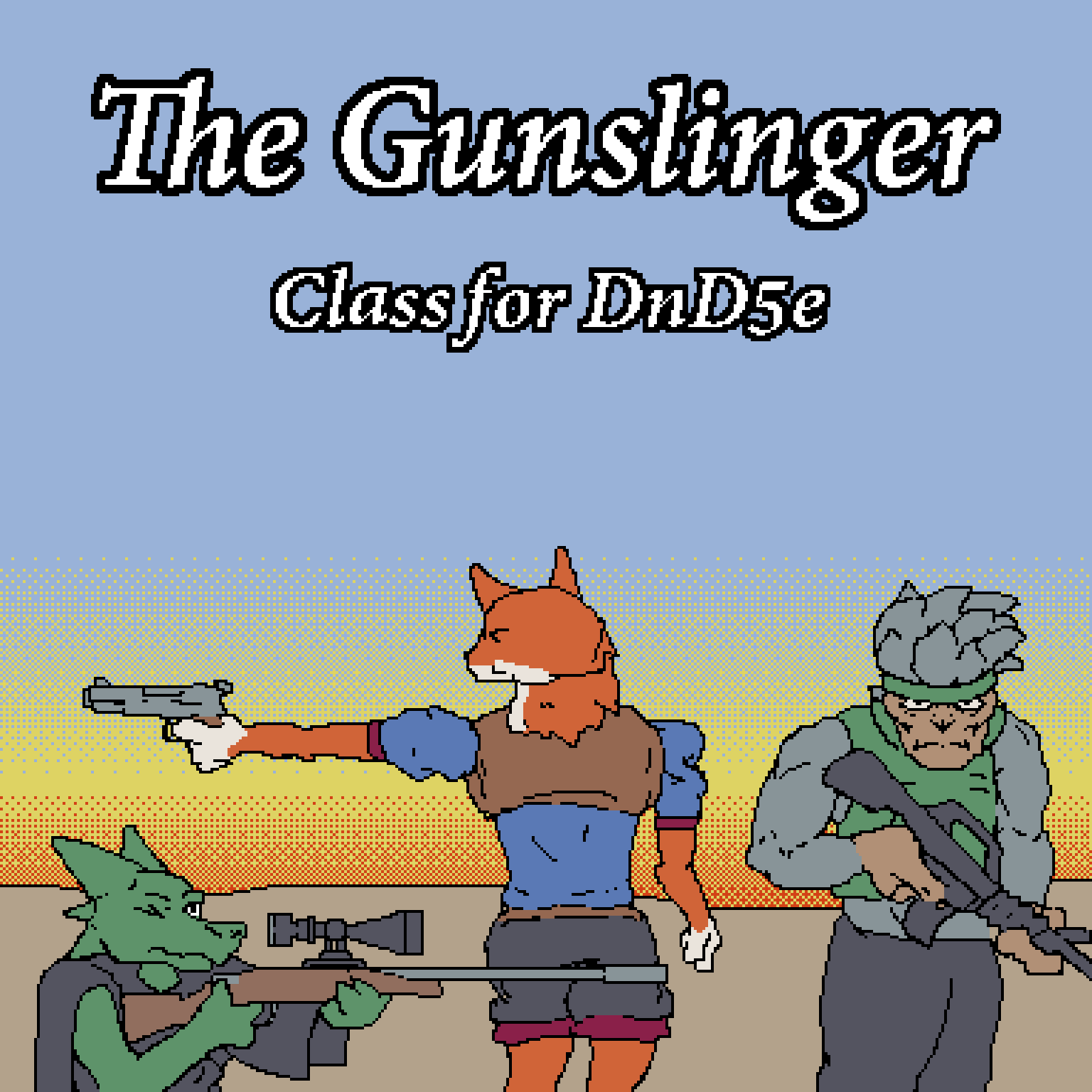

The Gunslinger
The Gunslinger, as the name would imply, primarily employs firearms as their weapon of choice. While a gun may be just as powerful in the hands of a novice as it is in the hands of a specialist, this only allows Gunslingers to further develop their speed, precision, and technique.
Flavor text, flavor text.
The gunslinger, unlike other fighters, fights at a long range. A lot of the power and individuality of a gunslinger comes from their subclass. In addition, you get access to a good variety of effects through deeds, and are most likely to be the one out of the group who spots when something is amiss. And, of course, you'll be stronger than most at long ranges.
Gunslinger Features
As a Gunslinger, you gain the following class features
Hit Points
- Hit Dice: 1d8 per Gunslinger level
- Hit Points at 1st Level: 8 + Constitution modifier
- Hit Points at Higher Levels: 1d8 (or 5) + Constitution
Proficiencies
- Armor: Light armor, Medium armor
- Weapons: Simple Weapons, Whips, Bows, Crossbows, Firearms
- Tools: Smith's tools, one artisan's tool set of your choice and one instrument of your choice
- Saving Throws: Intelligence, Wisdom
- Skills: Choose two from Athletics, Acrobatics, Stealth, Sleight of Hand, Investigation, Religion, Insight, Medicine, Perception, Persuasion, and Intimidation
Equipment
You start with the following equipment, in addition to the equipment granted by your background:
- (a) Chainmail Armor or (b) Leather Armor
- (a) One weapon which Gunslingers are proficient (a) Two weapons which Gunslingers are proficient in which have the light property
Creating a Gunslinger
The gunner is somewhat similar to the Fighter class, and you should similarly consider where or why you were trained for combat, and what makes you special as a warrior. However, many gunslingers usually live life closer to the edge, given that their weapon of choice works by exploding in their hand, and could kill them just as easily were they on the other end of the barrel. On the flip side, guns are also a safe weapon, being easy to use, fast, and effective from a very long distance. Is your gunslinger an unnecessary risk taker, and a powder keg? Or are they paranoid, defensive, and jumpy?
Additionally, consider the particular logistics of guns within this world. If you are playing in a setting where guns are unlikely to exist, how did you obtain and master them? Are you a trailblazer, which made guns yourself, innovating on the frontier of combat? Or is it a majorly forgotten, untapped, exotic weapon, which you particularly fancy in spite of its unpopularity in your location?
Quick Build
Dexterity, and your choice between Wisdom, Charisma, or Intelligence, are the most important abilities for a Gunslinger. If you choose the Soldier subclass, you can use Strength, instead of Dexterity. Additionally, choose the Precision firing style. Then, take the High Caliber and Duck and Cover deeds.
Multiclassing
You must have a Dexterity score of 13 or higher to multiclass in and out of this class.
Quick Links
Gunslinger
| Level | Prof. Bonus | Features | Risk Dice | Risk Die Size | Deeds Known |
|---|---|---|---|---|---|
| 1 | +2 | Specialty, Firing style | — | — | — |
| 2 | +2 | Quick Draw, Deeds | 3 | d6 | 3 |
| 3 | +2 | Keen Eye, Specialty Feature | 3 | d6 | 3 |
| 4 | +2 | Ability Score Increase | 4 | d6 | 3 |
| 5 | +3 | Extra Attack | 4 | d8 | 3 |
| 6 | +3 | Specialty Feature, Stability | 5 | d8 | 4 |
| 7 | +3 | Quick Draw Improvement, Hair Trigger | 5 | d8 | 4 |
| 8 | +3 | Ability Score Increase | 6 | d8 | 4 |
| 9 | +4 | Gunslinging Versatility, Specialty Feature | 6 | d8 | 4 |
| 10 | +4 | Grizzled | 7 | d10 | 5 |
| 11 | +4 | Specialty Feature | 7 | d10 | 5 |
| 12 | +4 | Ability Score Increase | 8 | d10 | 5 |
| 13 | +5 | — | 8 | d10 | 5 |
| 14 | +5 | Specialty Feature | 9 | d10 | 6 |
| 15 | +5 | Unload | 9 | d12 | 6 |
| 16 | +5 | Ability Score Increase | 10 | d12 | 6 |
| 17 | +6 | Specialty Feature | 10 | d12 | 6 |
| 18 | +6 | — | 11 | d12 | 6 |
| 19 | +6 | Ability Score Increase | 11 | d12 | 6 |
| 20 | +6 | Kinetic Overcharge | 12 | d12 | 6 |
Specialty
Beginning at 1st level, you choose your specialization in firearms. You can choose from Duelist, Soldier, Sniper, Crackshot, Spellslinger, Arsenal, or Loudmouth.
Firing Style
Also at 1st level, you gain one of the following fighting styles of your choice. (These fighting styles are also available to the Fighter class, and can be gained using the Fighting Initiate feature.)
Akimbo. You gain a +1 bonus to attack rolls with weapons that have both the light and tactless properties. Additionally, when engaging in two-weapon fighting with tactless weapons, you do not make your offhand attack with disadvantage. Alternatively, you can make use your bonus action to make two attacks with disadvantage using your offhand weapon, if the attack would not normally have disadvantage.
Precision. You gain a +2 bonus to attack rolls with firearms which have the Tactless property.
Skullcracker. When exceeding a target's AC by 5 or more or landing a critical hit with a firearm attack, you can add a d6 to the damage roll of the attack.
Defense. You gain a +1 bonus to AC and saving throws.
Close-quarters shooter. Your ranged attacks ignore half cover and three-quarters cover and have a +1 bonus to attack rolls against targets within 30 feet of you. Additionally, when making a ranged attack while you are within 5 feet of a hostile creature, you do not have disadvantage on the attack roll, and gain a +1 bonus to the damage roll. This works with weapons which have the tactless property.
Quick Draw
Starting at 2nd level, you remain high-strung, always envisioning your hand on your gun. You add your proficiency bonus to initiative rolls, and may draw and stow up to two firearms as part of rolling initiative. Starting at 7th level, you can also make a single attack with a firearm as part of rolling initiative.
Deeds
Also at 2nd level, you become bold enough to engage in risky maneuvers which seem to pan out for you. You learn two Deeds of your choice, and gain a number of Risk dice with which to use them. Additionally, you must choose Charisma, Wisdom, or Intelligence as your Risk modifier. This ability determines the saving throw and attack bonus of certain deeds and features in this class. You learn more deeds as you gain levels in this class, as shown in the deeds known column on the Gunslinger table. Each time you level up, you can replace one deed you know with another deed which you qualify for.
Risk Save DC
Risk attack modifier
Keen Eye
Starting at 3rd level, you have remarkably pointed eyes, your sight honing in on a point like bullets. As an action, you can take a moment to observe your surroundings with prudence. Until the end of your next turn, you can see through magical illusions or disguises that were created by a spell with a slot level no greater than your Proficiency bonus, as well as most nonmagical disguises. You can use this feature twice, and gain another use at levels 5, 9, 13, and 17, in this class, regaining all expended uses at the end of a long rest. You can also expend a use of this feature to cast Identify or Find Traps.
Extra Attack
Starting at 5th level, you can attack twice, instead of once, when you take the attack action on your turn.
Stability
Starting at 6th level, as a bonus action, you can choose to go prone. When going prone in this way, you do not have disadvantage on attack rolls due to being prone.
Hair Trigger
Starting at 7th level, your high-strung demeanor makes you both alert and observant. When making a Perception check, you can use your Risk modifier, instead of your Wisdom modifier, and you have advantage on the roll. Additionally, once per short or long rest, when failing a Dexterity or Wisdom saving throw, you can re-roll the save and take the better result.
Gunslinging Versatility
Starting at 9th level, you become adept enough with firearms for your expertise to be always applicable. You gain the 1st-level feature of a Gunslinger specialty of your choosing. You cannot gain a feature you already have this way. However, every time you gain a level in this class, you can change the benefit gained from this feature to another 1st-level feature of a gunslinger specialty.
Grizzled
Starting at 10th level, you've lived through enough gritty tales for a lifetime. When making an Insight, Intimidation, or Performance check, you can use your Risk modifier, instead of the normal modifier, and add one roll of your Risk die to the result. Additionally, once per short or long rest, upon taking damage, you can use a reaction to halve the damage against you.
Unload
Starting at 15th level, you can push yourself to fire with extreme speed and unleash a hail of hot lead. Once per short or long rest, in place of an attack, you can make 4 attacks. If the attacks are with only light weapons, you can instead make 6 attacks.
Kinetic Overcharge
Starting at 20th level, you can fire an incredible projectile with enough power to tear through anything. As an action, you can fire a bullet, forcing all creatures which fall on a line up to 300 feet long originating from you to make a Dexterity saving throw, taking 8d12 Force damage on a failed save. Any nonmagical material weaker than adamantine within the path of the projectile is vaporized. You can use this feature a number of times equal to your Proficiency bonus, and regain all uses at the end of a long rest.
Deeds
Tactics
Dodge Roll
As a bonus action, you can move up to 15 feet. During this movement, you do not provoke opportunity attacks, can move through the spaces of other creatures, can ignore difficult terrain, and cannot take damage due to the movement.
Scuffle
When making an attack with an improvised weapon (Such as the backend of a gun), you can expend one Risk die to instead make the attack with your Risk attack bonus and use your Risk die as its damage die. This effect lasts until the beginning of your next turn. Additionally, for the initial attack, you can add your Risk die to the attack roll.
Close Call
As a reaction when hit by an attack, you can expend and roll one Risk die, adding the amount rolled plus your Risk modifier to your AC against the attack, potentially causing the attack to miss.
Duck and Cover
When making a Dexterity saving throw, as a reaction, you can expend and roll one Risk die, adding the amount rolled to your saving throw.
Hotfoot
As a reaction to a creature ending their movement, you can expend one Risk die to force a target within 30 feet to make a Wisdom saving throw, then move up to 30 feet. On a failed save, they cannot make attacks of opportunity against you until the end of their next turn,
Blastback
When firing a firearm, you can expend one Risk die as a reaction to leap to any position within a range of 5 * your Proficiency bonus in feet without provoking opportunity attacks.
Covering Fire
As a reaction to an ally within the range of your firearm being hit by an attack, you can expend one Risk die to force the attack to be re-rolled with a penalty equal to the amount rolled on the Risk die, forcing the attacker to take the worse result.
Blanket Fire
As an action, you can expend risk dice up to your Proficiency bonus to fire upon a cube within your weapon's normal range. The cube's size is 10 + 5 feet for each risk die spent. All creatures in the area must make a Dexterity saving throw or take damage equal to the total rolled plus your Risk modifier, or half as much on a failed save.
Speedloader
When making a weapon attack, you can expend one Risk die to ignore the loading or reload properties of that weapon for the attack.
Shots
You can only apply one of these deeds per attack you make with a firearm.
Blank Flash
In place of an attack, you can expend one Risk die to fire an extra bright blank round, forcing a target within 30 feet to make a Wisdom saving throw or become blinded until the end of your next turn.
High Caliber
When making a successful attack with a firearm, you can expend one Risk die and add it to the damage roll.
Fly True
When making an attack roll with a firearm, you can expend and roll one Risk die to add it to that attack roll. Additionally, the attack ignores the AC bonus granted by the Shield spell.
Hollow Point
If you would normally make an attack without disadvantage, you can expend one Risk die as part of that attack to instead make it with disadvantage, but add your Risk die plus twice your Risk modifier to the damage roll.
Kneecap
When making a successful attack with a firearm, you can expend one Risk die to force the target to make a Strength saving throw. On a failed save, you can choose to either knock them prone or reduce their speed to 0 until the end of their next turn.
Riccochet
When making an attack with a firearm, you can expend one Risk die to fire a bullet to an unoccupied space within your weapon's normal range. You then make the attack from that position. You can also expend a Risk die as a reaction to successfully hitting a creature with a firearm attack to make a firearm attack from that creature's position with disadvantage.
Trick Shot
When making an attack with a firearm, before making the attack roll, you can expend and roll one Risk die and make it a trick shot. You recieve a -5 penalty to the attack roll, but if it hits, you add the risk die to the damage and the target must make a Wisdom saving throw or have disadvantage on attacks against creatures other than you until the end of your next turn.
Piercing Shot
When making an attack with a firearm, you can expend one Risk die to make the same attack against all targets that fall on a line from you to the target, extending to your weapon's normal range.
10th-level Deeds
You must be at least a 10th-level gunslinger to learn the deeds on this page.
Tactics
Pinpoint
As a reaction when an ally within range of your weapon makes a Dexterity saving throw against an effect you can see, as long as you are not forced to make the same saving throw, you can expend a Risk die to make a weapon attack with disadvantage against the DC of the saving throw. On a success, you successfully fire a bullet perfectly placed to block the source, and your ally automatically succeeds on the saving throw.
Countershot
You can expend one Risk die upon seeing an ally be targeted by a ranged attack (no action required). When expending this risk die, you make a weapon attack against an AC equal to the attack roll of the triggering attack. On a hit, the damage of the attack is reduced by an amount equal to one roll of your Risk die + your Gunslinger level + your Risk modifier.
Interrupt
As a reaction when a creature within range of your weapon draws a weapon, makes an attack roll, you can expend one Risk dice to interrupt them with a bullet. Make a weapon attack roll against the target. On a successful hit, they drop their weapon, or the attack is cancelled. Additionally, as a reaction to a creature within range performing the somatic components of a spell, you can expend two Risk dice to interrupt them. This functions identically to a Counterspell cast at 3rd level, using your Risk modifier as your spellcasting modifier.
Shots
You can only apply one of these deeds per attack you make with a firearm.
Hammering Shot
When making an attack with a firearm, before making the attack roll, you can expend one Risk die to make it a hammering shot. If the attack hits, add the risk die to the damage. Additionally, each time you successfully hit the creature with a hammering shot, you can add another Risk die to the damage roll. The amount of risk dice you add to the damage resets to 1 upon missing a shot.
Smart Bullet
When making an attack with a firearm, before making the attack roll, you can expend and roll one Risk die to cause it to curve towards its target. The attack ignores half and three-quarters cover and cannot have disadvantage.
Explosive Round
When making an attack roll with a firearm, you can expend two Risk dice to force all creatures within 10 feet of the target to make a Dexterity saving throw or take fire damage equal to one roll of your Risk die. The target automatically fails this save if the attack is successful.
Gunslinger Firearms
| Weapon Property | Effect |
|---|---|
| Tactless | You cannot add your ability modifier to damage rolls with this weapon. When engaging in two-weapon fighting and using this weapon for your offhand attack, the attack has disadvantage. Fighting styles, as well as the Sharpshooter and Great Weapon Master feats, do not work with this weapon, unless otherwise specified. |
| Maneuverable | This weapon does not have disadvantage on attack rolls within 5 feet. |
| Reload | Each time you make a number of attacks with this weapon equal to the number shown as part of this property, you must use another attack or a bonus action to reload before you can attack with this weapon again (You can choose to reload at any time). |
| Overheat | Same as reload, but an action must be used to reload instead. |
| Automatic | Attacks with this weapon are always made at disadvantage. However, if the attack would normally be made without disadvantage, you make two attacks, instead of one, and if it would be made with advantage, you make three attacks, instead of one. |
| Spread | When attacking with this gun, you instead force the creatures targeted to make a Dexterity saving throw with a DC equal to 8 + your attack bonus with this weapon, taking the weapon's damage on a failed save. If the target Additionally, this property lists two characteristics: Area and dropoff. Area lists the point of origin and the range of its effect, similarly to a spell. All creatures within the area are targets. Dropoff describes how much damage is lost as the target becomes further away from the point of origin, for example, a dropoff of 1d4 every 5 feet means a target 10 feet away takes 2d4 less damage. |
| Bulky | You use Strength, instead of Dexterity for attack rolls with this weapon, regardless of its ranged property. |
Derringer
2d4 Piercing damage, Light, Ranged (30/60), Tactless, Reload (2), Special
Special: This weapon is remarkably small and concealable. It imposes a -5 penalty on checks to find or perceive it, and does not make noise when fired.
Pistol
2d6 Piercing damage, Light, Ranged (40/80), Tactless
Revolver
2d8 Piercing damage, Ranged (40/80), Reload (6), Tactless
Rifle
2d8 Piercing damage, Two-handed, Ranged (80/160), Tactless
Sniper Rifle
2d12 Piercing damage, Two-handed, Ranged (120/800), Reload (1), Tactless, Special
Special: Attacks made against targets within 20 feet using this weapon have disadvantage.
SMG
1d10 Piercing damage, Light, Ranged (30/60), Tactless, Automatic
Assault Rifle
2d6 Piercing damage, Two-handed, Ranged (50/100), Tactless, Automatic
Chaingun
3d6 Piercing damage, Heavy, Two-handed, Ranged (40/120 ft.), Tactless, Automatic, Overheat (12), Bulky
Peppergun
1d4 Piercing damage, Ranged (50/100), Tactless, Special
Special. For every 2 points over the target's AC you make with an attack roll using this weapon, the attack deals 1d4 additional Piercing damage, to a max of 7d4.
Sawed Off Shotgun
3d6 Piercing damage, Versatile (4d6) Tactless, Ranged, Maneuverable, Reload (2), Bulky, Spread
Spread Area: 30 foot cone originating from user.
Spread Dropoff: 1d6 for every 10 feet.
Pump-action Shotgun
5d4 Piercing damage, Tactless, Ranged, Two-handed, Maneuverable, Reload (4), Spread
Spread Area: 5 foot wide, 60 foot long line originating from user.
Spread Dropoff: 1d4 for every 15 feet.
Rocket Launcher
1d8 Fire damage + 3d4 Thunder damage, Tactless, Ranged, Bulky, Spread, Reload (4), Special
Spread Area: 15 foot radius sphere originating from point within 60 feet which the user can see.
Spread Dropoff: 1d4 Thunder for every 5 feet.
Special: When reloading this firearm, you load only a single piece of ammunition, instead of all 4.
Great Cannon.
3d12 Bludgeoning damage, Ranged (60/180), Tactless, Reload (1), Heavy, Two-handed, Special, Bulky
Special: This weapon cannot be used while the user is prone. When making an attack with this weapon, the user must make a DC 12 Strength saving throw or be knocked prone, and cannot get up until the beginning of their next turn, as they struggle to lift the cannon.
Emergency Flare.
1d8 Piercing damage + 2d8 Fire damage, Ranged (20/60), Tactless, Overheat (1), Maneuverable
High-Grade Firearms
Not necessarily magic in nature, but more powerful and harder to obtain than the weapons listed above.
Gunblade
2d8 Piercing damage, Ranged (40/80), Reload (6), Tactless, Burdensome (12), Special
Special: This weapon can also be used as a longsword with the finesse property.
Lucky Shot
1d6 Piercing damage, Ranged (40/80), Tactless, Special
Special: Attacks made with this weapon cannot miss.
Peacekeepers
2d8 Piercing damage, Light, Ranged (60/120), Reload(5), Tactless, Burdensome(10)
A pair of finely crafted pistol-revolver hybrids with high power packed into a sleek design.
Laser Rifle
2d12 Force damage, Two-handed, Ranged (80/160), Ammunition, Tactless
A pair of finely crafted pistol-revolver hybrids with high power packed into a sleek design.
Mounted Cannon
3d12 Bludgeoning damage, Ranged (60/180), Tactless, Reload (1), Heavy, Burdensome (18), Masterful (10), Special, Bulky
Specialty: Duelist
You shoot and kill with an almost casual aim, being a nigh unbeatable opponent using nothing but basic handguns.
Mysterious Figure
When you adopt this archetype at 1st level, you can use your Risk modifier, instead of Charisma, when making persuasion or deception checks, and gain proficiency in the persuasion and deception skills.
Blast
Starting at 3rd level, when wielding a firearm in one hand and nothing else, or when wielding only light weapons, you can add a +2 bonus to damage rolls with that weapon (or weapons). This bonus increases by 1 when you reach levels 9, 13, and 17 in this class.
Extra Fighting Style
Starting at 6th level, you gain a 2nd Fighting Style from those available to you as part of your Firing Style feature.
Parting Shot
Also at 6th level, when taking the dash or disengage action on your turn, you can make a single weapon attack as part of the same action. This increases to two attacks at 13th level, and 3 attacks at 19th level.
Lock and Load
Starting at 9th level, you gain two additional Risk dice. Additionally, you can apply two 'Shot' deeds to a single attack, instead of only one.
Extra Attack (x2)
Starting at 11th level, the number of attacks you can make when you take the attack action on your turn increases to 3, and then to 4 at 17th level.
Crucial Shot
Starting at 14th level, you know just where to place your bullets to be as effective as possible. Once on each of your turns, you can add your Risk die to one weapon attack or damage roll.
Specialty: Soldier
A tough infantryman, better at staying in the fight, and able to fight in close-quarters just as well.
Strongarm
When you adopt this archetype at 1st level, you can always choose to use Strength instead of Dexterity for the attack and damage rolls of ranged weapon attacks, regardless of the weapon's properties.
Battle Hardened
Starting at 3rd level, your maximum hit points increase by 3, and another point every time you gain a level in this class. Additionally, you gain proficiency in heavy armor, shields, and martial weapons, and can use Strength, instead of Dexterity, when determining your AC for wearing armor.
CQC
Also at 3rd level, your unarmed strikes deal damage equal to your Risk die, instead of their normal amount. Additionally, once at the beginning of each of your turns, you can deal damage equal to your Risk die to a creature grappled by you. Finally, upon successfully hitting a creature with an unarmed strike, that creature cannot make attacks of opportunity against you for the rest of the current turn.
Guerilla Tactics
Starting at 6th level, you can take the Hide, Disengage, or Use an Item actions as a bonus action. Additionally, when a target is grappled by you, you can prevent them from speaking or making noise. Finally, upon hitting a target with an unarmed strike, you can make a single unarmed strike against them as a bonus action.
Steady Hand
Also at 6th level, once per turn, when making an attack with disadvantage, the attack does not have disadvantage if the target is within 30 feet of you. This bonus increases to twice per turn at 13th level, and 3 times at 19th level.
Bullet-Catch
Starting at 9th level, you can use your reaction to deflect or catch a projectile when you are hit by a ranged weapon attack. When you do so, the damage you take from the attack is reduced by 1d10 + your Strength or Dexterity modifier + your Proficiency bonus.
Trigger Finger
Starting at 11th level, once on each of your turns, you can make a single attack with a firearm (or unarmed strike) if you are not incapacitated or otherwise prevented from attacking. This increases to two attacks upon reaching 17th level in this class.
Veteran
Starting at 14th level, your movement speed increases by 10 feet, and you can use your Hair Trigger and Grizzled features twice per short or long rest, instead of once.
Specialty: Sniper
You fire a single clean shot, killing with ruthless efficiency.
Lineup
When you adopt this archetype at 1st level, once per turn, in place of an attack, you can impose advantage on your next attack before the end of your next turn.
Killshot
Starting at 3rd level, once per turn when you have advantage on a ranged weapon attack, it deals 1d6 extra damage on a successful hit. This damage increases by 1d6 when you reach levels 7, 13, and 18 in this class.
Level Head
Starting at 6th level, once on each of your turns while you are incapacitated or otherwise have your action restricted, you can make a single ranged weapon attack.
Cold Open
Additionally at 6th level, you can add your Risk modifier to the damage roll of your first successful ranged weapon attack each turn.
Deep Hiding
Finally at 6th level, when you take the Hide action, you are not immediately revealed upon attacking: Any targets which hear you must instead make a contested perception check against your stealth check to reveal you.
Deadeye
Starting at 9th level, when making an attack roll with advantage from your Lineup feature, you can reroll one of the d20s once.
Sightline
Starting at 11th level, you now no longer need to use your Lineup feature in place of an attack, and can simply use it at the beginning of each of your turns, no action required, as well as reload a single gun as part of the effect.
Infallible
Starting at 17th level, you can add your Risk modifier to attack rolls. In addition, you use d8s, instead of d6s, when determining the extra damage from your Killshot feature.
Specialty: Crackshot
You can reliably get critical hits, get critical hits more often, and deal more damage when getting critical hits. It's the crit subclass.
Re-align
When you adopt this archetype at 1st level, once per short or long rest, as a reaction to missing a ranged weapon attack, you can make the same attack with disadvantage. You can expend one Risk die to use this feature again if you have no more uses.
Overkill
Starting at 3rd level, when you exceed a target's AC by 10 or more with an attack roll using a ranged weapon with the tactless property, the attack is treated at a critical hit.
Crucial Shot
Starting at 6th level, you know just where to place your bullets to be as effective as possible. Once on each of your turns, you can add your Risk die to one weapon attack or damage roll.
Improved Critical
Additionally at 6th level, you land a critical hit on a roll of 19 or 20. You also land a crit on a roll of 18 starting at 11th level, and on 17 starting at 17th level.
Internal Riccochet
Starting at 9th level, you can roll an additional d6 when determining the extra damage for a ranged weapon attack. This increases to 2d6 at level 18.
Gut Shot
Also at 9th level, when landing a critical hit, you can force the target to make a Strength saving throw. On a failed save, they take additional damage equal to one roll of your Risk die and become incapacitated until the start of your next turn. You can use this feature a number of times equal to your Risk modifier, and regain all uses at the end of a long rest.
Strong Hits
Starting at 11th level, you can add your Dexterity modifier to damage rolls with attacks with ranged weapons that have the tactless property.
Extra Crucial Shot
Starting at 14th level, you can use your Crucial Shot feature on both one attack roll and one damage roll on each of your turns, instead of having to choose only one.
Extra Attack (x2)
Starting at 17th level, you can attack 3 times, instead of 2, when you take the attack action on your turn.
Specialty: Spellslinger
You shoot fire and fire shots.
Magic Bullet
When you adopt this specialty at 1st level, when dealing damage with a firearm, you can choose to deal force damage, instead of the weapon's normal damage type. You can use this feature a number of times equal to your Proficiency bonus, regaining all uses at the end of a long rest.
Spellcasting
Starting at 3rd level, you gain the ability to conjure minor effects. Your Risk modifier is your spellcasting modifier for these spells, as it comes from your unique ability.
Spellslinger Spellcasting
| Gunslinger Level | Cantrips Known | Spells Known | 1st | 2nd | 3rd | 4th |
|---|---|---|---|---|---|---|
| 3rd | 2 | 2 | 2 | - | - | - |
| 4th | 2 | 3 | 3 | - | - | - |
| 5th | 2 | 3 | 3 | - | - | - |
| 6th | 2 | 4 | 3 | - | - | - |
| 7th | 2 | 5 | 4 | 2 | - | - |
| 8th | 2 | 5 | 4 | 2 | - | - |
| 9th | 2 | 6 | 4 | 2 | - | - |
| 10th | 3 | 6 | 4 | 3 | - | - |
| 11th | 3 | 7 | 4 | 3 | - | - |
| 12th | 3 | 7 | 4 | 3 | - | - |
| 13th | 3 | 8 | 4 | 3 | 2 | - |
| 14th | 3 | 8 | 4 | 3 | 2 | - |
| 15th | 3 | 9 | 4 | 3 | 2 | - |
| 16th | 3 | 9 | 4 | 3 | 3 | - |
| 17th | 3 | 9 | 4 | 3 | 3 | - |
| 18th | 3 | 10 | 4 | 3 | 3 | - |
| 19th | 3 | 10 | 4 | 3 | 3 | 1 |
| 20th | 3 | 10 | 4 | 3 | 3 | 1 |
Cantrips
You learn two cantrips of your choice from the conduit spell list. You learn an additional conduit cantrip of your choice at 10th level.
Spell Slots
The Spellslinger Spellcasting table shows how many spell slots you have to cast your conduit spells of 1st level and higher. To cast one of these spells, you must expend a slot of the spell's level or higher. You regain all expended spell slots when you finish a long rest.
For example, if you know the 1st-level spell Shield and have a 1st-level and a 2nd-level spell slot available, you can cast Shield using either slot.
Spells Known of 1st Level and Higher
You learn Spellslinger spells at certain levels, as shown in the Spells Known column of the Spellslinger Spellcasting table. When learning a spell, you may pick any spell from the Conduit spell list for which you have spell slots.
Whenever you gain a level in this class, you can replace one of the conduit spells you know with another spell of your choice from the conduit spell list.
Empower
Starting at 6th level, when using your Magic Bullet feature, the attack deals an additional 1d4 force damage. Additionally, your Firing Style applies to spells which require attack rolls.
War Magic
Additionally at 6th level, when you use your action to cast a spell or cantrip, you can make a single weapon attack as a bonus action.
Energy Burst
Starting at 9th level, you can always cast cantrips with a casting time of one action as a bonus action. You cannot add any modifiers to the damage of cantrips cast in this way, or make a weapon attack as part of a cantrip cast in this way.
Additionally, you can always make a single ranged weapon attack as a bonus action.
Improved War Magic
Starting at 11th level, once per turn, you can replace one of your attacks with the casting of a spell or a cantrip. The spell must have a casting time of one action or one bonus action. You cannot make a weapon attack as part of a cantrip cast in this way.
Imbued Shot
Starting at 14th level, you can infuse your bullets with your magic. By expending a spell slot as part of a weapon attack, you can deal 1d10 additional force damage per level of the spell slot spent.
Magi
Starting at 17th level, you are adept enough in magic to keep a steady flow throughout the day. As a bonus action, you can gain spell slots whose total level equals your Proficiency bonus. You cannot gain a spell slot of a higher level than 4th. After using this feature, you must finish a long rest before you can use it again.
Spellslinger Spell List
Cantrips (0 Level)
- Acid Splash
- Blade Ward
- Chill Touch
- Create Bonfire
- Dancing Lights
- Fire Bolt
- Gust
- Lightning Lure
- Mending
- Minor Illusion
- Mold Earth
- Poison Spray
- Ray of Frost
- Shocking Grasp
- Thunderclap
- True Strike
- Vicious Mockery
1st Level
- Alarm
- Burning Hands
- Cause Fear
- Chaos Bolt
- Charm Person
- Chromatic Orb
- Color Spray
- Expeditious Retreat
- Frost Fingers
- Mage Armor
- Magic Missile
- Ice Knife
- Identify
- Jump
- Sleep
- Snare
- Witch Bolt
- Zephyr Strike
2nd Level
- Animal Messenger
- Arcane Lock
- Blur
- Enhance Ability
- Find Traps
- Gust of Wind
- Heat Metal
- Invisibility
- Magic Weapon
- Mirror Image
- Moonbeam
- Ray of Enfeeblement
- Rime's Binding Ice
- Scorching Ray
- Shatter
- Web
3rd Level
- Ashardalon's Stride
- Blink
- Call Lightning
- Conjure Barrage
- Counterspell
- Dispel Magic
- Elemental Weapon
- Erupting Earth
- Fireball
- Haste
- Hypnotic Pattern
- Incite Greed
- Leomund's Tiny Hut
- Protection from Energy
- Pulse Wave
- Spirit Shroud
- Thunder Step
- Water Walk
4th Level
- Blight
- Compulsion
- Control Water
- Death Ward
- Fabricate
- Fire Shield
- Freedom of Movement
- Gravity Sinkhole
- Greater Invisibility
- Vitriolic Sphere
- Watery Sphere
Specialty: Storm Gunner
You embody the fury of a rolling storm, and the devastation it can bring. You have a few lightning-based abilities and are slightly better with automatic weapons.
Voltage
When you adopt this archetype at 1st level, you can replace any Fire or Piercing damage you deal with firearms with Lightning damage.
Bullet Hell
Starting at 3rd level, once per turn when you make a firearm attack with disadvantage using the Automatic property or the Akimbo fighting style, you can instead make that attack without disadvantage (you do not replace the attack again for an automatic weapon, you simply make an exception and make the attack without disadvantage). You can do this twice per turn starting at 9th level, thrice per turn at level 13, and 4 times per turn starting at level 18.
Electromancy
Starting at 6th level, you gain a set of extra abilities related to the control of electricity.
Techniques. You learn one of four Storm Gunner Techniques listed on the next page. You learn another technique at levels 8, 12, and 16, and can replace any technique you know with another technique every time you gain a level in this class.
Electromancy Points. These abilities are fuelled by Electromancy points, which you have a number of equal to your Risk modifier + 1/4th of your Gunslinger level, rounded down (minimum 3 electromancy points). You regain all Electromancy points at the end of a long rest.
Improved Electromancy
Starting at 9th level, you gain Electromancy points equal to your Proficiency bonus.
Extra Attack (x2)
Starting at 11th level, the number of attacks you can make when you take the attack action on your turn increases to 3, and then to 4 at 17th level.
Bang, Bang!
Starting at 14th level, when using a bonus action to attack via two-weapon fighting, you can attack twice, instead of once, with your offhand weapon.
Recharge
Also at 14th level, once per long rest, you can regain 4 Electromancy points as a bonus action.
Storm Gunner Techniques
Lightning Rod
You can attract and channel electricity, allowing your body to be a high-powered conducter.
Grounding. As a bonus action or as part of rolling initiative, you can expend one Electromancy point to gain resistance to Lightning damage for one minute, or until you lose concentration (as if concentrating on a spell).
Attract/Disperse. As a reaction to an ally within 90 feet taking Lightning damage, you can take the full amount of lightning damage in their place. You can additionally expend 2 Electromancy points as part of the reaction to halve the damage against you, taking no damage if you have resistance to lightning damage. Regardless, after making this reaction, the next weapon attack you make before the end of your next turn will deal 1d12 additional Lightning damage on a successful hit.
Charge. You can expend Electromancy points up to your Proficiency bonus as part of a weapon attack to cause that attack to deal 1d8 additional Lightning damage per point spent, in addition to the normal damage of the attack. You must do this before you make the attack roll.
Raincloud
You can cause storm clouds to brew at a point of your choosing within 60 feet as a bonus action by expending one Electromancy point. The cloud is a 15 foot cube, has 15 HP, 14 AC, uses your saving throws, hovers up to 60 feet off the ground, uses your saving throws, and is immune to bludgeoning, slashing, piercing, psychic, and necrotic damage, and lasts for one minute. As part of the bonus action used to create the cloud, then a bonus action on each subsequent turn, you can expend one Electromancy point to command the cloud, allowing it to move up to 25 feet and then take one of the following actions:
Dodge Rain! All creatures that are within 10 feet (and are underneath) the raincloud must make a Dexterity saving throw against your Risk DC or take Piercing damage equal to one roll of your Risk die, taking half as much on a successful save, as bullets pour out of the cloud. You can expend one Risk die as part of this action to add it to the damage.
Descend. The cloud darkens and congeals as it lowers to the ground, heavily concealing the area it falls on similarly to the fog of a fog cloud spell (although cannot be dispersed by strong wind). You can cause it to rise again any time you move the cloud, ending these properties.
Jolt. A jolt of electricity leaps from the cloud to a target within 60 feet. Use your Risk attack bonus for the attack, dealing Lightning damage equal to one roll of your Risk die + your Risk modifier on a hit. You can expend one Risk die as part of this action to add it to the damage.
Zap
You gain access to a limited array of spells, using your Risk modifier as your spellcasting ability modifier. You must expend one Electromancy point per slot level you cast the spell at, but can cast any spell at a level up to your Proficiency bonus (cantrips do not cost any electromancy points). You must be able to cast a spell at its lowest level to be able to cast it at all.
Cantrips: Lightning Lure, Thunderclap
1st-level: Thunderous Smite, Witch Bolt
2nd-level: Shatter
3rd-level: Call Lightning, Lightning Bolt, Thunder Step
4th-level: Divine Death Blast
5th-level: Synaptic Static
6th-level: Chain Lightning
Lightning Speed
You move with the speed, if not the power, of lightning.
Fan the Hammer. Once on each of your turns, you can expend two Electromancy points to make a single extra attack with disadvantage using a light firearm (no action required). Additionally, you can expend two electromancy points as a bonus action to make your offhand attack with two-weapon fighting on any turn you do not take the attack action.
Extreme Speed. Upon rolling initiative, or as a bonus action, you can expend one Electromancy point to apply one of the following effects to yourself, which each last for 1 minute, or until you are incapacitated or knocked unconscious:
- You gain 15 feet of movement speed
- You gain a +1 bonus to attack rolls with firearms
- You can take the Dash and Disengage actions simultaneously as a bonus action
- You gain a +2 bonus to your AC
- You gain advantage on Dexterity saving throws
You can apply additional benefits on subsequent turns, but only one of each, and only one benefit can be granted per bonus action, expending electromancy points as normal.
Specialty: Graviturge
You have the bizarre ability to pull at the invisible attractions between all objects, especially useful for someone who fights with iron projectiles.
Attract/Repulse
When you adopt this archetype at 1st level, you can try to keep your foes unsure with your words. In place of an attack, you can force a target within 90 feet to make a Constitution saving throw against your Risk DC. On a failed save, the target's next attack roll before the end of your next turn has disadvantage, and the next attack against them before the end of your next turn has advantage.
Manipulations
Starting at 3rd level, you begin to perceive gravitational waves, and become attuned to the ways in which you can subtly distort and amplify them. You gain access to Gravitational Manipulations.
Wave Points. Your ability to control gravity is represented by a well of Wave Points, which you have 5 of, and gain more as you gain levels in this class, as shown in the Graviturge table. You regain all spent wave points at the end of a long rest.
Manipulations Known. You know one Gravitational Manipulation, choosing from the Manipulations on the next page. You learn additional manipulations as you level up in this class, as shown on the Graviturge table. Additionally, each time you level up, you can replace one manipulation you know with a new one.
Gravitational Manipulations. Manipulations additionally have optional effects listed under them, accompanied by the tag (x points), where X is the amount of points needed to expend to use that effect. Wave points are spent on these effects individually, and only to a maximum of your Wave limit can be spent to boost your manipulations after the initial cost to perform the manipulation. For example, if you are a 3rd level Gravity\urge gunslinger, you can spend 1 wave point to use the Railgun manipulation, then spend 2 more points on the Density effect to give your attack a +1 bonus to the attack roll and a +5 bonus to the damage roll.
Meteor Bullet
Starting at 6th level, you gain a single extra deed, which does not count against your deeds known:
Meteor Bullets. At the beginning of your turn (no action required), you can expend one Risk die to cause your bullets to be much more affected by gravity, allowing you to shoot upwards and have your projectiles crash back to earth with deadly speed. Your ranged weapon attacks ignore half and three-quarters cover for the rest of this turn, and may ignore full cover if the target is not covered from above.
Subtle Pull
Also at 6th level, you regain Wave points equal to your Risk modifier on a short rest.
Graviturge Table
| Gunslinger Level | Manipulations Known | Wave Points | Wave Limit |
|---|---|---|---|
| 3rd | 1 | 5 | 2 |
| 4th | 1 | 7 | 2 |
| 5th | 2 | 9 | 3 |
| 6th | 2 | 10 | 3 |
| 7th | 3 | 11 | 3 |
| 8th | 3 | 13 | 4 |
| 9th | 4 | 14 | 4 |
| 10th | 4 | 16 | 4 |
| 11th | 5 | 18 | 5 |
| 12th | 5 | 20 | 5 |
| 13th | 5 | 22 | 5 |
| 14th | 6 | 24 | 6 |
| 15th | 6 | 27 | 6 |
| 16th | 6 | 30 | 6 |
| 17th | 6 | 33 | 7 |
| 18th | 7 | 37 | 7 |
| 19th | 7 | 42 | 7 |
| 20th | 7 | 50 | 7 |
Gravitational Flow
Starting at 9th level, when using your action to use a Gravitational Manipulation, you can make a single weapon attack as a bonus action.
Extra Attack (x2)
The amount of attacks you can make when you take the Attack action increases to 3. It increases to 4 when you reach 17th level in this class.
Graviton Mastery
Starting at 14th level, at the beginning of each of your turns, you gain one Wave point. This wave point disappears if it is not used by the end of your turn.
Manipulations
Revolution
In place of a ranged weapon attack, you can expend one Wave point to force a creature within your weapon's range to make a Dexterity saving throw against your Risk DC. On a failed save, they take the full damage of the weapon attack. Every creature of your choosing who is exactly the same distance from you as the target must then make the same saving throw.
Velocity (1+ points) The save DC increases by 3 for each point spent.
Density (1+ points) The damage increases by 1d6 Piercing for each point spent.
Pull (2 points) The projectile is drawn back to you instead of falling to the ground. Every creature of your choice who is closer to you than the target must also make the save, but does so with advantage.
Table Flip
As a bonus action, you can pull up a section of ground (if possible) by expending two Wave points. You choose a 5-foot space adjacent to you, or the space you're standing in. An object is created in that space, with 10 health and 15 AC, which allows other creatures to occupy its space and grants half cover to any creatures occupying its space.
Length (1+ points) You can create one additional construct, or out of range if it is adjacent to an effected space. If you apply any additional effects for this manipulation, you can choose to have them effect or not effect each individual construct.
Hardness (1+ points) The construct gains 5 health and 1 AC per point spent.
Height (2 points) The construct grants 3/4 cover, instead of half cover.
Fort (3 points) The construct grants full cover. You must momentarily step out of the cover to make attacks, however.
Coefficient
As an action, you can change the rate at which gravity effects a creature. You can choose a creature within 60 feet, who can choose to make a Constitution saving throw against your Risk DC to resist the effects. You must concentrate on this manipulation as if concentrating on a spell.
Reduce (2 points) The target has advantage on dexterity-based ability checks, and saving throws, but has disadvantage on strength-based ones. Additionally, their jump distance is tripled.
Increase (2 points) The target has advantage on strength-based ability checks, and saving throws, but has disadvantage on dexterity-based ones. Additionally, they gain a +1 bonus to AC.
Push Negative (3 points) The creature is subject to the effects of the Levitate spell, with the same duration and concentration as normal. You have advantage on ranged weapon attack rolls while the target is effected in this way.
Push Multiplicative (3 points) The creature must make a Strength saving throw at the beginning of each of their turns, being rendered prone on a failed save.
Natural (2 points) This manipulation no longer requires concentration.
Weaponize (1 point) The target's advantage and disadvantage for strength and dexterity checks caused by this manipulation also gives them advantage and disadvantage to attack rolls using the corresponding scores.
Wormhole
As a bonus action, you can expend two Wave points to create a connection between two points. You create two portals at points you can see within 30 feet, up to 15 feet apart. They have a few properties:
- As expected, anything passing through one portal comes out the other portal in equal measure (including light, allowing visuals to be clear from one portal to the other).
- The portals are 1 foot in diameter, and are size category tiny. They do not occupy their space, but only creatures of equal or smaller size can pass through freely.
- Creatures caught mid-way inside the portal while it is created or dismissed are simply deposited on the side where most of their body is, no harm caused.
- The portals last for one minute, until a new pair of portals are created, or until dismissed. You can dismiss these portals at any time, no action required.
- These portals additionally slightly multiply the velocity of anything traveling through them. When you make a ranged weapon attack against the portal, the attack will stay caught in a loop between the portals until they are dismissed, at which point the attack is made from the position of one of the portals. The 'stored' attack gains an additional 1d8 Piercing damage at the end of each of your turns that the attack remains in the portal.
Distance (1+ points) The range in which you can create the portals increases by 10 feet, and the portals can be an additional 10 feet away from eachother for each point spent.
Size (1+ points) The portal's size category increases to small, and increases again for each point spent.
Crisp Image (4+ points) Any creature within the portal when it is created or dismissed must make a Constitution saving throw against your Risk DC or take 2d10 Force damage and will not be moved, or take half as much on a success. Upon taking this damage, the creature cannot take it again until the end of their next turn. The damage increases by 1d10 for each additional point spent.
Tandem (3 points) If another portal is already made or is made while these portals are active, the two pairs can co-exist.
Railgun
Once per turn when making a weapon attack, you can expend one Wave point to accelerate its velocity, adding +1 to the attack and damage rolls.
Velocity (1+ points) The attack gains a +2 bonus to the attack roll.
Density (1+ points) The attack gains a +2 bonus to the damage roll.
Approach Lightspeed (4 points) The attack immediately hits, instead of rolling, and deals Radiant damage instead of its normal type.
Isolated Well
In place of an attack, you can expend 1 Wave point to force a creature within 40 feet to make a Strength saving throw or be pushed 10 feet in a direction of your choice or be knocked prone.
Expand (2+ points) One additional creature can be targeted for every 2 points spent.
Crush (1+ points) A target additionally takes 1d8 force damage on a failed saving throw for each point spent.
Pull (1+ points) The target is moved an additional 5 feet on a failed saving throw for each point spent.
Slingshot
As a bonus action, you can expend one Wave point to leap to a point within 20 feet (without expending any movement).
Hold (2+ points) You instead fly to a point within range, and can make this movement again on your next turn. Afterwards, you fall as normal. For every 1 point spent after the initial 2, this effect lasts one additional round.
Speed (1+ points) You can move an additional 10 feet.
Impact (1+ points) The first time you move using this manipulation, all creatures within 10 feet of where you end your movement must make a Dexterity saving throw or take 1d6 Bludgeoning damage per point spent.
Pullstar
After making a successful weapon attack, you can expend one Wave point to magnetize the projectile and a different target within 90 feet of the first target. Make an attack roll against the new target with your Risk attack bonus, dealing 1d6 Piercing damage on a hit.
Bounce (1+ points) An additional new creature can be targeted in the same way for each point spent.
Density (1+ points) The damage of the attack against the second target increases by 1d6. This bonus damage decreases by 1 die for each subsequent creature targeted by this manipulation.
Magnetize Vitality
As an action, you can force a creature within 20 feet to make a Constitution saving throw against your Risk DC, as you attempt to cause their life essence to be pulled into your form. On a failed save, the target takes 1d8 Necrotic damage, and you are healed for the amount of damage the target took.
Strength (1+ points) The damage increases by 1d8 for each point spent.
Influence (1+ points) The range increases by 15 for each point spent.
Transfusion (1 point) You instead reverse the polarity, granting the target your vitality. The target does not make a saving throw. Instead, you choose to lose hit points up to the maximum amount that could be rolled for this manipulation's damage, and the target gains an equal amount of hit points.
Junk Shell
You pull up rock and debris from your surroundings to gravitate onto your body, forming a hardy layer of armor. As an action, you can expend two Wave points to gain a +2 bonus to your AC. You must concentrate on this effect as if concentrating on a spell, and it lasts up to one minute. Additionally, if you make an unarmed strike while under this effect, the unarmed strike deals 2d6 damage, instead of its normal amount, and you can use your Risk modifier, in place of your strength modifier, for its attack and damage rolls. However, each time you make an unarmed strike in this way, the AC bonus granted by this technique decreases by 1, and the effect ends if the bonus is reduced to 0.
Material (2+ points) The effect grants an additional +1 AC for every 2 points spent.
Gauntlets (1 point) The damage of the unarmed strike increases to 2d8.
Aerodynamics (1 point) The unarmed strikes count as light weapons for purposes of two-weapon fighting.
Specialty: Arsenal
You have a large variety of guns, and use all of them in tandem, taking advantage of their unique strengths to be a graceful whirlwind of bullets.
Extra Weapon
When you adopt this sepcialization at 1st level, you bizarrely gain the innate ability to fire small beams of energy when imitating a finger gun. Your empty hand can be used as a weapon which deals 1d10 force damage and has the tactless, ranged (40/80), maneuverable, and light properties.
Speedswap
Starting at 3rd level, you can stow one weapon and draw a new weapon as part of the attack with that weapon. Additionally, when making a successful attack with a ranged weapon that lacks the two-handed property, you gain one Armament point. All armament points disappear at the end of your turn. You can use these armament points in the following ways:
Momentum Shot. You can expend any amount of Armament points when making an attack with a two-handed ranged weapon to add that amount to both the attack and damage rolls.
Heavy Shot. You can expend two Armament points when making an attack with a two-handed ranged weapon to push the target of the attack back 15 feet in a straight line on a succcessful hit.
Quick Shot. You can expend 3 armament points to make a single attack with your Extra Weapon feature (no action required).
Grenades
Starting at 6th level, you gain a number of extra backup options to use when the going gets tough. You have a number of grenades equal to your Proficiency bonus, and regain all at the end of a long rest. As an action, you can throw a grenade to a point you can see within 40 feet. All targets within 15 feet of that point must make a Dexterity saving throw, or suffer the effects of the grenade. You choose from the following effects when you throw the grenade.
Frag. On a failed save, a creature takes 2d10 Fire damage + 2d10 Thunder damage, or half as much on a success.
Flashbang, On a failed save, a creature is blinded until the end of your next turn.
Molotov. On a failed save, the creature takes 2d8 fire damage. Regardless of the saving throws, the area become difficult terrain for 1 minute. For the duration it is difficult terrain, any creature that enters the area or ends its turn there must make the same saving throw.
Additionally, any time a creature fails a saving throw against one of your grenades, you gain one Armament point.
Bang, Bang!
Starting at 9th level, when using a bonus action to attack via two-weapon fighting, you can attack twice, instead of once, with your offhand weapon.
Trigger Finger
Starting at 11th level, once on each of your turns, you can make a single attack with a firearm if you are not incapacitated or otherwise prevented from shooting. This increases to two attacks upon reaching 17th level in this class.
Bullet Hell
Starting at 14th level, once per turn when you make a firearm attack with disadvantage using the Automatic property or the Akimbo fighting style, you can instead make that attack without disadvantage (you do not replace the attack again for an automatic weapon, you simply make an exception and make the attack without disadvantage). You can do this twice per turn starting at 18th level.
Heavily Armed
Starting at 17th level, you gain 2 Armament points at the beginning of each of your turns.
Specialty: Loudmouth
You rely more on intimidation and mind games than any sort of actual skill with a gun. In spite of this, you are a genuine asset to the team.
Threaten
When you adopt this archetype at 1st level, you can try to keep your foes unsure with your words. In place of an attack, you can force a target within 60 feet who can see and hear you and shares a language with you to make a Wisdom saving throw against your Risk DC. On a failed save, the target's next attack roll before the end of your next turn has disadvantage, and the next attack against them before the end of your next turn has advantage. You must be holding a gun.
Mind Games
Starting at 3rd level, you gain a number of Psych points equal to your Risk modifier, and regain all points at the end of along rest. You start with two ways to use these points:
Single Out. In place of an attack or as a bonus action, you can expend one Psych point threaten a target. The target must make an Intelligence saving throw against your Risk DC or become frightened of you until the end of your next turn.
Lob. In place of an attack, you can throw a nearby object, such as a rock or glass bottle. You can throw this to a distance of 60 feet, making a thrown ranged weapon attack against a creature within range. This attack uses your Risk modifier for its attack and damage rolls, and your Risk die for its damage die. Additionally, on a hit, you can expend a psych point to force the target to make a Constitution saving throw against your Risk DC or fall prone.
Suckershot
Additionally at 3rd level, your weapon attacks deal extra damage equal to your Proficiency bonus against targets frightened of you. Starting at 11th level, you also add your Risk modifier to this extra damage.
Improved Mind Games
Starting at 6th level, you can accurately take stock of the situation and command your allies to victory. The amount of Psych points you have increases to twice your Risk modifier, and you gain a new use for your Threaten charges.
Scheme. As a bonus action, you expend one Psych point and choose one creature within 60 feet who can hear you. The target gains a d6 which they can add to one saving throw, attack roll, or ability check before the end of your next turn. The creature can wait until after it rolls the d20 before deciding to use the bonus die, but must decide before the DM says whether the roll succeeds or fails. Once the bonus die is rolled, it is lost.
No, no, THAT way! As a bonus action, you expend a Psych point, then frantically point, wave, and hope, casting Control Flames as a bonus action.
Suture. In place of an attack or as a bonus action, you can expend one Psych point to give an ally within 5 feet temporary hit points equal to your Risk modifier + your Gunslinger level.
Psych Out
Starting at 9th level, in place of an attack, you can impose disadvantage on the next Wisdom or Intelligence saving throw a creature makes before the end of your next turn. The creature must be within 60 feet and be able to hear you. Additionally, if the target fails the saving throw which you imposed disadvantage on using this feature, you regain one Psych point.
Twitchy
Starting at 11th level, you can take an additional bonus action on each of your turns. This bonus action cannot be used for two-weapon fighting. You gain two of these bonus actions starting at 17th level.
Throwing Arm
Starting at 14th level, you can add your Proficiency bonus to damage rolls with your Lob feature.
Specialty: Darkheart
You edgy ass motherfucker...
(This is really just a variant of Storm Gunner. The dark arts are weaker than the storm techiques and you get fewer points to use jt, BUT you get to use your risk modifier for firearm attacks, making you less MAD, which is the main draw.)
Vengeful
When you adopt this archetype at 1st level, you can swear vengeance against the name of a number of individuals which you have history with (at the DM's discretion of what number of targets you can write and who is allowed as a target). You always have advantage on attack rolls against these targets. You cannot change or ammend these targets after gaining this features.
Hateful
Starting at 3rd level, once per long rest as a bonus action, you can enter a state of uncontrolled hatred. This state lasts for one minute, or until you are incapacitated. While hateful, your weapon attacks with your firearms ignore resistance and immunities, and do not provoke reactions. You gain another use of this feature at 14th level.
Deadeye
Also at 3rd level, you can use your Risk modifier, instead of Dexterity, for your firearm attacks.
Dark Soul
Starting at 6th level, you gain a set of extra abilities related to your inner darkness.
Dark Arts. You learn one of four Darkheart Arts listed on the next page. You learn another technique at levels 9 and 15.
Soul Points. These abilities are fuelled by Soul points, which you have a number of equal to your Risk modifier + 1/4th of your Gunslinger level, rounded down (minimum 3 Soul points). You regain all Soul points at the end of a long rest.
Soulpower
Starting at 9th level, while you are in your Hateful state, your attacks deal 1d6 additional Force damage on a hit.
Extra Attack (x2)
Starting at 11th level, the number of attacks you can make when you take the attack action on your turn increases to 3, and then to 4 at 17th level.
To Dust
Starting at 14th level, once per long rest, as an action, you can force one target within your weapon's normal range to make a Charisma saving throw, taking necrotic damage equal to 8 rolls of your Risk die on a failed save, or half as much on a successful save. If a creature is reduced to 0 hit points because of this feature, they are disintegrated, as if killed by the Disintegrate spell.
Darkheart Arts
Smoke and Fire
Your white-hot fury fuels a heat which you can harness, and lets your body move with uncanny
Spectre. As a reaction to being forced to make a Dexterity saving throw, you can expend two Soul points to reroll the save and take the better result. If this causes you to succeed the save, you can additionally teleport up to 30 feet to a space you can see as part of the same reaction. Additionally, if you use the Close Call tactic to cause an attack against you to miss, then you can teleport up to 20 feet as part of the same reaction.
Spark. In place of a weapon attack, you can make a ranged attack roll using your Risk attack bonus against a target within 80 feet. The attack deals fire damage equal to your Risk die, and on a successful hit, the target and all creatures within 10 feet of them take fire damage equal to your Risk die.
Superheat. When making a successful weapon attack, you can expend one Soul point to cause the attack to deal 1d6 additional Fire damage.
Demonicks
You can temporarily transform parts of your body to become more hellish, taking on the physical attributes and abilities of a demon.
Form Claw. As a bonus action, you can form your arm or arms into large claws. These claws are natural melee weapons with which you are proficient, and your Firing style applies to them even if it normally only applies to ranged or tactless weapons. They have the light and finesse properties, and deal 1d8 slashing damage on a hit. You can use your Risk modifier for their attack and damage rolls. The damage die increases to a d10 while you are in your Hateful state.
Abyss Maw. As an action, you can expend one soul point to form a hellish maw over you. Until the end of your next turn, all ranged attacks against you have their damage reduced by 1d10 + your Risk modifier. If an attack's damage is reduced below 0, you gain the remainder as temporary HP.
Devil's Heart. As a bonus action, you can expend one soul point to make a single ranged spell attack to a range of 120 feet, as a beam of twisted energy erupts from your chest. The attack is made with your Risk attack bonus and deals 1d10 + your Risk modifier force damage on a hit.
Soul Offering
You gain access to a limited array of spells, using your Risk modifier as your spellcasting ability modifier. You must expend one Soul point per slot level you cast the spell at, but can cast any spell at a level up to your Proficiency bonus (cantrips do not cost any Soul points). You must be able to cast a spell at its lowest level to be able to cast it at all.
Cantrips: Eldritch Blast, Toll the Dead
1st-level: Cause Fear, Arms of Hadar
2nd-level: Ray of Enfeeblement, Darkness
3rd-level: Fear, Spirit Shroud
4th-level: Blight,Shadow of Moil
5th-level: Negative Energy Flood
6th-level Eyebite
Spirit Leash
Your bullets double as harnesses for the souls of your victims, binding them temporarily to your bidding.
Tether. In place of an attack, you can expend one Soul point to summon a spirit in an unoccupied space within 40 feet. You can then, at any time as a reaction (i.e. when a creature moves to an adjacent space) cause the spirit to burst, dealing 1d8 + your Risk modifier force damage to any creature within 5 feet. You can expend additional soul points as part of this reaction to either cause another spirit to burst or cause the spirit to deal 1d4 additional damage and have its range increased to 15 feet.
Reap. As a reaction to reducing a hostile creature to 0 hit points, you can expend 2 soul points to temporarily draw the soul into your gun's chamber, causing your next firearm attack before the end of your next turn to he a critical hit, instead of rolling, and deal radiant damage instead of its normal type.
Siphon. Upon reducing a hostile creature to 0 hit points, you can expend one soul point to regain 1d8 + your Risk modifier hit points.
Ramblings
The class is over, but I feel a compulsive need to explain myself, so that's going down here.
The Gunslinger
Why is every single gunslinger class for dnd no good... I've looked through what must be dozens, and they're all either based around crit fishing, or weird stun mechanics, or running away and doing chip damage, none of which sounds fun to me even though guns are cool as shit. Plus, they're usually HORRIBLY numerically balanced, being far less powerful than other options (being fucking bows, of all things... Even in pathfinder, the guns are usually worse than bows.). Ideally, a ranged fighter should do a little less damage and be a little easier to kill than a melee fighter, but sometimes they just take it too far... You wouldn't expect it, but most of the guns I've seen are strictly worse than a fighter with a bow, not even taking into account sharpshooter and crossbow expert and all that. Even past full classes, the gunslinger fighter subclass isn't fun because you barely do any trick shots and misfire scores are the devil, and I saw an arcane marskman class which was cool but that's because they're spell casters first and gun dudes second.
In fairness, it is kinda hard to differentiate a gunslinger class from a fighter that uses a gun. I mean, realistically, a fighter is a fighting dude that can use any weapon, and any gunslinger is just a fighting dude that chooses to use a gun. Deeds and risk dic e exist, but that doesn't really scream 'gunslinger' to me... Certainly better than nothing.
I didn't bother with any ammunition rules, or misfire and jamming rules, because ammunition barely ever comes up after the first time you buy 300 arrows and stick them in your sock, and misfire/jamming is abysmal dogshit that nobody enjoys.
Unlike bow users, they don't add their dexterity modifier to their damage, which seems like a strict downside, but that does somewhat free them up to diversify into another specialization, going for max intelligence or wisdom or whatever. Although Dexterity is usually just the strongest stat in general, so there's not much reason to not still focus it... The gunslinger does also have better range and more options than a fighter with a bow, thanks to risk dice and deeds. Overall, they're the best ranged option there is. Mostly because they're... specifically made for ranged combat.
Also, I am aware, this class almost certainly needs to be nerfed. Every subclass gets a decent direct damage increase which lets them keep up with straight melee fighters, but that's on TOP of risk dice and deeds. Some things need to be cut out somewhere.
Duelist Specialty
The basic 'class squared' subclass, that just improves some of its base attributes a little and sends you on your way.
Soldier
This started as like, a character from call of duty, but it quickly became metal gear because there's not very much you can do to make a generic military shooty guy interesting.
Sniper
Not my best design... It's just rogue sneak attack shoved into a subclass, but, it works.
Crackshot
The 'overkill' feature started as a sniper feature, but it was WAYYY more powerful than I thought, so it became a separate subclass.
Spellslinger
Waugh all the 1/3rd casters kinda suck... Usually, the only reason to ever do any spellcasting as a martial is either booming blade or shield, which is like, the opposite of the complexity of any other caster. That's why this guy gets so many boosts that encourage spellcasting.
Storm Gunner
This one was made for a very particular character who I kinda, uh, have a crazy bias for, so it might be a little stronger than some other options... But lay offa me!
Graviturge
I had a vision, of a man, ambushed in the desert by an invisible assassin. He ducks down, forming up a wall out of the rock beneath him for cover. He shoots wildly, not knowing where his attacker is. The bullet is guided into its target, pulled into his heart by a manipulation of gravity itself.
Arsenal
This is beltboy, a character from a video game... That's why its so wacky. But, I think it works alright.
Loudmouth
This is Joel. See above.
Cut weapon properties
The burst fire property was the first iteration for the mechanics of an SMG. It was replaced with the much more sleek Automatic property, and was relegated to the special mechanic of the pepperbox.
Burst Fire. This property lists two numbers. The first is the burst threshhold, the second is the burst damage. When making a successful attack with this weapon, for each increment of the burst threshhold you beat the target's AC by, you can add the burst damage to the damage roll of the attack. If the Burst Fire property lists a third number, that is the Burst Limit. You cannot add the Burst Damage more times than this Burst Limit. For example, if you make an attack roll of 21 against a target with an AC of 14, and that weapon has the Burst Fire (2/1d4) property, you would add 3d4 to the damage (21 - 14 = 7, 7/2 = 3d4). If a third number is listed, that is the maximum amount of damage dice you can add.
In a similar vein, the Scatter property was the first iteration of the Spread property.
Scatter. When making an attack with this weapon, instead of rolling to attack, all targets within a cone that extends to the weapon's far range must make a Dexterity saving throw against a DC of 8 + your Dexterity modifier. If you have proficiency in this weapon, you add your proficiency bonus to this DC. On a failed save, the target takes the weapon's damage, or no damage on a success. Targets that are not within the weapon's normal range make the save with advantage.