"Gritty" Hexcrawl Rules
These are rules for exploring the wilderness using the gritty variant rests, i.e. short rests are 8 hours and long rests are a week of downtime in safety.
I say "gritty" because I think making the PCs go longer between breaks paints them as more powerful, compared to a constant barrage of encounters that leaves you spent and vulnerable at the end of every day. Plus the actions and map mechanics here brush over nitty gritty management to improve the pace of gameplay, which doesn't suit that descriptor either.
Downtime activities aren't covered since they're separate from the hexcrawling itself. The important bit is you're expected to find a safe area for a long rest around 7 hexes apart if taking a direct route; go fast one day and that's 2 short rests with 9 events (not all of which will be adversarial).
Travel Outline
Pace
Every day you travel two hexes, typically one in the morning and one in the afternoon. You can also choose one or both of the following options to alter your pace and time spent traveling:
Slow and Steady: -1 hex traveled. Everyone gets an extra rest action during camping (either at the start or end of the traveling day), and you have an edge against any creatures you encounter during the journey (like seeing enemies earlier, allowing surprise or preparations).
Fast and Hard: +1 hex traveled. Everyone makes DC 10 Constitution saves vs Exhaustion, and the DC of that save goes up by 5 until you long rest. Mounts make the save at disadvantage.
The Map
The map has a number of hexes with three insights you can learn about each. Usually there's a general trait that affects the ease of travel, an event during the day, and an event that triggers if you stay the night. These insights can be gained while traveling as described later, or from events, encounters, downtime, you name it.
Example hex: Beary Steep Hills
Insight 1: Clear rocky hills. Navigate DC 15 / Manage Supplies DC 20.
Insight 2: While appearing stable, there are sometimes massive rockslides. DC 15 Dexterity save (disadvantage if raining) to avoid 2d10 bludgeoning damage to you and your mount.
Insight 3: At night, a strange pack of bears will protect their territory. One of them seems more intelligent and sophisticated. [Combat against 3 Brown Bears and 1 Bearfolk Druid.]
Art: "The Coming Darkness"
by Noah Bradley
Weather
Weather is rolled in the morning, and persists until finishing a rest. It acts as another layer to your decisions of when to rest and where to travel. For example, heavy rain might be a good opportunity to sneak past enemies, but make climbing a cliffside harder.
Example weather effects, mundane to special:
- Light Mist: Overcast skies, and light obscurement beyond 60 feet if not in hills.
- Overbearing Sun: Manage Supplies has disadvantage if the party is exposed.
- Reversing Night: You see the sun rise over the horizon, only to set again. All is dim light as you head out, and a second stretch of travel will be in complete darkness. If there is a third, it's dim light again as the sun rises only to set upon night.
Mounts
Mounts help ease the burden of travel. Your DC for any travel action is reduced by 5 if you're mounted during the trip, unless the mount has Exhaustion.
Certain terrains don't allow you to use normal mounts, such as mountains or thick forests. Others are completely impassable requiring regular beasts to be left behind: caverns, steep cliffs or ladders. Combined with combat and other obstacles killing them, you can't expect normal mounts to keep providing this benefit over a long, harsh journey - but it's always a good idea to get them when possible. And if you're able to get more fantastical aid that survives a stray fireball, all the better.

Travel Actions
Whenever you travel from one hex to another, you can take one travel action. Its effects take place before whatever happens in the hex (the order of those actions are decided by the players). Essential actions can only be done by one person, and if not taken the party suffers the effects of a failure. Extra actions are optional and can be taken by multiple people, with no punishment for failure.
While tools can usually augment skill checks (granting advantage if you have proficiency in both), that is instead handled with the Help action here, requiring different people to focus on their own segment of whatever is being attempted.
Essential Travel Actions
Manage Supplies
Nature vs DC depending on terrain (forests 10, plains 15, deserts 20)
You keep an eye on your resources and surroundings, attaining fresh stock when possible, making sure what you have doesn't spoil, finding good rest spots and generally looking out for the group's well-being.
Weather may complicate this and impose disadvantage or other penalties. If the whole party got 4 Sleep last night, including if it was in safety without using these rest rules, the first roll for this has advantage.
Success: No change, as stocks are high and the mood is good.
Great Success (+5 DC): Choose one: Harvest beneficial plants with unique effects; reduce one ally's exhaustion by 1; or Set Camp for free in this hex.
Failure: The party collectively loses hit dice equal to half of the highest level character among them.
Extra Travel Actions
Cast Spells
Constitution save vs DC 15
While you can maintain concentration on spells or cast less than a minute of them during any other activity, more than that (such as casting a ritual spell) requires this action.
Success: You cast as much as you like, undisturbed.
Failure: You are interrupted regularly, but still cast spells up to 15 minutes per hour traveled.
Entertain
Cha + Instrument vs DC 15
You play a marching tune.
Success: An ally has advantage on their travel action.
Great Success (+5 DC): Grant Inspiration to one ally.
Find Clues
Investigation vs DC 15
You try to piece together what you're up against.
Success: Learn one insight about the destination hex.
Help
No check!
You diversify an ally's approach to their own action. You must be proficient in a skill or tool which isn't already used in the check, which you give advantage.
Some ways are reliable, like using Navigator's Tools to help Navigate, or a different instrument for Entertain, while others will be dependent on the situation, like using Athletics to help Manage Supplies by wrangling beasts through a thick forest.
Hide
Stealth vs DC 15
You keep in cover and shadow to surprise any potential foes. If not traveling slowly, this roll has disadvantage.
Success: You start Hidden when encountering any enemies, provided it is possible.
Scout
Perception vs DC 15
You range out to spot landmarks or hostile movement.
Special vision or scrying can give advantage. Obscurement affects this roll; treat it as looking at something 120 feet away.
Success: Learn one insight about a hex adjacent to both hexes you're traveling between.
Great Success (+5 DC): Learn one insight about a hex adjacent to your destination.
Take Cover
No check!
You hunker down under coverage to avoid weather effects, possibly still able to cast spells, entertain or help.
Trailblaze
Athletics vs DC 15
You take charge and find an efficient path through terrain.
Success: Grant advantage to one ally to overcome an environmental obstacle during this stretch of travel.
Great Success (+5 DC): As above but to all allies (yourself not included).
Making Camp
After a day of travel, you need to sleep, likely by making camp. While camping you can take 4 Camp Actions, a couple of hours passing for each.
If there is a night-time event, a d4 is rolled for when; decide when you sleep, hopefully keeping one person awake at any given time. You are Unconscious while sleeping, and you can be awoken instantly if someone shakes you as an action, or you wake up at the end of your turn if you've taken damage or if there is loud noise. Usually there will be some sign before an encounter starts, allowing an action to warn and prepare for those already awake.
If you roll Initiative more than once, or spend more than a minute casting spells or doing other taxing activity, no benefits are yielded in that time block.
During the first and fourth rest actions, it is dim light outdoors. Between those it is darkness.
In the morning, weather is rolled and your direction is chosen; start again from the top.
Camp actions
Set Camp
You set up tents, make food, and generally accommodate the party's safe respite. Taking this additional times can improve the camp, depending on a hex's accommodations. E.g. an inn might start and end at 1 Camp, and hostile terrain might not allow making a camp at all.
- No camp: Everyone's first Sleep is wasted, and Cast About checks have disadvantage.
- 1 Camp: Nothing bad or good, you get a nice spot and set up fine.
- 2+ Camp: You make the camp harder to find or access by hostile forces. Approaching enemies must succeed on a DC 10 skill check to contest the characters' rest. The skill used depends on the hex, like Investigation to find it in a maze or Athletics to get up to a cliffside camp. Additional Set Camp actions increase the DC by 5.
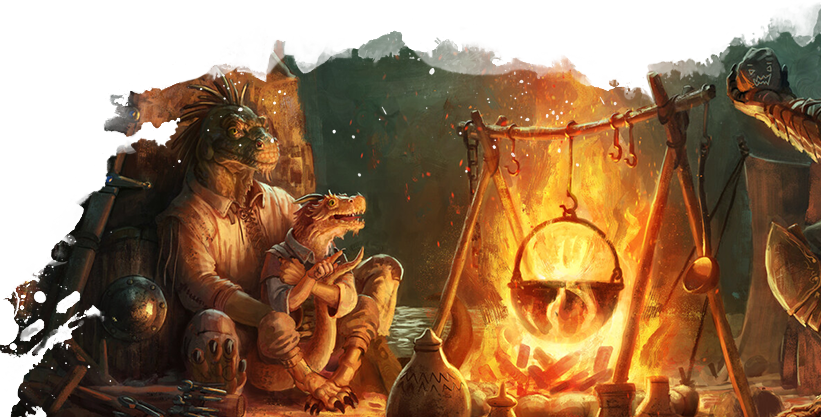
Art: "Draven with companions"
by Krasgar
Sleep
You spend some time in bed to recuperate. The benefits of this depend on how many stretches of sleep you get.
- 4 Sleep makes you well rested. If the whole party is, the next day's first Manage Supplies roll has advantage.
- 3 Sleep gives an immediate short rest.
- 2 Sleep prevents any negative effects.
- 1 Sleep requires a DC 10 Constitution save vs Exhaustion, and the DC of that save goes up by 5 until you long rest.
- 0 Sleep is as above but you automatically fail the save.
Light Sleep
Doesn't count towards amount of sleep, but lets you keep your armor and belt equipped during all sleep this rest, and awake instantly if initiative is rolled or loud noises are heard.
Cast About
You check the surroundings for signs of beasts or dangers that might interrupt your night. Make a DC 10 Survival check, and on a success, gain insight into the night event in this hex. If something happens during this action, you are at least 60 feet away from the camp.
Guard
If the night event happens during this action, you have advantage on any rolls to respond to it, and various contextual advantages, on top of being awake. For example, see enemies from further away to get an extra prep round or enter combat early.
Attune Magic Item
You learn the traits of one magic item in your possession (as in the Identify spell), and attune to it if desired. If you decide not to attune to it, the action is still spent.
Misc
Spend time on something else, like casting ritual spells, helping an ally, scribing spells, or reading. There may also be special ways to spend time depending on where you rest, like gathering special herbs.