
Bladesinging
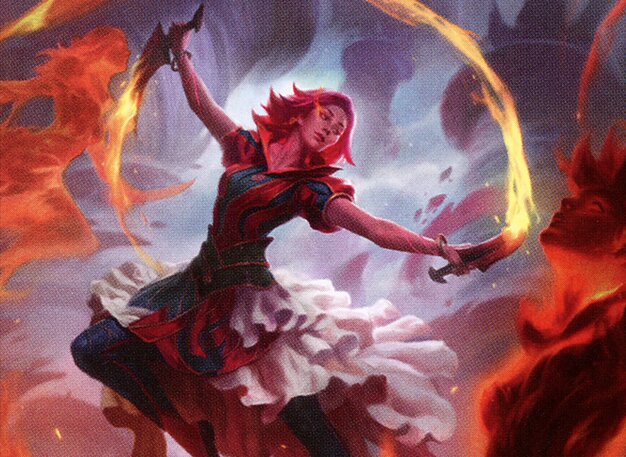
Bladesingers master a tradition of wizardry that incorporates swordplay and dance. In combat, a Bladesinger uses a series of intricate, elegant maneuvers that fend off harm and allow the Bladesinger to channel magic into devastating attacks and a cunning defense.
Many who have observed a Bladesinger at work remember the display as one of the more beautiful experiences in their life, a glorious dance accompanied by a singing blade.
Bladesinging is strongly associated with the ancient elven societies that first mastered the art and coined the term. Even today, most Bladesingers still hail from old elven realms, such as Cormanthyr, or from non-elven societies that share land and history with elves, such as the Silver Marches.
Wherever they hail from, Bladesingers are known for taking their talents all across the Realms in order to help common people and perform heroic deeds. Few communities greet the arrival of a Bladesinger as anything but a good omen.
Training in War & Song (Level 3)
You gain proficiency with Light Armor, and are particularly skilled at wielding weapons which emphasise grace and maneuverability. Simple and Martial melee weapons that have the Finesse property are considered Bladesong Weapons for you. You are considered proficient with Bladesong Weapons, and you can use them as a Spellcasting Focus for your Wizard spells.
You also gain proficiency in one of the following skills of your choice: Acrobatics, Athletics, Performance, or Persuasion.
Spell-Blade Savant (Level 3)
Choose two spells from the Bladesinging tradition list (bottom of this document), each of which must be no higher than level 2, and add them to your spellbook for free.
In addition, whenever you gain access to a new level of spell slots in this class, you can add one spell from the Bladesinging tradition list to your spellbook for free. The chosen spell must be of a level for which you have spell slots.
Bladesong (Level 3)
As a Bonus Action, you can invoke an ancient magic called the Bladesong. The Bladesong lasts for 1 minute and ends early if you have the Incapacitated condition, if you don medium or heavy armor or a Shield, or if you make an attack with a weapon lacking the Finesse property. You can dismiss the Bladesong at any time (no action required).
While the Bladesong is active, you gain the following benefits:
- Agility. You gain a bonus to your AC equal to
your Proficiency Bonus (minimum of +1), and your Speed increases by 10 feet.
- Elegance. You have advantage on Dexterity (Acrobatics) checks.
- Focus. When you make a Constitution saving throw to maintain Concentration, you can add your Proficiency Bonus to the total.
Select one of the following Bladesinging styles below. You gain the benefit associated with the selected style. Longswords and Double-Bladed Scimitars count as Bladesong Weapons for you. When you invoke yout Bladesong, gain temporary hitpoints equal to half your Wizard level (rounded up) plus your intelligence modifier. Handaxes, Spears and Glaives count as Bladesong Weapons for you. While your Bladesong is active, you can take the disengage action as a bonus action after making a melee attack against an enemy, and you can use a Reaction to make one melee attack against an enemy that enters the reach of your weapon.
Flails count as a Bladesong weapon for you. While your Bladesong is active, your melee weapon attacks score a critical hit on a roll of 19 or 20, and when you score a critical hit, the target’s speed is reduced by 10 feet until the start of your next turn. You can invoke the Bladesong a number of times equal to your Intelligence modifier (minimum of once), and you regain all expended uses when you finish a Long Rest. Bladesong Style
Cat
Bird
Snake


Extra Attack (Level 6)
You can attack twice, instead of once, whenever you take the Attack action on your turn. Moreover, you can cast one of your Wizard cantrips that has a casting time of an action in place of one of those attacks.
Song of Defense (Level 10)
When you take damage while your Bladesong is active, you can take a Reaction to expend one spell slot and reduce the damage taken by an amount equal to 2d6 per level of the spell slot. The next time you hit with a melee attack on your next turn, the target takes an extra 1d6 times the spell slot's level in force damage.
Bladesinging Tradition Spell List
Song of Celerity (Level 10)
When you cast a spell of 1st level or higher on your turn, you can make one melee weapon attack as a bonus action. You can use this feature a number of times equal to your Intelligence modifier, and you regain all expended uses when you finish a long rest. Additionally, when you make your first melee weapon attack on a turn in which you have cast a spell of 1st level or higher, you can activate your Bladesong as part of that attack.
Song of Victory (Level 14)
Starting at 14th level, while your Bladesong is active, you add your Intelligence modifier (minimum of +1) to the damage of your melee weapon attacks.
1st Level
- Shield
- Absorb Elements
- Longstrider
- Mage Armor
- Find Familiar
2nd Level
- Misty Step
- Shadow Blade
- Blur
- Suggestion
- Hold Person
3rd Level
- Haste
- Spirit Shroud
- Thunder Step
- Counterspell
- Ashardalon's Stride
4th Level
- Conjure Minor Elementals
- Greater Invisibility
- Stoneskin
- Fire Shield
- Dimension Door
5th Level
- Steel Wind Strike
- Circle of Power
- Skill Empowerment
- Yolande's Regal Presence
- Holde Monster
6th Level
- Tenser's Transformation
- Contingency
- Otto's Irresistible Dance
- Fizban's Platinum Shield
- Scatter
7th Level
- Mordenkainen's Sword
- Crown of Stars
- Draconic Transformation
8th Level
- Maze
- Telepathy
- Antimagic Field
9th Level
- Foresight
- Shapechange
- Blade of Disaster
Image Credits
- Rionya, Fire Dancer by Heonhwa Choe
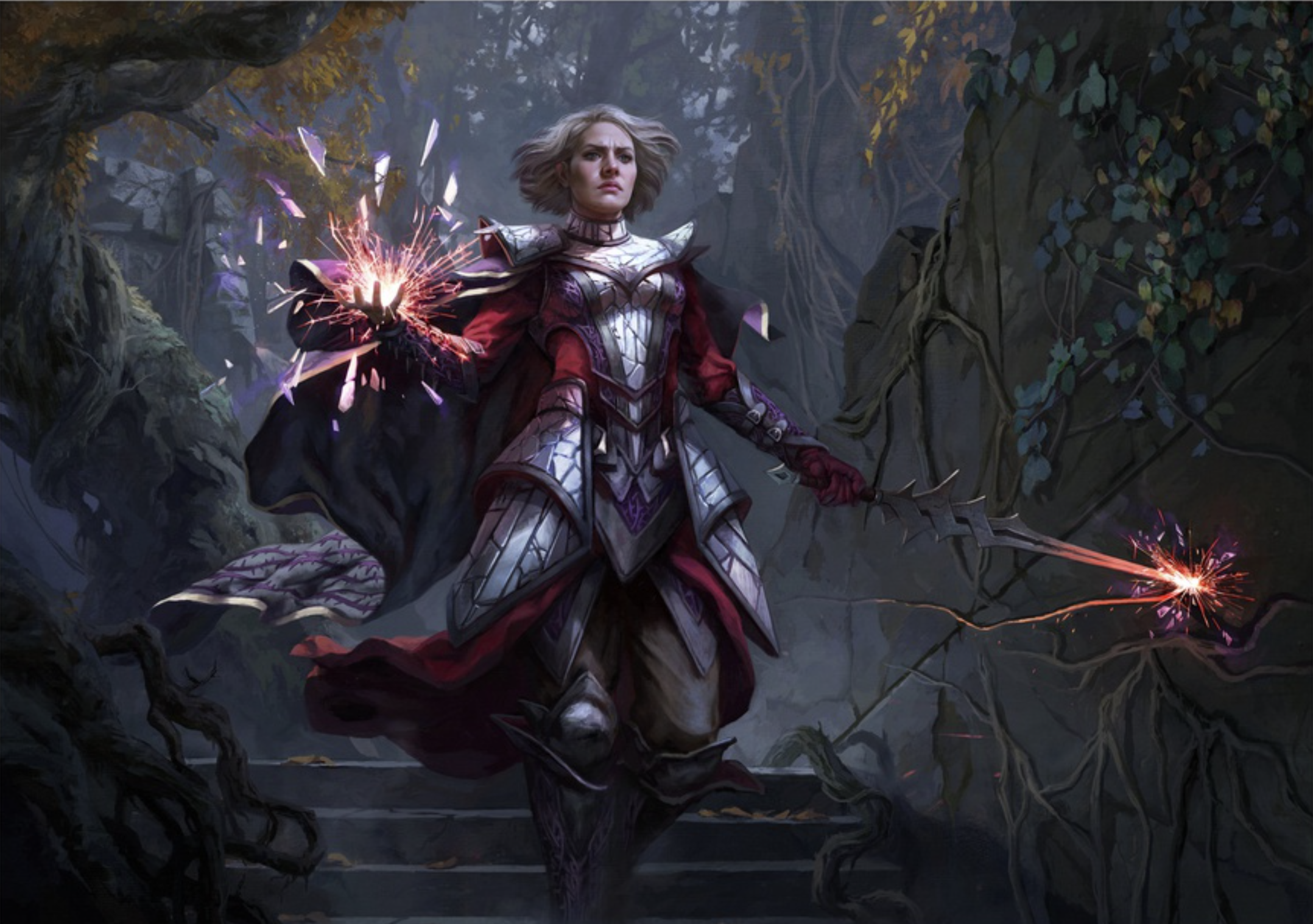
- Spellblade artwork (unknown name) by Wesley Burt
- Rowan, Scion of War by Magali Villaneuve