
Contents
-
Common Races
- Dwarf
-
- Hill Dwarf
-
- Mountain Dwarf
-
- Duerger
- Elf
-
- High Elf
-
- Wood Elf
-
- Drow
-
- Eladrin
-
- Sea Elf
-
- Shadar-Kai
-
- Astral Elf
- Halfling
-
- Lightfoot Halfling
-
- Stout Halfling
-
- Lotusden
-
- Ghostwise
- Human
-
- Base Human
-
- Variant Human
-
Uncommon Races
- Dragonborn
-
- Base Dragonborn
-
- Chromatic
-
- Metallic
-
- Gem
- Gnome
-
- Forest Gnome
-
- Rock Gnome
-
- Deep Gnome (aka Svirfneblin)
- Half-Elf
-
- Moon Elf Descent
-
- Sun Elf Descent
-
- Wood Elf Descent
-
- Drow Descent
-
- Aquatic Elf Descent
- Half-Orc
- Tiefling
-
- Base Tiefling
-
- Asmodeus
-
- Baalzebul
-
- Dispater
-
- Fierna
-
- Glasya
-
- Levistus
-
- Mammon
-
- Mephistopheles
-
- Zariel
-
- Devil's Tongue
-
- Infernal Legacy
-
- Winged
-
-
-
-
Beast Races
- Birdfolk
- Leonin
- Lizardfolk
- Centaur
- Frog & Toad Humanoids
- Harengon
- Piscine (Fish)
- Loxodon
- Minotaur
- Satyr & Faun
- Tabaxi
- Tortle
- Thri-Kreen
- Giff
- Hadozee
-
Monster Races
- Playing Monster Races
- Goblinoids
- Gnoll
- Grimlock
- Kobold
- Orc
- Troglodyte
- Undead
-
Exotic Races
- Aasimar
-
- Protector
-
- Scourge
-
- Fallen
- Fairy
- Firbolg
- Genasi
-
- Air
-
- Earth
-
- Fire
-
- Water
- Gith
-
- Githyanki
-
- Githzerai
- Goliath
- Kalashtar
-
- Dopplelgangers
-
-
- Beasthide
-
-
-
- Longtooth
-
-
-
- Swiftstride
-
-
-
- Wildhunt
-
- Triton
- Automatons
- Yuan-Ti
-
- Yuan-Ti-Pureblood
- Merfolk
- Plasmoid
- Dhampir
- Hexblood
- Reborn
- Custom Lineage
-
Height and Weight
-
5E Races
-
5E 2014 PHB
-
SCAG
-
Special PC Options
- Lycanthropes
- Vampirism
Sources
| Abbreviation | Source |
|---|---|
| AI | Acquisitions Incorporated |
| EEPC | Elemental Evil Player's Companion |
| EGW | Explorer's Guide to Wildemount |
| ERftLW / ERLW | Eberron: Rising From the Last War |
| GGtR / GGR | Guildmaster's Guide to Ravnica |
| LR | Locathah Rising |
| MOoT / MOT | Mythic Odysseys of Theros |
| MToF / MTF | Mordenkainen's Tome of Foes |
| MPMM | Monsters of the Multiverse |
| OGA | One Grung Above |
| PHB | Player's Handbook |
| SACoC | Strixhaven: A Curriculum of Chaos |
| SCAG | Sword Coast Adventurer's Guide |
| TTP | The Tortle Package |
| TWBtW / WBtW | The Wild Beyond the Witchlight |
| VGM / VGtM | Volo's Guide to Monsters |
Ignored: Book of Ebon Tides, Grim Hollow, Humblewood, Obojima, Griffon's Saddlebag, LotR, Planescape (Magic), Acquisitions Incorporated, most of Eberron, Ravnica (mostly).
UPDATED
October 20, 2025
- just started.
- pagination
- add from forgotten realms wiki
- fix source tags
- ALL main PC Stat blocks added, need cleaning up
- need Wiki (ma\ybe make pantheon and languages external... also species book for connections.)
| Name | Ability | Size | Source |
|---|---|---|---|
| Aarakocra | Dex +2; Wis +2 | Medium | DMG |
| Aarakocra | Dex +2; Wis +1 | Medium | EEPC |
| Aarakocra | Lineage | Medium | MPMM |
| Aasimar | Cha +2; Wis +1 | Medium | DMG |
| Aasimar | Lineage | Small/Medium | MPMM |
| Aasimar | Cha +2 | Medium | VGM |
| Aasimar (Fallen) | Cha +2; Str +1 | Medium | VGM |
| Aasimar (Protector) | Cha +2; Wis +1 | Medium | VGM |
| Aasimar (Scourge) | Cha +2; Con +1 | Medium | VGM |
| Autognome | Lineage | Small | AAG |
| Bugbear | Str +2; Dex +1 | Medium | ERLW |
| Bugbear | Lineage | Medium | MPMM |
| Bugbear | Str +2; Dex +1 | Medium | VGM |
| Bullywug | Int −2; Cha −2 | Medium | DMG |
| Centaur | Str +2; Wis +1 | Medium | GGR |
| Centaur [not listed] | Str +2; Wis +1 | Medium | MOT |
| Centaur | Lineage | Medium | MPMM |
| Changeling | Cha +2; Any other +1 | Medium | ERLW |
| Changeling | Lineage | Small/Medium | MPMM |
| Custom Lineage | Any +2 | Small/Medium | TCE |
| Dhampir | Lineage | Small/Medium | VRGR |
| Dragonborn | Str +2; Cha +1 | Medium | PHB |
| Dragonborn (Base) | Str +2; Cha +1 | Medium | PHB |
| Dragonborn (Chromatic) | Lineage | Medium | FTD |
| Dragonborn (Draconblood) [not listed] | Int +2; Cha +1 | Medium | EGW |
| Dragonborn (Gem) | Lineage | Medium | FTD |
| Dragonborn (Metallic) | Lineage | Medium | FTD |
| Dragonborn (Ravenite) [not listed] | Str +2; Con +1 | Medium | EGW |
| Name | Ability | Size | Source |
|---|---|---|---|
| Dwarf | Con +2 | Medium | PHB |
| Dwarf (Duergar) | Con +2; Str +1 | Medium | MTF |
| Dwarf (Duergar) | Lineage | Medium | MPMM |
| Dwarf (Hill) | Con +2; Wis +1 | Medium | PHB |
| Dwarf (Mark of Warding) [not listed] | Con +2; Int +1 | Medium | ERLW |
| Dwarf (Mountain) | Str +2; Con +2 | Medium | PHB |
| Eladrin | Lineage | Medium | MPMM |
| Elf | Dex +2 | Medium | PHB |
| Elf (Astral) | Lineage | Medium | AAG |
| Elf (Drow) | Dex +2; Cha +1 | Medium | PHB |
| Elf (Eladrin) | Dex +2; Int +1 | Medium | DMG |
| Elf (Eladrin) | Dex +2; Cha +1 | Medium | MTF |
| Elf (High) | Dex +2; Int +1 | Medium | PHB |
| Elf (Mark of Shadow) | Dex +2; Cha +1 | Medium | ERLW |
| Elf (Pallid) | Dex +2; Wis +1 | Medium | EGW |
| Elf (Sea) | Dex +2; Con +1 | Medium | MTF |
| Elf (Shadar-kai) | Dex +2; Con +1 | Medium | MTF |
| Elf (Wood) | Dex +2; Wis +1 | Medium | PHB |
| Fairy | Lineage | Small | MPMM |
| Fairy | Lineage | Small | WBtW |
| Firbolg | Lineage | Medium | MPMM |
| Firbolg | Wis +2; Str +1 | Medium | VGM |
| Genasi | Con +2 | Medium | EEPC |
| Genasi | Lineage | Small/Medium | MPMM |
| Genasi (Air) | Con +2; Dex +1 | Medium | EEPC |
| Genasi (Air) | Lineage | Small/Medium | MPMM |
| Genasi (Earth) | Con +2; Str +1 | Medium | EEPC |
| Genasi (Earth) | Lineage | Small/Medium | MPMM |
| Genasi (Fire) | Con +2; Int +1 | Medium | EEPC |
| Name | Ability | Size | Source |
|---|---|---|---|
| Genasi (Fire) | Lineage | Small/Medium | MPMM |
| Genasi (Water) | Con +2; Wis +1 | Medium | EEPC |
| Genasi (Water) | Lineage | Small/Medium | MPMM |
| Giff | Lineage | Medium | AAG |
| Gith | Int +1 | Medium | MTF |
| Gith (Githyanki) | Str +2; Int +1 | Medium | MTF |
| Gith (Githzerai) | Wis +2; Int +1 | Medium | MTF |
| Githyanki | Lineage | Medium | MPMM |
| Githzerai | Lineage | Medium | MPMM |
| Gnoll | Str +2; Int −2 | Medium | DMG |
| Gnome | Int +2 | Small | PHB |
| Gnome (Deep) | Lineage | Small | MPMM |
| Gnome (Deep) | Int +2; Dex +1 | Small | MTF |
| Gnome (Deep) | Dex +2; Str +1 | Small | DMG |
| Gnome (Deep/Svirfneblin) | Int +2; Dex +1 | Small | SCAG |
| Gnome (Forest) | Int +2; Dex +1 | Small | PHB |
| Gnome (Mark of Scribing) [not listed] | Int +2; Cha +1 | Small | ERLW |
| Gnome (Rock) | Int +2; Con +1 | Small | PHB |
| Goblin | Dex +2; Str −2 | Small | DMG |
| Goblin | Dex +2; Con +1 | Small | ERLW |
| Goblin | Dex +2; Con +1 | Small | GGR |
| Goblin | Lineage | Small | MPMM |
| Goblin | Dex +2; Con +1 | Small | VGM |
| Goliath | Lineage | Medium | MPMM |
| Goliath | Str +2; Con +1 | Medium | VGM |
| Grimlock | Str +2; Cha −2 | Medium | DMG |
| Grung | Dex +2; Con +1 | Small | OGA |
| Hadozee | Lineage | Small/Medium | AAG |
| Half-Elf | Cha +2; Any other 2 +1 | Medium | PHB |
| Name | Ability | Size | Source |
|---|---|---|---|
| Half-Elf (Base) | Cha +2; Any other 2 +1 | Medium | PHB |
| Half-Elf (Variant; Aquatic Elf Descent) | Cha +2; Any other 2 +1 | Medium | SCAG |
| Half-Elf (Variant; Drow Descent) | Cha +2; Any other 2 +1 | Medium | SCAG |
| Half-Elf (Variant; Mark of Detection) | Wis +2; Any other +1 | Medium | ERLW |
| Half-Elf (Variant; Mark of Storm) | Cha +2; Dex +1 | Medium | ERLW |
| Half-Elf (Variant; Moon Elf or Sun Elf Descent) | Cha +2; Any other 2 +1 | Medium | SCAG |
| Half-Elf (Variant; Wood Elf Descent) | Cha +2; Any other 2 +1 | Medium | SCAG |
| Half-Orc | Str +2; Con +1 | Medium | PHB |
| Half-Orc (Base) | Str +2; Con +1 | Medium | PHB |
| Half-Orc (Variant; Mark of Finding) [not listed] | Str +2; Con +1 | Medium | ERLW |
| Halfling | Dex +2 | Small | PHB |
| Halfling (Ghostwise) | Dex +2; Wis +1 | Small | SCAG |
| Halfling (Lightfoot) | Dex +2; Cha +1 | Small | PHB |
| Halfling (Lotusden) | Dex +2; Wis +1 | Small | EGW |
| Halfling (Mark of Healing) [not listed] | Dex +2; Wis +1 | Small | ERLW |
| Halfling (Mark of Hospitality) [not listed] | Dex +2; Cha +1 | Small | ERLW |
| Halfling (Stout) | Dex +2; Con +1 | Small | PHB |
| Harengon | Lineage | Small/Medium | MPMM |
| Harengon | Lineage | Small/Medium | WBtW |
| Hexblood | Lineage | Small/Medium | VRGR |
| Hobgoblin | None | Medium | DMG |
| Hobgoblin | Con +2; Int +1 | Medium | ERLW |
| Hobgoblin | Lineage | Medium | MPMM |
| Hobgoblin | Con +2; Int +1 | Medium | VGM |
| Human | Str +1; Dex +1; Con +1; Int +1; Wis +1; Cha +1 | Medium | PHB |
| Human (Base) | None | Medium | PHB |
| Name | Ability | Size | Source |
|---|---|---|---|
| Human (Mark of Handling) [not listed] | Wis +2; Any other +1 | Medium | ERLW |
| Human (Mark of Making) [not listed] | Int +2; Any other +1 | Medium | ERLW |
| Human (Mark of Passage) [not listed] | Dex +2; Any other +1 | Medium | ERLW |
| Human (Mark of Sentinel) [not listed] | Con +2; Wis +1 | Medium | ERLW |
| Human (Variant) | Any 2 +1 | Medium | PHB |
| Human (Variant; Mark of Finding) [not listed] | Wis +2; Con +1 | Medium | ERLW |
| Kalashtar | Wis +2; Cha +1 | Medium | ERLW |
| Kender [not listed] | Lineage | Small | DSotDQ |
| Kenku | Dex +2 | Medium | DMG |
| Kenku | Lineage | Small/Medium | MPMM |
| Kenku | Dex +2; Wis +1 | Medium | VGM |
| Kobold | Dex +2; Str −4 | Small | DMG |
| Kobold | Lineage | Small | MPMM |
| Kobold | Dex +2 | Small | VGM |
| Kuo-Toa | None | Medium | DMG |
| Leonin | Con +2; Str +1 | Medium | MOT |
| Lizardfolk | Str +2; Int −2 | Medium | DMG |
| Lizardfolk | Lineage | Medium | MPMM |
| Lizardfolk | Con +2; Wis +1 | Medium | VGM |
| Locathah | Str +2; Dex +1 | Medium | LR |
| Loxodon | Con +2; Wis +1 | Medium | GGR |
| Merfolk | None | Medium | DMG |
| Minotaur | Str +2; Con +1 | Medium | GGR |
| Minotaur | Str +2; Con +1 | Medium | MOT |
| Minotaur | Lineage | Medium | MPMM |
| Orc | Str +2; Int −2 | Medium | DMG |
| Orc | Str +2; Con +1 | Medium | EGW |
| Orc | Str +2; Con +1 | Medium | ERLW |
| Orc | Lineage | Medium | MPMM |
| Name | Ability | Size | Source |
|---|---|---|---|
| Orc | Str +2; Con +1 | Medium | VGM |
| Owlin | Lineage | Small/Medium | SCC |
| Plasmoid | Lineage | Small/Medium | AAG |
| Reborn | Lineage | Small/Medium | VRGR |
| Satyr | Cha +2; Dex +1 | Medium | MOT |
| Satyr | Lineage | Medium | MPMM |
| Sea Elf | Lineage | Medium | MPMM |
| Shadar-Kai | Lineage | Medium | MPMM |
| Shifter | None | Medium | ERLW |
| Shifter | Lineage | Medium | MPMM |
| Shifter (Beasthide) | Con +2; Str +1 | Medium | ERLW |
| Shifter (Longtooth) | Str +2; Dex +1 | Medium | ERLW |
| Shifter (Swiftstride) | Dex +2; Cha +1 | Medium | ERLW |
| Shifter (Wildhunt) | Wis +2; Dex +1 | Medium | ERLW |
| Skeleton | Dex +2; Int −4; Cha −4 | Medium | DMG |
| Tabaxi | Lineage | Small/Medium | MPMM |
| Tabaxi | Dex +2; Cha +1 | Medium | VGM |
| Thri-kreen | Lineage | Small/Medium | AAG |
| Tiefling | Cha +2; Int +1 | Medium | PHB |
| Tiefling (Asmodeus) | Cha +2; Int +1 | Medium | MTF |
| Tiefling (Baalzebul) | Cha +2; Int +1 | Medium | MTF |
| Tiefling (Base) | Cha +2; Int +1 | Medium | PHB |
| Tiefling (Dispater) | Cha +2; Dex +1 | Medium | MTF |
| Tiefling (Fierna) | Cha +2; Wis +1 | Medium | MTF |
| Tiefling (Glasya) | Cha +2; Dex +1 | Medium | MTF |
| Tiefling (Levistus) | Cha +2; Con +1 | Medium | MTF |
| Tiefling (Mammon) | Cha +2; Int +1 | Medium | MTF |
| Tiefling (Mephistopheles) | Cha +2; Int +1 | Medium | MTF |
| Tiefling (Variant; Devil's Tongue) | Int +1; Dex/Cha +2 | Medium | SCAG |
| Name | Ability | Size | Source |
|---|---|---|---|
| Tiefling (Variant; Hellfire) | Int +1; Dex/Cha +2 | Medium | SCAG |
| Tiefling (Variant; Infernal Legacy) | Int +1; Dex/Cha +2 | Medium | SCAG |
| Tiefling (Variant; Winged) | Int +1; Dex/Cha +2 | Medium | SCAG |
| Tiefling (Zariel) | Cha +2; Str +1 | Medium | MTF |
| Tortle | Lineage | Small/Medium | MPMM |
| Tortle | Str +2; Wis +1 | Medium | TTP |
| Triton | Str +1; Con +1; Cha +1 | Medium | MOT |
| Triton | Lineage | Medium | MPMM |
| Triton | Str +1; Con +1; Cha +1 | Medium | VGM |
| Troglodyte | Str +2; Con +2; Int −4; Cha −4 | Medium | DMG |
| Warforged | Con +2; Any other +1 | Medium | ERLW |
| Yuan-Ti | Lineage | Small/Medium | MPMM |
| Yuan-ti Pureblood | Cha +2; Int +1 | Medium | VGM |
| Zombie | Con +2; Str +1; Wis −4; Cha −4; Int −6 | Medium | DMG |


RACES

Races
A visit to one of the great cities in the worlds of Dungeons & Dragons—Waterdeep, the Free City of Greyhawk, or even uncanny Sigil, the City of Doors overwhelms the senses. Voices chatter in countless different languages. The smells of cooking in dozens of different cuisines mingle with the odors of crowded streets and poor sanitation. Buildings in myriad architectural styles display the diverse origins of their inhabitants.
And the people themselves—people of varying size, shape, and color, dressed in a dazzling spectrum of styles and hues—represent many different races, from diminutive halflings and stout dwarves to majestically beautiful elves, mingling among a variety of human ethnicities.
Scattered among the members of these more common races are the true exotics: a hulking dragonborn here, pushing his way through the crowd, and a sly tiefling there, lurking in the shadows with mischief in her eyes. A group of gnomes laughs as one of them activates a clever wooden toy that moves of its own accord. Half-elves and half-orcs live and work alongside hu-mans, without fully belonging to the races of either of their parents. And there, well out of the sunlight, is a lone drow—a fugitive from the subterranean expanse of the Underdark, trying to make his way in a world that fears his kind. The Player's Handbook has more information about these unusual races.
Uncommon Races
The dragonborn and the rest of the races in this list are uncommon. They don't exist in every world of D&D, and even where they are found, they are less widespread than dwarves, elves, halflings, and humans. In the cosmopolitan cities of the D&D multiverse, most people hardly look twice at members of even the most exotic races. But the small towns and villages that dot the countryside are different. The common folk aren't accustomed to seeing members of these races, and they react accordingly.
Dragonborn. It's easy to assume that a dragonborn is a monster, especially if his or her scales betray a chromatic heritage. Unless the dragonborn starts breathing fire and causing de-struction, though, people are likely to respond with caution rather than outright fear.
Gnome. Gnomes don't look like a threat and can quickly disarm suspicion with good humor. The common folk are often curious about gnomes, likely never having seen one before, but they are rarely hostile or fearful.
Half-Elf. Although many people have never seen a half-elf, virtually everyone knows they exist. A half-elf stranger's arrival is followed by gossip behind the half-elf's back and stolen glances across the common room, rather than any confrontation or open curiosity.
Half-Orc. It's usually safe to assume that a half-orc is belligerent and quick to anger, so people watch themselves around an unfamiliar half-orc. Shopkeepers might surreptitiously hide valuable or fragile goods when a half-orc comes in, and people slowly clear out of a tavern, as-suming a fight will break out soon.
Tiefling. Half-orcs are greeted with a practical caution, but tieflings are the subject of supernatural fear. The evil of their heritage is plainly visible in their features, and as far as most people are concerned, a tiefling could very well be a devil straight from the Nine Hells. People might make warding signs as a tiefling approaches, cross the street to avoid passing near, or bar shop doors before a tiefling can enter.
Choosing a Race
Humans are the most common people in the worlds of D&D, but they live and work alongside dwarves, elves, halflings, and countless other fantastic species. Your character belongs to one of these peoples.
Not every intelligent race of the multiverse is appropriate for a player-controlled adventurer. Dwarves, elves, halflings, and humans are the most common races to produce the sort of ad-venturers who make up typical parties. Other races and subraces are less common as adven-turers.
Your choice of race affects many different aspects of your character. It establishes fundamental qualities that exist throughout your character's adventuring career.
When making this decision, keep in mind the kind of character you want to play. For example, a halfling could be a good choice for a sneaky rogue, a dwarf makes a tough warrior, and an elf can be a master of arcane magic.
Your character race not only affects your ability scores and traits but also provides the cues for building your character's story. Each race's description in this chapter includes information to help you roleplay a character of that race, including personality, physical appearance, features of society, and racial alignment tendencies.
These details are suggestions to help you think about your character; adventurers can deviate widely from the norm for their race. It's worthwhile to consider why your character is different, as a helpful way to think about your character's background and personality.
Racial Traits
The description of each race includes racial traits that are common to members of that race. The following entries appear among the traits of most races.
Ability Score Increase
Every race increases one or more of a character's ability scores.
Age
The age entry notes the age when a member of the race is considered an adult, as well as the race's expected lifespan. This information can help you decide how old your character is at the start of the game. You can choose any age for your character, which could provide an explana-tion for some of your ability scores. For example, if you play a young or very old character, your age could explain a particularly low Strength or Constitution score, while advanced age could account for a high Intelligence or Wisdom.
Size
Characters of most races are Medium, a size category including creatures that are roughly 4 to 8 feet tall.
Members of a few races are Small (between 2 and 4 feet tall), which means that certain rules of the game affect them differently. The most important of these rules is that Small characters have trouble wielding heavy weapons, as explained in chapter 5.
Speed
Your speed determines how far you can move when traveling (chapter 8) and fighting (chapter 9).
Languages
By virtue of your race, your character can speak, read, and write certain languages. Chapter 4 lists the most common languages of the D&D multiverse.
Subraces
Some races have subraces. Members of a subrace have the traits of the parent race in addition to the traits specified for their subrace. Relationships among subraces vary significantly from race to race and world to world. In the Dragonlance campaign setting, for example, mountain dwarves and hill dwarves live together as different clans of the same people, but in the For-gotten Realms, they live far apart in separate kingdoms and call themselves shield dwarves and gold dwarves, respectively.
Player's Handbook Races
- Dragonborn
- Dwarf
- Elf
- Gnome
- Half-Elf
- Half-Orc
- Halfling
- Human
- Tiefling
Sword Coast, Races of the Realms
Faerûn is home to many races, some of them immigrants from other worlds who found their way here in ancient times when gates and portals were more plentiful, and easier to traverse. Others are relative newcomers to the world, still finding a place for themselves among the long-established races. The civilizations of the elder races have declined, while those of the younger races are flourishing and spreading ever outward.
The character races described in the Player's Handbook are all found in the Realms, along with some subraces unique to Faerûn. Each character race has all the traits of the primary race, as given in the Player's Handbook, plus traits for each subrace that are unique to those individuals. This chapter provides racial traits for a subrace only when they differ from or replace those given in the Player's Handbook. The information in this chapter is specific to the Realms, so if something stated here differs from what's presented in the Player's Handbook, this material takes precedence.
Monster Races
Monstrous Adventurers
In some campaigns, humanoids normally regarded as sinister threats can emerge to adventure alongside humans and the other standard races. This section is aimed at DMs who wish to expand the race selections for their campaigns beyond the typical folk of D&D.
Why a Monstrous Character?
Creating characters as creatures normally cast as villains offers up some interesting roleplaying possibilities. Whether played for comedy, as a tragic story of betrayal and loss, or as an antihero, a monstrous character gives a player a chance to take on an unusual challenge in the campaign. Before allowing monstrous characters in your campaign, consider the following three questions.
Rare or Mundane?
Consider how common orc, goblin, and similar adventurers are in your setting. Are they regarded as no stranger than elves or dwarves? Are they met with suspicion? The role these races play in your setting should determine the kinds of reactions that such characters meet.
Don't be afraid to push things to an extreme. An orc character might have to venture into town in disguise or remain in the wilderness, for fear of imprisonment or mob violence. Be sure to talk to the group about how such characters can expect the world to treat them. Some players like the challenge of taking on an outcast, but don't set up one expectation and deliver another.
You can establish a monstrous creature as just another culture in your campaign, one that has alliances and rivalries with humans, elves, and dwarves. A hobgoblin kingdom might serve as a buffer between a human kingdom and a blighted region overrun by the spawn of Kyuss. Kobolds might be city builders, the architects of grand, heavily fortified edifices, which other folk dwell in for a price. The cultural notes in chapter 1 are the standard D&D depiction of these creatures, but by no means do they define them for your campaign. Use them as a starting point for your own ideas.
Outcast or Ambassador?
Consider how a monstrous character's native culture views the character. Is the character an outcast, a spy, an ambassador, or something else? Work with the player to determine how the character ended up as an adventurer.
The character's bond is a great starting point to consider for this question. How did the bond drive the character to adventure? The character's trait, flaw, and ideal can also play a role in fleshing out the story.
Friends or Enemies?
Figure out what special ties the character has to other members of the adventuring party. An orc warlock might be the dwarf ranger's sworn enemy, but the two are forced to work together to defeat a mutual foe. Perhaps the kobold sorcerer was the tiefling wizard's familiar, transformed by an irate archmage in return for some petty insult. The hobgoblin paladin might have been human once, but crossed the wrong hag and was cursed to take on an evil guise. A creative tie between a monstrous character and the rest of the party helps make for a memorable campaign.
The Monstrous Origin table gives a number of ideas for adding a monstrous character to the campaign.
| d8 | Origin |
|---|---|
| 1 | You are a spy sent to undermine your enemies from within. |
| 2 | You are the victim of a curse or polymorph spell. |
| 3 | You were raised by humans, elves, or dwarves and have adopted their culture. |
| 4 | At a young age, you adopted a human religion and now serve it faithfully. |
| 5 | You received divine insight that sent you on your path, and occasionally receive new visions that guide you. |
| 6 | Your sworn enemy is an ally of your people, forcing you to leave your tribe to gain vengeance. |
| 7 | An evil entity corrupted your people's society. |
| 8 | An injury or strange event caused you to lose all memory of your past, but occasional flashes of it return to you. |
Height and Weight
You may roll for your character's height and weight on the Random Height and Weight table. The roll in the Height Modifier column adds a number (in inches) to the character's base height. To get a weight, multiply the number you rolled for height by the roll in the Weight Modifier column and add the result (in pounds) to the base weight.
| Race | Base Ht | Base Wt | Ht Mod | Wt Mod | Avg Ht | Avg Wt |
|---|---|---|---|---|---|---|
| Aarakocra | 4'6" | 80 | +2d10 | × 1d6 | 5' | 90 lbs. |
| Aasimar | 4'8" | 110 | +2d10 | × 2d4 | M: 5'-6'6" F: 4'7"-6'1" | M: 124-280 F: 89-245 |
| Autognome | N/A | N/A | N/A | N/A | 3' | 172 |
| Bugbear | 6'0" | 200 | +2d12 | × 2d6 | 6-8' | 250 - 350 |
| Bullywug | 4’0” | 100 | +3d12 | ×2d6 | 4' - 7' | 100 - 300 |
| Centaur | 6' | 600 | +1d10 | × 2d12 | 7' - 9.5' | 2,100 |
| Changeling | 5'1" | 115 | +2d4 | × 2d4 | 5' 3" - 5' 9" | |
| Custom Lineage | N/A | N/A | N/A | N/A | N/A | N/A |
| Dhampir | N/A | N/A | N/A | N/A | N/A | N/A |
| Dragonborn | 5'6" | 175 | +2d8 | × 2d6 | 6' 2" - 6' 8" | 220 - 320 |
| Dwarf Hill | 3'8" | 115 | +2d4 | × 2d6 | 4-5' | 150 |
| Dwarf Mountain | 4' | 130 | +2d4 | × 2d6 | 4-5' | 150 lb |
| Elf | N/A | N/A | N/A | N/A | ||
| Elf Eladrin | 4'6" | 90 | +2d12 | × 1d4 | ||
| Elf High | 4'6" | 90 | +2d10 | × 1d4 | ||
| Elf Palllid | 4'6" | 90 | +2d10 | × 1d4 | ||
| Elf Sea | 4'6" | 90 | +2d8 | × 1d4 | ||
| Elf Shadar-kai | 4'8" | 90 | +2d8 | × 1d4 | ||
| Elf Wood | 4'6" | 100 | +2d10 | × 1d4 | ||
| Elf Drow | 4'5" | 75 | +2d6 | × 1d6 | ||
| Fairy | 1’0” | 3 | +1d4 | ×1 | ||
| Firbolg | 6'2" | 175 | +2d12 | × 2d6 | ||
| Genasi | 4'8" | 110 | +2d10 | × 2d4 | ||
| Giff | N/A | N/A | N/A | N/A | ||
| Gith | 4’11” | 90 | +2d12 | ×1d4 | ||
| Githyanki | 5' | 100 | +2d12 | × 2d4 | ||
| Githzerai | 4'11" | 90 | +2d12 | × 1d4 | ||
| Gnoll | 6’0” | 200 | +2d10 | ×2d6 | ||
| Gnome | 2'11" | 35 | +2d4 | × 1 | ||
| Gnome Deep | 2'11" | 35 | +2d4 | × 1 | ||
| Gnome Forest | 2'11" | 35 | +2d4 | × 1 | ||
| Gnome Rock | 2'11" | 35 | +2d4 | × 1 | ||
| Goblin | 3'5" | 35 | +2d4 | × 1 | ||
| Goliath | 6'2" | 200 | +2d10 | × 2d6 | ||
| Grimlock | 5’0” | 170 | +1d8 | ×1d4 |
| Race | Base Ht | Base Wt | Ht Mod | Wt Mod | Avg Ht | Avg Wt |
|---|---|---|---|---|---|---|
| Grung | 2’6” | 25 | +2d6 | ×1 | ||
| Hadozee | 5’0” | 150 | +2d8 | ×2d4 | ||
| Half-Elf | 4'9" | 110 | +2d8 | × 2d4 | 5'-6' | |
| Half-Elf Moon or Sun | 4'9" | 110 | +2d8 | × 2d4 | ||
| Half-Elf Wood | 4'9" | 110 | +2d8 | × 2d4 | ||
| Hobgoblin | 4'8" | 110 | +2d10 | × 2d4 | ||
| Half-Orc | 4'10" | 140 | +2d10 | × 2d6 | ||
| Halfling | 2'7" | 35 | +2d4 | × 1 | ||
| Halfling Ghostwise | 2'7" | 35 | +2d4 | × 1 | ||
| Halfling Lightfoot | 2'7" | 35 | +2d4 | × 1 | ||
| Halfling Lotusden | 2'7" | 35 | +2d4 | × 1 | ||
| Halfling Stout | 2'7" | 35 | +2d4 | × 1 | ||
| Harengon | 4’0” | 60 | +2d10 | ×1d4 | ||
| Hexblood | 4'8" | 118 | +2d10 | × 2d4 | ||
| *30+P:AH | 4'8" | 118 | +2d10 | × 2d4 | ||
| Human | 4'8" | 118 | +2d10 | × 2d4 | ||
| Kalashtar | 5'4" | 110 | +2d6 | × 1d6 | ||
| Kenku | 4'4" | 50 | +2d8 | × 1d6 | ||
| Kobold | 2'1" | 25 | +2d4 | × 1 | ||
| Kuo-Toa | 4’0” | 90 | +2d8 | ×2d4 | ||
| Leonin | 5'6" | 180 | +2d10 | × 2d6 | ||
| Lizardfolk | 4'9" | 120 | +2d10 | × 2d6 | ||
| Locathah | 5’0” | 150 | +2d10 | ×2d6 | ||
| Loxodon | 6'7" | 295 | +2d10 | × 2d4 | ||
| Merfolk | 5’6” | 130 | +2d8 | ×2d6 | ||
| Minotaur | 5'4" | 175 | +2d8 | × 2d6 | ||
| Orc | 5'4" | 175 | +2d8 | × 2d6 | ||
| Owlin | N/A | N/A | N/A | N/A | ||
| Plasmoid | N/A | 200 | N/A | N/A | ||
| Reborn | 4'8" | 118 | +2d10 | × 2d4 | ||
| Satyr | 4'8" | 100 | +2d8 | × 2d4 | ||
| Shifter | 4'6" | 90 | +2d8 | × 2d4 | ||
| Shifter Beasthide | 4'6" | 90 | +2d8 | × 2d4 | ||
| Shifter Longtooth | 4'6" | 90 | +2d8 | × 2d4 | ||
| Shifter Swiftstride | 4'6" | 90 | +2d8 | × 2d4 | ||
| Shifter Wildhunt | 4'6" | 90 | +2d8 | × 2d4 | ||
| Skeleton | 4'8" | 10 | +2d10 | × 2d4 | ||
| Tabaxi | 4'10" | 90 | +2d10 | × 2d4 | ||
| Thri-kreen | 5’10” | 200 | +2d10 | ×2d6 | ||
| Tiefling | 4'9" | 110 | +2d8 | × 2d4 |

| Race | Base Ht | Base Wt | Ht Mod | Wt Mod | Avg Ht | Avg Wt |
|---|---|---|---|---|---|---|
| Tortle | 5’0” | 400 | +1d4 | ×2d6 | ||
| Triton | 4'6" | 90 | +2d10 | × 2d4 | ||
| Troglodyte | 5’0” | 130 | +1d8 | ×1d6 | ||
| Warforged | 5'10" | 270 | +2d6 | × 4 | ||
| Yuan-Ti | 4’10” | 100 | +2d10 | ×2d4 | ||
| Yuan-ti Pureblood | 4'8" | 110 | +2d10 | × 2d4 | ||
| Zombie | 4'8" | 118 | +2d10 | × 2d4 | ||
| SMALL | 2'10" | 30 | +2d6 | ×1d4 | 3'5" | 40 |
| MEDIUM | 4'8" | 80 | +2d10 | ×1d6 | 5'7" | 105 |
Homebrew
Table of Creature Size and Scale
On March 27, 2018, Posted by d20 Game Master , In Resources, With 0 Comments
An easy reference chart for D&D Monster Sizes from Fine to Colossal to show Attack and AC Modifier, Special Attacks Modifier, Hide Modifier, Height or Length, Weight, Space, Natural Reach, and their Carrying Capacity Multiplier.
| Size Category | Attack and AC Modifier | Special Attacks Modifier (1) | Hide Modifier | Height or Length (2) | Weight (3) | Space (4) | Natural Reach (4) | Carrying Capacity Multiplier |
|---|---|---|---|---|---|---|---|---|
| Tall | Long | Biped | ||||||
| Fine | +8 | -16 | +16 | 6 in. or less | 1/8 lb. or less | 1/2 ft. | 0 ft. | 0 ft. |
| Diminutive | +4 | -12 | +12 | 6 in.-1 ft. | 1/8 lb.-1 lb. | 1 ft. | 0 ft. | 0 ft. |
| Tiny | +2 | -8 | +8 | 1 ft.-2 ft. | 1 lb.-8 lb. | 2-1/2 ft. | 0 ft. | 0 ft. |
| Small | +1 | -4 | +4 | 2 ft.-4 ft. | 8 lb.-60 lb. | 5 ft. | 5 ft. | 5 ft. |
| Medium | +0 | +0 | +0 | 4 ft.-8 ft. | 60 lb.-500 lb. | 5 ft. | 5 ft. | 5 ft. |
| Large | -1 | +4 | -4 | 8 ft.-16 ft. | 500 lb.-2 tons | 10 ft. | 10 ft. | 5 ft. |
| Huge | -2 | +8 | -8 | 16 ft.-32 ft. | 2 tons-16 tons | 15 ft. | 15 ft. | 10 ft. |
| Gargantuan | -4 | +12 | -12 | 32 ft.-64 ft. | 16 tons-125 tons | 20 ft. | 20 ft. | 15 ft. |
| Colossal | -8 | +16 | -16 | 64 ft. or more | 125 tons or more | 30 ft. | 30 ft. | 20 ft. |
- This modifier applies to the bull rush, grapple, overrun, and trip special attacks.
- Biped’s height, quadruped’s body length (nose to base of tail)
- Assumes that the creature is roughly as dense as a regular animal. A creature made of stone will weigh considerably more. A gaseous creature will weigh much less.
- These values are typical for creatures of the indicated size. Some exceptions exist.
Something Fun: I like to use the The Measure of Things to enter a measurement to see comparisons. This can really help you give characters a perspective of monsters’ sizes. Like comparing an Ancient Blue Dragon (Gargantuan 16-125 tons) to a blue whale. Say 100 tons of dragon is 90% as heavy as a Blue Whale. Just a cool thing to give some perspective.
The Races
Aarakocra
Contents
- PC Stat Blocks
- DMG
- EEPC
- MPMM
- Forgotten Realms
- (Language)
Aarakocra
- Ability Scores. Dexterity +2; Wisdom +2
- Size. Medium
- Speed. 20 ft., fly 50 ft.
Dive Attack. If you are flying and dive at least 30 ft. straight toward a target and then hit it with a melee weapon attack, the attack deals an extra 1d6 damage to the target.
Talons. You are proficient with your unarmed strikes, which deal 1d4 slashing damage on a hit.
Language. You can speak, read, and write Auran.
Note: This race is listed in the Dungeon Master's Guide as an option for creating NPCs. It is not designed for use as a playable race.
Source: DMG, page 282

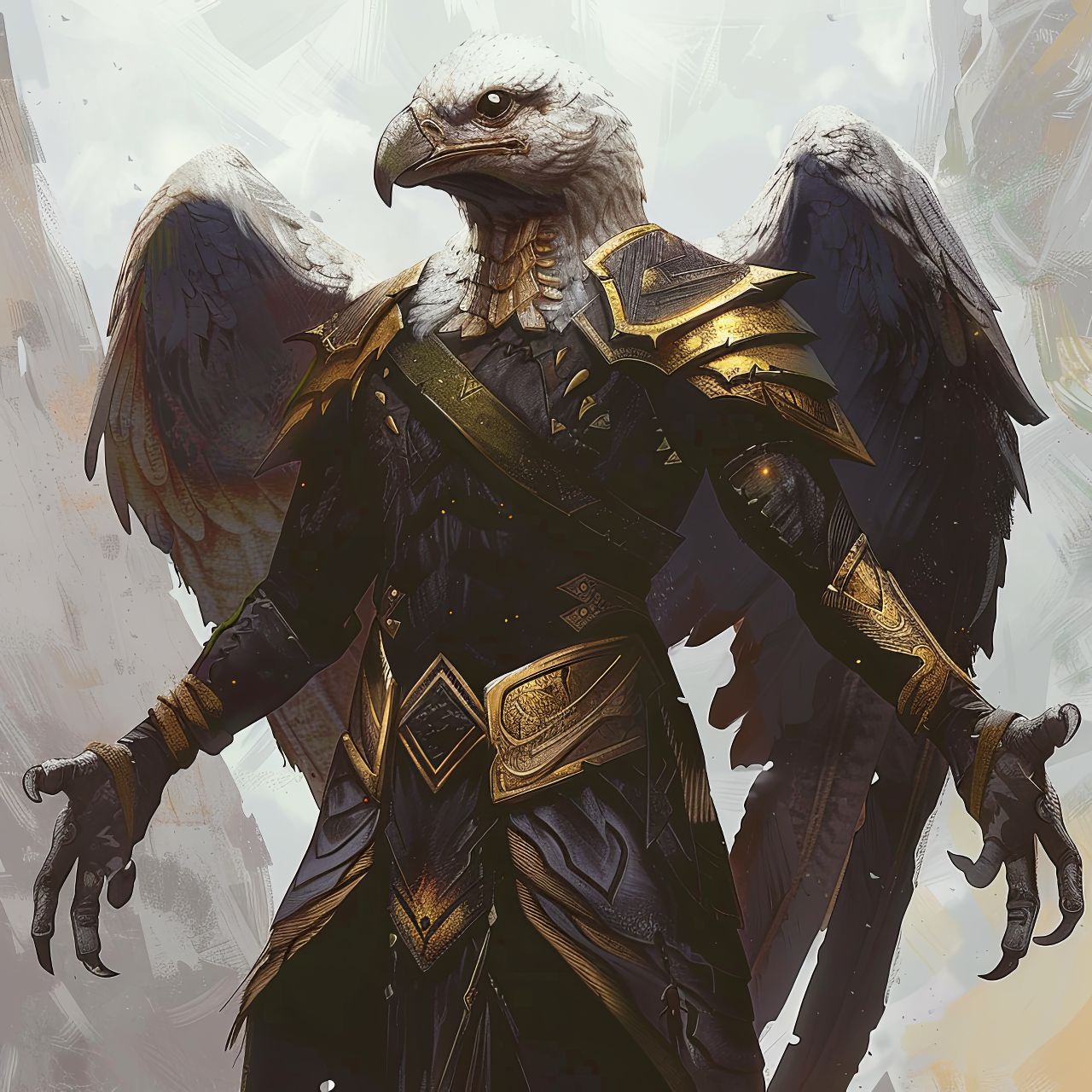
Aarakocra
- Ability Scores. Dexterity +2; Wisdom +1
- Size. Medium
- Speed. 25 ft., fly 50 ft.
Age. Aarakocra reach maturity by age 3. Compared to humans, aarakocra don't usually live longer than 30 years.
Alignment. Most aarakocra are good and rarely choose sides when it comes to law and chaos. Tribal leaders and warriors might be lawful, while explorers and adventurers might tend toward chaotic.
Size. Aarakocra are about 5 feet tall. They have thin, lightweight bodies that weigh be-tween 80 and 100 pounds. Your size is Medium.
Flight. You have a flying speed of 50 feet. To use this speed, you can't be wearing medi-um or heavy armor.
Talons. Your talons are natural weapons, which you can use to make unarmed strikes. If you hit with them, you deal slashing damage equal to 1d4 + your Strength modifier, instead of the bludgeoning damage normal for an unarmed strike.
Language. You can speak, read, and write Common, Aarakocra, and Auran.
Sequestered in high mountains atop tall trees, the aarakocra, sometimes called birdfolk, evoke fear and wonder. Many aarakocra aren't even native to the Material Plane. They hail from a world beyond-from the boundless vistas of the Elemental Plane of Air. They are immigrants, refugees, scouts, and explorers, their outposts functioning as footholds in a world both strange and alien.
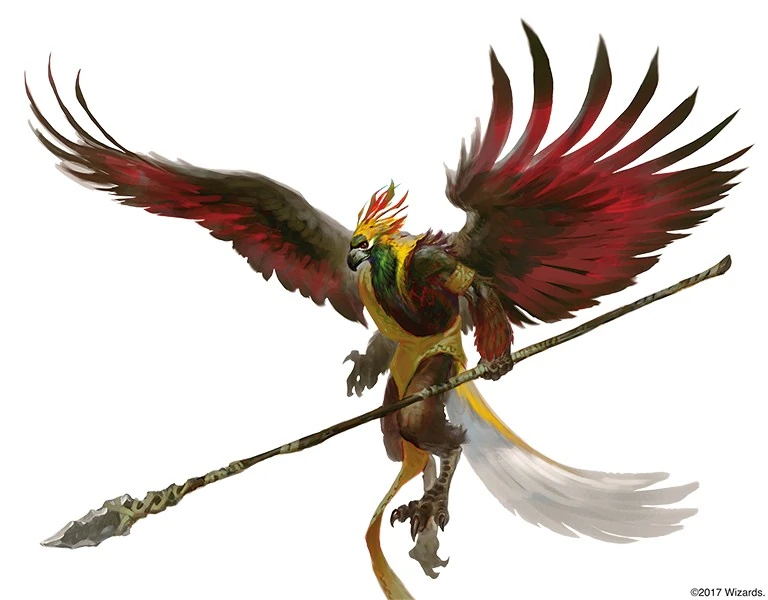
Beak and Feather. From below, aarakocra look much like large birds. Only when they de-scend to roost on a branch or walk across the ground does their humanoid appearance reveal itself. Standing upright, aarakocra might reach 5 feet tall, and they have long, narrow legs that taper to sharp talons.
Feathers cover their bodies. Their plumage typically denotes membership in a tribe. Males are brightly colored, with feathers of red, orange, or yellow. Females have more subdued colors, usually brown or gray. Their heads complete the avian appearance, being something like a par-rot or eagle with distinct tribal variations.
Sky Wardens. Nowhere are the aarakocra more comfortable than in the sky. They can spend hours in the air, and some go as long as days, locking their wings in place and letting the thermals hold them aloft. In battle, they prove dynamic and acrobatic fliers, moving with re-markable speed and grace, diving to lash opponents with weapons or talons before turning and flying away.
Once airborne, an aarakocra leaves the sky with reluctance. On their native plane, they can fly for days or months, landing only to lay their eggs and feed their young before launching them-selves back into the air. Those that make it to a world in the Material Plane find it a strange place. They sometimes forget or ignore vertical distances, and they have nothing but pity for those earthbound people forced to live and toil on the ground.
Avian Mannerisms. The resemblance of aarakocra to birds isn't limited to physical fea-tures. Aarakocra display many of the same mannerisms as ordinary birds. They are fastidious about their plumage, frequently tending their feathers, cleaning and scratching away any tiny passengers they might have picked up. When they deign to descend from the sky, they often do so near pools where they can catch fish and bathe themselves.
Aarakocra in the Forgotten Realms
Never well established in Faerûn, aarakocra have only four major colonies: in the Star Mounts within the High Forest, in the Storm Horns in Cormyr, in the Cloven Mountains on the Vilhon Reach, and in the Mistcliffs in Chult.
Those colonies established in the Star Mounts, closest to the Dessarin Valley, were ever a se-cretive and guarded people, only spotted during their flights over the High Forest. A cruel and rapacious green dragon nearly wiped out the population and scattered the survivors. These aarakocra and their descendants have sworn vengeance against the dragon and may be seen scouring the lands of the North and Cormyr for signs of their foe.
Their only remaining settlement lies on the slopes of the Star Mounts' southernmost moun-tains. At the headwaters of the Unicorn Run, the Last Aerie is home to several dozen aarakocra. Recently, aarakocra elders detected changes in the prevailing winds that they regarded as a bad omen.
Unlike the aarakocra of other worlds on the Material Plane, the aarakocra of the Realms rare-ly travel to the Elemental Plane of Air.
Many aarakocra punctuate their speech with chirps, sounds they use to convey emphasis and to shade meaning, much as a human might through facial expressions and gestures. An aarakocra might become frustrated with people who fail to pick up on the nuances; an aarakocra's threat might be taken as a jest and vice versa.
The idea of ownership baffles most aarakocra. After all, who owns the sky? Even when ex-plained to them, they initially find the notion of ownership mystifying.
As a result, aarakocra who have little interaction with other people might be a nuisance as they drop from the sky to snatch livestock or plunder harvests for fruits and grains. Shiny, glittering objects catch their eyes. They find it hard not to pluck the treasure and bring it back to their settlement to beautify it. An aarakocra who spends years among other races can learn to inhib-it these impulses.
Confinement terrifies the aarakocra. To be grounded, trapped underground, or imprisoned by the cold, unyielding earth is a torment few aarakocra can withstand. Even when perched on a high branch or at rest in their mountaintop homes, they appear alert, with eyes moving and bodies ready to take flight.
Homelands. Most aarakocra live on the Elemental Plane of Air. Aarakocra can be drawn into the Material Plane, sometimes to pursue enemies or thwart their foes' designs there. Ac-cident might also send a nest of aarakocra tumbling into a world on that plane. A few find their way to such a world through portals on their own plane and establish nests in high mountains or in the canopies of old forests.
Once tribes of aarakocra settle in an area, they share a hunting territory that extends across an area up to 100 miles on a side, with each tribe hunting in the lands nearest to their colony, ranging farther should game become scarce.
A typical colony consists of one large, open-roofed nest made of woven vines. The eldest acts as leader with the support of a shaman.
Great Purpose. Aarakocra enjoy peace and solitude. Most of them have little interest in dealing with other peoples and less interest in spending time on the ground. For this reason, it takes an exceptional circumstance for an aarakocra to leave his or her tribe and undertake the adventurer's life. Neither treasure nor glory is enough to lure them from their tribes; a dire threat to their people, a mission of vengeance, or a catastrophe typically lies at the heart of the aarakocra adventurer's chosen path.
Two other circumstances might call an aarakocra to adventure. First, aarakocra have historical ties to the Wind Dukes of Aqaa. Exceptional individuals honor that connection and might seek out the missing pieces of the Rod of Seven Parts, the remains of an artifact fashioned by the Wind Dukes long ago to defeat the Queen of Chaos's monstrous champion, Miska the Wolf-Spider.
When plunged into Miska's body, the chaos in his blood sundered the rod and scattered its pieces across the multiverse. Recovering the pieces means gaining honor and esteem in the eyes of the vaati who forged it and could possibly restore a powerful weapon for defense against the agents of elemental evil.
Second, aarakocra are sworn foes of elemental earth, in particular the gargoyles that serve Ogrémoch, the Prince of Earth. The Aarakocra word for gargoyle is loosely translated as "flying rock," and battles between aarakocra and gargoyles have raged across the Elemental Planes of Earth and Air, occasionally spilling into a world on the Material Plane. Aarakocra on that plane might leave their colonies to lend aid to other humanoids committed to fighting earth cults and thwarting their efforts.
Naming Traditions. As with much of their speech, aarakocra names include clicks, trills, and whistles to the point that other peoples have a difficult time pronouncing them. Typically, a name has two to four syllables with the sounds acting as connectors. When interacting with other races, aarako-cra may use nicknames gained from people they meet or shortened forms of their full names.
An aarakocra of either gender may have one of these short names: Aera, Aial, Aur, Deekek, Errk, Heehk, Ikki, Kleeck, Oorr, Ouss, Quaf, Quierk, Salleek, Urreek, or Zeed.
Aarakocra Backgrounds
Backgrounds that are most appropriate for aarakocra include the outlander, the hermit, and the sage.
The small colonies of aarakocra are insular and remote, and few aarakocra live away from their roosts. In the Star Mounts of the High Forest in the Forgotten Realms, no more than a few dozen aarakocra live away from the nests of their families. Those that do are usually rangers or fighters, constantly patrolling for outside threats.
Source: EEPC, page 5. Reprinted as Aarakocra in MPMM. Also found in EGW, page 165.
Aarakocra
- Ability Scores. Choose one of: (a) Choose any +2; choose any other +1 (b) Choose three different +1
- Size. Medium
- Speed. 30 ft., fly equal to your walking speed
Flight. Because of your wings, you have a flying speed equal to your walking speed. You can't use this flying speed if you're wearing medium or heavy armor.
Talons. You have talons that you can use to make unarmed strikes. When you hit with them, the strike deals 1d6 + your Strength modifier slashing damage, instead of the bludgeon-ing damage normal for an unarmed strike.
Wind Caller. Starting at 3rd level, you can cast the gust of wind spell with this trait, without requiring a material component. Once you cast the spell with this trait, you can't do so again until you finish a long rest. You can also cast the spell using any spell slots you have of 2nd level or higher.
Intelligence, Wisdom, or Charisma is your spellcasting ability for when you cast gust of wind with this trait (choose when you select this race).
Languages. You can speak, read, and write Common and one other language that you and your DM agree is appropriate for your character.

A winged people who originated on the Elemental Plane of Air, aarakocra soar through the sky wherever they wander. The first aarakocra served the Wind Dukes of Aaqa—mighty beings of air—and were imbued with a measure of their masters' power over winds. Their descendants still command echoes of that power.
From below, aarakocra look like large birds and thus are sometimes called birdfolk. Only when they roost on a branch or walk across the ground is their Humanoid nature clear. Standing upright, aarakocra are typically about 5 feet tall, and they have long, narrow legs that taper to sharp talons. Feathers cover their bodies—usually red, orange, yellow, brown, or gray. Their heads are also avian, often resembling those of parrots or eagles.
Source: MPMM, page 5
See Also
- Races Expanded
- Forgotten Realm Wiki on Aarakocra
- FR Wiki on Aarakocra Language
- RGBot Guide on Aarakocra
- Names | Names | Names
5th Edition Statistics
Size
Medium
Type
Alignment
Challenge rating
1⁄4
General Information
Patron deity
Movement
Flying
Activity cycle
Diurnal
Diet
Carnivorous
Average lifespan
65 years
Homeland(s)
Language(s)
Favored climate
Warm, temperate
Favored terrain
Mountains
Appearance
Average height
5 ft (1.5 m)
Average wingspan
20 ft (6.1 m)
Average weight
90 lb (41 kg)
Eye color(s)
Black
History
First appearance
Forgotten Realms Wiki
Aarakocra (pronounced: /ærɑːˈkoʊkrɑː/ æ-ra-KO-kra about this audio file listen or: /ɑːrɑːˈkoʊkrɑː/ a-rah-KO-krah; pl: aarakocra or: aarakocras), also called bird-men, were a race of avian humanoids.
Description
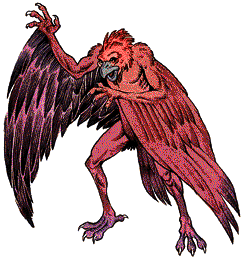
Aarakocra resembled humanoid birds. The average specimen stood about 5 feet (1.5 meters) tall and had a wingspan of 20 feet (6.1 meters). Halfway along the edge of each wing was a hand with three human-sized fingers and an opposable thumb. An elongated fourth finger ex-tended the length of the wing and locked in place during flight. The hands could not grasp while flying, but they were nearly as useful as human hands when an aarakocra was perched and its wings were folded back.
Their powerful legs ended in four sharp talons that could unlock and fold back to reveal another pair of functional hands. These humanoids had hollow, fragile bones. Their faces combined the features of both parrots and eagles. They had gray-black beaks and black eyes. Plumage color varied, but males generally had red, orange, and yellow coloration, while females tended to-wards brown and gray.
Personality
Aarakocra were generally peaceful creatures who cherished their solitude. They were known to be extremely claustrophobic, often refusing to enter caves or other enclosed spaces.
Male aarakocra tended to have very short tempers and had been known to fly into fits of rage when a perceived wrong occurred. They also were notorious romantic flirts, regardless of whether or not they were married.
Combat
Since aarakocra avoided melee combat when possible, their combat tactics revolved around attacking opponents from above. Javelins were the weapon of choice for many aarakocra, so much so that they developed their own unique type of javelin called a flight lance. A single aarakocra could comfortably carry up to six javelins at a time, stored in a special sheathe that was strapped to its body. Other weapons used by aarakocra included darts and daggers. Their sharp talons and beaks were effective weapons as well. Occasionally they wore studded leather, but they never used shields.
Society
On Toril, aarakocra lived atop the highest mountain peaks in small tribes that shared a com-munal nest and controlled hunting territories of about 100 square miles (260 square kilome-ters). Any animals in this territory were considered fair game, including the domesticated live-stock of other races, and most male aarakocra spent their days hunting. The eldest male served as leader, assisted by the tribe's shaman. Meanwhile, female aarakocra crafted the tribe's tools and weapons.
Aarakocra were also one of the major races on the inner planet Coliar. On that planet, it was the females who were always chosen as leaders, as society deemed them far more controlled emotionally. These aarakocra females were chosen by democratic elections, and each ruled over one of over 100 extended families. Males were not forbidden from running for office, but society was strongly against their election, and as of the late 14 century DR, no male had ruled for over 1,000 years. Male aarakocra from other worlds sometimes took offense at this societal trend.
Religion
Aarakocra of Toril almost all worshiped Aerdrie Faenya. She appeared to them as a giant white bird.
The small number of aarakocra living in the North mainly worshiped Syranita as their goddess but also paid homage to Akadi, Remnis of the giant eagles, and Stronmaus of the giants, in ad-dition to Aerdrie Faenya.
Relations
Many aarakocra tribes avoided contact with other species, and many individuals rarely, if ever, left their home territory. The aarakocra had strong ties with the avariels as they shared the same patron deity and had the same respect for nature.
Aarakocra understood and spoke common, but when they spoke it, they punctuated their speech with caws, whistles, and other bird-like sounds.
### Known Settlements Their settlements often took the form of large nests woven from vines which were open to the sky. Aarakocra were an immigrant race to Faerûn from Maztica. Known aarakocra settlements in Faerûn were:
- The Star Mounts in the High Forest. This tribe was almost totally slain by the green dragon Elaacrimalicros.
- The Storm Horns in Cormyr.
- The Cloven Mountains in the Vilhon Reach.
- The Mistcliffs in Chult.
- The Adder Hills in Chessenta.
- The monastery Kir Sabal in Chult.
- As of the Year of the Scarlet Witch, 1491 DR, the last settlement of aarakocra in the High Forest was the Last Aerie, on the slopes of the southernmost Star Mounts, near the headwaters of the Unicorn Run.
History
Following the fall of their empires to the first Flight of Dragons around −30,000 DR, the surviv-ing members of the avian creator race known as the aearee (primarily the subgroup known as the Aearee-Krocaa) fled to Anchorome, where their further exploits went largely undocumented by Faerûnian historians. The only thing known was that at some point after their arrival there, the aearee either created or devolved into the aarakocra, who then move south into Maztica.
In 418 DR, following generations of travel between Maztica and the islands of the Trackless Sea, the first aarakocra colonists successfully crossed to northern Faerûn.
In 1267 DR, the last aarakocra living in the Riders to the Sky Mountains were killed by Ches-sentan mercenaries, who hunted them to extinction for sport.
In the 1360s DR, there were five aarakocra settlements on the Star Mounts when the green dragon Elaacrimalicros attacked, killing over 120 aarakokra and leaving their homes completely uninhabitable. The survivors scattered across the North, many swearing revenge—such as the Nest of Retribution in the Lost Peaks. Forty-seven survivors came together for shelter at the source of the Unicorn Run in a new settlememt known as Khle'cayre.
As late as 1370 DR, the city of Ravens Bluff classified aarakocra as "monsters" that a third-party required a permit from city officials in order to bring into the boundaries of the city.
Source: Forgotten Realms Wiki
Aarakocra Language
Miscellaneous Language
Script
Spoken by
The Aarakocra language was the racial language of aarakocras, a race of intelligent bird-like people.23456
Speakers
Beyond aarakocras themselves, Aarakocra was a common secondary language among jungle druids, specialty priests in the Church of Ubtao, who sought to learn the exotic languages of the creatures that lived around the Chultan Peninsula.7
Phonology
This language consisted in part, though not entirely, of a variety of clicks, trills, and whistles.8
Derivations
Coliar Aarakocra
A dialect spoken by the aarakocra of the planet Coliar. Beyond the native aarakocra themselves, it was a common secondary language among elves of the Elven Imperial Fleet.9
Malatran Aarakocra
A dialect spoken by the aarakocra of the Malatran Plateau.10
Dictionary
Unknown Words
The Aarakocra tongue included a word for "gargoyle", one of their sworn foes, that loosely translated to "flying rock".8note 2
Names
Aaarakocran names typically featured two to four syllables. Clicks, trills, or whistles acted as the connectors between these syllables.8
Either Gender
Aera, Aial, Aur, Deekek, Errk, Heehk, Ikki, Kleeck, Oorr, Ouss, Quaf, Quierk, Salleek, Urreek, and Zeed.8
Appendix
Notes
- ↑ In the Elemental Evil Player's Companion, it is stated that Aarakocra player characters can "...speak, read, and write Common, Aarakocra, and Auran." This would imply that Aarakocra, much like the other two languages, has some form of writing script.
- ↑ What exactly this word is was never stated within the cited text.
Source: Forgotten Realms Wiki

Aasimar
Contents
- PC Stat Blocks
- DMG
- MPMM
- VGM
- Forgotten Realms
Aasimar
- Ability Scores. Charisma +2; Wisdom +1
- Size. Medium
- Speed. 30 ft.
Age. Aasimar mature at the same rate as humans but live a few years longer.
Size. Aasimar are built like well-proportioned humans. Your size is Medium.
Darkvision. Thanks to your celestial heritage, you have superior vision in dark and dim conditions. You can see in dim light within 60 feet of you as if it were bright light, and in dark-ness as if it were dim light. You can't discern color in darkness, only shades of grey.
Celestial Resistance. You have resistance to necrotic and radiant damage.
Celestial Legacy. You know the light cantrip. Once you reach 3rd level, you can cast the lesser restoration spell once with this trait, and you regain the ability to do so when you finish a long rest. Once you reach 5th level, you can cast the daylight spell once with this trait, and you regain the ability to do so when you finish a long rest. Charisma is your spell-casting ability for these spells.
Language. You can speak, read, and write Common and Celestial.
Source: DMG, page 286
Aasimar
- Ability Scores. Choose one of: (a) Choose any +2; choose any other +1 (b) Choose three different +1
- Size. Small/Medium
- Speed. 30 ft.
Size. You are Medium or Small. You choose the size when you select this race.
Celestial Resistance. You have resistance to necrotic damage and radiant damage.
Darkvision. You can see in dim light within 60 feet of you as if it were bright light and in darkness as if it were dim light. You discern colors in that darkness only as shades of gray.
Healing Hands. As an action, you can touch a creature and roll a number of d4s equal to your proficiency bonus. The creature regains a number of hit points equal to the total rolled. Once you use this trait, you can't use it again until you finish a long rest.
Light Bearer. You know the light cantrip. Charisma is your spellcasting ability for it.
Celestial Revelation. When you reach 3rd level, choose one of the revelation options be-low. Thereafter, you can use a bonus action to unleash the celestial energy within yourself, gain-ing the benefits of that revelation. Your transformation lasts for 1 minute or until you end it as a bonus action. Once you transform using your revelation below, you can't use it again until you finish a long rest.
- Necrotic Shroud. Your eyes briefly become pools of darkness, and ghostly, flightless wings sprout from your back temporarily. Creatures other than your allies within 10 feet of you that can see you must succeed on a Charisma saving throw (DC 8 + your proficiency bonus + your Charisma modifier) or become frightened of you until the end of your next turn. Until the trans-formation ends, once on each of your turns, you can deal extra necrotic damage to one target when you deal damage to it with an attack or a spell. The extra damage equals your proficiency bonus.
- Radiant Consumption. Searing light temporarily radiates from your eyes and mouth. For the duration, you shed bright light in a 10-foot radius and dim light for an additional 10 feet, and at the end of each of your turns, each creature within 10 feet of you takes radiant damage equal to your proficiency bonus. Until the transformation ends, once on each of your turns, you can deal extra radiant damage to one target when you deal damage to it with an attack or a spell. The extra damage equals your proficiency bonus.
- Radiant Soul. Two luminous, spectral wings sprout from your back temporarily. Until the transformation ends, you have a flying speed equal to your walking speed, and once on each of your turns, you can deal extra radiant damage to one target when you deal damage to it with an attack or a spell. The extra damage equals your proficiency bonus.
Languages. You can speak, read, and write Common and one other language that you and your DM agree is appropriate for your character.
Whether descended from a celestial being or infused with heavenly power, aasimar are mortals who carry a spark of the Upper Planes within their souls. They can fan that spark to bring light, ease wounds, and unleash the fury of the heavens.
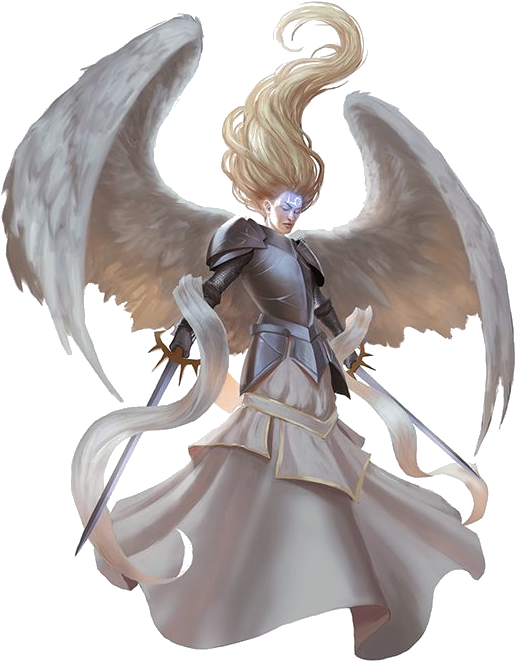
Aasimar can arise among any population of mortals. They resemble their parents, but they live for up to 160 years and often have features that hint at their celestial heritage. These often begin subtle and become more obvious when the aasimar gains the ability to reveal their full celestial nature. The Aasimar Celestial Features table has examples you can choose or use as inspiration to create your own.
Aasimar Celestial Features
| d6 | Celestial Feature |
|---|---|
| 1 | A dusting of metallic, white, or charcoal freckles |
| 2 | Metallic, luminous, or dark eyes |
| 3 | Starkly colored hair |
| 4 | An unusual hue tinting your shadow |
| 5 | A ghostly halo crowning your head |
| 6 | Rainbows gleaming on your skin |
Source: MPMM, page 7
Aasimar
- Ability Scores. Charisma +2
- Size. Medium
- Speed. 30 ft.
This race has multiple subraces, as listed below:
- Aasimar (Fallen)
- Aasimar (Protector)
- Aasimar (Scourge)
Traits
Age. Aasimar mature at the same rate as humans, but they can live up to 160 years.
Size. Aasimar have the same range of height and weight as humans.
Darkvision. Blessed with a radiant soul, your vision can easily cut through darkness. You can see in dim light within 60 feet of you as if it were bright light, and in darkness as if it were dim light. You can't discern color in darkness, only shades of gray.
Celestial Resistance. You have resistance to necrotic damage and radiant damage.
Healing Hands. As an action, you can touch a creature and cause it to regain a number of hit points equal to your level. Once you use this trait, you can't use it again until you finish a long rest.
Light Bearer. You know the light cantrip. Charisma is your spellcasting ability for it.
Languages. You can speak, read, and write Common and Celestial.
Aasimar bear within their souls the light of the heavens. They are descended from humans with a touch of the power of Mount Celestia, the divine realm of many lawful good deities. Aasimar are born to serve as champions of the gods, their births hailed as blessed events. They are a people of otherworldly visages, with luminous features that reveal their celestial heritage.
Falling from Grace or Rising to It
With your DM's consent, you can change your character's subrace to fallen aasimar if your protector/scourge aasimar turns to evil. To do so, replace your subrace benefits, including the ability score increase, with those of a fallen aasimar.
Similarly, if your fallen aasimar turns to good, your DM might allow you to become a protector or scourge aasimar.
Celestial Champions. Aasimar are placed in the world to serve as guardians of law and good. Their patrons expect them to strike at evil, lead by example, and further the cause of justice.
From an early age, an aasimar receives visions and guidance from celestial entities via dreams. These dreams help shape an aasimar, granting a sense of destiny and a desire for righteousness.
Each aasimar can count a specific celestial agent of the gods as a guide. This entity is typically a deva, an angel who acts as a messenger to the mortal world.
Hidden Wanderers. While aasimar are strident foes of evil, they typically prefer to keep a low profile. An aasimar inevitably draws the attention of evil cultists, fiends, and other enemies of good, all of whom would be eager to strike down a celestial champion if they had the chance.

When traveling, aasimar prefer hoods, closed helms, and other gear that allows them to conceal their identities. They nevertheless have no compunction about striking openly at evil. The secrecy they desire is never worth endangering the innocent.
Aasimar Guides. An aasimar, except for one who has turned to evil, has a link to an angelic being. That being—usually a deva—provides guidance to the aasimar, though this connection functions only in dreams. As such, the guidance is not a direct command or a simple spoken word. Instead, the aasimar receives visions, prophecies, and feelings.
The angelic being is far from omniscient. Its guidance is based on its understanding of the tenets of law and good, and it might have insight into combating especially powerful evils that it knows about.
As part of fleshing out an aasimar character, consider the nature of that character's angelic guide. The Angelic Guide tables offer names and natures that you can use to flesh out your character's guide.
| d6 | Name |
|---|---|
| 1 | Tadriel |
| 2 | Myllandra |
| 3 | Seraphina |
| 4 | Galladia |
| 5 | Mykiel |
| 6 | Valandras |
| d6 | Nature |
|---|---|
| 1 | Bookish and lecturing |
| 2 | Compassionate and hopeful |
| 3 | Practical and lighthearted |
| 4 | Fierce and vengeful |
| 5 | Stern and judgmental |
| 6 | Kind and parental |
Note to the DM: Playing an Angelic Guide
As DM, you take on the role of an aasimar's angelic guide and decide what kind of advice or omens to send in dreams.
The deva, or other celestial being, is your chance to add special roleplaying opportunities to the game. Remember, a deva lives in a realm of absolute law and good. The deva might not understand the compromises and hard choices that mortals must grapple with in the world. To the deva, an aasimar is a prized student who must live up to high, sometimes inflexible standards.
Conflicted Souls. Despite its celestial origin, an aasimar is mortal and possesses free will. Most aasimar follow their ordained path, but some grow to see their abilities as a curse. These disaffected aasimar are typically content to turn away from the world, but a few become agents of evil. In their minds, their exposure to celestial powers amounted to little more than brainwashing.
Evil aasimar make deadly foes. The radiant power they once commanded becomes corrupted into a horrid, draining magic. And their angelic guides abandon them.
Even aasimar wholly dedicated to good sometimes feel torn between two worlds. The angels that guide them see the world from a distant perch. An aasimar who wishes to stop and help a town recover from a drought might be told by an angelic guide to push forward on a greater quest. To a distant angel, saving a few commoners might pale in comparison to defeating a cult of Orcus. An aasimar's guide is wise but not infallible.
Aasimar Names. Most aasimar are born from human parents, and they use the same naming conventions as their native culture.

Aasimar (Fallen)
- Ability Scores. Charisma +2; Strength +1
- Size. Medium
- Speed. 30 ft.
Age. Aasimar mature at the same rate as humans, but they can live up to 160 years.
Size. Aasimar have the same range of height and weight as humans.
Darkvision. Blessed with a radiant soul, your vision can easily cut through darkness. You can see in dim light within 60 feet of you as if it were bright light, and in darkness as if it were dim light. You can't discern color in darkness, only shades of gray.
Celestial Resistance. You have resistance to necrotic damage and radiant damage.
Healing Hands. As an action, you can touch a creature and cause it to regain a number of hit points equal to your level. Once you use this trait, you can't use it again until you finish a long rest.
Light Bearer. You know the light cantrip. Charisma is your spellcasting ability for it.
Languages. You can speak, read, and write Common and Celestial.
Necrotic Shroud. Starting at 3rd level, you can use your action to unleash the divine en-ergy within yourself, causing your eyes to turn into pools of darkness and two skeletal, ghostly, flightless wings to sprout from your back. The instant you transform, other creatures within 10 feet of you that can see you must succeed on a Charisma saving throw (DC 8 + your proficiency bonus + your Charisma modifier) or become frightened of you until the end of your next turn.
Your transformation lasts for 1 minute or until you end it as a bonus action. During it, once on each of your turns, you can deal extra necrotic damage to one target when you deal damage to it with an attack or a spell. The extra necrotic damage equals your level.
Once you use this trait, you can't use it again until you finish a long rest.
An aasimar who was touched by dark powers as a youth or who turns to evil in early adulthood can become one of the fallen-a group of aasimar whose inner light has been replaced by shadow.
Aasimar (Protector)
- Ability Scores. Charisma +2; Wisdom +1
- Size. Medium
- Speed. 30 ft.
Age. Aasimar mature at the same rate as humans, but they can live up to 160 years.
Size. Aasimar have the same range of height and weight as humans.
Darkvision. Blessed with a radiant soul, your vision can easily cut through darkness. You can see in dim light within 60 feet of you as if it were bright light, and in darkness as if it were dim light. You can't discern color in darkness, only shades of gray.
Celestial Resistance. You have resistance to necrotic damage and radiant damage.
Healing Hands. As an action, you can touch a creature and cause it to regain a number of hit points equal to your level. Once you use this trait, you can't use it again until you finish a long rest.
Light Bearer. You know the light cantrip. Charisma is your spellcasting ability for it.
Languages. You can speak, read, and write Common and Celestial.
Radiant Soul. Starting at 3rd level, you can use your action to unleash the divine energy within yourself, causing your eyes to glimmer and two luminous, incorporeal wings to sprout from your back.
Your transformation lasts for 1 minute or until you end it as a bonus action. During it, you have a flying speed of 30 feet, and once on each of your turns, you can deal extra radiant damage to one target when you deal damage to it with an attack or a spell. The extra radiant damage equals your level.
Once you use this trait, you can't use it again until you finish a long rest.
Protector aasimar are charged by the powers of good to guard the weak, to strike at evil wherever it arises, and to stand vigilant against the darkness. From a young age, a protector aasimar receives advice and directives that urge to stand against evil.
Aasimar (Scourge)
- Ability Scores. Charisma +2; Constitution +1
- Size. Medium
- Speed. 30 ft.
Age. Aasimar mature at the same rate as humans, but they can live up to 160 years.
Size. Aasimar have the same range of height and weight as humans.
Darkvision. Blessed with a radiant soul, your vision can easily cut through darkness. You can see in dim light within 60 feet of you as if it were bright light, and in darkness as if it were dim light. You can't discern color in darkness, only shades of gray.
Celestial Resistance. You have resistance to necrotic damage and radiant damage.
Healing Hands. As an action, you can touch a creature and cause it to regain a number of hit points equal to your level. Once you use this trait, you can't use it again until you finish a long rest.
Light Bearer. You know the light cantrip. Charisma is your spellcasting ability for it.
Languages. You can speak, read, and write Common and Celestial.
Radiant Consumption. Starting at 3rd level, you can use your action to unleash the di-vine energy within yourself, causing a searing light to radiate from you, pour out of your eyes and mouth, and threaten to char you.
Your transformation lasts for 1 minute or until you end it as a bonus action. During it, you shed bright light in a 10-foot radius and dim light for an additional 10 feet, and at the end of each of your turns, you and each creature within 10 feet of you take radiant damage equal to half your level (rounded up). In addition, once on each of your turns, you can deal extra radiant damage to one target when you deal damage to it with an attack or a spell. The extra radiant damage equals your level.
Once you use this trait, you can't use it again until you finish a long rest.
Scourge aasimar are imbued with a divine energy that blazes intensely within them. It feeds a powerful desire to destroy evil-a desire that is, at its best, unflinching and, at its worst, all-consuming. Many scourge aasimar wear masks to block out the world and focus on containing this power, unmasking themselves only in battle.
Source: VGM, page 105. Reprinted as Aasi-mar in MPMM. Also found in EGW, page 166.
The celestial opposites of the tieflings, aasimar are descended from humans of celestial heritage. Aasimar aren't as prevalent in the Realms as tieflings, but common enough that some become adventurers. Dungeon Masters who want to allow their players to create aasimar characters can find rules for doing so in the Dungeon Master's Guide.
Source: SCAG, page 119
See Also
Forgotten Realms Wiki:
Aasimar were human-based planetouched, native outsiders that had in their blood some good, otherworldly characteristics. They were often, but not always, descended from celestials and other creatures of pure good alignment, but while predisposed to good alignments, aasimar were by no means always good.
Description
Aasimar bore the mark of their celestial touch through many different physical features that often varied from individual to individual. Most commonly, aasimar were very similar to humans, like tieflings and other planetouched. Nearly all aasimar were uncommonly beautiful and still, and they were often significantly taller than humans as well.
While several aasimar were immediately identifiable as such, others were even less distinguishable than tieflings from their human ancestors, commonly standing out with only one unusual feature. Most aasimar had pupil-less pale white, gray, or golden eyes and silver hair, but those descended from planetars could also have emerald skin, while those descended from avoral celestials might have feathers mixed in with their hair. Those descended from ghaeles often had pearly opalescent eyes.
Solar-descended aasimars often had brilliant topaz eyes instead or silvery or golden skin and those with couatl or lillend lineage most commonly had small, iridescent scales. Many aasimar also had a light covering of feathers on their shoulders, where an angel's wings might sprout. As in tieflings, aasimar bloodlines could sometimes run dormant for generations, reemerging after being hidden for some time.
5th Edition Statistics
Size
Medium
Type
Alignment
General Information
Vision
Darkvision
Average Lifespan
160 years
Homeland(s)
Prime Material Plane
Language(s)
Common, Celestial
Subraces
Deva
Protector aasimar
Scourge aasimar
Fallen aasimarAppearance
Average height
Males: 5 feet - 6 feet and 6 inches Females: 4 feet 7 inches - 6 feet and 1 inch
Average weight
Males: 124-280 lbs. Females: 89-245 lbs.
Skin color(s)
Pale to dark brown, emerald, gold, silver
Hair color(s)
Red, blond, brown, black, silver
Eye color(s)
Pupil-less pale white, gold, gray, or topaz
Distinctions
Physically similar to humans, insightful, magnetic personality, capacity to cast supernatural light, celestial heritage
History
First appearance
Personality
Most aasimar grew up cautious around others and, like tieflings, were sometimes misunderstood, though never to the hateful extent many of the fiendish bloodlines were. Even those raised by understanding parents could not escape their strangeness, or the curiosity (or even fear) that their unique nature sometimes provoked. Many aasimar even suffered prejudice, something that deeply hurt the soul of the aasimar in question since most had an inherent bent towards empathy for others.
Aasimar preferred to keep a low profile in public, as not to draw the attentions of evil cultists, fiends, or other beings that wished to strike them down because the their celestial nature. An aasimar would abandon the low profile if it meant striking openly at evil, though never at the expense of endangering the innocent.
Though many aasimar were good in nature, thanks in a large part to their celestial ancestors, not all were, just as not all tieflings or fey'ri were evil. Some aasimar fell into the trap of evil, corrupted perhaps by experience or the counsel and aid of an evil god. Shar and Sseth in particular took pleasure in corrupting aasimar and turning them from the ways of their celestial forebears, nursing grudges fueled by the prejudice of others. Most aasimar avoided this path, however, and a few even received direct counsel from their celestial ancestor or a creature in its service. These individuals were the aasimar most likely to manifest the stereotypical virtues of a celestial.
Abilities
As a general rule, aasimar were a wise and charismatic race, possessed of strong insights and a powerful allure with which most races could not compare. Aasimar were also quite perceptive, noticing things that others did not, and many could see largely unimpeded in perfect darkness, while also possessing the ability to cast magical light to aid those who could not see. Aasimar were also, like many of their celestial forebears, resistant to the effects of acidic elements, extreme cold, or electrical charges.
From an early age, aasimar often received visions, prophesies, feelings, and guidance from a patron deity, usually through their dreams. These visions, for an unfallen aasimar, came from a celestial patron (typically a deva) and gave the aasimar a sense of destiny and a desire to do what was right. Patrons were not omnipotent but could advise their charges on known evils and grant advice based on tenants to which the patron aligned.
These visions to the aasimar from a patron might cause moral conflicts to the mortal creature. For example, an angelic messenger was a distant onlooker and thus might send visions and feelings that would send the aasimar away from helping a specific town to hurry instead to defeat an even greater evil.
Society
“ I've made a career stealing fiendish artifacts from the blackened fortresses of Baator, the fetid reaches of the Abyss, and yugoloth strongholds on Gehenna. ”
— Seraphistus the aasimar thief
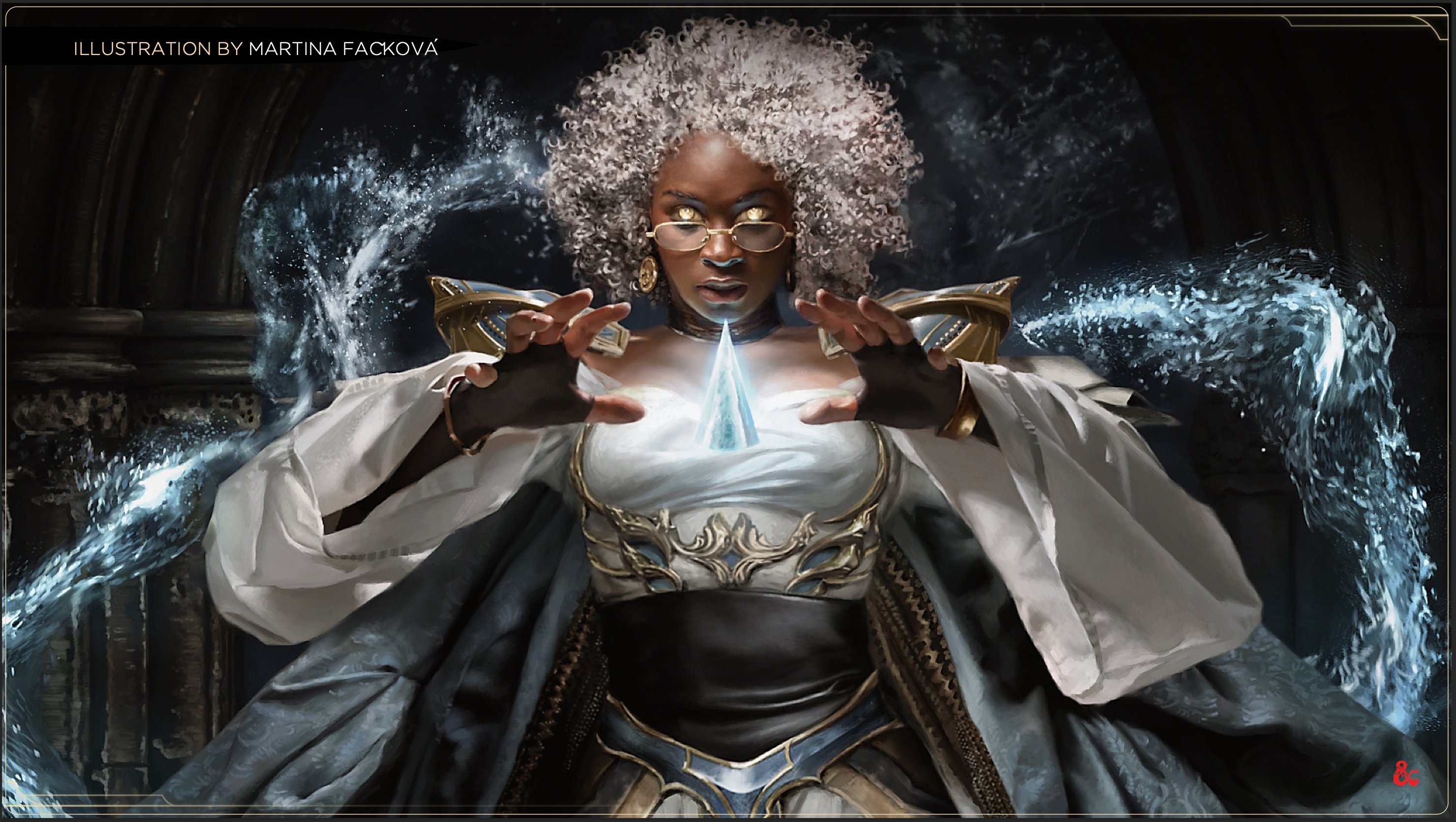
Aasimar were rare throughout Toril and, as such, had no true cities or societies of their own, much like other planetouched. Aasimar could live for the whole of their life without ever meeting another of their kind and, as such, were resigned to living amongst other races.
Very few aasimar had siblings who were also aasimar, in large part due to the rarity of a celestial or god mating with a human but also due to the fact that aasimar who sprang from ancient bloodlines long left dormant were even rarer. As a result, not many aasimar met others of their kind, though such meetings were more common in Mulhorand, owing to the relatively larger number of aasimar there. On the rare occasions where two aasimar did meet, they often felt a kind of kinship and unspoken understanding with one another. Most aasimar were likely to take the side of another instinctively, regardless of personal feeling and there was a strong bond between aasimar of all stripes.
Religion
Because of their ties to the goodly gods and celestial beings, many aasimar were drawn to a religious path and most aasimar spellcasters called on divine magic as opposed to arcane magic. A great many become paladins, most in the service of good, and the philosophy of lawful good paladins often resonated strongly with aasimar. Those descended from non-lawful outsiders, on the other hand, most often became clerics, though a few also became paladins.
Like other half-breeds, aasimar did not feel, as a whole, beholden to any one god or pantheon, but many aasimar worshiped the Mulhorandi pantheon and a large proportion of the race was descended from the goodly gods of Mulhorand. Many of these aasimar in particular often felt a strange bond to the animals whom their divine ancestor was a patron of. Others, particularly those born outside of Mulhorand or its neighbors, often took on gods appropriate for the nation in which they lived.
Some aasimar, who fell to evil, did so because of feelings that their celestial blood and patron visions had brainwashed them. Such aasimar who fell would lose their celestial patron but became fierce fighters, their radiant damage becoming necrotic.
On the Outer Planes, aasimar were the servants of many of the dwarven and elven gods, including Aerdrie Faenya, Berronar Truesilver, Corellon Larethian, Dugmaren Brightmantle, Eilistraee, Erevan Ilesere, Haela Brightaxe, Hanali Celanil, Labelas Enoreth, Moradin, Shevarash, and Solonor Thelandira— despite not having dwarven or elven blood. The human gods Lliira and Milil also had aasimar as servants.
Relations
Aasimar, despite their human ancestry, did not typically feel a strong draw to their kin but instead felt a stronger bond with other half-breeds. Many aasimar enjoyed the company of races as varied as half-elves or half-orcs, though very few aasimar got along well with tieflings, whom the celestial-descended race was instinctively wary of. Genasi were likewise alien to aasimar, who found the elemental race strange even by their own standards. Of the other common races, aasimar had little overall opinion, since dwarves, elves, and the like had little history of persecuting aasimar but neither did they have a history of befriending them.
History
Though mortal aasimar were the result of breeding between humans and celestials, devas were unheard of in the local multiverse prior to the arrival of the Mulani from a forgotten plane. Drawn to Imaskar by powerful wizards, the Mulani slaves called upon their gods for aid. Just as the gods could initially appear only as avatars so did their celestial servitors initially require mortal bodies, resulting in the first devas. Since then, devas, also commonly called aasimar in Mulhorand, (a term then adopted for the mortal progeny of celestials and mortals by others), were created through other means, but all of the race shared certain qualities with these first individuals.

Homelands
Aasimar were most commonly found in the eastern lands of Unther and Mulhorand, where they were the descendants of the good deities who once walked among the mortals. Since the Spellplague, however, and the devastation of both lands, aasimar became wandering nomads bound to no land or god and spread widely over the face of Faerûn, as well as other parts of Toril. Those from outside of Faerûn were often drawn to it, perhaps by the ancestral lure of Unther and Mulhorand, and so many aasimar could be found in borderlands such as Durpar, Murghôm, Thesk, or Waterdeep, though none of these places were considered traditional homelands.
Subraces
Fallen Aasimar
Some aasimar were marked by some form of darkness in their lives, that tarnished their inner light. In most instances these fallen aasimar were either influenced by some evil power in their youth, or they themselves had turned to the ways of evil.
Fallen aasimar typically possessed greater strength than their other celestial-blooded kin. Once per day, they could release the divine energy stored deep within them to form an aura of necrosis around them for a single minute. This effect was so horrific that it often caused others to run away in terror.
Protector Aasimar
Yet other aasimar were tasked by the greater powers of good to protect the weak and innocent of the Realms. From their youth they were given a divine missive, along with guidance, to smite evil in the defense of those unable to fight on their own.
Protector aasimar were often more learned and judicious than others. Around once per day, they could channel their inner light to conjure to angelic, incorporeal wings from their back for one minute. They could fly at the speed of about 300 ft (91 m) per minute and unleash radiant energy when they attack.
Scourge Aasimar
These individuals of divine heritage that possessed an intense drive to purge evil from the Realms. They imbued with powerful radiant energy to help them carry out their natural drive to smite evil. They were easily identifiable as the energy coursing through their body radiated outward. They were exceptionally hearty and robust individuals.
About once per day, scourge aasimar could release the radiant energy held within them in a blast that extended outwards for 10 ft (3 m). This power could last upwards of one minute.
Scourge aasimar often wore masks to hide away their otherworldly appearance, except when engaged in combat.
Notable Aasimar
- Turiel, The scourge aasimar Turiel of Candlekeep.
- Aiden, captain of the Blue Glaucus in the Moonshae Isles.
- Caelar Argent, a crusader who led an army to the Nine Hells, seemingly with the intent to rescue tormented souls of their deceased loved ones.
- Sirge de La Sunya, an Amnian paladin that founded The Winter Rose adventuring company.
- Turiel, the cleric of Bahamut that resided within the hallowed walls of Candlekeep.
- Xale of the Starry Glen, a Knight of the Blue Moon.
- Aylin, daughter of the Moonmaiden.
Notes
The 5 edition sourcebook Volo's Guide to Monsters lists protector, scourge, and fallen aasimar as subraces. The supplemental sourcebook Monsters of the Multiverse includes characteristics of these subraces as three different "Celestial Revelations".
Source: Forgotten Realms Wiki

Autognome
Contents
- PC Stat Blocks
- AAG
- Forgotten Realms
- NPC (BAM)
Autognome
- Ability Scores. Choose one of: (a) Choose any +2; choose any other +1 (b) Choose three different +1
- Size. Small
- Speed. 30 ft.
Creature Type. You are a Construct.
Armored Casing. You are encased in thin metal or some other durable material. While you aren't wearing armor, your base Armor Class is 13 + your Dexterity modifier.
Built for Success. You can add a d4 to one attack roll, ability check, or saving throw you make, and you can do so after seeing the d20 roll but before the effects of the roll are resolved. You can use this trait a number of times equal to your proficiency bonus, and you regain all ex-pended uses when you finish a long rest.
Healing Machine. If the mending spell is cast on you, you can spend a Hit Die, roll it, and regain a number of hit points equal to the roll plus your Constitution modifier (minimum of 1 hit point).
In addition, your creator designed you to benefit from several spells that preserve life but that normally don't affect Constructs: cure wounds, healing word, mass cure wounds, mass healing word, and spare the dying.
Mechanical Nature. You have resistance to poison damage and immunity to disease, and you have advantage on saving throws against being paralyzed or poisoned. You don't need to eat, drink, or breathe.
Sentry's Rest. When you take a long rest, you spend at least 6 hours in an inactive, mo-tionless state, instead of sleeping. In this state, you appear inert, but you remain conscious.
Specialized Design. You gain two tool proficiencies of your choice, selected from the Player's Handbook.
Languages. You can speak, read, and write Common and one other language that you and your DM agree is appropriate for your character.
Autognomes are mechanical beings built by rock gnomes. Sometimes, because of a malfunction or a unique circumstance, an autognome becomes separated from its creator and strikes out on its own.
An autognome bears a resemblance to its creator, and most autognomes are programmed to speak and understand Gnomish. The internal components used in an autognome's manufacture can vary wildly; one autognome might have an actual beating heart in its chest cavity, while another might be powered by stardust or intricate clockwork gears.
Roll on the Autognome History table or choose an entry that you like to identify what event set you on the path to adventure. If nothing on the table appeals to you, work with your DM to create an origin story for your character. Like gnomes, autognomes can live for centuries, typically up to 500 years.
Autognome History
| d6 | Story |
|---|---|
| 1 | Your creator gave you autonomy and urged you to follow your dreams. |
| 2 | Your creator died, leaving you to fend for yourself. |
| 3 | A glitch caused you to forget your original programming. You don't remember who made you or where you came from. |
| 4 | You didn't like how you were being treated by your creator, so you ran away from home. |
| 5 | You were built to complete a special mission. |
| 6 | You felt trapped in the role for which you were built and abandoned your creator, determined to find a greater purpose. |
Source: AAG, page 11
See Also
Autognome
An Autognome is a gnomish-created automaton from the Spelljammer campaign setting.
Overview
An autognome is a mechanical automaton created by the tinker gnomes for various missions in environments hostile to human- and gnome-kind, including exploration, rescue, prospecting, and defense. It works about as well as any other gnomish invention. Any autognome encountered is either carrying out its current orders; is under a gnomes' direct control; or is a rogue, meaning its forgotten its orders and is now wandering through wildspace doing anything except what it was designed to do.
Description
An autognome resembles a gnome, with gears, pulleys, and bits of magic inside it, though no one could ever confuse an autognome with a real gnome. Autognome faces are painted, even down to red circles on their cheeks. They walk with a stiff gait, clanking, wheezing, whirring, and razzing, their arms swinging out of rhythm. Autognomes can speak gnomish and the common trade tongue in a nasal monotone.
Ecology
Autognomes contribute nothing to their ecosystem except for piles of scrap metal when they inevitably break down. Rogue autognomes are often considered a wildspace hazard.
Combat
Autognomes are programmed to obey the following directives:
1. Defend gnomes under attack by non-gnomes;
2. Defend yourself against attack; and
3. Defend babies and children from harm.
The last directive arose from the best intentions, but unfortunately, it neglects to specify races; so if, for instance, an autognome sees elves battling young beholders, the autognome will automatically attack the elves.
Autognomes attack with two heavy metallic fists; unfortunately, autognomes are slow and always attack last in a round when using their fists. Since one of their functions is to collect soil samples from different planets, most autognomes have a retractable metal scoop. However, they will only use the scoop as a weapon if they have malfunctioned (see below).
Some autognomes have been designed exclusively for combat, and have a wand of lightning mounted in their chests. These wands are salvageable after an autognome has been defeated or (more likely) when it breaks down and collapses into a useless heap. Whichever attack form an autognome uses, it yells "Crush! Kill! Destroy! Exterminate, exterminate! Maim! Hurt! Incapacitate!" as it fights.
Basic Statistics
Origin
Sphere
Size
Small
Type
Construct
Alignment
Neutral good
General Information
Movement
Flying, swimming, burrowing
Activity cycle
Any
Diet
N/A
Intelligence
Semi
Language(s)
Gnomish. common
Favored climate
Any
Favored terrain
Any
Appearance
Average height
3 feet tall
Distinctions
Resembles a mechanical gnome
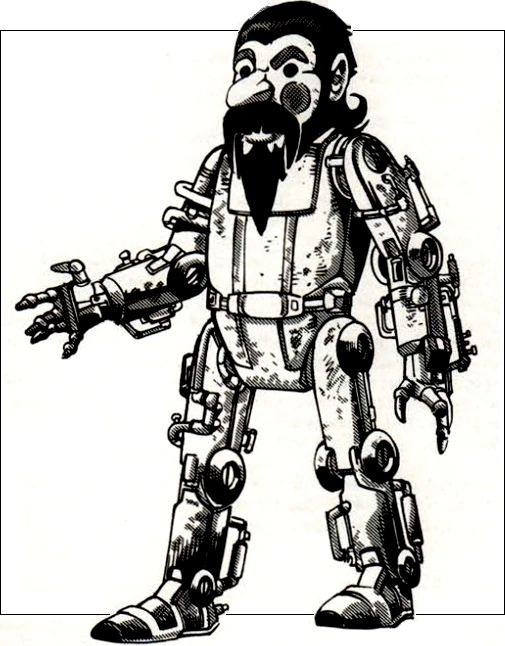
An autognome may spontaneously malfunction at any time, especially during combat: every successful hit on an autognome has a chance of causing it to malfunction. The various malfunction states include:
- the autognome goes rogue; or
- the autognome begins to attacks itself; or
- the autognome's head or limb falls off, and it may or may not stop to reattach them; or
- the autognome attempts to extract a core sample from a victim; or
- the autognome shuts down for up to 10 hours; or
- the autognome explodes, damaging or injuring everything in a 20 foot radius; or
- the autognome's programmed behaviors or orders may suddenly change, including:
- the autognome activates its self-destruct sequence, and has to be doused with water within 4 minutes or it will explode; or
- the autognome stops to deliver a report; or
- the autognome asks to record a report, and remains stationary until the selected person stops talking; or
- the autognome begins talking backwards; or
- the autognome identifies the nearest person as a baby; or
- the autognome identifies the nearest person as a gnome, and will follow them around, obeying their orders.
Society
Since autognomes are automatons, they have no society or preferred habitat. One in ten gnomish spelljammer have up to 4 autognomes on board to explore hostile environments.
Autognomes are capable of following up to 100 different orders, including what to do in certain situations, or what minerals to look for on a planet. An autognome can memorize and recite everything it sees and hears in a 24-hour period.
An autognome can converse with other beings, but its thought processes are inflexible, and it does not deviate from its orders. Figures of speech are lost on it, which can cause problems since an autognome's logic is quite narrow. For instance, an autognome may be ordered to fetch a rock sample. In its travels, it meets a human warrior named Rok. Therefore, out comes the sample scoop and…
One-in-three autognomes encountered will have gone rogue, meaning that they have forgotten their original orders and have defaulted to one of the following behaviors:
- the autognome believes itself to be a real gnome, and tries to live a normal life, including eating, sleeping, etc.
- the autognome accepts new orders from anyone it meets;
- the autognome accepts new orders from anyone it meets, except it does the exact opposite;
- the autognome attacks all living creatures in sight.
Creating an autognome
The tinker gnomes keep the process of creating new autognomes a tightly guarded secret (though truth be told, no one but the gnomes want to build the things). According to rumor, creating an autognome requires many spells, such as enchant an item, animate object, and permanency, and it costs at least 10,000 gp.
For some reason, the dohwar are interested in purchasing intact, working autognomes. All other intelligent races either flee from the things or, if the autognome is unaccompanied by a gnome, blow it up.
Signature Spelljammers
None. Some gnomish spelljammers will have up to 4 autognomes on board to explore hostile environments.
Appendix
External Links
- Gondsman article at the Forgotten Realms Wiki, a wiki for the Forgotten Realms campaign setting.
- Autognome article at the Advanced Dungeons & Dragons 2nd Edition Wiki, a wiki for official Dungeons & Dragons content from 2nd edition AD&D.
Source: Spelljammer Wiki

Autognome
Small Construct, Any Alignment
- Armor Class 16 (natural armor)
- Hit Points 39 (6d6 + 18)
- Hit Points 39 (6d6 + 18)
- Speed 20 ft.
STR DEX CON INT WIS CHA 13 (+1) 6 (-2) 16 (+3) 4 (-3) 11 (+0) 6 (-2)
- Saving Throws Con +5, Wis +2, Cha +0
- Damage Immunities poison
- Condition Immunities paralyzed, petrified, poisoned
- Senses darkvision 60 ft., passive Perception 10
- Languages Common, Gnomish
- Challenge 2 (450 XP)
- Proficiency Bonus +2
Malfunction. Whenever the autognome takes 15 damage or more from a single source and isn't reduced to 0 hit points by that damage, roll a d20 to determine if it suffers a malfunction:
- 1-10: "All Fine Here!" No malfunction occurs.
- 11-12: "My Mind Is Going. I Can Feel It." The autognome is incapacitated for 1 minute.
- 13-14: "You've Disarmed Me!" One of the autognome's arms falls off, reducing the number of Shock attacks it can make by 1 until a creature uses an action to reattach the arm.
- 15-16: "Who Turned Out the Lights?" The autognome's head falls off and deactivates, causing the autognome to be blinded and deafened until a creature uses an action to reattach the head, which reactivates it.
- 17-20: "Have a Magical Day!" The autognome explodes and is destroyed. Each creature within 20 feet of the exploding autognome must make a DC 11 Dexterity saving throw, taking 22 (4d10) slashing damage on a failed save, or half as much damage on a successful one.
- Unusual Nature. The autognome doesn't require air, food, drink, or sleep.
Actions
Multiattack. The autognome makes two Shock attacks.

An autognome is a mechanical gnome that resembles the rock gnome who created it, though it could never be mistaken for a gnome. Regardless of what its insides are made of, it has a metallic outer casing painted with gnomish features. It walks with a stiff gait, clanking, wheezing, whirring, and buzzing wherever it goes.
An autognome obeys its creator's commands when it is functioning properly, but a design flaw can cause an autognome to go rogue, forget its orders, and wander Wildspace doing anything except what it was designed for.
No two autognomes are necessarily made of the same materials; magic is what gives them their intelligence. Most autognomes are programmed to obey the following three directives: defend gnomes who are being attacked by non-gnomes, defend yourself if you are attacked, and protect infants and youngsters from harm. The last directive arose from the best intentions, but it doesn't distinguish between species; if an autognome sees a group of adults battling a lunar dragon wyrmling, for instance, it would come to the wyrmling's defense.
Source: BAM page 13


Bugbear
Contents
- PC Stat Blocks
- MPMM
- VGM
- Did not use ERLW
- Forgotten Realms
- (Language)
- (Pantheon)
Bugbear
- Ability Scores. Choose one of: (a) Choose any +2; choose any other +1 (b) Choose three different +1
- Size. Medium
- Speed. 30 ft.
Creature Type. You are a Humanoid. You are also considered a goblinoid for any prereq-uisite or effect that requires you to be a goblinoid.
Darkvision. You can see in dim light within 60 feet of you as if it were bright light and in darkness as if it were dim light. You discern colors in that darkness only as shades of gray.
Fey Ancestry. You have advantage on saving throws you make to avoid or end the charmed condition on yourself.
Long-Limbed. When you make a melee attack on your turn, your reach for it is 5 feet greater than normal.
Powerful Build. You count as one size larger when determining your carrying capacity and the weight you can push, drag, or lift.
Sneaky. You are proficient in the Stealth skill. In addition, without squeezing, you can move through and stop in a space large enough for a Small creature.
Surprise Attack. If you hit a creature with an attack roll, the creature takes an extra 2d6 damage if it hasn't taken a turn yet in the current combat.
Languages. You can speak, read, and write Common and one other language that you and your DM agree is appropriate for your character.
Neither bugs nor bears, bugbears are the hulking cousins of goblins and hobgoblins. With roots in the Feywild, early bugbears resided in hidden places, in hard-to-reach and shadowed spaces. Long ago and from out of the corner of your eye, they came to the Material Plane, urged to spread throughout the multiverse by the conquering god Maglubiyet. Centuries later, they still bear a fey gift for lurking just out of sight, and many of them have sneaked away from that god's influence.
They are long of limb and covered in coarse hair, with wedge-shaped ears and pointed teeth. Despite their formidable build, bugbears are quiet skulkers, thanks to a fey magic that allows them to hide in spaces seemingly too small for them.
Source: MPMM, page 8
Bugbear
- Ability Scores. Strength +2; Dexterity +1
- Size. Medium
- Speed. 30 ft.
Age. Bugbears reach adulthood at age 16 and live up to 80 years.
Size. Bugbears are between 6 and 8 feet tall and weigh between 250 and 350 pounds. Your size is Medium.
Darkvision. You can see in dim light within 60 feet of you as if it were bright light, and in darkness as if it were dim light. You can't discern color in darkness, only shades of gray.
Long-Limbed. When you make a melee attack on your turn, your reach for it is 5 feet greater than normal.
Powerful Build. You count as one size larger when determining your carrying capacity and the weight you can push, drag, or lift.
Sneaky. You are proficient in the Stealth skill.
Surprise Attack. If you surprise a creature and hit it with an attack on your first turn in combat, the attack deals an extra 2d6 damage to it. You can use this trait only once per com-bat.
Languages. You can speak, read, and write Common and Goblin.
Source: VGM, page 119. Reprinted as Bug-bear in MPMM. Also found in EGW, page 174.
NOTE See Appendix for more on Goblinoids from VGM.

See Also
Forgotten Realms Wiki
Bugbears were a massive humanoid race distantly related to, but larger and stronger than, goblins and hobgoblins.10
Description
Bugbears resembled hairy, feral goblins standing 7 feet (2.1 meters) tall. They took their name from their noses and claws, which were similar to those of bears.12 Their claws were not long and sharp enough to be used as weapons, so bugbears often armored and armed themselves with a variety of purloined gear,3 which was normally second-rate and in poor repair.10
Personality
Bugbears, like other goblinoids, had a reputation for being dim-witted and brutish. This claim was not unfounded, and like their kin, bugbears had easily provoked tempers and were prone to rages. Few bugbears overcame this flaw and their culture's brutal nature.13 Many bugbears were chaotic evil in alignment, favoring stealth and surprising their opponents.10
Bugbear heroes, though rare, were heard of and could acquire significant renown if successful. Often the motivation for this change of heart came from the rewards earned from virtue, which in the long term were more pleasing than the short-term pleasures of evil behaviors.13
Combat
Balsag and his two giant rats standing guard in an underground chamber near Thundertree.
5th Edition Statistics
Size
Medium
Type
Alignment
Challenge rating
Bugbear 1 Bugbear chief 3 4E Origin
General Information
Patron deity
Vision
Activity cycle
Any5
Diet
Carnivore5
Average lifespan
80 years10
Language(s)
Favored climate
Favored terrain
Appearance
Average height
6‒8 ft (1.8‒2.4 m)10
Average weight
250‒350 lb (110‒160 kg)10
Skin color(s)
Yellow to reddish brown6
Hair color(s)
Brown, red6
Eye color(s)
Yellow, orange, red, brown, greenish white6
Distinctions
Large, hairy, wedge-shaped ears, heightened sense of smell, tough hide, claws, strong but nimble
History
First appearance
Greyhawk
Based on
Bugbear (English)

Society
Bugbears were often found in the company of other goblinoids, particularly goblins, since tribes made up mostly of hobgoblins and bugbears tended to be wiped out quickly by other races as a precaution.13 Some bugbears also operated independently, though tribes ruled by hobgoblins were better organized and less savage. This was in part because bugbears had little patience for diplomacy or negotiation, preferring violent solutions to conflicts unless obviously overpowered.2
Religion
Bugbears once had their own pantheon, led by Hruggek. Bugbears often decapitated their enemies as a way to honor Hruggek, who was said to do the same.2 From the Spellplague to the Second Sundering, the power of Hruggek was diminished and the god served as an exarch of Bane, the god of tyranny.14 However, after the Second Sundering, bugbears began to follow bugbear-specific deities such as Hruggek once more.9
Other bugbear deities included Grankhul, the bugbear deity of hunting, senses, stealth, and surprise;1516 and Skiggaret. Local pantheons often included a god of earth, a god of fertility, and a god of death.17
Languages
In addition to speaking Common and the Goblin tongue like other goblinoids,10342 bugbears possessed their own language.511
Biology
Unlike most creatures, bugbears were particularly susceptible to the effects of Bowen's flowers, which would knock them out within minutes.18
History
Many scholars of the late 14th century DR believed that bugbears and goblins were both bred by the hobgoblins as slave races, with bugbears serving as elite soldiers.2
Nine bugbears working for the Xanathar Thieves' Guild dwelt upon the Dungeon Level of Undermountain.19
Four bugbears working for Yek dwelt in the Arcane Chambers Level of Undermountain, as well as twenty bugbears who served the Xanathar Thieves' Guild.20
Eight bugbears dwelt in Azrok's Hold, on the Sargauth Level of Undermountain.21
External Links
Disclaimer: The views expressed in the following links do not necessarily represent the views of the editors of this wiki, nor does any lore presented necessarily adhere to established canon. Please consider using affiliate links before purchases to support the wiki.
-
 Bugbear (Dungeons & Dragons) article at Wikipedia, The Free Encyclopedia.
 -
Bugbear article at the Eberron Wiki, a wiki for the Eberron campaign setting.
-
Bugbear article at the Baldur's Gate 3 Community Wiki, a community wiki for Baldur's Gate 3.
Source: Forgotten Realms Wiki
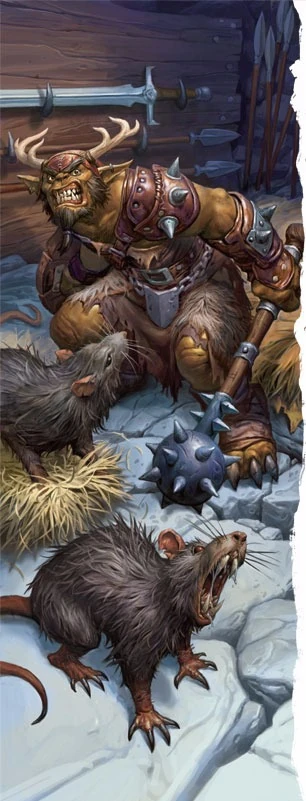
Bugbear Language
Miscellaneous Language
Script
Unknown
Spoken by
The Bugbear language was the racial language of bugbears, one of the many races of goblinoids.123
Description
Perceived by other creatures as being a rather uncouth language,4 Bugbear consisted of a variety of different grunts,1 snarls,14 and gestures.1
Speakers
Beyond bugbears themselves, Bugbear was a common secondary language among some specialty priests, such as the Authlim of Iyachtu Xvim and the Dreadmasters of Bane.5
Appendix
Appearances
Novels & Short Stories
Organized Play & Licensed Adventures
Referenced only
Twilight of the Dirty Turtles • Going Ape
Source: Forgotten Realms Wiki
Bugbear pantheon
Basic Information1
Type
Membership2
Members
The bugbear pantheonnote 1 was an extinct pantheon whose deities were once worshiped by bugbears.1
History
The bugbears once had a pantheon with deities unique to their race and culture. However, many of them were cut down by Maglubiyet, though the two brothers, Hruggek and Grankhul were spared. The original pantheon was absorbed into Maglubiyet's goblinoid pantheon. However, after Maglubiyet's conquest, bugbears still worshiped the two brother deities, even though it meant submitting to their conquerer's rule.1
Members
Some known members of the pantheon were:
The bugbears also knew of a god of fear known as Skiggaret, though it was unknown if this deity was ever part of the original bugbear pantheon or even the reformed goblinoid pantheon.3
Appendix
Notes
- ↑ Bugbears were noted to venerate the "bugbear pantheon" in Monster Mythology, a core sourcebook. However, this article focuses on recent Realms material, specifically Volo's Guide to Monsters. This sourcebook clearly states that bugbears as a race once had an individual pantheon that was dissolved by Maglubiyet. For the purposes of this wiki, the extinct pantheon is referred to as the bugbear pantheon.
Source: Forgotten Realms Wiki

Bullywug
Contents
- PC Stat Blocks
- DMG
- Forgotten Realms
- (Language)
Bullywug
- Ability Scores. Intelligence −2; Charisma −2
- Size. Medium
- Speed. 20 ft., swim 40 ft.
Amphibious. You can breathe air and water.
Speak with Frogs and Toads. You can communicate simple concepts to frogs and toads when you speak in Bullywug.
Swamp Camouflage. You have advantage on Dexterity (Stealth) checks made to hide in swampy terrain.
Standing Leap. Your long jump is up to 20 feet and your high jump is up to 10 feet, with or without a running start.
Languages. You can speak, read, and write Bullywug.
Note: This race is listed in the Dungeon Master's Guide as an option for creating NPCs. It is not designed for use as a playable race.
Source: DMG, page 282
See Also
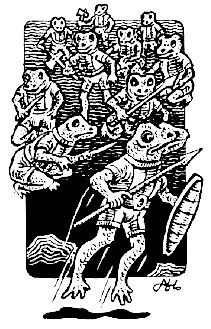
Forgotten Realms Wiki:
Bullywugs were a primitive race of frog-like humanoids found throughout the bogs and marshes of Toril, the self-proclaimed lords of the swamp. Savage and self-destructive, the bullywugs regularly tampered with forces beyond their understanding, threatening the safety of others and their own brutish, noisome, and wet lives. Description Bullywugs were amphibious humanoids with webbed digits that stood between 5′4″‒6′ (1.6‒1.8 m) and weighed 150 to 240 pounds (68 to 110 kilograms) on average, although they could vary in body type from 4 to 7 feet (1.2 to 2.1 meters) and 100 to 300 pounds (45 to 140 kilograms).
Their hides were smooth and reasonably tough, with mottled coloration ranging from emerald or olive green, yellow, brown, and gray. Bullywug skin was chameleon-like, so if they remained motionless in swampy terrain, they would shift through different hues and shades of their normal color range to match their surroundings. The creatures were noxious to be around, for they carried with them the rancid reek of the bog.
The huge heads of bullywugs resembled those of frogs, with big, bulbous eyes, wide mouths, and long, flicking tongues. Said tongues were barely capable of navigating a stunted variant of Common, and they typically spoke in thick, sloppy accents.
5th Edition Statistics1
Size
Medium
Type
Alignment
Challenge rating
1⁄4
4E Keyword(s)
4E Origin
3E Subtype(s)
General Information
Patron deity
Vision
Normal3
Diet
Carnivore4
Homeland(s)
Language(s)
Favored climate
Favored terrain
Appearance
Average height
Average weight
100 to 300 pounds (45 to 140 kilograms)3
Skin color(s)
Yellow, green, gray3
History
First appearance
Personality
“ I'll never get this stink off of my clothes. ”
Bullywugs were foul inhabitants of the natural world both in smell and company,2 constantly hungry savages1 often completely lacking in higher emotions and feelings.4 Unlike many other creatures of the wild, bullywugs either didn't understand or didn't care about the effect they had on their own ecosystems.13 They hunted and killed for sport without the intelligence or discrimination to allow environmental recovery, and so systematically depleted the natural resources of their own habitats.3
Rather than fill any ecological niche, these habits made bullywugs a disruption and threat to the fragile balance they themselves relied upon, and after exhausting other food sources, they would either move on to greener pastures or turn to cannibalism (although some were cannibals by choice). While they didn't permanently poison the land like the undead, the effects of bullywugs left due to their reckless practices was nothing short of disastrous for a few years, as they stripped acres of land bare4214 and left behind a despoiled morass of mud, a mere echo of a once fertile swamp.2
The bullywugs were not unaware of this phenomenon, the difference in environment before and after they entered being so noticeable that even they viewed their own presence as "off" somehow. This sense of something being wrong manifested as paranoia, the sense that everything was out to get them somehow, although this feeling was not exactly untrue. Those that struck the scourge of bullywugs with particular precision or power sometimes felt a moment of renewed strength or clarity, as if the natural world itself was thanking them for their service.2
Bullywugs were, appropriately enough, bullies,3 and often their greatest joy came from lording over trespassers in their domains.1 They believed themselves to be the true lords of the swamp and behaved as such,115 being known to laze and loaf even as others worked.1617 They prized coins, jewels, and other treasures, although as individuals they lacked the same kind of greed and megalomania found in marauders like orcs. Infighting within the same group almost never occurred, though some would suggest this was due to a lack of brainpower rather than malice.4 Regardless of the truth of that idea, bullywugs were easily confused,15 the smartest of them normally being of about average human intelligence.4
Despite their tendencies towards chaotic and evil behavior, bullywugs were capable of adopting other behaviors. They often remained individualistic, but sometimes shed their more despicable traits when trying to find a place in the outside world.18 Curiosity could drive them to explore,19 and those that met success were the ones that learned to work with and rely on others, with most stray bullywugs being neutral and, on rare occasion, creatures of good.18
Abilities
Bullywugs could deliver powerful bites1 and were creatures of notable athleticism.2 The amphibians were strong swimmers able to move rapidly under the water, even when weighed down by things like armor or shields. Despite being slow on land, with or without objects encumbering them, bullywugs could hop as fast as they could run (and possibly faster), leaping 20 to 30 feet (6.1 to 9.1 meters) forward or 10 to 15 feet (3 to 4.6 meters) high in a single bound.1345
A bullywug's camouflage protected them both from regular sight and from infravision since their body temperature changed along with their coloration to better blend with their surroundings.5
Some bullywugs, known as croakers, were flabby and weak compared to their kin, but able to belch up clouds of fetid, poisonous gas as they made their loud croaks.2
Combat
Bullywugs reserved their natural methods of defense (biting and to a lesser extent their pitiful "claws") for foes that got too close to them, preferring to wield weapons whenever possible.145 Most were barely able to wield more than a simple stone weapon (such as a club),11 so they stuck to spears, halfspears, and other sharp, piercing weapons that could be poked out of the water.3 They normally leapt when in melee, since by springing through the air they increased the odds of hitting their foes, and when holding an impaling weapon, their strikes were twice as lethal. This made long weapons especially important, since they compensated for their slow speed when running and their exposed state when jumping.45
Bullywugs also wore crude armor and donned shields when available despite these things slowing them down when underwater, trying to equip themselves with at least leather armor as a point of pride.3418 This highlighted an oddity when it came to bullywugs, their illogical approach to battle. Bullywugs were fierce, aggressive creatures known to display fanatical loyalty to their tribes, and yet had little stomach for protracted fighting, which combined with their lacking minds made them somewhat unpredictable as far as combat went. Bullywugs were just as likely to fight to the death no matter how obviously doomed they were as they were to run for the hills after only a few of them fell, melting away into the swamp even if they easily could have won.3920
Bullywugs did not favor fair fights, and were skilled in the construction and use of nets and snares.4 They preferred to fight in or near water,3 and given their camouflage and ability to suddenly spring into action, they were adept ambushers.45 Bullywugs were emboldened by superior numbers and always tried to overwhelm the enemy by surrounding them. They hated humans and attacked adventurers on sight whenever their own groups were larger, but against serious threats, they normally left in search of easier prey.1154 Fittingly, bullywugs usually tried to summon monsters as the first part of any attack whenever possible, but given their issues with that art, there was a 1/8 chance they would accidentally summon more creatures than expected, lose control, and then waste their efforts fighting their would-be aid.3
Most bullywugs outside of their homes trained as warriors while some became barbarians, the tribe's biggest bullywug often doing the latter.3 Some bullywugs had specific strategies; those known as muckers were strong and stout foes that jumped at their victims to knock them prone before kicking them while they were down, while others known as twitchers erratically spasmed around the battlefield, making them difficult to hit and difficult to avoid.2
Society
Bullywug society was savage, primitive, and tribal, one of the most petty-minded and mindlessly destructive of all humanoid organizations.24 Bullywugs had learned to cooperate for the sake of mutual survival and hunting benefit with practically zero infighting,184 but murder was still one of the two primary methods for getting ahead. The killing of one's rivals had to be performed secretly however, since bullywugs who witlessly did away with their opposition were likely to be executed by the others. Bullywug politics were typically more "subtle" than killing whoever was in front on the social ladder.1
Aside from their gods, bullywugs only ever showed respect to their leaders, for their organized (or at least semi-organized) societies were socially fascist and so tyrannical as to be totalitarian. Absolute authority was vested to subleaders led by a male chieftain, a self-styled lord of the muck who could treat all his subjects as possessions and freely kill (and eat if he chose) his followers if they did not instantly follow his whims.1184 Only when the previous leader was too old to rule would the next dominant male kill and usurp (and possibly consume) him.4
This foul aristocracy formed the basis of bullywug "etiquette", both amongst themselves and outsiders. Bullywugs introduced themselves with grand titles while groveling and kowtowing before their superiors, ceaselessly competing to win their favor.1 It was in this sycophantic competition that the bullywug love and hoarding of treasure became important despite its lack of actual use in their societal system.18 Instead of killing each other, bullywugs could advance by finding treasures and trinkets (including magical items) to present to their lord as tokens of deference or loyalty.1
It was for this reason that bullywugs raided caravans and settlements, obtaining baubles and knickknacks to impress and win over their masters. Even if this succeeded and a bullywug got into the good graces of their leaders, the careless abuse and neglect that they so commonly showed their own property invariably meant that the fine items they acquired would become broken and dirty, whereupon the bullywug lord would invariably demand even more. Capturing intruders was favorable to just killing them because they could be dragged before the bullywug kings and their queens and forced to beg for mercy.1
Bullywug royals were sneering and demanding, donning robes of leather, rough cloth, and marsh plants121 even as most bullywugs wore no clothes.4 Through bribery and flattery they could be convinced to release their captive audience, but not before trying to impress them with the majesty of their realm and the grandeur of their treasures.1 Despite claims of being the masters of the marshes, bullywugs recognized their adverse environmental influence and perceived themselves negatively because of it, and that attitude extended to the bullywug lords.12 Behind their pretensions to nobility and fanciful posturing was a deep inferiority complex, a desperate desire for legitimacy in the eyes of outsiders as beings worthy of not only fear, but respect.1
Numbers
“ They've got a shaman. Where there's a shaman, there's a swarm. ”
Bullywugs normally appeared in groups somewhere between ten to eighty individuals,4 although they traveled in their tribal groups in numbers somewhere below fifty.10 A grouping of four bullywugs was known as a "pad", a pair of pads was called a "float", and between two to six floats was a "pond".3 Bullywug bands always had large leaders, with communities of thirty or more possessing five subleaders and groups of sixty or more having a great chieftain and five subchieftans.45
Discrimination
A small number of bullywugs were bigger and smarter than their peers, being broader than their relatives and ranging in height from 6 to 7 feet (1.8 to 2.1 meters). These "advanced" bullywugs were also more organized, more well-equipped, and more aggressive than the normal variety, staking out regular territories varying with the group size. Advanced bullywugs dwelt in abandoned buildings and caves, sent out regular patrols and hunting parties, and unlike normal bullywugs, were able to wear armor and use weaponry with little trouble. They regularly raided outside territory for food and plunder, particularly enjoying human flesh.451811
The presence of advanced bullywugs was one of the few times that bullywugs fought. Normal bullywugs hated their larger, more intelligent kin with a passion, going to war with them every chance they got.4185 Advanced bullywugs reciprocated the feeling, viewing all outsiders, bullywugs or otherwise, as either threats or food sources. Despite this hatred,4 it was the largest and smartest bullywugs that invariably led bullywug kind,21 the kings and queens of their race normally being of unusual stature.1 On the other side of the coin, it was the advanced bullywugs that most frequently broke away from their kind and took up the adventuring lifestyle.1811
Often it was the females of bullywug society that decided to leave their lairs. Despite the fact that females and young made up about half of a given tribe, neither was given much weight in the social order, for their culture was heavily patriarchal. Females were looked down upon as nothing more than egg bearers, and these extremely limited options for advancement pushed them to a life of adventure.418
Relations
Bullywugs had difficulties allying with other beings, but when they did it was universally with the foul and the feral.2 While there was no open hostility between the two, lizardfolk rarely associated with them,5 and bullywugs were known to boss them around if given the chance.15 The sahuagin held them in contempt and occasionally raided their lairs out of hateful malice before eating captives alive.5 They fancied wemic claws as shield and armor decorations.23
Bullywugs were normally around the same size and color as gripplis, were known to abuse this fact to set ambushes, and in some cases were ancient enemies.24 The bullywugs that lived within the Marsh of Chelimber believed they were in a never-ending battle with the sivs over control of the edge of the wetlands. In truth, the sivs emerged victorious in the conflict and allowed the ravenous amphibians to live within their realm, serving as a buffer between them outsiders from beyond the marsh. Only in places throughout the Realms too small for the sivs' desired isolation could the bullywugs truly lord over their sinkholes without interference from their more organized cousins.3
While most bullywugs hated humans and most humans (and other humanoids) feared and hated them in return,18 bullywugs would readily serve wicked masters, even human ones.5 Those that grew accustomed to working with others and seeing others of different races consistently pass, at the very least didn't attack on sight.15 Most bullywugs lived out in the open, with loose territorial boundaries that they inefficiently enforced, though intruders often ended up killed and eaten.4 They reportedly had no sense of privacy or personal space, and when they did have specific living spaces (such as huts) they were not known to be assigned to specific areas.25
Language
Bullywugs had access to the Batrachian Common tongue (a language used by frog-like humanoids),24 and the more intelligent ones could speak a fractured form of Common with limited vocabulary,4 but they had a primitive language of their own.1 The bullywug tongue consisted of a series of croaks, staccato notes, and clicks,17 and though crude, it allowed them to communicate over large distances, spreading news quickly across the swamps.1
Animal Taming
Bullywug language allowed for the communication of simple concepts with amphibians, a capability bullywugs used to form strong bonds with giant frogs and toads. They trained them to serve as guardians, hunters, and in the case of larger varieties, mounts, and used their ability to swallow creatures whole to carry prey back to their villages.1 They were known to raise such creatures as tadpoles, and weren't bothered by them.25 Furthermore, they were the undisputed masters of capturing and training wild frogs, and while swamp-dwelling kobolds and goblins had managed to learn from them, only the bullywugs had learned to truly domesticate them, using them like dogs. Sometimes trained war frogs were offered as gifts to set up trade relations with other tribes.26
Summoning
Before Year of Wild Magic, 1372 DR a bullywug could be summoned by the summon monster I spell.28
Religion
“ Bullywugs are vile monsters, to be sure, but their magic is of little account. ”
— The mind flayer Vestriss.22
Clerics and shamans were common among the bullywugs, with as many as ten percent of those in a community having access to divine magic (varying based on how advanced they were).345 However, the greater number of bullywug priests came at the cost of their individual quality; they had access to only three kinds of magic, spells taken from their divine domains (typically from Chaos, Evil or Water), inflict spells, and summoning spells, the latter being culturally favored. Bullywug clerics were infamous, in fact, for their powerful yet unpredictable summonings, having made a religious fetish out of calling creatures that might or might not stay within their control.3
In any case, bullywug religion was not based on their past, at least not in any objectively verifiable way. They had only the most primitive of origin myths that ignored anything outside their own limited perceptions of their lives and environments.29 Often they claimed to have been created by ancient primordials rather than deities, a claim of tenuous accuracy. The only power exclusive to the bullywugs was Ramenos, a god (or possibly primordial) of intoxication, rest, and decline.22930 Even so, the bullywugs had no creation myth involving Ramenos,29 and even those who followed him didn't necessarily have anything more than the shallowest understanding.31
Ramenos had no clerics, only shamans, and those shamans were both crude and weak. They had no duties save for helping the leaders of the tribe (to whom they were often related) and to regularly take plant-based alkaloids to become intoxicated. Conversely, Ramenos gave practically no aid, sending neither omens nor avatars unless someone conducted a ritual at one of his ancient temples.29 Given his utter lack of support and seeming indifference to his own increasing irrelevance, it was questionable if Ramenos was even still alive (with many not even being sure if he existed in the first place).293031
Regardless of if Ramenos created them or not, bullywugs worshiped a host of noxious "gods" (some of which weren't even close to being divine), and much of their spiritual understanding was flawed.2332 For example, the cruelest of bullywugs believed that by creating legacies of savage violence for themselves, they might one day be reborn as slaadi.2 When bullywug tribes came across a froghemoth, they would treat the monstrosity as a divine being and try to coax it into their den by communicating basic ideas and offering it food. These froghemoths might only eat a few bullywugs before following the others and could then be "tamed" with the bullywugs giving it a comfortable lair and food as tribute, while fanatically protecting it and any young froghemoth while it matured (which was fortunate considering that froghemoths had a tendency to eat their offspring.32
Bullywugs were also known to worship such vile entities as the obyrith demon lord Dagon, the Great Old One Ghaunadaur, or the ancient goddess of darkness Shar, although that didn't mean they did so in any official capacity. In reported cases, their "religion" was known to be personally manufactured, self-taught, and based on the individual desires and goals of the devotee. Even those that could actually use divine magic might have just assembled a hodgepodge of confused dogma, combining anything from strange hallucinogens, imagined lore, borrowed iconography, and copied elements of mysticism without actual understanding of that entity's tenets.313334
Bullywug shamans that took up the life of an adventurer were usually those fleeing their god's wrath, and so often took up service to a new deity.18
Magic
Some bullywugs, known as mud lords, possessed greater intelligence than their kin and were able to cast spells. They emitted fiery croaks and blasted their foes with their own electric reflux, although this magic was more powerful if they sacrificed their allies by containing them in the blast radius.3
On rare occasion, bullywugs were born with the innate, bardic power to weave magic into their songs. Among the most arrogant and pompous of their kind, they were raised in protected enclaves and taught how to heal and harm with their powers. Known powers included the ability to sing an ode to an elder froghemoth and grant temporary life force to bullywugs nearby, and to sing a song of marshy doom to psychically injure surrounding enemies.21
Biology
Bullywugs wandering through Slitherswamp, the 8th level of the Undermountain.
Bullywugs preferred to inhabit dark, dank places isolated far from human beings, wet locations like rainforests, damp caves, swamps, meres, or virtually any other warm but shady region with abundant water.1345 They had adapted for easy movement among the trees,24 with soft, suction-cupped fingers,20 and had no difficultly moving through mud and wetlands3 on their webbed feet.4 Bullywugs had to routinely soak their entire bodies to keep their skin moist, at least three times a day with an average waterskin's worth of water. If unable to regularly hydrate, they would slowly weaken and die, hence why bullywugs feared dry heat and areas with little standing water.1418115
Bullywugs slept in a frog-like fashion, burying themselves up to the eyes in pits of mud. At night, they were known to crowd on top of each other until everyone in that group was squeezed in, with multiple piles of bullywugs visible throughout their sleeping grounds.25
Diet
Bullywugs were mainly carnivorous and preferred a diet of meat.4 They lived primarily off of fish and any other game (being skilled hunters and fisherman) and would supplement a diet of fruit and insects with flesh whenever possible.424 Extremely young salt dragons, which dwelt in salt flats, lakes, and marshes, were cautiously hunted for food as well.35
A particular point of interest regarding bullywugs, as discovered by Brother Twick of Verdusk, a halfling cleric of Chauntea, was that they were irresistibly drawn to human liquor. After consuming large quantities, they would begin to convulse, helplessly falling prone on the ground for several minutes. The contractions ended with the bullywugs either dying or lapsing into a deep coma, depending on the amount of the alcoholic beverage they consumed. Bullywug attacks had become increasingly rare in the lands surrounding territories where settlements kept an ale or two in case of bullywug raids.20
Reproduction
Bullywugs were not known to bond in the long-term. Females would lay a clutch of 200 or so eggs once a year, which would be watched over by the collective tribe in a breeding pond. The non-intelligent spawn that hatched resembled large tadpoles and would feed upon insects and small amphibians (including each other) until they were large enough to leave the breeding pool, usually after about six to eight weeks. Following their emergence, the juvenile bullywugs were forced to fend for themselves, with nothing to rely upon but luck and their own strength against their larger kin. Unfortunately for them, this brutal "parenting" meant that less than one percent of bullywugs reached adulthood.10
There were rumors that (despite their hatred of humanity) bullywug-human hybrids were viable. Such degenerate humans certainly dwelled in mixed communities, serving unnamed things deep below the earth.5
Anatomy
Puncturing a bullywug's throat pouch without killing it would cause it to suck and noisily dribble whenever they breathed heavily.36
History
“ Understand, Meat, that I am quite familiar with your feeble kind. My people ruled the whole of Merrouroboros while your ancestors cowered in caves and banged rocks together to create fire. ”
— The batrachi lord Bazim-Gorag, on humans.37
In the Days of Thunder, circa -33500 DR, long before the appearance of elves, giants, or even dragons, the amphibious creator race known as the batrachi ruled the supercontinent of Merrouroboros.3839 After the sarrukh fell into a state of somnolent inactivity, the rise of the batrachi ensured that their descendants, the snake-human hybrids known as the yuan-ti, would never reach the same level of prominence.40 The batrachi worshiped Ramenos, who in these days was strong and active, and evidence of his dominion could still be found deep within jungles and lost plateaus where his ruins temples stood. Huge stone statues of the amphibian power dominated plazas and open areas around main buildings, his massive maw open to swallow sacrifices.29
The batrachi reached the height of the power in -31500 DR under the leadership of The High One Zhoukoudien, but their dominion was threatened by the Jotunbrud, who Zhoukoudien had went to war with. His reign ended around that time when he was slain by the titan thane Omo. In the final days of their civilization, circa -31000 DR, the desperate batrachi performed a ritual of epic summoning to defeat Annam's titan armies, releasing several imprisoned primordials, including the Creator of Dragonkind, Asgorath. Unfortunately for the batrachi, the battle between the gods and the primordials unleashed unimaginable catastrophe across all of Toril. Continent-sized chunks of land fell into the ocean as the seas were rearranged, while earthquakes, windstorms and terrible fires scourged the entire planet.3841
The climax of this devastating tumult was the Tearfall, when comets and/or a moon of ice (suspected to have been hurled by Asgorath) crashed into Toril, merging the four Inner Seas into the Sea of Fallen Stars, and soon after tens of thousands of dragon eggs would hatch across the planet. An entity calling itself a batrachi lord spoke of the blanketing of the land with ice as the seven-turn winter, and the dramatic change in climate rendered the world uninhabitable for the batrachi. Forced to retreat from the fallout, the batrachi fled to Limbo, where they were changed for at least the second time by Ramenos to suit his purposes (with many confusing the batrachi for slaadi).3841
Back on Toril however, remnants of the batrachi lineage still remained. Spawned from their union with races of proto-amphibians were the degenerate descendants of the batrachi race that once ruled Toril—the bullywugs.29
External Links
- Bullywug article at the Eberron Wiki, a wiki for the Eberron campaign setting.
Source: Forgotten Realms Wiki
Bullywug language
Miscellaneous Language
Script
Unknown
Spoken by
The Bullywug language was the racial language of bullywugs, a race of frog-like humanoids.12345
Speakers
Beyond bullywugs themselves, Bullywug was somewhat common as a secondary language among warriors in Hlondeth.6 It was also a common secondary language among jungle druids, specialty priests in the Church of Ubtao, who sought to learn the exotic languages of the creatures that lived in Chult's jungles and swamps.7
Phonology
The Bullywug tongue consisted of a series of clicks, croaks, and staccato notes.45 Though considered by some to be a rather crude or primitive language,12 it allowed Bullywugs communicate over large distances, spreading news quickly across their territory.4
Dictionary
Y
Yurk Y'blorkflug
"Lord of fetid obliteration"; a name that the Blacktongue tribe of bullywugs used to refer to their leader, the death slaad Kuketh.8
Source: Forgotten Realms Wiki

Centaur
Contents
- PC Stat Blocks
- GGR
- MOT
- MPMM
- Forgotten Realms
Centaur
- Ability Scores. Strength +2; Wisdom +1
- Size. Medium
- Speed. 40 ft.
Age. Centaurs mature and age at about the same rate as humans.
Alignment. Centaurs are inclined toward neutrality. Those who join the Selesnya are more often neutral good, while those who join the Gruul are typically chaotic neutral.
Size. Centaurs stand between 6 and 7 feet tall, with their equine bodies reaching about 4 feet at the withers. Your size is Medium.
Fey. Your creature type is fey, rather than humanoid.
Charge. If you move at least 30 feet straight toward a target and then hit it with a me-lee weapon attack on the same turn, you can immediately follow that attack with a bonus ac-tion, making one attack against the target with your hooves.
Hooves. Your hooves are natural melee weapons, which you can use to make unarmed strikes. If you hit with them, you deal bludgeoning damage equal to 1d4 + your Strength modi-fier, instead of the bludgeoning damage normal for an unarmed strike.
Equine Build. You count as one size larger when determining your carrying capacity and the weight you can push or drag.
In addition, any climb that requires hands and feet is especially difficult for you because of your equine legs. When you make such a climb, each foot of movement costs you 4 extra feet, in-stead of the normal 1 extra foot.
Survivor. You have proficiency in one of the following skills of your choice: Animal Han-dling, Medicine, Nature, or Survival.
Languages. You can speak, read, and write Common and Sylvan. Sylvan is widely spoken in the Selesnya Conclave, for it is rich in vocabulary to describe natural phenomena and spiritual forces.
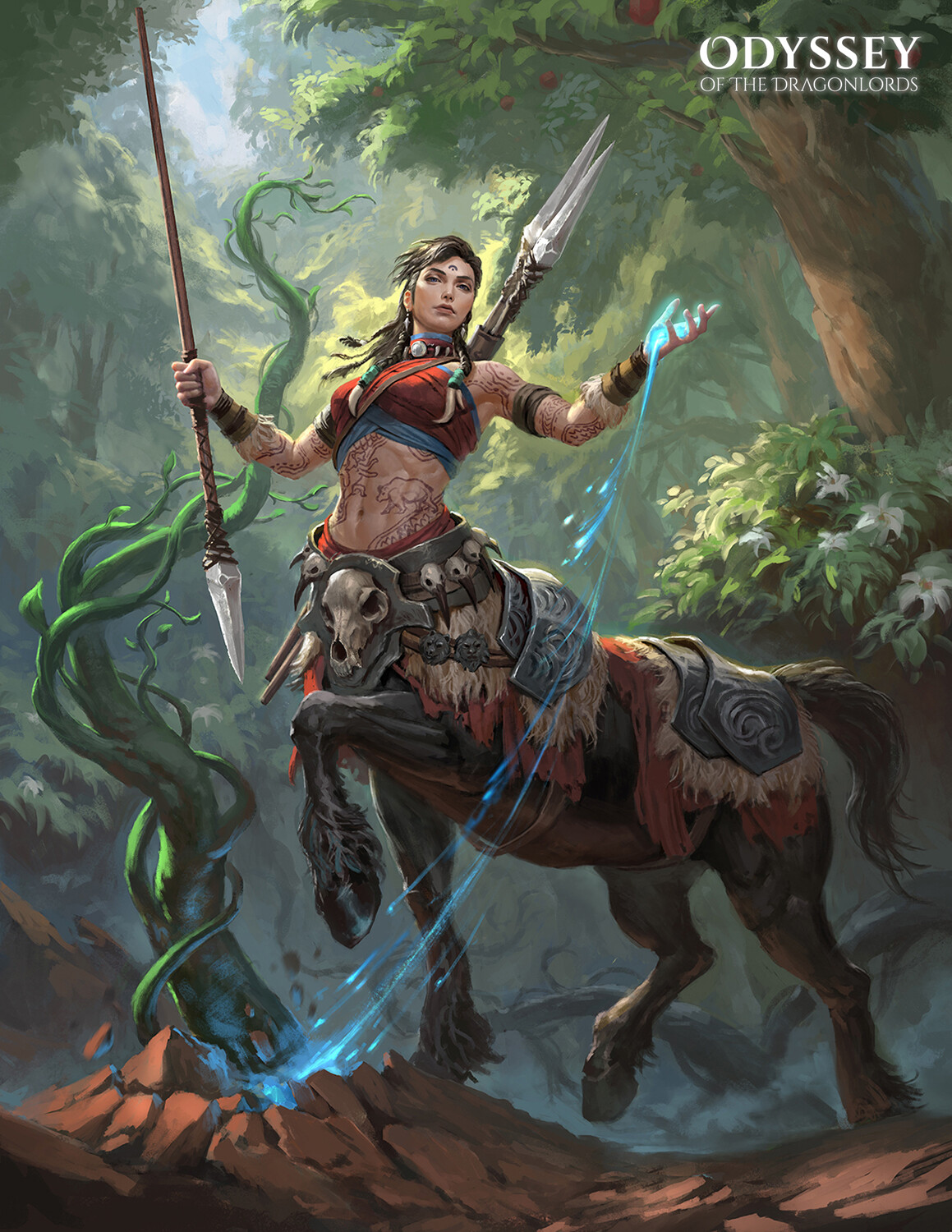
In Ravnica, where "open road" seems like a contradiction and "open plain" is sheer nonsense, centaurs nevertheless retain a love of wide spaces and the freedom to travel. As much as they can, centaurs run—in wide plazas, spacious parks, and expanses of rubble and ruin. They race the wind, hooves thundering and tails streaming behind them, until the next wall looms in their path and brings them to a stop.
Nature's Cavalry. Centaurs have the upper bodies, down to the waist, of muscular humans, displaying all the human variety of skin tones and features. Their ears are slightly pointed, but their faces are wider and squarer than those of elves. Below the waist, they have the bodies of small horses, with a similar range of coloration—from various shades of chestnut or bay to dappled or even zebra-like striped patterns. Most centaurs style their hair and their tails in a similar way. Selesnya centaurs favor long, flowing hair. Gruul centaurs cut their hair in rough, spiky styles.
The upper bodies of centaurs are comparable to human torsos in size, and their lower equine bodies average about 4 feet tall at the withers. Though they are smaller than a human rider mounted on a horse, they fill similar roles as cavalry warriors, messengers, outriders, and scouts.
Affinity for Nature. Centaurs have an affinity for the natural world. Among the guilds that share that affinity, centaurs favor the rubblebelts of the Gruul Clans and the wide plazas of the Selesnya Conclave over the undercity tunnels of the Golgari and the laboratories of the Simic.
Centaurs celebrate life and growth, and the birth of a foal is always cause for festivities. At the same time, they revere the traditions of the past, and among both the Gruul and the Selesnya they are voices of memory and history, preserving old ways and keeping alive the legends of ancestral heroes. They feel a close kinship with wild animals, perhaps because of their own horse-like bodies, and delight in the feeling of running alongside herds and packs of other beasts.
Clans and Community. Centaurs sense the interconnectedness of the natural world. Thus, they celebrate family and community as microcosms of that greater connection. Among the Gruul, they have a strong clan identity, and Selesnya centaurs are fiercely loyal to their individual communities as well as the guild as a whole. Their love of history and tradition also means that centaurs are more likely than most other Ravnicans to join the same guild that their parents did.
Centaur Names. Centaurs' given names are passed down through family lines. The name bestowed on a new foal is typically the name of the most recently deceased family member of the same gender, keeping alive the memory—and, the centaurs believe, some shard of the spirit—of the departed. Centaurs don't use family names, but they wear symbols that represent their family membership. These symbols might include graphical representations of plants or animals, printed mottoes, braids and beads worn in the hair and tail, or even specific patterns of woven fabric.
- Male Names: Bonmod, Boruvo, Chodi, Drozan, Kozim, Milosh, Ninos, Oleksi, Orval, Radovas, Radom, Rostis, Svetyos, Tomis, Trijiro, Volim, Vlodim, Yarog
- Female Names: Daiva, Dunja, Elnaya, Galisnya, Irinya, Kotyali, Lalya, Litisia, Madya, Mira, Nedja, Nikya, Ostani, Pinya, Rada, Raisya, Stasolya, Tatna, Zhendoya, Zoria
Source: GGR, page 15. Reprinted as Cen-taur in MPMM

Centaur
- Ability Scores. Strength +2; Wisdom +1
- Size. Medium
- Speed. 40 ft.
Age. Centaurs mature and age at about the same rate as humans.
Alignment. Centaurs are inclined toward neutrality. Lagonna centaurs tend to be more lawful, while Pheres centaurs are more often chaotic.
Size. Centaurs stand between 6 and 7 feet tall, with their equine bodies reaching about 4 feet at the withers. Pheres centaurs tend to be slightly larger than Lagonna centaurs. Your size is Medium.
Fey. Your creature type is fey, rather than humanoid.
Charge. If you move at least 30 feet straight toward a target and then hit it with a me-lee weapon attack on the same turn, you can immediately follow that attack with a bonus ac-tion, making one attack against the target with your hooves.
Hooves. Your hooves are natural melee weapons, which you can use to make unarmed strikes. If you hit with them, you deal bludgeoning damage equal to 1d4 + your Strength modi-fier, instead of the bludgeoning damage normal for an unarmed strike.
Equine Build. You count as one size larger when determining your carrying capacity and the weight you can push or drag.
In addition, any climb that requires hands and feet is especially difficult for you because of your equine legs. When you make such a climb, each foot of movement costs you 4 extra feet, in-stead of the normal 1 extra foot.
Survivor. You have proficiency in one of the following skills of your choice: Animal Han-dling, Medicine, Nature, or Survival.
Languages. You can speak, read, and write Common and Sylvan.
Powerful and curious, quick to act and knowledgeable of the wider world, centaurs seek to experience life's boundless bounty. The centaurs of Theros are divided into two groups: members of the far-traveling Lagonna band and the proud raiders of the Pheres band. These bands occupy territories situated between the three major human poleis, making them common sights to those who travel human lands. Not ones to settle in permanent homes, though, centaurs might be found wherever there are wonders to be witnessed and adventures to be had.
Markings of the Herd
Though centaurs share the same basic physiology, the centaur bands are commonly associated with their own distinct traits.
Lagonna band centaurs tend to be sleek and muscular, with powerful legs built for endurance rather than speed. They usually have coats of a single color, often with a shine that can look metallic in bright light.
Pheres band centaurs typically have long, nimble legs and lean bodies, and are often marked with natural color patterns on their hide. Pheres centaurs sometimes paint or tattoo their upper bodies to match the patterns on their lower half. Occasionally, a Pheres centaur is born with vertical stripes on their hooves, foretelling an exciting and adventurous life.

Lagonna Merchant Families
Lagonna centaurs travel in small merchant family bands called guri. These groups frequently trade with Meletis, which provides the biggest market for their wares, but they also do business with Setessa and smaller communities within Akros's lands.
The eldest member of each guros typically leads their family. In times of discord, the heads of the guri gather to make decisions together. Other members of the guros work as traders, gatherers, packers, and scouts. A guros has several specialized roles required for success in travel and trade: a barterer, an omener, a courser, and preferably a koletra.
A barterer negotiates deals between the guros and other traders. Barterers must know the customs of other cultures and speak several different languages.
An omener is an oracle who reads messages from the gods in the natural world and reveals how the immortals would have the guros travel.
A courser explores new trade territory for their guros. They are expert trackers and navigators, able to venture deep into unexplored territory and unerringly return to their families.
Finally, every guros tries to travel with at least one koletra, one of the mighty, well-trained warriors of the Lagonna who are said to have the blood of the first, legendary centaur heroes. Koletras are said to bring good luck to a band, but are also usually fated to die in defense of their family. Not every guros has a koletra of its own, and guri share their best warriors among each other as a sign of goodwill and a way to forge bonds.
Journeys of Discovery
When young Lagonna centaurs become adults, they often leave their band to travel the world on their own. This time of self-discovery, called a protoporos, can last anywhere from a few weeks to several years. The Lagonna believe that a protoporos helps young centaurs find their place in the world. An omener reads the signs of fortune before sending young centaurs on their way, guiding the first steps of their journey. While most centaurs return to the band eventually, some find their calling elsewhere. When the Lagonna tell tales of their greatest heroes, they often speak of centaurs who found their heroic destiny on a protoporos.
Pheres Raiders
The Pheres roam the wild lands between Setessa and Akros in small raiding herds. These herds are voluntary associations, in contrast to the family groups of the Lagonna. When necessary, several small bands join together in a larger herd to target particularly dangerous but resource-rich targets—be they humanoid traders or roving, greedy monsters. Bands also join together to defeat common threats or to hunt for game.
The Pheres value physical strength, speed, and prowess in both hunting and combat. Often a band is led by the strongest and most dominant warrior, called the charger. However, some bands elevate a tactician or strategist to this venerated position. The Pheres can be brutal and greedy, but they are clever as well, and understand the value of strategic leadership.
Other centaurs in Pheres herds work as scouts, archers, warriors, and foragers. In addition, most Pheres herds contain a caller and a tromper.
Pheres callers are typically druids or rangers who can draw animal assistance to their herd. Callers often have one or more animal allies at their side, and can speak to animals to learn about the surrounding lands.
Trompers are the most powerful and feared warriors of the herd. Centaur legends say that when the gods first fashioned humans from the red mud of the eldest river, Pheres trompers taught them how to corner and kill prey. The story tells that, to repay this debt, humans owe the centaurs a portion of what they catch. While humans don't recall this arrangement, the Pheres often cite it as justification for their raids.
Pheres Renegades
Pheres band members survive by working and fighting together, but still some centaurs choose to strike out on their own. These renegades often feel like outsiders in their own band. They might be pacifists, wishing to learn about other people rather than fighting them. Or they might feel a restlessness in their soul that nothing else can soothe. Though renegades build their own life away from the band, most retain some connection with their past. Some stories tell of renegades returning to help their band in times of need before disappearing once more.
Centaur Names
Lagonna centaurs tend to favor names of three or four syllables, often borrowed from cultures they have met during their travels. Pheres centaurs tend to have shorter, sharper sounding names, often appended with an honorific gained in battle.
- Female Lagonna Names: Honotia, Kelitia, Lileo, Meloe
- Male Lagonna Names: Aughus, Dririos, Ormasos, Volien
- Female Pheres Names: Bido, Daxa, Saya, Tesia
- Male Pheres Names: Eno, Roth, Skelor, Stihl
- Pheres Honorifics: Threekills, Razorhoof, Unsleeping, Daggereye, Silentstep
Source: MOT, page 18. Reprinted as Centaur in MPMM
Centaur
- Ability Scores. Choose one of: (a) Choose any +2; choose any other +1 (b) Choose three different +1
- Size. Medium
- Speed. 40 ft.
Creature Type. You are a Fey.
Charge. If you move at least 30 feet straight toward a target and then hit it with a me-lee weapon attack on the same turn, you can immediately follow that attack with a bonus ac-tion, making one attack against the target with your hooves.
Equine Build. You count as one size larger when determining your carrying capacity and the weight you can push or drag.
In addition, any climb that requires hands and feet is especially difficult for you because of your equine legs. When you make such a climb, each foot of movement costs you 4 extra feet in-stead of the normal 1 extra foot.
Hooves. You have hooves that you can use to make unarmed strikes. When you hit with them, the strike deals 1d6 + your Strength modifier bludgeoning damage, instead of the bludg-eoning damage normal for an unarmed strike.
Natural Affinity. Your fey connection to nature gives you an intuitive connection to the natural world and the animals within it. You therefore have proficiency in one of the following skills of your choice: Animal Handling, Medicine, Nature, or Survival.
Languages. You can speak, read, and write Common and one other language that you and your DM agree is appropriate for your character.
Centaurs gallop throughout the multiverse and trace their origins to many different realms. The centaurs presented here hail from the Feywild and mystically resonate with the natural world. From the waist up, they resemble elves, displaying all the elf varieties of skin tone. From the waist down, they have the bodies of horses.
Source: MPMM, page 9

Forgotten Realms Wiki:
The centaur was a large creature that lived in temperate forests. They could live solitary lives or live in small tribes.4
“
Swift and sure, that is the way of the centaur.
”
— Abryxius Bruile, centaur8
Description
A centaur had the upper body of a humanoid, and the lower body of a large horse. They stood around 7 feet (2.1 meters) tall and weighed approximately 2,100 pounds (950 kilograms).4
Society
Centaurs were a strong and proud race. Although they typically strove to find peace and balance with nature, they could act with violence when the need arose. Despite this desire for balance, centaurs had to eat a lot to fuel their large bodies and were known to overindulge, especially with wine and ale. A drunken centaur was much more prone to aggressive and violent behavior.9
Although some were solitary, centaurs generally lived in tribal hunter-gatherer societies. Those that felt a sense of wanderlust to explore the world made excellent companions, and occasionally would offer a ride to allies. The suggestion that they be used as a pack animal however would be met with derision.9
Centaurs had a strong hatred towards dracotaurs.10
Languages
Centaurs possessed their own racial language, referred to as Kentaur,7 but also commonly spoke Elvish24 and Sylvan.24
Religions
Skerrit the Forester, who dwelt in the House of Nature, was properly the god of the centaurs,411 yet he was not worshiped by many centaurs actually living in Faerûn. Centaurs of Faerûn did not pay great heed to the gods at all, and those who did usually worshiped Silvanus, not Skerrit, or they chose one of the elven nature gods.12 While centaurs of the Realms were not very religious, the elven deities Corellon Larethian, Erevan Ilesere, Rillifane Rallathil, and Solonor Thelandira often called on centaurs to serve as agents for their purposes.13
Relationships
They had good relations with elves, being as they were both creatures of the forest. They generally despised humans and dwarves but weren't actively hostile toward them and tolerated gnomes and halflings.4 It was said that centaurs had a superstitious fear of dragons and giants.9
5th Edition Statistics21
Size
Large
Type
Type (revised)
Alignment
Challenge rating
2
Challenge rating (revised)
Centaur trooper 2 Centaur warden 7 4E Origin
3E Type
General Information
Vision
Activity cycle
Day5
Diet
Omnivore5
Language(s)
Favored climate
Favored terrain
Appearance
Average height
Average weight
2,100 lb (950 kg)4
History
First appearance
Based on
Centaur (Greek)
Regions
Cormanthor
In the 1200s DR, a plague affected the numerous centaurs in the Cormanthor forest, causing their left hind leg to become three inches (7.5 cm) shorter than the others, and, as a result, they could not easily escape from predators such as dragons. The elves and halflings of the forest refused to help, fearing that the dragons would turn on them too.14
Populations dwindled so only three tribes of centaurs remained in the forest, each containing around one dozen families, and they were nomadic (within the forest boundary). Their migrations followed the same route each year, spending the winter in the east Starwood. In the early spring, they moved west, around Myth Drannor, and south to the Semberholme area, where they spent the summer near Lake Sember. At the end of the summer they traveled east, stopping for the autumn in the central Starwood, before repeating the cycle.14
Although the centaurs followed the same trails they had created over the years, these could be difficult for others to follow because they were disguised with a hallucinatory terrain spell created by the centaur leaders' magical amulets. These amulets were donated by an unknown friendly human priest.14
The centaurs of the Cormanthor forest were not as friendly toward other creatures as their counterparts elsewhere. They used falcons as scouts to warn them of nearby creatures, and were likely to attack on sight with their bows. They were still respectful of their surroundings, and would protect the forest and its wildlife. They were known to enjoy pears and peaches in particular.14
Evermeet
Small bands of centaurs lived freely in both the open plains and within the forests of Evermeet. They would hunt, fish and frolic with complete peace of mind. These centaurs worshiped the Sylvan deity Skerrit and were considered by the elves to be "children of Corellon".15
The High Forest
By 1489 DR, tribes of centaurs made their home in the High Forest, in the plateaus around the Unicorn Run. At this point, the tribes had grown so much in size and population that their tribes threatened to split and move to claim new territories.16
Other areas
As of 1368 DR, centaurs inhabited the Chondalwood.17 Some time after 1485 DR, centaurs inhabited the Far Forest, where they were protective of their territory.18
Appendix
See Also
Source: Forgotten Realms Wiki
Centaur language
Miscellaneous Language
Script
Unknown
Spoken by
Centaur
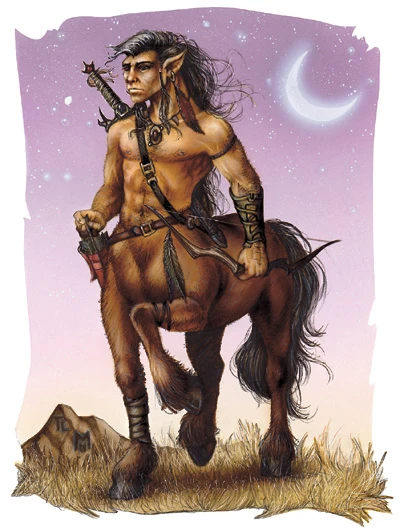


Centaur
Large Monstrosity, Neutral Good
- Armor Class 12
- Hit Points 45 (6d10 + 12)
- Hit Points 45 (6d10 + 12)
- Speed 50 ft.
STR DEX CON INT WIS CHA 18 (+4) 14 (+2) 14 (+2) 9 (-1) 13 (+1) 11 (+0)
- Skills Athletics +6, Perception +3, Survival +3
- Senses passive Perception 13
- Languages Elvish, Sylvan
- Challenge 2 (450 XP)
- Proficiency Bonus +2
Charge. If the centaur moves at least 30 feet straight toward a target and then hits it with a pike attack on the same turn, the target takes an extra 10 (3d6) piercing damage.
Actions
Multiattack. The centaur makes two attacks: one with its pike and one with its hooves or two with its longbow.
Pike. Melee Weapon Attack: +6 to hit, reach 10 ft., one target. Hit: 9 (1d10 + 4) piercing damage.
Hooves. Melee Weapon Attack: +6 to hit, reach 5 ft., one target. Hit: 11 (2d6 + 4) bludgeoning damage.
Longbow. Ranged Weapon Attack: +4 to hit, range 150/600 ft., one target. Hit: 6 (1d8 + 2) piercing damage.
Source: MM page38
Reclusive wanderers and omen-readers of the wild, centaurs avoid conflict but fight fiercely when pressed. They roam the vast wilderness, keeping far from borders, laws, and the company of other creatures.
Wilderness Nomads. Centaur tribes range across lands with mild to hot climates, where a centaur requires only light furs or oiled skins to deal with inclement weather. They are hunter-gatherers and rarely build shelters or even use tents.
Centaur migrations span continents and take decades to repeat, so that a centaur tribe might not retread the same path for generations. These long-ranging patterns can lead to conflict when centaurs encounter settlements of other creatures built along their traditional routes.
Reluctant Settlers. A centaur that can't keep pace with the rest of its tribe is left behind. Some such centaurs vanish into the wilderness and are never seen again. Those that can bear the loss of their tribe might take up residence among other races. Frontier settlements value the nature knowledge of their centaur residents. Many such communities owe their survival to the insight and acumen of a centaur.
Despite their reclusive nature, centaurs trade with elves and with the caravans of other benevolent humanoids they meet during their wanderings. A trader might save the life of a wounded or an elderly centaur unfit for long travel, escorting it to a settlement where it can peacefully live out the rest of its days.
I hear centaurs make excellent mounts!
— Batley Summerfoot, a halfling adventurer who never read Hooves of Fury by Irvil Grayborn of Sundown
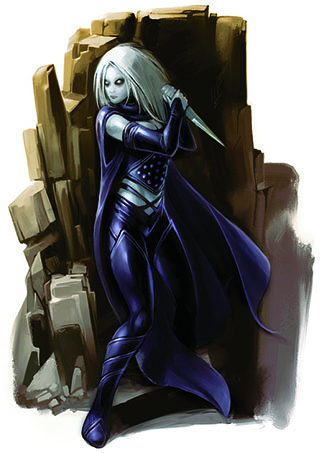
Changeling
Contents
- PC Stat Blocks
- ERLW
- MPMM
- Forgotten Realms
- NPC Stat Blocks
- Changeling (ERLW)
Changeling
- Ability Scores. Charisma +2; Choose any other +1
- Size. Medium
- Speed. 30 ft.
Age. Changelings mature slightly faster than humans but share a similar lifespan—typically a century or less. While a changeling can transform to conceal their age, the effects of aging affect them similarly to humans.
Alignment. Changelings tend toward pragmatic neutrality, and few changelings em-brace evil.
Size. Your size is Medium.
Shapechanger. As an action, you can change your appearance and your voice. You de-termine the specifics of the changes, including your coloration, hair length, and sex. You can al-so adjust your height and weight, but not so much that your size changes. You can make your-self appear as a member of another race, though none of your game statistics change. You can't duplicate the appearance of a creature you've never seen, and you must adopt a form that has the same basic arrangement of limbs that you have. Your clothing and equipment aren't changed by this trait.
You stay in the new form until you use an action to revert to your true form or until you die.
Changeling Instincts. You gain proficiency with two of the following skills of your choice: Deception, Insight, Intimidation, and Persuasion.
Languages. You can speak, read, and write Common and two other languages of your choice.
Long ago there was a woman named Jes, and she had one hundred children. Her rivals conspired against her and swore to kill her children. Jes begged the Sovereigns for help, but their only answer was the wind and rain. In the depths of her despair, a lonely traveler took her hand. "I will protect your children if they follow my path. Let them wander the world. They may be shunned and feared, but they will never be destroyed." Jes agreed, and the traveler gave her his cloak. When she draped it over her children, their old faces melted away and they could be whoever they wanted to be. And so it remains. Though the children are shunned by all, the gift of the Traveler protects them still.— Chance, changeling priestChangelings can shift their forms with a thought. Many changelings use this gift as a form of artistic and emotional expression. It's also an invaluable tool for grifters, spies, and others who wish to deceive. This leads many people to treat changelings with suspicion.

A Hidden People. Wherever humans live, changelings reside also; the question is whether their presence is known.
Changelings are born to one of three paths. A few are raised in stable communities where changelings are true to their nature and deal openly with the people around them. Some are orphans, raised by other races, who find their way in the world without ever knowing another like themselves. Others are part of nomadic changeling clans spread across the Five Nations, families who keep their true nature hidden from the single-skins. Some clans maintain safe havens in major cities and communities, but most prefer to wander the unpredictable path of the god known as the Traveler.
In creating a changeling adventurer, consider the character's relationships with people around them. Does the character conceal their true changeling nature? Do they embrace it? Do they have connections to other changelings or are they alone and in search of companions?
Masks and Personas. In their true form, changelings are pale, with colorless eyes and silver-white hair. It is rare to see a changeling in that form, for a typical changeling changes their shape the way others might change clothes. A casual shape—one created on the spur of the moment, with no depth or history—is called a mask. A mask can be used to express a mood or to serve a specific purpose and then might never be used again. However, many changelings develop identities that have more depth. They build an identity over time, crafting a persona with a history and beliefs. This focused identity helps a changeling pinpoint a particular skill or emotion. A changeling adventurer might have personas for many situations, including negotiation, investigation, and combat.
Personas can be shared by multiple changelings; there might be three healers in a community, but whoever is on duty will adopt the persona of Tek, the kindly old medic. Personas can even be passed down through a family, allowing a younger changeling to take advantage of contacts established by the persona's previous users.
Changeling Names. A changeling might use a different name for each mask and persona and adopt new names as easily as they change faces. The true name of a changeling tends to be simple and monosyllabic; however, there are often accents to a changeling's name that are expressed through shapeshifting, something single-skins will likely miss. So, two changelings might have the name Jin, but one is Jin-with-vivid-blue-eyes and one is Jin-with-golden-nails.
Changelings have a fluid relationship with gender, seeing it as one characteristic to change among many.
Changeling Names: Aunn, Bin, Cas, Dox, Fie, Hars, Jin, Lam, Mas, Nix, Ot, Paik, Ruz, Sim, Toox, Vil, Yug
Source: ERLW, page 17. Reprinted as Change-ling in MPMM
Changeling
- Ability Scores. Choose one of: (a) Choose any +2; choose any other +1 (b) Choose three different +1
- Size. Small/Medium
- Speed. 30 ft.
Creature Type. You are a Fey.
Size. You are Medium or Small. You choose the size when you select this race.
Changeling Instincts. Thanks to your connection to the fey realm, you gain proficiency with two of the following skills of your choice: Deception, Insight, Intimidation, Performance, or Persuasion.
Shapechanger. As an action, you change your appearance and your voice. You determine the specifics of the changes, including your coloration, hair length, and sex. You can also adjust your height between Medium and Small. You can make yourself appear as a member of anoth-er race, though none of your game statistics change. You can't duplicate the appearance of an individual you've never seen, and you must adopt a form that has the same basic arrangement of limbs that you have. Your clothing and equipment aren't changed by this trait.
You stay in the new form until you use an action to revert to your true form or until you die.
Languages. You can speak, read, and write Common and one other language that you and your DM agree is appropriate for your character.

With ever-changing appearances, changelings reside in many societies undetected. Each changeling can supernaturally adopt any face they like. For some changelings, a new face is only a disguise. For other changelings, a new face may reveal an aspect of their soul.
The first changelings in the multiverse appeared in the Feywild, and the wondrous, mutable essence of that plane lingers in changelings today—even in those changelings who have never set foot in the fey realm. Each changeling decides how to use their shape-shifting ability, channeling either the peril or the joy of the Feywild. Sometimes they adopt new forms for the sake of mischief or malice, and other times they don a new identity to right wrongs or delight the downtrodden.
In their true form, changelings appear faded, their features almost devoid of detail. It is rare to see a changeling in that form, for a typical changeling changes their shape the way others might change clothes. A casual shape—one created on the spur of the moment, with no depth or history—is called a mask. A mask can be used to express a mood or to serve a specific purpose and then might never be used again. However, many changelings develop identities that have more depth, crafting whole personas complete with histories and beliefs. A changeling adventurer might have personas for many situations, including negotiation, investigation, and combat.
Personas can be shared by multiple changelings; a community might be home to three healer changelings, with whoever is on duty adopting the persona of Andrea, the gentle physician. Personas can even be passed down through a family, allowing a younger changeling to take advantage of contacts established by the persona's previous users.
Source: MPMM, page 10
Forgotten Realms Wiki:
Changelings were a fey or humanoid race related to doppelgangers who had a natural ability for shapeshifting, making them effective as actors, spies, and criminals.31
Description
When in their true or natural form, a changeling looked rather like a doppelganger, with a lesser resemblance to a regular humanoid;3 in comparison to a human, they appeared faded and lacking detail1 and might be mistaken for someone with albinism.5 A typical changeling had skin of a pale grey hue, thin hair of a light silvery shade, and large eyes that were blank white.314 Their nose and mouth were small, even barely noticeable, so they seemed expressionless3 and almost featureless.1 In contrast to doppelgangers, changelings displayed sexual characteristics in their natural form, though could alter these as they pleased.3 A changeling had a humanoid build some 5 feet and 3 inches to 5 feet and 9 inches (160 to 180 centimeters) in height, but seemed gangly and ill-proportioned,3 having limbs that were slender and somewhat longer than a similarly sized humanoid.4 Some could change their height from human to halfling size.1 Despite this, they did not lack for grace or agility.34 Of course, given their shapeshifting talents, changelings were rarely seen like this.1
Changeling
5th Edition Statistics12
Size
Medium or Small
Type
3rd Edition Statistics3
Subtype(s)
General Information
Intelligence
Average3
Language(s)
Favored climate
Any3
Favored terrain
Any3
Appearance3142
Average height
5′3″‒5′9″ (160‒180 cm)2
Skin color(s)
Pale gray in true form
Eye color(s)
White in true form
Typical build
Slender and gangly in true form
Distinctions
Shapeshifting
History
First appearance
Based on
Personality
Changelings were subtle and deceptive in their ways.3 How a changeling chose and used each new guise they adopted was up to each individual. It might be for mischief, for entertainment, or for heroism, or it could be for terrible misdeeds. To one changeling, it might be no more than a disguise, but to another, it could be another facet of their soul. They had different terms for different kinds of guise. A 'mask' was a guise that lacked a backstory and deeper personality; it was created on a whim to display a mood or to fulfill a need and could be discarded, never seen again. A 'persona' was a full identity with a backstory, depth, and beliefs of its own. A changeling could maintain a number of personas for different applications and situations, and changelings and changeling communities could share them (for example, three changeling healers could play the one physician persona in shifts) or bequeath them to their descendants (so a young changeling could have the benefits and contacts of an older persona).1
A typical changeling was careful and wary of dangers, only undertaking a risky endeavor if the rewards or the odds of success made it worthwhile. On the other hand, they had expensive tastes, especially enjoying the comforts and luxuries that riches could bring, and sought them out whenever they could afford it.3
Changelings loved learning new languages and building collections of ones they knew. These linguistics also aided their disguises and personas.3
Abilities
Changelings had the magical ability to change their appearance. Although similar in effect to a disguise self spell, this was no illusion but a small physical transformation of their bodies, so their clothing and possessions are unaffected. It was also not as extensive as a doppelganger's transformation and they were limited to a humanoid form. They could alter their facial features, skin coloration and texture, hair length and color, race, sex, and their size, height, and weight, within limits31 of human3 or human and halfling scales.1 Though it took several seconds, a changeling could change their form as often as they liked and the new appearance lasted until they changed again. If they died, their bodies reverted to their natural forms. True seeing would also expose them.31
Unsurprisingly, this power gave a changeling a great facility for disguise and impersonation, with them able to create a highly convincing disguise on cue.3 They could take on any face they wanted, even those of other people, but of course could not look like someone they'd never laid eyes on.1
They had an innate resistance to sleep and charm magic.3
A changeling spoke softly, but when they talked to someone they had a knack for getting them to give away more information than they intended to share.3 They tended to be skilled in areas of deception, intimidation, sensing motive and deceit,31 persuasion, or performance.1
They also had a gift for languages and could learn new tongues with ease.3
Combat
A changeling avoided combat if they could and would rather bluff or bully their way to a peaceful resolution. When pushed to fight, they favored ambushes and sneak attacks and would remain on the defensive while they weighed up their odds and looked for a way out. If defeat was likely, they would retreat or run away.3
Society
The discovery of a changeling child—whether due to a changeling biological parent or by being swapped at birth for a human or other child—was not welcomed by all parents. Unwanted infants such as these and others might be abandoned at a local temple or monastery of a good deity, most often Selûne, and these foundlings would be taught and raised in the faith, with some even becoming monks. The lands most likely for this were Aglarond, Amn, Calimshan, Cormyr, Damara, Impiltur, Mulhorand, Lake of Steam, Luiren, and Silverymoon in the North. In harsher lands, unwanted children might simply be left to the elements.6
Lacking settlements of their own, changelings used their shapeshifting powers to live in secret amongst others, including humans, goblinoids, and others.31 Their abilities made them adept at infiltration and criminal activity, and many made the most of it, gravitating toward being rogues. They served as deep-cover spies and made up the core of a local criminal underbelly. Nevertheless, others preferred reputable professions, and they excelled as entertainers, spies and agents of their government, and occasionally as adventurers.3
Big cities were where changelings were most often found, but even there, they did not gather in great numbers. Those without families operated alone or in small changeling gangs of only about five members under one charismatic leader. Those with dependent children or elders came together in 'clans' for mutual protection and aid. These clans were not bound by blood, but by voluntary association. A clan head governed the clan and set a common purpose, but only with the consent of its members, so the role was replaced regularly. Clan bosses helped organize and keep order in the clan. The clan comprised anywhere from 10 to 60 capable adult members; an additional 30% children, elders, and non-combatants; a boss for every 10 adults, two elders, and one clan head.3
Relations
Humans and elves were suspicious of changelings, owing to their criminal associations and deception, yet most would still deal with them if they had need. Halflings and gnomes could have some fun in battles of wits with changelings, though those in the criminal underworld were as likely to be rivals. Meanwhile dwarves didn't have much patience for changelings' subtlety and tricks.3
Significance
"Changeling" was often a byword for other shapeshifters, such as true doppelgangers7 and individuals with the ability, such as Nylaersyn "the Changeling" Floshin.89 The elven deity of change and trickery, Erevan Ilesere, was titled "the Green Changeling" for his own shapeshifting habits.1011
More generally, "changeling" was also used as a term for children who'd grown up different or unnatural in the eyes of their kin,1213 thought to be possibly fey;14 a cambion, alu-fiend, or other demon offspring; or a descendant of wicked mages, particularly if they had been adopted. The young Abdel Adrian, a Bhaalspawn, was rumored to be such a changeling as a child.13 Green hags and annises were known to swap their offspring for human infants; suspected children were known colloquially as changelings.1516 Similarly, the name "malenti", for those mutant sahuagin who were indistinguishable from sea elves, meant "changeling" in the Elvish language and "ugly one" in the Sahuagin language.17
History
In one account of their origin, the first changelings anywhere came into existence in the Feywild, as a manifestation of that plane's magical, mutable nature. Accordingly, their shapeshifting power and whether they use it for good or for evil channeled either the joys or the dangers of the Feywild.1
More prosaically, however, another version holds that changelings began as the offspring of doppelgangers and humans. They evolved, ultimately becoming a distinct race in their own right.3
Notable Changelings
- Orin the Red, a murderous Bhaalspawn and would-be Chosen of Bhaal in the late 15th century DR.184
Appendix
Background
The changeling race is based on the real-world myth of changelings, which are children claimed to have been swapped (that is, changed) by fairies and displaying unusual traits or behaviors, and the term is often conflated with shapeshifting. Changelings were created for the Eberron setting and first appeared in Eberron Campaign Setting in June 2004. They were introduced to core D&D in the 3.5-edition Monster Manual III in August. Here, they were shapeshifting descendants of doppelgangers. Later books such as Races of Eberron expanded on them significantly, with suggestions of changeling babies being abandoned, adopted out, or swapped incorporating the real-world legend. (An unrelated changeling race based on the swapped-by-fairies myth was presented a year earlier in Dragon #304.)
For the 4th-edition Monster Manual, doppelgangers were revised, being downgraded in power and depicted similarly to the earlier changelings. Most likely, they were intended to be merged and 4th-edition Eberron Campaign Guide and Eberron Player's Guide followed suit, declaring its changelings to also be called doppelgangers and using the terms interchangeably. These changelings are not included above, but at the doppelganger article.
For 5th edition, changelings were reintroduced twice, first in Eberron: Rising from the Last War, where they were an independent race from which doppelgangers were created, and Mordenkainen Presents: Monsters of the Multiverse, where they were a fey race, with no relation to doppelgangers. It is unclear if they are meant to be the same. This article adopts the latter.
Meanwhile, the original senses of the word 'changeling' have often been used in D&D and the Forgotten Realms for other shapeshifters and strange children, while there have also been a few mentions of doppelganger-based changelings in Realms sources. Fittingly enough for a shapeshifting race, they can be very difficult to identify.
Appearances
Video Games
Card Games
Miniatures
Organized Play & Licensed Adventures
Referenced only
The Black Card
External Links
- Changeling article at the Eberron Wiki, a wiki for the Eberron campaign setting.
Source: Forgotten Realms Wiki
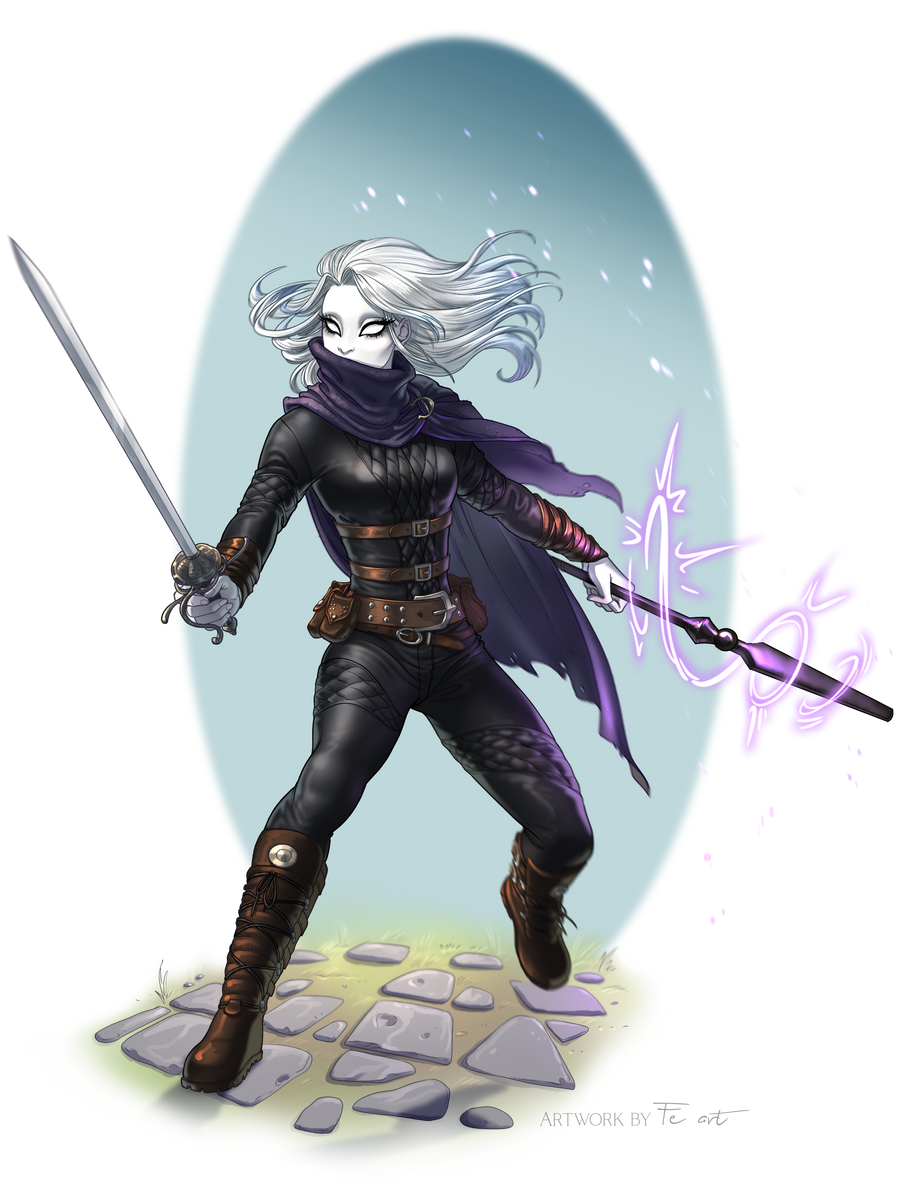


Changeling
Medium Humanoid (Changeling, Shapechanger), Any Alignment
- Armor Class 13 (leather armor)
- Hit Points 22 (4d8 + 4)
- Hit Points 22 (4d8 + 4)
- Speed 30 ft.
STR DEX CON INT WIS CHA 8 (-1) 15 (+2) 12 (+1) 14 (+2) 10 (+0) 16 (+3)
- Skills Acrobatics +4, Deception +5, Insight +2, Perception +2, Persuasion +5
- Senses passive Perception 12
- Languages Common, Dwarvish, Elvish, Halfling, Thieves' cant
- Challenge 1/2 (100 XP)
- Proficiency Bonus +2
Change Appearance. The changeling can use its action to polymorph into a Medium humanoid it has seen, or back into its true form. Its statistics, other than its size, are the same in each form. Any equipment it is wearing or carrying isn't transformed. It reverts to its true form if it dies.
Actions
Multiattack. The changeling makes two attacks with its dagger.
Dagger. Melee or Ranged Weapon Attack: +4 to hit, reach 5 ft. or range 20/60 ft., one target. Hit: 4 (1d4 + 2) piercing damage.
Unsettling Visage (Recharges after a Short or Long Rest). Each creature within 30 feet of the changeling must succeed on a DC 13 Wisdom saving throw or be frightened for 1 minute. A creature can repeat the saving throw at the end of each of its turns, ending the effect on itself on a success.
Source: ERLW page317
Changelings are a humanoid race of shapechangers who conceal their true identities behind false faces. Their gifts of mimicry allow them to appear as members of any humanoid culture, playing the part of a dwarf one day and a dragonborn the next. Although changelings can adopt any guise, most rely on a few established personas, each with a developed history and a network of friends and acquaintances.
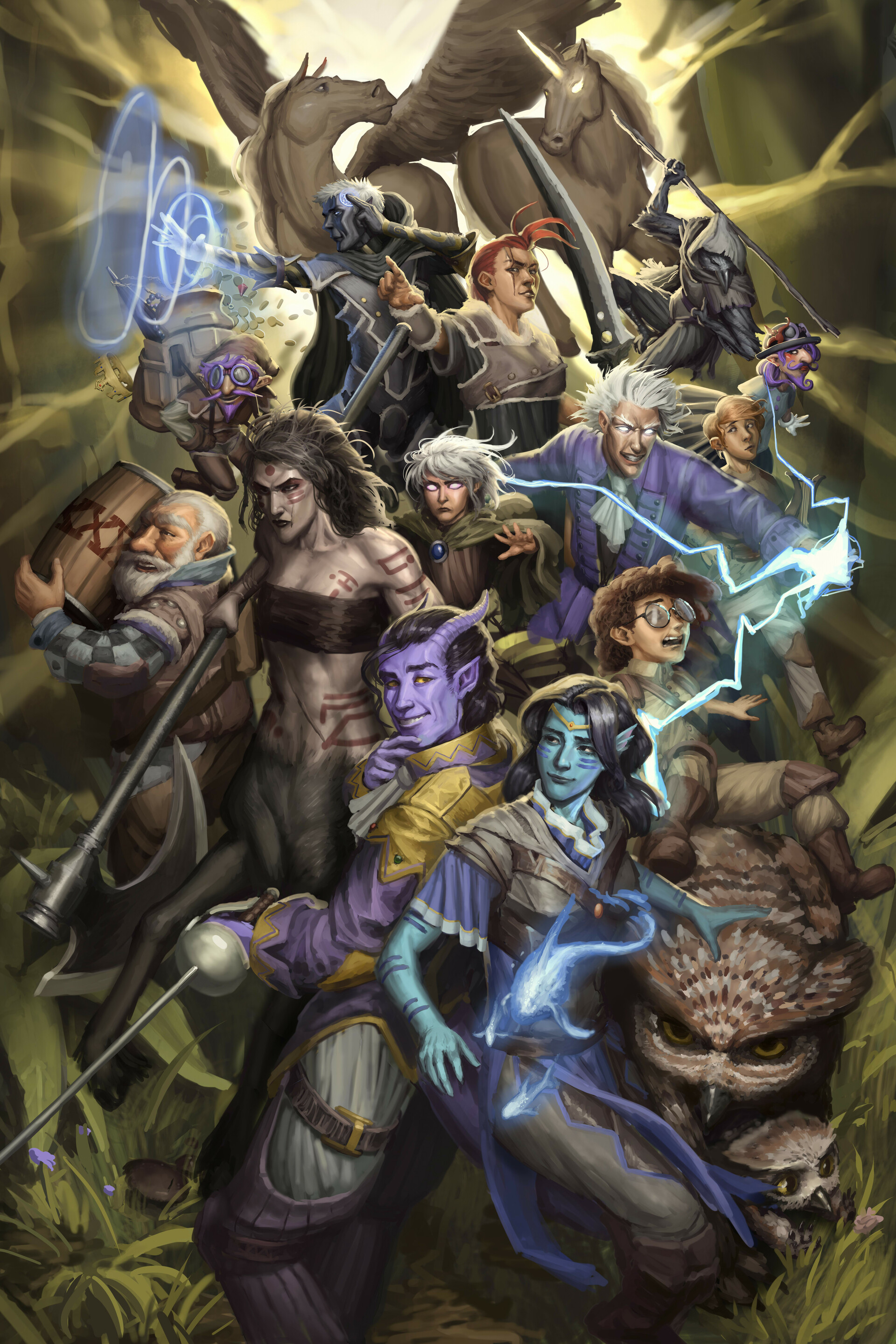
Custom Lineage
Contents
- PC Stat Blocks
- TCE
Custom Lineage
- Ability Scores. Choose any +2
- Size. Small/Medium
- Speed. 30 ft.
Instead of choosing one of the game's races for your character at 1st level, you can use the fol-lowing traits to represent your character's lineage, giving you full control over how your charac-ter's origin shaped them:
Creature Type. You are a humanoid. You determine your appearance and whether you resemble any of your kin.
Size. You are Small or Medium (your choice).
Feat. You gain one feats.html of your choice for which you qualify.
Variable Trait. You gain one of the following options of your choice: (a) darkvision with a range of 60 feet or (b) proficiency in one skill of your choice.
Languages. You can speak, read, and write Common and one other language that you and your DM agree is appropriate for your character.
Your race is considered to be a Custom Lineage for any game feature that requires a certain race, such as elf or dwarf.
Source: TCE, page 8
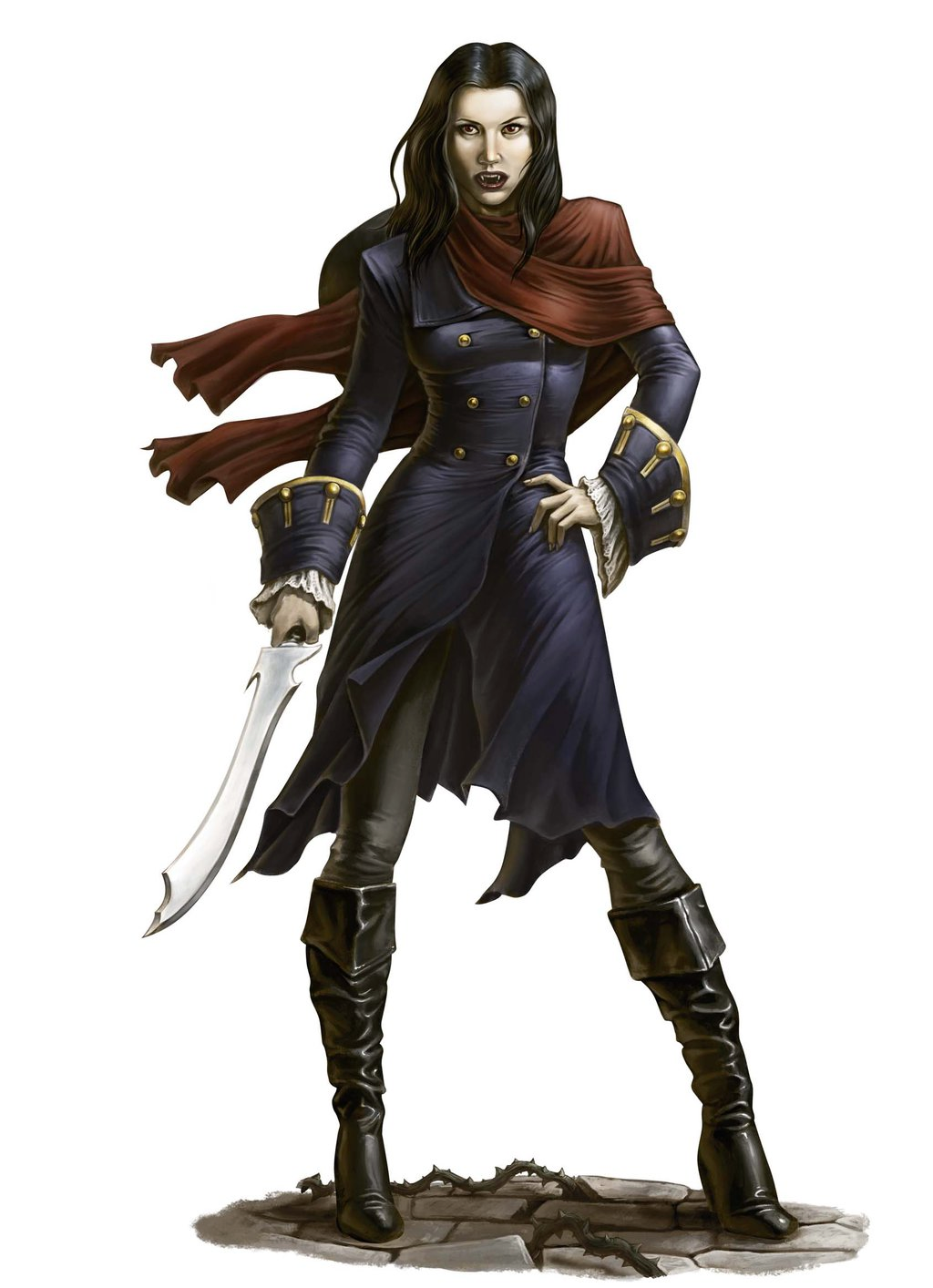
Dhampir
Contents
- PC Stat Blocks
- VRGR
- Forgotten Realms
Dhampir
- Ability Scores. Choose one of: (a) Choose any +2; choose any other +1 (b) Choose three different +1
- Size. Small/Medium
- Speed. 35 ft., climb equal to your walking speed
Size. You are Medium or Small. You choose the size when you gain this lineage.
Ancestral Legacy. If you replace a race with this lineage, you can keep the following el-ements of that race: any skill proficiencies you gained from it and any climbing, flying, or swimming speed you gained from it.
If you don't keep any of those elements or you choose this lineage at character creation, you gain proficiency in two skills of your choice.
Darkvision. You can see in dim light within 60 feet of you as if it were bright light and in darkness as if it were dim light. You discern colors in that darkness as shades of gray.
Deathless Nature. You don't need to breathe.
Spider Climb. You have a climbing speed equal to your walking speed. In addition, at 3rd level, you can move up, down, and across vertical surfaces and upside down along ceilings, while leaving your hands free.
Vampiric Bite. Your fanged bite is a natural weapon, which counts as a simple melee weapon with which you are proficient. You add your Constitution modifier, instead of your Strength modifier, to the attack and damage rolls when you attack with this bite. It deals 1d4 piercing damage on a hit. While you are missing half or more of your hit points, you have ad-vantage on attack rolls you make with this bite.
When you attack with this bite and hit a creature that isn't a Construct or an Undead, you can empower yourself in one of the following ways of your choice:
- You regain hit points equal to the piercing damage dealt by the bite.
- You gain a bonus to the next ability check or attack roll you make; the bonus equals the pierc-ing damage dealt by the bite
You can empower yourself with this bite a number of times equal to your proficiency bonus, and you regain all expended uses when you finish a long rest.
Languages. You can speak, read, and write Common and one other language that you and your DM agree is appropriate for your character.
Poised between the worlds of the living and the dead, dhampirs retain their grip on life yet are endlessly tested by vicious hungers. Their ties to the undead grant dhampirs a taste of a vampire's deathless prowess in the form of increased speed, darkvision, and a life-draining bite. With unique insights into the nature of the undead, many dhampirs become adventurers and monster hunters. Their reasons are often deeply personal. Some seek danger, imagining monsters as personifications of their own hungers. Others pursue revenge against whatever turned them into a dhampir. And still others embrace the solitude of the hunt, striving to distance themselves from those who'd tempt their hunger.

Dhampir Hungers
Every dhampir knows a thirst slaked only by the living. Those who overindulge their thirst risk losing control and forever viewing others as prey. Those who resist might find exceptional ways of controlling their urges or suppress them through constant, molar-grinding restraint. In any case, temptation haunts dhampirs, and circumstances conspire to give them endless reasons to indulge.
While many dhampirs thirst for blood, your character might otherwise gain sustenance from the living. Roll on or choose an option from the Dhampir Hungers table to determine what tempts your character to feed.
Dhampir Hungers
| d6 | Hunger |
|---|---|
| 1 | Blood |
| 2 | Flesh or raw meat |
| 3 | Cerebral spinal fluid |
| 4 | Psychic energy |
| 5 | Dreams |
| 6 | Life energy |
Dhampir Origins
Dhampirs often arise from encounters with vampires, but all manner of macabre bargains, necromantic influences, and encounters with mysterious immortals might have transformed your character. The Dhampir Origins table provides suggestions for how your character gained their lineage.
Dhampir Origins
| d8 | Origin |
|---|---|
| 1 | You are the reincarnation of an ancestor who was a vampiric tyrant. |
| 2 | Your pact with a predatory deity, fiend, fey, or spirit causes you to share their hunger. |
| 3 | You survived being attacked by a vampire but were forever changed. |
| 4 | A parasite lives inside you. You indulge its hunger. |
| 5 | Tragedy interrupted your transformation into an immortal. |
| 6 | You are a diminished form of an otherworldly being. Slaking your hunger hastens your renewal. |
| 7 | One of your parents was a vampire. |
| 8 | A radical experiment changed your body, making you reliant on others for vital fluids. |
Source: VRGR, page 16
Forgotten Realms Wiki:
Dhampyrs, also known as daywalkers and sometimes dhampirs,1 were living creatures who had inherited some of the tainted blood of vampires.3
Creation
Some were the descendants of male vampires and mortal females, but many others had dhampyrs for parents and some resulted from a vampire of either sex biting a pregnant female. A dhampyr's powers might lie dormant for years before being quickened; dhampyrs might also have children who were normal in every respect.3
For those not born as dhampirs, there were a few ways they might become one. Some of these included being the reincarnation of a vampiric tyrant ancestor, being a diminished form of an otherworldly being seeking renewal, surviving an attack from a vampire, being invaded by a hungry parasite, a transformation into an immortal being interrupted, a radical experiment, or a pact with a predatory deity, fiend, fey, or spirit.2
Dhampir
(Dhampyr1)
5th Edition Statistics2
Size
Medium or Small
Type
General Information
Movement
Walking, climbing2
Vision
Activity cycle
Any1
Diet
Omnivore or human blood;1 Flesh or raw meat, cerebral spinal fluid, psychic energy, dreams, or life energy2
Average lifespan
A century or more, longer than normal
Appearance
Skin color(s)
Pale
Eye color(s)
Various with large pupils flecked with red
Distinctions
Slightly pointed ears, thin build, small fangs
History
First appearance
Based on
Dhampir (Albanian)
Description
Dhampyrs were thin and willowy, with pale skin and slightly pointed ears. They had slightly pronounced canines and blood-red eyes. Dhampyrs were unharmed by sunlight or positive energy the way true vampires were. Many dhampyrs felt the characteristic bloodlust of a vampire as well as the ability to feed off of blood for sustenance or healing, though their thirst was much milder than that of true vampires and not all or even most dhampyrs carried out the practice.4
Abilities
In addition to the characteristic blood drain ability shared by nearly all of their kind, some dhampyrs developed other unnatural abilities. Some fairly common abilities were the ability to move more quickly, enhanced nightvision, or even the ability to transform into a mist for under a minute once per day. More advanced abilities might allow them to charm enemies into a daze, gain enhanced vitality from blood drinking, or other abilities that made them more like their vampiric kin.5
The time it took for vampiric abilities to awaken in dhampyrs varied from one person to another. In some cases, the marks of a dhampyr's heritage skipped a generation, awakening in later descendants. In other cases, dhampyrs awakened their vampiric heritage early in their life.6
In addition to abilities gained from their vampiric heritage, most dhampyrs possessed the standard abilities and physical characteristics of their mortal heritage, whatever that might be.6
Psychology
Because of their unusual circumstance of being not only half-breeds, but the spawn of the undead, dhampyrs often felt out of place no matter where they were. Grim and somber, dhampyrs often were guarded and obsessive, though they also exhibited a great deal of patience and a penchant for black humor as well.6
The degree of outcast feeling, however, varied from individual to individual and depended, to a certain degree, on the environment in which a dhampyr was raised. Dhampyr raised unaware of their vampiric blood might more or less pass as normal, while those who were aware of their heritage had a greater tendency to develop a fascination with death and macabre practices such as blood drinking or black humor. Some of the latter even developed a vampire-like thirst for blood, though this derived from a psychological, rather than a physical need.6
Culture
Possessing some of the strengths of vampires and none of their traditional weaknesses, dhampyrs were simultaneously valued and discriminated against by both sides of their heritage.3
Dhampyrs might be born into mortal society or they might be raised by vampires and treated as special but lesser members of a vampire clan. In the former case, how dhampyrs were treated depended largely on whether or not the dhampyr's neighbors knew of their true nature. In cases where a dhampyr's heritage was a secret known to only a few, many could safely pass as normal without incident. When a dhampyr's true nature was known, however, they were frequently mistreated, though in some cases their vampiric ancestry was treated as a boon rather than a curse.6
Dhampyrs raised among vampires were another matter. Most vampires saw their progeny as special creatures, above the average mortal though of less value than a true vampire.6 As a result, dhampyrs were the favored thralls of true vampires, who utilized them as soldiers and assassins, giving them tasks that were beneath a true vampire but allowed opportunity for prestige nonetheless.7 In some cases, dhampyrs were even allowed to use the names of vampire clans as their surname, a high honor in vampiric society.8
Some dhampyrs viewed their heritage as a curse, others as a blessing. The former often turned to hunting their undead brethren, becoming deadstalkers who hunted down vampires and other undead, turning vampires' own abilities against them. Those who felt their heritage made them special, however, were more likely to become bloodknights, using their supernatural abilities as a tool to make them deadlier warriors.9
Appendix
Appearances
Organized Play & Licensed Adventures
The Undumor Connection
Source: Forgotten Realms Wiki
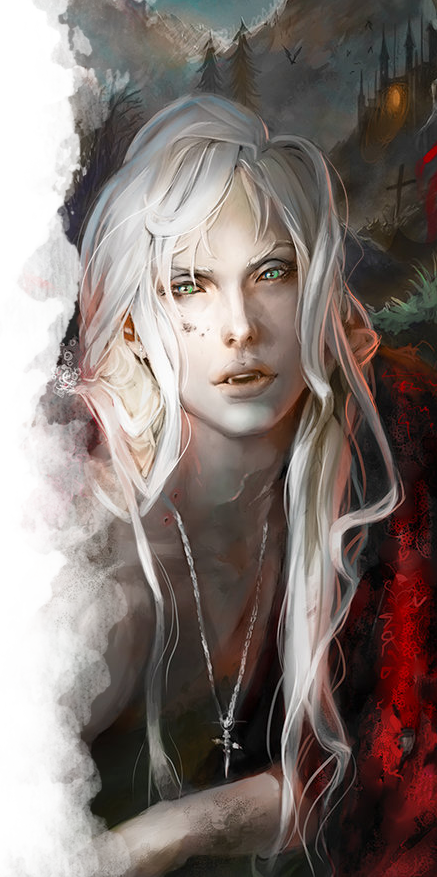
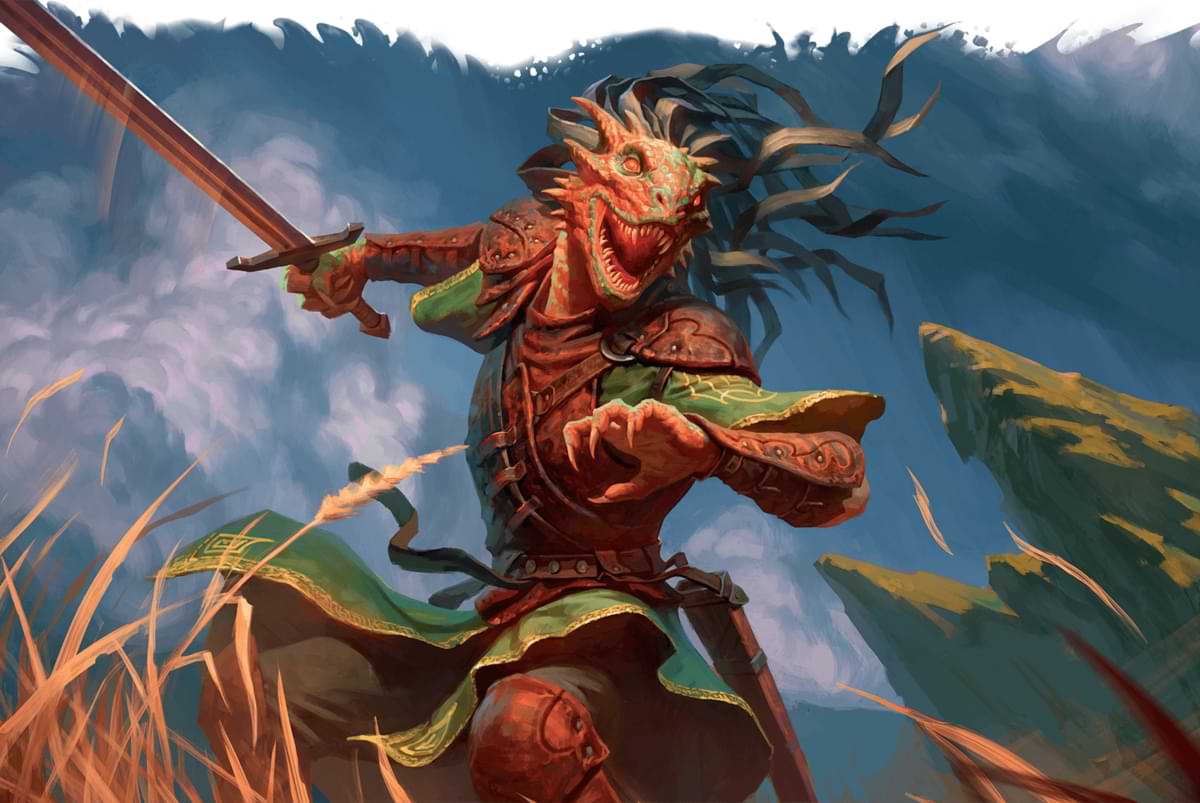
Dragonborn
Contents
- PC Stat Blocks
- PHB
- FTD
- SCAG
- Fizban's Treasury of Dragons
- Forgotten Realms
- NPC Stat Blocks
- Dragonborn of Bahamut (FTD)
- Dragonborn of Sardior (FTD)
- Dragonborn of Tiamag (FTD)
Dragonborn
- Ability Scores. Strength +2; Charisma +1
- Size. Medium
- Speed. 30 ft.
This race has multiple subraces, as listed below:
- Dragonborn
- Dragonborn (Draconblood)
- Dragonborn (Ravenite)
Traits
Age. Young dragonborn grow quickly. They walk hours after hatching, attain the size and development of a 10-year-old human child by the age of 3, and reach adulthood by 15. They live to be around 80.
Size. Dragonborn are taller and heavier than humans, standing well over 6 feet tall and averaging almost 250 pounds. Your size is Medium.
Draconic Ancestry. You have draconic ancestry. Choose one type of dragon from the Draconic Ancestry table. Your breath weapon and damage resistance are determined by the dragon type, as shown in the table.
Draconic Ancestry
| Dragon | Damage Type | Breath Weapon |
|---|---|---|
| Black | Acid | 5 by 30 ft. line (Dex. save) |
| Blue | Lightning | 5 by 30 ft. line (Dex. save) |
| Brass | Fire | 5 by 30 ft. line (Dex. save) |
| Bronze | Lightning | 5 by 30 ft. line (Dex. save) |
| Copper | Acid | 5 by 30 ft. line (Dex. save) |
| Gold | Fire | 15 ft. cone (Dex. save) |
| Green | Poison | 15 ft. cone (Con. save) |
| Red | Fire | 15 ft. cone (Dex. save) |
| Silver | Cold | 15 ft. cone (Con. save) |
| White | Cold | 15 ft. cone (Con. save) |
Breath Weapon. You can use your action to exhale destructive energy. Your draconic ancestry determines the size, shape, and damage type of the exhalation.
When you use your breath weapon, each creature in the area of the exhalation must make a saving throw, the type of which is determined by your draconic ancestry. The DC for this saving throw equals 8 + your Constitution modifier + your proficiency bonus. A creature takes 2d6 damage on a failed save, and half as much damage on a successful one. The damage increases to 3d6 at 6th level, 4d6 at 11th level, and 5d6 at 16th level.
After you use your breath weapon, you can't use it again until you complete a short or long rest.
Damage Resistance. You have resistance to the damage type associated with your draconic ancestry.
Languages. You can speak, read, and write Common and Draconic. Draconic is thought to be one of the oldest languages and is often used in the study of magic. The language sounds harsh to most other creatures and includes numerous hard consonants and sibilants.

Born of dragons, as their name proclaims, the dragonborn walk proudly through a world that greets them with fearful incomprehension. Shaped by draconic gods or the dragons themselves, dragonborn originally hatched from dragon eggs as a unique race, combining the best attributes of dragons and humanoids. Some dragonborn are faithful servants to true dragons, others form the ranks of soldiers in great wars, and still others find themselves adrift, with no clear calling in life.
Proud Dragon Kin
Dragonborn look very much like dragons standing erect in humanoid form, though they lack wings or a tail. The first dragonborn had scales of vibrant hues matching the colors of their dragon kin, but generations of interbreeding have created a more uniform appearance. Their small, fine scales are usually brass or bronze in color, sometimes ranging to scarlet, rust, gold, or copper-green. They are tall and strongly built, often standing close to 6½ feet tall and weighing 300 pounds or more. Their hands and feet are smiting, talon-like claws with three fingers and a thumb on each hand.
The blood of a particular type of dragon runs very strong through some dragonborn clans. These dragonborn often boast scales that more closely match those of their dragon ancestor-bright red, green, blue, or white, lustrous black, or gleaming metallic like gold, silver, brass, copper, or bronze.
Self-Sufficient Clans
To any dragonborn, the clan is more important than life itself. Dragonborn owe their devotion and respect to their clan above all else, even the gods. Each dragonborn's conduct reflects on the honor of his or her clan, and bringing dishonor to the clan can result in expulsion and exile. Each dragonborn knows his or her station and duties within the clan, and honor demands maintaining the bounds of that position.
A continual drive for self-improvement reflects the self-sufficiency, of the race as a whole. Dragonborn value skill and excellence in all endeavors. They hate to fail, and they push themselves to extreme efforts before they give up on something. A dragonborn holds mastery of that particular skill as a lifetime goal. Members of other races who share the same commitment find it easy to earn the respect of a dragonborn.
Though all dragonborn strive to be self-sufficient, they recognize that help is sometimes needed in difficult situations. But the best source for such help is the clan, and when a client needs help, it turns to another dragonborn clan before seeking aid from other races or even from the gods.
Dragonborn Names
Dragonborn have personal names given at birth, but they put their clan names first as a mark of honor. A childhood name or nickname is often used among clutch mates as a descriptive term or endearment. The name might recall an event or center on a habit.
- Male Names: Arjhan, Balasar, Bharash, Donaar, Ghesh, Hesken, Kriv, Medrash, Mehen, Nadarr, Pandjed, Patrin, Rhogar, Shamash, Shedinn, Tarhun, Torinn
- Female Names: Akra, Biri, Daar, Farideh, Harann, Havilar, Jheri, Kava, Korinn, Mishann, Nala, Perra, Raiann, Sora, Surina, Thava, Uadjit
- Childhood Names: Climber, Earbenden Leaper, Pious, Shieldbiter, Zealous
- Clan Names: Clethtinthiallor, Daardendrian, Delmirev, Drachedandion, Fenkenkabradon, Kepeshkmolik, Kerrhylon, Kimbatuul, Linxakasendalor, Myastan, Nemmonis, Norixius, Ophinshtalajiir, Prexijandilin, Shestendeliath, Turnuroth, Verthisathurgiesh, Yarjerit
Draconians
In the Dragonlance setting, the followers of the evil goddess Takhisis learned a dark ritual that let them corrupt the eggs of metallic dragons, producing evil dragonborn called draconians. Five types of draconians, corresponding to the five types of metallic dragons, fought for Takhisis in the War of the Lance-auraks (gold), baaz (brass), bozak (bronze), kapak (copper), and sivak (silver). In place of their draconic breath weapons they have unique magical abilities.
Uncommon Races
This race, and those listed below, are uncommon. They don't exist in every world of D&D, and even where they are found, they are less widespread than dwarves, elves, halflings, and humans. In the cosmopolitan cities of the D&D multiverse, most people hardly look twice at members of even the most exotic races. But the small towns and villages that dot the countryside are different. The common folk aren't accustomed to seeing members of these races, and they react accordingly.
Dragonborn. It's easy to assume that a dragonborn is a monster, especially if his or her scales betray a chromatic heritage. Unless the dragonborn starts breathing fire and causing destruction, though, people are likely to respond with caution rather than outright fear.
Gnome. Gnomes don't look like a threat and can quickly disarm suspicion with good humor. The common folk are often curious about gnomes, likely never having seen one before, but they are rarely hostile or fearful.
Half-Elf. Although many people have never seen a half-elf, virtually everyone knows they exist. A half-elf stranger's arrival is followed by gossip behind the half-elf's back and stolen glances across the common room, rather than any confrontation or open curiosity.
Half-Orc. It's usually safe to assume that a half-orc is belligerent and quick to anger, so people watch themselves around an unfamiliar half-orc. Shopkeepers might surreptitiously hide valuable or fragile goods when a half-orc comes in, and people slowly clear out of a tavern, assuming a fight will break out soon.
Tiefling. Half-orcs are greeted with a practical caution, but tieflings are the subject of supernatural fear. The evil of their heritage is plainly visible in their features, and as far as most people are concerned, a tiefling could very well be a devil straight from the Nine Hells. People might make warding signs as a tiefling approaches, cross the street to avoid passing near, or bar shop doors before a tiefling can enter.
Source: PHB, page 32. Available in the SRD 5.1.

Dragonborn (Chromatic)
- Ability Scores. Choose one of: (a) Choose any +2; choose any other +1 (b) Choose three different +1
- Size. Medium
- Speed. 30 ft.
Chromatic Ancestry. You have a chromatic dragon ancestor, granting you a special magi-cal affinity. Choose one kind of dragon from the Chromatic Ancestry table. This determines the damage type for your other traits, as shown in the table.
Chromatic Ancestry
| Dragon | Damage Type |
|---|---|
| Black | Acid |
| Blue | Lightning |
| Green | Poison |
| Red | Fire |
| White | Cold |
Breath Weapon. When you take the Attack action on your turn, you can replace one of your attacks with an exhalation of magical energy in a 30-foot line that is 5 feet wide. Each creature in that area must make a Dexterity saving throw (DC = 8 + your Constitution modifier + your proficiency bonus). On a failed save, the creature takes 1d10 damage of the type associat-ed with your Chromatic Ancestry. On a successful save, it takes half as much damage. This damage increases by 1d10 when you reach 5th level (2d10), 11th level (3d10), and 17th level (4d10).
You can use your Breath Weapon a number of times equal to your proficiency bonus, and you regain all expended uses when you finish a long rest.
Draconic Resistance. You have resistance to the damage type associated with your Chromatic Ancestry.
Chromatic Warding. Starting at 5th level, as an action, you can channel your draconic energy to protect yourself. For 1 minute, you become immune to the damage type associated with your Chromatic Ancestry. Once you use this trait, you can't do so again until you finish a long rest.
Languages. You can speak, read, and write Common and one other language that you and your DM agree is appropriate for your character.
Dragonborn with chromatic ancestry claim the raw elemental power of chromatic dragons. The vibrant colors of black, blue, green, red, and white dragons gleam in those dragonborn's scaled skin and in the deadly energy of their breath weapons. Theirs is the raw elemental fury of the volcano, of biting arctic winds, and of raging lightning storms, as well as the subtle whisper of swamp and forest, toxic and corrosive.
Source: FTD, page 10.

Dragonborn (Gem)
- Ability Scores. Choose one of: (a) Choose any +2; choose any other +1 (b) Choose three different +1
- Size. Medium
- Speed. 30 ft.
Gem Ancestry. You have a gem dragon ancestor, granting you a special magical affinity. Choose one kind of dragon from the Gem Ancestry table. This determines the damage type for your other traits, as shown in the table.
Gem Ancestry
| Dragon | Damage Type |
|---|---|
| Amethyst | Force |
| Crystal | Radiant |
| Emerald | Psychic |
| Sapphire | Thunder |
| Topaz | Necrotic |
Breath Weapon. When you take the Attack action on your turn, you can replace one of your attacks with an exhalation of magical energy in a 15-foot cone. Each creature in that area must make a Dexterity saving throw (DC = 8 + your Constitution modifier + your proficiency bo-nus). On a failed save, the creature takes 1d10 damage of the type associated with your Gem Ancestry. On a successful save, it takes half as much damage. This damage increases by 1d10 when you reach 5th level (2d10), 11th level (3d10), and 17th level (4d10).
You can use your Breath Weapon a number of times equal to your proficiency bonus, and you regain all expended uses when you finish a long rest.
Draconic Resistance. You have resistance to the damage type associated with your Gem Ancestry.
Psionic Mind. You can send telepathic messages to any creature you can see within 30 feet of you. You don't need to share a language with the creature for it to understand these messages, but it must be able to understand at least one language to comprehend them.
Gem Flight. Starting at 5th level, you can use a bonus action to manifest spectral wings on your body. These wings last for 1 minute. For the duration, you gain a flying speed equal to your walking speed and can hover. Once you use this trait, you can't do so again until you finish a long rest.
Languages. You can speak, read, and write Common and one other language that you and your DM agree is appropriate for your character.
Gem dragonborn partake of the heritage of gem dragons, who claim to be heirs of Sardior, the Ruby Dragon. The colors and mysterious powers of gem dragons—amethyst, crystal, emerald, sapphire, and topaz—gleam in these dragonborn's scaled skin and course through their veins. Theirs are the wonders of the mind, the force of will, the brilliant light of insight, and the resounding echo of discovery—but also the desiccation of despair.
Source: FTD, page 11

Dragonborn (Metallic)
- Ability Scores. Choose one of: (a) Choose any +2; choose any other +1 (b) Choose three different +1
- Size. Medium
- Speed. 30 ft.
Metallic Ancestry. You have a metallic dragon ancestor, granting you a special magical affinity. Choose one kind of dragon from the Metallic Ancestry table. This determines the dam-age type for your other traits, as shown in the table.
Metallic Ancestry
| Dragon | Damage Type |
|---|---|
| Brass | Fire |
| Bronze | Lightning |
| Copper | Acid |
| Gold | Fire |
| Silver | Cold |
Breath Weapon. When you take the Attack action on your turn, you can replace one of your attacks with an exhalation of magical energy in a 15-foot cone. Each creature in that area must make a Dexterity saving throw (DC = 8 + your Constitution modifier + your proficiency bo-nus). On a failed save, the creature takes 1d10 damage of the type associated with your Metal-lic Ancestry. On a successful save, it takes half as much damage. This damage increases by 1d10 when you reach 5th level (2d10), 11th level (3d10), and 17th level (4d10).
You can use your Breath Weapon a number of times equal to your proficiency bonus, and you regain all expended uses when you finish a long rest.
Draconic Resistance. You have resistance to the damage type associated with your Me-tallic Ancestry.
Metallic Breath Weapon. At 5th level, you gain a second breath weapon. When you take the Attack action on your turn, you can replace one of your attacks with an exhalation in a 15-foot cone. The save DC for this breath is 8 + your Constitution modifier + your proficiency bonus. Whenever you use this trait, choose one:
- Enervating Breath. Each creature in the cone must succeed on a Constitution saving throw or become incapacitated until the start of your next turn.
- Repulsion Breath. Each creature in the cone must succeed on a Strength saving throw or be pushed 20 feet away from you and be knocked prone.
Once you use your Metallic Breath Weapon, you can't do so again until you finish a long rest.
Languages. You can speak, read, and write Common and one other language that you and your DM agree is appropriate for your character.
Dragonborn with metallic ancestry lay claim to the tenacity of metallic dragons—brass, bronze, copper, gold, and silver—whose hues glint in their scales. Theirs is the fire of hearth and forge, the cold of high mountain air, the spark of inspiration, and the scouring touch of acid that purifies.
Source: FTD, page 12

Sword Coast
Races of the Realms
Dragonborn
Draconic humanoids from another world, the dragonborn of Faerûn are proud, honorable, and relatively rare. Slaves to dragons on their world of origin, they are now a free people looking for a place and purpose in their new world.
Uncertain Origins
As with all stories of the ancient past, tales of the origins of the dragonborn are hazy and sometimes contradictory. Each reveals something about the dragonborn in its telling, however.
One story relates that the dragonborn were shaped by the ancient dragon-god Io at the same time that Io created the dragons. In the beginning of days, Io fused brilliant astral spirits with the unchecked fury of the elements. The greater spirits became dragons—creatures so powerful, proud, and willful that they were lords of the newborn world. The lesser spirits became the dragonborn. Although smaller in stature, they were no less draconic in nature. This tale stresses the close kinship between dragons and dragonborn, while reinforcing the natural order of things—dragons rule and dragonborn serve, at least according to the dragonborn's former masters.
Another legend asserts that Io created the dragons at the birth of the world, but dragonborn did not yet exist. Then, during the Dawn War, Io was killed by the primordial known as Erek-Hus, the King of Terror. With a rough-hewn axe of adamantine, the behemoth split Io from head to tail, cleaving the dragon-god into two equal halves, which rose up as new gods—Bahamut and Tiamat. Droplets of Io's blood, spattered across the world, became the first dragonborn. For some who believe it, this origin story supports the view that dragonborn are clearly inferior to the dragons that were made by Io's loving hand, while others emphasize that the dragonborn arose from Io's own blood—just as two draconic deities arose from the god's severed body. So are the dragonborn not, therefore, like the gods themselves?
A third origin story posits that dragonborn were the firstborn of the world, created by Io before the existence of other humanoid races, which were pale imitations of dragonborn perfection. Io shaped the dragonborn and fired them with his breath, then spilled his own blood to give them life. The first dragonborn served Io as companions and allies, filling his astral court and singing his praises. The dragons he made only later, at the start of the Dawn War, to serve as engines of destruction. This view of dragonborn history is shared by those who believe that dragonborn are superior to other races and thus should be the masters of dragons and not the other way around.
Despite their differing conclusions, a common theme binds all these legends together: the dragonborn owe their existence to Io, the great dragon-god who created all of dragonkind. The dragonborn, all legends agree, are not the creations of Bahamut or Tiamat—and so they have no predetermined side in the conflict between those gods. Every individual dragonborn, regardless of one's particular draconic ancestry, makes a personal choice in matters of ethics and morality.
The Fight for Freedom
Dragonborn hail from Abeir, the primordial twin of Toril. On that world most of the dragonborn are slaves to their dragon masters, though many won their freedom and formed nations of free dragonborn. During the Spellplague, the two worlds intersected and one of those free dragonborn nations, Tymanchebar, was transported to Faerûn. It displaced the nation of Unther, and out of the ashes of these two kingdoms, the surviving dragonborn formed Tymanther, a new dragonborn nation in Faerûn.
For a time, the dragonborn of Tymanther sought to integrate with their new world while maintaining their own traditions and culture. These efforts gave the nation and its people a reputation for being honorable and worthy of respect. Only a few generations later, however, the events of the Sundering returned Unther to Faerûn, and the formerly displaced land sought to reclaim all it had lost to Tymanther. Reeling from this disaster, the remaining dragonborn in Faerûn now find they must work even harder and with fewer resources to find their place among the people the world.
Honor and Family
Every aspect of dragonborn life is dictated by the race's code of honor and strict adherence to tradition. Dragonborn society is highly ordered, with each member expected to do one's utmost for family and clan. This loyalty and sense of duty sustained the dragonborn during their long history of enslavement and also enabled them to form communities and nations of free dragonborn.
In dragonborn culture, the family is made up of one's direct relations, while a clan is a collection of families brought together by alliance, intermarriage, or shared history. Although they are rarely forced to choose one over the other, the clan's welfare is more important to most dragonborn than the family's. The promise of honor within the clan drives them to acts of heroism, daring, or excellence, all meant to bring glory to the clan first and the individual second.
The aftermath of the Sundering has tested these principles, leaving some clans fractured and decentralized. Some dragonborn in Faerûn seek to recapture the sort of connection they had with a now-lost clan or family by forging new relationships among their non-dragonborn allies and companions.
Dragonborn in Faerûn have the racial traits of dragonborn in the Player's Handbook.
Philosophy and Religion
Their code of honorable behavior and unswerving loyalty serves the dragonborn as a kind of faith, and, according to the traditionalists among them, that outlook is all the religion they need. Because they were forced to worship their draconic masters in times past, dragonborn are generally skeptical about religion, seeing it as a form of servitude. The skeptics believe that no matter how their original god, Io, brought them into being, that ancient deity is either long dead or uncaring about their fate, and the dragon gods that supplanted Io seem primarily interested in amassing soldiers for their ages-old conflict.
Still, some dragonborn do hear the call of the gods of Faerûn and choose to serve them, and are as loyal in this faith as they are to any other cause. Bahamut and Tiamat have dragonborn worshipers, and both Torm and Tyr appeal to the dragonborn sense of honor and order. Similarly, Tempus and the Red Knight appeal to the warrior spirit in some dragonborn, and Kelemvor speaks to some of the inevitability of death and the need to live well in one's allotted time. Religious belief is an intensely personal thing the dragonborn who espouse it, some of whom are as devoted to their faith as they are to their family and clan.
Source: SCAG, page 112

Fizban's Treasury
Draconic Races
“It's all too easy to prefer a certain color of dragonborn, but what's inside is what really matters—which is to say, the sort of damage their breath can do to you.”
— Fizban
The dragonborn race in the Player's Handbook is the most direct way to reflect a character with dragons somewhere far back in their ancestry. But for players who want to try a more nuanced approach, this section offers three variant dragonborn race options that can be used to create a character with clear connections to a specific draconic ancestry. When you're making a new character using one of these races, use the rules under "Creating Your Character" to fill out the details.
Creating Your Character
When you create your D&D character, you decide whether your character is a member of the human race or one of the game's fantastical races. If you select one of the dragonborn races in this chapter, follow these additional rules during character creation.
Ability Score Increases
When determining your character's ability scores, increase one of those scores by 2 and increase a different score by 1, or increase three different scores by 1. Follow this rule regardless of the method you use to determine the scores, such as rolling or point buy.
The "Quick Build" section for your character's class offers suggestions on which scores to increase. You're free to follow those suggestions or to ignore them. Whichever scores you decide to increase, none of the scores can be raised above 20.
Languages
Your character can speak, read, and write Common and one other language that you and your DM agree is appropriate for the character. The Player's Handbook offers a list of widespread languages to choose from. The DM is free to add or remove languages from that list for a particular campaign.
Creature Type
Every creature in D&D, including every player character, has a special tag in the rules that identifies the type of creature they are. Most player characters are of the Humanoid type. A race option presented here tells you what your character's creature type is.
Here's a list of the game's creature types in alphabetical order: Aberration, Beast, Celestial, Construct, Dragon, Elemental, Fey, Fiend, Giant, Humanoid, Monstrosity, Ooze, Plant, Undead. These types don't have rules themselves, but some rules in the game affect creatures of certain types in different ways. For example, the cure wounds spell doesn't work on a Construct or an Undead.
Source: FTD, page 9
Forgotten Realms Wiki:
This article is about a 4th and 5th Edition race. For the pre-4th Edition race, see Dragonborn of Bahamut.
Dragonborn (also known as Strixiki[5] in Draconic; or Vayemniri,[6] "Ash-Marked Ones", in Tymantheran draconic) were a race of draconic creatures native to Abeir, Toril's long-sundered twin. During the Spellplague, dragonborn were transplanted from Abeir to Toril, the majority of them living in the continent of Laerakond in the 15th century DR. In Faerûn, most dragonborn dwelt in the militaristic nation of Tymanther.[7]
“
You're one of the dragonborn... Interesting. The world truly did change while I was away.
”
5th Edition Statistics[1]
Size
Medium
Type
4E Origin
General Information
Vision
Normal, some exhibit low-light vision[3]
Average lifespan
Usually up to 80 years
Homeland(s)
Language(s)
Appearance[1][4]
Average height
6′2″‒6′8″ (1.9‒2 m)[4]
Average weight
220‒320 lb (100‒150 kg)[4]
Skin color(s)
Scarlet, gold, rust, ocher, bronze, or brown scales
Eye color(s)
Red or gold
Distinctions
Physically and mentally strong, capable of using dragon breath, rapid growth, energy resistance
Description
Dragonborn resembled in many ways what their name suggests: humanoid dragons. Standing on average 6 feet and 2 inches to 6 feet and 8 inches (1.9 to 2 meters), dragonborn were impressively tall with a heavy weight to match, commonly possessing a weight of 220 to 320 pounds (100 to 150 kilograms). Dragonborn feet ended with three strong talon-like claws with a fourth claw in the back, while their hands were similar with three claws with a thumb replacing the rear claw. A dragonborn's head featured a blunt snout, a strong brow, and reptilian frills on the cheeks and ears. On the back of the head, a crest of hornlike scales formed what resembled a mess of ropy hair. Dragonborn eyes were usually red or gold in hue.[4] A rare, few individuals were born with tails, but this was seen as a deformity by most dragonborn.[9]
Dragonborn exhibited many draconic features, including a scaly hide, a large muscular body, the capacity to use a breath weapon, and resistance to the same elemental energy they can breathe, thanks to their draconic heritage. Because of thousands of years of interbreeding, the scales of a dragonborn's hide were usually scarlet, gold, rust, ochre, bronze, or brown in hue,[1] though a few dragonborn with an stronger draconic heritage had scales resembling those of true dragons,[1] but white scaled dragonborn were said to be rare.[10] The color of their scales bore little correlation to a dragonborn's draconic heritage, however.[1] The scales were typically in their greatest concentration around forearms, lower legs, feet, shoulders, and thighs, with a very fine leathery covering over the rest of the body.[4]
Dragonborn used to have wings,[11] but it is believed they lost them when their noble heritage was lost in the dark times of their ancient history. However, with the proper training, dragonborn with an exceptional draconic heritage could learn to unlock more of their draconic potential, even to the point of sprouting wings with which to fly, like a dragon.[12][13]
Like dragons, dragonborn were often mistaken for reptiles, but were in fact warm-blooded draconic creatures. In fact, the internal body temperature of the dragonborn was warmer than that of most similar races, being so hot as to seem feverish to the human touch. While this might seem disadvantageous, the lack of hair and large mouth allowed the dragonborn to displace body heat at an effective rate, meaning dragonborn were comfortable in cold climates while remaining no more vulnerable to heat than humans.[14]
Draconic Ancestry
Despite having no ancestral links to true dragons,[11] the blood of particular dragon types ran in the different dragonborn clans, giving them the traits and some abilities of these types of dragons.[15] Some dragonborn believed that they had the blood of the dragon gods Bahamut, Tiamat and Sardior, instead.[16] There were three known draconic ancestries: the more common chromatic and metallic ancestries,[1] and the gem ancestry.[15]
Although dragonborn of different ancestries could interbreed between them,[1] it was generally believed that dragonborn could not breed with members of different humanoid species.[17]
Growth
Young dragonborn, who hatched from eggs like their draconic relatives, grew at an impressively rapid rate, much faster than most other races, reaching the equivalent maturity of a human child of 10 by age 3.[4] Dragonborn nursed their hatchlings for several months before teeth began to come in. A dragonborn would then slowly introduce soft food and then move towards normal dragonborn eating habits, which contained more meat than was typical of most other races.[18]
Their rate of maturation slowed dramatically within a few short years and they were not considered physically mature until the age of 12, when their bodies reached their adult height and appearance. Not all dragonborn developed a breath weapon but those that did usually obtained it during these years of growth.[18]
Psychologically, dragonborn were considered mature as a human adult by age 12, and when they reached age 15 they were considered legally adults in dragonborn society.[18] Once they did reach adulthood, dragonborn could expect a lifespan identical to that of humans.[4]
Abilities
Dragonborn had a number of abilities that set them apart. Dragonborn were both stronger and more charismatic than the typical humanoid, traits inherited from their draconic relatives. Dragonborn were also quite durable and when injured had an inner strength that could push them to accomplish even more than when they were at their best. Dragonborn also healed more easily than other humanoids.[1][4]
Most potent of all was a dragonborn's breath weapon, which, like that of a dragon, varied in nature, depending on a dragonborn's draconic heritage.[1][4] However, unlike with dragons, the skin color of a dragonborn did not vary depending on its breath weapon.[4] Dragonborn were very proud of their breath weapon, and they socially shunned those dragonborn that didn't develop one, as this was seen as a sign that their bloodlines were weakening.[19] Dragonborn also had a natural resistance to the same kind of energy of their breath weapons.[1]
Some dragonborn had additional abilities. For instance, while most dragonborn had vision comparable with humans, a number had enhanced vision more similar to that of an elf or eladrin.[3] Other dragonborn could modify their dragon breath, acquiring two or more other damage types. Others learned to even mix two or more elements together to create a composite breath weapon. Some dragonborn learned how to unleash zeal, giving gravely injured dragonborn the resolve to get back on their feet and keep fighting for a little longer,[18] while others developed the strong hide of dragons and retractable claws.[20]
Dragonborn who didn't develope their breath weapon manifested their draconic heritage in a different form: they could evoke the dragon's frightful presence, forcing others into panic. This ability was called the dragonfear.[19] Some dragonborn could even manifest both abilities at the same time.[20]
The different ancestries also conferred different abilities to the dragonborn. Chromatic dragonborn had the innate elemental resistances of chromatic dragons, and could temporarily become immune to the element that matched their draconic energy, while metallic dragonborn could also use the special gaseous breath weapons of metallic dragons. Gem dragonborn were telepaths and could temporarily manifest psychic wings that allowed them to fly.[15] Dragonborn with an exceptional strong draconic ancestry could manifest even stronger, unique abilities related to Bahamut, Tiamat and Sardior.[16]
Personality
Dragonborn had a well-known dedication to honor, but how deeply rooted this trait was remains debatable. However, all dragonborn tended to view all living things, even hated enemies, as deserving of courtesy and respect. To dragonborn, honor was more than a word and was often considered more important than life itself. Cowardice was not simply undesirable among dragonborn, it was considered outright repulsive.[4]
Part of the roots of this honorable attitude lay in the dragonborn's drive for self-improvement. The draconic nature of dragonborn gave them a strong self-consciousness and a tendency for strong emotions.[14] Both of these combined to make dragonborn particularly wanting for the approval of others. Dragonborn placed great value on the skill of an individual, including themselves. Failing at a task was anathema to dragonborn and as a result they could sometimes push themselves to unhealthy extremes of effort. This aspect of the dragonborn mind meant few of the race took a laid-back approach to any skill or ability, striving always to become the masters of a particular skill, and dragonborn respected those among other races who approached life in the same manner. As a result, most dragonborn adventurers came to their way of life through a desire to prove themselves and win respect from their brethren.[4]
Other races saw dragonborn as proud or even arrogant because of this dedication to excellence and high standards. It was true that dragonborn were typically proud of their race's accomplishments. However, dragonborn were also more than willing to recognize with respect the accomplishments of other races in turn, whether or not the race in question was an ally or enemy.[4]
“
Fire of black heaven, high beacon of the morning star,
lit with my last breath, I will not disappoint you…
”
— Dragonborn death-chant.[21]
The dragonborn sense of honor also compelled them to seek honorable deaths. Most dragonborn preferred to die in battle than to suffer the infirmities of old age, and because of that few dragonborn lived past 70 years old.[13]
More so than other races, dragonborn often wore their hearts on their sleeves, typically hiding neither anger nor joy. Dragonborn were enthusiastic about life, particularly success, and brooded about failure for only a short time before their disappointment was shaped into a strong drive for improvement. Only a handful of dragonborn actually demonstrated traits that might be considered timid or reserved, and the vast majority of the race had no qualms asking for what they needed or taking time to improve themselves. Trust was a major factor in the lives of all dragonborn and each expected others to be just as open and forthcoming with them as they were.[22]

Perhaps paradoxically, given the often rigid conditions of their society, dragonborn had a strong sense of independence and self-worth. Most dragonborn, however, did not view this as a need to break away from society as other individuals might, but rather to shape it for the better through their own unique strengths and weaknesses. Likewise, dragonborn saw themselves as responsible for those around them, with the group ultimately reflecting on the individual. In this way, the successes and failures of each dragonborn were the successes and failures of the group they associated with, giving dragonborn a very collective sense of self while retaining their individuality. Ultimately, dragonborn held themselves accountable for their choice of allies and poor judgment was considered no excuse for failing to uphold the standards all dragonborn held themselves to.[22]
Good dragonborn were fairly common, but dragonborn were as fallible to evil as any other race. The passionate nature of dragonborn could make the race brutal or vengeful and given to hasty choices that were morally compromising. The dragonborn sense of worth could likewise lead to greed and egotistic selfishness. But while dragonborn could turn to evil, most dragonborn villains retained the scruples and values that defined the race, including respect and courtesy to enemies.[22]
“
Io didn’t die so we could stand in the middle. We’re not called to ambivalence. The choices stand before you: Bahamut's way or Tiamat's. The only wrong decision is refusing to choose.
”
— Dragonborn adage.[23]
This tendency to have extreme views on good and evil wasn't only limited to moral views, and dragonborn tended to take extreme decisions on dire times. Some called this way of thinking as "deciding between the path of Bahamut and the path of Tiamat". A few dragonborn believed that those paths were a false dichotomy between two sides of the same coin, and rejected the idea of choosing sides between good and evil. This was not a sign of ambivalence, but rather a conscious position of choosing neither side.[23]
Actually, dragonborn disdained ambivalence, and while they appreciated the virtue of knowing both sides of an argument, they didn't respect those who knew both sides but were unable to chose between them. They believed decisiveness was a sign of strong character. Members of other races believed this made it more difficult to reach a compromise with the dragonborn, but sometimes dragonborn were eager to make a compromise because they realized that each side was committed to their own position, making a compromise the only possible solution.[23]
Culture
See also: Thymari
The dragonborn drive for honor carried on into the culture of the race. Among dragonborn, the most horrible crime was oath-breaking; honesty was expected whenever a deal was struck. Commitment to a word was expected to be carried out to the letter and all parties in a transaction were held accountable and responsible for failings. Ultimately, those who failed to meet their word were expected to accept the consequences and, in fact, most dragonborn did so.[4] So widespread was this value of honor and honesty that it was commonly believed that dragonborn never broke their word.[24]
Dragonborn society in the nation of Tymanther had a strong and abiding hatred of dragons, perpetuated by terrifying tales of draconic cruelty and retelling of the dragonborn struggle for freedom on Abeir. Though the dragons of Toril had nothing to do with this horrid past that haunted the race, the dragonborn were not particularly forgiving in this regard, and individuals who took up dragon-hunting for whatever reasons were honored as heroes among the Tymantherans.[7] Many dragonborn also took up the life of a mercenary,[24] and they rarely lingered in lands where there was no conflict.[13]
However, though this hatred of dragons was strong, even carrying over to a condemnation of the worship of good dragon gods, like Bahamut, many dragonborn hoped that life on Toril would help them escape the tragedies of their history.[7]
Relations with other races
Other than their well-known hatred of dragons, dragonborn had few definitive relationships with other races. The dragonborn of Tymanther had a known tolerance for races of all kinds, extending their courtesy even to races who were generally disliked, such as tieflings.[25]
In part because of their distrust of dragons, but also because of a general desire to forge a bright future for their people devoid of war, the Tymantheran dragonborn worked hard to earn the friendship of races around the world and few prejudices other than the hatred of dragons plagued the dragonborn race. Dragonborn efforts were partially successful but the sudden appearance of the dragonborn and the alien nature of their culture made many wary of their motives.[7] However, unless a dragonborn had an aggressive behavior, most people treated them with caution rather than fear.[1]
Art and Leisure
Like dwarves, dragonborn were usually practical about the arts. Few items were created for purely artistic reasons, instead having a functional purpose behind them. Despite this, like the dwarves, dragonborn arts were not at all ugly or mundane in appearance and dragonborn craftsmen took time and care in creating new works. As pieces representative of the skill of a craftsman, dragonborn art pieces often possessed a distinctive flair that was draconic or elemental in nature and they were often embroidered with jewels or precious metals.[26]
Not all dragonborn art was purely pragmatic in nature, however, and the dragonborn had a love for jewelry as well. Jewelers, gemcutters, smiths, and minters had a respected place in dragonborn society. Ironically, dragonborn often adorned themselves with baubles of all sorts in subconscious imitation of the very same dragons they resented. Like dragons, dragonborn had a craving for precious metals and jewels that could seem like hoarding, though most dragonborn possessed a culturally instilled restraint rather than engaging in the gross overindulgence that many wyrms did.[26]
Like the dragonborn approach to art, the race's attitude towards leisure activities was very practical, and when dragonborn weren't at work, they were often engaged in sports with a training component to them. Often competitive, these sports often lacked teams, with the most popular games ending in victory for one, clear winner. Many of these sports were also violent, particularly by the standards of many other races, and wrestling was extremely popular with the race, as were, to a more limited extent, blood sports such as gladiator games or pit fighting.[27]
Not all dragonborn sports were so physical, however, and the race was also fond of strategic board games, riddle contests, or improvised storytelling events. In all cases, the dragonborn emphasis for recreation was on the triumph of the individual and the improvement of practical skills.[27]
Clan and family
Clan and family bloodlines were both preserved among dragonborn and were highly important to dragonborn culture as a whole. Both were different, though the distinction was subtle to non-dragonborn. Family referred specifically to actual blood relatives, as far as could be traced, whereas clan, in the dragonborn context, referred to a confederation of families united by mutual purpose in ages past,[28][29] organized along military lines.[30] Of the two, clan was usually considered more important and it was to the clan that dragonborn owed their most loyalty, particularly in Tymanther.[28][29][31]
Clans were led by wizened, aged clan-masters chosen for their ability to lead who were looked to for guidance by their lieges. Dragonborn did not forget the past, and ties to clan and family determined much about how one dragonborn was viewed by others. All clans had reputations, for good and ill, that often lasted for generations. A dragonborn's actions were expected to bring favor and good will to his or her clan, improving this reputation. For this reason, dragonborn typically went by their clan names rather than their family names, hoping to bring honor and glory to their clan.[1][28] Dragonborn who worshiped gods were usually expelled from their clans because traditionalist dragonborn believed worshiping such beings was equal to selling themselves to dragon slavery again.[32]
This pressure to either right the wrongs of the past or continue a clan's glory could define a dragonborn's life. Some dragonborn fled from the imposing responsibilities their clan put on them, choosing infamy over such a burden. Others accepted the responsibility or even turned it into an additional drive for their ambition, hoping to one day become the clan-master.[28]
Overall, compared with clan ties, family was secondary and private to dragonborn, as reflected by the fact that most dragonborn family names were kept secrets shared with only the closest friends and other family members. The usual family unit was quite small, often composed of only two individuals: a mated pair or a parent and its child. Dragonborn marriages were arranged by the clan leaders along old pact lines. Dragonborn lacked the association of love with marriage that many races had, instead wedding purely for reproductive reasons. Once a dragonborn child reached 3 years old the wedding was typically dissolved, with the parent who was the same sex as the child rearing it for the remainder of its childhood.[33]
The parent–child relationship during the formative years between the marriage's dissolution and the child's adulthood were incredibly important. Parents, along with other adults from the community, were expected to not simply act as loving caretakers but teachers as well, using storytelling and direct action to instill the virtues of society within a child. In addition to scholarly studies and moral lessons, parents were also expected to focus the drive of a child and teach them basic martial skills for the purpose of defense. Dragonborn believed this in-depth mentorship was necessary not only for the child's education but also for their morality. It was thought that without this imposed discipline, a dragonborn's fierce passions might give way to a feral savagery. Within a large dragonborn community, the parent maintained the position of authority, but other adults were allowed to act as surrogate parents and teachers, giving a young child multiple examples to learn from.[33]
Combat
Dragonborn had strong military traditions that dated to ancient times, when they used to be soldiers in the ancient wars between dragons.[34][1] Many of these traditions were related to the founding of their clans, as in these times military discipline a trait needed for survival in a hostile world.[34] Dragonborn were honorable warriors who preferred bold and straightforward tactics, aimed at killing enemies as quickly and as efficiently as possibly. Dragonborn commanders preferred to lead from the frontlines, fighting alongside their troops.[27] Traditional dragonborn weapons included the katana, the katar and the claw gauntlet.[35]
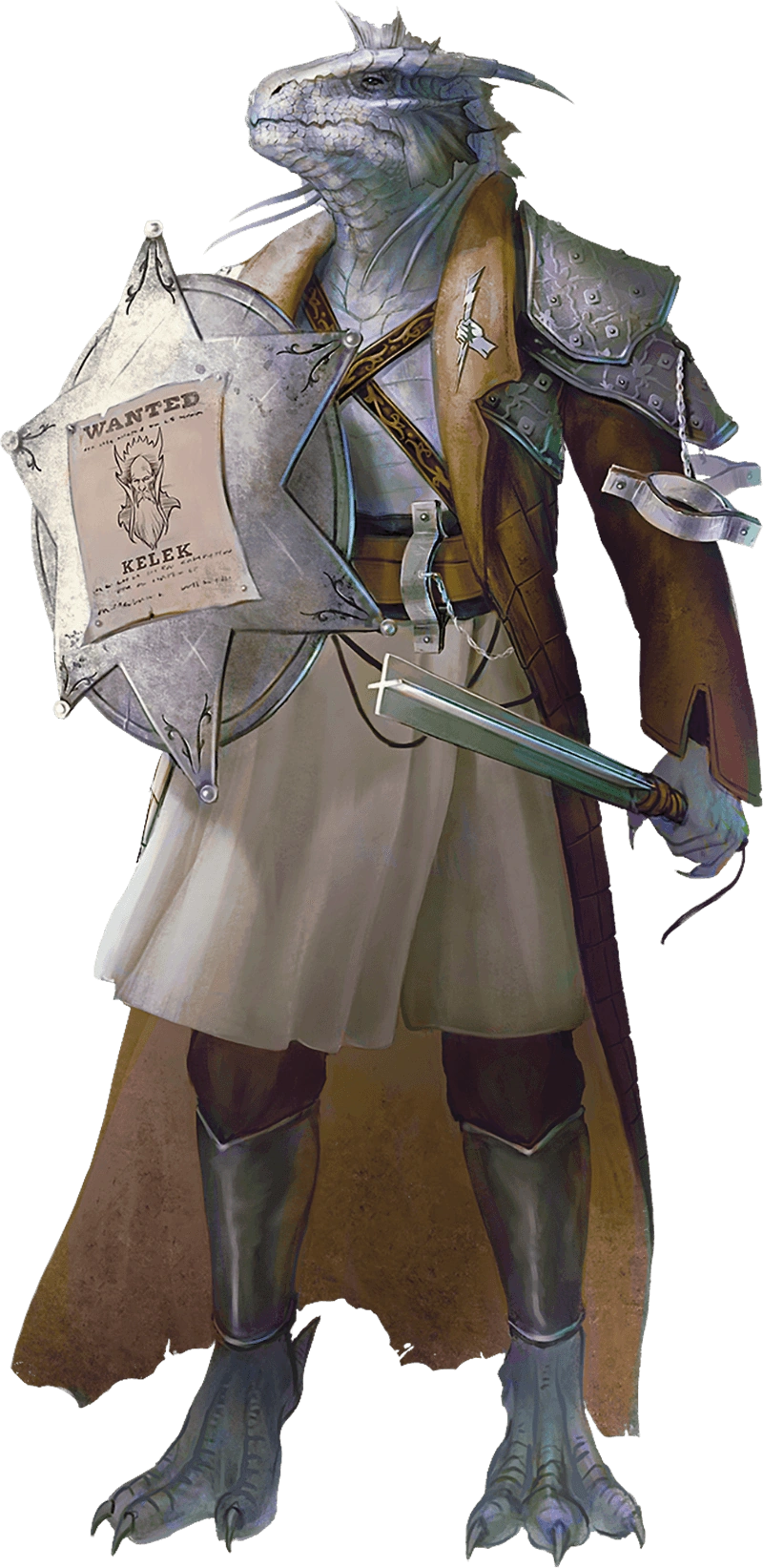
Magic and religion
Because of their position as slaves of the dragon lords for so long, dragonborn did not have a tradition of magic, though they had a significant affinity for certain forms of it. The race's natural abilities were well suited for the path of a warlock, though few dragonborn were willing to actually take up the career since it forced them to deal with powers beyond their control. Some dragonborn warlocks did exist, usually social outcasts or those who had justified it as a form of individuality. Dragonborn arcane spellcasters were, however, far more often wizards or sorcerers, attracted by the often secretive and eccentric ways that both paths involved.[36]
Having come from Abeir, dragonborn had a very different approach to religion than the other races.[7] On Abeir, divine influence was rare and mysterious, contrary to Toril where it had been relatively common in past ages. Since Abeir was dominated by the primordials who were, according to myth, driven into hiding by the mighty dragon lords that reigned over most of the planet, the dragonborn felt less beholden to gods than the members of other races. For this reason, many dragonborn were entirely agnostic, with no strong feelings one way or another about the gods.[29][7]
Dragonborn who did embrace religion, however, were well-suited to the path of a paladin. Making the creed and commandments of a god a code by which they could live was in many ways attractive to dragonborn, so long as they were able to get past their natural aversion to beholden to a superior authority they had no control of. If they did join the faithful, dragonborn could become quite devoted in their chosen church, craving the direction and purpose it gave them. Likewise, paladins, unlike clerics, represented an almost martial career path and one that blended well with the militaristic culture of the race.[36]
Dragonborn regarded psionic magic with fear, as they believed that manifesting such abilities were a symptom of madness. This was because the dragonborn who manifested such abilities did it in times of great stress, and because psionic magic was hard to master, and they believed that something they could not fully dominate was not safe to study. The few dragonborn who studied psionic powers did it with great caution. These fears were born from ignorance, however, as many dragonborn heroes of the past had been masters of psionic abilities.[37]
History
Origins
The origin of the dragonborn race was uncertain and shrouded in myth. While the origin of the Tel'Quessir as Corellon's children was well known and dwarves firmly believed in their stony origin, dragonborn were unsure whence they came.[29] Faerunian sages of the 1470s DR believed that dragonborn were either the original inhabitants of Unther, who were transformed into draconic beings after being exposed to the energies of the Spellplague, or experiments created by the followers of Tiamat in the ruins of Unther. Such beliefs were wrong, however, as dragonborn were denizens from Abeir.[30]
It was believed that the first dragonborn hatched from dragon eggs as a race that combined humanoid and draconic traits, although if they were shaped by the dragon gods or by mortal dragons was a matter of debate.[1] Some legends of Abeir told that Io, the first and greatest of the dragon gods, created the dragonborn as servants for the first dragons. These stories related that the dragonborn, like dragons, were formed from the essence of both the Astral Sea and the Elemental Chaos, though their nature overall favored the elemental over the astral, just like dragons. Yet another, less popular tale told that Io was killed in the war between the gods and the primordials and that the dragonborn sprang from his spilled blood.[38] A slight variation on this was common among the dragonborn of Tymanther, who believed they were bred by the dragon lords of Abeir for a cruel fate as slaves.[39]
A third legend, preferred by those dragonborn who believed theirs was the superior race, told that Io created the dragonborn before dragon and before the other humanoid races, that were created later in an attempt to match the draconic perfection. According to this legend, dragonborn were originally created to be the companions of Io, while dragons were created later, during the war with the primordials. All those legends had in common that dragonborn weren't the creations of Bahamut and Tiamat, and therefore they were free to chose their own destinies.[29]
The Platinum Cadre posited an alternative theory in their efforts to spread the worship of Bahamut, that the dragonborn were the ancient creations of the Platinum Dragon. However, most of the order was ridiculed or even openly persecuted for their beliefs since, to the dragonborn of Tymanther, the idea of a good dragon, let alone a good dragon god, was completely alien.[39] However, dragonborn were in fact related to the dragonborn of Bahamut, but only a handful of old dragons knew about this relationship.[40] Some dragonborn agreed to this theory, but they believed that only the dragonborn of metallic ancestries were descended from Bahamut, while those of chromatic and gem ancestries descended from Tiamat and Sardior, respectively.[16]
Ancient history
Regardless of the origin of the race, dragonborn had been the slaves of dragons for millennia.[39] Old tales from the oral tradition of the dragonborn tell of the breeding pits where the dragons lords of Abeir breed dragonborn in the hopes of making them better, stronger slaves.[41] Occasionally, some clans would rise in rebellion but only a few, such as the nation of Tymanchebar after the Dragonborn Rebellion of Laerakond, were ever successful.[39]
It's also said that in those ancient times, the dragonborn used to rule an empire that warred against an empire ruled by tieflings. Even though the two races had a long tradition of "enmity" because of their shared ancient history, those empires existed so long ago that dragonborn considered such enmity more theoretical than practical.[42][note 1]
Modern history
However, during the Spellplague (beginning 1385 DR), Tymanchebar was believed destroyed, wiped out following the transplantation of its center from Abeir to Toril. Despite this tragedy, the Abeiran expatriates of the new nation of Tymanther remained strong, and by 1479 DR formed a strong and steady homeland for the dragonborn of Toril that began to see acceptance among its neighbors. Some dragonborn migrated from Tymanther to other lands on Toril, though most that were not a part of the nation remain enslaved by dragons, either on Abeir or within the new continent of Laerakond.[39]
Kepeshkmolik Dumuzi was accepted as a Chosen of Enlil in the Year of the Nether Mountain Scrolls, 1486 DR, and began to proselytize the god's faith amongst the dragonborn.[43]
On Hammer 10 in the Year of the Rune Lords Triumphant, 1487 DR, the First Tymanther-Unther War ended in a decisive victory for the dragonborn.[44]
Lands
Dragonborn were most commonly found on Abeir, where the vast majority of the race dwelt. There, as well as in Laerakond, dragonborn were enslaved by draconic overlords who ruled over much of Toril's lost twin. However, some dragonborn nations did exist that had wrested themselves away from draconic rule. The largest of these was Tymanchebar on Abeir, whose center of power was wrested away from Abeir by the Spellplague and transplanted to the ruins of Unther. Most dragonborn believed that Tymanchebar had been destroyed and reconquered by the dragon lords of Abeir, no longer having the protection of its mighty citadels and armies.[7][29]
By 1479 DR, Tymanther, the dragonborn nation formed from this expatriate of Abeir, was the strongest center of dragonborn culture, at least on Toril.[7] By 1489 DR, dragonborn mercenaries had spread far from Tymanther, and could be encountered across Faerûn.[45]
Notable Dragonborn
Source: Forgotten Realms Wiki
Dragonborn of Bahamut
Medium Humanoid, typically Lawful Good
- Armor Class 18 (half plate, shield)
- Hit Points 93 (11d8 + 44)
- Hit Points 93 (11d8 + 44)
- Speed 30 ft., fly 30 ft.
STR DEX CON INT WIS CHA 19 (+4) 13 (+1) 18 (+4) 12 (+1) 14 (+2) 17 (+3)
- Saving Throws Con +7, Int +4, Wis +5, Cha +6
- Skills Athletics +7, Perception +5, Persuasion +6
- Condition Immunities frightened
- Senses passive Perception 15
- Languages Common, Draconic
- Challenge 8 (3,900 XP)
- Proficiency Bonus +3
Legendary Resistance (1/Day). If the dragonborn fails a saving throw, it can choose to succeed instead.
Actions
Multiattack. The dragonborn makes three Longsword attacks.
Longsword. Melee Weapon Attack: +7 to hit, reach 5 ft., one target. Hit: 8 (1d8 + 4) slashing damage, or 9 (1d10 + 4) slashing damage if used with two hands, plus 13 (3d8) radiant damage. The dragonborn can cause the sword to flare with bright light, and the target must succeed on a DC 14 Constitution saving throw or be blinded until the start of the dragonborn's next turn. The sword can flare in this way only once per turn.
Healing Touch (1/Day). The dragonborn touches another creature within 5 feet of it. The target magically regains 40 hit points. In addition, all diseases and poisons affecting the target are removed.
Radiant Breath (Recharge 6). The dragonborn exhales fiery radiance in a 30-foot cone. Each creature in that area must make a DC 15 Dexterity saving throw, taking 44 (8d10) radiant damage on a failed save, or half as much damage on a successful one. When the dragonborn uses this action, it can choose up to three creatures in the cone. These creatures take no damage from the radiance and instead regain 22 (4d10) hit points each.
Source: FTD page184


Often called platinum knights, dragonborn champions of Bahamut might belong to an order that exists to protect the world from evil—and especially from evil dragons. A champion of Bahamut has a distinctive pair of platinum wings and a breath weapon suffused with radiant energy.
Dragonborn Champions
The connection between dragonborn and their draconic ancestors manifests in a variety of ways. Some dragonborn identify with a particular kind of dragon and attempt to emulate such dragons' attitudes and behavior. Others consider their draconic heritage—chromatic, metallic, or gem—something like a large extended family. But for dragonborn champions, this bond is spiritual as much as biological, and they devote themselves to their divine ancestor. Dragonborn champions advance the cause of their dragon god among draconic creatures and other folk alike.
Dragonborn of Sardior
Medium Humanoid, typically Neutral
- Armor Class 17 (mental defense)
- Hit Points 75 (10d8 + 30)
- Hit Points 75 (10d8 + 30)
- Speed 30 ft., fly 30 ft. (hover)
STR DEX CON INT WIS CHA 14 (+2) 16 (+3) 17 (+3) 18 (+4) 14 (+2) 12 (+1)
- Saving Throws Con +6, Int +7, Wis +5, Cha +4
- Skills Arcana +7, History +7, Perception +5
- Damage Resistances psychic
- Condition Immunities frightened
- Senses passive Perception 15
- Languages Common, Draconic
- Challenge 6 (2,300 XP)
- Proficiency Bonus +3
Legendary Resistance (1/Day). If the dragonborn fails a saving throw, it can choose to succeed instead.
Mental Defense. While the dragonborn is wearing no armor, its AC includes its Intelligence modifier.
Actions
Multiattack. The dragonborn makes three Mind Blade attacks.
Mind Blade. Melee or Ranged Weapon Attack: +7 to hit, reach 5 ft. or range 20/60 ft., one target. Hit: 6 (1d4 + 4) piercing damage plus 10 (3d6) psychic damage.
Heat Breath (Recharge 6). The dragonborn exhales a wave of intense heat in a 30-foot cone. Each creature in that area must make a DC 14 Constitution saving throw, taking 27 (6d8) fire damage on a failed save, or half as much damage on a successful one. Metal objects in that area glow red-hot until the end of the dragonborn's next turn. Any creature in physical contact with a heated object at the start of its turn must make a DC 14 Constitution saving throw. On a failed save, the creature takes 9 (2d8) fire damage and has disadvantage on attack rolls until the start of its next turn.
Spellcasting (Psionics). The dragonborn casts one of the following spells, requiring no spell components and using Intelligence as the spellcasting ability (spell save DC 15, +7 to hit with spell attacks):
1/day each: Bigby's hand, hypnotic pattern, telekinesis
Source: FTD page185

Sardior is said to have died in the destruction of the First World. But many believe that Sardior's divine essence survives within every gem dragon. This philosophy is central to the teachings of Sardior's dragonborn champions, who wield psionic power in the service of their mysterious cause. Many of these champions are associated with the Inheritors of the First World (see chapter 3).
Sardior's champions use telekinetic power to move their foes and even carry themselves through the air. Their breath weapon, a blast of heat, is believed to be an echo of long-lost Sardior's breath.
Dragonborn Champions
The connection between dragonborn and their draconic ancestors manifests in a variety of ways. Some dragonborn identify with a particular kind of dragon and attempt to emulate such dragons' attitudes and behavior. Others consider their draconic heritage—chromatic, metallic, or gem—something like a large extended family. But for dragonborn champions, this bond is spiritual as much as biological, and they devote themselves to their divine ancestor. Dragonborn champions advance the cause of their dragon god among draconic creatures and other folk alike.
Dragonborn of Tiamat
Medium Humanoid, typically Chaotic Evil
- Armor Class 18 (plate)
- Hit Points 85 (10d8 + 40)
- Hit Points 85 (10d8 + 40)
- Speed 30 ft.
STR DEX CON INT WIS CHA 20 (+5) 11 (+0) 18 (+4) 10 (+0) 12 (+1) 16 (+3)
- Saving Throws Str +8, Con +7, Wis +4, Cha +6
- Skills Athletics +8, Intimidation +6, Perception +4
- Condition Immunities frightened
- Senses passive Perception 14
- Languages Common, Draconic
- Challenge 7 (2,900 XP)
- Proficiency Bonus +3
Legendary Resistance (1/Day). If the dragonborn fails a saving throw, it can choose to succeed instead.
Actions
Multiattack. The dragonborn makes two Greataxe attacks.
Greataxe. Melee Weapon Attack: +8 to hit, reach 5 ft., one target. Hit: 11 (1d12 + 5) slashing damage plus 13 (3d8) necrotic damage.
Necrotic Breath (Recharge 6). The dragonborn exhales shadowy fire in a 30-foot cone. Each creature in that area must make a DC 15 Wisdom saving throw. On a failed save, the creature takes 36 (8d8) necrotic damage and is frightened of the dragonborn for 1 minute. On a successful save, the creature takes half as much damage and isn't frightened. A frightened creature can repeat the saving throw at end of each of its turns, ending the effect on itself on a success.
Source: FTD page185
Champions of the dragon queen are often called Talons of Tiamat. They work tirelessly to free their master from her imprisonment in Avernus, and Tiamat grants these pawns immense strength and a devastating breath weapon. Champions of Tiamat are sometimes associated with the Cult of the Dragon (described in chapter 3).


Dragonborn Champions
The connection between dragonborn and their draconic ancestors manifests in a variety of ways. Some dragonborn identify with a particular kind of dragon and attempt to emulate such dragons' attitudes and behavior. Others consider their draconic heritage—chromatic, metallic, or gem—something like a large extended family. But for dragonborn champions, this bond is spiritual as much as biological, and they devote themselves to their divine ancestor. Dragonborn champions advance the cause of their dragon god among draconic creatures and other folk alike.
Dwarf
Contents
- PC Stat Blocks
- PHB
- xxx
- SCAG
- Fizban's Treasury of Dragons or other...
- Forgotten Realms
- (Language and/or Religion)
- NPC Stat Blocks
- NPC (SOURCE)
Dwarf
This race has multiple subraces, as listed below:
- Dwarf (Duergar)
- Dwarf (Hill)
- Dwarf (Mountain)
Traits
Age. Dwarves mature at the same rate as humans, but they're considered young until they reach the age of 50. On average, they live about 350 years.
Size. Dwarves stand between 4 and 5 feet tall and average about 150 pounds. Your size is Medium.
Speed. Your speed is not reduced by wearing heavy armor.
Darkvision. Accustomed to life underground, you have superior vision in dark and dim conditions. You can see in dim light within 60 feet of you as if it were bright light, and in dark-ness as if it were dim light. You can't discern color in darkness, only shades of gray.
Dwarven Resilience. You have advantage on saving throws against poison, and you have resistance against poison damage.
Dwarven Combat Training. You have proficiency with the battleaxe, handaxe, light hammer, and warhammer.
Tool Proficiency. You gain proficiency with the artisan's tools of your choice: Smith's tools, brewer's supplies, or mason's tools.
Stonecunning. Whenever you make an Intelligence (History) check related to the origin of stonework, you are considered proficient in the History skill and add double your proficiency bonus to the check, instead of your normal proficiency bonus.
Languages. You can speak, read, and write Common and Dwarvish. Dwarvish is full of hard consonants and guttural sounds, and those characteristics spill over into whatever other language a dwarf might speak.
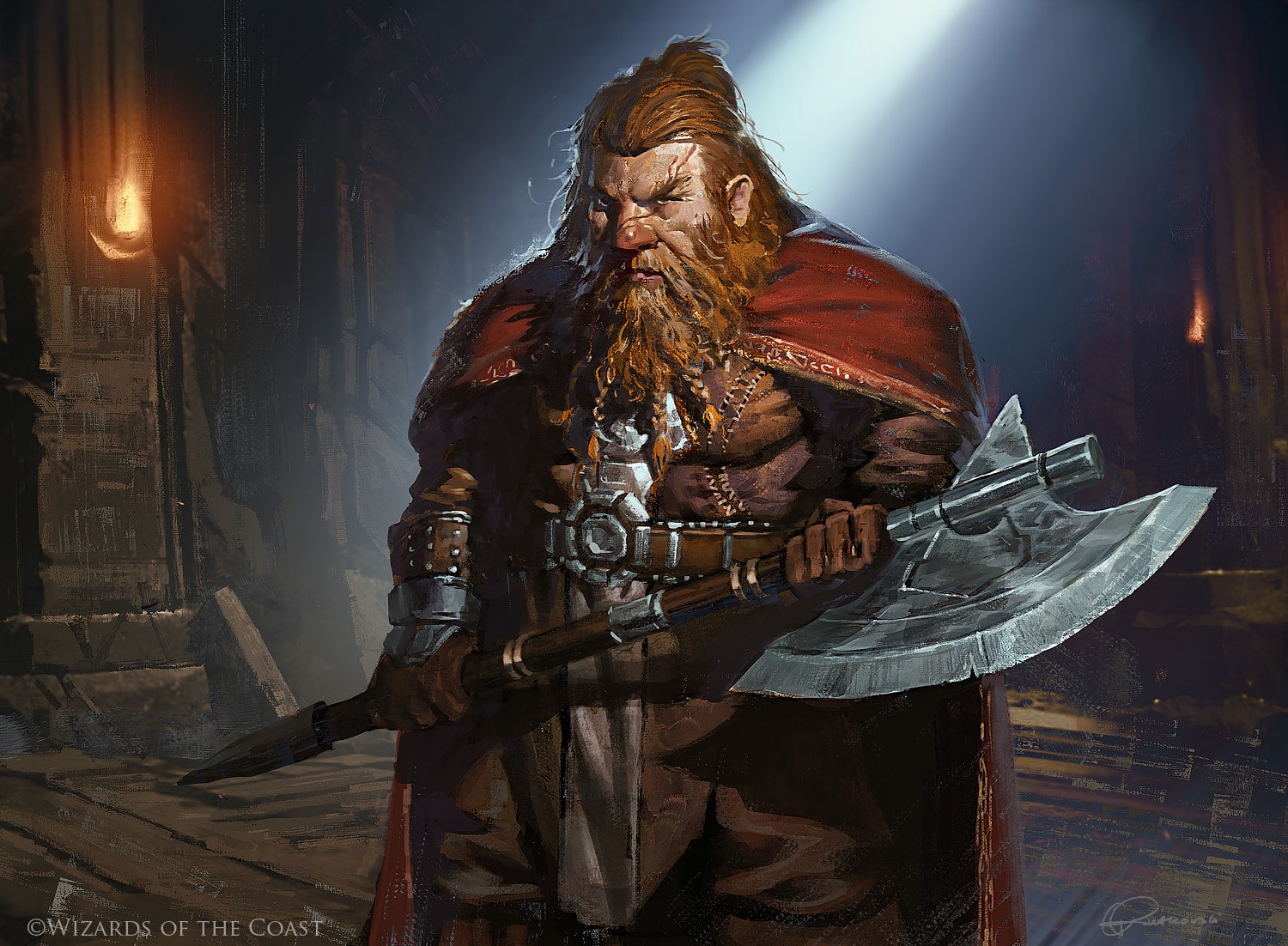
Dwarf (Hill)
- Ability Scores. Constitution +2; Wisdom +1
- Size. Medium
- Speed. 25 ft.
As a hill dwarf, you have keen senses, deep intuition, and remarkable resilience. The gold dwa-rves of Faerûn in their mighty southern kingdom are hill dwarves, as are the exiled Neidar and the debased Klar of Krynn in the Dragonlance setting.
Dwarven Toughness. Your hit point maximum increases by 1, and it increases by 1 every time you gain a level.
Dwarf (Mountain)
- Ability Scores. Strength +2; Constitution +2
- Size. Medium
- Speed. 25 ft.
As a mountain dwarf, you're strong and hardy, accustomed to a difficult life in rugged terrain. You're probably on the tall side (for a dwarf), and tend toward lighter coloration. The shield dwarves of northern Faerûn, as well as the ruling Hylar clan and the noble Daewar clan of Drag-onlance, are mountain dwarves.
Dwarven Armor Training. You have proficiency with light and medium armor.

Kingdoms rich in ancient grandeur, halls carved into the roots of mountains, the echoing of picks and hammers in deep mines and blazing forges, a commitment to clan and tradition, and a burning hatred of goblins and orcs-these common threads unite all dwarves.
Short and Stout
Bold and hardy, dwarves are known as skilled warriors, miners, and workers of stone and metal. Though they stand well under 5 feet tall, dwarves are so broad and compact that they can weigh as much as a human standing nearly two feet taller. Their courage and endurance are also easily a match for any of the larger folk.
Dwarven skin ranges from deep brown to a paler hue tinged with red, but the most common shades are light brown or deep tan, like certain tones of earth.
Their hair, worn long but in simple styles, is usually black, gray, or brown, though paler dwarves often have red hair. Male dwarves value their beards highly and groom them carefully.
Long Memory, Long Grudges
Dwarves can live to be more than 400 years old, so the oldest living dwarves often remember a very different world. For example, some of the oldest dwarves living in Citadel Felbarr (in the world of the Forgotten Realms) can recall the day, more than three centuries ago, when orcs conquered the fortress and drove them into an exile that lasted over 250 years. This longevity grants them a perspective on the world that shorter-lived races such as humans and halflings lack.
Dwarves are solid and enduring like the mountains they love, weathering the passage of centu-ries with stoic endurance and little change. They respect the traditions of their clans, tracing their ancestry back to the founding of their most ancient strongholds in the youth of the world, and don't abandon those traditions lightly. Part of those traditions is devotion to the gods of the dwarves, who uphold the dwarven ideals of industrious labor, skill in battle, and devotion to the forge.
Individual dwarves are determined and loyal, true to their word and decisive in action, some-times to the point of stubbornness. Many dwarves have a strong sense of justice, and they are slow to forget wrongs they have suffered. A wrong done to one dwarf is a wrong done to the dwarf's entire clan, so what begins as one dwarf's hunt for vengeance can become a full-blown clan feud.
Clans and Kingdoms
Dwarven kingdoms stretch deep beneath the mountains where the dwarves mine gems and precious metals and forge items of wonder. They love the beauty and artistry of precious met-als and fine jewelry, and in some dwarves this love festers into avarice. Whatever wealth they can't find in their mountains, they gain through trade. They dislike boats, so enterprising hu-mans and halflings frequently handle trade in dwarven goods along water routes. Trustworthy members of other races are welcome in dwarf settlements, though some areas are off limits even to them.
The chief unit of dwarven society is the clan, and dwarves highly value social standing. Even dwarves who live far from their own kingdoms cherish their clan identities and affiliations, rec-ognize related dwarves, and invoke their ancestors' names in oaths and curses. To be clanless is the worst fate that can befall a dwarf.
Dwarves in other lands are typically artisans, especially weaponsmiths, armorers, and jewelers. Some become mercenaries or bodyguards, highly sought after for their courage and loyalty.
Gods, Gold, and Clan
Dwarves who take up the adventuring life might be motivated by a desire for treasure-for its own sake, for a specific purpose, or even out of an altruistic desire to help others. Other dwa-rves are driven by the command or inspiration of a deity, a direct calling or simply a desire to bring glory to one of the dwarf gods. Clan and ancestry are also important motivators. A dwarf might seek to restore a clan's lost honor, avenge an ancient wrong the clan suffered, or earn a new place within the clan after having been exiled. Or a dwarf might search for the axe wielded by a mighty ancestor, lost on the field of battle centuries ago.
Slow to Trust
Dwarves get along passably well with most other races. "The difference between an acquaint-ance and a friend is about a hundred years," is a dwarf saying that might be hyperbole, but cer-tainly points to how difficult it can be for a member of a short-lived race like humans to earn a dwarf's trust.
Elves. "It's not wise to depend on the elves. No telling what an elf will do next; when the hammer meets the orc's head, they're as apt to start singing as to pull out a sword. They're flighty and frivolous. Two things to be said for them, though: They don't have many smiths, but the ones they have do very fine work. And when orcs or goblins come streaming down out of the mountains, an elf's good to have at your back. Not as good as a dwarf, maybe, but no doubt they hate the orcs as much as we do."
Halflings. "Sure, they're pleasant folk. But show me a halfling hero. An empire, a tri-umphant army. Even a treasure for the ages made by halfling hands. Nothing. How can you take them seriously?"
Humans. "You take the time to get to know a human, and by then the human's on her deathbed. If you're lucky, she's got kin-a daughter or granddaughter, maybe-who's got hands and heart as good as hers. That's when you can make a human friend. And watch them go!. They set their hearts on something, they'll get it whether it's a dragon's hoard or an empire's throne. You have to admire that kind of dedication, even if it gets them in trouble more often than not."
Dwarf Names
A dwarf's name is granted by a clan elder, in accordance with tradition. Every proper dwarven name has been used and reused down through the generations. A dwarf's name belongs to the clan, not to the individual.
A dwarf who misuses or brings shame to a clan name is stripped of the name and forbidden by law to use any dwarven name in its place.
- Male Names: Adrik, Alberich, Baern, Barendd, Brottor, Bruenor, Dain, Darrak, Delg, Eberk, Einkil, Fargrim, Flint, Gardain, Harbek, Kildrak, Morgran, Orsik, Oskar, Rangrim, Rurik, Taklinn, Thoradin, Thorin, Tordek, Traubon, Travok, Ulfgar, Veit, Vondal
- Female Names: Amber, Artin, Audhild, Bardryn, Dagnal, Diesa, Eldeth, Falkrunn, Finellen, Gunnloda, Gurdis, Helja, Hlin, Kathra, Kristryd, Ilde, Liftrasa, Mardred, Riswynn, Sannl, Torbera, Torgga, Vistra
- Clan Names: Balderk, Battlehammer, Brawnanvil, Dankil, Fireforge, Frostbeard, Gorunn, Holderhek, Ironfist, Loderr, Lutgehr, Rumnaheim, Strakeln, Torunn, Ungart
Duergar
In cities deep in the Underdark live the duergar, or gray dwarves. These vicious, stealthy slave traders raid the surface world for captives, then sell their prey to the other races of the Under-dark. They have innate magical abilities to become invisible and to temporarily grow to giant size.
Source: PHB, page 18. Available in the SRD 5.1.

Duergar
- Ability Scores. Choose one of: (a) Choose any +2; choose any other +1 (b) Choose three different +1
- Size. Medium
- Speed. 30 ft.
Creature Type. You are a Humanoid. You are also considered a dwarf for any prerequisite or effect that requires you to be a dwarf.
Darkvision. You can see in dim light within 120 feet of you as if it were bright light and in darkness as if it were dim light. You discern colors in that darkness only as shades of gray.
Duergar Magic. Starting at 3rd level, you can cast the enlarge/reduce spell on yourself with this trait, without requiring a material component. Starting at 5th level, you can also cast the invisibility spell on yourself with this trait, without requiring a material component. Once you cast either of these spells with this trait, you can't cast that spell with it again until you fin-ish a long rest. You can also cast these spells using spell slots you have of the appropriate level.
Intelligence, Wisdom, or Charisma is your spellcasting ability for these spells when you cast them with this trait (choose when you select this race).
Dwarven Resilience. You have advantage on saving throws you make to avoid or end the poisoned condition on yourself. You also have resistance to poison damage.
Psionic Fortitude. You have advantage on saving throws you make to avoid or end the charmed or stunned condition on yourself.
Languages. You can speak, read, and write Common and one other language that you and your DM agree is appropriate for your character.
Duergar are dwarves whose ancestors were transformed by centuries living in the deepest places of the Underdark. That chthonic realm is saturated with strange magical energy, and over generations, early duergar absorbed traces of it. They were further altered when mind flayers and other Aberrations invaded and performed horrific experiments on them. Fueled by Underdark magic, those experiments left early duergar with psionic powers, which have been passed down to their descendants. In time, they liberated themselves from their aberrant tyrants and forged a new life for themselves in the Underdark and beyond.
Like other dwarves, duergar typically have a life span of 350 years.
Source: MPMM, page 12
Dwarf (Duergar)
- Ability Scores. Constitution +2; Strength +1
- Size. Medium
- Speed. 25 ft.
Age. Dwarves mature at the same rate as humans, but they're considered young until they reach the age of 50. On average, they live about 350 years.
Size. Dwarves stand between 4 and 5 feet tall and average about 150 pounds. Your size is Medium.
Speed. Your speed is not reduced by wearing heavy armor.
Superior Darkvision. Accustomed to life underground, you have superior vision in dark and dim conditions. You can see in dim light within 120 feet of you as if it were bright light, and in darkness as if it were dim light. You can't discern color in darkness, only shades of gray.
Duergar Resilience. You have advantage on saving throws against poison, and you have resistance against poison damage. You also have advantage on saving throws against illusions and against being charmed or paralyzed.
Dwarven Combat Training. You have proficiency with the battleaxe, handaxe, light hammer, and warhammer.
Tool Proficiency. You gain proficiency with the artisan's tools of your choice: Smith's tools, brewer's supplies, or mason's tools.
Stonecunning. Whenever you make an Intelligence (History) check related to the origin of stonework, you are considered proficient in the History skill and add double your proficiency bonus to the check, instead of your normal proficiency bonus.
Languages. You can speak, read, and write Common, Dwarvish, and Undercommon.
Duergar Magic. When you reach 3rd level, you can cast the Enlarge/Reduce spell on yourself once with this trait, using only the spell's enlarge option. When you reach 5th level, you can cast the Invisibility spell on yourself once with this trait. You don't need material components for either spell, and you can't cast them while you're in direct sunlight, although sunlight has no effect on them once cast. You regain the ability to cast these spells with this trait when you finish a long rest. Intelligence is your spellcasting ability for these spells.
Sunlight Sensitivity. You have disadvantage on attack rolls and Wisdom (Perception) checks that rely on sight when you, the target of your attack, or whatever you are trying to perceive is in direct sunlight.
The gray dwarves, or duergar, live deep in the Underdark. After delving deeper than any other dwarves, they were enslaved by mind flayers for eons. Although they eventually won their freedom, these grim, ashen-skinned dwarves now take slaves of their own and are as tyrannical as their former masters.
Physically similar to other dwarves in some ways, duergar are wiry and lean, with black eyes and bald heads, with the males growing long, unkempt, gray beards.
Duergar value toil above all else. Showing emotions other than grim determination or wrath is frowned on in their culture, but they can sometimes seem joyful when at work. They have the typical dwarven appreciation for order, tradition, and impeccable craftsmanship, but their goods are purely utilitarian, disdaining aesthetic or artistic value.
Few duergar become adventurers, fewer still on the surface world, because they are a hidebound and suspicious race. Those who leave their subterranean cities are usually exiles. Check with your Dungeon Master to see if you can play a gray dwarf character.
Source: MTF, page 81
Sword Coast
Races of the Realms
Dwarves
The Stout Folk are deliberate and steadfast, with a proud history as great artisans, builders, and warriors. Although the glory of their empires faded long ago, the dwarves still hold to their ancient ways and traditions. They stubbornly defend what remains of their old domains beneath hill and mountain, and some seek to reclaim what they have lost to the depredations of orcs, goblins, and the inexorable march of time.
According to their own legends, dwarves were formed from iron, mithral, earth, and stone on the Soulforge of Moradin. After the All-Father breathed life into them in the heart of the world, dwarves found their way to the surface and, from there, spread across each continent.
Thousands of years of settlement and separation divided the dwarves into distinct subraces: the shield dwarves, most common in the North and the Sword Coast; the gold dwarves of the southern lands; and the gray dwarves, or duergar, of the Underdark.
The Dwarvish language of Faerûn uses a runic alphabet called Dethek, whose characters are easy to etch into stone and metal, as evidenced by the runestones and way-markers found in ancient dwarven tunnels and mines.
Shield Dwarves
The ancestral home of the shield dwarves is in northern Faerûn, where ancient dwarfholds exist in the North, Damara, Impiltur, Vaasa, the Vast, and the Western Heartlands. The most famous of the old shield dwarf cities is Citadel Adbar, north and east of Silverymoon. Many of these dwarfholds have changed hands over the centuries in a cycle of invasion by enemies, followed by reconquest by the dwarves.
Dwarf Clans of the North
All dwarves count their clan heritage as an important part of their lineage and identity. While in some cities a single clan dominates (or is the only one in residence), in other dwarven communities there is a complex relationship between family, clan, and the larger society.
Some of the dwarf clans in the North are Arnskull, Battlehammer, Blackbanner, Blackhammer, Bucklebar, Darkfell, Deepaxe, Deepdelve, Eaglecleft, Foehammer, Gallowglar, Hillsafar, Horn, Ironshield, Jundeth, Narlagh, Orothiar, Quarrymaster, Rockfist, Sstar, Stoneshaft, Stoneshield, Stoneshoulder, Trueforger, Watchever, Worldthrone, Wyrmslayer, and Yund.
Some dwarves hail from the family that founded or rules a given clan, and so they use the clan name as their family name. Others are simply "of" the clan, but bear the clan name with as much pride as their own surnames.
Living in a near-constant state of war for generations, shield dwarves are a hardy people, slow to trust, with long memories and often an equally long list of grievances against their ancient enemies. The more conservative among them want to maintain the traditions and remaining holdings of their people, isolated from the influence of outsiders and safe from invaders behind thick walls of stone. Shield dwarves of a more adventurous bent are interested in exploring the world and seeing what lies beyond the bounds of their ancient dwarfholds.
Shield dwarves have the racial traits of mountain dwarves in the Player's Handbook. Their skin is usually fair, eyes green, hazel, or silver-blue, and they have brown, blond, or red hair. Full beards and mustaches are commonly seen on male shield dwarves.
Shield dwarves are renowned artisans, particularly in metal and stone. They tend to focus more on sturdiness in their craft than on the artistic flourishes and gilding favored by their gold dwarf cousins. Shield dwarf crafters build to last, and each one's signature mark placed upon an enduring masterpiece serves as a way of gaining immortality.
Gold Dwarves

Gold dwarves are common in the lands to the south and east. They are formidable warriors, proud of their long traditions, with strong ties to clan. They are gruff and haughty and have a love of fine craftsmanship and an eagerness to trade.
Significant settlements of gold dwarves exist in the Great Rift, the area surrounding the Dragon Coast, as well as in the Old Empires of eastern Faerûn. Smaller communities are found in the Smoking Mountains, in the Giant's Run Mountains, and the Western Heartlands.
Because they have not endured the same cycle of invasion and displacement, gold dwarves tend to be more optimistic than their shield dwarf cousins, but they're still standoffish and prideful as only a dwarf can be. They believe their race's stable history is the result of their attentiveness to tradition, and have little doubt that the future of the gold dwarves will be just as peaceful, if they remain true to their customs and principles.
Gold dwarves have the racial traits of hill dwarves in the Player's Handbook. They are stocky and muscular, averaging about 4 feet tall, with brown skin, black or brown hair, and brown or hazel eyes, with green eyes rare (and considered lucky). Males grow full beards that they keep oiled and well groomed, and both genders wear their hair long and often elaborately braided.
Gold dwarves are best known for crafting beautiful objects. According to them, all the natural resources of the world exist for mortals to turn them into objects of great beauty. Gold dwarves don't want the most of everything; they want the best. Their artisans toil over items for years, getting their etchings and fine details just right before being satisfied with their efforts.
That deliberate, perfectionist approach is a reflection of gold dwarf culture, in which there is a right and proper way to do everything. Tradition dictates every aspect of a gold dwarf's life, from one's place in society, to prospects for marriage, to what careers are acceptable. Gold dwarves who take up a life of adventuring, away from the clan, rarely forsake their traditions when doing so. Even though they might have to live as outsiders for a time, they hope to ultimately improve their standing in their society.
Gray Dwarves (Duergar)
The gray dwarves, or duergar, live deep in the Underdark. After delving deeper than any other dwarves, they were enslaved by mind flayers for eons. Although they eventually won their freedom, these grim, ashen-skinned dwarves now take slaves of their own and are as tyrannical as their former masters.
Physically similar to other dwarves in some ways, duergar are wiry and lean, with black eyes and bald heads, with the males growing long, unkempt, gray beards.
Duergar value toil above all else. Showing emotions other than grim determination or wrath is frowned on in their culture, but they can sometimes seem joyful when at work. They have the typical dwarven appreciation for order, tradition, and impeccable craftsmanship, but their goods are purely utilitarian, disdaining aesthetic or artistic value.
Few duergar become adventurers, fewer still on the surface world, because they are a hidebound and suspicious race. Those who leave their subterranean cities are usually exiles. Check with your Dungeon Master to see if you can play a gray dwarf character.
- Dwarf (Duergar)
Dethek, the letters and numerals of Dwarvish

Dwarven Deities
The gods of the dwarves are a pantheon, or clan, collectively known as the Morndinsamman.

Forge Father and Revered Mother
Moradin, the Soulforger, leads the dwarven gods. Known as Dwarf-father or All-Father, he is the god of the dwarf people as a whole, as well as the god of creation, "dwarf-crafts" (smithing and stonework), and protection. His wife is the Revered Mother, Berronar Truesilver, goddess of hearth and home, of honesty and faithfulness, and of oaths, loyalty, and honor.
Gods of Battle
Clangeddin Silverbeard is the dwarven god of war and valor. Gorm Gulthyn, also called Fire Eyes and the Lord of the Bronze Mask, is the god of defense and vigilance, the protector of dwarves. Haela Brightaxe is the goddess of luck in battle, and the patron of dwarf fighters.
Gods of Craft
Dumathoin, the Keeper of Secrets under the Mountain, is the patron of the shield dwarves, as well as the god of buried wealth, mining, gems, and exploration, and the guardian of the dead. Sharindlar, Lady of Life and Mercy, is the goddess of healing, romantic love, and fertility, often associated with the moon.
Gods of Far Places
The god of invention and discovery is Dugmaren Brightmantle, called the Wandering Tinker or the Gleam in the Eye. Marthammor Duin is the traveler's god, patron of expatriates and guides, and deity of lightning and roads.
Gods of Wealth
Vergadain, called the Merchant King, is the god of thieves (who commands his followers never to steal from other dwarves), luck, and chance, as well as commerce and negotiation. Abbathor is the god of greed, sometimes portrayed as a dragon filled with envy of the wealth of others, who jealously tends his own hoard.
Gods of Evil
Laduguer is the patron of the duergar, god of magic and those crafts not governed by Moradin. Also worshiped among the duergar is Deep Duerra, a goddess of conquest and of the powers of the mind.
Source: SCAG, page 103
Forgotten Realms Wiki:
Dwarf
5th Edition Statistics[2]
Size
Medium
Type
4E Origin
General Information
Abbreviation
d[1]
Vision
Average lifespan
350 years[2]
Homeland(s)
Language(s)
Subraces
Arctic dwarves
Gold dwarves[5]
Gray dwarves[5]
Shield dwarves[5]
Urdunnir dwarves
Wild dwarvesAppearance
Average height
4‒5 ft (1.2‒1.5 m)[2]
Average weight
150 lb (68,000 g)[2]
Distinctions
Physically durable, insightful, primarily dwell underground, some females capable of growing beards
Gold
Average height 4 ft (1.2 m) [ 5 ] Skin color(s) Brown [ 5 ] Hair color(s) Black or brown [ 5 ] Eye color(s) Brown or hazel [ 5 ]
Shield
Skin color(s) Fair [ 5 ] Hair color(s) Brown, blond or red [ 5 ] Eye color(s) Green, hazel or silver-blue [ 5 ] Gray
Skin color(s) Ash [ 5 ] Hair color(s) Bald [ 5 ] Eye color(s) Black [ 5 ]
A dwarf (pl: dwarves) was a member of a natural humanoid race common throughout parts of Toril as well as Abeir.[6]. Dwarves, sometimes called the Stout Folk and Deep Folk,[7] were a tough, tradition-abiding folk known for their strong martial traditions and beautiful craftsmanship.[8]
“
Dwarves are creatures of stone, and like stone they change only in response to extremes. The dwarves of the many worlds share much in common, but never allow those similarities to blind you to their unique traits.
”
Description
Dwarves were a short race, as their name implied, standing from 4'3"–4'9" (1.3–1.45 meters) on average,[10] with gold dwarves a bit shorter.[11] What dwarves lacked in height they made up for in bulk; they were, on average, about as heavy as humans. A dwarf could weigh anywhere from about 160–220 lbs (73–100 kg).[10] Dwarven males were a bit taller and heavier than their female counterparts.[12] Like humans, dwarves had a wide variety of skin, eye, and hair colors, typically pale among shield dwarves and deeply tanned or brown amongst gold dwarves. Hazel eyes were common throughout the race, with blue eyes more common amongst shield dwarves and brown or green eyes found amongst the gold dwarves.[11]
Male dwarves were often bald and grew thick facial hair, which was sometimes used to display social status. Unusually for humanoids, both sexes naturally grew ample facial hair,[13] though the majority of shield dwarf females shaved their beards off.[14] Many dwarven women would do this to conform with the beauty standards of human societies, but some would revel in their long, luscious beards, or trim them in goatee-style.[15][16] This hair was often dark in hue, though among shield dwarves blond or red hair was just as common. Gold dwarves took the care of facial hair to an extreme, carefully oiling and grooming it,[11] with some adding perfume and ornamentations.[13] Naturally curly hair did not exist among the dwarves of Toril. Curles could only be achieved though deliberate styling.[17]
Dwarves were a long-lived race, though not so much as elves, and reached physical maturity somewhat later than humans. A dwarf was traditionally considered an adult once he or she reached age fifty.[12] Dwarves aged much like humans but over a longer period of time, remaining vigorous well past 150 years. Most dwarves lived to see their bicentennial[10] and a few lived to be over 400.[12] A dwarf was considered to be young until they reached the age of 50.[2]
Personality
Whether or not the dwarven claim that they'd been carved from the world's stone was true, dwarves shared many qualities considered similar to the stone they lived with. Strong, hardy, and dependable, dwarves were polite, particularly to elders, and possessed a wisdom beyond that of many other races. Dwarves valued their traditions, regardless of the subrace they came from, and looked for inspiration from ancestral heroes.[10] Dwarves were also known for their stubborn nature and cynicism, traits widespread amongst the dwarves but which contributed to and were commonly offset by their bravery and tenacity.[11]
Dwarven friendship was hard to earn, but was strong once won. Naturally dour and suspicious, the stout folk were slow to trust others, specifically those outside their family, suspecting the worst of an individual until the outsider had proved their good will many times. Once this trust was gained, dwarves held their friends to it and viewed betrayals, even minor ones, with a vicious propensity for vengeance.[11] A common gnomish oath, remarking on this dwarven sense of justice, was "If I'm lying, may I cross a dwarf."[12]
For dwarves, loyalty was more than a word and they felt that it should be both valued and rewarded. Dwarves believed it a gift and mark of respect to stand beside a friend in combat, and an even deeper one to protect that ally from harm. Many dwarven tales subsequently revolved around the sacrifice of dwarves for their friends and family. Just as dwarves were known for their dependability as friends and allies, dwarves also harbored grudges far longer than many other races. This might be on an individual basis between a dwarf and one who had wronged them, or against entire races, even if warfare with the enemy had long since ceased.[10]
Dwarves were careful and deliberate, with a more serious disposition than other races, who they sometimes viewed as flighty or reckless. A dwarf did all things with care and a stubborn resolve, with brash or cowardly behavior unusual for them. However, dwarves did succumb easily to wrath or greed, which were their most common vices.[12]
Dwarves who left their homeland to become adventurers did so for a number of reasons. In part, a dwarf might be motivated by simple avarice, given the dwarven love of beautiful things. As often, however, a dwarf might be motivated by a drive to do what was right for others (particularly their clan) or a love of excitement because, as settled as dwarves were, they rarely tired of thrills. But even these wayward dwarves retained the spirit of their brethren, hoping that their accomplishments abroad could bring honor to themselves, their clan, or both. Given that successful dwarven adventurers were likely to recover rare items or defeat enemies of the dwarven people during such challenges, this was a hope not entirely without merit.[12]
Abilities
Dwarves were unusually tough for humanoids, in more ways than one. Dwarven stomachs, for instance, were resistant to virtually all poisons and it took less effort for a dwarf to get back on their feet than other races. Dwarves also had dense bodies and were difficult to push around as a result, as well as having the capacity to bear loads that other races might find hindering with little ill effect. Dwarves also had a sense about them that few races did, with a preternatural awareness of their surroundings useful for a subterranean race as well as good judgment all-around in general.[10]
Many dwarves were difficult to like and lacked the charm of many other smaller races, such as halflings or gnomes, though this was not a trait common to all dwarves and some possessed a great deal of charismatic power. Furthermore, dwarves were not entirely unsocial and more than a few had a natural knack for bartering or judging the value of an offer, something that sat well with their legendary crafting abilities.[12]
Dwarves could see in the dark, out to about 60 feet (18 meters). Many dwarves had an affinity for the caverns in which they lived, possessing a knack for recognizing unusual patterns in stonework that could seem almost supernatural at times.[12]
Society
Culture
Dwarves highly valued the ties between family members and friends, weaving tightly knit clans. Dwarves particularly respected elders, from whom they expected sound leadership and the wisdom of experience, as well as ancestral heroes or clan founders. This idea carried on to relations with other races and dwarves were deferential even to the elders of another, non-dwarven race.[10]
Likewise, dwarves, perhaps moreso than most other races, turned to their gods for guidance and protection. Non-evil dwarves looked to the divine for comfort and inspiration, while the wicked looked to their divine overlords for methods through which to obtain power over others. Individual dwarves might be faithless, but the race as a whole, regardless of subrace, had a strong inclination for religion and almost every community maintained at least one temple or ancestral shrine.[10]
Clans
Most dwarven societies were divided into clans built along family ties and political allegiances. These clans were usually led by hereditary rulers, often monarchs of a sort and descended from the founder of the clan. Dwarves strongly valued loyalty to these rulers and to the clan as a whole and even objective dwarves tended to side primarily with their kin over other races or communities.[18]
These clan structures promoted a tradition of inbreeding. This was so excessive that it was considered one of the reasons for the dwarves' low birth rate.[19]
Most dwarven clans focused on one or two kinds of crafting, such as blacksmithing, jewelry, engineering, or masonry. Dwarves strove to avoid overspecialization by sending some of their youths to other clans to serve as apprentices, which also helped to foster racial unity. Because of their longevity, these apprenticeships might last decades.[18]
Homelands
Most dwarves preferred living in underground cities near the surface and above the Underdark, built around mines that provided much of their livelihood. Carved into stone, these cities might take centuries to complete but were practically ageless once finished. Though dwarves were typically a martial race by nature, these cities had civilian populations that made up about one fourth of the total population and which were made up primarily of the young, the elderly, or a few regular adults. Females typically composed as large a portion of the military as male dwarves did.[18]
As of the 14th century onward, dwarves could be found all across Faerûn, although the greatest numbers were in the Underdark, the North, the Great Rift, and the Cold Lands.[6]
In their own homelands, dwarves continuously carved out new living space, mining the mountains' riches as they did so. Dwarves in general stuck to these locales, disliking travel, particularly along waterways, but those who lived in human lands could make themselves quite comfortable. Most who did made a living as mercenaries, smiths, or artisans of various kinds. Dwarves were eagerly sought after as warriors, their reputation for courage and loyalty making them excellent choices for bodyguards.[12]
Interracial Relations
Dwarves were firm believers in the righteousness of their own ways, yet were surprisingly tolerant of the cultures of others, much of which was due to their natural introversion. Polite dwarves normally declined to speak their minds about others regardless of their true feelings; behavior considered "good enough" was left alone and not considered their business. Certain violent behavior might prompt more direct forms of response, but for the most part dwarves would live and let live. They got along passably well with most other races, their pragmatism and sense of honor serving diplomacy well, and few reasonable societies could not come to some level of agreement of them.[20][21]
However, most dwarves commonly believed that true friendships could only be forged over long periods of time and a common saying was that "the difference between an acquaintance and a friend is about a hundred years", meaning that few members of the shorter-lived races ever forged strong bonds with dwarves. There were exceptions, however, and some of the strongest friendships were those between a dwarf and a human whose grandparents and parents were also on good terms with the dwarf.[12]
Allies
Dwarves and gnomes had a history of cordial relations, mutually seeing each other as family, however distant. One dwarven myth proposed that the gnomes were once dwarves and Garl Glittergold a long-forgotten dwarven deity of magic known as Garal, who turned his devoted into gnomes. Dwarves held the outlooks the two had in common in strong regard, looking at gnomish culture with affectionate bemusement and gnomes often felt that dwarves had a grounding in the greater truths of the world that they themselves lacked. However, long-term contact between the two would likely cause irritation, for while they envied the dwarves, gnomes were unwilling to stick to their lifestyle. Dwarf strongholds were always open to gnomes, but few dwarves were comfortable enough with gnome ways to stay for long in their settlements.[21][22]
Similarly to gnomes, dwarves had a fondness for halflings comparable to an older brother's concern for a smaller, more awkward sibling. Dwarves prized the halfling talent for fitting in and lending a hand, while halflings admired the strong family ties and industriousness (as well as the nose for profit) of the dwarves. However, dwarves were usually stodgy and somewhat provincial in contrast to the more adventurous halflings. Furthermore, halflings, who did not hold martial prowess as important, saw dwarves as too war-like. Some dwarves mistook their disinterest for inability and could prove patronizing, yet halflings quietly dismissed this overbearing and somewhat arrogant attitude as part of dwarvish nature. Dwarves remained blissfully pleased with their relations besides vague concern and diplomatic offers of military aid.[21][23]
More than any other race, humans were capable of dwarven behavior, readily absorbing their virtues and able to value them almost equally. They looked up to the tradition, honor, conviction, and family values central to them, and admired dwarven martial skill and stonecraft. The two races had always been cordial neighbors at the very least, and when humans modeled their societies after dwarves, it was a source of pride and joy. However, humans were so morally and ethically flexible that they could also be almost elf-like, seeming flighty to their slow-paced ways. What all human nations shared was a short memory, and human adaptability was countered in their minds by cultural inconsistency. Still, if dwarves were good at anything, it was finding potential hidden below the surface, and so even in the darkest times, they never gave up on humanity.[21][24]
Dwarven and elven relations were infamously volatile, their vastly disparate perspectives on the relationship between the individual and society resulting in countless misunderstandings and feuds. While dwarves subjugated the individual in favor of the group, elves did the opposite, and while both ways of life worked for their respective races, it made it hard for the two to agree on specific plans. Dwarves were both frustrated and amused by their apparent flightiness, lack of family focus, and irresponsibility of a race that, given their long lives and magic power, should be some of the most responsible of all. The emotional elves usually saw the naturally reserved dwarves as too dour, foolishly failing to express themselves and their opinions. Dwarves and elves were both basically good however, and so agreed on the most important issues; like squabbling siblings, they jumped to the others' defense against outside forces despite their threats, shouts, and insults.[21][25]
Though primitive to their eyes, dwarves regarded goliaths as kindred spirits, followers of Moradin's ways even if not consciously aware of it. Dwarves perceived them as gentle giants and felt affection for their distant friends, leading them to make the extra effort of frequently visiting their villages for trade. For their part, goliaths held dwarves in high regard; most couldn't make their jewelry or metal crafts and held in high esteem those that could, wishing that they had a similar aptitude for weapon-crafting. They would eagerly trade furs and meat for dwarven (and gnomish) wonders, and some of the bravest of their numbers would traverse mountain caves to trade with dwarven communities.[21][26]
Enemies
Dwarves did not forgive past wrongs easily and the entire race had more or less declared war on goblins and orcs as a whole, wiping them out where they found them. Many dwarves viewed these races as a foul infestation of their mountain homes and felt it was their duty to purge them. Likewise, many dwarves viewed drow and grimlocks[11] with a similar hatred and few dwarves had forgotten their ancestral hatred of the giants who'd once enslaved them.[10]
As competitors for underground resources, dwarves and kobolds frequently fought over subterranean claims. The anti-social sentiments and persecution complex of the kobolds made diplomacy difficult, and while the two didn't always attack each other, neither side needed much provocation to start fighting. Not helping their relations was how dwarves frequently allied with or fought for gnomes against kobold tribes. However, if the two ended up working together due to circumstance, they could discover a common work ethic able to form the foundation of respectful friendships.[27]
Crossbreeds
Dwarves had few set opinions on half-elves, each being a reflection of whatever culture they were raised in. Perhaps more than that of elves or humans, the half-elf mindset was acceptable with that of the dwarf, combining the relative order of humanity with the long view provided by elven blood. Wise dwarves knew half-elves to be acceptable intermediaries when dwarves and elves desperately needed to cooperate, while half-elves also appreciated the dwarven understanding of the long view and lack of sheer pretention sometimes displayed by elves. However, half-elves could just as easily combine elven frivolity with human hubris, and their wanderlust was difficult for dwarves to understand. Half-elves generally saw dwarves as inflexible and unyielding, unable to understand their inability to negotiate and try new things.[21][28]
Given the racial enmity between dwarves and orcs and the importance dwarves placed on lineage, it was easy to understand their temptation to hold distrust and resent half-orcs.[21][12] Half-orcs meanwhile thought dwarves would be funny if not so dangerous, for despite their capacity for drinking and raucousness they were serious, judgmental, task-oriented, and strict. However, half-orcs held respect for the strength and martial prowess, and further admired dwarven skill with stone and honesty while sharing an appreciation for simple pleasures. Dwarves were predisposed to letting those so inclined prove themselves, and the two could be surprisingly staunch companions, to the point that less traditional clans would adopt particularly worthy half-orcs, demonstrating the possibility for even the oldest grudges to be wiped clean.[21][29]
Subspecies
In regards to their distant cousins the azers, duergar, and galeb duhr, dwarven opinions varied. Many viewed their distant relations with sympathy for their prior enslavement.[10] On the other hand, duergar and dwarves had long been enemies, though trade between them was a possibility.[30]
Subraces
There existed several dwarven subraces, the best known including:
Squat and hardy dwarves from the isolated northern reaches of Faerûn.
Gold dwarves (Hill Dwarves)
Strong and muscular dwarves with tanned skin from the south, largely in the Great Rift area.
Duergar were dwarves, separated by generations of divergence and slavery under the illithids.
Shield dwarves (Mountain Dwarves)
Tall dwarves, by comparison, who populated the northern reaches of west and central Faerûn.
Stocky and muscular dwarves living in the Underdark.
Primitive dark-skinned dwarves primarily from the jungles of Chult.
Main article: Half-dwarf
History
Like many races, the exact origins of the dwarves were lost in myth and legend. While many non-dwarven scholars believed that dwarves were not native to Abeir-Toril or its successor worlds, most dwarves believed that their ancestors came from the heart of the planet itself, given life by Moradin after being made by the All-Father's hammer in the Soulforge. These legends held that the dwarves fought their way to the surface world, overcoming the dangers they faced below through strength of arms and skill.[6]
The first known dwarven settlements on Abeir-Toril originated from the mountains of Yehimal. These dwarves settled underneath the junction between the three continents of Faerûn, Kara-Tur, and Zakhara, and migrated in all directions from there, spreading across the face of all the planet, except for those who migrated northwards and came to rest in the mountains of Novularond, becoming the ancestors of the arctic dwarves.[6] Those who turned westward to what would eventually become the continent of Faerûn settled in what was later Semphar. The dwarves then migrated westward from there, founding many settlements. The first great kingdom of the dwarves was Bhaerynden, beneath the Shaar.[6]
The dwarves in Bhaerynden prospered for centuries but gradually began to endure schisms and fractures, which drove the dwarves apart. The first of these schisms occurred around −11,000 DR when Taark Shanat, the so-called "Crusader", led a westward migration from the caverns of Bhaerynden. The descendants of these dwarves would eventually become the shield dwarves and forged the vast empire of Shanatar. The god Dumathoin created the urdunnir, who moved deeper into the earth and faded from common knowledge.[6]
Some time after this, Bhaerynden fell to the drow shortly after their Descent following the Crown Wars, and these southern dwarves were driven into exile, ending the ancient kingdom. Their descendants became known as the gold dwarves and would return millennia later with the collapse of Bhaerynden into the Great Rift, forming a new kingdom.[6] Another dwarven subrace emerged from some of these southern dwarves, who fled to Chult and embraced the ways of the jungle, becoming the wild dwarves.[6]
The last dwarven lineage formed from the shield dwarves of Clan Duergar. These hapless dwarves who lived beneath the Shining Plains were in time captured and enslaved by the illithids, becoming the separate but related race known as the duergar.[6] Over the ages, the twisting of illithid psionics caused the duergar to grow more and more distant from their kin.[6]
In the middle of the 5th century DR,[note 1] the dwarves who had controlled the World Pillar Mountains were enslaved or cast out by the nascent empire the yak-men.[31]
Over the centuries, dwarves entered into a long decline and most of the ancient kingdoms that once stood had fallen by the 15th century DR. The shield dwarves saw parts of the North overrun and conquered by the orcs of Many Arrows while to the south the gold dwarves were largely driven from their underground kingdom in the Great Rift towards the surface world. In spite of this, the dwarves remained a proud and hardy people, unshaken by the pitfalls that had befallen them.[32]
The most significant event in recent history for the dwarven peoples was the Thunder Blessing of 1306 DR, in which, after centuries of demographic decline, a sudden boom in fertility occurred, resulting in the births of many twins amongst the dwarves. The Blessing was widely believed to have been the work of Moradin, possibly as the culmination of a quest by a dwarven heroine or as part of some grander plan of the All-Father. One of the consequences of this sudden boon was, other than a demographic resurgence that helped bring the dwarves out of their decline, was a sudden shift in culture. The so-called thunder children were radical in comparison with their parents and during their lifetimes over the Era of Upheaval, dwarves took a more active role in the world and abandoned some of their oldest traditions, such as the ancient fear of magic and the arcane.[33]
Connections
Dwarves
Arctic dwarf • Chultan dwarf • Desert dwarf • Gold dwarf • Shield dwarf • Urdunnir dwarf • Wild dwarf
Related Races
Athasian dwarf (Mul) • Azer • Derro • Duergar • Durzagon • D'tarig • Half-dwarf • Korobokuru • Maeluth • Ysgardian dwarf
Undead: Dwarf ancestor • Vampire
Source: Forgotten Realms Wiki
Dwarvish
Standard language
Typical Speakers: dwarves
Script: Dwarvish / Dethek[1][2]
Dwarvish is full of hard consonants and guttural sounds, and those characteristics spill over into whatever other language a dwarf might speak.
Source: PHB, page 123. Additional information from PHB, page 18. Available in the SRD 5.1 and the Basic Rules (2014).

Dethek (Dwarvish)
Common Dialects
Kurit
Riftspeak
Duergan
Shanatan
Galenan
Authalan
Urdinnir
Dwarvish or Dwarven was the name for a family of languages used by dwarves. The dwarves called their own language Dethek,[3] but most other races used that term to refer to the runic alphabet in which the language was written.[4]
Although the language in its pure form and exclusive vocabulary had fallen somewhat in disuse by the mid‒14th century DR, Dwarvish was still found all over Faerûn inscribed into weapons, buildings and mystical items.[5]
The language followed dwarves all over Faerûn and beyond, making it an extremely widespread language. Communities and races that had been separated for some time evolved their own dialects.[5]
History
Originating from the ancient Elder language, Dwarvish saw many incarnations and variations.[5]
Although once a strong and exclusive language, actual Dwarvish words only made up a fraction of the words used by dwarves by the mid‒14th century DR. Many dwarves tended to speak common mixed with Dwarvish words. Dwarven record-keepers and historians were among the few left that could speak whole verses in pure Dwarvish.[5]
Dialects
Being such an old language, Dwarvish had been subject to various changes over the generations and had spawned numerous dialects. All of these dialects employed Dethek as their written alphabet.[6]
Kurit
This dialect was used by arctic dwarves. The language was strongly influenced by Uluik, the language spoken by human colonies in the nearby Great Glacier.[7]
Riftspeak
The dialect of the gold dwarves, Riftspeak was one of the oldest dialects and had barely changed in over 10,000 years. This was probably due to the great care gold dwarves took in learning languages. Gold dwarves were one of the most literate races of dwarves in Faerûn.[8]
Duergan
Duergan originated from Shanatan, the dialect of the shield dwarves. Since the split, Duergan had changed dramatically, leaving it as one of the most altered Dwarvish dialects. The drow and illithid influences in this dialect were hard to ignore, having altered its vocabulary and grammatical structure.[9]
Shanatan
Used by western shield dwarves, this dialect could be traced back as far as the founding of Shanatar around −10,800 DR[10]
Urdunnir dwarves used an older version of Shanatan, that more closely resembled the language in its early years.[11]
Galenan
Eastern shield dwarves used a different dialect to their western cousins. Galenan was a form of Dwarvish strongly influenced by the human dialect Damaran.[12]
Authalan
Wild dwarves used an ancient and simplified version of the Riftspeak dialect. Authalan also had noticeable Tashalan and Chultan influences. Literate wild dwarves were extremely rare.[13]
Writing System
Main article: Dethek
All Dwarvish languages used a runic script known as Dethek. Dethek runes were rarely written on paper or cloth due to the short life and fragile nature of such materials. Runes were usually carved or scraped into stone or metal, be it the walls of a building, the blade of a sword, or the walls of a cave.[5]
Alphabet
The Dethek runic alphabet consisted of 24 characters. This was because w, x and z were represented by the same character.[14]
Source: Forgotten Realms Wiki
Downloads
Morndinsamman
Morndinsamman
Basic Information[1]
Alias(es)
Moradinsamman
Leader(s)
Domains
Membership[1]
Alignment
| LG | NG | CG |
| LN | N | CN |
| LE | NE | CE |
Members
14
The Morndinsamman[2] (a dwarven term meaning "shield brothers on high" or "high dwarves") or Moradinsamman.[3] was the group name of the dwarven pantheon.[2]
“
Our forebears instill within us the potential for everything that made them great. It is our responsibility to refine that gift into something wonderful.
”
— Vistra Frostbeard[4]
Base of Operations
The majority of the Morndinsamman resided in Dwarfhome (when it was still located on Mount Celestia) under the leadership of Moradin, creator of the dwarves. Duerra and Laduguer lived in Hammergrim, having been exiled by Moradin.[5][6]
History
In 1383 DR, Moradin led the Morndinsamman on a crusade against the dark powers of Hammergrim, slaying Duerra and Laduguer, but at the cost of Gorm and Haela.[7]
As of 1479 DR, Moradin, Berronar, Clangeddin, Dugmaren, Dumathoin, Marthammor, Sharindlar, Thard, and Vergadain remained in Dwarfhome as part of the Morndinsamman.[8][9] Abbathor was serving Bane as an exarch in Banehold[10]
Following the Second Sundering, by the end of the 15th century DR, thirteen of the Morndinsamman deities appeared to have been restored to their portfolios as they were before the Time of Troubles of 1358 DR and the Spellplague of 1385 DR; the exception was Thard Harr, whose status at the time was unknown. The exact circumstances of their return are unclear.[11][1]
Members
The gods of the Morndinsamman were:[1][12][13]
- Moradin, greater god and chief among the Morndinsamman; he was the god of creation and crafts, and the dwarven race as a whole.
- Berronar Truesilver, intermediate goddess of hearth and home; consort of Moradin and matriarch of the dwarven pantheon.
- Dumathoin, intermediate god of mining, gems, and underground exploration.
- Sharindlar, intermediate goddess of fertility, romantic love, and healing.
- Clangeddin Silverbeard, god of battle, valor, and honor in combat.
- Vergadain, god of trade, wealth, negotiation, luck, trickery, and chance.
- Dugmaren Brightmantle, god of scholarship, discovery, and invention.
- Gorm Gulthyn, god of vigilance, defense, and protection.
- Haela Brightaxe, goddess of luck and battle.
- Marthammor Duin, god of wanderers.
- Thard Harr, god of survival, hunting, and nature.
- Abbathor, god of greed.
- Hanseath, god of war, carousing, alcohol.
- Tharmekhûl, demipower of the forge and molten rock, as well as war to a minor degree.
Although typically counted as part of the Morndinsamman, the two duergar deities had been banished by Moradin, making them members-in-exile (in contrast to the drow deities, who were no longer considered part of the Seldarine at all):[14]
- Laduguer, god of weapons-crafting, magic, and the duergar.
- Deep Duerra, the daughter of Laduguer and goddess of conquest, expansion, and psionics.
Occasionally associated to the Morndinsamman, but also exiled from it, was the derro god Diirinka, an intermediate god of magic, knowledge, and cruelty, as well as his mad twin brother, Diinkarazan.[15] He was considered to be the son of Moradin and Berronar; however, details are scarce.[16]
Source: Forgotten Realms Wiki
Albino Dwarf Spirit Warrior
Medium Humanoid (Dwarf), Any Alignment
- Armor Class 13 (hide armor)
- Hit Points 30 (4d8 + 12)
- Hit Points 30 (4d8 + 12)
- Speed 25 ft.
STR DEX CON INT WIS CHA 13 (+1) 13 (+1) 17 (+3) 12 (+1) 14 (+2) 11 (+0)
- Skills Perception +4, Stealth +3, Survival +4
- Damage Resistances poison
- Senses darkvision 60 ft., passive Perception 14
- Languages Common, Dwarvish
- Challenge 1 (200 XP)
- Proficiency Bonus +2
Dwarven Resilience. The dwarf has advantage on saving throws against poison.
Innate Spellcasting. The dwarf's innate spellcasting ability is Wisdom. It can innately cast the following spells, requiring no material components:
1/day each: hunter's mark, jump, pass without trace, speak with animals, speak with plants
Actions
Handaxe. Melee or Ranged Weapon Attack: +3 to hit, reach 5 ft. or range 20/60 ft., one target. Hit: 4 (1d6 + 1) slashing damage.
The albino dwarves of Chult were driven from their subterranean homes by volcanic activity, and those who didn't seek refuge in Port Nyanzaru adapted to living in the jungle. They make armor out of dinosaur hide; shape weapons out of dinosaur bones, flint, and wood; and craft ornate jewelry out of bones, feathers, tusks, and stone beads. Albino dwarves haven't forgotten how to forge metal, but they seldom have the means to do so.
Albino Dwarf Spirit Warriors. An albino dwarf can become so attuned to the land of Chult that a benevolent nature spirit takes notice and bestows a powerful charm on the dwarf, granting it innate spellcasting abilities. These dwarf spirit warriors dedicate themselves to preserving the natural beauty of Chult and battling unnatural threats. An albino dwarf spirit warrior has the statistics of an albino dwarf warrior, except it has a challenge rating of 1 (200 XP) and gains an Innate Spellcasting feature.
https://2014.5e.tools/img/bestiary/ToA/Albino%20Dwarf.webp
https://2014.5e.tools/img/bestiary/tokens/ToA/Albino%20Dwarf%20Spirit%20Warrior.webp
ToA p210
Albino Dwarf Warrior
Medium Humanoid (Dwarf), Any Alignment
- Armor Class 13 (hide armor)
- Hit Points 30 (4d8 + 12)
- Hit Points 30 (4d8 + 12)
- Speed 25 ft.
STR DEX CON INT WIS CHA 13 (+1) 13 (+1) 17 (+3) 12 (+1) 14 (+2) 11 (+0)
- Skills Perception +4, Stealth +3, Survival +4
- Damage Resistances poison
- Senses darkvision 60 ft., passive Perception 14
- Languages Common, Dwarvish
- Challenge 1/4 (50 XP)
- Proficiency Bonus +2
Dwarven Resilience. The dwarf has advantage on saving throws against poison.
Actions
Handaxe. Melee or Ranged Weapon Attack: +3 to hit, reach 5 ft. or range 20/60 ft., one target. Hit: 4 (1d6 + 1) slashing damage.
The albino dwarves of Chult were driven from their subterranean homes by volcanic activity, and those who didn't seek refuge in Port Nyanzaru adapted to living in the jungle. They make armor out of dinosaur hide; shape weapons out of dinosaur bones, flint, and wood; and craft ornate jewelry out of bones, feathers, tusks, and stone beads. Albino dwarves haven't forgotten how to forge metal, but they seldom have the means to do so.
https://2014.5e.tools/img/bestiary/ToA/Albino%20Dwarf.webp
https://2014.5e.tools/img/bestiary/tokens/ToA/Albino%20Dwarf%20Warrior.webp
ToA p210
Axe of Mirabar Soldier
Medium Humanoid (Shield Dwarf), Any Alignment
- Armor Class 18 (plate armor)
- Hit Points 67 (9d8 + 27)
- Hit Points 67 (9d8 + 27)
- Speed 25 ft.
STR DEX CON INT WIS CHA 16 (+3) 13 (+1) 16 (+3) 10 (+0) 11 (+0) 10 (+0)
- Skills Athletics +5, Perception +2
- Damage Resistances poison
- Senses darkvision 60 ft., passive Perception 12
- Languages Common, Dwarvish
- Challenge 3 (700 XP)
- Proficiency Bonus +2
Dwarven Resilience. The axe of mirabar soldier has advantage on saving throws against poison, and has resistance against poison damage.
Actions
Multiattack. The soldier makes two battleaxe attacks. If it has a handaxe drawn, it can also make a handaxe attack.
Battleaxe. Melee Weapon Attack: +5 to hit, reach 5 ft., one target. Hit: 7 (1d8 + 3) slashing damage, or 8 (1d10 + 3) slashing damage if used with two hands.
Handaxe. Melee or Ranged Weapon Attack: +5 to hit, reach 5 ft. or range 20/60 ft., one target. Hit: 6 (1d6 + 3) slashing damage.
Heavy Crossbow. Ranged Weapon Attack: +3 to hit, range 100/400 ft., one target. Hit: 6 (1d10 + 1) piercing damage.
https://2014.5e.tools/img/bestiary/tokens/SKT/Axe%20of%20Mirabar%20Soldier.webp
SKT p98
Battlehammer Dwarf
Medium Humanoid (Mountain Dwarf), Lawful Good
- Armor Class 13 (leather armor)
- Hit Points 16 (3d8 + 3)
- Hit Points 16 (3d8 + 3)
- Speed 25 ft.
STR DEX CON INT WIS CHA 11 (+0) 14 (+2) 12 (+1) 11 (+0) 13 (+1) 11 (+0)
- Skills Nature +4, Perception +5, Stealth +6, Survival +5
- Damage Resistances poison
- Senses darkvision 60 ft., passive Perception 15
- Languages any one language (usually Common), Dwarvish
- Challenge 1/2 (100 XP)
- Proficiency Bonus +2
Dwarven Resilience. The battlehammer dwarf has advantage on saving throws against poison, and has resistance against poison damage.
Keen Hearing and Sight. The dwarf has advantage on Wisdom (Perception) checks that rely on hearing or sight.
Actions
Multiattack. The dwarf makes two melee attacks or two ranged attacks.
Handaxe. Melee or Ranged Weapon Attack: +2 to hit, reach 5 ft. or range 20/60 ft., one target. Hit: 3 (1d6 + 0) slashing damage.
Light Crossbow. Ranged Weapon Attack: +4 to hit, ranged 80/320 ft., one target. Hit: 6 (1d8 + 2) piercing damage.
https://2014.5e.tools/img/bestiary/tokens/IDRotF/Battlehammer%20Dwarf.webp
IDRotF p107
Dagryn
Medium Humanoid (Dwarf), Neutral Evil
- Armor Class 19 (splint, shield)
- Hit Points 84 (13d8 + 26)
- Hit Points 84 (13d8 + 26)
- Speed 20 ft.
STR DEX CON INT WIS CHA 12 (+1) 8 (-1) 14 (+2) 14 (+2) 13 (+1) 17 (+3)
- Skills Deception +5, Performance +5, Persuasion +5
- Damage Resistances poison
- Damage Immunities acid
- Senses darkvision 120 ft., passive Perception 11
- Languages Common, Draconic, Dwarvish, Undercommon
- Challenge 4 (1,100 XP)
- Proficiency Bonus +2
Draconic Transformation. When Dagryn drops to 0 hit points, instead of falling unconscious, he transforms into his dragon form. He immediately gains all the statistics of an adult black dragon with the exception that his size is Medium, and has the stunned condition. At the start of his next turn, he grows to Large size, but remains stunned. At the start of his subsequent turn, Dagryn grows to Huge size and is no longer stunned. Dagryn remains in his dragon form for 24 hours whereupon he reverts to this stat block.
Dwarven Resilience. Dagryn has advantage on saving throws against poison, spells, and illusions, as well as to resist being charmed or paralyzed.
Actions
Club. Melee Weapon Attack: +3 to hit, reach 5 ft., one target. Hit: 3 (1d4 + 1) bludgeoning damage.
Eruption. Ranged Spell Attack: +5 to hit, range 120 ft., one target. Hit: 14 (2d10 + 3) acid damage.
Spellcasting. Dagryn casts one of the following spells, requiring no material components and using Charisma as the spellcasting ability (spell save DC 13):
At will: alter self, disguise self, levitate, major image, vicious mockery
2/day each: bane, fear, hold monster, misty step
1/day each: dimension door, seemingBonus Actions
Invisibility (Recharges after a Short or Long Rest). Dagryn magically turns invisible for 1 hour or until he attacks or casts a spell. Any equipment Dagryn wears or carries turns invisible with him.
I've long pursued the story of the dwarf who could change into a dragon. That Minsc and his ridiculous pet could track him down first is infuriating!— Volo Dagryn appears as an old, stooped dwarf, crippled with age and afflictions. Long ago, however, he went by another name... and another form. Originally, Dagryn was a powerful black dragon that hunted the Underdark, feasting on everything from beholders to drow to illithid. But he was particularly fond of dwarves, whom he considered a delicacy. Supremely arrogant, Dagryn believe no denizens of the Underdark could challenge his power, until he had the misfortune of angering a coven of hags. The hags trapped and killed the great wyrm, but instead of leaving him for dead, they reincarnated him in the form of a dwarf—a twisted joke on the once fearsome creature. In a final mockery of his former glory, they branded him with the name Dagryn—a bastardized echo of the mighty beast he once had been. Dagryn has now lived so many years as a dwarf that the memories of his life before the reincarnation have mostly faded. In addition to forgetting his true name, he no longer remembers his origin world, though he knows that Faerûn is not where he was born. In the early years after his transformation, Dagryn discovered another cruel quirk of the hag's curse. After several years his wretched existence as a lowly dwarf became unbearable, and Dagryn was driven to suicide. But upon his death, he woke to discover his body had been restored to its original dragon form. However, his joy was short-lived—after 24 hours he once again shifted back into his dwarven shape... but now he had a malformed leg, giving him a painful limp. Over the next decades, the true scope of the horror inflicted upon him became apparent. Each time his dwarven body was killed, he would be reborn as a dragon for a single day. And each time he turned back into a dwarf he would find himself afflicted with some new infirmity: arthritic joints; rotting teeth; punishing migraines; constant ulcers. Dagryn now dreads adding new ailments to the relentless, crippling pain of his dwarven body. Whenever he is killed—a somewhat frequent occurrence, as a frail, old dwarf is an easy target—he spends his time as a dragon unleashing mad vengeance upon the world in an orgy of death, destruction, and mayhem. As a result, he has developed two very distinct and contrasting personalities: the timid, subservient dwarf and the raging, hate-filled dragon.
https://2014.5e.tools/img/bestiary/MaBJoV/Dagryn.webp
https://2014.5e.tools/img/bestiary/tokens/MaBJoV/Dagryn.webp
MaBJoV p110
Duergar
Medium Humanoid (Dwarf), Lawful Evil
- Armor Class 16 (scale mail, shield)
- Hit Points 26 (4d8 + 4)
- Hit Points 26 (4d8 + 4)
- Speed 25 ft.
STR DEX CON INT WIS CHA 14 (+2) 11 (+0) 14 (+2) 11 (+0) 10 (+0) 9 (-1)
- Damage Resistances poison
- Senses darkvision 120 ft., passive Perception 10
- Languages Dwarvish, Undercommon
- Challenge 1 (200 XP)
- Proficiency Bonus +2
Duergar Resilience. The duergar has advantage on saving throws against poison, spells, and illusions, as well as to resist being charmed or paralyzed.
Sunlight Sensitivity. While in sunlight, the duergar has disadvantage on attack rolls, as well as on Wisdom (Perception) checks that rely on sight.
Actions
Enlarge (Recharges after a Short or Long Rest). For 1 minute, the duergar magically increases in size, along with anything it is wearing or carrying. While enlarged, the duergar is Large, doubles its damage dice on Strength-based weapon attacks (included in the attacks), and makes Strength checks and Strength saving throws with advantage. If the duergar lacks the room to become Large, it attains the maximum size possible in the space available.
War Pick. Melee Weapon Attack: +4 to hit, reach 5 ft., one target. Hit: 6 (1d8 + 2) piercing damage, or 11 (2d8 + 2) piercing damage while enlarged.
Javelin. Melee or Ranged Weapon Attack: +4 to hit, reach 5 ft. or range 30/120 ft., one target. Hit: 5 (1d6 + 2) piercing damage, or 9 (2d6 + 2) piercing damage while enlarged.
Invisibility (Recharges after a Short or Long Rest). The duergar magically turns invisible until it attacks, casts a spell, or uses its Enlarge, or until its concentration is broken, up to 1 hour (as if concentrating on a spell). Any equipment the duergar wears or carries is invisible with it.
The tyrannical duergar, also known as gray dwarves, dwell in fantastic cities deep in the Underdark. Using ancient dwarven knowledge and myriad slaves, they work tirelessly to expand their subterranean kingdoms.
Most duergar (including females) are bald and have ashen gray skin. They wear drab clothing designed to blend in with stone, along with simple jewelry that reflects their severe and utilitarian demeanor.
Slaves to Slavers. The duergar were once dwarves, before their greed and endless delving beneath the earth brought them into contact with the mind flayers. Held in captivity for generations by the illithids, the dwarves eventually won their independence with the aid of the evil god Laduguer. Slavery had forever changed them, however, darkening their spirits to make the duergar as evil as the tyrants they had escaped. Despite winning their freedom, duergar are dour, pessimistic, untrusting creatures, always toiling and complaining, with no memory of what it means to be happy or proud. Their craftsmanship and accomplishments endure, yet they are bereft of warmth or artistry.
Duergar make war against their dwarven kin and all other subterranean races. They forge alliances when it is convenient, then break those alliances when they have nothing more to gain. They take and hold slaves to toil in the Underdark, regarding them as free labor and crude currency.
Tough as Stone. Like dwarves, duergar have strong constitutions. Adding to their physical stamina is an incredible mental fortitude resulting from their time as slaves of the illithids. A duergar's mind is a fortress, able to shrug off charms, illusions, and other spells.
Born of Darkness. The Underdark is saturated with strange magical power, which the duergar absorbed over generations of imprisonment. A duergar can increase its size and strength for a short time, becoming a powerful ogre-sized warrior. If it faces a foe it can't fight, or when spying on creatures approaching its territory, it can just as easily become invisible to slip away into the darkness. Eons spent in the Underdark also sharpened their darkvision, allowing them to see twice as far as other dwarves. This keen eyesight comes at a cost, however, as a duergar's vision is compromised by sunlight.
Infernal Master. Asmodeus, Lord of the Nine Hells, has been known to impersonate duergar gods in order to cultivate the evil brimming in the hearts of the gray dwarves. He offers them divine guidance and vengeance against their enemies while urging them on toward greater acts of tyranny, all the while concealing his true identity.
https://2014.5e.tools/img/bestiary/MM/Duergar.webp
https://2014.5e.tools/img/bestiary/tokens/MM/Duergar.webp
MM p122
Duergar Alchemist
Medium Humanoid (Dwarf), Lawful Evil
- Armor Class 16 (scale mail, shield)
- Hit Points 26 (4d8 + 4)
- Hit Points 26 (4d8 + 4)
- Speed 25 ft.
STR DEX CON INT WIS CHA 14 (+2) 11 (+0) 14 (+2) 11 (+0) 10 (+0) 9 (-1)
- Damage Resistances poison
- Senses darkvision 120 ft., passive Perception 10
- Languages Dwarvish, Undercommon
- Challenge 1 (200 XP)
- Proficiency Bonus +2
Duergar Resilience. The duergar has advantage on saving throws against poison, spells, and illusions, as well as to resist being charmed or paralyzed.
Sunlight Sensitivity. While in sunlight, the duergar has disadvantage on attack rolls, as well as on Wisdom (Perception) checks that rely on sight.
Actions
Enlarge (Recharges after a Short or Long Rest). For 1 minute, the duergar magically increases in size, along with anything it is wearing or carrying. While enlarged, the duergar is Large, doubles its damage dice on Strength-based weapon attacks (included in the attacks), and makes Strength checks and Strength saving throws with advantage. If the duergar lacks the room to become Large, it attains the maximum size possible in the space available.
War Pick. Melee Weapon Attack: +4 to hit, reach 5 ft., one target. Hit: 6 (1d8 + 2) piercing damage, or 11 (2d8 + 2) piercing damage while enlarged.
Acid Vial. Ranged Weapon Attack: +4 to hit, range 20 ft., one target. Hit: 7 (2d6) acid damage.
Alchemist's Fire. Ranged Weapon Attack: +4 to hit, range 20 ft., one target. Hit: 2 (1d4) fire damage at the start of each of the target's turns. A creature can end this damage by using its action to make a successful DC 10 Dexterity check to extinguish the flames.
Invisibility (Recharges after a Short or Long Rest). The duergar magically turns invisible until it attacks, casts a spell, or uses its Enlarge, or until its concentration is broken, up to 1 hour (as if concentrating on a spell). Any equipment the duergar wears or carries is invisible with it.
Duergar Darkhaft
Medium Humanoid (Dwarf), Lawful Evil
- Armor Class 16 (scale mail, shield)
- Hit Points 26 (4d8 + 4)
- Hit Points 26 (4d8 + 4)
- Speed 25 ft.
STR DEX CON INT WIS CHA 14 (+2) 11 (+0) 14 (+2) 11 (+0) 10 (+0) 9 (-1)
- Damage Resistances poison
- Senses darkvision 120 ft., passive Perception 10
- Languages Dwarvish, Undercommon
- Challenge 2 (450 XP)
- Proficiency Bonus +2
Duergar Resilience. The duergar has advantage on saving throws against poison, spells, and illusions, as well as to resist being charmed or paralyzed.
Innate Spellcasting (Psionics). The darkhaft's innate spellcasting ability is Intelligence (spell save DC 10) it can innately cast the following spells, requiring no components:
At will: friends, mage hand
1/day each: disguise self, sleepSunlight Sensitivity. While in sunlight, the duergar has disadvantage on attack rolls, as well as on Wisdom (Perception) checks that rely on sight.
Actions
Enlarge (Recharges after a Short or Long Rest). For 1 minute, the duergar magically increases in size, along with anything it is wearing or carrying. While enlarged, the duergar is Large, doubles its damage dice on Strength-based weapon attacks (included in the attacks), and makes Strength checks and Strength saving throws with advantage. If the duergar lacks the room to become Large, it attains the maximum size possible in the space available.
War Pick. Melee Weapon Attack: +4 to hit, reach 5 ft., one target. Hit: 6 (1d8 + 2) piercing damage, or 11 (2d8 + 2) piercing damage while enlarged.
Javelin. Melee or Ranged Weapon Attack: +4 to hit, reach 5 ft. or range 30/120 ft., one target. Hit: 5 (1d6 + 2) piercing damage, or 9 (2d6 + 2) piercing damage while enlarged.
Invisibility (Recharges after a Short or Long Rest). The duergar magically turns invisible until it attacks, casts a spell, or uses its Enlarge, or until its concentration is broken, up to 1 hour (as if concentrating on a spell). Any equipment the duergar wears or carries is invisible with it.
Duergar Despot
Medium Humanoid (Dwarf), Any Alignment
- Armor Class 21 (natural armor)
- Hit Points 119 (14d8 + 56)
- Hit Points 119 (14d8 + 56)
- Speed 25 ft.
STR DEX CON INT WIS CHA 20 (+5) 5 (-3) 19 (+4) 15 (+2) 14 (+2) 13 (+1)
- Saving Throws Con +8, Wis +6
- Damage Immunities poison
- Condition Immunities charmed, exhaustion, frightened, paralyzed, poisoned
- Senses darkvision 120 ft., passive Perception 12
- Languages Dwarvish, Undercommon
- Challenge 12 (8,400 XP)
- Proficiency Bonus +4
Magic Resistance. The duergar has advantage on saving throws against spells and other magical effects.
Psychic Engine. When the duergar suffers a critical hit or is reduced to 0 hit points, psychic energy erupts from its frame to deal 14 (4d6) psychic damage to each creature within 5 feet of it.
Sunlight Sensitivity. While in sunlight, the duergar has disadvantage on attack rolls, as well as on Wisdom (Perception) checks that rely on sight.
Actions
Multiattack. The duergar makes two Iron Fist attacks and two Stomping Foot attacks. After one of the attacks, the duergar can move up to its speed without provoking opportunity attacks. It can replace one of the attacks with a use of Flame Jet.
Iron Fist. Melee Weapon Attack: +9 to hit, reach 5 ft., one target. Hit: 23 (4d8 + 5) bludgeoning damage. If the target is a Large or smaller creature, it must succeed on a DC 17 Strength saving throw or be pushed up to 30 feet away in a straight line and be knocked prone.
Spellcasting (Psionics). The duergar casts one of the following spells, requiring no spell components and using Intelligence as the spellcasting ability (spell save DC 12):
At will: mage hand, minor illusion
1/day: stinking cloudStomping Foot. Melee Weapon Attack: +9 to hit, reach 5 ft., one target. Hit: 10 (1d10 + 5) bludgeoning damage, or 21 (3d10 + 5) to a prone target.
Flame Jet. The duergar spews flames in a line 100 feet long and 5 feet wide. Each creature in the line must make a DC 16 Dexterity saving throw, taking 18 (4d8) fire damage on a failed save, or half as much damage on a successful one.
Duergar Hammerer
Medium Construct (Dwarf), Any Alignment
- Armor Class 17 (natural armor)
- Hit Points 33 (6d8 + 6)
- Hit Points 33 (6d8 + 6)
- Speed 20 ft.
STR DEX CON INT WIS CHA 17 (+3) 7 (-2) 12 (+1) 5 (-3) 5 (-3) 5 (-3)
- Damage Immunities poison
- Condition Immunities charmed, exhaustion, frightened, paralyzed, petrified, poisoned
- Senses darkvision 60 ft., passive Perception 7
- Languages understands Dwarvish but can't speak
- Challenge 2 (450 XP)
- Proficiency Bonus +2
Siege Monster. The hammerer deals double damage to objects and structures.
Actions
Multiattack. The hammerer makes one Claw attack and one Hammer attack.
Claw. Melee Weapon Attack: +5 to hit, reach 5 ft., one target. Hit: 6 (1d6 + 3) piercing damage.
Hammer. Melee Weapon Attack: +5 to hit, reach 5 ft., one target. Hit: 10 (2d6 + 3) bludgeoning damage.
Reactions
Engine of Pain. Immediately after a creature within 5 feet of the hammerer hits it with an attack roll, the hammerer makes a Hammer attack against that creature.
Duergar Kavalrachni
Medium Humanoid (Dwarf), Any Alignment
- Armor Class 16 (scale mail, shield)
- Hit Points 26 (4d8 + 8)
- Hit Points 26 (4d8 + 8)
- Speed 25 ft.
STR DEX CON INT WIS CHA 14 (+2) 11 (+0) 14 (+2) 11 (+0) 10 (+0) 9 (-1)
- Damage Resistances poison
- Senses darkvision 120 ft., passive Perception 10
- Languages Dwarvish, Undercommon
- Challenge 2 (450 XP)
- Proficiency Bonus +2
Cavalry Training. When the duergar hits a target with a melee attack while mounted, the mount can use its reaction to make one melee attack against the same target.
Duergar Resilience. The duergar has advantage on saving throws against spells and the charmed, paralyzed, and poisoned conditions.
Sunlight Sensitivity. While in sunlight, the duergar has disadvantage on attack rolls, as well as on Wisdom (Perception) checks that rely on sight.
Actions
Multiattack. The duergar makes two War Pick attacks.
War Pick. Melee Weapon Attack: +4 to hit, reach 5 ft., one target. Hit: 6 (1d8 + 2) piercing damage plus 5 (2d4) poison damage.
Heavy Crossbow. Ranged Weapon Attack: +2 to hit, range 100/400 ft., one target. Hit: 5 (1d10) piercing damage.
Shared Invisibility (Recharges after a Short or Long Rest). The duergar magically turns invisible for up to 1 hour or until it attacks, it forces a creature to make a saving throw, or its concentration is broken (as if concentrating on a spell). Any equipment the duergar wears or carries is invisible with it. While the invisible duergar is mounted, the mount is invisible as well. The invisibility ends early on the mount immediately after it attacks.
Duergar Keeper of the Flame
Medium Humanoid (Dwarf), Lawful Evil
- Armor Class 16 (scale mail, shield)
- Hit Points 26 (4d8 + 4)
- Hit Points 26 (4d8 + 4)
- Speed 25 ft.
STR DEX CON INT WIS CHA 14 (+2) 11 (+0) 14 (+2) 11 (+0) 10 (+0) 9 (-1)
- Damage Resistances poison
- Senses darkvision 120 ft., passive Perception 10
- Languages Dwarvish, Undercommon
- Challenge 2 (450 XP)
- Proficiency Bonus +2
Duergar Resilience. The duergar has advantage on saving throws against poison, spells, and illusions, as well as to resist being charmed or paralyzed.
Innate Spellcasting (Psionics). The Keeper of the Flame's innate spellcasting ability is Wisdom (spell save DC 12.) It can innately cast the following spells, requiring no components:
At will: friends, message
1/day: commandSpellcasting. The Keeper of the Flame is a 3rd-level spellcaster. Its spellcasting ability is Wisdom (spell save DC 12, +4 to hit with spell attacks). The Keeper of the Flame has the following cleric spells prepared:
Cantrips (at will): guidance, mending, sacred flame
1st level (4 slots): bane, inflict wounds, shield of faith
2nd level (2 slots): enhance ability, spiritual weaponSunlight Sensitivity. While in sunlight, the duergar has disadvantage on attack rolls, as well as on Wisdom (Perception) checks that rely on sight.
Actions
Enlarge (Recharges after a Short or Long Rest). For 1 minute, the duergar magically increases in size, along with anything it is wearing or carrying. While enlarged, the duergar is Large, doubles its damage dice on Strength-based weapon attacks (included in the attacks), and makes Strength checks and Strength saving throws with advantage. If the duergar lacks the room to become Large, it attains the maximum size possible in the space available.
War Pick. Melee Weapon Attack: +4 to hit, reach 5 ft., one target. Hit: 6 (1d8 + 2) piercing damage, or 11 (2d8 + 2) piercing damage while enlarged.
Javelin. Melee or Ranged Weapon Attack: +4 to hit, reach 5 ft. or range 30/120 ft., one target. Hit: 5 (1d6 + 2) piercing damage, or 9 (2d6 + 2) piercing damage while enlarged.
Invisibility (Recharges after a Short or Long Rest). The duergar magically turns invisible until it attacks, casts a spell, or uses its Enlarge, or until its concentration is broken, up to 1 hour (as if concentrating on a spell). Any equipment the duergar wears or carries is invisible with it.
Duergar Mind Master
Medium Humanoid (Dwarf), Any Alignment
- Armor Class 14 (leather armor)
- Hit Points 39 (6d8 + 12)
- Hit Points 39 (6d8 + 12)
- Speed 25 ft.
STR DEX CON INT WIS CHA 11 (+0) 17 (+3) 14 (+2) 15 (+2) 10 (+0) 12 (+1)
- Saving Throws Wis +2
- Skills Perception +2, Stealth +5
- Damage Resistances poison
- Senses darkvision 120 ft., truesight 30 ft., passive Perception 12
- Languages Dwarvish, Undercommon
- Challenge 2 (450 XP)
- Proficiency Bonus +2
Duergar Resilience. The duergar has advantage on saving throws against spells and the charmed, paralyzed, and poisoned conditions.
Sunlight Sensitivity. While in sunlight, the duergar has disadvantage on attack rolls, as well as on Wisdom (Perception) checks that rely on sight.
Actions
Multiattack. The duergar makes two Mind-Poison Dagger attacks. It can replace one attack with a use of Mind Mastery.
Mind-Poison Dagger. Melee Weapon Attack: +5 to hit, reach 5 ft., one target. Hit: 5 (1d4 + 3) piercing damage plus 10 (3d6) psychic damage, or 1 piercing damage plus 10 (3d6) psychic damage while under the effect of Reduce.
Invisibility (Recharge 4–6). The duergar magically turns invisible for up to 1 hour or until it attacks, it forces a creature to make a saving throw, or its concentration is broken (as if concentrating on a spell). Any equipment the duergar wears or carries is invisible with it.
Mind Mastery. The duergar targets one creature it can see within 60 feet of it. The target must succeed on a DC 12 Intelligence saving throw, or the duergar causes it to use its reaction, if available, either to make one weapon attack against another creature the duergar can see or to move up to 10 feet in a direction of the duergar's choice. Creatures that can't be charmed are immune to this effect.
Bonus Actions
Reduce (Recharges after a Short or Long Rest). For 1 minute, the duergar magically decreases in size, along with anything it is wearing or carrying. While reduced, the duergar is Tiny, reduces its weapon damage to 1, and makes attack rolls, ability checks, and saving throws with disadvantage if they use Strength. It gains a +5 bonus to all Dexterity (Stealth) checks and a +5 bonus to its AC. It can also take a bonus action on each of its turns to take the Hide action.
Duergar Screamer
Medium Construct (Dwarf), Any Alignment
- Armor Class 15 (natural armor)
- Hit Points 38 (7d8 + 7)
- Hit Points 38 (7d8 + 7)
- Speed 20 ft.
STR DEX CON INT WIS CHA 18 (+4) 7 (-2) 12 (+1) 5 (-3) 5 (-3) 5 (-3)
- Damage Immunities poison
- Condition Immunities charmed, exhaustion, frightened, paralyzed, petrified, poisoned
- Senses darkvision 60 ft., passive Perception 7
- Languages understands Dwarvish but can't speak
- Challenge 3 (700 XP)
- Proficiency Bonus +2
Actions
Multiattack. The screamer makes one Drill attack, and it uses Sonic Scream.
Drill. Melee Weapon Attack: +6 to hit, reach 5 ft., one target. Hit: 10 (1d12 + 4) piercing damage.
Sonic Scream. The screamer emits destructive energy in a 15-foot cube. Each creature in that area must succeed on a DC 11 Strength saving throw or take 7 (2d6) thunder damage and be knocked prone.
Reactions
Engine of Pain. Immediately after a creature within 5 feet of the screamer hits it with an attack roll, the screamer makes a Drill attack against that creature.
Duergar Soulblade
Medium Humanoid (Dwarf), Any Alignment
- Armor Class 14 (leather armor)
- Hit Points 27 (6d8)
- Hit Points 27 (6d8)
- Speed 25 ft.
STR DEX CON INT WIS CHA 16 (+3) 16 (+3) 10 (+0) 11 (+0) 10 (+0) 12 (+1)
- Damage Resistances poison
- Senses darkvision 120 ft., passive Perception 10
- Languages Dwarvish, Undercommon
- Challenge 1 (200 XP)
- Proficiency Bonus +2
Duergar Resilience. The duergar has advantage on saving throws against spells and the charmed, paralyzed, and poisoned conditions.
Sunlight Sensitivity. While in sunlight, the duergar has disadvantage on attack rolls, as well as on Wisdom (Perception) checks that rely on sight.
Actions
Soulblade. Melee Spell Attack: +5 to hit, reach 5 ft., one target. Hit: 10 (2d6 + 3) force damage, or 13 (3d6 + 3) force damage while under the effect of Enlarge.
Invisibility (Recharges after a Short or Long Rest). The duergar magically turns invisible for up to 1 hour or until it attacks, it forces a creature to make a saving throw, or its concentration is broken (as if concentrating on a spell). Any equipment the duergar wears or carries is invisible with it.
Bonus Actions
Enlarge (Recharges after a Short or Long Rest). For 1 minute, the duergar magically increases in size, along with anything it is wearing or carrying. While enlarged, the duergar is Large, doubles its damage dice on Strength-based weapon attacks (included in the attacks), and makes Strength checks and Strength saving throws with advantage. If the duergar lacks the room to become Large, it attains the maximum size possible in the space available.
Duergar Spy
Medium Humanoid (Dwarf), Lawful Evil
- Armor Class 15 (studded leather)
- Hit Points 33 (6d8 + 6)
- Hit Points 33 (6d8 + 6)
- Speed 25 ft.
STR DEX CON INT WIS CHA 10 (+0) 16 (+3) 12 (+1) 12 (+1) 10 (+0) 13 (+1)
- Skills Deception +5, Insight +2, Investigation +5, Perception +4, Persuasion +3, Sleight of Hand +5, Stealth +7
- Damage Resistances poison
- Senses darkvision 120 ft., passive Perception 14
- Languages Dwarvish, Undercommon
- Challenge 2 (450 XP)
- Proficiency Bonus +2
Cunning Action. On each of its turns, the spy can use a bonus action to take the Dash, Disengage, or Hide action.
Duergar Resilience. The spy has advantage on saving throws against poison, spells, and illusions, as well as to resist being charmed or paralyzed.
Sneak Attack. Once per turn, the spy can deal an extra 7 (2d6) damage when it hits a target with a weapon attack and has advantage on the attack roll, or when the target is within 5 feet of an ally of the spy that isn't incapacitated and the spy doesn't have disadvantage on the attack roll.
Sunlight Sensitivity. While in sunlight, the spy has disadvantage on attack rolls, as well as on Wisdom (Perception) checks that rely on sight.
Actions
Multiattack. The spy makes two shortsword attacks.
Enlarge (Recharges after a Short or Long Rest). For 1 minute, the spy magically increases in size, along with anything it is wearing or carrying. While enlarged, the spy is Large, doubles her damage dice on Strength-based weapon attacks (included in the attacks), and makes Strength checks and Strength saving throws with advantage. If the spy lacks the room to become Large, it attains the maximum size possible in the space available.
Shortsword. Melee Weapon Attack: +5 to hit, reach 5 ft., one target. Hit: 6 (1d6 + 3) piercing damage, or 10 (2d6 + 3) piercing damage while enlarged.
Hand Crossbow. Ranged Weapon Attack: +5 to hit, range 30/120 ft., one target. Hit: 6 (1d6 + 3) piercing damage.
Invisibility (Recharges after a Short or Long Rest). The spy magically turns invisible until it attacks, deals damage, casts a spell, or uses its Enlarge, or until its concentration is broken, up to 1 hour (as if concentrating on a spell). Any equipment the spy wears or carries is invisible with it.
Duergar Stone Guard
Medium Humanoid (Dwarf), Any Alignment
- Armor Class 18 (chain mail, shield)
- Hit Points 39 (6d8 + 12)
- Hit Points 39 (6d8 + 12)
- Speed 25 ft.
STR DEX CON INT WIS CHA 18 (+4) 11 (+0) 14 (+2) 11 (+0) 10 (+0) 9 (-1)
- Damage Resistances poison
- Senses darkvision 120 ft., passive Perception 10
- Languages Dwarvish, Undercommon
- Challenge 2 (450 XP)
- Proficiency Bonus +2
Duergar Resilience. The duergar has advantage on saving throws against spells and the charmed, paralyzed, and poisoned conditions.
Phalanx Formation. The duergar has advantage on attack rolls and Dexterity saving throws while standing within 5 feet of an ally wielding a shield.
Sunlight Sensitivity. While in sunlight, the duergar has disadvantage on attack rolls, as well as on Wisdom (Perception) checks that rely on sight.
Actions
Multiattack. The duergar makes two Shortsword or Javelin attacks.
Shortsword. Melee Weapon Attack: +6 to hit, reach 5 ft., one target. Hit: 7 (1d6 + 4) piercing damage, or 11 (2d6 + 4) piercing damage while under the effect of Enlarge.
Javelin. Melee or Ranged Weapon Attack: +6 to hit, reach 5 ft. or range 30/120 ft., one target. Hit: 7 (1d6 + 4) piercing damage, or 11 (2d6 + 4) piercing damage while under the effect of Enlarge.
Invisibility (Recharges after a Short or Long Rest). The duergar magically turns invisible for up to 1 hour or until it attacks, it forces a creature to make a saving throw, or its concentration is broken (as if concentrating on a spell). Any equipment the duergar wears or carries is invisible with it.
Bonus Actions
Enlarge (Recharges after a Short or Long Rest). For 1 minute, the duergar magically increases in size, along with anything it is wearing or carrying. While enlarged, the duergar is Large, doubles its damage dice on Strength-based weapon attacks (included in the attacks), and makes Strength checks and Strength saving throws with advantage. If the duergar lacks the room to become Large, it attains the maximum size possible in the space available.
Duergar Warlord
Medium Humanoid (Dwarf), Any Alignment
- Armor Class 20 (plate armor, shield)
- Hit Points 75 (10d8 + 30)
- Hit Points 75 (10d8 + 30)
- Speed 25 ft.
STR DEX CON INT WIS CHA 18 (+4) 11 (+0) 17 (+3) 12 (+1) 12 (+1) 14 (+2)
- Damage Resistances poison
- Senses darkvision 120 ft., passive Perception 11
- Languages Dwarvish, Undercommon
- Challenge 6 (2,300 XP)
- Proficiency Bonus +3
Duergar Resilience. The duergar has advantage on saving throws against spells and the charmed, paralyzed, and poisoned conditions.
Sunlight Sensitivity. While in sunlight, the duergar has disadvantage on attack rolls, as well as on Wisdom (Perception) checks that rely on sight.
Actions
Multiattack. The duergar makes three Psychic-Attuned Hammer or Javelin attacks and uses Call to Attack.
Psychic-Attuned Hammer. Melee Weapon Attack: +7 to hit, reach 5 ft., one target. Hit: 9 (1d10 + 4) bludgeoning damage, or 15 (2d10 + 4) bludgeoning damage while under the effect of Enlarge, plus 5 (1d10) psychic damage.
Javelin. Melee or Ranged Weapon Attack: +7 to hit, reach 5 ft. or range 30/120 ft., one target. Hit: 7 (1d6 + 4) piercing damage, or 11 (2d6 + 4) piercing damage while under the effect of Enlarge.
Call to Attack. Up to three allies within 120 feet of this duergar that can hear it can each use their reaction to make one weapon attack.
Invisibility (Recharge 4–6). The duergar magically turns invisible for up to 1 hour or until it attacks, it forces a creature to make a saving throw, or its concentration is broken (as if concentrating on a spell). Any equipment the duergar wears or carries is invisible with it.
Bonus Actions
Enlarge (Recharges after a Short or Long Rest). For 1 minute, the duergar magically increases in size, along with anything it is wearing or carrying. While enlarged, the duergar is Large, doubles its damage dice on Strength-based weapon attacks (included in the attacks), and makes Strength checks and Strength saving throws with advantage. If the duergar lacks the room to become Large, it attains the maximum size possible in the space available.
Reactions
Scouring Instruction. When an ally that the duergar can see makes a d20 roll, the duergar can roll a d6, and the ally can add the number rolled to the d20 by taking 3 (1d6) psychic damage.
Duergar Xarrorn
Medium Humanoid (Dwarf), Any Alignment
- Armor Class 18 (plate armor)
- Hit Points 26 (4d8 + 8)
- Hit Points 26 (4d8 + 8)
- Speed 25 ft.
STR DEX CON INT WIS CHA 16 (+3) 11 (+0) 14 (+2) 11 (+0) 10 (+0) 9 (-1)
- Damage Resistances poison
- Senses darkvision 120 ft., passive Perception 10
- Languages Dwarvish, Undercommon
- Challenge 2 (450 XP)
- Proficiency Bonus +2
Duergar Resilience. The duergar has advantage on saving throws against spells and the charmed, paralyzed, and poisoned conditions.
Sunlight Sensitivity. While in sunlight, the duergar has disadvantage on attack rolls, as well as on Wisdom (Perception) checks that rely on sight.
Actions
Fire Lance. Melee Weapon Attack: +5 to hit, reach 10 ft., one target. Hit: 9 (1d12 + 3) piercing damage, or 16 (2d12 + 3) piercing damage while under the effect of Enlarge, plus 3 (1d6) fire damage.
Fire Spray (Recharge 5–6). From its fire lance, the duergar shoots a 15-foot cone of fire or a line of fire 30 feet long and 5 feet wide. Each creature in that area must make a DC 12 Dexterity saving throw, taking 10 (3d6) fire damage on a failed save, or half as much damage on a successful one.
Invisibility (Recharges after a Short or Long Rest). The duergar magically turns invisible for up to 1 hour or until it attacks, it forces a creature to make a saving throw, or its concentration is broken (as if concentrating on a spell). Any equipment the duergar wears or carries is invisible with it.
Bonus Actions
Enlarge (Recharges after a Short or Long Rest). For 1 minute, the duergar magically increases in size, along with anything it is wearing or carrying. While enlarged, the duergar is Large, doubles its damage dice on Strength-based weapon attacks (included in the attacks), and makes Strength checks and Strength saving throws with advantage. If the duergar lacks the room to become Large, it attains the maximum size possible in the space available.
Dwarf
Medium Humanoid (Dwarf), Lawful Good
- Armor Class 10
- Hit Points 30
- Hit Points 30
- Speed 25 ft.
STR DEX CON INT WIS CHA 16 (+3) 13 (+1) 14 (+2) 10 (+0) 11 (+0) 10 (+0)
- Senses passive Perception —
- Languages —
- Challenge 1/4 (50 XP)
- Proficiency Bonus +2
Dwarven Resilience. They have advantage on saving throws against poison, and they have resistance to poison damage.
Actions
Shortbow. Melee Weapon Attack: +3 to hit, one target. Hit: 4 (1d6 + 1) slashing damage.
Dwarf Skeleton
Medium Undead, Lawful Evil
- Armor Class 13 (chain shirt)
- Hit Points 26 (4d8 + 8)
- Hit Points 26 (4d8 + 8)
- Speed 25 ft.
STR DEX CON INT WIS CHA 16 (+3) 10 (+0) 15 (+2) 6 (-2) 8 (-1) 5 (-3)
- Damage Vulnerabilities bludgeoning
- Damage Immunities poison
- Condition Immunities exhaustion, poisoned
- Senses darkvision 60 ft., passive Perception 9
- Languages understands Dwarvish but can't speak
- Challenge 1/2 (100 XP)
- Proficiency Bonus +2
Sure-Footed. The skeleton has advantage on Strength and Dexterity saving throws made against effects that make it have the prone condition.
Actions
Battleaxe. Melee Weapon Attack: +5 to hit, reach 5 ft., one target. Hit: 7 (1d8 + 3) slashing damage, or 8 (1d10 + 3) slashing damage if used with two hands.
Dwarven Ringmage
Medium Humanoid (Dwarf), Any Alignment
- Armor Class 16 (breastplate)
- Hit Points 136 (21d8 + 42)
- Hit Points 136 (21d8 + 42)
- Speed 30 ft.
STR DEX CON INT WIS CHA 10 (+0) 14 (+2) 15 (+2) 18 (+4) 12 (+1) 9 (-1)
- Saving Throws Con +5, Int +7, Wis +4
- Skills Arcana +7, History +7
- Damage Resistances poison
- Senses darkvision 60 ft., passive Perception 11
- Languages Common, Dwarvish
- Challenge 7 (2,900 XP)
- Proficiency Bonus +3
Dwarven Resilience. The dwarven ringmage has advantage on saving throws against poison.
Actions
Multiattack. The dwarven ringmage can use its Ring Magic. It then makes three Ring Staff attacks. It can replace one attack with a use of Spellcasting.
Ring Staff. Melee Weapon Attack: +5 to hit, reach 5 ft., one target. Hit: 5 (1d6 + 2) bludgeoning damage plus 10 (3d6) acid, cold, fire, lightning, or thunder damage (the ringmage's choice).
Ring Magic. The dwarven ringmage draws circles of magic in the air and sends them toward one creature it can see within 30 feet of it, causing one of the following effects:
- Rings of Binding. The target must succeed on a DC 15 Strength saving throw or be restrained by magical rings until the end of its next turn.
- Rings of Bravery. The target can't be frightened and has advantage on melee weapon attack rolls until the end of its next turn.
- Rings of Protection. The target has a +2 bonus to its Armor Class until the end of its next turn.
- Rings of Retribution. When any creature hits the target before the start of the ringmage's next turn, the creature takes 4 (1d8) acid, cold, fire, lightning, or thunder damage (the ringmage's choice).
Spellcasting. The dwarven ringmage casts one of the following spells, requiring no material components and using Intelligence as the spellcasting ability (spell save DC 15):
At will: color spray, mage hand, true strike
3/day each: expeditious retreat, fly, haste
1/day each: greater invisibility, wall of stone
Dwarven Worker
Medium Humanoid (Mountain Dwarf), Any Non-Good Alignment
- Armor Class 12 (leather armor)
- Hit Points 9 (2d8)
- Hit Points 9 (2d8)
- Speed 25 ft.
STR DEX CON INT WIS CHA 11 (+0) 12 (+1) 10 (+0) 10 (+0) 11 (+0) 10 (+0)
- Skills Deception +2, Religion +2
- Damage Resistances poison
- Senses darkvision 60 ft., passive Perception 10
- Languages any one language (usually Common), Dwarvish
- Challenge 1/8 (25 XP)
- Proficiency Bonus +2
Dark Devotion. The worker has advantage on saving throws against being charmed or frightened.
Dwarven Resilience. The dwarven worker has advantage on saving throws against poison, and has resistance against poison damage.
Actions
Pick or Hammer. Melee Weapon Attack: +3 to hit, reach 5 ft., one creature. Hit: 4 (1d6 + 1) bludgeoning or piercing damage.
Emerald Enclave Scout
Medium Humanoid (Dwarf), Lawful Neutral
- Armor Class 16 (breastplate)
- Hit Points 19 (3d8 + 6)
- Hit Points 19 (3d8 + 6)
- Speed 25 ft.
STR DEX CON INT WIS CHA 11 (+0) 14 (+2) 14 (+2) 11 (+0) 13 (+1) 11 (+0)
- Skills Nature +4, Perception +5, Stealth +6, Survival +5
- Damage Resistances poison
- Senses darkvision 60 ft., passive Perception 15
- Languages Common, Dwarvish
- Challenge 1/2 (100 XP)
- Proficiency Bonus +2
Dwarven Resilience. The scout has advantage on saving throws against poison.
Keen Hearing and Sight. The scout has advantage on Wisdom (Perception) checks that rely on hearing or sight.
Actions
Multiattack. The scout makes two melee attacks.
War Pick. Melee Weapon Attack: +4 to hit, reach 5 ft., one target. Hit: 7 (1d8 + 3) piercing damage.
Heavy Crossbow. Ranged Weapon Attack: +3 to hit, range 100/400 ft., one target. Hit: 5 (1d10) piercing damage.
Felbarren Dwarf
Medium Humanoid (Shield Dwarf), Lawful Good
- Armor Class 16 (chain shirt, shield)
- Hit Points 11 (2d8 + 2)
- Hit Points 11 (2d8 + 2)
- Speed 25 ft.
STR DEX CON INT WIS CHA 13 (+1) 12 (+1) 12 (+1) 10 (+0) 11 (+0) 10 (+0)
- Skills Perception +2
- Damage Resistances poison
- Senses darkvision 60 ft., passive Perception 12
- Languages any one language (usually Common), Dwarvish
- Challenge 1/8 (25 XP)
- Proficiency Bonus +2
Dwarven Resilience. The felbarren dwarf has advantage on saving throws against poison, and has resistance against poison damage.
Actions
Spear. Melee or Ranged Weapon Attack: +3 to hit, reach 5 ft. or range 20/60 ft., one target. Hit: 4 (1d6 + 1) piercing damage, or 5 (1d8 + 1) piercing damage if used with two hands to make a melee attack.
Fireforge Phalanx
Medium Humanoid (Dwarf), Any Alignment
- Armor Class 19 (splint, shield)
- Hit Points 76 (9d8 + 36)
- Hit Points 76 (9d8 + 36)
- Speed 25 ft.
STR DEX CON INT WIS CHA 17 (+3) 10 (+0) 18 (+4) 12 (+1) 13 (+1) 11 (+0)
- Damage Resistances fire, poison
- Senses darkvision 60 ft., passive Perception 11
- Languages Common, Dwarvish
- Challenge 3 (700 XP)
- Proficiency Bonus +2
Dwarven Resilience. The dwarf has advantage on saving throws against being poisoned.
Actions
Multiattack. The dwarf makes two attacks.
Shield Bash. Melee or Ranged Weapon Attack: +5 to hit, reach 5 ft. or range 20/60 ft., one target. Hit: 6 (1d6 + 3) bludgeoning damage.
Warhammer. Melee Weapon Attack: +5 to hit, reach 5 ft., one target. Hit: 7 (1d8 + 3) bludgeoning damage, or 8 (1d10 + 3) bludgeoning damage if used with two hands.
Reactions
Protect. When a creature attacks a target other than the elite that is within 5 feet of it, the elite imposes disadvantage on the attack roll. To do so, the elite must see the attacker and be wielding a shield. If the attack hits, the damage the target takes is reduced by 7 (2d6).
Fireforge Phalanx Elite
Medium Humanoid (Dwarf), Any Alignment
- Armor Class 20 (plate, shield)
- Hit Points 127 (15d8 + 60)
- Hit Points 127 (15d8 + 60)
- Speed 25 ft.
STR DEX CON INT WIS CHA 20 (+5) 11 (+0) 19 (+4) 14 (+2) 15 (+2) 14 (+2)
- Saving Throws Str +8, Con +7
- Skills Athletics +8, Intimidation +5
- Damage Resistances fire, poison
- Senses darkvision 60 ft., passive Perception 12
- Languages Common, Dwarvish
- Challenge 7 (2,900 XP)
- Proficiency Bonus +3
Active Defense. In addition to its normal reaction, the elite can take a special reaction each round that can only be used for its Protect reaction option.
Charge. If the elite moves at least 10 feet straight toward a Large or smaller target and then hits it with a melee weapon attack on the same turn, the target takes an extra 3 (1d6) bludgeoning damage. If the target is a creature, it must succeed on a DC 16 Strength saving throw or be knocked prone.
Dwarven Resilience. The elite has advantage on saving throws against being poisoned.
Actions
Multiattack. The elite makes three attacks.
Shield Bash. Melee or Ranged Weapon Attack: +8 to hit, reach 5 ft. or range 20/60 ft., one target. Hit: 8 (1d6 + 5) bludgeoning damage.
Warhammer. Melee Weapon Attack: +8 to hit, reach 5 ft., one target. Hit: 9 (1d8 + 5) bludgeoning damage, or 10 (1d10 + 5) bludgeoning damage if used with two hands.
Taunt (Recharges After a Short or Long Rest). The elite lets loose a raucous taunt. Each creature of the elite's choice within 30 feet of it that can hear it must make a DC 16 Wisdom saving throw. On a failed save, the taunted creature has disadvantage on attack rolls against targets other than the elite for 1 minute or until the creature takes damage from a creature other than the elite. For each creature affected by the taunt, the elite gains a +1 bonus to AC, to a maximum of +5. A taunted creature can repeat the saving throw at the end of each of its turns, ending the effect on itself on a success.
Reactions
Protect. When a creature attacks the elite or another target within 5 feet of it, the elite imposes disadvantage on the attack roll. To do so, the elite must see the attacker and be wielding a shield. If the attack hits, the damage the target takes is reduced by 14 (4d6). If the attack misses, the elite immediately makes a shield bash attack against the attacker, provided that the attacker is within 5 feet of the elite.
Hawkren Bloodstone
Medium Humanoid (Dwarf), Neutral Evil
- Armor Class 11 (14 with mage armor)
- Hit Points 105 (14d8 + 42)
- Hit Points 105 (14d8 + 42)
- Speed 25 ft.
STR DEX CON INT WIS CHA 11 (+0) 12 (+1) 17 (+3) 18 (+4) 15 (+2) 11 (+0)
- Skills Arcana +7, History +7, Investigation +7, Perception +5
- Damage Resistances necrotic
- Senses darkvision 60 ft., passive Perception 15
- Languages Common, Draconic, Dwarvish
- Challenge 7 (2,900 XP)
- Proficiency Bonus +3
Arcane Siphon. Once per turn, when Hawkren deals damage to a creature with a spell, he regains 9 (2d8) hit points.
Deathly Resilience (1/Day). When Hawkren takes damage that would reduce him to 0 hit points, he is reduced to 1 hit point instead and can immediately use his reaction to cast a spell with a casting time of 1 action.
Spellcasting. Hawkren is an 11th-level spellcaster. His spellcasting ability is Intelligence (spell save DC 15, +7 to hit with spell attacks). He has the following wizard spells prepared:
Cantrips (at will): chill touch, light, mage hand
1st level (4 slots): detect magic, false life, mage armor, magic missile
2nd level (3 slots): detect thoughts, knock, invisibility
3rd level (3 slots): dispel magic, nondetection, vampiric touch
4th level (3 slots): arcane eye, blight
5th level (2 slots): legend lore, scrying
6th level (1 slot): circle of deathActions
Dagger. Melee Weapon Attack: +5 to hit, reach 5 ft. or range 20/60 ft., one target. Hit: 4 (1d4 + 2) piercing damage.
Jalin
Medium Humanoid (Dwarf)
- Armor Class 17 (scale armour, shield)
- Hit Points 58 (9d8 + 18)
- Hit Points 58 (9d8 + 18)
- Speed 30 ft.
STR DEX CON INT WIS CHA 16 (+3) 12 (+1) 14 (+2) 9 (-1) 11 (+0) 13 (+1)
- Skills Intimidation +3
- Senses passive Perception 10
- Languages Dunlendish, Westron
- Challenge 2 (450 XP)
- Proficiency Bonus +2
Anguished. Jalin is miserable, and has disadvantage on all ability checks, attack rolls, and saving throws.
If a Jalin's d20 roll is a 1 or 2, the roll is a failure regardless of the DC for any ability check, attack roll, or saving throw.Reckless Hate. At the start of its turn, Jalin can gain advantage on all melee weapon attack rolls during that turn, but attack rolls against it have advantage until the start of its next turn.
Actions
Multiattack. Jalin makes two melee attacks, or one melee attack and one ranged attack.
Battle Axe. Melee Weapon Attack: +5 to hit, reach 5 ft., one target. Hit: 7 (1d8 + 3) slashing damage, or 8 (1d10 + 3) slashing damage if used with two hands to make a melee attack.
Spear. Melee or Ranged Weapon Attack: +5 to hit, reach 5 ft. or range 20/60 ft., one target. Hit: 6 (1d6 + 3) piercing damage, or 7 (1d8 + 3) piercing damage if used with two hands to make a melee attack.
Kagain
Medium Humanoid (Dwarf), Neutral Evil
- Armor Class 18 (plate)
- Hit Points 161 (17d8 + 85)
- Hit Points 161 (17d8 + 85)
- Speed 30 ft.
STR DEX CON INT WIS CHA 18 (+4) 13 (+1) 20 (+5) 10 (+0) 11 (+0) 10 (+0)
- Saving Throws Str +8, Con +9
- Skills Athletics +8, Perception +4, Survival +4
- Senses darkvision 30 ft., passive Perception 14
- Languages Common, Dwarvish
- Challenge 11 (7,200 XP)
- Proficiency Bonus +4
Special Equipment. Kagain wields a +3 greataxe. While Kagain is attuned to this weapon, his hit point maximum increases to 178. Whenever a hostile creature damages Kagain while the axe is in his possession, he must succeed on a DC 15 Wisdom saving throw or go berserk. He can choose to fail this saving throw. While berserk, Kagain gains advantage on all melee attacks and attacks made against him are made with advantage.
Actions
Multiattack. Kagain makes three attacks with his Berserking Greataxe.
Berserking Greataxe. Melee Weapon Attack: +11 to hit, reach 5 ft., one target. Hit: 13 (1d12 + 7) slashing damage.
Heavy Crossbow. Ranged Weapon Attack: +5 to hit, range 100/400 ft., one target. Hit: 6 (1d10 + 1) piercing damage.
Legendary Actions
Kagain can take 3 legendary actions, choosing from the options below. Only one legendary action can be used at a time and only at the end of another creature's turn. Kagain regains spent legendary actions at the start of their turn.
- Weapon Attack. Kagain makes a Berserking Greataxe attack.
- Berserk Whirlwind (Costs 3 Actions). Kagain makes a Berserking Greataxe attack against every creature within 5 feet of him.
Knight of the Mithral Shield
Medium Humanoid (Shield Dwarf), Lawful Good
- Armor Class 20 (plate armor, shield)
- Hit Points 52 (8d8 + 16)
- Hit Points 52 (8d8 + 16)
- Speed 25 ft.
STR DEX CON INT WIS CHA 16 (+3) 11 (+0) 14 (+2) 11 (+0) 11 (+0) 15 (+2)
- Saving Throws Con +4, Wis +2
- Damage Resistances poison
- Senses darkvision 60 ft., passive Perception 10
- Languages any one language (usually Common), Dwarvish
- Challenge 3 (700 XP)
- Proficiency Bonus +2
Brave. The knight has advantage on saving throws against being frightened.
Dwarven Resilience. The knight of the mithral shield has advantage on saving throws against poison, and has resistance against poison damage.
Possessed. While the knight is possessed by yakfolk, its alignment is lawful evil and it can speak Yikaria (the yakfolk tongue).
Actions
Multiattack. The knight makes two melee attacks.
Warhammer. Melee Weapon Attack: +5 to hit, reach 5 ft., one target. Hit: 7 (1d8 + 3) bludgeoning damage, or 8 (1d10 + 3) bludgeoning damage if used with two hands.
Heavy Crossbow. Ranged Weapon Attack: +2 to hit, range 100/400 ft., one target. Hit: 5 (1d10) piercing damage.
Leadership (Recharges after a Short or Long Rest). For 1 minute, the knight can utter a special command or warning whenever a nonhostile creature that it can see within 30 feet of it makes an attack roll or a saving throw. The creature can add a d4 to its roll provided it can hear and understand the knight. A creature can benefit from only one Leadership die at a time. This effect ends if the knight is incapacitated.
Reactions
Parry. The knight adds 2 to its AC against one melee attack that would hit it. To do so, the knight must see the attacker and be wielding a melee weapon.
Kraghammer Goat-Knight
Medium Humanoid (Dwarf)
- Armor Class 20 (plate, shield)
- Hit Points 52 (8d8 + 16)
- Hit Points 52 (8d8 + 16)
- Speed 25 ft.
STR DEX CON INT WIS CHA 17 (+3) 8 (-1) 14 (+2) 10 (+0) 11 (+0) 16 (+3)
- Saving Throws Str +5, Dex +1, Con +4, Int +2, Wis +2, Cha +5
- Skills Nature +2, Religion +4
- Damage Resistances poison
- Condition Immunities disease
- Senses darkvision 60 ft., passive Perception 10
- Languages Common, Dwarvish
- Challenge 3 (700 XP)
- Proficiency Bonus +2
Aura of Protection. Whenever the goat-knight or a creature friendly to it within 10 feet of it makes a saving throw, that creature gains a +2 bonus (included in the goat-knight's saving throws above). The goat-knight must be conscious to grant and gain this bonus.
Divine Health. The goat-knight is immune to disease.
Dwarven Resilience. The goat-knight has resistance to poison damage and advantage on saving throws against poison.
Spellcasting. The goat-knight is a 6th-level spellcaster. Its spellcasting ability is Charisma (spell save DC 13, +5 to hit with spell attacks). It has the following paladin spells prepared:
1st level (4 slots): bless, cure wounds, protection from evil and good, sanctuary, shield of faith
2nd level (2 slots): branding smite, find steed (Goat-Knight Steed only), lesser restoration, zone of truthActions
Multiattack. The goat-knight makes two warhammer attacks.
Warhammer. Melee Weapon Attack: +5 to hit, reach 5 ft., one target. Hit: 7 (1d8 + 3) bludgeoning damage, or 8 (1d10 + 3) bludgeoning damage if used with two hands.
Lords' Alliance Guard
Medium Humanoid (Dwarf), Chaotic Good
- Armor Class 16 (chain shirt, shield)
- Hit Points 11 (2d8 + 2)
- Hit Points 11 (2d8 + 2)
- Speed 30 ft.
STR DEX CON INT WIS CHA 14 (+2) 12 (+1) 12 (+1) 10 (+0) 11 (+0) 10 (+0)
- Skills Perception +2
- Senses darkvision 60 ft., passive Perception 12
- Languages —
- Challenge 1/4 (50 XP)
- Proficiency Bonus +2
Dwarven Resilience. The guard has advantage on saving throws against poison.
Actions
Halberd. Melee Weapon Attack: +4 to hit, reach 10 ft., one target. Hit: 7 (1d10 + 2) slashing damage.
Ogden Fellweaver
Medium Humanoid (Dwarf), Lawful Evil
- Armor Class 12 (15 with mage armor)
- Hit Points 153 (18d8 + 72)
- Hit Points 153 (18d8 + 72)
- Speed 25 ft.
STR DEX CON INT WIS CHA 12 (+1) 15 (+2) 18 (+4) 20 (+5) 12 (+1) 15 (+2)
- Saving Throws Int +9, Wis +5
- Skills Arcana +9, History +9, Intimidation +6, Persuasion +6
- Senses darkvision 90 ft., passive Perception 11
- Languages Common, Draconic, Dwarvish, Undercommon
- Challenge 12 (8,400 XP)
- Proficiency Bonus +4
Empowered Undead. Any undead that is under Ogden's control has advantage on saving throws against any effect that turns undead. In addition, it gains a +5 bonus to its attack and damage rolls, and its hit point maximum increases by 20.
Leech (5/Day). When Ogden hits a creature with his quarterstaff that isn't a construct or undead, he can choose to deal an extra 3 (1d6) necrotic damage and regain hit points equal to the number rolled.
Spellcasting. Ogden is a 15th-level spellcaster. His spellcasting ability is Intelligence (spell save DC 17, +9 to hit with spell attacks). He has the following wizard spells prepared:
Cantrips (at will): chill touch, dancing lights, mage hand, minor illusion
1st level (4 slots): mage armor, magic missile, shield, unseen servant
2nd level (3 slots): blindness/deafness, mirror image, misty step
3rd level (3 slots): animate dead, counterspell, fireball
4th level (3 slots): blight, dimension door, greater invisibility
5th level (2 slots): Bigby's hand, dominate person, wall of force
6th level (1 slot): create undead, disintegrate
7th level (1 slot): finger of death
8th level (1 slot): dominate monsterActions
Leeching Quarterstaff. Melee Weapon Attack: +6 to hit, reach 5 ft., one target. Hit: 5 (1d6 + 2) bludgeoning damage, or 6 (1d8 + 2) bludgeoning damage if used with two hands.
Bonus Actions
Grave Sacrifice. As a bonus action, Ogden can cause one undead under his control to drop to 0 hit points. When he does so, he gains 14 (4d6) temporary hit points.
Reactions
Grim Revival (3/Day). Immediately after Ogden kills a humanoid, he causes it to rise as a zombie under his control, as if by the animate dead spell.
Panopticus Wizard
Medium Humanoid (Dwarf), Neutral
- Armor Class 10
- Hit Points 9 (2d8)
- Hit Points 9 (2d8)
- Speed 25 ft.
STR DEX CON INT WIS CHA 10 (+0) 10 (+0) 10 (+0) 14 (+2) 10 (+0) 11 (+0)
- Skills Arcana +4, History +4
- Damage Resistances poison
- Senses passive Perception 10
- Languages Common, Dwarvish
- Challenge 1/4 (50 XP)
- Proficiency Bonus +2
Dwarven Resilience. The dwarf has advantage on saving throws against poison and resistance to poison damage.
Spellcasting. The Dwarf is a 1st-level spellcaster. Its spellcasting ability is Intelligence. It has the following wizard spells prepared:
Cantrips (at will): fire bolt, mending, prestidigitation
1st level (2 slots): burning hands, disguise self, shieldActions
Dagger. Melee Weapon Attack: +2 to hit, reach 5 ft., one target. Hit: 2 (1d4) piercing damage. Or Ranged Weapon Attack: +2 to hit, range 20/60 ft., one target. Hit: 2 (1d4) piercing damage.
Shield Dwarf Guard
Medium Humanoid (Shield Dwarf), Lawful Good
- Armor Class 16 (chain shirt, shield)
- Hit Points 11 (2d8 + 2)
- Hit Points 11 (2d8 + 2)
- Speed 25 ft.
STR DEX CON INT WIS CHA 13 (+1) 12 (+1) 12 (+1) 10 (+0) 11 (+0) 10 (+0)
- Skills Perception +2
- Damage Resistances poison
- Senses darkvision 60 ft., passive Perception 12
- Languages any one language (usually Common), Dwarvish
- Challenge 1/8 (25 XP)
- Proficiency Bonus +2
Dwarven Resilience. The shield dwarf guard has advantage on saving throws against poison, and has resistance against poison damage.
Actions
Warhammer. Melee Weapon Attack: +3 to hit, reach 5 ft., one target. Hit: 5 (1d8 + 1) bludgeoning damage, or 6 (1d10 + 1) bludgeoning damage if used with two hands.
Shield Dwarf Noble
Medium Humanoid (Shield Dwarf), Lawful Good
- Armor Class 15 (breastplate)
- Hit Points 9 (2d8)
- Hit Points 9 (2d8)
- Speed 25 ft.
STR DEX CON INT WIS CHA 11 (+0) 12 (+1) 11 (+0) 12 (+1) 14 (+2) 16 (+3)
- Skills Deception +5, Insight +4, Persuasion +5
- Damage Resistances poison
- Senses darkvision 60 ft., passive Perception 12
- Languages any two languages, Dwarvish
- Challenge 1/8 (25 XP)
- Proficiency Bonus +2
Dwarven Resilience. The shield dwarf noble has advantage on saving throws against poison, and has resistance against poison damage.
Actions
Warhammer. Melee Weapon Attack: +3 to hit, reach 5 ft., one target. Hit: 5 (1d8 + 1) bludgeoning damage, or 6 (1d10 + 1) bludgeoning damage if used with two hands.
Reactions
Parry. The noble adds 2 to its AC against one melee attack that would hit it. To do so, the noble must see the attacker and be wielding a melee weapon.
SKT p78
https://2014.5e.tools/img/bestiary/tokens/SKT/Shield%20Dwarf%20Noble.webp
Elf
Contents
- PC Stat Blocks
- PHB
- xxx
- SCAG
- Fizban's Treasury of Dragons or other...
- Forgotten Realms
- (Language and/or Religion)
- NPC Stat Blocks
- NPC (SOURCE)
Elf
This race has multiple subraces, as listed below:
- Elf (Drow)
- Elf (Eladrin) (DMG)
- Elf (Eladrin) (MTF)
- Elf (High)
- Elf (Pallid)
- Elf (Sea)
- Elf (Shadar-kai)
- Elf (Wood)
Traits
Age. Although elves reach physical maturity at about the same age as humans, the el-ven understanding of adulthood goes beyond physical growth to encompass worldly experience. An elf typically claims adulthood and an adult name around the age of 100 and can live to be 750 years old.
Size. Elves range from under 5 to over 6 feet tall and have slender builds. Your size is Medium.
Darkvision. Accustomed to twilit forests and the night sky, you have superior vision in dark and dim conditions. You can see in dim light within 60 feet of you as if it were bright light, and in darkness as if it were dim light. You can't discern color in darkness, only shades of gray.
Keen Senses. You have proficiency in the Perception skill.
Fey Ancestry. You have advantage on saving throws against being charmed, and magic can't put you to sleep.
Trance. Elves don't need to sleep. Instead, they meditate deeply, remaining semicon-scious, for 4 hours a day. (The Common word for such meditation is "trance.") While medi-tating, you can dream after a fashion; such dreams are actually mental exercises that have be-come reflexive through years of practice. After resting in this way, you gain the same benefit that a human does from 8 hours of sleep.
If you meditate during a long rest, you finish the rest after only 4 hours. You otherwise obey all the rules for a long rest; only the duration is changed.

Languages. You can speak, read, and write Common and Elvish. Elvish is fluid, with sub-tle intonations and intricate grammar. Elven literature is rich and varied, and their songs and poems are famous among other races. Many bards learn their language so they can add Elvish ballads to their repertoires.
Elf (Drow)
- Ability Scores. Dexterity +2; Charisma +1
- Size. Medium
- Speed. 30 ft.
As a drow, you are infused with the magic of the Underdark, an underground realm of wonders and horrors rarely seen on the surface above. You are at home in shadows and, thanks to your innate magic, learn to conjure forth both light and darkness. Your kin tend to have stark white hair and grayish skin of many hues.
The cult of the god Lolth, Queen of Spiders, has corrupted some of the oldest drow cities, espe-cially in the worlds of Oerth and Toril. Eberron, Krynn, and other realms have escaped the cult's influence—for now. Wherever the cult lurks, drow heroes stand on the front lines in the war against it, seeking to sunder Lolth's web.
Sunlight Sensitivity. You have disadvantage on attack rolls and on Wisdom (Perception) checks that rely on sight when you, the target of your attack, or whatever you are trying to per-ceive is in direct sunlight.
Drow Magic. You know the dancing lights cantrip. When you reach 3rd level, you can cast the faerie fire spell once with this trait; you regain the ability to cast it when you finish a long rest. When you reach 5th level, you can also cast the darkness spell once per day with this trait; you regain the ability to cast it when you finish a long rest. Charisma is your spell-casting ability for these spells.
Drow Weapon Training. You have proficiency with rapiers, shortswords, and hand crossbows.
As a drow, you are infused with the magic of the Underdark, an underground realm of wonders and horrors rarely seen on the surface above. You are at home in shadows and, thanks to your innate magic, learn to conjure forth both light and darkness. Your kin tend to have stark white hair and grayish skin of many hues.
The cult of the god Lolth, Queen of Spiders, has corrupted some of the oldest drow cities, especially in the worlds of Oerth and Toril. Eberron, Krynn, and other realms have escaped the cult's influence—for now. Wherever the cult lurks, drow heroes stand on the front lines in the war against it, seeking to sunder Lolth's web.
Elf (High)
- Ability Scores. Dexterity +2; Intelligence +1
- Size. Medium
- Speed. 30 ft.
As a high elf, you have a keen mind and a mastery of at least the basics of magic. In many of the worlds of D&D, there are two kinds of high elves. One type (which includes the gray elves and valley elves of Greyhawk, the Silvanesti of Dragonlance, and the sun elves of the Forgotten Realms) is haughty and reclusive, believing themselves to be superior to non-elves and even other elves. The other type (including the high elves of Greyhawk, the Qualinesti of Dragon-lance, and the moon elves of the Forgotten Realms) are more common and more friendly, and often encountered among humans and other races.
The sun elves of Faerûn (also called gold elves or sunrise elves) have bronze skin and hair of copper, black, or golden blond. Their eyes are golden, silver, or black. Moon elves (also called silver elves or gray elves) are much paler, with alabaster skin sometimes tinged with blue. They often have hair of silver-white, black, or blue, but various shades of blond, brown, and red are not uncommon. Their eyes are blue or green and flecked with gold.
Elf Weapon Training. You have proficiency with the longsword, shortsword, shortbow, and longbow.
Cantrip. You know one cantrip of your choice from the wizard spell list. Intelligence is your spellcasting ability for it.
Extra Language. You can speak, read, and write one extra language of your choosing.

As a high elf, you have a keen mind and a mastery of at least the basics of magic. In many of the worlds of D&D, there are two kinds of high elves. One type (which includes the gray elves and valley elves of Greyhawk, the Silvanesti of Dragonlance, and the sun elves of the Forgotten Realms) is haughty and reclusive, believing themselves to be superior to non-elves and even other elves. The other type (including the high elves of Greyhawk, the Qualinesti of Dragonlance, and the moon elves of the Forgotten Realms) are more common and more friendly, and often encountered among humans and other races.
The sun elves of Faerûn (also called gold elves or sunrise elves) have bronze skin and hair of copper, black, or golden blond. Their eyes are golden, silver, or black. Moon elves (also called silver elves or gray elves) are much paler, with alabaster skin sometimes tinged with blue. They often have hair of silver-white, black, or blue, but various shades of blond, brown, and red are not uncommon. Their eyes are blue or green and flecked with gold.
Elf (Wood)
- Ability Scores. Dexterity +2; Wisdom +1
- Size. Medium
- Speed. 35 ft.
As a wood elf, you have keen senses and intuition, and your fleet feet carry you quickly and stealthily through your native forests. This category includes the wild elves (Grugach) of Grey-hawk and the Kagonesti of Dragonlance, as well as the races called wood elves in Greyhawk and the Forgotten Realms. In Faerûn, wood elves (also called wild elves, green elves, or forest elves) are reclusive and distrusting of non-elves.
Wood elves' skin tends to be copperish in hue, sometimes with traces of green. Their hair tends toward browns and blacks, but it is occasionally blond or copper-colored. Their eyes are green, brown, or hazel.
Elf Weapon Training. You have proficiency with the longsword, shortsword, shortbow, and longbow.
Fleet of Foot. Your base walking speed increases to 35 feet.
Mask of the Wild. You can attempt to hide even when you are only lightly obscured by foliage, heavy rain, falling snow, mist, and other natural phenomena.
As a wood elf, you have keen senses and intuition, and your fleet feet carry you quickly and stealthily through your native forests. This category includes the wild elves (Grugach) of Greyhawk and the Kagonesti of Dragonlance, as well as the races called wood elves in Greyhawk and the Forgotten Realms. In Faerûn, wood elves (also called wild elves, green elves, or forest elves) are reclusive and distrusting of non-elves.
Wood elves' skin tends to be copperish in hue, sometimes with traces of green. Their hair tends toward browns and blacks, but it is occasionally blond or copper-colored. Their eyes are green, brown, or hazel.
Elves are a magical people of otherworldly grace, living in the world but not entirely part of it. They live in places of ethereal beauty, in the midst of ancient forests or in silvery spires glitter-ing with faerie light, where soft music drifts through the air and gentle fragrances waft on the breeze. Elves love nature and magic, art and artistry, music and poetry, and the good things of the world.
Slender and Graceful
With their unearthly grace and fine features, elves appear hauntingly beautiful to humans and members of many other races. They are slightly shorter than humans on average, ranging from well under 5 feet tall to just over 6 feet. They are more slender than humans, weighing only 100 to 145 pounds. Males and females are about the same height, and males are only marginally heavier than females.
Elves' coloration encompasses the normal human range and also includes skin in shades of copper, bronze, and almost bluish-white, hair of green or blue, and eyes like pools of liquid gold or silver. Elves have no facial and little body hair. They favor elegant clothing in bright colors, and they enjoy simple yet lovely jewelry.
A Timeless Perspective
Elves can live well over 700 years, giving them a broad perspective on events that might trouble the shorter-lived races more deeply. They are more often amused than excited, and more likely to be curious than greedy. They tend to remain aloof and unfazed by petty happenstance. When pursuing a goal, however, whether adventuring on a mission or learning a new skill or art, elves can be focused and relentless. They are slow to make friends and enemies, and even slower to forget them. They reply to petty insults with disdain and to serious insults with vengeance.
Like the branches of a young tree, elves are flexible in the face of danger. They trust in diploma-cy and compromise to resolve differences before they escalate to violence. They have been known to retreat from intrusions into their woodland homes, confident that they can simply wait the invaders out. But when the need arises, elves reveal a stern martial side, demon-strating skill with sword, bow, and strategy.
Fey Step. You can cast the misty step spell once using this trait. You regain the ability to do so when you finish a short or long rest.
Source: DMG, page 286.
Elf (Eladrin)
- Ability Scores. Dexterity +2; Charisma +1
- Size. Medium
- Speed. 30 ft.
Age. Although elves reach physical maturity at about the same age as humans, the el-ven understanding of adulthood goes beyond physical growth to encompass worldly experience. An elf typically claims adulthood and an adult name around the age of 100 and can live to be 750 years old.
Size. Elves range from under 5 to over 6 feet tall and have slender builds. Your size is Medium.
Darkvision. Accustomed to twilit forests and the night sky, you have superior vision in dark and dim conditions. You can see in dim light within 60 feet of you as if it were bright light, and in darkness as if it were dim light. You can't discern color in darkness, only shades of gray.
Keen Senses. You have proficiency in the Perception skill.
Fey Ancestry. You have advantage on saving throws against being charmed, and magic can't put you to sleep.
Trance. Elves don't need to sleep. Instead, they meditate deeply, remaining semicon-scious, for 4 hours a day. (The Common word for such meditation is "trance.") While medi-tating, you can dream after a fashion; such dreams are actually mental exercises that have be-come reflexive through years of practice. After resting in this way, you gain the same benefit that a human does from 8 hours of sleep.
If you meditate during a long rest, you finish the rest after only 4 hours. You otherwise obey all the rules for a long rest; only the duration is changed.
Languages. You can speak, read, and write Common and Elvish. Elvish is fluid, with sub-tle intonations and intricate grammar. Elven literature is rich and varied, and their songs and poems are famous among other races. Many bards learn their language so they can add Elvish ballads to their repertoires.
Choose your eladrin's season: autumn, winter, spring, or summer. When finishing a long rest, you can change your season. See the "Info" tab for more information.
Fey Step. As a bonus action, you can magically teleport up to 30 feet to an unoccupied space you can see. Once you use this trait, you can't do so again until you finish a short or long rest.
When you reach 3rd level, your Fey Step gains an additional effect based on your season; if the effect requires a saving throw, the DC equals 8 + your proficiency bonus + your Charisma modi-fier:
- Autumn. Immediately after you use your Fey Step, up to two creatures of your choice that you can see within 10 feet of you must succeed on a Wisdom saving throw or be charmed by you for 1 minute, or until you or your companions deal any damage to it.
- Winter. When you use your Fey Step, one creature of your choice that you can see within 5 feet of you before you teleport must succeed on a Wisdom saving throw or be frightened of you until the end of your next turn.
- Spring. When you use your Fey Step, you can touch one willing creature within 5 feet of you. That creature then teleports instead of you, appearing in an unoccupied space of your choice that you can see within 30 feet of you.
- Summer. Immediately after you use your Fey Step, each creature of your choice that you can see within 5 feet of you takes fire damage equal to your Charisma modifier (minimum of 1 damage).
Eladrin are elves native to the Feywild, a realm of beauty, unpredictable emotion, and boundless magic. An eladrin is associated with one of the four seasons and has coloration reminiscent of that season, which can also affect the eladrin's mood:
- Autumn is the season of peace and goodwill, when summer's harvest is shared with all.
- Winter is the season of contemplation and dolor, when the vibrant energy of the world slumbers.
- Spring is the season of cheerfulness and celebration, marked by merriment as winter's sorrow passes.
- Summer is the season of boldness and aggression, a time of unfettered energy.
Some eladrin remain associated with a particular season for their entire lives, whereas other eladrin transform, adopting characteristics of a new season. When finishing a long rest, any eladrin can change their season. An eladrin might choose the season that is present in the world or perhaps the season that most closely matches the eladrin's current emotional state. For example, an eladrin might shift to autumn if filled with contentment, another eladrin could change to winter if plunged into sorrow, still another might be bursting with joy and become an eladrin of spring, and fury might cause an eladrin to change to summer.
The following tables offer personality suggestions for eladrin of each season. You can roll on the tables or use them as inspiration for characteristics of your own.
Autumn
| d4 | Autumn Personality Trait |
|---|---|
| 1 | If someone is in need, you never withhold aid. |
| 2 | You share what you have, with little regard for your own needs. |
| 3 | There are no simple meals, only lavish feasts. |
| 4 | You stock up on fine food and drink. You hate going without such comforts. |
| d4 | Autumn Flaw |
|---|---|
| 1 | You trust others without a second thought. |
| 2 | You give to others, to the point that you leave yourself without necessary supplies. |
| 3 | Everyone is your friend, or a potential friend. |
| 4 | You spend excessively on creature comforts. |
Winter
| d4 | Winter Personality Trait |
|---|---|
| 1 | The worst case is the most likely to occur. |
| 2 | You preserve what you have. Better to be hungry today and have food for tomorrow. |
| 3 | Life is full of dangers, but you are ready for them. |
| 4 | A penny spent is a penny lost forever. |
| d4 | Winter Flaw |
|---|---|
| 1 | Everything dies eventually. Why bother building anything that is supposedly meant to last? |
| 2 | Nothing matters to you, and you allow others to guide your actions. |
| 3 | Your needs come first. In winter, all must watch out for themselves. |
| 4 | You speak only to point out the flaws in others' plans. |
Spring
| d4 | Spring Personality Trait |
|---|---|
| 1 | Every day is the greatest day of your life. |
| 2 | You approach everything with enthusiasm, even the most mundane chores. |
| 3 | You love music and song. You supply a tune yourself if no one else can. |
| 4 | You can't stay still. |
| d4 | Spring Flaw |
|---|---|
| 1 | You overdrink. |
| 2 | Toil is for drudges. Yours should be a life of leisure. |
| 3 | A pretty face infatuates you in an instant, but your fancy passes with equal speed. |
| 4 | Anything worth doing is worth doing again and again. |
Summer
| d4 | Summer Personality Trait |
|---|---|
| 1 | You believe that direct confrontation is the best way to solve problems. |
| 2 | Overwhelming force can accomplish almost anything. The tougher the problem, the more force you apply. |
| 3 | You stand tall and strong so that others can lean on you. |
| 4 | You maintain an intimidating front. It's better to prevent fights with a show of force than to harm others. |
| d4 | Summer Flaw |
|---|---|
| 1 | You are stubborn. Let others change. |
| 2 | The best option is one that is swift, unexpected, and overwhelming. |
| 3 | Punch first. Talk later. |
| 4 | Your fury can carry you through anything. |
Source: MTF, page 61. Reprinted as Eladrin in MPMM
Eladrin
- Ability Scores. Choose one of: (a) Choose any +2; choose any other +1 (b) Choose three different +1
- Size. Medium
- Speed. 30 ft.
Choose your eladrin's season: autumn, winter, spring, or summer. When finishing a long rest, you can change your season. See the "Info" tab for more information.
Creature Type. You are a Humanoid. You are also considered an elf for any prerequisite or effect that requires you to be an elf.
Darkvision. You can see in dim light within 60 feet of you as if it were bright light and in darkness as if it were dim light. You discern colors in that darkness only as shades of gray.
Fey Ancestry. You have advantage on saving throws you make to avoid or end the charmed condition on yourself.
Fey Step. As a bonus action, you can magically teleport up to 30 feet to an unoccupied space you can see. You can use this trait a number of times equal to your proficiency bonus, and you regain all expended uses when you finish a long rest.
When you reach 3rd level, your Fey Step gain an additional effect based on your season; if the effect requires a saving throw, the DC equals 8 + your proficiency bonus + your Intelligence, Wisdom, or Charisma modifier (choose when you select this race):
- Autumn. Immediately after you use your Fey Step, up to two creatures of your choice that you can see within 10 feet of you must succeed on a Wisdom saving throw or be charmed by you for 1 minute, or until you or your companions deal any damage to the creatures.
- Winter. When you use your Fey Step, one creature of your choice that you can see within 5 feet of you before you teleport must succeed on a Wisdom saving throw or be frightened of you until the end of your next turn.
- Spring. When you use your Fey Step, you can touch one willing creature within 5 feet of you. That creature then teleports instead of you, appearing in an unoccupied space of your choice that you can see within 30 feet of you.
- Summer. Immediately after you use your Fey Step, each creature of your choice that you can see within 5 feet of you takes fire damage equal to your proficiency bonus.
Keen Senses. You have proficiency in the Perception skill.
Trance. You don't need to sleep, and magic can't put you to sleep. You can finish a long rest in 4 hours if you spend those hours in a trancelike meditation, during which you retain con-sciousness.
Whenever you finish this trance, you can change your season, and you can gain two proficiencies that you don't have, each one with a weapon or a tool of your choice selected from the Player's Handbook. You mystically acquire these proficiencies by drawing them from shared el-ven memory, and you retain them until you finish your next long rest.
Languages. You can speak, read, and write Common and one other language that you and your DM agree is appropriate for your character.

Eladrin are elves of the Feywild, a realm of perilous beauty and boundless magic. Using that magic, eladrin can step from one place to another in the blink of an eye, and each eladrin resonates with emotions captured in the Feywild in the form of seasons—affinities that affect the eladrin's mood and appearance. An eladrin's season can change, though some remain in one season forever. Choose your season or roll on the Eladrin Seasons table. Your Trance trait lets you change your season. Like other elves, eladrin can live to be over 750 years old.
Eladrin Seasons
| d4 | Season |
|---|---|
| 1 | Autumn: peace and goodwill, when summer's harvest is shared with all. |
| 2 | Winter: contemplation and dolor, when the vibrant energy of the world slumbers. |
| 3 | Spring: cheerfulness and celebration, marked by merriment and hope as winter's sorrow passes. |
| 4 | Summer: boldness and aggression, a time of unfettered energy and calls to action. |
Source: MPMM, page 13
Astral Elf
- Ability Scores. Choose one of: (a) Choose any +2; choose any other +1 (b) Choose three different +1
- Size. Medium
- Speed. 30 ft.
Creature Type. You are a Humanoid. You are also considered an elf for any prerequisite or effect that requires you to be an elf.
Astral Fire. You know one of the following cantrips of your choice: dancing lights, light, or sacred flame. Intelligence, Wisdom, or Charisma is your spellcasting ability for it (choose when you select this race).
Darkvision. You can see in dim light within 60 feet of yourself as if it were bright light, and in darkness as if it were dim light. You discern colors in that darkness only as shades of gray.
Fey Ancestry. You have advantage on saving throws you make to avoid or end the charmed condition on yourself.
Keen Senses. You have proficiency in the Perception skill.
Starlight Step. As a bonus action, you can magically teleport up to 30 feet to an unoccu-pied space you can see. You can use this trait a number of times equal to your proficiency bo-nus, and you regain all expended uses when you finish a long rest.
Astral Trance. You don't need to sleep, and magic can't put you to sleep. You can finish a long rest in 4 hours if you spend those hours in a trancelike meditation, during which you re-main conscious.
Whenever you finish this trance, you gain proficiency in one skill of your choice and with one weapon or tool of your choice, selected from the Player's Handbook. You mystically acquire these proficiencies by drawing them from shared elven memory and the experiences of entities on the Astral Plane, and you retain them until you finish your next long rest.
Languages. You can speak, read, and write Common and one other language that you and your DM agree is appropriate for your character.

Long ago, groups of elves ventured from the Feywild to the Astral Plane to be closer to their gods. Life in the Silver Void has imbued their souls with a spark of divine light. That light manifests as a starry gleam in an astral elf's eyes.
Because nothing ages on the Astral Plane, astral elves who inhabit that plane can be very old, and their longevity gives them an unusual perspective on the passage of time. Some are prone to melancholy, while others might display an absence of feeling. Many look for creative ways to occupy themselves. Whether they choose to live in quiet contemplation or strike out to explore the reaches of the multiverse, astral elves tend to see things through the lens of time as having little or no meaning to them. Astral elves who don't dwell on the Astral Plane can live to be more than 750 years old.
Source: AAG, page 10
Elf (Pallid)
- Ability Scores. Dexterity +2; Wisdom +1
- Size. Medium
- Speed. 30 ft.
Age. Although elves reach physical maturity at about the same age as humans, the el-ven understanding of adulthood goes beyond physical growth to encompass worldly experience. An elf typically claims adulthood and an adult name around the age of 100 and can live to be 750 years old.
Size. Elves range from under 5 to over 6 feet tall and have slender builds. Your size is Medium.
Darkvision. Accustomed to twilit forests and the night sky, you have superior vision in dark and dim conditions. You can see in dim light within 60 feet of you as if it were bright light, and in darkness as if it were dim light. You can't discern color in darkness, only shades of gray.
Keen Senses. You have proficiency in the Perception skill.
Fey Ancestry. You have advantage on saving throws against being charmed, and magic can't put you to sleep.
Trance. Elves don't need to sleep. Instead, they meditate deeply, remaining semicon-scious, for 4 hours a day. (The Common word for such meditation is "trance.") While medi-tating, you can dream after a fashion; such dreams are actually mental exercises that have be-come reflexive through years of practice. After resting in this way, you gain the same benefit that a human does from 8 hours of sleep.
If you meditate during a long rest, you finish the rest after only 4 hours. You otherwise obey all the rules for a long rest; only the duration is changed.
Languages. You can speak, read, and write Common and Elvish. Elvish is fluid, with sub-tle intonations and intricate grammar. Elven literature is rich and varied, and their songs and poems are famous among other races. Many bards learn their language so they can add Elvish ballads to their repertoires.
Incisive Sense. You have advantage on Intelligence (Investigation) and Wisdom (Insight) checks.
Blessing of the Moon Weaver. You know the light cantrip. When you reach 3rd level, you can cast the sleep spell once with this trait and regain the ability to do so when you fin-ish a long rest. When you reach 5th level, you can cast the invisibility spell (targeting yourself only) once with this trait and regain the ability to do so when you finish a long rest. Casting these spells with this trait doesn't require material components. Wisdom is your spellcasting ability for these spells.
.webp)
The pallid elves are a mystical and insightful people with skin as pale as the surface of Exandria's largest moon. They emerged from the Pallid Grove this century and wander the world with childlike curiosity.
Elves are a magical people of otherworldly grace, living in the world but not entirely part of it. They live in places of ethereal beauty, in the midst of ancient forests or in silvery spires glittering with faerie light, where soft music drifts through the air and gentle fragrances waft on the breeze. Elves love nature and magic, art and artistry, music and poetry, and the good things of the world.
Source: EGW, page 21
Elf (Sea)
- Ability Scores. Choose one of: (a) Choose any +2; choose any other +1 (b) Choose three different +1
- Size. Medium
- Speed. 30 ft., swim equal to your walking speed
Creature Type. You are a Humanoid. You are also considered an elf for any prerequisite or effect that requires you to be an elf.
Speed. Your walking speed is 30 feet, and you have a swimming speed equal to your walking speed.
Child of the Sea. You can breathe air and water, and you have resistance to cold dam-age.
Darkvision. You can see in dim light within 60 feet of you as if it were bright light and in darkness as if it were dim light. You discern colors in that darkness only as shades of gray.
Fey Ancestry. You have advantage on saving throws you make to avoid or end the charmed condition on yourself.
Friend of the Sea. Aquatic animals have an extraordinary affinity with your people. You can communicate simple ideas to any Beast that has a swimming speed. It can understand your words, though you have no special ability to understand it in return.
Keen Senses. You have proficiency in the Perception skill.
Trance. You don't need to sleep, and magic can't put you to sleep. You can finish a long rest in 4 hours if you spend those hours in a trancelike meditation, during which you retain con-sciousness.
Whenever you finish this trance, you can gain two proficiencies that you don't have, each one with a weapon or a tool of your choice selected from the Player's Handbook. You mystically acquire these proficiencies by drawing them from shared elven memory, and you retain them until you finish your next long rest.
Languages. You can speak, read, and write Common and one other language that you and your DM agree is appropriate for your character.

Source: MPMM, page 30
Elf (Sea)
- Ability Scores. Dexterity +2; Constitution +1
- Size. Medium
- Speed. 30 ft., swim 30 ft.
Age. Although elves reach physical maturity at about the same age as humans, the el-ven understanding of adulthood goes beyond physical growth to encompass worldly experience. An elf typically claims adulthood and an adult name around the age of 100 and can live to be 750 years old.
Size. Elves range from under 5 to over 6 feet tall and have slender builds. Your size is Medium.
Darkvision. Accustomed to twilit forests and the night sky, you have superior vision in dark and dim conditions. You can see in dim light within 60 feet of you as if it were bright light, and in darkness as if it were dim light. You can't discern color in darkness, only shades of gray.
Keen Senses. You have proficiency in the Perception skill.
Fey Ancestry. You have advantage on saving throws against being charmed, and magic can't put you to sleep.
Trance. Elves don't need to sleep. Instead, they meditate deeply, remaining semicon-scious, for 4 hours a day. (The Common word for such meditation is "trance.") While medi-tating, you can dream after a fashion; such dreams are actually mental exercises that have be-come reflexive through years of practice. After resting in this way, you gain the same benefit that a human does from 8 hours of sleep.
If you meditate during a long rest, you finish the rest after only 4 hours. You otherwise obey all the rules for a long rest; only the duration is changed.
Languages. You can speak, read, and write Common and Elvish. Elvish is fluid, with sub-tle intonations and intricate grammar. Elven literature is rich and varied, and their songs and poems are famous among other races. Many bards learn their language so they can add Elvish ballads to their repertoires.
Sea Elf Training. You have proficiency with the spear, trident, light crossbow, and net.
Child of the Sea. You have a swimming speed of 30 feet, and you can breathe air and water.
Friend of the Sea. Using gestures and sounds, you can communicate simple ideas with any beast that has an innate swimming speed.
Extra Language. You can speak, read, and write Aquan.
Sea elves fell in love with the wild beauty of the ocean in the earliest days of the multiverse. While other elves traveled from realm to realm, sea elves navigated the currents and explored the waters of many worlds. Today these elves can be found wherever oceans exist, as well as in the Elemental Plane of Water. Like other elves, sea elves can live to be over 750 years old.
Elves of Many Realms
Created by the god Corellon, the first elves were Fey beings who cavorted on various planes of existence, changing their physical forms at will. Outside the glory of Arvandor, their favorite place was the feywild—a realm of unbridled passion. It was to that place of splendors that elves fled after they were exiled from Corellon's presence for plotting with their god's rival, Lolth. And it was there that they transformed from Fey creatures into Humanoids and lost their ability to shape-shift at will. Afterward, they often wept as they realized what they had lost, their sorrow made even deeper by the Feywild's influence. But in the Feywild, they also discovered the potential joys of being people of fixed forms, and they rediscovered hope once they renounced Lolth's treachery.
Most elves eventually spread from the Feywild to other worlds, as wanderlust and curiosity drove them to the far reaches of the multiverse. In those other worlds, elves developed the physical forms now associated with them. Because of their original mutable nature, each group of elves mystically took on characteristics of the environment with which they bonded, whether forests (wood elves), fey crossings in the Material Plane (high elves), the Underdark (drow), the Shadowfell (shadar-kai), the Feywild (eladrin), or oceans (sea elves).
In some places, Corellon has passed from elves' memory, but the god's blood flows within them still, even if they know nothing of its source. That blood is what causes them to evolve after spending centuries connected to a particular environment, so it is only a matter of time before other kinds of elves emerge.
Source: MTF, page 62. Reprinted as Sea Elf in MPMM. Also found in EGW, page 163.
Elf (Shadar-kai)
- Ability Scores. Choose one of: (a) Choose any +2; choose any other +1 (b) Choose three different +1
- Size. Medium
- Speed. 30 ft.
Creature Type. You are a Humanoid. You are also considered an elf for any prerequisite or effect that requires you to be an elf.
Blessing of the Raven Queen. As a bonus action, you can magically teleport up to 30 feet to an unoccupied space you can see. You can use this trait a number of times equal to your proficiency bonus, and you regain all expended uses when you finish a long rest.
Starting at 3rd level, you also gain resistance to all damage when you teleport using this trait. The resistance lasts until the start of your next turn. During that time, you appear ghostly and translucent.
Darkvision. You can see in dim light within 60 feet of you as if it were bright light and in darkness as if it were dim light. You discern colors in that darkness only as shades of gray.
Fey Ancestry. You have advantage on saving throws you make to avoid or end the charmed condition on yourself.
Keen Senses. You have proficiency in the Perception skill.
Necrotic Resistance. You have resistance to necrotic damage.
Trance. You don't need to sleep, and magic can't put you to sleep. You can finish a long rest in 4 hours if you spend those hours in a trancelike meditation, during which you retain con-sciousness.
Whenever you finish this trance, you can gain two proficiencies that you don't have, each one with a weapon or a tool of your choice selected from the Player's Handbook. You mystically acquire these proficiencies by drawing them from shared elven memory, and you retain them until you finish your next long rest.
Languages. You can speak, read, and write Common and one other language that you and your DM agree is appropriate for your character.

Shadar-kai are the elves of the Shadowfell, originally drawn to that dread realm by the Raven Queen. Over the centuries, some of them have continued to serve her, while others have ventured into the Material Plane to forge their own destinies. Once shadar-kai were Fey like the rest of their elven kin; now they exist in a state between life and death, thanks to being transformed by the Shadowfell's grim energy. Shadar-kai have ashen skin tones, and while they're in the Shadowfell, they also become wizened, reflecting the somber nature of that gloomy plane. Like other elves, shadar-kai can live to be over 750 years old.
Elves of Many Realms
Created by the god Corellon, the first elves were Fey beings who cavorted on various planes of existence, changing their physical forms at will. Outside the glory of Arvandor, their favorite place was the feywild—a realm of unbridled passion. It was to that place of splendors that elves fled after they were exiled from Corellon's presence for plotting with their god's rival, Lolth. And it was there that they transformed from Fey creatures into Humanoids and lost their ability to shape-shift at will. Afterward, they often wept as they realized what they had lost, their sorrow made even deeper by the Feywild's influence. But in the Feywild, they also discovered the potential joys of being people of fixed forms, and they rediscovered hope once they renounced Lolth's treachery.
Most elves eventually spread from the Feywild to other worlds, as wanderlust and curiosity drove them to the far reaches of the multiverse. In those other worlds, elves developed the physical forms now associated with them. Because of their original mutable nature, each group of elves mystically took on characteristics of the environment with which they bonded, whether forests (wood elves), fey crossings in the Material Plane (high elves), the Underdark (drow), the Shadowfell (shadar-kai), the Feywild (eladrin), or oceans (sea elves).
In some places, Corellon has passed from elves' memory, but the god's blood flows within them still, even if they know nothing of its source. That blood is what causes them to evolve after spending centuries connected to a particular environment, so it is only a matter of time before other kinds of elves emerge.
Source: MPMM, page 30
Elf (Shadar-kai)
- Ability Scores. Dexterity +2; Constitution +1
- Size. Medium
- Speed. 30 ft.
Age. Although elves reach physical maturity at about the same age as humans, the el-ven understanding of adulthood goes beyond physical growth to encompass worldly experience. An elf typically claims adulthood and an adult name around the age of 100 and can live to be 750 years old.
Size. Elves range from under 5 to over 6 feet tall and have slender builds. Your size is Medium.
Darkvision. Accustomed to twilit forests and the night sky, you have superior vision in dark and dim conditions. You can see in dim light within 60 feet of you as if it were bright light, and in darkness as if it were dim light. You can't discern color in darkness, only shades of gray.
Keen Senses. You have proficiency in the Perception skill.
Fey Ancestry. You have advantage on saving throws against being charmed, and magic can't put you to sleep.
Trance. Elves don't need to sleep. Instead, they meditate deeply, remaining semicon-scious, for 4 hours a day. (The Common word for such meditation is "trance.") While medi-tating, you can dream after a fashion; such dreams are actually mental exercises that have be-come reflexive through years of practice. After resting in this way, you gain the same benefit that a human does from 8 hours of sleep.
If you meditate during a long rest, you finish the rest after only 4 hours. You otherwise obey all the rules for a long rest; only the duration is changed.
Languages. You can speak, read, and write Common and Elvish. Elvish is fluid, with sub-tle intonations and intricate grammar. Elven literature is rich and varied, and their songs and poems are famous among other races. Many bards learn their language so they can add Elvish ballads to their repertoires.
Necrotic Resistance. You have resistance to necrotic damage.
Blessing of the Raven Queen. As a bonus action, you can magically teleport up to 30 feet to an unoccupied space you can see. Once you use this trait, you can't do so again until you finish a long rest.
Starting at 3rd level, you also gain resistance to all damage when you teleport using this trait. The resistance lasts until the start of your next turn. During that time, you appear ghostly and translucent.
Sworn to the Raven Queen's service, the mysterious shadar-kai venture into the Material Plane from the Shadowfell to advance her will. Once they were fey like the rest of their elven kin, and now they exist in a strange state between life and death. Eladrin and shadar-kai are like reflections of each other: one bursting with emotion, the other nearly devoid of it.
Source: MTF, page 62. Reprinted as Shadar-Kai in MPMM
Sword Coast
Races of the Realms
Elves
Skilled in both magic and warfare, the Tel'Quessir—"the People," as they call themselves—came to Faerûn ages ago, building vast and powerful empires long before the rise of humans. The days of the great elven nations are now long past, and many elves have withdrawn from the world into isolated sylvan realms, or set sail across the Trackless Sea to the isle of Evermeet.
Unlike dwarves, who developed subraces in the world, elves brought their divisions with them, settling into separate kingdoms by type. Beings of immense power, the first elves explored and settled the world, bringing about a golden age of art, magic, and civilization. At the height of their power, the elves performed a High Magic ritual intended to create the ideal homeland. They succeeded, but the spell sundered the land in a terrible cataclysm at the same time that it caused the distant isle of Evermeet to rise from beneath the sea.
Then came the Crown Wars, a series of conflicts between the great elven kingdoms lasting three thousand years. These battles devastated much of the world and resulted in the dark elves' flight into the Underdark.
Reeling from these calamities, the elven empires went into a long, slow decline, and many of their kind took part in the great Retreat to their refuge on Evermeet. As the elves increasingly withdrew from the world, other races and civilizations rose to prominence in Faerûn.
The Elvish language used across Faerûn—sometimes called the True Tongue by elves—is written in the graceful script of the Espruar alphabet. Seldruin, the ancient language of elven High Magic that uses the Hamarfae alphabet, is all but forgotten nowadays.
Moon Elves
Also called silver elves, or Teu'Tel'Quessir, moon elves are more tolerant and adventurous than elves of other sorts. In ancient times, the dissolution of their empires dispersed moon elves among other races, and since then they have traditionally gotten along well with their non-elf neighbors. They mingle with other people while their kin remain in hidden settlements and secluded strongholds.
Moon elves are sometimes seen as frivolous, especially by other elves. But it is the easygoing, fluid nature of their culture, philosophy, and personality that has enabled them to survive and flourish during and after tragic times in elven history. While communities of moon elves can be found in mainland Faerûn, many moon elves live in the settlements of other races, staying for a few seasons or several decades before moving on.
To a moon elf, home can be among the members of one's family, clan, or other friends and loved ones. Moon elves who temporarily take up residence in or near sun elf communities aren't shy about expressing the opinion that their kin need to be less serious. In turn, the sun elves pretend to be more annoyed by their moon elf neighbors than they truly are, provided that the moon elves' whims and adventuresome urges don't cause serious disruption. Given that the moon elves usually move on before wearing out their welcome, such unrest rarely occurs.
Moon elves have the racial traits of high elves in the Player's Handbook. They have pale skin with a bluish tint. Their hair runs the gamut of human colors, and some moon elves have hair of silvery white or various shades of blue. Their eyes are blue or green and have gold flecks.
Given the race's love of travel, exploration, and new experiences, many moon elves become adventurers, utilizing their talents for warfare, woodcraft, and wizardry in different measures.
Sun Elves

Sun elves, also known as gold elves, or Ar'Tel'Quessir, have a reputation for being arrogant and self-important. Many of them believe they are Corellon's chosen people and that other races—even other elves—are subordinate to them in skill, significance, and sophistication. They claim the title of "high elves" with pride, and indeed their race is responsible for great, and sometimes terrible, achievements.
Recalling and emphasizing the glorious aspects of their history, sun elves subscribe to the principle of "elven excellence"—no matter how interesting, exceptional, heroic, or noteworthy other races' accomplishments might be, there is an inherent superiority to all things elven. This attitude colors sun elves' relations with other elves, whom they see as diluted or diminished representatives of elven culture. Some sun elves reject this way of thinking, but it is common enough that when most folk of Faerûn see a sun elf, they see arrogance personified. Their haughty attitude can overshadow the fact that most sun elves are also tirelessly compassionate and thoughtful champions of good.
Sun elves have the racial traits of high elves in the Player's Handbook. Sun elves have bronze skin. Their eyes are black, metallic gold, or metallic silver, and their hair is black, metallic copper, or golden blond.
Sun elf culture and civilization is highly magical in nature, thanks to the race's many accomplished wizards, sages, and crafters. Not every sun elf is a skilled practitioner of the Art, but each one has at least a bit of inherent magic. Many sun elves mix magic with other art forms, which produces the complex dance of the bladesingers as well as the enchanting music of their bards and the meticulous craftwork of their artisans. Sun elf adventurers often bring a feeling of noblesse oblige to their profession: they venture out into the world to challenge its dangers because someone must, and who could be better suited?
Wood Elves
Also called copper elves, or Sy'Tel'Quessir, wood elves are the most common elves remaining in Faerûn. Their ancestors left behind the strife of the Crown Wars millennia ago to found strongholds and settlements deep in the forests. Today, most wood elves stand guard over the ruins of the past, believing it their duty to preserve their fallen glory as an object lesson of the dangers of hubris.
Wood elves tend to be hardier than other elves, more solid and grounded than their cousins. This attitude is reflected in their culture and traditions; wood elves tend more toward physical pursuits than do other elves, and they view ancient elven history with a more critical eye. To the wood elves, the "great" elven kingdoms were responsible for many equally great mistakes. They look upon the Sundering, the Crown Wars, the descent of the drow, and other calamities as the result of acts of arrogance on the part of their ancestors. Living around and amid the reminders of this arrogance, and standing witness to the rise and fall of many elven empires, wood elves see the place of elves in the world differently than moon or sun elves do. Wood elves seek a quiet harmony, not domination, with the wider world.
Sylvan counterparts of the sun elves and moon elves, wood elves eschew the cities and strongholds of their kin in favor of living close to nature. Wood elves have not claimed a large realm of their own since the kingdom of Eaerlann was destroyed millennia ago. Instead they maintain a number of smaller settlements, the better to keep those communities hidden or protected. Wood elves claim territory in the High Forest, the Great Dale, the Western Heartlands, and beyond. Some wood elves live in other elven communities and territories, where they serve as scouts, rangers, and hunters.
Despite seeing themselves as part of the world, wood elves don't commonly emerge from their homes to encounter non-elves. Likewise, in the deep woods and forests of the world, most wood elves don't come across members of other races. Adventurers, diplomats, couriers, and those who pursue similar professions are the exceptions, traveling far outside their sylvan domains and meeting a wide variety of folk.
Wood elves in Faerûn have the racial traits of wood elves in the Player's Handbook. They have tan or coppery skin, with hair of wood brown, golden blond, black, or a shining metallic copper, and eyes of green, brown, or hazel.
Skilled naturalists, wood elves often take up professions that allow them to remain close to the wild or to make use of their knowledge of woodcraft, wildlife, and forestry. Wood elves are more than capable in warfare, particularly archery. They are less magically inclined than their cousins, but have their fair share of practitioners of the Art, as well as clerics and many druids.
Dark Elves (Drow)
The drow are descended from the dark elves who retreated into the Underdark after the Crown Wars. They are infamous for their cruelty, evilness, and drive to dominate.
For much of history, many believed that all drow were beings of inherent and irredeemable evil. In truth, most drow do align with evil, engaging in torture, slavery, murder, and other nefarious activities in the name of their demon-goddess. Almost always, dark elves who reject the ways of their people are exiled, or executed for being rebels, heretics, and insurrectionists who have turned against drow culture and the will of Lolth. But the existence of noble and self-sacrificing drow such as Liriel Baenre and Drizzt Do'Urden suggests that the evil of the drow isn't innate and can be overcome. The actions of these few heroic drow have tempered some people's opinions toward the race, although the appearance of a dark elf on the surface remains a rare event and a cause for alarm.
Many drow in Faerûn hail from Menzoberranzan, the infamous City of Spiders, or one of the other drow city-states in the Underdark, such as Jhachalkhyn or Ched Nasad. Dark elves encountered on the surface are usually found near entrances to the Underdark, because they are harmed by the light of day, which weakens them and their magic. Drow who become adventurers often do so after fleeing the oppressive, cruel theocracy of the city-states. Most of these individuals live as outcasts and wanderers, though a rare few find new homes with another race or culture.
Drow have the racial traits of dark elves in the Player's Handbook. Drow characters can come from any background, though most have a history that links to one of the drow city-states of the Underdark.
Inherent magical abilities and a preference for dark places make drow naturally adept as assassins, thieves, and spies. Traditionally, male drow are warriors and wizards, and female drow occupy leadership roles as warriors or priestesses of Lolth. Drow exiles tend to follow their own path regardless of gender.
Rare Elf Subraces
Other lines of descendants exist of the elves who originally came to Faerûn, but they are so rare as to be legendary, often considered mythical.
Avariel. The Aril'Tel'Quessir, or winged elves, were among the first to settle in Faerûn. They are famed for their feathered wings and ability to fly. Ancient conflicts with dragons nearly wiped them out, and today they are rarely, if ever, seen.
Lythari. The Ly'Tel'Quessir have the ability to polymorph into wolves. Unlike werewolves, lythari don't have a hybrid form and aren't afflicted by a curse. They dwell together in secretive packs, primarily in wolf form, living free in the deep wilds of the world.
Sea Elves. The Alu'Tel'Quessir ("water elves") are an aquatic subrace of elves found in the oceans of the world, especially off the shores of Faerûn and Evermeet. Sea elves live along the Sword Coast in close-knit nomadic clans, but elsewhere sea elves claim kingdoms in sunlit shallows. They have been at war with the sahuagin throughout their history.
Star Elves. The star elves, or Ruar'Tel'Quessir, look much like tall moon elves. They dwell on the demiplane of Sildëyuir near the Feywild. A conflict with the nilshai, a race of wormlike sorcerers from the Ethereal Plane, forced some star elves to leave their home and come to Faerûn.
Wild Elves. The Sy'Tel'Quessir are considered by many elves to be the most strange of their race, having abandoned or lost much of their ancient culture.
Espruar, the letters and numerals of Elvish

Elven Deities
The gods of the Tel'Quessir, collectively known as the Seldarine, have embodied the ideals of the elf people since time immemorial. They are believed to dwell in the realm of Arvandor on the plane of Arborea.

God of the Elves
Corellon Larethian is the wise leader of the Seldarine, the god of elves, magic, poetry, rulership, and warcraft. He is thought of as the father of the race, but he is depicted as female as often as he is depicted as male.
Goddess of Wisdom
Angharradh, triune goddess of wisdom and the fierce mother-protector of the elf people, is Corellon's consort. Her three aspects are: Aerdrie Faenya, wild goddess of the winds and weather, as well as patron of the avariel; Hanali Celanil, the Winsome Rose, goddess of love, beauty, art, and enchantment; and the Moonlit Mystery, silver Sehanine Moonbow, goddess of all life's mysteries, including mysticism, prophecy, death, and dreams. In legends, these goddesses are often separate entities from Angharradh, and frequently depicted as Correllon's daughters or consorts.
Gods of Nature
Deep Sashelas is a sea god, lord of the sea elves and of dolphins. Labelas Enoreth is the philosopher god, deity of time and history, whose gift of trance is crucial to elven identity and survival. Rillifane Rallathil is god of the woodlands and the wild places, the father of wood elves and protector of druids. Closely allied with him is Solonor Thelandira, the god of hunting, archery, and woodcraft.
Gods of Shadow
Of somewhat darker bent, Erevan Ilesere is a deity of mischief, a trickster-god; and Fenmarel Mestarine is the moody and sullen god of outcasts and solitude, who has little to do with the rest of the Seldarine (except for Erevan, who uses Fenmarel as a scapegoat in his plots and pranks). And then there is Shevarash, a god thought of as embittered and obsessive, to whom elves turn when they seek vengeance.
Faerûnian Gods
Many elves worship deities in the Faerûnian pantheon, including Mielikki (and the unicorn goddess Lurue), Silvanus, and Sune. In recent years, some elves have found delight in the worship of Lathander, as well.
Drow Deities
The gods of the drow are fractious and treacherous as their worshipers.
The Spider Queen. Lolth, the Demon Queen of Spiders, reigns supreme as goddess of the drow, ruthlessly eliminating all who would threaten her position. Her priestesses do likewise with the cults of rival gods among their people.
Other Dark Powers. Selvetarm is god of warriors, and therefore patron of male drow, although perhaps not so much as Vhaeraun, the rogue god of thievery and of drow males who rebel against the matriarchy. Kiaransalee, drow goddess of the undead, is served by secretive cults of necromancers. Ghaunadaur, known as That Which Lurks, is a subversive power, the mad god of oozes, rebels, and outcasts, occasionally revered by drow.
The Dark Maiden. Some drow exiles have heard the song of Eilistraee, urging them out onto the surface to behold the moon as it rises. The drow goddess of song, beauty, sword-work, hunting, and moonlight, she is the patron of drow who reject the evils of their society, offering them light and hope.
Source: SCAG, page 103
Forgotten Realms Wiki:
Elf
Elf
Elf
5th Edition Statistics[5]
Size
Medium
Type
Alignment
Usually chaotic good
4th Edition Statistics[6]
Size
Medium
Origin
Type
Alignment
Any
3rd Edition Statistics[7]
Size
Medium
Type
Subtype(s)
Elf
Alignment
Usually chaotic good
Challenge rating
1⁄2
2nd Edition Statistics[8]
Size
Medium
Alignment
1st Edition Statistics[9]
Size
Medium
Alignment
General Information
Abbreviation
e[1]
Patron deity
Vision
Diet
Omnivore[8]
Average lifespan
750 years[5]
Homeland(s)
Language(s)
Subraces
Avariel[12]
Dark elf[12]
Lythari[12]
Moon elf[12]
Sea elf[12]
Star elf[12]
Sun elf[12]
Wild elf[12]
Wood elf[12]
Favored climate
Temperate[8]
Favored terrain
Forests[8]
Appearance[5][13]
Skin color(s)
Same range as humans plus shades of copper, bronze, and bluish-white
Hair color(s)
Same as humans plus green and blue
Eye color(s)
Same as humans plus gold and silver
Typical build
Slender
Distinctions
Pointed ears, little to no body hair
-
Female
-
Male
| Average height | 4′7″‒5′5″ (1.4‒1.7 m) |
| Average weight | 82‒152 lb (37‒68.9 kg) |
| Average height | 4′7″‒5′5″ (1.4‒1.7 m) |
| Average weight | 87‒157 lb (39‒71.2 kg) |
History
Based on
Elves, known in their own tongue as Tel-quessir[3] (also Tel'Quessir[2] or Tel'Quess), were a number of closely related, long-lived races that excelled in magic.[9][8][7][6][5]
Contents
Description[]
Although individual Tel-quessir races exhibited a number of unique traits, there were some features which were common to all of the races. Elves tended to be fair and beautiful by human standards and graceful, though they were often frail as well.[14][15] Elves stood on average 5′4″‒6′0″ (1.6‒1.8 m) and weighed 130‒170 lb (59‒77 kg). Usually, true elves were a naturally slender and athletic race.[15] Elves had a similar range of complexions to humans, with wood elves typically coppery or pale skinned and wild elves having darker pigmentation. Often, elven hair was dark, either brown or black, with copper red or blond hair also found amongst wood elves,[16] although orange or even green hues were not completely unheard of.[15] Elven eyes were commonly brown, hazel, or an emerald green.[16] Elves had pointed ears and had no hair on their body save eyebrows, eyelashes, and scalp hair.[15]
Personality[]
Elves commonly possessed strong but swiftly passing passions, being moved easily to laughter, anger, or misery and as quickly calmed. They were known for their impulsive behavior and, as a result, many races saw them as flighty or impetuous. However, elves were not as flaky as others might interpret them to be, and they were typically responsible despite their almost whimsical nature. Partially due to their long lifespan (though not entirely, since many long-lived races acted differently), elves had difficulty taking some matters as seriously as other races, but when threats they recognize did arise, elves were strong friends and allies to those they were loyal to.[15]
Elves tended to make strong and uplifting friends. Most elves loved simple joys such as dancing, singing, footraces, or contests of skill. They had a natural aversion to that which they saw as uninteresting tasks and were fun-loving by nature. However, despite how unpleasant some things such as war could be, elves became grimly serious if a threat to their friends, family, or livelihood made such actions necessary.[15]
Elves were a relaxed people, with a degree of patience and detachment granted to them by their long lifespans. Elves were not easily excited and lack the greed that sometimes characterized other races. Most elves were unconcerned with the events that only affected the short-term and were likewise slow to make friends or enemies since time for them was measured in centuries, not decades. Focused on whatever they applied themselves to, elves ignored the slight but rarely forgot the serious.[17]
Because of their long lifespan, most elves had a patience uncommon to other humanoids. Tel-quessir viewed the lives and concerns of younger races as fleeting and took less joy in the short-term victories that other races had to content themselves with. Instead, elves took pleasure in things that had more endurance, such as the arts or the honing of one's skills.[18]
Abilities[]
Elves had a number of abilities that set them apart from other humanoid races. They tended to be supremely aware of their surroundings, with more potent senses of sight and sound than humans. All Tel-quessir had the ability to see in low light conditions unhampered,[19][15] though drow also possessed the ability to see in the dark.[20] Elves were also agile, dexterous creatures and could move swiftly through even the roughest terrain. Additionally, elves were accurate in their attacks, having a degree of precision that would be unusual for other humanoids.[15]
Lifespan[]
Elves were universally long-lived, achieving what they consider adulthood at 110 years of age and living for up to 700 and more years thereafter. [14] However, wood and wild elves matured at roughly the same rate as humans, but did not display many signs of ageing past adulthood, with the most obvious changes being a change in hair color, alternatively graying or darkening. Most of these elves remained healthy and full of life up until their death, which was usually well over two centuries.[15]
AD
Advertisement
Reverie[]
Many elves did not sleep, instead finding their rest in a meditative state called reverie or "trance", which was as restful as true sleep but left them aware of their surroundings. In this state, they achieved the same results as a human might through sleeping in roughly two thirds the time. Elves able to trance were also often resistant to the effects of supernatural powers such as sleep, since they did not themselves sleep but instead rested in a semi-aware state.[19][21]
Society[]
Elves had an affinity for freedom more than anything else, preferring the way of unrestricted liberty to the restraints of civilized law and order. Liberty, both of one's self and of others, tended to be the greatest virtue in elven cultures. This love for freedom was often tempered by a good and generous nature, though not always.[11] Drow in particular stood out as an example of evil amongst the Tel-quessir.[20]
Elven governments tended to be very loosely organized, with small groups of elves accepting the legitimacy of a respected noble, who in turn acknowledged the authority of a monarchical king.[18] As of the 14th century DR, many moon, sun, and wood elven rulers paid their respects to the Elven Court, presided over by Queen Amlaruil in Evermeet.[22]
Elves tended to take up the adventurer's lifestyle for a number of reasons. Some did so out of, more than anything, boredom or a sense of wanderlust that drove them to explore beyond the boundaries of their homelands. They did not like being tied down and most often pursued careers that lent themselves well to adventuring. Some elves enjoyed adventuring as a way to demonstrate their own skill, such as with a bow or sword, while others did so in order to help others.[11]
Elves did not distinguish between males and females[23] and so did not discriminate based on gender. Males and females were treated equally in all areas, neither was excluded from anything, and they achieved power and fame in equal measure, apart from a tendency for more women in positions of authority, with a historically greater number of queens than kings. Unlike some other societies, they understood the value and potential of women.[24]
Relations[]
"Tel-quessir" was the elven word for "the people." Likewise, "N-Tel-Quess" was the elven word for "not people" and was used to refer to races outside of the Tel-quessir. This often gave other races the impression that elves were elitist, racist, and condescending to other races, but most simply saw these as words with no hidden meaning or agenda.[2]
Although the other races sometimes believed elves to be arrogant and condescending, they didn't hold any particular hatred for any races as a whole, though individual races may have had particular attitudes. The harshest racial conflict for the elves was actually often within, given the long-standing feud between the drow and the other Tel-quessir races. Elves could seem distant and unfriendly because many of the other races, such as humans and halflings, had a much shorter lifespan. It was easier for an elf to avoid contact with these races, rather than befriend individuals who lived only a small fraction of the elven life.[2]
Dwarves and elves generally had a different problem in forming relationships. Dwarves favored hard work whereas elves generally enjoyed relaxation. Dwarves enjoyed carving homes from the rock and engineering unswerving straight lines, while elves preferred more natural, flowing shapes. Dwarves and elves could form strong bonds of friendship, but only when both agreed to overlook each other's differences.[25]
Gnomes and elves generally got along well thanks to their mutual love of life, combined with the gnomes' love of fine art and illusion magic. On the other hand, halflings and elves shared only a lukewarm relationship. The elven habit of eating sparingly was not welcomed in halfling society, and elves sometimes deemed a halfling's curiosity as childlike and troublesome.[25]
Elves regarded humans with both fear and respect. Humans grasped magic and adapted to many situations incredibly fast from an elven perspective, but they were wary of the human tendency to claim lands as their own, often regarding them as greedy. It was quite possible for strong friendships to develop between humans and elves, but it was equally possible that hostilities might arise.[25]
Homelands[]
Elves tended to favor woodlands over other terrains, though exceptions existed. Most elven communities were relatively small in size, around a few hundred in number, and blended easily into the natural landscape. These communities were usually very well isolated and as a result contact between elves and outsiders was usually a matter of deliberate contact rather than accidental.[11]
Wood and wild elves were usually found in small tribes throughout the forests of Toril, as well as on windswept plains and in mountain vales. They preferred these secluded places of nature to the cities and nations of the civilized world, living in harmony with their natural surroundings. Cautious and cunning warriors, particularly of the bow, elves secured these homelands through guile and tactics.[16]
Culture[]
Elves who lived among humans, of whom there were many, tended to take on roles that favored the arts, such as minstrels, artists, or sages. Many were also valued as martial instructors, given the elven races' well-known skills with both the bow and the sword.[11]
AD
Advertisement
Diet[]
Elves were typically omnivorous, like humans, but tended to eat very little meat. This was not so much out of concern for the animal as an effort to make as little of an impact on the natural world as possible, with elves believing that the consumption of vegetation had a lesser impact on natural harmony. Additionally, this partially came from many elven cultures' traditions of nomadic life, which required food to be easily preservable.[18]
Subraces[]
[
](https://static.wikia.nocookie.net/forgottenrealms/images/a/a1/Elves.jpg/revision/latest?cb=20051218172114)
From left to right: a human, sun elf, wood elf, moon elf, drow, and wild elf.
There were at least nine different subraces[12] and at least three different sub-categories of elves.[26]
Many elves were quite proud of their particular sub-race. It was said that to insult a moon elf, call him a gray elf. To insult a sun elf, call him a moon elf.[27]
High Elves (Eladrin)[]
- Sun elf: Also called gold elves, sun elves were highly civilized elves with a natural gift for wizardry.[5][12]
- Moon elf: Also called silver elves, moon elves were one of the most common subraces. They lived a nomadic lifestyle, and often interacted with other races.[5][12]
- Star elf: Also called mithral elves, they were an isolated subrace that lived on the demiplane of Sildeyuir.[12][28][29]
- Fey eladrin: While high elves of most planes are "common eladrin", the fey eladrin are high elves that have fully transitioned from mundane humanoids of distant fey ancestry into fully-fledged fey due to centuries of Feywild's exposure. - In planes other than Feywild, they were also found in Arborea, where they were known as celestial eladrin, with some individuals again transitioning from fey to celestial from the upper plane's influence.
Other Elves[]
-
Sylvan elf: Also called, sy-tel-quessir,[12] they were either considered as one race,[5][30] two cultures of one race,[16] or two separate races.[31] - Wood elf: Also called copper elves and often confused with wild elves,[5][30] wood elves were a populous subrace that lived simply in the forests.[12]
-
Drow: Also called dark elves. A dark-skinned race of elves. They can be further divided into lorendrow (who lived in the surface forests), aevendrow (who lived in the surface frozen north), and predominantly the udadrow, the most infamous and numerous ones who lived in the Underdark.[12]
-
Aquatic elf: An aquatic race of water-breathing elves.[12]
-
Lythari: A rare and reclusive race of forest-dwelling elves who can transform into wolves.[12]
-
Astral elf: A race that was native to the Astral Plane, blessed with a divine spark of power from the plane.
-
Snow elf: A rare and mostly isolated race of elves of the icy mountaintops.
Mixed Elf Races[]
- Half-elf: result of any non-elf (typically human) and elf mating, including half-drow, half-sea elf or the even rarer dwelf.
- Fey'ri: offspring of an elf and a half-fiend.[33]
- Celadrin: result from the union of an elf and a celestial eladrin (usually firre).[34]
- Draegloth: a half-dark elf, half-fiend created by a ritual mating between Lolth's ascending drow high priestess and a glabrezu[35]
History[]
“
History, my young friends? Just because your lives are as fleetingly swift as a hummingbird's flight is no cause to say mine constitutes history. History is the weave of things outside life, not for those still within its loom. Still I shall tell you of my lifetime and my clan's lifetime, as my clansong has not been sung in over a century. In reverie, the People may learn all that has passed for them and their predecessors. Now, in songs that were once only sung in celebration, I may teach you brief candles of humanity of the People and your own place among us.
”
— Cymblir Haevault, Lorekeeper of House Haevault,[36][37] in the Year of the Speaking Mountain, 257 DR[37]
Creation[]
Legends told that the Tel-quessir were born out of the first divine blood shed by Corellon in the deity's battles against the god Gruumsh.[38]
The First Elves[]
The elves created directly from Corellon were much like the god, and far more powerful than modern elves, as they retained their creator's innate ability for shapeshifting and change. As some of them earned Corellon's favor they became the first members of the elven pantheon, including the elf who would go on to become the Spider Queen, Lolth.[39]
The Dawn Ages[]
The Fey opened gates from Faerie to Toril circa −30,000 DR, allowing the first elves to cross over and settle, as part of an effort to undermine the power of the dragons. The green elves continued to live contentedly as small, scattered tribes and worshiped the Faerie gods (rather than the then-unknown Seldarine). However, one tribe, the Ilythiiri, negotiated with the dragons and established a small southern kingdom based around their capital, Atorrnash, which stood as a glorious example of elven culture for millennia to come.[40][41]
Circa −25,400 DR, following the fall of Tintageer in the world of Faerie, a small band of gold elves led by Prince Durothil, together with a single silver elf, Sharlario Moonflower, searched for a new home. A divination showed them the world of Toril and the gold elf priestess Bonnalurie died to open a gate there that allowed the elven refugees of Tintageer through. They settled on a continent they named Faerûn, meaning "the One Land". They mixed with the existing green elves and gave rise to the sun elves, while the descendants of Sharlario Moonflower became known as the moon elves.[40][42]
Elves reigned on Toril in relative peace until −11,800 DR, when the sun elf nation of Aryvandaar invaded the dark elf and green elf nation of Miyeritar, starting the first of the five Crown Wars, which lasted for a total of 3000 years.[41][43]
At the end of the Fourth Crown War, the dark elf Ilythiiri were banished to the Underdark circa −10,000 DR,[44][45] becoming the drow. Finally, the Fifth Crown War that followed resolved matters, ending the conflicts. The Tel-quessir remained at peace with each other (with, of course the exception of the drow).[46][47]
The green elves suffered many defeats in the Crown Wars and by the end of the conflict had lost all of their former territory.[32] Withdrawing into the wilderness, the green elves gradually diverged from the high elves.[48] The green elves who remained in isolation became the wild elves and lost their taste for civilization and nation-building, becoming nomadic wanderers.[49] Others became the first of the wood elves.[32]
The wood elves, unlike the wild elves, continued to build civilizations, though on a smaller scale. In the eastern High Forest, the wood elves founded the kingdom of Eaerlann, a contemporary and ally of Netheril.[32]
For many millennia, thousands of Tel-quessir, particularly moon elves and sun elves, left Faerûn for the isle of Evermeet in a long migration known as the Retreat. However, by 1374 DR most of the Tel-quessir who desired to leave had already done so, as remarked upon by Cambrizym of Candlekeep, and in fact, the Retreat began a gradual reversal, with many who had left or their children returned to the continent.[50]
AD
Advertisement
Scholarship[]
The human scholar Wosar Anion wrote a book about elves based on the studies conducted by the academic minds of Myth Drannor, entitled A Study of the Tel'Quessir, their Natural Talents, Societal Norms, and their Explanations.[51]
Appendix[]
| This article is incomplete. You can help the Forgotten Realms Wiki by providing more information. |
Appearances[]
Adventures
Novels
Evermeet: Island of Elves • The Last Mythal
Video Games
Icewind Dale series • Baldur's Gate series • Neverwinter Nights series • Neverwinter • Sword Coast Legends • Dungeons & Dragons: Dark Alliance
Comics
Honor Among Thieves: The Feast of the Moon
Board Games
Dungeons & Dragons: Bedlam in Neverwinter
Card Games
Blood Wars • Epic Stat Cards • Magic: The Gathering (AFR • CLB)
Miniatures
Further Reading[]
- Roger E. Moore (April 1982). “All About Elves: The elven point of view”. In Kim Mohan ed. Dragon #60 (TSR, Inc.), pp. 6–8.
- Steve Kenson (April 2001). “Vs.: Elves”. In Dave Gross ed. Dragon #282 (Wizards of the Coast), p. 94.
Gallery[]
[
](https://forgottenrealms.fandom.com/wiki/File:Elf1.png "Elf1.png (183 KB)")
An elf from 2nd edition.
[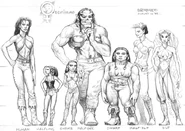
](https://forgottenrealms.fandom.com/wiki/File:FemaleDemikindII.jpg "FemaleDemikindII.jpg (140 KB)")
3rd-edition concept art showing a female human and other races with a height chart.
[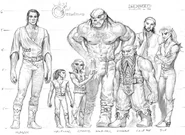
](https://forgottenrealms.fandom.com/wiki/File:MaleDemikindII.jpg "MaleDemikindII.jpg (154 KB)")
3rd-edition concept art showing a male human and other races with a height chart.
[
](https://forgottenrealms.fandom.com/wiki/File:Elf_wizard.jpg "Elf wizard.jpg (110 KB)")
A wizardly elf.
[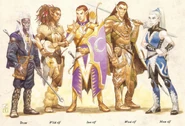
](https://forgottenrealms.fandom.com/wiki/File:Tel-quessir_races_-_Steve_Prescott.jpg "Tel-quessir races - Steve Prescott.jpg (113 KB)")
From left to right: a drow, a wild elf, a sun elf, a wood elf, and a moon elf.
AD
Advertisement
External Links[]
Disclaimer: The views expressed in the following links do not necessarily represent the views of the editors of this wiki, nor does any lore presented necessarily adhere to established canon. Please consider using affiliate links before purchases to support the wiki.
 Elf article at the Dark Sun Wiki, a wiki for the Dark Sun campaign setting.
 Elf article at the Dragonlance Wiki, a wiki for the Dragonlance campaign setting.
 Elf article at the Eberron Wiki, a wiki for the Eberron campaign setting.
 Elves article at the Greyhawk Wiki, a wiki for the Greyhawk campaign setting.
 Elf article at the Spelljammer Wiki, a wiki for the Spelljammer campaign setting.
 Elf article at the Critical Role Wiki.
 Elf article at the Baldur's Gate 3 Community Wiki, a community wiki for Baldur's Gate 3.
References[]
- ↑ Jeff Grubb and Ed Greenwood (1990). Forgotten Realms Adventures. (TSR, Inc). ISBN 0-8803-8828-5.
- ↑ Jump up to: 2.0 2.1 2.2 2.3 Steven E. Schend and Kevin Melka (1998). Cormanthyr: Empire of the Elves. (TSR, Inc), p. 14. ISBN 0-7069-0761-4.
- ↑ Jump up to: 3.0 3.1 Reynolds, Forbeck, Jacobs, Boyd (March 2003). Races of Faerûn. (Wizards of the Coast), p. 26. ISBN 0-7869-2875-1.
- ↑ Ed Greenwood (August 2006). Swords of Eveningstar. (Wizards of the Coast), chap. 3, p. 34. ISBN 978-0-7869-4022-6.
- ↑ Jump up to: 5.00 5.01 5.02 5.03 5.04 5.05 5.06 5.07 5.08 5.09 Mike Mearls, Jeremy Crawford (2014). Player's Handbook 5th edition. (Wizards of the Coast), pp. 21–24. ISBN 978-0-7869-6560-1.
- ↑ Jump up to: 6.0 6.1 Mike Mearls, Stephen Schubert, James Wyatt (June 2008). Monster Manual 4th edition. (Wizards of the Coast), pp. 102, 106. ISBN 978-0-7869-4852-9.
- ↑ Jump up to: 7.0 7.1 Skip Williams, Jonathan Tweet, Monte Cook (July 2003). Monster Manual v.3.5. (Wizards of the Coast), p. 102. ISBN 0-7869-2893-X.
- ↑ Jump up to: 8.0 8.1 8.2 8.3 8.4 Doug Stewart (June 1993). Monstrous Manual. (TSR, Inc), pp. 108–109. ISBN 1-5607-6619-0.
- ↑ Jump up to: 9.0 9.1 Gary Gygax (December 1977). Monster Manual, 1st edition. (TSR, Inc), p. 39. ISBN 0-935696-00-8.
- ↑ Jump up to: 10.0 10.1 Mike Mearls, Jeremy Crawford (May 29, 2018). Mordenkainen's Tome of Foes. Edited by Kim Mohan, Michele Carter. (Wizards of the Coast), p. 48. ISBN 978-0786966240.
- ↑ Jump up to: 11.0 11.1 11.2 11.3 11.4 Jonathan Tweet, Monte Cook, Skip Williams (July 2003). Player's Handbook v.3.5. (Wizards of the Coast), p. 16. ISBN 0-7869-2886-7.
- ↑ Jump up to: 12.00 12.01 12.02 12.03 12.04 12.05 12.06 12.07 12.08 12.09 12.10 12.11 12.12 12.13 12.14 12.15 12.16 12.17 12.18 12.19 Steve Kenson, et al. (November 2015). Sword Coast Adventurer's Guide. Edited by Kim Mohan. (Wizards of the Coast), pp. 105–107. ISBN 978-0-7869-6580-9.
- ↑ Jonathan Tweet, Monte Cook, Skip Williams (July 2003). Player's Handbook v.3.5. (Wizards of the Coast), p. 109. ISBN 0-7869-2886-7.
- ↑ Jump up to: 14.0 14.1 Jonathan Tweet, Monte Cook, Skip Williams (July 2003). Player's Handbook v.3.5. (Wizards of the Coast), p. 15. ISBN 0-7869-2886-7.
- ↑ Jump up to: 15.0 15.1 15.2 15.3 15.4 15.5 15.6 15.7 15.8 Rob Heinsoo, Andy Collins, James Wyatt (June 2008). Player's Handbook 4th edition. (Wizards of the Coast), pp. 40–41. ISBN 0-7869-4867-1.
- ↑ Jump up to: 16.0 16.1 16.2 16.3 Rob Heinsoo, Logan Bonner, Robert J. Schwalb (September 2008). Forgotten Realms Player's Guide. (Wizards of the Coast), p. 15. ISBN 978-0-7869-4929-8.
- ↑ Jonathan Tweet, Monte Cook, Skip Williams (August 2000). Player's Handbook 3rd edition. (Wizards of the Coast), p. 15. ISBN 0-7869-1551-4.
- ↑ Jump up to: 18.0 18.1 18.2 Skip Williams, Jonathan Tweet and Monte Cook (October 2000). Monster Manual 3rd edition. (Wizards of the Coast), p. 86. ISBN 0-7869-1552-1.
- ↑ Jump up to: 19.0 19.1 Jonathan Tweet, Monte Cook, Skip Williams (July 2003). Player's Handbook v.3.5. (Wizards of the Coast), p. 16. ISBN 0-7869-2886-7.
- ↑ Jump up to: 20.0 20.1 Skip Williams, Jonathan Tweet and Monte Cook (October 2000). Monster Manual 3rd edition. (Wizards of the Coast), p. 85. ISBN 0-7869-1552-1.
- ↑ R.A. Salvatore (July 2000). The Chaos Curse. (Wizards of the Coast), p. 70. ISBN 0-7869-1608-7.
- ↑ Ed Greenwood, Sean K. Reynolds, Skip Williams, Rob Heinsoo (June 2001). Forgotten Realms Campaign Setting 3rd edition. (Wizards of the Coast), p. 13. ISBN 0-7869-1836-5.
- ↑ Colin McComb (1993). The Complete Book of Elves. (TSR, Inc), p. 6. ISBN 1-56076-376-0.
- ↑ Colin McComb (1993). The Complete Book of Elves. (TSR, Inc), pp. 48, 82, 117. ISBN 1-56076-376-0.
- ↑ Jump up to: 25.0 25.1 25.2 Steven E. Schend and Kevin Melka (1998). Cormanthyr: Empire of the Elves. (TSR, Inc), p. 15. ISBN 0-7069-0761-4.
- ↑ James Wyatt (November 2007). “A Fractured Family: Elvish Strife, Separation, and Rebirth”. In Chris Youngs ed. Dragon #361 (Wizards of the Coast), pp. 8–12.
- ↑ Elaine Cunningham (April 2003). Windwalker (Hardcover). (Wizards of the Coast), p. 148. ISBN 0-7869-2968-5.
- ↑ Bruce R. Cordell, Ed Greenwood, Chris Sims (August 2008). Forgotten Realms Campaign Guide. Edited by Jennifer Clarke Wilkes, et al. (Wizards of the Coast), p. 68. ISBN 978-0-7869-4924-3.
- ↑ Rob Heinsoo, Andy Collins, James Wyatt (June 2008). Player's Handbook 4th edition. (Wizards of the Coast), p. 39. ISBN 0-7869-4867-1.
- ↑ Jump up to: 30.0 30.1 30.2 Steven E. Schend and Kevin Melka (1998). Cormanthyr: Empire of the Elves. (TSR, Inc), p. 19. ISBN 0-7069-0761-4.
- ↑ Ed Greenwood, Sean K. Reynolds, Skip Williams, Rob Heinsoo (June 2001). Forgotten Realms Campaign Setting 3rd edition. (Wizards of the Coast), p. 15. ISBN 0-7869-1836-5.
- ↑ Jump up to: 32.0 32.1 32.2 32.3 Reynolds, Forbeck, Jacobs, Boyd (March 2003). Races of Faerûn. (Wizards of the Coast), p. 45. ISBN 0-7869-2875-1.
- ↑ Reynolds, Forbeck, Jacobs, Boyd (March 2003). Races of Faerûn. (Wizards of the Coast), pp. 118–9. ISBN 0-7869-2875-1.
- ↑ Eric L. Boyd (December 2006). “Legacies of Ancient Empires: Planetouched of Faerûn”. In Erik Mona ed. Dragon #350 (Paizo Publishing, LLC), pp. 52–53.
- ↑ Richard Lee Byers (August 2003). Dissolution. (Wizards of the Coast), chap. 5, pp. 72–73. ISBN 0-7869-2944-8.
- ↑ Mike Mearls, Jeremy Crawford (May 29, 2018). Mordenkainen's Tome of Foes. Edited by Kim Mohan, Michele Carter. (Wizards of the Coast), pp. 36–37. ISBN 978-0786966240.
- ↑ Jump up to: 37.0 37.1 Steven E. Schend and Kevin Melka (1998). Cormanthyr: Empire of the Elves. (TSR, Inc), p. 20. ISBN 0-7069-0761-4.
- ↑ Bruce R. Cordell, Ed Greenwood, Chris Sims (August 2008). Forgotten Realms Campaign Guide. Edited by Jennifer Clarke Wilkes, et al. (Wizards of the Coast), p. 73. ISBN 978-0-7869-4924-3.
- ↑ Mike Mearls, Jeremy Crawford (May 29, 2018). Mordenkainen's Tome of Foes. Edited by Kim Mohan, Michele Carter (Wizards of the Coast), pp 36-37. ISBN 978-0786966240.
- ↑ Jump up to: 40.0 40.1 Brian R. James, Ed Greenwood (September 2007). The Grand History of the Realms. Edited by Kim Mohan, Penny Williams. (Wizards of the Coast), p. 8. ISBN 978-0-7869-4731-7.
- ↑ Jump up to: 41.0 41.1 Steven E. Schend and Kevin Melka (1998). Cormanthyr: Empire of the Elves. (TSR, Inc), pp. 21, 25. ISBN 0-7069-0761-4.
- ↑ Elaine Cunningham (1999). Evermeet: Island of Elves. (Wizards of the Coast), chap. 6, pp. 93–105. ISBN 0-7869-1354-1.
- ↑ Brian R. James, Ed Greenwood (September 2007). The Grand History of the Realms. Edited by Kim Mohan, Penny Williams. (Wizards of the Coast), p. 12. ISBN 978-0-7869-4731-7.
- ↑ Steven E. Schend and Kevin Melka (1998). Cormanthyr: Empire of the Elves. (TSR, Inc), p. 22. ISBN 0-7069-0761-4.
- ↑ Brian R. James, Ed Greenwood (September 2007). The Grand History of the Realms. Edited by Kim Mohan, Penny Williams. (Wizards of the Coast), p. 15. ISBN 978-0-7869-4731-7.
- ↑ Steven E. Schend and Kevin Melka (1998). Cormanthyr: Empire of the Elves. (TSR, Inc), pp. 23, 25. ISBN 0-7069-0761-4.
- ↑ Brian R. James, Ed Greenwood (September 2007). The Grand History of the Realms. Edited by Kim Mohan, Penny Williams. (Wizards of the Coast), p. 16. ISBN 978-0-7869-4731-7.
- ↑ Rob Heinsoo, Logan Bonner, Robert J. Schwalb (September 2008). Forgotten Realms Player's Guide. (Wizards of the Coast), pp. 15–16. ISBN 978-0-7869-4929-8.
- ↑ Reynolds, Forbeck, Jacobs, Boyd (March 2003). Races of Faerûn. (Wizards of the Coast), p. 43. ISBN 0-7869-2875-1.
- ↑ Ed Greenwood, Sean K. Reynolds, Skip Williams, Rob Heinsoo (June 2001). Forgotten Realms Campaign Setting 3rd edition. (Wizards of the Coast), pp. 13–15. ISBN 0-7869-1836-5.
- ↑ Steven E. Schend and Kevin Melka (1998). Cormanthyr: Empire of the Elves. (TSR, Inc), p. 16. ISBN 0-7069-0761-4.
AD
Advertisement
Connections[]
Tel-quessir/Elves
High elves: Grey elf • Llewyrr • Moon elf • Star elf • Sun elf
Aquatic Elves: Aquatic elf • Marel
Dark elves: Drow • Aevendrow • Lorendrow • Udadrow
Sylvan Elves: Wild elf • Wood elf
Miscellaneous: Astral elf • Athasian • Avariel • Dusk elf • Lythari • Poscadar elf • Snow elf
Related races
Planetouched: Celadrin • Draegloth • Eladrin • Fey'ri • Shadar-kai
Humanblood: Crinti • Half-elf • Half-drow • Half-sea elf
Dragonblood: Drow-dragon (shadow) • Drow-dragon (deep) • Zekyl • Zar'ithra
Miscellaneous: Drider • Maraloi • Vampire
Source: Forgotten Realms Wiki
Seldarine
[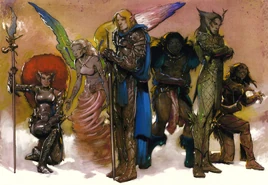
](https://static.wikia.nocookie.net/forgottenrealms/images/e/e9/Elven_Pantheon.jpg/revision/latest?cb=20210305205349 "Elven Pantheon")
Seldarine
Basic Information[1]
Base of
operations
Leader(s)
Membership
Alignment
| LG | NG | CG |
| LN | N | CN |
| LE | NE | CE |
Race(s)
Relationships
Enemies
The Dark Seldarine (except for Eilistraee)
The Seldarine (Elvish for "fellowship of brothers and sisters of the wood") was the elven pantheon of gods that resided on the astral dominion of Arvandor under the leadership of Corellon Larethian.[2]
Contents
AD
Advertisement
Members
The many members of the Seldarine included:
- Greater gods: - Corellon Larethian, leader of the Seldarine; he was the elven god of magic, warfare, music, art, and crafts.
- Angharradh, consort to Corellon; commonly believed to be a combination of three other elven goddesses (Sehanine Moonbow, Aerdrie Faenya, and Hanali Celanil) formed when Lolth rebelled and was exiled.
- Intermediate gods: - Aerdrie Faenya, goddess of the wind, weather, avariel and aarakocra.
- Deep Sashelas, god of the seas and of the aquatic elves, leader of the Asathalfinare pantheon.
- Erevan Ilesere, god of trickery, mischief, and rogues.
- Hanali Celanil, goddess of romantic love, beauty, joy and celadrins.
- Labelas Enoreth, deity of time, history, and knowledge.
- Rillifane Rallathil, god of nature, woodlands, and wild elves and/or wood elves.
- Sehanine Moonbow, goddess of the moon, dreams, mysteries, secrets, travel/journeys; she is also the protector of the elven dead and patron of the moon elves. Often described as Corellon's consort.
- Solonor Thelandira, god of hunting, archery, and survival. He was also the guardian of the boundaries between civilization and the wilds.
- Tarsellis Meunniduin, god of mountains, rivers, wilderness and snow elves.[3]
- Vandria Gilmadrith, goddess of grief, justice, vigilance and war.[4]
- Lesser gods: - Araleth Letheranil, god of starlight and twilight.[3]
- Avachel, the male elven manifestation of the draconic deity Hlal.[5]
- Fenmarel Mestarine, god of outcasts, scapegoats, and isolation.
- Khalreshaar, an interloper demigoddess[6] in the elven pantheon, aspect of Mielikki. Believed by half-elves to be the daughter of Silvanus and Hanali Celanil, and as such, the first truly half-elven deity.[7]
- Melira Taralen, goddess of bards and minstrels.[3]
- Naralis Analor, god of healing and suffering.[3]
- Rellavar Danuvien, god of cold and protection from the elements.[3]
- Sarula Iliene, goddess of nixies and water magic who attached herself to the Seldarine.[8]
- Demigods: - Alathrien Druanna, demigoddess of runic and conjuration magic.[8]
- Darahl Firecloak, demigod of earth and fire magic.[8]
- Lashrael and Felarathael, twin solars serving Corellon Larethian who were worshiped as demigods by some elves, particularly sun elves[5]
- Mythrien Sarath, demigod of mythals.[8]
- Shevarash, demigod of vengeance, loss, and hatred of the drow.
- Tethrin Veraldé, demigod of bladesingers and swordsmanship.[3]
Worship
Each member of the Seldarine was represented by both male and female forms. For example, in Cormanthor, there were statues of the Seldarine in either both their male and female forms or in a single androgynous form. Some gods even had more than three forms, including nonhumanoid forms.[9]
In fact, the elves found the human obsession with biological sex and gender roles to be limiting and not befitting of a deity, who was beyond mortal definitions. All gods were to be respected, not squeezed into a role that presented them as little more than powerful versions of mortals at best or spoiled children at worst.[9]
History
Myths & Lore
| This section is a stub. You can help us by expanding it. |
Among their accomplishments as an organisation, the Seldarine are reputed to have driven the Ordning from their realm before settling there, only allowing Iallanis to remain because she did not fight back. Because of this, they did not hold much respect for her.
AD
Advertisement
War of the Seldarine
In −30,000 DR,[10][11] Araushnee, with the help of her son Vhaeraun, gathered a host of evil deities opposed to the Seldarine, and convinced them to attack Arvandor, in an attempt to overthrow Corellon.[12] Ghaunadaur entered the fray on his own without being asked by anyone.[13]
She had planned for the assault to ultimately fail, as her actual goal was for his consort to be killed during the battle and to replace him as Coronal of Arvandor.[14] She tricked Eilistraee into dangerously injuring her own father,[15] but the Weaver's conspiracy was ultimately thwarted by Sehanine Moonbow, and Corellon's life was saved.[16] Angharradh arose from the great battle between the Seldarine and the followers of Araushnee. Aerdrie, Hanali and Sehanine came together to heal Corellon Larethian after he was felled by Eilistraee who was fooled by Araushnee. As they did so, they formed Angharradh, serving alongside Corellon as the Queen of Arvandor.[17][18]. After her betrayal was revealed, Araushnee was banished by Corellon and turned into a tanar'ri,[19] while Vhaeraun was simply exiled.[20] Even though she was cleared from all guilt, Eilistraee chose to share her mother's and brother's punishment, because she knew that the drow would need her light in the times to come.[21]
The wizard Mordenkainen recorded a different version of this story. According to him, all elves, including the ones who would become the deities of the Seldarine and of the Dark Seldarine, emerged from the blood that Corellon lost in a fight against Gruumsh. Like their god, the first elves had shape-changing powers, and freedom with them. The Protector took some favorites, who were made deities: among them, Lolth was the most privileged. She saw that other races made something out of their lives, and made the argument that the elves should do the same by casting off their shape-changing powers in exchange of a fixed form, that would allow them to gain dominion over everything. Every single elf agreed and chose such a form, but Corellon was revolted by their decision and railed against Lolth. The god was stopped with the argument that nobody of his blood should be attacked, and, while he was thinking about it, Lolth used the opportunity to attempt to murder him. Realizing the extent of Lolth's betrayal, many elves intervened to stop her, but some remained loyal to the Spider Queen: the latter became the dark elves and their gods, and Lolth became a demon lord of the Abyss.[22] Eilistraee was an exception in this version too, for she did not side with Lolth, but still chose to follow the dark elves.[23] Araushnee took the name of Lolth, and made the 66th layer of the Abyss, the Demonweb Pits, her new home.[24]
Modern History
| This section is a stub. You can help us by expanding it. |
The events of the Spellplague affected the Seldarine, though perhaps not as harshly as it did some of the other deities. However, several of the gods, such as Deep Sashelas, Labelas, Solonor, Erevan, Fenmarel, and Shevarash all became exarchs. Corellon and Angharradh managed to hang on to their original positions, but Hanali became the elven aspect of Sune, and Sehanine of Selune.
After the Second Sundering, order was restored, and the Seldarine was back to the way it was prior to the Spellplague, with Sehanine being described as Corellon's main consort/beloved.
Appendix
Further Reading
- Denise Lyn Voskuil (March 1990). “The Elfin Gods”. In Roger E. Moore ed. Dragon #155 (TSR, Inc.), pp. 20–22, 24.
- Chris Perry (December 1991). “Servants of the Seldarine”. In Roger E. Moore ed. Dragon #176 (TSR, Inc.), pp. 11–15.
- Chris Perry (December 1996). “The Seldarine Revisited”. In Pierce Watters ed. Dragon #236 (TSR, Inc.), pp. 13–17;25.
- Chris Perry (September 1998). “Magic of the Seldarine”. In Dave Gross ed. Dragon #251 (TSR, Inc.), pp. 28–35.
References
- ↑ Mike Mearls, Jeremy Crawford (May 29, 2018). Mordenkainen's Tome of Foes. Edited by Kim Mohan, Michele Carter. (Wizards of the Coast), pp. 43–49. ISBN 978-0786966240.
- ↑ Bruce R. Cordell, Ed Greenwood, Chris Sims (August 2008). Forgotten Realms Campaign Guide. Edited by Jennifer Clarke Wilkes, et al. (Wizards of the Coast), p. 73. ISBN 978-0-7869-4924-3.
- ↑ Jump up to: 3.0 3.1 3.2 3.3 3.4 3.5 Chris Perry (December 1996). “The Seldarine Revisited”. In Pierce Watters ed. Dragon #236 (TSR, Inc.), pp. 11–17, 25.
- ↑ Skip Williams (February 2005). Races of the Wild. (Wizards of the Coast), pp. 23–24. ISBN 0-7869-3438-7.
- ↑ Jump up to: 5.0 5.1 Eric L. Boyd (November 1998). Demihuman Deities. Edited by Julia Martin. (TSR, Inc.), pp. 121–122. ISBN 0-7869-1239-1.
- ↑ Anne Gray McCready et al. (March 1994). Elves of Evermeet. (TSR, Inc), p. 78. ISBN 1-5607-6829-0.
- ↑ Eric L. Boyd (November 1998). Demihuman Deities. Edited by Julia Martin. (TSR, Inc.), p. 142. ISBN 0-7869-1239-1.
- ↑ Jump up to: 8.0 8.1 8.2 8.3 Chris Perry (September 1998). “Magic of the Seldarine”. In Dave Gross ed. Dragon #251 (TSR, Inc.), pp. 28–35.
- ↑ Jump up to: 9.0 9.1 Steven E. Schend and Kevin Melka (1998). Cormanthyr: Empire of the Elves. (TSR, Inc), p. 52. ISBN 0-7069-0761-4.
- ↑ Brian R. James, Ed Greenwood (September 2007). The Grand History of the Realms. Edited by Kim Mohan, Penny Williams. (Wizards of the Coast), p. 8. ISBN 978-0-7869-4731-7.
- ↑ Richard Baker, Ed Bonny, Travis Stout (February 2005). Lost Empires of Faerûn. Edited by Penny Williams. (Wizards of the Coast), p. 51. ISBN 0-7869-3654-1.
- ↑ Elaine Cunningham (1999). Evermeet: Island of Elves. (Wizards of the Coast), p. 51. ISBN 0-7869-1354-1.
- ↑ Elaine Cunningham (1999). Evermeet: Island of Elves. (Wizards of the Coast), p. 137. ISBN 0-7869-1354-1.
- ↑ Elaine Cunningham (1999). Evermeet: Island of Elves. (Wizards of the Coast), p. 50. ISBN 0-7869-1354-1.
- ↑ Elaine Cunningham (1999). Evermeet: Island of Elves. (Wizards of the Coast), pp. 61–62. ISBN 0-7869-1354-1.
- ↑ Elaine Cunningham (1999). Evermeet: Island of Elves. (Wizards of the Coast), pp. 65–66. ISBN 0-7869-1354-1.
- ↑ Eric L. Boyd, Erik Mona (May 2002). Faiths and Pantheons. Edited by Gwendolyn F.M. Kestrel, et al. (Wizards of the Coast), p. 125. ISBN 0-7869-2759-3.
- ↑ Eric L. Boyd (November 1998). Demihuman Deities. Edited by Julia Martin. (TSR, Inc.), p. 97. ISBN 0-7869-1239-1.
- ↑ Elaine Cunningham (1999). Evermeet: Island of Elves. (Wizards of the Coast), pp. 70–72. ISBN 0-7869-1354-1.
- ↑ Elaine Cunningham (1999). Evermeet: Island of Elves. (Wizards of the Coast), p. 67. ISBN 0-7869-1354-1.
- ↑ Elaine Cunningham (1999). Evermeet: Island of Elves. (Wizards of the Coast), p. 69. ISBN 0-7869-1354-1.
- ↑ Mike Mearls, Jeremy Crawford (May 29, 2018). Mordenkainen's Tome of Foes. Edited by Kim Mohan, Michele Carter. (Wizards of the Coast), pp. 35–36. ISBN 978-0786966240.
- ↑ Mike Mearls, Jeremy Crawford (May 29, 2018). Mordenkainen's Tome of Foes. Edited by Kim Mohan, Michele Carter. (Wizards of the Coast), pp. 55–56. ISBN 978-0786966240.
- ↑ Eric L. Boyd (November 1998). Demihuman Deities. Edited by Julia Martin. (TSR, Inc.), p. 26. ISBN 0-7869-1239-1.
AD
Advertisement
Connections
The Seldarine
The Elven Pantheon
Aerdrie Faenya • Alathrien Druanna • Alobal Lorfiril • Angharradh • Araleth Letheranil • Corellon Larethian • Darahl Firecloak • Deep Sashelas • Elebrin Liothiel • Erevan Ilesere • Fenmarel Mestarine • Hanali Celanil • Khalreshaar • Kirith Sotheril • Labelas Enoreth • Melira Taralen • Mythrien Sarath • Naralis Analor • Rellavar Danuvien • Rillifane Rallathil • Sarula Iliene • Sehanine Moonbow • Shevarash • Solonor Thelandira • Tarsellis Meunniduin • Tethrin Veraldé • Vandria Gilmadrith • Zandilar
Source: Forgotten Realms Wiki
Redtooth Werefox
Medium Monstrosity (Elf), Any Alignment
- Armor Class 13
- Hit Points 60 (11d8 + 11)
- Hit Points 60 (11d8 + 11)
- Speed 30 ft. (in elf form; 40 ft. in fox and hybrid form)
STR DEX CON INT WIS CHA 16 (+3) 17 (+3) 12 (+1) 11 (+0) 13 (+1) 10 (+0)
- Skills Acrobatics +5, Perception +5, Survival +3
- Senses darkvision 60 ft., passive Perception 15
- Languages Common, Elvish (can't speak in fox form)
- Challenge 3 (700 XP)
- Proficiency Bonus +2
Actions
Multiattack. The werefox makes two Bite attacks, two Lance attacks, or one Bite attack and one Lance attack.
Bite (Fox or Hybrid Form Only). Melee Weapon Attack: +5 to hit, reach 5 ft., one target. Hit: 8 (1d10 + 3) piercing damage. If the werefox moved at least 20 feet straight toward the target immediately before the hit and the target is a Medium or smaller creature, the target must succeed on a DC 13 Strength saving throw or have the prone condition.
Lance (Elf or Hybrid Form Only). Melee Weapon Attack: +5 to hit, reach 10 ft., one target. Hit: 9 (1d12 + 3) piercing damage.
Entangling Arrow (Elf or Hybrid Form Only). Ranged Weapon Attack: +5 to hit, range 150/600 ft., one target. Hit: 10 (2d6 + 3) piercing damage, and the target must succeed on a DC 11 Dexterity saving throw or have the restrained condition until the start of the werefox's next turn.
Bonus Actions
Change Shape. The werefox polymorphs into a fox-elf hybrid, into a fox, or back into its elf form. Its game statistics, other than its speed, are the same in each form. Any equipment it is wearing or carrying isn't transformed. It reverts to its elf form if it dies.
Vulpine Nimbleness (Fox or Hybrid Form Only). The werefox takes the Dash or Disengage action.
Wood Elf
Medium Humanoid (Wood Elf), Chaotic Good
- Armor Class 13 (leather armor)
- Hit Points 16 (3d8 + 3)
- Hit Points 16 (3d8 + 3)
- Speed 35 ft.
STR DEX CON INT WIS CHA 11 (+0) 14 (+2) 12 (+1) 11 (+0) 13 (+1) 11 (+0)
- Skills Nature +4, Perception +5, Stealth +6, Survival +5
- Senses darkvision 60 ft., passive Perception 15
- Languages Common, Elvish
- Challenge 1/2 (100 XP)
- Proficiency Bonus +2
Fey Ancestry. The wood elf has advantage on saving throws against being charmed, and magic can't put the wood elf to sleep.
Keen Hearing and Sight. The wood elf has advantage on Wisdom (Perception) checks that rely on hearing or sight.
Mask of the Wild. The wood elf can attempt to hide even when they are only lightly obscured by foliage, heavy rain, falling snow, mist, and other natural phenomena.
Actions
Multiattack. The wood elf makes two melee attacks or two ranged attacks.
Shortsword. Melee Weapon Attack: +4 to hit, reach 5 ft., one target. Hit: 5 (1d6 + 2) piercing damage.
Longbow. Ranged Weapon Attack: +4 to hit, ranged 150/600 ft., one target. Hit: 6 (1d8 + 2) piercing damage.
Astral Elf Aristocrat
Medium Humanoid (Wizard), Any Alignment
- Armor Class 16 (elven chain)
- Hit Points 103 (23d8)
- Hit Points 103 (23d8)
- Speed 30 ft.
STR DEX CON INT WIS CHA 11 (+0) 14 (+2) 10 (+0) 21 (+5) 18 (+4) 18 (+4)
- Saving Throws Int +8, Wis +7, Cha +7
- Skills Arcana +8, Deception +7, Insight +7, Persuasion +7
- Senses darkvision 60 ft., passive Perception 14
- Languages Celestial, Common, Draconic, Elvish
- Challenge 8 (3,900 XP)
- Proficiency Bonus +3
Special Equipment. The elf wears a suit of elven chain.
Fey Ancestry. The elf has advantage on saving throws it makes to avoid or end the charmed condition on itself, and magic can't put it to sleep.
Unusual Nature. The elf doesn't require sleep.
Actions
Multiattack. The elf makes two Scimitar attacks and uses Radiant Beam (if available).
Scimitar. Melee Weapon Attack: +5 to hit, reach 5 ft., one target. Hit: 5 (1d6 + 2) slashing damage plus 10 (3d6) radiant damage.
Radiant Beam (3/Day). A magical beam of radiance flashes out from the elf's hand in a 5-foot-wide, 60-foot-long line. Each creature in the line must make a DC 16 Constitution saving throw, taking 18 (4d8) radiant damage on a failed save, or half as much damage on a successful one.
Spellcasting. The elf casts one of the following spells, using Intelligence as the spellcasting ability:
1/day each: fly, mislead, sending
Bonus Actions
Starlight Step (3/Day). The elf magically teleports up to 30 feet, along with anything it is wearing or carrying, to an unoccupied space it can see.
Summon Solar Dragon (1/Day). The elf has a 50 percent chance of magically summoning a young solar dragon. A summoned dragon appears in an unoccupied space that the summoner can see, acts on its own initiative count, and is an ally of its summoner. It remains for 10 minutes, until it or its summoner dies, or until its summoner dismisses it as an action.
Sable Elf Hierophant
Medium Humanoid (Sable Elf), Any Alignment
- Armor Class 11 (14 with mage armor)
- Hit Points 90 (20d8)
- Hit Points 90 (20d8)
- Speed 30 ft.
STR DEX CON INT WIS CHA 10 (+0) 13 (+1) 10 (+0) 18 (+4) 11 (+0) 12 (+1)
- Saving Throws Int +8, Wis +4
- Skills Arcana +6, Perception +2, Stealth +3
- Senses darkvision 60 ft., passive Perception 12
- Languages Common, Elvish, Sylvan, Umbral
- Challenge 9 (5,000 XP)
- Proficiency Bonus +4
Fey Ancestry. The sable elf has advantage on saving throws against being charmed, and magic can't put them to sleep.
Actions
Multiattack. The sable elf makes three Spellburn attacks.
Spellburn. Melee Spell Attack: +6 to hit, reach 5 ft., one target. Hit: 27 (5d10) force damage.
Spellcasting. The sable elf casts one of the following spells, using Intelligence as the spellcasting ability (spell save DC 14):
At will: dancing lights, light, mage hand, prestidigitation
2/day each: dispel magic, lightning bolt, mage armor, web
1/day each: banishment, Evard's black tentacles, fire shield, hypnotic pattern, teleportation circleVoice of Hecate (1/Day). Hecate speaks profane words of power through the hierophant. All creatures within 300 feet of the sable elf must succeed on a DC 15 Charisma saving throw or be frightened for 1 minute. A frightened target can repeat the saving throw at the end of each of its turns, ending the effect on itself on a success.
Bonus Actions
Witch Eye. The sable elf can cast detect magic without expending a spell slot.
Sable Elf
Medium Humanoid (Sable Elf), Any Alignment
- Armor Class 13 (leather)
- Hit Points 13 (3d8)
- Hit Points 13 (3d8)
- Speed 30 ft.
STR DEX CON INT WIS CHA 10 (+0) 14 (+2) 10 (+0) 14 (+2) 11 (+0) 12 (+1)
- Skills Arcana +4, Perception +2, Stealth +4
- Senses darkvision 60 ft., passive Perception 12
- Languages Common, Elvish, Sylvan, Umbral
- Challenge 1/4 (50 XP)
- Proficiency Bonus +2
Fey Ancestry. The sable elf has advantage on saving throws against being charmed, and magic can't put the sable elf to sleep.
Actions
Multiattack. The sable elf makes two Shortsword attacks or two Longbow attacks.
Shortsword. Melee Weapon Attack: +4 to hit, reach 5 ft., one target. Hit: 4 (1d6 + 2) piercing damage.
Longbow. Ranged Weapon Attack: +4 to hit, ranged 150/600 ft., one target. Hit: 5 (1d8 + 2) piercing damage.
Spellcasting. The sable elf casts one of the following spells, requiring no material components and using Intelligence as the spellcasting ability (spell save DC 12):
At will: acid splash
1/day each: fog cloud, sleet storm
Mongrelfolk
Medium Humanoid (Mongrelfolk), Any Alignment
- Armor Class 11 (natural armor)
- Hit Points 26 (4d8 + 8)
- Hit Points 26 (4d8 + 8)
- Speed 20 ft.
STR DEX CON INT WIS CHA 12 (+1) 9 (-1) 15 (+2) 9 (-1) 10 (+0) 6 (-2)
- Skills Deception +2, Perception +2, Stealth +3
- Senses passive Perception 12
- Languages Common
- Challenge 1/4 (50 XP)
- Proficiency Bonus +2
Extraordinary Feature. The mongrelfolk has one of the following extraordinary features, determined randomly by rolling a d20 or chosen by the DM:
1–3: Amphibious. The mongrelfolk can breathe air and water.
4–9: Darkvision. The mongrelfolk has darkvision out to a range of 60 feet.
10: Flight. The mongrelfolk has leathery wings and a flying speed of 40 feet.
11–15: Keen Hearing and Smell. The mongrelfolk has advantage on Wisdom (Perception) checks that rely on hearing or smell.
16–17: Spider Climb. The mongrelfolk can climb difficult surfaces, including upside down on ceilings, without needing to make an ability check.
18–19: Standing Leap. The mongrelfolk's long jump is up to 20 feet and its high jump up to 10 feet, with or without a running start.
20: Two-Headed. The mongrelfolk has advantage on Wisdom (Perception) checks and on saving throws against being blinded, charmed, deafened, frightened, stunned, or knocked unconscious.Mimicry. The mongrelfolk can mimic any sounds it has heard, including voices. A creature that hears the sounds can tell they are imitations with a successful DC 12 Wisdom (Insight) check.
Actions
Multiattack. The mongrelfolk makes two attacks: one with its bite and one with its claw or dagger.
Bite. Melee Weapon Attack: +3 to hit, reach 5 ft., one target. Hit: 3 (1d4 + 1) piercing damage.
Claw. Melee Weapon Attack: +3 to hit, reach 5 ft., one target. Hit: 3 (1d4 + 1) slashing damage.
Dagger. Melee or Ranged Weapon Attack: +3 to hit, reach 5 ft. or range 20/60 ft., one target. Hit: 3 (1d4 + 1) piercing damage.
Vex'ahlia
Medium Humanoid (Half-Elf)
- Armor Class 21 (+2 Studded White Dragon Leather Armor of Cold Resistance, +2 ring of protection)
- Hit Points 130 (20d10 + 20)
- Hit Points 130 (20d10 + 20)
- Speed 30 ft., fly 50 ft. (with broom of flying)
STR DEX CON INT WIS CHA 7 (-2) 20 (+5) 12 (+1) 14 (+2) 16 (+3) 17 (+3)
- Saving Throws Str +6, Dex +13, Con +3, Int +4, Wis +5, Cha +5
- Skills Acrobatics +17, Athletics +4, Deception +9, Insight +9, Investigation +8, Perception +15, Persuasion +9, Stealth +17, Survival +9
- Damage Resistances cold
- Senses darkvision 60 ft., passive Perception 25
- Languages Abyssal, Common, Draconic, Elvish, Thieves' Cant, Undercommon
- Challenge 18 (20,000 XP)
- Proficiency Bonus +6
Special Equipment. Vex wears +2 Studded White Dragon Leather Armor of Cold Resistance and a ring of protection with a +2 bonus. She carries a broom of flying and a raven's slumber, and wields Fenthras.
Assassinate. During her first turn, Vex has advantage on attack rolls against any creature that hasn't taken a turn. Any hit Vex scores against a surprised creature is a critical hit.
Evasion. If Vex is subjected to an effect that allows her to make a Dexterity saving throw to take only half damage, she instead takes no damage if she succeeds on the saving throw, and only half damage if she fails.
Fey Ancestry. Vex has advantage on saving throws against being charmed, and magic can't put her to sleep.
Ranged Master. Vex's ranged weapon attacks have a +2 bonus to hit (included in attacks), and ignore half cover and three-quarters cover, and have no range penalty. Additionally, Vex can take a −5 penalty to any ranged attack roll to gain a +10 bonus to the damage roll.
Sneak Attack (1/Turn). Vex deals an extra 14 (4d6) damage when she hits a target with a weapon attack and has advantage on the attack roll, or when the target is within 5 feet of an ally of Vex that isn't incapacitated and she doesn't have disadvantage on the attack roll.
Spellcasting. Vex is a 13th-level spellcaster. Her spell-casting ability is Wisdom (spell save DC 17, +9 to hit with spell attacks). She has the following ranger spells prepared:
1st level (4 slots): cure wounds, hunter's mark
2nd level (3 slots): pass without trace, protection from poison
3rd level (3 slots): lightning arrow, nondetection
4th level (1 slot): freedom of movement, grasping vineTrinket. Trinket moves and acts on Vex's turn, and Vex can use a bonus action to command him to take the Dash, Dodge, Disengage, or Attack action. She can also command him to Attack as part of her Multiattack action (see below). Trinket can take only one action on each of Vex's turns.
Actions
Multiattack. Vex makes two ranged attacks, and can command Trinket to move up to his speed and use his Multiattack action.
Fenthras. Ranged Weapon Attack: +16 to hit, range 600 ft., one target. Hit: 22 (1d8 + 18) piercing damage and 3 (1d6) lightning damage, and Vex can use the following ability:
Bramble Shot (2/Short Rest). The attack deals an extra 18 (4d8) piercing damage, and the target must succeed on a DC 17 Strength saving throw or be restrained. The target can repeat the saving throw at the end of each of its turns, ending the effect on itself on a success.
Bonus Actions
Cunning Action. Vex takes the Dash, Disengage, or Hide action.
Hunter's Mark. Vex casts hunter's mark to mark a creature she can see within 90 feet of her. For 1 hour, Vex's weapon attacks deal an extra 1d6 damage to the marked creature, and she has advantage on Wisdom (Perception) and Wisdom (Survival) checks made to find it.
Reactions
Uncanny Dodge. When an attacker that Vex can see hits her with an attack, she takes half damage from the attack.
Suldil Baldoriel
Medium Humanoid (Half-Elf), Chaotic Good
- Armor Class 12 (15 with mage armor)
- Hit Points 137 (25d8 + 25)
- Hit Points 137 (25d8 + 25)
- Speed 30 ft.
STR DEX CON INT WIS CHA 10 (+0) 14 (+2) 12 (+1) 12 (+1) 14 (+2) 20 (+5)
- Saving Throws Con +5, Cha +9
- Skills Arcana +9, Deception +9, Persuasion +9
- Damage Resistances lightning
- Senses passive Perception 12
- Languages Celestial, Common, Draconic, Elvish
- Challenge 10 (5,900 XP)
- Proficiency Bonus +4
Young Bronze Dragon. Suldil is accompanied by a young bronze dragon. The dragon allows Suldil to use him as a mount.
Actions
Bronze Bolt. Melee or Ranged Spell Attack: +9 to hit, reach 5 ft. or range 120 ft., one target. Hit: 21 (3d10 + 5) lightning damage.
Explosion (1/Day). Suldil discharges a burst of energy in a 60-foot-radius. Each creature in that area must make a DC 17 Dexterity saving throw, taking 44 (8d10) lightning damage on failed save, half as much damage on a successful save.
Spellcasting. Suldil casts one of the following spells, using Charisma as the spellcasting ability (spell save DC 17):
At will: detect magic, light, mage hand
2/day each: counterspell, shield
1/day: disintegrateBonus Actions
Mounted. If Suldil isn't mounted, she can use a bonus action to magically teleport onto her young bronze dragon mount, provided Suldil and the young bronze dragon are on the same plane of existence. When she teleports, Suldil appears astride the young bronze dragon along with any equipment she is wearing or carrying. While mounted and not incapacitated, Suldil can't be surprised, and both her and her mount gain advantage on Dexterity saving throws.
Keyleth, Voice of the Tempest
Medium Humanoid (Half-Elf)
- Armor Class 17 (+2 leather armor, +2 ring of protection)
- Hit Points 150 (20d8 + 60)
- Hit Points 150 (20d8 + 60)
- Speed 30 ft.
STR DEX CON INT WIS CHA 14 (+2) 15 (+2) 16 (+3) 15 (+2) 22 (+6) 15 (+2)
- Saving Throws Str +4, Dex +4, Con +5, Int +10, Wis +14, Cha +4
- Skills Athletics +8, Insight +12, Intimidation +8, Nature +12, Perception +12, Persuasion +8, Stealth +8, Survival +12
- Senses darkvision 60 ft., passive Perception 22
- Languages Auran, Common, Druidic, Elvish
- Challenge 18 (20,000 XP)
- Proficiency Bonus +6
Special Equipment. Keyleth wears a circlet of wisdom (which increases her Wisdom score by 2), +2 leather armor, and a ring of protection with a +2 bonus. She wields the Spire of Conflux.
Fey Ancestry. Keyleth has advantage on saving throws against being charmed, and magic can't put her to sleep.
Focused. Keyleth has advantage on Constitution saving throws made to maintain concentration on spells.
Spellcasting. Keyleth is a 20th-level spellcaster. Her spellcasting ability is Wisdom (spell save DC 22, +14 to hit with spell attacks). She has the following druid spells prepared:
Cantrips (at will): druidcraft, guidance, mending
1st level (4 slots): cure wounds, faerie fire, fog cloud, healing word, thunderwave
2nd level (3 slots): alter self (at will), flaming sphere, gust of wind, pass without trace
3rd level (3 slots): call lightning, wind wall
4th level (3 slots): blight, control water, grasping vine, polymorph, stone shape
5th level (3 slots): conjure elemental, greater restoration, scrying, wall of stone
6th level (2 slots): heroes' feast, move earth, transport via plants
7th level (2 slots): fire storm, plane shift
8th level (1 slot): control weather
9th level (1 slot): foresight, shapechangeActions
Shapechange. Keyleth casts shapechange to transform into a planetar, an adult bronze dragon, or another creature of CR 20 or lower that is not a construct or undead.
Meteor (Earth Elemental Form Only). When Keyleth falls at least 20 feet, she lands with meteoric force. Each creature within 20 feet of her must succeed on a DC 19 Dexterity saving throw or take 1d6 bludgeoning damage for every 10 feet Keyleth fell. Keyleth still takes falling damage while in earth elemental form.
Chain Lightning. Keyleth casts chain lightning (spell save DC 22) from the Spire of Conflux at a creature she can see within 150 feet of her.
Bonus Actions
Wild Shape. Keyleth magically polymorphs into a beast or elemental of CR 6 or lower. Her game statistics are replaced by the statistics of the new form, but she retains her alignment, personality, and Intelligence, Wisdom, and Charisma scores. She also retains all of her skill and saving throw proficiencies, in addition to gaining those of the new form. She assumes the new form's hit points and Hit Dice and returns to the number of hit points she had when she reverts to her normal form. Any equipment she is wearing or carrying is absorbed or borne by her new form (her choice). She reverts to her humanoid form as a bonus action, or when she falls unconscious. Her attacks in Wild Shape form are magical, and she can cast spells while transformed.
Healing Word (4th Level). Keyleth casts healing word, restoring 16 (4d4 + 6) hit points to herself or another creature she can see within 60 feet of her.
Jaheira
Medium Humanoid (Half-Elf), Neutral
- Armor Class 11 (16 with barkskin)
- Hit Points 150 (20d8 + 60)
- Hit Points 150 (20d8 + 60)
- Speed 30 ft.
STR DEX CON INT WIS CHA 14 (+2) 12 (+1) 16 (+3) 12 (+1) 20 (+5) 15 (+2)
- Saving Throws Con +8, Wis +10
- Skills Medicine +10, Nature +6, Perception +10
- Senses darkvision 60 ft., passive Perception 20
- Languages Common, Druidic, Elvish, Sylvan
- Challenge 13 (10,000 XP)
- Proficiency Bonus +5
Fey Ancestry. Jaheira has advantage on saving throws against being charmed, and magic can't put Jaheira to sleep.
Actions
Multiattack. Jaheira makes three Quarterstaff attacks.
Quarterstaff. Melee Weapon Attack: +10 to hit, reach 5 ft., one target. Hit: 5 (1d8 + 5) bludgeoning damage plus 21 (6d6) thunder damage.
Cleansing Plague (Recharge 6). Jaheira targets a creature she can see within 60 feet and causes a swarm of flying insects to cover the creature. The creature must make a DC 18 Constitution saving throw, taking 44 (8d10) piercing damage on a failed save, or half as much damage on a successful one. If the target fails their saving throw they are also blinded until the end of their next turn.
Spellcasting. Jaheira casts ones of the following spells, using Wisdom as the spellcasting ability (spell save DC 18):
At will: barkskin, druidcraft, poison spray, produce flame, shillelagh
2/day each: animal messenger, commune with nature (as an action), entangle, speak with animals
1/day each: heal, heroes' feast, stoneskinBonus Actions
Mighty Summons (1/Day). Jaheira summons three CR 2 Beasts or six CR 1 Beasts. These summoned creatures have maximum hit points and the damage they inflict is considered magical for the purpose of overcoming immunity and resistance to nonmagical attacks and damage.
King Robbit the Slimy
Small Humanoid (Grung), Lawful Grumpy
- Armor Class 13
- Hit Points 27 (5d6 + 10)
- Hit Points 27 (5d6 + 10)
- Speed 25 ft., climb 25 ft.
STR DEX CON INT WIS CHA 7 (-2) 16 (+3) 15 (+2) 10 (+0) 11 (+0) 15 (+2)
- Saving Throws Dex +5
- Skills Athletics +2, Intimidation +4, Perception +2, Stealth +5
- Damage Immunities poison
- Condition Immunities charmed, poisoned
- Senses passive Perception 12
- Languages Grung
- Challenge 2 (450 XP)
- Proficiency Bonus +2
Amphibious. The grung can breathe air and water.
Poisonous Skin. Any creature that grapples the grung or otherwise comes into direct contact with the grung's skin must succeed on a DC 12 Constitution saving throw or become poisoned for 1 minute. A poisoned creature no longer in direct contact with the grung can repeat the saving throw at the end of each of its turns, ending the effect on itself on a success.
Standing Leap. The grung's long jump is up to 25 feet and its high jump is up to 15 feet, with or without a running start.
Actions
Grumpy Grung Growl.. A ferocious gurgling issues from the throat of the Dankwood grung, warning those within 15 feet that they are indeed grumpy. Creatures in that area must succeed at a DC 12 Charisma saving throw or be frightened until the end of their next turn.
Dagger. Melee or Ranged Weapon Attack: +0 to hit, reach 5 ft. or range 20/60 ft., one target. Hit: 3 (1d4 + 1) piercing damage in melee, or 3 (1d4 + 1) piercing damage at range. Target must succeed on a DC 12 Constitution saving throw or take 5 (2d4) poison damage.
Shortbow. Ranged Weapon Attack: +5 to hit, range 80/320 ft., one target. Hit: 9 (1d6 + 6) piercing damage. Target must succeed on a DC 12 Constitution saving throw or take 5 (2d4) poison damage.
Dankwood Grung
Small Humanoid (Grung), Lawful Grumpy
- Armor Class 13
- Hit Points 27 (5d6 + 10)
- Hit Points 27 (5d6 + 10)
- Speed 25 ft., climb 25 ft.
STR DEX CON INT WIS CHA 7 (-2) 16 (+3) 15 (+2) 10 (+0) 11 (+0) 15 (+2)
- Saving Throws Dex +5
- Skills Athletics +2, Intimidation +4, Perception +2, Stealth +5
- Damage Immunities poison
- Condition Immunities poisoned
- Senses passive Perception 12
- Languages Grung
- Challenge 1 (200 XP)
- Proficiency Bonus +2
Amphibious. The grung can breathe air and water.
Poisonous Skin. Any creature that grapples the grung or otherwise comes into direct contact with the grung's skin must succeed on a DC 12 Constitution saving throw or become poisoned for 1 minute. A poisoned creature no longer indirect contact with the grung can repeat the saving throw at the end of each of its turns, ending the effect on itself on a success.
Standing Leap. The grung's long jump is up to 25 feet and its high jump is up to 15 feet, with or without a running start.
Actions
Grumpy Grung Growl.. A ferocious gurgling issues from the throat of the Dankwood grung, warning those within 15 feet that they are indeed grumpy. Creatures in that area must succeed at a DC 12 Charisma saving throw or be frightened until the end of their next turn.
Dagger. Melee or Ranged Weapon Attack: +0 to hit, reach 5 ft. or range 20/60 ft., one target. Hit: 3 (1d4 + 1) piercing damage in melee, or 3 (1d4 + 1) piercing damage at range. Target must succeed on a DC 12 Constitution saving throw or take 5 (2d4) poison damage.
Drow Favored Consort
Medium Humanoid (Elf, Wizard), Any Alignment
- Armor Class 15
- Hit Points 240 (32d8 + 96)
- Hit Points 240 (32d8 + 96)
- Speed 30 ft.
STR DEX CON INT WIS CHA 15 (+2) 20 (+5) 16 (+3) 18 (+4) 15 (+2) 18 (+4)
- Saving Throws Dex +11, Con +9, Cha +10
- Skills Acrobatics +11, Athletics +8, Perception +8, Stealth +11
- Senses darkvision 120 ft., passive Perception 18
- Languages Elvish, Undercommon
- Challenge 18 (20,000 XP)
- Proficiency Bonus +6
Fey Ancestry. The drow has advantage on saving throws against being charmed, and magic can't put the drow to sleep.
Sunlight Sensitivity. While in sunlight, the drow has disadvantage on attack rolls, as well as on Wisdom (Perception) checks that rely on sight.
Actions
Multiattack. The drow makes three Scimitar or Arcane Eruption attacks. The drow can replace one of the attacks with a use of Spellcasting.
Scimitar. Melee Weapon Attack: +11 to hit, reach 5 ft., one target. Hit: 8 (1d6 + 5) slashing damage plus 27 (6d8) poison damage.
Arcane Eruption. Ranged Spell Attack: +10 to hit, range 120 ft., one target. Hit: 36 (8d8) force damage, and the drow can push the target up to 10 feet away if it is a Large or smaller creature.
Spellcasting. The drow casts one of the following spells, requiring no material components and using Intelligence as the spellcasting ability (spell save DC 18):
At will: dancing lights, mage armor, mage hand, message
3/day each: dimension door, fireball, invisibility
1/day each: darkness, faerie fire, levitate (self only)Reactions
Protective Shield (3/Day). When the drow or a creature within 10 feet of it is hit by an attack roll, the drow gives the target a +5 bonus to its AC until the start of the drow's next turn, which can cause the triggering attack roll to miss.
Xan Moonblade
Medium Humanoid (Elf), Lawful Neutral
- Armor Class 13 (16 with mage armor)
- Hit Points 112 (25d8)
- Hit Points 112 (25d8)
- Speed 30 ft.
STR DEX CON INT WIS CHA 10 (+0) 16 (+3) 11 (+0) 17 (+3) 12 (+1) 11 (+0)
- Saving Throws Int +6, Wis +4
- Skills Acrobatics +9, Arcana +6, History +6, Performance +6
- Senses passive Perception 11
- Languages Common, Elvish
- Challenge 8 (3,900 XP)
- Proficiency Bonus +3
Special Equipment. Xan wields a Moonblade. The Moonblade has a +3 bonus to attack and damage rolls (already factored into Xan's attacks) and has the finesse property.
Enchanter. When Xan casts hideous laughter, hold person, or suggestion, the target has disadvantage on the saving throw.
Fey Ancestry. Xan has advantage on saving throws against being charmed, and magic can't put Xan to sleep.
Actions
Multiattack. Xan makes three Moonblade attacks.
Moonblade. Melee Weapon Attack: +9 to hit, reach 5 ft., one target. Hit: 10 (1d8 + 6) slashing damage or 11 (1d10 + 6) slashing damage if wielded with two hands, plus 7 (2d6) cold or fire damage (Xan's choice).
Spellcasting. Xan casts one of the following spells using Intelligence as the spellcasting ability (spell save DC 14):
At will: acid splash, light, mage armor, mage hand, prestidigitation
2/day each: detect magic, Tasha's hideous laughter, misty step, shield, suggestion
1/day each: counterspell, fly, greater invisibility, hold personBonus Actions
Bladesong (1/Day). Xan can use a bonus action to start a bladesong. His bladesong lasts for 1 minute. While using bladesong his movement increases to 40 ft., he gains a +3 bonus to his AC and he gains a +3 bonus to all concentration checks.
Wood Elf Wizard
Medium Humanoid (Elf), Neutral Evil
- Armor Class 12 (15 with mage armor)
- Hit Points 45 (10d8)
- Hit Points 45 (10d8)
- Speed 30 ft.
STR DEX CON INT WIS CHA 9 (-1) 14 (+2) 10 (+0) 17 (+3) 13 (+1) 12 (+1)
- Skills Arcana +6, Deception +4, Perception +4, Stealth +5
- Senses darkvision 120 ft., passive Perception 14
- Languages Elvish, Undercommon
- Challenge 7 (2,900 XP)
- Proficiency Bonus +3
Fey Ancestry. The wood elf has advantage on saving throws against being charmed, and magic can't put the wood elf to sleep.
Innate Spellcasting. The wood elf's spellcasting ability is Charisma (spell save DC 12). It can innately cast the following spells, requiring no material components:
At will: dancing lights
1/day each: darkness, faerie fire, levitate (self only)Spellcasting. The wood elf is a 10th-level spellcaster. Its spellcasting ability is Intelligence (spell save DC 14, +6 to hit with spell attacks). The wood elf has the following wizard spells prepared:
Cantrips (at will): mage hand, minor illusion, poison spray, ray of frost
1st level (4 slots): mage armor, magic missile, shield, witch bolt
2nd level (3 slots): alter self, misty step, web
3rd level (3 slots): fly, lightning bolt
4th level (3 slots): Evard's black tentacles, greater invisibility
5th level (2 slots): cloudkillActions
Staff. Melee Weapon Attack: +2 to hit, reach 5 ft., one target. Hit: 2 (1d6 - 1) bludgeoning damage, or 3 (1d8 - 1) bludgeoning damage if used with two hands, plus 3 (1d6) poison damage.
Summon Demon (1/Day). The wood elf magically summons a quasit, or attempts to summon a shadow demon with a 50 percent chance of success. The summoned demon appears in an unoccupied space within 60 feet of its summoner, acts as an ally of its summoner, and can't summon other demons. It remains for 10 minutes, until it or its summoner dies, or until its summoner dismisses it as an action.
Shadow Fey Guardian
Large Humanoid (Elf), Neutral Evil
- Armor Class 15 (chain shirt)
- Hit Points 110 (13d10 + 39)
- Hit Points 110 (13d10 + 39)
- Speed 30 ft.
STR DEX CON INT WIS CHA 18 (+4) 14 (+2) 16 (+3) 6 (-2) 14 (+2) 8 (-1)
- Saving Throws Str +6, Con +5
- Skills Athletics +6, Perception +4
- Condition Immunities charmed, frightened
- Senses darkvision 60 ft., passive Perception 14
- Languages Common, Elvish, Umbral
- Challenge 4 (1,100 XP)
- Proficiency Bonus +2
Fey Ancestry. The shadow fey guardian has advantage on saving throws against being charmed, and magic can't put it to sleep.
Shadow's Vigil. The guardian has advantage on Wisdom (Perception) checks, and magical darkness doesn't impede the guardian's darkvision.
Sunlight Sensitivity. While in sunlight, the shadow fey has disadvantage on attack rolls, as well as on Wisdom (Perception) checks that rely on sight.
Actions
Multiattack. The shadow fey guardian makes two Pike or Javelin attacks.
Pike. Melee Weapon Attack: +6 to hit, reach 10 ft., one target. Hit: 15 (2d10 + 4) piercing damage.
Javelin. Melee or Ranged Weapon Attack: +6 to hit, reach 5 ft. or range 30/120 ft., one target. Hit: 11 (2d6 + 4) piercing damage.
Bonus Actions
Shadow Traveler (2/Day). While in shadows, dim light, or darkness, the shadow fey disappears into the darkness and reappears in an unoccupied space it can see within 30 feet. A tendril of inky smoke appears at the origin and destination when it uses this bonus action.
Reactions
Protective Interference. When a friendly creature the shadow fey guardian can see within 5 feet of it is the target of an attack, the guardian can impose disadvantage on the attack roll. To do so, the guardian must see the attacker and be wielding a melee weapon.
Shadow Fey Forest Hunter
Medium Humanoid (Elf), Lawful Evil
- Armor Class 15 (chain shirt)
- Hit Points 104 (19d8 + 19)
- Hit Points 104 (19d8 + 19)
- Speed 30 ft.
STR DEX CON INT WIS CHA 12 (+1) 18 (+4) 12 (+1) 11 (+0) 12 (+1) 16 (+3)
- Saving Throws Dex +7, Con +4, Cha +6
- Skills Perception +4, Stealth +10, Survival +4
- Senses darkvision 60 ft., passive Perception 14
- Languages Common, Elvish, Umbral
- Challenge 5 (1,800 XP)
- Proficiency Bonus +3
Charging Archer. If the forest hunter moves at least 10 feet straight toward a target after hitting the target with a Longbow attack, the forest hunter can make one Dagger attack against the target as a bonus action.
Evasion. If the forest hunter is subjected to an effect that allows it to make a Dexterity saving throw to take only half the damage, the hunter instead takes no damage if it succeeds on the saving throw, and only half the damage if it fails.
Fey Ancestry. The shadow fey has advantage on saving throws against being charmed, and magic can't put it to sleep.
Forest and Urban Hunter. The forest hunter has advantage on Wisdom (Perception) and Wisdom (Survival) checks to find and track Beasts and Humanoids.
Sunlight Sensitivity. While in sunlight, the shadow fey has disadvantage on attack rolls, as well as on Wisdom (Perception) checks that rely on sight.
Actions
Multiattack. The shadow fey makes two Dagger or Longbow attacks.
Dagger. Melee or Ranged Weapon Attack: +7 to hit, reach 5 ft., one target. Hit: 6 (1d4 + 4) piercing damage plus 10 (3d6) poison damage.
Longbow. Ranged Weapon Attack: +7 to hit, range 150/600 ft., one target. Hit: 8 (1d8 + 4) piercing damage plus 10 (3d6) poison damage.
Bonus Actions
Shadow Traveler (3/Day). While in shadows, dim light, or darkness, the shadow fey disappears into the darkness and reappears in an unoccupied space it can see within 30 feet. A tendril of inky smoke appears at the origin and destination when it uses this bonus action.
Shadow Fey Enchantress
Medium Humanoid (Elf), Lawful Evil
- Armor Class 16 (breastplate)
- Hit Points 123 (19d8 + 38)
- Hit Points 123 (19d8 + 38)
- Speed 30 ft.
STR DEX CON INT WIS CHA 10 (+0) 15 (+2) 14 (+2) 12 (+1) 17 (+3) 18 (+4)
- Saving Throws Dex +5, Wis +6, Cha +7
- Skills Arcana +4, Deception +7, Perception +6, Persuasion +7, Stealth +5
- Senses darkvision 60 ft., passive Perception 16
- Languages Common, Elvish, Umbral
- Challenge 7 (2,900 XP)
- Proficiency Bonus +3
Fey Ancestry. The enchantress has advantage on saving throws against being charmed, and magic can't put her to sleep.
Phrenic Weapons. The enchantress's weapon attacks are magical. When she hits with any weapon, the weapon deals an extra 4d6 psychic damage (included in the attack).
Sunlight Sensitivity. While in sunlight, the shadow fey has disadvantage on attack rolls, as well as on Wisdom (Perception) checks that rely on sight.
Actions
Multiattack. The shadow fey enchantress makes two Rapier attacks. She can replace one attack with a use of Spellcasting.
Rapier. Melee Weapon Attack: +5 to hit, reach 5 ft., one target. Hit: 6 (1d8 + 2) piercing damage plus 14 (4d6) psychic damage.
Shadow Bolt. Ranged Spell Attack: +7 to hit, range 120 ft., one target. Hit: 11 (2d6 + 4) cold damage plus 9 (2d8) necrotic damage.
Beguiling Whispers (Recharge 5–6). The enchantress speaks sweet words to a creature she can see within 60 feet of her and that can hear her. The creature must succeed on a DC 15 Charisma saving throw or be charmed for 1 minute. While charmed in this way, the creature has disadvantage on Wisdom and Charisma saving throws against spells cast by the enchantress.
Leadership (Recharges after a Short or Long Rest). For 1 minute, the enchantress can utter a special command or warning whenever a nonhostile creature that she can see within 30 feet of her makes an attack roll or a saving throw. The creature can add a d4 to its roll, provided it can hear and understand the enchantress. A creature can benefit from only one Leadership die at a time. This effect ends if the enchantress is incapacitated.
Spellcasting. The enchantress casts one of the following spells, requiring no material components and using Charisma as the spellcasting ability (spell save DC 15):
At will: command, message
3/day: charm person, enthrall, fear, hold person, hypnotic pattern
1/day: confusion, dominate person, greater invisibility, hold monster, phantasmal killerBonus Actions
Shadow Traveler (3/Day). While in shadows, dim light, or darkness, the shadow fey disappears into the darkness and reappears in an unoccupied space it can see within 30 feet. A tendril of inky smoke appears at the origin and destination when it uses this bonus action.
Shadow Fey Duelist
Medium Humanoid (Elf), Lawful Evil
- Armor Class 17 (studded leather)
- Hit Points 117 (18d8 + 36)
- Hit Points 117 (18d8 + 36)
- Speed 30 ft.
STR DEX CON INT WIS CHA 13 (+1) 20 (+5) 14 (+2) 13 (+1) 12 (+1) 16 (+3)
- Saving Throws Dex +8, Con +5, Cha +6
- Skills Acrobatics +8, Deception +6, Perception +4, Stealth +8
- Senses darkvision 60 ft., passive Perception 14
- Languages Common, Elvish, Umbral
- Challenge 6 (2,300 XP)
- Proficiency Bonus +3
Duelist's Mobility. Opportunity attacks made against the duelist have disadvantage. If the duelist is prone at the start of its turn, it can immediately stand without costing movement.
Fey Ancestry. The shadow fey has advantage on saving throws against being charmed, and magic can't put it to sleep.
Sunlight Sensitivity. While in sunlight, the shadow fey has disadvantage on attack rolls, as well as on Wisdom (Perception) checks that rely on sight.
Actions
Multiattack. The shadow fey duelist makes two Rapier attacks and one Dagger attack.
Dagger. Melee or Ranged Weapon Attack: +8 to hit, reach 5 ft. or range 20/60 ft., one target. Hit: 7 (1d4 + 5) piercing damage plus 14 (4d6) poison damage, and if the target is a creature, it must succeed on a DC 14 Constitution saving throw or become poisoned for 1 minute. A poisoned creature can repeat the saving throw at the end of each of its turns, ending the effect on itself on a success.
Rapier. Melee Weapon Attack: +8 to hit, reach 5 ft., one target. Hit: 9 (1d8 + 5) piercing damage.
Bonus Actions
Shadow Traveler (3/Day). While in shadows, dim light, or darkness, the shadow fey disappears into the darkness and reappears in an unoccupied space it can see within 30 feet. A tendril of inky smoke appears at the origin and destination when it uses this bonus action.
Reactions
Parry. The shadow fey duelist adds 3 to its AC against one melee attack that would hit it. To do so, the duelist must see the attacker and be wielding a melee weapon.
Shadow Fey Bandit
Medium Humanoid (Elf), Lawful Evil
- Armor Class 15 (studded leather)
- Hit Points 44 (8d8 + 8)
- Hit Points 44 (8d8 + 8)
- Speed 30 ft.
STR DEX CON INT WIS CHA 10 (+0) 16 (+3) 12 (+1) 12 (+1) 14 (+2) 13 (+1)
- Skills Perception +4, Stealth +5
- Senses darkvision 60 ft., passive Perception 14
- Languages Common, Elvish, Umbral
- Challenge 1 (200 XP)
- Proficiency Bonus +2
Fey Ancestry. The shadow fey has advantage on saving throws against being charmed, and magic can't put them to sleep.
Sunlight Sensitivity. While in sunlight, the shadow fey has disadvantage on attack rolls and on Wisdom (Perception) checks that rely on sight.
Traveler in Darkness. The shadow fey has advantage on Intelligence (Arcana) checks made to know about shadow roads and shadow magic spells or items.
Actions
Shortsword. Melee Weapon Attack: +5 to hit, reach 5 ft., one target. Hit: 6 (1d6 + 3) piercing damage.
Shortbow. Ranged Weapon Attack: +5 to hit, range 80/320 ft., one target. Hit: 6 (1d6 + 3) piercing damage.
Shadow Cloak (Recharges after a Short or Long Rest). While in dim light or darkness, the shadow fey can magically turn invisible until they attack, they cast a spell, or their concentration is broken, up to 1 hour (as if concentrating on a spell). Any equipment the shadow fey wears or carries is invisible with them.
Bonus Actions
Shadow Traveler (3/Day). While in shadows, dim light, or darkness, the shadow fey disappears into the darkness and reappears in an unoccupied space it can see within 30 feet. A tendril of inky smoke appears at the origin and destination when it uses this trait.
Shadow Fey
Medium Humanoid (Elf), Lawful Evil
- Armor Class 15 (chain shirt)
- Hit Points 31 (7d8)
- Hit Points 31 (7d8)
- Speed 30 ft.
STR DEX CON INT WIS CHA 10 (+0) 14 (+2) 10 (+0) 11 (+0) 11 (+0) 13 (+1)
- Skills Arcana +2, Perception +2
- Senses darkvision 60 ft., passive Perception 12
- Languages Common, Elvish, Umbral
- Challenge 1/4 (50 XP)
- Proficiency Bonus +2
Fey Ancestry. The shadow fey has advantage on saving throws against being charmed, and magic can't put it to sleep.
Sunlight Sensitivity. While in sunlight, the shadow fey has disadvantage on attack rolls, as well as on Wisdom (Perception) checks that rely on sight.
Actions
Shortsword. Melee Weapon Attack: +4 to hit, reach 5 ft., one target. Hit: 5 (1d6 + 2) piercing damage.
Shortbow. Ranged Weapon Attack: +4 to hit, range 80/320 ft., one target. Hit: 5 (1d6 + 2) piercing damage.
Bonus Actions
Shadow Traveler (2/Day). While in shadows, dim light, or darkness, the shadow fey disappears into the darkness and reappears in an unoccupied space it can see within 30 feet. A tendril of inky smoke appears at the origin and destination when it uses this bonus action.
Shadar-kai Soul Monger
Medium Humanoid (Elf), Typically Neutral Evil
- Armor Class 15 (studded leather)
- Hit Points 136 (21d8 + 42)
- Hit Points 136 (21d8 + 42)
- Speed 30 ft.
STR DEX CON INT WIS CHA 8 (-1) 17 (+3) 14 (+2) 19 (+4) 16 (+3) 13 (+1)
- Saving Throws Dex +7, Wis +7, Cha +5
- Skills Perception +7
- Damage Immunities necrotic, psychic
- Condition Immunities charmed, exhaustion, frightened
- Senses darkvision 60 ft., passive Perception 17
- Languages Common, Elvish
- Challenge 11 (7,200 XP)
- Proficiency Bonus +4
Fey Ancestry. The shadar-kai has advantage on saving throws against being charmed, and magic can't put it to sleep.
Magic Resistance. The shadar-kai has advantage on saving throws against spells and other magical effects.
Soul Thirst. When it reduces a creature to 0 hit points, the shadar-kai can gain temporary hit points equal to half the creature's hit point maximum. While the shadar-kai has temporary hit points from this trait, it has advantage on attack rolls.
Weight of Ages. Any Beast or Humanoid (except an elf) that starts its turn within 5 feet of the shadar-kai has its speed reduced by 20 feet until the start of that creature's next turn.
Actions
Multiattack. The shadar-kai makes two Shadow Dagger attacks.
Shadow Dagger. Melee or Ranged Weapon Attack: +7 to hit, reach 5 ft. or range 20/60 ft., one target. Hit: 13 (4d4 + 3) piercing damage plus 19 (3d12) necrotic damage, and the target has disadvantage on saving throws until the end of the shadar-kai's next turn. Hit or Miss: The dagger magically returns to the shadar-kai's hand immediately after a ranged attack.
Spellcasting. The shadar-kai casts one of the following spells, requiring no material components and using Intelligence as the spellcasting ability (spell save DC 16):
1/day each: bestow curse, finger of death, gaseous form, seeming
Wave of Weariness (Recharge 4–6). The shadar-kai emits weariness in a 60-foot cube. Each creature in that area must make a DC 16 Constitution saving throw. On a failed save, a creature takes 45 (10d8) psychic damage and suffers 1 level of exhaustion. On a successful save, it takes half as much damage and doesn't gain a level of exhaustion.
Shadar-kai Shadow Dancer
Medium Humanoid (Elf), Any Alignment
- Armor Class 15 (studded leather)
- Hit Points 71 (13d8 + 13)
- Hit Points 71 (13d8 + 13)
- Speed 30 ft.
STR DEX CON INT WIS CHA 12 (+1) 16 (+3) 13 (+1) 11 (+0) 12 (+1) 12 (+1)
- Saving Throws Dex +6, Cha +4
- Skills Stealth +6
- Damage Resistances necrotic
- Condition Immunities charmed, exhaustion
- Senses darkvision 60 ft., passive Perception 11
- Languages Common, Elvish
- Challenge 7 (2,900 XP)
- Proficiency Bonus +3
Fey Ancestry. The shadar-kai has advantage on saving throws against being charmed, and magic can't put it to sleep.
Actions
Multiattack. The shadar-kai makes three Spiked Chain attacks.
It can use Shadow Jump after one of these attacks.Spiked Chain. Melee Weapon Attack: +6 to hit, reach 10 ft., one target. Hit: 10 (2d6 + 3) piercing damage. The target must succeed on a DC 14 Dexterity saving throw or suffer one of the following effects (choose one or roll a d6):
- 1–2: Decay. The target takes 22 (4d10) necrotic damage.
- 3–4: Grapple. The target is grappled (escape DC 14) if it is a Medium or smaller creature. Until the grapple ends, the target is restrained, and the shadar-kai can't grapple another target.
- 5–6: Topple. The target is knocked prone.
Bonus Actions
Shadow Jump. The shadar-kai teleports, along with any equipment is it wearing or carrying, up to 30 feet to an unoccupied space it can see. Both the space it teleports from and the space it teleports to must be in dim light or darkness.
Shadar-kai Gloom Weaver
Medium Humanoid (Elf), Typically Neutral Evil
- Armor Class 14
- Hit Points 104 (16d8 + 32)
- Hit Points 104 (16d8 + 32)
- Speed 30 ft.
STR DEX CON INT WIS CHA 11 (+0) 18 (+4) 14 (+2) 15 (+2) 12 (+1) 18 (+4)
- Saving Throws Dex +8, Con +6
- Damage Immunities necrotic
- Condition Immunities charmed, exhaustion
- Senses darkvision 60 ft., passive Perception 11
- Languages Common, Elvish
- Challenge 9 (5,000 XP)
- Proficiency Bonus +4
Burden of Time. Beasts and Humanoids (except elves) have disadvantage on saving throws while within 10 feet of the shadar-kai.
Fey Ancestry. The shadar-kai has advantage on saving throws against being charmed, and magic can't put it to sleep.
Actions
Multiattack. The shadar-kai makes three Shadow Spear attacks. It can replace one attack with a use of Spellcasting.
Shadow Spear. Melee or Ranged Weapon Attack: +8 to hit, reach 5 ft. or range 30/120, one target. Hit: 7 (1d6 + 4) piercing damage plus 26 (4d12) necrotic damage. Hit or Miss: The spear magically returns to the shadar-kai's hand immediately after a ranged attack.
Spellcasting. The shadar-kai casts one of the following spells, requiring no material components and using Charisma as the spellcasting ability (spell save DC 16):
At will: arcane eye, mage armor, minor illusion, prestidigitation, speak with dead
1/day each: arcane gate, bane, confusion, darkness, fear, major image, true seeingReactions
Misty Escape (Recharge 6). When the shadar-kai takes damage, it turns invisible and teleports, along with any equipment it is wearing or carrying, up to 60 feet to an unoccupied space it can see. It remains invisible until the start of its next turn or until it attacks or casts a spell.
Sea Elf Scout
Medium Humanoid (Elf), Any Alignment
- Armor Class 13 (leather armor)
- Hit Points 16 (3d8 + 3)
- Hit Points 16 (3d8 + 3)
- Speed 30 ft., swim 30 ft.
STR DEX CON INT WIS CHA 11 (+0) 14 (+2) 12 (+1) 11 (+0) 13 (+1) 11 (+0)
- Skills Nature +4, Perception +5, Stealth +6, Survival +5
- Senses darkvision 60 ft., passive Perception 15
- Languages Any one language (usually Common)
- Challenge 1/2 (100 XP)
- Proficiency Bonus +2
Child of the Sea. The scout can breathe air and water.
Fey Ancestry. The scout has advantage on saving throws against being charmed, and magic can't put it to sleep.
Keen Hearing and Sight. The scout has advantage on Wisdom (Perception) checks that rely on hearing or sight.
Actions
Multiattack. The scout makes two melee attacks or two ranged attacks.
Shortsword. Melee Weapon Attack: +4 to hit, reach 5 ft., one target. Hit: 5 (1d6 + 2) piercing damage.
Longbow. Ranged Weapon Attack: +4 to hit, ranged 150/600 ft., one target. Hit: 6 (1d8 + 2) piercing damage.
Sea Elf
Medium Humanoid (Elf), Chaotic Good
- Armor Class 11
- Hit Points 11 (2d8 + 2)
- Hit Points 11 (2d8 + 2)
- Speed 10 ft., swim 40 ft.
STR DEX CON INT WIS CHA 10 (+0) 13 (+1) 12 (+1) 11 (+0) 11 (+0) 12 (+1)
- Skills Perception +2
- Senses darkvision 60 ft., passive Perception 12
- Languages Common, Elvish
- Challenge 1/8 (25 XP)
- Proficiency Bonus +2
Amphibious. The sea elf can breathe air and water.
Fey Ancestry. The sea elf has advantage on saving throws against being charmed, and magic can't put the sea elf to sleep.
Actions
Spear. Melee or Ranged Weapon Attack: +2 to hit, reach 5 ft. or range 20/60 ft., one target. Hit: 3 (1d6) piercing damage, or 4 (1d8) piercing damage if used with two hands to make a melee attack.
Prophetess Dran
Medium Humanoid (Elf), Lawful Good
- Armor Class 14 (breastplate)
- Hit Points 27 (5d8 + 5)
- Hit Points 27 (5d8 + 5)
- Speed 30 ft.
STR DEX CON INT WIS CHA 14 (+2) 10 (+0) 12 (+1) 13 (+1) 16 (+3) 13 (+1)
- Skills Medicine +5, Persuasion +3, Religion +5
- Senses darkvision 60 ft., passive Perception 13
- Languages Common, Elvish
- Challenge 2 (450 XP)
- Proficiency Bonus +2
Divine Eminence. As a bonus action, Prophetess can expend a spell slot to cause her melee weapon attacks to magically deal an extra 10 (3d6) radiant damage to a target on a hit. This benefit lasts until the end of the turn. If Prophetess expends a spell slot of 2nd level or higher, the extra damage increases by 1d6 for each level above 1st.
Fey Ancestry. Prophetess has advantage on saving throws against being charmed, and magic can't put her to sleep.
Spellcasting. Prophetess is a 5th-level spellcaster. Her spellcasting ability is Wisdom (spell save DC 13, +5 to hit with spell attacks). Prophetess has the following cleric spells prepared:
Cantrips (at will): light, sacred flame, thaumaturgy
1st level (4 slots): cure wounds, guiding bolt, sanctuary
2nd level (3 slots): lesser restoration, spiritual weapon
3rd level (2 slots): dispel magic, spirit guardiansActions
Maul. Melee Weapon Attack: +4 to hit, reach 5 ft., one target. Hit: 9 (2d6 + 2) bludgeoning damage.
Kivan
Medium Humanoid (Elf), Chaotic Good
- Armor Class 16 (studded leather)
- Hit Points 132 (24d8 + 24)
- Hit Points 132 (24d8 + 24)
- Speed 30 ft.
STR DEX CON INT WIS CHA 16 (+3) 18 (+4) 12 (+1) 11 (+0) 14 (+2) 11 (+0)
- Saving Throws Dex +7, Wis +5
- Skills Nature +6, Perception +8, Stealth +10, Survival +8
- Senses passive Perception 18
- Languages Common, Elvish, Sylvan
- Challenge 7 (2,900 XP)
- Proficiency Bonus +3
Fey Ancestry. Kivan has advantage on saving throws against being charmed, and magic can't put Kivan to sleep.
Keen Hearing and Sight. Kivan has advantage on Wisdom (Perception) checks that rely on hearing or sight.
Actions
Multiattack. Kivan makes three Longsword attacks or three Longbow attacks.
Longsword. Melee Weapon Attack: +6 to hit, reach 5 ft., one target. Hit: 7 (1d8 + 3) slashing damage or 8 (1d10 + 3) slashing damage if wielded with two hands.
Longbow. Ranged Weapon Attack: +7 to hit, ranged 150/600 ft., one target. Hit: 8 (1d8 + 4) piercing damage.
Volley (2/Day). Kivan makes a Longbow attack against any number of creatures he can see within 150 feet. He must make a separate attack roll with advantage for each target.
Bonus Actions
Kivan's Mark. Kivan designates one creature he can see within 60 feet as his prey. The first time each turn that Kivan hits his prey with a weapon attack, the prey takes an extra 7 (2d6) damage from the weapon.
Golgari Shaman
Medium Humanoid (Elf), Neutral Evil
- Armor Class 14 (hide armor)
- Hit Points 88 (16d8 + 16)
- Hit Points 88 (16d8 + 16)
- Speed 30 ft.
STR DEX CON INT WIS CHA 11 (+0) 15 (+2) 12 (+1) 12 (+1) 17 (+3) 16 (+3)
- Saving Throws Con +4, Wis +6
- Skills Arcana +4, Insight +6, Nature +4, Religion +4
- Senses darkvision 60 ft., passive Perception 13
- Languages Common, Elvish
- Challenge 5 (1,800 XP)
- Proficiency Bonus +3
Fey Ancestry. The shaman has advantage on saving throws against being charmed, and magic can't put it to sleep.
Spellcasting. The shaman is an 8th-level Golgari spellcaster. Its spellcasting ability is Wisdom (spell save DC 14, +6 to hit with spell attacks). The shaman has the following druid spells prepared:
Cantrips (at will): poison spray, shillelagh, thorn whip
1st level (4 slots): cure wounds, entangle, ray of sickness
2nd level (3 slots): pass without trace, ray of enfeeblement, spike growth
3rd level (3 slots): animate dead, dispel magic, plant growth
4th level (2 slots): blight, giant insectActions
Quarterstaff. Melee Weapon Attack: +4 to hit, reach 5 ft., one target. Hit: 5 (1d6 + 2) bludgeoning damage, or 6 (1d8 + 2) bludgeoning damage if used with two hands.
Fungal Rot. Melee Spell Attack: +6 to hit, reach 5 ft., one target. Hit: 9 (2d8) necrotic damage, and the target must make a DC 14 Constitution saving throw, taking 18 (4d8) poison damage on a failed save, or half as much damage on a successful one.
Reactions
Feed on Death. When a creature within 30 feet of the shaman drops to 0 hit points, the shaman gains 5 (1d10) temporary hit points.
Elvish Veteran Archer
Medium Humanoid (Elf), Any Alignment
- Armor Class 16 (studded leather)
- Hit Points 66 (12d8 + 12)
- Hit Points 66 (12d8 + 12)
- Speed 30 ft.
STR DEX CON INT WIS CHA 11 (+0) 18 (+4) 12 (+1) 11 (+0) 13 (+1) 11 (+0)
- Skills Nature +2, Perception +5, Stealth +5, Survival +3
- Senses passive Perception 15
- Languages Common, Elvish
- Challenge 3 (700 XP)
- Proficiency Bonus +2
Beast Hunter. The elvish veteran archer has advantage on Wisdom (Survival) checks to track Beasts and on Intelligence (Nature) checks to recall information about Beasts.
Fey Ancestry. The elvish veteran archer has advantage on saving throws against being charmed, and magic can't put the archer to sleep.
Keen Hearing and Sight. The elvish veteran archer has advantage on Wisdom (Perception) checks that rely on hearing or sight.
Point Blank Hunter. A longbow deals one extra die of its damage when the archer hits with it (included in the attack). In addition, when the archer makes a ranged attack with a longbow, it doesn't have disadvantage on the attack roll from being within 5 feet of a hostile creature, though it may still have disadvantage from other sources.
Actions
Multiattack. The elvish veteran archer makes three Shortsword attacks or two Longbow attacks.
Shortsword. Melee Weapon Attack: +6 to hit, reach 5 ft., one target. Hit: 7 (1d6 + 4) piercing damage.
Longbow. Ranged Weapon Attack: +6 to hit, range 150/600 ft., one target. Hit: 13 (2d8 + 4) piercing damage. Instead of dealing damage, the archer can pin part of the target's clothing or body to the ground or to a nearby wall or tree. If it does so, the target is restrained. A creature, including the target, can take its action to remove the arrow and free the restrained target by succeeding on a DC 14 Strength check.
Arrow Spray (Recharge 5–6). The elvish veteran archer fires a flurry of arrows in a 15-foot cone. Each creature in the cone must make a DC 14 Dexterity saving throw, taking 18 (4d8) piercing damage on a failed save, or half as much damage on a successful one.
Drow Shadowblade
Medium Humanoid (Elf), Any Alignment
- Armor Class 17 (studded leather)
- Hit Points 150 (20d8 + 60)
- Hit Points 150 (20d8 + 60)
- Speed 30 ft.
STR DEX CON INT WIS CHA 14 (+2) 21 (+5) 16 (+3) 12 (+1) 14 (+2) 13 (+1)
- Saving Throws Dex +9, Con +7, Wis +6
- Skills Perception +6, Stealth +9
- Senses darkvision 120 ft., passive Perception 16
- Languages Elvish, Undercommon
- Challenge 11 (7,200 XP)
- Proficiency Bonus +4
Devil's Sight. Magical darkness doesn't impede the drow's darkvision.
Fey Ancestry. The drow has advantage on saving throws against being charmed, and magic can't put the drow to sleep.
Sunlight Sensitivity. While in sunlight, the drow has disadvantage on attack rolls, as well as on Wisdom (Perception) checks that rely on sight.
Actions
Multiattack. The drow makes three Shadow Sword attacks. One of the attacks can be replaced by a Hand Crossbow attack. The drow can also use Spellcasting to cast darkness.
Shadow Sword. Melee or Ranged Weapon Attack: +9 to hit, reach 5 ft. or range 30/60 ft., one target. Hit: 27 (7d6 + 5) necrotic damage.
Hand Crossbow. Ranged Weapon Attack: +9 to hit, range 30/120 ft., one target. Hit: 8 (1d6 + 5) piercing damage, and the target must succeed on a DC 13 Constitution saving throw or be poisoned for 1 hour. If the saving throw fails by 5 or more, the target is also unconscious while poisoned in this way. The target regains consciousness if it takes damage or if another creature takes an action to shake it.
Spellcasting. The drow casts one of the following spells, requiring no material components and using Charisma as the spellcasting ability (spell save DC 13):
At will: dancing lights, darkness
1/day each: faerie fire, levitate (self only)Bonus Actions
Shadow Step. While in dim light or darkness, the drow teleports, along with any equipment it is wearing or carrying, up to 60 feet to an unoccupied space it can see that is also in dim light or darkness. It then has advantage on the first melee attack it makes before the end of the turn.
Variant: Summon Shadow Demon (1/Day)
The drow attempts to magically summon a shadow demon with a 50 percent chance of success. If the attempt fails, the drow takes 5 (1d10) psychic damage. Otherwise, the summoned demon appears in an unoccupied space within 60 feet of its summoner, acts as an ally of its summoner, and can't summon other demons. It remains for 10 minutes, until it or its summoner dies, or until its summoner dismisses it as an action.
Drow Priestess of Lolth
Medium Humanoid (Elf), Neutral Evil
- Armor Class 16 (scale mail)
- Hit Points 71 (13d8 + 13)
- Hit Points 71 (13d8 + 13)
- Speed 30 ft.
STR DEX CON INT WIS CHA 10 (+0) 14 (+2) 12 (+1) 13 (+1) 17 (+3) 18 (+4)
- Saving Throws Con +4, Wis +6, Cha +7
- Skills Insight +6, Perception +6, Religion +4, Stealth +5
- Senses darkvision 120 ft., passive Perception 16
- Languages Elvish, Undercommon
- Challenge 8 (3,900 XP)
- Proficiency Bonus +3
Fey Ancestry. The drow has advantage on saving throws against being charmed, and magic can't put the drow to sleep.
Innate Spellcasting. The drow's spellcasting ability is Charisma (spell save DC 15). She can innately cast the following spells, requiring no material components:
At will: dancing lights
1/day each: darkness, faerie fire, levitate (self only)Spellcasting. The drow is a 10th-level spellcaster. Her spellcasting ability is Wisdom (save DC 14, +6 to hit with spell attacks). The drow has the following cleric spells prepared:
Cantrips (at will): guidance, poison spray, resistance, spare the dying, thaumaturgy
1st level (4 slots): animal friendship, cure wounds, detect poison and disease, ray of sickness
2nd level (3 slots): lesser restoration, protection from poison, web
3rd level (3 slots): conjure animals (2 giant spiders), dispel magic
4th level (3 slots): divination, freedom of movement
5th level (2 slots): insect plague, mass cure woundsSunlight Sensitivity. While in sunlight, the drow has disadvantage on attack rolls, as well as on Wisdom (Perception) checks that rely on sight.
Actions
Multiattack. The drow makes two scourge attacks.
Scourge. Melee Weapon Attack: +5 to hit, reach 5 ft., one target. Hit: 5 (1d6 + 2) piercing damage plus 17 (5d6) poison damage.
Summon Demon (1/Day). The drow attempts to magically summon a yochlol with a 30 percent chance of success. If the attempt fails, the drow takes 5 (1d10) psychic damage. Otherwise, the summoned demon appears in an unoccupied space within 60 feet of its summoner, acts as an ally of its summoner, and can't summon other demons. It remains for 10 minutes, until it or its summoner dies, or until its summoner dismisses it as an action.
Variant: Drow Magic Armor and Weapons
Drow often wear magic armor and carry magic weapons that lose their enhancement bonuses permanently if they are exposed to sunlight for 1 hour or longer.
A drow priestess of Lolth wearing +3 scale mail has AC 19.
Drow Mage
Medium Humanoid (Elf), Neutral Evil
- Armor Class 12 (15 with mage armor)
- Hit Points 45 (10d8)
- Hit Points 45 (10d8)
- Speed 30 ft.
STR DEX CON INT WIS CHA 9 (-1) 14 (+2) 10 (+0) 17 (+3) 13 (+1) 12 (+1)
- Skills Arcana +6, Deception +4, Perception +4, Stealth +5
- Senses darkvision 120 ft., passive Perception 14
- Languages Elvish, Undercommon
- Challenge 7 (2,900 XP)
- Proficiency Bonus +3
Fey Ancestry. The drow has advantage on saving throws against being charmed, and magic can't put the drow to sleep.
Innate Spellcasting. The drow's spellcasting ability is Charisma (spell save DC 12). It can innately cast the following spells, requiring no material components:
At will: dancing lights
1/day each: darkness, faerie fire, levitate (self only)Spellcasting. The drow is a 10th-level spellcaster. Its spellcasting ability is Intelligence (spell save DC 14, +6 to hit with spell attacks). The drow has the following wizard spells prepared:
Cantrips (at will): mage hand, minor illusion, poison spray, ray of frost
1st level (4 slots): mage armor, magic missile, shield, witch bolt
2nd level (3 slots): alter self, misty step, web
3rd level (3 slots): fly, lightning bolt
4th level (3 slots): Evard's black tentacles, greater invisibility
5th level (2 slots): cloudkillSunlight Sensitivity. While in sunlight, the drow has disadvantage on attack rolls, as well as on Wisdom (Perception) checks that rely on sight.
Actions
Staff. Melee Weapon Attack: +2 to hit, reach 5 ft., one target. Hit: 2 (1d6 - 1) bludgeoning damage, or 3 (1d8 - 1) bludgeoning damage if used with two hands, plus 3 (1d6) poison damage.
Summon Demon (1/Day). The drow magically summons a quasit, or attempts to summon a shadow demon with a 50 percent chance of success. The summoned demon appears in an unoccupied space within 60 feet of its summoner, acts as an ally of its summoner, and can't summon other demons. It remains for 10 minutes, until it or its summoner dies, or until its summoner dismisses it as an action.
Drow House Captain
Medium Humanoid (Elf), Any Alignment
- Armor Class 16 (chain mail)
- Hit Points 162 (25d8 + 50)
- Hit Points 162 (25d8 + 50)
- Speed 30 ft.
STR DEX CON INT WIS CHA 14 (+2) 19 (+4) 15 (+2) 12 (+1) 14 (+2) 13 (+1)
- Saving Throws Dex +8, Con +6, Wis +6
- Skills Perception +6, Stealth +8
- Senses darkvision 120 ft., passive Perception 16
- Languages Elvish, Undercommon
- Challenge 9 (5,000 XP)
- Proficiency Bonus +4
Fey Ancestry. The drow has advantage on saving throws against being charmed, and magic can't put the drow to sleep.
Sunlight Sensitivity. While in sunlight, the drow has disadvantage on attack rolls, as well as on Wisdom (Perception) checks that rely on sight.
Actions
Multiattack. The drow makes two Scimitar attacks and one Whip or Hand Crossbow attack.
Scimitar. Melee Weapon Attack: +8 to hit, reach 5 ft., one target. Hit: 7 (1d6 + 4) slashing damage plus 14 (4d6) poison damage.
Whip. Melee Weapon Attack: +8 to hit, reach 10 ft., one target. Hit: 6 (1d4 + 4) slashing damage.
Hand Crossbow. Ranged Weapon Attack: +8 to hit, range 30/120 ft., one target. Hit: 7 (1d6 + 4) piercing damage, and the target must succeed on a DC 13 Constitution saving throw or be poisoned for 1 hour. If the saving throw fails by 5 or more, the target is also unconscious while poisoned in this way. The target regains consciousness if it takes damage or if another creature takes an action to shake it.
Spellcasting. The drow casts one of the following spells, requiring no material components and using Charisma as the spellcasting ability (spell save DC 13):
At will: dancing lights
1/day each: darkness, faerie fire, levitate (self only)Bonus Actions
Battle Command. Choose one creature within 30 feet of the drow that the drow can see. If the chosen creature can see or hear the drow, that creature can use its reaction to make one melee attack or to take the Dodge or Hide action.
Reactions
Parry. The drow adds 3 to its AC against one melee attack roll that would hit it. To do so, the drow must see the attacker and be wielding a melee weapon.
Drow Gunslinger
Medium Humanoid (Elf), Any Alignment
- Armor Class 18 (studded leather, shield)
- Hit Points 84 (13d8 + 26)
- Hit Points 84 (13d8 + 26)
- Speed 30 ft.
STR DEX CON INT WIS CHA 13 (+1) 18 (+4) 14 (+2) 11 (+0) 13 (+1) 14 (+2)
- Saving Throws Dex +6, Con +4, Wis +3
- Skills Perception +3, Stealth +8
- Senses darkvision 120 ft., passive Perception 13
- Languages Elvish, Undercommon
- Challenge 4 (1,100 XP)
- Proficiency Bonus +2
Fey Ancestry. The drow has advantage on saving throws against being charmed, and magic can't put the drow to sleep.
Gunslinger. Being within 5 feet of a hostile creature or attacking at long range doesn't impose disadvantage on the drow's ranged attack rolls with a pistol. In addition, the drow ignores half cover and three-quarters cover when making ranged attacks with a pistol.
Innate Spellcasting. The drow's spellcasting ability is Charisma (spell save DC 12) It can innately cast the following spells, requiring no material components:
At will: dancing lights
1/day each: darkness, faerie fire, levitate (self only)Sunlight Sensitivity. While in sunlight, the drow has disadvantage on attack rolls, as well as on Wisdom (Perception) checks that rely on sight.
Actions
Multiattack. The drow makes two shortsword attacks.
Shortsword. Melee Weapon Attack: +6 to hit, reach 5 ft., one target. Hit: 7 (1d6 + 4) piercing damage.
Poisonous Pistol. Ranged Weapon Attack: +6 to hit, range 30/90 ft., one target. Hit: 9 (1d10 + 4) piercing damage plus 11 (2d10) poison damage.
Drow Elite Warrior
Medium Humanoid (Elf), Neutral Evil
- Armor Class 18 (studded leather, shield)
- Hit Points 71 (11d8 + 22)
- Hit Points 71 (11d8 + 22)
- Speed 30 ft.
STR DEX CON INT WIS CHA 13 (+1) 18 (+4) 14 (+2) 11 (+0) 13 (+1) 12 (+1)
- Saving Throws Dex +7, Con +5, Wis +4
- Skills Perception +4, Stealth +10
- Senses darkvision 120 ft., passive Perception 14
- Languages Elvish, Undercommon
- Challenge 5 (1,800 XP)
- Proficiency Bonus +3
Fey Ancestry. The drow has advantage on saving throws against being charmed, and magic can't put the drow to sleep.
Innate Spellcasting. The drow's spellcasting ability is Charisma (spell save DC 12). It can innately cast the following spells, requiring no material components:
At will: dancing lights
1/day each: darkness, faerie fire, levitate (self only)Sunlight Sensitivity. While in sunlight, the drow has disadvantage on attack rolls, as well as on Wisdom (Perception) checks that rely on sight.
Actions
Multiattack. The drow makes two shortsword attacks.
Shortsword. Melee Weapon Attack: +7 to hit, reach 5 ft., one target. Hit: 7 (1d6 + 4) piercing damage plus 10 (3d6) poison damage.
Hand Crossbow. Ranged Weapon Attack: +7 to hit, range 30/120 ft., one target. Hit: 7 (1d6 + 4) piercing damage, and the target must succeed on a DC 13 Constitution saving throw or be poisoned for 1 hour. If the saving throw fails by 5 or more, the target is also unconscious while poisoned in this way. The target wakes up if it takes damage or if another creature takes an action to shake it awake.
Reactions
Parry. The drow adds 3 to its AC against one melee attack that would hit it. To do so, the drow must see the attacker and be wielding a melee weapon.
Variant: Drow Magic Armor and Weapons
Drow often wear magic armor and carry magic weapons that lose their enhancement bonuses permanently if they are exposed to sunlight for 1 hour or longer.
A drow elite warrior wearing +2 studded leather and carrying a +2 shortsword has AC 20 and a +2 bonus on attack and damage rolls with shortsword attacks.
Drow Commander
Medium Humanoid (Elf), Neutral Evil
- Armor Class 18 (studded leather, shield)
- Hit Points 110 (11d8 + 22)
- Hit Points 110 (11d8 + 22)
- Speed 30 ft.
STR DEX CON INT WIS CHA 13 (+1) 18 (+4) 14 (+2) 11 (+0) 13 (+1) 12 (+1)
- Saving Throws Dex +7, Con +5, Wis +4
- Skills Perception +4, Stealth +10
- Senses darkvision 120 ft., passive Perception 14
- Languages Elvish, Undercommon
- Challenge 5 (1,800 XP)
- Proficiency Bonus +3
Special Equipment. The drow carries three magical bolts, as follows:
- A bolt of holding, which casts hold person on a target hit with the bolt, as well as up to two other targets within 30 feet of that target
- A bolt of blinding, which casts blindness/deafness to blind on a target hit with the bolt, as well as up to two other targets within 30 feet of that target
- A bolt of vapors, which casts stinking cloud centered on the point it hits
Each of these effects has a spell save DC of 15 and a duration of 1 minute.
Fey Ancestry. The drow has advantage on saving throws against being charmed, and magic can't put the drow to sleep.
Innate Spellcasting. The drow's spellcasting ability is Charisma (spell save DC 12). It can innately cast the following spells, requiring no material components:
At will: dancing lights
1/day each: darkness, faerie fire, levitate (self only)Sunlight Sensitivity. While in sunlight, the drow has disadvantage on attack rolls, as well as on Wisdom (Perception) checks that rely on sight.
Actions
Multiattack. The drow makes two shortsword attacks.
Shortsword +2. Melee Weapon Attack: +9 to hit, reach 5 ft., one target. Hit: 9 (1d6 + 6) piercing damage plus 10 (3d6) poison damage.
Hand Crossbow +1. Ranged Weapon Attack: +8 to hit, range 30/120 ft., one target. Hit: 8 (1d6 + 5) piercing damage, and the target must succeed on a DC 13 Constitution saving throw or be poisoned for 1 hour. If the saving throw fails by 5 or more, the target is also unconscious while poisoned in this way. The target wakes up if it takes damage or if another creature takes an action to shake it awake.
Reactions
Parry. The drow adds 3 to its AC against one melee attack that would hit it. To do so, the drow must see the attacker and be wielding a melee weapon.
Drow Arachnomancer
Medium Humanoid (Elf), Typically Chaotic Evil
- Armor Class 15 (studded leather)
- Hit Points 162 (25d8 + 50)
- Hit Points 162 (25d8 + 50)
- Speed 30 ft., climb 30 ft.
STR DEX CON INT WIS CHA 11 (+0) 17 (+3) 14 (+2) 19 (+4) 14 (+2) 16 (+3)
- Saving Throws Con +7, Int +9, Cha +8
- Skills Arcana +9, Nature +9, Perception +7, Stealth +8
- Damage Resistances poison
- Senses blindsight 10 ft., darkvision 120 ft., passive Perception 17
- Languages Elvish, Undercommon, can speak with spiders
- Challenge 13 (10,000 XP)
- Proficiency Bonus +5
Fey Ancestry. The drow has advantage on saving throws against being charmed, and magic can't put the drow to sleep.
Spider Climb. The drow can climb difficult surfaces, including upside down on ceilings, without needing to make an ability check.
Sunlight Sensitivity. While in sunlight, the drow has disadvantage on attack rolls, as well as on Wisdom (Perception) checks that rely on sight.
Web Walker. The drow ignores movement restrictions caused by webbing.
Actions
Multiattack. The drow makes three attacks, using Bite, Poisonous Touch, Web, or a combination of them. One attack can be replaced by a use of Spellcasting.
Bite (Spider Form Only). Melee Weapon Attack: +8 to hit, reach 5 ft., one target. Hit: 12 (2d8 + 3) piercing damage, and the target must make a DC 15 Constitution saving throw, taking 31 (7d8) poison damage on a failed save, or half as much damage on a successful one. If the poison damage reduces the target to 0 hit points, the target is stable but poisoned for 1 hour, even after regaining hit points, and is paralyzed while poisoned in this way.
Poisonous Touch (Humanoid Form Only). Melee Weapon Attack: +8 to hit, reach 5 ft., one target. Hit: 35 (10d6) poison damage.
Spellcasting. The drow casts one of the following spells, requiring no material components and using Intelligence as the spellcasting ability (spell save DC 17):
At will: dancing lights, mage hand
1/day each: darkness, dispel magic, etherealness, faerie fire, fly, insect plague, invisibilityWeb (Spider Form Only; (Recharge 5–6)). Ranged Weapon Attack: +8 to hit, range 30/60 ft., one target. Hit: The target is restrained by webbing. As an action, the restrained target can make a DC 15 Strength check, bursting the webbing on a success. The webbing can also be attacked and destroyed (AC 10; hp 5; vulnerability to fire damage; immunity to bludgeoning, poison, and psychic damage).
Bonus Actions
Change Shape (Recharges after a Short or Long Rest). The drow magically transforms into a Large spider, remaining in that form for up to 1 hour, or back into its true form. Its statistics, other than its size, are the same in each form. It can speak and cast spells while in spider form. Any equipment it is wearing or carrying in Humanoid form melds into the spider form. It can't activate, use, wield, or otherwise benefit from any of its equipment. It reverts to its Humanoid form if it dies.
Drow
Medium Humanoid (Elf), Neutral Evil
- Armor Class 15 (chain shirt)
- Hit Points 13 (3d8)
- Hit Points 13 (3d8)
- Speed 30 ft.
STR DEX CON INT WIS CHA 10 (+0) 14 (+2) 10 (+0) 11 (+0) 11 (+0) 12 (+1)
- Skills Perception +2, Stealth +4
- Senses darkvision 120 ft., passive Perception 12
- Languages Elvish, Undercommon
- Challenge 1/4 (50 XP)
- Proficiency Bonus +2
Fey Ancestry. The drow has advantage on saving throws against being charmed, and magic can't put the drow to sleep.
Innate Spellcasting. The drow's spellcasting ability is Charisma (spell save DC 11). It can innately cast the following spells, requiring no material components:
At will: dancing lights
1/day each: darkness, faerie fireSunlight Sensitivity. While in sunlight, the drow has disadvantage on attack rolls, as well as on Wisdom (Perception) checks that rely on sight.
Actions
Shortsword. Melee Weapon Attack: +4 to hit, reach 5 ft., one target. Hit: 5 (1d6 + 2) piercing damage.
Hand Crossbow. Ranged Weapon Attack: +4 to hit, range 30/120 ft., one target. Hit: 5 (1d6 + 2) piercing damage, and the target must succeed on a DC 13 Constitution saving throw or be poisoned for 1 hour. If the saving throw fails by 5 or more, the target is also unconscious while poisoned in this way. The target wakes up if it takes damage or if another creature takes an action to shake it awake.
Variant: Drow Magic Armor and Weapons
Drow often wear magic armor and carry magic weapons that lose their enhancement bonuses permanently if they are exposed to sunlight for 1 hour or longer.
A drow wearing a +1 chain shirt and carrying a +1 shortsword has AC 16 and a +1 bonus on attack and damage rolls with shortsword attacks.
Círdan the Shipwright
Medium Humanoid (Elf)
- Armor Class —
- Hit Points —
- Hit Points —
- Speed —
STR DEX CON INT WIS CHA — — — — — —
- Senses passive Perception —
- Languages All
- Challenge —
Distinctive Features. Lordly, Patient
Occupation. Emissary, Lore-master
Dankwood Duergar
Medium Humanoid (Dwarf), Lawful Grumpy
- Armor Class 18 (Plate Mail)
- Hit Points 26 (4d8 + 8)
- Hit Points 26 (4d8 + 8)
- Speed 25 ft.
STR DEX CON INT WIS CHA 16 (+3) 11 (+0) 14 (+2) 11 (+0) 10 (+0) 9 (-1)
- Damage Resistances poison
- Senses darkvision 120 ft., passive Perception 10
- Languages Dwarvish, Undercommon
- Challenge 2 (450 XP)
- Proficiency Bonus +2
Duergar Resilience. The Dankwood duergar has advantage on saving throws against poison, spells, and illusions, as well as to resist being charmed or paralyzed.
Sunlight Sensitivity. While in sunlight, the Dankwood duergar has disadvantage on attack rolls, as well as on Wisdom (Perception) checks that rely on sight.
Actions
Verbal Jab. The duergar unleashes a string of insults laced with subtle enchantments at a creature they can see within 60 feet. If the creature can hear them (it doesn't need to understand them), it must succeed on a DC 12 Wisdom saving throw or take 1d4 psychic damage and have disadvantage on the next attack roll it makes before the end of its next turn.
Haymaker. Melee Weapon Attack: +5 to hit, reach 5 ft., one target. Hit: 9 (1d6 + 6) bludgeoning damage. If the duergar is enlarged, increase their damage to 10 (2d6 + 3) bludgeoning damage.
Junior Drow Priestess of Lolth
Medium Humanoid (Drow, Elf), Neutral Evil
- Armor Class 13 (chain shirt)
- Hit Points 27 (5d8 + 5)
- Hit Points 27 (5d8 + 5)
- Speed 30 ft.
STR DEX CON INT WIS CHA 10 (+0) 10 (+0) 12 (+1) 13 (+1) 16 (+3) 13 (+1)
- Skills Medicine +7, Perception +5, Persuasion +3, Religion +5
- Senses darkvision 120 ft., passive Perception 13
- Languages any two languages, Elvish
- Challenge 2 (450 XP)
- Proficiency Bonus +2
Divine Eminence. As a bonus action, the priestess can expend a spell slot to cause its melee weapon attacks to magically deal an extra 10 (3d6) radiant damage to a target on a hit. This benefit lasts until the end of the turn. If the priestess expends a spell slot of 2nd level or higher, the extra damage increases by 1d6 for each level above 1st.
Fey Ancestry. The junior drow priestess of lolth has advantage on saving throws against being charmed, and magic can't put the junior drow priestess of lolth to sleep.
Innate Spellcasting. The junior drow priestess of lolth's innate spellcasting ability is Charisma (spell save DC 11). The junior drow priestess of lolth can innately cast the following spells, requiring no material components:
At will: dancing lights
1/day each: darkness, faerie fireSpellcasting. The priestess is a 5th-level spellcaster. Its spellcasting ability is Wisdom (spell save DC 13, +5 to hit with spell attacks). The priestess has the following cleric spells prepared:
Cantrips (at will): light, sacred flame, thaumaturgy
1st level (4 slots): cure wounds, guiding bolt, sanctuary
2nd level (3 slots): lesser restoration, spiritual weapon
3rd level (2 slots): dispel magic, spirit guardiansSunlight Sensitivity. While in sunlight, the junior drow priestess of lolth has disadvantage on attack rolls, as well as on Wisdom (Perception) checks that rely on sight.
Actions
Mace. Melee Weapon Attack: +2 to hit, reach 5 ft., one target. Hit: 3 (1d6) bludgeoning damage.
Drow Spy
Medium Humanoid (Drow, Elf), Any Alignment
- Armor Class 12
- Hit Points 27 (6d8)
- Hit Points 27 (6d8)
- Speed 30 ft.
STR DEX CON INT WIS CHA 10 (+0) 15 (+2) 10 (+0) 12 (+1) 14 (+2) 16 (+3)
- Skills Deception +5, Insight +4, Investigation +5, Perception +6, Persuasion +5, Sleight of Hand +4, Stealth +4
- Senses darkvision 120 ft., passive Perception 16
- Languages any two languages, Elvish
- Challenge 1 (200 XP)
- Proficiency Bonus +2
Cunning Action. On each of its turns, the spy can use a bonus action to take the Dash, Disengage, or Hide action.
Fey Ancestry. The drow spy has advantage on saving throws against being charmed, and magic can't put the drow spy to sleep.
Innate Spellcasting. The drow spy's innate spellcasting ability is Charisma (spell save DC 13). The drow spy can innately cast the following spells, requiring no material components:
At will: dancing lights
1/day each: darkness, faerie fireSneak Attack (1/Turn). The spy deals an extra 7 (2d6) damage when it hits a target with a weapon attack and has advantage on the attack roll, or when the target is within 5 feet of an ally of the spy that isn't incapacitated and the spy doesn't have disadvantage on the attack roll.
Sunlight Sensitivity. While in sunlight, the drow spy has disadvantage on attack rolls, as well as on Wisdom (Perception) checks that rely on sight.
Actions
Multiattack. The spy makes two melee attacks.
Shortsword. Melee Weapon Attack: +4 to hit, reach 5 ft., one target. Hit: 5 (1d6 + 2) piercing damage.
Hand Crossbow. Ranged Weapon Attack: +4 to hit, range 30/120 ft., one target. Hit: 5 (1d6 + 2) piercing damage.
Drow Scout
Medium Humanoid (Drow, Elf), Any Alignment
- Armor Class 13 (leather armor)
- Hit Points 16 (3d8 + 3)
- Hit Points 16 (3d8 + 3)
- Speed 30 ft.
STR DEX CON INT WIS CHA 11 (+0) 14 (+2) 12 (+1) 11 (+0) 13 (+1) 11 (+0)
- Skills Nature +4, Perception +5, Stealth +6, Survival +5
- Senses darkvision 120 ft., passive Perception 15
- Languages any one language (usually Common), Elvish
- Challenge 1/2 (100 XP)
- Proficiency Bonus +2
Fey Ancestry. The drow scout has advantage on saving throws against being charmed, and magic can't put the drow scout to sleep.
Innate Spellcasting. The drow scout's innate spellcasting ability is Charisma (spell save DC 10). The drow scout can innately cast the following spells, requiring no material components:
At will: dancing lights
1/day each: darkness, faerie fireKeen Hearing and Sight. The scout has advantage on Wisdom (Perception) checks that rely on hearing or sight.
Sunlight Sensitivity. While in sunlight, the drow scout has disadvantage on attack rolls, as well as on Wisdom (Perception) checks that rely on sight.
Actions
Multiattack. The scout makes two melee attacks or two ranged attacks.
Shortsword. Melee Weapon Attack: +4 to hit, reach 5 ft., one target. Hit: 5 (1d6 + 2) piercing damage.
Longbow. Ranged Weapon Attack: +4 to hit, ranged 150/600 ft., one target. Hit: 6 (1d8 + 2) piercing damage.
Drow Noble
Medium Humanoid (Drow, Elf), Any Alignment
- Armor Class 15 (breastplate)
- Hit Points 9 (2d8)
- Hit Points 9 (2d8)
- Speed 30 ft.
STR DEX CON INT WIS CHA 11 (+0) 12 (+1) 11 (+0) 12 (+1) 14 (+2) 16 (+3)
- Skills Deception +5, Insight +4, Perception +4, Persuasion +5
- Senses darkvision 120 ft., passive Perception 12
- Languages any two languages, Elvish
- Challenge 1/8 (25 XP)
- Proficiency Bonus +2
Fey Ancestry. The drow noble has advantage on saving throws against being charmed, and magic can't put the drow noble to sleep.
Innate Spellcasting. The drow noble's innate spellcasting ability is Charisma (spell save DC 13). The drow noble can innately cast the following spells, requiring no material components:
At will: dancing lights
1/day each: darkness, faerie fireSunlight Sensitivity. While in sunlight, the drow noble has disadvantage on attack rolls, as well as on Wisdom (Perception) checks that rely on sight.
Actions
Rapier. Melee Weapon Attack: +3 to hit, reach 5 ft., one target. Hit: 5 (1d8 + 1) piercing damage.
Reactions
Parry. The noble adds 2 to its AC against one melee attack that would hit it. To do so, the noble must see the attacker and be wielding a melee weapon.
Drow Guard
Medium Humanoid (Drow, Elf), Any Alignment
- Armor Class 16 (chain shirt, shield)
- Hit Points 11 (2d8 + 2)
- Hit Points 11 (2d8 + 2)
- Speed 30 ft.
STR DEX CON INT WIS CHA 13 (+1) 12 (+1) 12 (+1) 10 (+0) 11 (+0) 10 (+0)
- Skills Perception +2
- Senses darkvision 120 ft., passive Perception 12
- Languages any one language (usually Common), Elvish
- Challenge 1/8 (25 XP)
- Proficiency Bonus +2
Fey Ancestry. The drow guard has advantage on saving throws against being charmed, and magic can't put the drow guard to sleep.
Innate Spellcasting. The drow guard's innate spellcasting ability is Charisma (spell save DC 10). The drow guard can innately cast the following spells, requiring no material components:
At will: dancing lights
1/day each: darkness, faerie fireSunlight Sensitivity. While in sunlight, the drow guard has disadvantage on attack rolls, as well as on Wisdom (Perception) checks that rely on sight.
Actions
Spear. Melee or Ranged Weapon Attack: +3 to hit, reach 5 ft. or range 20/60 ft., one target. Hit: 4 (1d6 + 1) piercing damage, or 5 (1d8 + 1) piercing damage if used with two hands to make a melee attack.
Drow Cultist
Medium Humanoid (Drow, Elf), Any Non-Good Alignment
- Armor Class 12 (leather armor)
- Hit Points 9 (2d8)
- Hit Points 9 (2d8)
- Speed 30 ft.
STR DEX CON INT WIS CHA 11 (+0) 12 (+1) 10 (+0) 10 (+0) 11 (+0) 10 (+0)
- Skills Deception +2, Perception +2, Religion +2
- Senses darkvision 120 ft., passive Perception 10
- Languages any one language (usually Common), Elvish
- Challenge 1/8 (25 XP)
- Proficiency Bonus +2
Dark Devotion. The cultist has advantage on saving throws against being charmed or frightened.
Fey Ancestry. The drow cultist has advantage on saving throws against being charmed, and magic can't put the drow cultist to sleep.
Innate Spellcasting. The drow cultist's innate spellcasting ability is Charisma (spell save DC 10). The drow cultist can innately cast the following spells, requiring no material components:
At will: dancing lights
1/day each: darkness, faerie fireSunlight Sensitivity. While in sunlight, the drow cultist has disadvantage on attack rolls, as well as on Wisdom (Perception) checks that rely on sight.
Actions
Scimitar. Melee Weapon Attack: +3 to hit, reach 5 ft., one creature. Hit: 4 (1d6 + 1) slashing damage.
Drow Commoner
Medium Humanoid (Drow, Elf), Any Alignment
- Armor Class 10
- Hit Points 4 (1d8)
- Hit Points 4 (1d8)
- Speed 30 ft.
STR DEX CON INT WIS CHA 10 (+0) 10 (+0) 10 (+0) 10 (+0) 10 (+0) 10 (+0)
- Skills Perception +2
- Senses darkvision 120 ft., passive Perception 10
- Languages any one language (usually Common), Elvish
- Challenge 0 (10 XP)
- Proficiency Bonus +2
Fey Ancestry. The drow commoner has advantage on saving throws against being charmed, and magic can't put the drow commoner to sleep.
Innate Spellcasting. The drow commoner's innate spellcasting ability is Charisma (spell save DC 10). The drow commoner can innately cast the following spells, requiring no material components:
At will: dancing lights
1/day each: darkness, faerie fireSunlight Sensitivity. While in sunlight, the drow commoner has disadvantage on attack rolls, as well as on Wisdom (Perception) checks that rely on sight.
Actions
Club. Melee Weapon Attack: +2 to hit, reach 5 ft., one target. Hit: 2 (1d4) bludgeoning damage.
Drow Bandit
Medium Humanoid (Drow, Elf), Any Non-Lawful Alignment
- Armor Class 12 (leather armor)
- Hit Points 11 (2d8 + 2)
- Hit Points 11 (2d8 + 2)
- Speed 30 ft.
STR DEX CON INT WIS CHA 11 (+0) 12 (+1) 12 (+1) 10 (+0) 10 (+0) 10 (+0)
- Skills Perception +2
- Senses darkvision 120 ft., passive Perception 10
- Languages any one language (usually Common), Elvish
- Challenge 1/8 (25 XP)
- Proficiency Bonus +2
Fey Ancestry. The drow bandit has advantage on saving throws against being charmed, and magic can't put the drow bandit to sleep.
Innate Spellcasting. The drow bandit's innate spellcasting ability is Charisma (spell save DC 10). The drow bandit can innately cast the following spells, requiring no material components:
At will: dancing lights
1/day each: darkness, faerie fireSunlight Sensitivity. While in sunlight, the drow bandit has disadvantage on attack rolls, as well as on Wisdom (Perception) checks that rely on sight.
Actions
Scimitar. Melee Weapon Attack: +3 to hit, reach 5 ft., one target. Hit: 4 (1d6 + 1) slashing damage.
Light Crossbow. Ranged Weapon Attack: +3 to hit, range 80/320 ft., one target. Hit: 5 (1d8 + 1) piercing damage.
Drow Acolyte
Medium Humanoid (Drow, Elf), Any Alignment
- Armor Class 10
- Hit Points 9 (2d8)
- Hit Points 9 (2d8)
- Speed 30 ft.
STR DEX CON INT WIS CHA 10 (+0) 10 (+0) 10 (+0) 10 (+0) 14 (+2) 11 (+0)
- Skills Medicine +4, Perception +4, Religion +2
- Senses darkvision 120 ft., passive Perception 12
- Languages any one language (usually Common), Elvish
- Challenge 1/4 (50 XP)
- Proficiency Bonus +2
Fey Ancestry. The drow acolyte has advantage on saving throws against being charmed, and magic can't put the drow acolyte to sleep.
Innate Spellcasting. The drow acolyte's innate spellcasting ability is Charisma (spell save DC 10). The drow acolyte can innately cast the following spells, requiring no material components:
At will: dancing lights
1/day each: darkness, faerie fireSpellcasting. The acolyte is a 1st-level spellcaster. Its spellcasting ability is Wisdom (spell save DC 12, +4 to hit with spell attacks). The acolyte has following cleric spells prepared:
Cantrips (at will): light, sacred flame, thaumaturgy
1st level (3 slots): bless, cure wounds, sanctuarySunlight Sensitivity. While in sunlight, the drow acolyte has disadvantage on attack rolls, as well as on Wisdom (Perception) checks that rely on sight.
Actions
Club. Melee Weapon Attack: +2 to hit, reach 5 ft., one target. Hit: 2 (1d4) bludgeoning damage.
Drow Matron Mother
Medium Humanoid (Cleric, Elf), Typically Neutral Evil
- Armor Class 17 (half plate)
- Hit Points 247 (33d8 + 99)
- Hit Points 247 (33d8 + 99)
- Speed 30 ft.
STR DEX CON INT WIS CHA 12 (+1) 18 (+4) 16 (+3) 17 (+3) 21 (+5) 22 (+6)
- Saving Throws Con +9, Wis +11, Cha +12
- Skills Insight +11, Perception +11, Religion +9, Stealth +10
- Condition Immunities charmed, frightened, poisoned
- Senses darkvision 120 ft., passive Perception 21
- Languages Elvish, Undercommon
- Challenge 20 (25,000 XP)
- Proficiency Bonus +6
Special Equipment. The drow wields a tentacle rod.
Fey Ancestry. The drow has advantage on saving throws against being charmed, and magic can't put the drow to sleep.
Sunlight Sensitivity. While in sunlight, the drow has disadvantage on attack rolls, as well as on Wisdom (Perception) checks that rely on sight.
Actions
Multiattack. The drow makes two Demon Staff attacks or one Demon Staff attack and three Tentacle Rod attacks.
Demon Staff. Melee Weapon Attack: +10 to hit, reach 5 ft., one target. Hit: 7 (1d6 + 4) bludgeoning damage, or 8 (1d8 + 4) bludgeoning damage if used with two hands, plus 14 (4d6) psychic damage. The target must succeed on a DC 19 Wisdom saving throw or become frightened of the drow for 1 minute. The frightened target can repeat the saving throw at the end of each of its turns, ending the effect on itself on a success.
Spellcasting. The drow casts one of the following spells, requiring no material components and using Charisma as the spellcasting ability (spell save DC 20):
At will: command, dancing lights, detect magic, thaumaturgy
2/day each: banishment, blade barrier, cure wounds, hold person, plane shift, silence
1/day each: clairvoyance, darkness, detect thoughts, dispel magic, faerie fire, gate, levitate (self only), suggestionTentacle Rod. Melee Weapon Attack: +9 to hit, reach 15 ft., one creature. Hit: 3 (1d6) bludgeoning damage. If the target is hit three times by the rod on one turn, the target must succeed on a DC 15 Constitution saving throw or suffer the following effects for 1 minute: the target's speed is halved, it has disadvantage on Dexterity saving throws, and it can't use reactions. Moreover, on each of its turns, it can take either an action or a bonus action, but not both. At the end of each of its turns, it can repeat the saving throw, ending the effect on itself on a success.
Divine Flame (2/Day). A 10-foot-radius, 40-foot-high column of divine fire sprouts in an area up to 120 feet away from the drow. Each creature in the column must make a DC 20 Dexterity saving throw, taking 14 (4d6) fire damage and 14 (4d6) radiant damage on a failed save, or half as much damage on a successful one.
Bonus Actions
Lolth's Fickle Favor. The drow bestows the Spider Queen's blessing on one ally she can see within 30 feet of her. The ally takes 7 (2d6) psychic damage but has advantage on the next attack roll it makes before the end of its next turn.
Summon Servant (1/Day). The drow magically summons a glabrezu or a yochlol. The summoned creature appears in an unoccupied space within 60 feet of its summoner, acts as an ally of its summoner, and can't summon other demons. It remains for 10 minutes, until it or its summoner dies, or until its summoner dismisses it as an action.
Legendary Actions
The drow matron mother can take 3 legendary actions, choosing from the options below. Only one legendary action can be used at a time and only at the end of another creature's turn. The drow matron mother regains spent legendary actions at the start of its turn.
- Compel Demon. An allied demon within 30 feet of the drow uses its reaction to make one attack against a target of the drow's choice that she can see.
- Demon Staff. The drow makes one Demon Staff attack.
- Cast a Spell (Costs 2 Actions). The drow uses Spellcasting.
Lair Actions
On initiative count 20 (losing initiative ties), the drow can take one of the following lair actions when in her lair; she can't take the same lair action two rounds in a row:
- Perceive Interlopers. The drow projects her mind throughout her lair, marking any potential threats against her or her retinue. Until initiative count 20 of the next round, hostile creatures within the lair can't become hidden from her and gain no benefit from the invisible condition against her.
- Spectral Web. A glistening spectral spider web erupts from a point the drow can see within 120 feet of her. Each creature within 60 feet of that point must succeed a DC 19 Dexterity saving throw or be restrained for 1 minute. A creature can repeat the saving throw at the end of each of its turns, ending the effect on itself on a success.
- Telekinetic Throw. The drow targets one creature she can see within 60 feet of her and attempts to expel it from her presence. The target must succeed on a DC 19 Strength saving throw or be flung 2d6 × 10 feet through the air. A creature smashed into a solid object takes 1d6 bludgeoning damage for every 10 feet moved. If released in midair, the creature takes falling damage as normal.
Drow Inquisitor
Medium Humanoid (Cleric, Elf), Typically Neutral Evil
- Armor Class 16 (breastplate)
- Hit Points 149 (23d8 + 46)
- Hit Points 149 (23d8 + 46)
- Speed 30 ft.
STR DEX CON INT WIS CHA 11 (+0) 15 (+2) 14 (+2) 16 (+3) 21 (+5) 20 (+5)
- Saving Throws Con +7, Wis +10, Cha +10
- Skills Insight +10, Perception +10, Religion +8, Stealth +7
- Condition Immunities frightened
- Senses darkvision 120 ft., passive Perception 20
- Languages Elvish, Undercommon
- Challenge 14 (11,500 XP)
- Proficiency Bonus +5
Discern Lie. The drow discerns when a creature in earshot speaks a lie in a language the drow knows.
Fey Ancestry. The drow has advantage on saving throws against being charmed, and magic can't put the drow to sleep.
Sunlight Sensitivity. While in sunlight, the drow has disadvantage on attack rolls, as well as on Wisdom (Perception) checks that rely on sight.
Actions
Multiattack. The drow makes three Death Lance attacks.
Death Lance. Melee Weapon Attack: +10 to hit, reach 5 ft., one target. Hit: 8 (1d6 + 5) piercing damage plus 18 (4d8) necrotic damage. The target's hit point maximum is reduced by an amount equal to the necrotic damage taken. This reduction lasts until the target finishes a long rest. The target dies if its hit point maximum is reduced to 0.
Spellcasting. The drow's casts one of the following spells, requiring no material components and using Charisma as the spellcasting ability (spell save DC 18):
At will: dancing lights, detect magic, message, thaumaturgy
1/day each: clairvoyance, darkness, detect thoughts, dispel magic, faerie fire, levitate (self only), silence, suggestion, true seeingBonus Actions
Spectral Dagger (Recharges after a Short or Long Rest). The drow conjures a floating, spectral dagger within 60 feet of itself. The drow can make a melee spell attack (+10 to hit) against one creature within 5 feet of the dagger. On a hit, the target takes 9 (1d8 + 5) force damage.
The dagger lasts for 1 minute. As a bonus action on later turns, the drow can move the dagger up to 20 feet and repeat the attack against one creature within 5 feet of the dagger.Variant: Summon Demon (1/Day)
The drow attempts to magically summon a yochlol, with a 50 percent chance of success. If the attempt fails, the drow takes 5 (1d10) psychic damage. Otherwise, the summoned demon appears in an unoccupied space within 60 feet of its summoner, acts as an ally of its summoner, and can't summon other demons. It remains for 10 minutes, until it or its summoner dies, or until its summoner dismisses it as an action.
Astral Elf Star Priest
Medium Humanoid (Cleric), Any Alignment
- Armor Class 13 (chain shirt)
- Hit Points 90 (20d8)
- Hit Points 90 (20d8)
- Speed 30 ft.
STR DEX CON INT WIS CHA 11 (+0) 11 (+0) 10 (+0) 16 (+3) 20 (+5) 17 (+3)
- Saving Throws Int +6, Wis +8, Cha +6
- Skills Medicine +8, Religion +6
- Senses darkvision 60 ft., passive Perception 15
- Languages Celestial, Common, Elvish
- Challenge 5 (1,800 XP)
- Proficiency Bonus +3
Fey Ancestry. The elf has advantage on saving throws it makes to avoid or end the charmed condition on itself, and magic can't put it to sleep.
Unusual Nature. The elf doesn't require sleep.
Actions
Multiattack. The elf makes two Morningstar attacks. It can use Rain of Radiance in place of one of these attacks.
Morningstar. Melee Weapon Attack: +3 to hit, reach 5 ft., one target. Hit: 4 (1d8) piercing damage plus 17 (5d6) radiant damage.
Rain of Radiance. Magical, flame-like radiance rains down on a creature that the elf can see within 60 feet of itself. The target must make a DC 16 Dexterity saving throw, taking 22 (5d8) radiant damage on a failed save, or half as much damage on a successful one.
Spellcasting. The elf casts one of the following spells, using Wisdom as the spellcasting ability (spell save DC 16):
2/day each: cure wounds (8th-level version), hold person
1/day each: divination, sending, word of recallBonus Actions
Starlight Step (2/Day). The elf magically teleports up to 30 feet, along with anything it is wearing or carrying, to an unoccupied space it can see.
Astral Elf Warrior
Medium Humanoid, Any Alignment
- Armor Class 16 (breastplate)
- Hit Points 58 (13d8)
- Hit Points 58 (13d8)
- Speed 30 ft.
STR DEX CON INT WIS CHA 12 (+1) 15 (+2) 10 (+0) 16 (+3) 16 (+3) 15 (+2)
- Saving Throws Dex +4, Wis +5
- Skills Intimidation +4, Survival +5
- Senses darkvision 60 ft., passive Perception 13
- Languages Celestial, Common, Elvish
- Challenge 3 (700 XP)
- Proficiency Bonus +2
Fey Ancestry. The elf has advantage on saving throws it makes to avoid or end the charmed condition on itself, and magic can't put it to sleep.
Unusual Nature. The elf doesn't require sleep.
Actions
Multiattack. The elf makes two Longsword or Longbow attacks.
Longsword. Melee Weapon Attack: +3 to hit, reach 5 ft., one target. Hit: 5 (1d8 + 1) slashing damage, or 6 (1d10 + 1) slashing damage when used with two hands, plus 10 (3d6) radiant damage.
Longbow. Ranged Weapon Attack: +4 to hit, range 150/600 ft., one target. Hit: 6 (1d8 + 2) piercing damage plus 10 (3d6) radiant damage.
Astral Elf Honor Guard
Medium Humanoid, Any Alignment
- Armor Class 17 (half plate)
- Hit Points 93 (17d8 + 17)
- Hit Points 93 (17d8 + 17)
- Speed 30 ft.
STR DEX CON INT WIS CHA 14 (+2) 15 (+2) 12 (+1) 17 (+3) 16 (+3) 16 (+3)
- Saving Throws Wis +6, Cha +6
- Skills Intimidation +6, Perception +6, Survival +6
- Senses darkvision 60 ft., passive Perception 16
- Languages Celestial, Common, Elvish
- Challenge 5 (1,800 XP)
- Proficiency Bonus +3
Fey Ancestry. The elf has advantage on saving throws it makes to avoid or end the charmed condition on itself, and magic can't put it to sleep.
Unusual Nature. The elf doesn't require sleep.
Actions
Multiattack. The elf makes two Longsword or Radiant Ray attacks.
Longsword. Melee Weapon Attack: +5 to hit, reach 5 ft., one target. Hit: 11 (2d8 + 2) slashing damage, or 13 (2d10 + 2) slashing damage when used with two hands, plus 10 (3d6) radiant damage.
Radiant Ray. Ranged Spell Attack: +6 to hit, range 120 ft., one target. Hit: 22 (4d10) radiant damage.
Astral Elf Commander
Medium Humanoid, Any Alignment
- Armor Class 17 (half plate)
- Hit Points 143 (26d8 + 26)
- Hit Points 143 (26d8 + 26)
- Speed 30 ft.
STR DEX CON INT WIS CHA 12 (+1) 15 (+2) 13 (+1) 18 (+4) 18 (+4) 18 (+4)
- Saving Throws Dex +5, Con +4, Wis +7, Cha +7
- Skills Deception +7, History +7, Intimidation +7, Survival +7
- Senses darkvision 60 ft., passive Perception 14
- Languages Celestial, Common, Elvish
- Challenge 7 (2,900 XP)
- Proficiency Bonus +3
Fey Ancestry. The elf has advantage on saving throws it makes to avoid or end the charmed condition on itself, and magic can't put it to sleep.
Unusual Nature. The elf doesn't require sleep.
Actions
Multiattack. The elf makes two Longsword or Longbow attacks.
Longsword. Melee Weapon Attack: +4 to hit, reach 5 ft., one target. Hit: 5 (1d8 + 1) slashing damage, or 6 (1d10 + 1) slashing damage when used with two hands, plus 14 (4d6) radiant damage.
Longbow. Ranged Weapon Attack: +5 to hit, range 150/600 ft., one target. Hit: 6 (1d8 + 2) piercing damage plus 14 (4d6) radiant damage.
Spellcasting. The elf casts the following spell, using Wisdom as the spellcasting ability:
2/day: teleport
Winter Eladrin
Medium Fey (Elf), Typically Chaotic Neutral
- Armor Class 19 (natural armor)
- Hit Points 165 (22d8 + 66)
- Hit Points 165 (22d8 + 66)
- Speed 30 ft.
STR DEX CON INT WIS CHA 11 (+0) 16 (+3) 16 (+3) 18 (+4) 17 (+3) 13 (+1)
- Damage Resistances cold
- Senses darkvision 60 ft., passive Perception 13
- Languages Common, Elvish, Sylvan
- Challenge 10 (5,900 XP)
- Proficiency Bonus +4
Magic Resistance. The eladrin has advantage on saving throws against spells and other magical effects.
Sorrowful Presence. Any non-eladrin creature that starts its turn within 60 feet of the eladrin must make a DC 13 Wisdom saving throw. On a failed save, the creature becomes charmed by the eladrin for 1 minute. While charmed in this way, the creature has disadvantage on ability checks and saving throws. The charmed creature can repeat the saving throw at the end of each of its turns, ending the effect on itself on a success. If a creature's saving throw is successful or the effect ends for it, the creature is immune to any eladrin's Sorrowful Presence for the next 24 hours.
Whenever the eladrin deals damage to the charmed creature, the charmed creature can repeat the saving throw, ending the effect on itself on a success.Actions
Multiattack. The eladrin makes two Longsword or Longbow attacks. It can replace one attack with a use of Spellcasting.
Longsword. Melee Weapon Attack: +4 to hit, reach 5 ft., one target. Hit: 4 (1d8) slashing damage, or 5 (1d10) slashing damage if used with two hands, plus 13 (3d8) cold damage.
Longbow. Ranged Weapon Attack: +7 to hit, range 150/600 ft., one target. Hit: 7 (1d8 + 3) piercing damage plus 13 (3d8) cold damage.
Spellcasting. The eladrin casts one of the following spells, requiring no material components and using Intelligence as the spellcasting ability (spell save DC 16):
At will: fog cloud, gust of wind, sleet storm
Bonus Actions
Fey Step (Recharge 4–6). The eladrin teleports, along with any equipment it is wearing or carrying, up to 30 feet to an unoccupied space it can see.
Reactions
Frigid Rebuke. When the eladrin takes damage from a creature the eladrin can see within 60 feet of it, the eladrin can force that creature to make a DC 16 Constitution saving throw. On a failed save, the creature takes 11 (2d10) cold damage.
Summer Eladrin
Medium Fey (Elf), Typically Chaotic Neutral
- Armor Class 19 (natural armor)
- Hit Points 165 (22d8 + 66)
- Hit Points 165 (22d8 + 66)
- Speed 50 ft.
STR DEX CON INT WIS CHA 19 (+4) 21 (+5) 16 (+3) 14 (+2) 12 (+1) 18 (+4)
- Skills Athletics +8, Intimidation +8
- Damage Resistances fire
- Senses darkvision 60 ft., passive Perception 11
- Languages Common, Elvish, Sylvan
- Challenge 10 (5,900 XP)
- Proficiency Bonus +4
Fearsome Presence. Any non-eladrin creature that starts its turn within 60 feet of the eladrin must make a DC 16 Wisdom saving throw. On a failed save, the creature becomes frightened of the eladrin for 1 minute. A creature can repeat the saving throw at the end of each of its turns, ending the effect on itself on a success. If a creature's saving throw is successful or the effect ends for it, the creature is immune to any eladrin's Fearsome Presence for the next 24 hours.
Magic Resistance. The eladrin has advantage on saving throws against spells and other magical effects.
Actions
Multiattack. The eladrin makes two Longsword or Longbow attacks.
Longsword. Melee Weapon Attack: +8 to hit, reach 5 ft., one target. Hit: 13 (2d8 + 4) slashing damage, or 15 (2d10 + 4) slashing damage if used with two hands, plus 9 (2d8) fire damage.
Longbow. Ranged Weapon Attack: +9 to hit, range 150/600 ft., one target. Hit: 14 (2d8 + 5) piercing damage plus 9 (2d8) fire damage.
Bonus Actions
Fey Step (Recharge 4–6). The eladrin teleports, along with any equipment it is wearing or carrying, up to 30 feet to an unoccupied space it can see.
Reactions
Parry. The eladrin adds 3 to its AC against one melee attack that would hit it. To do so, the eladrin must see the attacker and be wielding a melee weapon.
Spring Eladrin
Medium Fey (Elf), Typically Chaotic Neutral
- Armor Class 19 (natural armor)
- Hit Points 165 (22d8 + 66)
- Hit Points 165 (22d8 + 66)
- Speed 30 ft.
STR DEX CON INT WIS CHA 14 (+2) 16 (+3) 16 (+3) 18 (+4) 11 (+0) 18 (+4)
- Skills Deception +8, Persuasion +8
- Damage Resistances psychic
- Senses darkvision 60 ft., passive Perception 10
- Languages Common, Elvish, Sylvan
- Challenge 10 (5,900 XP)
- Proficiency Bonus +4
Joyful Presence. Any non-eladrin creature that starts its turn within 60 feet of the eladrin must make a DC 16 Wisdom saving throw. On a failed save, the creature becomes charmed by the eladrin for 1 minute. On a successful save, the creature becomes immune to any eladrin's Joyful Presence for 24 hours.
Whenever the eladrin deals damage to the charmed creature, the charmed creature can repeat the saving throw, ending the effect on itself on a success.Magic Resistance. The eladrin has advantage on saving throws against spells and other magical effects.
Actions
Multiattack. The eladrin makes two Longsword or Longbow attacks. It can replace one attack with a use of Spellcasting.
Longsword. Melee Weapon Attack: +6 to hit, reach 5 ft., one target. Hit: 6 (1d8 + 2) slashing damage, or 7 (1d10 + 2) slashing damage if used with two hands, plus 22 (5d8) psychic damage.
Longbow. Ranged Weapon Attack: +7 to hit, range 150/600 ft., one target. Hit: 7 (1d8 + 3) piercing damage plus 22 (5d8) psychic damage.
Spellcasting. The eladrin casts one of the following spells, requiring no material components and using Charisma as the spellcasting ability (spell save DC 16):
At will: Tasha's hideous laughter
1/day each: major image, suggestionBonus Actions
Fey Step (Recharge 4–6). The eladrin teleports, along with any equipment it is wearing or carrying, up to 30 feet to an unoccupied space it can see.
Isolde
Medium Fey (Elf), Any Evil Alignment
- Armor Class 19 (scale mail)
- Hit Points 82 (11d8 + 33)
- Hit Points 82 (11d8 + 33)
- Speed 30 ft., fly 60 ft.
STR DEX CON INT WIS CHA 18 (+4) 18 (+4) 16 (+3) 14 (+2) 12 (+1) 16 (+3)
- Saving Throws Str +7, Con +6, Int +5, Cha +6
- Skills Deception +6, Intimidation +6, Perception +4, Stealth +7
- Damage Resistances cold, fire, lightning, poison; bludgeoning, piercing, and slashing from nonmagical attacks
- Senses darkvision 60 ft., passive Perception 14
- Languages Abyssal, Common, Infernal
- Challenge 5 (1,800 XP)
- Proficiency Bonus +3
Fiendish Blessing. The AC of Isolde includes her Charisma bonus.
Innate Spellcasting. Isolde's spellcasting ability is Charisma (spell save DC 14). Isolde can innately cast the following spells, requiring no material components:
3/day each: alter self, command, detect magic
1/day: plane shift (self only)Magic Resistance Aura. While holding Nepenthe, Isolde creates an aura in a 10-foot radius around her. While this aura is active, Isolde and all creatures friendly to her in the aura have advantage on saving throws against spells and other magical effects.
Actions
Multiattack. Isolde makes two melee attacks or uses its Fire Ray twice.
Nepenthe. Melee Weapon Attack: +10 to hit, reach 5 ft.., one target. Hit: 11 (1d8 + 7) slashing damage, or 12 (1d10 + 7) slashing damage if used with two hands to make a melee attack. If the target is a fiend or an undead, it takes an extra 11 (2d10) radiant damage.
Fire Ray. Ranged Spell Attack: +7 to hit, range 120 ft., one target. Hit: 10 (3d6) fire damage.
Fiendish Charm. One humanoid Isolde can see within 30 feet of it must succeed on a DC 14 Wisdom saving throw or be magically charmed for 1 day. The charmed target obeys Isolde's spoken commands. If the target suffers any harm from Isolde or another creature or receives a suicidal command from Isolde, the target can repeat the saving throw, ending the effect on itself on a success. If a target's saving throw is successful, or if the effect ends for it, the creature is immune to Isolde's Fiendish Charm for the next 24 hours.
Autumn Eladrin
Medium Fey (Elf), Typically Chaotic Neutral
- Armor Class 19 (natural armor)
- Hit Points 165 (22d8 + 66)
- Hit Points 165 (22d8 + 66)
- Speed 30 ft.
STR DEX CON INT WIS CHA 12 (+1) 16 (+3) 16 (+3) 14 (+2) 17 (+3) 18 (+4)
- Skills Insight +7, Medicine +7
- Damage Resistances psychic
- Senses darkvision 60 ft., passive Perception 13
- Languages Common, Elvish, Sylvan
- Challenge 10 (5,900 XP)
- Proficiency Bonus +4
Enchanting Presence. Any non-eladrin creature that starts its turn within 60 feet of the eladrin must make a DC 16 Wisdom saving throw. On a failed save, the creature becomes charmed by the eladrin for 1 minute. On a successful save, the creature becomes immune to any eladrin's Enchanting Presence for 24 hours.
Whenever the eladrin deals damage to the charmed creature, the charmed creature can repeat the saving throw, ending the effect on itself on a success.Magic Resistance. The eladrin has advantage on saving throws against spells and other magical effects.
Actions
Multiattack. The eladrin makes two Longsword or Longbow attacks. It can replace one attack with a use of Spellcasting.
Longsword. Melee Weapon Attack: +5 to hit, reach 5 ft., one target. Hit: 5 (1d8 + 1) slashing damage, or 6 (1d10 + 1) slashing damage if used with two hands, plus 22 (5d8) psychic damage.
Longbow. Ranged Weapon Attack: +7 to hit, range 150/600 ft., one target. Hit: 7 (1d8 + 3) piercing damage plus 22 (5d8) psychic damage.
Spellcasting. The eladrin casts one of the following spells, requiring no material components and using Charisma as the spellcasting ability (spell save DC 16):
At will: hold person
2/day each: cure wounds (as a 5th-level spell), lesser restoration
1/day each: greater restoration, revivifyBonus Actions
Fey Step (Recharge 4–6). The eladrin teleports, along with any equipment it is wearing or carrying, up to 30 feet to an unoccupied space it can see.
Reactions
Foster Peace. If a creature charmed by the eladrin hits with an attack roll while within 60 feet of the eladrin, the eladrin magically causes the attack to miss, provided the eladrin can see the attacker.
Fairy
- Ability Scores. Choose one of: (a) Choose any +2; choose any other +1 (b) Choose three different +1
- Size. Small
- Speed. 30 ft., fly equal to your walking speed
Creature Type. You are a Fey.
Fairy Magic. You know the druidcraft cantrip. Starting at 3rd level, you can cast the faerie fire spell with this trait. Starting at 5th level, you can also cast the enlarge/reduce spell with this trait. Once you cast faerie fire or enlarge/reduce with this trait, you can't cast that spell with it again until you finish a long rest. You can also cast either of those spells using any spell slots you have of the appropriate level.
Intelligence, Wisdom, or Charisma is your spellcasting ability for these spells when you cast them with this trait (choose when you select this race).
Flight. Because of your wings, you have a flying speed equal to your walking speed. You can't use this flying speed if you're wearing medium or heavy armor.
Languages. You can speak, read, and write Common and one other language that you and your DM agree is appropriate for your character.
Source: MPMM, page 14
Fairy
- Ability Scores. Choose one of: (a) Choose any +2; choose any other +1 (b) Choose three different +1
- Size. Small
- Speed. 30 ft., fly equal to your walking speed
Creature Type. You are a Fey.
Flight. Because of your wings, you have a flying speed equal to your walking speed. You can't use this flying speed if you're wearing medium or heavy armor.
Fairy Magic. You know the druidcraft cantrip.
Starting at 3rd level, you can cast the faerie fire spell with this trait. Starting at 5th level, you can also cast the enlarge/reduce spell with this trait. Once you cast faerie fire or enlarge/reduce with this trait, you can't cast that spell with it again until you finish a long rest. You can also cast either of those spells using any spell slots you have of the appropriate level.
Intelligence, Wisdom, or Charisma is your spellcasting ability for these spells when you cast them with this trait (choose when you select this race).
Languages. You can speak, read, and write Common and one other language that you and your DM agree is appropriate for your character.

The Feywild is home to many fantastic peoples, including fairies. Fairies are a wee folk, but not nearly as much so as their pixie and sprite friends. The first fairies spoke Elvish, Goblin, or Sylvan, and encounters with human visitors prompted many of them to learn Common as well.
Infused with the magic of the Feywild, most fairies look like Small elves with insectile wings, but each fairy has a special physical characteristic that sets the fairy apart. For your fairy, roll on the Fey Characteristics table or choose an option from it. You're also free to come up with your own characteristic if none of the suggestions below fit your character.
Fey Characteristics
| d8 | Characteristic |
|---|---|
| 1 | Your wings are like those of a bird. |
| 2 | You have shimmering, multicolored skin. |
| 3 | You have exceptionally large ears. |
| 4 | A glittering mist constantly surrounds you. |
| 5 | You have a small spectral horn on your forehead, like a little unicorn horn. |
| 6 | Your legs are insectile. |
| 7 | You smell like fresh brownies. |
| 8 | A noticeable, harmless chill surrounds you. |
Source: WBtW, page 12. Reprinted as Fairy in MPMM
Fey
[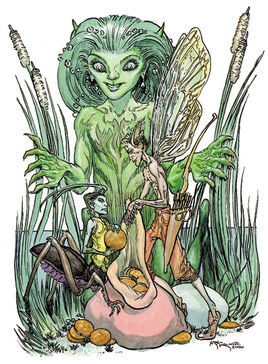
](https://static.wikia.nocookie.net/forgottenrealms/images/e/e8/Faerie.jpg/revision/latest?cb=20080309111448)
A group of sprites.
Fey
- 3e
3rd Edition Statistics[1]
Type
Fey
General Information[3]
Language(s)
Fey were creatures from the Feywild, a parallel plane to the Prime, the Feywild was also called the Plane of Faerie.[4][5] Many were typified as having supernatural abilities and a connection to nature or to some other force or place.[1] The language of the fey was called Sylvan.[2]
Contents
AD
Advertisement
Description[]
Species of Fey[]
There were many different species of fey, and connections between them could be hard to identify, other than being natives of the Feywild.[6] A few common threads could be drawn between certain smaller groups, however, while some were simply impossible to classify.[speculation]
Some fey were strongly bound or associated with specific natural locations such as water bodies, landmarks, or other geographical features. These included dryads, hamadryads, nymphs, naiads, nereids, oreads, and fossergrim.[speculation]
Other fey were reported as being born from emotions felt while in the Feywild, manifested due to that plane's strange energy. Redcaps, meenlocks, boggles,[6] and mites were all included in this group.[7]
Another group that was easily identified were the hags: annises, bheur hags, sea hags, green hags,[8][9] shrieking hags, and bog hags were all considered.[10] Night hags, although related, were actually fiends.[11]
One group of fey was confusingly called sprites, despite this being a specific name for one of its included members. All "sprites" were small, mostly humanoid fey, that typically displayed some insect-like attributes (such as wings). Besides the classical sprite for which the group was named,[12] there were the sea sprites,[13] shrub sprites,[14] the light makers of Chult,[15] grigs, nixies, pixies,[12] and atomies.[16] The winterling, despite also being small and winged, was not included.[17] Conversely, the sakina of Zakhara were considered "sprites", despite not exhibiting any of the typical features of one.[18]
Yet another diverse group of minuscule fey were the gremlins, who descended from goblins transformed by fomorian rituals.[19] They included the fremlin, galltrit, jermlaine, snyad,[20] and the plainsjan that inhabited the planet Anadia in Realmspace.[21] Mites were also considered by some to be members of this group.[20]
Of course, many fey could not be classified into any larger group beyond being related to either nature or emotion.[speculation] These included:
- Blink dog[3]
- Boggart[6]
- Bramble
- Brownie
- Clurichaun
- Darkling[6]
- Dobie
- Faerie fiddler[22]
- Feystag
- Frostwind virago
- Gloura
- Gorse
- Hoary hunter
- Hybsil
- Iceling
- Kelpie
- Killmoulis
- Killoren
- Korred[6]
- Leanan sidhe
- Leprechaun
- Lunar ravager
- Quickling[6]
- Ragewalker
- Ruin chanter
- Rusalka
- Satyr[3]
- Shadovig
- Sirine
- Spriggan
- Sylph
- Thorn
- Verdant prince
- Winterling
- Yeth hound[6]
- Yuki-on-na
AD
Advertisement
History[]
Stories about the fey went back eons, to the Days of Thunder.[23] Some claimed that fey creatures known as the leShay were one of these creator races,[24] who had created or progenerated the many kinds of fey, possibly including elves.[23][25]
Following the Year of Risen Elfkin, 1375 DR, an ancient fey kingdom known as Sarifal returned from the Feywild to takeover the island of Gwynneth in the Moonshae Isles.[26]
Appendix[]
See Also[]
References[]
- ↑ Jump up to: 1.0 1.1 1.2 Skip Williams, Jonathan Tweet, Monte Cook (July 2003). Monster Manual v.3.5. (Wizards of the Coast), p. 309. ISBN 0-7869-2893-X.
- ↑ Jump up to: 2.0 2.1 Jonathan Tweet, Monte Cook, Skip Williams (July 2003). Player's Handbook v.3.5. (Wizards of the Coast), p. 82. ISBN 0-7869-2886-7.
- ↑ Jump up to: 3.0 3.1 3.2 Mike Mearls, Jeremy Crawford, Christopher Perkins (2014-09-30). Monster Manual 5th edition. Edited by Scott Fitzgerald Gray. (Wizards of the Coast). ISBN 978-0786965614.
- ↑ Mike Mearls, Jeremy Crawford, Christopher Perkins (2014-09-30). Monster Manual 5th edition. Edited by Scott Fitzgerald Gray. (Wizards of the Coast), p. 6. ISBN 978-0786965614.
- ↑ Bruce R. Cordell, Ed Greenwood, Chris Sims (August 2008). Forgotten Realms Campaign Guide. Edited by Jennifer Clarke Wilkes, et al. (Wizards of the Coast), p. 68. ISBN 978-0-7869-4924-3.
- ↑ Jump up to: 6.0 6.1 6.2 6.3 6.4 6.5 6.6 Mike Mearls, et al. (November 2016). Volo's Guide to Monsters. Edited by Jeremy Crawford, et al. (Wizards of the Coast). ISBN 978-0786966011.
- ↑ Mike Mearls, Bart Carroll, Bill Benham (December 2019). Mordenkainen's Fiendish Folio, Volume 1: Monsters Malevolent and Benign. (Wizards of the Coast), p. 14.
- ↑ Mike Mearls, Jeremy Crawford, Christopher Perkins (2014-09-30). Monster Manual 5th edition. Edited by Scott Fitzgerald Gray. (Wizards of the Coast), pp. 176–179. ISBN 978-0786965614.
- ↑ Mike Mearls, et al. (November 2016). Volo's Guide to Monsters. Edited by Jeremy Crawford, et al. (Wizards of the Coast), pp. 52–62, 159–160. ISBN 978-0786966011.
- ↑ Mike Mearls, Stephen Schubert, James Wyatt (June 2008). Monster Manual 4th edition. (Wizards of the Coast), p. 150. ISBN 978-0-7869-4852-9.
- ↑ Mike Mearls, Jeremy Crawford, Christopher Perkins (2014-09-30). Monster Manual 5th edition. Edited by Scott Fitzgerald Gray. (Wizards of the Coast), pp. 178–179. ISBN 978-0786965614.
- ↑ Jump up to: 12.0 12.1 Skip Williams, Jonathan Tweet, Monte Cook (July 2003). Monster Manual v.3.5. (Wizards of the Coast), pp. 235–236. ISBN 0-7869-2893-X.
- ↑ Doug Stewart (June 1993). Monstrous Manual. (TSR, Inc), pp. 328–329. ISBN 1-5607-6619-0.
- ↑ Tachyon Studios (November 1996). Designed by Brian Fargo. Blood & Magic. Interplay.
- ↑ James Lowder (November 1992). The Ring of Winter. (TSR, Inc), chap. 10, p. 174. ISBN 978-1560763307.
- ↑ Gary Gygax (August 1983). Monster Manual II 1st edition. (TSR, Inc), p. 11. ISBN 0-88038-031-4.
- ↑ Yury Pavlotsky (October 2004). “Chilled to the Bone”. In Matthew Sernett ed. Dragon #324 (Paizo Publishing, LLC), pp. 58–62.
- ↑ Wolfgang Baur, Steve Kurtz (1992). Monstrous Compendium Al-Qadim Appendix. (TSR, Inc). ISBN l-56076-370-1.
- ↑ Mike Mearls, Greg Bilsland, Robert J. Schwalb (June 2010). Monster Manual 3 4th edition. Edited by Greg Bilsland, et al. (Wizards of the Coast), p. 106. ISBN 978-0-7869-5490-2.
- ↑ Jump up to: 20.0 20.1 Doug Stewart (June 1993). Monstrous Manual. (TSR, Inc), p. 174. ISBN 1-5607-6619-0.
- ↑ Dale "slade" Henson (April 1991). Realmspace. Edited by Gary L. Thomas, Karen S. Boomgarden. (TSR, Inc), p. 87. ISBN 1-56076-052-4.
- ↑ Spike Y. Jones (June 1994). “The Dragon's Bestiary: The good, the bad and the clumsy”. In Kim Mohan ed. Dragon #206 (TSR, Inc.), pp. 71–74.
- ↑ Jump up to: 23.0 23.1 Brian R. James, Ed Greenwood (September 2007). The Grand History of the Realms. Edited by Kim Mohan, Penny Williams. (Wizards of the Coast), pp. 7–8. ISBN 978-0-7869-4731-7.
- ↑ Brian R. James (June 2009). “Realmslore: Sarifal”. In Chris Youngs ed. Dragon #376 (Wizards of the Coast), p. 64.
- ↑ Paulina Claiborne (May 2012). The Rose of Sarifal (Kindle ed.). (Wizards of the Coast), chaps. 11, 15. ASIN B006NPFFHY.
- ↑ Bruce R. Cordell, Ed Greenwood, Chris Sims (August 2008). Forgotten Realms Campaign Guide. Edited by Jennifer Clarke Wilkes, et al. (Wizards of the Coast), p. 152. ISBN 978-0-7869-4924-3.
In D&D 5e, Fairies are a player race with innate magical abilities and a unique "Fairy" lineage that allows for customizability, while Sprites are a specific monster type with mischievous, nature-attuned personalities and abilities like sleep-arrows. A Pixie is a sub-type of sprite, known for being even more whimsical, using illusions to play pranks, and possessing powerful but limited magical effects like invisibility and polymorph self.
Sprite (classification)
This article is about the grouping of fey creatures. For the specific creature, see Sprite (creature).
[
](https://static.wikia.nocookie.net/forgottenrealms/images/e/e8/Faerie.jpg/revision/latest?cb=20080309111448)
From left to right, a grig, a nixie, and a pixie.
Sprite
-
3e
-
2e
-
1e
3rd Edition Statistics[1]
Size
Tiny or small
Type
Alignment
| LG | NG | CG |
| LN | N | CN |
| LE | NE | CE |
2nd Edition Statistics[2]
Size
Tiny or small
Alignment
| LG | NG | CG |
| LN | N | CN |
| LE | NE | CE |
1st Edition Statistics[3][4]
Size
Small
Alignment
| LG | NG | CG |
| LN | N | CN |
| LE | NE | CE |
General Information
Vision
Language(s)
Subraces
Favored climate
Temperate[1]
Favored terrain
Forest[2]
History
Based on
Sprite (English)
Sprites were a grouping of fey that lived in forests and enjoyed making mischief.
The gods Chauntea, Eldath, Erevan Ilesere, Mielikki, Sheela Peryroyl, and Silvanus all had sprites among their servants.[5]
Contents
Description[]
All sprites were small creatures with elven features, ranging from the 1‑foot-tall (0.3‑meter) atomie to the 4‑foot-tall (1.2‑meter) nixie. Except for the nixie, sprites had insect-like wings and could fly.[2]
Personality[]
As a group, sprites were shy, mischievous fey who hated ugliness and evil. They would fight to protect their homes if necessary, whether through combat or trickery.[2]
Ecology[]
Most sprites were hunter-gatherers who lived in small groups, either as nomads like the grigs or in tiny villages. Sprites typically preferred to live in temperate forest regions.[2]
Types of sprites[]
There were several different types of sprites, including:
History[]
In 1369 DR, a clan of sprites dwelt in the Misty Vale in Brynwood in the Vast, where they served the Green Lady, a druid of Eldath.[6]
Appendix[]
| This article is incomplete. You can help the Forgotten Realms Wiki by providing more information. |
Gallery[]

Neverwinter Sprite Companion Trailer
[
](https://forgottenrealms.fandom.com/wiki/File:Neverwinter_MMO_-Web_Image-_Sprite.jpg "Neverwinter MMO - Web Image - Sprite.jpg (486 KB)")
References[]
- ↑ Jump up to: 1.0 1.1 1.2 1.3 Skip Williams, Jonathan Tweet, Monte Cook (July 2003). Monster Manual v.3.5. (Wizards of the Coast), pp. 235–236. ISBN 0-7869-2893-X.
- ↑ Jump up to: 2.0 2.1 2.2 2.3 2.4 Doug Stewart (June 1993). Monstrous Manual. (TSR, Inc), pp. 328–330. ISBN 1-5607-6619-0.
- ↑ Gary Gygax (December 1977). Monster Manual, 1st edition. (TSR, Inc), pp. 74, 79. ISBN 0-935696-00-8.
- ↑ Gary Gygax (August 1983). Monster Manual II 1st edition. (TSR, Inc), pp. 11, 71, 92. ISBN 0-88038-031-4.
- ↑ Sean K. Reynolds (2002-05-04). Deity Do's and Don'ts (Zipped PDF). Web Enhancement for Faiths and Pantheons. Wizards of the Coast. pp. 10–15. Archived from the original on 2016-11-01. Retrieved on 2018-09-08.
- ↑ Matthew G. Adkins (July 1999). “Into the Nest of Vipers”. Dungeon #75 (Wizards of the Coast) (75)., p. 66.
AD
Advertisement
Connections[]
Sprites
Atomie • Flame sprite • Grig • Light maker • Nixie • Pixie • Sakina • Sea sprite • Sprite • Shrub sprite
Pixie
5th Edition Statistics[1]
Size
Tiny
Type
Alignment
Challenge rating
1⁄4
4th Edition Statistics[2][3]
Size
Tiny
Origin
Type
Alignment
3rd Edition Statistics[4]
Size
Small
Type
Alignment
Always neutral good
Challenge rating
| 4 |
2nd Edition Statistics[5][6]
Size
Small
Alignment
1st Edition Statistics[7]
Size
Small
Alignment
General Information[1][4][7]
Patron deity
Movement
Flying[4]
Vision
Activity cycle
Night[6]
Diet
Herbivore[6]
Average lifespan
About 300 years[6]
Language(s)
Favored climate
Temperate[6]
Favored terrain
Forests[6]
Appearance[1][4][7][6]
Average height
1‒2.5 ft (30‒76 cm)
Average weight
30 lb (14 kg)
History
First appearance
Based on
Pixie (Cornish)
Pixies were a race of fey sprites.[7][6][4][1]
“
Petal gowns and acorn caps are so last summer!
”
— Rivergleam, pixie fashionista[1]
Description[]
Pixies resembled tiny elves, with reports placing them variously at 2.5 feet (0.76 meters)[7][6][4] to as little as 1 foot (0.3 meters)[1] in height. Pixies had silvery, moth-like wings and preferred to wear brightly colored clothing.[6]
Personality[]
Pixies were mischievous sprites that enjoyed playing pranks on people. Such pranks included leading travelers astray and tricking misers into parting with their wealth.[6]
Abilities[]
“
Pixies are well known as pranksters, but some delight in more helpful magic.[9]
”
Pixies had a number of innate magical abilities, such as being naturally invisible. At will, they could replicate the spells polymorph self, know alignment, dispel magic, dancing lights, and ESP. Once per day, they could turn invisible for as long as they desired, cause confusion at a touch, and create an illusion with both visual and audible components; this illusion would remain until dispelled. Some pixies could replicate the spell Otto's irresistible dance once a day.[6]
In combat, pixies wielded appropriately sized swords and bows. Their arrows were sometimes drugged with a potion that caused complete memory loss.[6]
Society[]
[
](https://static.wikia.nocookie.net/forgottenrealms/images/3/35/Pixie_Guide.jpg/revision/latest?cb=20211127120533)
A pixie demonstrating her helpfulness.
Pixie villages each had different clans or families in it; community loyalty was very important to pixies.[6]
Although pixies carried no treasure with them, they were known to have tiny hoards in their homes in order to impress visitors.[6]
Diet[]
Pixies were active at nighttime. They were herbivorous, eating fruit and nectar.[6]
Homelands[]
Pixies tended to live in temperate forest regions, making their villages in deep forest caves.[6]
In North Faerûn, they inhabited the woods of Cormanthyr.[10] In Northwest Faerûn, they inhabited the Laughing Hollow.[11]
Beyond Faerûn, pixies inhabited caves deep in the forests of Evermeet.[12] On the Moonshae Isles they could be found in many of its deciduous and coniferous forests, in particular the Myrloch Vale,[13] as well as the kingdom of Sarifal and Llyrath Forest on Gwynneth Isle.[14]
In the Unapproachable East, pixies could be found around the woodlands of Aglarond. Including the grassy meadow known as Halendos.[15]
Beyond the Prime Material plane, some pixies could be found in the realm of Faerie[16] and the Elemental Plane of Air.[17]
Religion[]
The pixies that inhabited Evermeet were known to worship Titania, Oberon, and other members of the Seelie Court.[12]
Usage[]
Crushed pixie wings made pixie dust, also called dust of disappearance. The creation of this dust was, naturally, frowned upon by pixies.[6]
History[]
Pixies were among the creatures believed to have been created by the fey creator race.[18]
Maerovyna, a druid of Chauntea who led the Harvest House in Daggerford in the mid-to-late 14th century DR, was served by two pixies, a grizzly bear, and a leopard who were ready to defend her with their lives.[19]
Rumors & Legends[]
One legend in the Feywild claimed that pixies stole the secret of making honey from a goblet of mead belonging to the Summer Queen and then sold it to the bee species as a whole.[20]
Notable Pixies[]
Appendix[]
| This article is incomplete. You can help the Forgotten Realms Wiki by providing more information. |
See Also[]
Gallery[]
[
](https://forgottenrealms.fandom.com/wiki/File:Moonshae_Pixie.jpg "Moonshae Pixie.jpg (526 KB)")
A blue pixie from the Moonshae Isles.

A pixie rides atop the back of a rabbit, using it as a mount.
[
](https://forgottenrealms.fandom.com/wiki/File:Pixie_NWN.jpg "Pixie NWN.jpg (27 KB)")
A depiction of a pixie from Neverwinter Nights.
Appearances[]
Adventures
Novels & Short Stories
Referenced only
The Council of Blades
Video Games
Neverwinter Nights series (Neverwinter Nights • Neverwinter Nights 2 • Darkness over Daggerford • Tyrants of the Moonsea) • Idle Champions of the Forgotten Realms
Card Games
Miniatures
Organized Play & Licensed Adventures
Lost Temple of the Fey Gods • Scout's Honor • The Tower of Ahghairon'
Further Reading[]
- Vince Garcia (March 1990). “The Folk of the Faerie Kingdom”. In Roger E. Moore ed. Dragon #155 (TSR, Inc.), p. 37.
- Andy Collins (July 2001). “Vs.: Pixies”. In Dave Gross ed. Dragon #285 (Wizards of the Coast), p. 89.
References[]
- ↑ Jump up to: 1.0 1.1 1.2 1.3 1.4 1.5 Mike Mearls, Jeremy Crawford, Christopher Perkins (2014-09-30). Monster Manual 5th edition. Edited by Scott Fitzgerald Gray. (Wizards of the Coast), p. 253. ISBN 978-0786965614.
- ↑ Steve Townshend (February 2013). “The Dragon's Bestiary: Fey of Wood and Wind”. In Steve Winter ed. Dragon #420 (Wizards of the Coast), p. 9.
- ↑ Rodney Thompson, Claudio Pozas, Steve Townshend (2011). Player's Option: Heroes of the Feywild. (Wizards of the Coast), p. 28. ISBN 978-0786958368.
- ↑ Jump up to: 4.0 4.1 4.2 4.3 4.4 4.5 Skip Williams, Jonathan Tweet, Monte Cook (July 2003). Monster Manual v.3.5. (Wizards of the Coast), p. 236. ISBN 0-7869-2893-X.
- ↑ [David "Zeb" Cook](https://forgottenrealms.fandom.com/wiki/David_%22Zeb%22_Cook "David "Zeb" Cook"), et al. (1989). Monstrous Compendium Volume Two. (TSR, Inc). ISBN 0-8803-8753-X.
- ↑ Jump up to: 6.00 6.01 6.02 6.03 6.04 6.05 6.06 6.07 6.08 6.09 6.10 6.11 6.12 6.13 6.14 6.15 6.16 6.17 Doug Stewart (June 1993). Monstrous Manual. (TSR, Inc), pp. 328–329. ISBN 1-5607-6619-0.
- ↑ Jump up to: 7.0 7.1 7.2 7.3 7.4 Gary Gygax (December 1977). Monster Manual, 1st edition. (TSR, Inc), p. 79. ISBN 0-935696-00-8.
- ↑ Carl Sargent (May 1992). Monster Mythology. (TSR, Inc), p. 119. ISBN 1-5607-6362-0.
- ↑ Magic: The Gathering (July 2021).
 AFR #066 "Pixie Guide", illus. Fariba Khamseh. Wizards of the Coast.
 - ↑ Ed Greenwood (1989). Shadowdale. (TSR, Inc.), p. 26. ISBN 978-0880387200.
- ↑ Steve Perrin (1987). Under Illefarn. Edited by Rick Swan. (TSR, Inc), pp. 12, 30–31. ISBN 0-88038-489-1.
- ↑ Jump up to: 12.0 12.1 Anne Gray McCready et al. (March 1994). Elves of Evermeet. (TSR, Inc), p. 32. ISBN 1-5607-6829-0.
- ↑ Douglas Niles (November 1987). Moonshae. Edited by Mike Breault. (TSR, Inc.), pp. 17, 54. ISBN 0-88038-494-8.
- ↑ Brian R. James (June 2009). “Realmslore: Sarifal”. In Chris Youngs ed. Dragon #376 (Wizards of the Coast), pp. 60, 65.
- ↑ Anthony Pryor (June 1995). “Campaign Guide”. In Michele Carter, Doug Stewart eds. Spellbound (TSR, Inc.), pp. 55–56. ISBN 978-0786901395.
- ↑ Douglas Niles (February 1989). Darkwell. (TSR, Inc.), chap. 14, p. 237. ISBN 0-88038-717-3.
- ↑ Monte Cook and William W. Connors (December 7, 1998). The Inner Planes. Edited by Michele Carter and Ray Vallese. (TSR, Inc.), p. 25. ISBN 0-7869-0736-3.
- ↑ Brian R. James, Ed Greenwood (September 2007). The Grand History of the Realms. Edited by Kim Mohan, Penny Williams. (Wizards of the Coast), p. 7. ISBN 978-0-7869-4731-7.
- ↑ Ossian Studios (June 2018). Neverwinter Nights: Darkness over Daggerford. Beamdog.
- ↑ Rodney Thompson, Claudio Pozas, Steve Townshend (2011). Player's Option: Heroes of the Feywild. (Wizards of the Coast), p. 28. ISBN 978-0786958368.
- ↑ Will Doyle (2016-02-03). Reclamation of Phlan (DDEP4) (PDF). D&D Adventurers League: Curse of Strahd (Wizards of the Coast), p. 70.
- ↑ David Cook (August 1990). “Volume II”. In Steve Winter ed. The Horde (TSR, Inc.), p. 91. ISBN 0-88038-868-4.

Connections[]
Atomie • Flame sprite • Grig • Light maker • Nixie • Pixie • Sakina • Sea sprite • Sprite • Shrub sprite
Sprite (creature)
02:30
This article is about the specific creature. For the general classification, see Sprite (classification).
- 5e
- 2e
- 1e
[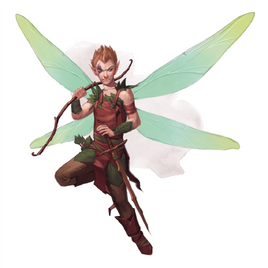
](https://static.wikia.nocookie.net/forgottenrealms/images/d/d4/Sprite-5e.png/revision/latest?cb=20171010182903 "5e")
[
](https://static.wikia.nocookie.net/forgottenrealms/images/d/d7/Sprite.png/revision/latest?cb=20190812135708 "2e")
[
](https://static.wikia.nocookie.net/forgottenrealms/images/4/4c/Sprites.png/revision/latest?cb=20200404093252 "1e")
Various depictions of sprites.
Sprite
-
5e
-
2e
-
1e
5th Edition Statistics[1]
Size
Tiny
Type
Alignment
Challenge rating
1⁄4
2nd Edition Statistics[2]
Size
Small
Alignment
Neutral (good)
1st Edition Statistics[3]
Size
Small
Alignment
General Information
Patron deity
Activity cycle
Day[2]
Diet
Omnivore[2]
Homeland(s)
Language(s)
Favored terrain
Appearance
Average height
2 ft (0.61 m)[2]
History
First appearance
Based on
Sprite (English)
Sprites were the warrior relatives of pixies. They were fierce defenders of good wherever they dwelt, and were also firm judges of other creatures' hearts and intentions.[1]
The term "sprite" actually had two meanings: the first meant the specific race of tiny warriors, while the second use referred to the group of tiny, insect-featured fey that the specific kind belonged to.[2]
Contents
Description[]
Sprites resembled tiny, elven-featured fey with insect-like wings. They were about 2 feet (0.61 meters) tall.[2]
Personality[]
Sprites were flighty and found most other creatures too serious. However, they also despised evil.[2]
Because of their austerity and zealous attitude against evil, sprites were considered overly sullen and harsh by other fey. Unlike pixies, they did not care to engage in fun activities or adorn themselves. However, they were excellent judges of character, and could always sense another creature's real nature and emotions. They were quick to ally with good-natured creatures, and would come to their aid even at unexpected times.[1]
Abilities[]
Like other fey, sprites possessed several innate magical powers: they could become invisible at will and could detect good or evil from 50 yards (46 meters) away.[2]
Sprites were expert brewers of toxins, poisons, and antidotes. In particular, they favored a potent sleep poison with which they coated their arrows. They usually harvested the ingredients for these toxins in forests, even venturing into dangerous areas to find them, but were not above stealing some from hags' gardens if extremely necessary.[1]
Society[]
“
The tree had a wee village nestled in its boughs, I swear. Next thing I knew, I was lyin' face-down in the dirt. My head was full of stars, an' when I stood up an' looked around, both the tree an' the wee village were gone.
”
— Haravak, relaying a tale of his encounter with sprites[5]
Sprites made their homes by meadows and glades deep within thriving forests. They were omnivorous creatures who, unlike most of their kin, were mainly active during the day.[2] Sprites' villages could also be found inside the trunks of trees or treants. They allowed no trespassers, and were quick to judge the moral character of persisting invaders.[1]
Homelands[]
Cormanthyr[6] and the Far Forest were some of many locations on the Faerûn that sprites were known to inhabit.[7]
In the Unapproachable East, sprites could be found around the woodlands of Aglarond. Including the grassy meadow known as Halendos.[8]
Beyond Faerûn, sprites could be found on Evermeet, where they acted as protectors of glades and meadows. They were the only race of fey known to have regular contact with the island's elves.[9] In the Moonshae Isles, sprites lived in the kingdom of Sarifal and the Llyrath Forest on Gwynneth Isle.[10]
Beyond the Prime Material plane, some sprites could be found in the Elemental Plane of Air.[11]
Relations[]
Sprites kept an eye on other small sprite-like fey, either to protect them or to know who to invite to their gatherings. They were also known to associate with druids and the occasional ranger.[2]
Sprites were one of the many fey races known to serve the Seldarine.[12]
Varieties[]
- Flame sprites, temperamental and flame-loving sprites that made their home in Mount Hotenow circa the 15th century DR.[13][14]
AD
Advertisement
Notable Sprites[]
Appendix[]
| This article is incomplete. You can help the Forgotten Realms Wiki by providing more information. |
See Also[]
Gallery[]
[
](https://forgottenrealms.fandom.com/wiki/File:FFFey-p117.png "FFFey-p117.png (937 KB)")
A sprite and brownie, armed with a rapier and quarterstaff respectively, fight a gorbel while a sylph admires herself in a mirror.
[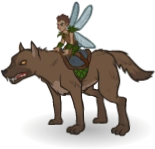
](https://forgottenrealms.fandom.com/wiki/File:SpriteWildogMount.png "SpriteWildogMount.png (21 KB)")
A male sprite rides atop the back of a wild dog, using it as a mount.
[
](https://forgottenrealms.fandom.com/wiki/File:Sprite1.png "Sprite1.png (161 KB)")
A sprite from 2nd edition.
Appearances[]
Adventures
Gamebooks
Card Games
Board Games
Dungeons & Dragons Adventure Begins
Video Games
Miniatures
Further Reading[]
- Vince Garcia (March 1990). “The Folk of the Faerie Kingdom”. In Roger E. Moore ed. Dragon #155 (TSR, Inc.), pp. 37–38.
References[]
- ↑ Jump up to: 1.00 1.01 1.02 1.03 1.04 1.05 1.06 1.07 1.08 1.09 Mike Mearls, Jeremy Crawford, Christopher Perkins (2014-09-30). Monster Manual 5th edition. Edited by Scott Fitzgerald Gray. (Wizards of the Coast), p. 283. ISBN 978-0786965614.
- ↑ Jump up to: 2.00 2.01 2.02 2.03 2.04 2.05 2.06 2.07 2.08 2.09 2.10 2.11 2.12 2.13 Doug Stewart (June 1993). Monstrous Manual. (TSR, Inc). ISBN 1-5607-6619-0.
- ↑ Gary Gygax (December 1977). Monster Manual, 1st edition. (TSR, Inc), p. 92. ISBN 0-935696-00-8.
- ↑ Carl Sargent (May 1992). Monster Mythology. (TSR, Inc), p. 119. ISBN 1-5607-6362-0.
- ↑ unknown (2025). Monster Manual 5th edition (revised). (Wizards of the Coast), p. 298. ISBN 978-0-7869-6954-8.
- ↑ Ed Greenwood (1989). Shadowdale. (TSR, Inc.), p. 26. ISBN 978-0880387200.
- ↑ Christopher Perkins, et al. (September 2016). Storm King's Thunder. Edited by Kim Mohan, Michele Carter. (Wizards of the Coast), p. 83. ISBN 978-0-7869-6600-4.
- ↑ Anthony Pryor (June 1995). “Campaign Guide”. In Michele Carter, Doug Stewart eds. Spellbound (TSR, Inc.), pp. 55–56. ISBN 978-0786901395.
- ↑ Anne Gray McCready et al. (March 1994). Elves of Evermeet. (TSR, Inc), p. 33. ISBN 1-5607-6829-0.
- ↑ Brian R. James (June 2009). “Realmslore: Sarifal”. In Chris Youngs ed. Dragon #376 (Wizards of the Coast), pp. 60, 65.
- ↑ Monte Cook and William W. Connors (December 7, 1998). The Inner Planes. Edited by Michele Carter and Ray Vallese. (TSR, Inc.), p. 25. ISBN 0-7869-0736-3.
- ↑ Wolfgang Baur and Lester Smith (1994-07-01). “The Book of Chaos”. In Michele Carter ed. Planes of Chaos (TSR, Inc), p. 39. ISBN 1560768746.
- ↑ Cryptic Studios (June 2013). Neverwinter. Perfect World Entertainment.
- ↑ Julia (nitocris83) (November 29, 2017). CTA: Battle for the Bridge (HTML). Neverwinter Developer Blog. Arc Games. Archived from the original on 6-24-2021. Retrieved on 6-24-2021.
- ↑ Strategic Simulations, Inc. (1993). Eye of the Beholder III: Assault on Myth Drannor. Strategic Simulations, Inc.
Connections[]
Atomie • Flame sprite • Grig • Light maker • Nixie • Pixie • Sakina • Sea sprite • Sprite • Shrub sprite
Firbolg
- Ability Scores. Choose one of: (a) Choose any +2; choose any other +1 (b) Choose three different +1
- Size. Medium
- Speed. 30 ft.
Firbolg Magic. You can cast detect magic and disguise self spells with this trait. When you use this version of disguise self, you can seem up to 3 feet shorter or taller. Once you cast either of these spells with this trait, you can't cast that spell with it again until you fin-ish a long rest. You can also cast these spells using any spell slots you have.
Intelligence, Wisdom, or Charisma is your spellcasting ability for these spells when you cast them with this trait (choose when you select this race).
Hidden Step. As a bonus action, you can magically turn invisible until the start of your next turn or until you attack, make a damage roll, or force someone to make a saving throw. You can use this trait a number of times equal to your proficiency bonus, and you regain all ex-pended uses when you finish a long rest.
Powerful Build. You count as one size larger when determining your carrying capacity and the weight you can push, drag, or lift.
Speech of Beast and Leaf. You have the ability to communicate in a limited manner with Beasts, Plants, and vegetation. They can understand the meaning of your words, though you have no special ability to understand them in return. You have advantage on all Charisma checks you make to influence them.
Languages. You can speak, read, and write Common and one other language that you and your DM agree is appropriate for your character.
https://2014.5e.tools/img/races/MPMM/Firbolg.webp
Distant cousins of giants, the first firbolgs wandered the primeval forests of the multiverse, and the magic of those forests entwined itself with the firbolgs' souls. Centuries later, that magic still thrums inside a firbolg, even one who has never lived under the boughs of a great forest. A firbolg's magic is an obscuring sort, which allowed their ancestors to pass through a forest without disturbing it. So deep is the connection between a firbolg and the wild places of the world that they can communicate with flora and fauna. Firbolgs can live up to 500 years.
Source: MPMM, page 15
Firbolg
- Ability Scores. Wisdom +2; Strength +1
- Size. Medium
- Speed. 30 ft.
Age. As humanoids related to the fey, firbolg have long lifespans. A firbolg reaches adulthood around 30, and the oldest of them can live for 500 years.
Size. Firbolg are between 7 and 8 feet tall and weigh between 240 and 300 pounds. Your size is Medium.
Firbolg Magic. You can cast detect magic and disguise self with this trait, using Wisdom as your spellcasting ability for them. Once you cast either spell, you can't cast it again with this trait until you finish a short or long rest. When you use this version of disguise self, you can seem up to 3 feet shorter than normal, allowing you to more easily blend in with hu-mans and elves.
Hidden Step. As a bonus action, you can magically turn invisible until the start of your next turn or until you attack, make a damage roll, or force someone to make a saving throw. Once you use this trait, you can't use it again until you finish a short or long rest.
Powerful Build. You count as one size larger when determining your carrying capacity and the weight you can push, drag, or lift.
Speech of Beast and Leaf. You have the ability to communicate in a limited manner with beasts and plants. They can understand the meaning of your words, though you have no special ability to understand them in return. You have advantage on all Charisma checks you make to influence them.
Languages. You can speak, read, and write Common, Elvish, and Giant.
https://2014.5e.tools/img/races/VGM/Firbolg.webp
Firbolg tribes cloister in remote forest strongholds, preferring to spend their days in quiet harmony with the woods. When provoked, firbolgs demonstrate formidable skills with weapons and druidic magic.
Humble Guardians. Firbolgs love nothing more than a peaceful day spent among the trees of an old forest. They see forests as sacred places, representing the heart of the world and monuments to the durability of life.
In their role as caretakers, firbolgs live off the land while striving to remain in balance with nature. Their methods reflect common sense and remarkable resourcefulness. During a bountiful summer, they store away excess nuts, fruit, and berries. When winter arrives, they scatter everything they can spare to ensure the animals of the wood survive until springtime.
In a firbolg's eyes, there is no greater fault than greed. The firbolgs believe that the world remains healthiest when each creature takes only what it needs. Material goods, especially precious gems and gold, have little appeal to them. What use are such things when winter lingers and food runs short?
Natural Druids. Firbolgs have a talent for druidic magic. Their cultural reverence for nature, combined with their strong and insightful minds, makes learning such magic an instinctive part of their development. Almost every firbolg learns a few spells, typically those used to mask their presence, and many go on to master nature magic.
Firbolgs who become druids serve as stronghold leaders. With every action the tribe takes, the druids weigh not only the group's needs, but the effect each action will have on the forest and the rest of the natural world. Firbolg tribes would rather go hungry than strain the land during a famine.
Firbolg Classes
Most firbolgs are druids, rangers, or fighters. Among their kind, these vocations are passed down from one generation to the next. The firbolgs' magical heritage also expresses itself in other ways; those who become bards preserve the clan's lore, and firbolg sorcerers defend their communities. Firbolg wizards arise when a clan becomes friendly with elves.
Firbolg rogues are typically scouts tasked with spying on neighboring folk to determine their intentions. They are most common among firbolgs whose homes border human settlements.
Firbolg barbarians are rare except among clans that face constant threats from evil humanoids and other invaders.
Firbolg clerics and paladins are usually dedicated to nature gods and are seen as enforcers of that god's will.
Firbolg warlocks are rare, but some clans forge alliances and arcane pacts with powerful fey beings.
Firbolg monks are almost entirely unheard of, though a monastery might take in the young survivors of a devastated firbolg clan.
Hidden Shepherds. As caretakers of the land, firbolgs prefer to remain out of sight and out of mind. They don't try to dominate nature, but rather seek to ensure that it prospers and survives according to its own laws.
Firbolgs use their magic to keep their presence in a forest secret. This approach allows them to avoid the politics and struggles of elves, humans, and orcs. Such events concern the firbolgs only when the events affect the forest.
Even in the face of an intrusion, firbolgs prefer a subtle, gentle approach to prevent damage to their territory. They employ their magic to make the forest an unappealing place to explore by temporarily diverting springs, driving away game, stealing critical tools, and altering trails to leave hunting or lumber parties hopelessly lost. The firbolgs' presence is marked by an absence of animals and a strange quiet, as if the forest wishes to avoid attracting attention to itself. The faster travelers decide to move on, the better.
If these tactics fail, the firbolgs take more direct action. Their observations of a settlement determine what happens next. If the outsiders seem peaceful, the firbolgs approach and gently ask them to leave, even offering food and other supplies to aid their departure. If those who insist on remaining respect nature, take only what they need, and live in harmony with the wood, firbolgs explore the possibility of friendship with them, as long as the outsiders vow to safeguard the forest. If the settlers clearly display evil intentions, however, the firbolgs martial their strength and magic for a single overwhelming attack.
Outcast Adventurers. As guardians of the wood, few firbolgs would dream of leaving their homes or attempting to fit into human society. An exiled firbolg, or one whose clan has been destroyed, might not have a choice in the matter. Most adventuring firbolgs fall into this latter category.
Outcast firbolgs can never return home. They committed some unforgivable deed, usually something that put their homeland at risk, such as starting a forest fire or killing a rare or beautiful wild creature. These firbolgs are loners who wander the world in hope of finding a new place to call home.
Orphaned firbolgs are those whose clans or home lands have been destroyed. They become crusaders for nature, seeking to avenge their loss and prevent the further destruction of the natural world.
A few rare firbolgs are entrusted by their clan with an important mission that takes them beyond their homes. These firbolgs feel like pilgrims in a strange land, and usually they wish only to complete their quests and return home as quickly as possible.
The Firbolg Adventurers table can serve as inspiration for determining why a firbolg character leaves home.
Firbolg Adventurers
| d8 | Reason for Adventuring |
|---|---|
| 1 | Outcast for murder |
| 2 | Outcast for severely damaging home territory |
| 3 | Clan slain by invading humanoids |
| 4 | Clan slain by a dragon or demon |
| 5 | Separated from the tribe and lost |
| 6 | Homeland destroyed by natural disaster |
| 7 | Personal quest ordained by omens |
| 8 | Dispatched on a quest by tribe leaders |
Firbolg Names. Firbolg adopt elven names when they must deal with outsiders, although the concept of names strikes them as strange. They know the animals and plants of the forest without formal names, and instead identify the forest's children by their deeds, habits, and other actions.
By the same token, their tribe names merely refer to their homes. When dealing with other races, firbolgs refer to their lands by whatever name the surrounding folk use, as a matter of tact and hospitality, but among their own kind they simply call it "home." Sometimes firbolgs adopt the nicknames or titles outsiders give them under the assumption that those who need names can call them whatever they wish.
Source: VGM, page 107. Reprinted as Firbolg in MPMM. Also found in EGW, page 169.
Firbolg
This is a
Good Article!
- 5e
- 4e
- 3e
- 2e
- 1e
[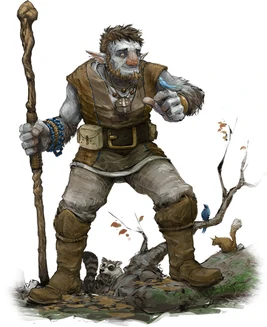
](https://static.wikia.nocookie.net/forgottenrealms/images/7/79/Firbolg-5e.jpg/revision/latest?cb=20180623050202 "5e")
[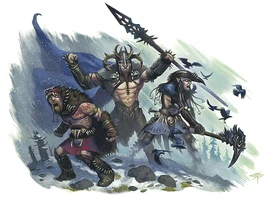
](https://static.wikia.nocookie.net/forgottenrealms/images/8/82/Firbolgs_-_Steve_Prescott.jpg/revision/latest?cb=20210805111913 "4e")
[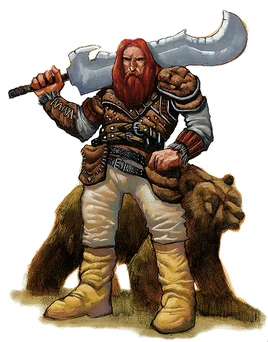
](https://static.wikia.nocookie.net/forgottenrealms/images/3/37/Firbolg_3e.jpg/revision/latest?cb=20210818111139 "3e")
[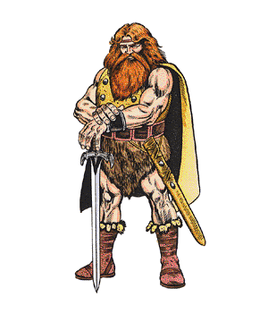
](https://static.wikia.nocookie.net/forgottenrealms/images/c/c9/Firbolg2e.gif/revision/latest?cb=20161126071553 "2e")
[
](https://static.wikia.nocookie.net/forgottenrealms/images/1/1f/Firbolg1e.JPG/revision/latest?cb=20200402114113 "1e")
Various depictions of firbolgs.[note 1]
Firbolg
-
5e
-
4e
-
3e
-
2e
-
1e
5th Edition Statistics[1]
Size
Medium
Type
Alignment
Usually neutral good
4th Edition Statistics[2]
Size
Large
Origin
Type
Alignment
3rd Edition Statistics[3]
Size
Large
Type
Alignment
Usually neutral
Challenge rating
12
2nd Edition Statistics[4][5][note 2]
Size
Large
Alignment
Usually lawful good
1st Edition Statistics[6][5][note 2]
Size
Large
Alignment
Usually lawful good
General Information
Patron deity
Vision
Activity cycle
Any[4]
Diet
Omnivore[4]
Average lifespan
Up to 500 years[1]
Homeland(s)
Language(s)
Common[1][2][3][9]
Giant[1][3][9]
Elven[1][2]
Firbolg[9][10]
Favored climate
Favored terrain
Appearance
Skin color(s)
Hair color(s)
Hairstyle(s)
Long[4]
-
Male
-
Female
| Average height | 10′6″‒11′4″ (3.2‒3.45 m)[11][note 2] |
| Average weight | 610‒710 lb (280‒320 kg)[11][note 2] |
| Hairstyle(s) | Thick beards[4] |
| Average height | 9′10″‒10′8″ (3‒3.25 m)[11][note 2] |
| Average weight | 460‒560 lb (210‒250 kg)[11][note 2] |
History
First appearance
Based on
Fir Bolg (Irish)
Firbolgs (pronounced: /ˈ[f](https://forgottenrealms.fandom.com/wiki/F_as_in_%22fighter%22 "F as in "fighter"")[ɪər](https://forgottenrealms.fandom.com/wiki/Eer_as_in_%22seer%22 "Eer as in "seer"")[b](https://forgottenrealms.fandom.com/wiki/B_as_in_%22bard%22 "B as in "bard"")[oʊ](https://forgottenrealms.fandom.com/wiki/O_as_in_%22gnome%22 "O as in "gnome"")[l](https://forgottenrealms.fandom.com/wiki/L_as_in_%22law%22 "L as in "law"")[g](https://forgottenrealms.fandom.com/wiki/G_as_in_%22good%22 "G as in "good"")/ FEER-bolg[12]  listen) were a reclusive race of giant-kin who preferred to avoid contact with other sentient races.[6][3][13] They were both the most intelligent[14][13] and the most powerful of the giant-kin.[6][4][9] Their name was derived from the Dwarvish phrase "Fir-Bolg", meaning "large men with spears".[15]
Contents
AD
Advertisement
Description[]
“
Well, now. They live in the Big Cave – here in the fens. They look like you, as, of course, I said already, except they're much taller and broader and, well, hairier, and their noses are huge, I mean they just hang out of their faces like a limb hangs off a tree, and, well, they smell bad, and ...
”
— Newt, the faerie dragon[16]
Firbolgs resembled humans,[6][4][9][3] and the males would sport great, thick beards.[4][9][3] Their thick, tough skin[4][9] was fleshy pink,[3][4][9][note 1] and their hair, though it came in many colors, was usually either red or blond[3][4] and worn long.[3][4][9] A firbolg's voice was deep and smooth, and they tended to roll their consonants when speaking.[4][9]
Firbolgs were typically over 10 feet (3 meters) tall,[4][3] averaging a height of about 10.5 feet (3.2 meters).[6][4][9] While firbolgs from other worlds weighed more than 800 pounds (360 kilograms),[4][9][3] those of Faerûn were lighter, with males being about 650 pounds (290 kilograms) and females about 500 pounds (230 kilograms).[11][note 2][note 3]
The firbolgs of the Moonshae Isles were said to be considerably ugly.[17]
Abilities[]
The average firbolg was stronger than a forest bear.[4] Beyond sheer physical strength, they had innate magical abilities.[6][4][3] Firbolgs were said to be resistant to magic.[6][9] They could sense the presence of magical auras innately.[6][4][9][3][1] They also had the power to change their physical appearance,[6][4][9][3][1] including making themselves larger[18] or smaller.[6][4][9][3][1] They sometimes used this magical power to blend in or interact with smaller races.[6][4][1]
They had excellent vision at night[4][3] and could perhaps see in the dark.[3] Some sages claimed that firbolgs had regenerative abilities.[3][2] Other sages reported that firbolgs could make themselves turn invisible.[1] They were also said to be able to communicate to a limited effect with both plants and animals of their forest homes.[1]
Personality[]
[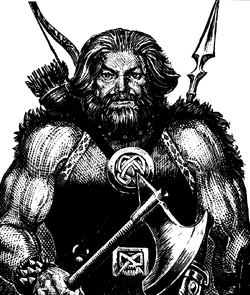
](https://static.wikia.nocookie.net/forgottenrealms/images/2/28/Tavis.png/revision/latest?cb=20241108071410)
Tavis Burdun, King of Hartsvale.
Firbolgs enjoyed quiet time in the woods, in harmony with nature. The forests were sacred to them and symbolized the heart of the earth and the adaptability of life. They saw themselves as the forests' caretakers.[1]
While firbolgs of other worlds may have had tendencies toward a variety of alignments, those of Faerûn were usually lawful good in alignment,[5][note 2] although they were seen as maug ("unholy" or "dishonorable"[19]) creatures by other giants,[5] because of the sin of the goddess Othea.[20]
Firbolgs considered greed to be one of the worst vices. They believed that one should only ever take what one needs and no more. They saw no value in material wealth such as gems and gold,[1] but sometimes would find prankish ways of taking valuables from strangers, out of a sense of fun.[4][9]
Firbolgs believed that charity was a virtue but also believed that it was harmful for the recipient to know the identity of the provider; because of this they appeared to be reclusive amongst the other races, although they were very sociable with established friends. They were extremely honest and could not lie without feeling physical discomfort, even if the lie was by omission.[8]
Firbolgs tended to be over-confident and fearless, except for a pervasive phobia of humanoid mobs.[9] They saw the wearing of armor as cowardly,[5] and thus did not usually wear armor,[5][4][9] nor did they carry shields.[4][9]
Firbolgs were cautious and shrewd in their dealings with outsiders.[6][4][9][3] They distrusted most humans[6][4][9][3] and demihumans.[4][3] Among non-giants, they were neutral with druids, elves, and fey.[4][9] They were on good terms with storm giants,[4][9] whom they looked up to and tried to emulate,[9] but they avoided other giant races, and actively fought against the other giant-kin.[4][9]
Combat[]
If provoked, firbolgs were formidable opponents, skilled both in physical combat and druidic magics.[1] They preferred massive weapons,[6][4][9] such as two-handed swords and halberds.[6][4] They were strong enough to wield most human-made weapons in a single hand.[6][4][9]
In battle, firbolgs fought tactically and relied on teamwork.[9][3] They were adept at batting away or catching projectiles,[6][4][9][3] and had excellent throwing arms, like any giant did.[3] They could easily toss a large rock weighing around 40 to 50 pounds (18 to 23 kilograms).[3]
Society[]
Firbolgs had a family-centered, clan-based society.[4][9] They lived in settlements in remote hilly[4][9][8] or forested areas.[4][9][8][1] Their settlements were strongholds,[3][1] including wooden structures, built from the trees around them,[4] with defensive towers with catwalks between them.[8][3] Rarely, they inhabited cavern complexes dug into the hillsides.[3] They used their magic to ensure that their homes remained a secret to outsiders.[1] These clan settlements were small, with between about four and sixteen members, often with a shaman or druid, and lived separate from each other.[4] A few firbolg clans were nomadic.[4][9]
A typical firbolg home was a huge one-story log building with strong walls. A large fireplace with multiple openings warmed a central common room.[4]
As caretakers of the woods,[1] they carefully and resourcefully lived off the land, making sure to ensure balance.[4][9][1] During summer, they stored excess nuts, fruits, and berries, so that they could provide food to the forest animals during winter.[1] Although they did farm, it was only to supplement their diets;[4] they preferred a more hunter-gatherer lifestyle,[4][9] rather than the brigand/raider lifestyle of many other giants.[3] Their hunting grounds were usually spread out in a 20‑mile (32‑kilometer) radius from their clan homes. They ate small portions of meat with most meals, and reserved large roasts of meat for special celebrations.[4]
Most firbolg tribes preferred isolation from other races, avoiding their politics and struggles.[4][1] If intruders entered their territory, they would usually try an indirect approach at causing the "invaders" to leave—driving game away to discourage hunters or redirecting streams or forest trails to confuse parties. If these methods failed, the firbolgs would at last confront the outsiders. If the outsiders seemed peaceful, the firbolgs would peacefully ask them to leave; if the outsiders seemed evil or seemed to have no concern for the forest lands, the firbolgs might mount a devastating attack.[1] On occasion, they would trade with peaceful folk living nearby in exchange for providing services utilizing their great strength.[4][9]
Firbolg adventurers were rare and most often were individuals separated from their tribes—orphans, exiles, lone survivors, or the like.[1] A few adventured to gain knowledge.[9]
Firbolgs seemed to have a natural tendency toward druidic magics, and many of their chieftains were thus druids.[3][1] Others became rangers or fighters. Other adventuring vocations were rare; firbolg monks were completely unknown.[1] About five percent of firbolgs encountered were shamans.[6][4]
Firbolg communities were known to rally around individuals who contracted lycanthropy, rather than shun them, using all resources at their disposal to help the afflicted find a cure.[21]
AD
Advertisement
Government[]
The Firbolg Code
(in the original language)
Prakt, Strev, Rang, glang byrd.
Stomm rang glang du.
Blod ettin er blod kong.
Gi tusen val nul.
Trut zund stommpaart.
The firbolgs had rejected the ordning, the customary social order amongst giants and giant-kin, and preferred to exercise free will by using a system called "the code". This was conceived in ancient times, although its exact origins had been lost,[13] and a written copy was usually required to be carried by all firbolgs,[22] but the exact implementation varied from one community to the next. It promoted the idea that the society was the most important aspect and superseded the individual. Actions were more important than relatives or heritage. If "the code" was breached, a firbolg might be enslaved within their own tribe[13] or banished completely, although transgressions were uncommon.[22] The implications of "the code" meant that the firbolgs would treat all intelligent creatures as equals, and thus they did not exhibit the same superior attitude that other giants and giant-kin displayed.[8] For every decision made, they considered the effects on the forest and the rest of the natural world. During a famine, they would rather go hungry themselves than strain the land.[1]
The Firbolg Code
(a translation into Common)
Bravery, Effort, and Honor over birth.
The tribe's honor over yours.
The blood of the runt is the blood of a king.
Give a thousand for nothing.
Truth is the honor of the tribe.
Firbolgs had a rough form of democracy known as "the cast". This involved summoning all the firbolgs in a tribe who then would cast their vote on an issue by using a rune-engraved stone. The actual "casting" of votes varied from clan to clan. In some cases, it involved literally tossing the stones. At one firbolg settlement in the Cold Mountains, they had built an enormous scale and set their votes in the appropriate weighing pan.[13]
Exile was often used as a form of punishment for an unforgivable act, such as killing a rare or beautiful animal or starting a forest fire. An outcast firbolg was never permitted to return home.[1]
Nearby clans would gather once a year at the fall solstice at an enclave to settle any disputes among the clans.[4][9] Shamans would preside over such events, which often simply were a time of celebration.[4]
Religion[]
[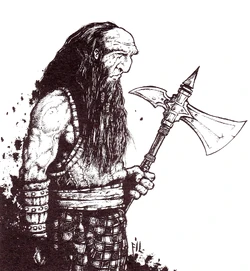
](https://static.wikia.nocookie.net/forgottenrealms/images/a/a4/Grond_Peaksmasher.png/revision/latest?cb=20241111095827)
Grond Peaksmasher, patron demigod of the firbolgs of the Moonshae Isles.
In general, firbolgs admired the goddess Iallanis.[23] However, the firbolgs of the Moonshae Isles were an exception to this. They worshiped the demigod Grond Peaksmasher, thought by religious scholars to be the son of Hiatea.[7] While in truth, the firbolgs were descendants of Othea and Ulutiu,[24] the firbolgs of the Moonshaes believed that Grond carved them from stone and that the dwarves were the result of the "leftovers" of this process.[7] Before Grond was reawakened, many of the firbolgs of the Isles were ruled by Kazgaroth, an aspect of Malar.[25]
On the Moonshaes, the worship of Grond was originally led by shamans, but after Grond's reawakening, priests became active. Grond's priests were allied with the druids of the Earthmother.[7]
Language[]
Firbolgs had their own tongue,[9][10] but also spoke Common,[1][2][3][9] Giant,[1][3][9] and Elven.[1][2] Sometimes, firbolgs who interacted with outsiders took elven names.[1] The traveler Volothamp Geddarm reported that firbolgs had no names for themselves or their homes,[1] but there were many named firbolgs and tribes in the region of Hartsvale in the North.[22][26]
Biology[]
Firbolg pregnancies were typically about two years long.[27] This was much longer than other giant-kin, who had pregnancies roughly equivalent to humans.[28] Firbolgs reached adulthood at about 30 years, and could live as many as 500 years.[1] Some scholars postulated that this long life was because firbolgs had fey blood,[1] but most giant races had long lifespans.[29]
Firbolgs consumed about twice as much as a human to survive.[30]
Lycanthropy[]
Firbolgs were known to be highly susceptible to almost all forms of lycanthropy, though somehow immune to being afflicted with the wereraven form of the condition.[21]
History[]
The firbolg race was created when Othea, wife of the giant deity Annam All-Father, had an affair with Ulutiu.[24] While, as noted above, the firbolgs of the Moonshae Isles believed themselves created from the rock of the islands, the other races of those islands held to legends that the firbolgs crawled out of the sea, called forth by the Beast.[31]
Like all the giant-kin races, the firbolgs were never granted a portion land by Annam from which to found their own "dynasty" inside the kingdom of Ostoria. They were initially welcomed by their fellow giants and learned their ways, but once their true parentage had been discovered by Annam he cast them out. They became excluded from the societies of true giants, despite Othea's best efforts to protect them.[32]
In -5000 DR, in a great conflict with the land's dwarves, Grond Peaksmasher was imprisoned on Oman's Isle beneath the great Ice Peak. Without his guidance,[15] the firbolgs of the Moonshae Isles over time degenerated into a barbaric culture little better than that of hill giants,[7][15] engaging in violent raids against the humans of the islands.[17]
In -2000 DR, a race of giants known as the fomorians were brought to the Moonshae Isles by the Beast's master, and they overpowered the native firbolg tribes, taking them as slaves. After a couple generations of forced breeding, the firbolgs of the Moonshae Isles began to assume some of the same disfigurements commonly associated with fomorians.[15]
In 1365 DR, the firbolgs managed to awaken their patron god Grond Peaksmasher with the aid of Deirdre Kendrick.[33] Grond then sought to elevate the firbolgs back to their full potential and culture. At this time, many of the firbolgs of the Isles began migrating to Oman's Isle to live in isolation from the other races.[7]
AD
Advertisement
Notable Firbolgs[]
- Tavis Burdun
- Galgadayle
- Morten
- Orvis Torval, a member of the City Watch of Waterdeep.[34]
- Raeyadfourne
- Vander
Notable Firbolg Clans[]
Appendix[]
Background[]
The firbolg are likely inspired by the Fir Bolg, a people in Irish myth said to have settled Ireland in ancient times.
Notes[]
- ↑ Jump up to: 1.0 1.1 The 5th-edition artwork for firbolgs does not correspond with the descriptions given in all previous editions, nor does Volo's Guide to Monsters describe the appearance of firbolgs beyond their size. Until another Realms-specific 5th-edition source describes the skin color of firbolgs as blue, we assume that the artist was in error.
- ↑ Jump up to: 2.0 2.1 2.2 2.3 2.4 2.5 2.6 2.7 Giantcraft, p. 6, implies that the giants of other worlds differ in "customs and details" from those of the Forgotten Realms.
- ↑ Volo's Guide to Monsters strangely lists a firbolg's height as 7 to 8 feet (2.1 to 2.4 meters) and gives them a weight of 240 to 300 pounds (110 to 140 kilograms). Perhaps Volo only encountered firbolgs who had taken a shorter stature with their innate magic.
Appearances[]
Adventures
Novels & Short Stories
Darkwalker on Moonshae • Darkwell • Night Masks • The Druid Queen • The Fallen Fortress • The Chaos Curse • The Giant Among Us • The Titan of Twilight • Honor Among Thieves: The Druid's Call
Referenced only
Prophet of Moonshae • Crucible: The Trial of Cyric the Mad
Video Games
Idle Champions of the Forgotten Realms
Referenced only
Dungeons & Dragons: Dark Alliance
Board Games
Dungeons & Dragons Dice Masters: Trouble in Waterdeep • Dungeons & Dragons: Onslaught • Dungeons & Dragons: The Yawning Portal
Card Games
AD&D Trading Cards • Dragonfire • Magic: The Gathering (CLB) • Spellfire (FR)
Miniatures
Organized Play & Licensed Adventures
Gallery[]
[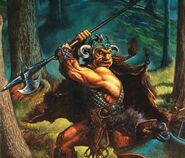
](https://forgottenrealms.fandom.com/wiki/File:MM2_firbolg.jpg "MM2 firbolg.jpg (210 KB)")
A firbolg battling an adventurer.
[
](https://forgottenrealms.fandom.com/wiki/File:Firbolg2e.png "Firbolg2e.png (172 KB)")
A firbolg leaning on his axe. (Not all firbolgs have noses so large.)
[
](https://forgottenrealms.fandom.com/wiki/File:Titans_of_twilight_cover.png "Titans of twilight cover.png (2.12 MB)")
Firbolg Tavis Burdun, with his magic bow, takes on a giant, from the cover of the novel The Titan of Twilight.
[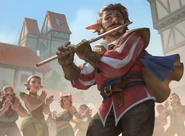
](https://forgottenrealms.fandom.com/wiki/File:Firbolg_Flutist_CLB.jpg "Firbolg Flutist CLB.jpg (375 KB)")
A firbolg flute player.
AD
Advertisement
External Links[]
Disclaimer: The views expressed in the following links do not necessarily represent the views of the editors of this wiki, nor does any lore presented necessarily adhere to established canon. Please consider using affiliate links before purchases to support the wiki.
Firbolg article at the Critical Role Wiki.
 Firbolg (Dungeons & Dragons) article at Wikipedia, The Free Encyclopedia.
References[]
- ↑ Jump up to: 1.00 1.01 1.02 1.03 1.04 1.05 1.06 1.07 1.08 1.09 1.10 1.11 1.12 1.13 1.14 1.15 1.16 1.17 1.18 1.19 1.20 1.21 1.22 1.23 1.24 1.25 1.26 1.27 1.28 1.29 1.30 1.31 1.32 1.33 Mike Mearls, et al. (November 2016). Volo's Guide to Monsters. Edited by Jeremy Crawford, et al. (Wizards of the Coast), pp. 106–107. ISBN 978-0786966011.
- ↑ Jump up to: 2.0 2.1 2.2 2.3 2.4 2.5 2.6 2.7 Rob Heinsoo, Stephen Schubert (May 19, 2009). Monster Manual 2 4th edition. (Wizards of the Coast), pp. 108–111. ISBN 0786995101.
- ↑ Jump up to: 3.00 3.01 3.02 3.03 3.04 3.05 3.06 3.07 3.08 3.09 3.10 3.11 3.12 3.13 3.14 3.15 3.16 3.17 3.18 3.19 3.20 3.21 3.22 3.23 3.24 3.25 3.26 3.27 3.28 3.29 3.30 3.31 3.32 3.33 3.34 3.35 3.36 Ed Bonny, Jeff Grubb, Rich Redman, Skip Williams, and Steve Winter (September 2002). Monster Manual II 3rd edition. (TSR, Inc), pp. 101–102. ISBN 07-8692-873-5.
- ↑ Jump up to: 4.00 4.01 4.02 4.03 4.04 4.05 4.06 4.07 4.08 4.09 4.10 4.11 4.12 4.13 4.14 4.15 4.16 4.17 4.18 4.19 4.20 4.21 4.22 4.23 4.24 4.25 4.26 4.27 4.28 4.29 4.30 4.31 4.32 4.33 4.34 4.35 4.36 4.37 4.38 4.39 4.40 4.41 4.42 4.43 4.44 4.45 4.46 4.47 4.48 4.49 4.50 4.51 4.52 4.53 4.54 4.55 Doug Stewart (June 1993). Monstrous Manual. (TSR, Inc), p. 136. ISBN 1-5607-6619-0.
- ↑ Jump up to: 5.0 5.1 5.2 5.3 5.4 5.5 Ray Winninger (September 1995). Giantcraft. Edited by Karen S. Boomgarden. (TSR, Inc.), pp. 33–34. ISBN 0-7869-0163-2.
- ↑ Jump up to: 6.00 6.01 6.02 6.03 6.04 6.05 6.06 6.07 6.08 6.09 6.10 6.11 6.12 6.13 6.14 6.15 6.16 6.17 Gary Gygax (August 1983). Monster Manual II 1st edition. (TSR, Inc), pp. 68–69. ISBN 0-88038-031-4.
- ↑ Jump up to: 7.0 7.1 7.2 7.3 7.4 7.5 Eric L. Boyd (September 1995). “Forgotten Deities: Grond Peaksmasher”. In Duane Maxwell ed. Polyhedron #111 (TSR, Inc.), p. 4.
- ↑ Jump up to: 8.0 8.1 8.2 8.3 8.4 8.5 8.6 Ray Winninger (September 1995). Giantcraft. Edited by Karen S. Boomgarden. (TSR, Inc.), p. 33. ISBN 0-7869-0163-2.
- ↑ Jump up to: 9.00 9.01 9.02 9.03 9.04 9.05 9.06 9.07 9.08 9.09 9.10 9.11 9.12 9.13 9.14 9.15 9.16 9.17 9.18 9.19 9.20 9.21 9.22 9.23 9.24 9.25 9.26 9.27 9.28 9.29 9.30 9.31 9.32 9.33 9.34 9.35 9.36 9.37 9.38 9.39 9.40 9.41 Bill Slavicsek (1993). The Complete Book of Humanoids. (TSR, Inc), pp. 27–29. ISBN 1-5607-6611-5.
- ↑ Jump up to: 10.0 10.1 Troy Denning (September 1995). The Titan of Twilight. (TSR, Inc.), p. 41. ISBN 0-7869-3798-X.
- ↑ Jump up to: 11.0 11.1 11.2 11.3 11.4 Ray Winninger (September 1995). Giantcraft. Edited by Karen S. Boomgarden. (TSR, Inc.), p. 19. ISBN 0-7869-0163-2.
- ↑ Frank Mentzer (January 1985). “Ay pronunseeAYshun gyd”. In Kim Mohan ed. Dragon #93 (TSR, Inc.), p. 26.
- ↑ Jump up to: 13.0 13.1 13.2 13.3 13.4 Ray Winninger (September 1995). Giantcraft. Edited by Karen S. Boomgarden. (TSR, Inc.), p. 31. ISBN 0-7869-0163-2.
- ↑ Ray Winninger (September 1995). Giantcraft. Edited by Karen S. Boomgarden. (TSR, Inc.), p. 14. ISBN 0-7869-0163-2.
- ↑ Jump up to: 15.0 15.1 15.2 15.3 Brian R. James (December 2007). “Grand History of the Realms: The Moonshaes”. Dragon #362 (Wizards of the Coast), p. 24. Archived from the original on 2009-06-01.
- ↑ Douglas Niles (September 2004). Darkwalker on Moonshae. (Wizards of the Coast). ISBN 0-7869-3560-X.
- ↑ Jump up to: 17.0 17.1 Douglas Niles (November 1987). Moonshae. Edited by Mike Breault. (TSR, Inc.), p. 9. ISBN 0-88038-494-8.
- ↑ Troy Denning (September 1995). The Titan of Twilight. (TSR, Inc.), chap. 15. ISBN 0-7869-3798-X.
- ↑ Mike Mearls, et al. (November 2016). Volo's Guide to Monsters. Edited by Jeremy Crawford, et al. (Wizards of the Coast), p. 20. ISBN 978-0786966011.
- ↑ Ray Winninger (September 1995). Giantcraft. Edited by Karen S. Boomgarden. (TSR, Inc.), p. 15. ISBN 0-7869-0163-2.
- ↑ Jump up to: 21.0 21.1 Brian P. Hudson (December 1999). “The Dragon's Bestiary: Giant Lycanthropes”. In Dave Gross ed. Dragon #266 (TSR, Inc.), pp. 76–80.
- ↑ Jump up to: 22.0 22.1 22.2 Ray Winninger (September 1995). Giantcraft. Edited by Karen S. Boomgarden. (TSR, Inc.), p. 32. ISBN 0-7869-0163-2.
- ↑ Ray Winninger (September 1995). Giantcraft. Edited by Karen S. Boomgarden. (TSR, Inc.), p. 52. ISBN 0-7869-0163-2.
- ↑ Jump up to: 24.0 24.1 Ray Winninger (September 1995). Giantcraft. Edited by Karen S. Boomgarden. (TSR, Inc.), p. 9. ISBN 0-7869-0163-2.
- ↑ Douglas Niles (November 1987). Moonshae. Edited by Mike Breault. (TSR, Inc.), p. 29. ISBN 0-88038-494-8.
- ↑ Troy Denning (September 1995). The Titan of Twilight. (TSR, Inc.), chap. 3. ISBN 0-7869-3798-X.
- ↑ Troy Denning (September 1995). The Titan of Twilight. (TSR, Inc.), p. 16. ISBN 0-7869-3798-X.
- ↑ Ray Winninger (September 1995). Giantcraft. Edited by Karen S. Boomgarden. (TSR, Inc.), p. 25. ISBN 0-7869-0163-2.
- ↑ Ray Winninger (September 1995). Giantcraft. Edited by Karen S. Boomgarden. (TSR, Inc.), p. 18. ISBN 0-7869-0163-2.
- ↑ Ray Winninger (September 1995). Giantcraft. Edited by Karen S. Boomgarden. (TSR, Inc.), p. 16. ISBN 0-7869-0163-2.
- ↑ Douglas Niles (November 1987). Moonshae. Edited by Mike Breault. (TSR, Inc.), p. 4. ISBN 0-88038-494-8.
- ↑ Tuque Games (2020). Dungeons & Dragons: Dark Alliance. Wizards of the Coast.
- ↑ Brian R. James (December 2007). “Grand History of the Realms: The Moonshaes”. Dragon #362 (Wizards of the Coast), p. 29. Archived from the original on 2009-06-01.
- ↑ Jerry Holkins, Elyssa Grant, Scott Fitzgerald Gray (June 18, 2019). Acquisitions Incorporated. Edited by Scott Fitzgerald Gray. (Wizards of the Coast), p. 86. ISBN 978-0786966905.
Connections[]
True Giants
Cloud • Ettin • Fire (Fire titan ) • Fog • Frost • Hill (Earth titan • Mouth of Grolantor • Scion of Grolantor) • Mountain • Stone • Storm • Titan
True Giant Offshoots
Ash • Craa'ghoran • Maur • Phaerlin
Giant-Kin
Cyclops (Cyclopskin) • Firbolg • Fomorian • Ogre (Oni) • Verbeeg • Voadkyn
Zakharan Giants
Desert • Island • Jungle • Ogre giant • Reef
Other Giants
Abyssal • Eldritch • Fensir • Death • Sand
Related Creatures
Goliath • Half-giant • Troll (Fell • Giant troll)
https://forgottenrealms.fandom.com/wiki/Firbolg
Firbolg Primeval Warden
Medium Humanoid (Druid), Any Alignment
- Armor Class 16 (hide armor, shield)
- Hit Points 65 (10d8 + 20)
- Hit Points 65 (10d8 + 20)
- Speed 30 ft.
STR DEX CON INT WIS CHA 16 (+3) 14 (+2) 14 (+2) 12 (+1) 16 (+3) 11 (+0)
- Saving Throws Int +3, Wis +5
- Skills Medicine +5, Nature +3, Perception +7
- Senses passive Perception 17
- Languages Common, Druidic, Giant
- Challenge 4 (1,100 XP)
- Proficiency Bonus +2
Actions
Multiattack. The firbolg makes two Spear or Fire Lance attacks.
Spear. Melee or Ranged Weapon Attack: +5 to hit, reach 5 ft. or range 20/60 ft., one target. Hit: 6 (1d6 + 3) piercing damage plus 9 (2d8) fire damage.
Fire Lance. Ranged Spell Attack: +5 to hit, range 120 ft., one target. Hit: 14 (2d10 + 3) fire damage.
Spellcasting. The firbolg casts one of the following spells, using Wisdom as the spellcasting ability (spell save DC 13):
At will: entangle, speak with animals, speak with plants
1/day each: commune with nature (as an action), detect magic, disguise selfBonus Actions
Hidden Step (2/Day). The firbolg magically turns invisible until the start of its next turn, until it makes an attack roll, or until it forces someone to make a saving throw.
Firbolg Wanderer
Medium Humanoid (Cleric), Any Alignment
- Armor Class 16 (breastplate)
- Hit Points 90 (12d8 + 36)
- Hit Points 90 (12d8 + 36)
- Speed 30 ft.
STR DEX CON INT WIS CHA 16 (+3) 14 (+2) 16 (+3) 14 (+2) 17 (+3) 16 (+3)
- Saving Throws Dex +5, Cha +6
- Skills Perception +6, Persuasion +6, Stealth +5
- Senses passive Perception 16
- Languages Common, Giant
- Challenge 5 (1,800 XP)
- Proficiency Bonus +3
Actions
Multiattack. The firbolg makes two attacks using Longsword, Bewitching Bolt, or a combination of them.
Longsword. Melee Weapon Attack: +6 to hit, reach 5 ft., one target. Hit: 7 (1d8 + 3) slashing damage, or 8 (1d10 + 3) slashing damage if used with two hands, plus 9 (2d8) psychic damage.
Bewitching Bolt. Ranged Spell Attack: +6 to hit, range 60 ft., one creature. Hit: 10 (2d6 + 3) psychic damage, and the target must succeed on a DC 14 Charisma saving throw or have the charmed condition until the start of the target's next turn.
Spellcasting. The firbolg casts one of the following spells, using Wisdom as the spellcasting ability (spell save DC 14):
At will: mage hand, minor illusion, Tasha's hideous laughter
1/day each: detect magic, disguise self, dispel magic, polymorphBonus Actions
Duplicitous Movement (1/Day). The firbolg projects an illusory duplicate of itself in an unoccupied space it can see within 30 feet of itself. The firbolg can then swap places with the illusion. The illusion vanishes after 1 minute, if the firbolg is incapacitated, or if the illusion is more than 120 feet from the firbolg.
As a bonus action on later turns, the firbolg can move the illusion up to 30 feet and can then swap places with it.
Genasi
- Ability Scores. Constitution +2
- Size. Medium
- Speed. 30 ft.
This race has multiple subraces, as listed below:
- Genasi (Air)
- Genasi (Earth)
- Genasi (Fire)
- Genasi (Water)
Traits
Age. Genasi mature at about the same rate as humans and reach adulthood in their late teens. They live somewhat longer than humans do, up to 120 years.
Alignment. Independent and self-reliant, genasi tend toward a neutral alignment.
Size. Genasi are as varied as their mortal parents but are generally built like humans, standing anywhere from 5 feet to over 6 feet tall. Your size is Medium.
Languages. You can speak, read, and write Common and Primordial. Primordial is a guttural language, filled with harsh syllables and hard consonants.
https://2014.5e.tools/img/races/EEPC/Genasi.webp
Genasi (Air)
- Ability Scores. Constitution +2; Dexterity +1
- Size. Medium
- Speed. 30 ft.
Age. Genasi mature at about the same rate as humans and reach adulthood in their late teens. They live somewhat longer than humans do, up to 120 years.
Alignment. Independent and self-reliant, genasi tend toward a neutral alignment.
Size. Genasi are as varied as their mortal parents but are generally built like humans, standing anywhere from 5 feet to over 6 feet tall. Your size is Medium.
Languages. You can speak, read, and write Common and Primordial. Primordial is a guttural language, filled with harsh syllables and hard consonants.
Unending Breath. You can hold your breath indefinitely while you're not incapacitated.
Mingle with the Wind. You can cast the levitate spell once with this trait, requiring no material components, and you regain the ability to cast it this way when you finish a long rest. Constitution is your spellcasting ability for this spell.
As an air genasi, you are descended from the djinn. As changeable as the weather, your moods shift from calm to wild and violent with little warning, but these storms rarely last long.
Air genasi typically have light blue skin, hair, and eyes. A faint but constant breeze accompanies them, tousling the hair and stirring the clothing. Some air genasi speak with breathy voices, marked by a faint echo. A few display odd patterns in their flesh or grow crystals from their scalps.
Genasi (Earth)
- Ability Scores. Constitution +2; Strength +1
- Size. Medium
- Speed. 30 ft.
Age. Genasi mature at about the same rate as humans and reach adulthood in their late teens. They live somewhat longer than humans do, up to 120 years.
Alignment. Independent and self-reliant, genasi tend toward a neutral alignment.
Size. Genasi are as varied as their mortal parents but are generally built like humans, standing anywhere from 5 feet to over 6 feet tall. Your size is Medium.
Languages. You can speak, read, and write Common and Primordial. Primordial is a guttural language, filled with harsh syllables and hard consonants.
Earth Walk. You can move across difficult terrain made of earth or stone without ex-pending extra movement.
Merge with Stone. You can cast the pass without trace spell once with this trait, re-quiring no material components, and you regain the ability to cast it this way when you finish a long rest. Constitution is your spellcasting ability for this spell.
As an earth genasi, you are descended from the cruel and greedy dao, though you are not necessarily evil. You have inherited some measure of control over earth, reveling in superior strength and solid power. You tend to avoid rash decisions, pausing long enough to consider your options before taking action.
Elemental earth manifests differently from one individual to the next. Some earth genasi always have bits of dust falling from their bodies and mud clinging to their clothes, never getting clean no matter how often they bathe. Others are as shiny and polished as gemstones, with skin tones of deep brown or black, eyes sparkling like agates. Earth genasi can also have smooth metallic flesh, dull iron skin spotted with rust, a pebbled and rough hide, or even a coating of tiny embedded crystals. The most arresting have fissures in their flesh, from which faint light shines.
Genasi (Fire)
- Ability Scores. Constitution +2; Intelligence +1
- Size. Medium
- Speed. 30 ft.
Age. Genasi mature at about the same rate as humans and reach adulthood in their late teens. They live somewhat longer than humans do, up to 120 years.
Alignment. Independent and self-reliant, genasi tend toward a neutral alignment.
Size. Genasi are as varied as their mortal parents but are generally built like humans, standing anywhere from 5 feet to over 6 feet tall. Your size is Medium.
Languages. You can speak, read, and write Common and Primordial. Primordial is a guttural language, filled with harsh syllables and hard consonants.
Darkvision. You can see in dim light within 60 feet of you as if it were bright light, and in darkness as if it were dim light. Your ties to the Elemental Plane of Fire make your darkvision unusual: everything you see in darkness is in a shade of red.
Fire Resistance. You have resistance to fire damage.
Reach to the Blaze. You know the produce flame cantrip. Once you reach 3rd level, you can cast the burning hands spell once with this trait as a 1st-level spell, and you regain the ability to cast it this way when you finish a long rest. Constitution is your spellcasting ability for these spells.
As a fire genasi, you have inherited the volatile mood and keen mind of the efreet. You tend toward impatience and making snap judgments. Rather than hide your distinctive appearance, you exult in it.
Nearly all fire genasi are feverishly hot as if burning inside, an impression reinforced by flaming red, coal-black, or ash-gray skin tones. The more human-looking have fiery red hair that writhes under extreme emotion, while more exotic specimens sport actual flames dancing on their heads. Fire genasi voices might sound like crackling flames, and their eyes flare when angered. Some are accompanied by the faint scent of brimstone.
Genasi (Water)
- Ability Scores. Constitution +2; Wisdom +1
- Size. Medium
- Speed. 30 ft., swim 30 ft.
Age. Genasi mature at about the same rate as humans and reach adulthood in their late teens. They live somewhat longer than humans do, up to 120 years.
Alignment. Independent and self-reliant, genasi tend toward a neutral alignment.
Size. Genasi are as varied as their mortal parents but are generally built like humans, standing anywhere from 5 feet to over 6 feet tall. Your size is Medium.
Languages. You can speak, read, and write Common and Primordial. Primordial is a guttural language, filled with harsh syllables and hard consonants.
Acid Resistance. You have resistance to acid damage.
Amphibious. You can breathe air and water.
Swim. You have a swimming speed of 30 feet.
Call to the Wave. You know the shape water cantrip. When you reach 3rd level, you can cast the create or destroy water spell as a 2nd-level spell once with this trait, and you regain the ability to cast it this way when you finish a long rest. Constitution is your spellcasting ability for these spells.
The lapping of waves, the spray of sea foam on the wind, the ocean depths, all of these things call to your heart. You wander freely and take pride in your independence, though others might consider you selfish.
Most water genasi look as if they just finished bathing, with beads of moisture collecting on their skin and hair. They smell of fresh rain and clean water. Blue or green skin is common, and most have somewhat overlarge eyes, blue-black in color. A water genasi's hair might float freely, swaying and waving as if underwater. Some have voices with undertones reminiscent of whale song or trickling streams.
Those who think of other planes at all consider them remote, distant realms, but planar influence can be felt throughout the world. It sometimes manifests in beings who, through an accident of birth, carry the power of the planes in their blood. The genasi are one such people, the offspring of genies and mortals.
The Elemental Planes are often inhospitable to natives of the Material Plane: crushing earth, searing flames, boundless skies, and endless seas make visiting these places dangerous for even a short time. The powerful genies, however, do not face such troubles when venturing into the mortal world. They adapt well to the mingled elements of the Material Plane, and they sometimes visit whether of their own volition or compelled by magic. Some genies can adopt mortal guise and travel incognito.
During these visits, a mortal might catch a genies eye. Friendship forms, romance blooms, and sometimes children result. These children are genasi: individuals with ties to two worlds, yet belonging to neither. Some genasi are born of mortal-genie unions, others have two genasi as parents, and a rare few have a genie further up their family tree, manifesting an elemental heritage that's lain dormant for generations.
Occasionally, genasi result from exposure to a surge of elemental power, through phenomena such as an eruption from the Inner Planes or a planar convergence. Elemental energy saturates any creatures in the area and might alter their nature enough that their offspring with other mortals are born as genasi.
Heirs to Elemental Power. Genasi inherit something from both sides of their dual nature. They resemble humans but have unusual skin color (red, green, blue, or gray), and there is something odd about them. The elemental blood flowing through their veins manifests differently in each genasi, often as magical power.
Seen in silhouette, a genasi can usually pass for human. Those of earth or water descent tend to be heavier, while those of air or fire tend to be lighter. A given genasi might have some features reminiscent of the mortal parent (pointed ears from an elf, a stockier frame and thick hair from a dwarf, small hands and feet from a halfling, exceedingly large eyes from a gnome, and so on).
Genasi almost never have contact with their elemental parents. Genies seldom have interest in their mortal offspring, seeing them as accidents. Many feel nothing for their genasi children at all.
Some genasi live as outcasts, driven into exile for their unsettling appearance and strange magic, or assuming leadership of savage humanoids and weird cults in untamed lands. Others gain positions of great influence, especially where elemental beings are revered. A few genasi leave the Material Plane to find refuge in the households of their genie parents.
Wild and Confident. Genasi rarely lack confidence, seeing themselves as equal to almost any challenge in their path. This certainty might manifest as graceful self-assurance in one genasi and as arrogance in another. Such self-confidence can sometimes blind genasi to risk, and their great plans often get them and others into trouble.
Too much failure can chip away at even a genasis sense of self, so they constantly push themselves to improve, honing their talents and perfecting their craft.
Genasi Lands. As rare beings, genasi might go their entire lives without encountering another one of their kind. There are no great genasi cities or empires. Genasi seldom have communities of their own and typically adopt the cultures and societies into which they are born. The more strange their appearance, the harder time they have. Many genasi lose themselves in teeming cities, where their distinctiveness hardly raises an eyebrow in places accustomed to a variety of different people.
Those living on the frontier, though, have a much harder time. People there tend to be less accepting of differences. Sometimes a cold shoulder and a suspicious glare are the best genasi can hope for; in more backward places, they face ostracism and even violence from people who mistake them for fiends. Facing a hard life, these genasi seek isolation in the wilds, making their homes in mountains or forests, near lakes, or underground.
Most air and fire genasi in the Realms are descendants of the djinn and efreet who once ruled Calimshan. When those rulers were overthrown, their planetouched children were scattered. Over thousands of years, the bloodlines of those genasi have spread into other lands. Though far from common, air and fire genasi are more likely to be found in the western regions of Faerûn, along the coast from Calimshan north up to the Sword Coast, and into the Western Heartlands to the east. Some remain in their ancient homeland.
In contrast, water and earth genasi have no common history. Individuals have difficulty tracing their own lineage, and bloodlines occasionally skip a generation or two. Many earth genasi originated in the North and spread out from there. Water genasi come from coastal areas, the largest concentration of them hailing from the regions surrounding the Sea of Fallen Stars.
The distant land of Zakhara is known only in legends to most inhabitants of Faerûn. There, genies and spellcasters enter into bargains, and genasi can result from such pacts. Those genasi have been sources of great weal and woe in the history of that land.
Genasi Names. Genasi use the naming conventions of the people among whom they were raised. They might later assume distinctive names to capture their heritage, such as Flame, Ember, Wave, or Onyx.
Source: EEPC, page 9. Additional information from EGW, page 170. Reprinted as Genasi in MPMM. Also found in EGW, page 170.
Genasi
- Ability Scores. Choose one of: (a) Choose any +2; choose any other +1 (b) Choose three different +1
- Size. Small/Medium
- Speed. 30 ft.
This race has multiple subraces, as listed below:
- Genasi (Air)
- Genasi (Earth)
- Genasi (Fire)
- Genasi (Water)
Traits
Size. You are Medium or Small. You choose the size when you select this race.
Darkvision. You can see in dim light within 60 feet of you as if it were bright light and in darkness as if it were dim light. You discern colors in that darkness only as shades of gray.
Languages. You can speak, read, and write Common and one other language that you and your DM agree is appropriate for your character.
Genasi (Air)
- Ability Scores. Choose one of: (a) Choose any +2; choose any other +1 (b) Choose three different +1
- Size. Small/Medium
- Speed. 35 ft.
Size. You are Medium or Small. You choose the size when you select this race.
Darkvision. You can see in dim light within 60 feet of you as if it were bright light and in darkness as if it were dim light. You discern colors in that darkness only as shades of gray.
Languages. You can speak, read, and write Common and one other language that you and your DM agree is appropriate for your character.
Unending Breath. You can hold your breath indefinitely while you're not incapacitated.
Lightning Resistance. You have resistance to lightning damage.
Mingle with the Wind. You know the shocking grasp cantrip. Starting at 3rd level, you can cast the feather fall spell with this trait, without requiring a material component. Starting 5th level, you can also cast the levitate spell with this trait, without requiring a ma-terial component. Once you cast feather fall or levitate with this trait, you can't cast that spell with it again until you finish a long rest. You can also cast either of those spells using any spell slots you have of the appropriate level.
Intelligence, Wisdom, or Charisma is your spellcasting ability for these spells when you cast them with this trait (choose when you select this race).
Genasi (Earth)
- Ability Scores. Choose one of: (a) Choose any +2; choose any other +1 (b) Choose three different +1
- Size. Small/Medium
- Speed. 30 ft.
Size. You are Medium or Small. You choose the size when you select this race.
Darkvision. You can see in dim light within 60 feet of you as if it were bright light and in darkness as if it were dim light. You discern colors in that darkness only as shades of gray.
Languages. You can speak, read, and write Common and one other language that you and your DM agree is appropriate for your character.
Earth Walk. You can move across difficult terrain without expending extra movement if you are using your walking speed on the ground or a floor.
Merge with Stone. You know the blade ward cantrip. You can cast it as normal, and you can also cast it as a bonus action a number of times equal to your proficiency bonus, re-gaining all expended uses when you finish a long rest.
Starting at 5th level, you can cast the pass without trace spell with this trait, without requir-ing a material component. Once you cast that spell with this trait, you can't do so again until you finish a long rest. You can also cast it using any spell slots you have of 2nd level or higher.
Intelligence, Wisdom, or Charisma is your spellcasting ability for these spells when you cast them with this trait (choose when you select this race).
Genasi (Fire)
- Ability Scores. Choose one of: (a) Choose any +2; choose any other +1 (b) Choose three different +1
- Size. Small/Medium
- Speed. 30 ft.
Size. You are Medium or Small. You choose the size when you select this race.
Darkvision. You can see in dim light within 60 feet of you as if it were bright light and in darkness as if it were dim light. You discern colors in that darkness only as shades of gray.
Languages. You can speak, read, and write Common and one other language that you and your DM agree is appropriate for your character.
Fire Resistance. You have resistance to fire damage.
Reach to the Blaze. You know the produce flame cantrip. Starting at 3rd level, you can cast the burning hands spell with this trait. Starting at 5th level, you can also cast the flame blade spell with this trait, without a material component. Once you cast burning hands or flame blade with this trait, you can't cast that spell with it again until you finish a long rest. You can also cast either of those spells using any spell slots you have of the appropriate level.
Intelligence, Wisdom, or Charisma is your spellcasting ability for these spells when you cast them with this trait (choose when you select this race).
Genasi (Water)
- Ability Scores. Choose one of: (a) Choose any +2; choose any other +1 (b) Choose three different +1
- Size. Small/Medium
- Speed. 30 ft., swim equal to your walking speed
Size. You are Medium or Small. You choose the size when you select this race.
Darkvision. You can see in dim light within 60 feet of you as if it were bright light and in darkness as if it were dim light. You discern colors in that darkness only as shades of gray.
Languages. You can speak, read, and write Common and one other language that you and your DM agree is appropriate for your character.
Speed. Your walking speed is 30 feet, and you have a swimming speed equal to your walking speed.
Acid Resistance. You have resistance to acid damage.
Amphibious. You breathe air and water.
Call to the Wave. You know the acid splash cantrip. Starting at 3rd level, you can cast the create or destroy water spell with this trait. Starting at 5th level, you can also cast the water walk spell with this trait, without requiring a material component. Once you cast create or destroy water or water walk with this trait, you can't cast that spell with it again until you finish a long rest. You can also cast either of those spells using any spell slots you have of the appropriate level.
Intelligence, Wisdom, or Charisma is your spellcasting ability for these spells when you cast them with this trait (choose when you select this race).
Tracing their ancestry to the genies of the Elemental Planes, each genasi can tap into the power of one of the elements. Air, earth, fire, and water—these are the four pillars of the Material Plane and the four types of genasi. Some genasi are direct descendants of a genie, while others were born to non-genasi parents who lived near a place suffused by a genie's magic.
A typical genasi has a life span of 120 years.
Source: MPMM, page 16
Genasi
Our Venom Predictions
Keep WatchingNext video in 8 seconds
More Videos
0 of 2 minutes, 30 secondsVolume 0%
Press shift question mark to access a list of keyboard shortcuts
Keyboard ShortcutsEnabledDisabled
Shortcuts Open/Close/ or ?
Play/PauseSPACE
Increase Volume↑
Decrease Volume↓
Seek Forward→
Seek Backward←
Captions On/Offc
Fullscreen/Exit Fullscreenf
Mute/Unmutem
Decrease Caption Size-
Increase Caption Size+ or =
Seek %0-9
Auto1080p1080p720p406p270p180p
0.5x1x1.25x1.5x2x
Live
00:21
02:09
02:30
- 5e
- 4e
- 3e
[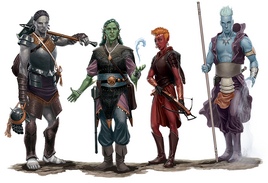
](https://static.wikia.nocookie.net/forgottenrealms/images/9/95/Genasi_subraces_5e.png/revision/latest?cb=20151010092802 "5e")
[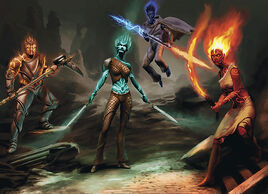
](https://static.wikia.nocookie.net/forgottenrealms/images/d/df/Genasi4e.jpg/revision/latest?cb=20210805105342 "4e")
[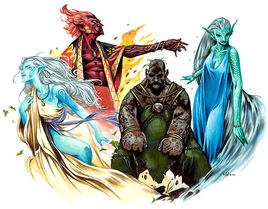
](https://static.wikia.nocookie.net/forgottenrealms/images/d/d9/Genasi_-_MoF.jpg/revision/latest?cb=20151010092217 "3e")
Various depictions of genasi.
Genasi
-
5e
-
4e
-
3e
5th Edition Statistics[1][2]
Size
Medium
Type
Alignment
Usually neutral
4th Edition Statistics[3][4]
Size
Medium
Origin
Type
Alignment
3rd Edition Statistics[5][6][7]
Size
Medium
Type
Subtype(s)
Alignment
Often neutral
Challenge rating
1⁄2
General Information
Vision
Darkvision[6] - Fire genasi
Normal - Air genasi Water genasi Earth genasi
Average lifespan
90–150 years[8]
Homeland(s)
Language(s)
Subraces
Air genasi
Earth genasi
Fire genasi
Water genasi
Para-genasi
Favored climate
Any[5]
Appearance
Average height
5'7" – 6'2"[4]
Average weight
130–225 lbs.[4]
History
First appearance
Genasi (pronounced: /[dʒ](https://forgottenrealms.fandom.com/wiki/J_as_in_%22jump%22 "J as in "jump"")[ɛ](https://forgottenrealms.fandom.com/wiki/E_as_in_%22elf%22 "E as in "elf"")[n](https://forgottenrealms.fandom.com/wiki/N_as_in_%22dragon%22 "N as in "dragon"")ˈ[ɑː](https://forgottenrealms.fandom.com/wiki/A_as_in_%22bard%22 "A as in "bard"")[s](https://forgottenrealms.fandom.com/wiki/S_as_in_%22sorcerer%22 "S as in "sorcerer"")[i](https://forgottenrealms.fandom.com/wiki/Ee_as_in_%22fee%22 "Ee as in "fee"")/ jen-AH-see[12]) were planetouched humans,[13][5] infused with the power of the elements.[14][5][9] Along with aasimar and tieflings, genasi were the most common planetouched found on the world of Toril.[15]
Technically speaking, the genasi were not a race but rather a general classification of humans who had a heritage (usually unknown) that included some planar being from one of the elemental planes,[13] most often a genie,[13][5] (dao, djinn, efreet, marid, or jann,[6]) whence their name is derived.[14]
Contents
Subraces[]
Each of the four fundamental elements had associated genies, so the most common genasi were air genasi, earth genasi, fire genasi, and water genasi,[16][6] while stormsoul genasi became common in lands such as Akanûl in the 15th century DR.[4] Para-genasi were genasi who expressed a bloodline of two elements, akin to the Para-Elemental Planes. These included the dust para-genasi, ice para-genasi, magma para-genasi, ooze para-genasi, smoke para-genasi, steam para-genasi, among other possibilities. Para-genasi were even rarer than the four standard genasi.[17]
After the Spellplague, when the separate elemental planes coalesced into the Elemental Chaos,[18] each genasi gained the potential to manifest the power of any of the elements, though only one at a time.[4] After the Second Sundering, the genasi were again separated into the four major subraces of air, earth, fire, and water.[2][1]
Description[]
No two genasi were alike in appearance.[5][3] Some could pass as normal humans, bearing the marks of their human ethnicity;[15] for others, their elemental nature was impossible to hide.[14] Their heritage was nearly always evident in one or two physical traits,[14][note 1] such as skin[14][4] or hair color[14][4] or an elemental aura.[14] Some genasi did not have hair at all; for such genasi, the substance that appeared to cover their heads was actually a supernatural expression of their elemental nature.[4]
[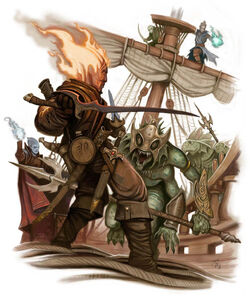
](https://static.wikia.nocookie.net/forgottenrealms/images/2/24/4e_genasi.jpg/revision/latest?cb=20080924054938)
A group of four genasi battle sahuagin aboard a sailing vessel.
Even after the Spellplague, no genasi could maintain a neutral, "non-elemental" state, and their physical appearance changed depending on the elemental soul that they were currently manifesting. Those genasi manifesting an "earthsoul" had brown skin and golden eyes. Those manifesting a "firesoul" had bronze skin and orange eyes, with flickering flames coming out of their heads. "Stormsoul" genasi had purple skin with glowing, crystal spikes of silver in place of hair. Genasi with the "watersoul" manifestation had skin the color of seafoam and were bald. "Windsoul"-manifesting genasi had silver skin with blue and gray crystalline "hair".[4]
Genasi were about the same size and stature as normal humans,[19][4] but their bodies displayed signs of greater physical strength,[4] and other subtle indications of their heritage.[19]
Szuldar[]
[
](https://static.wikia.nocookie.net/forgottenrealms/images/8/8b/Watersoul_genasi_-_William_O%27Connor.jpg/revision/latest?cb=20081114004307)
A genasi manifesting as a watersoul, with clear blue szuldar on the face.
Genasi of the era between the Spellplague and the Second Sundering bore a unique physical feature not reported in earlier generations. Regardless of their elemental manifestation, the body of each such genasi was etched with strange lines of energy, called szuldar in Primordial,[20] that glowed in a color associated with the element that the genasi was currently manifesting. The earthsoul manifestation had golden-colored energy lines; the firesoul manifestation had fiery orange lines; the stormsoul manifestation had silvery lines; the watersoul had bright blue lines; and the windsoul light blue. These lines appeared in a pattern that was passed along family lines, sometimes extending into small communities as well. Though the patterns could be similar between relatives in a general sense, the specific configurations were unique to each individual and served much the same purpose that fingerprints did amongst humans; the pattern of these lines remained unchanged even when a genasi changed their manifestation. Many genasi, especially adventurers, displayed these lines with pride, often wearing clothing that left a fair amount of skin exposed.[4]
Though szuldar usually remain unchanged throughout a genasi's life it was possible to alter them through scarring. Some genasi did this deliberately for aesthetic reasons, or in order to disguise themselves. Most genasi, however, disapproved of the practice and saw it as a loss of self-awareness, valuing the patterns they were born with as a mark of their identity.[20]
Abilities[]
[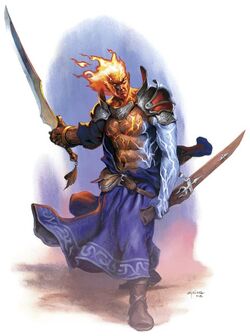
](https://static.wikia.nocookie.net/forgottenrealms/images/d/d2/Elemental_tempest_4e.jpg/revision/latest?cb=20200424161826)
All genasi had inherent magical powers and resistances related to their element.[16][6]
During the era after the Spellplague, a rare few genasi could control two elemental manifestations simultaneously. These powerful entities were known as elemental tempests.[21][20]
Like other planetouched, because of the strength of their elemental heritage, many spells that specifically affected humanoids had no effect on genasi. On the other hand, some spells that affected outsiders were effective against them, such as banishment.[15][22]
Personality[]
Unlike many planetouched races, genasi generally took pride in their unusual features.[6] Furthermore, because of their elemental power, most genasi felt a sense of superiority over other races[14][5] and even over other genasi[14]—including those of the same element.[14] This was not so much a matter of prejudice as it was simple fact—a simple mortal could not possibly understand the mind of one with elemental heritage.[23] In return, the genasi were perhaps the most distrusted of the planetouched races for being the most alien.[14]
The personality of the typical genasi reflected her or his core element. For example, a fire genasi might have a "hot temper" and an earth genasi might take life slowly and carefully.[14] Between the Spellplague and the Second Sundering, because of their roots in the powers of the Elemental Chaos, genasi were by nature changeable and contradictory. Nevertheless, the psychology of a genasi depended vastly on what element was currently manifested by the individual in question. Thus, genasi who could manifest in more than one way thought of themselves as possessing multiple personalities. Such genasi might even use one when dealing with one group of friends while using a another to interact with another set. Others were more picky and chose friends who could cope with their changing nature.[4][24]
Many genasi philosophers believed that their race existed as a compromise between the chaos of the primordials and the divinely crafted world of the gods. A few genasi took this to heart and tried to eliminate one or the other aspect of their nature, either becoming agents of chaos or disciples of order, but these individuals were considered the exception rather than the rule. Most genasi were simply grateful for the innate connection to the elemental forces that shaped the world that they all shared.[4][24]
Genasi had a strong ability to adapt, perhaps only superseded by humans in this regard, and embraced change as an inevitability or even something to be relished. Even lawful genasi embraced this change, and genasi of all kinds valued the possibilities the future might bring, such as new allies or new opportunities. In many ways, genasi were the most flexible of races, less stubborn and more willing to accept new ideas for better or worse.[24]
One of the traits found commonly amongst all genasi was a strong sense of ambition. All genasi had a desire to better themselves and advance their status, either through pursuit of power, the acquisition of friends, or other means. Nearly all genasi had dreams and aspirations and would pursue these goals throughout their life and though few genasi were truly patient, so strong were their passions for these goals that they would often continue to follow them even long after individuals of other races would have given up and moved on.[24] Simply put, they felt that they had a destiny and a calling to leave a name for themselves.[23]
Genasi loved most forms of recreation, particularly competitive ones that allowed them to improve their standing amongst other races further. Most genasi preferred recreational activities that were active and physical, allowing them to release their impulses and wilder urges.[25]
Because of their chaotic and spontaneous nature, genasi were not predisposed towards team athletics and preferred sports that favored the individual. Genasi were particularly fond of gladiatorial sports, which allowed them to bask in the attention of others while simultaneously releasing pent-up passions.[25]
AD
Advertisement
Society[]
Genasi were exceptionally rare among the planes.[14] They were more common on Toril, however, because of the many portals to other planes found on that world.[22] Even so, until the time after the Spellplague, genasi were lucky if they ever met another one of their kind.[26] In Faerûn, they could be found in isolated wildlands or in major cities, such as Waterdeep, where their strange traits would not arouse significant suspicion.[5] Fire and air genasi were found in the deserts of Calimshan,[10][11] and water genasi were found along the coasts of Threskel in Chessenta.[10][11] In Thay, the wizards there intentionally bred their slaves with various outsiders, resulting in a higher population of genasi and other planetouched there as well.[10][11] Earth genasi could also be found in Mulhorand, and fire genasi in Unther.[11] Argentor was a village located in Tethyr that was home to many earthsoul genasi after the Spellplague. This was regarded as one of the few settlements that were exclusive to the earthsouled.[27]
Abeir was exception to the rule in that it had a large number of genasi who were native to that world.[9]
Genasi of Faerûn usually lived in isolation until the Spellplague.[14][5] When genasi gathered together in any great numbers, such as in Calimshan or Akanûl in the time after the Spellplague, their social structures were almost certain to be chaotic and unstable.[4][28]
Though genasi could be extremely passionate in a way that might seem violent, the race as a whole had a love for family and friends, to the point that few genasi marriages ended in divorce. Post-Spellplague, most genasi families were large, and the genasi as a whole looked upon another genasi as a potential relative to the point of referring to those they met as "brother", "sister", or "cousin".[24] In the infrequent genasi society, family played an important role, likely in part because genasi found it difficult to form new friendships and bonds. To most genasi, family bonds were the only ones that were truly reliable and it was far rarer for genasi to become alienated or estranged from members of their family. This is not to say that internal feuds and disputes did not happen, but the vast majority led to only temporary divides, and family members spread over the world would eventually come looking for a reunion. Genasi parents went out of their way to ensure that their children had a chance to interact with genasi of other manifestations, thereby increasing their appreciation for the race as a whole. This was particularly true for families that were made of several manifestations rather than just one or two.[28]
Genasi could be found in any climate. Water genasi could even make their homes underwater.[5]
Language[]
Genasi spoke the languages of their native region.[6] In addition, they often learned the languages of the elemental plane from which their powers derived.[29]
Magic[]
Because of their elemental origins, genasi usually favored elemental magic over other forms of the Art, which they had a particular skill for given their natural elemental abilities.[28]
Religion[]
After the Spellplague, the earthsouled worshiped many lords and gods and were not confined to just one.[27]
Art[]
Genasi art was wild and exciting, similar to the race itself. Genasi preferred elaborate and bold designs, using bright and vibrant colors to express the wide range of emotions they felt. Sculptures were often explosive in appearance, resembling surges of power more than anything else. Even for relatively simple or functional items, the genasi poured care into giving it a flamboyant appearance, marking it with swirling patterns, gemstones, or elaborate carvings.[30]
Genasi artisans often saw their craft as a means of obtaining prestige. These individuals desired nothing more than to be in high demand and so worked hard to please their customer base. For this reason, many genasi often substituted actual excellence for customization and individuality and while the average genasi swordsmith might not compare with his dwarven counterpart in terms of quality, the genasi would work much harder to tailor the blade to his or her customer's specific needs and wants. This could go so far as to make genasi-crafted items seem uncomfortable or unwieldy in the hands of those for whom they were not intended.[30]
Combat[]
[
](https://static.wikia.nocookie.net/forgottenrealms/images/3/36/Swordmage.jpg/revision/latest?cb=20230614111442)
A "stormsoul" genasi swordmage.
As a rule, genasi favored training as fighters.[5][6] Others chose the path of swordmage (especially those from Returned Abeir[31]) or warlord.[4]
Ecology[]
The child of an elemental creature with a human was a half-elemental. The child of a half-elemental and a human was a genasi. The child of a genasi and a human might show planetouched traits or purely human ones.[26] Thus, overtime, the elemental bloodline was diluted until it was no longer obvious in most individuals.[22] However, every few generations, a child might display his or her elemental heritage as a genasi.[22][26]
If two genasi of the same element were to produce offspring, the child was always a genasi of that element; if the couple was of differing elements, the child would take after only one of the parents. However, both elements were still present in the child's blood and might manifest in future generations.[26][20]
Para-genasi came about when a half-elemental of one type mated with an elemental creature of another type.[22]
The genealogy of an individual genasi was extremely difficult to determine, as the elemental planes had many sentient lifeforms capable of interbreeding with humans. Moreover, most such races would never admit to such a coupling and would reject both the half-elemental offspring and any of his or her descendants.[14]
[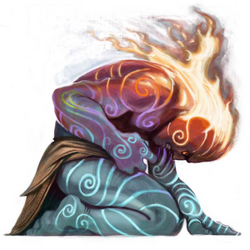
](https://static.wikia.nocookie.net/forgottenrealms/images/a/af/Genasi_teenager.png/revision/latest?cb=20180611051246)
A young genasi painfully gaining a second elemental manifestation.
Even after the Spellplague, a genasi child came into the world with only one elemental manifestation, the one passed on to him or her through the parents.[4][20] By late adolescence or early adulthood, it was possible for genasi of this era to learn an additional manifestation.[4][20] A few genasi were rumored to have learned several throughout their lives.[4] Because the initial manifestation of a genasi was determined genetically, specific manifestations were most common in regions matching that element. For example, an underwater culture was not likely to produce many earthsoul genasi![4] Children reared in close contact with genasi of a different subrace were more likely to develop a second manifestation, as were those who were reared in areas where their manifestation's element was weak or nonexistent. Hence, a firesoul genasi raised in the middle of the ocean on an island was likely to develop a watersoul manifestation as well.[20]
The initial development of a second manifestation could often be uncomfortable, even painful, and usually came suddenly and without warning. With practice, this transition became less discomforting, with those well-versed in the transformation experiencing little more than a mild and passing unease. The reason for this discomfort lay in the fact that the transition was more than aesthetic in nature and was actually a fundamental change in the physical makeup of the genasi, like replacing the sand in a bag with water.[20]
Genasi possessed a lifespan comparable with that of humans, reaching 75 years on average barring accident or violence.[4] However, like other planetouched, some genasi had life spans roughly 20 to 40 years longer than normal humans.[8]
AD
Advertisement
History[]
Calimshan had an historically higher population of air and fire genasi, because of its history of djinni and efreeti rulers.[26] After the Second Era of Skyfire, the genasi of that land became engaged in a civil war over the Skyfire Wastes.[32][33] When the Calimemnon Crystal shattered and the ancient foes Calim and Memnon were released, so too were many of their genasi servants. The two noble genies immediately began their epic war again, and the genasi took sides, joined by those genasi already living in Calimshan and even more from nearby lands of Tethyr, Amn, and the Lake of Steam. The Second Era of Skyfire ended suddenly in the Year of Holy Thunder, 1450 DR, when Calim and Memnon mysteriously disappeared again to their home planes. At that point, the power vacuum was filled by the genasi, who ruled Calimshan and enslaved many humans under them, reigning from the cities of Calimport and Memnon.[33] The human slaves, led by a Chosen of Ilmater eventually overcame their genasi masters, restoring Calimshan to human rule and returning the genasi population once again to minority status.[34]
Also after the Spellplague, when Abeir and Toril were merged again for a time, the lands that were once Chondath became the realm of Akanûl, which was ruled by genasi originally from the continent of Shyr.[32] Prior to coming to Toril, these Abeiran genasi had been enslaved by the primordial Karshimis, but his citadel was not transferred with them to Toril, leaving them free to form their own kingdom.[35] The majority of the citizens of Akanûl had the windsoul and stormsoul manifestation.[36]
Members of the Burned, a group of Abeiran genasi, believed themselves to be direct descendants of original genasi crafted by the primordial Nehushta to be its slaves and that all other genasi "tribes" descended from theirs, but most other scholars refuted this local legend.[37]
Notable Genasi[]
- Arathane, Queen of Akanûl, who commonly manifested with a stormsoul.[35]
- Gaspar-shen, a watersoul adventurer and crewmember of the Sphinx active in the late 15th century DR.[38]
- Ghaelya, from Airspur, who commonly manifested with a watersoul.[39]
- Jahin, a member of the Order of Blue Flame, who commonly manifested with a watersoul.[40]
- Raneger, crime lord in Airspur, who commonly manifested with a watersoul.[41]
- Son-liin of Akanûl, who commonly manifested with a stormsoul[42]
Appendix[]
Notes[]
- ↑ 2nd, 3rd, and 5th edition of D&D were all in agreement that genasi displayed "one or two" signs of their elemental heritage. However, many artists chosen to depict genasi in the sourcebooks have shown them with far more elemental traits than described in the text.
Appearances[]
Novels & Short Stories
Sandstorm • The Spectral Blaze • Sword of the Gods • Spinner of Lies • The Rose of Sarifal
Video Games
Referenced only
Icewind Dale II
Miniatures
Gallery[]
[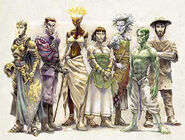
](https://forgottenrealms.fandom.com/wiki/File:Planetouched3e.jpg "Planetouched3e.jpg (44 KB)")
Left to right: an aasimar, a tiefling, a fire genasi, an earth genasi, an air genasi, a water genasi, and a normal human.
[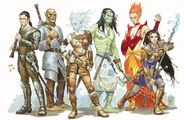
](https://forgottenrealms.fandom.com/wiki/File:Planetouched.JPG "Planetouched.JPG (23 KB)")
Left to right: an aasimar, an earth genasi, an air genasi, a water genasi, a fire genasi, and a tiefling.
[
](https://forgottenrealms.fandom.com/wiki/File:GenasiBySamWood.png "GenasiBySamWood.png (895 KB)")
Close-up view of a (left to right) fire genasi, earth genasi, air genasi, water genasi.
Further Reading[]
- Peter Schaefer (October 2009). “Abyssal Genasi”. In Chris Youngs ed. Dragon #380 (Wizards of the Coast), pp. 18–23.
References[]
- ↑ Jump up to: 1.0 1.1 Richard Baker, et al. (April 2015). Princes of the Apocalypse. Edited by Michele Carter, Stacy Janssen. (Wizards of the Coast), pp. 227–229. ISBN 978-0-7869-6578-6.
- ↑ Jump up to: 2.0 2.1 Richard Baker, Robert J. Schwalb, Stephen Schubert (April 2015). Elemental Evil Player's Companion , link:[1]. In David Noonan, Stacy Janssen eds. (Wizards of the Coast), pp. 7–10.
- ↑ Jump up to: 3.0 3.1 3.2 3.3 Rob Heinsoo, Stephen Schubert (May 19, 2009). Monster Manual 2 4th edition. (Wizards of the Coast), pp. 116–118. ISBN 0786995101.
- ↑ Jump up to: 4.00 4.01 4.02 4.03 4.04 4.05 4.06 4.07 4.08 4.09 4.10 4.11 4.12 4.13 4.14 4.15 4.16 4.17 4.18 4.19 4.20 4.21 4.22 Rob Heinsoo, Logan Bonner, Robert J. Schwalb (September 2008). Forgotten Realms Player's Guide. (Wizards of the Coast), pp. 10–12. ISBN 978-0-7869-4929-8.
- ↑ Jump up to: 5.00 5.01 5.02 5.03 5.04 5.05 5.06 5.07 5.08 5.09 5.10 James Wyatt, Rob Heinsoo (February 2001). Monster Compendium: Monsters of Faerûn. Edited by Duane Maxwell. (Wizards of the Coast), pp. 71–72. ISBN 0-7869-1832-2.
- ↑ Jump up to: 6.0 6.1 6.2 6.3 6.4 6.5 6.6 6.7 6.8 Ed Greenwood, Sean K. Reynolds, Skip Williams, Rob Heinsoo (June 2001). Forgotten Realms Campaign Setting 3rd edition. (Wizards of the Coast), pp. 19–20. ISBN 0-7869-1836-5.
- ↑ Richard Baker and James Wyatt (2004-03-13). Monster Update (Zipped PDF). Web Enhancement for Player's Guide to Faerûn. Wizards of the Coast. p. 5. Archived from the original on 2016-11-01. Retrieved on 2018-09-10.
- ↑ Jump up to: 8.0 8.1 Richard Baker, James Wyatt (March 2004). Player's Guide to Faerûn. (Wizards of the Coast), p. 31. ISBN 0-7869-3134-5.
- ↑ Jump up to: 9.0 9.1 9.2 Bruce R. Cordell, Ed Greenwood, Chris Sims (August 2008). Forgotten Realms Campaign Guide. Edited by Jennifer Clarke Wilkes, et al. (Wizards of the Coast), p. 46. ISBN 978-0-7869-4924-3.
- ↑ Jump up to: 10.0 10.1 10.2 10.3 Richard Baker, James Wyatt (March 2004). Player's Guide to Faerûn. (Wizards of the Coast), pp. 27–28. ISBN 0-7869-3134-5.
- ↑ Jump up to: 11.0 11.1 11.2 11.3 11.4 Richard Baker, James Wyatt (March 2004). Player's Guide to Faerûn. (Wizards of the Coast), p. 29. ISBN 0-7869-3134-5.
- ↑ Genasi. D&D Beyond. Wizards of the Coast. Archived from the original on 2019-04-19. Retrieved on 2019-05-10.
- ↑ Jump up to: 13.0 13.1 13.2 Monte Cook (1996). The Planewalker's Handbook. Edited by Michele Carter. (TSR), p. 68. ISBN 978-0786904600.
- ↑ Jump up to: 14.00 14.01 14.02 14.03 14.04 14.05 14.06 14.07 14.08 14.09 14.10 14.11 14.12 14.13 14.14 Monte Cook (1996). The Planewalker's Handbook. Edited by Michele Carter. (TSR), pp. 71–72. ISBN 978-0786904600.
- ↑ Jump up to: 15.0 15.1 15.2 Ed Greenwood, Sean K. Reynolds, Skip Williams, Rob Heinsoo (June 2001). Forgotten Realms Campaign Setting 3rd edition. (Wizards of the Coast), p. 18. ISBN 0-7869-1836-5.
- ↑ Jump up to: 16.0 16.1 Monte Cook (1996). The Planewalker's Handbook. Edited by Michele Carter. (TSR), p. 75. ISBN 978-0786904600.
- ↑ Travis Stout (July 2002). “Children of the Cosmos: 8 New Planetouched Races”. In Jesse Decker ed. Dragon #297 (Wizards of the Coast), pp. 62–66.
- ↑ Bruce R. Cordell, Ed Greenwood, Chris Sims (August 2008). Forgotten Realms Campaign Guide. Edited by Jennifer Clarke Wilkes, et al. (Wizards of the Coast), pp. 66–67. ISBN 978-0-7869-4924-3.
- ↑ Jump up to: 19.0 19.1 Ed Greenwood, Sean K. Reynolds, Skip Williams, Rob Heinsoo (June 2001). Forgotten Realms Campaign Setting 3rd edition. (Wizards of the Coast), p. 40. ISBN 0-7869-1836-5.
- ↑ Jump up to: 20.0 20.1 20.2 20.3 20.4 20.5 20.6 20.7 Rodney Thompson (September 2008). “The Ecology of the Genasi”. In Chris Youngs ed. Dragon #367 (Wizards of the Coast), pp. 13–14.
- ↑ Rob Heinsoo, Logan Bonner, Robert J. Schwalb (September 2008). Forgotten Realms Player's Guide. (Wizards of the Coast), p. 53. ISBN 978-0-7869-4929-8.
- ↑ Jump up to: 22.0 22.1 22.2 22.3 22.4 Sean K. Reynolds (March 2002). “The Elemental Planetouched: Using Genasi in Your Campaign”. In Jesse Decker ed. Dragon #293 (Wizards of the Coast), pp. 56–57.
- ↑ Jump up to: 23.0 23.1 Monte Cook (1996). The Planewalker's Handbook. Edited by Michele Carter. (TSR), p. 75. ISBN 978-0786904600.
- ↑ Jump up to: 24.0 24.1 24.2 24.3 24.4 Rodney Thompson (September 2008). “The Ecology of the Genasi”. In Chris Youngs ed. Dragon #367 (Wizards of the Coast), pp. 15–16.
- ↑ Jump up to: 25.0 25.1 Rodney Thompson (September 2008). “The Ecology of the Genasi”. In Chris Youngs ed. Dragon #367 (Wizards of the Coast), p. 20.
- ↑ Jump up to: 26.0 26.1 26.2 26.3 26.4 Reynolds, Forbeck, Jacobs, Boyd (March 2003). Races of Faerûn. (Wizards of the Coast), p. 112. ISBN 0-7869-2875-1.
- ↑ Jump up to: 27.0 27.1 Christopher Rowe (March 2011). Sandstorm. (Wizards of the Coast). ISBN 978-0786957422.
- ↑ Jump up to: 28.0 28.1 28.2 Rodney Thompson (September 2008). “The Ecology of the Genasi”. In Chris Youngs ed. Dragon #367 (Wizards of the Coast), pp. 17–18.
- ↑ Ed Greenwood, Sean K. Reynolds, Skip Williams, Rob Heinsoo (June 2001). Forgotten Realms Campaign Setting 3rd edition. (Wizards of the Coast), pp. 9, 28, 85. ISBN 0-7869-1836-5.
- ↑ Jump up to: 30.0 30.1 Rodney Thompson (September 2008). “The Ecology of the Genasi”. In Chris Youngs ed. Dragon #367 (Wizards of the Coast), p. 19.
- ↑ Rob Heinsoo, Logan Bonner, Robert J. Schwalb (September 2008). Forgotten Realms Player's Guide. (Wizards of the Coast), p. 25. ISBN 978-0-7869-4929-8.
- ↑ Jump up to: 32.0 32.1 Bruce R. Cordell, Ed Greenwood, Chris Sims (August 2008). Forgotten Realms Campaign Guide. Edited by Jennifer Clarke Wilkes, et al. (Wizards of the Coast), pp. 86–87. ISBN 978-0-7869-4924-3.
- ↑ Jump up to: 33.0 33.1 Bruce R. Cordell, Ed Greenwood, Chris Sims (August 2008). Forgotten Realms Campaign Guide. Edited by Jennifer Clarke Wilkes, et al. (Wizards of the Coast), p. 98. ISBN 978-0-7869-4924-3.
- ↑ Steve Kenson, et al. (November 2015). Sword Coast Adventurer's Guide. Edited by Kim Mohan. (Wizards of the Coast), p. 9. ISBN 978-0-7869-6580-9.
- ↑ Jump up to: 35.0 35.1 Bruce R. Cordell, Ed Greenwood, Chris Sims (August 2008). Forgotten Realms Campaign Guide. Edited by Jennifer Clarke Wilkes, et al. (Wizards of the Coast), p. 90. ISBN 978-0-7869-4924-3.
- ↑ Rob Heinsoo, Logan Bonner, Robert J. Schwalb (September 2008). Forgotten Realms Player's Guide. (Wizards of the Coast), p. 78. ISBN 978-0-7869-4929-8.
- ↑ Bruce R. Cordell (May 2009). “Gontal: Dominions of Nehu”. In Chris Youngs ed. Dragon #375 (Wizards of the Coast), p. 78.
- ↑ Paulina Claiborne (May 2012). The Rose of Sarifal (Kindle ed.). (Wizards of the Coast), chap. 1. ASIN B006NPFFHY.
- ↑ James P. Davis (May 2009). The Restless Shore. (Wizards of the Coast). ISBN 978-0-7869-5131-4.
- ↑ Jak Koke (August 2009). The Edge of Chaos. (Wizards of the Coast), p. 28. ISBN 978-0-7869-5189-5.
- ↑ Bruce R. Cordell (June 2012). Spinner of Lies. (Wizards of the Coast), loc. 1234. ISBN 978-0-7869-5995-2.
- ↑ Richard Lee Byers (June 7th, 2011). The Spectral Blaze. (Wizards of the Coast). ISBN 0786957980.
AD
Advertisement
Connections[]
Genasi
Air genasi • Earth genasi • Fire genasi • Para-genasi • Water genasi
Ethnic Groups
Faerûn: Arkaiun • Bedine • Calishite (Djen • Tethan) • Chondathan • Chultan (Tabaxi, Eshowe, Thinguth) • Damaran • D'tarig • Durpari • Ffolk • Gur • Halruaan • Illuskan • Imaskari • Lantanna • Mar • Maztican • Muhjari • Mulan • Nar • Netherese (Eraka, Marsh Drover, Tunlar) • Rashemi • Raumviran • Rengarth • Reghedmen • Shaaran • Sossrim • Talfir • Tashalan • Tethyrian • Turami • Ulutiun (Angulutiun, Ice Hunters, Iulutiun, Nakulutiun) • Vaasan
Maztica: Azuposi • Dog People • Green Folk • Metahel • Nahopaca • Nexalan • Payit (Itza)
Taan: Commani, Dalat, Fankiang, Gur, Guychiang, Igidujin, Kashghun, Khassidi, Naican, Oigur, Pazruki, Quirish, T'aghur, Tsu-tsu, Tuigan, Zamogedi
Kara-Tur & Malatra: Bavanese & Bertanese • Bawani • Han • Issacortae • Koryoan • Kozakuran • Kuong • Nubari (Huroola • Koshiva • Kukalatu • Wise Ones • Zantira) • Pazruki • Purang • Seng • Shou • Tabotan • Tayanulchi • Wanese • Wu-haltai
Zakhara: Zakharan
Related Races
Abbalaya • Aperusa • Buried ones • Chosen ones • Deep Imaskari • Elan • Frost folk • Gith (Githyanki • Githzerai) • Grimlock • Half-elf (Half-drow • Half-sea elf) • Half-giant • Half-ogre • Half-orc • Mongrelfolk • Neanderthal • Nubari • Planetouched (Aasimar • Deva • Genasi • Tiefling) • Shifter • Skulk • Spirit folk (Gugari • Tam'hi) • Volodni
Categories
- Categories:
- Medium-sized creatures
- Humanoids
- Humanoids (5e)
- Creatures of neutral alignment
- Elemental creatures
- Humanoids (4e)
- Creatures of unaligned alignment
- Outsiders
- Outsiders (3e)
- Native outsiders
- Creatures with a challenge rating less than 1 (3e)
- Creatures found in cold climates
- Creatures found in temperate climates
- Creatures found in warm climates
- Creatures
- Planetouched
- Races
- Add category
Cancel Save
https://forgottenrealms.fandom.com/wiki/Genasi
Zikran
Medium Humanoid (Water Genasi), Any Alignment
- Armor Class 12 (15 with mage armor)
- Hit Points 144 (18d8 + 18)
- Hit Points 144 (18d8 + 18)
- Speed 30 ft., swim 30 ft.
STR DEX CON INT WIS CHA 10 (+0) 14 (+2) 12 (+1) 20 (+5) 15 (+2) 16 (+3)
- Saving Throws Int +9, Wis +6
- Skills Arcana +13, History +13
- Damage Resistances damage from spells; nonmagical bludgeoning, piercing, and slashing (from stoneskin); acid
- Senses passive Perception 12
- Languages Aquan, Common, Primordial, Sahuagin, Undercommon
- Challenge 12 (8,400 XP)
- Proficiency Bonus +4
Amphibious. Zikran can breathe air and water.
Magic Resistance. Zikran has advantage on saving throws against spells and other magical effects.
Spellcasting. Zikran is an 18th-level spellcaster. Its spellcasting ability is Intelligence (spell save DC 17, +9 to hit with spell attacks). Zikran can cast disguise self and invisibility at will and has the following wizard spells prepared:
Cantrips (at will): fire bolt, light, mage hand, prestidigitation, shocking grasp
1st level (4 slots): detect magic, identify, mage armor*, magic missile
2nd level (3 slots): detect thoughts, mirror image, misty step
3rd level (3 slots): counterspell, fly, lightning bolt
4th level (3 slots): banishment, fire shield, stoneskin*
5th level (3 slots): cone of cold, conjure elemental, scrying, wall of force
6th level (1 slot): globe of invulnerability
7th level (1 slot): teleport
8th level (1 slot): mind blank*
9th level (1 slot): time stop*Zikran casts these spells on itself before combat.
Actions
Dagger. Melee or Ranged Weapon Attack: +6 to hit, reach 5 ft. or range 20/60 ft., one target. Hit: 4 (1d4 + 2) piercing damage.
Shoalar Quanderil
Medium Humanoid (Water Genasi), Lawful Evil
- Armor Class 10 (13 with mage armor)
- Hit Points 60 (8d8 + 24)
- Hit Points 60 (8d8 + 24)
- Speed 30 ft., swim 30 ft.
STR DEX CON INT WIS CHA 11 (+0) 12 (+1) 16 (+3) 14 (+2) 10 (+0) 17 (+3)
- Skills Arcana +4, Deception +5, Insight +2, Persuasion +5
- Damage Resistances acid
- Senses passive Perception 10
- Languages Aquan, Common
- Challenge 4 (1,100 XP)
- Proficiency Bonus +2
Amphibious. Shoalar can breathe air and water.
Innate Spellcasting. Shoalar's innate spellcasting ability is Constitution (spell save DC 13, +5 to hit with spell attacks). He can innately cast the following spells:
At will: shape water
1/day: create or destroy waterSpellcasting. Shoalar is a 5th-level spellcaster. His spellcasting ability is Charisma (spell save DC 13, +5 to hit with spell attacks). He knows the following sorcerer spells:
Cantrips (at will): acid splash, chill touch, friends, prestidigitation, ray of frost
1st level (4 slots): disguise self, mage armor, magic missile
2nd level (3 slots): hold person, misty step
3rd level (2 slots): tidal waveActions
Dagger. Melee or Ranged Weapon Attack: +3 to hit, reach 5 ft. or ranged 20/60 ft., one target. Hit: 3 (1d4 + 1) piercing damage.
Shoalar Quanderil
Medium Humanoid (Water Genasi), Lawful Evil
- Armor Class 11 (14 with mage armor)
- Hit Points 75 (10d8 + 30)
- Hit Points 75 (10d8 + 30)
- Speed 30 ft., swim 30 ft.
STR DEX CON INT WIS CHA 12 (+1) 12 (+1) 16 (+3) 14 (+2) 10 (+0) 18 (+4)
- Skills Arcana +6, Deception +8, Insight +4, Persuasion +8
- Damage Resistances acid, lightning, thunder
- Senses passive Perception 10
- Languages Aquan, Common
- Challenge 4 (1,100 XP)
- Proficiency Bonus +2
Amphibious. Shoalar can breathe air and water.
Innate Spellcasting. Shoalar's innate spellcasting ability is Constitution (spell save DC 14, +6 to hit with spell attacks). He can innately cast the following spells:
At will: shape water
1/day: create or destroy waterSpellcasting. Shoalar is a 7th-level spellcaster. His spellcasting ability is Charisma (spell save DC 15, +7 to hit with spell attacks). He knows the following sorcerer spells:
Cantrips (at will): acid splash, chill touch, light, prestidigitation, ray of frost
1st level (4 slots): disguise self, mage armor, shield
2nd level (3 slots): hold person, misty step
3rd level (2 slots): lightning bolt, tidal wave
4th level (1 slot): watery sphereActions
Dagger. Melee or Ranged Weapon Attack: +4 to hit, reach 5 ft. or ranged 20/60 ft., one target. Hit: 3 (1d4 + 1) piercing damage.
Avi
Medium Humanoid (Water Genasi), Neutral Good
- Armor Class 13 (chain shirt)
- Hit Points 27 (5d8 + 5)
- Hit Points 27 (5d8 + 5)
- Speed 30 ft., swim 30 ft.
STR DEX CON INT WIS CHA 10 (+0) 10 (+0) 12 (+1) 13 (+1) 16 (+3) 13 (+1)
- Skills Medicine +7, Persuasion +3, Religion +5
- Damage Resistances acid
- Senses passive Perception 13
- Languages Common, Primordial
- Challenge 2 (450 XP)
- Proficiency Bonus +2
Control Water. At will, Avi can control the flow and shape of water in a 5-foot cube, or cause the water to freeze for up to 1 hour.
Divine Eminence. As a bonus action, Avi can expend a spell slot to cause its melee weapon attacks to magically deal an extra 10 (3d6) radiant damage to a target on a hit. This benefit lasts until the end of the turn. If Avi expends a spell slot of 2nd level or higher, the extra damage increases by 1d6 for each level above 1st.
Spellcasting. Avi is a 5th-level spellcaster. Its spellcasting ability is Wisdom (spell save DC 13, +5 to hit with spell attacks). Avi has the following cleric spells prepared:
Cantrips (at will): light, sacred flame, thaumaturgy
1st level (4 slots): cure wounds, guiding bolt, sanctuary
2nd level (3 slots): lesser restoration, spiritual weapon
3rd level (2 slots): dispel magic, spirit guardiansActions
Mace. Melee Weapon Attack: +2 to hit, reach 5 ft., one target. Hit: 3 (1d6) bludgeoning damage.
Ayo Jabe (Tier 3)
Medium Humanoid (Ranger, Water Genasi), Chaotic Good
- Armor Class 17 (studded leather)
- Hit Points 150 (20d8 + 60)
- Hit Points 150 (20d8 + 60)
- Speed 30 ft., swim 30 ft.
STR DEX CON INT WIS CHA 16 (+3) 20 (+5) 16 (+3) 10 (+0) 16 (+3) 14 (+2)
- Saving Throws Str +6, Dex +8
- Skills Athletics +6, Perception +6, Survival +6
- Damage Resistances acid
- Condition Immunities frightened
- Senses passive Perception 16
- Languages Common, Goblin, Orc
- Challenge 8 (3,900 XP)
- Proficiency Bonus +3
Special Equipment. Ayo wields a ruidium harpoon (see appendix B). If Ayo rolls a 1 on an attack roll made with the harpoon, she must succeed on a DC 20 Charisma saving throw or gain 1 level of exhaustion.
Amphibious. Ayo can breathe air and water.
Actions
Multiattack. Ayo makes three Harpoon or Longbow attacks.
Ruidium Harpoon. Melee Weapon Attack: +6 to hit, reach 5 ft., one target. Hit: 12 (2d8 + 3) piercing damage plus 7 (2d6) psychic damage.
Longbow. Ranged Weapon Attack: +8 to hit, range 150/600 ft., one target. Hit: 18 (3d8 + 5) piercing damage.
Spellcasting. Ayo casts one of the following spells, using Wisdom as the spellcasting ability (spell save DC 14):
1/day each: animal friendship, freedom of movement, goodberry, pass without trace, protection from energy
Bonus Actions
Reposition. Ayo issues orders to one ally she can see within 30 feet of herself. If the target can see or hear Ayo, it can spend its reaction to move up to its speed. This movement doesn't provoke opportunity attacks.
Ayo Jabe (Tier 2)
Medium Humanoid (Ranger, Water Genasi), Chaotic Good
- Armor Class 15 (studded leather)
- Hit Points 97 (15d8 + 30)
- Hit Points 97 (15d8 + 30)
- Speed 30 ft., swim 30 ft.
STR DEX CON INT WIS CHA 14 (+2) 16 (+3) 14 (+2) 10 (+0) 14 (+2) 12 (+1)
- Saving Throws Str +5, Dex +6
- Skills Athletics +5, Perception +5, Survival +5
- Damage Resistances acid
- Senses passive Perception 15
- Languages Common, Goblin, Orc
- Challenge 5 (1,800 XP)
- Proficiency Bonus +3
Amphibious. Ayo can breathe air and water.
Actions
Multiattack. Ayo makes three Harpoon or Longbow attacks.
Harpoon. Melee Weapon Attack: +5 to hit, reach 5 ft., one target. Hit: 11 (2d8 + 2) piercing damage.
Longbow. Ranged Weapon Attack: +6 to hit, range 150/600 ft., one target. Hit: 12 (2d8 + 3) piercing damage.
Spellcasting. Ayo casts one of the following spells, using Wisdom as the spellcasting ability (spell save DC 13):
1/day each: animal friendship, goodberry, pass without trace
Bonus Actions
Reposition. Ayo issues orders to one ally she can see within 30 feet of herself. If the target can see or hear Ayo, it can spend its reaction to move up to its speed. This movement doesn't provoke opportunity attacks.
Ayo Jabe (Tier 1)
Medium Humanoid (Ranger, Water Genasi), Chaotic Good
- Armor Class 14 (studded leather)
- Hit Points 65 (10d8 + 20)
- Hit Points 65 (10d8 + 20)
- Speed 30 ft., swim 30 ft.
STR DEX CON INT WIS CHA 14 (+2) 14 (+2) 14 (+2) 10 (+0) 12 (+1) 12 (+1)
- Saving Throws Str +4, Dex +4
- Skills Athletics +4, Perception +3, Survival +3
- Damage Resistances acid
- Senses passive Perception 13
- Languages Common, Goblin, Orc
- Challenge 3 (700 XP)
- Proficiency Bonus +2
Amphibious. Ayo can breathe air and water.
Actions
Multiattack. Ayo makes two Harpoon or Longbow attacks.
Harpoon. Melee Weapon Attack: +4 to hit, reach 5 ft., one target. Hit: 11 (2d8 + 2) piercing damage.
Longbow. Ranged Weapon Attack: +4 to hit, range 150/600 ft., one target. Hit: 11 (2d8 + 2) piercing damage.
Spellcasting. Ayo casts one of the following spells, using Wisdom as the spellcasting ability (spell save DC 11):
1/day each: animal friendship, goodberry
Embric
Medium Humanoid (Fire Genasi), Neutral Good
- Armor Class 15 (studded leather)
- Hit Points 65 (10d8 + 20)
- Hit Points 65 (10d8 + 20)
- Speed 30 ft.
STR DEX CON INT WIS CHA 15 (+2) 16 (+3) 14 (+2) 14 (+2) 11 (+0) 14 (+2)
- Saving Throws Str +4, Dex +5, Wis +2
- Skills Athletics +4, Deception +4
- Senses darkvision 60 ft., passive Perception 10
- Languages Common, Primordial
- Challenge 2 (450 XP)
- Proficiency Bonus +2
Innate Spellcasting. Embric's spellcasting ability is Constitution (+4 to hit with spell attacks). He can innately cast the following spells, requiring no material components:
At will: produce flame
Actions
Multiattack. Embric makes three melee attacks: two with its scimitar and one with its dagger. Or Embric makes two ranged attacks with its daggers.
Scimitar. Melee Weapon Attack: +5 to hit, reach 5 ft., one target. Hit: 6 (1d6 + 3) slashing damage.
Dagger. Melee or Ranged Weapon Attack: +5 to hit, reach 5 ft. or range 20/60 ft., one target. Hit: 5 (1d4 + 3) piercing damage.
Reactions
Parry. Embric adds 2 to its AC against one melee attack that would hit it. To do so, Embric must see the attacker and be wielding a melee weapon.
Bastian Thermandar
Medium Humanoid (Fire Genasi), Neutral Evil
- Armor Class 12 (15 with mage armor)
- Hit Points 78 (12d8 + 24)
- Hit Points 78 (12d8 + 24)
- Speed 30 ft.
STR DEX CON INT WIS CHA 12 (+1) 14 (+2) 15 (+2) 11 (+0) 9 (-1) 18 (+4)
- Skills Arcana +3, Deception +7
- Damage Resistances fire
- Senses darkvision 60 ft., passive Perception 9
- Languages Common, Ignan
- Challenge 8 (3,900 XP)
- Proficiency Bonus +3
Innate Spellcasting. Bastian's innate spellcasting ability is Constitution (spell save DC 13, +5 to hit with spell attacks). He can innately cast the following spells:
At will: produce flame
1/day: burning handsSpellcasting. Bastian is a 9th-level spellcaster. His spellcasting ability is Charisma (spell save DC 15, +7 to hit with spell attacks). Bastian knows the following sorcerer spells:
Cantrips (at will): fire bolt, mage hand, message, prestidigitation, shocking grasp
1st level (4 slots): mage armor, magic missile, shield
2nd level (3 slots): misty step, scorching ray
3rd level (3 slots): counterspell, fireball
4th level (3 slots): dimension door, wall of fire
5th level (1 slot): hold monsterActions
Dagger. Melee or Ranged Weapon Attack: +5 to hit, reach 5 ft. or range 20/60 ft., one target. Hit: 4 (1d4 + 2) piercing damage.
Miraj Vizann
Medium Humanoid (Earth Genasi), Neutral Evil
- Armor Class 10 (13 with mage armor)
- Hit Points 82 (11d8 + 33)
- Hit Points 82 (11d8 + 33)
- Speed 30 ft.
STR DEX CON INT WIS CHA 12 (+1) 10 (+0) 17 (+3) 13 (+1) 11 (+0) 18 (+4)
- Skills Arcana +4, Deception +7
- Senses passive Perception 10
- Languages Common, Primordial
- Challenge 6 (2,300 XP)
- Proficiency Bonus +3
Earth Walk. Moving through difficult terrain made of earth or stone costs Miraj no extra movement.
Innate Spellcasting. Miraj's innate spellcasting ability is Constitution (spell save DC 14). He can innately cast the following spell, requiring no material components:
1/day: pass without trace
Spellcasting. Miraj is an 11th-level spellcaster. His spellcasting ability is Charisma (spell save DC 15, +7 to hit with spell attacks). He knows the following sorcerer spells:
Cantrips (at will): acid splash, blade ward, friends, light, message, mold earth
1st level (4 slots): chromatic orb, mage armor, magic missile
2nd level (3 slots): Maximilian's earthen grasp, shatter, suggestion
3rd level (3 slots): counterspell, erupting earth
4th level (3 slots): polymorph, stoneskin
5th level (2 slots): wall of stone
6th level (1 slot): move earthActions
Staff. Melee Weapon Attack: +4 to hit, reach 5 ft., one target. Hit: 4 (1d6 + 1) bludgeoning damage, or 5 (1d8 + 1) bludgeoning damage when used with two hands.
Giff
- Ability Scores. Choose one of: (a) Choose any +2; choose any other +1 (b) Choose three different +1
- Size. Medium
- Speed. 30 ft., swim equal to your walking speed
Astral Spark. Your psychic connection to the Astral Plane enables you to mystically ac-cess a spark of divine power, which you can channel through your weapons. When you hit a tar-get with a simple or martial weapon, you can cause the target to take extra force damage equal to your proficiency bonus.
You can use this trait a number of times equal to your proficiency bonus, but you can use it no more than once per turn. You regain all expended uses when you finish a long rest.
Firearms Mastery. You have a mystical connection to firearms that traces back to the gods of the giff, who delighted in such weapons. You have proficiency with all firearms and ig-nore the loading property of any firearm. In addition, attacking at long range with a firearm doesn't impose disadvantage on your attack roll.
Hippo Build. You have advantage on Strength-based ability checks and Strength saving throws. In addition, you count as one size larger when determining your carrying capacity and the weight you can push, drag, or lift.
Languages. You can speak, read, and write Common and one other language that you and your DM agree is appropriate for your character.
https://2014.5e.tools/img/races/AAG/Giff.webp
Giff are tall, broad-shouldered folk with hippo-like features. Some have smooth skin, while others have short bristles on their faces and the tops of their heads. As beings of impressive size and unforgettable appearance, giff are noticed wherever they go.
Most giff believe they originated on one world, but their home world is now the stuff of legend, because no living giff has seen it or knows where it is. The divine beings who created giff have likewise been forgotten. Their titanic petrified bodies drift on the Astral Sea, isolated and unrecognizable in their current forms.
Although they don't realize it, giff are drawn to the Astral Plane because, on a deep psychic level, they remain connected to their creator gods, who have just enough divine spark left in them to imbue giff with sparks of their own, which giff have learned to channel through their weapons. Most giff have no idea where this so-called astral spark comes from, but they feel its presence most strongly when they are in Wildspace or the Astral Sea.
Giff are split into two camps concerning how their name is pronounced. Half of them say it with a hard g, half with a soft g. Disagreements over the correct pronunciation often blossom into hard feelings, loud arguments, and head-butting contests, but they rarely escalate beyond that.
Source: AAG, page 12
Gith
- Ability Scores. Intelligence +1
- Size. Medium
- Speed. 30 ft.
This race has multiple subraces, as listed below:
- Gith (Githyanki)
- Gith (Githzerai)
Traits
Age. Gith reach adulthood in their late teens and live for about a century.
Size. Gith are taller and leaner than humans, with most a slender 6 feet in height.
Languages. You can speak, read, and write Common and Gith.
Source: MTF, page 96. Reprinted as Githyanki in MPMM; Githzerai in MPMM
The story of the gith is rooted in a cruel twist of cosmic fate. Inspired by the great leader for whom the race is named, the gith rose up to overthrow the mind flayers that held them in servitude. But after they won their freedom, two factions among the gith disagreed on what kind of civilization they would forge. That disagreement quickly flared into open hostility, and the two groups distanced themselves from one another to pursue their separate agendas. They remain bitter enemies today, each side willing to fight to the death whenever they cross paths.
The githyanki were motivated by revenge and convinced that they deserved to take whatever they wanted from the worlds they traveled. Ranging out from the titanic city of Tu'narath on the Astral Plane, they send raiders out to plunder the Material Plane and other worlds, bringing treasures and slaves back to their ageless realm. At the same time, they hunt down and kill mind flayers whenever possible, as recompense for what the illithids did to them.
The githzerai believed that the path to an enlightened civilization lay in seclusion, not conflict. Their dedication to the principles of order is so strong that they can manipulate the stuff of chaos and use it to their benefit; thus, they have carved out a stronghold for themselves on the plane of Limbo that is virtually impervious. Though the githzerai are pacifists by nature, they share the githyanki's racial hatred for mind flayers, and from time to time they send out squads to destroy illithid outposts.
If the two races were ever to team up against the illithids, a combined force of gith could conceivably tip the balance in their favor. But as long as the githyanki and githzerai stay at each other's throats, their goal of ultimate victory over their original common enemy will likely remain unachieved.
Gith (Githyanki)
- Ability Scores. Strength +2; Intelligence +1
- Size. Medium
- Speed. 30 ft.
Age. Gith reach adulthood in their late teens and live for about a century.
Size. Gith are taller and leaner than humans, with most a slender 6 feet in height.
Languages. You can speak, read, and write Common and Gith.
Alignment. Githyanki tend toward lawful evil. They are aggressive and arrogant, and they remain the faithful servants of their lich-queen, Vlaakith. Renegade githyanki tend toward chaos.
Decadent Mastery. You learn one language of your choice, and you are proficient with one skill or tool of your choice. In the timeless city of Tu'narath, githyanki have bountiful time to master odd bits of knowledge.
Martial Prodigy. You are proficient with light and medium armor and with shortswords, longswords, and greatswords.
Githyanki Psionics. You know the mage hand cantrip, and the hand is invisible when you cast the cantrip with this trait.
When you reach 3rd level, you can cast jump once with this trait, and you regain the ability to do so when you finish a long rest. When you reach 5th level, you can cast the misty step spell once with this trait, and you regain the ability to do so when you finish a long rest.
Intelligence is your spellcasting ability for these spells. When you cast them with this trait, they don't require components.
https://2014.5e.tools/img/races/MTF/Githyanki.webp
The brutal githyanki are trained from birth as warriors.
Gith (Githzerai)
- Ability Scores. Wisdom +2; Intelligence +1
- Size. Medium
- Speed. 30 ft.
Age. Gith reach adulthood in their late teens and live for about a century.
Size. Gith are taller and leaner than humans, with most a slender 6 feet in height.
Languages. You can speak, read, and write Common and Gith.
Alignment. Githzerai tend toward lawful neutral. Their rigorous training in psychic abili-ties requires an implacable mental discipline.
Mental Discipline. You have advantage on saving throws against the charmed and frightened conditions. Under the tutelage of monastic masters, githzerai learn to govern their own minds.
Githzerai Psionics. You know the mage hand cantrip, and the hand is invisible when you cast the cantrip with this trait.
When you reach 3rd level, you can cast shield once with this trait, and you regain the ability to do so when you finish a long rest. When you reach 5th level, you can cast the detect thoughts spell once with this trait, and you regain the ability to do so when you finish a long rest.
Wisdom is your spellcasting ability for these spells. When you cast them with this trait, they don't require components.
In their fortresses within Limbo, the githzerai hone their minds to a razor's edge.
Githyanki
- Ability Scores. Choose one of: (a) Choose any +2; choose any other +1 (b) Choose three different +1
- Size. Medium
- Speed. 30 ft.
Astral Knowledge. You can mystically access a reservoir of experiences of entities con-nected to the Astral Plane. Whenever you finish a long rest, you gain proficiency in one skill of your choice and with one weapon or tool of your choice, selected from the Player's Handbook, as you momentarily project your consciousness into the Astral Plane. These proficiencies last until the end of your next long rest.
Githyanki Psionics. You know the mage hand cantrip, and the hand is invisible when you cast the cantrip with this trait.
Starting at 3rd level, you can cast the jump spell with this trait. Starting at 5th level, you can also cast misty step with it. Once you cast jump or misty step with this trait, you can't cast that spell with it again until you finish a long rest. You can also cast either of those spells using any spell slots you have of the appropriate level.
Intelligence, Wisdom, or Charisma is your spellcasting ability for these spells when you cast them with this trait (choose when you select this race). None of these spells require spell com-ponents when you cast them with this trait.
Psychic Resilience. You have resistance to psychic damage.
Languages. You can speak, read, and write Common and one other language that you and your DM agree is appropriate for your character.
https://2014.5e.tools/img/races/MPMM/Githyanki.webp
Once members of a people who escaped servitude to mind flayers, githyanki split from their cousins, githzerai, and fled to the Astral Plane. In that timeless, silvery realm, githyanki honed their psionic powers and built a great city called Tu'narath. They have since spread throughout the multiverse, starting in outposts outside the Astral Plane, called creches, where time passes and their children can reach adulthood.
A lanky people with skin tones of yellows, greens, and browns, githyanki complement their physical prowess with psionic might, instilled in them by mind flayers and cultivated over eons in the Astral Plane. Now all githyanki can use their psychic bond with that plane to access splinters of knowledge left behind by beings who travel, live, and die among the silver astral clouds.
Githyanki who reside in the Astral Plane can live indefinitely.
Source: MPMM, page 18
Githzerai
- Ability Scores. Choose one of: (a) Choose any +2; choose any other +1 (b) Choose three different +1
- Size. Medium
- Speed. 30 ft.
Githzerai Psionics. You know the mage hand cantrip, and the hand is invisible when you cast the cantrip with this trait.
Starting at 3rd level, you can cast the shield spell with this trait. Starting at 5th level, you can also cast the detect thoughts spell with it. Once you cast shield or detect thoughts spell with this trait, you can't cast that spell with it again until you finish a long rest. You can also cast either of those spells using any spell slots you have of the appropriate level.
Intelligence, Wisdom, or Charisma is your spellcasting ability for these spells when you cast them with this trait (choose when you select this race). None of these spells require spell com-ponents when you cast them with this trait.
Mental Discipline. Your innate psychic defenses grant you advantage on saving throws you make to avoid or end the charmed and frightened conditions on yourself.
Psychic Resilience. You have resistance to psychic damage.
Languages. You can speak, read, and write Common and one other language that you and your DM agree is appropriate for your character.
https://2014.5e.tools/img/races/MPMM/Githzerai.webp
Githzerai migrated to the Everchanging Chaos of Limbo after the ancient schism that split their ancestors from their cousins, githyanki. Limbo is a roiling maelstrom of matter and energy, collapsing and reforming without purpose or direction, until a creature exerts deliberate will to stabilize it. Through their potent psionic power, githzerai carved a home for themselves amid the chaos. As the ages passed, githzerai explorers ranged out to other planes and worlds of the multiverse.
Githzerai are generally slender, with speckled skin in shades of yellow, green, or brown. Eons of cultivating their mental powers within the endless chaos of Limbo have imbued githzerai with the ability to shape psionic energy to protect themselves and probe minds.
Source: MPMM, page 19
Gnoll
- Ability Scores. Strength +2; Intelligence −2
- Size. Medium
- Speed. 30 ft.
Bite. Your fanged maw is a natural weapon, which you can use to make unarmed strikes. If you hit with it, you deal piercing damage equal to 1d4 + your Strength modifier, in-stead of the bludgeoning damage normal for an unarmed strike.
Darkvision. You can see in dim light within 60 feet of you as if it were bright light, and in darkness as if it were dim light. You can't discern color in darkness, only shades of gray.
Rampage. When you reduce a creature to 0 hit points with a melee attack on your turn, you can take a bonus action to move up to half your speed and make a bite attack.
NOTE See Appendix for more on Gnolls from VGM.
Source: DMG, page 282
Gnome
- Ability Scores. Intelligence +2
- Size. Small
- Speed. 25 ft.
This race has multiple subraces, as listed below:
- Gnome (Deep)
- Gnome (Deep/Svirfneblin)
- Gnome (Forest)
- Gnome (Rock)
Traits
Age. Gnomes mature at the same rate humans do, and most are expected to settle down into an adult life by around age 40. They can live 350 to almost 500 years.
Size. Gnomes are between 3 and 4 feet tall and average about 40 pounds. Your size is Small.
Darkvision. Accustomed to life underground, you have superior vision in dark and dim conditions. You can see in dim light within 60 feet of you as if it were bright light, and in dark-ness as if it were dim light. You can't discern color in darkness, only shades of gray.
Gnome Cunning. You have advantage on all Intelligence, Wisdom, and Charisma saving throws against magic.
Languages. You can speak, read, and write Common and Gnomish. The Gnomish lan-guage, which uses the Dwarvish script, is renowned for its technical treatises and its catalogs of knowledge about the natural world.
Source: PHB, page 35. Available in the SRD 5.1.
Deep Gnome
- Ability Scores. Choose one of: (a) Choose any +2; choose any other +1 (b) Choose three different +1
- Size. Small
- Speed. 30 ft.
Creature Type. You are a Humanoid. You are also considered a gnome for any prerequi-site or effect that requires you to be a gnome.
Darkvision. You can see in dim light within 120 feet of you as if it were bright light and in darkness as if it were dim light. You discern colors in that darkness only as shades of gray.
Source: DMG, page 282
Gnome (Deep)
- Ability Scores. Intelligence +2; Dexterity +1
- Size. Small
- Speed. 25 ft.
Age. Deep gnomes are short-lived for gnomes. They mature at the same rate humans do and are considered full-grown adults by 25. They live 200 to 250 years, although hard toil and the dangers of the Underdark often claim them before their time.
Size. Unlike other gnomes, svirfneblin tend to weigh 80 to 120 pounds. Your size is Small.
Superior Darkvision. Accustomed to life underground, you have superior vision in dark and dim conditions. You can see in dim light within 120 feet of you as if it were bright light, and in darkness as if it were dim light. You can't discern color in darkness, only shades of gray.
Gnome Cunning. You have advantage on all Intelligence, Wisdom, and Charisma saving throws against magic.
Languages. You can speak, read, and write Common, Gnomish, and Undercommon.
Alignment. Svirfneblin believe that survival depends on avoiding entanglements with other creatures and not making enemies, so they favor neutral alignments. They rarely wish others ill, and they are unlikely to take risks on behalf of others, except those dearest to them.
Stone Camouflage. You have advantage on Dexterity (Stealth) checks to hide in rocky terrain.
Source: MTF, page 113. Reprinted as Deep Gnome in MPMM
Gnome (Deep)
- Ability Scores. Dexterity +2; Strength +1
- Size. Small
- Speed. 20 ft.
Innate Spellcasting. You have an innate ability to cast the following spells, requiring no material components:
- At will: nondetection (self only)
- 1/day each: blindness/deafness, blur, disguise self
Intelligence is your spellcasting ability for these spells.
Stone Camouflage. You have advantage on Dexterity (Stealth) checks to hide in rocky terrain.
Gnome Cunning. You have advantage on Intelligence, Wisdom, and Charisma saving throws against magic.
Superior Darkvision. Accustomed to life underground, you have superior vision in dark and dim conditions. You can see in dim light within 120 feet of you as if it were bright light, and in darkness as if it were dim light. You can't discern color in darkness, only shades of gray.
Languages. You can speak, read, and write Gnomish, Terran, and Undercommon.
Gnome (Deep/Svirfneblin)
- Ability Scores. Intelligence +2; Dexterity +1
- Size. Small
- Speed. 25 ft.
Age. Deep gnomes are short-lived for gnomes. They mature at the same rate humans do and are considered full-grown adults by 25. They live 200 to 250 years, although hard toil and the dangers of the Underdark often claim them before their time.
Size. A typical svirfneblin stands about 3 to 3½ feet tall and weighs 80 to 120 pounds. Your size is Small.
Superior Darkvision. Accustomed to life underground, you have superior vision in dark and dim conditions. You can see in dim light within 120 feet of you as if it were bright light, and in darkness as if it were dim light. You can't discern color in darkness, only shades of gray.
Gnome Cunning. You have advantage on all Intelligence, Wisdom, and Charisma saving throws against magic.
Languages. You can speak, read, and write Common, Gnomish, and Undercommon. The svirfneblin dialect is more guttural than surface Gnomish, and most svirfneblin know only a little bit of Common, but those who deal with outsiders (and that includes you as an adventur-er) pick up enough Common to get by in other lands.
Alignment. Svirfneblin believe that survival depends on avoiding entanglements with other creatures and not making enemies, so they favor neutral alignments. They rarely wish others ill, and they are unlikely to take risks on behalf of others.
Stone Camouflage. You have advantage on Dexterity (Stealth) checks to hide in rocky terrain.
Forest gnomes and rock gnomes are the gnomes most commonly encountered in the lands of the surface world. There is another subrace of gnomes rarely seen by any surface-dweller: deep gnomes, also known as svirfneblin. Guarded, and suspicious of outsiders, svirfneblin are cunning and taciturn, but can be just as kind-hearted, loyal, and compassionate as their surface cousins.
Born of Deep Earth
Svirfneblin seem more like creatures of stone than flesh. Their leathery skin is usually a gray, brown, or dun hue that acts as a natural camouflage with the rock around them. Their bodies are gnarled with hard muscle or fat, and they are heavier than their small stature suggests; svirfneblin often weigh 100 pounds or more but rarely stand much more than 3 feet tall.
Male svirfneblin are bald from early childhood, although adults can grow stiff beards or mustaches. Females have full heads of hair, and they usually tie their hair back in braids or cut it short to keep it from getting in their way as they work.
Svirfneblin are well adapted for their subterranean existence. They have excellent darkvision, and many of them have magical talents that rival the innate spellcasting of the drow and duergar. They are surprisingly strong for their size, enduring toil and danger that would overwhelm most other people.
Master Miners
Despite their guarded natures, svirfneblin aren't joyless. They admire skillful work and delicate craftsmanship, just like any other gnome. Svirfneblin love gemstones of all kinds, and they boldly seek out precious stones in the deepest and darkest tunnels. They are also expert gemcutters and miners, and they prize rubies above all other gemstones.
Deep Dwellers
Svirfneblin are known as deep gnomes because they choose to live far below the earth's surface. Most svirfneblin never see the light of day. Their homes are well-hidden strongholds concealed by mazelike passages and clever illusions. Vast networks of mine tunnels ring most svirfneblin settlements, guarded by deadly traps and concealed sentries. Once a traveler passes through the outer defenses, the tunnels open up into marvelous cavern-towns carved from the surrounding rock with exquisite care. The svirfneblin are austere in their comforts compared to their surface cousins, but they take great pride in their stonework.
Deep gnomes do their best to remain hidden. Even if surface travelers succeed in locating a svirfneblin community, winning their trust can be even more difficult. Those rare travelers who do succeed in befriending deep gnomes find that they are loyal and courageous allies against any foe.
Scouts and Spies
Surface-dwelling gnomes often take up the adventurer's life out of sheer curiosity about the world around them, eager to see new things and meet new people.
By comparison, most svirfneblin possess very little wanderlust and rarely travel far from home. They see the surface world as a bewildering place without boundaries and filled with unknown dangers.
Nevertheless, a few svirfneblin understand that it is necessary to know something about what is happening on the surface near their hidden refuges. As a result, some svirfneblin become scouts, spies, or messengers who venture abroad, doing their best to avoid attention.
These travelers are notoriously close-mouthed about where they come from and what they are up to, but a few eventually learn to trust good-hearted people of the surface world.
A few svirfneblin become merchants who deal with other races both above and below ground. Drow, duergar, and other peoples know that svirfneblin are usually neutral in outlook and typically honest in their dealings. Serving as middlemen between races too hostile to deal with each other directly can be lucrative, and it serves an important defensive function; svirfneblin middlemen tend to know more about rumors and threats between rival merchants than anybody else.
Deep Gnome Names
Svirfneblin prefer less flamboyant names than their rock gnome or forest gnome cousins. Clan names reflect skills or occupations that a particular family is associated with, and sometimes change if a noteworthy individual strikes out in a new direction.
- Male Names: Belwar, Brickers, Durthmeck, Firble, Krieger, Kronthud, Schneltheck, Schnicktick, Thulwar, Walschud
- Female Names: Beliss, Durthee, Fricknarti, Ivridda, Krivi, Lulthiss, Nalvarti, Schnella, Thulmarra, Wirsidda
- Clan Names: Crystalfist, Gemcutter, Ironfoot, Rockhewer, Seamfinder, Stonecutter
Deep Gnomes in the Forgotten Realms
In the Forgotten Realms, deep gnomes live within a perilous, subterranean world known as the Underdark. This maze of caverns and tunnels is home to some of the most feared creatures in Faerûn. Because of this, the svirfneblin that dwell here are much more distrusting and wary than their kin on other worlds. Rarely do they allow strangers within their midst, and those that they must deal with are kept at arms length. If one is lucky enough to be trusted by the deep gnomes, they are a friend for life. For the svirfneblin of the Underdark, genuine trust is a commodity far more valuable than gold.
Deep Gnome Feat
If your DM allows the use of feats, your deep gnome character has the option of taking the following feat: Svirfneblin Magic.
Source: SCAG, page 115. Reprinted as Deep Gnome in MPMM. Also found in EEPC, page 5.
Gnome (Forest)
- Ability Scores. Intelligence +2; Dexterity +1
- Size. Small
- Speed. 25 ft.
Age. Gnomes mature at the same rate humans do, and most are expected to settle down into an adult life by around age 40. They can live 350 to almost 500 years.
Size. Gnomes are between 3 and 4 feet tall and average about 40 pounds. Your size is Small.
Darkvision. Accustomed to life underground, you have superior vision in dark and dim conditions. You can see in dim light within 60 feet of you as if it were bright light, and in dark-ness as if it were dim light. You can't discern color in darkness, only shades of gray.
Gnome Cunning. You have advantage on all Intelligence, Wisdom, and Charisma saving throws against magic.
Languages. You can speak, read, and write Common and Gnomish. The Gnomish lan-guage, which uses the Dwarvish script, is renowned for its technical treatises and its catalogs of knowledge about the natural world.
Natural Illusionist. You know the minor illusion cantrip. Intelligence is your spell-casting ability for it.
Speak with Small Beasts. Through sounds and gestures, you can communicate simple ideas with Small or smaller beasts. Forest gnomes love animals and often keep squirrels, badgers, rabbits, moles, woodpeckers, and other creatures as beloved pets.
https://2014.5e.tools/img/races/PHB/Gnome.webp
As a forest gnome, you have a natural knack for illusion and inherent quickness and stealth. In the worlds of D&D, forest gnomes are rare and secretive. They gather in hidden communities in sylvan forests, using illusions and trickery to conceal themselves from threats or to mask their escape should they be detected. Forest gnomes tend to be friendly with other good-spirited woodland folk, and they regard elves and good fey as their most important allies. These gnomes also befriend small forest animals and rely on them for information about threats that might prowl their lands.
Source: PHB, page 37
Gnome (Rock)
- Ability Scores. Intelligence +2; Constitution +1
- Size. Small
- Speed. 25 ft.
Age. Gnomes mature at the same rate humans do, and most are expected to settle down into an adult life by around age 40. They can live 350 to almost 500 years.
Size. Gnomes are between 3 and 4 feet tall and average about 40 pounds. Your size is Small.
Darkvision. Accustomed to life underground, you have superior vision in dark and dim conditions. You can see in dim light within 60 feet of you as if it were bright light, and in dark-ness as if it were dim light. You can't discern color in darkness, only shades of gray.
Gnome Cunning. You have advantage on all Intelligence, Wisdom, and Charisma saving throws against magic.
Languages. You can speak, read, and write Common and Gnomish. The Gnomish lan-guage, which uses the Dwarvish script, is renowned for its technical treatises and its catalogs of knowledge about the natural world.
Artificer's Lore. Whenever you make an Intelligence (History) check related to magic items, alchemical objects, or technological devices, you can add twice your proficiency bonus, instead of any proficiency bonus you normally apply.
Tinker. You have proficiency with artisan's tools (tinker's tools). Using those tools, you can spend 1 hour and 10 gp worth of materials to construct a Tiny clockwork device (AC 5, 1 hp). The device ceases to function after 24 hours (unless you spend 1 hour repairing it to keep the device functioning), or when you use your action to dismantle it; at that time, you can reclaim the materials used to create it. You can have up to three such devices active at a time.
When you create a device, choose one of the following options:
Clockwork Toy. This toy is a clockwork animal, monster, or person, such as a frog, mouse, bird, dragon, or soldier. When placed on the ground, the toy moves 5 feet across the ground on each of your turns in a random direction. It makes noises as appropriate to the creature it rep-resents.
Fire Starter. The device produces a miniature flame, which you can use to light a candle, torch, or campfire. Using the device requires your action.
Music Box. When opened, this music box plays a single song at a moderate volume. The box stops playing when it reaches the song's end or when it is closed.
As a rock gnome, you have a natural inventiveness and hardiness beyond that of other gnomes. Most gnomes in the worlds of D&D are rock gnomes, including the tinker gnomes of the Dragonlance setting.
A constant hum of busy activity pervades the warrens and neighborhoods where gnomes form their close-knit communities. Louder sounds punctuate the hum: a crunch of grinding gears here, a minor explosion there, a yelp of surprise or triumph, and especially bursts of laughter. Gnomes take delight in life, enjoying every moment of invention, exploration, investigation, creation, and play.
Vibrant Expression
A gnome's energy and enthusiasm for living shines through every inch his or her tiny body. Gnomes average slightly over 3 feet tall and weigh 40 to 45 pounds. Their tan or brown faces are usually adorned with broad smiles (beneath their prodigious noses), and their bright eyes shine with excitement. Their fair hair has a tendency to stick out in every direction, as if expressing the gnome's insatiable interest in everything around.
A gnome's personality is writ large in his or her appearance. A male gnome's beard, in contrast to his wild hair, is kept carefully trimmed but often styled into curious forks or neat points. A gnome's clothing, though usually made in modest earth tones, is elaborately decorated with embroidery, embossing, or gleaming jewels.
Delighted Dedication
As far as gnomes are concerned, being alive is a wonderful thing, and they squeeze every ounce of enjoyment out of their three to five centuries of life. Humans might wonder about getting bored over the course of such a long life, and elves take plenty of time to savor the beauties of the world in their long years, but gnomes seem to worry that even with all that time, they can't get in enough of the things they want to do and see.
Gnomes speak as if they can't get the thoughts out of their heads fast enough. Even as they offer ideas and opinions on a range of subjects, they manage to listen carefully to others, adding the appropriate exclamations of surprise and appreciation along the way.
Though gnomes love jokes of all kinds, particularly puns and pranks, they're just as dedicated to the more serious tasks they undertake. Many gnomes are skilled engineers, alchemists, tinkerers, and inventors. They're willing to make mistakes and laugh at themselves in the process of perfecting what they do, taking bold (sometimes foolhardy) risks and dreaming large.
Bright Burrows
Gnomes makes their homes in hilly, wooded lands. They live underground but get more fresh air than dwarves do, enjoying the natural, living world on the surface where ever they can. Their homes are well hidden by both clever construction and simple illusions. Welcome visitors are quickly ushered into the bright, warm burrows. Those who are not welcome are unlikely to find the burrows in the first place.
Gnomes who settle in human lands are commonly gemcutters, engineers, sages, or tinkerers. Some human families retained gnome tutors, ensuring that their pupils enjoy a mix of serious learning and delighted enjoyment. A gnome might tutor several generations of a single human family over the course of his or her long life.
Gnome Names
Gnomes love names, and most have half a dozen or so. A gnome's mother, father, clan elder, aunts, and uncles each give the gnome a name, and various nicknames from just about everyone else might or might not stick over time. Gnome names are typically variants on the names of ancestors or distant relatives, though some are truly new inventions. When dealing with humans and others who are "Stuffy" about names, a gnome learns to use no more than three names; A personal name, a clan name, and a nickname, choosing the one in each category that's the most fun to say.
- Male Names: Alston, Alvyn, Boddynock, Brocc, Ettrgell, Dimble, Eldon, Erky, Fonkin, Frug, Gerbo, Gimble, Glim, Jebeddo, Kellen, Namfoodle. Orryn, Roondar, Seebo, Warryn, Wrenn, Zook
- Female Names: Bimpnottin, Breena, Caramip, Carlin, Donella, Duvamil, Ella, Ellyjobell, Ellywick, Lilli, Loopmottin, Lorilla, Mardnab, Nissa, Nyx, Oda, Orla, Roywyn, Shamil, Tana, Waywocket, Zanna
- Clan Names: Beren, Daergel, Folkor, Garrick, Nackle, Murnig, Ningcl, Raulnor, Seheppen, Timbers, Turen
- Nicknames: Aleslosh, Aslthearth, Badger, Cloak, Doublelock, Filchbatter, Fnipper, Ku, Nina, Oneshoe, Pock, Sparklegem, Scumbleduck
Seeing The World
Curious and impulsive, gnomes might take up adventuring as a way to see the world or for the love of exploring. As lovers of gems and other fine items, some gnomes take to adventuring as s quick, if dangerous, path to wealth. Regardless of what spurs them to adventure, gnomes who adopt this way of life eke as much enjoyment out of it as they do out of any other activity they undertake, sometimes to the great annoyance of their adventuring companions.
Deep Gnomes
A third sub race of gnomes, the deep gnomes (or svirfneblin) live in small communities scattered in the Underdark. Unlike the duergar and the drow, svirfneblin are as good as their surface cousins. However, their humor and enthusiasm are dampened by their oppressive environment, and their inventive expertise is directed mostly toward stonework.
Uncommon Races
This race, and those listed below, are uncommon. They don't exist in every world of D&D, and even where they are found, they are less widespread than dwarves, elves, halflings, and humans. In the cosmopolitan cities of the D&D multiverse, most people hardly look twice at members of even the most exotic races. But the small towns and villages that dot the countryside are different. The common folk aren't accustomed to seeing members of these races, and they react accordingly.
Dragonborn. It's easy to assume that a dragonborn is a monster, especially if his or her scales betray a chromatic heritage. Unless the dragonborn starts breathing fire and causing destruction, though, people are likely to respond with caution rather than outright fear.
Gnome. Gnomes don't look like a threat and can quickly disarm suspicion with good humor. The common folk are often curious about gnomes, likely never having seen one before, but they are rarely hostile or fearful.
Half-Elf. Although many people have never seen a half-elf, virtually everyone knows they exist. A half-elf stranger's arrival is followed by gossip behind the half-elf's back and stolen glances across the common room, rather than any confrontation or open curiosity.
Half-Orc. It's usually safe to assume that a half-orc is belligerent and quick to anger, so people watch themselves around an unfamiliar half-orc. Shopkeepers might surreptitiously hide valuable or fragile goods when a half-orc comes in, and people slowly clear out of a tavern, assuming a fight will break out soon.
Tiefling. Half-orcs are greeted with a practical caution, but tieflings are the subject of supernatural fear. The evil of their heritage is plainly visible in their features, and as far as most people are concerned, a tiefling could very well be a devil straight from the Nine Hells. People might make warding signs as a tiefling approaches, cross the street to avoid passing near, or bar shop doors before a tiefling can enter.
Sword Coast Races of the Realms
Gnomes

Small of stature and dwelling in the corners of Faerûn away from prying eyes, gnomes are one of the least populous and influential races in the world, called the "Forgotten Folk" by some. This appellation doesn't bother the gnomes; they generally prefer their anonymity and the protection it affords them.
According to legend, the first gnomes in Faerûn sprang from mystic gems buried deep in the earth—an event that accounts for both the gnomes' love of gems and the cozy embrace of their underground warrens. It is said that mystic diamonds became the rock gnomes, emeralds birthed the forest gnomes, and rubies turned into the deep gnomes. Since the time of their creation, gnomes have settled in hidden places away from other races, concerned that their way of life couldn't survive wider exposure.
Gnomes gladly socialize and work with humans, elves, and dwarves, but they always keep in mind that, as a small and relatively insignificant race, their interests can become secondary even among their allies. Indeed, members of other races sometimes thoughtlessly treat gnomes as second-class citizens, perhaps thinking highly of their gnome friends but rarely giving credit to gnomes as a people. Gnomes are regularly underestimated, and they use that lack of esteem as both a defense and an offense, when need be.
Like dwarves, gnomes have long battled for territory with kobolds, goblinoids, and orcs, but gnomes and kobolds share a special hatred for each other. Both races believe in a legend that, long ago, the deity Garl Glittergold tricked the kobold god Kurtulmak, collapsing the earth and trapping him in an endless underground maze and earning his everlasting enmity.
Ladies of the Golden Hills
A curious bit of gnomish lore is that the pantheon counts not a single female within its ranks. Legend has it that the mysterious Ladies of the Golden Hills went away together on some task in the most ancient days, and have not yet returned. The stories differ as to the Ladies' task, from seeking to gather examples of all of the beauty and riches of Toril, to a secret plan to thwart the evils of the world using their anonymity as a shield, causing the world to forget even their names and identities for a time. Gnomes who wander far from home are said to have "gone looking for the Ladies."
Forest Gnomes
The reclusive forest gnomes live simply in hillside dwellings deep in the woods. A neighbor could live only a few miles from a forest gnome settlement for a lifetime and never know it. In these communities, anonymity and stealth help to ensure protection, peace, and survival. If they are discovered and treated well, forest gnomes make fine neighbors, but they usually avoid contact even with civilizations that seem friendly.
Forest gnomes use their affinity with small animals and their knack for illusions to help them remain hidden. When necessary, a forest gnome community defends itself with all the resources at its disposal. Many settlements, however, simply vanish if they are discovered, retreating to some uncharted corner of the forest to begin anew.
The rare forest gnomes who leave their people to become adventurers often draw upon their closeness to nature and their magical gifts to serve as guides, scouts, or mystics. Living close to nature also makes forest gnomes likely to take up roles as druids, who serve various forest spirits and deities.
Forest gnomes in Faerûn have the racial traits of forest gnomes in the Player's Handbook.
Rock Gnomes
When most folk on the Sword Coast and in the North talk about gnomes, they mean rock gnomes. Unlike their shy forest cousins, the inquisitive and irrepressible rock gnomes interact regularly with individuals of other races, especially if those individuals have something to teach them. Rock gnomes prefer to live on the edges of other settlements in their own enclaves, though the occasional adventuresome rock gnome takes up residence in a human or dwarven city.
Rock gnome communities are most common in the Western Heartlands and along the coast of the Shining Sea, but gnome wanderers travel between communities across Faerûn in order to trade with or learn from outsiders, including members of other races.
Rock gnomes who leave their communities often find work by using their racial aptitudes to their advantage. Their heritage and their interest in precious stones leads many rock gnomes to become skilled gemcutters and jewelers. Rock gnomes also use their affinity with machines to work as tinkers, alchemists, and engineers. In human communities, gnome tutors and sages are popular, since their comparatively long life spans enable them to acquire and pass on knowledge for generations.
Rock gnomes in Faerûn have the racial traits of rock gnomes in the Player's Handbook.
Deep Gnomes (Svirfneblin)
Also known as svirfneblin, the deep gnomes of the Underdark are a stark contrast to their surface kin, dour and serious compared to the cheerful and generally optimistic rock gnomes and forest gnomes. They share their cousins' obsession with privacy, and their homes below the surface of Faerûn are well guarded and deeply hidden.
Owing to the hostility of their Underdark neighbors, particularly the drow, the settlements and kingdoms of svirfneblin are in constant danger of being relocated, conquered, or destroyed. Such was the fate of Blingdenstone, one of the grandest deep gnome strongholds, which existed for more than two thousand years until it was overrun a little more than a century ago by the dark elves of Menzoberranzan. The deep gnomes recently reclaimed their old home, and now struggle to rid it of malign influences that have crept into the tunnels and warrens in their absence.
Deep gnomes are lean with dark, earthen skin tones of gray. Males are bald and beardless, while females have hair on their heads. Both sexes have little or no body hair and a stone-like look to their skin.
Deep gnome adventurers are just as curious and daring as those of other races. Some find their purpose living among other subterranean races, and a few make their way to the surface. Those who study the arcane arts of illusion in particular often range far from home, seeking knowledge unavailable in their own lands.
Svirfneblin Subrace Traits
The svirfneblin subrace has the gnome traits in the Player's Handbook, plus the subrace traits below. Unlike other gnomes, svirfneblin tend to be neutral, they weigh 80 to 120 pounds, and they reach maturity at 25 and live 200 to 250 years.
- Gnome (Deep/Svirfneblin)
Gnomish Deities
Gnomes honor a small pantheon of seven primary deities, known as the Lords of the Golden Hills, plus two other entities.
Wise Protectors
The Watchful Protector, Garl Glittergold, is the king of gnomish gods, a deity of humor, gemcutting, protection, and trickery. His pranks serve to protect gnomes and to teach his victims humility and wisdom. Garl's second, Gaerdal Ironhand, is the gnomes' war god, who espouses vigilance and defense.
Nature Gods
Baervan Wildwanderer is the gnomish god of forests and woodlands, accompanied by his companion Chiktikka Fastpaws, a great raccoon said to be the wiser of the two. Segojan Earthcaller is god of the wilds beneath the earth, rather than upon it, as well as god of burrows and the plants and animals found therein.
Shadow and Stone
Baravar Cloakshadow is the god of illusion and deception, given the respectful title of Sly One. Callarduran Smoothhands is the god of stone and the Underdark, patron of the svirfneblin.
Craft and Invention
Flandal Steelskin, the god of mining and smithcraft, is known as the Steelsmith. He is also the gnomes' god of physical improvement and good health. The fearless Nebelun the Meddler is the god of invention and luck, revered by many gnomes even though he isn't considered one of the Lords of the Golden Hills. "Nebelun's head!" is a common gnomish exclamation of discovery.
The Crawler Below
The last member of the gnomish pantheon is Urdlen, which appears not as a gnome, but an elephantine, blind, pale mole. Urdlen is the great-clawed god of bloodlust and evil, of greed and uncontrolled impulses. Young gnomes are warned to "never let Urdlen burrow into your heart," as a caution against giving in to wicked impulses.
Goblin
- Ability Scores. Dexterity +2; Strength −2
- Size. Small
- Speed. 30 ft.
Nimble Escape. You can take the Disengage or Hide action as a bonus action on each of your turns.
Darkvision. Accustomed to life underground, you have superior vision in dark and dim conditions. You can see in dim light within 60 feet of you as if it were bright light, and in dark-ness as if it were dim light. You can't discern color in darkness, only shades of gray.
Languages. You can speak, read, and write Common and Goblin.
Source: DMG, page 282
Goblin
- Ability Scores. Dexterity +2; Constitution +1
- Size. Small
- Speed. 30 ft.
Age. Goblins reach adulthood at age 8 and live up to 60 years.
Size. Your size is Small.
Darkvision. You can see in dim light within 60 feet of you as if it were bright light, and in darkness as if it were dim light. You can't discern color in darkness, only shades of gray.
Fury of the Small. When you damage a creature with an attack or a spell and the crea-ture's size is larger than yours, you can cause the attack or spell to deal extra damage to the creature. The extra damage equals your level. Once you use this trait, you can't use it again un-til you finish a short or long rest.
Nimble Escape. You can take the Disengage or Hide action as a bonus action on each of your turns.
Languages. You can speak, read, and write Common and Goblin.
Alignment. In Eberron, goblins are usually neutral. They tend to look out for themselves, preferably without drawing unwanted attention from any larger, more powerful people.
https://2014.5e.tools/img/races/ERLW/Goblinoids.webp
Source: ERLW, page 26. Reprinted as Goblin in MPMM
Goblin
- Ability Scores. Dexterity +2; Constitution +1
- Size. Small
- Speed. 30 ft.
Age. Goblins reach adulthood around age 8. They age noticeably faster than humans, and though few goblins live to old age, the most cautious rarely live longer than 60 years.
Size. Goblins are between 3 and 4 feet tall and weigh between 40 and 80 pounds. Your size is Small.
Darkvision. You can see in dim light within 60 feet of you as if it were bright light, and in darkness as if it were dim light. You can't discern color in darkness, only shades of gray.
Fury of the Small. When you damage a creature with an attack or a spell and the crea-ture's size is larger than yours, you can cause the attack or spell to deal extra damage to the creature. The extra damage equals your level. Once you use this trait, you can't use it again un-til you finish a short or long rest.
Nimble Escape. You can take the Disengage or Hide action as a bonus action on each of your turns.
Languages. You can speak, read, and write Common and Goblin. In Ravnica, Goblin is a simplistic language with a limited vocabulary and fluid rules of grammar, unsuited for any so-phisticated conversation.
Alignment. Goblins are typically neutral evil, as they care only for their own needs. A few goblins might tend toward good or neutrality, but only rarely.
https://2014.5e.tools/img/races/ERLW/Goblinoids.webp
Whether sniveling in fear, cackling with mad laughter, or snarling in a fury, goblins are wretched and inconsequential—at least in the eyes of most of Ravnica's other folk. In their own minds, though, they are content to lurk in the shadows only until they fully come into their own and receive the recognition they believe they deserve. They are entitled to some credit for their tenacity, agility, crafty ingenuity, and dumb luck, all of which has enabled them to survive in a world overrun with creatures larger and more powerful than they are.
Small and Wiry. Standing around 3 feet tall and covered in warty green or red skin, goblins have huge noses and ears. Their wiry bodies are surprisingly strong, and their mouths are full of sharp, crooked teeth.
Most goblins are bald, either by heredity or by choice, but a few boast shocks of red or black hair. Their arms and legs are elongated in proportion to their small bodies, and their fingers and toes are also long and slender. Many goblins prefer to go unshod to leave their toes exposed for climbing.
Unfettered Emotion. Creatures of raw impulse, goblins are found among guilds that value that quality, particularly the Izzet (where they typically serve as attendants for researchers), the Gruul (in camps that form hapless buffers between the clans and civilized regions), the Rakdos (putting their love of explosions to good use), and occasionally the Boros (if they discover a well of discipline and courage within themselves, or find themselves unable to resist the shininess of Boros weapons and armor). Many goblins are guildless and make their way as members of street gangs.
Sometimes driven by wild mood swings, goblins have an inclination toward destruction, which can take a playful form but is often anything but. Some goblins clobber things, others like to light them on fire, and many love to blow things up.
Goblins have an outrageous sense of humor, usually expressed through mischievous pranks. The malicious among them find pleasure in the misfortune of others and tend to cackle maniacally whenever they're amused. They can act with apparent randomness, sometimes just to confuse and befuddle others.
Goblin Names. The Goblin language is fond of certain sounds, and goblin names tend to repeat those sounds to form what can sound like nonsense words. A goblin's name gives no indication of gender.
- Goblin Names: Azzinax, Babolax, Blixanix, Crixizix, Dazzaz, Estrix, Finizix, Juzba, Kaluzax, Lyzaxa, Mizzix, Myznar, Nixispix, Paxizaz, Ravixiz, Stixil, Sunnix, Tozinox, Uxivozi, Vazozav, Wexiny, Zizzix
Source: GGR, page 16. Reprinted as Goblin in MPMM
Goblin
- Ability Scores. Choose one of: (a) Choose any +2; choose any other +1 (b) Choose three different +1
- Size. Small
- Speed. 30 ft.
Creature Type. You are a Humanoid. You are also considered a goblinoid for any prereq-uisite or effect that requires you to be a goblinoid.
Darkvision. You can see in dim light within 60 feet of you as if it were bright light and in darkness as if it were in dim light. You discern colors in that darkness only as shades of gray.
Fey Ancestry. You have advantage on saving throws you make to avoid or end the charmed condition on yourself.
Fury of the Small. When you damage a creature with an attack or a spell and the crea-ture's size is larger than yours, you can cause the attack or spell to deal extra damage to the creature. The extra damage equals your proficiency bonus.
You can use this trait a number of times equal to your proficiency bonus, regaining all expended uses when you finish a long rest, and you can use it no more than once per turn.
Nimble Escape. You can take the Disengage or Hide action as a bonus action on each of your turns.
Languages. You can speak, read, and write Common and one other language that you and your DM agree is appropriate for your character.
https://2014.5e.tools/img/races/MPMM/Goblin.webp
A subterranean folk, goblins can be found in every corner of the multiverse, often beside their bugbear and hobgoblin kin. Long before the god Maglubiyet conquered them, early goblins served in the court of the Queen of Air and Darkness, one of the Feywild's archfey. Goblins thrived in her dangerous domain thanks to a special boon from her—a supernatural knack for finding the weak spots in foes larger than themselves and for getting out of trouble. Goblins brought this fey boon with them to worlds across the Material Plane, even if they don't remember the fey realm they inhabited before Maglubiyet's rise. Now many goblins pursue their own destinies, escaping the plots of both archfey and gods.
Source: MPMM, page 20
Goblin
- Ability Scores. Dexterity +2; Constitution +1
- Size. Small
- Speed. 30 ft.
Age. Goblins reach adulthood at age 8 and live up to 60 years.
Size. Goblins are between 3 and 4 feet tall and weigh between 40 and 80 pounds. Your size is Small.
Darkvision. You can see in dim light within 60 feet of you as if it were bright light, and in darkness as if it were dim light. You can't discern color in darkness, only shades of gray.
Fury of the Small. When you damage a creature with an attack or a spell and the crea-ture's size is larger than yours, you can cause the attack or spell to deal extra damage to the creature. The extra damage equals your level. Once you use this trait, you can't use it again un-til you finish a short or long rest.
Nimble Escape. You can take the Disengage or Hide action as a bonus action on each of your turns.
Languages. You can speak, read, and write Common and Goblin.
https://2014.5e.tools/img/races/VGM/Goblin.webp
Source: VGM, page 119. Reprinted as Goblin in MPMM. Also found in EGW, page 174.
NOTE See Appendix for more on Goblinoids from VGM.
Goliath
- Ability Scores. Choose one of: (a) Choose any +2; choose any other +1 (b) Choose three different +1
- Size. Medium
- Speed. 30 ft.
Little Giant. You have proficiency in the Athletics skill, and you count as one size larger when determining your carrying weight and the weight you can push, drag, or lift.
Mountain Born. You have resistance to cold damage. You also naturally acclimate to high altitudes, even if you've never been to one. This includes elevations above 20,000 feet.
Stone's Endurance. You can supernaturally draw on unyielding stone to shrug off harm. When you take damage, you can use your reaction to roll a d12. Add your Constitution modifier to the number rolled and reduce the damage by that total.
You can use this trait a number of times equal to your proficiency bonus, and you regain all ex-pended uses when you finish a long rest.
Languages. You can speak, read, and write Common and one other language that you and your DM agree is appropriate for your character.
https://2014.5e.tools/img/races/MPMM/Goliath.webp
The first goliaths lived on the highest mountain peaks—far above the tree line, where the air is thin and frigid winds howl. Distantly related to giants and infused with the supernatural essence of their ancestors' mountainous home, goliaths stand between 7 and 8 feet tall and have a wide array of skin tones resembling different types of stone.
Source: MPMM, page 21
Goliath
- Ability Scores. Strength +2; Constitution +1
- Size. Medium
- Speed. 30 ft.
Age. Goliaths have lifespans comparable to humans. They enter adulthood in their late teens and usually live less than a century.
Size. Goliaths are between 7 and 8 feet tall and weigh between 280 and 340 pounds. Your size is Medium.
Natural Athlete. You have proficiency in the Athletics skill.
Stone's Endurance. You can focus yourself to occasionally shrug off injury. When you take damage, you can use your reaction to roll a d12. Add your Constitution modifier to the number rolled, and reduce the damage by that total. After you use this trait, you can't use it again until you finish a short or long rest.
Powerful Build. You count as one size larger when determining your carrying capacity and the weight you can push, drag, or lift.
Mountain Born. You have resistance to cold damage. You're also acclimated to high alti-tude, including elevations above 20,000 feet.
Languages. You can speak, read, and write Common and Giant.
https://2014.5e.tools/img/races/VGM/Goliath.webp
At the highest mountain peaks-far above the slopes where trees grow and where the air is thin and the frigid winds howl-dwell the reclusive goliaths. Few folk can claim to have seen a goliath, and fewer still can claim friendship with them. Goliaths wander a bleak realm of rock, wind, and cold. Their bodies look as if they are carved from mountain stone and give them great physical power. Their spirits take after the wandering wind, making them nomads who wander from peak to peak. Their hearts are infused with the cold regard of their frigid realm, leaving each goliath with the responsibility to earn a place in the tribe or die trying.
Driven Competitors. Every day brings a new challenge to a goliath. Food, water, and shelter are rare in the uppermost mountain reaches. A single mistake can bring doom to an entire tribe, while an individual's heroic effort can ensure the entire group's survival.
Goliaths thus place a premium on self-sufficiency and individual skill. They have a compulsion to keep score, counting their deeds and tallying their accomplishments to compare to others. Goliaths love to win, but they see defeat as a prod to improve their skills.
This dedication to competition has a dark side. Goliaths are ferocious competitors, but above all else they are driven to outdo their past efforts. If a goliath slays a dragon, he or she might seek out a larger, more powerful wyrm to battle. Few goliath adventurers reach old age, as most die attempting to surpass their past accomplishments.
Fair Play. For goliaths, competition exists only when it is supported by a level playing field. Competition measures talent, dedication, and effort. Those factors determine survival in their home territory, not reliance on magic items, money, or other elements that can tip the balance one way or the other. Goliaths happily rely on such benefits, but they are careful to remember that such an advantage can always be lost. A goliath who relies too much on them can grow complacent, a recipe for disaster in the mountains.
This trait manifests most strongly when goliaths interact with other folk. The relationship between peasants and nobles puzzles goliaths. If a king lacks the intelligence or leadership to lead, then clearly the most talented person in the kingdom should take his place. Goliaths rarely keep such opinions to themselves, and mock folk who rely on society's structures or rules to maintain power.
Survival of the Fittest. Among goliaths, any adult who can't contribute to the tribe is expelled. A lone goliath has little chance of survival, especially an older or weaker one. Goliaths have little pity for adults who can't take care of themselves, though a sick or injured individual is treated, as a result of the goliath concept of fair play.
A permanently injured goliath is still expected to pull his or her weight in the tribe. Typically, such a goliath dies attempting to keep up, or the goliath slips away in the night to seek the cold will of fate.
In some ways, the goliath drive to outdo themselves feeds into the grim inevitability of their decline and death. A goliath would much rather die in battle, at the peak of strength and skill, than endure the slow decay of old age. Few folk have ever meet an elderly goliath, and even those goliaths who have left their people grapple with the urge to give up their lives as their physical skills decay.
Because of their risk-taking, goliath tribes suffer from a chronic lack of the experience offered by long-term leaders. They hope for innate wisdom in their leadership, for they can rarely count on a wisdom grown with age.
Goliath Names. Every goliath has three names: a birth name assigned by the newborn's mother and father, a nickname assigned by the tribal chief, and a family or clan name. A birth name is up to three syllables long. Clan names are five syllables or more and end in a vowel.
Birth names are rarely linked to gender. Goliaths see females and males as equal in all things, and they find societies with roles divided by gender to be puzzling or worthy of mockery. To a goliath, the person who is best at a job should be the one tasked with doing it.
A goliath's nickname is a description that can change on the whim of a chieftain or tribal elder. It refers to a notable deed, either a success or failure, committed by the goliath. Goliaths assign and use nicknames with their friends of other races, and change them to refer to an individual's notable deeds.
Goliaths present all three names when identifying themselves, in the order of birth name, nickname, and clan name. In casual conversation, they use their nickname.
- Birth Names: Aukan, Eglath, Gae-Al, Gauthak, Ilikan, Keothi, Kuori, Lo-Kag, Manneo, Maveith, Nalla, Orilo, Paavu, Pethani, Thalai, Thotham, Uthal, Vaunea, Vimak
- Nicknames: Bearkiller, Dawncaller, Fearless, Flintfinder, Horncarver, Keeneye, Lonehunter, Longleaper, Rootsmasher, Skywatcher, Steadyhand, Threadtwister, Twice-Orphaned, Twistedlimb, Wordpainter
- Clan Names: Anakalathai, Elanithino, Gathakanathi, Kalagiano, Katho-Olavi, Kolae-Gileana, Ogolakanu, Thuliaga, Thunukalathi, Vaimei-Laga
Source: VGM, page 108. Reprinted as Goliath in MPMM. Also found in EEPC, page 10; EGW, page 175; IDRotF.
Grimlock
- Ability Scores. Strength +2; Charisma −2
- Size. Medium
- Speed. 30 ft.
Blindsight. You have no eyes, and cannot be blinded. You can perceive your surroundings within 30 ft., or 10 ft. while deafened. You are considered blind beyond this radius.
Keen Hearing and Smell. You have advantage on Wisdom (Perception) checks that rely on hearing or smell.
Stone Camouflage. You have advantage on Dexterity (Stealth) checks made to hide in rocky terrain.
Languages. You can speak, read, and write Undercommon.
Source: DMG, page 282
Grung
- Ability Scores. Dexterity +2; Constitution +1
- Size. Small
- Speed. 25 ft., climb 25 ft.
Age. Grungs mature to adulthood in a single year, but have been known to live up to 50 years.
Alignment. Most grungs are lawful, having been raised in a strict caste system. They tend toward evil as well, coming from a culture where social advancement occurs rarely, and most often because another member of your army has died and there is no one else of that caste to fill the vacancy.
Size. Grungs stand between 2½ and 3½ feet tall and average about 30 pounds. Your size is Small.
Arboreal Alertness. You have proficiency in the Perception skill.
Amphibious. You can breathe air and water.
Poison Immunity. You're immune to poison damage and the poisoned condition.
Poisonous Skin. Any creature that grapples you or otherwise comes into direct contact with your skin must succeed on a DC 12 Constitution saving throw or become poisoned for 1 minute. A poisoned creature no longer in direct contact with you can repeat the saving throw at the end of each of its turns, ending the effect on itself on a success.
You can also apply this poison to any piercing weapon as part of an attack with that weapon, though when you hit the poison reacts differently. The target must succeed on a DC 12 Consti-tution saving throw or take 2d4 poison damage.
Standing Leap. Your long jump is up to 25 feet and your high jump is up to 15 feet, with or without a running start.
Water Dependency. If you fail to immerse yourself in water for at least 1 hour during a day, you suffer one level of exhaustion at the end of that day. You can only recover from this exhaustion through magic or by immersing yourself in water for at least 1 hour.
Languages. You can speak, read, and write Grung.
Source: OGA, page 4
Hadozee
- Ability Scores. Choose one of: (a) Choose any +2; choose any other +1 (b) Choose three different +1
- Size. Small/Medium
- Speed. 30 ft., climb equal to your walking speed
Size. You are Medium or Small. You choose the size when you select this race.
Dexterous Feet. As a bonus action, you can use your feet to manipulate an object, open or close a door or container, or pick up or set down a Tiny object.
Glide. When you fall at least 10 feet above the ground, you can use your reaction to ex-tend your skin membranes to glide horizontally a number of feet equal to your walking speed, and you take 0 damage from the fall. You determine the direction of the glide.
Hadozee Dodge. The magic that runs in your veins heightens your natural defenses. When you take damage, you can use your reaction to roll a d6. Add your proficiency bonus to the number rolled, and reduce the damage you take by an amount equal to that total (mini-mum of 0 damage).
You can use this trait a number of times equal to your proficiency bonus. You regain all expend-ed uses when you finish a long rest.
Languages. You can speak, read, and write Common and one other language that you and your DM agree is appropriate for your character.
https://2014.5e.tools/img/races/AAG/Hadozee.webp
Hadozees' progenitors were mammals no bigger than housecats. Hunted by larger natural predators, they took to the trees and evolved wing-like flaps that enabled them to glide from branch to branch.
Today, hadozees are sapient, bipedal beings eager to leave behind the fearsome predators of their homeworld and explore other worlds.
In addition to being natural climbers, hadozees have feet that are as dexterous as their hands, even to the extent of having opposable thumbs. Membranes of skin hang loosely from their arms and legs. When stretched taut, these membranes enable hadozees to glide. Hadozees wrap these wings around themselves to keep warm.
Source: AAG, page 13
Half-Elf (Base)
- Ability Scores. Charisma +2; Choose any other two unique +1
- Size. Medium
- Speed. 30 ft.
This race has multiple subraces, as listed below:
- Half-Elf
- Half-Elf (Variant; Aquatic Elf Descent)
- Half-Elf (Variant; Drow Descent)
- Half-Elf (Variant; Moon Elf or Sun Elf Descent)
- Half-Elf (Variant; Wood Elf Descent)
Traits
Age. Half-elves mature at the same rate humans do and reach adulthood around the age of 20. They live much longer than humans, however, often exceeding 180 years.
Size. Half-elves are about the same size as humans, ranging from 5 to 6 feet tall. Your size is Medium.
Darkvision. Thanks to your elf blood, you have superior vision in dark and dim conditions. You can see in dim light within 60 feet of you as if it were bright light, and in darkness as if it were dim light. You can't discern color in darkness, only shades of gray.
Fey Ancestry. You have advantage on saving throws against being charmed, and magic can't put you to sleep.
Skill Versatility. You gain proficiency in two skills of your choice.
Languages. You can speak, read, and write Common, Elvish, and one extra language of your choice.
Half-Elf
- Ability Scores. Charisma +2; Choose any other two unique +1
- Size. Medium
- Speed. 30 ft.
Age. Half-elves mature at the same rate humans do and reach adulthood around the age of 20. They live much longer than humans, however, often exceeding 180 years.
Size. Half-elves are about the same size as humans, ranging from 5 to 6 feet tall. Your size is Medium.
Darkvision. Thanks to your elf blood, you have superior vision in dark and dim conditions. You can see in dim light within 60 feet of you as if it were bright light, and in darkness as if it were dim light. You can't discern color in darkness, only shades of gray.
Fey Ancestry. You have advantage on saving throws against being charmed, and magic can't put you to sleep.
Skill Versatility. You gain proficiency in two skills of your choice.
Languages. You can speak, read, and write Common, Elvish, and one extra language of your choice.
https://2014.5e.tools/img/races/PHB/Half-Elf.webp
Walking in two worlds but truly belonging to neither, half-elves combine what some say are the best qualities of their elf and human parents: human curiosity, inventiveness, and ambition tempered by the refined senses, love of nature, and artistic tastes of the elves. Some half-elves live among humans, set apart by their emotional and physical differences, watching friends and loved ones age while time barely touches them. Others live with the elves, growing to adulthood while their peers continue to live as children, growing restless in the timeless elven realms. Many half-elves, unable to fit into either society, choose lives of solitary wandering or join with other misfits and outcasts in the adventuring life.
Of Two Worlds
To humans, half-elves look like elves, and to elves, they look human. In height, they're on par with both parents, though they're neither as slender as elves nor as broad as humans. They range from under 5 feet to about 6 feet tall, and from 100 to 180 pounds, with men only slightly taller and heavier than women. Half-elf men do have facial hair, and sometimes grow beards to mask their elven ancestry. Half-elven coloration and features lie, somewhere between their human and elf parents, and thus show a variety even more pronounced than that found among either race. They tend to have the eyes of their elven parents.
Diplomats or Wanderers
Half-elves have no lands of their own, though they are welcome in human cities and somewhat less welcome in elven forests. In large cities in regions where elves and humans interact often, half-elves are sometimes numerous enough to form small communities of their own. They enjoy the company of other half-elves, the only people who truly understand what it is to live between these two worlds.
In most parts of the world, though, half-elves are uncommon enough that one might live for years without meeting another. Some prefer to avoid company altogether, wandering the wilds as foresters, hunters, or adventurers and visiting civilization only rarely. Like elves, they are driven by the wanderlust that comes of their longevity. Others, in contrast, throw themselves into the thick of society, putting their charisma and social skills to great use in diplomatic roles or as swindlers.
Half-Elf Names
Half-elves use either human or elven naming conventions. As if to emphasize that they don't really fit in to either society, half-elves raised among humans are often given elven names, and those raised among elves often take human names.
Excellent Ambassadors
Many half-elves learn at an early age to get along with everyone, defusing hostility and finding common ground. As a race, they have elven grace without elven aloofness and human energy without human boorishness. They often make excellent ambassadors and go-betweens (except between elves and humans, since each side suspects the half-elf of favoring the other).
Uncommon Races
This race, and those listed below, are uncommon. They don't exist in every world of D&D, and even where they are found, they are less widespread than dwarves, elves, halflings, and humans. In the cosmopolitan cities of the D&D multiverse, most people hardly look twice at members of even the most exotic races. But the small towns and villages that dot the countryside are different. The common folk aren't accustomed to seeing members of these races, and they react accordingly.
Dragonborn. It's easy to assume that a dragonborn is a monster, especially if his or her scales betray a chromatic heritage. Unless the dragonborn starts breathing fire and causing destruction, though, people are likely to respond with caution rather than outright fear.
Gnome. Gnomes don't look like a threat and can quickly disarm suspicion with good humor. The common folk are often curious about gnomes, likely never having seen one before, but they are rarely hostile or fearful.
Half-Elf. Although many people have never seen a half-elf, virtually everyone knows they exist. A half-elf stranger's arrival is followed by gossip behind the half-elf's back and stolen glances across the common room, rather than any confrontation or open curiosity.
Half-Orc. It's usually safe to assume that a half-orc is belligerent and quick to anger, so people watch themselves around an unfamiliar half-orc. Shopkeepers might surreptitiously hide valuable or fragile goods when a half-orc comes in, and people slowly clear out of a tavern, assuming a fight will break out soon.
Tiefling. Half-orcs are greeted with a practical caution, but tieflings are the subject of supernatural fear. The evil of their heritage is plainly visible in their features, and as far as most people are concerned, a tiefling could very well be a devil straight from the Nine Hells. People might make warding signs as a tiefling approaches, cross the street to avoid passing near, or bar shop doors before a tiefling can enter.
Source: PHB, page 38. Available in the SRD 5.1.

Half-Elf (Variant; Aquatic Elf Descent)
- Ability Scores. Charisma +2; Choose any other two unique +1
- Size. Medium
- Speed. 30 ft.
Age. Half-elves mature at the same rate humans do and reach adulthood around the age of 20. They live much longer than humans, however, often exceeding 180 years.
Size. Half-elves are about the same size as humans, ranging from 5 to 6 feet tall. Your size is Medium.
Darkvision. Thanks to your elf blood, you have superior vision in dark and dim conditions. You can see in dim light within 60 feet of you as if it were bright light, and in darkness as if it were dim light. You can't discern color in darkness, only shades of gray.
Fey Ancestry. You have advantage on saving throws against being charmed, and magic can't put you to sleep.
Variant Feature (Choose 1)
Skill Versatility. You gain proficiency in two skills of your choice.
Swim. You gain a swimming speed of 30 ft.
Languages. You can speak, read, and write Common, Elvish, and one extra language of your choice.
Source: SCAG, page 116
Half-Elf (Variant; Drow Descent)
- Ability Scores. Charisma +2; Choose any other two unique +1
- Size. Medium
- Speed. 30 ft.
Age. Half-elves mature at the same rate humans do and reach adulthood around the age of 20. They live much longer than humans, however, often exceeding 180 years.
Size. Half-elves are about the same size as humans, ranging from 5 to 6 feet tall. Your size is Medium.
Darkvision. Thanks to your elf blood, you have superior vision in dark and dim conditions. You can see in dim light within 60 feet of you as if it were bright light, and in darkness as if it were dim light. You can't discern color in darkness, only shades of gray.
Fey Ancestry. You have advantage on saving throws against being charmed, and magic can't put you to sleep.
Variant Feature (Choose 1)
Skill Versatility. You gain proficiency in two skills of your choice.
Drow Magic. You know the dancing lights cantrip. When you reach 3rd level, you can cast the faerie fire spell once per day; you must finish a long rest in order to cast the spell again using this trait. When you reach 5th level, you can also cast the darkness spell once per day; you must finish a long rest in order to cast the spell again using this trait. Charisma is your spellcasting ability for these spells.
Languages. You can speak, read, and write Common, Elvish, and one extra language of your choice.
Source: SCAG, page 116
Half-Elf (Variant; Moon Elf or Sun Elf Descent)
- Ability Scores. Charisma +2; Choose any other two unique +1
- Size. Medium
- Speed. 30 ft.
Age. Half-elves mature at the same rate humans do and reach adulthood around the age of 20. They live much longer than humans, however, often exceeding 180 years.
Size. Half-elves are about the same size as humans, ranging from 5 to 6 feet tall. Your size is Medium.
Darkvision. Thanks to your elf blood, you have superior vision in dark and dim conditions. You can see in dim light within 60 feet of you as if it were bright light, and in darkness as if it were dim light. You can't discern color in darkness, only shades of gray.
Fey Ancestry. You have advantage on saving throws against being charmed, and magic can't put you to sleep.
Variant Feature (Choose 1)
Skill Versatility. You gain proficiency in two skills of your choice.
Elf Weapon Training. You have proficiency with the longsword, shortsword, shortbow, and longbow.
Cantrip. You know one cantrip of your choice from the wizard spell list. Intelligence is your spellcasting ability for it.
Languages. You can speak, read, and write Common, Elvish, and one extra language of your choice.
Source: SCAG, page 116
Half-Elf (Variant; Wood Elf Descent)
- Ability Scores. Charisma +2; Choose any other two unique +1
- Size. Medium
- Speed. 30 ft.
Age. Half-elves mature at the same rate humans do and reach adulthood around the age of 20. They live much longer than humans, however, often exceeding 180 years.
Size. Half-elves are about the same size as humans, ranging from 5 to 6 feet tall. Your size is Medium.
Darkvision. Thanks to your elf blood, you have superior vision in dark and dim conditions. You can see in dim light within 60 feet of you as if it were bright light, and in darkness as if it were dim light. You can't discern color in darkness, only shades of gray.
Fey Ancestry. You have advantage on saving throws against being charmed, and magic can't put you to sleep.
Variant Feature (Choose 1)
Skill Versatility. You gain proficiency in two skills of your choice.
Elf Weapon Training. You have proficiency with the longsword, shortsword, shortbow, and longbow.
Fleet of Foot. Your base walking speed increases to 35 feet.
Mask of the Wild. You can attempt to hide even when you are only lightly obscured by foliage, heavy rain, falling snow, mist, and other natural phenomena.
Languages. You can speak, read, and write Common, Elvish, and one extra language of your choice.
Source: SCAG, page 116
Sword Coast Races of the Realms
Half-Elves
An elf who looks upon a half-elf sees a human, and a human who beholds the same person sees an elf. Though this characterization is simplistic, it gets to the heart of what it means to be a half-elf in Faerûn.
To elves who have an extreme viewpoint on the matter, half-elves are emblematic of the decline of elven civilization, a dilution of the race's heritage and culture that will lead to its eventual dissolution. To the humans at the other end of the spectrum, half-elves have an unfair advantage over their fully human peers, and are seen as privileged or favored regardless of the actual circumstances of their birth.
For most folk in Faerûn, the issue isn't so cut and dried. Half-elves are generally tolerated wherever they go, or wherever they take up residence—with the proviso that a society that doesn't look kindly on elves or humans is likely to feel the same way about someone who has the blood of both races. Conversely, a society that holds humans or elves in high esteem doesn't usually bestow the same status on half-elves (though such individuals are generally not ostracized).
Young Race, Old Roots

In the distant past, half-elves were scarce because humans and elves came into contact only infrequently. The ancient elven kingdoms of Cormanthyr and Myth Drannor had significant populations of half-elves. It is only in the past thousand years or so, as the races have intermingled more and more, that the number of half-elves has increased so that they are now found throughout Faerûn.
Not surprisingly, half-elves enjoy the company of others of their kind, such that where half-elves congregate, they are likely to be joined by others. Most of the half-elves in the North and along the Sword Coast are of moon elf heritage mixed with Illuskan or Tethyrian blood. In other parts of Faerûn, half-elves have significant communities in the Yuirwood and throughout Aglarond. Aquatic half-elves are found along the coasts, including near Aglarond, the Dragon Coast, Impiltur, Sembia, and the Vilhon Reach. Drow half-elves are most numerous in the nation of Dambrath, which was conquered by the dark elves years ago, and in the Underdark, where House Ousstyl of Menzoberranzan is particularly infamous for having mated with humans.
Mixed Heritage
Half-elves are a diverse lot, given the number of combinations of elf subraces and human ethnicities in their ranks. Most of them consider their dual nature a blessing more than a disadvantage, because it gives them a set of capabilities and a perspective on the world that full-blooded humans and elves can't hope to match.
At the same time, the mixed heritage of half-elves dictates that they make an effort to fit in with humans or elves when possible. For instance, half-elves born and raised in human settlements tend to have human names, while half-elves in elven communities generally have elven names. In some places half-elf children are named according to the "other" parent, or with a mix of human and elven names, as a way of setting half-elves apart from the rest of their community.
Half-elves speak both Common and Elvish. In addition, half-elves from the Yuirwood commonly speak Aglarondan.
Half-elves in Faerûn have the racial traits of half-elves in the Player's Handbook, although some variations are possible; see the "Half-Elf Variants" sidebar.
The Gods of Two Peoples
There are no half-elven gods, so half-elves follow elven or human deities of their choosing—although just as many religious half-elves believe that their gods choose them. Half-elves often revere the gods of the culture in which they were raised, although some rebel against their upbringing, seeking out the gods of the other aspect of their heritage, or feeling a calling or need to do so.
As with any people, half-elves often choose a favored deity based on their calling or profession: Corellon Larethian, Azuth, or Mystra for wizards, Solonor Thelandira or Mielikki for rangers, Milil or Corellon for poets and bards, and so forth.
Many half-elves worship Sune or Hanali Celanil in appreciation for the love their parents felt for one another, and the two goddesses are seen as boon companions. Some half-elves are drawn to outsiders such as Auril, Eldath, Erevan Ilesere, and Ilmater, or to nature gods like Mielikki, Rillifane Rallathil, and Silvanus. Half-elves from Aglarond often choose Chauntea, Selûne, or one of the Seldarine as their patron.
Half-Elf Variants
Some half-elves in Faerûn have a racial trait in place of the Skill Versatility trait. If your DM allows it, your half-elf character can forgo Skill Versatility and instead take a trait based on your elf parentage:
- Half-Elf (Variant; Aquatic Elf Descent)
- Half-Elf (Variant; Drow Descent)
- Half-Elf (Variant; Moon Elf or Sun Elf Descent)
- Half-Elf (Variant; Wood Elf Descent)
Half-Orc (Base)
- Ability Scores. Strength +2; Constitution +1
- Size. Medium
- Speed. 30 ft.
This race has multiple subraces, as listed below:
- Half-Orc
- Half-Orc (Variant; Mark of Finding)
Traits
Age. Half-orcs mature a little faster than humans, reaching adulthood around age 14. They age noticeably faster and rarely live longer than 75 years.
Size. Half-orcs are somewhat larger and bulkier than humans, and they range from 5 to well over 6 feet tall. Your size is Medium.
Darkvision. Thanks to your orc blood, you have superior vision in dark and dim condi-tions. You can see in dim light within 60 feet of you as if it were bright light, and in darkness as if it were dim light. You can't discern color in darkness, only shades of gray.
Menacing. You gain proficiency in the Intimidation skill.
Relentless Endurance. When you are reduced to 0 hit points but not killed outright, you can drop to 1 hit point instead. You can't use this feature again until you finish a long rest.
Savage Attacks. When you score a critical hit with a melee weapon attack, you can roll one of the weapon's damage dice one additional time and add it to the extra damage of the critical hit.
Languages. You can speak, read, and write Common and Orc. Orc is a harsh, grating language with hard consonants. It has no script of its own but is written in the Dwarvish script.
Half-Orc
- Ability Scores. Strength +2; Constitution +1
- Size. Medium
- Speed. 30 ft.
Age. Half-orcs mature a little faster than humans, reaching adulthood around age 14. They age noticeably faster and rarely live longer than 75 years.
Size. Half-orcs are somewhat larger and bulkier than humans, and they range from 5 to well over 6 feet tall. Your size is Medium.
Darkvision. Thanks to your orc blood, you have superior vision in dark and dim condi-tions. You can see in dim light within 60 feet of you as if it were bright light, and in darkness as if it were dim light. You can't discern color in darkness, only shades of gray.
Menacing. You gain proficiency in the Intimidation skill.
Relentless Endurance. When you are reduced to 0 hit points but not killed outright, you can drop to 1 hit point instead. You can't use this feature again until you finish a long rest.
Savage Attacks. When you score a critical hit with a melee weapon attack, you can roll one of the weapon's damage dice one additional time and add it to the extra damage of the critical hit.
Languages. You can speak, read, and write Common and Orc. Orc is a harsh, grating language with hard consonants. It has no script of its own but is written in the Dwarvish script.
https://2014.5e.tools/img/races/PHB/Half-Orc.webp
Whether united under the leadership of a mighty warlock or having fought to a standstill after years of conflict, orc and human tribes sometimes form alliances, joining forces into a larger horde to the terror of civilized lands nearby. When these alliances are sealed by marriages, half-orcs are born. Some half-orcs rise to become proud chiefs of orc tribes, their human blood giving them an edge over their full-blooded orc rivals. Some venture into the world to prove their worth among humans and other civilized races. Many of these become adventurers, achieving greatness for their mighty deeds and notoriety for their barbaric customs and savage fury.
Scarred and Strong
Half-orcs' grayish pigmentation, sloping foreheads, jutting jaws, prominent teeth, and towering builds make their orcish heritage plain for all to see. Half-orcs stand between 6 and 7 feet tall and usually weigh between 180 and 250 pounds.
Orcs regard battle scars as tokens of pride and ornamental scars as things of beauty. Other scars, though, mark an Orc, or half-orc as a former slave or a disgraced exile. Any half-orc who has lived among or near orcs has scars, whether they are marks of humiliation or of pride, recounting their past exploits and injuries. Such a half-orc living among humans might display these scars proudly or hide them in shame.
The Mark of Gruumsh
The one-eyed god Gruumsh created the Orcs, and even those orcs who turn away from his worship can't fully escape his influence. The same is true of half orcs, though their human blood moderates the impact of their orcish heritage. Some half-orcs hear the whispers of Gruumsh in their dreams, calling them to unleash the rage that simmers within them. Others feel Gruumsh's exultation when they join in melee combat-and either exult along with him or shiver with fear and loathing. Half-orcs are not evil by nature, but evil does lurk within them, whether they embrace it or rebel against it.
Beyond the rage of Gruumsh, half-orcs feel emotion powerfully. Rage doesn't just quicken their pulse, it makes their bodies burn. An insult stings like acid, and sadness saps their strength. But they laugh loudly and heartily, and simple bodily pleasures-feasting, drinking, wrestling, drumming, and wild dancing-fill their hearts with joy. They tend to be short tempered and sometimes sullen, more inclined to action than contemplation and to fighting than arguing. The most accomplished half-orcs are those with enough self control to get by in a civilized land.
Half-Orc Names
Half-orcs usually have names appropriate to the culture in which they were raised. A half-orc who wants to fit in among humans might trade an orc name for a human name. Some half-orcs with human names decide to adopt a guttural orc name because they think it makes them more intimidating.
- Male Orc Names: Dench, Feng, Gell, Henk, Holg, Imsh, Keth, Krusk, Mhurren, Ront, Shump, Thokk
- Female Orc Names: Baggi, Emen, Engong, Kansif, Myev, Neega, Ovak, Ownka, Shautha, Vola, Volen, Yevelda
Grudging Acceptance
Each half-orc finds a way to gain acceptance from those who hate orcs. Some are reserved, trying not to draw attention to themselves. A few demonstrate piety and good-heartedness as publicly as they can (whether or not such demonstrations are genuine). And some simply try to be so tough that others just avoid them.
Uncommon Races
This race, and those listed below, are uncommon. They don't exist in every world of D&D, and even where they are found, they are less widespread than dwarves, elves, halflings, and humans. In the cosmopolitan cities of the D&D multiverse, most people hardly look twice at members of even the most exotic races. But the small towns and villages that dot the countryside are different. The common folk aren't accustomed to seeing members of these races, and they react accordingly.
Dragonborn. It's easy to assume that a dragonborn is a monster, especially if his or her scales betray a chromatic heritage. Unless the dragonborn starts breathing fire and causing destruction, though, people are likely to respond with caution rather than outright fear.
Gnome. Gnomes don't look like a threat and can quickly disarm suspicion with good humor. The common folk are often curious about gnomes, likely never having seen one before, but they are rarely hostile or fearful.
Half-Elf. Although many people have never seen a half-elf, virtually everyone knows they exist. A half-elf stranger's arrival is followed by gossip behind the half-elf's back and stolen glances across the common room, rather than any confrontation or open curiosity.
Half-Orc. It's usually safe to assume that a half-orc is belligerent and quick to anger, so people watch themselves around an unfamiliar half-orc. Shopkeepers might surreptitiously hide valuable or fragile goods when a half-orc comes in, and people slowly clear out of a tavern, assuming a fight will break out soon.
Tiefling. Half-orcs are greeted with a practical caution, but tieflings are the subject of supernatural fear. The evil of their heritage is plainly visible in their features, and as far as most people are concerned, a tiefling could very well be a devil straight from the Nine Hells. People might make warding signs as a tiefling approaches, cross the street to avoid passing near, or bar shop doors before a tiefling can enter.
Source: PHB, page 40. Available in the SRD 5.1.
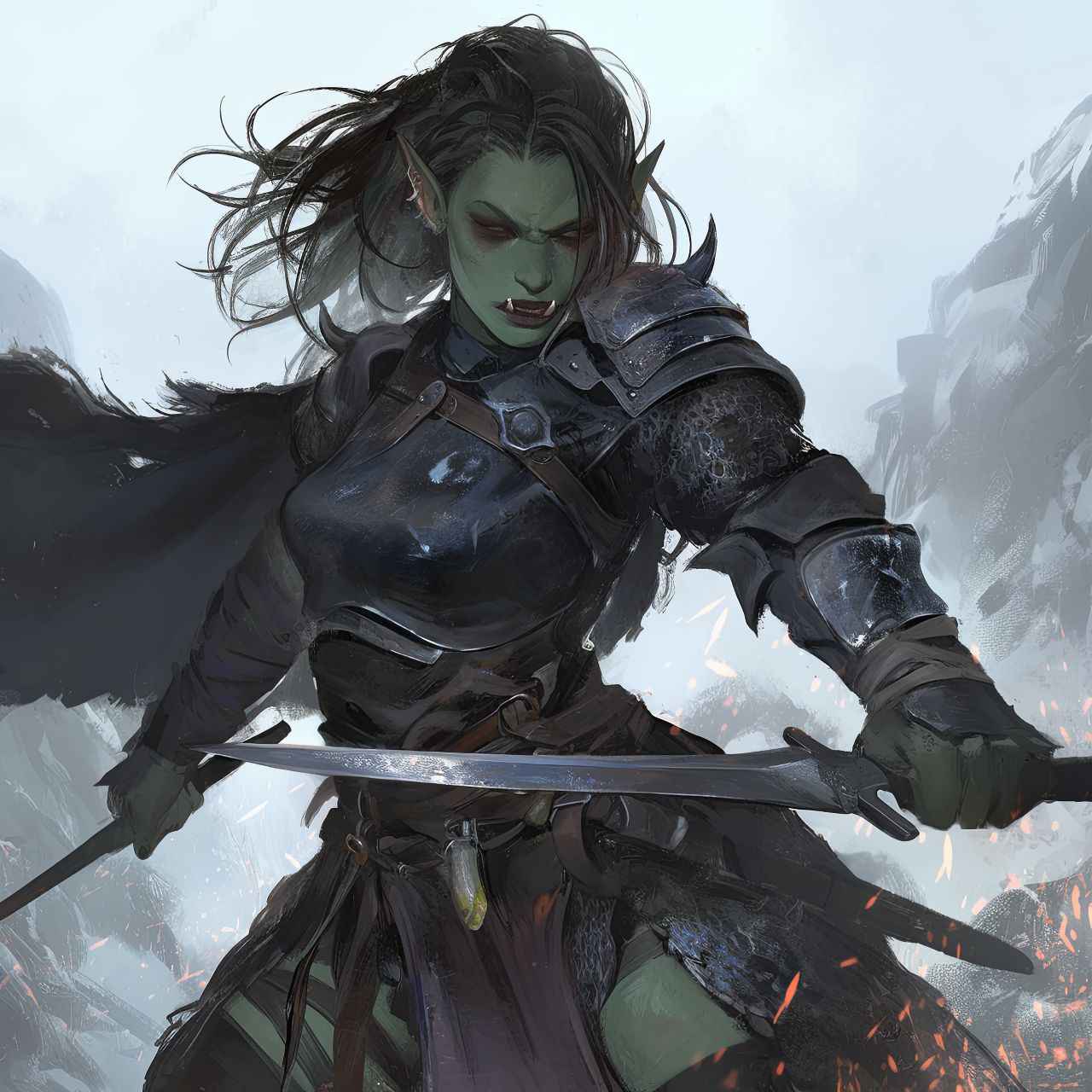
Sword Coast Races of the Realms
Half-Orcs
Half-orcs have existed in the world since before the dawn of recorded history, when orcs and humans first came into contact. Yet, in all that time, they have found few places for themselves in Faerûnian civilization—or, perhaps more accurately, civilization has never made room for them.
Most of the common folk have an aversion to half-orcs based largely on their appearance: anyone who looks that much like an orc, they reason, must be like an orc and should be kept at a distance. Because half-orcs are typically stronger and hardier than their human peers, they can find employment in towns and cities, but their appearance marks them as outsiders . In response to being ostracized, half-orcs either embrace their otherness and take pride in their physical superiority, pull back and try not to draw too much attention to themselves, or give up trying to fit in anywhere and adopt a nomadic lifestyle.
Half-orcs in Faerûn have the racial traits of half-orcs in the Player's Handbook. They speak both Common and Orc. The rare written examples of the Orc language use the Dethek alphabet.
Blood Will Tell

Half-orcs ultimately owe their plight to the deity Gruumsh, the creator of the orcs. Legend has it that when Gruumsh discovered all the territories of the world had been claimed by other races, he swore the orcs would avenge themselves by taking what they wanted by force. The great orc hordes continue to do just that today, appearing periodically from out of the wilderness to raid and scavenge.
As a result, the word "orc" has no pleasant connotation in the minds of other Faerûnians. At the same time, the word "half" is a mark of derision among orcs. Some half-orcs raised among orcs react to this stigma by being more brutal than others of their tribe, which can put them in roles of leadership, but outsider half-orcs aren't welcomed into orc society because they aren't of pure orc blood. And they aren't accepted into other societies because of their orc heritage.
Half-orcs are seen as off-putting and intimidating by other people, which is both a blessing and a curse, because while they are often left alone by those who fear them, they also become targets of discrimination, or outright attacks, from those who feel threatened by them. This prejudice against the race makes half-orcs slow to trust even those who show them courtesy—because they all have stories of when they were tricked by such behavior. Their orc blood—the Mark of Gruumsh—makes them quick to anger and inclined to lash out at those who treat them unfairly.
Having grown up among orcs or under the shadow of their heritage, half-orcs rarely have experience with pleasant society, and they often come off as coarse, blunt, or rude in dealings with other people. With the directness of an orc, they speak their minds with no apparent concern for how their opinions are received. No matter where they live, half-orcs usually find themselves defined by others in terms of their usefulness as heavy laborers and soldiers. It is the rare and fortunate few who are judged by their character and their deeds rather than their ancestry.
Half-Orc Homelands
In lands far from the Sword Coast, such as Thesk and Chessenta, there are large communities of half-orcs, where generations of them have lived as a people in their own right. Yet there are few such places in the North. A small community was growing near the Kingdom of Many Arrows, but the recent war with the orcs of that realm caused this burgeoning population to disperse.
Today no civilized place in the North has a significant population of half-orcs, although at least a few of them reside in or on the outskirts of any stable community. Ironically, it is among the largest and most civilized of these places that half-orcs are likely to find acceptance—in the great cities where people are often more cosmopolitan in their outlook.
In Waterdeep, for instance, half-orcs make up a tiny percentage of the population, yet even at that they still number in the hundreds. Half-orcs who call Waterdeep home appreciate the acceptance, or at least tolerance, they receive in the city, whether they were born there, arrived overland from elsewhere on the continent, or entered the city by way of ships bringing trade.
Half-Orc Deities
As befits their dual nature, many half-orcs revere deities from both the human and the orc pantheons. Alone or among themselves, half-orcs offer prayers to orc deities, particularly Ilneval, who is thought of as a patron of half-orcs and other orc crossbreeds.
Faerûnian Gods
Half-orcs trying to fit in with human society often adopt a human deity out of expediency (though rarely just for the sake of appearances). They favor Faerûnian deities of war and trickery, such as Bane, Mask, and Tempus.
First Family
The orc pantheon, known as the Tribe of He Who Watches, is a group of brutal and cruel gods, dominated by their father and chieftain, Gruumsh One-Eye. This god of conquest, strength, and survival is the hated rival of the elven deity Corellon Larethian. It is said that Gruumsh owes the loss of his eye to Corellon's aim with an arrow.
The mother-deity of the orcs is Luthic, mate of Gruumsh, and the goddess of fecundity, caverns, and witchery.
Bahgtru, the son of Gruumsh, is the god of pure, brute strength, renowned for his power but disdained by some for his oafishness.
Horde Leader
The patron deity of half-orcs is the war god Ilneval. He has the title of War Master in the pantheon, revered by those who believe in the wisdom of attacking with overwhelming numbers.
Black and White
The two most sinister members of the orc pantheon lie at opposite ends of the visual spectrum. One is Shargaas, the Night Lord, god of darkness, night, and stealth. The other is Yurtrus the White-Handed, Lord of Maggots, the fearsome deity of plagues and death.
Halfling
This race has multiple subraces, as listed below:
- Halfling (Ghostwise)
- Halfling (Lightfoot)
- Halfling (Lotusden)
- Halfling (Mark of Healing)
- Halfling (Mark of Hospitality)
- Halfling (Stout)
Traits
Age. A halfling reaches adulthood at the age of 20 and generally lives into the middle of his or her second century.
Size. Halflings average about 3 feet tall and weigh about 40 pounds. Your size is Small.
Lucky. When you roll a 1 on an attack roll, ability check, or saving throw, you can reroll the die and must use the new roll.
Brave. You have advantage on saving throws against being frightened.
Halfling Nimbleness. You can move through the space of any creature that is of a size larger than yours.
Languages. You can speak, read, and write Common and Halfling. The Halfling language isn't secret, but halflings are loath to share it with others. They write very little, so they don't have a rich body of literature. Their oral tradition, however, is very strong. Almost all halflings speak Common to converse with the people in whose lands they dwell or through which they are traveling.
Halfling (Lightfoot)
- Ability Scores. Dexterity +2; Charisma +1
- Size. Small
- Speed. 25 ft.
As a lightfoot halfling, you can easily hide from notice, even using other people as cover. You're inclined to be affable and get along well with others. In the Forgotten Realms, lightfoot halflings have spread the farthest and thus are the most common variety.
Lightfoots are more prone to wanderlust than other halflings, and often dwell alongside other races or take up a nomadic life. In the world of Greyhawk, these halflings are called hairfeet or tallfellows.
Naturally Stealthy. You can attempt to hide even when you are obscured only by a crea-ture that is at least one size larger than you.
As a lightfoot halfling, you can easily hide from notice, even using other people as cover. You're inclined to be affable and get along well with others. In the Forgotten Realms, lightfoot halflings have spread the farthest and thus are the most common variety.
Lightfoots are more prone to wanderlust than other halflings, and often dwell alongside other races or take up a nomadic life. In the world of Greyhawk, these halflings are called hairfeet or tallfellows.
Halfling (Stout)
- Ability Scores. Dexterity +2; Constitution +1
- Size. Small
- Speed. 25 ft.
As a stout halfling, you're hardier than average and have some resistance to poison. Some say that stouts have dwarven blood. In the Forgotten Realms, these halflings are called strong-hearts, and they're most common in the south.
Stout Resilience. You have advantage on saving throws against poison, and you have re-sistance against poison damage.

As a stout halfling, you're hardier than average and have some resistance to poison. Some say that stouts have dwarven blood. In the Forgotten Realms, these halflings are called stronghearts, and they're most common in the south.
https://2014.5e.tools/img/races/PHB/Halfling.webp
The comforts of home are the goals of most halflings' lives: a place to settle in peace and quiet, far from marauding monsters and clashing armies; a blazing fire and a generous meal; fine drink and fine conversation. Though some halflings live out their days in remote agricultural communities, others form nomadic bands that travel constantly, lured by the open road and the wide horizon to discover the wonders of new lands and peoples. But even these wanderers love peace, food, hearth, and home, though home might be a wagon jostling along a dirt road or a raft floating downriver.
Small and Practical
The diminutive halflings survive in a world full of larger creatures by avoiding notice or, barring that, avoiding offense. Standing about 3 feet tall, they appear relatively harmless and so have managed to survive for centuries in the shadow of empires and on the edges of wars and political strife. They are inclined to be stout, weighing between 40 and 45 pounds.
Halflings' skin ranges from tan to pale with a ruddy cast, and their hair is usually brown or sandy brown and wavy. They have brown or hazel eyes. Halfling men often sport long sideburns, but beards are rare among them and mustaches even more so. They like to wear simple, comfortable, and practical clothes, favoring bright colors.
Halfling practicality extends beyond their clothing. They're concerned with basic needs and simple pleasures and have little use for ostentation. Even the wealthiest of halflings keep their treasures locked in a cellar rather than on display for all to see. They have a knack for finding the most straightforward solution to a problem, and have little patience for dithering.
Kind and Curious
Halflings are an affable and cheerful people. They cherish the bonds of family and friendship as well as the comforts of hearth and home, harboring few dreams of gold or glory. Even adventurers among them usually venture into the world for reasons of community, friendship, wanderlust, or curiosity. They love discovering new things, even simple things, such as an exotic food or an unfamiliar style of clothing.
Halflings are easily moved to pity and hate to see any living thing suffer. They are generous, happily sharing what they have even in lean times.
Blend into the Crowd
Halflings are adept at fitting into a community of humans, dwarves, or elves, making themselves valuable and welcome. The combination of their inherent stealth and their unassuming nature helps halflings to avoid unwanted attention.
Halflings work readily with others, and they are loyal to their friends, whether halfling or otherwise. They can display remarkable ferocity when their friends, families, or communities are threatened.
Pastoral Pleasantries
Most halflings live in small, peaceful communities with large farms and well-kept groves. They rarely build kingdoms of their own or even hold much land beyond their quiet shires. They typically don't recognize any sort of halfling nobility or royalty, instead looking to family elders to guide them. Families preserve their traditional ways despite the rise and fall of empires.
Many halflings live among other races, where the halflings' hard work and loyal outlook offer them abundant rewards and creature comforts. Some halfling communities travel as a way of life, driving wagons or guiding boats from place to place and maintaining no permanent home.
Affable and Positive
Halfling try to get along with everyone else and are loath to make sweeping generalizations-especially negative ones.
Dwarves. "Dwarves make loyal friends, and you can count on them to keep their word. But would it hurt them to smile once in a while?"
Elves. "They're so beautiful! Their faces, their music, their grace and all. It's like they stepped out of a wonderful dream. But there's no telling what's going on behind their smiling faces-surely more than they ever let on."
Humans. "Humans are a lot like us, really. At least some of them are. Step out of the castles and keeps, go talk to the farmers and herders and you'll find good, solid folk. Not that there's anything wrong with the barons and soldiers - you have to admire their conviction. And by protecting their own lands, they protect us as well."
Exploring Opportunities
Halflings usually set out on the adventurer's path to defend their communities, support their friends, or explore a wide and wonder-filled world. For them, adventuring is less a career than an opportunity or sometimes a necessity.
Halfling Names
A halfling has a given name, a family name, and possibly a nickname. Family names are often nicknames that stuck so tenaciously they have been passed down through the generations.
- Male Names: Alton, Ander, Cade, Corrin, Eldon, Errich, Finnan, Garret, Lindal, Lyle, Merric, Milo, Osborn, Perrin, Reed, Roscoe, Wellby
- Female Names: Andry, Bree, Callie, Cora, Euphemia, Jillian, Kithri, Lavinia, Lidda, Merla, Nedda, Paela, Portia, Seraphina, Shaena, Trym, Vani, Verna
- Family Names: Brushgather, Goodbarrel, Greenbottle, High-hill, Hilltopple, Leagallow, Tealeaf, Thorngage, Tosscobble, Underbough
Source: PHB, page 26. Available in the SRD 5.1 and the Basic Rules (2014).
Sword Coast Races of the Realms
Halflings

Folk think of elves as aloof and graceful, dwarves as fierce and hardy, and of gnomes—if they think of them at all—as clever and shy. Halflings, in contrast, have the reputation of being deft and plucky.
Halflings, or hin as they call themselves, exhibit a natural adroitness that often surprises larger folk. This nimbleness regularly comes in handy when their courage outruns their common sense, and tales about halflings abound with lucky breaks and narrow escapes.
Beyond these typical elements of the halfling character, halflings can be divided into two major subraces. Many aspects of the two groups' cultures make them distinct, but even without such trappings they are distinct due to a divergence in what seems to be a primal drive: to go or to stay. Lightfoot halflings are travelers as a rule, with tongues and hearts as nimble as their feet. Whereas if strongheart halflings are on the move, it always seems driven by a desire to return to home or find and settle in a new one. As the saying goes, "Lightfoot, light hearted. Strongheart, strong footing."
Although there are many halfling communities, particularly in the lands in and around Luiren, halflings frequently fit themselves into dwarven, gnomish, elven, and human societies. Lightfoots breeze into communities as they travel, make friends easily, and then move on as the wind or whimsy takes them. Stronghearts settle in, make themselves at home, and weave themselves so deftly into the fabric of a community that it becomes hard for folk to think of a time without them.
Lightfoot Halflings
For lightfoot halflings, neither the journey nor the destination matters more; the important thing is to keep moving. The life of a lightfoot is one long exploration with each new horizon, new town, or new face a chance to find something delightful.
Lightfoot halflings typically travel in small bands, using whatever conveyance is convenient but just as easily striking out on foot. Bands consist of loosely related individuals, and when bands meet, membership frequently shifts. Lightfoot halflings typically excel at tasks related to travel—be it navigation, handling pack animals, foraging, sailing, and cartwright work—having tried their hand at all such things before or learned from other lightfoots met during their journeys.
Lightfoot halflings are highly social, often as curious about other people as they are about what might lie around the next bend. They characteristically possess an easygoing and open attitude, curious about others and willing to share of themselves, which enables them to make friends easily. Their facile friendships and ease with partings can make lightfoot halflings seem disingenuous to others. Lightfoot halflings get stereotyped as flighty, easily distracted, fickle, and unreliable. But their friendships and courtships, if brief, tend to be genuine. The staid and stable life that most other people desire just isn't part of their character.
Lightfoot halflings have all the racial traits of lightfoot halflings in the Player's Handbook. They share the skin, hair, and eye tones of humans, but most lightfoot halflings have hazel or brown eyes and brown hair. Lightfoot halflings don't grow facial hair except that males and females typically grow short sideburns.
Strongheart Halflings
Creatures of the earth who love a warm hearth and pleasant company, strongheart halflings are folks of few enemies and many friends. Stronghearts are sometimes referred to fondly by members of other races as "the good folk," for little upsets stronghearts or corrupts their spirit. To many of them, the greatest fear is to live in a world of poor company and mean intent, where one lacks freedom and the comfort of friendship.
When strongheart halflings settle into a place, they intend to stay. It's not unusual for a dynasty of stronghearts to live in the same place for a few centuries. Strongheart halflings don't develop these homes in seclusion. On the contrary, they do their best to fit into the local community and become an essential part of it. Their viewpoint stresses cooperation above all other traits, and the ability to work well with others is the most valued behavior in their lands.
Pushed from their nests, strongheart halflings typically try to have as many comforts of home with them as possible. Non-stronghearts with a more practical bent can find strongheart travel habits maddening, but their lightfoot cousins typically enjoy the novelty of it—so long as the lightfoots don't have to carry any of the baggage.
While often stereotyped as fat and lazy due to their homebound mindset and obsession with fine food, strongheart halflings are typically quite industrious. Nimble hands, their patient mindset, and their emphasis on quality makes them excellent weavers, potters, wood carvers, basket makers, painters, and farmers.
Strongheart halflings have all the racial traits of stouts in the Player's Handbook. Strongheart halflings are shorter on average than their lightfoot kin, and tend to have rounder faces. They have the skin tones and hair colors of humans, with most having brown hair. Unlike their lightfoot cousins, strongheart halflings often have blond or black hair and blue or green eyes. Males don't grow beards or mustaches, but both males and females can grow sideburns down to mid-cheek, and both genders plait them into long braids.
Halfling Deities
The hin have a small but intimate pantheon of deities, which are honored primarily at household altars, roadside shrines, and wooded groves.
The Blessed Sisters
The hin mother-goddess and the head of the pantheon is Yondalla, the Blessed One, goddess of bounty and fertility, protector of hearth, home, and family. Sheela Peryroyl is the Green Sister of Yondalla. She is a nature goddess, the lady of fields, streams, and the wilds found in shire and glen, and the weather in such places. She is also a goddess of love, song, and dance.
Keepers of the Home
Cyrrollalee is goddess of the hearth and hospitality, as well as of trust and handicrafts. Arvoreen is a defender-god, a watchful protector who sacrifices personal comfort for the safety of others.
The Shadowed Gods
Brandobaris is the trickster-god of thievery and stealth, patron of many halfling adventurers. Urogalan is the silent, melancholy god of the earth and death. Accompanied everywhere by a great dark hound, he is saddened by his duties, and vigilant in ensuring that the dead are respected and protected.
Lady Luck
Many halflings have taken to regular worship of Tymora, seeing her as a helping hand in their fortunes and a patron of the luckiness associated with the hin.
Halfling (Ghostwise)
- Ability Scores. Dexterity +2; Wisdom +1
- Size. Small
- Speed. 25 ft.
Age. A halfling reaches adulthood at the age of 20 and generally lives into the middle of his or her second century.
Size. Halflings average about 3 feet tall and weigh about 40 pounds. Your size is Small.
Lucky. When you roll a 1 on an attack roll, ability check, or saving throw, you can reroll the die and must use the new roll.
Brave. You have advantage on saving throws against being frightened.
Halfling Nimbleness. You can move through the space of any creature that is of a size larger than yours.
Languages. You can speak, read, and write Common and Halfling. The Halfling language isn't secret, but halflings are loath to share it with others. They write very little, so they don't have a rich body of literature. Their oral tradition, however, is very strong. Almost all halflings speak Common to converse with the people in whose lands they dwell or through which they are traveling.
Silent Speech. You can speak telepathically to any creature within 30 feet of you. The creature understands you only if the two of you share a language. You can speak telepathically in this way to one creature at a time.
Ghostwise Halflings
Ghostwise halflings trace their ancestry back to a war among halfling tribes that sent their ancestors into flight from Luiren. Ghostwise halflings are the rarest of the hin, found only in the Chondalwood and a few other isolated forests, clustered in tight-knit clans.
Many ghostwise clans select a natural landmark as the center of their territory, and members carry a piece of that landmark with them at all times. Clan warriors known as nightgliders bond with and ride giant owls as mounts.
Because these folk are clannish and mistrustful of outsiders, ghostwise halfling adventurers are rare. Ask your DM if you can play a member of this subrace, which has the halfling traits in the Player's Handbook, plus the subrace traits listed.
- Halfling (Ghostwise)
Halfling (Lotusden)
- Ability Scores. Dexterity +2; Wisdom +1
- Size. Small
- Speed. 25 ft.
Age. A halfling reaches adulthood at the age of 20 and generally lives into the middle of his or her second century.
Size. Halflings average about 3 feet tall and weigh about 40 pounds. Your size is Small.
Lucky. When you roll a 1 on an attack roll, ability check, or saving throw, you can reroll the die and must use the new roll.
Brave. You have advantage on saving throws against being frightened.
Halfling Nimbleness. You can move through the space of any creature that is of a size larger than yours.
Languages. You can speak, read, and write Common and Halfling. The Halfling language isn't secret, but halflings are loath to share it with others. They write very little, so they don't have a rich body of literature. Their oral tradition, however, is very strong. Almost all halflings speak Common to converse with the people in whose lands they dwell or through which they are traveling.
Child of the Wood. You know the druidcraft cantrip. When you reach 3rd level, you can cast the entangle spell once with this trait and regain the ability to do so when you finish a long rest. When you reach 5th level, you can cast the spike growth spell once with this trait and regain the ability to do so when you finish a long rest. Casting these spells with this trait doesn't require material components. Wisdom is your spellcasting ability for these spells.
Timberwalk. Ability checks made to track you have disadvantage, and you can move across difficult terrain made of nonmagical plants and undergrowth without expending extra movement.
https://2014.5e.tools/img/races/EGW/Halfling%20(Lotusden).webp
Long tied to the natural heart of the Lotusden Greenwood, these halflings have adapted to live synergistically with the chaotic laws of the wilds.
Harengon
- Ability Scores. Choose one of: (a) Choose any +2; choose any other +1 (b) Choose three different +1
- Size. Small/Medium
- Speed. 30 ft.
Size. You are Medium or Small. You choose the size when you select this race.
Hare-Trigger. You can add your proficiency bonus to your initiative rolls.
Leporine Senses. You have proficiency in the Perception skill.
Lucky Footwork. When you fail a Dexterity saving throw, you can use your reaction to roll a d4 and add it to the save, potentially turning the failure into a success. You can't use this re-action if you're prone or your speed is 0.
Rabbit Hop. As a bonus action, you can jump a number of feet equal to five times your proficiency bonus, without provoking opportunity attacks. You can use this trait only if your speed is greater than 0. You can use it a number of times equal to your proficiency bonus, and you regain all expended uses when you finish a long rest.
Languages. You can speak, read, and write Common and one other language that you and your DM agree is appropriate for your character.
https://2014.5e.tools/img/races/MPMM/Harengon.webp
https://2014.5e.tools/img/races/WBtW/Harengon.webp
Harengons originated in the Feywild, where they spoke Sylvan and embodied the spirit of freedom and travel. In time, these rabbitfolk hopped into other worlds, bringing the fey realm's exuberance with them and learning new languages as they went.
Harengons are bipedal, with the characteristic long feet of the rabbits they resemble and fur in a variety of colors. They share the keen senses and powerful legs of leporine creatures and are full of energy, like a wound-up spring. Harengons are blessed with a little fey luck, and they often find themselves a few fortunate feet away from dangers during adventures.
Source: WBtW, page 13. Reprinted as Harengon in MPMM
Hexblood
- Ability Scores. Choose one of: (a) Choose any +2; choose any other +1 (b) Choose three different +1
- Size. Small/Medium
- Speed. 30 ft.
Creature Type. You are a Fey.
Size. You are Medium or Small. You choose the size when you gain this lineage.
Ancestral Legacy. If you replace a race with this lineage, you can keep the following el-ements of that race: any skill proficiencies you gained from it and any climbing, flying, or swimming speed you gained from it.
If you don't keep any of those elements or you choose this lineage at character creation, you gain proficiency in two skills of your choice.
Darkvision. You can see in dim light within 60 feet of you as if it were bright light and in darkness as if it were dim light. You discern colors in that darkness as shades of gray.
Eerie Token. As a bonus action, you can harmlessly remove a lock of your hair, one of your nails, or one of your teeth. This token is imbued with magic until you finish a long rest. While the token is imbued in this way, you can take these actions:
- Telepathic Message. As an action, you can send a telepathic message to the creature holding or carrying the token, as long as you are within 10 miles of it. The message can contain up to twenty-five words.
- Remote Viewing. If you are within 10 miles of the token, you can enter a trance as an action. The trance lasts for 1 minute, but it ends early if you dismiss it (no action required) or are incapacitated. During this trance, you can see and hear from the token as if you were locat-ed where it is. While you are using your senses at the token's location, you are blinded and deafened in regard to your own surroundings. When the trance ends, the token is harmlessly destroyed.
Once you create a token using this feature, you can't do so again until you finish a long rest, at which point your missing part regrows.
Hex Magic. You can cast the disguise self and hex spells with this trait. Once you cast either of these spells with this trait, you can't cast that spell with it again until you finish a long rest. You can also cast these spells using any spell slots you have.
Intelligence, Wisdom, or Charisma is your spellcasting ability for these spells (choose the ability when you gain this lineage).
Becoming a Hag
Hags can undertake a ritual to irreversibly transform a hexblood they created into a new hag, either one of their own kind or that embodies the hexblood's nature. This requires that both the hag and hexblood be in the same place and consent to the lengthy ritual—circumstances most hexbloods shun but might come to accept over the course of centuries. Once a hexblood under-goes this irreversible ritual, they emerge as a hag NPC no longer under the control of the hexblood's player, unless the DM rules otherwise.
Languages. You can speak, read, and write Common and one other language that you and your DM agree is appropriate for your character.
https://2014.5e.tools/img/races/VRGR/Hexblood.webp
Where wishing fails, ancient magic can offer a heart's desire—at least, for a time. Hexbloods are individuals infused with eldritch magic, fey energy, or mysterious witchcraft. Some who enter into bargains with hags gain their deepest wishes but eventually find themselves transformed. These changes evidence a hag's influence: ears that split in forked points, skin in lurid shades, long hair that regrows if cut, and an irremovable living crown. Along with these marks, hexbloods manifest hag-like traits, such as darkvision and a variety of magical methods to beguile the senses and avoid the same.
While many hexbloods gain their lineage after making a deal with a hag, others reveal their nature as they age—particularly if a hag influenced them early in life or even before their birth. Many hexbloods turn to lives of adventure, seeking to discover the mysteries of their magic, to forge a connection with their fey natures, or to avoid a hag that obsesses over them.
Heir of Hags
One way hags create more of their kind is through the creation of hexbloods. Every hexblood exhibits features suggestive of the hag whose magic inspires their powers. This includes an unusual crown, often called an eldercross or a witch's turn. This living, garland-like part of a hexblood's body extends from their temples and wraps behind the head, serving as a visible mark of the bargain between hag and hexblood, a debt owed, or a change to come.
Hexblood Origins
A bargain with a hag or other eerie forces transformed your character into a magical being. Roll on or choose an option from the Hexblood Origins table to determine how your character gained their lineage.
Hexblood Origins
| d6 | Origin |
|---|---|
| 1 | Seeking a child, your parent made a bargain with a hag. You are the result of that arrangement. |
| 2 | Fey kidnappers swapped you and your parents' child. |
| 3 | A coven of hags lost one of its members. You were created to replace the lost hag. |
| 4 | You were cursed as a child. A deal with the spirits of the forest transformed you into a hexblood, now free of the curse. |
| 5 | You began life as a fey creature, but an accident changed you and forced you from your home. |
| 6 | A slighted druid transformed you and bound you to live only so long as a sacred tree bears fruit. |
Source: VRGR, page 18
Hobgoblin
- Ability Scores.
- Size. Medium
- Speed. 30 ft.
Martial Advantage. Once per turn, you can deal an extra 2d6 damage to a creature you hit with a weapon attack if that creature is within 5 ft. of an ally of yours that isn't incapacitat-ed.
Darkvision. You can see in dim light within 60 feet of you as if it were bright light, and in darkness as if it were dim light. You can't discern color in darkness, only shades of gray.
Languages. You can speak, read, and write Common and Goblin.
Source: DMG, page 282
Hobgoblin
- Ability Scores. Constitution +2; Intelligence +1
- Size. Medium
- Speed. 30 ft.
Age. Hobgoblins mature at the same rate as humans and have lifespans similar in length to theirs.
Size. Your size is Medium.
Darkvision. You can see in dim light within 60 feet of you as if it were bright light, and in darkness as if it were dim light. You can't discern color in darkness, only shades of gray.
Martial Training. You are proficient with two martial weapons of your choice and with light armor.
Saving Face. Hobgoblins are careful not to show weakness in front of their allies, for fear of losing status. If you miss with an attack roll or fail an ability check or a saving throw, you can gain a bonus to the roll equal to the number of allies you can see within 30 feet of you (maxi-mum bonus of +5). Once you use this trait, you can't use it again until you finish a short or long rest.
Languages. You can speak, read, and write Common and Goblin.
Alignment. Hobgoblin society in Eberron is shaped by the ideal of a strict code of honor and rigid martial discipline. Most hobgoblins are lawful, tending toward harsh enforcement of their laws.
https://2014.5e.tools/img/races/ERLW/Goblinoids.webp
Source: ERLW, page 26. Reprinted as Hobgoblin in MPMM
Hobgoblin
- Ability Scores. Choose one of: (a) Choose any +2; choose any other +1 (b) Choose three different +1
- Size. Medium
- Speed. 30 ft.
Creature Type. You are a Humanoid. You are also considered a goblinoid for any prereq-uisite or effect that requires you to be a goblinoid.
Darkvision. You can see in dim light within 60 feet of you as if it were bright light and in darkness as if it were dim light. You discern colors in that darkness only as shades of gray.
Fey Ancestry. You have advantage on saving throws you make to avoid or end the charmed condition on yourself.
Fey Gift. You can use this trait to take the Help action as a bonus action, and you can do so a number of times equal to your proficiency bonus. You regain all expended uses when you finish a long rest.
Starting at 3rd level, choose one of the options below each time you take the Help action with this trait:
- Hospitality. You and the creature you help each gain a number of temporary hit points equal to 1d6 plus your proficiency bonus.
- Passage. You and the creature you help each increase your walking speeds by 10 feet un-til the start of your next turn.
- Spite. Until the start of your next turn, the first time the creature you help hits a target with an attack roll, that target has disadvantage on the next attack roll it makes within the next minute.
Fortune from the Many. If you miss with an attack roll or fail an ability check or a saving throw, you can draw on your bonds of reciprocity to gain a bonus to the roll equal to the number of allies you can see within 30 feet of you (maximum bonus of +3). You can use this trait a number of times equal to your proficiency bonus, and you regain all expended uses when you finish a long rest.
Languages. You can speak, read, and write Common and one other language that you and your DM agree is appropriate for your character.
https://2014.5e.tools/img/races/MPMM/Hobgoblin.webp
Hobgoblins trace their origins to the ancient courts of the Feywild, where they first appeared with their goblin and bugbear kin. Many of them were driven from the Feywild by the conquering god Maglubiyet, who marshaled them as soldiers, but the fey realm left its mark; wherever they are in the multiverse, they continue to channel an aspect of the Feywild's rule of reciprocity, which creates a mystical bond between the giver and the receiver of a gift. On some worlds, such bonds lead hobgoblins to form communities with deep ties to one another. In Eberron and the Forgotten Realms, vast hobgoblin legions have emerged, with ranks of devoted soldiers famed for their unity. Hobgoblins are generally taller than their goblin cousins but not quite as big as bugbears. They have curved, pointed ears and noses that turn bright red or blue during displays of emotion.
Source: MPMM, page 23
Hobgoblin
- Ability Scores. Constitution +2; Intelligence +1
- Size. Medium
- Speed. 30 ft.
Age. Hobgoblins mature at the same rate as humans and have lifespans similar in length to theirs.
Size. Hobgoblins are between 5 and 6 feet tall and weigh between 150 and 200 pounds. Your size is Medium.
Darkvision. You can see in dim light within 60 feet of you as if it were bright light, and in darkness as if it were dim light. You can't discern color in darkness, only shades of gray.
Martial Training. You are proficient with two martial weapons of your choice and with light armor.
Saving Face. Hobgoblins are careful not to show weakness in front of their allies, for fear of losing status. If you miss with an attack roll or fail an ability check or a saving throw, you can gain a bonus to the roll equal to the number of allies you can see within 30 feet of you (maxi-mum bonus of +5). Once you use this trait, you can't use it again until you finish a short or long rest.
Languages. You can speak, read, and write Common and Goblin.
https://2014.5e.tools/img/races/VGM/Hobgoblin.webp
Source: VGM, page 119. Reprinted as Hobgoblin in MPMM. Also found in EGW, page 175.
NOTE See Appendix for more on Goblinoids from VGM.
Human (Base)
- Ability Scores.
- Size. Medium
- Speed. 30 ft.
This race has multiple subraces, as listed below:
- Human
- Human (Variant)
Traits
Age. Humans reach adulthood in their late teens and live less than a century.
Size. Humans vary widely in height and build, from barely 5 feet to well over 6 feet tall. Regardless of your position in that range, your size is Medium.
Languages. You can speak, read, and write Common and one extra language of your choice. Humans typically learn the languages of other peoples they deal with, including obscure dialects. They are fond of sprinkling their speech with words borrowed from other tongues: Orc curses, Elvish musical expressions, Dwarvish military phrases, and so on.
Human
- Ability Scores. Strength +1; Dexterity +1; Constitution +1; Intelligence +1; Wisdom +1; Charisma +1
- Size. Medium
- Speed. 30 ft.
Age. Humans reach adulthood in their late teens and live less than a century.
Size. Humans vary widely in height and build, from barely 5 feet to well over 6 feet tall. Regardless of your position in that range, your size is Medium.
Languages. You can speak, read, and write Common and one extra language of your choice. Humans typically learn the languages of other peoples they deal with, including obscure dialects. They are fond of sprinkling their speech with words borrowed from other tongues: Orc curses, Elvish musical expressions, Dwarvish military phrases, and so on.
Human (Variant)
- Ability Scores. Choose any two unique +1
- Size. Medium
- Speed. 30 ft.
Age. Humans reach adulthood in their late teens and live less than a century.
Size. Humans vary widely in height and build, from barely 5 feet to well over 6 feet tall. Regardless of your position in that range, your size is Medium.
Languages. You can speak, read, and write Common and one extra language of your choice. Humans typically learn the languages of other peoples they deal with, including obscure dialects. They are fond of sprinkling their speech with words borrowed from other tongues: Orc curses, Elvish musical expressions, Dwarvish military phrases, and so on.
Skills. You gain proficiency in one skill of your choice.
Feat. You gain one feats.html of your choice.
https://2014.5e.tools/img/races/PHB/Human.webp
In the reckonings of most worlds, humans are the youngest of the common races, late to arrive on the world scene and short-lived in comparison to dwarves, elves, and dragons. Perhaps it is because of their shorter lives that they strive to achieve as much as they can in the years they are given. Or maybe they feel they have something to prove to the elder races, and that's why they build their mighty empires on the foundation of conquest and trade. Whatever drives them, humans are the innovators, the achievers, and the pioneers of the worlds.
A Broad Spectrum
With their penchant for migration and conquest, humans are more physically diverse than other common races. There is no typical human. An individual can stand from 5 feet to a little over 6 feet tall and weigh from 125 to 250 pounds. Human skin shades range from nearly black to very pale, and hair colors from black to blond (curly, kinky, or straight); males might sport facial hair that is sparse or thick. A lot of humans have a dash of nonhuman blood, revealing hints of elf, orc, or other lineages. Humans reach adulthood in their late teens and rarely live even a single century.
Variety in All Things
Humans are the most adaptable and ambitious people among the common races. They have widely varying tastes, morals, and customs in the many different lands where they have settled. When they settle, though, they stay: they build cities to last for the ages, and great kingdoms that can persist for long centuries. An individual human might have a relatively short life span, but a human nation or culture preserves traditions with origins far beyond the reach of any single human's memory. They live fully in the present-making them well suited to the adventuring life-but also plan for the future, striving to leave a lasting legacy. Individually and as a group, humans are adaptable opportunists, and they stay alert to changing political and social dynamics.
Lasting Institutions
Where a single elf or dwarf might take on the responsibility of guarding a special location or a powerful secret, humans found sacred orders and institutions for such purposes. While dwarf clans and halfling elders pass on the ancient traditions to each new generation, human temples, governments, libraries, and codes of law fix their traditions in the bedrock of history. Humans dream of immortality, but (except for those few who seek undeath or divine ascension to escape death's clutches) they achieve it by ensuring that they will be remembered when they are gone.
Although some humans can be xenophobic, in general their societies are inclusive. Human lands welcome large numbers of nonhumans compared to the proportion of humans who live in nonhuman lands.
Exemplars of Ambition
Humans who seek adventure are the most daring and ambitious members of a daring and ambitious race. They seek to earn glory in the eyes of their fellows by amassing power, wealth, and fame. More than other people, humans champion causes rather than territories or groups.
Everyone's Second-Best Friends
Just as readily as they mix with each other, humans mingle with members of other races. They get along with almost everyone, though they might not be close to many. Humans serve as ambassadors, diplomats, magistrates, merchants, and functionaries of all kinds.
Dwarves. "They're stout folk, stalwart friends, and true to their word. Their greed for gold is their downfall, though."
Elves. "It's best not to wander into elven woods. They don't like intruders, and you'll as likely be bewitched as peppered with arrows. Still, if an elf can get past that damned racial pride and actually treat you like an equal, you can learn a lot from them."
Halflings. "It's hard to beat a meal in a halfling home, as long as you don't crack your head on the ceiling - good food and good stories in front of a nice, warm fire. If halflings had a shred of ambition, they might really amount to something."
Human Names and Ethnicities
Having so much more variety than other cultures, humans as a whole have no typical names. Some human parents give their children names from other languages, such as Dwarvish or Elvish (pronounced more or less correctly), but most parents give names that are linked to their region's culture or to the naming traditions of their ancestors.
The material culture and physical characteristics of humans can change wildly from region to region. In the Forgotten Realms, for example, the clothing, architecture, cuisine, music, and literature are different in the northwestern lands of the Silver Marches than in distant Turmish or Impiltur to the east-and even more distinctive in far-off Kara-Tur. Human physical characteristics, though, vary according to the ancient migrations of the earliest humans, so that the humans of the Silver Marches have every possible variation of coloration and features.
In the Forgotten Realms, nine human ethnic groups are widely recognized, though over a dozen others are found in more localized areas of Faerûn. These groups, and the typical names of their members, can be used as inspiration no matter which world your human is in.
Calishite. Shorter and slighter in build than most other humans, Calishites have dusky brown skin, hair, and eyes.
They're found primarily in southwest Faerûn.
- Calishite Names: (Male) Aseir, Bardeid, Haseid, Khemed, Mehmen, Sudeiman, Zasheir; (female) Atala, Ceidil, Hama, Jasmal, Meilil, Seipora, Yasheira, Zasheida; (surnames) Basha, Dumein, Jassan, Khalid, Mostana, Pashar, Rein
Chondathan. Chondathans are slender, tawny-skinned folk with brown hair that ranges from almost blond to almost black. Most are tall and have green or brown eyes, but these traits are hardly universal. Humans of Chondathan descent dominate the central lands of Faerûn, around the Inner Sea.
- Chondathan Names: (Male) Darvin, Dorn, Evendur, Gorstag, Grim, Helm, Malark, Morn, Randal, Stedd; (female) Arveene, Esvele, Chessail, Kerri, Lureene, Miri, Rowan, Shandri, Tessele; (surnames) Amblecrown, Buckman, Dundragon, Evenwood, Greycastle, Tallstag
Damaran. Found primarily in the northwest of Faerûn, Damarans are of moderate height and build, with skin hues ranging from tawny to fair. Their hair is usually brown or black, and their eye color varies widely, though brown is most common.
- Damaran Names: (Male) Bor, Fodel, Glar, Grigor, Igan, Ivor, Kosef, Mival, Orel, Pavel, Sergor; (female) Alethra, Kara, Katernin, Mara, Natali, Olma, Tana, Zora; (surnames) Bersk, Chernin, Dotsk, Kulenov, Marsk, Nemetsk, Shemov, Starag
Illuskan. Illuskans are tall, fair-skinned folk with blue or steely gray eyes. Most have raven-black hair, but those who inhabit the extreme northwest have blond, red, or light brown hair.
- Illuskan Names: (Male) Ander, Blath, Bran, Frath, Geth, Lander, Luth, Malcer, Stor, Taman, Urth; (female) Amafrey, Betha, Cefrey, Kethra, Mara, Olga, Silifrey, Westra; (surnames) Brightwood, Helder, Hornraven, Lackman, Stormwind, Windrivver
Mulan. Dominant in the eastern and southeastern shores of the Inner Sea, the Mulan are generally tall, slim, and amber-skinned, with eyes of hazel or brown. Their hair ranges from black to dark brown, but in the lands where the Mulan are most prominent, nobles and many other Mulan shave off all their hair.
- Mulan Names: (Male) Aoth, Bareris, Ehput-Ki, Kethoth, Mumed, Ramas, So-Kehur, Thazar-De, Urhur; (female) Arizima, Chathi, Nephis, Nulara, Murithi, Sefris, Thola, Umara, Zolis; (surnames) Ankhalab, Anskuld, Fezim, Hahpet, Nathandem, Sepret, Uuthrakt
Rashemi. Most often found east of the Inner Sea and often intermingled with the Mulan, Rashemis tend to be short, stout, and muscular. They usually have dusky skin, dark eyes, and thick black hair.
- Rashemi Names: (Male) Borivik, Faurgar, Jandar, Kanithar, Madislak, Ralmevik, Shaumar, Vladislak; (female) Fyevarra, Hulmarra, Immith, Imzel, Navarra, Shevarra, Tammith, Yuldra; (surnames) Chergoba, Dyernina, Iltazyara, Murnyethara, Stayanoga, Ulmokina
Shou. The Shou are the most numerous and powerful ethnic group in Kara-Tur, far to the east of Faerûn. They are yellowish-bronze in hue, with black hair and dark eyes. Shou surnames are usually presented before the given name.
- Shou Names: (Male) An, Chen, Chi, Fai, Jiang, Jun, Lian, Long, Meng, On, Shan, Shui, Wen; (female) Bai, Chao, Lia, Lei, Mei, Qiao, Shui, Tai; (surnames) Chien, Huang, Kao, Kung, Lao, Ling, Mei, Pin, Shin, Sum, Tan, Wan
Tethyrian. Widespread along the entire Sword Coast at the western edge of Faerûn, Tethyrians are of medium build and height, with dusky skin that tends to grow fairer the farther north they dwell. Their hair and eye color varies widely, but brown hair and blue eyes are the most common. Tethyrians primarily use Chondathan names.
Turami. Native to the southern shore of the Inner Sea, the Turami people are generally tall and muscular, with dark mahogany skin, curly black hair, and dark eyes.
- Turami Names: (Male) Anton, Diero, Marcon, Pieron, Rimardo, Romero, Salazar, Umbero; (female) Balama, Dona, Faila, Jalana, Luisa, Marta, Quara, Selise, Vonda; (surnames) Agosto, Astorio, Calabra, Domine, Falone, Marivaldi, Pisacar, Ramondo
Source: PHB, page 29. Available in the SRD 5.1 and the Basic Rules (2014).

Sword Coast Races of the Realms
Humans

Humans dwell in every corner of Toril and encompass a full range of cultures and ethnicities. Along the Sword Coast and across the North, humans are the most pervasive of the races and in many places the most dominant. Their cultural and societal makeup runs the gamut, from the cosmopolitan folk who reside in great cities such as Baldur's Gate and Waterdeep to the barbarians who rage throughout the Savage Frontier.
Humans are famous for their adaptability. No other race lives in so many diverse lands or environments, from lush jungles to burning deserts, from the eternal cold of the Great Glacier to the fertile shores along rivers and seas. Humans find ways to survive and to thrive almost anywhere. In locations where elves and dwarves have withdrawn, humans often move in and build anew alongside or on top of an earlier community.
It follows, then, that the most common feature of humans is their lack of commonality. This diversity has enabled human civilizations to grow faster than those of other races, making humans one of the dominant races in much of the world today. It has also led to conflicts between communities of humans because of their cultural and political differences. If not for their penchant for infighting, humans would be even more populous and predominant than they already are.
Human Ethnicities in Faerûn
Nine human ethnicities in Faerûn are detailed in the Player's Handbook. Several other noteworthy groups of humans are discussed here. Some are significant minorities in regions or nations that border the North, while others are prevalent in parts of the world far from the Sword Coast.
Arkaiun
Short in stature with tan skin and dark hair, the Arkaiuns dwell primarily in Dambrath as well as Halruaa and the Shar. Many Arkaiuns lived under the yoke of drow slavery centuries ago after a failed military campaign against the dark elves, which led to the eventual destruction of the Arkaiun kingdom in Dambrath.
Arkaiun Names. (Male) Houn, Rhivaun, Umbril, Xaemar, Zeltaebar; (female) Glouris, Maeve, Sevaera, Xaemarra, Zraela; (surnames) Lharaendo, Mristar, Wyndael
Bedine
Dark-skinned and dark-haired, the Bedine were warriors and nomads in southern Anauroch. Once divided into over a hundred tribes, the clannish Bedine mostly kept to their desert lands and interacted little with outsiders, except for trading. Over the generations, more Bedine have become city dwellers, leaving behind their nomadic ways, and reducing the number of tribes that still espouse their traditional way of life.
Bedine Names. (Male) Aali, Rashid, Tahnon, Tanzim, Whalide; (female) Aisha, Farah, Nura, Rashida, Zalebyeh; (tribe names) Alaii, Bordjia, Clelarra, Desai, Dakawa, Dursalai, Goldor, Iriphawa, Kellordrai, Lalajar, Qahtan, Yethtai, Zazalaar
Ffolk
The Ffolk of the Moonshae Isles are descended from Tethyrian settlers who came to the isles a thousand years ago. The Ffolk have a deep respect for nature, and are primarily farmers, worshiping the goddess they call the Earthmother and keeping to old druidic ways. Ffolk shipwrights are well regarded, having proven their ability to build sturdy ships that are capable of weathering the tumultuous seas around their home.
Ffolk Names. (Male) Artur, Bern, Colin, Manfred, Tristan; (female) Alicia, Gennifer, Meridith, Elaine, Olivia; (surnames) Archer, Gareth, Leed, Kendrick, Morgan, Waters
Gur
Related to the Rashemi, Gurs are stout, dusky-skinned, and dark-haired. They consider themselves "children of Selûne," and most of them revere the moon goddess. Gur communities live a nomadic existence wandering the Western Heartlands, leading others to refer to them as "the people of the highway."
Gur Names. (Male) Boriv, Gardar, Madevik, Vlad; (female) Varra, Ulmarra, Imza, Navarra, Yuldra; (surnames) Chergoba, Drazlad, Tazyara, Vargoba, Stayankina
Halruaan
The people of the mysterious and magical kingdom of Halruaa, the Halruaans are touched by magic, and many of them are talented in the Art. They and their land vanished during the Spellplague, but just as mysteriously returned after the second Sundering. Most Halruaans have blond or dark hair and olive complexions. Black, brown, and green eyes are the most common.
Halruaan Names. (Male) Aldym, Chand, Meleghost, Presmer, Sandrue, Uregaunt; (female) Aithe, Chalan, Oloma, Phaele, Sarade; (surnames) Avhoste, Darante, Maurmeril, Stamaraster
Imaskari
An uprising of Mulan slaves brought about the ruin of Imaskar and its ruling wizards thousands of years ago, but some Imaskari survived and fled into the Underdark. There they changed, developing the pale, smooth skin and whitish hair now common among them. The Imaskari who dominated the region of Mulhorand have been forced into exile by a second uprising of those they dominated.
Imaskari Names. (Male) Charva, Duma, Hukir, Jama, Pradir, Sikhil; (female) Apret, Bask, Fanul, Mokat, Nismet, Ril; (surnames) Datharathi, Melpurvatta, Nalambar, Tiliputakas
Nar
More than a thousand years ago, the dark priests of Narfell amassed great power by treating with demons, but their actions eventually brought about a war that destroyed their civilization. The Nars abandoned their ruined and accursed cities and became nomads and traders. Nars have tanned skin, brown or black eyes, and black hair, often worn long and tied in a tail or topknot.
Nar Names. (Male) Avan, Ostaram, Petro, Stor, Taman, Thalaman, Urth; (female) Anva, Dasha, Dima, Olga, Westra, Zlatara; (surnames) Dashkev, Hargroth, Laboda, Lackman, Stonar, Stormwind, Sulyma
Shaaran
Dark-haired and tan-skinned nomads from southern Faerûn, the Shaarans are skilled hunters, archers, and riders who revere various nature deities. They are organized into clans under the direction of elders and chieftains.
Shaaran Names. (Male) Awar, Cohis, Damota, Gewar, Hapah, Laskaw, Senesaw, Tokhis; (female) Anet, Bes, Idim, Lenet, Moqem, Neghet, Sihvet; (surnames) Cor Marak, Laumee Harr, Moq Qo Harr, Woraw Tarak
Tuigan
A nomadic horde from the vast plains between Faerûn and Kara-Tur, the Tuigans once nearly conquered Faerûn under the great leader Yamun Khahan before being defeated by a coalition of armies. Since those days, Tuigans are sometimes seen on the Sword Coast and in other nearby regions, but not in great numbers.
The Tuigans resemble the Shou, with a bronze or golden cast to their skin and dark hair, but they tend to have darker skin and broader features. Each has only a single name (sometimes handed down from one's parent); Tuigans don't use surnames. No strangers to travel, Tuigan traders and adventurers are often familiar with many languages and cultures.
Tuigan Names. (Male) Atlan, Bayar, Chingis, Chinua, Mongke, Temur; (female) Bolormaa, Bortai, Erdene, Naran
Ulutiun
The Ulutiuns are short, dark-haired, golden-skinned people who originated in northern Kara-Tur and migrated westward to Icewind Dale and other cold lands near the Endless Ice Sea. Hunters and gatherers, Ulutiuns live in small tribes that have managed to survive in one of the harshest environments in the world. Each has only a single name (sometimes handed down from one's parent); Ulutiuns don't use surnames.
Ulutiun Names. (Male) Amak, Chu, Imnek, Kanut, Siku; (female) Akna, Chena, Kaya, Sedna, Ublereak
Option: Human Languages
Many human ethnicities and nations in Faerûn have their own language, in addition to Common. Most human languages are written in Thorass, the alphabet of Old Common, derived from the Chondathan language that traders used as their common tongue. A few human languages use other alphabets, including Draconic, Dethek, and Espruar. The languages of the ethnicities described in the Player's Handbook and this book are as follows:
- Arkaiun: Dambrathan (written in Espruar)
- Bedine: Midani
- Calishite: Alzhedo
- Chondathan: Chondathan
- Damaran: Damaran (written in Dethek)
- Ffolk: Waelan
- Gur: Guran (a patois of Roushoum and Rashemi)
- Halruaan: Halruaan (written in Draconic)
- Illuskan: Illuskan
- Imaskari: Roushoum
- Mulan: Chessentan, Mulhorandi, Untheric, or Thayan
- Nar: Damaran
- Rashemi: Rashemi
- Shaaran: Shaaran (written in Dethek)
- Shou: Shou
- Tethyrian: Chondathan
- Tuigan: Tuigan
- Turami: Turmic
- Ulutiun: Uluik
If your Dungeon Master allows this option, then any human from an ethnic group that has its own language is assumed to know that language as well as Common. This ethnic language is treated as a free additional language for such individuals.
Thorass, the letters and numerals of Common

Humans' Deities
The breadth and variety of the human race in Faerûn is never more evident than in the diverse collection of deities that humans worship. The Faerûnian pantheon (detailed in chapter 1) includes gods of every stripe, and a number of deities whose spheres of influence overlap and compete, which seems to be just how humans like it.
Along the Sword Coast, most human communities have temples and shrines tended by priests who are devoted to various Faerûnian gods. In some of these places, the faithful of deities revered by rulers and other powerful individuals play a greater role in local politics than those not so favored. In the extreme, worship that is deemed heretical or dangerous is outlawed—for example, in a region where followers of Shar hold authority and power, the worship of her good twin and nemesis Selûne might be against the law.
Kalashtar
- Ability Scores. Wisdom +2; Charisma +1
- Size. Medium
- Speed. 30 ft.
Age. Kalashtar mature and age at the same rate as humans.
Alignment. The noble spirit tied to a kalashtar drives it toward lawful and good behav-ior. Most kalashtar combine strong self-discipline with compassion for all beings, but some kal-ashtar resist the virtuous influence of their spirit.
Size. Your size is Medium.
Dual Mind. You have advantage on all Wisdom saving throws.
Mental Discipline. You have resistance to psychic damage.
Mind Link. You can speak telepathically to any creature you can see, provided the crea-ture is within a number of feet of you equal to 10 times your level. You don't need to share a language with the creature for it to understand your telepathic utterances, but the creature must be able to understand at least one language.
When you're using this trait to speak telepathically to a creature, you can use your action to give that creature the ability to speak telepathically with you for 1 hour or until you end this effect as an action. To use this ability, the creature must be able to see you and must be within this trait's range. You can give this ability to only one creature at a time; giving it to a creature takes it away from another creature who has it.
Severed from Dreams. Kalashtar sleep, but they don't connect to the plane of dreams as other creatures do. Instead, their minds draw from the memories of their otherworldly spirit while they sleep. As such, you are immune to spells and other magical effects that require you to dream, like dream, but not to spells and other magical effects that put you to sleep, like sleep.
Languages. You can speak, read, and write Common, Quori, and one other language of your choice.
https://2014.5e.tools/img/races/ERLW/Kalashtar.webp
I am kalashtar, born of two worlds. Over a thousand years ago, my ancestor bound her bloodline to the spirit Kashtai, and I am a child of that union. Kashtai moves within me. Her memories come to me in dreams, and at times her voice whispers in the silence of my mind. As long as at least one of my sisters is alive, Kashtai will survive—and as long as she lives, she will fight il-Lashtavar.— Lakashtai, servant of the lightThe kalashtar are a compound people, created from the union of humanity and renegade spirits from the plane of dreams—spirits called quori. Kalashtar are often seen as wise, spiritual people with great compassion for others. There is an unmistakable alien quality to the kalashtar, though, as they are haunted by the conflicts of their otherworldly spirits.
Bound to Spirits. Every kalashtar has a connection to a spirit of light, a bond shared by other members of their bloodline. Kalashtar appear human, but their spiritual connection affects them in a variety of ways. Kalashtar have symmetrical, slightly angular features, and their eyes often glow when they are focused or expressing strong emotions.
Kalashtar can't directly communicate with their quori spirits. Rather, they might experience this relationship as a sense of instinct and inspiration, drawing on the memories of the spirit when they dream. This connection grants kalashtar minor psionic abilities, as well as protection from psychic attacks. All of these quori dream-spirits are virtuous, but some are warriors and others are more contemplative. Work together with the DM to determine the nature of your linked spirit. Typically, a kalashtar knows the name and nature of their spirit, but some may know nothing of their spirit or the source of their psychic gifts, such as an orphan kalashtar raised among strangers.
The bond to the spirit can cause some kalashtar to display unusual quirks. Consider rolling or selecting a trait from the Kalashtar Quirks table.
Kalashtar Quirks
| d10 | Quirk |
|---|---|
| 1 | You try to understand the motives and feelings of your enemies. |
| 2 | You prefer using telepathy over speaking aloud. |
| 3 | You feel a strong drive to protect the innocent. |
| 4 | You apply dream logic to mundane situations. |
| 5 | You discuss things out loud with your quori spirit. |
| 6 | You suppress your emotions and rely on logic. |
| 7 | You are strongly influenced by the emotions of those around you. |
| 8 | You prefer to find nonviolent solutions to problems whenever possible. |
| 9 | You are driven by a warrior spirit and will fight for any noble cause. |
| 10 | You are obsessed with Dreaming Dark conspiracies. |
Hunted by Nightmares. The virtuous spirits tied to the kalashtar fled from the dream-realm of Dal Quor to escape evil spirits that dominate it. The rebel quori believe that through meditation and devotion, they can change the fundamental nature of Dal Quor, shifting the balance from darkness to light. Most kalashtar communities focus on acts of devotion known as the Path of Light. But the dark powers of Dal Quor have their own plans for Eberron. Through the force known as the Dreaming Dark, these monsters manipulate the folk of Khorvaire to eliminate kalashtar whenever possible.
Many kalashtar defend themselves from the Dreaming Dark by focusing on devotion to the Path of Light. Others, though, seek out the agents of the Dreaming Dark and oppose their plans, or protect the innocent however they can. Still other kalashtar grow up isolated, knowing nothing about Dal Quor or the Dreaming Dark. Such orphans might use their abilities for personal gain or otherwise act against the virtuous instincts of their quori spirits; this can cause internal conflicts and violent mood swings.
Kalashtar Names. A kalashtar name adds a personal prefix to the name of the quori spirit within the kalashtar. Such names have no relation to the kalashtar's gender.
Kalashtar orphans are unlikely to know the name of their spirit and take names from another source.
Quori Names: Ashana, Ashtai, Ishara, Hareth, Khad, Kosh, Melk, Nari, Tana, Tari, Tash, Ulad, Vakri, Vash
Kalashtar Names: Coratash, Dalavash, Dolishara, Halakosh, Khoratari, Koratana, Lanhareth, Molavakri, Nevitash, Sorashana, Torashtai, Valakhad, Vishara
Source: ERLW, page 29
Kenku
- Ability Scores. Dexterity +2
- Size. Medium
- Speed. 30 ft.
Ambusher. In the first round of a combat, you have advantage on attack rolls against any creature who is surprised.
Mimicry. You can mimic any sounds you have heard, including voices. A creature that hears the sounds can tell they are imitations with a successful DC 14 Wisdom (Insight) check.
Languages. You can read and write Common and Auran, but you can only speak using your Mimicry trait.
Source: DMG, page 282
Kenku
- Ability Scores. Choose one of: (a) Choose any +2; choose any other +1 (b) Choose three different +1
- Size. Small/Medium
- Speed. 30 ft.
Size. Your size is Medium or Small. You choose the size when you select this race.
Expert Duplication. When you copy writing or craftwork produced by yourself or some-one else, you have advantage on any ability checks you make to produce an exact duplicate.
Kenku Recall. Thanks to your supernaturally good memory, you have proficiency in two skills of your choice.
Moreover, when you make an ability check using any skill in which you have proficiency, you can give yourself advantage on the check before rolling the d20. You can give yourself advantage in this way a number of times equal to your proficiency bonus, and you regain all expended uses when you finish a long rest.
Mimicry. You can accurately mimic sounds you have heard, including voices. A creature that hears the sounds you make can tell they are imitations only with a successful Wisdom (In-sight) check against a DC of 8 + your proficiency bonus + your Charisma modifier.
Languages. You can speak, read, and write Common and one other language that you and your DM agree is appropriate for your character.
https://2014.5e.tools/img/races/MPMM/Kenku.webp
Feathered folk who resemble ravens, kenku are blessed with keen observation and supernaturally accurate memories. None of them can remember the origin of the first kenku, however, and they often joke that there are as many kenku origin stories as there are kenku. Some of them paint their genesis as a curse, being a flightless bird people doomed to mimic other people's creations. Other kenku recite cryptic but beautiful poems about their advent being a blessed event in which they were sent into the multiverse to observe and catalog its many wonders. Whatever their true origin, kenku are most often found in the Shadowfell and the Material Plane, and they tend to have the coloration typical of ravens.
Source: MPMM, page 24
Kenku
- Ability Scores. Dexterity +2; Wisdom +1
- Size. Medium
- Speed. 30 ft.
Age. Kenku have shorter lifespans than humans. They reach maturity at about 12 years old and can live to 60.
Size. Kenku are around 5 feet tall and weigh between 90 and 120 pounds. Your size is Medium.
Expert Forgery. You can duplicate other creatures' handwriting and craftwork. You have advantage on all checks made to produce forgeries or duplicates of existing objects.
Kenku Training. You are proficient in your choice of two of the following skills: Acro-batics, Deception, Stealth, and Sleight of Hand.
Mimicry. You can mimic sounds you have heard, including voices. A creature that hears the sounds can tell they are imitations with a successful Wisdom (Insight) check opposed by your Charisma (Deception) check.
Languages. You can read and write Common and Auran, but you can only speak using your Mimicry trait.
Haunted by an ancient crime that robbed them of their wings, the kenku wander the world as vagabonds and burglars who live at the edge of human society. Kenku suffer from a sinister reputation that is not wholly unearned, but they can prove to be valuable allies.
An Ancient Curse. The kenku once served a mysterious, powerful entity on another plane of existence. Some believe they were minions of Graz'zt, while others say that they were scouts and explorers for the Wind Dukes of Aaqa. Whatever the truth, according to legend, the kenku betrayed their master. Unable to resist the lure of a beautiful sparkling treasure, the kenku plotted to steal the item and escape to the Material Plane.
Unfortunately for the kenku, their master discovered their plan before they could enact it. Enraged, the entity imposed three dreadful curses upon them. First, the kenku's beloved wings withered and fell away from their bodies, leaving them bound to the earth. Second, because their ingenuity and skill had turned toward scheming against their patron, the spark of creativity was torn from their souls. Finally, to ensure that the kenku could never divulge any secrets, their master took away their voices. Once the entity was satisfied that they had been sufficiently punished, the kenku were set loose on the Material Plane.
Since then, the kenku have wandered the world. They settle in places that accept them, usually bleak cities that have fallen on hard times and are overrun with crime.
Dreams of Flight. Above all else, kenku wish to regain their ability to fly. Every kenku is born with a desire to take to the air, and those who learn spellcasting do so in hope of mastering spells that will allow them to fly. Rumors of magic items such as flying carpets, brooms capable of flight, and similar objects provoke a great desire for the kenku to acquire the items for themselves.
Despite their lack of wings, kenku love dwelling in towers and other tall structures. They seek out ruins that reach to the sky, though they lack the motivation and creativity to make repairs or fortify such places. Even so, their light weight and size allow them to dwell in rickety structures that would collapse beneath a human or an orc.
Some thieves' guilds use kenku as lookouts and messengers. The kenku dwell in the tallest buildings and towers the guild controls, allowing them to lurk in the highest levels and to keep watch on the city below.
Hopeless Plagiarists. As a result of their lack of creativity, kenku function comfortably as minions of a powerful master. Flock leaders enforce discipline and minimize conflicts, but they fail at effective planning or crafting long-term schemes.
Although unable to speak in their own voices, kenku can perfectly mimic any sound they hear, from a halfling's voice to the noise of rocks clattering down a hillside. However, kenku cannot create new sounds and can communicate only by using sounds they have heard. Most kenku use a combination of overheard phrases and sound effects to convey their ideas and thoughts.
By the same token, kenku have no ability to invent new ideas or create new things. Kenku can copy existing items with exceptional skill, allowing them to become excellent artisans and scribes. They can copy books, make replicas of objects, and otherwise thrive in situations where they can produce large numbers of identical items. Few kenku find this work satisfying, since their quest for the freedom of flight makes them ill-suited to settle into a routine.
Ideal Minions. Kenku gather in groups called flocks. A flock is led by the oldest and most experienced kenku with the widest store of knowledge to draw on, often called Master.
Although kenku can't create new things, they have a talent for learning and memorizing details. Thus, ambitious kenku can excel as superb spies and scouts. A kenku who learns of clever schemes and plans devised by other creatures can put them to use. The kenku lack the talent to improvise or alter a plan, but a wise Master sets multiple plans in motion at once, confident that underlings can follow orders to the letter.
For this reason, many kenku make an easy living serving as messengers, spies, and lookouts for thieves' guilds, bandits, and other criminal cartels. A network of kenku can relay a bird call or similar noise across the city, alerting their allies to the approach of a guard patrol or signaling a prime opportunity for a robbery.
Since kenku can precisely reproduce any sound, the messages they carry rarely suffer degradation or shifts in meaning. Human messengers might switch words or phrases and garble a message inadvertently, but the kenku produce perfect copies of whatever they hear.
Kenku Adventurers. Kenku adventurers are usually the survivors of a flock that has sustained heavy losses, or a rare kenku who has grown weary of a life of crime. These kenku are more ambitious and daring than their fellows. Others strike out on their own in search of the secrets of flight, to master magic, or to uncover the secret of their curse and find a method to break it.
Kenku adventurers, despite their relative independence, still have a tendency to seek out a companion to emulate and follow. A kenku loves to mimic the voice and words of its chosen companion.
Roleplaying a Kenku
If you're playing a kenku, constant attempts to mimic noises can come across as confusing or irritating rather than entertaining. You can just as easily describe the sounds your character makes and what they mean. Be clear about your character's intentions unless you're deliberately aiming for inscrutable or mysterious.
You might say, "Snapper makes the noise of a hammer slowly and rhythmically tapping a stone to show how bored he is. He plays with his dagger and studies the Lords' Alliance agent sitting at the bar." Creating a vocabulary of noises for the other players to decode might sound like fun, but it can prove distracting and could slow down the game.
Kenku Names. Given that kenku can duplicate any sound, their names are drawn from a staggering variety of noises and phrases. Kenku names tend to break down into three categories that make no distinction between male and female names.
Kenku thugs, warriors, and toughs adopt noises made by weapons, such as the clang of a mace against armor or the sound made by a breaking bone. Non-kenku refer to the kenku by describing this noise. Examples of this type of name include Smasher, Clanger, Slicer, and Basher.
Kenku thieves, con artists, and burglars adopt animal noises, typically those common in urban settings. In this manner, kenku can call out to each other while those who overhear them mistake them for common animals. Non-kenku use names that refer to the sound made or the animal a kenku mimics, such as Rat Scratch, Whistler, Mouser, and Growler.
Some kenku turn their back on crime to pursue legitimate trades. These kenku adopt noises made as part of their craft. A sailor duplicates the sound of a fluttering sail, while a smith mimics the clanging of a hammer on metal. Non-kenku describe these folk by their trade sounds, such as Sail Snap, Hammerer, and Cutter.
Source: VGM, page 109. Reprinted as Kenku in MPMM. Also found in EGW, page 177.
Kobold
- Ability Scores. Dexterity +2; Strength −4
- Size. Small
- Speed. 30 ft.
Pack Tactics. You have advantage on an attack roll against a creature if at least one of your allies is within 5 feet of the creature and the ally isn't incapacitated.
Sunlight Sensitivity. You have disadvantage on attack rolls and on Wisdom (Perception) checks that rely on sight when you, the target of your attack, or whatever you are trying to per-ceive is in direct sunlight.
Darkvision. Accustomed to life underground, you have superior vision in dark and dim conditions. You can see in dim light within 60 feet of you as if it were bright light, and in dark-ness as if it were dim light. You can't discern color in darkness, only shades of gray.
Languages. You can speak, read, and write Common and Draconic.
Source: DMG, page 282
Kobold
- Ability Scores. Choose one of: (a) Choose any +2; choose any other +1 (b) Choose three different +1
- Size. Small
- Speed. 30 ft.
Darkvision. You can see in dim light within 60 feet of you as if it were bright light, and in darkness as if it were in dim light. You discern colors in that darkness only as shades of gray.
Draconic Cry. As a bonus action, you let out a cry at your enemies within 10 feet of you. Until the start of your next turn, you and your allies have advantage on attack rolls against any of those enemies who could hear you. You can use this trait a number of times equal to your proficiency bonus, and you regain all expended uses when you finish a long rest.
Kobold Legacy. Kobold's connections to dragons can manifest in unpredictable ways in an individual kobold. Choose one of the following legacy options for your kobold.
- Craftiness. You have proficiency in one of the following skills of your choice: Arcana, In-vestigation, Medicine, Sleight of Hand, or Survival.
- Defiance. You have advantage on saving throws to avoid or end the frightened condition on yourself.
- Draconic Sorcery. You know one cantrip of your choice from the sorcerer spell list. Intelli-gence, Wisdom, or Charisma is your spellcasting ability for that cantrip (choose when you se-lect this race).
Languages. You can speak, read, and write Common and one other language that you and your DM agree is appropriate for your character.
https://2014.5e.tools/img/races/MPMM/Kobold.webp
Some of the smallest draconic creatures in the multiverse, kobolds display their draconic ancestry in the glint of their scales and in their roars. Legends tell of the first kobolds emerging from the Underdark near the lairs of the earliest dragons. In some lands, kobolds serve chromatic or metallic dragons—even worshiping them as divine beings. In other places, kobolds know too well how dangerous those dragons can be and help others defend against draconic destruction.
Whatever their relationship to dragons, kobold scales tend to be rust colored, although the occasional kobold sports a scale color more akin to that of a chromatic or a metallic dragon. A kobold's cry can express a range of emotion: anger, resolve, elation, fear, and more. Regardless of the emotion expressed, their cry resonates with draconic power.
Source: MPMM, page 25
Kobold
- Ability Scores. Dexterity +2
- Size. Small
- Speed. 30 ft.
Age. Kobolds reach adulthood at age 6 and can live up to 120 years but rarely do so.
Size. Kobolds are between 2 and 3 feet tall and weigh between 25 and 35 pounds. Your size is Small.
Darkvision. You can see in dim light within 60 feet of you as if it were bright light, and in darkness as if it were dim light. You can't discern color in darkness, only shades of gray.
Grovel, Cower, and Beg. As an action on your turn, you can cower pathetically to distract nearby foes. Until the end of your next turn, your allies gain advantage on attack rolls against enemies within 10 feet of you that you can see. Once you use this trait, you can't use it again until you finish a short or long rest.
Pack Tactics. You have advantage on an attack roll against a creature if at least one of your allies is within 5 feet of the creature and the ally isn't incapacitated.
Sunlight Sensitivity. You have disadvantage on attack rolls and on Wisdom (Perception) checks that rely on sight when you, the target of your attack, or whatever you are trying to per-ceive is in direct sunlight.
Languages. You can speak, read, and write Common and Draconic.
https://2014.5e.tools/img/races/VGM/Kobold.webp
Source: VGM, page 119. Reprinted as Kobold in MPMM
NOTE See Appendix for more on Kobolds from VGM.
Kuo-Toa
- Ability Scores.
- Size. Medium
- Speed. 30 ft., swim 30 ft.
Amphibious. You can breathe air and water.
Otherworldly Perception. You can sense the presence of any creature within 30 feet of you that is invisible or on the Ethereal Plane. You can pinpoint such a creature that is moving.
Slippery. You have advantage on ability checks and saving throws made to escape a grapple.
Sunlight Sensitivity. While in sunlight, you have disadvantage on attack rolls, as well as on Wisdom (Perception) checks that rely on sight.
Superior Darkvision. You have superior vision in dark and dim conditions. You can see in dim light within 120 feet of you as if it were bright light, and in darkness as if it were dim light. You can't discern color in darkness, only shades of gray.
Languages. You can speak, read, and write Undercommon.
Note: This race is listed in the Dungeon Master's Guide as an option for creating NPCs. It is not designed for use as a playable race.
Source: DMG, page 282
Leonin
- Ability Scores. Constitution +2; Strength +1
- Size. Medium
- Speed. 35 ft.
Age. Leonin mature and age at about the same rate as humans.
Alignment. Leonin tend toward good alignments. Leonin who are focused on the pride lean toward lawful good.
Size. Leonin are typically over 6 feet tall, with some standing over 7 feet. Your size is Medium.
Darkvision. You can see in dim light within 60 feet of you as if it were bright light and in darkness as if it were dim light. You can't discern color in darkness, only shades of gray.
Claws. Your claws are natural weapons, which you can use to make unarmed strikes. If you hit with them, you can deal slashing damage equal to 1d4 + your Strength modifier, instead of the bludgeoning damage normal for an unarmed strike.
Hunter's Instincts. You have proficiency in one of the following skills of your choice: Ath-letics, Intimidation, Perception, or Survival.
Daunting Roar. As a bonus action, you can let out an especially menacing roar. Creatures of your choice within 10 feet of you that can hear you must succeed on a Wisdom saving throw or become frightened of you until the end of your next turn. The DC of the save equals 8 + your proficiency bonus + your Constitution modifier. Once you use this trait, you can't use it again until you finish a short or long rest.
Languages. You can speak, read, and write Common and Leonin.
https://2014.5e.tools/img/races/MOT/Leonin.webp
https://2014.5e.tools/img/races/MOT/Leonin%20Matron.webp
The leonin guard the shining lands of Oreskos, a golden plain where even the gods rarely trespass. Prides of these nomadic, lion-like humanoids rarely interact with other peoples, having all they need in their shimmering homeland and knowing the treachery of strangers. Still, some leonin wonder what lies beyond Oreskos's border mountains and seek to test themselves in a wider world.
Noble and Fierce
Leonin tend to be tall compared to humans and move with a boldness that suggests their physical might. Tawny fur covers leonin bodies, and some grow thick manes ranging in shades from gold to black. While their hands prove as nimble as those of other humanoids, leonin have retractable feline claws, which they can extend instantly. This, along with their ability to produce bone-shaking roars, gives most leonin an air that readily shifts between regal and fearsome.
Leonin often act with confidence, which can come off as imperiousness. While this can reassure their allies, it can also suggest defiance in the face of what they perceive as imposed authority or unworthy experts.
Quick to Quarrel
Other peoples often perceive leonin as quick to take offense, intolerant of criticism, or belligerent. The truth is that many leonin simply enjoy fighting, whether verbal or physical. They take pleasure in argument, wrestling, sparring, and even battle, enjoying the opportunity to exercise their minds and bodies.
It follows, too, that leonin aren't inclined to carry grudges. A warrior might react with sudden violence to an insult, but when the fight is over (and the leonin's superiority proven), the insult is forgotten—along with the vanquished foe.
Pride and Self-Reliance
Few leonin devote themselves to the service of the gods. Centuries ago, the leonin worshiped the same gods that humans do, but after many of their prides suffered depravities at the hands of the tyrant Agnomakhos, most leonin rejected the gods. It's not that they deny the existence of deities; they merely see the gods as mercurial and ultimately unworthy of adoration. The Leonin and the Gods table suggests the range of attitudes that leonin might adopt toward the gods.
Leonin rely on themselves and their prides. A pride is bound together by the experience of a shared challenge and, in particular, the sacred act of the hunt. See chapter 3 for more details on Oreskos and the leonin who call that land home.
Leonin and the Gods
| d6 | Attitude |
|---|---|
| 1 | I'm amused by the antics of the gods and their earnest, but ultimately deluded, mortal champions, and I feel smugly superior in my detachment. |
| 2 | The meddling of the gods in mortal affairs makes me angry and bitter. I wish they would just leave us all alone! |
| 3 | I view the gods as worthy adversaries—incredibly clever and well-prepared to play a long game but ultimately doomed to lose their games. |
| 4 | I'm certain every bad thing that happens can ultimately be blamed on the gods, but I roll my eyes at each new twist of fate and try to get on with my life. |
| 5 | I wish that I could be as naive as humans and other mortals who actually think the gods are looking out for them. I miss that kind of innocence. |
| 6 | I don't talk about it among other leonin, but I actually revere the gods and try to please them by my actions. |
Leonin Names
Along with their personal names, leonin identify themselves by their pride. A member of the Flintclaw pride with the personal name of Ziore, for example, would likely style herself as Ziore of the Flintclaw.
- Female Names: Aletha, Atagone, Demne, Doxia, Ecate, Eriz, Gragonde, Iadma, Koila, Oramne, Seza, Ziore
- Male Names: Apto, Athoz, Baragon, Bryguz, Eremoz, Gorioz, Grexes, Oriz, Pyxathor, Teoz, Xemnon, Xior
- Pride Names: Embereye, Flintclaw, Goldenfield, Ironmane, Starfeller, Sunguides
Source: MOT, page 20
Lizardfolk
- Ability Scores. Strength +2; Intelligence −2
- Size. Medium
- Speed. 30 ft., swim 30 ft.
Hold Breath. You can hold your breath for up to 15 minutes at a time.
Natural Armor. Your scales function as natural armor, granting you a +3 bonus to Armor Class.
Languages. You can speak, read, and write Draconic.
Note: This race is listed in the Dungeon Master's Guide as an option for creating NPCs. It is not designed for use as a playable race.
Source: DMG, page 282
Lizardfolk
- Ability Scores. Choose one of: (a) Choose any +2; choose any other +1 (b) Choose three different +1
- Size. Medium
- Speed. 30 ft., swim equal to your walking speed
Speed. Your walking speed is 30 feet, and you have a swimming speed equal to your walking speed.
Bite. You have a fanged maw that you can use to make unarmed strikes. When you hit with it, the strike deals 1d6 + your Strength modifier slashing damage, instead of the bludgeon-ing damage normal for an unarmed strike.
Hold Breath. You can hold your breath for up to 15 minutes at a time.
Hungry Jaws. You can throw yourself into a feeding frenzy. As a bonus action, you can make a special attack with your Bite. If the attack hits, it deals its normal damage, and you gain temporary hit points equal to your proficiency bonus. You can use this trait a number of times equal to your proficiency bonus, and you regain all expended uses when you finish a long rest.
Natural Armor. You have tough, scaly skin. When you aren't wearing armor, your base AC is 13 + Dexterity modifier. You can use your natural armor to determine your AC if the armor you wear would leave you with a lower AC. A shield's benefits apply as normal while you use your natural armor.
Nature's Intuition. Thanks to your mystical connection to nature, you gain proficiency with two of the following skills of your choice: Animal Handling, Medicine, Nature, Perception, Stealth, or Survival.
Languages. You can speak, read, and write Common and one other language that you and your DM agree is appropriate for your character.
https://2014.5e.tools/img/races/MPMM/Lizardfolk.webp
The saurian lizardfolk are thought by some sages to be distant cousins of dragonborn and kobolds. Despite their resemblance to those other scaled folk, however, lizardfolk are their own people and have lived on the worlds of the Material Plane since the worlds' creation. Gifted by the gods with remarkable physical defenses and a mystical connection to the natural world, lizardfolk can survive with just their wits in situations that would be deadly for other folk. Because of that fact, many lizardfolk myths state that their people were placed by the gods in the Material Plane to guard its natural wonders. Lizardfolk have colorful scales and exhibit a wide array of scale patterns. Their individual facial features are as varied as those of lizards.
Source: MPMM, page 26
Lizardfolk
- Ability Scores. Constitution +2; Wisdom +1
- Size. Medium
- Speed. 30 ft., swim 30 ft.
Age. Lizardfolk reach maturity around age 14 and rarely live longer than 60 years.
Size. Lizardfolk are a little bulkier and taller than humans, and their colorful frills make them appear even larger. Your size is Medium.
Swim Speed. You have a swimming speed of 30 feet.
Bite. Your fanged maw is a natural weapon, which you can use to make unarmed strikes. If you hit with it, you deal piercing damage equal to 1d6 + your Strength modifier, in-stead of the bludgeoning damage normal for an unarmed strike.
Cunning Artisan. As part of a short rest, you can harvest bone and hide from a slain beast, construct, dragon, monstrosity, or plant creature of size small or larger to create one of the following items: a shield, a club, a javelin, or 1d4 darts or blowgun needles. To use this trait, you need a blade, such as a dagger, or appropriate artisan's tools, such as leatherworker's tools.
Hold Breath. You can hold your breath for up to 15 minutes at a time.
Hunter's Lore. You gain proficiency with two of the following skills of your choice: Animal Handling, Nature, Perception, Stealth, and Survival.
Natural Armor. You have tough, scaly skin. When you aren't wearing armor, your AC is 13 + your Dexterity modifier. You can use your natural armor to determine your AC if the armor you wear would leave you with a lower AC. A shield's benefits apply as normal while you use your natural armor.
Hungry Jaws. In battle, you can throw yourself into a vicious feeding frenzy. As a bonus action, you can make a special attack with your bite. If the attack hits, it deals its normal dam-age, and you gain temporary hit points equal to your Constitution modifier (minimum of 1), and you can't use this trait again until you finish a short or long rest.
Languages. You can speak, read, and write Common and Draconic.
https://2014.5e.tools/img/races/VGM/Lizardfolk.webp
Only a fool looks at the lizardfolk and sees nothing more than scaly humanoids. Their physical shape notwithstanding, lizardfolk have more in common with iguanas or dragons than they do with humans, dwarves, or elves. Lizardfolk possess an alien and inscrutable mindset, their desires and thoughts driven by a different set of basic principles than those of warm-blooded creatures. Their dismal swamp homes might lie hundreds of miles from the nearest human settlement, but the gap between their way of thinking and that of the smooth-skins is far greater.
Despite their alien outlook, some lizardfolk make an effort to understand and, in their own manner, befriend people of other races. Such lizardfolk make faithful and skilled allies.
Alien Minds. The lizardfolk's reptilian nature comes through not only in their appearance, but also in how they think and act. Lizardfolk experience a more limited emotional life than other humanoids. Like most reptiles, their feelings largely revolve around fear, aggression, and pleasure.
Lizardfolk experience most feelings as detached descriptions of creatures and situations. For example, humans confronted by an angry troll experience fear on a basic level. Their limbs shake, their thinking becomes panicked and jumbled, and they react by instinct. The emotion of fear takes hold and controls their actions. In contrast, lizardfolk see emotions as traits assigned to other creatures, objects, and situations. A lizardfolk doesn't think, "I'm scared." Instead, aggressive, stronger creatures register to the lizardfolk as fearsome beings to be avoided if possible. If such creatures attack, lizardfolk flee, fighting only if cornered. Lizardfolk aren't scared of a troll; instead, they understand that a troll is a fearsome, dangerous creature and react accordingly.
Lizardfolk never become angry in the way others do, but they act with aggression toward creatures that they could defeat in a fight and that can't be dealt with in some other manner. They are aggressive toward prey they want to eat, creatures that want to harm them, and so on.
Pleasurable people and things make life easier for lizardfolk. Pleasurable things should be preserved and protected, sometimes at the cost of the lizardfolk's own safety. The most pleasurable creatures and things are ones that allow lizardfolk to assess more situations as benign rather than fearsome.
Cold and Calculating. Most humanoids describe cold-blooded people as lacking in emotion and empathy. The same label serves as an apt depiction of lizardfolk.
Lacking any internal emotional reactions, lizardfolk behave in a distant manner. They don't mourn fallen comrades or rage against their enemies. They simply observe and react as a situation warrants.
Lizardfolk lack meaningful emotional ties to the past. They assess situations based on their current and future utility and importance. Nowhere does this come through as strongly as when lizardfolk deal with the dead. To a lizardfolk, a comrade who dies becomes a potential source of food. That companion might have once been a warrior or hunter, but now the body is just freshly killed meat.
A lizardfolk who lives among other humanoids can, over time, learn to respect other creatures' emotions. The lizardfolk doesn't share those feelings, but instead assesses them in the same clinical manner. Yes, the fallen dwarf might be most useful as a meal, but hacking the body into steaks provokes aggression in the other humanoids and makes them less helpful in battle.
Utility and Survival. The lizardfolk mindset might seem unnecessarily cruel, but it helps them survive in a hostile environment. The swamps they inhabit are filled with a staggering variety of threats. Lizardfolk focus on survival above all, without sentiment.
Lizardfolk assess everyone and everything in terms of utility. Art and beauty have little meaning for them. A sharp sword serves a useful and good purpose, while a dull sword is a dead weight without a whetstone.
Lizardfolk see little need to plan more than a season or so into the future. This approach allows them to maintain their current level of influence in the world, but it limits their growth. Lizardfolk have no interest in developing writing, making long-term plans, or cultivating other methods to progress beyond their simple existence as hunters and gatherers.
Hapless Soft Ones. At their core, lizardfolk view other humanoids with an indifference verging on pity. Born into the world lacking stout scales and sharp teeth, it's a wonder they have managed to survive for so long. The typical human would barely make it through a day in the swamps.
Still, if other creatures prove useful to lizardfolk, those creatures can trigger a protective response made all the stronger by their apparent weakness. The lizardfolk assess such beings as hatchlings, young ones incapable of protecting themselves but who might prove useful in the future if they receive care.
Lizardfolk Personality. You can use the Lizardfolk Quirks table to determine a personality quirk for a lizardfolk character or to inspire a unique mannerism.
Lizardfolk Quirks
| d8 | Quirk |
|---|---|
| 1 | You hate waste and see no reason not to scavenge fallen enemies. Fingers are tasty and portable! |
| 2 | You sleep best while mostly submerged in water. |
| 3 | Money is meaningless to you. |
| 4 | You think there are only two species of humanoid: lizardfolk and meat. |
| 5 | You have learned to laugh. You use this talent in response to all emotional situations, to better fit in with your comrades. |
| 6 | You still don't understand how metaphors work. That doesn't stop you from using them at every opportunity. |
| 7 | You appreciate the soft humanoids who realize they need chain mail and swords to match the gifts you were born with. |
| 8 | You enjoy eating your food while it's still wriggling. |
Lizardfolk Speech
Lizardfolk can master Common, but their mindset results in a speech pattern distinct from other humanoids.
Lizardfolk rarely use metaphors. Their speech is almost always literal. They might pick up idioms, but only with some difficulty.
Names confuse them, unless they are descriptive. They tend to apply their own naming conventions to other creatures using Common words.
Lizardfolk use active verbs to describe the world. A lizardfolk in cold weather might say, "This wind brings cold" rather than "I feel cold." Lizardfolk tend to define things in terms of actions, rather than effects.
Lizardfolk Names. Lizardfolk take their names from the Draconic language. They use simple descriptives granted by the tribe based on an individual's notable deeds or actions. For example, Garurt translates as "axe," a name given to a lizardfolk warrior who defeated an orc and claimed his foe's weapon. A lizardfolk who likes to hide in a stand of reeds before ambushing an animal might be called Achuak, which means "green" to describe how she blends into the foliage.
Lizardfolk make no distinction between male and female in their naming conventions. Each example name includes its translation in parenthesis.
- Lizardfolk Names: Achuak (green), Aryte (war), Baeshra (animal), Darastrix (dragon), Garurt (axe), Irhtos (secret), Jhank (hammer), Kepesk (storm), Kethend (gem), Korth (danger), Kosj (small), Kothar (demon), Litrix (armor), Mirik (song), Othokent (smart), Sauriv (eye), Throden (many), Thurkear (night), Usk (iron), Valignat (burn), Vargach (battle), Verthica (mountain), Vutha (black), Vyth (steel)
Source: VGM, page 111. Reprinted as Lizardfolk in MPMM
Locathah
- Ability Scores. Strength +2; Dexterity +1
- Size. Medium
- Speed. 30 ft., swim 30 ft.
Age. Locathah mature to adulthood by the age of 10 but have been known to live up to 80 years.
Alignment. Most locathah are true neutral or have some aspect of neutrality in their alignment. They tend toward good, coming from a culture where compassion for the down-trodden is a commonality.
Natural Armor. You have tough, scaly skin. When you aren't wearing armor, your AC is 12 + your Dexterity modifier. You can use your natural armor to determine your AC if the armor you wear would leave you with a lower AC. A shield's benefits apply as normal while you use your natural armor.
Observant & Athletic. You have proficiency in the Athletics and Perception skills.
Leviathan Will. You have advantage on saving throws against being charmed, frightened, paralyzed, poisoned, stunned, or put to sleep.
Limited Amphibiousness. You can breathe air and water, but you need to be submerged at least once every 4 hours to avoid suffocating.
Size. Locathah stand between 5 and 6 feet tall and average about 150 pounds. Your size is Medium.
Language. You can speak, read, and write Aquan and Common.
https://2014.5e.tools/img/races/LR/Locathah.webp
Featured in Ghosts of Saltmarsh, these resilient and proud fish-folk have endured war, slavery, and mistreatment at the hands of other aquatic creatures. They dwell in submerged tribal communities along seacoasts, and hunt both above and below the water.
Source: LR, page 24
Loxodon
- Ability Scores. Constitution +2; Wisdom +1
- Size. Medium
- Speed. 30 ft.
Age. Loxodons physically mature at the same rate as humans, but they live about 450 years. They highly value the weight of wisdom and experience and are considered young until they reach the age of 60.
Alignment. Most loxodons are lawful, believing in the value of a peaceful, ordered life. They also tend toward good.
Size. Loxodons stand between 7 and 8 feet tall. Their massive bodies weigh between 300 and 400 pounds. Your size is Medium.
Powerful Build. You count as one size larger when determining your carrying capacity and the weight you can push, drag, or lift.
Loxodon Serenity. You have advantage on saving throws against being charmed or frightened.
Natural Armor. You have thick, leathery skin. When you aren't wearing armor, your AC is 12 + your Constitution modifier. You can use your natural armor to determine your AC if the ar-mor you wear would leave you with a lower AC. A shield's benefits apply as normal while you use your natural armor.
Tip: AC Calculations Don't Stack
When the game gives you more than one way to calculate your Armor Class, you can use only one of them. You choose the one to use. For example, if you have the loxodon's Natural Armor trait and the monk's Unarmored Defense feature, you don't mix them together. Instead, you choose which one determines your AC.
Trunk. You can grasp things with your trunk, and you can use it as a snorkel. It has a reach of 5 feet, and it can lift a number of pounds equal to five times your Strength score. You can use it to do the following simple tasks: lift, drop, hold, push, or pull an object or a creature; open or close a door or a container; grapple someone; or make an unarmed strike. Your DM might allow other simple tasks to be added to that list of options.
Your trunk can't wield weapons or shields or do anything that requires manual precision, such as using tools or magic items or performing the somatic components of a spell.
Keen Smell. Thanks to your sensitive trunk, you have advantage on Wisdom (Percep-tion), Wisdom (Survival), and Intelligence (Investigation) checks that involve smell.
Languages. You can speak, read, and write Common and Loxodon.
https://2014.5e.tools/img/races/GGR/Loxodon.webp
The humanoid elephants called loxodons are often oases of calm in the busy streets of Ravnica. They hum or chant in sonorous tones and move slowly or sit in perfect stillness. If provoked to action, loxodons are true terrors—bellowing with rage, trumpeting and flapping their ears. Their serene wisdom, fierce loyalty, and unwavering conviction are tremendous assets to their guilds.
Lumbering Giants. Loxodons tower above most other humanoids, standing over 7 feet tall. They have the heads—trunks, tusks, ears, and faces—of elephants, and hulking bipedal bodies covered by thick, leathery skin. Each of their hands has four thick digits, and their feet are the flat-bottomed, oval-shaped feet of elephants.
Like that of an elephant, a loxodon's trunk is a useful appendage. In addition to providing a keen sense of smell, the trunk can be used to lift and carry even heavy objects. The trunk can be used to carry both food and liquid to the mouth and can even act as a snorkel.
Gifted Stoneworkers. Loxodons are tireless, patient artisans with an unrivaled intuition about their craft. Although they make nurturing spiritual leaders, their gift for stonework is so ingrained that they are often at a loss when they try to impart that knowledge to others. Among the Selesnya, it primarily falls to loxodons to build the guild's magnificent, cathedral-like arboretum structures.
Relentlessly Loyal. Loxodons believe in the value of community and life, and thus are most often found in the Selesnya Conclave. Some find fulfillment in the cause of order by joining the Orzhov Syndicate or the Azorius Senate.
Loxodons believe that the members of a group have a responsibility to look out for each other. Once they have joined a guild or bonded with other individuals in any capacity, loxodons devote themselves to maintaining that bond. They coordinate their efforts and are often willing to sacrifice themselves for the sake of the group. They expect reciprocal loyalty and commitment from the other members of their communities and can be severe in their disappointment when their trust is betrayed.
The primary difference between loxodons who join different guilds is their sense of the size of the community they belong to. For loxodons in the Selesnya Conclave, their community is the world and all living beings in it—everything valuable, meant to live in harmony, and interdependent. For Azorius loxodons, community primarily means a society of different peoples who need adherence to law and order so they can function together. For those in the Orzhov Syndicate, community means the syndicate alone, with its interests taking priority over those of any other group.
Loxodon Names. A loxodon's name includes subtle tones, produced in a loxodon's resonant nasal chambers, that indicate status, family connection, and community role. Since most non-loxodons can't distinguish these underlying tones, let alone produce them, loxodons often translate them into titles, such as Hierarch, Revered, Grandmother, Healer, or Saint, when interacting with other races.
-
Male Names: Bayul, Berov, Brooj, Chedumov, Dobrun, Droozh, Golomov, Heruj, Ilromov, Kel, Nikoom, Ondros, Radomov, Svetel, Tamuj, Throom, Vasool
-
Female Names: Ajj, Boja, Dancu, Dooja, Elyuja, Fanoor, Irij, Jasoo, Katrun, Lyooda, Mayja, Radu, Shuja, Soofya, Totoor, Verij, Vesmova, Yoolna, Zarij, Zoorja
Source: GGR, page 17
Player Characters as Lycanthropes
A character who becomes a lycanthrope retains his or her statistics except as specified by lycanthrope type. The character gains the lycanthrope's speeds in non-humanoid form, damage immunities, traits, and actions that don't involve equipment. The character is proficient with the lycanthrope's natural attacks, such as its bite or claws, which deal damage as shown in the lycanthrope's statistics. The character can't speak while in animal form.
A non-lycanthrope humanoid hit by an attack that carries the curse of lycanthropy must succeed on a Constitution saving throw (DC 8 + the lycanthrope's proficiency bonus + the lycanthrope's Constitution modifier) or be cursed. If the character embraces the curse, his or her alignment becomes the one defined for the lycanthrope. The DM is free to decide that a change in alignment places the character under DM control until the curse of lycanthropy is removed.
The following information applies to specific lycanthropes.
Werebear. The character gains a Strength of 19 if his or her score isn't already higher, and a +1 bonus to AC while in bear or hybrid form (from natural armor). Attack and damage rolls for the natural weapons are based on Strength.
Wereboar. The character gains a Strength of 17 if his or her score isn't already higher, and a +1 bonus to AC while in boar or hybrid form (from natural armor). Attack and damage rolls for the tusks are based on Strength. For the Charge trait, the DC is 8 + the character's proficiency bonus + Strength modifier.
Wererat. The character gains a Dexterity of 15 if his or her score isn't already higher. Attack and damage rolls for the bite are based on whichever is higher of the character's Strength and Dexterity.
Weretiger. The character gains a Strength of 17 if his or her score isn't already higher. Attack and damage rolls for the natural weapons are based on Strength. For the Pounce trait, the DC is 8 + the character's proficiency bonus + Strength modifier.
Werewolf. The character gains a Strength of 15 if his or her score isn't already higher, and a +1 bonus to AC while in wolf or hybrid form (from natural armor). Attack and damage rolls for the natural weapons are based on Strength.
Wereraven. A character cursed with wereraven lycanthropy gains a Dexterity of 15 if his or her score isn't already higher. Attack and damage rolls for the wereraven's bite are based on whichever is higher of the character's Strength and Dexterity. The bite of a wereraven in raven form deals 1 piercing damage (no ability modifier applies to this damage) and carries the curse of lycanthropy.
Werebat. A player character who becomes a werebat gains a Dexterity of 17 if their score isn't already higher. Attack and damage rolls for the werebat's bite attack are based on the character's Strength or Dexterity score, whichever is higher.
Loup Garou. A Humanoid who succumbs to a loup garou's lycanthropy becomes a werewolf (see above). This form of lycanthropy can't be removed while the loup garou that inflicted the curse lives.
Once a loup garou is slain, a remove curse spell cast during the night of a full moon on any afflicted werewolf it created forces the target to make a DC 17 Constitution saving throw. On a success, the curse is broken, and the target returns to its normal form and gains 3 levels of exhaustion. On a failure, the curse remains, and the target automatically fails any saving throw made to break this curse for 1 month.
See also: Shifter
Merfolk
- Ability Scores.
- Size. Medium
- Speed. 10 ft., swim 40 ft.
Amphibious. You can breathe air and water.
Languages. You can speak, read, and write Common and Aquan.
Note: This race is listed in the Dungeon Master's Guide as an option for creating NPCs. It is not designed for use as a playable race.
Source: DMG, page 282
Minotaur
- Ability Scores. Strength +2; Constitution +1
- Size. Medium
- Speed. 30 ft.
These traits are also suitable for minotaurs in other D&D worlds where these people have avoided the demonic influence of Baphomet.
Age. Minotaurs enter adulthood at around the age of 17 and can live up to 150 years.
Alignment. Most minotaurs who join the Boros Legion lean toward lawful alignments, while those associated with the Cult of Rakdos or the Gruul Clans tend toward chaotic align-ments.
Size. Minotaurs average over 6 feet in height, and they have stocky builds. Your size is Medium.
Horns. Your horns are natural melee weapons, which you can use to make unarmed strikes. If you hit with them, you deal piercing damage equal to 1d6 + your Strength modifier, instead of the bludgeoning damage normal for an unarmed strike.
Goring Rush. Immediately after you use the Dash action on your turn and move at least 20 feet, you can make one melee attack with your horns as a bonus action.
Hammering Horns. Immediately after you hit a creature with a melee attack as part of the Attack action on your turn, you can use a bonus action to attempt to shove that target with your horns. The target must be no more than one size larger than you and within 5 feet of you. Unless it succeeds on a Strength saving throw against a DC equal to 8 + your proficiency bonus + your Strength modifier, you push it up to 10 feet away from you.
Imposing Presence. You have proficiency in one of the following skills of your choice: In-timidation or Persuasion.
Languages. You can speak, read, and write Common and Minotaur.
https://2014.5e.tools/img/races/GGR/Minotaur.webp
The minotaurs of Ravnica are strong in body, dedication, and courage. They are at home on the battlefield, willing to fight for their various causes. They combine a burning fury in battle with keen tactics that make them excellent commanders as well as valuable shock troops.
Horns and Hooves. Minotaurs are barrel-chested humanoids with heads resembling those of bulls. Their horns range in size from about 1 foot long to great, curling weapons easily three times that length. They often ornament their horns with metal rings or sheathe them in metal to protect them from damage.
Manes of shaggy fur extend down minotaurs' necks and powerful backs, and males have long tufts of hair on their chins and cheeks. Their legs end in heavy, cloven hooves. Minotaurs are born with long, tufted tails, but minotaurs of the Ordruun clan (and some others) have their tails docked as part of a coming-of-age ceremony; they find the heavy armor of the Boros legion much more comfortable without a long tail in the way.
Strength and Zeal. Minotaurs are zealous and love battle. They are found among the Gruul Clans, but the minotaurs of the Ordruun family line, long associated with the Boros Legion, are much better known and respected. Boros minotaurs choose the precision of the legion over the fury of the pack.
Minotaurs tend to vent their outrage through violence, but they aren't generally quick to anger. They are passionate, loving their friends and partners fiercely, and they laugh loud and long at good jokes.
Family and Guild. Minotaur legends describe a small pantheon of heroes—perhaps they were once thought of as gods—who established the minotaurs' place in the world. Every minotaur in Ravnica claims descent from one of these heroes. The Ordruun line is the most prominent, with thousands of members descended from an ancient hero who is said to have taught minotaurs the arts of war. Other important family lines include the Kharran line (primarily associated with the Gruul Scab clan), the Drendaa line (found scattered among the Gruul Clans), and the Tazgral line (divided between the Boros and the Gruul, with a significant number in the Rakdos as well).
Since each family line has so many members, minotaurs don't usually find it helpful to connect the name of the line to their personal names; even though Commander Grozdan of the Boros Legion's Kamen Fortress is a prominent member of the Ordruun line, he would never call himself Grozdan Ordruun the way a human would.
Minotaur Names. The legends that recount the deeds of ancient minotaur heroes are full of other names as well: those of the retainers, allies, lovers, servants, enemies, and others who played roles, however small, in the lives of the heroes. Almost every minotaur name is drawn from that long list of minor characters of legend, so that those folk are never forgotten.
-
Male Names: Alovnek, Brogmir, Brozhdar, Dornik, Drakmir, Drazhan, Grozdan, Kalazmir, Klattic, Melislek, Nirikov, Prezhlek, Radolak, Rugilar, Sarovnek, Svarakov, Trovik, Vraslak, Yarvem
-
Female Names: Akra, Bolsa, Cica, Dakka, Drakisla, Eleska, Enka, Irnaya, Jaska, Kalka, Makla, Noraka, Pesha, Raisha, Sokali, Takyat, Vrokya, Veska, Yelka, Zarka, Zoka
Source: GGR, page 18. Reprinted as Minotaur in MPMM
Minotaur
- Ability Scores. Strength +2; Constitution +1
- Size. Medium
- Speed. 30 ft.
These traits are also suitable for minotaurs in other D&D worlds where these people have avoided the demonic influence of Baphomet.
Age. Minotaurs mature and age at about the same rate as humans.
Alignment. Minotaurs who leave the walls of Skophos have the opportunity to be free of its culture and pursue chaotic alignments, while those who remain within the polis and its ty-rannical regime tend toward lawful alignments.
Size. Minotaurs average over 6 feet in height, and they have stocky builds. Your size is Medium.
Horns. Your horns are natural melee weapons, which you can use to make unarmed strikes. If you hit with them, you deal piercing damage equal to 1d6 + your Strength modifier, instead of the bludgeoning damage normal for an unarmed strike.
Goring Rush. Immediately after you use the Dash action on your turn and move at least 20 feet, you can make one melee attack with your horns as a bonus action.
Hammering Horns. Immediately after you hit a creature with a melee attack as part of the Attack action on your turn, you can use a bonus action to attempt to shove that target with your horns. The target must be no more than one size larger than you and within 5 feet of you. Unless it succeeds on a Strength saving throw against a DC equal to 8 + your proficiency bonus + your Strength modifier, you push it up to 10 feet away from you.
Imposing Presence. You have proficiency in one of the following skills of your choice: In-timidation or Persuasion.
Languages. You can speak, read, and write Common and Minotaur.
https://2014.5e.tools/img/races/MOT/Minotaur.webp
https://2014.5e.tools/img/races/MOT/Minotaur%202.webp
The minotaurs who dwell in the badlands of Phoberos and the remote polis of Skophos are caught between two worlds. Some follow the dark god Mogis, who has tyrannized them for ages untold and shown them a trail of slaughter that is all many minotaurs have ever known. Others, though, have emerged from this bloody path and found a world that welcomes those who pursue their own destinies and heroic callings.
Built to Survive
Minotaurs are barrel-chested humanoids with heads resembling those of bulls. Their horns range in size from about 1 foot long to great, curling weapons easily three times that length. Theros minotaurs often carve their horns to sharpen their edges, etch symbols of power into them, or sheathe them in bronze to prevent them from shattering during battle.
Thick hair extends down minotaurs' necks and powerful backs, and some have long patches of hair on their chins and cheeks. Their legs end in heavy, cloven hooves, and they have long, tufted tails. Minotaur priests often adorn themselves with sacred items, be they trophies from fallen foes, keepsakes from their homeland, or naturally occurring marks of their god's favor.
Ages of Darkness
Although minotaurs aren't evil by nature and are free to worship any god, many are raised among those devoted to Mogis's vile whims. Myths tell that Mogis created the first minotaurs from his own followers, typically criminals and monsters of unspeakable depravity. While many groups of minotaurs still honor their villainous progenitors, others have abandoned their ancestors and moved beyond their crimes, seeking their fates in the future, not the past.
While the inhabitants of Akros and other reaches near Phoberos, the homeland of most minotaur herds, have engaged in endless conflicts with bloodthirsty minotaurs, they know there are those who forsake Mogis's depravities. The people of Meletis, Setessa, and lands beyond are also generally open-minded and curious about minotaurs who wander into their lands. Epics like The Callapheia also describe multiple heroic minotaurs. As a result, a minotaur traveling in the company of other non-minotaurs is likely to be accepted in any polis.
See chapter 3 for more details on Phoberos, the minotaur polis of Skophos, and various minotaur bands.
Passion and Zeal
Minotaurs are known for venting their outrage through violence, but they aren't generally quick to anger. They are passionate, loving their friends and partners fiercely, and they laugh loud and long at good jokes. This zeal also extends to their faith. Those who have avoided the corrupting influence of Mogis gravitate toward the service of gods who share their bold nature, especially Erebos, Keranos, and Purphoros. Those who have rejected Mogis sometimes embrace his hated twin brother, Iroas.
Minotaur Names
In the labyrinthine polis of Skophos, the deeds of minotaur champions are carved among the winding halls. Minotaurs often name their children after these great heroes, believing that a child will inherit the strength, audacity, guile, or fearsomeness of a heroic namesake. Other minotaur parents invent their own names, though, believing in their child's potential to light a new constellation in Nyx with the brightness of their own soul.
The Minotaur Namesake table suggests possible qualities or deeds that a minotaur's namesake might have been known for. Your character might strive to emulate that quality or seek to forge a new legacy to be associated with your name by future generations.
- Female Names: Bozzri, Dhazdoro, Erinimachis, Ghalantzo, Halafoti, Kerania, Mitévra, Philoprodis, Tavromiki, Ypoudoris
- Male Names: Bamvros, Fotiyinos, Halafotios, Keranios, Menetavro, Nikavros, Prodos, Rhordon, Tavrostenes, Thyrogog
Myth of Mogis and the Minotaurs
Some legends claim that Mogis created the minotaurs, transforming his most bloodthirsty followers so that their hulking bodies resembled his own. However, while the tales told in the labyrinth-polis of Skophos affirm that Mogis rewarded his most devoted followers, they assert that these followers were already minotaurs, and all Mogis did was exalt them to an honored status. Among minotaurs who worship Mogis, these heroes are revered as spiritual if not literal ancestors. The moral of this story is simply that Mogis is a god who rewards his faithful servants.
Minotaurs who don't follow Mogis are quick to point out that this myth says nothing about the nature of minotaurs. The worship of Mogis, they argue, is no more inherent to them than it is to humans, and minotaurs aren't destined to a life of slaughter because of the circumstances of their creation. Perhaps most importantly, minotaurs aren't an offshoot of humanity but a people in their own right, and neither their nature nor their destiny is tied to a single god.
Minotaur namesake
| d8 | Ancestor's Qualities |
|---|---|
| 1 | My namesake defeated a massive enemy. |
| 2 | My namesake was known for fierce devotion to a god. |
| 3 | My namesake was a respected leader of other warriors. |
| 4 | My namesake ran the entire breadth of Phoberos in order to warn the minotaurs of an Akroan attack. |
| 5 | My namesake was famous for great magical ability. |
| 6 | My namesake was a hero's devoted companion. |
| 7 | My namesake is remembered for incredible generosity. |
| 8 | My namesake was a great oracle. |
Source: MOT, page 22. Reprinted as Minotaur in MPMM
Minotaur
- Ability Scores. Choose one of: (a) Choose any +2; choose any other +1 (b) Choose three different +1
- Size. Medium
- Speed. 30 ft.
Horns. You have horns that you can use to make unarmed strikes. When you hit with them, the strike deals 1d6 + your Strength modifier piercing damage, instead of the bludgeon-ing damage normal for an unarmed strike.
Goring Rush. Immediately after you take the Dash action on your turn and move at least 20 feet, you can make one melee attack with your Horns as a bonus action.
Hammering Horns. Immediately after you hit a creature with a melee attack as part of the Attack action on your turn, you can use a bonus action to attempt to push that target with your horns. The target must be within 5 feet of you and no more than one size larger than you. Unless it succeeds on a Strength saving throw against a DC equal to 8 + your proficiency bonus + your Strength modifier, you can push it up to 10 feet away from you.
Labyrinthine Recall. You always know which direction is north, and you have advantage on any Wisdom (Survival) check you make to navigate or track.
Languages. You can speak, read, and write Common and one other language that you and your DM agree is appropriate for your character.
https://2014.5e.tools/img/races/MPMM/Minotaur.webp
Source: MPMM, page 27
Minotaurs are barrel-chested humanoids with heads resembling those of bulls. Blessed with a supernaturally strong sense of direction, minotaurs make great navigators. Some sages believe minotaurs were first created by the Lady of Pain to patrol the magical mazes that she uses to trap her foes. Minotaur horns range in size from about 1 foot long to easily three times that length. Minotaurs often carve their horns to sharpen their edges, etch symbols of power into them, or sheathe them in bronze to prevent them from shattering during battle. Thick hair extends down minotaurs' necks and powerful backs, and some have long patches of hair on their chins and cheeks. Their legs end in heavy, cloven hooves, and they have long, tufted tails.
Orc
- Ability Scores. Strength +2; Intelligence −2
- Size. Medium
- Speed. 30 ft.
Aggressive. As a bonus action, you can move up to your speed toward a hostile creature that you can see.
Darkvision. Accustomed to life underground, you have superior vision in dark and dim conditions. You can see in dim light within 60 feet of you as if it were bright light, and in dark-ness as if it were dim light. You can't discern color in darkness, only shades of gray.
Languages. You can speak, read, and write Common and Orc.
Note: This race is listed in the Dungeon Master's Guide as an option for creating NPCs. It is not designed for use as a playable race.
Source: DMG, page 282
Orc
- Ability Scores. Strength +2; Constitution +1
- Size. Medium
- Speed. 30 ft.
Age. Orcs reach adulthood at age 16, and live up to 80 years.
Alignment. Orcs fear the curse of ruin that is said to plague their race, and tend strongly toward either chaos (accepting their fate), or toward law (rejecting it).
Size. Orcs stand easily 8 feet tall and corded with powerful muscles, weighing up to 280 pounds. Your size is Medium.
Darkvision. You can see in dim light within 60 feet of you as if it were bright light, and in darkness as if it were dim light. You can't discern color in darkness, only shades of gray.
Aggressive. As a bonus action, you can move up to your movement speed toward a hos-tile creature you can see or hear. You must end this move closer to the enemy than you started.
Primal Intuition. You have proficiency in two of the following skills of your choice: Animal Handling, Insight, Intimidation, Medicine, Perception, and Survival.
Powerful Build. You count as one size larger when determining your carrying capacity and the weight you can push, drag, or lift.
Languages. You can speak, read, and write Common and Orc.
Source: EGW, page 178. Reprinted as Orc in MPMM
Orc
- Ability Scores. Strength +2; Constitution +1
- Size. Medium
- Speed. 30 ft.
Age. Orcs reach adulthood at age 12 and live up to 50 years.
Alignment. The orcs of Eberron are a passionate people, given to powerful emotion and deep faith. They are generally chaotic, but can be any alignment.
Size. Your size is Medium.
Darkvision. You can see in dim light within 60 feet of you as if it were bright light, and in darkness as if it were dim light. You can't discern color in darkness, only shades of gray.
Aggressive. As a bonus action, you can move up to your movement speed toward a hos-tile creature you can see or hear. You must end this move closer to the enemy than you started.
Primal Intuition. You have proficiency in two of the following skills of your choice: Animal Handling, Insight, Intimidation, Medicine, Nature, Perception, and Survival.
Powerful Build. You count as one size larger when determining your carrying capacity and the weight you can push, drag, or lift.
Languages. You can speak, read, and write Common and Orc.
Source: ERLW, page 31. Reprinted as Orc in MPMM
Orc
- Ability Scores. Choose one of: (a) Choose any +2; choose any other +1 (b) Choose three different +1
- Size. Medium
- Speed. 30 ft.
Adrenaline Rush. You can take the Dash action as a bonus action. You can use this trait a number of times equal to your proficiency bonus, and you regain all expended uses when you finish a long rest.
Whenever you use this trait, you gain a number of temporary hit points equal to your proficien-cy bonus.
Darkvision. You can see in dim light within 60 feet of you as if it were bright light, and in darkness as if it were dim light. You discern colors in that darkness only as shades of gray.
Powerful Build. You count as one size larger when determining your carrying capacity and the weight you can push, drag, or lift.
Relentless Endurance. When you are reduced to 0 hit points but not killed outright, you can drop to 1 hit point instead. Once you use this trait, you can't do so again until you finish a long rest.
Languages. You can speak, read, and write Common and one other language that you and your DM agree is appropriate for your character.
https://2014.5e.tools/img/races/MPMM/Orc.webp
Orcs trace their creation to the one-eyed god Gruumsh, an unstoppable warrior and powerful leader. The divine qualities of Gruumsh resonate within orcs, granting them a reflection of his toughness and tenacity that can't be matched, and the god equipped his children to be able to live above or below ground. On some worlds, such as Eberron, orcs were among the first defenders of the natural order from the encroachments of Fiends and other extraplanar threats. Gruumsh's blessings have made orcs tireless guardians and mighty allies wherever they are found, even when they turn their devotion to other gods.
Source: MPMM, page 28
Orc
- Ability Scores. Strength +2; Constitution +1
- Size. Medium
- Speed. 30 ft.
Age. Orcs reach adulthood at age 12 and live up to 50 years.
Size. Orcs are usually over 6 feet tall and weigh between 230 and 280 pounds. Your size is Medium.
Darkvision. You can see in dim light within 60 feet of you as if it were bright light, and in darkness as if it were dim light. You can't discern color in darkness, only shades of gray.
Aggressive. As a bonus action, you can move up to your movement speed toward a hos-tile creature you can see or hear. You must end this move closer to the enemy than you started.
Primal Intuition. You have proficiency in two of the following skills of your choice: Animal Handling, Insight, Intimidation, Medicine, Nature, Perception, and Survival.
Powerful Build. You count as one size larger when determining your carrying capacity and the weight you can push, drag, or lift.
Languages. You can speak, read, and write Common and Orc.
https://2014.5e.tools/img/races/VGM/Orc.webp
Source: VGM, page 120. Reprinted as Orc in MPMM
NOTE See Appendix for more on orcs from VGM.
Owlin
- Ability Scores. Choose one of: (a) Choose any +2; choose any other +1 (b) Choose three different +1
- Size. Small/Medium
- Speed. 30 ft., fly equal to your walking speed
Size. You are Medium or Small. You choose the size when you select this race.
Darkvision. You can see in dim light within 120 feet of yourself as if it were bright light and in darkness as if it were dim light. You discern colors in that darkness only as shades of gray.
Flight. Thanks to your wings, you have a flying speed equal to your walking speed. You can't use this flying speed if you're wearing medium or heavy armor.
Silent Feathers. You have proficiency in the Stealth skill.
Languages. You can speak, read, and write Common and one other language that you and your DM agree is appropriate for your character.
https://2014.5e.tools/img/races/SCC/Owlin.webp
Distant kin of giant owls from the Feywild, owlin come in many shapes and sizes, from petite and fluffy to wide-winged and majestic. Owlin have arms and legs like other Humanoids, as well as wings that extend from their back and shoulders. Like owls, owlin are graced with feathers that make no sound when they move or fly, making it easy for them to sneak up on you in the library. Your owlin character might be nocturnal. Or perhaps your character is simply prone to rise later, embodying the common nickname of night owl.
Source: SCC, page 29
Plasmoid
- Ability Scores. Choose one of: (a) Choose any +2; choose any other +1 (b) Choose three different +1
- Size. Small/Medium
- Speed. 30 ft.
Creature Type. You are an Ooze.
Size. You are Medium or Small. You choose the size when you select this race.
Amorphous. You can squeeze through a space as narrow as 1 inch wide, provided you are wearing and carrying nothing. You have advantage on ability checks you make to initiate or escape a grapple.
Darkvision. You can see in dim light within 60 feet of yourself as if it were bright light, and in darkness as if it were dim light. You discern colors in that darkness only as shades of gray.
Hold Breath. You can hold your breath for 1 hour.
Natural Resilience. You have resistance to acid and poison damage, and you have ad-vantage on saving throws against being poisoned.
Shape Self. As an action, you can reshape your body to give yourself a head, one or two arms, one or two legs, and makeshift hands and feet, or you can revert to a limbless blob. While you have a humanlike shape, you can wear clothing and armor made for a Humanoid of your size.
As a bonus action, you can extrude a pseudopod that is up to 6 inches wide and 10 feet long or reabsorb it into your body. As part of the same bonus action, you can use this pseudopod to manipulate an object, open or close a door or container, or pick up or set down a Tiny object. The pseudopod contains no sensory organs and can't attack, activate magic items, or lift more than 10 pounds.
Languages. You can speak, read, and write Common and one other language that you and your DM agree is appropriate for your character.
https://2014.5e.tools/img/races/AAG/Plasmoid.webp
Plasmoids are amorphous beings with no typical shape. In the presence of other folk, they often adopt a similar shape, but there's little chance of mistaking a plasmoid for anything else. They consume food by osmosis, the way an amoeba does, and excrete waste through tiny pores. They breathe by absorbing oxygen through another set of pores, and their limbs are strong and flexible enough to grasp and manipulate weapons and tools. Although most plasmoids are translucent gray, they can alter their color and translucence by absorbing dyes through their pores. Plasmoids don't have internal organs of the usual sort. Their bodies are composed of cells, fibers, plasma-like ooze, and clusters of nerves. These nerves enable a plasmoid to detect light, heat, texture, sound, pain, and vibrations. Plasmoids can stiffen the outer layers of their bodies to maintain a humanlike shape, so they can wear clothing and accessories. They speak by forcing air out of tubular cavities that constrict to produce sound. When plasmoids sleep, they lose their rigidity and spread out and are thus sometimes mistaken for a rock or some other feature of the environment.
Source: AAG, page 14
Reborn
- Ability Scores. Choose one of: (a) Choose any +2; choose any other +1 (b) Choose three different +1
- Size. Small/Medium
- Speed. 30 ft.
Size. You are Medium or Small. You choose the size when you gain this lineage.
Ancestral Legacy. If you replace a race with this lineage, you can keep the following el-ements of that race: any skill proficiencies you gained from it and any climbing, flying, or swimming speed you gained from it.
If you don't keep any of those elements or you choose this lineage at character creation, you gain proficiency in two skills of your choice.
Deathless Nature. You have escaped death, a fact represented by the following benefits:
- You have advantage on saving throws against disease and being poisoned, and you have re-sistance to poison damage.
- You have advantage on death saving throws.
- You don't need to eat, drink, or breathe.
- You don't need to sleep, and magic can't put you to sleep. You can finish a long rest in 4 hours if you spend those hours in an inactive, motionless state, during which you retain conscious-ness.
Knowledge from a Past Life. You temporarily remember glimpses of the past, perhaps faded memories from ages ago or a previous life. When you make an ability check that uses a skill, you can roll a d6 immediately after seeing the number on the d20 and add the number on the d6 to the check. You can use this feature a number of times equal to your proficiency bonus, and you regain all expended uses when you finish a long rest.
Languages. You can speak, read, and write Common and one other language that you and your DM agree is appropriate for your character.
https://2014.5e.tools/img/races/VRGR/Reborn.webp
Death isn't always the end. The reborn exemplify this, being individuals who have died yet, somehow, still live. Some reborn exhibit the scars of fatal ends, their ashen flesh or bloodless veins making it clear that they've been touched by death. Other reborn are marvels of magic or science, being stitched together from disparate beings or bearing mysterious minds in manufactured bodies. Whatever their origins, reborn know a new life and seek experiences and answers all their own.
Faded Memories
Reborn suffer from some manner of discontinuity, an interruption of their lives or physical state that their minds are ill equipped to deal with. Their memories of events before this interruption are often vague or absent. Occasionally, the most unexpected experiences might cause sensations or visions of the past to come rushing back.
Rather than sleeping, reborn regularly sit and dwell on the past, hoping for some revelation of what came before. Most of the time, these are dark, silent stretches. Occasionally, though, in a moment of peace, stress, or excitement, a reborn gains a glimpse of what came before. When you desire to have such a dreamlike vision, roll on the Lost Memories table to inspire its details.
Lost Memories
| d6 | Memory |
|---|---|
| 1 | You recall a physically painful moment. What mark or scar on your body does it relate to? |
| 2 | A memory brings tears to your eyes. Is it a bitter or cheerful memory? Does recalling it make you feel the same way? |
| 3 | You recall a childhood memory. What about that event or who you were still influences you? |
| 4 | A memory brings with it the voice of someone once close to you. How do they advise you? |
| 5 | You recall enjoying something that you can't stand doing now. What is it? Why don't you like it now? |
| 6 | A memory carries a vivid smell or sensation. What are you going to do to recreate that experience? |
Reborn Origins
Reborn might originate from circumstances similar to those of various undead or constructs. The Reborn Origins table provides suggestions for how your character became reborn.
Reborn Origins
| d8 | Origins |
|---|---|
| 1 | You were magically resurrected, but something went wrong. |
| 2 | Stitches bind your body's mismatched pieces, and your memories come from multiple different lives. |
| 3 | After clawing free from your grave, you realized you have no memories except for a single name. |
| 4 | You were a necromancer's undead servant for years. One day, your consciousness returned. |
| 5 | You awoke in an abandoned laboratory alongside complex designs for clockwork organs. |
| 6 | You were released after being petrified for generations. Your memories have faded, though, and your body isn't what it once was. |
| 7 | Your body hosts a possessing spirit that shares its memories and replaces your missing appendages with phantasmal limbs. |
| 8 | In public, you pass as an unremarkable individual, but you can feel the itchy straw stuffing inside you. |
Source: VRGR, page 20
Satyr
- Ability Scores. Charisma +2; Dexterity +1
- Size. Medium
- Speed. 35 ft.
Age. Satyrs mature and age at about the same rate as humans.
Alignment. Satyrs delight in living a life free of the mantle of law. They gravitate toward being good, but some have devious streaks and enjoy causing dismay.
Size. Satyrs range from just under 5 feet to about 6 feet in height, with generally slender builds. Your size is Medium.
Fey. Your creature type is fey, rather than humanoid.
Ram. You can use your head and horns to make unarmed strikes. If you hit with them, you deal bludgeoning damage equal to 1d4 + your Strength modifier.
Magic Resistance. You have advantage on saving throws against spells and other magi-cal effects.
Mirthful Leaps. Whenever you make a long or high jump, you can roll a d8 and add the number rolled to the number of feet you cover, even when making a standing jump. This extra distance costs movement as normal.
Reveler. You have proficiency in the Performance and Persuasion skills, and you have proficiency with one musical instrument of your choice.
Languages. You can speak, read, and write Common and Sylvan.
https://2014.5e.tools/img/races/MOT/Satyr.webp
Satyrs have a well-earned reputation for their good spirits, gregarious personalities, and love of revels. Most satyrs are driven by simple desires, to see the world and to sample its every pleasure. While their spontaneity and whimsy sometimes put them at odds with more stoic peoples, satyrs rarely let the moodiness of others hinder their own happiness. Life is a blessing from the gods, after all, and the proper response to such a gift, as far as most satyrs are concerned, is to accept it with relish.
Born of the Wild
In their physical forms, satyrs embody a fusion of humanoid civilization with the freedom of wild beasts. Generally, they look similar to humans, with a range of builds and features. But their goatlike horns, pointed ears, and furred lower bodies sharply distinguish them. Satyrs' solid horns connect to their heads at the base of their skulls, while their legs end in sturdy hooves. Thick fur covers their bodies from the waist down, shorter at the waist and longer below the knees. Short, soft hair grows down their neck and spine, along their shoulders, and on their forearms.
Embracing Life
Most satyrs believe that the other peoples of Theros are woefully burdened with the plague of seriousness. Satyrs scoff at the efforts of polis-builders with their laws and right angles, and they poke fun at philosophers with their endless theories and interminable discourse. Satyrs feel that life is to be lived and experienced with all the senses. Satyrs see the world and everything in it as a book of delights, and they want to explore every page. See chapter 3 for more details on the satyr homeland, the Skola Vale.
The Art of the Revel
The humans of the poleis generally think of satyrs' revels as raucous bacchanals, where anything and everything might happen. This picture isn't wrong, but it's incomplete: there's more to a revel than debauchery. For satyrs, revelry is a way of life. It's the delight in small things: the song of a bird, a warm breeze, the smell of a tasty pie, relaxing by a river in the sunshine. Life freely offers these gifts, and for a satyr, they are more valuable than gold or glory. To revel means to forget the constraints of time, to let go of the future and past, and to be wholly in the present moment. For satyrs, encountering life with all the senses honors the gods, and—most importantly—it feels really good. Driven by instinct and intuition, most satyrs prove unpredictable, following their sense of wonder wherever it leads.
Very Odd Indeed
Satyrs are known for their eccentricities. Some people spend too much time worrying over why satyrs behave as they do. But satyrs themselves simply are as they are, feeling no need to understand what drives them, much less explain it to others. The Satyr Eccentricities table suggests a few tastes or proclivities your satyr character might possess.
Myth of Xenagos the Satyr God
The satyr Xenagos savored his reputation for presiding over the most raucous revels his people had ever known. However, when fate led him to discover the nature of the gods and how they were beholden to mortals for their very existence, the whole order of the world felt like a joke—one at his expense.
With immortal power no longer feeling so out of reach, Xenagos set into motion a plan that would propel him to godhood. His victory shook the pantheon, but his victory was short-lived. Heliod dispatched his champion, Elspeth, who faced many trials but ultimately killed the god-satyr by driving the spear, Godsend, through his heart.
Many satyrs remember Xenagos as a satyr who lived life to the fullest and who played tricks that stirred up even the gods. Yet, he's also an example of how bitterness can turn a great trick nasty and how schemes that get out of hand aren't fun for anybody. What satyr wants the responsibility of being a god anyway?
Satyr Eccentricities
| d8 | Characteristic |
|---|---|
| 1 | Flowers are the most amazing things ever. I want to pick them, wear them, and discover their silent secrets. |
| 2 | There isn't a tree or statue that isn't fun to climb. |
| 3 | Nothing wards off bad luck like a jolly dance. |
| 4 | Sometimes talking to a plant really helps. |
| 5 | If stumped, I smoke a pipe. And if I'm going to smoke a pipe, it's going to be a splendid pipe. |
| 6 | I imagine that my clothes are my glorious soul on display for all the world to behold, and I dress accordingly. |
| 7 | Having horns is the best. They are fun to decorate, and they can pop open an amphora, no problem. |
| 8 | If I have something really important to say, I always make sure to sing it. |
Satyr Names
A satyr's name is as playful and mischievous as they are, and each one is given when a satyr's personality shines through. Most satyrs also give each other nicknames.
- Female Names: Aliki, Avra, Chara, Dafni, Eirini, Elpida, Irini, Kaiti, Lia, Niki, Tasia, Xeni, Yanna, Zoi
- Male Names: Alekos, Dimi, Filippos, Ilias, Kyriakos, Neofytos, Omiros, Pantelis, Spyro, Takis, Zenon
- Nicknames: Bounder, Bristlechin, Clip-Clop, Dappleback, Hopper, Nobblehorn, Orangebeard, Quickfoot, Scrufflebutt, Sunbeam, Skiphoof, Twinkle-Eyes
Source: MOT, page 24. Reprinted as Satyr in MPMM
Satyr
- Ability Scores. Choose one of: (a) Choose any +2; choose any other +1 (b) Choose three different +1
- Size. Medium
- Speed. 35 ft.
Creature Type. You are a Fey.
Ram. You can use your head and horns to make unarmed strikes. When you hit with them, the strike deals 1d6 + your Strength modifier bludgeoning damage, instead of the bludg-eoning damage normal for an unarmed strike.
Magic Resistance. You have advantage on saving throws against spells.
Mirthful Leaps. Whenever you make a long jump or a high jump, you can roll a d8 and add the number rolled to the number of feet you cover, even when making a standing jump. This extra distance costs movement as usual.
Reveler. As an embodiment of revelry, you have proficiency in the Performance and Per-suasion skills, and you have proficiency with one musical instrument of your choice.
Languages. You can speak, read, and write Common and one other language that you and your DM agree is appropriate for your character.
https://2014.5e.tools/img/races/MPMM/Satyr.webp
Originating in the Feywild—a realm of pure emotion-satyrs thrive on the energy of merriment. They resemble elves but have goatlike legs, cloven hooves, and ram or goat horns. The magic of the fey realm has given them an innate ability to perform, to delight, and to resist magical intrusion. While they're usually found in the Feywild, satyrs do wander to other planes of existence, most often to the Material Plane. There they seek to bring a bit of their home plane's splendor to other worlds.
Source: MPMM, page 29
Shifter
- Ability Scores. Choose one of: (a) Choose any +2; choose any other +1 (b) Choose three different +1
- Size. Medium
- Speed. 30 ft.
Bestial Instincts. Channeling the beast within, you have proficiency in one of the follow-ing skills of your choice: Acrobatics, Athletics, Intimidation, or Survival.
Darkvision. You can see in dim light within 60 feet of you as if it were bright light, and in darkness as if it were in dim light. You discern colors in that darkness only as shades of gray.
Shifting. As a bonus action, you can assume a more bestial appearance. This transfor-mation lasts for 1 minute, until you die, or until you revert to your normal appearance as a bo-nus action. When you shift, you gain temporary hit points equal to 2 × your proficiency bonus. You can shift a number of times equal to your proficiency bonus, and you regain all expended uses when you finish a long rest.
Whenever you shift, you gain an additional benefit based on one of the following options (choose when you select this race):
- Beasthide. You gain 1d6 additional temporary hit points. While shifted, you have a +1 bo-nus to your Armor Class.
- Longtooth. When you shift and as a bonus action on your other turns while shifted, you can use your elongated fangs to make an unarmed strike. If you hit with your fangs, you can deal piercing damage equal to 1d6 + your Strength modifier, instead of the bludgeoning dam-age normal for an unarmed strike.
- Swiftstride. While shifted, your walking speed increases by 10 feet. Additionally, you can move up to 10 feet as a reaction when a creature ends its turn within 5 feet of you. This reac-tive movement doesn't provoke opportunity attacks.
- Wildhunt. While shifted, you have advantage on Wisdom checks, and no creature within 30 feet of you can make an attack roll with advantage against you unless you're incapacitated.
Languages. You can speak, read, and write Common and one other language that you and your DM agree is appropriate for your character.
https://2014.5e.tools/img/races/MPMM/Shifter.webp
Shifters are sometimes called weretouched, as they are descendants of people who contracted full or partial lycanthropy. Humanoids with a bestial aspect, shifters can't fully change shape, but they can temporarily enhance their animalistic features by entering a state they call shifting. Shifters are similar to humans in height and build but are typically more lithe and flexible. Their facial features have a bestial cast, often with large eyes and pointed ears; most shifters also have prominent canine teeth. They grow fur-like hair on nearly every part of their bodies. While a shifter's appearance might remind an onlooker of an animal, they remain clearly identifiable as shifters even when at their most feral. Most shifters resemble a particular kind of lycanthrope. You can choose the kind of lycanthrope in your past, or you can determine it randomly by rolling on the Lycanthrope Ancestor table. The table also provides a suggestion for the Shifting option you might have as a result of your ancestry.
Lycanthrope Ancestor
| d6 | Ancestor | Suggested Shifting Option |
|---|---|---|
| 1 | Werebear | Beasthide |
| 2 | Wereboar | Beasthide |
| 3 | Wererat | Swiftstride |
| 4 | Weretiger | Swiftstride |
| 5 | Werewolf (wolflike) | Longtooth |
| 6 | Werewolf (doglike) | Wildhunt |
Source: MPMM, page 32
Shifter
- Ability Scores.
- Size. Medium
- Speed. 30 ft.
This race has multiple subraces, as listed below:
- Shifter (Beasthide)
- Shifter (Longtooth)
- Shifter (Swiftstride)
- Shifter (Wildhunt)
Traits
Age. Shifters are quick to mature both physically and emotionally, reaching young adult-hood at age 10. They rarely live to be more than 70 years old.
Alignment. Shifters tend toward neutrality, being more focused on survival than con-cepts of good and evil. A love of personal freedom can drive shifters toward chaotic alignments.
Size. Your size is Medium.
Speed. Your base walking speed is 30 feet.
Darkvision. You have superior vision in dark and dim conditions. You can see in dim light within 60 feet of you as if it were bright light, and in darkness as if it were dim light. You can't discern color in darkness, only shades of gray.
Shifting. As a bonus action, you can assume a more bestial appearance. This transfor-mation lasts for 1 minute, until you die, or until you revert to your normal appearance as a bo-nus action. When you shift, you gain temporary hit points equal to your level + your Constitution modifier (minimum of 1 temporary hit point). You also gain additional benefits that depend on your shifter subrace, described below.
Once you shift, you can't do so again until you finish a short or long rest.
Languages. You can speak, read, and write Common.
https://2014.5e.tools/img/races/ERLW/Shifter%20001.webp
Shifter (Beasthide)
- Ability Scores. Constitution +2; Strength +1
- Size. Medium
- Speed. 30 ft.
Age. Shifters are quick to mature both physically and emotionally, reaching young adult-hood at age 10. They rarely live to be more than 70 years old.
Alignment. Shifters tend toward neutrality, being more focused on survival than con-cepts of good and evil. A love of personal freedom can drive shifters toward chaotic alignments.
Size. Your size is Medium.
Speed. Your base walking speed is 30 feet.
Darkvision. You have superior vision in dark and dim conditions. You can see in dim light within 60 feet of you as if it were bright light, and in darkness as if it were dim light. You can't discern color in darkness, only shades of gray.
Shifting. As a bonus action, you can assume a more bestial appearance. This transfor-mation lasts for 1 minute, until you die, or until you revert to your normal appearance as a bo-nus action. When you shift, you gain temporary hit points equal to your level + your Constitution modifier (minimum of 1 temporary hit point). You also gain additional benefits that depend on your shifter subrace, described below.
Once you shift, you can't do so again until you finish a short or long rest.
Languages. You can speak, read, and write Common.
Natural Athlete. You have proficiency in the Athletics skill.
Shifting Feature. Whenever you shift, you gain 1d6 additional temporary hit points. While shifted, you have a +1 bonus to your Armor Class.
Stoic and solid, a beasthide shifter draws strength and stability from the beast within. Beasthide shifters are typically tied to the bear or the boar, but this subrace could embody any creature known for its toughness.
Shifter (Longtooth)
- Ability Scores. Strength +2; Dexterity +1
- Size. Medium
- Speed. 30 ft.
Age. Shifters are quick to mature both physically and emotionally, reaching young adult-hood at age 10. They rarely live to be more than 70 years old.
Alignment. Shifters tend toward neutrality, being more focused on survival than con-cepts of good and evil. A love of personal freedom can drive shifters toward chaotic alignments.
Size. Your size is Medium.
Speed. Your base walking speed is 30 feet.
Darkvision. You have superior vision in dark and dim conditions. You can see in dim light within 60 feet of you as if it were bright light, and in darkness as if it were dim light. You can't discern color in darkness, only shades of gray.
Shifting. As a bonus action, you can assume a more bestial appearance. This transfor-mation lasts for 1 minute, until you die, or until you revert to your normal appearance as a bo-nus action. When you shift, you gain temporary hit points equal to your level + your Constitution modifier (minimum of 1 temporary hit point). You also gain additional benefits that depend on your shifter subrace, described below.
Once you shift, you can't do so again until you finish a short or long rest.
Languages. You can speak, read, and write Common.
Fierce. You have proficiency in the Intimidation skill.
Shifting Feature. While shifted, you can use your elongated fangs to make an unarmed strike as a bonus action. If you hit with your fangs, you can deal piercing damage equal to 1d6 + your Strength modifier, instead of the bludgeoning damage normal for an unarmed strike.
Longtooth shifters are fierce and aggressive, but they form deep bonds with their friends. Many longtooth shifters have canine traits that become more pronounced as they shift, but they might instead draw on tigers, hyenas, or other predators.
Shifter (Swiftstride)
- Ability Scores. Dexterity +2; Charisma +1
- Size. Medium
- Speed. 30 ft.
Age. Shifters are quick to mature both physically and emotionally, reaching young adult-hood at age 10. They rarely live to be more than 70 years old.
Alignment. Shifters tend toward neutrality, being more focused on survival than con-cepts of good and evil. A love of personal freedom can drive shifters toward chaotic alignments.
Size. Your size is Medium.
Speed. Your base walking speed is 30 feet.
Darkvision. You have superior vision in dark and dim conditions. You can see in dim light within 60 feet of you as if it were bright light, and in darkness as if it were dim light. You can't discern color in darkness, only shades of gray.
Shifting. As a bonus action, you can assume a more bestial appearance. This transfor-mation lasts for 1 minute, until you die, or until you revert to your normal appearance as a bo-nus action. When you shift, you gain temporary hit points equal to your level + your Constitution modifier (minimum of 1 temporary hit point). You also gain additional benefits that depend on your shifter subrace, described below.
Once you shift, you can't do so again until you finish a short or long rest.
Languages. You can speak, read, and write Common.
Graceful. You have proficiency in the Acrobatics skill.
Shifting Feature. While shifted, your walking speed increases by 10 feet. Additionally, you can move up to 10 feet as a reaction when a creature ends its turn within 5 feet of you. This reactive movement doesn't provoke opportunity attacks.
Swiftstride shifters are graceful and quick. Typically feline in nature, swiftstride shifters are often aloof and difficult to pin down physically or socially.
Shifter (Wildhunt)
- Ability Scores. Wisdom +2; Dexterity +1
- Size. Medium
- Speed. 30 ft.
Age. Shifters are quick to mature both physically and emotionally, reaching young adult-hood at age 10. They rarely live to be more than 70 years old.
Alignment. Shifters tend toward neutrality, being more focused on survival than con-cepts of good and evil. A love of personal freedom can drive shifters toward chaotic alignments.
Size. Your size is Medium.
Speed. Your base walking speed is 30 feet.
Darkvision. You have superior vision in dark and dim conditions. You can see in dim light within 60 feet of you as if it were bright light, and in darkness as if it were dim light. You can't discern color in darkness, only shades of gray.
Shifting. As a bonus action, you can assume a more bestial appearance. This transfor-mation lasts for 1 minute, until you die, or until you revert to your normal appearance as a bo-nus action. When you shift, you gain temporary hit points equal to your level + your Constitution modifier (minimum of 1 temporary hit point). You also gain additional benefits that depend on your shifter subrace, described below.
Once you shift, you can't do so again until you finish a short or long rest.
Languages. You can speak, read, and write Common.
Natural Tracker. You have proficiency in the Survival skill.
Shifting Feature. While shifted, you have advantage on Wisdom checks, and no creature within 30 feet of you can make an attack roll with advantage against you, unless you're incapac-itated.
Wildhunt shifters are sharp and insightful. Many are constantly alert, ever wary for possible threats. Others focus on their intuition, searching within. Wildhunt shifters are excellent hunters, and they also tend to become the spiritual leaders of shifter communities.
https://2014.5e.tools/img/races/ERLW/Shifter%20(Wildhunt).webp
https://2014.5e.tools/img/races/ERLW/Shifter%20001.webp
Geth's ancient heritage rose up from deep within him, spreading out from the core of his being. Some shifters manifested terrible claws, others massive fangs, still others astounding speed or heightened senses. Geth's gift from his lycanthrope ancestors was sheer toughness. Strength seeped into his bones and flooded his flesh. His skin hardened, and his hair became coarse like an animal's tough hide. A sense of invincibility spread through him. For the moment at least, he felt unstoppable!— Don Bassingthwaite, The Binding StoneShifters are sometimes called the weretouched, as many believe they are the descendants of humans and lycanthropes. Whatever their origins, shifters have evolved into a unique race. They are humanoids with a bestial aspect; while they can't fully change shape, they can temporarily enhance their animalistic features—a state they call shifting. Each shifter walks on the knife's edge between the wilds and the world around them. Do they embrace their primal instincts or the path of civilization?
The Beast Within. Early in childhood, a shifter forms a bond with a beast within, a totemic force that shapes their body and mind. Some shifters believe that these spirits are independent entities, and they may speak of Bear or Wolf as ancestors or guides. Most just see the beast within as a formidable expression of their inner nature, something that emerges as the shifter's personality takes shape. The beast within is a pool of powerful instincts, and its influence is revealed by a shifter's personality: a feline shifter may be cool and distant, driven by predatory instincts, while a shifter with a lupine spirit might be drawn to find and protect a pack. When a shifter fully embraces this beast within they physically transform for a short time.
A shifter's beast within is reflected by the shifter's subrace. Four subraces are especially common:
Beasthide often signifies the bear or boar: stoic, stubborn, and thick-skinned.
Longtooth shifters typically have lupine traits and prefer to run with a pack.
Swiftstride are often predatory and feline, but a swiftstride could also be a cunning rat who darts through the shadows.
Wildhunt shifters are born from any creature that tracks its prey.
While the beast within certainly has a physical impact on a shifter, it has a spiritual and psychological effect, as well. Two beasthide shifters share the same special ability, but if one has the aspect of the boar and the other is more like a bear, they'll be quite different in personality. With any shifter, identifying the beast within is a crucial part of understanding the character.
Similar and Diverse. Shifters are similar to humans in height and build but are typically more lithe and flexible. Their facial features have a bestial cast, often with large eyes, flat noses, and pointed ears; most shifters also have prominent canine teeth. They grow fur-like hair on nearly every part of their bodies.
The traits of the beast within affect a shifter's appearance as well. A swiftstride shifter may have catlike eyes and delicate build, while a beasthide shifter might be a massive brute built like a bear. While a shifter's appearance might remind an onlooker of an animal, they remain clearly identifiable as shifters even when at their most feral.
The Journey Yet to Come. Shifters have a strong presence in the Eldeen Reaches but can be found in rural areas across Khorvaire, where they often live among humans. While they form powerful bonds to friends and kin, shifters place great value on self-reliance and freedom. It's a shifter proverb to "always be prepared for the journey yet to come," and most shifters strive to be ready for change or opportunity.
Shifters have a natural inclination toward classes with a primal connection. A shifter barbarian draws their rage from the beast within. A shifter ranger indulges their urge to wander and hunt. A shifter rogue harnesses their own predatory instincts. But shifters can pursue any path or faith.
Shifter Names. Shifters have no language of their own and often live in blended communities. Their names typically overlap with the names of other cultures in their region. Many shifters prefer to keep their personal names for their friends and use "wandering names" with strangers. These are usually tied to a physical or personality trait.
Shifter Names: Badger, Bear, Cat, Fang, Grace, Grim, Moon, Rain, Red, Scar, Stripe, Swift, Talon, Wolf
Source: ERLW, page 34. Reprinted as Shifter in MPMM
Skeleton
- Ability Scores. Dexterity +2; Intelligence −4; Charisma −4
- Size. Medium
- Speed. 30 ft.
Creature Type. You are Undead.
Brittle Bones. You are vulnerable to bludgeoning damage.
Undead Nature. You are immune to poison damage and exhaustion, and you can't be poisoned. You don't require air, food, drink, or sleep.
Darkvision. You can see in dim light within 60 feet of you as if it were bright light, and in darkness as if it were dim light. You can't discern color in darkness, only shades of gray.
Languages. You can't speak, but you can understand the languages you knew in life.
Note: This race is listed in the Dungeon Master's Guide as an option for creating NPCs. It is not designed for use as a playable race.
Source: DMG, page 282
Tabaxi
- Ability Scores. Choose one of: (a) Choose any +2; choose any other +1 (b) Choose three different +1
- Size. Small/Medium
- Speed. 30 ft., climb equal to your walking speed
Size. You are Medium or Small. You choose the size when you select this race.
Speed. Your walking speed is 30 feet, and you have a climbing speed equal to your walk-ing speed.
Cat's Claws. You can use your claws to make unarmed strikes. When you hit with them, the strike deals 1d6 + your Strength modifier slashing damage, instead of the bludgeoning damage normal for an unarmed strike.
Cat's Talent. You have proficiency in the Perception and Stealth skills.
Darkvision. You can see in dim light within 60 feet of you as if it were bright light and in darkness as if it were dim light. You discern colors in that darkness only as shades of gray.
Feline Agility. Your reflexes and agility allow you to move with a burst of speed. When you move on your turn in combat, you can double your speed until the end of the turn. Once you use this trait, you can't use it again until you move 0 feet on one of your turns.
Languages. You can speak, read, and write Common and one other language that you and your DM agree is appropriate for your character.
Created by the Cat Lord—a divine being of the Upper Planes—to blend the qualities of humanoids and cats, tabaxi are a varied people in both attitude and appearance. In some lands, tabaxi live like the cats they resemble, naturally curious and at home in playful environments. In other places, tabaxi live as other folk do, not exhibiting the feline behavior the Cat Lord intended. Tabaxi's appearance is as varied as their attitudes. Some tabaxi have features or patterning in their fur like tigers, jaguars, or other big cats, while others have appearances more like a house cat. Still others have unique patterns or might style their fur to their preferences—or might even be hairless!
https://2014.5e.tools/img/races/MPMM/Tabaxi.webp
Created by the Cat Lord—a divine being of the Upper Planes—to blend the qualities of humanoids and cats, tabaxi are a varied people in both attitude and appearance. In some lands, tabaxi live like the cats they resemble, naturally curious and at home in playful environments. In other places, tabaxi live as other folk do, not exhibiting the feline behavior the Cat Lord intended.
Tabaxi's appearance is as varied as their attitudes. Some tabaxi have features or patterning in their fur like tigers, jaguars, or other big cats, while others have appearances more like a house cat. Still others have unique patterns or might style their fur to their preferences—or might even be hairless!
Source: MPMM, page 33
Tabaxi
- Ability Scores. Dexterity +2; Charisma +1
- Size. Medium
- Speed. 30 ft., climb 20 ft.
Age. Tabaxi have lifespans equivalent to humans.
Size. Tabaxi are taller on average than humans and relatively slender. Your size is Medi-um.
Darkvision. You have a cat's keen senses, especially in the dark. You can see in dim light within 60 feet of you as if it were bright light, and in darkness as if it were dim light. You can't discern color in darkness, only shades of gray.
Feline Agility. Your reflexes and agility allow you to move with a burst of speed. When you move on your turn in combat, you can double your speed until the end of the turn. Once you use this trait, you can't use it again until you move 0 feet on one of your turns.
Cat's Claws. Because of your claws, you have a climbing speed of 20 feet. In addition, your claws are natural weapons, which you can use to make unarmed strikes. If you hit with them, you deal slashing damage equal to 1d4 + your Strength modifier, instead of the bludg-eoning damage normal for an unarmed strike.
Cat's Talents. You have proficiency in the Perception and Stealth skills.
Languages. You can speak, read, and write Common and one other language of your choice.
Hailing from a strange and distant land, wandering tabaxi are catlike humanoids driven by curiosity to collect interesting artifacts, gather tales and stories, and lay eyes on all the world's wonders. Ultimate travelers, the inquisitive tabaxi rarely stay in one place for long. Their innate nature pushes them to leave no secrets uncovered, no treasures or legends lost.
Wandering Outcasts. Most tabaxi remain in their distant homeland, content to dwell in small, tight clans. These tabaxi hunt for food, craft goods, and largely keep to themselves.
However, not all tabaxi are satisfied with such a life. The Cat Lord, the divine figure responsible for the creation of the tabaxi, gifts each of his children with one specific feline trait. Those tabaxi gifted with curiosity are compelled to wander far and wide. They seek out stories, artifacts, and lore. Those who survive this period of wanderlust return home in their elder years to share news of the outside world. In this manner, the tabaxi remain isolated but never ignorant of the world beyond their home.
Barterers of Lore. Tabaxi treasure knowledge rather than material things. A chest filled with gold coins might be useful to buy food or a coil of rope, but it's not intrinsically interesting. In the tabaxi's eyes, gathering wealth is like packing rations for a long trip. It's important to survive in the world, but not worth fussing over.
Instead, tabaxi value knowledge and new experiences. Their ears perk up in a busy tavern, and they tease out stories with offers of food, drink, and coin. Tabaxi might walk away with empty purses, but they mull over the stories and rumors they collected like a miser counting coins.
Although material wealth holds little attraction for the tabaxi, they have an insatiable desire to find and inspect ancient relics, magical items, and other rare objects. Aside from the power such items might confer, a tabaxi takes great joy in unraveling the stories behind their creation and the history of their use.
The Cat Lord
The deity of the tabaxi is a fickle entity, as befits the patron of cats. The tabaxi believe that the Cat Lord wanders the world, watching over them and intervening in their affairs as needed. Clerics of the Cat Lord are rare and typically access the Trickery domain.
Fleeting Fancies. Wandering tabaxi are mercurial creatures, trading one obsession or passion for the next as the whim strikes. A tabaxi's desire burns bright, but once met it disappears to be replaced with a new obsession. Objects remain intriguing only as long as they still hold secrets.
A tabaxi rogue could happily spend months plotting to steal a strange gem from a noble, only to trade it for passage on a ship or a week's lodging after stealing it. The tabaxi might take extensive notes or memorize every facet of the gem before passing it on, but the gem holds no more allure once its secrets and nature have been laid bare.
Tinkers and Minstrels. Curiosity drives most of the tabaxi found outside their homeland, but not all of them become adventurers. Tabaxi who seek a safer path to satisfy their obsessions become wandering tinkers and minstrels.
These tabaxi work in small troupes, usually consisting of an elder, more experienced tabaxi who guides up to four young ones learning their way in the world. They travel in small, colorful wagons, moving from settlement to settlement. When they arrive, they set up a small stage in a public square where they sing, play instruments, tell stories, and offer exotic goods in trade for items that spark their interest. Tabaxi reluctantly accept gold, but they much prefer interesting objects or pieces of lore as payment.
These wanderers keep to civilized realms, preferring to bargain instead of pursuing more dangerous methods of sating their curiosity. However, they aren't above a little discreet theft to get their claws on a particularly interesting item when an owner refuses to sell or trade it.
Tabaxi Names. Each tabaxi has a single name, determined by clan and based on a complex formula that involves astrology, prophecy, clan history, and other esoteric factors. Tabaxi names can apply to both males and females, and most use nicknames derived from or inspired by their full names.
Clan names are usually based on a geographical feature located in or near the clan's territory.
The following list of sample tabaxi names includes nicknames in parenthesis.
- Tabaxi Names: Cloud on the Mountaintop (Cloud), Five Timber (Timber), Jade Shoe (Jade), Left-Handed Hummingbird (Bird), Seven Thundercloud (Thunder), Skirt of Snakes (Snake), Smoking Mirror (Smoke)
- Tabaxi Clans: Bright Cliffs, Distant Rain, Mountain Tree, Rumbling River, Snoring Mountain
Tabaxi Personality. A tabaxi might have motivations and quirks much different from a dwarf or an elf with a similar background. You can use the following tables to customize your character in addition to the trait, ideal, bond, and flaw from your background.
The Tabaxi Obsession table can help hone your character's goals. For extra fun, roll a new result every few days that pass in the campaign to reflect your ever-changing curiosity.
Tabaxi Obsessions
| d8 | My curiosity is currently fixed on... |
|---|---|
| 1 | A god or planar entity |
| 2 | A monster |
| 3 | A lost civilization |
| 4 | A wizard's secrets |
| 5 | A mundane item |
| 6 | A magic item |
| 7 | A location |
| 8 | A legend or tale |
Tabaxi Quirks
| d10 | Quirk |
|---|---|
| 1 | You miss your tropical home and complain endlessly about the freezing weather, even in summer. |
| 2 | You never wear the same outfit twice, unless you absolutely must. |
| 3 | You have a minor phobia of water and hate getting wet. |
| 4 | Your tail always betrays your inner thoughts. |
| 5 | You purr loudly when you are happy. |
| 6 | You keep a small ball of yarn in your hand, which you constantly fidget with. |
| 7 | You are always in debt, since you spend your gold on lavish parties and gifts for friends. |
| 8 | When talking about something you're obsessed with, you speak quickly and never pause and others can't understand you. |
| 9 | You are a font of random trivia from the lore and stories you have discovered. |
| 10 | You can't help but pocket interesting objects you come across. |
Tabaxi in the Forgotten Realms
In the Forgotten Realms, tabaxi hail from Maztica, a realm located far across the ocean west of the Sword Coast. The tabaxi of Maztica are known for their isolation, and until recently they never ventured from their homeland. The tabaxi say little of why that has changed, though rumors persist of strange happenings in that distant land.
Source: VGM, page 113. Reprinted as Tabaxi in MPMM. Also found in EGW, page 179.
Tabaxi
Tabaxi
(Jaguar Person)
5th Edition Statistics1
Size
Medium
Type
2nd Edition Statistics2
Size
Medium
Alignment
1st Edition Statistics3
Size
Medium
Alignment
General Information
Patron deity
Vision
Activity cycle
Any2
Diet
Carnivore2
Average lifespan
Homeland(s)
Language(s)
Favored climate
Warm2
Favored terrain
Jungles2
Appearance
Average height
6' – 7'2
Average weight
200–250 lbs.5
Hair color(s)
Yellow to red2
Eye color(s)
Green, yellow2
History
First appearance
Tabaxi (pronounced: /[t](https://forgottenrealms.fandom.com/wiki/T_as_in_%22turn%22 "T as in "turn"")[ɑː](https://forgottenrealms.fandom.com/wiki/A_as_in_%22bard%22 "A as in "bard"")ˈ[b](https://forgottenrealms.fandom.com/wiki/B_as_in_%22bard%22 "B as in "bard"")[æ](https://forgottenrealms.fandom.com/wiki/A_as_in_%22dragon%22 "A as in "dragon"")[k](https://forgottenrealms.fandom.com/wiki/K_as_in_%22monk%22 "K as in "monk"")[s](https://forgottenrealms.fandom.com/wiki/S_as_in_%22sorcerer%22 "S as in "sorcerer"")[i](https://forgottenrealms.fandom.com/wiki/Ee_as_in_%22fee%22 "Ee as in "fee"")/ ta-BÆK-see67 or: /[t](https://forgottenrealms.fandom.com/wiki/T_as_in_%22turn%22 "T as in "turn"")[ɑː](https://forgottenrealms.fandom.com/wiki/A_as_in_%22bard%22 "A as in "bard"")ˈ[b](https://forgottenrealms.fandom.com/wiki/B_as_in_%22bard%22 "B as in "bard"")[ɑː](https://forgottenrealms.fandom.com/wiki/A_as_in_%22bard%22 "A as in "bard"")[ʃ](https://forgottenrealms.fandom.com/wiki/Sh_as_in_%22shoot%22 "Sh as in "shoot"")[i](https://forgottenrealms.fandom.com/wiki/Ee_as_in_%22fee%22 "Ee as in "fee"")/ ta-BAHSH-ee7), also known as jaguar people2 or cat-men,3 were a race of feline humanoids native to the jungles of Maztica.12
Contents
Description
Tabaxi were taller than most humans at six to seven feet. Their bodies were slender and covered in spotted2 or striped3 fur. Like most felines, Tabaxi had long tails and retractable claws. Tabaxi fur color ranged from light yellow to brownish red.2 Tabaxi eyes were slit-pupiled3 and usually green or yellow.2
Tabaxi were competent swimmers and climbers as well as speedy runners. They had a good sense of balance and an acute sense of smell.2
Etymology
Depending on their region and fur coloration, tabaxi were known by different names. Tabaxi with solid spots were sometimes called leopard-folk and tabaxi with rosette spots were called jaguar-folk.7
The way the tabaxi pronounced their own name also varied; the "leopard-folk" pronounced it ta-BÆK-see,67 and the jaguar-folk tah-BAHSH-ee.7
Personality
Tabaxi were a reclusive people who often avoided interaction with other intelligent races.2 However, as each tabaxi possessed a specific feline trait, some had an innate curiosity that compelled them to travel and seek out stories, artifacts, new experiences and knowledge, never remaining in the same place or obsessing over the same piece of lore for too long.1
In general, tabaxi did not care for wealth, but they had an almost obsessive interest in ancient artifacts, relics and magic items, not for the items themselves as much as the stories and secrets they held. Once an item had been thoroughly examined and studied, and its secrets revealed, it would lose its allure and the tabaxi would quickly lose interest and pass it on.1
Not all tabaxi were motivated by curiosity to leave their homeland, however. Some found safer ways to satisfy their fleeting obsessions by becoming traveling minstrels and tinkers, often accepting interesting objects and stories as payment for their services.1
Combat
[
](https://static.wikia.nocookie.net/forgottenrealms/images/b/b2/Tabaxi_Toucaneers_CLB.jpg/revision/latest?cb=20220816095300)
Tabaxi riding atop giant toucan aerial mounts.
Tabaxi were exceptional hunters and utilized these skills in combat. Speed and stealth combined with their natural camouflage meant that tabaxi were particularity skilled at surprise attacks.2 Tabaxi were even known to disguise their scent with aromatic herbs.3 Their hunting skills and intelligence made them formidable tacticians. Groups would often drive prey into ambushes, sometime playing with their doomed foe before killing them.2 Tabaxi clans did have berserker warriors within them, these were known as blood-stalkers.8
For weapons, tabaxi favored bolas, slings, macas, and javelins with atlatl. These weapons would often be made from wood, bone or stone. Tabaxi were just as likely to use weapons as they were to use their claws and teeth.2 Their preference of simple weapons was not due to a lack of capability. Tabaxi were quite capable of adapting to new technology or salvaged weapons.3
Due to their knowledge of hunting, intelligence and sense of smell, it was practically impossible to trap a tabaxi.2
Society
Tabaxi society was built around clans. Clans were split evenly between males and females with 3 to 12 young. Each clan had several Hunts each made up of two to eight individuals. The Hunts patrolled the area around the clan's lair.2
[
](https://static.wikia.nocookie.net/forgottenrealms/images/c/c1/Tabaxibaby.png/revision/latest?cb=20231203152443)
A tabaxi holding their child, shortly after it was rescued from the maws of a great fish by Xenk Yendar.
Although tabaxi lairs were sometimes just temporary, they were more often small villages of ramadas. Each ramada was built from wooden poles with grass roofs.2
Clans were led by elders. About half of the time, leaders were aided by shamans. Clans tended to avoid each other and did not engage in trade. Tabaxi considered trade to be demeaning but in rare instances would use third party agents to trade for them.2
When the tabaxi started wandering out of their homeland of Maztica, rumors followed about strange happenings there, but the tabaxi themselves said little about them.1
AD
Advertisement
Language
The Tabaxi language was an ancient form of the Payit language. Those who spoke modern Payit and knew what to listen for could usually understand about half of the Tabaxi words they heard.2 It was completely unrelated to the Tabaxi language of the Tabaxi tribe of Chult.910
Religion
Most clans worshiped Tezca, Nula, or (rarely) Azul.2 A minority of clans owed their allegiance to a jaguar lord. In this instance, Zaltec was the dominant deity of the tribe.2
The creator figure in the tabaxi pantheon was the Cat Lord, a fickle and tricky entity who bestowed each tabaxi with a specific feline trait and was believed to wander the world, watching over them.1
Interracial Relations
Tabaxi had few enemies and only the most degenerate clans would attack members of other intelligent species without good reason.2
Threats
Tabaxi were sometimes hunted for their pelts. Each pelt could be sold for up to 50 gp. Hishna shapers could use tabaxi skin and claws to enhance their strength.2 Young tabaxi could be sold on the black market for around 225 gp.11
History
Because of the black market and slave trade that brought them to Faerûn, some tabaxi made the jungles of Chult their home after escaping captivity. Tabaxi minstrels primarily lived in and around Port Nyanzaru, but hunters roamed the entire peninsula.12
Notable Tabaxi
[
](https://static.wikia.nocookie.net/forgottenrealms/images/8/87/Tabaxi_minstrel.jpg/revision/latest?cb=20180224004531)
A tabaxi minstrel
- Birdsong, a tabaxi bard from Chult.13
- Chioptl, a tabaxi who led a group of warriors to Nexal to recover a legendary cloak.14
- River Mist and Flask of Wine, two tabaxi siblings from Port Nyanzaru who offered their services as guides to the jungles of Chult in the late 15th century DR.15
- Two Llamas Running, a tabaxi swashbuckler from Maztica kept prisoner in Silverymoon.16
- The Velvet Veil tavern in Ashabenford was famous for a particularly talented tabaxi dancer.17
Appendix
See Also
- Jaguar lord
- Paka
- Rakasta
Tabaxi language
This article is about the human language spoken in Chult. For the predecessor of the Payit language spoken by the Tabaxi of Maztica, see Tabaxi#Language.
Tabaxi
Language Family
Chultan Languages
Language Group
Language Subgroup
Tabaxi
Spoken in
Tabaxi was a language spoken by the Tabaxi tribe of humans in the jungles of Chult. It was a part of the Chultan language, and had its origin in Katashaka, a continent southwest of Faerûn and west of Zakhara.1
Contents
Notable Speakers
- Alisanda Rayburton, the Tabaxi daughter of Lord Dhalmass.2
- Artus Cimber knew some degree of the Tabaxi language, though only enough to get him through rudimentary exchanges.3
- Dhalmass Rayburton, a multilinguist that preferred to speak Tabaxi over any other language.4
Appendix
Appearances
Novels & Short Stories
Tabaxi Hunter
Medium Humanoid (Tabaxi), Chaotic Good
- Armor Class 14 (leather armor)
- Hit Points 40 (9d8)
- Hit Points 40 (9d8)
- Speed 30 ft., climb 20 ft.
STR DEX CON INT WIS CHA 10 (+0) 17 (+3) 11 (+0) 13 (+1) 14 (+2) 15 (+2)
- Skills Athletics +2, Perception +4, Stealth +5, Survival +6
- Senses darkvision 60 ft., passive Perception 14
- Languages Common plus any one language
- Challenge 1 (200 XP)
- Proficiency Bonus +2
Feline Agility. When the tabaxi moves on its turn in combat, it can double its speed until the end of the turn. Once it uses this ability, the tabaxi can't use it again until it moves 0 feet on one of its turns.
Actions
Multiattack. The tabaxi makes two attacks with its claws, its shortsword, or its shortbow.
Claws. Melee Weapon Attack: +2 to hit, reach 5 ft., one target. Hit: 2 (1d4) slashing damage.
Shortsword. Melee Weapon Attack: +5 to hit, reach 5 ft., one target. Hit: 6 (1d6 + 3) slashing damage.
Shortbow. Ranged Weapon Attack: +5 to hit, range 80/320 ft., one target. Hit: 6 (1d6 + 3) piercing damage.
Tabaxi Minstrel
Medium Humanoid (Tabaxi), Chaotic Good
- Armor Class 12
- Hit Points 22 (5d8)
- Hit Points 22 (5d8)
- Speed 30 ft., climb 20 ft.
STR DEX CON INT WIS CHA 10 (+0) 15 (+2) 11 (+0) 14 (+2) 12 (+1) 16 (+3)
- Skills Perception +3, Performance +7, Persuasion +5, Stealth +4
- Senses darkvision 60 ft., passive Perception 13
- Languages Common plus any two languages
- Challenge 1/4 (50 XP)
- Proficiency Bonus +2
Feline Agility. When the tabaxi moves on its turn in combat, it can double its speed until the end of the turn. Once it uses this ability, the tabaxi can't use it again until it moves 0 feet on one of its turns.
Inspire (1/Day). While taking a short rest, the tabaxi can spend 1 minute singing, playing an instrument, telling a story, or reciting a poem to soothe and inspire creatures other than itself. Up to five creatures of the tabaxi's choice that can see and hear its performance gain 8 temporary hit points at the end of the tabaxi's short rest.
Actions
Multiattack. The tabaxi makes two claws attacks or two dart attacks.
Claws. Melee Weapon Attack: +2 to hit, reach 5 ft., one target. Hit: 2 (1d4) slashing damage.
Dart. Ranged Weapon Attack: +4 to hit, range 20/60 ft., one target. Hit: 4 (1d4 + 2) piercing damage.
Tabaxi are catfolk who hail from the land of Maztica. The ultimate wanderers, Tabaxi rarely stay in one place for long. They love to collect interesting artifacts, gather tales, and lay eyes on all the world's wonders. This curiosity pushes them to leave no secrets uncovered, and no treasures or legends lost. They revere a fickle deity called the Cat Lord, who is said to wander the world.
Tabaxi hunters are trained to survive in the wild, making them excellent guides. Tabaxi minstrels gather in small troupes and make themselves at home in any settlement, earning coin through music and storytelling.
Names. A tabaxi typically has a single name, determined by his or her clan and based on a complex formula involving astrology, prophecy, clan history, and other factors. Male and female tabaxi use the same names, and most use nicknames derived from or inspired by their full names. Tabaxi clan names are usually based on a geographical feature located in or near a clan's territory. Sample tabaxi names include Nest of Eggs ("Eggs"), Dead Leaf ("Leaf"), Eyes of Onyx ("Onyx"), Lost Spear ("Lost"), and Daylight Moon ("Moon"). Clan names include Distant Rain, Hundred Feathers, Sleeping Creek, Bright Cliffs, and Snoring Mountain.
Thri-kreen
- Ability Scores. Choose one of: (a) Choose any +2; choose any other +1 (b) Choose three different +1
- Size. Small/Medium
- Speed. 30 ft.
Creature Type. You are a Monstrosity.
Size. You are Medium or Small. You choose the size when you select this race.
Chameleon Carapace. While you aren't wearing armor, your carapace gives you a base Armor Class of 13 + your Dexterity modifier.
As an action, you can change the color of your carapace to match the color and texture of your surroundings, giving you advantage on Dexterity (Stealth) checks made to hide in those sur-roundings.
Darkvision. You can see in dim light within 60 feet of yourself as if it were bright light, and in darkness as if it were dim light. You discern colors in that darkness only as shades of gray.
Secondary Arms. You have two slightly smaller secondary arms below your primary pair of arms. The secondary arms can manipulate an object, open or close a door or container, pick up or set down a Tiny object, or wield a weapon that has the light property.
Sleepless. You do not require sleep and can remain conscious during a long rest, though you must still refrain from strenuous activity to gain the benefit of the rest.
Thri-kreen Telepathy. Without the assistance of magic, you can't speak the non-thri-kreen languages you know. Instead you use telepathy to convey your thoughts. You have the magical ability to transmit your thoughts mentally to willing creatures within 120 feet of your-self. A contacted creature doesn't need to share a language with you to understand your thoughts, but it must be able to understand at least one language. Your telepathic link to a creature is broken if you and the creature move more than 120 feet apart, if either of you is in-capacitated, or if either of you mentally breaks the contact (no action required).
Languages. You can speak, read, and write Common and one other language that you and your DM agree is appropriate for your character.
https://2014.5e.tools/img/races/AAG/Thri-kreen.webp
Thri-kreen have insectile features and two pairs of arms. Their bodies are encased in protective chitin. They can alter the coloration of this carapace to blend in with their natural surroundings.
Although thri-kreen don't sleep, they do require periods of inactivity to revitalize themselves. During these periods, they are fully aware of what's happening around them.
Thri-kreen speak by clacking their mandibles and waving their antennae, indicating to other thri-kreen what they are thinking and feeling. Other creatures find this method of communication difficult to interpret and impossible to duplicate. To interact with other folk, thri-kreen rely on a form of telepathy.
Source: AAG, page 15
Thri-kreen
5th Edition Statistics21
Size
Medium
Type
Type (revised)
Alignment
Alignment (revised)
Challenge rating
1
4th Edition Statistics3
Size
Medium
Origin
Type
Alignment
3rd Edition Statistics45
Size
Medium
Type
Subtype(s)
Alignment
Usually chaotic neutral
Challenge rating
1
2nd Edition Statistics6
Size
Medium
Alignment
1st Edition Statistics7
Size
Medium
Alignment
General Information
Patron deity
Vision
Average lifespan
Homeland(s)
Shaar9
Shining Plains1011
Lake of Steam12
Hordelands
Quoya
Raurin13
Northwest Maztica14
Language(s)
Favored climate
Favored terrain
Appearance
Average height
Average weight
Skin color(s)
Distinctions
History
First appearance
The thri-kreen (pronounced: /[θ](https://forgottenrealms.fandom.com/wiki/Th_as_in_%22strength%22 "Th as in "strength"")[r](https://forgottenrealms.fandom.com/wiki/R_as_in_%22ranger%22 "R as in "ranger"")[aɪ](https://forgottenrealms.fandom.com/wiki/Eye_as_in_%22eye%22 "Eye as in "eye"")ˈ[k](https://forgottenrealms.fandom.com/wiki/K_as_in_%22monk%22 "K as in "monk"")[r](https://forgottenrealms.fandom.com/wiki/R_as_in_%22ranger%22 "R as in "ranger"")[i](https://forgottenrealms.fandom.com/wiki/Ee_as_in_%22fee%22 "Ee as in "fee"")[n](https://forgottenrealms.fandom.com/wiki/N_as_in_%22dragon%22 "N as in "dragon"")/ thry-KREEN16) were an insectoid monstrous humanoid race that primarily lived in the Shaar. The thri-kreen were a race of nomads and hunters. They were also known as mantis warriors and sometimes called "tri-kreen".649510
Contents
AD
Advertisement
Description
A thri-kreen resembled a giant praying mantis, bipedal and standing 4.5–7 feet (1.4–2.1 meters) high and weighing 100–375 pounds (45–170 kilograms); a full-grown adult averaged at 6 feet (1.8 meters) and 200 pounds (90 kilograms). They had exoskeletons over their entire bodies.45 They had six limbs protruding from their thorax: two for walking and four for use as arms, ending in four-fingered claw-like hands capable of tool- and weapon-use. Their insectoid heads had two black, multi-faceted compound eyes; two small antennae sprouting from the top; and a complex jaw structure with large sharp mandibles.6459 It was extremely difficult to distinguish the males and females.6
The carapace of a thri-kreen was typically a sandy yellow in hue, but could vary from a sandy brown to a pale green color, as best suited the environment. This enabled thri-kreen to blend in with the dry savannas and grasslands they dwelled in.6459
Thri-kreen wore little to no clothing or armor. Instead, they wore only simple leather belts, harnesses, or slings to hold their food, equipment, and weaponry, and only as much as they needed. They did not make or wear any kind of adornments.645
Abilities
Thri-kreen had superior physical abilities compared to a human, with high strength and great agility. They were faster on their feet, and naturally and supremely good at jumping. They were quick enough to deflect or dodge an incoming projectile. Their carapace was naturally armored, being tough and resistant to impact, and its sandy color helped them hide in sandy or barren landscapes. Thri-kreen typically grew to be skilled in their senses, hiding, jumping, climbing, and balancing.645
A thri-kreen's four claws and a bite from its mandibles were dangerous natural weapons. They secreted a paralyzing poison from their mouths, sufficient for a single venomous bite per day. This could hamper a victim's agility, or cause paralysis for several minutes.645
Thri-kreen were naturally psionic beings, possessing psionic energy and knowing innately a number of powers. A thri-kreen could manifest the powers chameleon and know direction and location thrice each per day, and greater concealing amorpha and metaphysical claw once each per day.45
They could see in the dark through darkvision, and did not sleep at all, making them immune to sleep spells and the like.45
Combat
[
](https://static.wikia.nocookie.net/forgottenrealms/images/4/4c/Thri-kreen_3.jpg/revision/latest?cb=20160804143940)
A thri-kreen wielding a gythka and hurling a chatkcha.
When hunting prey, thri-kreen used their natural and unnatural camouflage abilities to get close and observe. They always spared the time to prepare, using their psionic powers to boost their defensive and offensive capability. They then quickly closed the distance with their speed and jumping prowess, but if the fight went against them, they retreated just as quickly, using their camouflage to hide once more.45
In melee, the mantis warriors were whirlwinds of violence, preferring their four claws and venomous bites, but also wielding strange weapons. The thri-kreen primarily fought with two types of weapons unique to their kind: the gythka, a double-ended, crescent-headed polearm; and the chatkcha, a crystalline throwing wedge. With four arms, a thri-kreen could wield two gythkas or throw up to four chatkchas at a time. As exotic as these weapons were, they came naturally to trained mantis warriors.645
Personality
Thri-kreen had no clear or definable personalities as humans would know them. No emotions could be discerned from their insectoid faces or their patterns of behavior, though rapid twitching of their antennae or mandibles indicated agitation.4 Acting spontaneously, they were unpredictable and always of chaotic alignment, showing no inclination toward good or evil. These traits made them utterly alien and inscrutable to other races, and folk unfamiliar with them regarded them as savage and brutal monsters.45
In fact, thri-kreen simply viewed themselves and other beings in terms of the relationship between predator and prey. They saw themselves as noble hunters,5 and were wholly focused on survival and the basic needs of existence, a life in which the weak died and the strong survived. They were not cruel or evil if they had no need to be, but nor did they go out of their way to aid others if they did not have to.4 By instinct, they saw humanoid beings as food first and as trading partners or allies second.6
Their alien thought patterns made it hard for them to understand the advanced concepts or sophisticated social rules of other races.45 They lacked ideas of devotion, honor, or loyalty, but they respected skill and strength and recognized the convenience of working with talented hunting companions. They maintained no traditions, and saw no benefit in the traditions of others.4 They valued little that humanoids made.6
AD
Advertisement
Relations
[
](https://static.wikia.nocookie.net/forgottenrealms/images/6/6a/Thri-kreen_and_loxo.jpg/revision/latest?cb=20210501213539)
Thri-kreen and loxo waging a territorial dispute on the Shaar.
Predictably, it was also very difficult for thri-kreen to deal with others,5 and they were hard to negotiate with.645 They neither avoided nor sought out other races, but merely existed alongside them, sharing territory without conflict. They appreciated folk who lived off the land, respectfully hunted prey, and cared for the environment. Farmers and city-dwellers were seen as "not-hunters", not worthy of attention nor hostility.45 However, they would treat with others—the Krakk't tribe sent one of their number to the Hill of Memories each year to meet with human, centaur, and wemic representatives of the Shining Plains, where they discussed issues.17
However, those who overhunted, despoiled the land, or otherwise wasted natural resources, such as gnolls, orcs, and others, were seen as dangers to be driven off or destroyed. A thri-kreen pack would attack without pause or consideration for their own safety. They typically did not attack without provocation, however.45 Nevertheless, there would always be some vicious examples—as in any species—who would attack and kill strangers without pause or thought, purely for the sake of it.18 Either way, when they did attack, it was without mercy or guilt.15
Humanoid realms sometimes made alliances with thri-kreen neighbors that encouraged the mantis warriors to oppose folk from a rival realm or assist in some activity, if they could be persuaded. Some collectors valued thri-kreen harnesses and their exotic weapons. Some trophy-hunters even mounted whole thri-kreen exoskeletons for display, even having them magically animated like undead skeletons. A thri-kreen's head could even be hollowed out and worn as a helmet or mask.6
Society
Thri-kreen mated in the spring. The females dug egg chambers and laid clutches of up to 120 eggs, before reburying and abandoning it. The eggs hatched in mid-summer; the larvae looked like miniature adult thri-kreen. They survived on instinct alone, discovering hunting and tool-making skills and how to survive, but 90% of larvae perished6 before reaching adulthood after only 5 or 6 summers645 Thri-kreen were short-lived; if they survived their harsh lives, they could be considered middle-aged at 12 or 16, old by 18 to 20, and truly venerable at 25. No thri-kreen lived past 35 by natural means.45
Thri-kreen were distinctly not social in nature.6 Each thri-kreen developed deep personal attachments to only a small handful of other thri-kreen, their clutch-mates. They would defend these companions at all costs, even at the cost of their own lives. All creatures outside this small band were viewed as strangers and enemies, though a wandering thri-kreen didn't advertise such beliefs for the sake of peace.5 They formed small and independent packs, almost always of their clutch-mates,64 but sometimes lone young thri-kreen or survivors of failed packs would join existing packs or find each other and establish new packs.6 Rarely, a few packs would ally to combine their strength when they faced a more dangerous threat.4
They had very nomadic lifestyles, with packs journeying great distances within their extensive territories over their relatively short lifespans. Permanent settlements of thri-kreen were completely unheard of.45
Thri-kreen packs spent their days foraging and hunting for the food and other supplies they need to survive.4 They could survive on relatively little food and water, and were carnivorous, pursuing a variety of creatures as prey.6 Thri-kreen tribes like the Krakk't typically hunted rabbits, horses (which they considered a delicacy), and other herd beasts.1019 They also especially enjoyed the taste of elves.6196 Leftover meat they dried and saved to eat later, but when times were tough, they would eat carrion or even cannibalize each other, even their young.6
Sometimes—usually requested by a thri-kreen leader, but not always—a thri-kreen left their pack to explore lands outside their territory, on the basis that the information gained would be useful for the pack's survival. Such lone thri-kreen often fell in with others who wandered the land, simply in order to survive. In the process, they learned their ways and bonded with them, adopting them as new clutch-mates. Most became caravan guards across the plains, but rarely a wandering thri-kreen joined with an adventuring party.45
Culture
[
](https://static.wikia.nocookie.net/forgottenrealms/images/3/37/Thri-kreen.jpg/revision/latest?cb=20160804143315)
A thri-kreen on look-out.
Thri-kreen were not religious18 and had no established faith, nor gods of their own. Instead, they preferred druidic traditions of nature worship and thri-kreen druids served as spiritual leaders for their kind.45 Thri-kreen druids were usually attuned to nature deities like Malar and Silvanus, those with portfolios of hunting and natural resources. A few thri-kreen however, likely influenced by humanoid neighbors like the Shaarans, saw the benefits in Akadi or Tempus, and became their clerics.4
They placed little value in possessions. What few treasures or trinkets they had were kept for their usefulness or decorative purposes.6
Language
Thri-kreen had their own language—simply called Thri-Kreen—made up of whistles and clicks and snaps of their mandibles. Typical thri-kreen names were Chak-tha, Chit'al, Drik-chkit, Gulnik, Kacht-ta, Kat'chka, Kiktul, Klaktuk, Krik, Pak'cha, Pik-ik-cha, Pok, Ptekwe, Tak-tha, Tal'tich, Tilnak, and Tik-tik; there were no gendered names and no surnames.45
Thri-kreen whose packs ranged close to humanoid civilizations often picked up a little of their languages too, usually Common, but Elven, Giant, Gnoll, Goblin, and Halfling were all possible. Those who dwelled in the Shaar typically also picked up Shaaran.4515
AD
Advertisement
Thri-kreen lands
Thri-kreen preferred climates that were dry and warm, but could manage in temperate conditions. They also favored arid and open landscapes that provided places where they could easily camouflage themselves, such as against dry grass, sand dunes, and rock. Thus they could be found in deserts, grasslands, plains, savannas, and scrublands, places many other folk would see as uninhabitable.645 When they did rest, they dug lairs that were little more than bare and lightless holes in the ground.6
Their best known territory was perhaps in the Eastern Shaar,4159 where thri-kreen controlled the hills and lowlands a short distance north of the Toadsquat Mountains. They occasionally ventured further north, but to avoid confrontations with humans, they rarely went as far as the Council Hills.9 Their nomadic population was relatively small, divided into a number of packs that trekked the open grasslands and plains, hunting and following the migrating herds.4159 Thri-kreen were especially well suited for the hot, dry environment of the Shaar, and here they flourished.9 They were known to be an untiring, well-disciplined, and fearless group, well-armed with gythkas and chatkchas and potions of cure light wounds.15
Because of this, the thri-kreen were dominant in their territory, but they ignored other races within it and did not attack unless provoked or their resources were threatened. Otherwise, they remained reclusive and tried to avoid confrontation if they could. In return, however, most other races of the Shaar feared them and also steered clear of them. Centaurs and wemics of the Shaar liked them not and stayed away, while the loxo, also seen as alien by their neighbors, better accepted the thri-kreen and trade with them from time to time.4159 Some Shaaran human tribes got on well with both loxo and thri-kreen, others less so, according to how close their territories were, but the Shaarans only interacted as much as the thri-kreen permitted them.20
The small Krakk't tribe of thri-kreen dwelt in the Rushing Hills and ranged into the Shining Plains east of the Vilhon Reach.1011
Thri-kreen were also sighted on the more barren parts of the plains north of the Lake of Steam or in ruins found there.12
To the east, thri-kreen were very rarely sighted in the central steppe of the Hordelands, and in the Quoya and Raurin deserts.13
Thri-kreen also lived in the badlands and harsh deserts of the far northwest of Maztica. The Azuposi people told fanciful stories of these mantis warriors, claiming among other things that they mined precious gems and metals—and devoured these riches for food!14
History
[
](https://static.wikia.nocookie.net/forgottenrealms/images/3/3d/Thri-kreen_SJ_5e.png/revision/latest?cb=20220822092322)
A trio of spelljamming thri-kreen adventurers.
The thri-kreen were an ancient race, predating the races of both humans and mind flayers by millions of years.21 Thousands of years before the Standing Stone (1 DR),821 the thri-kreen were spread all over the crystal spheres, a time when they were known as the People of the Celestial Mantis.821 The ancient poetry of the thri-kreen contained some of the most detailed creation myths of any known race, and these myths included references to an enigmatic race called the Juna21 or the Lost Gods.8
The People of the Celestial Mantis were strongly religious, worshiping the Mantis God of the Eternal Lotus. The tenets and philosophy of this major sect of thri-kreen religion at that time were largely incomprehensible and alien to other races, yet the People of the Celestial Mantis had a strong belief in the need to spread their religion among the crystal spheres. When other races did not convert to the faith of the spacefaring thri-kreen, they used their spelljamming navies to force the infidels to convert.8
From 715 DR, the three cities of the Shining Plains—Assam, Lheshayl, and Ormath—spent the next three centuries in skirmishes and minor battles with the thri-kreen and centaurs of the plains, before they learned to live in peace.22
In the mid-to-late 14th century DR, one of the People of the Celestial Mantis, named Tiktikik, was discovered by a group of adventurers traveling in the phlogiston. The mantis warrior's body had been preserved for some forty centuries in the flow. Tiktikik desired to be returned to his own people, and his request was granted.8 Tiktikik, after discovering a lost apocrypha of his people entitled Lyric of the Eternal Lotus, came to believe himself to be his people's new holy leader. Within only four months, Tiktikik had convinced the spacefaring thri-kreen tribes to unite under his leadership and once again spread their rediscovered religion to wildspace.23
Tiktikik's fleet surrounded the Rock of Bral and demanded its conversion to the faith of the Mantis God of the Eternal Lotus, prompting even Prince Andru to abandon his palace. Ultimately, the Rock was saved by the diplomatic actions of the same group of adventurers who had earlier rescued Tiktikik, as they happened to be on the Rock at the time when the thri-kreen flotilla arrived. The group showed Tiktikik a more ancient manuscript of the Lyric of the Eternal Lotus, convincing him that the later edition had had additions from later editors who were not inspired.
Thri-kreen
Typical Speakers: thri-kreen
Thri-Kreen language
Thri-Kreen
Script
Varies1
Spoken in
Spoken by
The Thri-Kreen language, referred to simply as Thri-Kreen289 or Kreen,310 was the racial language of thri-kreen.24581112 Though believed to originate alongside the race on the world of Athas,13 the language was also spoken by thri-kreen on Toril5 and those across the wider reaches of Wildspace.67note 1
Contents
AD
Advertisement
Description
The Thri-kreen language was composed of a series of buzzes,3414 clicks,28341516 glottal stops,1417 pops,2314 rasps,3418 a rush of air from the lungs accompanied by the gnashing of jaws,15 snaps,816 and whistles.8
Most other creatures found the various sounds of the language to be difficult, if not impossible, to duplicate or imitate2346712 and difficult to interpret.6712 This lead some to mistakenly believe that Thri-Kreen was a language without words.12note 2
Knowledge of the Kreen tongue was inherited by all thri-kreen through means of a shared racial memory.192021 This was the primary means by which the language was learned, rather than being taught by others over time like other languages. As a consequence, this made Thri-Kreen mostly static as a language, changing little over the course of centuries.21 It could take many generations before changes in the language,3 such as new words,21 became widespread in the racial language. Until such a time occurred, changes would have to be manually taught and passed down to children.3
Phonology
The Thri-Kreen language was phonetically structured around thri-kreen physiology.3 A mouth structure that lacked any lips,2314 had lateral jaws (mandibles) that could not completely close, an esophagus longer than those of demihumans and humans,15 and a different sort of tongue than most humanoids and demihumans.21415 Together these factors, but most especially the lack of lips, rendered thri-kreen unable to effectively reproduce certain sounds that were employed in the languages of many other races. These sounds were the consonants p, b, f, v, and m.231415
These sounds could be somewhat approximated by thri-kreen through the use of other sounds in their language.3 However, many lacked the temperament necessary for such a slow process,15 and would instead opt to use some innate form of telepathy (if available)67note 3 or prefer that non-kreen made an effort to learn their language.3 In turn, the Kreen tongue utilized sounds that were difficult or impossible for many other races to reproduce, as well as a few sounds that were merely uncommon in other languages. These sounds, and their symbols, are described below.314
| Thri-kreen sound | Symbol used to represent the sound |
|---|---|
| Click | qh |
| Glottal stop | * |
| Grind | xh |
| Hum | m m |
| Pop | • |
Click
A sound produce by thri-kreen clicking their mandibles together, it was relatively uncommonly in the language.3 Alleged by some to be impossible for all but the most accomplished demihuman and human speakers to reproduce, due to their lack of mandibles, and even then it was noticeably different from a true thri-kreen "click".15 Nonetheless, many non-kreen found ways to approximate this sound. The most commonly accepted ways included clapping hands, snapping fingers,315 quickly closing one's mouth to cause a clashing of teeth, hitting stones together, or even using psionic powers to imitate the sound. Among the more lazy non-kreen attempting to speak the language, the sound would simply be substituted with a "ch" sound. Though all were noticeably different, with the exception of psionic duplication, thri-kreen still appreciated such attempts.3
D & K
The "d" and "k" sounds in the thri-kreen language were often used by less accomplished kreen in place of any of the sounds that were impossible for their race to reproduce.3
Glottal stop
Rather than being a specific sound, this referred to a brief, almost soundless or nonvocal pause between syllables.1417 This was among the sounds of the language more easily reproducible by other humanoid races,17 simply requiring one to close the glottis at the back of their throat.14 Glottal stop were most apparent in words where two consonants would put together together when they typically wouldn't be in other languages. For example, the name "Ka'cha" which would be pronounced "Kah-(stop)-CHAH". Whenever non-insectoid races tried to speak Thri-kreen, such as humans opr demihumans, they neglected the use of glottal stops or tried to substitute the sound with either "uh" or "ah".17
Grind
Described by some as more of a "rush/grind",15 was a growling sort of sound,14 consisting of an audible blast of air from the lungs followed by the gnashing of the jaws315 and manible parts. It was a relatively rare sound within the Thri-kreen language, primarily used in derogatory terms or insults,3 and was physiologically impossible for non-insectoid races to imitate.15 At best, a rough approximation could be achieved by growling.3
Hum
Referred to by some as buzzes,4 it was most accurately described as an open-mouthed hum with a bit of a buzzing quality to it.14 It was a relatively rare sound within the Thri-kreen language,17 sometimes used to approximate the consonant "m".3 It was reproducible by non-insectoid races by making an open-mouthed hum whilst simultaneously making a light "Z" sound. But more often, non-kreen speakers would simply compromise by using the "m" sound.17
Pop
A sound that was produced by thri-kreen popping their tongue against either side of their jaws. It was a relatively common sound in the Thri-Kreen language and sometimes used by thri-kreen to approximate the consonants "b" and "p". It was impossible for demihumans or humans to reproduce effectively,3 though a tongue-click made for a close approximation.14 That being, drawing the tongue up against the roof of the mouth (its hard palate) and then releasing it against the floor of the mouth.314 Alternatively, non-kreen could try flicking their finger against their throat. Much like attempts to approximate the language's "click", these were noticeably different in sound, but their effort was nonetheless appreciated by thri-kreen.3
S
"S" sounds were sometimes used by thri-kreen to approximate the consonant "v".3
Th
"Th" sounds were sometimes used by thri-kreen to approximate the consonant "f".3
In addition to these various sounds, it was common for thri-kreen to express their emotions through speaking at different volumes. Generally, soft volumes were used to indicate more passionate emotions, such as admiration, awe, friendship, love, tikchak (hunt mentality), or tokchak (cluch mentality). Whilst speaking at a high volume was used to indicate a state of excitement, whether it be from happiness or sad. Thri-kreen were generally reluctant to alter their tone in light of a given situation, such as a breeze making it difficult to hear a thri-kreen that was being soft-spoken, as the nuances of volume would effect the meaning of words. Non-kreen who interacted with the race frequently enough gradually came to accept this nuanced aspect of the language.17
Verbal communication in the language was sometimes supplemented by thri-kreen with the emission of pheromones,217 This was done in order to help convey emotions, as thri-kreen voices had a dearth of emotional range, and as such always accompanied the aforementioned "changes in volume" so as to further ensure a speaker's intent,17 These pheromones had their own sort of "vocabulary", but it was only in the sense of vague, general meanings.2 Non-kreen could generally not detect these pheromones unless they naturally had strong olfactory senses or used some sort of magic or psionics to heighten their senses. Though even if one could detect these pheromones, it took practice to correctly interpret them.217
AD
Advertisement
Grammar
Similar to a number of languages, sentences in the Kreen tongue were structured in a subject and verb agreement, though there were various aspects of grammar common to other languages that were absent in Kreen. These various differences contributed to its difficulty in being translated or learned by non-kreen. For starters, Thri-Kreen lacked the usage of articles - that being words such as "a", "an", and "the". Articles were occasionally used in the language when thri-kreen attempted to speak with non-kreen, though it was not uncommon for them be used incorrectly, such as saying "look at a running pig" instead of "look at the running pig".21
The Kreen tongue featured male and female pronouns, as well as a gender-neutral pronoun ("ker"). However, the language lacked distinct pronouns for nominative and subjective cases, such as "he" and "him". The language also lacked any shorthands for possession, thus instead of saying "Drasna's chatkcha" a speaker might say "that chatkcha belongs to Drasna". Distinct plurals were absent in the language, with every noun being both singular and plural, though in lieu of distinct plurals the usage of numbers was done whenever possible.21 And similarly, the same words were often used to refer to the verb form of a word and the individual performing the action described by it. For example, the word "ka" had the dual meaning of "to seek" and "seeker".21
Some group nouns did exist within the Kreen tongue. One such noun was g', which meant "family" or "of the same blood" and carried an implication of plurality.21
Many words within the Kreen tongue were composite or compound in nature,22 meaning that they were formed from a combination of two or more words. For example, the word "g'tokmma'ak" was a combination of the words "g" (family), "tok" (egg), and "mma'ak" (close companion). The word meant "clutchmate," but when translated more literally from its component parts it meant, "same-egg-family close-companion."21
Speakers
Beyond thri-kreen themselves, a perfect imitation of the language was spoken by clockwork horrors, a type of interstellar construct.23
Writing System
There was no single official script for the Kreen tongue. Some thri-kreen felt that the sounds of their language could not be sufficiently conveyed through script, whilst other communities did use some form of writing or another.1 If a thri-kreen script did exist among a community, basic knowledge of it would be passed down through racial memory and triggered upon first sight of such writing.20
Names
Unlike some languages, there were no gendered given names in Thri-Kreen.1724 Many names were characterized by glottal stops and hard consonant sounds.2 Thr-kreen typically possessed only a singular name, lacking any sort of surname.224 Typical names included the following:
Cha'ka,17 Chak-tha, Chit'al,24 Chuka-tet, Drasna,17 Drik-chkit, Gulnik,24 Hakka, Ka'cha,17 Kacht-ta, Kat'chka,24 Ka'tho,17 Kiktul, Klaktuk,24 Klik-chaka'da,17 Krik,24 Lakta-cho17 Pak'cha, Pik-ik-cha, Pok, Ptekwe, Tak-tha, Tal'tich, Tilnak, and Tik-tik.24
Appendix
See Also
- Thri-kreen dictionary
Notes
-
↑ This article is written under the assumption that Thri-Kreen is uniform across all settings. This is due to a lack of sources distinguishing between the "thri-kreen language" of Athas, detailed in Thri-Kreen of Athas and other Dark Sun sources, with the "thri-kreen language" mentioned in Core or Forgotten Realms sources, as well as the fact that the language is stated on pages 70-71 of that book to be largely static and unchanging over the course of centuries.
-
↑ As other cited sources show that Thri-Kreen most certainly has a large selection of words, the statement "...a language without words." in the 5th edition Monster Manual is taken to be a misunderstanding on the part of non-kreen.
-
↑ The thri-kreen presented in Spelljammer: Adventures in Space are detailed to have an innate form of telepathy that they use to overcome communication barriers. In most other iterations, thri-kreen lack any such innate telepathy.
Appearances
Organized Play & Licensed Adventures
Referenced only
Twilight of the Dirty Turtles
Thri-kreen
Medium Humanoid (Thri-kreen), Chaotic Neutral
- Armor Class 15 (natural armor)
- Hit Points 33 (6d8 + 6)
- Hit Points 33 (6d8 + 6)
- Speed 40 ft.
STR DEX CON INT WIS CHA 12 (+1) 15 (+2) 13 (+1) 8 (-1) 12 (+1) 7 (-2)
- Skills Perception +3, Stealth +4, Survival +3
- Senses darkvision 60 ft., passive Perception 13
- Languages Thri-kreen
- Challenge 1 (200 XP)
- Proficiency Bonus +2
Chameleon Carapace. The thri-kreen can change the color of its carapace to match the color and texture of its surroundings. As a result, it has advantage on Dexterity (Stealth) checks made to hide.
Standing Leap. The thri-kreen's long jump is up to 30 feet and its high jump is up to 15 feet, with or without a running start.
Actions
Multiattack. The thri-kreen makes two attacks: one with its bite and one with its claws.
Bite. Melee Weapon Attack: +3 to hit, reach 5 ft., one creature. Hit: 4 (1d6 + 1) piercing damage, and the target must succeed on a DC 11 Constitution saving throw or be poisoned for 1 minute. If the saving throw fails by 5 or more, the target is also paralyzed while poisoned in this way. The poisoned target can repeat the saving throw at the end of each of its turns, ending the effect on itself on a success.
Claws. Melee Weapon Attack: +3 to hit, reach 5 ft., one target. Hit: 6 (2d4 + 1) slashing damage.
Variant: Thri-kreen Weapons and Psionics
Some thri-kreen employ special martial weapons. A gythka is a two-handed polearm with a blade at each end. A chatkcha is a flat, triangular wedge with three serrated blades (a light thrown weapon). A thri-kreen armed with a gythka and chatkchas gains the following action options:
Weapons Multiattack. The thri-kreen makes two gythka attacks or two chatkcha attacks.
Gythka. Melee Weapon Attack: +3 to hit, reach 5 ft., one target. Hit: 5 (1d8 + 1) slashing damage.
Chatkcha. Ranged Weapon Attack: +4 to hit, range 30/120 ft., one target. Hit: 5 (1d6 + 2) slashing damage.
A few thri-kreen manifest psionic abilities, using their powers to aid the hunt and communicate more easily with outsiders.
A psionic thri-kreen has telepathy out to a range of 60 feet and gains the following additional trait:
Innate Spellcasting (Psionics). The thri-kreen's innate spellcasting ability is Wisdom. The thri-kreen can innately cast the following spells, requiring no components:
At will: mage hand (the hand is invisible)
2/day each: blur, magic weapon
1/day: invisibility (self only)
Thri-kreen wander the deserts and savannas of the world, avoiding all other races.
Thri-kreen Communication. Thri-kreen employ a language without words. To show emotion and reaction, a thri-kreen clacks its mandibles and waves its antennae, giving other thri-kreen a sense of what it is thinking and feeling. Other creatures find this manner of communication difficult to interpret and impossible to duplicate.
When forced to interact with creatures of other intelligent species, thri-kreen employ alternative methods of communication, such as drawing pictures in sand or making pictures out of twigs or blades of grass.
Limited Emotions. Thri-kreen experience the full range of emotions but aren't as prone to emotional outbursts as humans. Thri-kreen with psionic ability often demonstrate a wider range of emotions, particularly if they live near or interact with humans or other highly emotional creatures.
Isolationists and Wanderers. Thri-kreen consider all other living creatures as potential nourishment, and they love the taste of elf flesh in particular. If a creature might be useful for something other than food, the thri-kreen aren't likely to attack it on sight. Thri-kreen kill to survive, never for sport.
Sleepless. Thri-kreen don't require sleep and can rest while remaining alert and performing light tasks. Their inability to sleep is thought to be the reason why thri-kreen have such short lifespans, the average thri-kreen life expectancy being only thirty years.
Thri-kreen Gladiator
Medium Monstrosity, Any Alignment
- Armor Class 17 (natural armor)
- Hit Points 142 (19d8 + 57)
- Hit Points 142 (19d8 + 57)
- Speed 30 ft.
STR DEX CON INT WIS CHA 18 (+4) 18 (+4) 16 (+3) 10 (+0) 15 (+2) 11 (+0)
- Saving Throws Str +7, Dex +7, Wis +5
- Skills Acrobatics +7, Athletics +7, Perception +5
- Condition Immunities frightened
- Senses darkvision 60 ft., passive Perception 15
- Languages telepathy 60 ft., Thri-kreen
- Challenge 7 (2,900 XP)
- Proficiency Bonus +3
Actions
Multiattack. The thri-kreen makes two Gythka attacks and one Chatkcha attack.
Gythka. Melee Weapon Attack: +7 to hit (with advantage if the thri-kreen is missing any hit points), reach 5 ft., one target. Hit: 13 (2d8 + 4) slashing damage.
Chatkcha. Ranged Weapon Attack: +7 to hit (with advantage if the thri-kreen is missing any hit points), range 30/120 ft., one target. Hit: 7 (1d6 + 4) slashing damage.
Bonus Actions
Leap. The thri-kreen leaps up to 20 feet in any direction, provided its speed isn't 0.
Reactions
Parry. The thri-kreen adds 3 to its AC against one melee attack that would hit it. To do so, the thri-kreen must see the attacker and be wielding a melee weapon.
Thri-kreen gladiators relish opportunities to test their mettle in combat and often paint their carapaces with the blood of their enemies.
Thri-kreen Hunter
Medium Monstrosity, Any Alignment
- Armor Class 16 (natural armor)
- Hit Points 60 (11d8 + 11)
- Hit Points 60 (11d8 + 11)
- Speed 30 ft.
STR DEX CON INT WIS CHA 15 (+2) 16 (+3) 13 (+1) 10 (+0) 14 (+2) 9 (-1)
- Skills Perception +4, Stealth +5, Survival +6
- Senses darkvision 60 ft., passive Perception 14
- Languages telepathy 60 ft., Thri-kreen
- Challenge 2 (450 XP)
- Proficiency Bonus +2
Actions
Multiattack. The thri-kreen makes two Gythka or Chatkcha attacks.
Gythka. Melee Weapon Attack: +4 to hit, reach 5 ft., one target. Hit: 6 (1d8 + 2) slashing damage.
Chatkcha. Ranged Weapon Attack: +5 to hit, range 30/120 ft., one target. Hit: 6 (1d6 + 3) slashing damage.
Bonus Actions
Chameleon Carapace. The thri-kreen changes the color of its carapace to match the color and texture of its surroundings, gaining advantage on Dexterity (Stealth) checks it makes to hide in those surroundings.
Leap. The thri-kreen leaps up to 20 feet in any direction, provided its speed isn't 0.
Reactions
Parry. The thri-kreen adds 2 to its AC against one melee attack that would hit it. To do so, the thri-kreen must see the attacker and be wielding a melee weapon.
Thri-kreen hunters are skilled foragers and stalkers. A thri-kreen hunter encountered in Wildspace might be on the trail of a fugitive or leading a gang of pirates.
Thri-kreen Mystic
Medium Monstrosity, Any Alignment
- Armor Class 15 (natural armor)
- Hit Points 99 (18d8 + 18)
- Hit Points 99 (18d8 + 18)
- Speed 30 ft.
STR DEX CON INT WIS CHA 12 (+1) 15 (+2) 13 (+1) 12 (+1) 16 (+3) 10 (+0)
- Skills Perception +6, Stealth +5, Survival +6
- Senses darkvision 60 ft., passive Perception 16
- Languages telepathy 60 ft., Thri-kreen
- Challenge 5 (1,800 XP)
- Proficiency Bonus +3
Actions
Multiattack. The thri-kreen makes two Gythka attacks or four Psychic Bolt attacks.
Gythka. Melee Weapon Attack: +4 to hit, reach 5 ft., one target. Hit: 10 (2d8 + 1) slashing damage.
Psychic Bolt. Ranged Spell Attack: +6 to hit, range 60 ft., one creature. Hit: 6 (1d6 + 3) psychic damage.
Drain Vitality (Recharges after a Short or Long Rest). The thri-kreen targets one creature it can see within 30 feet of itself. The target must make a DC 14 Constitution saving throw, taking 32 (5d12) necrotic damage on a failed save, or half as much damage on a successful one. The thri-kreen regains hit points equal to the damage dealt.
Spellcasting (Psionics). The thri-kreen casts one of the following spells, requiring no spell components and using Wisdom as the spellcasting ability:
At will: levitate (self only), mage hand (the hand is invisible)
1/day each: freedom of movement (self only), invisibility (self only)Bonus Actions
Chameleon Carapace. The thri-kreen changes the color of its carapace to match the color and texture of its surroundings, gaining advantage on Dexterity (Stealth) checks it makes to hide in those surroundings.
Thri-kreen mystics use psionics to navigate difficult terrain in Wildspace, turn invisible, and drain life from their prey. They often serve as spelljammers aboard thri-kreen ships.
Tiefling (Base)
- Ability Scores. Charisma +2; Intelligence +1
- Size. Medium
- Speed. 30 ft.
This race has multiple subraces, as listed below:
- Tiefling
- Tiefling (Asmodeus)
- Tiefling (Baalzebul)
- Tiefling (Dispater)
- Tiefling (Fierna)
- Tiefling (Glasya)
- Tiefling (Levistus)
- Tiefling (Mammon)
- Tiefling (Mephistopheles)
- Tiefling (Variant; Devil's Tongue)
- Tiefling (Variant; Hellfire)
- Tiefling (Variant; Infernal Legacy)
- Tiefling (Variant; Winged)
- Tiefling (Zariel)
Traits
Age. Tieflings mature at the same rate as humans but live a few years longer.
Size. Tieflings are about the same size and build as humans. Your size is Medium.
Darkvision. Thanks to your infernal heritage, you have superior vision in dark and dim conditions. You can see in dim light within 60 feet of you as if it were bright light, and in darkness as if it were dim light. You can't discern color in darkness, only shades of gray.
Hellish Resistance. You have resistance to fire damage.
Infernal Legacy. You know the thaumaturgy cantrip. Once you reach 3rd level, you can cast the hellish rebuke spell as a 2nd-level spell with this trait; you regain the ability to cast it when you finish a long rest. Once you reach 5th level, you can also cast the darkness spell once per day with this trait; you regain the ability to cast it when you finish a long rest. Charisma is your spellcasting ability for these spells.
Languages. You can speak, read, and write Common and Infernal.
Tiefling
- Ability Scores. Charisma +2; Intelligence +1
- Size. Medium
- Speed. 30 ft.
Age. Tieflings mature at the same rate as humans but live a few years longer.
Size. Tieflings are about the same size and build as humans. Your size is Medium.
Darkvision. Thanks to your infernal heritage, you have superior vision in dark and dim conditions. You can see in dim light within 60 feet of you as if it were bright light, and in darkness as if it were dim light. You can't discern color in darkness, only shades of gray.
Hellish Resistance. You have resistance to fire damage.
Infernal Legacy. You know the thaumaturgy cantrip. Once you reach 3rd level, you can cast the hellish rebuke spell as a 2nd-level spell with this trait; you regain the ability to cast it when you finish a long rest. Once you reach 5th level, you can also cast the darkness spell once per day with this trait; you regain the ability to cast it when you finish a long rest. Charisma is your spellcasting ability for these spells.
Languages. You can speak, read, and write Common and Infernal.
https://2014.5e.tools/img/races/PHB/Tiefling.webp
To be greeted with stares and whispers, to suffer violence and insult on the street, to see mistrust and fear in every eye: this is the lot of the tiefling. And to twist the knife, tieflings know that this is because a pact struck generations ago infused the essence of Asmodeus-overlord of the Nine Hells-into their bloodline. Their appearance and their nature are not their fault but the result of an ancient sin, for which they and their children and their children's children will always be held accountable.
Infernal Bloodline
Tieflings are derived from human bloodlines, and in the broadest possible sense, they still look human. However, their infernal heritage has left a clear imprint on their appearance. Tieflings have large horns that take any of a variety of shapes - some have curling horns like a ram, others have straight and tall horns like a gazelle's, and some spiral upward like an antelopes' horns. They have thick tails, four to five feet long, which lash or coil around their legs when they get upset or nervous. Their canine teeth are sharply pointed, and their eyes are solid colors black, red, white, silver, or gold with no visible sclera or pupil. Their skin tones cover the full range of human coloration, but also include various shades of red. Their hair, cascading down from behind their horns, is usually dark, from black or brown to dark red, blue, or purple.
Self-Reliant and Suspicious
Tieflings subsist in small minorities found mostly in human cities or towns, often in the roughest quarters of those places, where they grow up to be swindlers, thieves or crime lords. Sometimes they live among other minority populations in enclaves where they are treated with more respect.
Lacking a homeland, tieflings know that they have to make their own way in the world and that they have to be strong to survive. They are not quick to trust anyone who claims to be a friend, but when a tiefling's companions demonstrate that they trust him or her, a tiefling learns to extend the same trust to them. And once a tiefling gives someone loyalty, the tiefling is a friend or ally for life.
Tiefling Names
Tiefling names fall into three broad categories. Tieflings born into another culture typically have names reflective of that culture. Some have names derived from the infernal language passed down through generations, and reflect their fiendish heritage. And some younger tieflings striving to find a place in the world, adopt a name that signifies a virtue or other concept and then try to embody that concept. For some, the chosen name is a quest. For others, its a grim destiny.
- Male Infernal Names: Akmenos, Amnon, Harahas, Ekernon, Tados, Kairon, Leucis, Melech, Morthos, Pelaios, Skamos, Therai
- Female Infernal Names: Akra, Anakis, Bryseis, Criella, Ea, Kallista, Lerissa, Makaria, Nemeia, Phelaia, Rieta
- Virtue Names: Art, Carrion, Chant, Creed, Despair, Fear, Glory, Hope, Ideal, Music, Nowhere, Poetry, Quest, Random, Reverence, Sorrow, Torment, Weary
Mutual Mistrust
People tend to be suspicious of tieflings, assuming that their infernal heritage has left its mark on their personality and morality, not just their appearance. Shopkeepers keep a close eye on their goods when tieflings enter their stores, the town watch might follow a tiefling around for a while, and demagogues blame tieflings for strange happenings. The reality, though, is that a tiefling's bloodline doesn't affect his or her personality to any great degree. Years of dealing with mistrust does leave its mark on most tieflings, and they respond to it in different ways. Some choose to live up to the wicked stereotype, but others are virtuous. Most are simply very aware of how people respond to them. After dealing with this mistrust throughout youth, a tiefling often develops the ability to overcome prejudice through charm or intimidation.
Uncommon Races
This race, and those listed below, are uncommon. They don't exist in every world of D&D, and even where they are found, they are less widespread than dwarves, elves, halflings, and humans. In the cosmopolitan cities of the D&D multiverse, most people hardly look twice at members of even the most exotic races. But the small towns and villages that dot the countryside are different. The common folk aren't accustomed to seeing members of these races, and they react accordingly.
Dragonborn. It's easy to assume that a dragonborn is a monster, especially if his or her scales betray a chromatic heritage. Unless the dragonborn starts breathing fire and causing destruction, though, people are likely to respond with caution rather than outright fear.
Gnome. Gnomes don't look like a threat and can quickly disarm suspicion with good humor. The common folk are often curious about gnomes, likely never having seen one before, but they are rarely hostile or fearful.
Half-Elf. Although many people have never seen a half-elf, virtually everyone knows they exist. A half-elf stranger's arrival is followed by gossip behind the half-elf's back and stolen glances across the common room, rather than any confrontation or open curiosity.
Half-Orc. It's usually safe to assume that a half-orc is belligerent and quick to anger, so people watch themselves around an unfamiliar half-orc. Shopkeepers might surreptitiously hide valuable or fragile goods when a half-orc comes in, and people slowly clear out of a tavern, assuming a fight will break out soon.
Tiefling. Half-orcs are greeted with a practical caution, but tieflings are the subject of supernatural fear. The evil of their heritage is plainly visible in their features, and as far as most people are concerned, a tiefling could very well be a devil straight from the Nine Hells. People might make warding signs as a tiefling approaches, cross the street to avoid passing near, or bar shop doors before a tiefling can enter.
Source: PHB, page 42. Available in the SRD 5.1.
Tiefling (Asmodeus)
- Ability Scores. Charisma +2; Intelligence +1
- Size. Medium
- Speed. 30 ft.
Age. Tieflings mature at the same rate as humans but live a few years longer.
Size. Tieflings are about the same size and build as humans. Your size is Medium.
Darkvision. Thanks to your infernal heritage, you have superior vision in dark and dim conditions. You can see in dim light within 60 feet of you as if it were bright light, and in darkness as if it were dim light. You can't discern color in darkness, only shades of gray.
Hellish Resistance. You have resistance to fire damage.
Infernal Legacy. You know the thaumaturgy cantrip. Once you reach 3rd level, you can cast the hellish rebuke spell as a 2nd-level spell with this trait; you regain the ability to cast it when you finish a long rest. Once you reach 5th level, you can also cast the darkness spell once per day with this trait; you regain the ability to cast it when you finish a long rest. Charisma is your spellcasting ability for these spells.
Languages. You can speak, read, and write Common and Infernal.
The tieflings connected to Nessus command the power of fire and darkness, guided by a keener than normal intellect, as befits those linked to Asmodeus himself.
Source: MTF, page 21
Tiefling (Baalzebul)
- Ability Scores. Charisma +2; Intelligence +1
- Size. Medium
- Speed. 30 ft.
Age. Tieflings mature at the same rate as humans but live a few years longer.
Size. Tieflings are about the same size and build as humans. Your size is Medium.
Darkvision. Thanks to your infernal heritage, you have superior vision in dark and dim conditions. You can see in dim light within 60 feet of you as if it were bright light, and in darkness as if it were dim light. You can't discern color in darkness, only shades of gray.
Hellish Resistance. You have resistance to fire damage.
Legacy of Maladomini. You know the thaumaturgy cantrip. When you reach 3rd level, you can cast the ray of sickness spell as a 2nd-level spell once with this trait and regain the ability to do so when you finish a long rest. When you reach 5th level, you can cast the crown of madness spell once with this trait and regain the ability to do so when you finish a long rest. Charisma is your spellcasting ability for these spells.
Languages. You can speak, read, and write Common and Infernal.
The crumbling realm of Maladomini is ruled by Baalzebul, who excels at corrupting those whose minor sins can be transformed into acts of damnation. Tieflings linked to this archdevil can corrupt others both physically and psychically.
Source: MTF, page 21
The crumbling realm of Maladomini is ruled by Baalzebul, who excels at corrupting those whose minor sins can be transformed into acts of damnation. Tieflings linked to this archdevil can corrupt others both physically and psychically.
Source: MTF, page 23
Tiefling (Dispater)
- Ability Scores. Charisma +2; Dexterity +1
- Size. Medium
- Speed. 30 ft.
Age. Tieflings mature at the same rate as humans but live a few years longer.
Size. Tieflings are about the same size and build as humans. Your size is Medium.
Darkvision. Thanks to your infernal heritage, you have superior vision in dark and dim conditions. You can see in dim light within 60 feet of you as if it were bright light, and in darkness as if it were dim light. You can't discern color in darkness, only shades of gray.
Hellish Resistance. You have resistance to fire damage.
Legacy of Dis. You know the thaumaturgy cantrip. When you reach 3rd level, you can cast the disguise self spell once with this trait and regain the ability to do so when you finish a long rest. When you reach 5th level, you can cast the detect thoughts spell once with this trait and regain the ability to do so when you finish a long rest. Charisma is your spellcasting ability for these spells.
Languages. You can speak, read, and write Common and Infernal.
The great city of Dis occupies most of Hell's second layer. It is a place where secrets are uncovered and shared with the highest bidder, making tieflings tied to Dispater excellent spies and infiltrators.
Source: MTF, page 23
Tiefling (Fierna)
- Ability Scores. Charisma +2; Wisdom +1
- Size. Medium
- Speed. 30 ft.
Age. Tieflings mature at the same rate as humans but live a few years longer.
Size. Tieflings are about the same size and build as humans. Your size is Medium.
Darkvision. Thanks to your infernal heritage, you have superior vision in dark and dim conditions. You can see in dim light within 60 feet of you as if it were bright light, and in darkness as if it were dim light. You can't discern color in darkness, only shades of gray.
Hellish Resistance. You have resistance to fire damage.
Legacy of Phlegethos. You know the friends cantrip. When you reach 3rd level, you can cast the charm person spell as a 2nd-level spell once with this trait and regain the ability to do so when you finish a long rest. When you reach 5th level, you can cast the suggestion spell once with this trait and regain the ability to do so when you finish a long rest. Charisma is your spellcasting ability for these spells.
Languages. You can speak, read, and write Common and Infernal.
A master manipulator, Fierna grants tieflings tied to her forceful personalities.
Source: MTF, page 23
Tiefling (Glasya)
- Ability Scores. Charisma +2; Dexterity +1
- Size. Medium
- Speed. 30 ft.
Age. Tieflings mature at the same rate as humans but live a few years longer.
Size. Tieflings are about the same size and build as humans. Your size is Medium.
Darkvision. Thanks to your infernal heritage, you have superior vision in dark and dim conditions. You can see in dim light within 60 feet of you as if it were bright light, and in darkness as if it were dim light. You can't discern color in darkness, only shades of gray.
Hellish Resistance. You have resistance to fire damage.
Legacy of Malbolge. You know the minor illusion cantrip. When you reach 3rd level, you can cast the disguise self spell once with this trait and regain the ability to do so when you finish a long rest. When you reach 5th level, you can cast the invisibility spell once with this trait and regain the ability to do so when you finish a long rest. Charisma is your spellcasting ability for these spells.
Languages. You can speak, read, and write Common and Infernal.
Glasya, Hell's criminal mastermind, grants her tieflings magic that is useful for committing heists.
Source: MTF, page 23
Tiefling (Levistus)
- Ability Scores. Charisma +2; Constitution +1
- Size. Medium
- Speed. 30 ft.
Age. Tieflings mature at the same rate as humans but live a few years longer.
Size. Tieflings are about the same size and build as humans. Your size is Medium.
Darkvision. Thanks to your infernal heritage, you have superior vision in dark and dim conditions. You can see in dim light within 60 feet of you as if it were bright light, and in darkness as if it were dim light. You can't discern color in darkness, only shades of gray.
Hellish Resistance. You have resistance to fire damage.
Legacy of Stygia. You know the ray of frost cantrip. When you reach 3rd level, you can cast the armor of Agathys spell as a 2nd-level spell once with this trait and regain the ability to do so when you finish a long rest. When you reach 5th level, you can cast the darkness spell once with this trait and regain the ability to do so when you finish a long rest. Charisma is your spellcasting ability for these spells.
Languages. You can speak, read, and write Common and Infernal.
Frozen Stygia is ruled by Levistus, an archdevil known for offering bargains to those who face an inescapable doom.
Source: MTF, page 23
Tiefling (Mammon)
- Ability Scores. Charisma +2; Intelligence +1
- Size. Medium
- Speed. 30 ft.
Age. Tieflings mature at the same rate as humans but live a few years longer.
Size. Tieflings are about the same size and build as humans. Your size is Medium.
Darkvision. Thanks to your infernal heritage, you have superior vision in dark and dim conditions. You can see in dim light within 60 feet of you as if it were bright light, and in darkness as if it were dim light. You can't discern color in darkness, only shades of gray.
Hellish Resistance. You have resistance to fire damage.
Legacy of Minauros. You know the mage hand cantrip. When you reach 3rd level, you can cast the Tenser's floating disk spell once with this trait and regain the ability to do so when you finish a short or long rest. When you reach 5th level, you can cast the arcane lock spell once with this trait, requiring no material component, and regain the ability to do so when you finish a long rest. Charisma is your spellcasting ability for these spells.
Languages. You can speak, read, and write Common and Infernal.
The great miser Mammon loves coins above all else. Tieflings tied to him excel at gathering and safeguarding wealth.
Source: MTF, page 23
Tiefling (Mephistopheles)
- Ability Scores. Charisma +2; Intelligence +1
- Size. Medium
- Speed. 30 ft.
Age. Tieflings mature at the same rate as humans but live a few years longer.
Size. Tieflings are about the same size and build as humans. Your size is Medium.
Darkvision. Thanks to your infernal heritage, you have superior vision in dark and dim conditions. You can see in dim light within 60 feet of you as if it were bright light, and in darkness as if it were dim light. You can't discern color in darkness, only shades of gray.
Hellish Resistance. You have resistance to fire damage.
Legacy of Cania. You know the mage hand cantrip. When you reach 3rd level, you can cast the burning hands spell as a 2nd-level spell once with this trait and regain the ability to do so when you finish a long rest. When you reach 5th level, you can cast the flame blade spell once with this trait and regain the ability to do so when you finish a long rest. Charisma is your spellcasting ability for these spells.
Languages. You can speak, read, and write Common and Infernal.
In the frozen realm of Cania, Mephistopheles offers arcane power to those who entreat with him. Tieflings linked to him master some arcane magic.
Source: MTF, page 23
Tiefling (Variant; Devil's Tongue)
- Ability Scores. Intelligence +1; Choose Dexterity or Charisma +2
- Size. Medium
- Speed. 30 ft.
Age. Tieflings mature at the same rate as humans but live a few years longer.
Size. Tieflings are about the same size and build as humans. Your size is Medium.
Darkvision. Thanks to your infernal heritage, you have superior vision in dark and dim conditions. You can see in dim light within 60 feet of you as if it were bright light, and in darkness as if it were dim light. You can't discern color in darkness, only shades of gray.
Hellish Resistance. You have resistance to fire damage.
Devil's Tongue. You know the vicious mockery cantrip. When you reach 3rd level, you can cast the charm person spell as a 2nd-level spell once with this trait. When you reach 5th level, you can cast the enthrall spell once with this trait. You must finish a long rest to cast these spells once again with this trait. Charisma is your spellcasting ability for them. This trait replaces the Infernal Legacy trait.
Languages. You can speak, read, and write Common and Infernal.
Appearance. Your tiefling might not look like other tieflings. Rather than having the physical characteristics described in the Player's Handbook, choose 1d4+1 of the following features: small horns; fangs or sharp teeth; a forked tongue; catlike eyes; six fingers on each hand; goatlike legs; cloven hoofs; a forked tail; leathery or scaly skin; red or dark blue skin; cast no shadow or reflection; exude a smell of brimstone.
https://2014.5e.tools/img/races/SCAG/Feral%20Tiefling.webp
Source: SCAG, page 118
Tiefling (Variant; Hellfire)
- Ability Scores. Intelligence +1; Choose Dexterity or Charisma +2
- Size. Medium
- Speed. 30 ft.
Age. Tieflings mature at the same rate as humans but live a few years longer.
Size. Tieflings are about the same size and build as humans. Your size is Medium.
Darkvision. Thanks to your infernal heritage, you have superior vision in dark and dim conditions. You can see in dim light within 60 feet of you as if it were bright light, and in darkness as if it were dim light. You can't discern color in darkness, only shades of gray.
Hellish Resistance. You have resistance to fire damage.
Hellfire. You know the thaumaturgy cantrip. Once you reach 3rd level, you can cast the burning hands spell once per day as a 2nd-level spell; you must finish a long rest in order to cast the spell again using this trait. Once you reach 5th level, you can also cast the darkness spell; you must finish a long rest in order to cast the spell again using this trait. Charisma is your spellcasting ability for these spells.
Languages. You can speak, read, and write Common and Infernal.
Appearance. Your tiefling might not look like other tieflings. Rather than having the physical characteristics described in the Player's Handbook, choose 1d4+1 of the following features: small horns; fangs or sharp teeth; a forked tongue; catlike eyes; six fingers on each hand; goatlike legs; cloven hoofs; a forked tail; leathery or scaly skin; red or dark blue skin; cast no shadow or reflection; exude a smell of brimstone.
Source: SCAG, page 118
Tiefling (Variant; Infernal Legacy)
- Ability Scores. Intelligence +1; Choose Dexterity or Charisma +2
- Size. Medium
- Speed. 30 ft.
Age. Tieflings mature at the same rate as humans but live a few years longer.
Size. Tieflings are about the same size and build as humans. Your size is Medium.
Darkvision. Thanks to your infernal heritage, you have superior vision in dark and dim conditions. You can see in dim light within 60 feet of you as if it were bright light, and in darkness as if it were dim light. You can't discern color in darkness, only shades of gray.
Hellish Resistance. You have resistance to fire damage.
Infernal Legacy. You know the thaumaturgy cantrip. Once you reach 3rd level, you can cast the hellish rebuke spell as a 2nd-level spell with this trait; you regain the ability to cast it when you finish a long rest. Once you reach 5th level, you can also cast the darkness spell once per day with this trait; you regain the ability to cast it when you finish a long rest. Charisma is your spellcasting ability for these spells.
Languages. You can speak, read, and write Common and Infernal.
Appearance. Your tiefling might not look like other tieflings. Rather than having the physical characteristics described in the Player's Handbook, choose 1d4+1 of the following features: small horns; fangs or sharp teeth; a forked tongue; catlike eyes; six fingers on each hand; goatlike legs; cloven hoofs; a forked tail; leathery or scaly skin; red or dark blue skin; cast no shadow or reflection; exude a smell of brimstone.
Source: SCAG, page 118
Tiefling (Variant; Winged)
- Ability Scores. Intelligence +1; Choose Dexterity or Charisma +2
- Size. Medium
- Speed. 30 ft., fly 30 ft.
Age. Tieflings mature at the same rate as humans but live a few years longer.
Size. Tieflings are about the same size and build as humans. Your size is Medium.
Darkvision. Thanks to your infernal heritage, you have superior vision in dark and dim conditions. You can see in dim light within 60 feet of you as if it were bright light, and in darkness as if it were dim light. You can't discern color in darkness, only shades of gray.
Hellish Resistance. You have resistance to fire damage.
Winged. You have bat-like wings sprouting from your shoulder blades. You have a flying speed of 30 feet while you aren't wearing heavy armor.
Languages. You can speak, read, and write Common and Infernal.
Appearance. Your tiefling might not look like other tieflings. Rather than having the physical characteristics described in the Player's Handbook, choose 1d4+1 of the following features: small horns; fangs or sharp teeth; a forked tongue; catlike eyes; six fingers on each hand; goatlike legs; cloven hoofs; a forked tail; leathery or scaly skin; red or dark blue skin; cast no shadow or reflection; exude a smell of brimstone.
Source: SCAG, page 118
Tiefling (Zariel)
- Ability Scores. Charisma +2; Strength +1
- Size. Medium
- Speed. 30 ft.
Age. Tieflings mature at the same rate as humans but live a few years longer.
Size. Tieflings are about the same size and build as humans. Your size is Medium.
Darkvision. Thanks to your infernal heritage, you have superior vision in dark and dim conditions. You can see in dim light within 60 feet of you as if it were bright light, and in darkness as if it were dim light. You can't discern color in darkness, only shades of gray.
Hellish Resistance. You have resistance to fire damage.
Legacy of Avernus. You know the thaumaturgy cantrip. When you reach 3rd level, you can cast the searing smite spell as a 2nd-level spell once with this trait and regain the ability to do so when you finish a long rest. When you reach 5th level, you can cast the branding smite spell once with this trait and regain the ability to do so when you finish a long rest. Charisma is your spellcasting ability for these spells.
Languages. You can speak, read, and write Common and Infernal.
Tieflings with a blood tie to Zariel are stronger than the typical tiefling and receive magical abilities that aid them in battle.
Source: MTF, page 23
Sword Coast Races of the Realms
Tieflings
Humans with the blood of fiends, most tieflings in Faerûn share a common connection due to the machinations of the archdevil Asmodeus a century ago.
The Mark of Asmodeus

During the Spellplague, Asmodeus consumed the divine spark of Azuth and thereby achieved godhood. Subsequently, Asmodeus and a coven of warlocks, the Toril Thirteen, performed a rite wherein the archdevil claimed all tieflings in the world as his own, cursing them to bear "the blood of Asmodeus." This act marked all tieflings as "descendants" of the Lord of the Nine Hells, regardless of their true heritage, and changed them into creatures that resembled their supposed progenitor. The other folk of Faerûn, unnerved by the appearance of these devil-beings, became suspicious of all tieflings and occasionally hostile to them.
In spite of what some people believe, however, Asmodeus exerts no power over his "children," and tieflings today are as free-willed—and willful—as they ever have been. Some do choose to serve the Lord of the Nine Hells and his schemes, while others align themselves with different fiendish factions, or none at all, doing their best to stay out of infernal politics.
Since the ritual that spread the curse of Asmodeus a century ago, tieflings have been born on Faerûn that belong to other infernal bloodlines, but those that bear the mark of the archdevil (and their descendants) remain the most numerous examples of their kind by far.
Tieflings in Faerûn generally have the racial traits of tieflings in the Player's Handbook, except that those not descended from Asmodeus might exhibit different qualities; see the "Tiefling Variants" sidebar.
A Race without a Home
As offspring of the infernal, tieflings call no place in Faerûn their own, although some places and nations are more tolerant of them than most.
In the North, the largest population of tieflings is found in Neverwinter. Since the Ashmadai, a violent cult dedicated to Asmodeus, is also active in the city, mistrust of tieflings isn't unusual even here, since folk never know if a tiefling is a member of the Ashmadai or was drawn to Neverwinter by the opportunity to blend in that a metropolis provides.
Small and scattered groups of tieflings are found elsewhere across Faerûn, particularly in cosmopolitan cities (where they can be anonymous to some degree) and in rough and poor settlements that welcome anyone who can help them survive and prosper.
Tieflings are common in Calimshan, to the south, where many of them fought for the djinn as mercenaries and now serve other masters with the coin to pay them. In the east, many tieflings dwell in Aglarond—escaped slaves from Thay or their descendants—and in Mulhorand, where tieflings are believed to carry the blood of the ancient Mulhorandi gods themselves.
Lone Faithful
Although many Faerûnian folk believe that all tieflings worship Asmodeus and the Lords of the Nine Hells, the truth is that only a fraction of them do so, but enough are devil- or demon-worshipers to lend the weight of truth to all the rumors and suspicion.
Tieflings who revere a god other than Asmodeus often worship deities who watch over and care for outsiders, including Ilmater, Mask, Selûne, Shar, and Tymora. Gods of knowledge, survival, cunning, and warfare are also common attractions for tieflings who value those qualities. Beshaba has tiefling worshipers who consider the accident of their birth as a kind of cruel joke they have chosen to embrace.
Equally intriguing and disturbing to followers of some faiths in Faerûn are stories spread by tieflings who claim to have visions in which the gods of Faerûn appear to them modeled in the tieflings' own image. One such is the entity they call the "pale horned goddess of the moon" (Selûne); another is the "dark, devilish lady of fortune" (Tymora)—an indication, tieflings say, that one's outward appearance and bloodline are less important to the gods than the heart and soul within.
Tiefling Names
A great many tiefling parents follow the naming conventions of the culture in which their offspring are born, such as using human names if they live in a human settlement (the better to seem like "normal" citizens). Others take names derived from the Infernal language that have been passed down since ancient times.
In addition, some Faerûnian tieflings have names drawn from the language of cultures where they are relatively common and generally accepted, such as Calishite and Mulhorandi, which are foreign-sounding to folk in the North and along the Sword Coast.
Al-Khem and Beni-Asmodai are two common Calishite tiefling surnames that proclaim the race's heritage, along with first names such as Haroun, Ishaq, and Nizam (male) or Hania, Rashaa, and Zaar (female).
Mulhorandi surnames that begin with "Sia" or "Zia" followed by a god's name indicate a bearer of that god's bloodline, such as Zianhur and Siasobek. First names commonly seen among Mulhorandi tieflings include Aybtep ("horned"), Bahati ("wise soul"), Het ("smoke"), Kamen ("dark"), Katsu ("star born"), and Kohl ("dark eyed").
Tiefling Variants
Since not all tieflings are of the blood of Asmodeus, some have traits that differ from those in the Player's Handbook. The Dungeon Master may permit the following variants for your tiefling character, although Devil's Tongue, Hellfire, and Winged are mutually exclusive.
- Tiefling (Variant; Infernal Legacy)
- Tiefling (Variant; Devil's Tongue)
- Tiefling (Variant; Hellfire)
- Tiefling (Variant; Winged)
Tiefling
-
5eR
-
5e
-
4e
-
3e
-
2e
[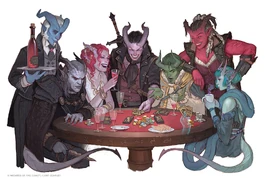
](https://static.wikia.nocookie.net/forgottenrealms/images/4/4e/Rainbow_tieflings_5point5e.jpg/revision/latest?cb=20241021163453 "5eR")
[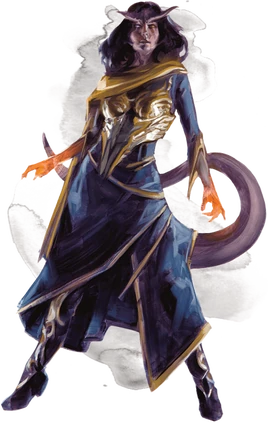
](https://static.wikia.nocookie.net/forgottenrealms/images/9/98/Tiefling_PHB5e.png/revision/latest?cb=20200308114310 "5e")
[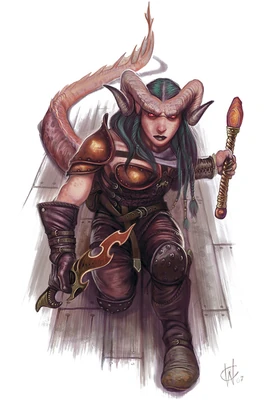
](https://static.wikia.nocookie.net/forgottenrealms/images/c/c6/4e_tiefling.jpg/revision/latest?cb=20080924052904 "4e")
[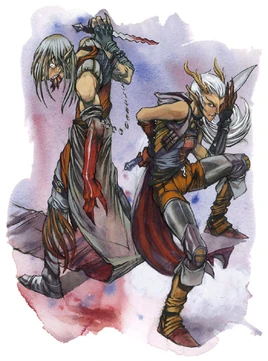
](https://static.wikia.nocookie.net/forgottenrealms/images/b/be/Tieflings_RoF.jpg/revision/latest?cb=20220829050930 "3e")
[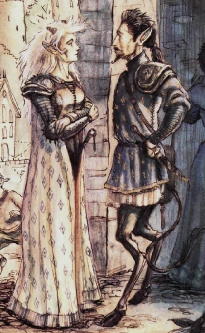
](https://static.wikia.nocookie.net/forgottenrealms/images/1/18/Tieflings_PWHB_PS.png/revision/latest?cb=20140911080635 "2e")
Various depictions of tieflings.
Tiefling
-
5e
-
4e
-
3e
-
2e
5th Edition Statistics2
Size
Medium
Type
Alignment
| LG | NG | CG |
| LN | N | CN |
| LE | NE | CE |
4th Edition Statistics3
Size
Medium
Origin
Type
3rd Edition Statistics4
Size
Medium
Type
Subtype(s)
Alignment
| LG | NG | CG |
| LN | N | CN |
| LE | NE | CE |
Challenge rating
1⁄2
2nd Edition Statistics5
Size
Medium
Alignment
| LG | NG | CG |
| LN | N | CN |
| LE | NE | CE |
General Information
Abbreviation
tf1
Vision
Diet
Carnivore5
Average lifespan
90–150 years6
Homeland(s)
Narfell, the Unapproachable East, the Old Empires7
Language(s)
Favored climate
Temperate4
Favored terrain
Plains4
Appearance
Average height
4′11″‒6′ (150‒180 cm)8
Average weight
114‒238 lb (51.7‒108 kg)8
Skin color(s)
Hair color(s)
Red, brown, black, dark blue, purple2
Eye color(s)
Black, gold, red, silver, or white (solid color, with no sclera or pupil)2
Distinctions
History
First appearance
Tieflings were human-based planetouched, native outsiders that were infused with the touch of the fiendish planes, most often through descent from fiends—demons, Yugoloths, devils, evil deities, and others who had bred with humans.10 Tieflings were known for their cunning and personal allure, which made them excellent deceivers as well as inspiring leaders when prejudices were laid aside.11
Although their evil ancestors could be many generations removed, the taint lingered. Unlike half-fiends, tieflings were not predisposed to evil alignments and varied in alignment nearly as widely as full humans, though tieflings were certainly devious.12 The celestial counterparts of tieflings were called aasimar.13
“
Eh... She's a tiefling, chief. They got fiend blood in their veins, usually 'cause some ancestor of theirs shared knickers with one demon or another. Makes some of 'em addled in the head... and addled-looking, too.
”
— Morte14
Contents
AD
Advertisement
Description
[
](https://static.wikia.nocookie.net/forgottenrealms/images/9/92/Scion_of_Stygia.jpg/revision/latest?cb=20220520082523)
A tiefling descended from a devil from Stygia.
Tieflings tended to have an unsettling air about them, and most people were uncomfortable around them, whether they were aware of the tiefling's unsavory ancestry or not. While some looked like normal humans, most retained physical characteristics derived from their ancestor, with the most common such features being horns,15 prehensile16 or non-prehensile tails, and pointed teeth. Some tieflings also had eyes that were solid orbs of black, red, white, silver, or gold, while others had eyes more similar to those of humans.15 Other, more unusual characteristics included a sulfurous odor, cloven feet, or a general aura of discomfort they left on others.10
In many other ways, tieflings were similar to humans physically. Tieflings were, on average, just as tall as humans, from 5 feet and 6 inches to 6 feet and 2 inches (170 to 190 centimeters) and weighed just a little bit heavier at 140 to 220 pounds (64 to 100 kilograms). Tiefling skin was usually human-like in color, though extending past normal human colors into reddish hues as well. Tiefling hair was also often the same color as human hair, though dark blue, red, or purple were common shades amongst the race.15 Although it was not always the case, tieflings tended to have better reflexes than their human kin. This, along with their natural propensity for hiding and deceit, helped to give tieflings a reputation for thievery and duplicity.10
Tieflings who had strikingly inhuman features were often killed at birth by their horrified parents or others. Only those tieflings with subtle features or born to someone indifferent to their appearance, either out of acceptance or cruel purpose, were likely to reach adulthood.9 Those tieflings who did reach adulthood could be expected to age at roughly the same rate.12 They had life spans roughly 20 to 40 years longer than normal humans.6
Tiefling Bloodlines
[
](https://static.wikia.nocookie.net/forgottenrealms/images/c/c5/2024_Fiendish_Legacies.png/revision/latest?cb=20250706090129)
From left to right: Abyssal, Chthonic, and Infernal legacies.
The physical appearance of a tiefling often depended on the exact ancestry that spawned it, a bloodline that might have remained dormant for generations. Diabolic or demonic tieflings could, besides the common horns and tails, possess a forked tongue, leathery or scaly skin, the smell of brimstone, or unusually warm flesh. Some accounts even held these tieflings to cast neither shadows nor reflections. Some diabolic tieflings also sported goat-like legs or hooves. Tieflings descended from rakshasa might have furred skin or feline eyes. Those descended from night hags could have small horns, glowing red eyes, or bruised, blue skin. Most tieflings had only one or two of these features.17
Most tieflings of the late 1400s DR could be categorized under three distinct legacies:18
- Infernal: Infernal tieflings had their roots in devils, native to the lawful evil planes of the Nine Hells, Gehenna, and Acheron. Besides the common horns and tails, they often possessed a forked tongue, smooth reddish skin, golden eyes, and the smell of brimstone or unusually warm flesh. Some infernal tieflings also sported goat-like legs or hooves. All infernal tieflings had innate resistance to fire and the ability to utilize the fire bolt cantrip, with those more experienced also having access to hellish rebuke and darkness.18
- Abyssal: Abyssal tieflings had their roots in the entropy of the Abyss, the chaos of Pandemonium, and the despair of Carceri. Hailing from a demonic lineage, they typically had a somewhat beastly appearance, exhibiting rough, jagged horns, tusks, and fur. Some were known to emanate peculiar scents of indistinct origin due to their demon-tinged blood. All abyssal tieflings had innate resistance to poison and the ability to utilize the poison spray cantrip, with those more experienced also having access to ray of sickness and hold person.18
- Chthonic: Chthonic tieflings had their roots in the draw of Carceri, the greed of Gehenna, and the gloom of Hades. Descended from the native yugoloths (or daemons) from these realms, they typically had thick, winding horns in addition to standard tiefling traits like tails. They could possess features of virtually any neutral evil fiend and ranged widely from having cadaverous high daemonic features to the unearthly beauty of the succubus, to the furry, animalistic appearance of the arcanaloth. All chthonic tieflings had innate resistance to necrosis and the ability to utilize the chill touch cantrip, with the more experienced also having access to false life and ray of enfeeblement.18
Some tieflings were not descended from mere fiends at all, but from powerful gods. These tieflings often had their own physical characteristics that set them apart. Tieflings sired by Beshaba, for instance, often had antlers instead of horns and pale, white hair. Those sired by Mask, on the other hand, were known for their tendency to cast no reflection.19
In Mulhorand, the most common tieflings were often those spawned from a union with Set or Sebek. Most tieflings were, however, the grandchildren or even great-grandchildren of fiends and in Mulhorand's neighbor, Thay, most tieflings were spawned deliberately by powerful wizards as part of some elaborate plot for power.12
In 1358 DR, a warlock coven known as the Toril thirteen performed a ritual that cursed most tiefling lineages—those of demons, devils, hags, and rakshasas, among others—with the "blood of Asmodeus", changing their original lineage with that of the archdevil himself. This was done to make Asmodeus a "racial god", ensuring him enough followers to attain godly powers.20 After the Spellplague of 1385 DR, when Asmodeus became a god, the magic of the ritual took effect across all of Toril and afterwards most tieflings living in the 15th century DR were of the Asmodean lineage, all having a similar devilish appearance.21
Prior to Asmodeus's ascension to godhood, the infernal blood could be diluted through intermarriage, but afterward, the union of a tiefling with another race always produced a tiefling child.22
In the late years of the 15th century, tieflings of other bloodlines began to be born again, but the Asmodean lineage was still the most numerous by a wide margin at the time.21
AD
Advertisement
Personality
Tieflings had a number of abilities gifted to them by their fiendish heritage. By and large, tieflings were alluring and intelligent creatures, with a seductive aura in spite of their obviously evil ancestry. To a large degree, tieflings were more capable of guile than a great number of races, but these were not their dominant qualities.11
[
](https://static.wikia.nocookie.net/forgottenrealms/images/0/05/Valor_Singer_AFR.jpg/revision/latest?cb=20210710180047)
A tiefling bard singing in battle.
Most tieflings were aware from an early age that they were different from others around them, and would give in to strange urges and desires because of their unusual ancestry. Few tieflings were raised with the love a normal human child might expect to receive and this shaped most of the race into bitter individuals who expected eventual rejection from all whom they meet. While some would follow this path towards evil, others rejected it wholeheartedly and sought to make a good impact on the world around them, sometimes becoming the most heroic characters of all. Few could maintain this discipline however, and most tieflings fell somewhere between both extremes.12
“
Don't ever make a bet with a tiefling.
”
— Planar Proverb23
Because tieflings were generally distrusted throughout the world, owing to their fiendish heritage, many were themselves distrusting and self-reliant.15 Tieflings were also proud and secretive by nature and possessed a dark demeanor.7 Unfortunately, this only helped to further the reputation tieflings had for being social outcasts and untrustworthy scoundrels. However, members of other races would find that once they demonstrated friendship and trust towards a tiefling, it would quickly be reciprocated in full. Once that bond was forged, it was rarely broken.15
Combat
[
](https://static.wikia.nocookie.net/forgottenrealms/images/7/74/Oathofglory.png/revision/latest?cb=20210326113618)
A tiefling Oath of Glory paladin.
Tieflings were talented warriors. In melee combat they were agile and quick on their feet. They preferred to use weapons that combined sharpness with speed. They commonly used hand crossbows, daggers, longswords, ranseurs, scimitars, spears, and stilettos. Most tieflings were ambidextrous and as a result favored a two-hand fighting style. Tieflings preferred to wear light armor and rarely used shields.5
Abilities
Those tieflings who sought power through arcane magic were most often warlocks.11 Tiefling arcane spellcasters of all kinds, however, felt a draw towards the fiendish energies of the planes and tiefling wizards commonly specialized as diviners for the purposes of seeking knowledge of the Lower Planes or as conjurers so that they might summon the dark spirits whom they called kin.12
Tieflings had an innate resistance to heat and had a hint of bloodlust that gave them a slight edge in combat. Tieflings also had access to an ability known as infernal wrath, which channeled their innate rage and potential for evil into their attacks for added effectiveness.11 Some tieflings also learned to unlock their fiendish potential further, sprouting wings such as those borne by many fiends.24
Some tieflings also had the innate ability to cast a darkness spell, though not all of the race exhibited this trait.10
Society
[
](https://static.wikia.nocookie.net/forgottenrealms/images/3/35/Tiefling_MM_4e.jpg/revision/latest?cb=20200314102148)
A tiefling just standing there.
Like other races that were the result of the breeding of two or more others, tieflings had no true culture they could call their own. However, there were many archetypal features of tieflings that were not necessarily innate. This include their attitude regarding their heritage, and while some tieflings embraced it, others were repulsed by it, forging the two most common stereotypes of tieflings.7
The former tieflings, who were proud of their fiendish past, were often fascinated by the dark and sinister events that touched the world, but were not necessarily evil or inclined to perpetuate them. Some tieflings of this type chose to use their knowledge of evil and their own fiendish abilities to thwart these dark plots and schemes. Others sought to learn more and to emulate these evil deeds.7
Other tieflings were ashamed or even frightened of their heritage and wished only to escape the shadow that lurked over them as a result. Some did this through constantly doing good, as though to make up for the evil that begot them. Others instead hid and tried to go unnoticed as they passed through the world, preferring to be ignored and forgotten than noticed and made a target because of their past.7
Regardless of their motivations, tieflings often distrusted one another, sometimes even casting the same preconceptions on one another that others did on them. In spite of this, many secretly desired to have another tiefling nearby, if only to experience some small kind of kinship. Some of these tieflings gathered as partners-in-crime, while others were sought out by good tieflings who hoped to redeem others of their race.12
Relations with other races
Tieflings, in general, didn't get along well with the other races of the world and were slow to trust others of any race, even their own. This animosity that tieflings had for others was taken to its extreme in the case of aasimar, whom tieflings instinctively feared or loathed. Devas often had a similar reaction, making it difficult for members of either race to successfully interact with each other. Of all the common races, tieflings felt the most kinship with half-orcs, who were similarly a target of revulsion and hate.19
[
](https://static.wikia.nocookie.net/forgottenrealms/images/5/50/Tiefling_Sam-Wood_FRCS3e.jpg/revision/latest?cb=20140911060441)
A tiefling monk.
Religion
Those tieflings who were religious were a varied lot, since no god held more sway over tieflings than any other, though Asmodeus, as the lord over the fiendish race of devils, may come close. Most tieflings called on one of the primary gods of their homeland, though there were exceptions. Beshaba, the goddess of bad luck, for instance, appealed to many of the race, owing to tieflings' collective sense of misfortune. Many evil tieflings who channeled their dark emotions into aggression often found themselves in the service of Cyric, as well. Prior to the Spellplague and the god's subsequent disappearance, Gargauth also drew a large number of worshipers seeking vengeance, as did Mask, who gathered tiefling thieves to his church. Shar, like Gargauth, appealed to those with a taste for vengeance.19
AD
Advertisement
Ecology
Tieflings were carnivores. They consumed blood, blubber, bone, gristle and meat. They even roasted insects and considered raw bone marrow a delicacy.5
History
In ancient times, the tieflings used to rule an empire that warred with an ancient empire ruled by the dragonborn. Even though the races had a long tradition of "enmity", those empires existed so long ago that dragonborn considered such enmity more theoretical than practical.25note 1
Homelands
Being the result of fiendish interference with humans, tieflings had no true homeland and were found throughout Toril. The race was particularly common, however, in Mulhorand and Unther before both nations were devastated by the Spellplague,7 though the latter's population was said to have been vastly exaggerated.12 Tieflings also once had a large presence in Thay, where many were slaves. Tieflings who were discovered in the land often became pawns in the struggles between Thay's zulkirs, whom they served as assassins, thieves, and spies.12 The takeover by Szass Tam, however drove many out of the region.7
In the 15th century, tieflings were most commonly found in Narfell and High Imaskar, though many were also welcome in Tymanther, thanks to the native dragonborn's policy of racial tolerance. Other tieflings allied themselves with the genasi servants of Memnon in Calimshan, where they were a valued addition to the efreeti's war against his rival Calim. Many tieflings were also found along the Sword Coast, particularly in the cosmopolitan Baldur's Gate, as well as parts of the Dragon Coast. In Aglarond, the race was only begrudgingly tolerated as enemies of Thay.7
Notable Tieflings
- Avarice, a devoted to the archdevil Levistus and a member of the Arcane Brotherhood.
- Bryseis Kakistos, a warlock who lived near Vaasa in the 14th century DR.26
- Farideh, a warlock who accidentally made a pact with the cambion Lorcan in the 15th century DR.27
- Havilar, Farideh's sister, fighter, and bounty hunter of the late 15th century DR.28
- Karlach Cliffgate, a barbarian member of the Absolute Adversaries during the Absolute crisis.28
- Klement, a novice cleric from Baldur's Gate.29
- Maccath the Crimson, a researcher of dragons and a member of the Arcane Brotherhood.30
- Makos, a warlock lich from Neverwinter in the late years of the 15th century DR.28
- Sylvira Savikas, an archmage, sage, as well as one of the eight Great Readers of Candlekeep during the late 15th century DR.31
- Tief of Selûne, one of the very few tieflings in the Vast and a prominent Selûnite adventurer from the city of Ravens Bluff in the late 14th century DR3233.
- Vanifer, the Prophet of Fire and leader of the Cult of the Eternal Flame in the late 15th century DR.34
Appendix
Notes
- ↑ The ancient empires of the dragonborn and tieflings seems to be a reference to Arkhosia and Bael Turath, two ancient empires that existed in the world Nerath. While Nerath is the setting of "core" 4th Edition, and there is no evidence in Realmslore of said empires existing in the past history of Abeir-Toril, the lore of said empires mentions that they build some colonies in other worlds and planes. Perhaps the history of these ancient empires was learned by the dragonborn and tieflings of the Realms from these places.
Tiefling Parents
| d8 | Parents |
|---|---|
| 1-4 | Both parents were humans, their infernal heritage dormant until you came along. |
| 5-6 | One parent was a tiefling and the other was a human. |
| 7 | One parent was a tiefling and the other was a devil. |
| 8 | One parent was a human and the other was a devil. |
Tiefling Acrobat
Medium Humanoid (Any Race), Any Alignment
- Armor Class 10
- Hit Points 4 (1d8)
- Hit Points 4 (1d8)
- Speed 30 ft.
STR DEX CON INT WIS CHA 10 (+0) 10 (+0) 10 (+0) 10 (+0) 10 (+0) 10 (+0)
- Skills Acrobatics +4, Performance +4
- Senses passive Perception 10
- Languages any one language (usually Common)
- Challenge 0 (10 XP)
- Proficiency Bonus +2
Actions
Club. Melee Weapon Attack: +2 to hit, reach 5 ft., one target. Hit: 2 (1d4) bludgeoning damage.
Tortle
- Ability Scores. Choose one of: (a) Choose any +2; choose any other +1 (b) Choose three different +1
- Size. Small/Medium
- Speed. 30 ft.
Size. You are Medium or Small. You choose the size when you select this race.
Claws. You have claws that you can use to make unarmed strikes. When you hit with them, the strike deals 1d6 + your Strength modifier slashing damage, instead of the bludgeon-ing damage normal for an unarmed strike.
Hold Breath. You can hold your breath for up to 1 hour.
Natural Armor. Your shell provides you a base AC of 17 (your Dexterity modifier doesn't affect this number). You can't wear light, medium, or heavy armor, but if you are using a shield, you can apply the shield's bonus as normal.
Nature's Intuition. Thanks to your mystical connection to nature, you gain proficiency with one of the following skills of your choice: Animal Handling, Medicine, Nature, Perception, Stealth, or Survival.
Shell Defense. You can withdraw into your shell as an action. Until you emerge, you gain a +4 bonus to your AC, and you have advantage on Strength and Constitution saving throws. While in your shell, you are prone, your speed is 0 and can't increase, you have disadvantage on Dexterity saving throws, you can't take reactions, and the only action you can take is a bonus action to emerge from your shell.
Languages. You can speak, read, and write Common and one other language that you and your DM agree is appropriate for your character.
https://2014.5e.tools/img/races/MPMM/Tortle.webp
Tortles have a saying: "We wear our homes on our backs." These turtle folk live on many worlds, most often journeying up and down coasts, along waterways, and across the sea. Tortles don't have a unified story of how they were created, but they all have a sense of being mystically connected to the natural world. Carrying their shelter on their backs gives tortles a special feeling of security wherever they go, for even if they visit a far, unknown country, they have a place to lay their heads. Tortles exhibit the same range of coloration and patterns found among turtles, and many tortles enjoy adorning their shells in distinctive ways.
Source: MPMM, page 34
Tortle
- Ability Scores. Strength +2; Wisdom +1
- Size. Medium
- Speed. 30 ft.
The Tortle Package is considered part of Xanathar's Guide to Everything for Adventurers League character creation.
Age. Young tortles crawl for a few weeks after birth before learning to walk on two legs. They reach adulthood by the age of 15 and live an average of 50 years.
Alignment. Tortles tend to lead orderly, ritualistic lives. They develop customs and rou-tines, becoming more set in their ways as they age. Most are lawful good. A few can be selfish and greedy, tending more toward evil, but it's unusual for a tortle to shuck off order in favor of chaos.
Size. Tortle adults stand 5 to 6 feet tall and average 450 pounds. Their shells account for roughly one-third of their weight. Your size is Medium.
Claws. Your claws are natural weapons, which you can use to make unarmed strikes. If you hit with them, you deal slashing damage equal to 1d4 + your Strength modifier, instead of bludgeoning damage normal for an unarmed strike.
Hold Breath. You can hold your breath for up to 1 hour at a time. Tortles aren't natural swimmers, but they can remain underwater for some time before needing to come up for air.
Natural Armor. Due to your shell and the shape of your body, you are ill-suited to wear-ing armor. Your shell provides ample protection, however; it gives you a base AC of 17 (your Dexterity modifier doesn't affect this number). You gain no benefit from wearing armor, but if you are using a shield, you can apply the shield's bonus as normal.
Shell Defense. You can withdraw into your shell as an action. Until you emerge, you gain a +4 bonus to AC, and you have advantage on Strength and Constitution saving throws. While in your shell, you are prone, your speed is 0 and can't increase, you have disadvantage on Dexteri-ty saving throws, you can't take reactions, and the only action you can take is a bonus action to emerge from your shell.
Survival Instinct. You gain proficiency in the Survival skill. Tortles have finely honed sur-vival instincts.
Languages. You can speak, read, and write Aquan and Common.
https://2014.5e.tools/img/races/TTP/Tortle.webp
I caught a big fish.
Now I search for a good friend
To share my lunch with.— Tortle haikuWhat many tortles consider a simple life, others might call a life of adventure. Tortles are born near sandy coastlines, but as soon as they're able to walk on two legs, they become nomad survivalists eager to explore the wilderness, experience its many wonders, put their skills to the test, and make new acquaintances.
Life of a Tortle. A tortle hatches from a thick-shelled egg and spends the first few weeks of its life crawling on all fours. Its parents, old and near death, spend what little time they have left telling stories to their offspring. Within a year, the young tortle becomes an orphan, though not before it learns to speak and to survive on its own.
A young tortle and its siblings inherit whatever tools, weapons, and gifts their parents left behind. Each young tortle is expected to fend for itself. It leaves the place of its birth and finds its own corner of the wilderness in which to hunt, catch fish, and get by. With each passing year, a tortle hones its survival skills. It forms friendships with its neighbors while also respecting their privacy. At some point, a tortle feels an almost overwhelming urge to venture far away from home and see more of the world. It gathers up its possessions and heads into the wilderness, returning months or years later with stories of its exploits and new skills.
When a tortle nears the end of its natural lifespan, it seeks out a mate and procreates. Tortles lay their eggs (numbering as few as one or as many as a dozen) in a fortified compound enclosed by stone walls that are easily defensible. If no such compound exists, they build one. The parents spend the remainder of their lives guarding the compound, defending their offspring, and sharing a lifetime of knowledge before they die. When the children are old enough to leave the compound, they pick up whatever weapons and tools their parents left behind and set out on their own.
Beliefs. Tortles don't have their own pantheon of gods, but they often worship the gods of other races. It's not unusual for a tortle to hear stories or legends related to a god and choose to worship that deity. In the Forgotten Realms, tortles are especially fond of Eldath, Gond, Lathander, Savras, Selûne, and Tymora. In the Greyhawk setting, they gravitate toward Celestian, Fharlanghn, Pelor, Pholtus, and St. Cuthbert. Tortles are often drawn to the Gods of Good in Dragonlance and the Sovereign Host in Eberron. Among the nonhuman deities, Moradin and Yondalla relate to tortles most of all.
Tortles believe that night and day watch over them and other creatures. The moon is the eye of night that watches over them in darkness, and the sun is the equally vigilant eye of day. Tortles feel most at peace when one or both of these "eyes" are looking down on them. They become more nervous and uneasy when neither orb is visible in the sky. Tortles tend to be most uncomfortable underground, where neither the sun nor the moon is visible to them.
Blessed are the days when both the sun and moon are visible in the sky at the same time. Tortles often choose such days to leave their homes and begin a wilderness expedition, or perform some other task they know to be dangerous.
Adventurers at Heart. Tortles have a saying: "We wear our homes on our backs." The shells they carry around provide all the shelter they require. Consequently, tortles don't feel the need to root themselves in one place for too long. A tortle settlement is primarily used as a kind of moot, where tortles can socialize with one another, share useful information, and trade with strangers in the safety of greater numbers. Tortles don't regard these settlements as places worth defending with their lives, and they will abandon a settlement when it no longer serves their needs.
Most tortles like to see how other creatures live and discover new customs and new ways of doing things. The urge to procreate doesn't kick in until the end of a tortle's life, and a tortle can spend decades away from its native land without feeling homesick.
Tortles embrace a simple view of the world. It is a place of wonder, and tortles see beauty in the ordinary. They live for the chance to hear a soft wind blowing through palm trees, to watch a frog croaking on a lily pad, or to stand in a crowded human marketplace.
Tortles like to learn new skills. They craft their own tools and weapons, and they are good at building structures and fortifications. They marvel at the works of other civilized creatures, humans in particular, and can lose themselves for years in a city, studying its architectural wonders and learning skills they can put to use when building forts to contain their offspring.
Although they spend a considerable portion of their lives in isolation, tortles are social creatures that like to form meaningful friendships. They have no inbred animus toward people of other races. In fact, a tortle will often seek out friendships with non-tortles to learn new customs and new points of view.
Tortle Names. Tortles prefer simple, non-gender-specific names that are usually no more than two syllables. If a tortle doesn't like its name for whatever reason, it can change it. A tortle might change its name a dozen times in its life.
Tortles don't have surnames or family names.
- Male and Female Names: Baka, Damu, Gar, Gura, Ini, Jappa, Kinlek, Krull, Lim, Lop, Nortle, Nulka, Olo, Ploqwat, Quee, Queg, Quott, Sunny, Tibor, Ubo, Uhok, Wabu, Xelbuk, Xopa, Yog
Source: _TTP, page 3
Tortle
5th Edition Statistics12
Size
Medium
Type
Alignment
Challenge rating
1⁄4
3rd Edition Statistics3
Size
Medium
Type
Alignment
Usually lawful neutral
Challenge rating
1⁄2
2nd Edition Statistics4
Size
Medium
Alignment
General Information124
Activity cycle
Day
Diet
Omnivore
Average lifespan
50 years
Homeland(s)
Language(s)
Favored climate
Temperate, warm
Favored terrain
Coasts, forests
Appearance1245
Average height
5‒6 ft (1.5‒1.8 m)
Average weight
450‒500 lb (200‒230 kg)
Skin color(s)
Olive-green or blue-green
Distinctions
Shell, back darker, front lighter and more yellowish than skin
Tortles were a race of intelligent tortoise-like humanoids indigenous to southern Chult.14
“
We wear our homes on our back.
”
— A tortle saying.2
Contents
- 1 Description
- 2 Personality
- 3 Combat
- 4 Society
- 5 History
- 6 Notable tortles
- 7 Appendix - 7.1 See Also
- 7.2 Gallery
- 7.3 Appearances
- 7.4 References
AD
Advertisement
Description
Tortles were reptilian-looking humanoids with large shells on their backs that were capable of containing their entire bodies.1 They had leathery skins that varied between olive-green to blue-green hues. The dorsal portion of their shells was usually darker than their skins, while the ventral portion was lighter, usually with yellowish tones.4
Tortles rarely wore any clothing, favoring instead belts and harnesses to carry their belongings. They had little tolerance for cold, and usually migrated away from temperate areas when winter approached.4
Although generally poor swimmers, tortles were capable of floating on water and could hold their breath for over an hour. Their high buoyancy granted them the ability to cross swamps, mud, and quicksand with little difficulty.4
Personality
Most tortles had the notion of having their houses on their backs, which meant that they rarely felt homesick or the need to lay roots in any single place. They were eager to learn new customs and found beauty in the most ordinary things. Despite spending much of their lives isolated, tortles liked to form strong friendships.1
Combat
Besides being able to wield weapons and shields, tortles had claws and beaks that were effective as natural weapons. In addition, they could retreat into their shells for additional protection if necessary. When withdrawn in this way, they were unable to move and see, but could still hear and smell the outside world. The shape of their bodies made it impossible for tortles to wear armor, however.14
Society
[
](https://static.wikia.nocookie.net/forgottenrealms/images/2/2c/Tortle-2e.jpg/revision/latest?cb=20190916171007)
A tortle traveler.
Tortles only reproduced near the end of their natural lifespans. When their young hatched from their eggs, they spent the remainder of their lives sharing all their life experiences and teaching survival skills. Young tortles would become orphans after about one year, by which time they were expected to be able to fend for themselves.1
Usually keeping to themselves, they tended to live alone, but kept in closed contact with their community. Tortle villages were typically welcoming of humans, halflings, and elves.4
History
Tortles were common in southern Chult, near a peninsula that bordered Samarach.6. An event brought by the Spellplague separated the peninsula from the continent by a narrow strait. The newly formed island became known as the Snout of Omgar and provided a natural defense from predators from the mainland. The island was claimed by the tortles living nearby as their domain.7 They built the fort of Ahoyhoy in the northwestern tip of the island.8
During the late 1480s DR, a few tortles offered their services as jungle guides in different places of Chult.7
Notable tortles
- Eeyal, a tortle guide from Fort Beluarian who wore goggles to protect her eyes from volcanic ash.7
- Krull, a death-priest of Tiamat who lived in Arkhan's Tower in Avernus.9
- Kwilgok, a guide from Port Nyanzaru who worked for the merchant prince Jobal.7
- Mudgraw, a tortle druid from Ahoyhoy who also worked as a guide.7
Appendix
See Also
Gallery
[
](https://forgottenrealms.fandom.com/wiki/File:Turtle_with_a_stick.jpg "Turtle with a stick.jpg (133 KB)")
Tortle
Medium Humanoid, Any Alignment
- Armor Class 17 (natural armor)
- Hit Points 22 (4d8 + 4)
- Hit Points 22 (4d8 + 4)
- Speed 30 ft.
STR DEX CON INT WIS CHA 15 (+2) 10 (+0) 12 (+1) 11 (+0) 13 (+1) 12 (+1)
- Skills Athletics +4, Survival +3
- Senses passive Perception 11
- Languages Aquan, Common
- Challenge 1/4 (50 XP)
- Proficiency Bonus +2
Hold Breath. The tortle can hold its breath for 1 hour.
Actions
Claw. Melee Weapon Attack: +4 to hit, reach 5 ft., one target. Hit: 4 (1d4 + 2) slashing damage.
Spear. Melee or Ranged Weapon Attack: +4 to hit, reach 5 ft. or range 20/60 ft., one target. Hit: 5 (1d6 + 2) piercing damage, or 6 (1d8 + 2) piercing damage if used with two hands in melee.
Light Crossbow. Ranged Weapon Attack: +2 to hit, range 80/320 ft., one target. Hit: 4 (1d8) piercing damage.
Shell Defense. The tortle withdraws into its shell. Until it emerges, it gains a +4 bonus to AC and has advantage on Strength and Constitution saving throws. While in its shell, the tortle is prone, its speed is 0 and can't increase, it has disadvantage on Dexterity saving throws, it can't take reactions, and the only action it can take is a bonus action to emerge.
The generic tortle stat block here represents a warrior, especially the sort who travels far and wide.
Tortles
Tortles are omnivorous, turtle-like bipeds with shells that cover most of their bodies. Because they carry their homes on their backs, tortles feel little need to stay put for long.
Most tortles like to see how other folk live. A tortle can spend decades away from their native land without feeling homesick, often viewing their current companions as their family.
Tortle Druid
Medium Humanoid, Any Alignment
- Armor Class 17 (natural armor)
- Hit Points 33 (6d8 + 6)
- Hit Points 33 (6d8 + 6)
- Speed 30 ft.
STR DEX CON INT WIS CHA 14 (+2) 10 (+0) 12 (+1) 11 (+0) 15 (+2) 12 (+1)
- Skills Animal Handling +4, Nature +2, Survival +4
- Senses passive Perception 12
- Languages Aquan, Common
- Challenge 2 (450 XP)
- Proficiency Bonus +2
Hold Breath. The tortle can hold its breath for 1 hour.
Actions
Multiattack. The tortle makes four Claw attacks or two Nature's Wrath attacks.
Claw. Melee Weapon Attack: +4 to hit, reach 5 ft., one target. Hit: 4 (1d4 + 2) slashing damage.
Nature's Wrath. Ranged Spell Attack: +4 to hit, range 90 ft., one target. Hit: 9 (2d6 + 2) damage of a type chosen by the tortle: cold, fire, lightning, or thunder.
Shell Defense. The tortle withdraws into its shell. Until it emerges, it gains a +4 bonus to AC and has advantage on Strength and Constitution saving throws. While in its shell, the tortle is prone, its speed is 0 and can't increase, it has disadvantage on Dexterity saving throws, it can't take reactions, and the only action it can take is a bonus action to emerge.
Spellcasting. The tortle casts one of the following spells, using Wisdom as the spellcasting ability (spell save DC 12):
At will: druidcraft, guidance
2/day each: cure wounds, hold person, speak with animals, thunderwave
Many tortles view the world as a place of wonder. They live for the chance to hear a soft wind blowing through trees, to watch a frog croaking on a lily pad, or to stand in a crowded marketplace. A tortle druid savors such things more than most, channeling the natural magic of the world around them.
Tortles
Tortles are omnivorous, turtle-like bipeds with shells that cover most of their bodies. Because they carry their homes on their backs, tortles feel little need to stay put for long.
Most tortles like to see how other folk live. A tortle can spend decades away from their native land without feeling homesick, often viewing their current companions as their family.
Triton
- Ability Scores. Strength +1; Constitution +1; Charisma +1
- Size. Medium
- Speed. 30 ft., swim 30 ft.
Age. Tritons reach maturity around age 15 and can live up to 200 years.
Size. Tritons are slightly shorter than humans, averaging about 5 feet tall. Your size is Medium.
Swim Speed. You have a swimming speed of 30 feet.
Amphibious. You can breathe air and water.
Control Air and Water. A child of the sea, you can call on the magic of elemental air and water. You can cast fog cloud with this trait. Starting at 3rd level, you can cast gust of wind with it, and starting at 5th level, you can also cast wall of water with it. Once you cast a spell with this trait, you can't cast that spell with it again until you finish a long rest. Charisma is your spellcasting ability for these spells.
Darkvision. You can see in dim light within 60 feet of you as if it were bright light and in darkness as if it were dim light. You can't discern color in darkness, only shades of gray.
Emissary of the Sea. Aquatic beasts have an extraordinary affinity with your people. You can communicate simple ideas with beasts that can breathe water. They can understand the meaning of your words, though you have no special ability to understand them in return.
Guardians of the Depths. Adapted to even the most extreme ocean depths, you have resistance to cold damage.
Languages. You can speak, read, and write Common and Primordial.
Alignment. Tritons tend toward neutrality. Their culture encourages them to be mindful of life's currents, knowing when to harness fate's tides and when to flow along with them.
https://2014.5e.tools/img/races/MOT/Triton.webp
https://2014.5e.tools/img/races/MOT/Triton%202.webp
Tritons dwell throughout the Siren Sea, exploring a world of coral forests and secret mountains the "dryfolk" of the surface world will never know. While most live their entire lives beneath the sea, they're not bound to the deep. Following their inherent curiosity, some tritons venture beyond the waves, seeking to explore a whole world of wonders beyond their own.
Born of the Sea
Tritons are an amphibious people, at home in the water but mobile on dry land. Their bodies are covered in fine scales that range from yellowish-green through shades of blue to deep purple. Their heads are crowned with prominent crests, and fins sprout from their forearms, calves, and shoulders. Their digits are webbed, allowing them to swim as quickly as they can run.
Well suited to life in the deep, tritons wear little clothing unless armored for battle. They fashion most of their clothes and other items from materials found in the ocean: coral, seaweed, shells, bone, sea urchin spines, the shells of monstrous crustaceans, and so on. Having an old, well-developed civilization, tritons know much of how to refine these materials into garb as rich and weapons as sturdy as any found on land.
Land and Sea
For centuries, dryfolk have fished the seas of Theros and have used the sea's surface as a means of travel. Many tritons interpret this as an intrusion into their domains. As a result, some warlike triton communities respond with periodic strikes against sailors and fishing vessels. Others believe that turnabout is fair play and so venture onto land to hunt for meat, steal supplies from coastal travelers, or raid dryfolk poleis for riches.
Despite the tensions between tritons and the peoples of the surface, some tritons make their lives on land. Enchanted by the feeling of the winds, the rustle of leaves, the ingenuity of land-dwelling inventors, or any of countless other surface-world charms, every triton living beyond the waves does so for their own reasons. In some places, like the polis of Meletis, whole triton communities flourish among dryfolk neighbors. See chapter 3 for more details on the tritons of Meletis and the Siren Sea.
Hand of Thassa
While tritons pay respects to many gods, they tend to revere Thassa, god of the sea, above all other deities. Her devotees see her as the primary god of the pantheon, believing she will bring their people to ascendancy over the monsters of the sea and the poleis of the land.
Depths of Curiosity
Many tritons are intrigued by surface culture. The curious among them venture into sunken ruins and shipwrecks, sifting through the debris for whatever grabs their attention. Often these tritons develop collections of a specific kind of object or lore, trading with one another as they develop a sort of expertise in their field. Some tritons approach investigations of the dryfolk with scientific rigor. Such scholars often hold theories to go along with their collections, hypotheses many are eager to test upon meeting new dryfolk.
Myth of Dalakos and the Kraken
Dalakos considered himself a triton like any other—curious, quick-minded, maybe even blessed with exceptional cleverness by the gods. But he was unfocused and easily distracted, his potential scattered like seeds on stone. It wasn't until a kraken rose from the ocean's deepest depths and began a rampage that threatened Dalakos's community that he was forced to focus. As the beast drew closer, Dalakos sought ways to turn the monstrosity from its path. He worked day and night, but ultimately his plans failed. All that Dalakos knew was destroyed, obliterated by the might of the kraken.
Yet the kraken carried on, moving toward a coastal human settlement. Amid the ruins of his home, Dalakos had a revelation. Working desperately, the triton crafted a miraculous device, one that ultimately laid low the kraken and saved the town. Today, Dalakos resides inside the kraken's shell, where he works day and night, his heart broken, but his mind forever focused on bringing his gifts to life.
Triton Names
A triton's name is a symbol of choice. Upon reaching adulthood, a triton might shed the name they were given by their parents for one of their own choosing. Some opt to keep their name, but the majority select one that represents the adult they've become. Tritons might even go on to choose yet other names, as they shift from one phase of life to another, or after significant life events. Leaving a home community or transitioning to live among dryfolk might constitute such life changes. Tritons also have a fluid concept of gender and might switch names freely as they shift gender identities.
- Female Names: Amathe, Gnorcys, Leurybia, Margomestra, Nereones, Oleia, Samathe, Saphiro, Tethene, Theaneia, Thectra
- Male Names: Bysseus, Cetos, Galaukus, Galiton, Kenessos, Odexes, Palamon, Pontreus, Rheteus, Thrasios
Source: MOT, page 26. Reprinted as Triton in MPMM
Triton
- Ability Scores. Choose one of: (a) Choose any +2; choose any other +1 (b) Choose three different +1
- Size. Medium
- Speed. 30 ft., swim equal to your walking speed
Speed. Your walking speed is 30 feet, and you have a swimming speed equal to your walking speed.
Amphibious. You can breathe air and water.
Control Air and Water. You can cast fog cloud with this trait. Starting at 3rd level, you can cast the gust of wind spell with this trait. Starting at 5th level, you can also cast the water walk spell with it. Once you cast any of these spells with this trait, you can't cast that spell with it again until you finish a long rest. You can also cast these spells using any spell slots you have of the appropriate level.
Intelligence, Wisdom, or Charisma is your spellcasting ability for these spells when you cast them with this trait (choose when you select this race).
Darkvision. You can see in dim light within 60 feet of you as if it were bright light and in darkness as if it were dim light. You discern colors in that darkness only as shades of gray.
Emissary of the Sea. You can communicate simple ideas to any Beast, Elemental, or Monstrosity that has a swimming speed. It can understand your words, though you have no special ability to understand it in return.
Guardian of the Depths. Adapted to the frigid ocean depths, you have resistance to cold damage.
Languages. You can speak, read, and write Common and one other language that you and your DM agree is appropriate for your character.
https://2014.5e.tools/img/races/MPMM/Triton.webp
Originally from the Elemental Plane of Water, many tritons entered the Material Plane centuries ago in response to the growing threat of evil elementals. Those tritons spread across the worlds' oceans, protecting the surface from terrors in the deep. Over time, triton have extended their stewardship over the sea floor to the ocean's surface. Tritons have webbed hands and feet, small fins on their calves, and coloration that favors blues and greens.
Source: MPMM, page 35
Triton
- Ability Scores. Strength +1; Constitution +1; Charisma +1
- Size. Medium
- Speed. 30 ft., swim 30 ft.
Age. Tritons reach maturity around age 15 and can live up to 200 years.
Size. Tritons are slightly shorter than humans, averaging about 5 feet tall. Your size is Medium.
Swim Speed. You have a swimming speed of 30 feet.
Amphibious. You can breathe air and water.
Control Air and Water. A child of the sea, you can call on the magic of elemental air and water. You can cast fog cloud with this trait. Starting at 3rd level, you can cast gust of wind with it, and starting at 5th level, you can also cast wall of water with it. Once you cast a spell with this trait, you can't cast that spell with it again until you finish a long rest. Charisma is your spellcasting ability for these spells.
Darkvision. You can see in dim light within 60 feet of you as if it were bright light and in darkness as if it were dim light. You can't discern color in darkness, only shades of gray.
Emissary of the Sea. Aquatic beasts have an extraordinary affinity with your people. You can communicate simple ideas with beasts that can breathe water. They can understand the meaning of your words, though you have no special ability to understand them in return.
Guardians of the Depths. Adapted to even the most extreme ocean depths, you have resistance to cold damage.
Languages. You can speak, read, and write Common and Primordial.
Tritons guard the ocean depths, building small settlements beside deep trenches, portals to the elemental planes, and other dangerous spots far from the eyes of land-bound folk. Long-established guardians of the deep ocean floor, in recent years the noble tritons have become increasingly active in the world above.
Aquatic Crusaders. Centuries ago, tritons entered the world in response to the growing threat of evil elementals. Tritons waged many wars against their enemies on the Plane of Water, driving them into the Darkened Depths where they escaped into the crushing pressure and utter darkness. In time, the tritons noticed that their ancient elemental foes had grown quiet. Expeditions to the depths revealed that krakens, sahuagin, and far worse foes had fled the Plane of Water for the Material Plane.
The tritons, driven by a sense of duty and responsibility, would not allow their foes to escape so easily. A great conclave of tritons chose volunteers skilled in weapons and magic as part of an expeditionary force to enter the Material Plane and seek out their enemies.
Those tritons spread across the world's oceans and established protectorates to watch over deep sea trenches, portals, undersea caves, and other locations where their enemies might lurk. They defeated their foes when they found them and drove the rest into hiding.
With their foes banished to the deepest reaches of the sea, tritons settled in to watch for any sign of their return. Over time, the tritons extended their stewardship over the sea floor from their initial settlements and built outposts to create trade with other races. Despite this expansion, few folk know of them. Their settlements are so remote even merfolk and sea elves rarely encounter them.
Haughty Nobles. As a result of their isolation and limited understanding of the Material Plane, tritons can come across as haughty and arrogant. They see themselves as caretakers of the sea, and they expect other creatures to pay them deep respect, if not complete deference.
This attitude might grate on others, but it arises from a seed of truth. Few know of the tritons' great victories over dreadful undersea threats. The tritons make little allowance for such ignorance and are delighted to expound upon the great debt others owe them.
Tritons also have a tendency to emerge from their isolation under the assumption that other folk will welcome them as respected allies and mentors. Again, distance drives much of this attitude. The tritons' limited view of the world leaves them ignorant of the kingdoms, wars, and other struggles of the surface world. Tritons readily see such concerns as minor events, a sideshow to the tritons' role as the world's true protectors.
Staunch Champions. Despite their off-putting manners, tritons are benevolent creatures at heart, convinced that other civilized races deserve their protection. Their attitude might grate, but when pirate fleets prowl the waves or a kraken awakens from its slumber, they are among the first to take up arms to protect others.
Tritons readily sacrifice themselves for the common good. They will fight and die for humans, merfolk, and other creatures without question. Their self-absorbed nature makes them overlook the history of other creatures, but they also endure a sense of guilt over allowing the evils of the Plane of Water to enter the Material Plane and threaten its inhabitants. The tritons believe they owe a debt of honor to the world, and they will fight and die to pay it.
At times their fervor and ignorance of the world can lead them astray. Tritons encountering other creatures for the first time can underestimate them, leaving the tritons vulnerable to deception. With their strong martial tradition, tritons can sometimes be too eager to leap into a fight.
Strangers to the Surface. Given their isolation, most tritons have never been to the surface world. They struggle with the idea that they can't easily move up and down out of water, and the changing of the seasons mystifies them.
Tritons also find the variety of social institutions, kingdoms, and other customs bewildering. For all their proud culture, they remain innocent of the surface world. The typical triton protectorate is tightly regimented, organized, and unified around a common cause. A triton on the surface becomes easily confused by the bewildering array of alliances, rivalries, and petty grievances that prevent the surface folk from truly unifying.
At its worst, a triton's arrogance compounds the tendency for the triton not to understand the ways of the surface world.
It's easy for a triton to blame baffling social practices on what the triton perceives as the barbarism, weakness, or cowardice of surface folk.
Triton Personality. Far from flawless, these champions of good mean well, but they are easily frustrated by others. You can select, roll, or adapt a triton-specific quirk from the Triton Quirks table. Use the quirk to inform how you portray your character.
Triton Quirks
| d6 | Quirk |
|---|---|
| 1 | You phrase requests as orders that you expect to be obeyed. |
| 2 | You are quick to boast of the greatness of your civilization. |
| 3 | You learned an antiquated version of Common and drop "thee" and "thou" into your speech. |
| 4 | You assume that people are telling you the truth about local customs and expectations. |
| 5 | The surface world is a wondrous place, and you catalog all its details in a journal. |
| 6 | You mistakenly assume that surface folk know about and are impressed by your people's history. |
Triton Names. Most triton names have two or three syllables. Male names typically end with a vowel and the letter s, and female names traditionally end with an n. Tritons use their home protectorate as a surname, with the name formed by adding a vowel followed by a "th" to the end of the protectorate's name.
- Female Triton Names: Aryn, Belthyn, Duthyn, Feloren, Otanyn, Shalryn, Vlaryn, Wolyn
- Male Triton Names: Corus, Delnis, Jhimas, Keros, Molos, Nalos, Vodos, Zunis
- Triton Surnames: Ahlorsath, Pumanath, Vuuvaxath
Source: VGM, page 115. Reprinted as Triton in MPMM
Triton
5th Edition Statistics1
Size
Medium
Type
Alignment
Usually Lawful good
3rd Edition Statistics2
Size
Medium
Type
Subtype(s)
Alignment
Usually neutral good
Challenge rating
2
2nd Edition Statistics3
Size
Medium
Alignment
1st Edition Statistics4
Size
Medium
Alignment
General Information
Patron deity
Movement
Vision
Average lifespan
200 years1
Language(s)
Favored climate
Temperate2
Favored terrain
Aquatic2
Appearance
Average height
5 ft (1.52 m)1
Skin color(s)
Silver, silver-blue
Hair color(s)
Deep blue, green-blue
History
First appearance
Tritons (pronounced: /ˈ[t](https://forgottenrealms.fandom.com/wiki/T_as_in_%22turn%22 "T as in "turn"")[r](https://forgottenrealms.fandom.com/wiki/R_as_in_%22ranger%22 "R as in "ranger"")[aɪ](https://forgottenrealms.fandom.com/wiki/Eye_as_in_%22eye%22 "Eye as in "eye"")[t](https://forgottenrealms.fandom.com/wiki/T_as_in_%22turn%22 "T as in "turn"")[ʌ](https://forgottenrealms.fandom.com/wiki/U_as_in_%22dungeon%22 "U as in "dungeon"")[n](https://forgottenrealms.fandom.com/wiki/N_as_in_%22dragon%22 "N as in "dragon"")[z](https://forgottenrealms.fandom.com/wiki/Z_as_in_%22wizard%22 "Z as in "wizard"")/ TRY-tunz5) were an outsider race native to the seas but hailing from the Elemental Plane of Water.126
“
Ah, the tritons. Imagine if elves spent a few centuries far beneath the sea, where their arrogance and pretension could grow undisturbed. At least the tritons spent that time fighting sahuagin and worse, so you know you can count on them in a fight.
”
— Brego Stoneheart, sea captain.1
Contents
AD
Advertisement
Description
Tritons were a humaniform race, notable in their many underwater adaptations that rendered them visually distinct from other humanoid races. Their skin was most commonly a deep-blue but had also been known to appear as pearl, light green, or in rare cases, other mutant colors.7 Their hands and feet were webbed, and they had minor dorsal fins that ran from their mid-calf and ended at their ankles. They were notably shorter than humans, averaging around five feet tall.8
Triton hair tended to be dark blue or dark green and was worn in the form of long, flowing "manes". Triton men typically cut their hair around five inches past their shoulders, braiding it to keep it out of their eyes. While triton women occasionally followed this rule, they had also been known to let it flow free. Triton hair did not grow within two inches of the base of their pointed ears, giving the appearance that it had been shaved there. When heading into combat, they often bound their hair into styles such as tight ponytails, so as to maintain visibility. They were also known to weave pieces of coral or metal into their hair for emergency use as bludgeons.8
Triton eyes typically seemed to vary between brilliant shades of green or blue. If seen in standard lighting (typically within 200 feet (61 meters) of the surface of the sea or near a typical torch), their eyes appeared similar to a human's. In dim lighting, their pupils expanded greatly to allow for better sight in the dark, sometimes turning the entire eye black. Their eyes also possessed a nictitating membrane, which protected them from sudden changes or flashes in light. All of this allowed for them to have normal vision even up to depths of 1,000 ft (300 m) under the sea,8 though the triton were known to be able to safely swim down to 3,000 ft (910 m).9
Personality
Tritons were a very proud people, with many biases and preconceptions as a result of their way of life. Having spent centuries protecting the world from supposed great evils under the sea, they believed they were entitled to a certain amount of fealty and respect from other races,8 something that was rarely acknowledged due to the lack of awareness many people held for the triton. Their isolation from the rest of the world also left them ignorant of the grand achievements of other civilizations or struggles the rest of the world had dealt with. When they were aware of such things, they considered them minor compared to the tritons' attempts to protect the world.1
Despite this, the triton were a noble and kind-hearted people who valued the world and other races. Their arrogance aside, they would readily sacrifice themselves to protect others, willing to fight and die for the other races of the world. They harbored a sense of guilt over allowing the evils of the Elemental Plane of Water to threaten this world, and felt a need to make up for this crime.1 The fact that their name, "triton", translated to "guardian" in their language, is an example of their heroic nature.10
Combat
[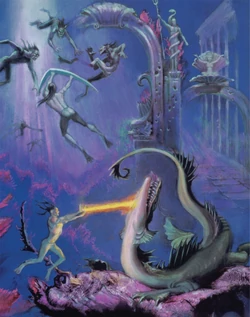
](https://static.wikia.nocookie.net/forgottenrealms/images/a/a8/Tritons_SoFS_2.jpg/revision/latest?cb=20240623160154)
Tritons battling their foes with tapal and with spell.
The tritons had a special weapon that was unique solely to their culture, known as the tapal.11 These were weapons traditionally carried through family lines, to be presented to a triton when they become an adult. Triton were also known to use more traditional weapons, such as unique aquatic variants of crossbows, designed with thicker wire and reinforced to withstand the pressure of the sea. They also used other aquatic weapons, such as stingray whips,12 daggers, javelins, nets,13 and their favored weapons, tridents.14 Triton weapons were often made from bone or coral, with enchantments to strengthen them. Some used metal, with magical enhancements to make them immune to rusting and pitting.15
The tritons of Serôs wore silverweave armor,16 which was crafted from a light and flexible fabric made out of silver coral fronds treated so that it had the durability of chainmail but moved like cloth. This was rarely worn outside of war, and usually was worn to protect the legs.14
Triton spellcasters tended to use various shells in the place of magical staves.17 When it came to writing down spells, they shunned spellbooks in favor of carving spells into a cavern wall, typically in a language only the triton wizards knew and in caves only they could access.15
Additionally, exceptional tritons and triton leaders were known to wield special magical horns crafted from conches, known as a horn of the tritons.3
Triton believed in the Law of Duels, in which two combating armies would instead put forward their champions to represent their faction and fight a personal challenge. This public conflict could have been nonlethal and to first blood, if the challenged (not the challenger) chosen so.18
Society
[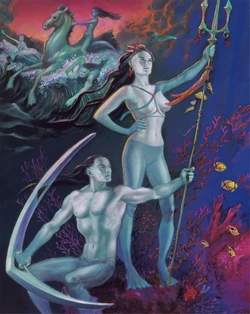
](https://static.wikia.nocookie.net/forgottenrealms/images/3/35/Tritons_SoFS_1.jpg/revision/latest?cb=20240623160657)
Tritons riding a hippocampus, and others with tapal and trident.
Homelands
Tritons originated from the Elemental Plane of Water,1 where some lived as bodyguards or courtiers of noble marids.19 Most notably, a great deal of tritons visited the Citadel of Ten Thousand Pearls or lived around it as courtiers of its noble marid Kalbari al-Durrat al-Amwaj ibn Jari,1920 sometimes traveling with her to the Material Plane as part of an entourage of courtiers and servants.21 They could also be found in Elavandor, on the plane of Arborea.22
On the Material Plane, tritons could be found across most of Toril’s major bodies of water.2324252627 These included the Sea of Swords off the Sword Coast,2328 the Inner Sea in Interior Faerûn,24 in the Trackless Sea off the coast of Maztica,25 in the Great Sea26 and its Bay of Dancing Dolphins,29 and in the oceans of Zakhara.27
The tritons of the Inner Sea lived in three kingdoms centered around a deepwater trench known as the Trench of Lopok. They kingdoms were Ahlorsath, Pumanath, and Vuuvaxath. Other creatures within the Inner Sea referred to them collectively as the Triton Protectorates, out of a misconception that the three were politically and socially one entity.24 Beyond these three, there potentially existed other triton settlements within the Inner Sea, but they were unknown to the wider world due to a desire to remain isolated.30
AD
Advertisement
Government
Triton society was a patriarchal feudal system that consisted of inherited noble titles.8 In addition, the military and priesthood shared a great deal of power, with the priesthood ruling over citizens at home and the military ensuring the survival of the communities. Their rule did not extend past their own protectorates, as each protectorate was a sovereign nation independent from the others.31
Triton settlements were built in a very orthodox, logical manner that stems from a characteristic orderliness. Triton protectorates started with a single garrisoned outpost, which took the form of a central tower surrounded by additional buildings or caverns to provide more space. There were then four more outposts created sixteen miles from the center tower, in each of the four cardinal directions. More outposts were then created, in sets of four, to create a grid-like pattern, ensuring that each settlement was within a half-day's journey of each other. These protectorates ended up being composed of a capital city, a ring of eight trade cities, twelve farming villages, and twenty-four outposts guarding it all.8 These cities reached no higher than 1,250 ft (381 m) below sea level.31
The triton made regular use of hydrothermal vents to smelt metals and produce valuable weapons and armor. However, continued exposure to the mineral-rich waters could make them ill, so they limited their interactions with them.32
Religion
The triton were a theocratic society, where all triton had ties to the church of their creator-god, Persana. All that non-tritons knew of Persana's worship was that it placed a great deal of focus on craftsmanship and guardianship, with the triton having created great cities in his name. Persana's priests were known to work readily with those of other faiths, if such an arrangement would benefit the triton, something that Persana would do himself.11
The triton believed that Persana created their species out of magically treated water from the fountain of the Elemental Plane of Water. While Persana seemed to only care about the triton in particular, he would cooperate with other races and their gods if it means aiding his people. Rarely, he would have his avatar appear in triton courts to guide them, or would send omens in the form of things such as pearls, underwater whirlpools, or living caverns.33
Persana's priests had many responsibilities in triton life. They were known to administer justice in court, act as architects for undersea cities, and even lead others in battle.33
Some triton claimed the god Eadro as their creator. The triton were also said to have a more significant druidic population than the the air-breathing races, tending to their aquatic environment and protecting it from harm.3435
Organizations
The most well-known triton-founded organization were the Dukars. The Dukars, through a mysterious ritual, used coral implants in their skeletons that caused magic to flow through them. The Dukars were divided between the Lorekeepers, who strove to preserve history, and the Peacekeepers, who kept the peace and gathered knowledge. Their numbers consisted of many races, with some claiming they counted storm giants, great whales, dolphins, koalinth, and ixitxachitl among their ranks. The organization disappeared due to an unknown conflict six hundred years ago, however, bringing an end to their 8,000 year long campaign for peace. They remained, but only in small number, with their goal being to maintain the fragile alliances in Serôs.36
The triton were also said to have an order of paladins known as the Order of the Crimson Shell, whose purpose was to destroy the sahuagin and put an end to their cult, the Jaws of Sekolah, as well as the terror it spread.37
Relationships
Tritons had good relations with giant sea horses, hippocampi, and sea lions, such that all these creatures would hark to a summons by the sounding of their magical conch shell horns.338 They were uneasy around dolphins, who would invade their space without care and often would try to break down the triton’s aloof attitude.8 The triton also domesticated twilight turtles, a species of black-and-purple aquatic turtles which glowed with bioluminescence, while also acting as a pack animal.39
Triton had a number of sapient allies. In Serôs, their allies included the shalarin, the merfolk, the morkoth of Qatoris,40 and the inhabitants of Myth Nantar.11
They were sometimes found as courtiers or servants in the palace of the marid Kalbari al-Durrat al-Amwaj ibn Jari, the Citadel of Ten Thousand Pearls, and entire tribes of them would occasionally accompany her whenever she traveled on the Prime Material plane.41 Besides her, tritons often acted as bodyguards of traveling marids.42
Despite their xenophobic attitude, the triton rarely killed outsiders without reason. Instead, their preferred method of dealing with intruders depended on the quality of the individual, which was tested in a triton court. Those deemed innocent awakened the next day on a nearby shore, while the guilty were stripped of their belongings and set adrift ten miles from the nearest shore. This practice was called leaving them "to the fate of the seas".3
AD
Advertisement
History
The triton were said to be created long ago, when their patron god Persana created them out of magically treated water from the Elemental Plane of Water. They were said to be the "cousins" of nereids, sharing a common ancestry.43
Centuries ago, the triton fought a number of elemental evils within the Elemental Plane of Water. These evils—such as the krakens, the sahuagin, and much more—were eventually defeated, and forced them into the Darkest Depths, a dark and crushing part of the plane. Eventually, the triton noticed that their enemies were strangely silent, causing them to investigate the Darkest Depths. There, they learned that their enemies had fled into the Prime Material Plane.1
The triton, feeling guilty from allowing this to occur, decided to pursue their enemies. Triton volunteers, skilled in weapons and magic, were sent into the Prime Material Plane to seek out these evils. They spread across the ocean, creating protectorates that served to guard locations they believed these creatures might lurk in, such as near portals or deep sea trenches.1
Once they had banished these evils to the farthest reaches of the ocean, the triton chose to stay in this plane, waiting for their enemies to return. Their cities spread throughout the seafloor, trading with other races but remaining so remote that even the merfolk and sea elves would rarely meet them.1
The first recorded appearance of tritons on Toril was in during the Fifth Serôs War (-788 DR--777 DR),44 when they revealed themselves to ally with the shalarin kingdom of Es'krin against the Aryselmalyr Empire. This was because the Arselmalyn Coronal, Vaequiis II, had allied himself with sworn enemies of the tritons, a pair of krakens from the Trench of Lopok named Borapalys and Rylurkarth. During the conflict Borapalys was said to have been killed by a triton Dukar named Kayas using the legendary Krakenscourge, some legends claiming that he had transformed himself into the weapon.45 The location of their Protectorates remained unknown after the conflict.46
In the final year of the Seventh Serôs War, −36 TS (−106 DR), during one of its last battles a storm giant adventurer named Lorthar wielding the lost Krakenscourge fell to a legion of elite morkoth fighters and they briefly took hold of it. Determined to retrieve the weapon and fight their ancient foes,45 the Triton Protectorates unexpectedly joined the fray,4546 making their existence more widely known among Serôsians. The triton forces struck at the Theocracy of the Deep Ones, sending its morkoths fleeing into the deeper depths of the Inner Sea,46 and finally reclaimed ownership of the Krakenscourge.45 Following the conflict the tritons continued to play an active role in Serôs, helping to maintain balance between the shalarin and the morkoth of Serôs.46 Overtime the three kingdoms that made up the Triton Protectorates would become known to the other races of Serôs. In order these were Ahlorsath in −21 TS (−91 DR), Vuuvaxath in 82 TS (12 DR), and Pumanath in 235 TS (165 DR).47
In the time approaching the Twelfth Serôs War, the triton ignored the disruptions caused by the evil megalodon Iakhovas, believing it to be an "upwater problem" that would distract them from protecting the ocean floor. They wouldn't involve themselves in the war until a triton conch was stolen by a mermaid and shalarin who sought aid against their enemies, causing the triton to chase after them. Soon afterward, the morkoth invaded the cities of Abydos and Pumana in the Protectorate of Pumanath, taking back fell magic that they would use to fight the Twelfth Serôs War. This caused the triton to realize their arrogance, and inspired them to join the war soon after.8
In Flamerule, 1369 DR, the tritons joined an alliance between the shalarin of Es’rath, the merfolk of Voalidru, and the good-aligned morkoth of Qatoris, in an attempt to rally against the growing plans of the morkoth of Olleth. In the month of Uktar, the triton formally joined the war, breaking the army of Iakhovas in two at Myth Nantar. The war ended soon afterward with Iakhovas being banished from Serôs.40
Notable Tritons
- Dukar, a triton wizard who founded the Dukar organization.48
- Jhimar, the triton warrior maiden who founded the now Lost Order of the Dukars, the Red Adherents, dedicated to the use of their coral weaponry.49
- Keros the Wanderer, a triton exile who came into possession of the corrupt Claw of Xynakt, and ended up helping his people during the battle at Myth Nantar.50
- Pythan, a triton wizard who sacrificed her life to seal away the greatest evils of Serôs within the Alamber Sea.51
- Rusar, the first triton to learn to forge weapons with Rusar’s Coral, a type of coral that, when heated, becomes a steel-hard emerald-green crystal.52
- Vodos, the Great Builder, a priest of Persana who designed the Sharksteeth Mounts and the Sharksbane Wall.
triton language
Triton language
Triton
Spoken by
The Triton language was the racial language of the tritons.1
Contents
AD
Advertisement
Speakers
Beyond tritons themselves, Triton was commonly a secondary language among asrai, water sprites of the Upper Planes.2
Some of the individual specialty priests of aquatic deities were known to learn various other aquatic languages, such as Triton.345 These included the sea druids of Deep Sashelas,3 the waveservants of Umberlee,4 and the waterwalkers of Istishia.5
Grammar
To modify a word to be a collective term, such as in order to refer to the members of a family or the various colonies surrounding the capital of one of their protectorates, tritons would add a "(a)th" to the interceding vowel where needed.6 For example, the Pumana Protectorate and Vuuvax Protectorate would be rendered as Pumanath and Vuuvaxath respectively.7 When used with a name, such as Numyn, depending upon the context it could refer to either possessions of the individual or their children.6
Dictionary
K
kraknyth
T
triton
"guardian".9
Naming Conventions
On average, a name in the Triton language had two to three syllables. Feminine names always ended in the letter "n", whilst masculine names always ended in the letter "s". Around the 9th century DR, the customs of masculine names changed, with such names now taking on a vowel at their end.6
Notable Speakers
- Veda Silas, a Ravenian half-elf wizard.
Triton
The Triton language was the racial language of the tritons.1
Speakers
Beyond tritons themselves, Triton was commonly a secondary language among asrai, water sprites of the Upper Planes.2
Some of the individual specialty priests of aquatic deities were known to learn various other aquatic languages, such as Triton.345 These included the sea druids of Deep Sashelas,3 the waveservants of Umberlee,4 and the waterwalkers of Istishia.5
Grammar
To modify a word to be a collective term, such as in order to refer to the members of a family or the various colonies surrounding the capital of one of their protectorates, tritons would add a "(a)th" to the interceding vowel where needed.6 For example, the Pumana Protectorate and Vuuvax Protectorate would be rendered as Pumanath and Vuuvaxath respectively.7 When used with a name, such as Numyn, depending upon the context it could refer to either possessions of the individual or their children.6
Dictionary
K
kraknyth
T
triton
"guardian".9
Naming Conventions
On average, a name in the Triton language had two to three syllables. Feminine names always ended in the letter "n", whilst masculine names always ended in the letter "s". Around the 9th century DR, the customs of masculine names changed, with such names now taking on a vowel at their end.6
Notable Speakers
Appendix
References
- ↑ Ed Greenwood, Julia Martin, Jeff Grubb (1993). Forgotten Realms Campaign Setting 2nd edition (revised), A Grand Tour of the Realms. (TSR, Inc), p. 25. ISBN 1-5607-6617-4.
- ↑ Wolfgang Baur and Lester Smith (1994-07-01). “Monstrous Supplement”. In Michele Carter ed. Planes of Chaos (TSR, Inc), pp. 4–5. ISBN 1560768746.
- ↑ Jump up to: 3.0 3.1 Eric L. Boyd (November 1998). Demihuman Deities. Edited by Julia Martin. (TSR, Inc.), p. 107. ISBN 0-7869-1239-1.
- ↑ Jump up to: 4.0 4.1 Julia Martin, Eric L. Boyd (March 1996). Faiths & Avatars. (TSR, Inc.), p. 174. ISBN 978-0786903849.
- ↑ Jump up to: 5.0 5.1 Julia Martin, Eric L. Boyd (March 1996). Faiths & Avatars. (TSR, Inc.), p. 80. ISBN 978-0786903849.
- ↑ Jump up to: 6.0 6.1 6.2 Steven E. Schend (1999). Sea of Fallen Stars. (TSR, Inc), p. 157. ISBN 0-7869-1393-2.
- ↑ Steven E. Schend (1999). Sea of Fallen Stars. (TSR, Inc), p. 149. ISBN 0-7869-1393-2.
- ↑ Steven E. Schend (1999). Sea of Fallen Stars. (TSR, Inc), p. 106. ISBN 0-7869-1393-2.
- ↑ Steven E. Schend (1999). Sea of Fallen Stars. (TSR, Inc), p. 148. ISBN 0-7869-1393-2.
- ↑ Phillip A. Dyer, et al. (August 1991). Port of Ravens Bluff. Edited by Jean Rabe, Skip Williams, David Wise. (TSR, Inc.), p. 52. ISBN 1-56076-120-2.
Connections
Triton Shorestalker
Medium Humanoid (Triton), Neutral Evil
- Armor Class 13
- Hit Points 32 (5d8 + 10)
- Hit Points 32 (5d8 + 10)
- Speed 30 ft., swim 30 ft.
STR DEX CON INT WIS CHA 11 (+0) 16 (+3) 14 (+2) 10 (+0) 15 (+2) 11 (+0)
- Skills Nature +4, Perception +4, Stealth +5
- Damage Resistances cold
- Senses darkvision 60 ft., passive Perception 14
- Languages Common, Primordial
- Challenge 2 (450 XP)
- Proficiency Bonus +2
Amphibious. The triton can breathe air and water.
Innate Spellcasting. The triton's spellcasting ability is Wisdom (spell save DC 12). It can innately cast the following spells, requiring no material components:
1/day each: fog cloud, gust of wind
Nimble Escape. The triton can take the Disengage or Hide actions as a bonus action on each of its turns.
Actions
Multiattack. The triton makes two urchin-spine shortsword attacks.
Urchin-Spine Shortsword. Melee Weapon Attack: +5 to hit, reach 5 ft., one target. Hit: 6 (1d6 + 3) piercing damage plus 10 (3d6) poison damage. If the damage reduces a creature to 0 hit points, that creature is stable but poisoned for 1 hour, even after regaining hit points, and is paralyzed while poisoned in this way.
Poisoned Spine. Ranged Weapon Attack: +5 to hit, range 30/60 ft., one target. Hit: 5 (1d4 + 3) piercing damage plus 10 (3d6) poison damage.
Some insults don't wash away with the tides. When surface dwellers threaten the safety of triton communities, impede upon Thassa's holiest depths, or steal the treasures of the deep, triton shorestalkers seek vengeance. Using speed and poison harvested from deadly sea beasts, these triton assassins slip into shallow waters and strike when least expected. Often, surface dwellers don't even realize they've been attacked by shorestalkers, chalking disappearances and deaths up to the innumerable dangers of the sea.
Clever, far-ranging people of the sea, tritons live rich lives unknown to most land-dwelling individuals. While the waves separate most tritons from land-dwellers, occasionally the inhabitants of the surface and the deep come into conflict. In such cases, tritons prove skilled at sabotaging ocean-going vessels, employing water-based magic, and otherwise whipping up the fury of the sea. Few dare insult tritons in their home environment, but those who do and survive often learn that the tritons' wrath doesn't end at the shore.
Triton Master of Waves
Medium Humanoid (Triton), Neutral
- Armor Class 15 (natural armor)
- Hit Points 105 (14d8 + 42)
- Hit Points 105 (14d8 + 42)
- Speed 30 ft., swim 30 ft.
STR DEX CON INT WIS CHA 16 (+3) 11 (+0) 16 (+3) 10 (+0) 12 (+1) 19 (+4)
- Saving Throws Dex +3, Int +3, Cha +7
- Skills Athletics +6, Nature +6, Survival +4
- Damage Resistances cold, fire
- Senses darkvision 60 ft., passive Perception 11
- Languages Common, Primordial
- Challenge 8 (3,900 XP)
- Proficiency Bonus +3
Amphibious. The triton can breathe air and water.
Innate Spellcasting. The triton's spellcasting ability is Charisma (spell save DC 15, +7 to hit with spell attacks). It can innately cast the following spells, requiring no material components:
At will: ray of frost (see "Actions" below)
2/day: cone of cold
1/day each: fog cloud, gust of wind, wind wallSummon Water Weird (Recharges after a Short or Long Rest). As a bonus action, the triton magically summons 1d4 water weirds. The summoned weirds appear in unoccupied spaces in water within 60 feet of the triton. The water weirds act immediately after the triton on the same initiative count and fight until they're destroyed. They disappear if the triton dies.
Actions
Multiattack. The triton makes two attacks using Wave Touch and casts ray of frost.
Wave Touch. Melee Spell Attack: +7 to hit, reach 5 ft., one target. Hit: 22 (4d10) cold damage.
Ray of Frost (Cantrip). Ranged Spell Attack: +7 to hit, range 60 ft., one creature. Hit: 13 (3d8) cold damage, and the target's speed is reduced by 10 feet until the start of the triton's next turn.
Reactions
Frigid Shield. When a creature the triton can see targets the triton with an attack, the triton gains 10 temporary hit points. If the attack hits and reduces the temporary hit points to 0, each creature within 5 feet of the triton takes 9 (2d8) cold damage.
Triton masters of waves sculpt storms and change the tides, bending the sea to their will. Drawing forth living currents and the icy cold of the deep, these mages make the ocean their ally, using it to defend their people or enact Thassa's wishes. While dire threats from the land might bring them to coastal shallows, most masters of waves keep to the ocean's depths.
Although many masters of waves resent land-dwellers and strike out at those who trespass upon their waters, most are devoted followers of the sea god. Those who share their faith or who bear earnest offerings to Thassa might defuse the tritons' ire—that is, if they survive the deadly winds and waves that typically herald these sea guardians' appearance.
Clever, far-ranging people of the sea, tritons live rich lives unknown to most land-dwelling individuals. While the waves separate most tritons from land-dwellers, occasionally the inhabitants of the surface and the deep come into conflict. In such cases, tritons prove skilled at sabotaging ocean-going vessels, employing water-based magic, and otherwise whipping up the fury of the sea. Few dare insult tritons in their home environment, but those who do and survive often learn that the tritons' wrath doesn't end at the shore.
Troglodyte
- Ability Scores. Strength +2; Constitution +2; Intelligence −4; Charisma −4
- Size. Medium
- Speed. 30 ft.
Chameleon Skin. You have advantage on Dexterity (Stealth) checks made to hide.
Stench. Any creature other than a troglodyte that starts its turn within 5 ft. of you must succeed on a DC 12 Constitution saving throw or be poisoned until the start of the creature's next turn. On a successful saving throw, the creature is immune to the stench of all troglodytes for 1 hour.
Sunlight Sensitivity. While in sunlight, you have disadvantage on attack rolls, as well as on Wisdom (Perception) checks that rely on sight.
Natural Armor. Your thick hide grants you a +1 bonus to Armor Class.
Darkvision. You can see in dim light within 60 feet of you as if it were bright light, and in darkness as if it were dim light. You can't discern color in darkness, only shades of gray.
Languages. You can speak, read, and write Troglodyte.
Note: This race is listed in the Dungeon Master's Guide as an option for creating NPCs. It is not designed for use as a playable race.
Source: DMG, page 282
Troglodyte
5th Edition Statistics21
Size
Medium
Type
Type (revised)
Alignment
Challenge rating
1⁄4
4th Edition Statistics3
Size
| Curse Chanter | Medium |
| Impaler | Medium |
| Mauler | Medium |
| Warrior | Large |
Origin
Type
Keyword(s)
Alignment
3rd Edition Statistics4
Size
Medium
Type
Subtype(s)
Alignment
Usually chaotic evil
Challenge rating
1
2nd Edition Statistics5
Size
Medium
Alignment
1st Edition Statistics6
Size
Medium
Alignment
General Information
Patron deity
Vision
Language(s)
Favored terrain
Underground
Appearance
Average height
5‒6 ft (1.5‒1.8 m)6
Average weight
150 pounds
History
First appearance
Based on
Troglodyte (Classical Greek)
Troglodytes, often referred to as stinkmeat by the duergar,7 were cave-dwelling reptilian humanoids, with a barbaric culture centered around food and scent. The stench of an angry or frightened troglodyte was so foul that it sickened all living creatures nearby, even after the troglodyte had died.4
Contents
Description
[
](https://static.wikia.nocookie.net/forgottenrealms/images/1/1a/Troglodyte_vs_knight.png/revision/latest?cb=20211021201622)
Spear-wielding troglodytes struggling against a knight adventurer.
Troglodytes were shorter than humans on average, standing 5‒6 ft (1.5‒1.8 m) tall with spindly but muscular arms, squat legs and long, slender tails. Their bodies were coated with rough leathery scales, and normally possessed a grayish-brown skin tone, although they also had the chameleon-like ability to change their coloration. They had lizard-like heads, which on males were crowned with frills that extended from their foreheads to their necks. Their black beady eyes struggled to see in the light, and their claws and fangs were obvious to those who saw them.6
Personality
Troglodytes took sadistic pleasure in mercilessly hunting weaker sentient beings before dragging them back to their caves to be eaten. They were a constantly warring race, convinced the world was full of creatures seeking to kill them, a self-fulfilling prophecy caused by their constant raiding. Their failure to plan for the future led them to conduct regular raids on nearby settlements. They were rejected by most races for their savagery, stench, and relative stupidity, and so took comfort in their isolation from other races and in destroying other sentient beings. There was always warring amongst troglodytes, whether between tribes or within. Despite this, they treated members of their own tribe like their family members, although individual friendships were somewhat rare.8
Abilities
Like chameleons, troglodytes could blend into their surroundings, allowing them to sneak up on unsuspecting prey. Most notable of their abilities was their overwhelming stench. A buildup of olfactory screams, battle cries, and various other messages would combine to forge an overpowering scent. So keen was a troglodyte's sense of smell that they were capable of smelling fear, or rather, the hormones given off by creatures experiencing fear, and would target those who they could smell were most afraid.9
Combat
An unarmed troglodyte was more than capable of fighting with tooth and claw, ferociously tearing away at their enemies with primal savagery. They would craft stone tools and were especially good at throwing javelins, hurling them at their targets before closing in with stone axes and claws. Because of their sensitivity to light, they would avoid fire and tried to attack when the sun wasn't present, however this did not mean that they were defenseless in these circumstances. Troglodytes navigated primarily through smell and so being blinded was akin to becoming deafened to them.9
Society
[
](https://static.wikia.nocookie.net/forgottenrealms/images/7/70/Underdark_2650_3.jpg/revision/latest?cb=20200411235918)
Troglodytes and their behemoth.
Troglodyte leaders were decided by sheer strength, with the strongest and toughest troglodyte becoming the chieftain, and the next strongest warriors becoming sub-chieftains. This was regardless of gender. However, weakness of any kind from their leaders was grounds for mutiny. Troglodyte society was clan-based, and the rank system was loose and in a constant state of flux.2 Because they were once a servitor race, troglodytes would submit to the most powerful entity wishing to rule them, although this was usually other troglodytes.2
Incapable both physically and mentally of crafting anything beyond stone tools and lacking in trade goods, troglodytes placed heavy value on metal items, seeing them as a sign of combat prowess. Having one was a serious status symbol and tribes could be torn apart, either socially or physically, on who may possess them.2 If two tribes went to war, the result would either be the annihilation of one, or the merging of the broken halves, with the strongest living troglodyte taking over. Some troglodytes were so feral that they could not be controlled and would need to be kept locked away to prevent them from attacking others.10
Young troglodytes were raised by the whole tribe rather than by their specific parents and were actively encouraged to fight each other at a young age. They could wield weapons by the time they were two years old and they were given steel weapons in order to go with hunters when they became older. Half of the population of a clan was female, and half of the males were hatchlings. Old troglodytes were presumed to have gathered wisdom over the years because they'd survived so long, with elders working as chief advisers. Very few members of a tribe were not warriors, besides dedicated hunter-gatherers and clerics.2
Troglodyte lairs were either huge caverns or smaller caverns naturally connected by tunnels. Most troglodytes did not consider specific parts of the lair their living quarters and would fall asleep in random places. Half-eaten food and greasy secretions could be found lying everywhere in the lair, alongside whatever treasures the troglodytes stole during raiding. Lairs were chosen partially based on their proximity to nearby settlements, and also by their drafts. Lairs with a draft towards the inside of the cave allowed the scent of humans to be more easily detected and for the alarmed scents of other troglodytes to be picked up at farther distances.9 Some troglodytes would tame drakes while others employed monitor lizards in order to guard their warrens. They would mark the borders of their territory with pictographs made with blood and dung or the remains of various creatures to indicate their presence to beings without a proper sense of smell.2
AD
Advertisement
Language
The troglodytes' spoken language was a simplified version of Draconic; it could be transcribed but never by the troglodytes themselves. However, only half of the troglodyte language was communicated verbally and it was restricted to simple phrases. The rest of the language was based on the variety of smells that they could produce, making it unintelligible to most other races. Because troglodytes had a variety of concepts that could only be conveyed via scent, translation of certain ideas was basically impossible. Similarly, they did not use maps to navigate, but rather a series of scents travelers should experience while they approached the destination.9
Religion
Originally created by the sarrukh, troglodytes first worshiped the World Serpent, but after the downfall of that empire, the god of the troglodytes became Laogzed. They would worship him by hosting great feasts to celebrate victory, feeding upon their recently slaughtered foes, although the desire to do this as often as possible led them to over-hunt the area. Clerics were well appreciated for their ability not only to cause pain with divine power, but also heal injuries. Their deity offered troglodytes nothing but aspiration to be as fat and content as they saw him,2 with the only benefit to worshiping him being the low standards he held. After every battle, the dead of the tribe would be gathered together and blessed by the priest before being eaten in a ceremony known as "Renewal" in which their meat was "returned" to the tribe.8
Occasionally troglodytes of great intelligence and strength would be born, and these rare few would be known as champions. Champions of Laogzed were capable of spewing globs of acid and were typically chieftains.11
Troglodytes could also worship other Abyssal deities such as the brutal Demogorgon through sacrificial rituals. Non-cleric magic users included the more intelligent deep scourges, shamans who used the alchemy of their own stench to create attacks, as well as the curse chanters.1210
Ecology
[
](https://static.wikia.nocookie.net/forgottenrealms/images/b/b0/Mindsliver.png/revision/latest?cb=20211009152117)
A troglodyte's lack of intelligence made a mind spell most effective against one.
Troglodytes were carnivorous, subsisting purely on meat they obtained via raiding. While they would eat any meat, they had a strong preference for human meat, causing ferocious reactions when smelt. Their sense of smell was so incredibly powerful that they could tell minute differences in scents undetectable to most races, to the point of having a language based on them.9 Troglodytes stayed with their mates so long as they were alive, but would find new ones if one member died. After being laid by the female, troglodyte eggs were incubated in a nearby waterway and kept safe with leather nets. Troglodyte eggs were lighter hued and speckled with darker color.7 Clutches were removed from the waterway a day or so before hatching in order to render the shells brittle enough to be broken.8
History
Troglodytes were created by the sarrukh of Mhairshaulk to scout a part of the Underdark known as the Serpent Deeps. The discovery of races like the aboleths and illithids resulted in their use as sentries for a time, and attempted invasions by these forces failed because of the troglodyte's vigilance and the enemies' inability to cooperate.813
They spread and settled throughout the Underdark at some point after the fall of the Mhairshaulk empire. They were eventually found by the yuan-ti (although some reports claimed the illithids were responsible) who bred those they found into the more powerful, but less intelligent, tren. After failing to defend Serpentes, the yuan-ti traded many tren to other races who almost immediately released them because of their overpowering odor. After this, many tren found their way back into the arms of the troglodyte race.8
As skirmishes between their tribes were common, and troglodytes had trouble planning for the future, they rarely posed a threat in the Underdark and were more seen as a nuisance for when they staged raids to acquire food.2
Appendix
See Also
Trogolodyte Language
Troglodyte language
Our Venom Predictions
Keep WatchingNext video in 8 seconds
More Videos
0 of 2 minutes, 30 secondsVolume 0%
Press shift question mark to access a list of keyboard shortcuts
Keyboard ShortcutsEnabledDisabled
Shortcuts Open/Close/ or ?
Play/PauseSPACE
Increase Volume↑
Decrease Volume↓
Seek Forward→
Seek Backward←
Captions On/Offc
Fullscreen/Exit Fullscreenf
Mute/Unmutem
Decrease Caption Size-
Increase Caption Size+ or =
Seek %0-9
Auto1080p1080p720p406p270p180p
0.5x1x1.25x1.5x2x
Live
00:22
02:07
02:30
Troglodyte
Influenced by
Script
None1
Spoken by
The Troglodyte language, a simplified form of Draconic,1 was the racial language of troglodytes.2345 Troglodytes themselves referred to the language as Glav, which meant "speech" in the Draconic tongue.1
Contents
Phonlogy
Troglodyte used a much simpler vocabulary than base Draconic.1
Speakers
Troglodyte was among the common racial languages of the Underdark. Thus it was not uncommon for there to be speakers among the demihumans of Faerûn that tended to live in the Underdark, such as drow, duergar, gold dwarves, shield dwarves, and svirfneblin.6 It was also common among the hybrid race tren7 and gray druids, a variety of druids that were associated with the Underdark.8
Above ground, Troglodyte was somewhat common as a secondary language among warriors in Hlondeth9 and in the Chultan Peninsula by the jungle druids of the the Church of Ubtao.10
Derivations
Tren
Trens, being that they were crossbreeds between troglodytes and lizardfolk, occasionally spoke their own creole language derived from combining the Troglodyte and Lizardman tongues.7
Dictionary
U
Uvech
A word used when referring to something owned by troglodytes, made by troglodytes, or that was of troglodyte culture. Translates literally as "ours", "us", and "of us".1
V
Vechrand
The name troglodytes use to refer to themselves. It was derived from two words in the Draconic tongue, "versvech" and "arand", which meant "strong" and "core" or "heart of" respectively.1
Unknown Words
The Troglodyte tongue included a word for "broken glass".11note 1
Notable Speakers
Appendix
Notes
- ↑ What exactly this word is was never stated within the cited text.
Appearances
Adventures
The Ruins of Undermountain II: The Deep Levels: "Troglodyte Warren" • Waterdeep: Dungeon of the Mad Mage • Baldur's Gate: Descent into Avernus
Troglodyte
Medium Humanoid (Troglodyte), Chaotic Evil
- Armor Class 11 (natural armor)
- Hit Points 13 (2d8 + 4)
- Hit Points 13 (2d8 + 4)
- Speed 30 ft.
STR DEX CON INT WIS CHA 14 (+2) 10 (+0) 14 (+2) 6 (-2) 10 (+0) 6 (-2)
- Skills Stealth +2
- Senses darkvision 60 ft., passive Perception 10
- Languages Troglodyte
- Challenge 1/4 (50 XP)
- Proficiency Bonus +2
Chameleon Skin. The troglodyte has advantage on Dexterity (Stealth) checks made to hide.
Stench. Any creature other than a troglodyte that starts its turn within 5 feet of the troglodyte must succeed on a DC 12 Constitution saving throw or be poisoned until the start of the creature's next turn. On a successful saving throw, the creature is immune to the stench of all troglodytes for 1 hour.
Sunlight Sensitivity. While in sunlight, the troglodyte has disadvantage on attack rolls, as well as on Wisdom (Perception) checks that rely on sight.
Actions
Multiattack. The troglodyte makes three attacks: one with its bite and two with its claws.
Bite. Melee Weapon Attack: +4 to hit, reach 5 ft., one target. Hit: 4 (1d4 + 2) piercing damage.
Claw. Melee Weapon Attack: +4 to hit, reach 5 ft., one target. Hit: 4 (1d4 + 2) slashing damage.
The savage, degenerate troglodytes squat in the shallow depths of the Underdark in a constant state of war against their neighbors and one another. They mark the borders of their territories with cracked bones and skulls, or with pictographs painted in blood or dung.
Perhaps the most loathsome of all humanoids, troglodytes eat anything they can stomach. They dwell in filth. The walls of their cavern homes are smeared with grime, oily secretions, and the debris of their foul feasting.
Simpleminded Brutes. Troglodytes have a simple, communal culture devoted almost entirely to procuring food. Too simple to plan more than a few days into the future, troglodytes rely on constant raids and hunting to survive. They take sadistic pleasure in hunting intelligent creatures weaker than themselves and show no mercy toward those they capture and drag back to their lairs to be devoured. The largest and toughest troglodytes lead the hunt and become the leaders of their tribes. However, if a leader shows any weakness or hesitation, other troglodytes attack and eat it in a frenzy.
Troglodytes make little and build less, scavenging their possessions from their prey. They understand the value of metal weapons and armor, and fight among one another for the right to have such items. A troglodyte tribe might be torn apart by battles over a single longsword.
Devotees of Laogzed. Some troglodytes venerate Laogzed, a demonic, monstrously fat toad-lizard that slumbers in the Abyss. Laogzed offers the troglodytes nothing in return except aspiration, for it is the dream of his troglodyte worshipers to become as fat, well-fed, and wearily content as he seems to be.
Smells like an orc's loincloth in here!— Last words of Arlack Hammermantle, dwarf spelunker
Troglodyte Champion of Laogzed
Medium Humanoid (Troglodyte), Chaotic Evil
- Armor Class 14 (natural armor)
- Hit Points 59 (7d8 + 28)
- Hit Points 59 (7d8 + 28)
- Speed 30 ft.
STR DEX CON INT WIS CHA 18 (+4) 12 (+1) 18 (+4) 8 (-1) 12 (+1) 12 (+1)
- Skills Athletics +6, Intimidation +3, Stealth +3
- Senses darkvision 60 ft., passive Perception 11
- Languages Troglodyte
- Challenge 3 (700 XP)
- Proficiency Bonus +2
Chameleon Skin. The troglodyte has advantage on Dexterity (Stealth) checks made to hide.
Stench. Any creature other than a troglodyte that starts its turn within 5 feet of the troglodyte must succeed on a DC 14 Constitution saving throw or be poisoned until the start of the creature's next turn. On a successful saving throw, the creature is immune to the stench of all troglodytes for 1 hour.
Sunlight Sensitivity. While in sunlight, the troglodyte has disadvantage on attack rolls, as well as on Wisdom (Perception) checks that rely on sight.
Actions
Multiattack. The troglodyte makes three attacks: one with its bite and two with either its claws or its greatclub.
Bite. Melee Weapon Attack: +6 to hit, reach 5 ft., one target. Hit: 6 (1d4 + 4) piercing damage.
Claw. Melee Weapon Attack: +6 to hit, reach 5 ft., one target. Hit: 6 (1d4 + 4) slashing damage.
Greatclub. Melee Weapon Attack: +6 to hit, reach 5 ft., one target. Hit: 8 (1d8 + 4) bludgeoning damage.
Acid Spray (Recharge 6). The troglodyte spits acid in a line 15 feet long and 5 feet wide. Each creature in that line must make a DC 14 Dexterity saving throw, taking 10 (3d6) acid damage on a failed save, or half as much damage on a successful one.
The Monster Manual provides statistics for the typical troglodyte. Once in a while, a troglodyte tribe produces an unusually smart and strong specimen that can spew acid-what many troglodytes consider blessings from Laogzed, their demonic god. These hulking troglodyte champions make excellent chieftains.
Gorzil's Gang Troglodyte
Medium Humanoid (Troglodyte), Chaotic Evil
- Armor Class 14 (breastplate)
- Hit Points 13 (2d8 + 4)
- Hit Points 13 (2d8 + 4)
- Speed 30 ft.
STR DEX CON INT WIS CHA 14 (+2) 10 (+0) 14 (+2) 6 (-2) 10 (+0) 6 (-2)
- Skills Stealth +2
- Senses darkvision 60 ft., passive Perception 10
- Languages understands Undercommon but can't speak
- Challenge 1/4 (50 XP)
- Proficiency Bonus +2
Chameleon Skin. The troglodyte has advantage on Dexterity (Stealth) checks made to hide.
Stench. Any creature other than a troglodyte that starts its turn within 5 feet of the troglodyte must succeed on a DC 12 Constitution saving throw or be poisoned until the start of the creature's next turn. On a successful saving throw, the creature is immune to the stench of all troglodytes for 1 hour.
Sunlight Sensitivity. While in sunlight, the troglodyte has disadvantage on attack rolls, as well as on Wisdom (Perception) checks that rely on sight.
Actions
Multiattack. The troglodyte makes three attacks: one with its bite and two with its longsword.
Bite. Melee Weapon Attack: +4 to hit, reach 5 ft., one target. Hit: 4 (1d4 + 2) piercing damage.
Longsword. Melee Weapon Attack: +4 to hit, reach 5 ft., one target. Hit: 6 (1d8 + 2) slashing damage, or 7 (1d10 + 2) slashing damage if used with two hands.
Young Troglodyte
Small Humanoid (Troglodyte), Lawful Evil
- Armor Class 12
- Hit Points 5 (2d6 - 2)
- Hit Points 5 (2d6 - 2)
- Speed 30 ft.
STR DEX CON INT WIS CHA 7 (-2) 15 (+2) 9 (-1) 8 (-1) 7 (-2) 8 (-1)
- Senses darkvision 60 ft., passive Perception 8
- Languages Common, Draconic
- Challenge 1/8 (25 XP)
- Proficiency Bonus +2
Pack Tactics. The troglodyte has advantage on an attack roll against a creature if at least one of the troglodyte's allies is within 5 feet of the creature and the ally isn't incapacitated.
Sunlight Sensitivity. While in sunlight, the troglodyte has disadvantage on attack rolls, as well as on Wisdom (Perception) checks that rely on sight.
Actions
Dagger. Melee Weapon Attack: +4 to hit, reach 5 ft., one target. Hit: 4 (1d4 + 2) piercing damage.
Sling. Ranged Weapon Attack: +4 to hit, range 30/120 ft., one target. Hit: 4 (1d4 + 2) bludgeoning damage.
Old Troglodyte
Medium Humanoid (Troglodyte), Chaotic Evil
- Armor Class 11 (natural armor)
- Hit Points 13 (2d8 + 4)
- Hit Points 13 (2d8 + 4)
- Speed 30 ft.
STR DEX CON INT WIS CHA 14 (+2) 10 (+0) 14 (+2) 6 (-2) 10 (+0) 6 (-2)
- Skills Stealth +2
- Senses darkvision 60 ft., passive Perception 10
- Languages Troglodyte
- Challenge 1/8 (25 XP)
- Proficiency Bonus +2
Chameleon Skin. The troglodyte has advantage on Dexterity (Stealth) checks made to hide.
Stench. Any creature other than a troglodyte that starts its turn within 5 feet of the troglodyte must succeed on a DC 12 Constitution saving throw or be poisoned until the start of the creature's next turn. On a successful saving throw, the creature is immune to the stench of all troglodytes for 1 hour.
Sunlight Sensitivity. While in sunlight, the troglodyte has disadvantage on attack rolls, as well as on Wisdom (Perception) checks that rely on sight.
Actions
Multiattack. The troglodyte makes two claw attacks.
Claw. Melee Weapon Attack: +4 to hit, reach 5 ft., one target. Hit: 4 (1d4 + 2) slashing damage.
Player Characters as Vampires
The game statistics of a player character transformed into a vampire spawn and then a vampire don't change, except that the character's Strength, Dexterity, and Constitution scores become 18 if they aren't higher. In addition, the character gains the vampire's damage resistances, darkvision, traits, and actions. Attack and damage rolls for the vampire's attacks are based on Strength. The save DC for Charm is 8 + the vampire's proficiency bonus + the vampire's Charisma modifier. The character's alignment becomes lawful evil, and the DM might take control of the character until the vampirism is reversed with a wish spell or the character is killed and brought back to life.
Jiangshi
Humanoids killed by a jiangshi rise as life-hungry corpses and might turn into jiangshi themselves if they feed upon the living.
Warforged
- Ability Scores. Constitution +2; Choose any other +1
- Size. Medium
- Speed. 30 ft.
Age. A typical warforged is between two and thirty years old. The maximum warforged lifespan remains a mystery; so far, warforged have shown no signs of deterioration due to age. You are immune to magical aging effects.
Alignment. Most warforged take comfort in order and discipline, tending toward law and neutrality. But some have absorbed the morality, or lack thereof, of the beings with which they served.
Size. Your size is Medium.
Constructed Resilience. You were created to have remarkable fortitude, represented by the following benefits:
- You have advantage on saving throws against being poisoned, and you have resistance to poi-son damage.
- You don't need to eat, drink, or breathe.
- You are immune to disease.
- You don't need to sleep, and magic can't put you to sleep.
Sentry's Rest. When you take a long rest, you must spend at least six hours in an inac-tive, motionless state, rather than sleeping. In this state, you appear inert, but it doesn't render you unconscious, and you can see and hear as normal.
Integrated Protection. Your body has built-in defensive layers, which can be enhanced with armor:
- You gain a +1 bonus to Armor Class.
- You can don only armor with which you have proficiency. To don armor other than a shield, you must incorporate it into your body over the course of 1 hour, during which you remain in contact with the armor. To doff armor, you must spend 1 hour removing it. You can rest while donning or doffing armor in this way.
- While you live, the armor incorporated into your body can't be removed against your will.
Specialized Design. You gain one skill proficiency and one tool proficiency of your choice.
Languages. You can speak, read, and write Common and one other language of your choice.
https://2014.5e.tools/img/races/ERLW/Warforged.webp
https://2014.5e.tools/img/races/ERLW/Warforged%20001.webp
"Pierce was built by design, while you were built by accident," Lakashtai said. "The soul is what matters, not the shape of the vessel."
"What makes you think he has a soul?" Gerrion said
"What makes you think you do?"— Keith Baker, The Shattered LandThe warforged were built to fight in the Last War. While the first warforged were mindless automatons, House Cannith devoted vast resources to improving these steel soldiers. An unexpected breakthrough produced sapient soldiers, giving rise to what some have only grudgingly accepted as a new species. Warforged are made from wood and metal, but they can feel pain and emotion. Built as weapons, they must now find a purpose beyond war. A warforged can be a steadfast ally, a cold-hearted killer, or a visionary in search of meaning.
Living Steel and Stone. Warforged are formed from a blend of organic and inorganic materials. Root-like cords infused with alchemical fluids serve as their muscles, wrapped around a framework of steel, darkwood, or stone. Armored plates form a protective outer shell and reinforce joints. Warforged share a common facial design, with a hinged jaw and crystal eyes embedded beneath a reinforced brow ridge. Beyond these common elements of warforged design, the precise materials and build of a warforged vary based on the purpose for which it was designed.
Although they were manufactured, warforged are living humanoids. Resting, healing magic, and the Medicine skill all provide the same benefits to warforged that they do to other humanoids.
Warforged Personality. The warforged were built to serve and to fight. For most of their existence, warforged had a clearly defined function and were encouraged to focus purely on that role. The Treaty of Thronehold gave them freedom, but many still struggle both to find a place in the post-war world and to relate to the creatures who created them.
The typical warforged shows little emotion. Many warforged embrace a concrete purpose—such as protecting allies, completing a contract, or exploring a land—and embrace this task as they once did war. However, there are warforged who delight in exploring their feelings, their freedom, and their relationships with others. Most warforged have no interest in religion, but some embrace faith and mysticism, seeking higher purpose and deeper meaning.
The typical warforged has a sexless body shape. Some warforged ignore the concept of gender entirely, while others adopt a gender identity.
The more a warforged develops its individuality, the more likely it is to modify its body, seeking out an artificer to customize the look of its face, limbs, and plating.
Quirks. Warforged often display an odd personality trait or two, given how new they are to the world. The Warforged Quirks table contains example quirks.
Warforged Quirks
| d8 | Quirk |
|---|---|
| 1 | You analyze—out loud—the potential threat posed by every creature you meet. |
| 2 | You often misread emotional cues. |
| 3 | You are fiercely protective of your friends. |
| 4 | You try to apply wartime discipline to every situation. |
| 5 | You don't know how to filter your feelings and are prone to dramatic emotional outbursts. |
| 6 | You don't understand clothing beyond its utility and assume it denotes a person's function. |
| 7 | You are obsessed with your appearance and constantly polish and buff yourself. |
| 8 | War is the only thing that makes sense to you, and you're always looking for a fight. |
Warforged Names. Most warforged were assigned numerical designations for use in military service. Many of them adopted nicknames, often given to them by their comrades. As independent individuals, some have chosen new names as a way to express their path in life. A few take on human names, often the name of a fallen friend or mentor.
Warforged Names: Anchor, Banner, Bastion, Blade, Blue, Bow, Cart, Church, Crunch, Crystal, Dagger, Dent, Five, Glaive, Hammer, Iron, Lucky, Mace, Oak, Onyx, Pants, Pierce, Red, Rod, Rusty, Scout, Seven, Shield, Slash, Smith, Spike, Temple, Vault, Wall
https://2014.5e.tools/img/races/ERLW/Warforged%20001.webp
Warforged
5th Edition Statistics12
Size
Medium
Type
Alignment
Any
Challenge rating
| Soldier | 1 |
4th Edition Statistics3
Size
Medium
Origin
Type
Keyword(s)
Alignment
Any
3rd Edition Statistics4
Size
Medium
Type
Subtype(s)
Alignment
Usually lawful neutral
Challenge rating
1⁄2
General Information15
Average lifespan
Unknown
Homeland(s)
Language(s)
Appearance16
Average height
6′‒6′10″ (1.8‒2.1 m)
Average weight
270‒318 lb (120‒144 kg)
Warforged were a rare race of humanoid constructs created through powerful rituals.3 Warforged averaged 6′‒6′6″ (1.8‒2 m) and were made up of bulky (albeit resilient) metallic or stone bodies that weighed roughly 270‒300 lb (120‒140 kg).6 Extremely powerful and durable, warforged were able fighters.7 Unlike most constructs, warforged were fully self-aware and maintained mental faculties on par with elves, humans, or similar races.3
Contents
AD
Advertisement
Description
Warforged were physically impressive humanoids made up of magically enchanted materials. The "skin" of a warforged was made of hardened materials such as metal or stone. Beneath this lay the skeleton, made up of similar materials, and the "musculature" of the warforged, made up of leather, wooden fibers, or any leather-like material. Throughout the warforged's body were vessels resembling the circulatory system of organic creatures, complete with a blood-like fluid. The arms of a warforged ended in hands with two fingers and a thumb while the feet of the constructs were likewise two-toed.6
The faces of warforged were simple and vague in their features, with beak-like jaws, heavy brows, glowing eyes, runic markings and little else. The most important marking for any warforged was their ghulra, the primordial word for "truth", a rune distinctive to each warforged which was placed upon their forehead.6
Warforged were completely sexless—though some did "adopt" genders—and were incapable of reproduction. Each warforged was individually created through ritual, like any other construct. The warforged's artificial nature also gave the race a unique relationship to pain, which seemed limited to actual injury. This allowed warforged to modify themselves with some ease, giving them a varied appearance in spite of their lack of inherent biological diversity. Warforged's artificial nature also meant they did not need to eat, drink, or breathe. Likewise, warforged did not need to sleep but did nonetheless require rest in a fully-aware state for a period of at least four hours.6
Personality
[
](https://static.wikia.nocookie.net/forgottenrealms/images/d/d8/WarforgedJuggernautPath.jpg/revision/latest?cb=20130210000658)
Warforged Juggernaut
Warforged took their name from their original purpose, as soldiers, and many had a dutiful attitude towards life, taking pleasure from fulfilling commands. Warforged as a whole had a strong work ethic and shared an aversion to failure. Warforged were capable of fear, often of death or pain, as much as other races and could come to hate the sources of these fears just as easily. Warforged were also capable of loyalty and joy, particularly in relations to friends and allies and could be driven to anger when their loves or goals were threatened. However, warforged as a whole exhibited a simple-minded and reserved approach to life with straightforward goals and reactionary passions.6
Since warforged were created in a state of physical maturity, many exhibited a childlike perspective that was often mistaken as naïve or emotionally crippled; this was not necessarily true. Some warforged, in fact, developed a particularly sophisticated view of the world, ever curious about its mysteries in part due to the odd nature of their creation. Many wondered where they might go in death and if they even have souls.8 Some created deeply ordered philosophies to govern themselves or maintained a perpetual list of tasks to occupy themselves with. Others fell in with the religions and mindsets of other races. Some warforged even lived long enough to develop a deep and weathered personality as tempered by time as that of other races.6
Notable Warforged
- Warden, a prison warden from Eberron turned Realmspace-wandering minion of Hadar.9
Appendix
Warforged Soldier
Medium Humanoid (Warforged), Any Alignment
- Armor Class 16 (natural armor, shield)
- Hit Points 30 (4d8 + 12)
- Hit Points 30 (4d8 + 12)
- Speed 30 ft.
STR DEX CON INT WIS CHA 16 (+3) 12 (+1) 16 (+3) 10 (+0) 14 (+2) 11 (+0)
- Skills Athletics +5, Perception +4, Survival +4
- Damage Resistances poison
- Condition Immunities disease
- Senses passive Perception 14
- Languages Common
- Challenge 1 (200 XP)
- Proficiency Bonus +2
Warforged Resilience. The warforged has advantage on saving throws against being poisoned and is immune to disease. Magic can't put it to sleep.
Actions
Multiattack. The warforged makes two armblade attacks.
Armblade. Melee Weapon Attack: +5 to hit, reach 5 ft., one target. Hit: 6 (1d6 + 3) slashing damage.
Javelin. Melee or Ranged Weapon Attack: +5 to hit, reach 5 ft. or range 30/120 ft., one target. Hit: 6 (1d6 + 3) piercing damage.
Reactions
Protection. When an attacker the warforged can see makes an attack roll against a creature within 5 feet of the warforged, the warforged can impose disadvantage on the attack roll.
Warforged soldiers are humanoids formed from wood and steel, then magically imbued with life and sentience. The warforged were created to fight in the Last War, and in the aftermath of that conflict, they struggle to understand their place in the world.
Most warforged soldiers still serve their former masters, often guarding dragonmarked houses or merchant caravans. Many warforged find it difficult to separate themselves from the soldiers they were made to be, seeking work as bouncers, bailiffs, and bodyguards. Others put their tireless strength to work as laborers, committed to the reconstruction of the towns and cities they defended or destroyed in the war.
Warforged Warrior
Medium Construct, Any Alignment
- Armor Class 16 (natural armor)
- Hit Points 30 (4d8 + 12)
- Hit Points 30 (4d8 + 12)
- Speed 30 ft.
STR DEX CON INT WIS CHA 16 (+3) 12 (+1) 16 (+3) 10 (+0) 14 (+2) 11 (+0)
- Skills Athletics +5, Perception +4, Survival +4
- Damage Resistances poison
- Condition Immunities poisoned
- Senses passive Perception 14
- Languages Common
- Challenge 1 (200 XP)
- Proficiency Bonus +2
Actions
Multiattack. The warforged makes two Armblade attacks.
Armblade. Melee Weapon Attack: +5 to hit, reach 5 ft., one target. Hit: 6 (1d6 + 3) slashing damage.
Javelin. Melee or Ranged Weapon Attack: +5 to hit, reach 5 ft. or range 30/120 ft., one target. Hit: 6 (1d6 + 3) piercing damage.
Reactions
Protection. When an attacker the warforged can see makes an attack roll against a creature within 5 feet of the warforged, the warforged can impose disadvantage on the attack roll.
Warforged warriors are formed from wood and steel, then magically imbued with life and sentience. They were created to fight in the Last War on the continent of Khorvaire in Eberron. In the aftermath of that conflict, they struggle to understand their place in the world.
Yuan-Ti
- Ability Scores. Choose one of: (a) Choose any +2; choose any other +1 (b) Choose three different +1
- Size. Small/Medium
- Speed. 30 ft.
Size. You are Medium or Small. You choose the size when you select this race.
Darkvision. You can see in dim light within 60 feet of you as if it were bright light and in darkness as if it were dim light. You discern colors in that darkness only as shades of gray.
Magic Resistance. You have advantage on saving throws against spells.
Poison Resilience. You have advantage on saving throws you make to avoid or end the poisoned condition on yourself. You also have resistance to poison damage.
Serpentine Spellcasting. You know the poison spray cantrip. You can cast animal friendship an unlimited number of times with this trait, but you can target only snakes with it. Starting at 3rd level, you can also cast suggestion with this trait. Once you cast it, you can't do so again until you finish a long rest. You can also cast it using any spell slots you have of 2nd level or higher.
Intelligence, Wisdom, or Charisma is your spellcasting ability for these spells when you cast them with this trait (choose when you select this race).
Languages. You can speak, read, and write Common and one other language that you and your DM agree is appropriate for your character.
https://2014.5e.tools/img/races/MPMM/Yuan-ti.webp
Yuan-ti were originally humans who transformed themselves into serpent folk through ancient rituals. Most yuan-ti were corrupted into monsters by those rites, but some yuan-ti instead became a new people who mix characteristics of humans and snakes. Blessed with resistance to magical and poisonous effects by the rituals that created them, each of these yuan-ti manifests their serpentine heritage in a variety of ways: a forked tongue, snake eyes, a snakelike nose, or some other ophidian characteristic. However a yuan-ti looks, they have the power to pursue great good or evil in the multiverse.
Source: MPMM, page 36
Yuan-ti Pureblood
- Ability Scores. Charisma +2; Intelligence +1
- Size. Medium
- Speed. 30 ft.
Age. Purebloods mature at the same rate as humans and have lifespans similar in length to theirs.
Size. Purebloods match humans in average size and weight. Your size is Medium.
Darkvision. You can see in dim light within 60 feet of you as if it were bright light, and in darkness as if it were dim light. You can't discern color in darkness, only shades of gray.
Innate Spellcasting. You know the poison spray cantrip. You can cast animal friend-ship an unlimited number of times with this trait, but you can target only snakes with it. Starting at 3rd level, you can also cast suggestion with this trait. Once you cast it, you can't do so again until you finish a long rest. Charisma is your spellcasting ability for these spells.
Magic Resistance. You have advantage on saving throws against spells and other magi-cal effects.
Poison Immunity. You are immune to poison damage and the poisoned condition.
Languages. You can speak, read, and write Common, Abyssal, and Draconic.
https://2014.5e.tools/img/races/VGM/Yuan-ti%20Pureblood.webp
Source: VGM, page 120. Reprinted as Yuan-Ti in MPMM
NOTE See Appendix for more on Yuan-ti from VGM.
Yuan-ti
Our Venom Predictions
Keep WatchingNext video in 8 seconds
More Videos
0 seconds of 2 minutes, 30 secondsVolume 0%
Press shift question mark to access a list of keyboard shortcuts
Keyboard ShortcutsEnabledDisabled
Shortcuts Open/Close/ or ?
Play/PauseSPACE
Increase Volume↑
Decrease Volume↓
Seek Forward→
Seek Backward←
Captions On/Offc
Fullscreen/Exit Fullscreenf
Mute/Unmutem
Decrease Caption Size-
Increase Caption Size+ or =
Seek %0-9
0.5x1x1.25x1.5x2x
Auto1080p1080p720p406p270p180p
Live
00:00
02:30
02:30
- 5e
- 4e
- 3e
- 2e
- 1e
[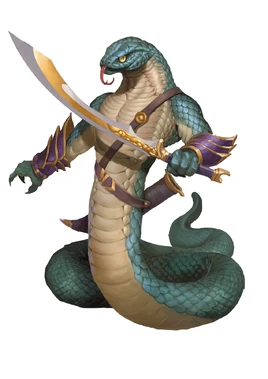
](https://static.wikia.nocookie.net/forgottenrealms/images/7/74/Monster_Manual_5e_-Yuan-ti-_p307.jpg/revision/latest?cb=20141116095915 "5e")
[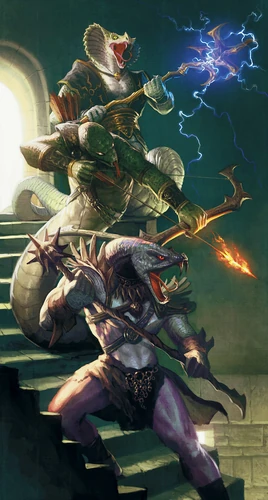
](https://static.wikia.nocookie.net/forgottenrealms/images/6/60/4e_yuan-ti.jpg/revision/latest?cb=20190816074258 "4e")
[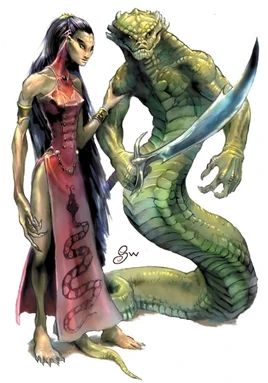
](https://static.wikia.nocookie.net/forgottenrealms/images/f/f1/Yuan-ti_-_Sam_Wood.jpg/revision/latest?cb=20070211211557 "3e")
[
](https://static.wikia.nocookie.net/forgottenrealms/images/d/de/Monstrous_Manual_2e_-Yuan-ti-_p369.png/revision/latest?cb=20141116095855 "2e")
[
](https://static.wikia.nocookie.net/forgottenrealms/images/9/96/Monster_Manual_2_1e_-Yuan_ti-_p130.jpg/revision/latest?cb=20151019022920 "1e")
Various depictions of yuan-ti.
Yuan-Ti
(Snake People1)
-
5e
-
4e
-
3e
-
2e
-
1e
5th Edition Statistics2
Alignment
4th Edition Statistics3
Origin
Keyword(s)
Alignment
3rd Edition Statistics45
Type
Subtype(s)
Alignment
Usually chaotic evil
2nd Edition Statistics6
Alignment
1st Edition Statistics7
Size
Medium
Alignment
General Information
Patron deity
Vision
Activity cycle
Any6
Diet
Carnivore6
Homeland(s)
Language(s)
Subraces
Favored climate
Favored terrain
Appearance
Distinctions
Various serpent features
History
First appearance
Dwellers of the Forbidden City
Yuan-ti (sing & pl4; pronounced: /[j](https://forgottenrealms.fandom.com/wiki/Y_as_in_%22yes%22 "Y as in "yes"")[uː](https://forgottenrealms.fandom.com/wiki/Oo_as_in_%22noon%22 "Oo as in "noon"")[ɑː](https://forgottenrealms.fandom.com/wiki/A_as_in_%22bard%22 "A as in "bard"")[n](https://forgottenrealms.fandom.com/wiki/N_as_in_%22dragon%22 "N as in "dragon"")ˈ[t](https://forgottenrealms.fandom.com/wiki/T_as_in_%22turn%22 "T as in "turn"")[i](https://forgottenrealms.fandom.com/wiki/Ee_as_in_%22fee%22 "Ee as in "fee"")/ yoo-an-TEE11 listen or: /[w](https://forgottenrealms.fandom.com/wiki/W_as_in_%22wizard%22 "W as in "wizard"")[ɑː](https://forgottenrealms.fandom.com/wiki/A_as_in_%22bard%22 "A as in "bard"")[n](https://forgottenrealms.fandom.com/wiki/N_as_in_%22dragon%22 "N as in "dragon"")ˈ[t](https://forgottenrealms.fandom.com/wiki/T_as_in_%22turn%22 "T as in "turn"")[i](https://forgottenrealms.fandom.com/wiki/Ee_as_in_%22fee%22 "Ee as in "fee"")/ wahn-TEE12) were a collective, and mostly psionic, race of serpentfolk, also known as the snake people of Malatra.1 They were often seen as corrupt and degenerate monsters by other races.7
Contents
Description
The appearance of yuan-ti varied greatly from nearly human-like to nearly snake-like, but all had some serpentine features.67 Scale colors were usually simple greens and browns, but more elaborate swirls, stripes, or diamond patterns were possible, even in blues and reds.6
Yuan-ti gave off almost no scent that a human could detect, but animals could sense a dry, musty odor from their bodies.6
Only the most human-like forms wore clothing, but all varieties wielded weapons if they had means to carry them.6
Varieties
Major Subraces
The yuan-ti came in several distinct castes or breeds. The three most prevalent were as follows:67
Purebloods appeared mostly human, with minor reptilian features,67 such as slit eyes,6 a forked tongue,67 or patches of scales on their skin.7
Also called malisons,13 halfbloods were humanoid in shape but had a wide variety of noticeable serpentine features, such as a snakelike tail in place of legs,67 a complete covering of scales,67 a hood like a cobra,14 a snake's head,67 or snakes in place of arms.67 Known subgroups of halfbloods included mind whisperers, pit masters, and nightmare speakers.
Abominations were almost completely snakelike, with only a few human features, such as arms or a humanoid head.67
Minor Subraces
[
](https://static.wikia.nocookie.net/forgottenrealms/images/9/9c/Yuan-ti_anathema_3e.jpg/revision/latest?cb=20200306104515)
A yuan-ti anathema.
[
](https://static.wikia.nocookie.net/forgottenrealms/images/5/5c/Yuan-ti_holy_guardian.jpg/revision/latest?cb=20180923010852)
A yuan-ti holy guardian.
[
](https://static.wikia.nocookie.net/forgottenrealms/images/9/94/Yuan-ti_Mageslayer.jpg/revision/latest?cb=20071102071258)
A yuan-ti mageslayer.
In addition to the three main breeds, other breeds have been described as well:
By far the most powerful and loathsome of yuan-ti, anathemas were worshiped as divine incarnations of Merrshaulk. They were truly bizarre in appearance, with a body like a 25-foot-long serpent; a pair of humanoid arms with clawed, three-fingered hands; and six serpentine heads rising from its shoulders.15
A rare breed specifically bred as temple guards, holy guardians uniformly had a serpentine tail in place of legs and a snakelike head.16
Another rare type of yuan-ti, mageslayers were bred for the special purpose of battling or hunting down human magic-users, and most of their abilities were magical rather than psionic. They had a human-like head but a snakelike tail instead of legs.17
A volatile subspecies created by infusing yuan-ti with elemental energies.18
AD
Advertisement
Personality
Most yuan-ti were evil beings,63 usually of the chaotic variety.67
The yuan-ti had a great respect for reptiles of all kinds.67
Abilities
Yuan-ti had superb intelligence compared to other races.6
Human-headed yuan-ti were able to cast the following magic innately: cause fear, darkness, snake charm, sticks to snakes, neutralize poison, suggestion, and polymorph.67
Combat
[
](https://static.wikia.nocookie.net/forgottenrealms/images/4/4f/Yuan-ti_battle.jpg/revision/latest?cb=20180922234804)
Hunters attack a nest of yuan-ti in the thick jungles of the Chultan Peninsula.
The yuan-ti took advantage of their great intelligence during battle, planning traps and making excellent use of their surroundings. They favored ambushes over direct attacks. If in groups, they sent their least valuable members forward first, meaning that purebloods advanced before halfbloods who advanced before abominations.6
Yuan-ti favored bladed weapons. They used slow-acting poisons in their elaborate traps but not typically on their blades.6
Society
The yuan-ti preferred to make their homes in tropical jungles.67
Yuan-ti call themselves vrael olo (which means "favored ones"). Daily use typically uses the shortened "vrael", and can be modified to "auvrael" (meaning friendly or known yuan-ti) and "duthrael" (unfriendly or unfamiliar yuan-ti).19
[
](https://static.wikia.nocookie.net/forgottenrealms/images/6/6f/Yuan-ti_house_interior.jpg/revision/latest?cb=20180923010851)
Two halfblood females relaxing in a typical yuan-ti home.
In general, the more serpentine features a yuan-ti possesses the higher its status in yuan-ti society. Abominations are at the top of their society, followed by halfblood, and finally purebloods. Within their subraces, yuan-ti are ranked by achievements and the demonstrated favor of Sseth.19
Yuan-ti culture centered around their temples, which often were found in ancient ruins or hidden deep underneath human cities. The locations of these were well-guarded secrets.6
Outside their temples, they usually only appeared in small groups of less than five.6
Yuan-ti found the body odor of humans repulsive, so much so that in areas controlled by yuan-ti, humans wore perfume to conceal their body odor.20
Government
The abominations ruled over the other breeds of yuan-ti, leading from the temples.6
Purebloods, being the most human-like, were the caste involved in negotiations with outside races.6
Religion
The yuan-ti were devout demon-worshipers.7 Their worship often involved bloody sacrifices.6 Most worshiped Sseth, with other serpentine deities that some have worshiped over the years either being masks worn by Sseth or a false deity of the Scaleless Ones. All yuan-ti must act in accordance with the Sacred Way of Sseth - that is, subtly. Whenever possible, yuan-ti choose manipulation over open confrontation, the whisper over the fang. Followers of the Sacred Way of Sseth know their foes, think ahead, and plan forward.21
Language
Yuan-ti had their own language,647 which used the Draconic alphabet,22 and most could also speak Common.647 Draconic4 and Abyssal were also typically known.4 Some sages reported that all yuan-ti could also communicate readily with any snake or snake-like creature.67
Architecture
Yuan-ti buildings were often circular. In place of staircases, they often had ramps or poles instead, since most of them could slither and many of them could climb.6
AD
Advertisement
Houses
A number of ruling houses make up major power structures among the yuan-ti.
Ecology
Yuan-ti were consummate carnivores, eating any kind of warm-blooded flesh, including humans. Besides human meat, they also enjoyed birds and thus kept large herds of flightless birds captive for food.6
[
](https://static.wikia.nocookie.net/forgottenrealms/images/8/87/Yuan-Ti_Broodguardpic.png/revision/latest?cb=20190921162830)
A yuan-ti broodguard.
Female yuan-ti lay eggs in brood chambers, marking each clutch with its parentage, then abandoning them to the care of broodguards. Yuan-ti hatchlings are hatched from these eggs, which are always curious and eager to explore, and will seek food immediately, even eating each other if sustenance is not at hand. Their initial training is provided by broodguards, which also monitor the hatchery. Young yuan-ti are trained in the use of their powers almost immediately after being born. They will turn into tiny vipers and slither to the nearest cover when they see danger or hear a warning.23
Yuan-ti in their prime will scheme, breed, and work on behalf of their tribes. Breeding is carefully controlled, seen as a holy act, in order to produce the "best" offspring. Prospective partners will coldly measure one another and if both agree that the match is promising, they usually mate, regardless of their personal affections towards each other.23
Often elder yuan-ti grow lazy when they reach great age, sleeping or lying in torpor for longer and longer periods - first for days, then weeks, then seasons at a time, and finally years upon years. At last, they fail to wake at all.23
History
The yuan-ti were once human.67 Long before humankind dominated the continent of Faerûn, the creator races ruled Toril. The reptilian creator race, the sarrukh, were foremost amongst these and built great empires. They bred the first yuan-ti by magically experimenting with and breeding humans with snakes and sarrukh, also creating nagas and lizardfolk. They eventually fell from power and the resourceful yuan-ti rose up to claim their creators' power, even while sustaining the empire of Mhairshaulk.24 Of the fragmented World Serpent deity that the sarrukh had worshiped, the yuan-ti venerated the strongest aspect, the cruel and despotic deity Merrshaulk, who grew distant and aloof.25
Eventually, though, Merrshaulk had sunk into a slumber, ignoring his followers. Around the time of the collapse of the human empire of Netheril, Merrshaulk himself was also reborn as a winged yuan-ti avatar named Sseth, who became the yuan-ti's new primary deity. In the end, though, Sseth too sank into somnolence.25
At this point, some sarrukh, long suffering a heavy war on other planes or sunken into hibernation in their ruins, began to return in some numbers. They crucially needed help from their deity, but Sseth was not answering prayers in his slumber. So for aid in their endeavors some of the sarrukh made a bargain with the Mulhorandi deity Set, that put Sseth into a deeper sleep but allowed Set to assume Sseth's mantle and grant the sarrukh their aid.26
| This section is a stub. You can help us by expanding it. |
Notable Yuan-Ti
- House Extaminos, the ruling family of Hlondeth.
- Nhyris D'Hothek, nephew of Zstulkk Ssarmn, and one time possessor of the Crown of Horns.
- Ras Nsi, a bara in Chult, featured in Tomb of Annihilation.
- Sibyl, whose body was used as Sseth's avatar during the Time of Troubles.
- Sisaspia, a yuan-ti pureblood druid and adventurer from the Chultan city of Omu.27
- The Snake Mother, the ancient and immensely powerful 20 feet (6.1 meters) female Nubari-faced long yuan-ti abomination who was worshiped by the snake people of the Malatran Plateau.1
- Zelia, powerful psion
- Zstulkk Ssarmn, a member of the ruthless trade and slaving consortium the Iron Ring.
Yuan-ti Malison (Type 1)
Medium Monstrosity (Shapechanger, Yuan-Ti), Neutral Evil
- Armor Class 12
- Hit Points 66 (12d8 + 12)
- Hit Points 66 (12d8 + 12)
- Speed 30 ft.
STR DEX CON INT WIS CHA 16 (+3) 14 (+2) 13 (+1) 14 (+2) 12 (+1) 16 (+3)
- Skills Deception +5, Stealth +4
- Damage Immunities poison
- Condition Immunities poisoned
- Senses darkvision 60 ft., passive Perception 11
- Languages Abyssal, Common, Draconic
- Challenge 3 (700 XP)
- Proficiency Bonus +2
Shapechanger. The yuan-ti can use its action to polymorph into a Medium snake, or back into its true form. Its statistics are the same in each form. Any equipment it is wearing or carrying isn't transformed. It doesn't change form if it dies.
Magic Resistance. The yuan-ti has advantage on saving throws against spells and other magical effects.
Malison Type. The yuan-ti has one of the following types:
- Type 1: Human body with snake head
- Type 2: Human head and body with snakes for arms
- Type 3: Human head and upper body with a serpentine lower body instead of legs
Innate Spellcasting (Yuan-ti Form Only). The yuan-ti's innate spellcasting ability is Charisma (spell save DC 13). The yuan-ti can innately cast the following spells, requiring no material components:
At will: animal friendship (snakes only)
3/day: suggestionActions
Multiattack (Yuan-ti Form Only). The yuan-ti makes two ranged attacks or two melee attacks, but can use its bite only once.
Bite. Melee Weapon Attack: +5 to hit, reach 5 ft., one creature. Hit: 5 (1d4 + 3) piercing damage plus 7 (2d6) poison damage.
Scimitar (Yuan-ti Form Only). Melee Weapon Attack: +5 to hit, reach 5 ft., one target. Hit: 6 (1d6 + 3) slashing damage.
Longbow (Yuan-ti Form Only). Ranged Weapon Attack: +4 to hit, range 150/600 ft., one target. Hit: 6 (1d8 + 2) piercing damage plus 7 (2d6) poison damage.
Yuan-ti Malison (Type 2)
Medium Monstrosity (Shapechanger, Yuan-Ti), Neutral Evil
- Armor Class 12
- Hit Points 66 (12d8 + 12)
- Hit Points 66 (12d8 + 12)
- Speed 30 ft.
STR DEX CON INT WIS CHA 16 (+3) 14 (+2) 13 (+1) 14 (+2) 12 (+1) 16 (+3)
- Skills Deception +5, Stealth +4
- Damage Immunities poison
- Condition Immunities poisoned
- Senses darkvision 60 ft., passive Perception 11
- Languages Abyssal, Common, Draconic
- Challenge 3 (700 XP)
- Proficiency Bonus +2
Shapechanger. The yuan-ti can use its action to polymorph into a Medium snake, or back into its true form. Its statistics are the same in each form. Any equipment it is wearing or carrying isn't transformed. It doesn't change form if it dies.
Magic Resistance. The yuan-ti has advantage on saving throws against spells and other magical effects.
Malison Type. The yuan-ti has one of the following types:
- Type 1: Human body with snake head
- Type 2: Human head and body with snakes for arms
- Type 3: Human head and upper body with a serpentine lower body instead of legs
Innate Spellcasting (Yuan-ti Form Only). The yuan-ti's innate spellcasting ability is Charisma (spell save DC 13). The yuan-ti can innately cast the following spells, requiring no material components:
At will: animal friendship (snakes only)
3/day: suggestionActions
Multiattack (Yuan-ti Form Only). The yuan-ti makes two bite attacks using its snake arms.
Bite. Melee Weapon Attack: +5 to hit, reach 5 ft., one creature. Hit: 5 (1d4 + 3) piercing damage plus 7 (2d6) poison damage.
Yuan-ti Malison (Type 3)
Medium Monstrosity (Shapechanger, Yuan-Ti), Neutral Evil
- Armor Class 12
- Hit Points 66 (12d8 + 12)
- Hit Points 66 (12d8 + 12)
- Speed 30 ft.
STR DEX CON INT WIS CHA 16 (+3) 14 (+2) 13 (+1) 14 (+2) 12 (+1) 16 (+3)
- Skills Deception +5, Stealth +4
- Damage Immunities poison
- Condition Immunities poisoned
- Senses darkvision 60 ft., passive Perception 11
- Languages Abyssal, Common, Draconic
- Challenge 3 (700 XP)
- Proficiency Bonus +2
Shapechanger. The yuan-ti can use its action to polymorph into a Medium snake, or back into its true form. Its statistics are the same in each form. Any equipment it is wearing or carrying isn't transformed. It doesn't change form if it dies.
Magic Resistance. The yuan-ti has advantage on saving throws against spells and other magical effects.
Malison Type. The yuan-ti has one of the following types:
- Type 1: Human body with snake head
- Type 2: Human head and body with snakes for arms
- Type 3: Human head and upper body with a serpentine lower body instead of legs
Innate Spellcasting (Yuan-ti Form Only). The yuan-ti's innate spellcasting ability is Charisma (spell save DC 13). The yuan-ti can innately cast the following spells, requiring no material components:
At will: animal friendship (snakes only)
3/day: suggestionActions
Multiattack (Yuan-ti Form Only). The yuan-ti makes two ranged attacks or two melee attacks, but can constrict only once.
Bite (Snake Form Only). Melee Weapon Attack: +5 to hit, reach 5 ft., one creature. Hit: 5 (1d4 + 3) piercing damage plus 7 (2d6) poison damage.
Constrict. Melee Weapon Attack: +5 to hit, reach 5 ft., one target. Hit: 10 (2d6 + 3) bludgeoning damage, and the target is grappled (escape DC 13). Until this grapple ends, the target is restrained, and the yuan-ti can't constrict another target.
Scimitar (Yuan-ti Form Only). Melee Weapon Attack: +5 to hit, reach 5 ft., one target. Hit: 6 (1d6 + 3) slashing damage.
Longbow (Yuan-ti Form Only). Ranged Weapon Attack: +4 to hit, range 150/600 ft., one target. Hit: 6 (1d8 + 2) piercing damage.
A malison is a hideous blend of human and serpentine features. Three different types of malisons are known to exist, and other types are possible. Malisons form the middle caste of yuan-ti society and hunt with arrows tipped with their own venom. They use their magical powers of suggestion to force their enemies' surrender.
Yuan-ti
Yuan-ti are devious serpent folk devoid of compassion. From remote temples in jungles, swamps, and deserts, the yuan-ti plot to supplant and dominate all other races and to make themselves gods.
Forsaken Humanity. The yuan-ti were once humans who thrived in the earliest days of civilization and worshiped serpents as totem animals. They lauded the serpent's sinuous flexibility, its calculated poise, and its deadly strike. Their advanced philosophy taught the virtue of detachment from emotion and of clear, focused thought.
Yuan-ti culture was among the richest in the mortal world. Their warriors were legendary, their empires always expanding. Yuan-ti temples stood at the centers of ancient metropolises, reaching ever higher in prayer to the gods they longed to emulate. In time, the serpent gods heard those prayers, their sibilant voices responding from the darkness as they told the yuan-ti what they must do. The yuan-ti religion grew more fanatical in its devotion. Cults bound themselves to the worship of the serpent gods and imitated their ways, indulging in cannibalism and humanoid sacrifice. Through foul sorcery, the yuan-ti bred with snakes, utterly sacrificing their humanity to become like the serpent gods in form, as well as in thought and emotion.
Yuan-ti know that the world they hope to rule can't be bound for long by brute force, and that many creatures will refuse to serve. As a result, yuan-ti first influence other creatures with the promise of wealth and power. Time and again, humanoid cultures make the fatal mistake of trusting the yuan-ti. They forget that a yuan-ti that acts honorably or lends aid in a time of trouble does so only as part of a grander design.
Yuan-ti leaders are cunning and ruthless tacticians who readily sacrifice lesser yuan-ti if potential victory justifies such losses. They have no sense of honorable combat and strike first in decisive ambush if they can.
Serpent Kings of Fallen Empires. The yuan-ti view their physical transformation as a transcendent moment for their race, allowing them to shed their frail humanity like dead skin. Those that did not transform eventually became slaves or food for the blessed of the serpent gods. The yuan-ti empires withered or were defeated by those who fought against their cannibalism and slavery, and the serpent folk were left in the ruins of their great capitals, far removed from other races.
Cold of Heart. Humanoid emotions are foreign to most yuan-ti, which understand sentiment only as unexploitable weakness. A yuan-ti views the world and the events of its own life with such extreme pragmatism that it is nearly impossible to manipulate, influence, or control by nonmagical means, even as it seeks to control other creatures through terror, pleasure, and awe.
False Worship. Yuan-ti life revolves around their temples, yet yuan-ti don't love the gods they worship. Instead, they see worship as a means to attain power. A yuan-ti believes an individual who attains enough power can devour and replace one of the yuan-ti gods. The yuan-ti strive for ascension and are willing to commit the darkest atrocities to achieve it.
Serpent Gods
The yuan-ti revere a number of powerful entities as gods, including the following.
Dendar, the Night Serpent. Dendar's followers say that one day she will grow so large from feasting on the fears and nightmares of the world that she will devour it whole. Yuan-ti that serve Dendar terrorize other creatures in any way they can, growing and nurturing the fears of humanoids to feed the Night Serpent.
Merrshaulk, Master of the Pit. Merrshaulk is the long slumbering chief deity of the yuan-ti. As worship of Merrshaulk waned, he went into slumber. Merrshaulk's priests are yuan-ti abominations that maintain traditions of living sacrifice and cause suffering in the god's name. With enough vile acts, the abominations believe that Merrshaulk will reawaken and restore the yuan-ti to their rightful place.
Sseth, the Sibilant Death. Sseth appeared to the yuan-ti of antiquity in the form of a winged yuan-ti claiming to be an avatar of Merrshaulk. Speaking with Merrshaulk's voice, Sseth vowed to pull the yuan-ti out of decline and build a new empire. Many of Merrshaulk's devout turned to the worship of Sseth. Some yuan-ti have long suspected Sseth as an usurper taking advantage of Merrshaulk's slumber to make himself a god. They believe that Sseth might even have devoured Merrshaulk, and now answers the prayers of Merrshaulk's followers, as his priests convert or consume Merrshaulk's more stubborn adherents.
The yuan-ti cast off their humanity long ago, and with it, their sanity.— From Masters of the Forbidden City by Codo Vidak
in: Medium-sized creatures, Humanoids, Humanoids (5e),
and 17 more
- Yuan-ti
- Serpentfolk
- Scaled Ones
- Creatures of neutral evil alignment
- Creatures with a 1 challenge rating (5e)
- Monstrous humanoids
- Monstrous humanoids (3e)
- Psionic creatures
- Creatures of chaotic evil alignment
- Creatures with a 3 challenge rating (3e)
- Creatures found in warm climates
- Creatures found in forests
- Creatures
- Carnivorous creatures
- Cathemeral creatures
- Races
- Reptiles
Yuan-ti pureblood
Our Venom Predictions
Keep WatchingNext video in 1 second
More Videos
0 of 2 minutes, 30 secondsVolume 0%
Press shift question mark to access a list of keyboard shortcuts
Keyboard ShortcutsEnabledDisabled
Shortcuts Open/Close/ or ?
Play/PauseSPACE
Increase Volume↑
Decrease Volume↓
Seek Forward→
Seek Backward←
Captions On/Offc
Fullscreen/Exit Fullscreenf
Mute/Unmutem
Decrease Caption Size-
Increase Caption Size+ or =
Seek %0-9
Auto270p1080p720p406p270p180p
0.5x1x1.25x1.5x2x
Live
00:57
01:32
02:30
- 5e
- 3e
[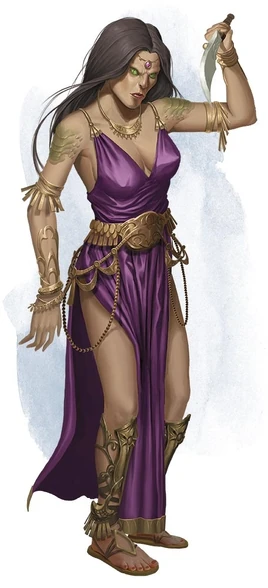
](https://static.wikia.nocookie.net/forgottenrealms/images/5/59/Yuan-ti_Pureblood-5e.png/revision/latest?cb=20171011135901 "5e")
[
](https://static.wikia.nocookie.net/forgottenrealms/images/f/f1/Yuan-ti_-_Sam_Wood.jpg/revision/latest?cb=20070211211557 "3e")
Various depictions of yuan-ti purebloods.
Yuan-ti Pureblood
-
5e
-
3e
-
2e
-
1e
5th Edition Statistics1
Size
Medium
Type
Alignment
Challenge rating
1
3rd Edition Statistics23
Size
Medium
Type
Subtype(s)
Alignment
Usually Chaotic evil
Challenge rating
3
2nd Edition Statistics4
Size
Medium
Alignment
1st Edition Statistics5
Size
Medium
Alignment
General Information
Patron deity
Vision
Activity cycle
Any4
Diet
Carnivore4
Average lifespan
80 – 120 years7
Homeland(s)
Language(s)
Favored climate
Favored terrain
Appearance
Average height
Average weight
Skin color(s)
Varies
Hair color(s)
Varies
Eye color(s)
Varies
Distinctions
Human appearance, with very subtle snake features2
Slim hips2
Fangs2
Forked tongue2
Patches of scaly skin2
Snake eyes7
Psionic abilities2
Serpent form2
Purebloods were the most human-seeming of all true yuan-ti and one of three main breeds—the other two being the halfbloods and the abominations.75
Contents
Description
Purebloods were described as human-like but with minor reptilian features, such as snake-like eyes, a forked tongue, and patches of scales on their skin.75
Purebloods had weights and heights in the same range as humans.2
Abilities
While not as powerful as other yuan-ti forms, purebloods still had psionic powers. Like all yuan-ti, they could morph their bodies into the form of any viper by force of will alone and could sense the presence of any poison nearby. They were also innately resistant to magic. They were not as intelligent as halfbloods, yet they still took pride in being more intelligent on average than humans.2
The psionic powers of purebloods included the ability to charm other humanoids, to entrance animals, to cause fear, to create darkness, and to command plants to entangle opponents.2
Purebloods were very adept at impersonating humans, and often entered human settlements in disguise as spies.27
Life Cycle
Pure bloods could mate with halfbloods or abominations but usually did not. Like other yuan-ti, they hatched from eggs and reached adulthood by twelve years of age. An average lifespan for any yuan-ti was 80 years, but attaining an age as great as 120 years was possible.7
Personality
Despite being thoroughly wicked, the majority of purebloods had magnetic personalities.6 Like all yuan-ti, they tended to be arrogant and self-centered.7
Purebloods were the least likely of the true yuan-ti breeds to remain attached to their tribe. Since they could more easily disguise themselves, they had the freedom to pursue their own interests wherever such things took them. Purebloods were the most likely yuan-ti to use grafts to modify their bodies, provided the new serpentine body parts could still be easily hidden with magic or underneath clothing until "needed".10
Combat
Yuan-ti were perfectionists, and only used high-quality weapons.11 They would rather weaken a foe from a distance than engage in melee combat. If a fight came to that, however, the purebloods would be sent in first as the more powerful and "valuable" yuan-ti waited.2
Purebloods were often equipped with studded leather armor2 and bore scimitars and heavy shields or longbows211 They often poisoned their blades and arrows.11
Purebloods who were trained in combat favored the skills of rangers.2 They were naturally dextrous.6
Society
[
](https://static.wikia.nocookie.net/forgottenrealms/images/5/52/Aviary_of_Extaminos.jpg/revision/latest?cb=20180923010849)
A pair of purebloods strolling through the Aviary of Extaminos in the city of Hlondeth.
Purebloods served a special role in yuan-ti society by being the liaisons, agents, spies, or assassins, as they could usually readily hide their serpentine features. They also oversaw the "lesser" yuan-ti servitor subraces, the broodguards and tainted ones.7
Language
Purebloods spoke the Yuan-ti language, Common, and any regional languages. They often could speak Abyssal or Draconic as well.6
Religion
Purebloods, like the majority of yuan-ti, worshiped the god Sseth.611 Free-wandering purebloods sometimes worshiped the god Varae instead.12 Some sects were known to worship demons.5
History
The sarrukh, one of the creator races, created the yuan-ti, including purebloods, millennia ago in controlled magical breeding experiments combining humans, serpents, and sarrukh themselves.13
Notable Yuan-ti Purebloods
- The Rhaunister family of Mhairhetel
- Mruthlissk, a male yuan-ti shadowdancer
- Tathtlass, a female yuan-ti assassin
- Dmetiro Extaminos, leader of Hlondeth's Cult of the Dragon
- Iraska, the "Slime King"
- Zaltys Serrat
- Nhyris D'Hothek, possessor of the Crown of Horns
- Netocris bin Shalah
Yuan-ti Pureblood
Medium Humanoid (Yuan-Ti), Neutral Evil
- Armor Class 11
- Hit Points 40 (9d8)
- Hit Points 40 (9d8)
- Speed 30 ft.
STR DEX CON INT WIS CHA 11 (+0) 12 (+1) 11 (+0) 13 (+1) 12 (+1) 14 (+2)
- Skills Deception +6, Perception +3, Stealth +3
- Damage Immunities poison
- Condition Immunities poisoned
- Senses darkvision 60 ft., passive Perception 13
- Languages Abyssal, Common, Draconic
- Challenge 1 (200 XP)
- Proficiency Bonus +2
Innate Spellcasting. The yuan-ti's spellcasting ability is Charisma (spell save DC 12). The yuan-ti can innately cast the following spells, requiring no material components:
At will: animal friendship (snakes only)
3/day each: poison spray, suggestionMagic Resistance. The yuan-ti has advantage on saving throws against spells and other magical effects.
Actions
Multiattack. The yuan-ti makes two melee attacks.
Scimitar. Melee Weapon Attack: +3 to hit, reach 5 ft., one target. Hit: 4 (1d6 + 1) slashing damage.
Shortbow. Ranged Weapon Attack: +3 to hit, range 80/320 ft., one target. Hit: 4 (1d6 + 1) piercing damage plus 7 (2d6) poison damage.
Purebloods form the lowest caste of yuan-ti society. They closely resemble humans, yet a pureblood can't pass for human under close scrutiny because there's always some hint of its true nature, such as scaly patches of skin, serpentine eyes, pointed teeth, or a forked tongue. Wearing cloaks and cowls, they masquerade as humans and infiltrate civilized lands to gather information, kidnap prisoners for interrogation and sacrifice, and trade with anyone who has something that can further their myriad plots.
Yuan-ti
Yuan-ti are devious serpent folk devoid of compassion. From remote temples in jungles, swamps, and deserts, the yuan-ti plot to supplant and dominate all other races and to make themselves gods.
Forsaken Humanity. The yuan-ti were once humans who thrived in the earliest days of civilization and worshiped serpents as totem animals. They lauded the serpent's sinuous flexibility, its calculated poise, and its deadly strike. Their advanced philosophy taught the virtue of detachment from emotion and of clear, focused thought.
Yuan-ti culture was among the richest in the mortal world. Their warriors were legendary, their empires always expanding. Yuan-ti temples stood at the centers of ancient metropolises, reaching ever higher in prayer to the gods they longed to emulate. In time, the serpent gods heard those prayers, their sibilant voices responding from the darkness as they told the yuan-ti what they must do. The yuan-ti religion grew more fanatical in its devotion. Cults bound themselves to the worship of the serpent gods and imitated their ways, indulging in cannibalism and humanoid sacrifice. Through foul sorcery, the yuan-ti bred with snakes, utterly sacrificing their humanity to become like the serpent gods in form, as well as in thought and emotion.
Yuan-ti know that the world they hope to rule can't be bound for long by brute force, and that many creatures will refuse to serve. As a result, yuan-ti first influence other creatures with the promise of wealth and power. Time and again, humanoid cultures make the fatal mistake of trusting the yuan-ti. They forget that a yuan-ti that acts honorably or lends aid in a time of trouble does so only as part of a grander design.
Yuan-ti leaders are cunning and ruthless tacticians who readily sacrifice lesser yuan-ti if potential victory justifies such losses. They have no sense of honorable combat and strike first in decisive ambush if they can.
Serpent Kings of Fallen Empires. The yuan-ti view their physical transformation as a transcendent moment for their race, allowing them to shed their frail humanity like dead skin. Those that did not transform eventually became slaves or food for the blessed of the serpent gods. The yuan-ti empires withered or were defeated by those who fought against their cannibalism and slavery, and the serpent folk were left in the ruins of their great capitals, far removed from other races.
Cold of Heart. Humanoid emotions are foreign to most yuan-ti, which understand sentiment only as unexploitable weakness. A yuan-ti views the world and the events of its own life with such extreme pragmatism that it is nearly impossible to manipulate, influence, or control by nonmagical means, even as it seeks to control other creatures through terror, pleasure, and awe.
False Worship. Yuan-ti life revolves around their temples, yet yuan-ti don't love the gods they worship. Instead, they see worship as a means to attain power. A yuan-ti believes an individual who attains enough power can devour and replace one of the yuan-ti gods. The yuan-ti strive for ascension and are willing to commit the darkest atrocities to achieve it.
Serpent Gods
The yuan-ti revere a number of powerful entities as gods, including the following.
Dendar, the Night Serpent. Dendar's followers say that one day she will grow so large from feasting on the fears and nightmares of the world that she will devour it whole. Yuan-ti that serve Dendar terrorize other creatures in any way they can, growing and nurturing the fears of humanoids to feed the Night Serpent.
Merrshaulk, Master of the Pit. Merrshaulk is the long slumbering chief deity of the yuan-ti. As worship of Merrshaulk waned, he went into slumber. Merrshaulk's priests are yuan-ti abominations that maintain traditions of living sacrifice and cause suffering in the god's name. With enough vile acts, the abominations believe that Merrshaulk will reawaken and restore the yuan-ti to their rightful place.
Sseth, the Sibilant Death. Sseth appeared to the yuan-ti of antiquity in the form of a winged yuan-ti claiming to be an avatar of Merrshaulk. Speaking with Merrshaulk's voice, Sseth vowed to pull the yuan-ti out of decline and build a new empire. Many of Merrshaulk's devout turned to the worship of Sseth. Some yuan-ti have long suspected Sseth as an usurper taking advantage of Merrshaulk's slumber to make himself a god. They believe that Sseth might even have devoured Merrshaulk, and now answers the prayers of Merrshaulk's followers, as his priests convert or consume Merrshaulk's more stubborn adherents.
The yuan-ti cast off their humanity long ago, and with it, their sanity.— From Masters of the Forbidden City by Codo Vidak
Zombie
- Ability Scores. Constitution +2; Strength +1; Wisdom −4; Charisma −4; Intelligence −6
- Size. Medium
- Speed. 30 ft.
Creature Type. You are Undead.
Undead Fortitude. If damage reduces you to 0 hit points, you must make a Constitution saving throw with a DC of 5+the damage taken, unless the damage is radiant or from a critical hit. On a success, you drop to 1 hit point instead.
Undead Nature. You are immune to poison damage, and you can't be poisoned. You don't require air, food, drink, or sleep.
Darkvision. You can see in dim light within 60 feet of you as if it were bright light, and in darkness as if it were dim light. You can't discern color in darkness, only shades of gray.
Languages. You can't speak, but you can understand the languages you knew in life.
Note: This race is listed in the Dungeon Master's Guide as an option for creating NPCs. It is not designed for use as a playable race.
Source: _TTP, page 3
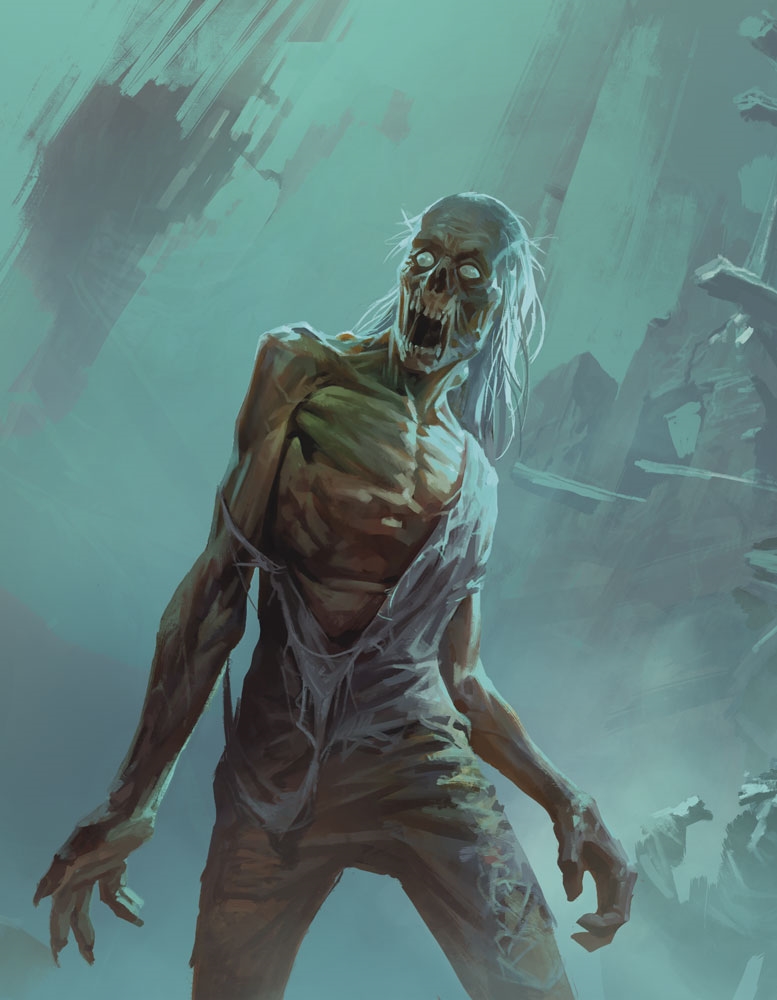
Forgotten Realms Wiki:
A zombie was an undead creature usually created by the re-animation of a corpse. Unlike animated skeletons, zombies still retained some flesh on their bodies and gave off a horrid, rank smell. They were almost mindless, but could be given simple commands, such as "kill anyone who opens the treasure chest." Virtually any solid creature could be turned into a zombie; in addition to humanoids, troglodytes, minotaurs, ogres, and even beholders, among others, could be turned into zombies.13
“
The Realms would be far friendlier to the undead if we learned to exercise greater control over our culinary habits. I fear most of us are beyond reasoning though. If you can get three moans from a zombie, you can consider it a good conversation.
”
— Lyressa
Description
Basically, a zombie was the corpse of a creature that had been animated by someone who could manipulate negative energy, such as a cleric. For example, a cleric would be able to use negative energy on a corpse and make it move its body, arms, legs, etc.3 Zombies could also rise spontaneously if an area was saturated with necromantic magic.1 Some zombies were risen after their bodies were preserved, appearing significantly less grotesque than their rotting kind.7 On rare occasions, ordinary zombies retained some of their basic cognitive functions, able to speak simple words and phrases8 and some were capable of wielding weapons.7910
Zombies dragged their feet and so did not leave clear prints.11
They were manifestations of the lowest tiers of necromantic magic and were naught but soulless shambling shells. When a zombie was raised, its soul was already long gone to the afterlife and was not forced into the decaying corpse.
5th Edition Statistics
Size
Medium
Type
Alignment
Challenge rating
1⁄4
General Information
Vision
Darkvision
Activity cycle
Night
Favored climate
Any
Favored terrain
Any
Appearance
Average height
6 ft (1.8 m)
History
First appearance
Ecology
Necromancers used demons' blood as a powerful magical adhesive liberally applied to zombies' joints to stave the rotting and disintegration of tissues.13
Habitats
The monstrous hamlet of Wormbarrow was located deep within Undermountain, inhabited by Ghaunadaur-worshiping avolakias and numerous undead, including zombies.14
In the 15th century DR, the Jungles of Chult became home to hordes of zombies created by Ras Nsi in an attempt to conquer the city of Mezro. With the city departing the Prime Material plane, Nsi's zombies remained a plague.15
10,000 zombies inhabited the so-called City of Zombies in the 333rd layer of the Abyss, ruled by the Zombie King. These rotting wrecks were victims of Orcus and sought to achieve true death that would end their torturous existence.16
Relationships
Zombies were common shock troops used by the drow of Menzoberranzan, including House Do'Urden that used fellow drow as their undead servants.17
They were also a profitable business. Shradin's Excellent Zombies shop in Skullport offered zombies controllable via a dead hand scepter for purchase.18
Variants
Ankylosaurus zombie
A zombie created from the corpse of an ankylosaurus, typical to the jungles of Chult.19
A zombie created from ash of the victims of the Mount Hotenow explosion. Usually Thayan magic in the creation.20
Sometimes called Death tyrants; zombified beholders which possessed some of their deadly abilities.21
Zombies infused with deathly cold, which were capable of sapping the life from their victims.222
Girallon zombie
Crated from the corpse of a girallon, typical to some locations in Chult.19
Undead hounds found in Shadowfell and sometimes used by Thayan necromancers.23
Greater zombie
A stronger and more resilient version of an ordinary zombie.24
Free-willed, sentient zombies often created from powerful curses or other fell magics.25
Netherese zombie
Intelligent and sentient walking dead servants of the Lichlord.26
Powerful zombies created from dead ogres.1
Created from the corpses of humans who drowned at sea.4
Created from the corpse of a tyrannosaurus, typical to Chult. These fearsome creatures could regurgitate zombies from their gullets.19
Priests of evil deities killed by other evil deities.27
Created from dragons and retained some of their deadly abilities. Not to be confused with dracoliches.
Notable Zombies
- Connor Vinderblad, a victim of Auntie Ethel's in the late 15th century DR.29
- Viledel, the Sea King, and his wife Liala, rose as well-reserved zombies when their tomb on the Island of Viledel was disturbed by a group of shipwreck survivors in the mid-14th century DR.7
Appendix
See Also
Zombie
Medium Undead, Neutral Evil
- Armor Class 8
- Hit Points 22 (3d8 + 9)
- Hit Points 22 (3d8 + 9)
- Speed 20 ft.
STR DEX CON INT WIS CHA 13 (+1) 6 (-2) 16 (+3) 3 (-4) 6 (-2) 5 (-3)
- Saving Throws Wis +0
- Damage Immunities poison
- Condition Immunities poisoned
- Senses darkvision 60 ft., passive Perception 8
- Languages understands all languages it spoke in life but can't speak
- Challenge 1/4 (50 XP)
- Proficiency Bonus +2
Undead Fortitude. If damage reduces the zombie to 0 hit points, it must make a Constitution saving throw with a DC of 5 + the damage taken, unless the damage is radiant or from a critical hit. On a success, the zombie drops to 1 hit point instead.
Actions
Slam. Melee Weapon Attack: +3 to hit, reach 5 ft., one target. Hit: 4 (1d6 + 1) bludgeoning damage.
From somewhere in the darkness, a gurgling moan is heard. A form lurches into view, dragging one foot as it raises bloated arms and broken hands. The zombie advances, driven to kill anyone too slow to escape its grasp.
Dark Servants. Sinister necromantic magic infuses the remains of the dead, causing them to rise as zombies that do their creator's bidding without fear or hesitation. They move with a jerky, uneven gait, clad in the moldering apparel they wore when put to rest, and carrying the stench of decay.
Most zombies are made from humanoid remains, though the flesh and bones of any formerly living creature can be imbued with a semblance of life. Necromantic magic, usually from spells, animates a zombie. Some zombies rise spontaneously when dark magic saturates an area. Once turned into a zombie, a creature can't be restored to life except by powerful magic, such as a resurrection spell.
A zombie retains no vestiges of its former self, its mind devoid of thought and imagination. A zombie left without orders simply stands in place and rots unless something comes along that it can kill. The magic animating a zombie imbues it with evil, so left without purpose, it attacks any living creature it encounters.
Hideous Forms. Zombies appear as they did in life, showing the wounds that killed them. However, the magic that creates these vile creatures often takes time to run its course. Dead warriors might rise from a battlefield, eviscerated and bloated after days in the sun. The muddy cadaver of a peasant could claw its way from the ground, riddled with maggots and worms. A zombie might wash ashore or rise from a marsh, swollen and reeking after weeks in the water.
Mindless Soldiers. Zombies take the most direct route to any foe, unable to comprehend obstacles, tactics, or dangerous terrain. A zombie might stumble into a fast-flowing river to reach foes on a far shore, clawing at the surface as it is battered against rocks and destroyed. To reach a foe below it, a zombie might step out of an open window. Zombies stumble through roaring infernos, into pools of acid, and across fields littered with caltrops without hesitation.
A zombie can follow simple orders and distinguish friends from foes, but its ability to reason is limited to shambling in whatever direction it is pointed, pummeling any enemy in its path. A zombie armed with a weapon uses it, but the zombie won't retrieve a dropped weapon or other tool until told to do so.
Undead Nature. A zombie doesn't require air, food, drink, or sleep.
After Beek died, we cast an animate dead spell on his corpse. It was fun for a while, but the zombie started to smell real bad, so we doused it in oil and set it on fire. Beek would've found that hilarious.— Fonkin Hoodypeak, on friendship