Path of the Brawler (2024)
A rowdy combatant, thriving in chaotic brawls and using improvised attacks to devastate foes.
Adept Brawler (3rd)
You possess an innate talent for turning scraps, mundane items, potions, and more into deadly weapons. Consult the Typical Improvised Weapon chart for details.
Typical Improvised Weapon
| Size | Damage | Examples |
|---|---|---|
| Tiny | 1d4 | Coin, Mug, Fork, Small Rock |
| Small | 1d6 | Bottle, Rolling Pin, Torch |
| Medium | 1d8 | Branch, Chair, Rock |
| Large | 2d6 | Bar Stool, Door, Wagon Wheel |
| Huge | * | Wagon, Log, Statue, Large Bell |
| Gargantuan | * | Boulder, Broken Wall, Tree |
Huge & Gargantuan Objects*
Using huge or gargantuan improvised weapons deals massive damage (as determined by your Dungeon Master), but requires the correct circumstances to utilize. For example: a cracked pillar ready to topple, a boulder pushed down a steep hill, etc.
Frequency of Use
Improvised weapons vary in frequency of use based on durability. Fragile objects (e.g., bottles, clay pots) are one-time use, breaking after a successful attack. Sturdy items (e.g., chairs, wooden planks) can endure 3 to 5 attacks before breaking, while durable items (e.g., metal pipes, strong beams) function like standard weapons, only breaking on a critical failure (natural 1).
Improvised Weapon Examples:
Here are some examples to assist you!
- Chair (Medium, Wooden): 1d8 bludgeoning damage. Can be used 3 times before it breaks.
- Broken Bottle (Small, Glass): 1d6 piercing damage. Breaks after 1 use.
- Metal Pipe (Medium, Metal): 1d8 bludgeoning damage. Very durable. Breaks only on a natural 1.
Improvised Fighter (3rd)
You have proficiency with improvised weapons. Additionally, when you wield an improvised weapon, you use the Weapon Mastery listed for it in the section below. If an improvised weapon does not have an assigned Mastery, you can choose one Mastery property for it from the list of martial weapon Masteries (Cleave, Graze, Nick, Push, Sap, Slow, Topple, Vex) or the improvised Mastery list (Burst, Feint, Flick, Ricochet, Tangle, Utilize) with the DM’s approval.
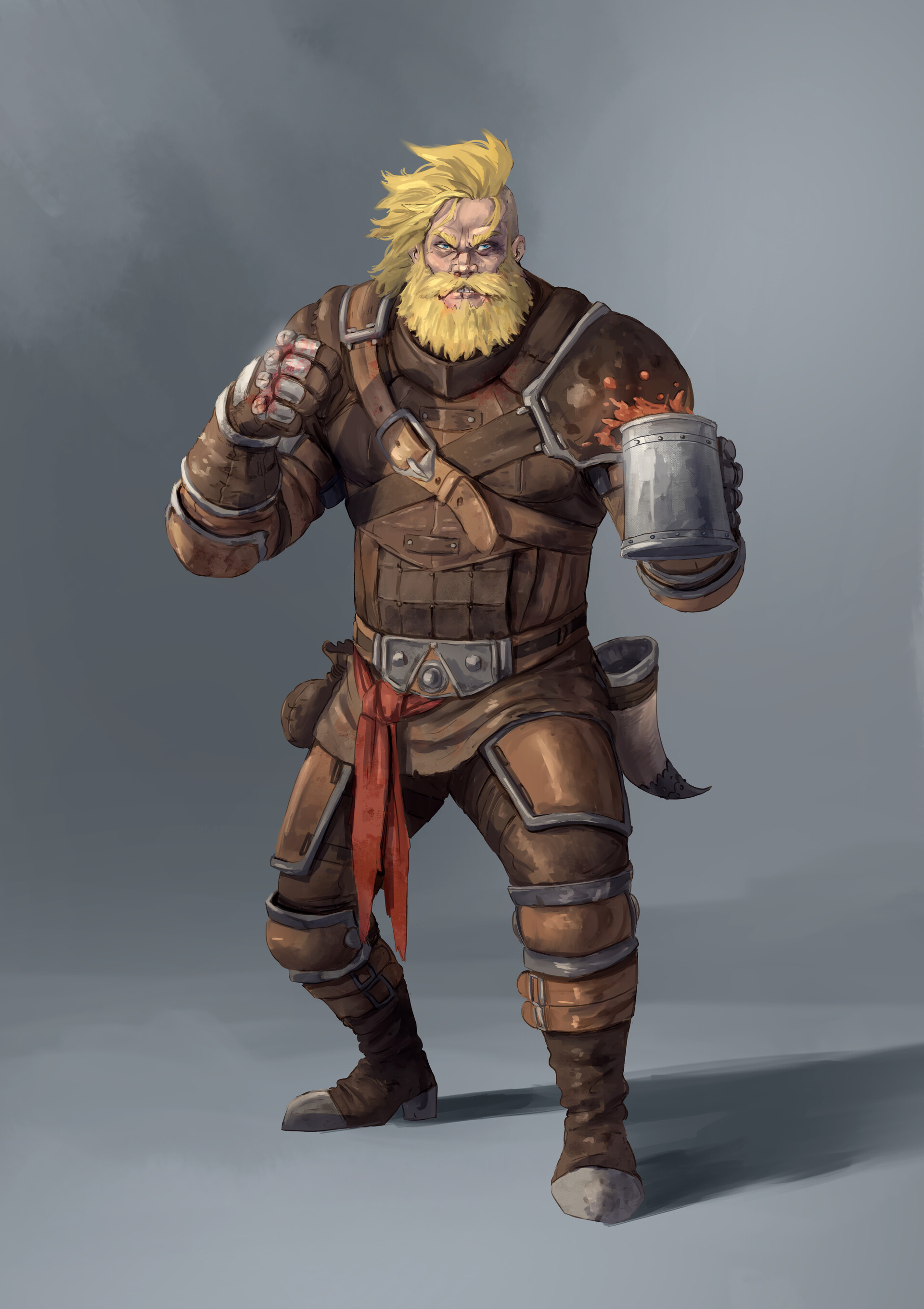
Art Credit: Felipe Bracioli (Artstation)
Improved Brawling (6th)
When you use the Attack action with an Unarmed Strike or Improvised Weapon on your turn, you can make one Unarmed Strike as a Bonus action. Whenever you deal damage with an improvised weapon or Unarmed Strikes, it can deal your choice of Force damage or its normal damage type.
Battle Customization (6th)
During a short or long rest, you can spend 1 minute modifying an improvised weapon to suit your combat style. You can modify a number of improvised weapons this way equal to your Proficiency Bonus. A modified weapon has a +1 bonus to attack and damage rolls, this bonus improves to +2 at level 10, and +3 at level 14. The properties last until the weapon breaks, or you roll a natural 1 when you make an attack roll with the modified weapon. You can choose from the properties below:
- Battering. The weapon deals double damage to objects and structures.
- Concussing. If you hit a creature concentrating on a spell, that creature subtracts 1d4 from the Constitution saving throw made to maintain concentration.
- Daunting. If you reduce a creature to 0 hit points with an object not meant to kill, you have advantage on your next Charisma (Intimidation) check before the end of your next turn, as others are shaken by your improbable lethality.
- Jury-Rigged. Choose one Weapon Mastery property appropriate to this improvised weapon’s form and use (DM’s discretion). The weapon gains that property in addition to any it already has.
- Reach. The weapon’s reach is 5 feet greater.
- Reinforced. Lasts twice as many hits before breaking.
- Sharp. When you score a critical hit with this weapon, you roll one additional damage die of the weapon’s damage type and add it to the damage of the critical hit.
- Shielding. While you are wielding this weapon, you gain a +1 bonus to AC.
- Tethered Throw. The weapon returns to your hand immediately after being thrown.
- Throw. Gains the thrown property (range 30/120). If it already has the thrown property, its normal range is doubled.
- Weighted. When you score a critical hit, you can roll one of the weapon's damage dice one additional time and add it to the extra damage of the critical hit.
Practical Limitations
Not every modification is practical, and the DM has final say on whether an improvised weapon can safely support a chosen property or maintain its structural integrity, as some items may not be suitable for throwing or specific alteration.
Interupting Strike (10th)
When a creature you can see makes an attack roll against you while within 5 feet of you or within the normal range of an improvised weapon you’re holding, you can use your Reaction to make one attack against that creature before it rolls.
Make It Hurt (10th)
When you hit with an improvised weapon, increase its damage die by one step on the Improvised Damage Progression below.
Improvised Damage Progression: 1d4 → 1d6 → 1d8 → 1d10 → 2d6 → 2d8 → 3d6 → 3d8 → 4d6 → 4d8 → 6d6 → 6d8 → 8d6 → 8d8 → 12d6 → 12d8 → 16d6
If a damage die isn’t shown above, choose the next higher value.
Miasmic Rowdiness (14th)
When your spirit ignites, it spreads quickly as those around you are caught up in the chaos, their hearts pounding and fists flying.
When you enter your Rage, you can choose a number of willing creatures you can see within 30 feet of you equal to your Proficiency Bonus (minimum of one creature). While at least one creature is under the effect of Miasmic Rowdiness, the first time you hit with an Unarmed Strike or improvised weapon on your turn, you deal extra damage equal to 1d6 + your Proficiency Bonus.
Until your Rage ends, whenever one of those creatures starts its turn while you are in sight, you can grant it one of the following benefits until the start of its next turn:
- It gains temporary hit points equal to half your Barbarian level + your Constitution modifier.
- It gains proficiency with improvised weapons and has advantage on attack rolls made with them.
- As a Bonus Action, it can make one Unarmed Strike, adding your Rage Damage bonus to the damage of that attack.
Once you use this feature, you can’t use it again until you finish a Long Rest, unless you expend one use of your Rage (no action required) to regain its use.
Improvised Weapon Expanded PHB'2024
These charts show the damage and properties of common items used as improvised weapons. If an item isn’t listed, use the closest equivalent.
Improvised Weapons
| Item | Damage | Properties | Mastery |
|---|---|---|---|
| Arrow/Bolts | 1d4 Piercing | Light, Finese, Thrown (20/60) | Nick |
| Ball Bearings (1000) | 1d4 Bludgeoning | Thrown (20/60) | Utilize |
| Barrel | 2d6 Bludgeoning | Heavy, Two-Handed | Burst |
| Bedroll/blanket | 1d4 Bludgeoning | - | Topple |
| Book | 1d4 Bludgeoning | Light | Ricochet |
| Bottle/Jug | 1d4 Bludgeoning | Light, Finese, Thrown (20/60) | Burst |
| Bucket | 1d4 Bludgeoning | Light | Sap |
| Caltrops | 1d4 Slashing | Thrown (20/60) | Utilize |
| Chain (10 ft.) | 1d8 Bludgeoning | Reach, Two-Handed | Tangle |
| Chest | 2d6 Bludgeoning | Heavy, Two-Handed | Push |
| Coin | 1d4 Bludgeoning | Light, Thrown (20/60) | Flick |
| Crowbar | 1d6 Bludgeoning | Light, Versatile (d8) | Feint |
| Grappling Hook | 1d6 Piercing | Thrown (20/60) | Tangle |
| Hunting Trap | 1d4 Bludgeoning | Thrown (20/60) | Utilize |
| Ladder | 1d8 Bludgeoning | Reach, Two-Handed | Slow |
| Lamp/Lantern | 1d4 Bludgeoning | Light, Thrown (20/60) | Burst |
| Manacles | 1d4 Bludgeoning | Light | Nick |
| Mirror | 1d4 Bludgeoning | - | Burst |
| Net | 1d4 Bludgeoning | Thrown (20/60) | Tangle |
| Paper | 1d4 Slashing | Light | Vex |
| Pole | 1d6 Bludgeoning | Reach, Two-Handed | Push |
| Pot, Iron | 1d6 Bludgeoning | Light, Versatile (d8) | Sap |
| Ram, Portable | 2d6 Bludgeoning | Heavy, Two-Handed | Push |
| Rope | 1d1 Bludgeoning | Thrown (15/30) | Tangle |
| Shovel | 1d8 Bludgeoning | Versatile (d10) | Sap |
| Spike, Iron | 1d4 Piercing | Light, Finese | Nick |
| Tinderbox | 1d2 Fire | Light | Flick |
| Torch (lit) | 1d4 Fire | Light | Sap |
| Waterskin | 1d1 Bludgeoning | Thrown (20/60) | Burst |
Chemicals
| Item | Damage | Properties | Mastery |
|---|---|---|---|
| Acid Flask | 1d4 Bludgeoning | Light, Thrown (20/60) | Burst (2d8 Acid) |
| Alchemist’s Fire | 1d4 Bludgeoning | Light, Thrown (20/60) | Burst (2d4 Fire + Burn) |
| Antitoxin | 1d4 Bludgeoning | Light, Thrown (20/60) | Burst |
| Healing Potion | 1d4 Bludgeoning | Light, Thrown (20/60) | Burst (2d6 + 2 Healing) |
| Holy Water | 1d4 Bludgeoning | Light, Thrown (20/60) | Burst (2d10 Radiant) |
| Oil Flask | 1d4 Bludgeoning | Light, Thrown (20/60) | Burst (Oil) |
| Poison, Basic | 1d4 Bludgeoning | Light, Thrown (20/60) | Burst (1d6 Poison) |
New Weapon Mastery Properties
These charts show the damage and special effects of specific improvised weapons. Start with the Typical Improvised Weapons chart for base damage, then use the others for special cases.
Burst
When you hit a creature with this weapon, you may break it. If it contains a substance, that substance is spilled onto the target and into its space. If it does not contain a substance, the breaking weapon deals 1d6 piercing damage to the target and each creature within 5 feet.
Feint
If you attack a creature with this weapon and miss, you have advantage on your next attack roll against that creature before the end of your next turn.
Flick
Being within 5 feet of an enemy doesn't impose Disadvantage on your attack rolls with this Ranged weapons.
Art Credit: u/JameserThe5th
Tavern Brawl Art
Ricochet
If you hit a creature with a ranged attack roll using this weapon, you can make a ranged attack roll with the weapon against a second creature within 10 feet of the first. On a hit, the second creature takes the weapon's damage, but don't add your ability modifier to that damage unless that modifier is negative. You can make this extra attack only once per turn.
Tangle
When you hit a creature with this weapon, you can attempt to entangle it. The target must succeed on a Strength or Dexterity saving throw (its choice) against a DC equal to 8 + your Strength modifier + your proficiency bonus or become grappled. You must have a free hand to use this property.
Utilize
If you hit a creature with this weapon, you can immediately use the item’s normal effect as if you had taken the Utilize action. The item is used or deployed as normal.
References
Weapon Mastery Properties (p.214)
Cleave
If you hit a creature with a melee attack roll using this weapon, you can make a melee attack roll with the weapon against a second creature within 5 feet of the first that is also within your reach. On a hit, the second creature takes the weapon's damage, but don't add your ability modifier to that damage unless that modifier is negative. You can make this extra attack only once per turn.
Graze
If your attack roll with this weapon misses a creature, you can deal damage to that creature equal to the ability modifier you used to make the attack roll. This damage is the same type dealt by the weapon, and the damage can be increased only by increasing the ability modifier.
Nick
When you make the extra attack of the Light property, you can make it as part of the Attack action instead of as a Bonus Action. You can make this extra attack only once per turn.
Push
If you hit a creature with this weapon, you can push the creature up to 10 feet straight away from yourself if it is Large or smaller.
Sap
If you hit a creature with this weapon, that creature has Disadvantage on its next attack roll before the start of your next turn.
Slow
If you hit a creature with this weapon and deal damage to it, you can reduce its Speed by 10 feet until the start of your next turn. If the creature is hit more than once by weapons that have this property, the Speed reduction doesn't exceed 10 feet.
Topple
If you hit a creature with this weapon, you can force the creature to make a Constitution saving throw (DC 8 plus the ability modifier used to make the attack roll and your Proficiency Bonus). On a failed save, the creature has the Prone condition.
Vex
If you hit a creature with this weapon and deal damage to the creature, you have Advantage on your next attack roll against that creature before the end of your next turn.
Improvised Weapons Rules (p.369)
An improvised weapon is an object wielded as a makeshift weapon, such as broken glass, a table leg, or a frying pan. A Simple or Martial weapon also counts as an improvised weapon if it's wielded in a way contrary to its design; if you use a Ranged weapon to make a melee attack or throw a Melee weapon that lacks the Thrown property, the weapon counts as an improvised weapon. An improvised weapon follows the rules below.
Proficiency. Don't add your Proficiency Bonus to attack rolls with an improvised weapon.
Damage. On a hit, the weapon deals 1d4 damage of a type the DM thinks is appropriate for the object.
Range. If you throw the weapon, it has a normal range of 20 feet and a long range of 60 feet.
Weapon Equivalents. If an improvised weapon resembles a Simple or Martial weapon, the DM may say it functions as that weapon and uses that weapon's rules. For example, the DM could treat a table leg as a Club.
Equipping and Unequipping Weapons (p.369)
You can either equip or unequip one weapon when you make an attack as part of this action. You do so either before or after the attack. If you equip a weapon before an attack, you don't need to use it for that attack. Equipping a weapon includes drawing it from a sheath or picking it up. Unequipping a weapon includes sheathing, stowing, or dropping it.
Origin Feat: Tavern Brawler (p.202)
Enhanced Unarmed Strike. When you hit with your Unarmed Strike and deal damage, you can deal Bludgeoning damage equal to 1d4 plus your Strength modifier instead of the normal damage of an Unarmed Strike.
Damage Rerolls. Whenever you roll a damage die for your Unarmed Strike, you can reroll the die if it rolls a 1, and you must use the new roll.
Improvised Weaponry. You have proficiency with improvised weapons.
Push. When you hit a creature with an Unarmed Strike as part of the Attack action on your turn, you can deal damage to the target and also push it 5 feet away from you. You can use this benefit only once per turn.