Gritty No Magic D&D
"You think this war is different from any of the thousands fought before? You think our lives, our stories, are special? You're a fool.
We fight for a man we don't know. In a land we've never heard of before. Against an enemy who has done us no wrong - except kill our comrades in defence of their homes and families.
And why fight? All so that man can sit upon another throne. History will remember him, not us... The forsaken pawns of war.
Even after we give our lives for this doomed cause, our children will grow weak, their hands uncalloused and fattened from the fruits of our torment.
And so another king will ride over the hill, with an army full of men just like us, and claim this land for himself... Such is the endless cycle of this cruel world."
—Words of wisdom, or heresy
General Rule Changes
The following rules replace the existing rules found in the Player's Handbook.
Health, Stamina and Stamina Die
There are two measures of a creatures current life-force: Health and Stamina. Health represents their real, actual ability to take an injury, while stamina represents their staying power, determination, and ability to go on fighting after a few bruises.
Stamina
Stamina is exactly like hit points in the base Dungeons & Dragons rules. A player character gets Stamina based on their class, can recover Stamina by rolling their Stamina Dice on a short rest, etc.
Otherwise, except for the specific exceptions here, if the base rules refer to hit points, they refer to Stamina in this system.
Health
Health on the other hand is equal to a creature's Constitution score + their class level or the number of stamina die they have (whichever is higher).
When a creature’s Stamina hits 0, they take any further damage to their Health instead. When a creature’s Health hits 0, they start making saves against dying and their current Stamina also drops to 0, if it is not already.
The amount of Health a creature has is also dependent on their size. For every size category larger than Medium, a creature gains 5 Health. Likewise, for every size category below Medium, a creature loses 5 Health, to a minimum of 1.
Taking Damage
When a damage roll is made against a creature, damage is dealt to it’s Stamina. If the target has 0 Stamina and takes damage it is dealt to it’s Health instead.
On a critical hit, the attacker deals the maximum amount of damage the attack can deal to the target’s Stamina and then rolls the attack's damage as normal, which is then applied to the target's Health regardless of the target’s current Stamina. The target also gains a gritty injury (see Combat).
If the target of an attack is two or more size categories larger than the attacker, damage can only be dealt to their Health when the target has 0 Stamina. In the case of the Health damage from a critical hit on such a creature, the attacker rolls the attack’s damage and adds the result to the Stamina damage instead.
Regaining Health and Stamina
When a character would receive healing only their Stamina will be healed unless they are taking a long rest. Certain abilities ignore this rule, as stated in their descriptions. All Health and Stamina is regained after completing a long rest.
Resting
The following resting rules force players to carefully judge the benefits and drawbacks of combat. Characters can't afford to engage in too many battles in a row, and all adventuring requires careful planning.
There are two different types of rest: a short and long rest.
Short Rest
A short rest is a period of extended downtime, at least 8 hours long, during which a character sleeps for at least 6 hours and performs no more than 2 hours of light activity such as reading, talking, eating, or standing watch. If the rest is interrupted by a period of strenuous activity, at least 1 hour of walking, fighting, or similar activities, the character must begin the rest again to gain any benefit from it.
At the end of a short rest, a character can spend any number of Stamina Dice to heal, up to however many they have.
A character can spend Stamina Die to either heal, as per normal, or reduce their current level of exhaustion by 1 per stamina die spent. For every stamina die spent during a short rest, on either healing or reducing exhaustion, a character reduces their current Stress (see Madness) by 1.
A character can't benefit from more than one short rest in a 24-hour period, and they must have at least 1 health at the start of the rest to gain its benefits. If a character has not eaten enough food or drank enough water in the last 24 hours, they can’t benefit from a short rest.
Long Rest
A long rest is a period of 7 days of Downtime Activity. This period can include even strenuous activities such as dueling or training, but can’t include proper 'adventuring' activity or overland travel. Each day of the long rest is split into two 8 hour chunks, each of which can be dedicated to a Downtime Activity of a character's choice. For example, they can commit 8 hours a day to training for the whole rest, then spend 8 hours on four days days carousing, and 8 hours on the last three days practicing a profession. Smaller activities such as shopping do not count against the number of downtime activities a character can accomplish. If the rest is interrupted by a period of strenuous activity, at least 1 hour of 'adventuring' activity, they must begin the rest again to gain any benefit from it.
At the end of a long rest, a character regains all of their Health, Stamina and Stamina Dice, and their exhaustion is reduced by 1. Additionally, a character rolls a d4 per day to recover Stress. On an even number the character removes 1 Stress while on an odd number they remove no Stress. A character can guarantee Stress removal by indulging in a vice such as drinking or wenching during a period of Downtime. For every period of Downtime they do so they roll a d4. On an even number the character removes 2 Stress while on an odd number they remove 1 Stress. Indulging a vice will often require some monetary investment or other 'price' depending on their chosen vice.
In order to take a long rest, the characters must be in a settlement of hamlet size or larger that is non-hostile towards them.
Sleeping in Armour
Sleeping in light armour has no adverse effect on the wearer, but sleeping in medium or heavy armour makes it difficult to recover fully during a short rest.
When a character finishes a short rest during which they slept in medium or heavy armour, they half any stamina they recover and do not reduce their Stress as a result of spending Stamina Die. If a character has any levels of exhaustion, they cannot choose to reduce it by spending Stamina Die.
Going Without a Short Rest
A short rest is never mandatory, but going without sleep does have its consequences.
Whenever a character ends a 24-hour period without finishing a short rest, they gain 1 Stress and must succeed on a DC 10 Constitution saving throw or suffer one level of exhaustion.
It becomes harder to fight off exhaustion if a character stays awake for multiple days. After the first 24 hours, the DC increases by 5 and the amount of Stress gains increases by 1 for each consecutive 24-hour period without a short rest. The DC and Stress gained resets to 10 and 1 respectively when the character finishes a short or long rest.
New Skills
There are two new skills available to player characters and NPCs, which are detailed below.
Grit
A Constitution (Grit) skill check is used when a character tries to persevere through physical trauma or overcome challenges through sheer endurance.
Occultism
An Intelligence (Occultism) skill check is used when a character tries to recall obscure information not founded in historical accounts or religious doctrine, or to divine meaning from supposedly 'magical' events or objects (such as the ramblings of an accused witch or the nature of a heretical idol).
This skill replaces the Intelligence (Arcana) skill.
Racial Options
Player characters can only be Humans or Variant Humans.
Classes
Refer to the GNM D&D Classes document for the classes available to players and NPCs.
Character Sheet
Use the following character sheet when using this ruleset.
Combat
Combat in the medieval times is brutal, gritty, and unforgiving. Yet it is a crucial and unavoidable part of the world. The following rules make even the most trivial combat into a life or death situation.
Gritty Injuries
Damage in standard 5e D&D normally leaves no lingering effects. The following rules introduce the potential for long-term injuries.
A creature gains a gritty injury under the following circumstances:
- When it takes a critical hit.
- When it rolls a natural 1 on a saving throw of a damaging effect.
- When it rolls a natural 1 on a death saving throw.
When one of these conditions is fulfilled a creature will then roll on the appropriate gritty injury table, determined by the damage type of the critical hit, in conjunction with the location table. A d10 is used when rolling on a gritty injury table.
The creature receives a modifier to their d10 roll from their Physical Condition before any damage from the attack is dealt. When the creature rolls as a result of hitting 0 health, use their health from before they were damaged down to 0 health.
| Physical Condition | Requirement | Modifier |
|---|---|---|
| Uninjured | Current health and stamina are equal to a character’s maximum for both respectively. | -1 |
| Bruised | Current stamina is less than a character's stamina maximum and their current health is equal to their health maximum. | +0 |
| Battered | Current stamina is less than or equal to half a character's stamina maximum and their current health is equal to their health maximum. | +1 |
| Bloodied | Current health is less than a character's health maximum. | +3 |
| Broken | Current health is less than or equal to half a character's health maximum. | +5 |
Location
When rolling for gritty injury, roll 1d6 and consult the table below, then consult the appropriate gritty injury table for the damage type of the injury.
| d6 | Location |
|---|---|
| 1 | Head |
| 2 | Torso |
| 3 | Right Arm |
| 4 | Left Arm |
| 5 | Right Leg |
| 6 | Left Leg |
Choosing a Location
If a creature is attacking an unconscious, paralyzed, or otherwise helpless creature, it may select the body part location it wishes to damage, rather than rolling randomly on the location table.
Inhuman Anatomy
If a creature does not have the requisite anatomy to match the location table, or it doesn't make sense for a certain location to be targeted, then it is up to GM adjudication to either modify the table or choose the location of the injury themselves.
Injury Types
The following injuries are referenced in the various critical injury tables.
Minor Scar
The scar doesn't have any adverse effect, though it is a grim reminder of a blow that might have killed you.
Horrible Scar
You are disfigured to the extent that the wound can't be easily concealed. You have a -2 penalty on Charisma (Persuasion) checks and a +2 bonus on Charisma (Intimidation) checks. For each Horrible Scar you obtain after the first, the penalty and bonus increases by 1.
Painful Scar
You have a scar which gets painful whenever you are subjected to physical trauma. Whenever you attempt an action in combat while you are Bloodied or Broken, you must make a DC 12 Constitution saving throw. On a failed save, you lose your action and can’t use reactions until the start of your next turn. For each Painful Scar you obtain after the first, increase the DC by 1.
Useless Limbs
An essentially paralysed, amputated, or otherwise nonfunctional limb/appendage. Attempting any action with a Useless Limb is done without any positive modifiers and has disadvantage. The table below details additional, specific penalties depending on the limb/appendage rendered Useless.
| Appendage Effected | Effect |
|---|---|
| Hand | You cannot use weapons that require both hands to wield and you have a -3 penalty to checks related to grappling and being disarmed. |
| Arm | In addition to the Hand penalties: You reduce your AC by 2 due to your reduced ability to defend yourself. |
| Foot | Your movement speed is reduced by 10 feet and taking the Dash action requires you to make a DC 12 Dexterity saving throw at the end of your movement, falling prone on a failure. |
| Leg | In addition to the Foot penalties: You cannot walk unaided or without a crutch (your movement speed is halved while you do so) and you reduce your AC by 1 due to your reduced ability to dodge attacks. |
Punctured Lung
You can either take an action or bonus action on your turn, but not both. A Punctured Lung heals by itself after 8 weeks. If you gain 2 punctured lungs at the same time, you die within 1d6 turns.
Festering Wound
Your health maximum is reduced by 1 every hour the wound persists. If your health maximum drops to 0, you die. The injury heals if someone can tend to the wound and make a DC 15 Wisdom (Medicine) check, or expend one use of a healer's kit, once every hour. After ten successes, the injury heals and you regain your health maximum by 1 point every day.
Open Wound
You lose 1 health and your health maximum is reduced by 1 every minute the wound persists. If your health maximum drops to 0, you die. The injury heals if someone can tend to the wound and make a DC 15 Wisdom (Medicine) check, or expend one use of a healer's kit, once every minute. After five successes, the injury heals and you regain your health maximum by 1 point every hour.
Bleeding Out
You lose 1 health at the beginning of each of your turns until you fall to 0 health, at which point you gain either an Open or Festering Wound (as described in the injury). A successful DC 15 Wisdom (Medicine) check, done by either you or someone else, will stop the blood loss for one round. After ten successes, the injury heals into an Open or Festering Wound (as described in the injury).
Critical Hits and Size
When a creature is critically hit by a creature one or more size categories larger than itself, that creature gains a cumulative +2 penalty to their Gritty Injury roll for every size category larger the attacking creature is.
Stressful Criticals
Whenever a creature receives a critical hit, that creature gains Stress equal to the number rolled on the d10 while rolling for the Gritty Injury.
Death Saving Throw Injury
When rolling for a gritty injury as a result of critically failing a Death saving throw, do so without adding any condition modifier and without rolling on the location table.
Critical Injury Tables
Refer to the Gritty Injury Tables HERE when rolling a Gritty Injury.
Optional Rule: Less Brutal Criticals
Should the Gritty Injury rules be to lethal for a GMs taste, they can use any combination of the following optional rules instead:
- Lesser Foes: Some enemies hit harder than others. When rolling the severity of a Gritty Injury, weak foes roll a d4 instead of a d10. What constitutes a 'weak' foe is up to GM adjudication.
- Non-Severe Injuries: A creature's current Physical State does not add to the severity of a Gritty Injury.
- "It's just a flesh wound... I've had worse.": Creatures do not gain Stress as a result of being critically hit.
- Critical Confirmation: Whenever an enemy critically hits a player character, the enemy must roll another d20. Should the result meet or beat the character's AC, then they gain a Gritty Injury like normal. If not then the character does not gain a Gritty Injury but suffers the extra damage of a critical hit.
Infection
When a creature receives an open or festering wound, or a particularly unpleasant injury, there is a chance that said wound can become infected if not treated properly. If a creature fails the Wisdom (Medicine) check to tend to an open or festering wound by 10 or more or by rolling a 1 on the d20, critically failing, then the creature with the injury must make a DC 10 Contusion saving throw to resist infection. On a failure, the wound becomes Infected.
While a creature has an infected wound, they cannot regain health and the amount of stamina they regain during a rest is halved.
An infection will eventually kill the wounded creature in 1d2 weeks, rolled by the creature when the wound becomes Infected, unless they receive special healing from a medical professional. Said healing varies depending on the injury and the nature of the infection. An arm might be amputated or an exotic herb used to burn out the festering pus. Regardless, the cost of such treatment is ruinous for the wounded creature, both financially and in terms of self sacrifice.
Massive Damage
This rule makes it easier for a creature to be felled by massive damage.
When a creature takes damage to their Health from a single source equal to or greater than half its Health maximum, it suffers a random effect determined by a roll on the System Shock table.
| d10 | System Shock Effect |
|---|---|
| 1 | The creature drops to 0 Health and suffers a Gritty Injury. |
| 2 | The creature drops to 0 Health. |
| 3 | The creature drops to 0 Health, but is stable. |
| 4 | The creature is Stunned until the end of its next turn. |
| 5 | The creature is Incapacitated and Winded until the end of its next turn. |
| 6-7 | The creature is Staggered until the end of its next turn. |
| 8-9 | The creature is Winded until the end of its next turn. |
| 10 | The creature can’t take reactions until the end of its next turn. |
Stamina Shock
A character can lose their composure should they get the wind knocked out of them. Similar to System Shock, when a creature takes damage to their Stamina from a single source that reduces them to 0 Stamina, it must succeed on a DC 12 Constitution (Grit) check or become Winded until the end of its next turn.
Death and Dying
Life begets death. As such it is a constant presence in the world, both on and off the battlefield. Below are changes to the standard rules regarding death.
Falling to 0 Health
Whenever a creature is reduced to 0 Health but not killed outright, it gains a level of exhaustion an amount of Stress equal to any damage that was left over after reducing the creature to 0 health.
Death Saving Throws
The DC of death saving throws is 12, instead of 10.
Additionally, every time a creature fails a death saving throw it gains 1 Stress.
Instant Death
A devastating blow can end a creature's life instantly. When damage reduces a creature to 0 heath and there is damage remaining, the creature dies if the remaining damage equals or exceeds their health maximum.
Attacks of Opportunity
In a fight, everyone is constantly watching for enemies to drop their guard. You can rarely move heedlessly past your foes or divert your attention elsewhere without putting yourself in danger; doing so provokes an opportunity attack.
A creature provokes opportunity attacks from creatures within attacking reach in the following circumstances:
- When the creature intentionally moves out of a hostile creature’s reach.
- When the creature stands up from prone.
- When the creature is flanked and takes the Attack Action and does not target one or more of the creatures flanking them. This only provokes an opportunity attack for the non-targeted flanking creatures.
To make an opportunity attack, a creature uses their reaction to make one melee attack against the provoking creature. The attack interrupts the provoking creature’s turn, occurring right before the creature leaves attack reach, stands from prone or makes their attack.
A creature can avoid provoking an opportunity attack by taking the Disengage Action if they wish to move out of a creature's reach, by spending their full movement to stand up from prone, or by using the Attack Action and targeting all the creatures currently flanking them with an attack.
A creature does not provoke an opportunity attack when someone or something moves them without that creature using their movement, action, or reaction. Additionally a creature does not provoke opportunity attacks when they themselves make an opportunity attack while flanked. For example, a creature does not provoke an opportunity attack if an explosion hurls them out of a foe’s reach or if gravity causes them to fall past an enemy.
Flanking
When a creature and at least one of its allies are adjacent to an enemy and on opposite sides or corners of the enemy’s space, they are considered to be flanking that enemy, as long as neither of them are being flanked themselves.
Facing
At the start of their turn when a creature is being flanked, it chooses one of the creatures flanking it to face. After the flanked creature makes this choice, the flanker it is not facing gains advantage on all melee attack rolls it makes against the flanked creature, while the flanker the flanked creature chose to face does not.
Give Ground
When a creature first begins to flank a target, the target can use its reaction to Give Ground. When it chooses to do so, the target makes a Wisdom (Perception) check contested by the flanking creature's Strength (Athletics) or Dexterity (Acrobatics) check. On a success, the target sees the creature coming and moves 5ft away from it. In addition, the creature cannot flank the target until the start of its next turn. On a failure, the creature can flank the target as normal.
Additional Combat Conditions
The following conditions supplement those found in the Player’s Handbook.
Winded
A creature suffering from the Winded condition gains the following penalties:
- Attack rolls against the creature have advantage, and the creature’s Attack rolls have disadvantage.
- The creature cannot take Reactions.
Staggered
A creature suffering from the Staggered condition gains the following penalties:
- The creature has disadvantage on Strength and Dexterity checks and saving throws.
- The creature’s movement speed is halved.
- The creature does not add its Dexterity modifier to its AC unless it’s a negative value.
- The creature does not add its Ability Modifier to weapon attacks and damage rolls unless it’s a negative value.
Madness
In typical medieval warfare people can be driven mad by the horrors they face and the carnage they inflict day after day, and sometimes the mere stress of being in these situations can be too much to bear. The following rules emphasise these facts.
Stress
A character exposed to uncomfortable situations, extreme mental exertion, soul-shivering horror, torture, or bearing witness to unspeakable acts or sights can potentially suffer Stress.
Some environmental effects can inflict Stress, such as surviving a particularly nasty battle or spending several days without food. Stress can also be generated by encountering certain powerful creatures/beings/people.
Gaining Stress
Characters gain Stress by doing/experiencing stressful things which range from seeing a friend get killed, staying awake for 24 hours straight, using certain costly abilities, etc. What events, creatures, and circumstances that would create Stress for a character are either detailed in the description of the aforementioned or is adjudicated by the GM.
The table below lists some examples of situations where a character might take Stress and how much damage would be taken.
| Event | Stress Gained |
|---|---|
| Over exerting oneself, receiving a scathing insult, going without food or sleep for a day, watching as an important plan falls apart. | 1-2 |
| Seeing a friend get downed in combat, getting badly wounded, being publicly humiliated. | 3-4 |
| Starvation or dehydration setting in, being tortured, being disgraced in front of a respected figure. | 5-6 |
| Watching a close friend die, getting mortally wounded. | 7+ |
Removing Stress
Stress can be removed by several sources. Spending Stamina Die or preforming Affliction Relief during a short rest, taking a long rest, and using certain abilities heal varying amounts of Stress as seen in their descriptions.
Sanity
Sanity is a mixture of a creature's mental wellbeing, their self identity, and their determination to push past adversity and horror.
A creature's Sanity is equal to their Intelligence score + their level or number of stamina die (whichever is higher).
A creature's Sanity is used to gauge how much Stress they can undertake before their psyche warps as a result of neglected Stress. A creature cannot gain Stress over their Sanity.
Resolve
A character’s Resolve is how much Stress they can withstand before their Sanity begins to crack and eventually break. A creature can gain an amount of Stress equal to their Resolve before Stress is counted against a character's Sanity, causing them to potentially suffer from the Fallout of unattended Stress.
A character's Resolve is equal to 1 + their Intelligence, Wisdom, or Charisma modifier (their choice at character creation).
A characters Resolve increases by 1 at 3rd, 6th, and 9th level.
Mental Condition
As a character gains Stress, their Mental Condition determines the consequences of their dwindling mental faculties. Reference the table below whenever a character gains Stress to see if they suffer Fallout.
| Mental Condition | Requirement | Fallout |
|---|---|---|
| Composed | Current Stress does not surpass their Resolve. | - |
| Distressed | Counted Stress surpasses their Resolve by at least 1. | Affliction |
| Tormented | Counted Stress is equal to or greater than half their Sanity. | Trauma |
| On the Brink | Counted Stress is equal to their Sanity. | Insanity or Ruin |
Composed
The character is clear headed and resolved in their actions.
They are not at risk of Fallout.
Distressed
The character is experiencing mental or emotional strain or tension that could cause adverse effects if left to fester.
Whenever a character first becomes Distressed they must make a DC 12 Intelligence saving throw or gain an Affliction. Whenever a character gains Stress while Distressed they must make the saving throw against Affliction again.
Tormented
The character is currently suffering a great deal under the stress of their situation and it shows in their words and actions. If left in this state for too long there could be dire repercussions.
Whenever a character first becomes Tormented they must make a DC 10 Intelligence saving throw or gain an Affliction and a DC 12 Intelligence saving throw or gain a Trauma. If a character fails their saving throw against Affliction, then they gain advantage on their saving throw against Trauma.
Whenever a character gains Stress while Tormented they must make the saving throw against Trauma again.

On the Brink
The character is on the edge of full blown madness. Anything could push them over, reducing them to a blubbering inconsolable shell of their former self.
When a character starts their turn On the Brink they must make a Sanity Saving Throw, an unmodified d20 roll with a DC of 10. Succeeding this saving throw grants 1 success while failing grants 1 failure. Rolling a 20 on the d20 grants 2 successes while rolling a 1 grants 2 failures. Gaining any Stress while On the Brink grants 1 failure.
Should a character gain 3 successes, they are able to pull themselves back from the brink at a cost. They gain an Insanity and reduce their Stress by an amount equal to their Resolve.
However, should a character gain 3 failures, their mind gives out completely. Shattering under the immense weight of stress, the character is reduced to a state where they can no longer function and is forced to retire as a result of their anguish. Though in their final moments of clarity they gain a Ruin.
Fallout
Fallout is the result of excess Stress going unattended, resulting in a character snapping in order to relieve the crushing weight of said Stress. The more Stress a character is under, the worse the Fallout.
There are 4 kinds of Fallout of increasing severity: Affliction, Trauma, Insanity, and finally Ruin. Below is a description of the 4 types of Fallout.
Affliction
An Affliction is a short term but alarming negative change in a character's mental state.
What Affliction a character gains is determined by rolling on the Affliction Table. When rolling on the table, reroll any result that would give a character an Affliction they are already suffering from.
Afflictions can be removed once a character's Sanity returns to its maximum and they complete a short or long rest.
Personal Affliction
At character creation a character must choose a Personal Affliction from the list of potential Afflictions (see the Afflictions Table).
Affliction Relief
During a short rest, a character with an Affliction can act out as a way to relieve their stress, either intentionally or unintentionally pushing their burdens upon others in the process. When a character chooses to do so, the player and/or GM initiates a roleplay scene, with the character's Affliction being the focus. After this scene has ended, refer to the table below to determine if the requirement for Stress removal was met (subject to GM adjudication).
| Affliction | Roleplay Requirement |
|---|---|
| Abusive | Berate an ally about something they did wrong/poorly recently. |
| Anxious | At inopportune times, refuse to engage socially with others. |
| Fearful | Become inconsolable or the duration of the rest. |
| Hopeless | Share your hopelessness with another, whether they want to hear your woes or not. |
| Irrational | Deliberately misinterpret an important piece of information. |
| Lethargic | Actively hinder your allies though your laziness. |
| Masochistic | Physically harm yourself or get someone else to. |
| Panicked | Loose your nerve over a minor issue that wouldn't normally bother you. |
| Paranoid | Accuse a party member of working against the interests of the group. |
| Selfish | Hoard/steal the best supplies for yourself at your allies expense. |
If the character successfully acted in accordance with their Affliction, they reduce their Stress by 1d4. The GM may decide, depending on the context and outcome of the scene, that more or less Stress is removed.
Trauma
A Trauma is the long term repercussion of a character not processing Stress before their psyche cracks under the immense pressure.
The Trauma a character gains is determined by rolling on the Trauma Table.
The effects of Trauma are removed after a long rest, though the Trauma itself persists and has a chance of resurfacing whenever the character gains Stress over their Resolve. When this happens, the character must succeed a DC 10 Intelligence saving throw or have the Trauma resurface and begin bearing its effects again. This saving throw is made for each Trauma a character has but is not currently suffering from.
Individual Traumas must be removed through a therapeutic process that takes 7 days worth of effort per Trauma with an appropriate professional. A character cannot benefit from a long rest during this time.
Insanity
An Insanity is a serious consequence of unattended Stress that has a major and near permanent impact on a characters everyday functioning.
The Insanity a character gets is determined by rolling on the Severity 1 Insanity Table. If a character is already suffering from an insanity, then they roll on the next highest Severity table. If a character is suffering from a Severity 3 insanity, then they begin rolling on the Severity 1 table again.
Insanities can be removed through a therapeutic process that takes 14 days worth of effort with an appropriate professional for the level of severity. A character cannot benefit from a long rest during this time.
Ruin
A Ruin is the final act a character preforms before the last fragments of their shattered sanity slip from their grasp, crushed by rigors of stress and the horrors of the world around them.
The Ruin a character gains is determined by rolling on the Ruin table.
After the effects of the Ruin end, a character is left in a helpless state. Mechanically speaking, they are effectively dead. There is no saving them now. In the case of player characters, the player must create a new character.
Fallout Tables
Refer to the Stress Fallout Tables HERE when rolling on the the Affliction, Trauma, Insanity and Ruin roll tables (scroll down past the Gritty Injury tables).
NPC Stress and Sanity
Player characters are not the only ones who suffer the misery of Stress. Non-player characters controlled by the GM also have Sanity and can therefore fall into madness just as easily as player characters. However, since many NPC's rarely resurface after encountering player characters, the long term consequences of Stress scarcely apply to them.
As a result, to simplify the bookkeeping surrounding Stress and Sanity for multiple NPC's, and to encourage player characters to use Stress as a weapon against their enemies, use the following optional mechanic:
- Fallout Vulnerability: Whenever an NPC first becomes Distressed or Tormented, they automatically fail their saving throws against Affliction and Trauma. Additionally, when a NPC is On the Brink they make only a single Sanity Saving Throw. Success grants an Insanity and failure a Ruin.
Exertion
When the cost of failure is injury or death, one cannot afford to not risk everything. The flesh must live, even if the mind has to suffer for it.
When a creature makes an attack roll or ability check it can choose to exert themselves, increasing their chances of success at the cost of adding to their mental anguish. When they do so they to gain an amount of Stress, up to a maximum equal to their proficiency bonus. For every 1 Stress they choose to gain, that creature gains a +1 bonus to their roll.
A creature can do this before or after the roll is made, but before the outcome is determined.
Battle Fatigue
After the battle is done and the adrenaline and bloodlust subside, all that's left is the deafening quiet. Save for the dying moans of the fallen. While those who have taken to the profession of killing are less affected by the stresses of battle those unacquainted with war will struggle with it’s rigours. After a combat has ended, a character gains a certain amount of Stress based on their class and the outcome of the combat.
| Class | Battle Fatigue Stress |
|---|---|
| Brigand | 2 |
| Marshal | 2 |
| Scholar | 3 |
| Slayer | 1 |
| Wanderer | 2 |
| Warrior | 1 |
If the combat lasted for 1 minute (10 rounds) or more then the characters gain 1 Stress. Similarly, characters wearing heavy armour gain 1 additional Stress should a combat last for 1 minute (10 rounds) or more as a result of the physical toll fighting in such armour has on the body.
Additionally, if a character fights while Encumbered or Heavily Encumbered they gain 1 or 2 Stress respectively after combat ends.
Finally, if the characters were defeated or forced to retreat, then they gain an additional 1d6+1 Stress.
However, as a character becomes stronger and more experienced they can better manage their stress in dangerous situations. At 4th level and again at 8th level, the amount of Stress gained from Battle Fatigue is reduced by 1, to a minimum of 0.
Elation of Slaughter
If the characters slaughter their enemies in combat with brutal efficiency they can instead be invigorated by their success. If the combat lasted for 3 rounds or less, and the characters are without substantial injuries, they instead gain no Stress and can make a DC 10 Charisma saving throw, removing 1 Stress on a success.
Equipment
The following rules supplement those regarding equipment in standard D&D.
Item Conditions
Similar to the conditions creatures experience, Item Conditions represent the wear and tear of equipment, specifically weapons and armour.
There are three different Item Conditions that an item can be: Undamaged, Damaged, and Broken. The degradation of an item's Item Condition is different for both weapons and armour.
Weapons simply reduce their Item Condition whenever they roll a natural 1 on an attack roll.
Armour on the other hand requires the wearer to purposefully allow their armour to be sundered in the name of self preservation for its condition to decrease. When a creature wearing medium or heavy armour would be hit by a critical hit, they can choose to activate their armours Scuff property (See Armour). Light armours Item Condition is automatically reduced then the wearer is critically hit.
The details of the three different Item Conditions are listed below:
Undamaged
Undamaged weapons and armour have no mechanical changes from how they are mentioned in the base rules. It is assumed that, unless stated, all items are Undamaged.
Damaged
Weapons: Damaged weapons reduce their damage die by one step (d10>d8, 2d6>2d4, d4>1, etc.).
Armour: Damaged armor reduces the AC they provide by an amount equal to the base AC they provide -10, halved, rounded up (Plate: 18 -10=8 /2 =-4, Chain shirt: 13 - 10=3 /2 =1.5 which rounded up =-2, etc.).
Damaged equipment can be repaired by the relevant professional at a base cost of 25% of the market price of the Damaged item.
Broken
Weapons: Broken weapons cannot be used or at best can be used as improvised weapons (subject to GM approval).
Armour: Broken light and medium armour has a base AC of 9 + your Dexterity modifier. Broken heavy armour just has a base AC of 9.
Broken equipment can be repaired by the relevant professional at a base cost of 75% of the market price of the Broken item.
Special Crafted Arms and Armour
Armour and weapons receive bonuses or penalties depending on their make. There are four separate Properties that can affect items depending on how they were crafted: Standard, Poorcraft, Finecraft, and Mastercraft.
These Properties, as described in the below, are applied to weapons and armour when they are made under certain circumstances. Items of unremarkable make are considered the standard. It is assumed that, unless stated, all items are of Standard make.
Poorcraft
A piece of equipment of noticeably less quality than the standard as a result of its poor craftsmanship.
Poorcraft weapons take a -1 penalty to attack and damage rolls made with it, while Poorcraft armour takes a -1 penalty to its AC. This penalty can increase depending on how poorly the item was constructed, to a maximum of -3.
However, the base market price of Poorcraft equipment is reduced by a percentage equal to 25% x its penalty (max 75%).
Poorcraft weapons can be acquired just as readily, if not more so, as standard grade equipment.
Finecraft
A piece of equipment of noticeably better quality than the standard as a result of its fine craftsmanship.
Finecraft weapons have either a +1 bonus to attack rolls or a +1 to damage rolls made with it, while Finecraft armour has a +1 bonus to its AC. This bonus can increase depending on how well the item was constructed, to a maximum of +3.
However, the base market price of Finecraft equipment is increased by a percentage equal to 100% x its bonus (max 300%).
Finecraft equipment is harder to find than standard equipment and might require commissioning an expert of the craft to obtain, or ‘taking’ it from a person of importance.
Mastercraft
A piece of equipment that is so masterfully made that it is practically unique, as a result of its exquisite craftsmanship.
Mastercraft weapons have a +1 bonus to attack and damage rolls made with it and causes targets critically hit by it to gain a +1 penalty to their gritty injury roll, while Mastercraft armour has a +1 bonus to its AC and gains the Resistant (1) property or increases its existing Resistant property by 1. This bonus can increase depending on how excellently the item was constructed, to a maximum of +3. Additionally, while wielding a Mastercraft weapon or wearing Mastercraft armour, creatures add its bonus to their Charisma checks.
However, the base market price of Mastercraft equipment is increased by a percentage equal to 200% x its bonus (max 600%).
Mastercraft equipment is impossible to come across and must be custom made by a legendary practitioner of the craft or ‘taken’ from the likes of kings and emperors. Mastercraft items always seem to have a name and a story surrounding them.
Armour
The following additions are made to armour in order to improve the survivability of the well equipped.
Heavy Armour
Mailcoats and metal plates offer a great amount of protection to their wearers. As a result, all heavy armour types gain the Resistant property.
Resistant
Resistant armour can deflect blows that would kill others in lighter armour. While you are wearing the armour; bludgeoning, piercing and slashing damage that you take from attacks is reduced by the number stated below.
| Armour | Resistant |
|---|---|
| Ring Mail | 1 |
| Chain Mail | 2 |
| Splint | 3 |
| Plate | 4 |
Scuff
Armour made from thick and/or sturdy materials are better at turning blows away from their wearer. All Medium and Heavy armour types gain the Scuff property.
Scuff
Armour with this property can turn wounding blows into scuffing attacks. While you are wearing the armour and receive a critical hit you can choose to gain a -3 bonus to the gritty injury roll at the cost of reducing the armours Item Condition by 1 step.
Shields
Shields are the most common defensive commodity of the medieval battlefield, and for good reason. A killing strike can be turned away by a sturdy shield. As such, shields gain the Splinter property.
Splinter
Shields will keep you alive, but interposing them between you and a solid blow can splinter them. When you are wielding a shield and receive a critical hit, you can choose to negate the gritty injury you would get at the cost of breaking your shield.
Helmets
An invaluable piece of equipment, a helmet protects the wearer's head. Coming in many styles, from the purely functional to the mostly decorative, helmets are essential for any who wish to survive a battle.
Donning or doffing a helmet requires an action. However, a successful DC 12 Dexterity (Slight of Hand) check can be made as a bonus action to quickly remove the helmet should the need arise.
A Helmet will protect its wearer’s head should it be struck by a brutal blow, and so gains the Absorb property.
Absorb
When a creature is wearing a helmet and is critically hit, and the target of the Gritty Injury is their head, the creature automatically gains a negative bonus to their Gritty Injury roll equal to the helmets Absorb property. Once this happens, the value of the helmets Absorb property is reduced by 1. If this value is reduced to 0, then the helmet is broken.
Broken Helmets
While wearing a destroyed helmet a creature has disadvantage on attack rolls and on any ability checks that rely on sight. A destroyed helmet can be repaired at 75% of its cost by a relevant professional.
Helmet Types
Each helmet has a corresponding type of armour that a character must be proficient with in order to wear the helmet, as seen on the table below.
| Armour Proficiency | Helmet | Helmet Cost | Absorb | Perception Penalty |
|---|---|---|---|---|
| No Armour | Skullcap | 10 gp | 1 | -1 |
| Light Armour | Spangenhelm | 25 gp | 2 | -3 |
| Medium Armour | Bassinet | 50 gp | 3 | -5 |
| Heavy Armour | Great Helm | 75 gp | 4 | -7 |
Skullcap: A simple close-fitting helmet. They are cheap and easy to produce, and thus are often worn by foot soldiers and peasant militiamen.
Spangenhelm: A reinforced helmet with predominant eye protection. Often comes with cheek flaps and/or a chain coif. A favorite among those not wealthy enough to afford metal armour.
Bassinet: An open-faced helmet with a hinged visor. It is common among soldiers and mercenaries due to its versatility and practicality.
Great Helm: Also known as a bucket helmet, due to it's appearance. Great Helms are very popular among knights and heavy infantry for their protective ability. They are often decorated with crests or fabric.
Encumbrance
This rule is used in place of base encumbrance rules, to simplify bookkeeping but still emphasise the importance of packing appropriately.
Each creature has a carrying capacity equal to half their total Strength Score (rounded up) in Stones. A Stone is a generic unit of measurement that considers the weight, bulk and area needed to wield an object.
An objects weight in Stone, unless otherwise stated, is determined by the following parameters:
- Light, Medium and Heavy armor weighs 1, 2 and 3 Stones respectively.
- Most weapons weigh 1 Stone unless they have the Heavy, two-handed, versatile, or reach property, in which case they weigh 2 Stones.
- Medium sized items such as 50ft of rope or a backpack weigh 1 Stone.
- Heavy or bulky items such as a chest or tent weigh 2 Stones.
- Small items and weapons (daggers, knives, slings) are not tracked and characters can assume they have them within reason (and at the GM's discretion).
Only important items are tracked in this way. It is ultimately up to GM adjudication on what constitutes an important item. For example, while Daggers aren't tracked should a character have a strap of 6 daggers across their chest, that would constitute an important item, which a GM might rule takes up 1 Stone.
Determining Encumbrance
When a creature is carrying an amount of Stone over their carrying capacity, they are considered Encumbered. When a creature is carrying more than double their carrying capacity, they are also considered Heavily Encumbered. It can be assumed that creatures able to set gear down temporarily when needed, but in situations where they are unable or unwilling to, such a during a surprise round or when carrying gear up a rope ladder, they receive he following penalties:
Encumbered
An Encumbered creature's movement speed is halved and at the end of each day of travel a creature undertakes it must make a DC 10 Strength saving throw or gain 1 Stress.
Heavily Encumbered
A Heavily Encumbered creature has disadvantage on ability checks, attack rolls, and saving throws that use Strength, Dexterity, or Constitution. Additionally, at the end of each day of travel a creature undertakes it must make a DC 14 Strength saving throw or gain a level of Exhaustion.
Carrying Capacity and Size
A creatures carrying capacity is also altered by their size, as seen on the table below.
| Size | Carrying Capacity Modifier |
|---|---|
| Tiny | Can only carry 1 Stone. |
| Small | Half total carry capacity (rounded up). |
| Medium | None. |
| Large | Double carry capacity. |
| Huge | Triple carry capacity. |
| Gargantuan | Quadruple carry capacity. |
Travel
The medieval world is a huge place, so much so that characters will spend a lot of time simply traversing it. Well trodden cobblestone roads are a rarity, and gravel roads or paths worn down by constant use don't always lead to where characters need to go.
The following rules attempt to represent this reality mechanically.
Resources
There are two resources that characters will use throughout their travels: Supply and Provisions.
Supply
A Supply is an abstract resource used to determine how prepared and well stocked characters are when traveling. They can represent anything from a loaf of bread, a keg of grog, spare clothes, a length of rope, basic trade goods, or an extra saddle bag.
A warband with a well stocked baggage train full of Supplies seldom want for basic survival amenities, while a wandering group of starving bandits with no Supplies will be eying up their wounded ally as a chef eyes a cut of meat. Simply: the more Supply a party of travelers have, the more able they are to survive the rigors of an arduous journey.
Supply is measured in units. One unit of Supply costs 3 gold pieces. Five units of Supply weigh 1 Stone.
As characters journey across the land they will spend Supply to feed themselves, keep warm, and to make shelter during the night or against inhospitable weather. The specifics of spending Supply in this way is detailed bellow under Camp Rolls.
Provisions
Where a Supply is an abstract resource, a Provision is a concrete resource used by a character to meet a specific need of their survival. In addition, where Supply is tracked and shared among a group, each character tracks their own Provisions individually.
Each Provision is assigned a dice which represents the amount and quality of the Provisions in a character's possession. This dice, called a Provision Die, can be either a d4, d6, d8, d10, or d12.
A d4 of any Provision costs 10 gold pieces. Upgrading the d4 to a d6 costs 20 gold pieces, d6 to d8 30 gp, etc. Additionally, a d4 Provision weighs 1 Stone, a d6 2 Stone, etc.
Provisions are used in emergency situations where a groups Supply fails to meet the needs of an individual. The specifics of using Provisions in this way is detailed bellow under Camp Rolls.
There are three such Provisions: Rations, Kindling, and Tents.
- Rations: Rations are used to slake both the hunger and thirst of a character. They represent long lasting foodstuffs and liquids.
- Kindling: Kindling is used to keep a character warm during the night. While sticks and dry leaves may be abundant in some locations, Kindling represents the tools and resources a characters needs to get a fire going and keep it going, where the aforementioned may not.
- Tents: Tents are used to shelter a character from the elements and provide a somewhat comfortable place to sleep. The size of this Provisions die more so represents the wear and tear of a single Tent rather than the amount of Tents a character has.

Travel Roles
There are four main responsibilities a party of travelers must undertake if their journey is to be successful. In a group of player characters, each must select one Travel Role to shoulder each day. Once they have decided, each must make a specific Skill Check depending on their Travel Role. A success granting a boon to the group, while a failure a bane.
If one or more of the Travel Roles does not have a person able to undertake it, the skill check is considered an automatic failure to the unassigned Travel Role. However, excess player characters can help another character preform their Travel Role. Doing so gives them advantage on their Skill Check.
If a group of player characters have one or more NPCs accompanying them, the NPCs may not be able to adopt a Travel Role depending on their profession. For example, an NPC Wanderer would be able to undertake any Travel Role while a hired guard might only be able to help the Watcher.
The four Travel Roles are the Navigator, the Gatherer, the Stockpiler, and the Watcher.
Gatherer
The Gatherer finds what the party lacks as they travel, scavenging/hunting for supplies in the wilderness. They may find berries, some good fire wood, or locate a dry place to set up camp - whatever the group needs most in that moment.
A Gatherer makes either an Intelligence (Nature) or a Wisdom (Survival) check. The DC of this check is determined by several factors including the availability of game, the season, the terrain, and if civilisation has a hold in the lands being traveled.
Succeeding on their check allows the Gatherer to find 1d6 Supply, with the Gatherer describing what they brought back to the group. Failure means that the Gatherer did not find anything.
Stockpiler
The Stockpiler manages their groups baggage, rationing out and keeping track of Supply while making sure everyone has what they need. They pack bags, arrange camp, maintain traveling equipment, feed the pack animals, and make sure there is enough of everything to go around.
A Stockpiler makes a Wisdom (Insight) check. The DC of this check is determined by several factors including the seasons, weather, presence of pests, and the size of the group they are managing the supplies for.
Succeeding on their check allows the Stockpiler to manage the Supply of the group properly. Failure causes the Stockpiler to misjudge the groups expenditure of supplies, loosing 1d6 Supply in the process.
Additionally, every three days of travel that pass the Stockpiler rolls a d20 on the Supply Event table (see later).
Watcher
The Watcher keeps an eye on the horizon, making sure their group is safe. They are ever vigilant in their duty, scouting ahead for hidden dangers and warning the warband in advance should they spot anything. The lives of a traveling group often lies in the hands of the Watcher.
A Watcher makes a Wisdom (Perception) check. The DC of this check is determined by several factors including visibility, the terrain, how well the group knows the location, and the level of danger posed by potential enemies.
Succeeding on their check allows the Watcher to spot danger before it befalls the group, giving them time (even if it is but a few seconds) to prepare. Failure renders the group unaware of the potential danger they are in until it is to late.
Using Different Skills
The Skills listed for each Travel Role are the best fit for the respective task being preformed by each role. However, a character might come up with a clever way to utilize another skill to accomplish the same goal, such as a Navigator using Strength (Athletics) to reach a high up vantage point go get a lay of the land, or a Stockpiler using Charisma (Intimidation) to scare their companions off using too many supplies.
It is ultimately up to GM adjudication if a certain Skill is suitable to be used in the Travel Role, and if the DC of the Skill Check is increased or the roll gains disadvantage as a result.
Camp Rolls
After a long trudge through the wilderness, the sun retreats over the horizon as the starry night envelops the sky. With miles behind them, sore legs and blistered feet find respite as camp is set.
At the end of a day of travel, a group of characters set up camp and rest. While camping in the wilds, far from civilisation, characters will need to draw upon their Supply and Provisions in order to meet the Needs of their survival.
Needs
A Need is one of the requirements for a character's base physical survival. In the wilderness, meeting these Needs is not a guarantee, and thus characters must rely on their preparation or perseverance in order to meet their Needs. There are three Needs a character must meet while at Camp: the need for Food/Water, Warmth, and Shelter.
In order to meet these Needs a character can either make a Camp Roll, a skill check or saving throw depending on the Need, or can make use of their groups Supply or their own Provisions.
- Using Supply: Before a character makes the Camp Roll to see if they meet a Need, they can choose to spend 1 Supply to gain an automatic success on the Camp Roll.
- Using Provisions: Should a character fail the Camp Roll to meet one or more of their Needs, they can choose to roll their Provisions Die (Rations for Food/Water, Kindling for Warmth, and Tents for Shelter). On a roll of 1 or 2, the Provision Die is reduced by 1 step (d6>d4 etc.). Should a d4 roll a 1 or 2, then the Provision is consumed entirely and destroyed. Regardless of what is rolled, the Need is considered to have been met.
Food/Water
The Need for Food/Water is self explanatory: if you don't eat or drink you eventually die.
The Camp Roll for Food/Water is an Intelligence (Nature) check. This check encompasses the characters ability to find and identify a safe source food/water in the area around their camp.
Succeeding allows the character to rely more on foraged or hunted food and/or water than on their stockpile.
Should a character fail however, they gain 1 Stress and must make a DC 10 Constitution saving throw or gain a level of Exhaustion.
If a character is unable to meet this Need for a number of days in a row equal to 3 + their Constitution modifier, they automatically suffer a level of Exhaustion in addition to the stated effects.
Warmth
The Need for Warmth is situational based on the environment and season a character is traveling in. During summer in a temperate climate, Warmth is more a comfort than a Need for survival. During winter in the arctic however, Warmth is the difference between life and death.
The Camp Roll for Warmth is a Constitution saving throw. This saving throw reflects the characters ability to endure the cold.
Succeeding means that the character is able to keep warm throughout the night and stave off any ill effects of the cold.
Should a character fail however, they gain a penalty based on their current environment:
- Temperate: There is minor variation in temperature throughout the seasons. The character gains 1 Stress.
- Continental: It often snows during the winter. During summer as Temperate, during winter the character gains 1 stage of Frostbite (see later) and must make a DC 10 Wisdom saving throw or gain 1 Stress.
- Polar: It is always freezing. During summer as Continental winter, during winter the character gains 2 stages of Frostbite and must make a DC 10 Wisdom saving throw or gain 1 Stress.
Shelter
The Need for Shelter can sometimes take president over the need for food and warmth. Shelter protects you from wind, rain, snow, hot or cold temperatures and enemy observation.
The Camp Roll for Shelter is a Wisdom (Survival) check. This check represents a character's ability to construct a safe, effective, and comfortable shelter using their equipment and things from their surroundings.
Succeeding means that the character is able to set up a nice shelter to sleep in for the night.
Should a character fail however, they must make a DC 10 Constitution saving throw or gain a level of Exhaustion. Additionally, should the temperature be sufficiently cold, they must also make another Constitution saving throw who's DC equals that of the Camp Roll's, advancing 1 stage of Frostbite on a failure.
If a character succeeds on this saving throw (or both if applicable), then they gain 1 Stress instead.
Assigning Difficulty Classes
Determining the DC for both the Travel Roles and Camp Rolls is up to the GM to decide. After the characters have decided where they will travel and how they will get there, the GM sets these DCs at the start of a journey. This should give the GM some information on how high or low to set the DCs.
Following are some guidelines to assist in the decision making process.
Travel Roles
In the description of each Travel Role is a brief rundown of what factors might effect their DC. Generally speaking however, the more inhospitable the environment, the higher the DC.
A Navigator in a thick forest might not be able to see any landmarks and end up setting lost in the sea of trees. A Gatherer will have a hard time finding food during the winter. A Stockpiler might not be able to properly secure the baggage on a treacherous mountain road. And the Watcher might be unable to spot nearby danger due to the unfamiliar terrain.
Below is a table with some example DCs to reference.
| Example | Navigator DC | Gatherer DC | Stockpiler DC | Watcher DC |
|---|---|---|---|---|
| Traveling along a well trodden path | 5 | 10 | 8 | 10 |
| Hiking through unfamiliar woodlands | 15 | 12 | 10 | 14 |
| Trudging along a frozen river during winter | 12 | 18 | 12 | 13 |
| Walking through flat grassy planes | 10 | 14 | 9 | 10 |
| Wading through ankle deep water under sheets of pelting rain | 13 | 15 | 18 | 16 |
Camp Rolls
The DCs for Camp Rolls is determined by the accessibility of natural resources used to fulfill the Needs of a group of characters. A swamp is not the most comfortable places to sleep, but you won't want for food. A mountainside path is bound to have caves to shelter in, but food is likely scarce. The GM should think about the environment the character's are traveling though and assign the DCs appropriately.
Below is a table with some example DCs to reference.
| Example | Food/Water DC | Warmth DC | Shelter DC |
|---|---|---|---|
| A summer night in civilised lands | 8 | 8 | 8 |
| Deep within enemy territory, in hiding | 10 | 14 | 18 |
| Howling winds cut though even the thickest of clothing | 12 | 16 | 14 |
| A flat snow plane, with nothing but white for miles | 18 | 20 | 16 |
| The deep recesses of an untouched forest | 12 | 10 | 9 |
| Admits the suffocating humidity of a rainforest | 13 | 3 | 20 |
Attrition
Traveling under extreme, inhospitable conditions force warbands, caravans and groups of wanderers to expend more of their supplies in order to sustain themselves. In doing so they take Attrition.
When a character takes Attrition, they must consume 1 Supply per day. Failure to do so inflicts 1 Stress upon the character. A character takes Attrition under the following circumstances:
- While traveling in extreme heat or cold.
- While traveling during extreme weather events like a blizzard or flood.
- While on a Forced March.
A character can suffer Attrition from multiple sources at once, and must consume the cumulative number of Supply or gain the cumulative amount of Stress.
Supply Event Table
| Roll | Supply Event |
|---|---|
| 1 | Doomed Journey. Roll twice on this table and take both results, rerolling any result above a 9 or another roll of 1. |
| 2 | Dreadful Misfortune. Some disaster befalls you and your companions that results in most of the supplies being lost. Half your groups total Supply. |
| 3 | Night Raid. Supplies are taken at night by unseen bandits. The group looses 1d4 Supply per character in the group. If the amount of Supplies taken is greater than the groups current stock, then each character gains 1 Stress. |
| 4 | Disastrously Managed. The supplies are horribly mismanaged. You and each of your traveling companions consume 2 Supply. |
| 5 | Beast Thief. Wolves/bears/other large animals make off with a large chunk of your foodstuffs. The group looses 1 Supply per character in the group. If the amount of Supplies taken is greater than the groups current stock, then each character gains 1 Stress. |
| 6 | Outlaw Robbery. Unnoticed by the Watcher, a group of outlaws ambush the group and demand 2d8 Supply. The group can pay 5 gold pieces per Supply they want if you don't wish to give them Supplies. The group may also fight these outlaws if they want, but the outlaw's group is of similar size to theirs. |
| 7 | Poorly Maintained. The supplies are poorly managed/rationed. You and each of your traveling companions consume 1 Supply. |
| 8 | Overuse. Members of your group use more supplies than necessary. The group loses 1d4 Supply. |
| 9 | Vermin. Rats/insects/other small animals eat some food or otherwise ruin equipment. The group loses 1 Supply. |
| 10-12 | Properly Maintained. Nothing in particular occurs that impacts your supplies or provisions. They are maintained and consumed normally. |
| 13 | Scrounged Resource. You come across a small amount of food or trade goods on your travels. The group gains 1 Supply. |
| 14 | Foraged Resources. You come across a decent amount of food or trade goods. The group gains 1d4 Supply. |
| 15 | Well Maintained. The supplies are well managed and rationed. You and each of your traveling companions can choose to meet one Need without having to consume a Supply during the next Camp. |
| 16 | Wanderer’s Stash. You come across a stash of resources left by wanderers for other travellers less fortunate than themselves. The group can choose to gain up to 2d6 Supply from the stash. |
| 17 | Successful Hunt. The Gatherer brings back a good haul today. The group gains 2d4 Supply. |
| 18 | Exceptionally Managed. The supplies are managed and rationed excellently. You and each of your traveling companions can choose to meet two Needs without having to consume a Supply during the next Camp. |
| 19 | Fortunate Misfortune. The Watcher spots an overturned cart or abandoned camp with untended supplies. The group gains 4d4 Supply. Further investigation indicates that the previous owners were killed some time ago by beasts or claimed by nature. |
| 20 | Fated Journey. Roll twice on this table and take both results, rerolling any result below a 10 or another roll of 20. |
Frostbite
Frostbite is the grizzly reality of a character being exposed to freezing temperatures for too long.
When a character travels through a cold environment, such as the arctic or a snowy forest during winter, they must make a Constitution saving throw during the day and again at night if it is winter. The DC for this saving throw is 10 during the day, while the DC for night is covered by the Warmth Camp Roll. If the character is not wearing the appropriate cold weather gear, then they gain disadvantage on this saving throw. Blizzards or similar weather grant a -5 penalty to the saving throw.
Should the character fail the Constitution saving throw, then they increase the stage of their Frostbite by 1. Additionally they take an amount of cold damage equal to the stage of Frostbite they gained.
A character reduces their Frostbite by spending a short rest completely out of the elements in a warm place, such as a house with a fireplace. Doing so reduces their Frostbite by 1. After a long rest a character reduces their Frostbite by 7 if they spent most of their time inside someplace warm.
The stages of Frostbite are detailed below.
Stages of Frostbite
-
Stage 1: The character feels cold. You cannot add your Constitution modifier to the result of rolling a Stamina die to heal during a short rest unless it is a negative value.
-
Stage 2: The character starts to shiver. You gain a level of exhaustion that can only be removed by resting in a warm place.
-
Stage 3: The character becomes clumsy, irrational, and confused. Whenever you draw or sheath a weapon, take something from a bag or pouch, or make a weapon attack you must make a successful DC 10 Dexterity (Slight of Hand) check to accomplish the task without fumbling and dropping the item.
Additionally, the character gains 2 Stress.
-
Stage 4: The character's extremities begin to turn blue and then black. You must roll a d4 to determine which extremity if effected by the cold (1 = right hand, 2 = left hand, 3 = right foot, 4 = left foot).
If the result is a Hand: Any weapon wielded with the effected hand halves its bonus to attack and damage rolls and any shield wielded halves its bonus to AC, and a reaction must be used to use its Splinter property.
If the result is a Foot: If you move more than half your maximum movement speed must make a DC 10 Dexterity (Acrobatics) check or fall prone before you can move.
If the hand/foot that is rolled that is already effected, the other hand/foot is instead effected, but if both hands/feet are already effected then hand/foot that is rolled becomes Useless as 1 finger/toe freezes and falls off. This Uselessness ends if your stage of Frostbite becomes 3 or lower, but becomes permanent if any particular hand/foot looses more than 3 fingers/toes.
Finally, each time a character gains a stage of Frostbite after this one, they must roll the same d4 again and suffer the rolled effect.
-
Stage 5: The character's muscles start to stiffen. You gain a level of exhaustion that can only be removed by resting in a warm place.
-
Stage 6: The character stops shivering and practically collapses. You become Winded and Staggered until your stage of Frostbite becomes 5 or lower.
-
Stage 7: The character wavers between consciousness. Every day you must roll a d6 (1-2 = morning, 3-4 = midday, 5-6 = dusk). For the duration of that time of the day, you become Unconscious.
Additionally, the character gains 4 Stress.
-
Stage 8: The character goes unconscious. You are rendered Unconscious until your stage of Frostbite becomes 7 or lower.
-
Stage 9: The character's breathing and pulse slows. At the end of each day while still in the cold, you take 1d4 cold damage. Should this damage reduce you to 0 health, you immediately progresses 1 stage of Frostbite.
-
Stage 10: The character is cold and dead. You die (and become a meat popsicle).
Heatstroke
Heatstroke, also known as Hyperthermia, occurs when a creatures internal body temperature becomes too high. In a hot environment, it can be fatal if not dealt with immediately.
When a character travels through a hot environment, such as a desert or a humid rainforest, they must make three Constitution saving throws during the day: one during the morning, one during midday, and another at dusk. The DC for this saving throw is 12 during morning and dusk and 15 at midday. If the character is not wearing the appropriate hot weather gear, then they gain disadvantage on these saving throws.
Should the character fail a Constitution saving throw, then they increase the stage of their Heatstroke by 1 and take fire damage equal to the Stage of Heatstroke they gain. Should a character not have access to Supplies or the Rations Provision, then they advance 2 stages instead of 1.
A character reduces their Heatstroke by 2 after spending a short rest in a cool or cold place. Luckily, nighttime in many hot environments are often cold enough to offer respite from the effects of Heatstroke. After a long rest a character reduces their Heatstroke by 6 if they spent most of their time inside someplace cool or cold.
The stages of Heatstroke are detailed below.
Stages of Heatstroke
- Stage 1: The character sweats profusely, weak and exhausted from dehydration. You gain disadvantage on Strength checks and saving throws.
- Stage 2: The character vomits as a severe headache renders them delirious and confused. You gain 1d6 Stress and the DC for any Intelligence, Wisdom, or Charisma checks or saving throws you make is increased by 2.
- Stage 3: The character turns pale as they begin to convulse and eventually faint. You must immediately make a DC 15 Constitution saving throw or fall unconscious. On a success you instead fall unconscious if you fail a saving throw against Heatstroke. Once unconscious you can only be awoken once your stage of Heatstroke is reduced below 3.
- Stage 4: The character suffers minor brain damage and shock as they begin to suffocate due to heart failure. You are rendered Unconscious until your stage of Heatstroke becomes 2 or lower. You must then roll a d6 (1-2 representing your Intelligence score, 3-4 your Wisdom score, and 5-6 your Charisma score), permanently reduce the rolled Ability Score by 1.
- Stage 5: The character suffers major brain damage as they suffocate to death. You roll 1d2 three times and permanently deduct the result in order from your Intelligence, Wisdom and Charisma scores.
- Stage 6: The character's muscles become rigid as they die instantly. You die.
Image Credits
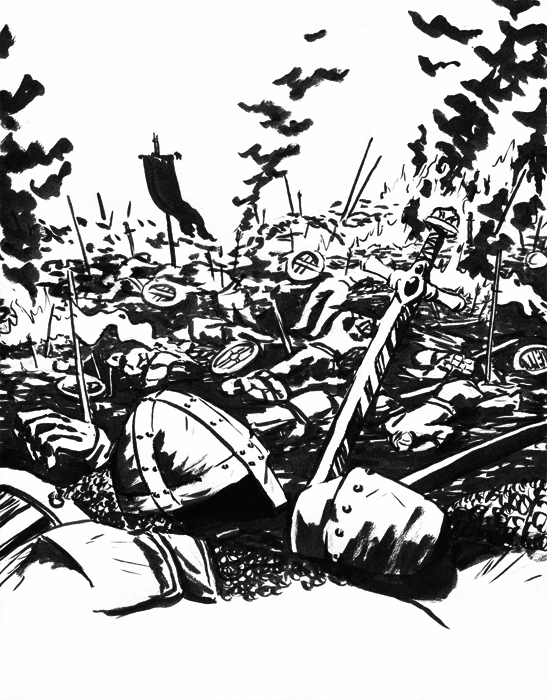
- General Rule Changes Image: Inktober - 13 Ash [Battlefield] by AkiaWalker
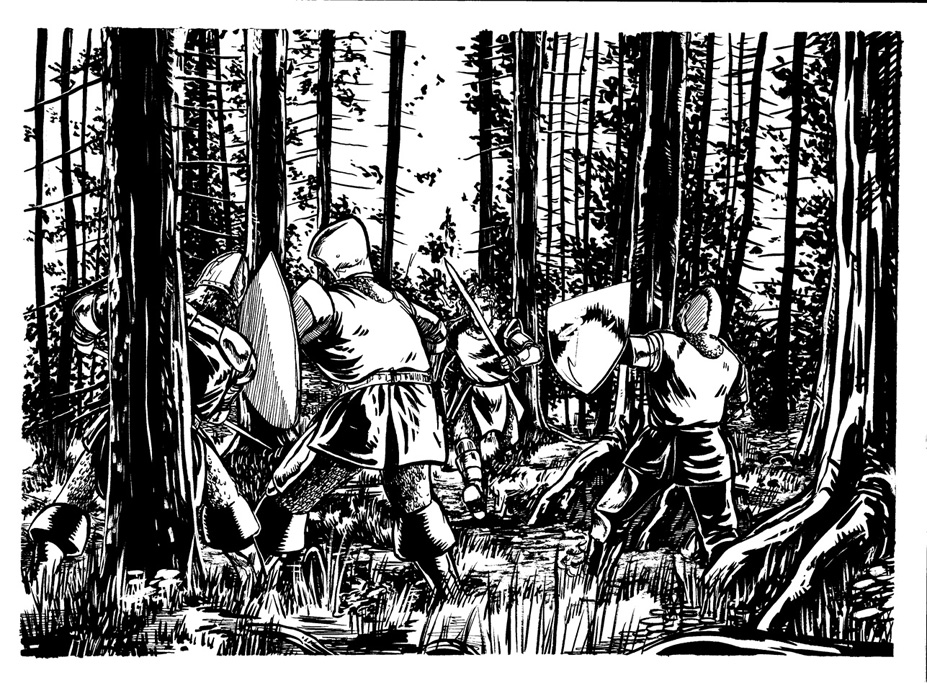
- Combat Image: Battle in the Forest by self-replica
- Madness Image: Stress Icon by Red Hook Studios
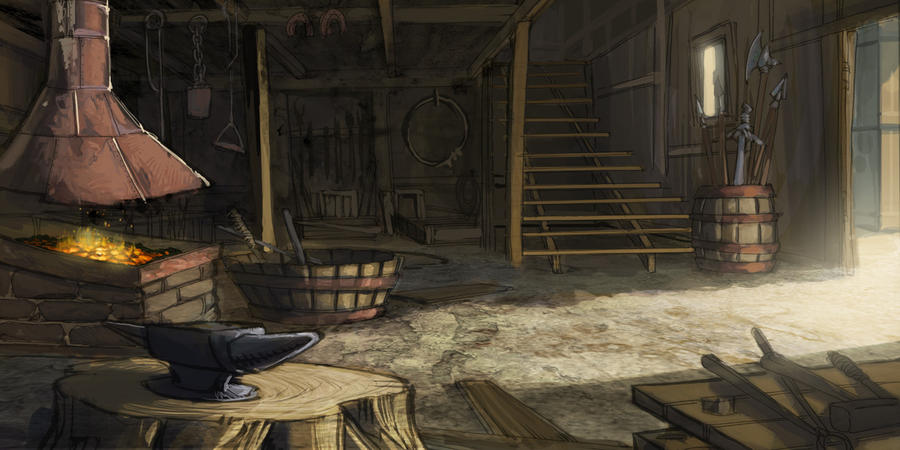
- Equipment Image: Gilead Forge by Rusty001
- Travel Image: Inktober - 28 Ride [Wind] by AkiaWalker