
The Sleuth
An orcish man puffs on a dwarven cigar as he kneels down, lowering himself to the level of the lifeless body beneath him. His eyes begin to smolder a soft amber as he examines the late human woman. He notices a harsh green aura radiate from the pistol in her hand, clashing against the existing mild blue; a second set of fingerprints. Perhaps this case wasn't as simple as he was led to believe.
A halfling youth sprints across the mansion's wooden floor, the gallop of her canine companion ringing throughout the dim hallways. The girl fumbles through her bag, stealing glances behind her. Her ears wouldn't help her against a threat like this. As her hands finally find purchase on the eldritch tome, she spins on her heels before commanding her companion to attack. The great dane leaps, seizing the curtain rod and holding it down to the ground. She approaches the struggling canine and as her eyes begin to glow a sickly green hue, she examines the creature standing before her, only to recognize what seems to be the grey-bearded ghost of the mansion's former owner. Did he deserve to be banished after all?
These characters would both be considered Sleuths, those with curiosity to spare and the skill to find the truths they seek before wielding them like a warrior wields a weapon.
Occult Truths
When a child receives a charm and brands it as lucky, then holds it close for a lifetime, that luck is true to an extent. It truly impacts how that child carries themselves day to day. When a superstition sweeps a community, a similar principle begins to occur, as the belief locally impacts the way that part of the world functions. Stories. Traditions. Laws.
Sleuths are experts at exploiting these principles, purposefully weaving narratives with Conceptual Strings, imbuing them into objects, before magically pulling on the threads to enhance their abilities and senses, or to evoke powerful magical effects.
Where Do Sleuths Fit In?
In many worlds, Sleuths would fit in well within law-enforcement agencies and academic institutions alike. While those who are lone wolves exist, two heads are better than one. Having a second pair of eyes on a case will always make cases easier, a principle many Sleuths are quick to take advantage of, whether for curiosity's sake or for some grand moral purpose.
Consider that many Sleuths, however, do not use their skills for the benefits of the world, or to sate their own curiosity. Many enforcers, fixers, or spymasters are Sleuths. Finding blackmail can be as interesting a mystery as any to some Sleuths. Not to mention that if you find yourself on the opposite perspective of a moral issue, Sleuths can be quick to find ways to discredit or impugn you for what you've done at your lowest moments.



Creating Your Sleuth
When creating your Sleuth, there are two main things that are important to consider.
The first is what is the mystery they're most desperate to solve, and as such any leads they need, but lack.
The second is how they became proficient in the magic of Conceptual Strings? Were they always in touch with the strange narratives and truths that bind reality together, or were they shown by a teacher or mentor?
Multiclassing and the Sleuth
If your group uses the optional multiclassing rule, here's what you need to know if you choose to take your first level in the Sleuth class.
Ability Score Minimum. As a multiclass character, you must have at least an Intelligence score of 13 to take a level in the Sleuth class, or to take a level in another class if you are already a Sleuth.
Proficiencies Gained. If Sleuth is not your initial class, you gain proficiency in light armor, simple weapons, and one skill of your choice.
Spellcasting. If you have the Spellcasting feature, you can use the Conceptual Strings from your Case Magic feature to cast spells you know from that class, and you can use spell slots from other classes to cast any of your Sleuth Spells.
The Sleuth
| Level | PB | Features | Cantrips Known |
Conceptual Strings |
Spells Known |
Rational Limit |
Investigative Aces |
|---|---|---|---|---|---|---|---|
| 1st | +2 | Investigative Ace, Elevated Reasoning | — | — | — | 1st | 1 |
| 2nd | +2 | Case Magic, All the Angles | 2 | 2 | 2 | 1st | 1 |
| 3rd | +2 | Discerning Suspicion, Method of Inquiry | 2 | 2 | 3 | 1st | 2 |
| 4th | +2 | Ability Score Improvement | 3 | 3 | 3 | 1st | 2 |
| 5th | +3 | Extra Attack | 3 | 3 | 4 | 2nd | 2 |
| 6th | +3 | Method of Inquiry Feature | 3 | 4 | 4 | 2nd | 3 |
| 7th | +3 | Due Diligence | 3 | 4 | 5 | 2nd | 3 |
| 8th | +3 | Ability Score Improvement | 3 | 5 | 5 | 2nd | 3 |
| 9th | +4 | — | 3 | 5 | 6 | 3rd | 4 |
| 10th | +4 | Method of Inquiry Feature | 4 | 6 | 6 | 3rd | 4 |
| 11th | +4 | Dogged Suspicion, Sixth Sense | 4 | 6 | 7 | 3rd | 4 |
| 12th | +4 | Ability Score Improvement | 4 | 7 | 7 | 3rd | 5 |
| 13th | +5 | — | 4 | 8 | 8 | 4th | 5 |
| 14th | +5 | Method of Inquiry Feature | 4 | 9 | 8 | 4th | 5 |
| 15th | +5 | — | 4 | 9 | 9 | 4th | 6 |
| 16th | +5 | Ability Score Improvement | 4 | 10 | 9 | 4th | 6 |
| 17th | +6 | Dogged Suspicion Improvement | 4 | 10 | 10 | 5th | 6 |
| 18th | +6 | Method of Inquiry Feature | 4 | 11 | 10 | 5th | 7 |
| 19th | +6 | Ability Score Improvement | 4 | 12 | 11 | 5th | 7 |
| 20th | +6 | Distinguished Suspicion | 4 | 13 | 11 | 5th | 7 |
Class Features
As a Sleuth, you gain the following class features
Hit Points
- Hit Dice: 1d8 per Sleuth level
- Hit Points at 1st Level: 8 + your Constitution modifier.
- Hit Points at Higher Levels: 1d8 (or 5) + your Constitution modifier per Sleuth level after 1st
Proficiencies
- Armor: Light armor
- Weapons: Simple weapons, martial weapons
- Tools: Thieves' tools, one set of artisan's tools
- Saving Throws: Intelligence, Wisdom
- Skills: Choose any three
Equipment
As a Sleuth, you start with the following equipment, in addition to the equipment granted by your background:
- (a) a rapier or (b) a shortsword and a dagger
- (a) a dungeoneer's pack or (b) an explorer's pack
- a martial ranged weapon with 20 pieces of ammunition
- Leather armor, thieves' tools, and one set of artisan's tools
Investigative Ace
At 1st level, you gain proficiency in Investigation. If you are already proficient in Investigation, you instead add double your proficiency bonus to your Intelligence (Investigation) checks. In addition, you gain the following benefits:
Aces Known
You learn one Investigative Ace of your choice from the list at the end of this class, which is bound to a Curio that grants you its benefits. A Curio is a Tiny object reminiscent of the occult insight it grants you. If one of your Curios is lost or destroyed, it reforms on your person at the end of your next short or long rest.
Learning Additional Aces
When you gain certain Sleuth levels, you learn additional Aces of your choice, as indicated in the Investigative Aces column of the Sleuth table. These Aces must also be bound to Curios. If an Ace has a prerequisite, you must meet those prerequisites to learn it.
Replacing Known Aces
When you learn a new Investigative Ace, you can replace one of your Aces with another Ace of your choice. Though, you can't replace Aces currently acting as prerequisites.

Elevated Reasoning
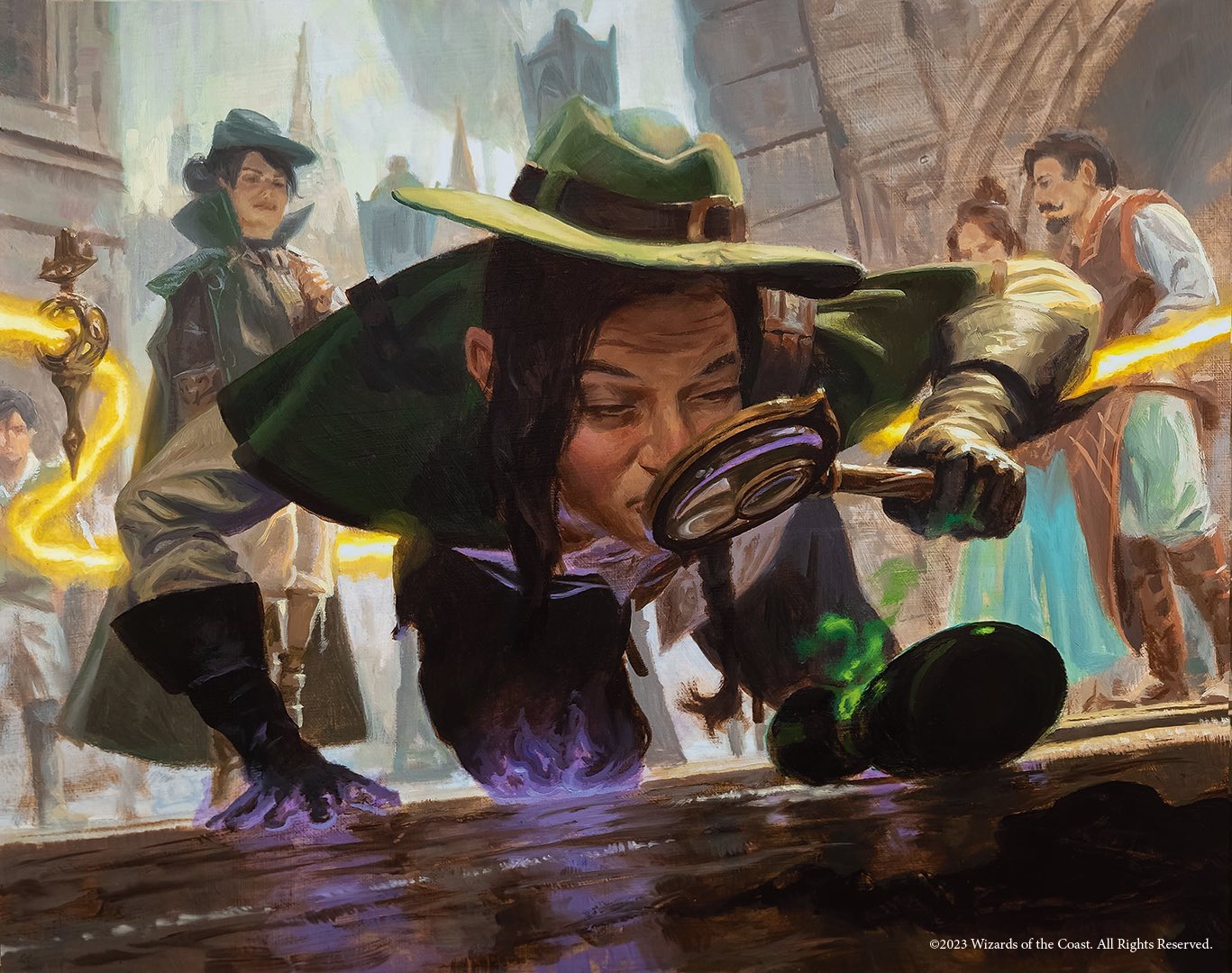
Also at 1st level, you have mastered using logic to find the truths underpinning reality. As a bonus action, you can infuse your senses with (or dismiss) divination magic, causing
your eyes to take on a striking supernatural appearance.
While your senses are infused in this way, you gain the
following benefits:
Inductive Observation
You can use Intelligence in place of Wisdom whenever
you make a Wisdom (Perception) or Wisdom (Insight) check.
In addition, as long as you're unarmored or wearing light armor, and not wielding a shield, you can use Intelligence in place of Dexterity when calculating your Armor Class.
Deductive Strikes
When you make an attack with an unarmed strike, finesse weapon, or ranged weapon, you can predict your opponent's movements. When you do, you use your Intelligence, in place of Strength or Dexterity, for the attack and damage rolls.
Rational Limit
Your Sleuth level limits the power of spells you can cast or concentrate on during Elevated Reasoning. This limit is reflected in the Rational Limit column of the Sleuth Table.
You cannot cast or concentrate on spells of 1st level or higher while under the effects of Elevated Reasoning, unless they are of a level equal to your Rational Limit or lower.
Case Magic
At 2nd level, you've learned to draw on the mystical truths deep within objects to produce magical effects and enhancements that aid you in investigations. You gain the following features:
Cantrips
You learn two Cantrips of your choice from the Sleuth spell list, which can be found at the end of this class description.
You learn another Sleuth Cantrip at 4th and 10th levels, as shown in the Cantrips Known column of the Sleuth table.
Conceptual Strings
Your ability to connect to the meaning in the world is represented by your network of Conceptual Strings. The Sleuth table shows the number of Conceptual Strings this network contains at each level. To cast one of the Sleuth spells you know, you must expend a number of Strings equal to the level of the spell (0 for Cantrips), and you regain all expended Strings each time you finish a short or long rest.
For example, a 5th-level Sleuth could cast the see invisibility spell at 2nd-level by expending 2 Strings.
Finally, when a Sleuth feature (including Case Magic) allows you to expend Strings, you can never expend more Strings than it costs to cast a spell of your Rational Limit, unless otherwise specified.
Spells Known of 1st-level and Higher
At 2nd level, know two 1st-level spells of your choice from the Sleuth spell list at the end of this class. The Spells Known column of the Sleuth table shows when you learn more Sleuth spells of your choice. Each spell you learn must be of a level equal to your Rational Limit or lower. For instance, when you reach 5th level, you learn one Sleuth spell of 1st or 2nd-level.
When you gain a Sleuth level, you can replace one Sleuth spell you know with another Sleuth spell of your choice.
Spellcasting Ability
Intelligence is your spellcasting ability for your Sleuth spells, as you are utilizing your reason to extract the truths out of the world around you. You use your Intelligence whenever a spell refers to your spellcasting ability, when you set the saving throw DC for a spell, and when you make a spell attack roll.
Spell Save DC
Spell attack modifier
Spellcasting Focus
You can use any Curio bearing an Investigative Ace as a spellcasting focus for the Sleuth spells you know.
All the Angles
You know when a tool just isn't fit for the case at hand. Starting at 2nd level, each time you finish a long rest you can replace one Sleuth spell you know with another Sleuth spell of your choice equal to your Rational Limit or lower.
Method of Inquiry
At 3rd level, choose your Method of Inquiry: The Bloodhound, The Detective, The Examiner, The Esotericist, The Heat, or The Operative. Your Method of Inquiry grants you features at 3rd level, and again when you reach 6th, 10th, 14th, and 18th level in this class.
Discerning Suspicion
At 3rd level, you have honed your instincts and skepticism. As a bonus action, you can mark a creature within 60 feet as a Suspect. You gain the following benefits against Suspects:
-
When you mark a creature as a Suspect, you learn one of the following characteristics: a condition immunity, damage immunity, vulnerability, resistance, feature (such as Spellcasting), or if a spell is currently affecting it. As an action, you can learn another characteristic from this list.
-
When you make a Deductive Strike against a Suspect, you can cause it to have disadvantage on its next attack roll against you before the start of your next turn. If you hit, it is unable to take reactions until the end of the current turn.
-
You have advantage on ability checks using Intelligence to determine or recall information about the Suspect.
A creature remains a Suspect for 1 hour or until you mark another creature as a Suspect. You can use this feature a number of times equal to your Intelligence modifier (minimum once). You regain all expended uses when you finish a long rest. When you have no uses left, you can expend 1 String to mark a creature as a Suspect again.
Finally, the duration of this feature increases when you reach 9th (8 hours) and 17th levels (24 hours) in this class.
Ability Score Improvement
At 4th level, and again when you reach 8th, 12th, 16th, and 19th level, you can increase one of your ability scores by 2, or two different ability scores of your choice by 1. As normal, you cannot increase an ability score above 20 using this feature.
Extra Attack
Beginning at 5th level, you can attack twice, instead of once, whenever you take the Attack action on your turn.
Also, if you use your action to cast a Sleuth spell, you can make one Deductive Strike as a bonus action on that turn.

Due Diligence
Your suspicion prepares you for anything that can go wrong. At 7th level, when an effect produced by a Suspect forces you to make a saving throw, you can spend 1 String to gain a bonus to the roll's result equal to your Intelligence modifier (minimum 1). You can do so after you roll the d20, but before you know if you succeed or fail.
Dogged Suspicion
You are effortlessly suspicious of those around you. At 11th level, you regain a single expended use of your Discerning Suspicion feature whenever you finish a short rest.
At 17th level, you regain two expended uses whenever you finish a short rest.
Sixth Sense
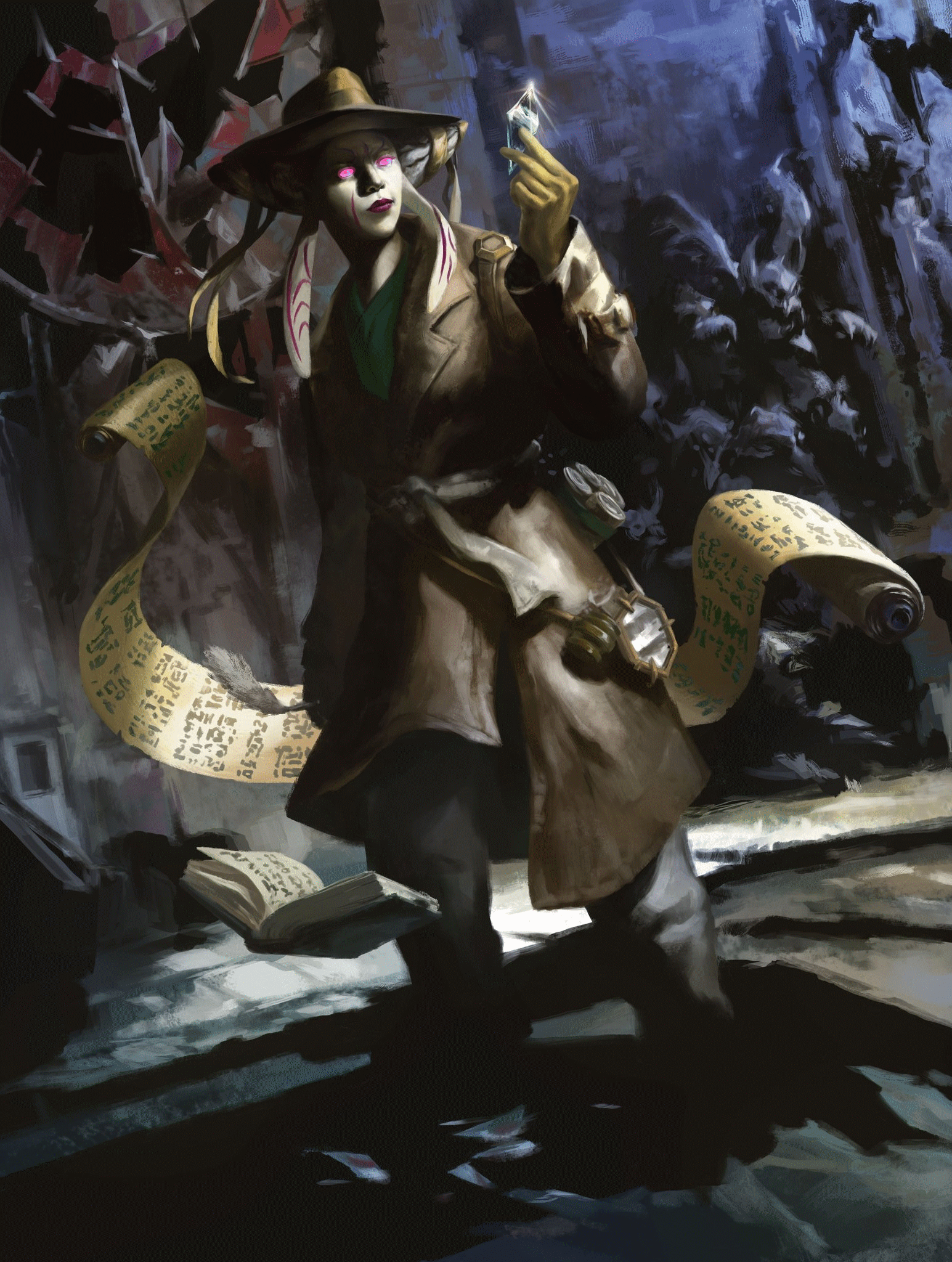
You can push your senses beyond their natural limits. Also at 11th level, when you finish a short or long rest, choose a Sleuth spell of your Rational Limit or lower, which becomes your Sixth Sense spell until the end of your next short or long rest. Upon choosing the spell, you must make any choices or rolls normally made as part of casting the spell.
Requirements. The chosen spell must be of the Divination school, have a casting time of one action or bonus action, have a duration longer than instantaneous, and be able to target a single creature.
Effects. When you infuse your senses with Elevated Reasoning, you can choose to gain the benefits of your Sixth Sense spell as though it was cast at your Rational Limit and as though its duration was until dispelled. You lose the benefits of the spell when you dismiss Elevated Reasoning.
Concentration. If the chosen spell originally required concentration, you must concentrate on it to gain its benefits during Elevated Reasoning. Losing concentration on the spell causes the spell to end, as detailed below.
Ending the Spell. If the spell would end, instead your Elevated Reasoning is dismissed and you cannot infuse your senses with it again until the start of your next turn.
Distinguished Suspicion
You have learned to apply various techniques in reasoning and tenacity. At 20th level, you gain the benefits below:
Dialectics
You can have up to two creatures marked as Suspects at once. When you would mark a creature as a Suspect while you already have two creatures marked, you choose which of the currently marked creatures ceases to be a Suspect.
Determination
While you have a Suspect, you can use an action expend a use of Discerning Suspicion to mark it as your Prime Suspect. When you do so, all other creatures cease to be a Suspect for you, and your Prime Suspect remains your Suspect indefinitely.
When you mark another creature as your Suspect, your Prime Suspect ceases to be your Prime Suspect, but remains a Suspect for the duration of your Discerning Suspicion.
Why the Sleuth?
I was inspired to make The Sleuth when I wasn't satisfied with the options available in 5e to create a detective with a supernatural flair. You could jury-rig a build that worked, but didn't feel as coherent as a class dedicated to fulfilling the fantasy would.
My goal with The Sleuth is to make exactly that: a class dedicated to fulfilling the fantasy of the supernatural detectives of the world. I hope you'll find I've succeeded, but if you think I haven't feel free to send me any feedback you have!
Sleuth Spell List
Below are the spells available to a Sleuth. They are organized by spell level and are from the Player's Handbook, Xanathar's Guide to Everything*, and Tasha's Cauldron of Everything**.
Spells marked with ll are found in the laserllama Spell Compendium, and spells marked with 🔎︎ are listed with their effects at the end of this document.
Laserllama's Content
I am not affiliated with Laserllama, their Spell Compendium, or any of their other content. Their content is simply high quality, and my table likes to use and draw upon their content a lot.
Cantrips
- dancing lights
- detention blade 🔎︎
- friends ll︎
- glitterbeam ll︎
- guidance ll︎
- light
- lightning lure ll︎
- mage hand
- mending
- message
- mind sliver
- mind thrust ll︎
- minor illusion
- mystic hammer ll︎
- psionic strike ll︎
- shallow savvy 🔎︎
- spare the dying
- tempestuous blade ll︎
- thaumaturgy
- thunderclap
- true strike ll︎
1st Level
- alarm
- command
- comprehend languages
- detect clues 🔎︎
- detect evil and good*
- detect magic
- detect poison and disease
- disguise self
1st Level (Cont'd)
- ethereal anchor ll︎
- feather fall
- find familiar
- identify
- id insinuation ll︎
- illicit minor 🔎︎
- illusory script
- jump ll︎
- protection from evil and good
- purify food and drink
- sanctuary
- shield ll︎
- snare*
- speak with animals
- unseen servant
2nd Level
- alter self
- augury
- beast sense
- calm emotions
- darkvision
- detect thoughts
- ensnaring strike ll︎
- find traps
- gentle repose
- hold person
- honest admission 🔎︎
- invisibility
- lock/unlock ll︎
- locate creature ll︎
2nd Level (Cont'd)
- locate object
- mind spike
- mind whip**
- mirror image
- misty step
- pass without trace ll︎
- see invisibility
- silence
- skywrite
- suggestion
- syllogism 🔎︎
- zone of truth
3rd Level
- blink
- cerebral blast ll︎
- clairvoyance
- counterspell ll︎
- dispel magic
- fly
- haste
- intellect fortress**
- magic circle
- phantom steed
- remove curse
- sending
- shrewdness 🔎︎
- slow
- speak with dead
- spectral passage ll︎
- tiny hut ll︎
- tongues
- vicarious vision 🔎︎
4th Level
- arcane eye
- banishment
- death ward
- detect lies 🔎︎
- dimension door
- divination
- ego scourge ll︎
- faithful hound
- freedom of movement
- greater invisibility
- illicit major 🔎︎
- private sanctum
- resilient sphere
- secret chest
5th Level
- apprehend axioms 🔎︎
- banishing smite ll︎
- contact other plane
- dispel evil and good
- dream
- geas
- hold monster
- legend lore
- modify memory
- psychometry 🔎︎
- scrying
- synaptic static*
- telekinesis
- telepathic bond
- wall of force ll︎


Method of Inquiry
Choose a Method of Inquiry from below that best represents your investigative process:
| Bloodhound | Examiner |
| Detective | Heat |
| Esotericist | Operative |
Bloodhound
Some investigators employ a trusty companion to give them a second opinion or a help them in sniffing out the subjects of their leads. Such sleuths are known as Bloodhounds.
Bloodhound Spells
3rd-level Bloodhound Method feature
You learn certain spells at the Sleuth levels shown below. They are Sleuth spells for you, they do not count against your number of Spells Known, and they cannot be replaced:
| Sleuth Level | Spells |
|---|---|
| 3rd | animal friendship, beast bond* |
| 5th | beast sense, locate creature ll |
| 9th | feign death, haste |
| 13th | death ward, freedom of movement |
| 17th | awaken, commune with nature |
Detective Dolittle
3rd-level Bloodhound Method feature
You gain the Naturalist I Ace. It does not count against your number of Investigative Aces and it cannot be replaced with another Ace.
If you already have the Naturalist I Ace, you gain another Ace of your choice.
Canny Companion
3rd-level Bloodhound Method feature
You have formed a bond with a Canny Companion. Its stat block is represented by the Dane. The Dane stat block uses your proficiency bonus (PB) and Sleuth Spell save DC.
The Dane is friendly to you and your allies, and it obeys your commands. In combat, it acts on your turn. It can move and use its reaction on its own, but only takes the Dodge action unless you use a bonus action to order it to take an action from its stat block, or another action. Whenever you take the Attack action, you can forgo one attack to command your Dane to attack. When you are incapacitated, your Dane can act on its own, and uses its turns to defend both itself and you to the best of its abilities.
If your Dane is reduced to 0 hit points, it makes death saving throws like a player character would. If it dies, you can spend 1 String to return it to life with 1 hit point. When revived in this way, the Dane can expend hit dice up to your Intelligence modifier to regain additional hit points.

Dane's Diligence
6th-level Bloodhound Method feature
When you order your Dane as a bonus action, you can spend 1 String to cause it to enter a state of diligence for 1 minute or until it becomes incapacitated.
While in this state of diligence, your Dane gains a +1 bonus to its AC, and a bonus to saving throws equal to your Intelligence modifier (minimum 1) against effects created by Suspects.
Dane
Medium beast, lawful neutral
- Armor Class 13 + PB (Natural Armor)
- Hit Points 5 + five times your Sleuth level
- Speed 40 ft., climb 30 ft.
STR DEX CON INT WIS CHA 14 (+2) 15 (+2) 14 (+2) 8 (-1) 15 (+2) 10 (0)
- Senses darkvision 30 ft., passive Perception 12
- Languages understands the languages you speak
Hit Dice. The Dane has a total number of d8 Hit Dice equal to your Sleuth level. It also gains all the normal benefits of both short and long rests.
Keen Senses. The Dane has advantage on ability checks that use its sense of hearing or smell.
Snoopy Dane. You can add your PB to any Intelligence, Wisdom, or Charisma ability check that the Dane makes.
Actions
Bite. Melee Weapon Attack: +2 + PB to hit, reach 5 ft., one target. Hit: 1d6 +2 +PB piercing damage
Mystery Mutt
6th-level Bloodhound Method feature
Your Case Magic has imprinted onto your Dane. Your Dane's Bite attacks count as Deductive Strikes you make against their targets. In addition, the damage of your Dane's Bite attack is considered to be magical for the purposes of overcoming resistances and immunities.
Scrappy Dane
10th-level Bloodhound Method feature
Your Dane is a dogged defender of its crew. Once per turn when you command your Dane to make a Bite attack, it can make two attacks instead of one.
Mystery Instincts
14th-level Bloodhound Method feature
You have taught your companion to open its mind. Your Dane can magically speak, read, and write Common, as well as one other language of your choice.
In addition, it gains the benefits of your Sixth Sense spell as long as it's conscious.
Greater Dane
18th-level Bloodhound Method feature
Your companion's story has become ingrained into the fabric of the universe's narrative. Your Dane uses the Greater Dane stat block in place of its previous stat block.
Finally, when your Dane dies, it automatically returns to life after 1 hour with its maximum hit points.
Greater Dane
Large beast, lawful neutral
- Armor Class 19 (Natural Armor)
- Hit Points 105
- Speed 60 ft., climb 40 ft., swim 40 ft.
STR DEX CON INT WIS CHA 18 (+4) 15 (+2) 14 (+2) 14 (+2) 18 (+4) 16 (+3)
- Senses darkvision 60 ft., passive Perception 16
- Languages Common, understands the languages you speak
Hit Dice. The Dane has a total number of d8 Hit Dice equal to your Sleuth level. It also gains all the normal benefits of both short and long rests.
Keen Senses. The Dane has advantage on checks that incorporate its sense of hearing or smell.
Snoopy Dane. You can add your PB to any Intelligence, Wisdom, or Charisma ability check or saving throw that the Dane makes.
Actions
Bite. Melee Weapon Attack: +10 to hit, reach 5 ft., one target. Hit: 1d8 +10 piercing damage



Detective
From private investigators to public sector detectives, Detectives use what is widely considered the most common and versatile, if elementary, method of inquiry.
Detective Spells
3rd-level Detective Method feature
You learn certain spells at the Sleuth levels shown below. They are Sleuth spells for you, they do not count against your number of Spells Known, and they cannot be replaced:
| Sleuth Level | Spells |
|---|---|
| 3rd | detect clues 🔎︎, detect magic |
| 5th | locate object, syllogism 🔎︎ |
| 9th | clairvoyance, shrewdness 🔎︎ |
| 13th | arcane eye, detect lies 🔎︎ |
| 17th | apprehend axioms 🔎︎, scrying |
Aces High
3rd-level Detective Method feature
You're a master of reasoning. You gain an additional Investigative Ace of your choice. Whenever you finish a long rest, you can replace this Ace with another Investigative Ace of your choice that you meet the prerequisites for. This Investigative Ace does not count toward prerequisites.
Clued In
3rd-level Detective Method feature
You are incredibly detail oriented. At any time during the duration of a detect clues 🔎︎ spell cast by you, you can use an action to change a single choice you made during the spell's casting, such as the period of time or clue type.
Expert Reasoning
6th-level Detective Method feature
Whenever you make an ability check or saving throw using Intelligence while under the effects of Elevated Reasoning, you can expend 1 String to gain a bonus to the roll equal to your Intelligence modifier. You can do so after you roll the d20, but before you know if you succeed or fail.
Reconstructionist
10th-level Detective Method feature
You are permanently under the effects of the detect clues 🔎︎ spell as though you'd cast it at your Rational Limit, except it doesn't require concentration.
In addition, you can memorize any number of auras sensed with detect clues 🔎︎.
Pocket Aces
14th-level Detective Method feature
You can now replace the Investigative Ace you learned with Aces High whenever you finish a short or long rest.
Just One More Thing
18th-level Detective Method feature
As an action, you can have an epiphany to ask the DM a single question. They must answer the question truthfully in at least a single complete sentence.
Once you use this feature, you must finish a long rest before you do so again.
Esotericist
A student of the arcane, you've honed your ability to use your Case Magic to its fullest potential.
Esotericist Spells
3rd-level Esotericist Method feature
You learn certain spells at the Sleuth levels shown below. They are Sleuth spells for you, they do not count against your number of Spells Known, and they cannot be replaced:
| Sleuth Level | Spells |
|---|---|
| 3rd | detect magic, identify |
| 5th | augury, see invisibility |
| 9th | counterspell ll︎, dispel magic |
| 13th | banishment, gate seal |
| 17th | circle of power, planar binding |
Life is Infinitely Stranger...
When using Just One More Thing, especially to ask a question regarding the future, the answer may be uncertain as a result of player agency.
In such a case, the DM may answer in an appropriately uncertain way or answer what would happen if players don't intervene. DMs, use your best judgment and err on the side of the players!
Ritualist Savant
3rd-level Esotericist Method feature
You gain the Arcanist I Ace. It does not count against your number of Investigative Aces and it cannot be replaced with another Ace.
If you already have the Arcanist I Ace, you gain another Ace of your choice.
Obscure Insight
3rd-level Esotericist Method feature
Choose a single class with a spell list that contains cantrips. You learn one cantrip from that spell list, which counts as a Sleuth cantrip for you and does not count against your total Cantrips Known.
In addition, whenever you learn a Sleuth spell or replace a Sleuth spell you know, you can choose to learn that spell from the chosen spell list, and it becomes a Sleuth spell for you as long as you know it.
Combative Curiosity
6th-level Esotericist Method feature
Whenever you deal damage to a Suspect with a spell, you learn a single characteristic listed in Discerning Suspicion.
Also, once per turn when you damage a Suspect with a cantrip, you add your Intelligence modifier to the damage.
Esoteric Confluence
10th-level Esotericist Method feature
Each time you finish a short rest you can replace one Sleuth spell you know with another Sleuth spell of your choice equal to your Rational Limit or lower.
Second Sight
14th-level Esotericist Method feature
You are a master of seeing beyond sight. When you select your Sixth Sense spell, you can instead choose a number of spells with a combined level equal to your Rational Limit or lower. Only one of the chosen spells can be your Sixth Sense spell at one time, though you can change which of the chosen spells is your Sixth Sense spell as an action.
Esoteric Arcanum
18th-level Esotericist Method feature
Your strings can pull you to new heights. You learn a single 6th-level Sleuth spell from a spell list of your choice. You can cast it once per long rest without expending Strings, and can cast this spell while under the effects of Elevated Reasoning.
Obscure Insight Concerns
Esotericist makes certain spells Sleuth spells for you, but does not add them to the Sleuth spell list, so they can't necessarily be used with Sixth Sense.
In addition, the feature is designed for use with Laserllama's Compendium of Spells. Some spells can be problematic with the feature, like the original animate dead spell, so DMs may want to disallow taking those using Obscure Insight.
Examiner
These doctors and forensic experts are savvy in the ways the body works; they know what can kill, what can't, and what can save lives. They often use their talents to determine the causes of deaths in the world, as well as help to prevent them.
Examiner Spells
3rd-level Examiner Method feature
You learn certain spells at the Sleuth levels shown below. They are Sleuth spells for you, they do not count against your number of Spells Known, and they cannot be replaced:
| Sleuth Level | Spells |
|---|---|
| 3rd | cure wounds, detect poison and disease |
| 5th | gentle repose, restoration ll︎ |
| 9th | beacon of hope, revivify |
| 13th | aura of life, aura of purity |
| 17th | mass cure wounds, raise dead |
Medical Training
3rd-level Examiner Method feature
You gain the Forensics I Ace. It does not count against your number of Investigative Aces and it cannot be replaced with another Ace.
If you already have the Forensics I Ace, you gain another Ace of your choice.


First Responder
3rd-level Examiner Method feature
You're always prepared in an emergency. As a bonus action, you can conjure your Trauma Kit in an empty hand , which is a special Healer's Kit that stores the supplies you need to conduct your medical practice. Unlike a normal Healer's Kit, it contains a maximum number of uses equal to your Intelligence modifier, regaining a single expended use whenever you finish a short rest, or regaining all expended uses whenever you finish a long rest.
You can spend uses from your Trauma Kit as though it were a normal Healer's Kit, as well as in place of Strings for the purposes of your Examiner Spells and features gained from the Examiner Method of Inquiry.
The Trauma Kit disappears if you conjure your Trauma Kit again, if you dismiss your Trauma Kit (no action required), or if you die.
Cause for Concern
6th-level Examiner Method feature
You can focus in on subjects, allowing you to determine their ills. You can use a bonus action to expend 1 String and mark a non-Undead creature, living or dead, that you can see within 60 feet as a Specimen for a duration equal to the duration of your Discerning Suspicion feature or until you mark another creature as a Specimen. You gain the following benefits while you have a Specimen.
Living Specimen. You automatically know any condition, disease, curse, or spell affecting the Specimen. In addition, you gain a bonus to hit points you restore to the Specimen equal to twice your Rational Limit.
Dead Specimen You immediately learn any condition, curse, disease, or spell affecting the Specimen at its time of death. In addition, you learn how long it's been dead, rounded to the nearest hour. Finally, you gain a bonus to ability checks made to determine information about its death. This bonus is equal to the level of your Rational Limit.


Examiner's Inoculation
10th-level Examiner Method feature
Your body has adapted to the presence of toxins in your occupation. You gain resistance to poison and necrotic damage, as well as immunity to poison and disease.
Sustainable Practice
14th-level Examiner Method feature
Your Conceptual Strings more efficiently weave what you need for your practice. Your Trauma Kit regains all expended uses whenever you finish a short rest.
In addition, you can cast revivify or raise dead targeting a Specimen without providing material components. Once you do so, you cannot do so again until a week has passed.
Miracle Worker
18th-level Examiner Method feature
You are at the top of your field. You gain immunity to poison and necrotic damage. In addition, you gain the following benefits while you have a Specimen.
Living Specimen. The String cost for your Method Spells is reduced by 1 if they only affect the Specimen.
Dead Specimen The amount of time the Specimen has been dead for is half as much for the purposes of spells you cast that can it to life, such as revivify or raise dead.
Heat
These bringers of justice are often found in the city guard or in investigative units trained to deal with violent threats, due to their training in specialized combat techniques.
Martial Exploits
3rd-level Heat Method feature
You are experienced in advanced combat training. You gain the following features:
Exploit Dice. The Heat Exploits table shows how many Exploit Dice you have to use Exploits. To use an Exploit, you expend an Exploit Die, and you regain all your expended Exploit Dice when you finish a short or long rest.
High Degree. Your Sleuth level limits the technicality of Exploits you are able to learn an use. This limit is reflected in the High Degree column of the Heat Exploits table on the next page.
Exploits. You learn two Martial Exploits of your choice from those available to Laserllama's Alternate Fighter. You can only use one Exploit per ability check, attack, or saving throw.
When you gain a Sleuth level, you can replace one Exploit you know with another Martial Exploit of your choice.
Saving Throws. If a Heat Exploit requires a creature to make a saving throw, the saving throw DC is calculated as follows:
Exploit Save DC
Field Tested
3rd-level Heat Method feature
Choose one of the following Aces: Bruiser I, Extraction Plan, Investigative Arsenal, or Long Arm of the Law. You gain the chosen Ace, it does not count against your number of Investigative Aces, and it can only be replaced with
another Ace from this list.
Never Believe In Luck
6th-level Heat Method feature
You don't let your foes get away so easily. Once per
turn, when a Suspect succeeds on a saving throw
against the effects of one of your Exploits, you can
spend Strings to impose a penalty on that saving
throw equal to the number of Strings spent,
potentially turning a success into a failure.
Particular Set of Skills
10th-level Heat Method feature
You have skills that make you a nightmare in combat. You gain the Reasonable Contender Ace. It does not count against your number of Investigative Aces and cannot be replaced.
If you already have the Reasonable Contender Ace, you gain another Ace of your choice.
Finally, whenever you finish a long rest, you can forgo replacing a spell with All the Angles to replace the Fighting Style you learned from Reasonable Contender with another Fighting Style of your choice.
Follow-Up
14th-level Heat Method feature
You have learned to fail forward in combat. Once per turn, when you miss a Suspect with a Deductive Strike, you can immediately make an additional Deductive Strike against that Suspect.
High Heat
18th-level Heat Method feature
You have mastered the art of combat. You gain one of the following benefits of your choice:
An Excellent Shot. At the beginning of your turn, you can choose to halve your speed until the start of your next turn. If you do, you gain a bonus to ranged weapon attacks against your Suspect until you hit a Suspect or the end of your turn. This bonus is equal to the level of your Rational Limit.
Back to Basics. You gain two additional Aces from the Aces listed in the Field Tested feature.
Can Do This All Day. Once per turn, when you hit or make an attack roll against a Suspect, you can use a 1st-degree Exploit without expending an Exploit Die by rolling a d4 in place of your Exploit die. The Exploit must be able to be used as part of an attack.
Not Afraid of Death. Whenever you take damage from your Suspect, that damage is reduced by the level of your Rational Limit.


Heat Exploits
| Sleuth Level |
Exploits Known |
Exploit Die |
Exploit Dice |
High Degree |
|---|---|---|---|---|
| 3rd | 2 | d4 | 2 | 1st |
| 4th | 2 | d4 | 2 | 1st |
| 5th | 3 | d4 | 2 | 1st |
| 6th | 3 | d4 | 2 | 1st |
| 7th | 4 | d6 | 3 | 2nd |
| 8th | 4 | d6 | 3 | 2nd |
| 9th | 4 | d6 | 3 | 2nd |
| 10th | 4 | d6 | 3 | 2nd |
| 11th | 5 | d6 | 3 | 2nd |
| 12th | 5 | d6 | 3 | 2nd |
| 13th | 5 | d6 | 3 | 2nd |
| 14th | 5 | d6 | 3 | 2nd |
| 15th | 6 | d8 | 4 | 3rd |
| 16th | 6 | d8 | 4 | 3rd |
| 17th | 6 | d8 | 4 | 3rd |
| 18th | 6 | d8 | 4 | 3rd |
| 19th | 7 | d8 | 4 | 3rd |
| 20th | 7 | d8 | 4 | 3rd |

v
Operative
Spymasters across the world employ this method, as it's perfect for Sleuths wishing to remain discrete in poking around in business they have no business poking around in.
Operative Spells
3rd-level Operative Method feature
You learn certain spells at the Sleuth levels shown below. They are Sleuth spells for you, they do not count against your number of Spells Known, and they cannot be replaced:
| Sleuth Level | Spells |
|---|---|
| 3rd | charm person, sleep |
| 5th | invisibility, suggestion |
| 9th | enemies abound, major image |
| 13th | charm monster, greater invisibility |
| 17th | dominate person, seeming |
Spymaster's Shroud
3rd-level Operative Method feature
You gain the Faceless I Ace. It does not count against your number of Investigative Aces and it cannot be replaced with another Ace.
If you already have the Faceless I Ace, you gain another Ace of your choice.
Color the Truth
3rd-level Operative Method feature
You learn two languages of your choice, gain proficiency in forgery kits, as well as your choice of Deception or Persuasion. If you are already proficient in the chosen skill, you add double your proficiency bonus to any ability check you make with that skill instead.
In addition, you can use Intelligence, in place of Charisma, whenever you make a Deception or Persuasion check.
Mind Games
6th-level Operative Method feature
Your strikes can shake your foes' very sense of reality. Once per turn when you hit a Suspect with a Deductive Strike, you can impose disadvantage on the next saving throw it makes against an Enchantment or Illusion spell you cast before the end of your next turn.
Subtle Magnetism
6th-level Operative Method feature
You are effortlessly convincing. Whenever you cast a Sleuth spell from the Enchantment school, you can expend 1 String to cast it without providing any of its somatic or verbal components. If you do so when casting the charm person spell, the creature does not know it was charmed by you when the spell ends.
Vice Versa
10th-level Operative Method feature
As an action you can choose a creature within 60 feet of you that has the same basic arrangement of limbs as you, and force it to make a Charisma saving throw against your Sleuth Spell Save DC. On a failed save, you and that creature swap appearances, including body, clothes, size, and voice for 1 hour or until you use an action to end this feature early. This feature does not change the game statistics of yourself or the target aside from size category.
Once you use this feature, you cannot do so again until you finish a short or long rest. If you have no uses remaining, you can spend 5 Strings to use this feature again.
The duration of this feature increases to 8 hours at 14th level, and to 24 hours at 18th level.
Stonewall
14th-level Operative Method feature
Not even magic can penetrate the enigma of your mind. When a creature attempts to magically divine your thoughts, intentions, or alignment, you can make an Intelligence (Deception) check against a DC determined by the DM typically the creature's Spell Save DC). On a success, you can present false results.
Finally, you gain the Hardboiled Ace. It does not count against your number of Investigative Aces and it cannot be replaced with another Ace.
If you already have the Hardboiled Ace, you gain another Ace of your choice.
Instinctual Magenetism
18th-level Operative Method feature
You can effortlessly weave yourself into the narrative of the universe, allowing your charms to become so convincing even you begin to believe them. You no longer need to spend 1 String to cast a spell using Subtle Magnetism.
Finally, Suspects have disadvantage on saving throws against your Enchantment and Illusion spells.
Variant: Flexible Method Spells
Using this variant rule, you can replace spells granted by your Method with another spell of the same level upon gaining a Sleuth level, but not by using All the Angles. Below are the requirements spells must meet for each Method to gain it in place of an existing Method spell.
Method Requirements Spell Lists Bloodhound Divination or Transmutation Druid or Ranger Detective Abjuration or Divination Cleric or Wizard Esotericist Abjuration or Divination Chosen
ClassExaminer Divination or
Restores Hit PointsCleric or Paladin Operative Enchantment or Illusion Bard or Warlock

Investigative Aces
Below are the Investigative Aces available to a Sleuth. If an Ace has a prerequisite you can learn it at the same time that you meet its prerequisites. Investigative Aces use your Sleuth spellcasting ability, spell attack bonus, and spell save DC.
Arcanist I
Prerequisite: 3rd level Sleuth
You gain proficiency in Arcana. If you are already proficient in Arcana, you can add double your proficiency bonus to checks you make using that proficiency.
In addition, you can cast any Sleuth spell you know as a ritual, so long as it has the ritual tag.
Arcanist II
Prerequisite: 6th level Sleuth, Arcanist I
When you cast the ritual version of a Sleuth spell, you can use a Curio in its casting. If you do, it can replace any material component that's not consumed, and the ritual version of the spell only takes 1 additional minute, instead of 10 minutes.
Whenever you cast a divination spell in this way, the spell is cast at your Rational Limit.
Arcanist III
Prerequisite: 12th level Sleuth, Arcanist II
As a bonus action, you can regain a number of Strings equal to your Intelligence modifier (minimum 1). Once you do so you must finish a long rest before you can do so again.
Arcanist IV
Prerequisite: 18th level Sleuth, Arcanist III
Whenever you finish a short or long rest, choose one Sleuth spell you know. The String cost to cast that spell is reduced by 1 (to a minimum of 0) until you finish a short or long rest.
Bruiser I
When you make a Deductive Strike using an unarmed strike, it deals bludgeoning damage equal to 1d6 + your Intelligence modifier in place of its normal damage.
In addition, if you have two free hands and use your action to make only unarmed strikes you can make a single unarmed strike as a bonus action on that turn.
Bruiser II
Prerequisite: 9th level Sleuth, Bruiser I
You can use the bonus action granted by Bruiser I to take the Shove or Grapple actions. If you do, you can use Intelligence in place of Strength for that action's ability check.
Also, the damage die of your unarmed strikes using Bruiser I increases to 1d8. At 17th level, it increases again to 1d10.
Defensive Reconsideration
Prerequisite: 3rd level Sleuth
When a Suspect hits you with an attack, you can use your reaction to add your Intelligence modifier (minimum 1) to your Armor Class against that attack.
Discombobulate I
Prerequisite: 3rd level Sleuth
Whenever you hit a Suspect with a Deductive Strike, it cannot use reactions until the start of your next turn.
Discombobulate II
Prerequisite: 6th level Sleuth, Discombobulate I
Whenever you hit a Suspect with a melee Deductive Strike, you can spend 1 String to disorient them and force the target to make a Constitution saving throw. On a failure, the target is either blinded, deafened, or unable to speak (your choice) until the beginning of your next turn.
Extraction Plan
As long as you are under the effects of Elevated Reasoning, your speed increases by 10 feet and you can take the Dash or Disengage action as a bonus action on each of your turns.
Faceless I
Prerequisite: 3rd level Sleuth
You gain proficiency in Deception. If you are already proficient in Deception, you can add double your proficiency bonus to checks you make using that proficiency.
In addition, when you use your bonus action to enhance your senses with Elevated Reasoning, you can alter your physical appearance and voice to match that of a creature that you have seen before, so long as the new appearance has the same arrangement of limbs. You determine the specifics, including your race, eyes, sex, height, weight, and hair length, but you cannot change sizes. This does not affect your clothing or game statistics, and can be changed as an action.
If Elevated Reasoning is dismissed, the alteration ends.
Faceless II
Prerequisite: 6th level Sleuth, Faceless I
Whenever you finish a short or long rest, you may touch a set of clothes or armor to make it a set of Protean Apparel. While wearing a set of Protean Apparel, a creature can use a bonus action to silently change its apperance, deciding on its color, style, and accessories. If the Protean Apparel is a set of armor, it retains its normal bulk and weight
During each long rest, you must spend 10 minutes maintaining each set of Protean Apparel or it reverts to mundane clothing or armor again. You can maintain a number of sets equal to your Rational Limit.
Forensics I
Prerequisite: 3rd level Sleuth
You gain proficiency in Medicine. If you are already proficient in Medicine, you can add double your proficiency bonus to checks you make using that proficiency.
In addition, when you would make a Wisdom (Medicine) check while under the effects of Elevated Reasoning, you can make an Intelligence (Medicine) check instead.
Finally, you have advantage on checks to determine the cause of death of a corpse you can see.
Forensics II
Prerequisite: 6th level Sleuth, Forensics I
You learn the detect poison and disease spell, which doesn't count against your Spells Known and can't be replaced. If you already know detect poison and disease, you learn a Sleuth spell of your choice instead.
Also, you gain the benefits of detect poison and disease so long as you are under the effects of Elevated Reasoning.
Finally, when you see a corpse you immediately know its generalized cause of death, such as blunt force trauma to the head, poison ingested orally, or sewer plague.
Hardboiled
Prerequisite: 12th level Sleuth
You are immune to the charmed and frightened conditions.
Also, whenever you finish a long rest you can choose poison, psychic, necrotic, or radiant damage. You gain resistance to the chosen type until you finish a long rest.
Interrogator I
Prerequisite: 3rd level Sleuth
You gain proficiency in your choice of Intimidation or Persuasion. If you are already proficient in the chosen skill, you can add double your proficiency bonus to checks made with your proficiency in the chosen skill.
In addition, you have advantage on ability checks to convince a Suspect to tell you information.
Interrogator II
Prerequisite: 12th level Sleuth, Interrogator I
While in a settlement, you can expend a use of Discerning Suspicion and spend 1 hour to enlist an informant in that settlement if one exists, as determined by your DM. Such informants include criminals, urchins, or nobles, depending on the nature of the requested information. Informants are self-interested, and will not aid in combat or risk their safety.
Before the end of each long rest, each informant you’ve enlisted seeks out your location if they can and delivers information to you as requested, though its accuracy cannot be guaranteed. Such information can include:
-
News or rumors within the informant's circles.
-
Secrets regarding a creature, faction, event, or location of your choice within the settlement that the informant could reasonably know about.
-
The attitude of a creature or faction toward a topic of your choice that the informant could reasonably know about.
After successfully delivering such information, it is relieved of duty unless you choose not to regain the use of Discerning Suspicion spent to enlist the informant.
Intuition I
Prerequisite: 3rd level Sleuth
You gain proficiency in Insight. If you are already proficient in Insight, you can add double your proficiency bonus to checks you make using that proficiency.
In addition, when you roll initiative, as long as you aren't surprised you can immediately mark a creature within 60 feet as a Suspect (no action required).
Intuition II
Prerequisite: 6th level Sleuth, Intuition I
When you see an Aberration, Celestial, Dragon, Fey, or Fiend with a CR equal to your Sleuth level + your Intelligence modifier or lower, you immediately learn its creature type, its spellcasting ability, and the level of its highest spell.
In addition, you can't be surprised while you are conscious.
Intuition III
Prerequisite: 12th level Sleuth, Intuition II
When you make a Deductive Strike against a Suspect, it has disadvantage on all attack rolls it makes against you until the start of your next turn.
Also, you learn a characteristic about a Suspect from Discerning Suspicion's list whenever you hit it with a Deductive Strike.
Intuition IV
Prerequisite: 18th level Sleuth, Intuition III
So long as you have a Suspect within 30 feet of you, you gain the benefits of the detect thoughts spell against that creature, except the spell only ends when that creature ceases to be a Suspect or when they are no longer within 30 feet.
In addition, you learn the detect lies 🔎︎ spell, which doesn't count against your Spells Known and can't be replaced. If you already know detect lies, you learn a Sleuth spell of your choice instead.
Finally, you gain the benefits of detect lies 🔎︎ so long as you are are under the effects of Elevated Reasoning

Investigative Arsenal
You can make Deductive Strikes with melee weapons that lack the finesse property as long as they also lack the two-handed property.
Long Arm of the Law
So long as you are under the effects of Elevated Reasoning, attacking at long range doesn't impose disadvantage on your ranged weapon attack rolls.
Naturalist I
Prerequisite: 3rd level Sleuth
You gain proficiency in Nature. If you are already proficient in Nature, you can add double your proficiency bonus to checks you make using that proficiency.
In addition, you learn the speak with animals spell, which doesn't count against your Spells Known and can't be replaced. If you already know speak with animals, you learn a Sleuth spell of your choice instead.
Finally, you gain the benefits of speak with animals so long as you are are under the effects of Elevated Reasoning.
Naturalist II
Prerequisite: 12th level Sleuth, Naturalist I
You learn the speak with plants spell, which doesn't count against your Spells Known and can't be replaced. If you already know speak with plants, you learn a Sleuth spell of your choice instead.
In addition, you can cast speak with plants without expending Strings.
Obstinate Apotropaic
Prerequisite: 18th level Sleuth
Whenever you finish a long rest, choose aberrations, celestials, elementals, fey, fiends, or undead.
As long as you are under the effects of Elevated Reasoning, you gain the benefits of the protection from evil and good spell against the chosen creature type.
Whenever you take damage from a creature of the chosen type, you lose the benefits of the spell until the start of your next turn.
Offensive Reconsideration
Prerequisite: 6th level Sleuth
Once per turn when you miss a Suspect with a Deductive Strike, you can expend 1 String to re-roll your attack. You must use the second result.
Private Eye I
Prerequisite: 3rd level Sleuth
You gain proficiency in Stealth. If you are already proficient in Stealth, you can add double your proficiency bonus to checks you make using that proficiency.
In addition, you can take the Hide action as a bonus action on your turn.
Private Eye II
Prerequisite: 6th level Sleuth, Private Eye I
Your Suspects have disadvantage on ability checks made to detect or track you.
Questions Later
While under the effects of Elevated Reasoning, you can use a bonus action on your turn to make an Intelligence check, take the Help action, or learn a characteristic of a Suspect.
Reasonable Contender
Prerequisite: 6th level Sleuth
You gain a Fighting Style of your choice from the list below that you meet the prerequisites for, originally listed in Laserllama's Alternate Fighter.
Archery
Prerequisite: Dexterity 13 or higher
You gain a +1 bonus to attack rolls with ranged weapons, and your attacks with ranged weapons ignore half-cover and treat three-quarter's cover as half cover.
Balanced Fighting
When wielding a melee weapon in one hand and no other weapons, you gain a +2 bonus to damage rolls. You can use a shield and still gain this benefit.
Classical Swordplay
Prerequisite: Dexterity 13 or higher
While wielding a single finesse weapon, no shield, and not wearing heavy armor, you gain a +2 bonus to attack rolls with that weapon and a +1 bonus to your Armor Class.
Dual Wielding
Prerequisite: Strength or Dexterity 13 or higher
While two-weapon fighting, you make your off-hand attack as part of your Attack action instead of your bonus action, and you add your ability modifier to the damage of this attack. You cannot also make an attack with your bonus action that turn.
Protection
When a creature you can see hits you, or a target within 5 feet with a melee attack, you can use a reaction to add your Proficiency Bonus to the target's Armor Class against that attack. You must be wielding a shield or a melee weapon.
Versatile Fighting
Prerequisite: Strength or Dexterity of 11 or higher
While wielding a single versatile weapon and no shield, you gain a +1 bonus to your attack rolls with that weapon. While doing so, you can use your bonus action to make a grapple or shove attack, or to take the Use an Object action.
Savvy Regard
You learn the shallow savvy 🔎︎cantrip, which does not count against your total Cantrips Known, and which you can cast without providing somatic components.
If a target succeeds on its saving throw when you cast shallow savvy 🔎︎, it does not learn of its use and only becomes immune until its next short rest.
Strung to Solve
Prerequisite: 3rd level Sleuth
Whenever you make a Deductive Strike against a Suspect with a thrown weapon, you can cause that weapon to return to your hand immediately after the attack.

Curios and You!
When making a Sleuth, you should give the appearance of your Curios some thought.
A traditional Sleuth may have a magnifying glass or hat as Curios infused with the generalized truths and narratives around their Aces.
Alternatively, one might have lucky charms or gifts from loved ones, channeling more personal truths through Aces.
Tracker I
Prerequisite: 3rd level Sleuth
You gain proficiency in Survival. If you are already proficient in Survival, you can add double your proficiency bonus to checks you make using that proficiency.
Also, whenever you would make a Wisdom (Survival) check, you can make an Intelligence (Survival) check instead.
Finally, you have advantage on checks to determine a Suspect’s location or destination.
Tracker II
Prerequisite: 18th level Sleuth, Tracker I
You can cast locate creature ll︎ at your Rational Limit without expending Strings or providing the spell's components. When you do, you must describe or name a specific creature.
Twist Ending
Prerequisite: 6th level Sleuth
When you hit a Suspect with a Deductive Strike, you can expend a number of Strings to deal additional psychic damage to the target.
The damage dealt for each String spent is 1d10 upon hitting with a melee attack, or 1d6 with a ranged attack.
Vigilant I
Prerequisite: 3rd level Sleuth
You gain proficiency in Perception. If you are already proficient in Perception, you can add double your proficiency bonus to checks you make using that proficiency.
In addition, as long as you are under the effects of Elevated Reasoning, you can see normally in dim light and darkness, both magical and nonmagical, to a distance of 60 feet.
Vigilant II
Prerequisite: 6th level Sleuth, Vigilant I
Whenever you roll for initiative, as long as you aren't surprised, you can use your reaction to enhance your senses with Elevated Reasoning before rolling.
In addition, you learn the see invisibility spell, which doesn't count against your Spells Known and can't be replaced. If you already know see invisibility, you learn a Sleuth spell of your choice instead.
Finally, you gain the benefits of see invisibility so long as you are are under the effects of Elevated Reasoning
Vigilant III
Prerequisite: 12th level Sleuth, Vigilant II
When you roll for initiative, if you are under the effects of Elevated Reasoning, you gain a bonus to your initiative roll equal to your Intelligence modifier.
Also, as long as you are under the effects of Elevated Reasoning, you have Truesight out to a radius of 15 feet.
Vigilant IV
Prerequisite: 18th level Sleuth, Vigilant III
You can choose to gain the benefits of your Sixth Sense spell even while not under the effects of Elevated Reasoning.
Finally, the radius of your Truesight increases to 30 feet.

Additional Spells
| Spell Level | Spells |
|---|---|
| Cantrip | notion blade, shallow savvy |
| 1st | detect clues, illicit minor |
| 2nd | honest admission, syllogism |
| 3rd | shrewdness, vicarious vision |
| 4th | detect lies, illicit major |
| 5th | apprehend axioms, psychometry |
Cantrips
The following cantrips are listed in alphabetical order.
Detention Blade
Enchantment cantrip
- Classes: Sleuth
- Casting Time: 1 bonus action
- Range: Self
- Components: V, M (a simple or martial melee weapon)
- Duration: 1 round
You infuse the melee weapon used in the casting of this spell with threads of mind magic. Until the start of your next turn, your attacks with that weapon deal psychic damage in place of the weapon's normal damage type.
Once per casting when you deal psychic damage with this spell, you can choose to plant a restraint in the target's mind which lasts untilthe start of your next turn. When you do, choose melee attacks or ranged attacks.
The next time the target makes an attack of the chosen type before the start of your next turn, the restraint snaps, causing it to take 1d6 psychic damage.
At Higher Levels. The psychic damage dealt by this spell when the restraint snaps increases at 5th level (1d8), 11th level (1d10), and 17th level (1d12).
Shallow Savvy
Divination cantrip
- Classes: Bard, Psion, Sleuth, Warlock, Wizard
- Casting Time: 1 action
- Range: 60 feet
- Components: S
- Duration: Instantaneous
This spell is a minor magical trick that draws benign pieces of information out of a target's mind. One creature of your choice within range must make a Wisdom saving throw.
On a successful save, the target realizes that you tried to divine information secretly about them, and they become immune to this spell until they finish a long rest. On a failure, you discern one of the following pieces of information:
-
The name the target prefers to go by at the moment.
-
The target's birth date, and as such its age.
-
The location of the target's birth.
-
A single piece of inane information about the target, such as their handedness, favorite food, occupation, or a number the target is currently thinking of.
The target must know the piece of information and consider its dissemination fairly inconsequential. If either of these conditions don't apply, or the target's mind is protected from divination magic, the spell fails.
At Higher Levels. You learn an additional piece of information upon a failed save when you reach 5th level (two pieces), 11th level (three pieces), and 17th level (four pieces).
1st-Level Spells
The following 1st-level spells are listed in alphabetical order.
Detect Clues
1st-level divination (ritual)
- Classes: Paladin, Psion, Ranger, Sleuth, Warlock, Wizard
- Casting Time: 1 action
- Range: Self
- Components: V, S
- Duration: Concentration, up to 10 minutes
When you cast this spell, choose any period of time within the last week and one of the clue types below. You can sense the location of clues of that type within the listed range of you, so long as they were left during the chosen time period.
In addition, each clue you sense in this way has a unique aura. Two clues of the same type have an identical aura if they meet the condition specified in the Match column.
| Clue Type | Range | Match |
|---|---|---|
| Blood & Bloodstains | 60 ft. | Blood belonging to the same creature. |
| Fingerprints | 15 ft. | Fingerprints left by the same hand or handwear. |
| Footprints | 30 ft. | Footprints left by the same foot or footwear. |
You can memorize an aura sensed with this spell as an action, and can remember a total number of auras sensed with this spell equal to your Spellcasting ability modifier, allowing you to recognize an identical aura sensed in the future. If you would memorize an aura while at your maximum, you can choose to replace a memorized aura.
At Higher Levels. When you cast this spell using a spell slot of 2nd level or higher, the chosen period of time can be up to one additional month in the past for each level greater than 1st. When you cast this spell using a spell slot of 5th level or higher, you can choose any period of time within the last year.
Illicit Minor
1st-level divination
- Classes: Sleuth
- Casting Time: 1 bonus action
- Range: Self
- Components: V
- Duration: Concentration, up to 1 minute
You can spot errors in the attacks of your suspects. Until
the spell ends, a creature cannot make an Opportunity
Attack against you if its attack roll would have disadvantage.
Additionally, when a creature would make an attack roll against you with disadvantage, you can immediately use
your reaction to end the spell. If you do, you can make a single weapon attack against the attacker.
Other Third-Party Spells?
When considering which third-party spells from other creators should be given to the Sleuth, there are some points below to consider.
From a thematic standpoint, Sleuth's spell list is mostly based around spells that manipulate the minds of themselves and others, or that are helpful in investigation and apprehension of culprits.
These spells are often Abjuration, Divination, Illusion, and Enchantment, with fewer Conjuration and Transmutation spells thrown in the mix. Evocation spells, especially ones that rely on elemental damage are very rarely appropriate.
From a balance standpoint, consider carefully how spells might interact with the Sleuth's 11th level feature: Sixth Sense.


2nd-Level Spells
The following 2nd-level spells are listed in alphabetical order.
Honest Admission
2nd-level divination
- Classes: Paladin, Sleuth
- Casting Time: 1 action
- Range: Self
- Components: V, S
- Duration: Instantaneous
As part of casting the spell, you immediately speak aloud a statement of twenty-five words or less that you believe to be true. Any creature who hears this statement and understands the language it was spoken in instantly knows that you believe it to be true.
Syllogism
2nd-level divination
- Classes: Sleuth
- Casting Time: 1 bonus action
- Range: Self
- Components: V, S
- Duration: 1 minute
You can glimpse the outcomes of your attacks, and use those outcomes as premises that inform your actions. When you cast this spell, and at the beginning of each of your turns while under its effects, you can choose to roll a d20 and record the number rolled. This number becomes your Premise until the end of that turn.
The first time you make a weapon attack on your turn while you have a Premise, you must use your Premise in place of rolling a d20. Any modifiers or bonuses to the attack roll still apply.
3rd-Level Spells
The following 3rd-level spells are listed in alphabetical order.
Shrewdness
3rd-level divination
- Classes: Sleuth
- Casting Time: 1 action
- Range: Self
- Components: V, S
- Duration: 1 hour
Until the spell ends, when you make an Intelligence check, you can replace the number you roll with an 8. Additionally, you gain advantage on passive Intelligence checks.
At Higher Levels. When you cast this spell using a spell slot of 4th level or higher, the number you can replace your roll with increases by 1.
Vicarious Vision
3rd-level divination
- Classes: Psion, Sleuth, Warlock, Wizard
- Casting Time: 1 action
- Range: Touch
- Components: V, S
- Duration: 10 minutes
You touch a creature and form a mental connection with them until the end of the spell's duration that allows you to see through their senses. If the creature is willing, the connection forms automatically, but if the creature is unwilling, they can make a Charisma saving throw. On a success, the connection fails and the creature knows you attempted to make it.
So long as the connected creature is within 10 miles and on the same plane as you, you can use an action to perceive through its senses until the spell ends or until you use an action to return to your own. While perceiving through the other creature's senses, you benefit from any special senses possessed by that creature, and you are blinded and deafened to your own surroundings.
At Higher Levels. When you cast this spell using a spell slot of 5th level, the spell's duration increases to 1 hour. When you cast this spell using a spell slot of 7th level, the spell's duration increases to 8 hours. Finally, when you cast this spell using a spell slot of 9th level, the spell's duration increases to 24 hours.
4th-Level Spells
The following 4th-level spells are listed in alphabetical order.
Detect Lies
4th-level divination
- Classes: Paladin, Sleuth
- Casting Time: 1 action
- Range: Self
- Components: V, S, M (a vial of hard liquor)
- Duration: Concentration, up to 10 minutes
You shield your mind from intentional deceptions. Whenever you hear a creature deliberately and knowingly speak a lie in a language you know, you instantly perceive it as a lie.
The spell does not reveal the truth, uncover unintentional inaccuracies, or necessarily reveal evasions.
Illicit Major
4th-level divination
- Classes: Sleuth
- Casting Time: 1 bonus action
- Range: Self
- Components: V
- Duration: 1 minute
You can spot every error in the attacks of your enemies, and respond in kind. Until the spell ends, you do not provoke Opportunity Attacks.
Additionally, whenever a creature makes an attack roll against you, you can immediately use your reaction to make a single weapon attack against the attacker.


Inspirations for The Sleuth
Comics
- Alias by Brian Michael Bendis
- Hellboy by Mike Mignola
- Hellblazer by Alan Moore & Stephen Bisette
- Vull, the Invisible by Alan Moore
Literature
- Dirk Gently by Douglas Adams
- Miss Marple by Agatha Christie
- Sherlock Holmes by Sir Arthur Conan Doyle
- The Dresden Files by Jim Butcher
Tabletop
- Complete Investigator by Mage Hand Press
- The Psion Class by Laserllama
- The Savant Class by Laserllama
- The Vessel Class by Laserllama
Television
- Scooby Doo by Joe Ruby & Ken Spears
- Supernatural by Eric Kripke
- The X Files by Chris Carter
- Twin Peaks by David Lynch & Mark Frost
Video Games
- Batman: Arkham Asylum by Rocksteady
- Detroit Become Human by Quantic Dream
- Disco Elysium by R. Kurvitz & A. Rostov
- The Wolf Among Us by Telltale Games
5th-Level Spells
The following 5th-level spells are listed in alphabetical order.
Appprehend Axioms
5th-level divination
- Classes: Sleuth
- Casting Time: 1 action
- Range: Touch
- Components: V, S
- Duration: Insantaneous
You touch a creature, and force it to make a Wisdom saving throw. On a failure, choose two pieces of information from the categories below to learn about the creature. On a success, choose one piece of information instead.
- One of its bonds, ideals, flaws, or its alignment.
- One of its core motivations.
- A one sentence summary of its opinion on a creature, faction, or location of your choice.
You may choose an option more than once, learning a different piece of information that falls within the same category.
Psychometry
5th-level divination (ritual)
- Classes: Sleuth
- Casting Time: 1 minute
- Range: Touch
- Components: V, S, M (a spool of fibers worth 250gp, which the spell consumes)
- Duration: Instantaneous
You touch an object or surface, and call to mind significant past events imprinted upon the object or a nearby area.
For the purposes of this spell, significant events that typically involve powerful emotions, such as battles and betrayals, marriages and murders, births and funerals. However, they might also include more mundane events that are nevertheless important in your current situation.
Depending on whether you touched an object or surface, you gain the target's benefit below.
Object. You learn the appearance of the object's most recent owner, how it acquired and lost the object, as well as the most recent significant event involving the object and that owner. For each additional time you cast the spell on the same object, you learn the same information regarding the object's owner prior to the last you learned about.
Surface. You learn the most recent significant event that occurred within 30 feet of the point on the surface you touched, and see a vision of it. For each additional time you cast the spell on the same point, you learn the next most recent significant event to the last you learned about.

The Sleuth
Pull on the strings of mystery and crack cold cases wide open as this new playtest class for 5e! Utilize over thirty Investigative Aces, twelve new spells, and six Methods of Inquiry to find the truths that underpin what's important to you.
Bloodhound - Detective - Esotericist
Examiner - Heat - Operative
Version 0.7.0 - By @vagrant.muse on Discord
Last Updated: January 6th, 2026
Artist Credits:
Front Cover - Leonardo Santanna - Projektor Inspector
Page 1 - Aurore Folny - Jacob Hauken, Inspector
Page 3 - Jake Murray - Sharp-Eyed Rookie
Page 4 - Denman Rooke - Catlike Curiosity
Page 5 - Yeong-Hao Han - Field Researcher
Page 6 - Tyler Jacobson - Familiar Stranger
Page 7 - Scott Murphy - Track Down
Page 8 - Campbell White- Dogged Detective
Page 9 - Jarel Threat - Nephalia Sleuth
Page 10 - Wayne Wu - Cold Case Cracker
Page 11 - Matthew Stewart - Body Launderer
Page 12 - Aaron J Riley - Lethal Throwdown
Page 13 - Tyler Walpole - Undercover Operative
Page 14 - Wylie Beckert - Vesuvan Duplimancy
Page 16 - Chris Rallis - Doppelgang
Page 18 - Miklós Ligeti - Ballad of the Black Flag
Page 19 - Igor Kieryluk - Murder Investigation
Page 20 - Diana Cearley - Thought-String Analyst
Page 22 - Valera Lutfullina - Temporal Mastery
Back Cover - Livia Prima - Blood Operative